

ISO 24223
(Main)Milk and milk products — Guidance on sample preparation for physical and chemical testing
- Abstract
This document gives guidance on the sample preparation of milk and milk products for physical and chemical analysis, including analysis by applying instrumental methods. This document specifies the (sub)sampling, and sample preparation steps carried out after sampling according to ISO 707 | IDF 50 and prior to method-specific sample preparations, e.g. as with analytical methods. NOTE Analysis on volatile substances, minor components or allergens can require additional precautionary measures in sample preparation in order to avoid loss of or contamination with one or more target analytes.
- Status
- Not Published
- Technical Committee
- ISO/TC 34/SC 5 - Milk and milk products
- Drafting Committee
- ISO/TC 34/SC 5 - Milk and milk products
- Current Stage
- 6000 - International Standard under publication
- Start Date
- 20-Oct-2026
- Completion Date
- 24-Oct-2026
Buy Documents
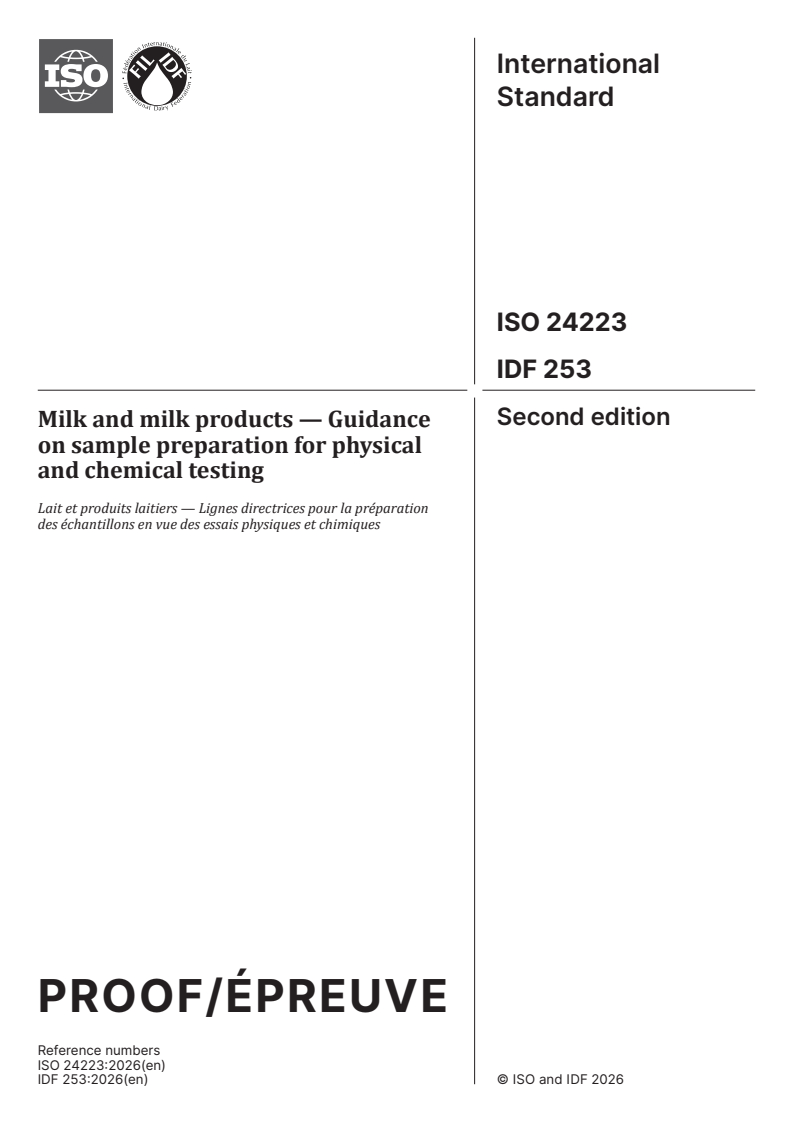
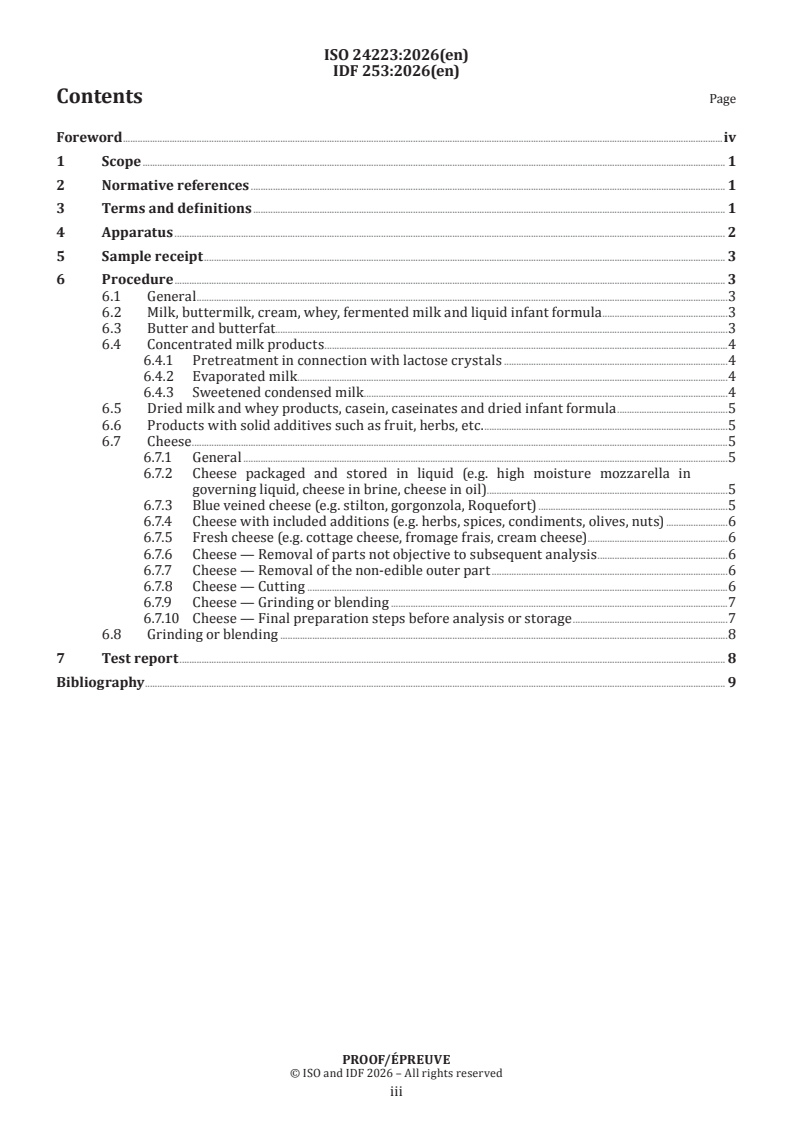
ISO/PRF 24223 - Milk and milk products — Guidance on sample preparation for physical and chemical testing
REDLINE ISO/PRF 24223 - Milk and milk products — Guidance on sample preparation for physical and chemical testing
ISO 24223 - Lait et produits laitiers — Lignes directrices pour la préparation des échantillons en vue des essais physiques et chimiques
ISO 24223, published jointly by ISO and IDF, gives guidance on sample preparation for milk and milk products before physical and chemical testing. It covers the (sub)sampling and preparation steps after sampling according to ISO 707 | IDF 50 and before method-specific sample preparation, including work for instrumental methods.
What does ISO 24223 specify?
ISO 24223 specifies how to prepare milk and milk product samples so they are representative, homogeneous and suitable for analysis. The document is aimed at the preparation stage between sampling and the actual analytical method, so the way the sample is handled does not distort the test result.
The scope includes milk and milk products for physical and chemical analysis. It also highlights extra care for volatile substances, minor components and allergens, because these analytes can be lost or introduced by contamination during preparation.
ISO 24223 is organized into clauses on scope, references, terms and definitions, apparatus, sample receipt, procedure and test report, followed by a bibliography. Clause 6 is the core of the document and sets out product-specific preparation steps.
What are the key requirements of ISO 24223?
ISO 24223 focuses on practical sample handling rules that keep the test portion representative of the original material. In practice, that means the laboratory must control temperature, mixing, contamination and sample loss.
General preparation rules
Clause 6.1 requires the procedure to be carried out as quickly as possible so the sample composition is not noticeably changed. It also says the sample should be protected from air, contamination and deterioration, and that any additional grinding or blending must be considered carefully if it could affect the analysis.
This matters because even small changes in moisture, fat distribution or surface contamination can affect physical and chemical results.
Receipt and handling of sub-samples
Clause 5 allows sub-samples from the same batch to be prepared individually or combined into one sample, provided the combined sample is properly mixed and representative. If sub-samples are handled separately, tools and equipment must be cleaned between them.
This is important for batch control and traceability, especially when several field or production sub-samples arrive together.
Product-specific preparation
Clause 6.2 gives a heating and mixing sequence for milk, buttermilk, cream, whey, fermented milk and liquid infant formula, with a target of 38 °C ± 2 °C followed by cooling to 20 °C ± 2 °C. Clause 6.3 gives separate handling for butter and butterfat, including warming in a sealed container and careful mixing without breaking the emulsion.
Clause 6.4 addresses concentrated milk products, including treatment for lactose crystals, plus preparation of evaporated milk and sweetened condensed milk. These steps matter because crystallization, separation and storage effects can make the sample non-homogeneous.
Dried products and size reduction
Clause 6.5 covers dried milk and whey products, casein, caseinates and dried infant formula. The sample is sieved through a 500 µm sieve, and if more than 5 % remains on the sieve, grinding or blending is used until the sample meets the criterion.
This helps reduce particle-size effects so the test portion behaves consistently during analysis.
Cheese handling
Clause 6.7 is the most detailed part of the document. It covers cheese packaged in liquid, blue veined cheese, cheese with additions such as herbs or nuts, fresh cheese, removal of the non-edible outer part, cutting, grinding or blending, and final preparation before analysis or storage.
Tables 1 to 3 guide how to remove the outer part, whether cutting is needed, and whether grinding or blending is appropriate for each cheese type. In practice, these tables help the laboratory choose a preparation route that reflects the cheese structure and any rind, coating or inclusions.
Final sample condition and reporting
Clause 6.7.10 and 7 require the final prepared sample to be transferred promptly to a suitable container, stored under validated conditions if testing is delayed, and reported with ambient conditions and a clear description of the preparation steps. For test reporting, ISO 24223 points to ISO/IEC 17025:2017, 7.8.2.
What terms does ISO 24223 define?
ISO 24223 defines key cheese-related terms used in the preparation instructions.
- Cheese surface - the outer layer or outside of the cheese, including sliced, shredded or grated forms.
- Cheese coating - a layer or film of non-cheese material that protects the cheese or helps its presentation.
- Cheese rind - a semi-closed outer layer with lower moisture content formed during ripening.
- Non-edible - a part of the cheese not intended for human consumption.
These terms matter because the preparation steps depend on whether outer material should be removed or retained.
Who uses ISO 24223?
ISO 24223 is used by dairy laboratories, quality managers, analysts, and sampling or testing staff who prepare milk and milk product samples for physical and chemical examination. It is also relevant to manufacturers, contract labs and buyers who need consistent sample handling before release testing, disputes or conformity work.
What changed in ISO 24223 from the previous edition?
ISO 24223 is the second edition and cancels and replaces ISO 24223 | IDF 253:2021. The stated technical change is that the scope was expanded from cheese to other milk and milk products.
Which standards are used with ISO 24223?
ISO 24223 refers to these documents in use or in support of its content:
- ISO 707 | IDF 50 - provides the sampling framework that comes before the preparation steps in this document.
- ISO/IEC 17025:2017 - provides the test report information expected in clause 7.
- CODEX STAN 283-1978:2018 - supplies source definitions for cheese surface, cheese coating and cheese rind.
What does the ISO 24223 document contain?
ISO 24223 contains apparatus requirements, sample receipt guidance, and detailed preparation procedures for liquid, concentrated, dried and cheese products. It also includes practical handling notes for reducing heterogeneity, limiting moisture loss and avoiding unwanted heating or contamination. Tables 1 to 3 summarize cheese-specific actions for removing outer parts, cutting, and grinding or blending. The bibliography links the document to the sampling standard and the laboratory reporting standard used alongside it.
Relations
- Effective Date
- 12-Feb-2026
- Effective Date
- 18-May-2024
Buy Documents
ISO/PRF 24223 - Milk and milk products — Guidance on sample preparation for physical and chemical testing
REDLINE ISO/PRF 24223 - Milk and milk products — Guidance on sample preparation for physical and chemical testing
ISO 24223 - Lait et produits laitiers — Lignes directrices pour la préparation des échantillons en vue des essais physiques et chimiques
Get Certified
Connect with accredited certification bodies for this standard

BSI Group
BSI (British Standards Institution) is the business standards company that helps organizations make excellence a habit.

Bureau Veritas
Bureau Veritas is a world leader in laboratory testing, inspection and certification services.

DNV
DNV is an independent assurance and risk management provider.
Sponsored listings
Frequently Asked Questions
ISO 24223 is a draft published by the International Organization for Standardization (ISO). Its full title is "Milk and milk products — Guidance on sample preparation for physical and chemical testing". This standard covers: This document gives guidance on the sample preparation of milk and milk products for physical and chemical analysis, including analysis by applying instrumental methods. This document specifies the (sub)sampling, and sample preparation steps carried out after sampling according to ISO 707 | IDF 50 and prior to method-specific sample preparations, e.g. as with analytical methods. NOTE Analysis on volatile substances, minor components or allergens can require additional precautionary measures in sample preparation in order to avoid loss of or contamination with one or more target analytes.
This document gives guidance on the sample preparation of milk and milk products for physical and chemical analysis, including analysis by applying instrumental methods. This document specifies the (sub)sampling, and sample preparation steps carried out after sampling according to ISO 707 | IDF 50 and prior to method-specific sample preparations, e.g. as with analytical methods. NOTE Analysis on volatile substances, minor components or allergens can require additional precautionary measures in sample preparation in order to avoid loss of or contamination with one or more target analytes.
ISO 24223 is classified under the following ICS (International Classification for Standards) categories: 67.100.01 - Milk and milk products in general. The ICS classification helps identify the subject area and facilitates finding related standards.
ISO 24223 has the following relationships with other standards: It is inter standard links to prEN ISO 24223, ISO 24223:2021. Understanding these relationships helps ensure you are using the most current and applicable version of the standard.
ISO 24223 is available in PDF format for immediate download after purchase. The document can be added to your cart and obtained through the secure checkout process. Digital delivery ensures instant access to the complete standard document.
Standards Content (Sample)
International
Standard
IDF 253
Second edition
Milk and milk products — Guidance
on sample preparation for physical
and chemical testing
Lait et produits laitiers — Lignes directrices pour la préparation
des échantillons en vue des essais physiques et chimiques
PROOF/ÉPREUVE
Reference numbers
IDF 253:2026(en) © ISO and IDF 2026
IDF 253:2026(en)
© ISO and IDF 2026
All rights reserved. Unless otherwise specified, or required in the context of its implementation, no part of this publication may
be reproduced or utilized otherwise in any form or by any means, electronic or mechanical, including photocopying, or posting on
the internet or an intranet, without prior written permission. Permission can be requested from either ISO at the address below
or ISO’s member body in the country of the requester.
ISO copyright office International Dairy Federation
CP 401 • Ch. de Blandonnet 8 Silver Building • Bd Auguste Reyers 70/B
CH-1214 Vernier, Geneva B-1030 Brussels
Phone: +41 22 749 01 11 Phone: +32 2 325 67 40
Fax: +32 2 325 67 41
Email: copyright@iso.org Email: info@fil-idf.org
Website: www.iso.org Website: www.fil-idf.org
Published in Switzerland
PROOF/ÉPREUVE
ii
IDF 253:2026(en)
Contents Page
Foreword .iv
1 Scope . 1
2 Normative references . 1
3 Terms and definitions . 1
4 Apparatus . 2
5 Sample receipt . 3
6 Procedure . 3
6.1 General .3
6.2 Milk, buttermilk, cream, whey, fermented milk and liquid infant formula .3
6.3 Butter and butterfat.3
6.4 Concentrated milk products .4
6.4.1 Pretreatment in connection with lactose crystals .4
6.4.2 Evaporated milk . .4
6.4.3 Sweetened condensed milk . .4
6.5 Dried milk and whey products, casein, caseinates and dried infant formula .5
6.6 Products with solid additives such as fruit, herbs, etc. .5
6.7 Cheese .5
6.7.1 General .5
6.7.2 Cheese packaged and stored in liquid (e.g. high moisture mozzarella in
governing liquid, cheese in brine, cheese in oil).5
6.7.3 Blue veined cheese (e.g. stilton, gorgonzola, Roquefort) .5
6.7.4 Cheese with included additions (e.g. herbs, spices, condiments, olives, nuts) .6
6.7.5 Fresh cheese (e.g. cottage cheese, fromage frais, cream cheese) .6
6.7.6 Cheese — Removal of parts not objective to subsequent analysis .6
6.7.7 Cheese — Removal of the non-edible outer part .6
6.7.8 Cheese — Cutting .6
6.7.9 Cheese — Grinding or blending .7
6.7.10 Cheese — Final preparation steps before analysis or storage .7
6.8 Grinding or blending .8
7 Test report . 8
Bibliography . 9
PROOF/ÉPREUVE
iii
IDF 253:2026(en)
Foreword
ISO (the International Organization for Standardization) is a worldwide federation of national standards
bodies (ISO member bodies). The work of preparing International Standards is normally carried out through
ISO technical committees. Each member body interested in a subject for which a technical committee
has been established has the right to be represented on that committee. International organizations,
governmental and non-governmental, in liaison with ISO, also take part in the work. ISO collaborates closely
with the International Electrotechnical Commission (IEC) on all matters of electrotechnical standardization.
The procedures used to develop this document and those intended for its further maintenance are described
in the ISO/IEC Directives, Part 1. In particular, the different approval criteria needed for the different types
of ISO document should be noted. This document was drafted in accordance with the editorial rules of the
ISO/IEC Directives, Part 2 (see www.iso.org/directives).
ISO draws attention to the possibility that the implementation of this document may involve the use of (a)
patent(s). ISO takes no position concerning the evidence, validity or applicability of any claimed patent
rights in respect thereof. As of the date of publication of this document, ISO had not received notice of (a)
patent(s) which may be required to implement this document. However, implementers are cautioned that
this may not represent the latest information, which may be obtained from the patent database available at
www.iso.org/patents. ISO shall not be held responsible for identifying any or all such patent rights.
Any trade name used in this document is information given for the convenience of users and does not
constitute an endorsement.
For an explanation of the voluntary nature of standards, the meaning of ISO specific terms and expressions
related to conformity assessment, as well as information about ISO’s adherence to the World Trade
Organization (WTO) principles in the Technical Barriers to Trade (TBT), see www.iso.org/iso/foreword.html.
This document was prepared by Technical Committee ISO/TC 34, Food products, Subcommittee SC 5,
Milk and milk products, and the International Dairy Federation (IDF), in collaboration with the European
Committee for Standardization (CEN) Technical Committee CEN/TC 302, Milk and milk products – Methods
of sampling and analysis, in accordance with the Agreement on technical cooperation between ISO and CEN
(Vienna Agreement). It is being published jointly by ISO and IDF.
This second edition cancels and replaces the first edition (ISO 24223 | IDF 253:2021), which has been
technically revised.
The main changes are as follows:
— the Scope was expanded from cheese to other milk and milk products.
Any feedback or questions on this document should be directed to the user’s national standards body. A
complete listing of these bodies can be found at www.iso.org/members.html.
PROOF/ÉPREUVE
iv
IDF 253:2026(en)
IDF (the International Dairy Federation) is a non-profit private sector organization representing the
interests of various stakeholders in dairying at the global level. IDF members are organized in National
Committees, which are national associations composed of representatives of dairy-related national interest
groups including dairy farmers, dairy processing industry, dairy suppliers, academics and governments/
food control authorities.
ISO and IDF collaborate closely on all matters of standardization relating to methods of analysis and
sampling for milk and milk products. Since 2001, ISO and IDF jointly publish their International Standards
using the logos and reference numbers of both organizations.
IDF draws attention to the possibility that the implementation of this document may involve the use of (a)
patent(s). IDF takes no position concerning the evidence, validity or applicability of any claimed patent
rights in respect thereof. As of the date of publication of this document, IDF had not received notice of (a)
patent(s) which may be required to implement this document. However, implementers are cautioned that
this may not represent the latest information, which may be obtained from the patent database available at
www.iso.org/patents. IDF shall not be held responsible for identifying any or all such patent rights.
Any trade name used in this document is information given for the convenience of users and does not
constitute an endorsement.
This document was prepared by the IDF Standing Committee on Analytical Methods for Composition and
ISO Technical Committee ISO/TC 34, Food products, Subcommittee SC 5, Milk and milk products. It is being
published jointly by ISO and IDF.
The work was carried out by the IDF/ISO Action Team on C58 of the Standing Committee on Analytical
Methods for Composition under the aegis of its project leader Mr K. van Cleef (NL).
PROOF/ÉPREUVE
v
International Standard
IDF 253:2026(en)
Milk and milk products — Guidance on sample preparation
for physical and chemical testing
1 Scope
This document gives guidance on the sample preparation of milk and milk products for physical and chemical
analysis, including analysis by applying instrumental methods.
This document specifies the (sub)sampling and sample preparation steps carried out after sampling in
[1]
accordance with ISO 707 | IDF 50 and prior to method-specific sample preparations (e.g. as with analytical
methods).
NOTE Analysis on volatile substances, minor components or allergens can require additional precautionary
measures in sample preparation in order to avoid loss of or contamination with one or more target analytes.
2 Normative references
There are no normative references in this document.
3 Terms and definitions
For the purposes of this document, the following terms and definitions apply.
ISO and IEC maintain terminology databases for use in standardization at the following addresses:
— ISO Online browsing platform: available at https:// www .iso .org/ obp
— IEC Electropedia: available at https:// www .electropedia .org/
3.1
cheese surface
outer layer or parts of the cheese, even in the sliced, shredded or grated form, including the outside of the
whole cheese, disregarding whether a cheese rind (3.3) has been formed or not
[2]
[SOURCE: CODEX STAN 283-1978:2018 , Appendix]
3.2
cheese coating
layer or film of non-cheese material which helps protect the cheese against microorganisms and physical
damage during retail handling and, in some cases, it contributes to the presentation of the cheese
[2]
[SOURCE: CODEX STAN 283-1978:2018 , Appendix]
3.3
cheese rind
semi-closed layer of cheese with a lower moisture content at the outside of the cheese developed during
ripening of the cheese
[2]
[SOURCE: CODEX STAN 283-1978:2018, Appendix]
3.4
non-edible
part of the cheese that is specified as not intended for human consumption
PROOF/ÉPREUVE
IDF 253:2026(en)
4 Apparatus
The usual laboratory apparatus and, in particular, the following should be used.
The devices and tools to be used should be clean and dry. The devices and tools should not demonstrably
influence the composition of the sample.
4.1 Knife or other suitable cutting device, constructed in a way that pressure on the sample is
minimized to avoid loss of water and water-soluble components.
For samples used for spectrometry or visual analysis, contamination of the cut surface, with cheese rind,
coating or other residuals, should be prevented.
4.2 Peeling device, a razor blade planer has proven to be a suitable device.
4.3 Grinding machine, constructed in a way to produce a small and evenly ground sample portion
without demonstrably influencing the composition of the sample. The device should not produce undue heat.
EXAMPLE An apparatus with a rotating grater, provided with apertures of 1,2 mm to 2,0 mm in diameter, can be
suitable for several types of hard and semi-hard cheese.
The optimal size of aperture can vary with the type of cheese and its maturation level.
4.4 Blending machine (for samples unsuitable for grinding), constructed in a way to produce a small
and evenly blended sample portion without demonstrably influencing the composition of the sample portion.
The device should not produce undue heat.
4.5 Spoons, spatulas or mortar and pestle, of a size matching the required sub-sample size and total
sample size.
4.6 Mixing equipment, optional, any suitable equipment.
4.7 Container with a cover for mixing, of a suitable material, e.g. plastic, and of suitable size.
4.8 Sample containers for storage, of a material and construction, including for closures, that adequately
protect the sample and do not bring about a change in the sample which can affect the results of subsequent
analyses. Appropriate materials include glass, some metallic materials (e.g. stainless steel) and some plastics
(e.g. polypropylene).
The containers should be opaque. If necessary, transparent filled containers should be stored in a dark place.
Sample containers should be securely closed either by using a suitable stopper or a screw cap of metallic or
plastics material.
Containers and closures should be clean, dry and odour free. Containers for solid products should be wide-
mouthed. Suitable plastic bags, with appropriate methods of closure, may also be used. If critical for the
analysis, light-excluding containers should be used.
4.9 Sieves for removal of excessive liquids, with an appropriate mesh size.
4.10 Sieves, with nominal size openings of 500 µm, with receiver.
4.11 Water baths, capable of maintaining the desired temperature ± 2 °C.
4.12 Oven, capable of being maintained to a maximum temperature of 35 °C.
4.13 Glass beaker, various sizes.
PROOF/ÉPREUVE
IDF 253:2026(en)
5 Sample receipt
In case of receipt of sub-samples from the same product batch, all received samples can be individually
prepared for analysis or be commingled to one sample before sample preparation. The commingled samples
should be properly mixed in such a way that it represents the specific product batch. If sub-samples are to
be analysed individually, equipment/tools used for sample preparation should be cleaned in between every
sub-sample.
6 Procedure
6.1 General
The procedure as specified in this clause should be executed as swiftly as possible, so that the composition
of the sample is not demonstrably affected.
If the mass of the sample is too large for analysis, it can be reduced to a smaller quantity, provided that it
[1]
remains representative of the original sample, see ISO 707 | IDF 50 .
The exposure of the sample to the air should be avoided as much as possible, to minimize adsorption or
evaporation of moisture. It should be ensured that the sample is not contaminated with unwanted surface
microbiota or does not show signs of deterioration before sample preparation starts. In some instances, it
can be necessary, due to heterogeneity of the sample or large particles, to perform an additional grinding or
blending step as specified in 6.8. It should be considered whether this extra step can potentially negatively
affect the analysis. If so, this step should not be performed. Equipment that has been in contact with the
sample should be cleaned in between every sample.
The objective of this step is to minimize heter
...
revISO/DISISO/PRF 24223:2026(en)
IDF 253:2026(en)
ISO/TC 34/SC 5
Secretariat: NEN
Date: 2026-07-2209-21
Milk and milk products — Guidance on sample preparation for
physical and chemical testing
Lait et produits laitiers — Lignes directrices pour la préparation des échantillons en vue des essais physiques et
chimiques
PROOF
TThhiiss d drraftaft i iss s suubbmmiitttteded t too a pa pararallel vallel vootte e iinn I ISSOO,, C CEENN.
ISO/PRF 24223:2026(en)
IDF 253:2026(en)
All rights reserved. Unless otherwise specified, or required in the context of its implementation, no part of this publication
may be reproduced or utilized otherwise in any form or by any means, electronic or mechanical, including photocopying,
or posting on the internet or an intranet, without prior written permission. Permission can be requested from either ISO
at the address below or ISO’s member body in the country of the requester.
ISO Copyright Office
CP 401 • CH-1214 Vernier, Geneva
Phone: + 41 22 749 01 11
Email: copyright@iso.org
Website: www.iso.org
International Dairy Federation
Silver Building • Bd Auguste Reyers 70/B
Geneva B-1030 Brussels
Phone: +32 2 325 67 40
Email: info@fil-idf.org
Website: www.fil-idf.org
Published in Switzerland
ISO/PRF 24223:2026(en)
IDF 253:2026(en)
Contents
Foreword . iv
1 Scope . 1
2 Normative references . 1
3 Terms and definitions . 1
4 Apparatus . 2
5 Sample receipt . 3
6 Procedure . 3
6.1 General. 3
6.2 Milk, buttermilk, cream, whey, fermented milk and liquid infant formula . 3
6.3 Butter and butterfat . 4
6.4 Concentrated milk products . 4
6.5 Dried milk and whey products, casein, caseinates and dried infant formula . 5
6.6 Products with solid additives such as fruit, herbs, etc. . 5
6.7 Cheese . 5
6.8 Grinding or blending . 8
7 Test report . 8
Bibliography . 9
iii
ISO/PRF 24223:2026(en)
IDF 253:2026(en)
Foreword
ISO (the International Organization for Standardization) is a worldwide federation of national standards
bodies (ISO member bodies). The work of preparing International Standards is normally carried out through
ISO technical committees. Each member body interested in a subject for which a technical committee has been
established has the right to be represented on that committee. International organizations, governmental and
non-governmental, in liaison with ISO, also take part in the work. ISO collaborates closely with the
International Electrotechnical Commission (IEC) on all matters of electrotechnical standardization.
The procedures used to develop this document and those intended for its further maintenance are
specifieddescribed in the ISO/IEC Directives, Part 1. In particular, the different approval criteria needed for
the different types of ISO document should be noted. This document was drafted in accordance with the
editorial rules of the ISO/IEC Directives, Part 2 (see www.iso.org/directives).
ISO draws attention to the possibility that the implementation of this document may involve the use of (a)
patent(s). ISO takes no position concerning the evidence, validity or applicability of any claimed patent rights
in respect thereof. As of the date of publication of this document, ISO had not received notice of (a) patent(s)
which may be required to implement this document. However, implementers are cautioned that this may not
represent the latest information, which may be obtained from the patent database available at
www.iso.org/patents. ISO shall not be held responsible for identifying any or all such patent rights.
Any trade name used in this document is information given for the convenience of users and does not
constitute an endorsement.
For an explanation of the voluntary nature of standards, the meaning of ISO specific terms and expressions
related to conformity assessment, as well as information about ISO’s adherence to the World Trade
Organization (WTO) principles in the Technical Barriers to Trade (TBT), see www.iso.org/iso/foreword.html.
This document was prepared by Technical Committee ISO/TC 34, Food products, Subcommittee SC 5, Milk and
milk products, and the International Dairy Federation (IDF), in collaboration with the European Committee for
Standardization (CEN) Technical Committee CEN/TC 302, Milk and milk products – Methods of sampling and
analysis, in accordance with the Agreement on technical cooperation between ISO and CEN (Vienna
Agreement). It is being published jointly by ISO and IDF.
This second edition cancels and replaces the first edition (ISO 24223 | IDF 253:2021), which has been
technically revised.
The main changes are as follows:
— the Scope was expanded from cheese to other milk and milk products.
Any feedback or questions on this document should be directed to the user’s national standards body. A
complete listing of these bodies can be found at www.iso.org/members.html.
iv
ISO/PRF 24223:2026(en)
IDF 253:2026(en)
IDF (the International Dairy Federation) is a non-profit private sector organization representing the interests
of various stakeholders in dairying at the global level. IDF members are organized in National Committees,
which are national associations composed of representatives of dairy-related national interest groups
including dairy farmers, dairy processing industry, dairy suppliers, academics and governments/food control
authorities.
ISO and IDF collaborate closely on all matters of standardization relating to methods of analysis and sampling
for milk and milk products. Since 2001, ISO and IDF jointly publish their International Standards using the
logos and reference numbers of both organizations.
IDF draws attention to the possibility that the implementation of this document may involve the use of (a)
patent(s). IDF takes no position concerning the evidence, validity or applicability of any claimed patent rights
in respect thereof. As of the date of publication of this document, IDF had not received notice of (a) patent(s)
which may be required to implement this document. However, implementers are cautioned that this may not
represent the latest information, which may be obtained from the patent database available at
www.iso.org/patents. IDF shall not be held responsible for identifying any or all such patent rights.
Any trade name used in this document is information given for the convenience of users and does not
constitute an endorsement.
This document was prepared by the IDF Standing Committee on Analytical Methods for Composition and ISO
Technical Committee ISO/TC 34, Food products, Subcommittee SC 5, Milk and milk products. It is being
published jointly by ISO and IDF.
The work was carried out by the IDF/ISO Action Team on C58 of the Standing Committee on Analytical Methods
for Composition under the aegis of its project leader Mr K. van Cleef (NL).
v
ISO/PRF 24223:2026(en)
IDF 253:2026(en)
Milk and milk products — Guidance on sample preparation for
physical and chemical testing
1 Scope
This document gives guidance on the sample preparation of milk and milk products for physical and chemical
analysis, including analysis by applying instrumental methods.
This document specifies the (sub)sampling, and sample preparation steps carried out after sampling
[1]
according to in accordance with ISO 707 | IDF 50 and prior to method-specific sample preparations, (e.g. as
with analytical methods.).
NOTE Analysis on volatile substances, minor components or allergens can require additional precautionary
measures in sample preparation in order to avoid loss of or contamination with one or more target analytes.
2 Normative references
There are no normative references in this document.
3 Terms and definitions
For the purposes of this document, the following terms and definitions apply.
ISO and IEC maintain terminology databases for use in standardization at the following addresses:
— ISO Online browsing platform: available at https://www.iso.org/obp
— IEC Electropedia: available at https://www.electropedia.org/
3.1
cheese surface
outer layer or parts of the cheese, even in the sliced, shredded or grated form, including the outside of the
whole cheese, disregarding whether a cheese rind (3.3) has been formed or not
[2]
[SOURCE: CODEX STAN 283-1978:2018 , Appendix]
3.2
cheese coating
layer or film of non-cheese material which helps protect the cheese against microorganisms and physical
damage during retail handling and, in some cases, it contributes to the presentation of the cheese
[2]
[SOURCE: CODEX STAN 283-1978:2018 , Appendix]
3.3
cheese rind
semi-closed layer of cheese with a lower moisture content at the outside of the cheese developed during
ripening of the cheese
[2]
[SOURCE: CODEX STAN 283-1978:2018, Appendix]
3.4
non-edible
part of the cheese that is specified as not intended for human consumption
ISO/PRF 24223:2026(en)
IDF 253:2026(en)
4 Apparatus
The usual laboratory apparatus and, in particular, the following should be used.
The devices and tools to be used should be clean and dry. The devices and tools should not demonstrably
influence the composition of the sample.
4.1 Knife or other suitable cutting device, constructed in a way that pressure on the sample is minimized
to avoid loss of water and water-soluble components.
For samples used for spectrometry or visual analysis, contamination of the cut surface, with cheese rind,
coating or other residuals, should be prevented.
4.2 Peeling device, a razor blade planer has proven to be a suitable device.
4.3 Grinding machine, constructed in a way to produce a small and evenly ground sample portion without
demonstrably influencing the composition of the sample. The device should not produce undue heat.
EXAMPLE An apparatus with a rotating grater, provided with apertures of 1,2 mm to 2,0 mm in diameter, can be
suitable for several types of hard and semi-hard cheese.
The optimal size of aperture can vary with the type of cheese and its maturation level.
4.4 Blending machine (for samples unsuitable for grinding), constructed in a way to produce a small
and evenly blended sample portion without demonstrably influencing the composition of the sample portion.
The device should not produce undue heat.
4.5 Spoons, spatulas or mortar and pestle, of a size matching the required sub-sample size and total
sample size.
4.6 Mixing equipment, optional, any suitable equipment.
4.7 Container with a cover for mixing, of a suitable material, e.g. plastic, and of suitable size.
4.8 Sample containers for storage, of a material and construction, including for closures, that adequately
protect the sample and do not bring about a change in the sample which can affect the results of subsequent
analyses. Appropriate materials include glass, some metallic materials (e.g. stainless steel) and some plastics
(e.g. polypropylene).
The containers should be opaque. If necessary, transparent filled containers should be stored in a dark place.
Sample containers should be securely closed either by using a suitable stopper or a screw cap of metallic or
plastics material.
Containers and closures should be clean, dry and odour free. Containers for solid products should be wide-
mouthed. Suitable plastic bags, with appropriate methods of closure, may also be used. If critical for the
analysis, light-excluding containers should be used.
4.9 Sieves for removal of excessive liquids, with an appropriate mesh size.
4.10 Sieves, with nominal size openings of 500 µm, with receiver.
4.11 Water baths, capable of maintaining the desired temperature ± 2 °C.
4.12 Oven, capable of being maintained to a maximum temperature of 35 °C.
ISO/PRF 24223:2026(en)
IDF 253:2026(en)
4.13 Glass beaker, various sizes.
5 Sample receipt
In case of receipt of sub-samples from the same product batch, all received samples can be individually
prepared for analysis or be commingled to one sample before sample preparation. The commingled samples
should be properly mixed in such a way that it represents the specific product batch. If sub-samples are to be
analysed individually, equipment/tools used for sample preparation should be cleaned in between every sub-
sample.
6 Procedure
6.1 General
The procedure as specified in this clause should be executed as swiftly as possible, so that the composition of
the sample is not demonstrably affected.
If the mass of the sample is too large for analysis, it can be reduced to a smaller quantity, provided that it
[1]
remains representative of the original sample, see ISO 707 | IDF 50 .
The exposure of the sample to the air should be avoided as much as possible, to minimize adsorption or
evaporation of moisture. It should be ensured that the sample is not contaminated with unwanted surface
microbiota or does not show signs of deterioration before sample preparation starts. In some instances, it can
be necessary, due to heterogeneity of the sample or large particles, to perform an additional grinding or
blending step as specified in 6.8. Consider that It should be considered whether this extra step can potentially
negatively affect the analysis. If so, do not perform this step should not be performed. Equipment that has been
in contact with the sample should be cleaned in between every sample.
The objective of this step is to minimize heterogeneity of the sample. Internal processes and conditions should
be validated using an appropriate technique. The chosen technique may vary depending on the type of
product.
6.2 Milk, buttermilk, cream, whey, fermented milk and liquid infant formula
The sample is warmed in a 38 °C ± 2 °C water bath (4.11) to this temperature and gently mixed thoroughly by
repeatedly inverting the sample bottle or container. Prevent extendedExtended residence in the water bath
should be prevented (max. 30 min to prevent buttering and/or merging of the fat droplets). Before
continuation of the procedure, the attainment of the target temperature is verified. Even distribution of the
fat throughout the sample is achieved by repeatedly inverting the sample bottle or container. The mixed
sample subsequently is cooled in a 20 °C ± 2 °C water bath (4.11) to this temperature. Samples in the original
container are transferred into a sample container (4.8) and closed. Where a homogeneous test sample can be
obtained without pre-warming (e.g. samples of skimmed milk) it is sufficient to warm the sample in a
20 °C ± 2 °C water bath (4.11) to this temperature and to gently mix it thoroughly by repeatedly inverting the
sample bottle or container. If the sample is in the original packaging, it should be transferred to a sample
container (4.8) which is thanthen closed it. The sample should be mixed and analysed immediately after
sample pretreatment.
NOTE Sa
...
Norme
internationale
FIL 253
Deuxième édition
Lait et produits laitiers — Lignes
2026-11
directrices pour la préparation
des échantillons en vue des essais
physiques et chimiques
Milk and milk products — Guidance on sample preparation for
physical and chemical testing
PROOF/ÉPREUVE
Numéros de référence
FIL 253:2026(fr) © ISO et FIL 2026
Norme
internationale
FIL 253:2026(fr)
FIL 253
Deuxième édition
Lait et produits laitiers — Lignes
2026-11
directrices pour la préparation
des échantillons en vue des essais
physiques et chimiques
Milk and milk products — Guidance on sample preparation for
physical and chemical testing
DOCUMENT PROTÉGÉ PAR COPYRIGHT
© ISO et FIL 2026
Tous droits réservés. Sauf prescription différente ou nécessité dans le contexte de sa mise en œuvre, aucune partie de cette
publication ne peut être reproduite ni utilisée sous quelque forme que ce soit et par aucun procédé, électronique ou mécanique,
y compris la photocopie, ou la diffusion sur l’internet ou sur un intranet, sans autorisation écrite préalable. Une autorisation peut
être demandée à l’ISO à l’adresse ci-après ou au comité membre de l’ISO dans le pays du demandeur.
ISO copyright office International Dairy Federation
Case postale 401 • Ch. de Blandonnet 8 Silver Building • Bd Auguste Reyers 70/B
CH-1214 Vernier, Genève B-1030 Brussels
PROOF/ÉPREUVE
Tél.: +41 22 749 01 11 Tél.: + 32 2 325 67 40
Fax: + 32 2 325 67 41
E-mail: copyright@iso.org E-mail: info@fil-idf.org
Web: www.iso.org Web: www.fil-idf.org
Numéros de référence
Publié en Suisse ISO 24223:2026(fr)
FIL 253:2026(fr) © ISO et FIL 2026
PROOF/ÉPREUVE
© ISO et FIL 2026 – Tous droits réservés
ii
FIL 253:2026(fr)
Sommaire Page
Avant-propos .iv
1 Domaine d'application . 1
2 Références normatives . 1
3 Termes et définitions . 1
4 Appareillage . 2
5 Réception des échantillons . 3
6 Mode opératoire . 3
6.1 Généralités .3
6.2 Lait, babeurre, crème, lactosérum, lait fermenté et formule infantile liquide .3
6.3 Beurre et matière grasse butyrique .4
6.4 Produits laitiers concentrés .4
6.4.1 Prétraitement lié aux cristaux de lactose .4
6.4.2 Lait évaporé .4
6.4.3 Lait concentré sucré .5
6.5 Produits laitiers secs et à base de lactosérum, caséine, caséinates et formules infantiles
sèches .5
6.6 Produits contenant des additifs solides tels que des fruits, des herbes, etc .5
6.7 Fromage .6
6.7.1 Généralités .6
6.7.2 Fromage emballé et conservé dans un liquide (par exemple, mozzarella à haute
teneur en humidité conservée dans du liquide, fromage conservé dans de la
saumure, fromage conservé dans de l'huile) .6
6.7.3 Fromage à pâte persillée (par exemple, stilton, gorgonzola, roquefort) .6
6.7.4 Fromage avec inclusions (par exemple, fines herbes, épices, condiments, olives,
noix) .6
6.7.5 Fromage frais (par exemple, cottage cheese, fromage blanc, fromage à la crème) .6
6.7.6 Fromage — Élimination des parties non soumises à une analyse ultérieure .6
6.7.7 Fromage — Élimination de la partie extérieure non comestible .6
6.7.8 Fromage — Découpe .7
6.7.9 Fromage — Broyage ou mixage .7
6.7.10 Fromage — Dernières étapes de préparation avant l'analyse ou le stockage .8
6.8 Broyage ou mixage .8
7 Rapport d'essai . 9
Bibliographie . 10
PROOF/ÉPREUVE
© ISO et FIL 2026 – Tous droits réservés
iii
FIL 253:2026(fr)
Avant-propos
L'ISO (Organisation internationale de normalisation) est une fédération mondiale d'organismes nationaux
de normalisation (comités membres de l'ISO). L'élaboration des Normes internationales est en général
confiée aux comités techniques de l'ISO. Chaque comité membre intéressé par une étude a le droit de faire
partie du comité technique créé à cet effet. Les organisations internationales, gouvernementales et non
gouvernementales, en liaison avec l'ISO participent également aux travaux. L'ISO collabore étroitement avec
la Commission électrotechnique internationale (IEC) en ce qui concerne la normalisation électrotechnique.
Les procédures utilisées pour élaborer le présent document et celles destinées à sa mise à jour sont
décrites dans les Directives ISO/IEC, Partie 1. Il convient, en particulier, de prendre note des différents
critères d'approbation requis pour les différents types de documents ISO. Le présent document a
été rédigé conformément aux règles de rédaction données dans les Directives ISO/IEC, Partie 2 (voir
www.iso.org/directives).
L'ISO attire l'attention sur le fait que la mise en application du présent document peut entraîner l'utilisation
d'un ou de plusieurs brevets. L'ISO ne prend pas position quant à la preuve, à la validité et à l'applicabilité de
tout droit de brevet revendiqué à cet égard. À la date de publication du présent document, l'ISO n'avait pas
reçu notification qu'un ou plusieurs brevets pouvaient être nécessaires à sa mise en application. Toutefois,
il y a lieu d'avertir les responsables de la mise en application du présent document que des informations
plus récentes sont susceptibles de figurer dans la base de données de brevets, disponible à l'adresse
www.iso.org/brevets. L'ISO ne saurait être tenue pour responsable de ne pas avoir identifié tout ou partie de
tels droits de brevet.
Les appellations commerciales éventuellement mentionnées dans le présent document sont données pour
information, par souci de commodité, à l'intention des utilisateurs et ne sauraient constituer un engagement.
Pour une explication de la nature volontaire des normes, la signification des termes et expressions
spécifiques de l'ISO liés à l'évaluation de la conformité, ou pour toute information au sujet de l'adhésion de
l'ISO aux principes de l'Organisation mondiale du commerce (OMC) concernant les obstacles techniques au
commerce (OTC), voir www.iso.org/iso/fr/avant-propos.html.
Le présent document a été élaboré par le comité technique ISO/TC 34, Produits alimentaires, sous-comité
SC 5, Lait et produits laitiers, et par la Fédération internationale du lait (FIL), en collaboration avec le comité
technique CEN/TC 302, Lait et produits laitiers — Méthodes d'échantillonnage et d'analyse, du Comité européen
de normalisation (CEN), conformément à l'Accord de coopération technique entre l'ISO et le CEN (Accord de
Vienne). Il est publié conjointement par l'ISO et la FIL.
Cette deuxième édition annule et remplace la première édition (ISO 24223 | FIL 253:2021), qui a fait l'objet
d'une révision technique.
Les principales modifications sont les suivantes:
— le domaine d'application a été étendu du fromage au lait et aux produits laitiers.
Il convient que l'utilisateur adresse tout retour d'information ou toute question concernant le présent
document à l'organisme national de normalisation de son pays. Une liste exhaustive desdits organismes se
trouve à l'adresse www.iso.org/fr/members.html.
PROOF/ÉPREUVE
© ISO et FIL 2026 – Tous droits réservés
iv
FIL 253:2026(fr)
La FIL (Fédération internationale du lait) est une organisation privée à but non lucratif qui représente les
intérêts des divers acteurs de la filière laitière au niveau international. Les membres de la FIL sont organisés
en comités nationaux, qui sont des associations nationales composées de représentants de groupes d'intérêt
nationaux dans le secteur des produits laitiers, incluant des producteurs laitiers, des acteurs de l'industrie
de transformation des produits laitiers, des fournisseurs de produits laitiers, des universitaires et des
représentants des gouvernements/autorités chargées du contrôle des aliments.
L'ISO et la FIL collaborent étroitement à toutes les activités de normalisation concernant les méthodes
d'analyse et d'échantillonnage du lait et des produits laitiers. Depuis 2001, l'ISO et la FIL publient
conjointement leurs Normes internationales en utilisant les logos et les numéros de référence des deux
organisations.
La FIL attire l'attention sur le fait que la mise en application du présent document peut entraîner l'utilisation
d'un ou de plusieurs brevets. La FIL ne prend pas position quant à la preuve, à la validité et à l'applicabilité de
tout droit de brevet revendiqué à cet égard. À la date de publication du présent document, la FIL n'avait pas
reçu notification qu'un ou plusieurs brevets pouvaient être nécessaires à sa mise en application. Toutefois,
il y a lieu d'avertir les responsables de la mise en application du présent document que des informations
plus récentes sont susceptibles de figurer dans la base de données de brevets, disponible à l'adresse
www.iso.org/brevets. La FIL ne saurait être tenue pour responsable de ne pas avoir identifié tout ou partie
de tels droits de brevet.
Les appellations commerciales éventuellement mentionnées dans le présent document sont données pour
information, par souci de commodité, à l'intention des utilisateurs et ne sauraient constituer un engagement.
Le présent document a été élaboré par le comité permanent de la FIL chargé des méthodes d'analyse de la
composition et par le comité technique de l'ISO, l'ISO/TC 34, Produits alimentaires, sous-comité SC 5, Lait et
produits laitiers. Il est publié conjointement par l'ISO et la FIL.
L'ensemble des travaux a été confié à l'équipe d'action mixte ISO/FIL C58 du comité permanent chargé des
méthodes d'analyse de la composition, sous la conduite de son chef de projet, M. K. van Cleef (NL).
PROOF/ÉPREUVE
© ISO et FIL 2026 – Tous droits réservés
v
Norme internationale
FIL 253:2026(fr)
Lait et produits laitiers — Lignes directrices pour la
préparation des échantillons en vue des essais physiques et
chimiques
1 Domaine d'application
Le présent document donne des lignes directrices pour la préparation d'échantillons de lait et de produits
laitiers en vue d'analyses physiques et chimiques, en incluant l'analyse par l'application de méthodes
instrumentales.
Le présent document spécifie les étapes de (sous-)échantillonnage et de préparation d'échantillons effectuées
[1]
après l'échantillonnage conformément à l'ISO 707 | FIL 50 et avant les préparations d'échantillons
spécifiques de la méthode (par exemple comme pour les méthodes analytiques).
NOTE L'analyse des substances volatiles, des composants mineurs ou des allergènes, peut nécessiter des
précautions supplémentaires lors de la préparation des échantillons, afin d'éviter toute perte d'un ou de plusieurs
analytes cibles ou contamination par un ou plusieurs analytes cibles.
2 Références normatives
Le présent document ne contient aucune référence normative.
3 Termes et définitions
Pour les besoins du présent document, les termes et définitions suivants s'appliquent.
L'ISO et l'IEC tiennent à jour des bases de données terminologiques destinées à être utilisées en normalisation,
consultables aux adresses suivantes:
— ISO Online browsing platform: disponible à l'adresse https:// www .iso .org/ obp
— IEC Electropedia: disponible à l'adresse https:// www .electropedia .org/
3.1
surface du fromage
couche extérieure du fromage ou de parties du fromage, même dans les fromages en tranches, râpés et
finement râpés, y compris la partie externe du fromage entier, qu'une croûte de fromage (3.3) se soit formée
ou non
[2]
[SOURCE: CODEX STAN 283-1978:2018, Annexe]
3.2
enrobage de fromage
couche ou pellicule de substance autre que le fromage qui aide à protéger le fromage contre les micro-
organismes et les chocs durant la vente au détail et, dans certains cas, qui donne un meilleur aspect au
fromage
[2]
[SOURCE: CODEX STAN 283-1978:2018, Annexe]
PROOF/ÉPREUVE
© ISO et FIL 2026 – Tous droits réservés
FIL 253:2026(fr)
3.3
croûte de fromage
couche semi-fermée à teneur en humidité plus faible à l'extérieur du fromage, qui se développe pendant
l'affinage du fromage
[2]
[SOURCE: CODEX STAN 283-1978:2018, Annexe]
3.4
non comestible
partie du fromage non destinée à la consommation humaine
4 Appareillage
Il convient d'utiliser le matériel courant de laboratoire et, en particulier, ce qui suit.
Il convient que les dispositifs et outils à utiliser soient propres et secs. Il convient que les dispositifs et outils
n'influencent pas la composition de l'échantillon de façon manifeste.
4.1 Couteau ou autre dispositif de découpe approprié, conçu de telle manière que la pression sur
l'échantillon est réduite au minimum pour éviter toute perte d'eau et de composants hydrosolubles.
Pour les échantillons utilisés pour la spectrométrie ou l'analyse visuelle, il convient d'éviter toute
contamination de la surface de coupe par de la croûte de fromage, de l'enrobage ou d'autres résidus.
4.2 Dispositif de raclage, un rabot à lame de rasoir s'est avéré être un dispositif approprié.
4.3 Dispositif de broyage, conçu de façon à produire une petite fraction d'échantillon broyée de manière
uniforme sans influencer la composition de l'échantillon de façon manifeste. Il convient que le dispositif ne
produise pas de chaleur excessive.
EXEMPLE Un appareil muni d'une râpe rotative, équipée de trous de 1,2 mm à 2,0 mm de diamètre, peut être
approprié pour plusieurs types de fromage à pâte dure et semi-dure.
Le diamètre optimal des trous peut varier en fonction du type de fromage et de son degré d'affinage.
4.4 Dispositif de mixage (pour échantillons impropres au broyage), conçu de façon à produire une
petite fraction d'échantillon mixée de manière uniforme sans influencer la composition de la fraction
d'échantillon de façon manifeste. Il convient que le dispositif ne produise pas de chaleur excessive.
4.5 Cuillères, spatules ou mortiers-pilons, d'une taille correspondant à la taille du sous-échantillon et à
la taille de l'échantillon entier.
4.6 Dispositif de mélange, en option, n'importe quel matériel approprié.
4.7 Récipient avec couvercle pour le mélange, fabriqué dans un matériau approprié, par exemple le
plastique, et de taille adaptée.
4.8 Récipients pour échantillons hermétiques, conçus et fabriqués avec des matériaux, y compris les
couvercles, de manière à protéger correctement l'échantillon sans entraîner de modification de ce dernier qui
serait susceptible d'avoir une influence sur les résultats des analyses ultérieures. Les matériaux appropriés
englobent le verre, certains métaux (par exemple l'acier inoxydable) et certains plastiques (par exemple le
polypropylène).
II convient que les récipients soient opaques. Dans le cas où l'utilisation de récipients transparents est
nécessaire, il convient de conserver ces derniers à l'abri de la lumière. Il convient de fermer hermétiquement
les récipients pour échantillons soit à l'aide d'un bouchon approprié, soit à l'aide d'un capuchon fileté en
métal ou en matière plastique.
PROOF/ÉPREUVE
© ISO et FIL 2026 – Tous droits réservés
FIL 253:2026(fr)
Il convient que les récipients et les couvercles soient propres, secs et sans odeur. Il convient que les récipients
pour produits solides aient un goulot large. Des sacs en plastique appropriés, pourvus de systèmes adéquats
de fermeture, peuvent également être utilisés. Si l'analyse l'exige, il convient d'utiliser des récipients opaques.
4.9 Tamis pour l'élimination des liquides en excès, avec une taille de maille appropriée.
4.10 Tamis, avec des ouvertures de taille nominale de 500 µm, avec récepteur.
4.11 Bains-marie, permettant de maintenir la température souhaitée ±2 °C.
4.12 Étuve, pouvant être maintenue à une température maximale de 35 °C.
4.13 Béchers en verre, de différentes tailles.
5 Réception des échantillons
En cas de réception de sous-échantillons d'un même lot de produits, tous les échantillons reçus peuvent être
préparés individuellement pour l'analyse ou être regroupés en un seul échantillon avant la préparation de
l'échantillon. Il convient de bien mélanger les échantillons regroupés de manière à ce qu'ils représentent
le lot de produits spécifique. S'il est prévu d'analyser les sous-échantillons individuellement, il convient de
nettoyer le matériel/les outils utilisés pour la préparation des échantillons entre chaque sous-échantillon.
6 Mode opératoire
6.1 Généralités
Il convient que le mode opératoire spécifié dans le présent article soit exécuté le plus rapidement possible,
afin que la composition de l'échantillon ne soit pas affectée de façon manifeste.
Si la masse de l'échantillon est trop élevée pour l'analyse, elle peut être réduite à une valeur inférieure, à
[1]
condition qu'elle reste représentative de l'échantillon d'origine, voir l'ISO 707 | FIL 50 .
Il convient d'éviter autant que possible l'exposition de l'échantillon à l'air, afin de minimiser l'adsorption ou
l'évaporation de l'humidité. Il convient de s'assurer que l'échantillon n'est pas contaminé par un microbiote
de surface indésirable ou qu'il ne présente pas de signes de détérioration avant de préparer l'échantillon.
Dans certains cas, il peut être nécessaire, en raison de l'hétérogénéité de l'échantillon ou des grosses
particules, d'effectuer une étape supplémentaire de broyage ou de mixage comme spécifié au 6.8. Il convient
de déterminer si cette étape supplémentaire peut potentiellement affecter négativement l'analyse. Dans ce
cas, il convient de ne pas effectuer cette étape. Il convient de nettoyer le matériel en contact avec l'échantillon
entre chaque échantillon.
L'objectif de cette étape est de réduire au minimum l'hétérogénéité de l'échantillon. Il convient de valider les
processus internes et les conditions en utilisant une technique appropriée. La technique choisie peut être
différente selon le type de produit.
6.2 Lait, babeurre, crème, lactosérum, lait fermenté et formule infantile liquide
L'échantillon est chauffé dans un bain-marie à 38 °C ± 2 °C (4.11) jusqu'à ce qu'il atteigne cette temp
...