

ISO 22935-3:2023
(Main)Milk and milk products — Sensory analysis — Part 3: Method for evaluation of compliance with product specifications for sensory properties by scoring
General Information
- Abstract
This document specifies a general method for evaluation of compliance with product specifications for sensory properties based on sensory scoring and the use of a common nomenclature of terms. The method is especially applicable in process and quality control performed regularly on a larger number of samples and/or with some time pressure and/or with a limited number of expert assessors available. The results from the method can be part of product classification systems for domestic and international trade. This document does not apply to classification systems.
- Status
- Published
- Publication Date
- 11-Apr-2023
- Technical Committee
- ISO/TC 34/SC 5 - Milk and milk products
- Drafting Committee
- ISO/TC 34/SC 5 - Milk and milk products
- Current Stage
- 6060 - International Standard published
- Start Date
- 12-Apr-2023
- Due Date
- 21-Oct-2022
- Completion Date
- 12-Apr-2023
Buy Documents
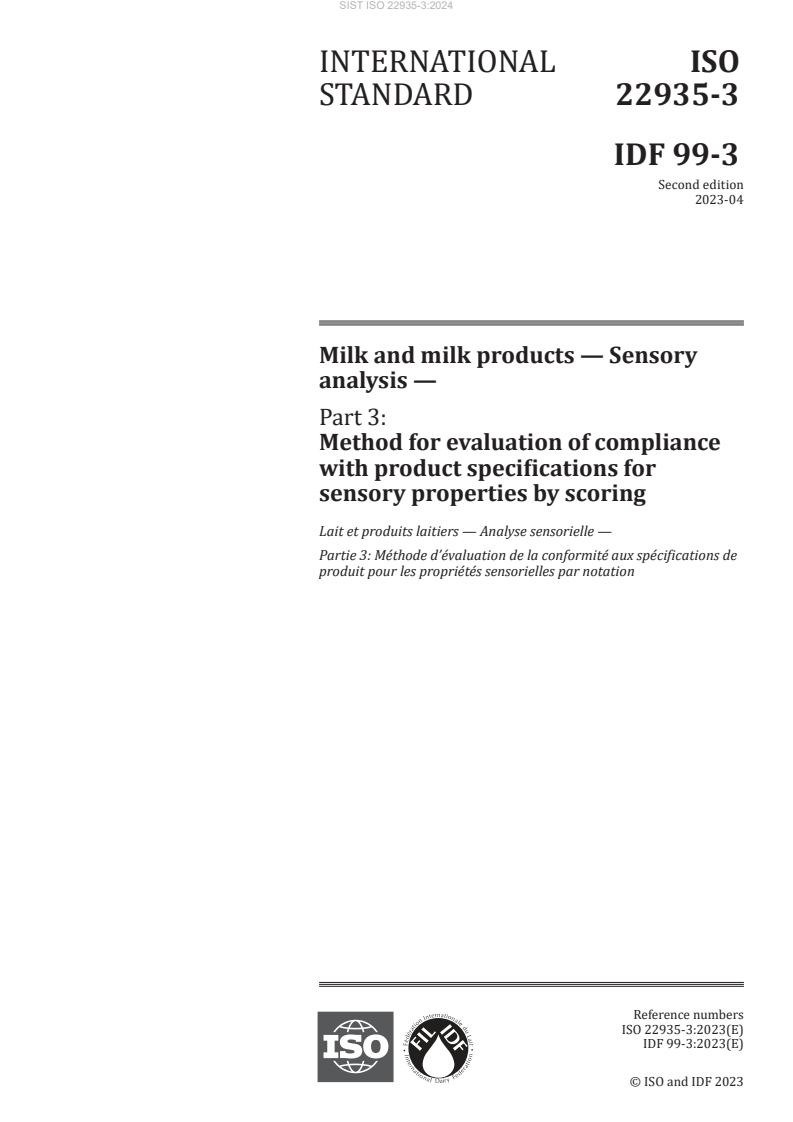

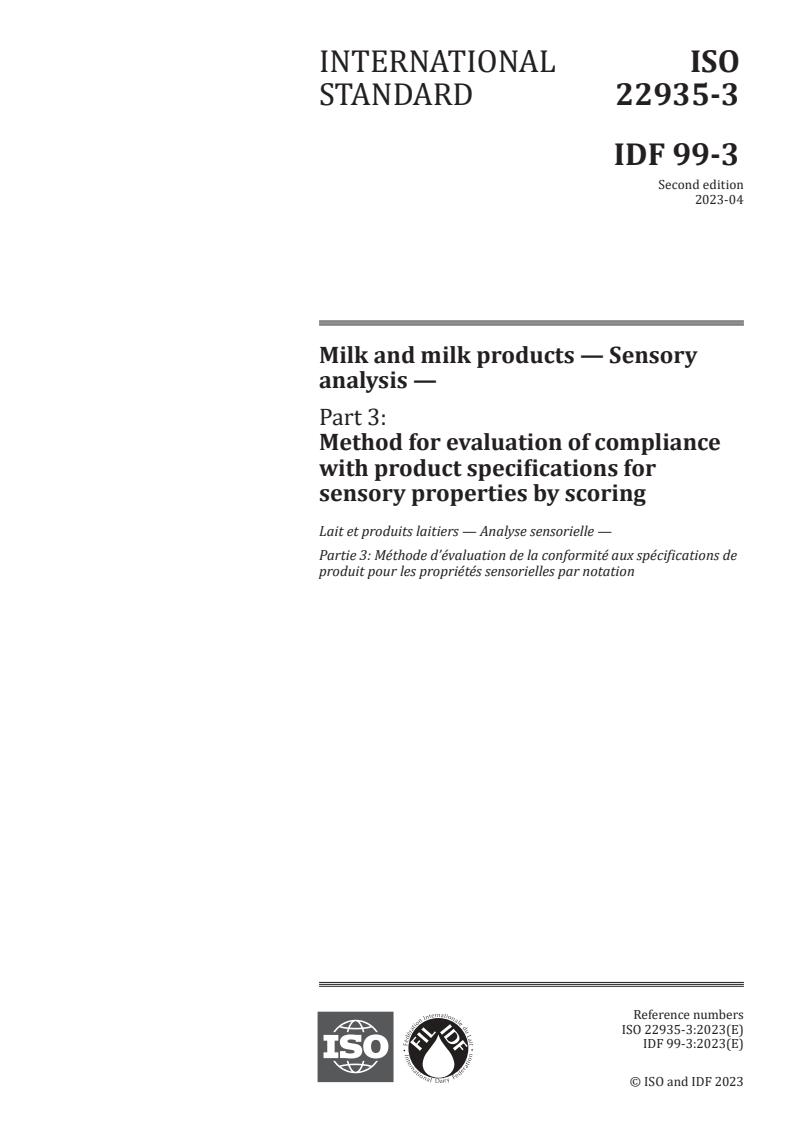
ISO 22935-3:2023 - Milk and milk products — Sensory analysis — Part 3: Method for evaluation of compliance with product specifications for sensory properties by scoring Released:12. 04. 2023
ISO 22935-3:2023 - Lait et produits laitiers — Analyse sensorielle — Partie 3: Méthode d’évaluation de la conformité aux spécifications de produit pour les propriétés sensorielles par notation/1/2023
Overview
ISO 22935-3:2023 - "Milk and milk products - Sensory analysis - Part 3" specifies a general, standardized method for evaluating compliance with sensory product specifications by scoring. The method is designed for routine process and quality control where multiple samples, time constraints, or a limited number of expert assessors apply. Scores from assessors are combined with a common nomenclature of terms to characterise sensory deviations (appearance, consistency, odour/flavour). While results can feed into product classification or trade systems, this document does not define classification rules.
Key topics and requirements
- Sensory scoring method: Assessors use a defined scale to estimate deviations from a pre-established sensory product specification; mean panel scores plus descriptive terms form the result.
- Nomenclature of terms: A standardized vocabulary is required to objectively describe the character of deviations; terms can be qualified (e.g., “low intensity of sweetness”).
- Panel composition: Minimum panel size is three trained expert milk and milk product assessors. Assessors must be recruited, selected, trained and monitored according to ISO guidance.
- Panel leader: A knowledgeable panel leader oversees the procedure and normally does not participate; exceptions exist for limited-site panels if the leader meets assessor criteria.
- Test environment and apparatus: Testing must occur in a standardized test room and use apparatus appropriate for the product, avoiding any influence on samples or assessors.
- Documentation and sample preparation: Standardized documents (product specifications, nomenclature, procedures) are required. Specific methods for particular milk products should supplement this general method.
- Sampling: Sampling itself is not specified in this part; recommended sampling methods are referenced elsewhere (e.g., ISO 707).
- Conformance and reporting: Procedures include provisions for recording precision, preparing test reports and ensuring repeatable, auditable sensory results.
Practical applications
- Routine sensory quality control in dairy processing plants
- Rapid process monitoring for large sample volumes or time-constrained operations
- Sensory acceptance checks for incoming raw milk or finished dairy products
- Supporting product development and maintaining product consistency across production batches
- Providing standardized sensory evidence for commercial specifications and trade documentation (note: does not define classification systems)
Who should use this standard
- Quality assurance and sensory lab managers in the dairy industry
- Sensory panel leaders and trained assessors for milk and milk products
- Regulatory bodies and testing laboratories applying sensory checks for product conformity
- R&D teams developing sensory specifications and control plans
Related standards
- ISO 22935-1 | IDF 99-1 - Recruitment, selection, training and monitoring of assessors
- ISO 22935-2 | IDF 99-2 - Methods for sensory evaluation (product-specific guidance)
- ISO 4121, ISO 5492, ISO 6658, ISO 8586, ISO 8589 - General sensory methodology and terminology
- ISO/IEC 17025 - Competence of testing and calibration laboratories
Keywords: ISO 22935-3:2023, sensory analysis, milk and milk products, sensory scoring, product specifications, quality control, sensory panel, nomenclature of terms.
Relations
- Effective Date
- 06-Jun-2022
Buy Documents
ISO 22935-3:2023 - Milk and milk products — Sensory analysis — Part 3: Method for evaluation of compliance with product specifications for sensory properties by scoring Released:12. 04. 2023
ISO 22935-3:2023 - Lait et produits laitiers — Analyse sensorielle — Partie 3: Méthode d’évaluation de la conformité aux spécifications de produit pour les propriétés sensorielles par notation/1/2023
Get Certified
Connect with accredited certification bodies for this standard

BSI Group
BSI (British Standards Institution) is the business standards company that helps organizations make excellence a habit.

Bureau Veritas
Bureau Veritas is a world leader in laboratory testing, inspection and certification services.

DNV
DNV is an independent assurance and risk management provider.
Sponsored listings
Frequently Asked Questions
ISO 22935-3:2023 is a standard published by the International Organization for Standardization (ISO). Its full title is "Milk and milk products — Sensory analysis — Part 3: Method for evaluation of compliance with product specifications for sensory properties by scoring". This standard covers: This document specifies a general method for evaluation of compliance with product specifications for sensory properties based on sensory scoring and the use of a common nomenclature of terms. The method is especially applicable in process and quality control performed regularly on a larger number of samples and/or with some time pressure and/or with a limited number of expert assessors available. The results from the method can be part of product classification systems for domestic and international trade. This document does not apply to classification systems.
This document specifies a general method for evaluation of compliance with product specifications for sensory properties based on sensory scoring and the use of a common nomenclature of terms. The method is especially applicable in process and quality control performed regularly on a larger number of samples and/or with some time pressure and/or with a limited number of expert assessors available. The results from the method can be part of product classification systems for domestic and international trade. This document does not apply to classification systems.
ISO 22935-3:2023 is classified under the following ICS (International Classification for Standards) categories: 67.100.01 - Milk and milk products in general. The ICS classification helps identify the subject area and facilitates finding related standards.
ISO 22935-3:2023 has the following relationships with other standards: It is inter standard links to ISO 22935-3:2009. Understanding these relationships helps ensure you are using the most current and applicable version of the standard.
ISO 22935-3:2023 is available in PDF format for immediate download after purchase. The document can be added to your cart and obtained through the secure checkout process. Digital delivery ensures instant access to the complete standard document.
Standards Content (Sample)
SLOVENSKI STANDARD
01-junij-2024
Mleko in mlečni izdelki - Senzorična analiza - 3. del: Metoda ocenjevanja
skladnosti proizvoda s specifikacijami za senzorične lastnosti s točkovanjem (ISO
22935-3:2023)
Milk and milk products — Sensory analysis — Part 3: Method for evaluation of
compliance with product specifications for sensory properties by scoring (ISO 22935-
3:2023)
Lait et produits laitiers — Analyse sensorielle — Partie 3: Méthode d’évaluation de la
conformité aux spécifications de produit pour les propriétés sensorielles par notation
(ISO 22935-3:2023)
Ta slovenski standard je istoveten z: ISO 22935-3:2023
ICS:
67.100.01 Mleko in mlečni proizvodi na Milk and milk products in
splošno general
2003-01.Slovenski inštitut za standardizacijo. Razmnoževanje celote ali delov tega standarda ni dovoljeno.
INTERNATIONAL ISO
STANDARD 22935-3
IDF 99-3
Second edition
2023-04
Milk and milk products — Sensory
analysis —
Part 3:
Method for evaluation of compliance
with product specifications for
sensory properties by scoring
Lait et produits laitiers — Analyse sensorielle —
Partie 3: Méthode d’évaluation de la conformité aux spécifications de
produit pour les propriétés sensorielles par notation
Reference numbers
IDF 99-3:2023(E)
IDF 99-3:2023(E)
© ISO and IDF 2023
All rights reserved. Unless otherwise specified, or required in the context of its implementation, no part of this publication may
be reproduced or utilized otherwise in any form or by any means, electronic or mechanical, including photocopying, or posting on
the internet or an intranet, without prior written permission. Permission can be requested from either ISO at the address below
or ISO’s member body in the country of the requester.
ISO copyright office International Dairy Federation
CP 401 • Ch. de Blandonnet 8 Silver Building • Bd Auguste Reyers 70/B
CH-1214 Vernier, Geneva B-1030 Brussels
Phone: +41 22 749 01 11 Phone: +32 2 325 67 40
Fax: +32 2 325 67 41
Email: copyright@iso.org Email: info@fil-idf.org
Website: www.iso.org Website: www.fil-idf.org
Published in Switzerland
ii
IDF 99-3:2023(E)
Contents Page
Forewords .iv
Introduction . vi
1 Scope . 1
2 Normative references . 1
3 Terms and definitions . 1
4 Principle . 2
5 General test requirements . 2
5.1 General . 2
5.2 Test room . 2
5.3 Assessors . 2
5.4 Panel . 2
5.5 Panel leader . 2
5.6 Documents. 3
5.6.1 General . 3
5.6.2 Specific methods for specific milk and milk products. 3
5.6.3 Product specifications . 3
5.6.4 Nomenclature of terms . 3
6 Apparatus . 3
7 Sampling . 3
8 Preparation of test samples .4
9 Procedures . 4
10 Precision . 5
11 Test report . 6
Bibliography . 7
iii
IDF 99-3:2023(E)
Forewords
ISO (the International Organization for Standardization) is a worldwide federation of national
standards bodies (ISO member bodies). The work of preparing International Standards is normally
carried out through ISO technical committees. Each member body interested in a subject for which
a technical committee has been established has the right to be represented on that committee.
International organizations, governmental and non-governmental, in liaison with ISO, also take part
in the work. ISO collaborates closely with the International Electrotechnical Commission (IEC) on all
matters of electrotechnical standardization.
The procedures used to develop this document and those intended for its further maintenance are
described in the ISO/IEC Directives, Part 1. In particular, the different approval criteria needed for the
different types of ISO documents should be noted. This document was drafted in accordance with the
editorial rules of the ISO/IEC Directives, Part 2 (see www.iso.org/directives).
Attention is drawn to the possibility that some of the elements of this document may be the subject of
patent rights. ISO shall not be held responsible for identifying any or all such patent rights. Details of
any patent rights identified during the development of the document will be in the Introduction and/or
on the ISO list of patent declarations received (see www.iso.org/patents).
Any trade name used in this document is information given for the convenience of users and does not
constitute an endorsement.
For an explanation of the voluntary nature of standards, the meaning of ISO specific terms and
expressions related to conformity assessment, as well as information about ISO's adherence to
the World Trade Organization (WTO) principles in the Technical Barriers to Trade (TBT) see
www.iso.org/iso/foreword.html.
This document was prepared by Technical Committee ISO/TC 34, Food products, Subcommittee SC 5,
Milk and milk products, and the International Dairy Federation (IDF). It is being published jointly by ISO
and IDF.
This second edition cancels and replaces the first edition (ISO 22935-3 | IDF 99-3:2009), which has
been technically revised.
The main changes are as follows:
— the Normative references have been updated;
— procedures have been adjusted to align with ISO 20613:2019 in that there is now an opening for
using variation in scale definitions, and not only using the 1 to 5 point scale.
A list of all parts in the ISO 22935 series can be found on the ISO website.
Any feedback or questions on this document should be directed to the user’s national standards body. A
complete listing of these bodies can be found at www.iso.org/members.html
iv
IDF 99-3:2023(E)
IDF (the International Dairy Federation) is a non-profit private sector organization representing the
interests of various stakeholders in dairying at the global level. IDF members are organized in National
Committees, which are national associations composed of representatives of dairy-related national
interest groups including dairy farmers, dairy processing industry, dairy suppliers, academics and
governments/food control authorities.
ISO and IDF collaborate closely on all matters of standardization relating to methods of analysis
and sampling for milk and milk products. Since 2001, ISO and IDF jointly publish their International
Standards using the logos and reference numbers of both organizations.
Attention is drawn to the possibility that some of the elements of this document may be the subject of
patent rights. IDF shall not be held responsible for identifying any or all such patent rights. Details of
any patent rights identified during the development of the document will be in the Introduction and/or
on the ISO list of patent declarations received (see www.iso.org/patents).
Any trade name used in this document is information given for the convenience of users and does not
constitute an endorsement.
This document was prepared by the IDF Standing Committee on Statistics and Automation and ISO
Technical Committee ISO/TC 34, Food products, Subcommittee SC 5, Milk and milk products. It is being
published jointly by ISO and IDF.
The work was carried out by the IDF/ISO Action Team S17 of the Standing Committee on Statistics and
Automation under the aegis of its project leader Dr H. Kraggerud (NO).
v
IDF 99-3:2023(E)
Introduction
The purpose of the ISO 22935 | IDF 99 series is to give guidance on methodology for sensory analysis
and the use of a common nomenclature of terms for milk and milk products.
To achieve that, the ISO 22935 | IDF 99 series is divided into three parts.
ISO 6658 should be consulted for an overview of sensory methods other than the one provided in this
document.
The principles described are largely derived from various International Standards on the topic.
vi
INTERNATIONAL STANDARD
IDF 99-3:2023(E)
Milk and milk products — Sensory analysis —
Part 3:
Method for evaluation of compliance with product
specifications for sensory properties by scoring
1 Scope
This document specifies a general method for evaluation of compliance with product specifications for
sensory properties based on sensory scoring and the use of a common nomenclature of terms.
The method is especially applicable in process and quality control performed regularly on a larger
number of samples and/or with some time pressure and/or with a limited number of expert assessors
available.
The results from the method can be part of product classification systems for domestic and international
trade. This document does not apply to classification systems.
2 Normative references
The following documents are referred to in the text in such a way that some or all of their content
constitutes requirements of this document. For dated references, only the edition cited applies. For
undated references, the latest edition of the referenced document (including any amendments) applies.
ISO 4121, Sensory analysis — Guidelines for the use of quantitative response scales
ISO 5492, Sensory analysis — Vocabulary
ISO 5496, Sensory analysis — Methodology — Initiation and training of assessors in the detection and
recognition of odours
ISO 6658, Sensory analysis — Methodology — General guidance
ISO 8586, Sensory analysis — General guidelines for the selection, training and monitoring of selected
assessors and expert sensory assessors
ISO 8589, Sensory analysis — General guidance for the design of test rooms
ISO 22935-1 | IDF 99-1, Milk and milk products — Sensory analysis — Recruitment, selection, training and
monitoring of assessors
ISO 22935-2 | IDF 99-2, Milk and milk products — Sensory analysis — Methods for sensory evaluation
ISO/IEC 17025, General requirements for the competence of testing and calibration laboratories
3 Terms and definitions
For the purposes of this document, the terms and definitions given in ISO 4121, ISO 5492, ISO 5496,
ISO 6658, ISO 8586, ISO 8589, ISO 22935-1 | IDF 99-1 and the following apply.
ISO and IEC maintain te
...
INTERNATIONAL ISO
STANDARD 22935-3
IDF 99-3
Second edition
2023-04
Milk and milk products — Sensory
analysis —
Part 3:
Method for evaluation of compliance
with product specifications for
sensory properties by scoring
Lait et produits laitiers — Analyse sensorielle —
Partie 3: Méthode d’évaluation de la conformité aux spécifications de
produit pour les propriétés sensorielles par notation
Reference numbers
IDF 99-3:2023(E)
IDF 99-3:2023(E)
© ISO and IDF 2023
All rights reserved. Unless otherwise specified, or required in the context of its implementation, no part of this publication may
be reproduced or utilized otherwise in any form or by any means, electronic or mechanical, including photocopying, or posting on
the internet or an intranet, without prior written permission. Permission can be requested from either ISO at the address below
or ISO’s member body in the country of the requester.
ISO copyright office International Dairy Federation
CP 401 • Ch. de Blandonnet 8 Silver Building • Bd Auguste Reyers 70/B
CH-1214 Vernier, Geneva B-1030 Brussels
Phone: +41 22 749 01 11 Phone: +32 2 325 67 40
Fax: +32 2 325 67 41
Email: copyright@iso.org Email: info@fil-idf.org
Website: www.iso.org Website: www.fil-idf.org
Published in Switzerland
ii
IDF 99-3:2023(E)
Contents Page
Forewords .iv
Introduction . vi
1 Scope . 1
2 Normative references . 1
3 Terms and definitions . 1
4 Principle . 2
5 General test requirements . 2
5.1 General . 2
5.2 Test room . 2
5.3 Assessors . 2
5.4 Panel . 2
5.5 Panel leader . 2
5.6 Documents. 3
5.6.1 General . 3
5.6.2 Specific methods for specific milk and milk products. 3
5.6.3 Product specifications . 3
5.6.4 Nomenclature of terms . 3
6 Apparatus . 3
7 Sampling . 3
8 Preparation of test samples .4
9 Procedures . 4
10 Precision . 5
11 Test report . 6
Bibliography . 7
iii
IDF 99-3:2023(E)
Forewords
ISO (the International Organization for Standardization) is a worldwide federation of national
standards bodies (ISO member bodies). The work of preparing International Standards is normally
carried out through ISO technical committees. Each member body interested in a subject for which
a technical committee has been established has the right to be represented on that committee.
International organizations, governmental and non-governmental, in liaison with ISO, also take part
in the work. ISO collaborates closely with the International Electrotechnical Commission (IEC) on all
matters of electrotechnical standardization.
The procedures used to develop this document and those intended for its further maintenance are
described in the ISO/IEC Directives, Part 1. In particular, the different approval criteria needed for the
different types of ISO documents should be noted. This document was drafted in accordance with the
editorial rules of the ISO/IEC Directives, Part 2 (see www.iso.org/directives).
Attention is drawn to the possibility that some of the elements of this document may be the subject of
patent rights. ISO shall not be held responsible for identifying any or all such patent rights. Details of
any patent rights identified during the development of the document will be in the Introduction and/or
on the ISO list of patent declarations received (see www.iso.org/patents).
Any trade name used in this document is information given for the convenience of users and does not
constitute an endorsement.
For an explanation of the voluntary nature of standards, the meaning of ISO specific terms and
expressions related to conformity assessment, as well as information about ISO's adherence to
the World Trade Organization (WTO) principles in the Technical Barriers to Trade (TBT) see
www.iso.org/iso/foreword.html.
This document was prepared by Technical Committee ISO/TC 34, Food products, Subcommittee SC 5,
Milk and milk products, and the International Dairy Federation (IDF). It is being published jointly by ISO
and IDF.
This second edition cancels and replaces the first edition (ISO 22935-3 | IDF 99-3:2009), which has
been technically revised.
The main changes are as follows:
— the Normative references have been updated;
— procedures have been adjusted to align with ISO 20613:2019 in that there is now an opening for
using variation in scale definitions, and not only using the 1 to 5 point scale.
A list of all parts in the ISO 22935 series can be found on the ISO website.
Any feedback or questions on this document should be directed to the user’s national standards body. A
complete listing of these bodies can be found at www.iso.org/members.html
iv
IDF 99-3:2023(E)
IDF (the International Dairy Federation) is a non-profit private sector organization representing the
interests of various stakeholders in dairying at the global level. IDF members are organized in National
Committees, which are national associations composed of representatives of dairy-related national
interest groups including dairy farmers, dairy processing industry, dairy suppliers, academics and
governments/food control authorities.
ISO and IDF collaborate closely on all matters of standardization relating to methods of analysis
and sampling for milk and milk products. Since 2001, ISO and IDF jointly publish their International
Standards using the logos and reference numbers of both organizations.
Attention is drawn to the possibility that some of the elements of this document may be the subject of
patent rights. IDF shall not be held responsible for identifying any or all such patent rights. Details of
any patent rights identified during the development of the document will be in the Introduction and/or
on the ISO list of patent declarations received (see www.iso.org/patents).
Any trade name used in this document is information given for the convenience of users and does not
constitute an endorsement.
This document was prepared by the IDF Standing Committee on Statistics and Automation and ISO
Technical Committee ISO/TC 34, Food products, Subcommittee SC 5, Milk and milk products. It is being
published jointly by ISO and IDF.
The work was carried out by the IDF/ISO Action Team S17 of the Standing Committee on Statistics and
Automation under the aegis of its project leader Dr H. Kraggerud (NO).
v
IDF 99-3:2023(E)
Introduction
The purpose of the ISO 22935 | IDF 99 series is to give guidance on methodology for sensory analysis
and the use of a common nomenclature of terms for milk and milk products.
To achieve that, the ISO 22935 | IDF 99 series is divided into three parts.
ISO 6658 should be consulted for an overview of sensory methods other than the one provided in this
document.
The principles described are largely derived from various International Standards on the topic.
vi
INTERNATIONAL STANDARD
IDF 99-3:2023(E)
Milk and milk products — Sensory analysis —
Part 3:
Method for evaluation of compliance with product
specifications for sensory properties by scoring
1 Scope
This document specifies a general method for evaluation of compliance with product specifications for
sensory properties based on sensory scoring and the use of a common nomenclature of terms.
The method is especially applicable in process and quality control performed regularly on a larger
number of samples and/or with some time pressure and/or with a limited number of expert assessors
available.
The results from the method can be part of product classification systems for domestic and international
trade. This document does not apply to classification systems.
2 Normative references
The following documents are referred to in the text in such a way that some or all of their content
constitutes requirements of this document. For dated references, only the edition cited applies. For
undated references, the latest edition of the referenced document (including any amendments) applies.
ISO 4121, Sensory analysis — Guidelines for the use of quantitative response scales
ISO 5492, Sensory analysis — Vocabulary
ISO 5496, Sensory analysis — Methodology — Initiation and training of assessors in the detection and
recognition of odours
ISO 6658, Sensory analysis — Methodology — General guidance
ISO 8586, Sensory analysis — General guidelines for the selection, training and monitoring of selected
assessors and expert sensory assessors
ISO 8589, Sensory analysis — General guidance for the design of test rooms
ISO 22935-1 | IDF 99-1, Milk and milk products — Sensory analysis — Recruitment, selection, training and
monitoring of assessors
ISO 22935-2 | IDF 99-2, Milk and milk products — Sensory analysis — Methods for sensory evaluation
ISO/IEC 17025, General requirements for the competence of testing and calibration laboratories
3 Terms and definitions
For the purposes of this document, the terms and definitions given in ISO 4121, ISO 5492, ISO 5496,
ISO 6658, ISO 8586, ISO 8589, ISO 22935-1 | IDF 99-1 and the following apply.
ISO and IEC maintain terminology databases for use in standardization at the following addresses:
— ISO Online browsing platform: available at https:// www .iso .org/ obp
IDF 99-3:2023(E)
— IEC Electropedia: available at https:// www .electropedia .org/
3.1
property
overall appearance, consistency or odour/flavour of a sample
4 Principle
Sensory properties of individual samples of milk and milk products are analysed under standardized
conditions by a panel of exp
...
NORME ISO
INTERNATIONALE 22935-3
FIL 99-3
Deuxième édition
2023-04
Lait et produits laitiers — Analyse
sensorielle —
Partie 3:
Méthode d’évaluation de la conformité
aux spécifications de produit pour les
propriétés sensorielles par notation
Milk and milk products — Sensory analysis —
Part 3: Method for evaluation of compliance with product
specifications for sensory properties by scoring
Numéros de référence
FIL 99-3:2023(F)
© ISO et FIL 2023
FIL 99-3:2023(F)
DOCUMENT PROTÉGÉ PAR COPYRIGHT
© ISO et FIL 2023
Tous droits réservés. Sauf prescription différente ou nécessité dans le contexte de sa mise en œuvre, aucune partie de cette
publication ne peut être reproduite ni utilisée sous quelque forme que ce soit et par aucun procédé, électronique ou mécanique,
y compris la photocopie, ou la diffusion sur l’internet ou sur un intranet, sans autorisation écrite préalable. Une autorisation peut
être demandée à l’ISO à l’adresse ci-après ou au comité membre de l’ISO dans le pays du demandeur.
ISO copyright office International Dairy Federation
Case postale 401 • Ch. de Blandonnet 8 Silver Building • Bd Auguste Reyers 70/B
CH-1214 Vernier, Genève B-1030 Brussels
Tél.: +41 22 749 01 11 Tél.: + 32 2 325 67 40
Fax: +41 22 749 09 47 Fax: + 32 2 325 67 41
E-mail: copyright@iso.org E-mail: info@fil-idf.org
Web: www.iso.org Web: www.fil-idf.org
Publié en Suisse
ii
© ISO et FIL 2023 – Tous droits réservés
FIL 99-3:2023(F)
Sommaire Page
Avant-propos .iv
Introduction . vi
1 Domaine d’application . 1
2 Références normatives .1
3 Termes et définitions . 1
4 Principe. 2
5 Exigences générales relatives à l’essai . 2
5.1 Généralités . 2
5.2 Local d’essai . 2
5.3 Sujets . 2
5.4 Jury . 2
5.5 Chef de jury . 2
5.6 Documents. 3
5.6.1 Généralités . 3
5.6.2 Méthodes spécifiques pour le lait et les produits laitiers spécifiques . 3
5.6.3 Spécifications de produit . 3
5.6.4 Nomenclature des termes . 3
6 Appareillage . 3
7 Échantillonnage .4
8 Préparation des échantillons pour essai . 4
9 Modes opératoires . .4
10 Fidélité . 6
11 Rapport d’essai .6
Bibliographie . 7
iii
© ISO et FIL 2023 – Tous droits réservés
FIL 99-3:2023(F)
Avant-propos
L'ISO (Organisation internationale de normalisation) est une fédération mondiale d'organismes
nationaux de normalisation (comités membres de l'ISO). L'élaboration des Normes internationales est
en général confiée aux comités techniques de l'ISO. Chaque comité membre intéressé par une étude
a le droit de faire partie du comité technique créé à cet effet. Les organisations internationales,
gouvernementales et non gouvernementales, en liaison avec l'ISO participent également aux travaux.
L'ISO collabore étroitement avec la Commission électrotechnique internationale (IEC) en ce qui
concerne la normalisation électrotechnique.
Les procédures utilisées pour élaborer le présent document et celles destinées à sa mise à jour sont
décrites dans les Directives ISO/IEC, Partie 1. Il convient, en particulier de prendre note des différents
critères d'approbation requis pour les différents types de documents ISO. Le présent document
a été rédigé conformément aux règles de rédaction données dans les Directives ISO/IEC, Partie 2
(voir www.iso.org/directives).
L'attention est attirée sur le fait que certains des éléments du présent document peuvent faire l'objet de
droits de propriété intellectuelle ou de droits analogues. L'ISO ne saurait être tenue pour responsable
de ne pas avoir identifié de tels droits de propriété et averti de leur existence. Les détails concernant
les références aux droits de propriété intellectuelle ou autres droits analogues identifiés lors de
l'élaboration du document sont indiqués dans l'Introduction et/ou dans la liste des déclarations de
brevets reçues par l'ISO (voir www.iso.org/brevets).
Les appellations commerciales éventuellement mentionnées dans le présent document sont données
pour information, par souci de commodité, à l’intention des utilisateurs et ne sauraient constituer un
engagement.
Pour une explication de la nature volontaire des normes, la signification des termes et expressions
spécifiques de l'ISO liés à l'évaluation de la conformité, ou pour toute information au sujet de l'adhésion
de l'ISO aux principes de l’Organisation mondiale du commerce (OMC) concernant les obstacles
techniques au commerce (OTC), voir: www.iso.org/iso/fr/avant-propos.
Le présent document a été élaboré par le comité technique ISO/TC 34, Produits alimentaires, sous-comité
SC 5, Lait et produits laitiers, et la Fédération Internationale du Lait (FIL). Il est publié conjointement par
l’ISO et la FIL.
Cette deuxième édition annule et remplace la première édition (ISO 22935-3|FIL 99-3:2009), qui a fait
l’objet d’une révision technique.
Les principales modifications sont les suivantes:
— mise à jour des références normatives;
— alignement des modes opératoires sur l’ISO 20613:2019 dans la mesure où d’autres définitions
d’échelles peuvent désormais être utilisées, et pas uniquement l’échelle de 1 à 5 points.
Une liste de toutes les parties de la série ISO 22935 se trouve sur le site web de l’ISO.
Il convient que l’utilisateur adresse tout retour d’information ou toute question concernant le présent
document à l’organisme national de normalisation de son pays. Une liste exhaustive desdits organismes
se trouve à l’adresse www.iso.org/fr/members.html.
iv
© ISO et FIL 2023 – Tous droits réservés
FIL 99-3:2023(F)
La FIL (Fédération internationale du lait) est une organisation privée à but non lucratif qui représente
les intérêts des divers acteurs de la filière laitière au niveau international. Les membres de la FIL sont
organisés en comités nationaux, qui sont des associations nationales composées de représentants de
groupes d’intérêt nationaux dans le secteur des produits laitiers, incluant des producteurs laitiers, des
acteurs de l’industrie de transformation des produits laitiers, des fournisseurs de produits laitiers, des
universitaires et des représentants des gouvernements/autorités chargées du contrôle des aliments.
L’ISO et la FIL collaborent étroitement sur toutes les activités de normalisation concernant les méthodes
d’analyse et d’échantillonnage du lait et des produits laitiers. La FIL collabore avec l’ISO et avec l’AOAC
International pour l’élaboration de méthodes normalisées d’analyse et d’échantillonnage pour le lait et
les produits laitiers. Depuis 2001, l’ISO et la FIL publient conjointement leurs Normes internationales en
utilisant les logos et les numéros de référence des deux organisations.
L’attention est attirée sur le fait que certains des éléments du présent document peuvent faire l’objet de
droits de propriété intellectuelle ou de droits analogues. La FIL ne saurait être tenue pour responsable
de ne pas avoir identifié de tels droits de propriété et averti de leur existence. Les détails concernant
les références aux droits de propriété intellectuelle ou autres droits analogues identifiés lors de
l’élaboration du document sont indiqués dans l’Introduction et/ou dans la liste des déclarations de
brevets reçues par l’ISO (voir www.iso.org/brevets).
Les appellations commerciales éventuellement mentionnées dans le présent document sont données
pour information, par souci de commodité, à l’intention des utilisateurs et ne sauraient constituer un
engagement.
Le présent document a été élaboré par le Comité permanent de la FIL chargé des statistiques et de
l’automatisation, ainsi que par le comité technique ISO/TC 34, Produits alimentaires, sous-comité SC 5,
Lait et produits laitiers. Il est publié conjointement par l’ISO et la FIL.
Les travaux ont été confiés à l’Équipe d’Action FIL/ISO S17 du Comité permanent chargé des statistiques
et de l’automatisation, sous la conduite de son chef de projet, le Dr H. Kraggerud (NO).
v
© ISO et FIL 2023 – Tous droits réservés
FIL 99-3:2023(F)
Introduction
La série ISO 22935|FIL 99 vise à fournir des recommandations quant à la méthodologie à appliquer
pour l’analyse sensorielle et l’utilisation d’une nomenclature commune pour les termes du lait et des
produits laitiers.
Pour cela, la série ISO 22935|FIL 99 a été divisée en trois parties.
Pour un aperçu général des méthodes d’analyse sensorielle, autres que celles données dans le présent
document, il convient de consulter l’ISO 6658.
Les principes décrits sont en grande partie issus de diverses Normes internationales sur le même sujet.
vi
© ISO et FIL 2023 – Tous droits réservés
NORME INTERNATIONALE
FIL 99-3:2023(F)
Lait et produits laitiers — Analyse sensorielle —
Partie 3:
Méthode d’évaluation de la conformité aux spécifications
de produit pour les propriétés sensorielles par notation
1 Domaine d’application
Le présent document spécifie une méthode générale d’évaluation de la conformité des propriétés
sensorielles aux spécifications de produit fondée sur la notation et l’utilisation d’une nomenclature
commune de termes.
La méthode s’applique surtout lors du contrôle des procédés et de la qualité effectué régulièrement
sur un nombre relativement important d’échantillons et/ou avec des contraintes de temps et/ou en
présence d’un nombre limité de sujets experts.
Les résultats obtenus par la méthode peuvent faire partie de systèmes de classification des produits
pour le commerce intérieur et international. Le présent document ne s’applique pas aux systèmes de
classification.
2 Références normatives
Les documents suivants sont cités dans le texte de sorte qu’ils constituent, pour tout ou partie de leur
contenu, des exigences du présent document. Pour les références datées, seule l’édition citée s’applique.
Pour les références non datées, la dernière édition du document de référence s’applique (y compris les
éventuels amendements).
ISO 4121, Analyse sensorielle — Lignes directrices pour l'utilisation d'échelles de réponses quantitatives
ISO 5492, Analyse sensorielle — Vocabulaire.
ISO 5496, Analyse sensorielle — Méthodologie — Initiation et entraînement des sujets à la détection et à la
reconnaissance des odeurs
ISO 6658, Analyse sensorielle — Méthodologie — Lignes directrices générales
ISO 8586, Analyse sensorielle — Lignes directrices générales pour la sélection, l’entraînement et le contrôle
des sujets qualifiés et sujets sensoriels experts
ISO 8589, Analyse sensorielle — Directives générales pour la conception de locaux destinés à l'analyse
ISO 22935-1 | FIL 99-1, Lait et produits laitiers — Analyse sensorielle — Partie 1:Recrutement, sélection,
entraînement et contrôle des sujets
ISO 22935-2 | FIL 99-2, Lait et produits laitiers — Analyse sensorielle — Partie 2: Méthodes pour
l’évaluation sensorielle
ISO/IEC 17025, Exigences générales concernant la compétence des laboratoires d'étalonnages et d'essais
3 Termes et définitions
Pour les besoins du présent document, les termes et définitions donnés dans l’ISO 4121, l’ISO 5492,
l’ISO 5496, l’ISO 6658, l’ISO 8586, l’ISO 8589 et l’ISO 22935-1|FIL 99-1 ainsi que les suivants s’appliquent.
© ISO et FIL 2023 – Tous droits réservés
FIL 99-3:2023(F)
L’ISO et l’IEC tiennent à jour des bases de données terminologiques destinées à être utilisées en
normalisation, consultables aux adresses suivantes:
— ISO Online browsing platform: disponible à l’adresse https:// www .iso .org/ obp;
— IEC Electropedia: disponible à l’adresse https:// www .electropedia .org/ .
3.1
propriété
aspect général, consistance ou odeur/flaveur d’un échantillon
4 Principe
Les propriétés sensorielles d’échantillons individuels de lait et de produits laitiers sont analysées dans
des conditions normalisées par un jury de sujets experts du lait et des produits laitiers. Chaque sujet
évalue les échantillons indépendamment des autres sujets et utilise une échelle définie pour estimer
l’importance de l’écart éventuel d’un produit par rapport à une spécification sensorielle de produit
pré-établie. Lorsque les notes données par les sujets présentent une différence significative, la note est
...