

ISO 24223:2026
(Main)Milk and milk products — Guidance on sample preparation for physical and chemical testing
- Abstract
This document gives guidance on the sample preparation of milk and milk products for physical and chemical analysis, including analysis by applying instrumental methods. This document specifies the (sub)sampling and sample preparation steps carried out after sampling in accordance with ISO 707 | IDF 50 [1] and prior to method-specific sample preparations (e.g. as with analytical methods). NOTE Analysis on volatile substances, minor components or allergens can require additional precautionary measures in sample preparation in order to avoid loss of or contamination with one or more target analytes.
- Status
- Published
- Publication Date
- 05-Nov-2026
- Technical Committee
- ISO/TC 34/SC 5 - Milk and milk products
- Drafting Committee
- ISO/TC 34/SC 5 - Milk and milk products
- Current Stage
- 6060 - International Standard published - 60 Publication
- Start Date
- 06-Nov-2026
- Due Date
- 06-Nov-2026
- Completion Date
- 06-Nov-2026
Buy Documents
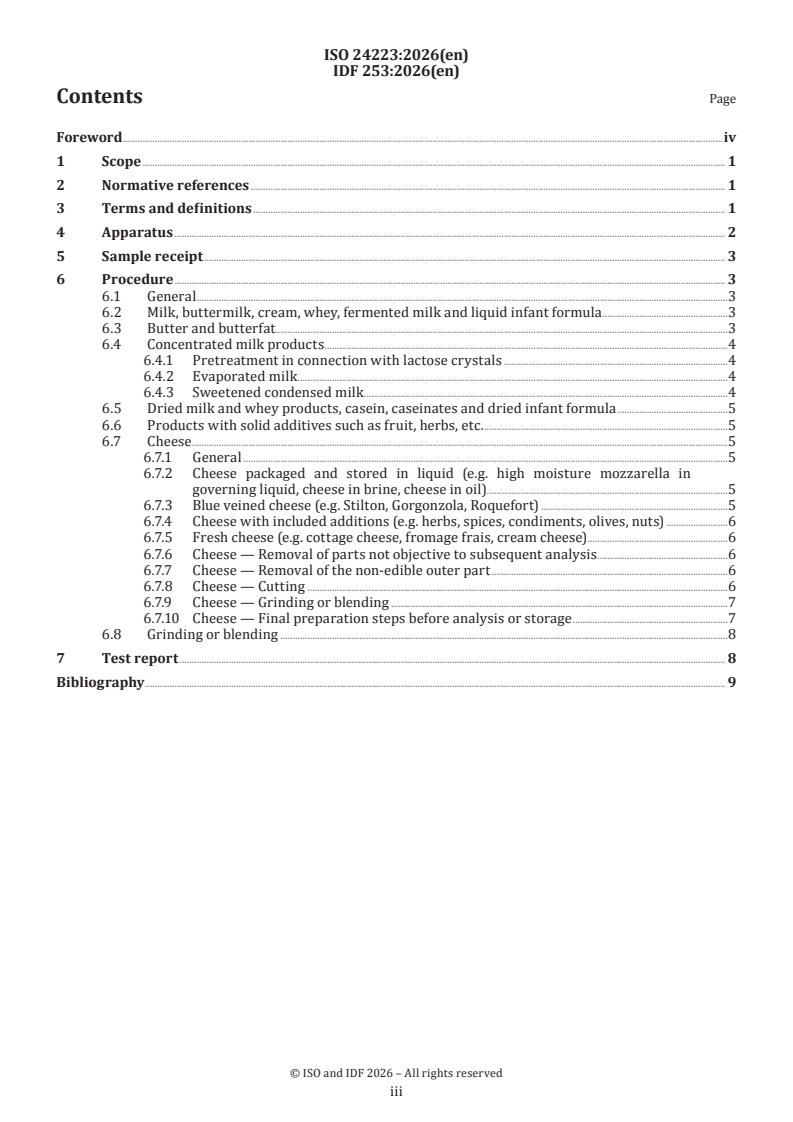
ISO 24223:2026 - Milk and milk products — Guidance on sample preparation for physical and chemical testing
ISO 24223:2026 - Lait et produits laitiers — Lignes directrices pour la préparation des échantillons en vue des essais physiques et chimiques
ISO 24223:2026 is an International Standard published by ISO and IDF for sample preparation of milk and milk products before physical and chemical testing. It gives guidance on the (sub)sampling and preparation steps carried out after sampling to ISO 707 | IDF 50 and before method-specific preparation, including work for instrumental methods.
What does ISO 24223:2026 specify?
ISO 24223:2026 specifies how to prepare samples of milk and milk products for physical and chemical analysis. It is written for the stage after sampling and before the sample enters the method-specific analytical procedure, so the reader can use it as the bridge between field sampling and the actual test.
The document is organized into clauses on scope, references, terms and definitions, apparatus, sample receipt, procedure, and test report. Clause 6 gives the practical preparation steps for different product groups, with cheese handled in several detailed subclauses and supported by Tables 1 to 3.
In practice, the standard matters because sample preparation can change composition. The guidance focuses on keeping the sample representative, avoiding moisture loss, contamination, heating damage, and separation of fat or solids.
What are the key requirements of ISO 24223:2026?
ISO 24223:2026 centers on preserving the original composition of the sample while making it suitable for analysis. The main technical message is: prepare quickly, keep the sample representative, and choose the lightest preparation step that still gives a uniform test portion.
General handling
Clause 4 requires clean, dry apparatus that does not influence the sample composition. Clause 6.1 says preparation should be carried out as swiftly as possible, with exposure to air minimized and equipment cleaned between samples. In practice, this reduces evaporation, adsorption, and cross-contamination.
Clause 5 allows sub-samples from the same batch to be prepared separately or combined into one mixed sample. If sub-samples are analyzed individually, the tools must be cleaned between each one. That matters when a laboratory receives multiple containers from one lot and must decide whether to test them together or separately.
Product-specific preparation
For milk, buttermilk, cream, whey, fermented milk and liquid infant formula, Clause 6.2 uses controlled warming and repeated inversion to redistribute fat, followed by cooling and immediate analysis. For butter and butterfat, Clause 6.3 calls for warming in a sealed container, gentle mixing without breaking the emulsion, cooling, and prompt testing. These steps matter because temperature and agitation strongly affect fat distribution.
Clause 6.4 covers concentrated milk products, including handling lactose crystals, evaporated milk and sweetened condensed milk. Clause 6.5 covers dried milk and whey products, casein, caseinates and dried infant formula, using sieving and, if needed, grinding or blending until the sample meets the sieve criterion. This is the route for reducing heterogeneity in dry, particulate products.
Clause 6.6 addresses products with solid additives such as fruit, herbs, spices, olives or nuts. The sample is blended until the additives are finely and evenly distributed. This helps the analyst measure the whole product, not just the base dairy matrix.
Cheese preparation
Clause 6.7 gives the most detailed guidance. It covers cheese packaged in liquid, blue veined cheese, cheese with included additions, fresh cheese, removal of parts not meant for analysis, removal of the non-edible outer part, cutting, grinding or blending, and final preparation before analysis or storage. Tables 1 to 3 summarize the cheese-type-specific choices.
The practical point is that the portion analyzed must represent the cheese as sold, while excluding parts that are not relevant to the measurement objective. Clause 6.7.10 also requires validation of the mass-reduction method, storage conditions and shelf life when the prepared sample is not tested immediately.
What terms does ISO 24223:2026 define?
- cheese surface - the outer layer of cheese, including sliced, shredded or grated forms, whether or not a rind is present.
- cheese coating - a non-cheese layer or film that protects the cheese during handling and can affect presentation.
- cheese rind - the semi-closed outer cheese layer with lower moisture content that develops during ripening.
- non-edible - a cheese part specified as not intended for human consumption.
These terms matter because Clause 6.7 uses them to decide what to remove before testing.
Who uses ISO 24223:2026?
ISO 24223:2026 is used by laboratories and technical staff who prepare milk and dairy samples for physical and chemical testing, including instrumental analysis. It is also relevant to dairy processors, quality managers, contract laboratories and food control bodies that need a consistent way to prepare samples before measurement.
It is especially useful where product form affects test results - for example cheese with rind or liquid, dried powders, or products with mixed-in fruit or herbs. The document helps users choose the right preparation path for the product they receive.
What changed in ISO 24223:2026 from the previous edition?
ISO 24223:2026 is the second edition and replaces ISO 24223 | IDF 253:2021. The stated technical change is that the scope was expanded from cheese to other milk and milk products.
Which standards are used with ISO 24223:2026?
ISO 707 | IDF 50 is the sampling basis used before the preparation steps in this document. It defines the sampling stage that ISO 24223:2026 builds on.
CODEX STAN 283-1978:2018 is used for the cheese terms cited in Clause 3, including cheese surface, cheese coating and cheese rind. It provides the terminology basis for cheese-specific preparation decisions.
ISO/IEC 17025:2017 is referenced in Clause 7 for test report content. It contributes the general reporting requirements that laboratories should include together with the sample preparation details.
What does the ISO 24223:2026 document contain?
ISO 24223:2026 contains a practical apparatus list, including knives, peeling devices, grinders, blenders, sieves, water baths, an oven and sample containers. It then gives product-specific procedures for liquid, butter, concentrated, dried and additive-containing dairy products.
The cheese section is the most detailed part of the document. It includes guidance on draining, removing non-edible outer parts, cutting, grinding or blending, and the final transfer to a test container, with Tables 1 to 3 used to match the preparation step to the cheese type.
Clause 7 requires the test report to include the sample preparation information and ambient conditions, or a link to that information. That makes the preparation stage traceable for testing, audits and later review.
Relations
- Effective Date
- 12-Feb-2026
- Effective Date
- 18-May-2024
Buy Documents
ISO 24223:2026 - Milk and milk products — Guidance on sample preparation for physical and chemical testing
ISO 24223:2026 - Lait et produits laitiers — Lignes directrices pour la préparation des échantillons en vue des essais physiques et chimiques
Get Certified
Connect with accredited certification bodies for this standard

BSI Group
BSI (British Standards Institution) is the business standards company that helps organizations make excellence a habit.

Bureau Veritas
Bureau Veritas is a world leader in laboratory testing, inspection and certification services.

DNV
DNV is an independent assurance and risk management provider.
Sponsored listings
Frequently Asked Questions
ISO 24223:2026 is a standard published by the International Organization for Standardization (ISO). Its full title is "Milk and milk products — Guidance on sample preparation for physical and chemical testing". This standard covers: This document gives guidance on the sample preparation of milk and milk products for physical and chemical analysis, including analysis by applying instrumental methods. This document specifies the (sub)sampling and sample preparation steps carried out after sampling in accordance with ISO 707 | IDF 50 [1] and prior to method-specific sample preparations (e.g. as with analytical methods). NOTE Analysis on volatile substances, minor components or allergens can require additional precautionary measures in sample preparation in order to avoid loss of or contamination with one or more target analytes.
This document gives guidance on the sample preparation of milk and milk products for physical and chemical analysis, including analysis by applying instrumental methods. This document specifies the (sub)sampling and sample preparation steps carried out after sampling in accordance with ISO 707 | IDF 50 [1] and prior to method-specific sample preparations (e.g. as with analytical methods). NOTE Analysis on volatile substances, minor components or allergens can require additional precautionary measures in sample preparation in order to avoid loss of or contamination with one or more target analytes.
ISO 24223:2026 is classified under the following ICS (International Classification for Standards) categories: 67.100.01 - Milk and milk products in general. The ICS classification helps identify the subject area and facilitates finding related standards.
ISO 24223:2026 has the following relationships with other standards: It is inter standard links to EN ISO 24223:2026, ISO 24223:2021. Understanding these relationships helps ensure you are using the most current and applicable version of the standard.
ISO 24223:2026 is available in PDF format for immediate download after purchase. The document can be added to your cart and obtained through the secure checkout process. Digital delivery ensures instant access to the complete standard document.
Standards Content (Sample)
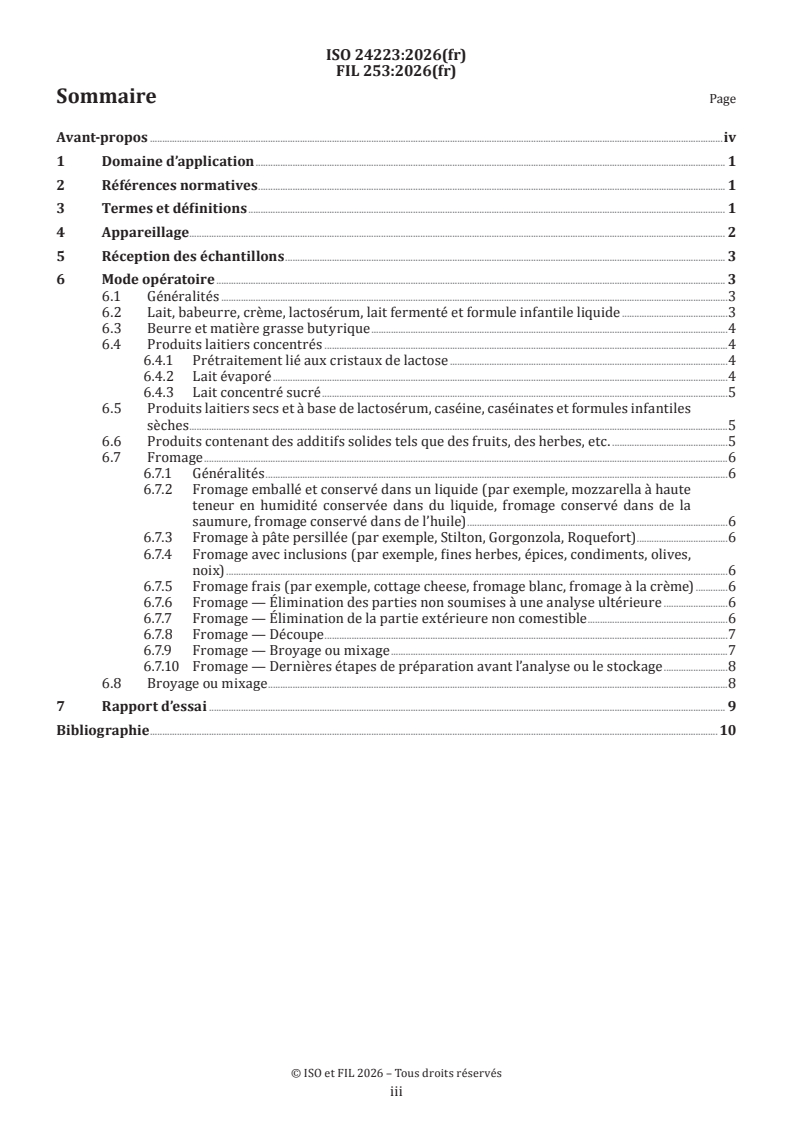
Contents
- 1 Scope
- 2 Normative references
- 3 Terms and definitions
- 3.1 cheese surface
- 3.2 cheese coating
- 3.3 cheese rind
- 3.4 non-edible
- 4 Apparatus
- 4.3 Grinding machine, constructed in a way to produce a small and evenly ground sample portion
- 5 Sample receipt
- 6 Procedure
- 6.1 General
- 6.2 Milk, buttermilk, cream, whey, fermented milk and liquid infant formula
- 6.3 Butter and butterfat
- 6.4 Concentrated milk products
- 6.5 Dried milk and whey products, casein, caseinates and dried infant formula
- 6.7 Cheese
- 6.8 Grinding or blending
- 7 Test report
- Bibliography
1 Scope
This document gives guidance on the sample preparation of milk and milk products for physical and chemical analysis, including analysis by applying instrumental methods. This document specifies the (sub)sampling and sample preparation steps carried out after sampling in [1] accordance with ISO 707 | IDF 50 and prior to method-specific sample preparations (e.g. as with analytical methods).
NOTE Analysis on volatile substances, minor components or allergens can require additional precautionary measures in sample preparation in order to avoid loss of or contamination with one or more target analytes.
2 Normative references
There are no normative references in this document.
3 Terms and definitions
For the purposes of this document, the following terms and definitions apply. ISO and IEC maintain terminology databases for use in standardization at the following addresses:
- ISO Online browsing platform: available at https:// www .iso .org/ obp
- IEC Electropedia: available at https:// www .electropedia .org/
3.1 cheese surface
outer layer or parts of the cheese, even in the sliced, shredded or grated form, including the outside of the whole cheese, disregarding whether a cheese rind (3.3) has been formed or not [2] [SOURCE: CODEX STAN 283-1978:2018 , Appendix]
3.2 cheese coating
layer or film of non-cheese material which helps protect the cheese against microorganisms and physical damage during retail handling and, in some cases, it contributes to the presentation of the cheese [2] [SOURCE: CODEX STAN 283-1978:2018 , Appendix]
3.3 cheese rind
semi-closed layer of cheese with a lower moisture content at the outside of the cheese developed during ripening of the cheese [2] [SOURCE: CODEX STAN 283-1978:2018, Appendix]
3.4 non-edible
part of the cheese that is specified as not intended for human consumption
ISO 24223:2026(en) IDF 253:2026(en)
4 Apparatus
The usual laboratory apparatus and, in particular, the following should be used. The devices and tools to be used should be clean and dry. The devices and tools should not demonstrably influence the composition of the sample.
4.1 Knife or other suitable cutting device, constructed in a way that pressure on the sample is minimized to avoid loss of water and water-soluble components. For samples used for spectrometry or visual analysis, contamination of the cut surface, with cheese rind, coating or other residuals, should be prevented.
4.2 Peeling device, a razor blade planer has proven to be a suitable device.
4.3 Grinding machine, constructed in a way to produce a small and evenly ground sample portion
without demonstrably influencing the composition of the sample. The device should not produce undue heat. EXAMPLE An apparatus with a rotating grater, provided with apertures of 1,2 mm to 2,0 mm in diameter, can be suitable for several types of hard and semi-hard cheese.
The optimal size of aperture can vary with the type of cheese and its maturation level. 4.4 Blending machine (for samples unsuitable for grinding), constructed in a way to produce a small and evenly blended sample portion without demonstrably influencing the composition of the sample portion. The device should not produce undue heat.
4.5 Spoons, spatulas or mortar and pestle, of a size matching the required sub-sample size and total sample size.
4.6 Mixing equipment, optional, any suitable equipment.
4.7 Container with a cover for mixing, of a suitable material, e.g. plastic, and of suitable size. 4.8 Sample containers for storage, of a material and construction, including for closures, that adequately protect the sample and do not bring about a change in the sample which can affect the results of subsequent analyses. Appropriate materials include glass, some metallic materials (e.g. stainless steel) and some plastics (e.g. polypropylene).
The containers should be opaque. If necessary, transparent filled containers should be stored in a dark place. Sample containers should be securely closed either by using a suitable stopper or a screw cap of metallic or plastics material.
Containers and closures should be clean, dry and odour free. Containers for solid products should be widemouthed. Suitable plastic bags, with appropriate methods of closure, may also be used. If critical for the analysis, light-excluding containers should be used.
4.9 Sieves for removal of excessive liquids, with an appropriate mesh size. 4.10 Sieves, with nominal size openings of 500 µm, with receiver. 4.11 Water baths, capable of maintaining the desired temperature ± 2 °C. 4.12 Oven, capable of being maintained to a maximum temperature of 35 °C. 4.13 Glass beaker, various sizes.
ISO 24223:2026(en) IDF 253:2026(en)
5 Sample receipt
In case of receipt of sub-samples from the same product batch, all received samples can be individually prepared for analysis or be commingled to one sample before sample preparation. The commingled samples should be properly mixed in such a way that it represents the specific product batch. If sub-samples are to be analysed individually, equipment/tools used for sample preparation should be cleaned in between every sub-sample.
6 Procedure
6.1 General
The procedure as specified in this clause should be executed as swiftly as possible, so that the composition of the sample is not demonstrably affected.
If the mass of the sample is too large for analysis, it can be reduced to a smaller quantity, provided that it [1] remains representative of the original sample, see ISO 707 | IDF 50 . The exposure of the sample to the air should be avoided as much as possible, to minimize adsorption or evaporation of moisture. It should be ensured that the sample is not contaminated with unwanted surface microbiota or does not show signs of deterioration before sample preparation starts. In some instances, it can be necessary, due to heterogeneity of the sample or large particles, to perform an additional grinding or blending step as specified in 6.8. It should be considered whether this extra step can potentially negatively affect the analysis. If so, this step should not be performed. Equipment that has been in contact with the sample should be cleaned in between every sample.
The objective of this step is to minimize heterogeneity of the sample. Internal processes and conditions should be validated using an appropriate technique. The chosen technique may vary depending on the type of product.
6.2 Milk, buttermilk, cream, whey, fermented milk and liquid infant formula
The sample is warmed in a 38 °C ± 2 °C water bath (4.11) to this temperature and gently mixed thoroughly by repeatedly inverting the sample bottle or container. Extended residence in the water bath should be prevented (max. 30 min to prevent buttering and/or merging of the fat droplets). Before continuation of the procedure, the attainment of the target temperature is verified. Even distribution of the fat throughout the sample is achieved by repeatedly inverting the sample bottle or container. The mixed sample subsequently is cooled in a 20 °C ± 2 °C water bath (4.11) to this temperature. Samples in the original container are transferred into a sample container (4.8) and closed. Where a homogeneous test sample can be obtained without pre-warming (e.g. samples of skimmed milk) it is sufficient to warm the sample in a 20 °C ± 2 °C water bath (4.11) to this temperature and to gently mix it thoroughly by repeatedly inverting the sample bottle or container. If the sample is in the original packaging, it should be transferred to a sample container (4.8) which is then closed. The sample should be mixed and analysed immediately after sample pretreatment. NOTE Samples that, after warming to 38 °C ± 2 °C and mixing, show sediment in the container, can require an additional 5 min ultrasonic step.
6.3 Butter and butterfat
If the sample is still in its original packaging, all of the sample is transferred into the sample container (4.8). The sample container is filled by more than half and no more than three-quarters of its capacity. The sample is warmed in the sealed sample container to a maximum temperature of 35 °C in an oven (4.12). In doing so, measures should be taken to prevent local overheating of the sample container. If fat separation or melting can be expected (e.g. in non-hard butter samples or based on previous obtained experience), warming of the sample in the closed sample container to a temperature of 26 °C ± 2 °C is applied.
...
Contents
- 1 Domaine d’application
- 2 Références normatives
- 3 Termes et définitions
- 3.1 surface du fromage
- 3.2 enrobage de fromage
- 3.3 croûte de fromage
- 3.4 non comestible
- 4 Appareillage
- 5 Réception des échantillons
- 6 Mode opératoire
- 6.1 Généralités
- 6.2 Lait, babeurre, crème, lactosérum, lait fermenté et formule infantile liquide
- 6.3 Beurre et matière grasse butyrique
- 6.4 Produits laitiers concentrés
- 6.5 Produits laitiers secs et à base de lactosérum, caséine, caséinates et formules infantiles
- 6.7 Fromage
- 6.8 Broyage ou mixage
- 7 Rapport d’essai
- Bibliographie
1 Domaine d’application
Le présent document donne des lignes directrices pour la préparation d’échantillons de lait et de produits laitiers en vue d’analyses physiques et chimiques, en incluant l’analyse par l’application de méthodes instrumentales.
Le présent document spécifie les étapes de (sous-)échantillonnage et de préparation d’échantillons effectuées [1] après l’échantillonnage conformément à l’ISO 707 | FIL 50 et avant les préparations d’échantillons spécifiques de la méthode (par exemple comme pour les méthodes analytiques). NOTE L’analyse des substances volatiles, des composants mineurs ou des allergènes, peut nécessiter des précautions supplémentaires lors de la préparation des échantillons, afin d’éviter toute perte d’un ou de plusieurs analytes cibles ou contamination par un ou plusieurs analytes cibles.
2 Références normatives
Le présent document ne contient aucune référence normative.
3 Termes et définitions
Pour les besoins du présent document, les termes et définitions suivants s’appliquent. L’ISO et l’IEC tiennent à jour des bases de données terminologiques destinées à être utilisées en normalisation, consultables aux adresses suivantes:
- ISO Online browsing platform: disponible à l’adresse https:// www .iso .org/ obp
- IEC Electropedia: disponible à l’adresse https:// www .electropedia .org/
3.1 surface du fromage
couche extérieure du fromage ou de parties du fromage, même dans les fromages en tranches, râpés et finement râpés, y compris la partie externe du fromage entier, qu’une croûte de fromage (3.3) se soit formée ou non [2] [SOURCE: CODEX STAN 283-1978:2018 , Annexe]
3.2 enrobage de fromage
couche ou pellicule de substance autre que le fromage qui aide à protéger le fromage contre les microorganismes et les chocs durant la vente au détail et, dans certains cas, qui donne un meilleur aspect au fromage [2] [SOURCE: CODEX STAN 283-1978:2018 , Annexe]
ISO 24223:2026(fr) FIL 253:2026(fr)
3.3 croûte de fromage
couche semi-fermée à teneur en humidité plus faible à l’extérieur du fromage, qui se développe pendant l’affinage du fromage [2] [SOURCE: CODEX STAN 283-1978:2018 , Annexe]
3.4 non comestible
partie du fromage non destinée à la consommation humaine
4 Appareillage
Il convient d’utiliser le matériel courant de laboratoire et, en particulier, ce qui suit. Il convient que les dispositifs et outils à utiliser soient propres et secs. Il convient que les dispositifs et outils n’influencent pas la composition de l’échantillon de façon manifeste. 4.1 Couteau ou autre dispositif de découpe approprié, conçu de telle manière que la pression sur l’échantillon est réduite au minimum pour éviter toute perte d’eau et de composants hydrosolubles. Pour les échantillons utilisés pour la spectrométrie ou l’analyse visuelle, il convient d’éviter toute contamination de la surface de coupe par de la croûte de fromage, de l’enrobage ou d’autres résidus. 4.2 Dispositif de raclage, un rabot à lame de rasoir s’est avéré être un dispositif approprié. 4.3 Dispositif de broyage, conçu de façon à produire une petite fraction d’échantillon broyée de manière uniforme sans influencer la composition de l’échantillon de façon manifeste. Il convient que le dispositif ne produise pas de chaleur excessive.
EXEMPLE Un appareil muni d’une râpe rotative, équipée de trous de 1,2 mm à 2,0 mm de diamètre, peut être approprié pour plusieurs types de fromage à pâte dure et semi-dure. Le diamètre optimal des trous peut varier en fonction du type de fromage et de son degré d’affinage. 4.4 Dispositif de mixage (pour échantillons impropres au broyage), conçu de façon à produire une petite fraction d’échantillon mixée de manière uniforme sans influencer la composition de la fraction d’échantillon de façon manifeste. Il convient que le dispositif ne produise pas de chaleur excessive. 4.5 Cuillères, spatules ou mortiers-pilons, d’une taille correspondant à la taille du sous-échantillon et à la taille de l’échantillon entier.
4.6 Dispositif de mélange, en option, n’importe quel matériel approprié. 4.7 Récipient avec couvercle pour le mélange, fabriqué dans un matériau approprié, par exemple le plastique, et de taille adaptée.
4.8 Récipients pour échantillons hermétiques, conçus et fabriqués avec des matériaux, y compris les couvercles, de manière à protéger correctement l’échantillon sans entraîner de modification de ce dernier qui serait susceptible d’avoir une influence sur les résultats des analyses ultérieures. Les matériaux appropriés englobent le verre, certains métaux (par exemple l’acier inoxydable) et certains plastiques (par exemple le polypropylène).
II convient que les récipients soient opaques. Dans le cas où l’utilisation de récipients transparents est nécessaire, il convient de conserver ces derniers à l’abri de la lumière. Il convient de fermer hermétiquement les récipients pour échantillons soit à l’aide d’un bouchon approprié, soit à l’aide d’un capuchon fileté en métal ou en matière plastique.
ISO 24223:2026(fr) FIL 253:2026(fr) Il convient que les récipients et les couvercles soient propres, secs et sans odeur. Il convient que les récipients pour produits solides aient un goulot large. Des sacs en plastique appropriés, pourvus de systèmes adéquats de fermeture, peuvent également être utilisés. Si l’analyse l’exige, il convient d’utiliser des récipients opaques. 4.9 Tamis pour l’élimination des liquides en excès, avec une taille de maille appropriée. 4.10 Tamis, avec des ouvertures de taille nominale de 500 µm, avec récepteur. 4.11 Bains-marie, permettant de maintenir la température souhaitée ±2 °C. 4.12 Étuve, pouvant être maintenue à une température maximale de 35 °C. 4.13 Béchers en verre, de différentes tailles.
5 Réception des échantillons
En cas de réception de sous-échantillons d’un même lot de produits, tous les échantillons reçus peuvent être préparés individuellement pour l’analyse ou être regroupés en un seul échantillon avant la préparation de l’échantillon. Il convient de bien mélanger les échantillons regroupés de manière à ce qu’ils représentent le lot de produits spécifique. S’il est prévu d’analyser les sous-échantillons individuellement, il convient de nettoyer le matériel/les outils utilisés pour la préparation des échantillons entre chaque sous-échantillon.
6 Mode opératoire
6.1 Généralités
Il convient que le mode opératoire spécifié dans le présent article soit exécuté le plus rapidement possible, afin que la composition de l’échantillon ne soit pas affectée de façon manifeste. Si la masse de l’échantillon est trop élevée pour l’analyse, elle peut être réduite à une valeur inférieure, à [1] condition qu’elle reste représentative de l’échantillon d’origine, voir l’ISO 707 | FIL 50 . Il convient d’éviter autant que possible l’exposition de l’échantillon à l’air, afin de minimiser l’adsorption ou l’évaporation de l’humidité. Il convient de s’assurer que l’échantillon n’est pas contaminé par un microbiote de surface indésirable ou qu’il ne présente pas de signes de détérioration avant de préparer l’échantillon. Dans certains cas, il peut être nécessaire, en raison de l’hétérogénéité de l’échantillon ou des grosses particules, d’effectuer une étape supplémentaire de broyage ou de mixage comme spécifié au 6.8. Il convient de déterminer si cette étape supplémentaire peut potentiellement affecter négativement l’analyse. Dans ce cas, il convient de ne pas effectuer cette étape. Il convient de nettoyer le matériel en contact avec l’échantillon entre chaque échantillon.
L’objectif de cette étape est de réduire au minimum l’hétérogénéité de l’échantillon. Il convient de valider les processus internes et les conditions en utilisant une technique appropriée. La technique choisie peut être différente selon le type de produit.
6.2 Lait, babeurre, crème, lactosérum, lait fermenté et formule infantile liquide
L’échantillon est chauffé dans un bain-marie à 38 °C ± 2 °C (4.11) jusqu’à ce qu’il atteigne cette température et est mélangé délicatement en retournant à plusieurs reprises le flacon ou le récipient de l’échantillon. Il convient d’éviter un séjour prolongé dans le bain-marie (max. 30 min pour prévenir le barattage et/ ou la fusion des gouttelettes de matière grasse). Avant de poursuivre le mode opératoire, l’atteinte de la température cible est vérifiée. La répartition uniforme de la matière grasse dans l’échantillon est obtenue en retournant à plusieurs reprises le flacon ou le récipient de l’échantillon. L’échantillon mélangé est ensuite refroidi dans un bain-marie à 20 °C ± 2 °C (4.11) jusqu’à ce qu’il atteigne cette température. Les échantillons dans le récipient d’origine sont transférés dans un récipient pour échantillons (4.8) et celui-ci est fermé. Lorsqu’un échantillon d’essai homogène peut être obtenu sans préchauffage (par exemple, des échantillons
ISO 24223:2026(fr) FIL 253:2026(fr) de lait écrémé), il suffit de réchauffer l’échantillon dans un bain-marie à 20 °C + 2 °C (4.11) jusqu’à ce qu’il atteigne cette température et de le mélanger délicatement en retournant à plusieurs reprises le flacon ou le récipient de l’échantillon. Si l’échantillon se trouve dans l’emballage d’origine, il convient de le transférer dans un récipient pour échantillons (4.8) et de fermer celui-ci. Il convient de mélanger et d’analyser l’échantillon immédiatement après son prétraitement.
NOTE Les échantillons qui, après avoir été chauffés à 38 °C ± 2 °C et mélangés, présentent des sédiments dans le récipient, peuvent nécessiter une étape ultrasonore supplémentaire de 5 min.
6.3 Beurre et matière grasse butyrique
Si l’échantillon est toujours dans son emballage d’origine, la totalité de l’échantillon est transférée dans le récipient pour échantillons (4.8). Le récipient pour échantillons est rempli à plus de la moitié et pas plus des trois quarts de sa capacité.
...