

ISO/PRF 24223
(Main)Milk and milk products — Guidance on sample preparation for physical and chemical testing
- Abstract
This document gives guidance on the sample preparation of milk and milk products for physical and chemical analysis, including analysis by applying instrumental methods. This document specifies the (sub)sampling, and sample preparation steps carried out after sampling according to ISO 707 | IDF 50 and prior to method-specific sample preparations, e.g. as with analytical methods. NOTE Analysis on volatile substances, minor components or allergens can require additional precautionary measures in sample preparation in order to avoid loss of or contamination with one or more target analytes.
- Status
- Not Published
- Technical Committee
- ISO/TC 34/SC 5 - Milk and milk products
- Drafting Committee
- ISO/TC 34/SC 5 - Milk and milk products
- Current Stage
- 5020 - FDIS ballot initiated: 2 months. Proof sent to secretariat
- Start Date
- 21-Sep-2026
- Completion Date
- 10-Oct-2026
Buy Documents
ISO/PRF 24223 - Milk and milk products — Guidance on sample preparation for physical and chemical testing
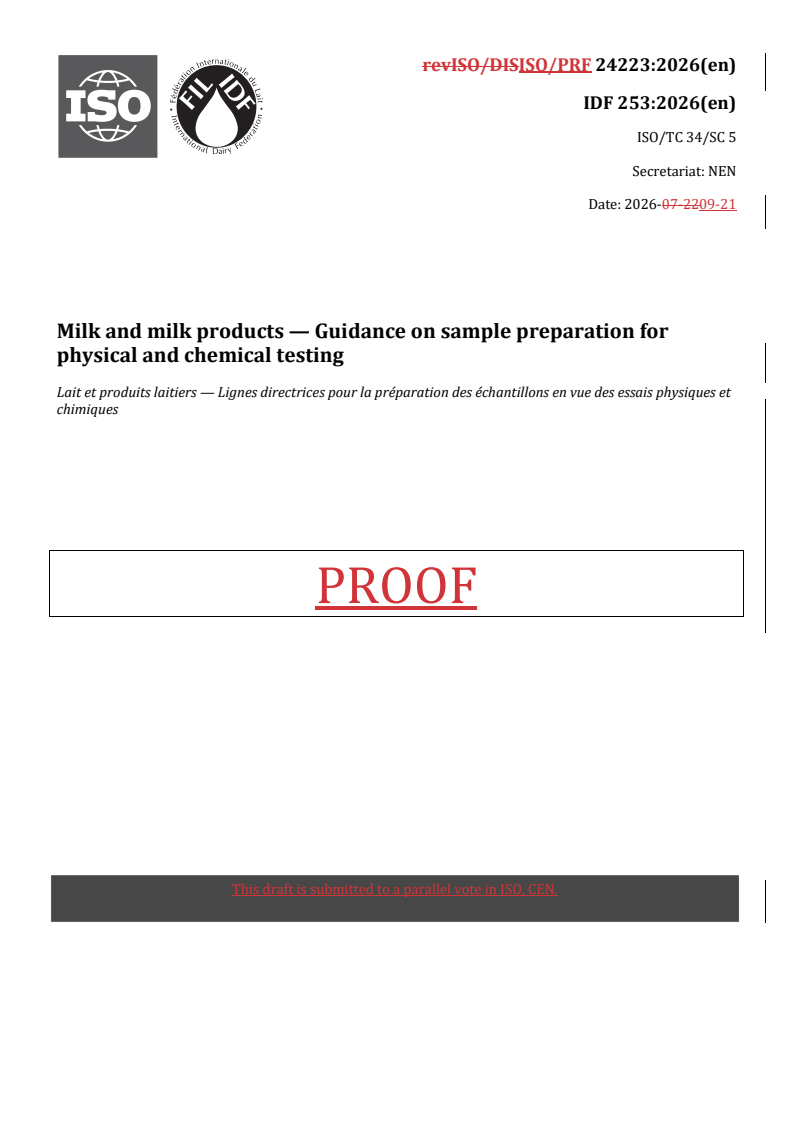
REDLINE ISO/PRF 24223 - Milk and milk products — Guidance on sample preparation for physical and chemical testing
ISO/PRF 24223 is a joint ISO and IDF document for laboratories working with milk and milk products. It gives guidance on how to prepare samples for physical and chemical testing, including instrumental methods, after sampling and before method-specific preparation. The document is aimed at producing representative, homogeneous test portions while limiting loss, contamination, heating, drying or other changes to the sample.
What does ISO/PRF 24223 specify?
ISO/PRF 24223 specifies guidance for (sub)sampling and sample preparation of milk and milk products for physical and chemical analysis. In practice, it sits between sampling according to ISO 707 | IDF 50 and the sample preparation steps required by the analytical method itself.
The document is organized into clauses on scope, terms and definitions, apparatus, sample receipt, procedure and test report. Clause 6 gives product-specific preparation routes for liquid milks, butter and butterfat, concentrated products, dried products, products with solid additives, and cheese.
What are the key requirements of ISO/PRF 24223?
Clause 4 sets out the apparatus that should be clean, dry and not affect sample composition. The practical point is that cutting devices, grinders, blenders, sieves, baths and containers must not introduce heat, moisture loss, odour or contamination.
Clause 5 says samples from the same batch may be prepared separately or commingled, but a commingled sample must be mixed so it still represents the batch. If sub-samples are handled individually, tools should be cleaned between them. This matters for traceability and for avoiding carry-over between samples.
Clause 6.1 requires preparation to be done quickly and with minimal exposure to air. The sample should remain representative, and extra grinding or blending should only be used when it helps homogeneity and does not harm the analysis. That is important for volatile substances, moisture-sensitive samples and very heterogeneous products.
Clauses 6.2 to 6.4 give different preparation routes for liquid, fat-rich and concentrated products. For milk, buttermilk, cream, whey, fermented milk and liquid infant formula, warming and gentle inversion are used to redistribute fat, then the sample is cooled and analysed promptly. For butter and butterfat, the sample is softened in the closed container, mixed without breaking the emulsion, cooled, and mixed again briefly before weighing out. Concentrated milk products may need temperature cycling to dissolve lactose crystals, while evaporated milk and sweetened condensed milk are mixed carefully so that material from the walls and lid is included.
Clause 6.5 covers dried milk and whey products, casein, caseinates and dried infant formula. The sample is shaken, then sieved, and if the sieve criterion is not met it is ground or blended until it is suitable. This reduces clumping and helps the test portion reflect the whole sample.
Clause 6.6 and 6.7 address products with solid additives and cheese. Products with fruit, herbs or similar additions are blended until the added pieces are evenly distributed. Cheese preparation depends on type: liquid-packed cheeses are drained, blue-veined and added-in cheese are sampled to reflect the internal distribution, fresh cheese with visible whey is mixed first, and non-edible outer parts are removed when required.
Clause 6.7.8 to 6.7.10 and 6.8 emphasize validation of the chosen preparation approach. The laboratory should validate the way it cuts, grinds, blends, reduces mass and stores prepared cheese samples, because those steps affect homogeneity, headspace, moisture loss and deterioration.
What terms does ISO/PRF 24223 define?
Cheese surface is the outer layer or outer parts of cheese, including sliced, shredded or grated cheese, whether or not a rind has formed.
Cheese coating is a non-cheese layer or film used to protect cheese against microorganisms and physical damage and, in some cases, to improve presentation.
Cheese rind is the outer, lower-moisture layer that develops during ripening.
Non-edible means a cheese part specified as not intended for human consumption.
Who uses ISO/PRF 24223?
ISO/PRF 24223 is used by testing laboratories, dairy quality teams and sample-preparation staff who handle milk and milk products before physical or chemical analysis. It is relevant to analysts working with instrumental methods, because those tests depend on a test portion that is homogeneous and representative. Producers, buyers and quality managers use it when they need a common laboratory approach for routine control, batch assessment or dispute testing.
What changed in ISO/PRF 24223 from the previous edition?
ISO/PRF 24223 is the second edition and replaces ISO 24223 | IDF 253:2021. The main change stated in the document is that the scope was expanded from cheese to other milk and milk products.
Which standards are used with ISO/PRF 24223?
ISO 707 | IDF 50 is the sampling standard that this document assumes has already been applied before sample preparation starts. ISO/IEC 17025:2017 is referenced for the information that should appear in the test report, especially reporting requirements and links to accessible information. CODEX STAN 283-1978:2018 is used as the source for several cheese definitions.
What does the ISO/PRF 24223 document contain?
The document contains product-specific procedures for preparing liquid, concentrated, dried and cheese samples for testing. It includes practical equipment guidance, such as knives, peeling devices, grinders, blenders, sieves, water baths and storage containers. Tables 1 to 3 guide how cheese is trimmed, cut, ground or blended by cheese type, and the cheese clauses also cover storage and the handling of headspace and condensed moisture. Clause 7 describes what the test report should record about sample preparation and ambient conditions.
Relations
- Effective Date
- 12-Feb-2026
- Effective Date
- 18-May-2024
Buy Documents
ISO/PRF 24223 - Milk and milk products — Guidance on sample preparation for physical and chemical testing
REDLINE ISO/PRF 24223 - Milk and milk products — Guidance on sample preparation for physical and chemical testing
Get Certified
Connect with accredited certification bodies for this standard

BSI Group
BSI (British Standards Institution) is the business standards company that helps organizations make excellence a habit.

Bureau Veritas
Bureau Veritas is a world leader in laboratory testing, inspection and certification services.

DNV
DNV is an independent assurance and risk management provider.
Sponsored listings
Frequently Asked Questions
ISO/PRF 24223 is a draft published by the International Organization for Standardization (ISO). Its full title is "Milk and milk products — Guidance on sample preparation for physical and chemical testing". This standard covers: This document gives guidance on the sample preparation of milk and milk products for physical and chemical analysis, including analysis by applying instrumental methods. This document specifies the (sub)sampling, and sample preparation steps carried out after sampling according to ISO 707 | IDF 50 and prior to method-specific sample preparations, e.g. as with analytical methods. NOTE Analysis on volatile substances, minor components or allergens can require additional precautionary measures in sample preparation in order to avoid loss of or contamination with one or more target analytes.
This document gives guidance on the sample preparation of milk and milk products for physical and chemical analysis, including analysis by applying instrumental methods. This document specifies the (sub)sampling, and sample preparation steps carried out after sampling according to ISO 707 | IDF 50 and prior to method-specific sample preparations, e.g. as with analytical methods. NOTE Analysis on volatile substances, minor components or allergens can require additional precautionary measures in sample preparation in order to avoid loss of or contamination with one or more target analytes.
ISO/PRF 24223 is classified under the following ICS (International Classification for Standards) categories: 67.100.01 - Milk and milk products in general. The ICS classification helps identify the subject area and facilitates finding related standards.
ISO/PRF 24223 has the following relationships with other standards: It is inter standard links to prEN ISO 24223, ISO 24223:2021. Understanding these relationships helps ensure you are using the most current and applicable version of the standard.
ISO/PRF 24223 is available in PDF format for immediate download after purchase. The document can be added to your cart and obtained through the secure checkout process. Digital delivery ensures instant access to the complete standard document.
Standards Content (Sample)
International
Standard
ISO 24223
IDF 253
Second edition
Milk and milk products — Guidance
on sample preparation for physical
and chemical testing
Lait et produits laitiers — Lignes directrices pour la préparation
des échantillons en vue des essais physiques et chimiques
PROOF/ÉPREUVE
Reference numbers
ISO 24223:2026(en)
IDF 253:2026(en) © ISO and IDF 2026
ISO 24223:2026(en)
IDF 253:2026(en)
© ISO and IDF 2026
All rights reserved. Unless otherwise specified, or required in the context of its implementation, no part of this publication may
be reproduced or utilized otherwise in any form or by any means, electronic or mechanical, including photocopying, or posting on
the internet or an intranet, without prior written permission. Permission can be requested from either ISO at the address below
or ISO’s member body in the country of the requester.
ISO copyright office International Dairy Federation
CP 401 • Ch. de Blandonnet 8 Silver Building • Bd Auguste Reyers 70/B
CH-1214 Vernier, Geneva B-1030 Brussels
Phone: +41 22 749 01 11 Phone: +32 2 325 67 40
Fax: +32 2 325 67 41
Email: copyright@iso.org Email: info@fil-idf.org
Website: www.iso.org Website: www.fil-idf.org
Published in Switzerland
PROOF/ÉPREUVE
ii
ISO 24223:2026(en)
IDF 253:2026(en)
Contents Page
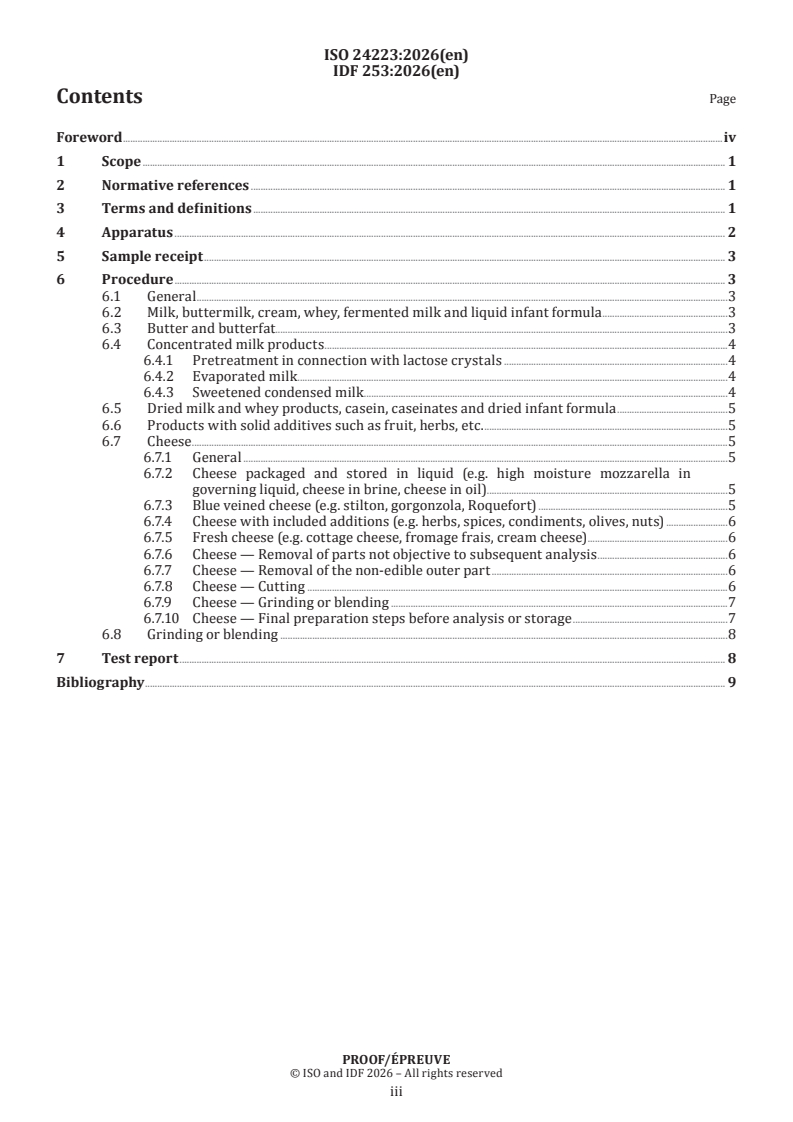
Foreword .iv
1 Scope . 1
2 Normative references . 1
3 Terms and definitions . 1
4 Apparatus . 2
5 Sample receipt . 3
6 Procedure . 3
6.1 General .3
6.2 Milk, buttermilk, cream, whey, fermented milk and liquid infant formula .3
6.3 Butter and butterfat.3
6.4 Concentrated milk products .4
6.4.1 Pretreatment in connection with lactose crystals .4
6.4.2 Evaporated milk . .4
6.4.3 Sweetened condensed milk . .4
6.5 Dried milk and whey products, casein, caseinates and dried infant formula .5
6.6 Products with solid additives such as fruit, herbs, etc. .5
6.7 Cheese .5
6.7.1 General .5
6.7.2 Cheese packaged and stored in liquid (e.g. high moisture mozzarella in
governing liquid, cheese in brine, cheese in oil).5
6.7.3 Blue veined cheese (e.g. stilton, gorgonzola, Roquefort) .5
6.7.4 Cheese with included additions (e.g. herbs, spices, condiments, olives, nuts) .6
6.7.5 Fresh cheese (e.g. cottage cheese, fromage frais, cream cheese) .6
6.7.6 Cheese — Removal of parts not objective to subsequent analysis .6
6.7.7 Cheese — Removal of the non-edible outer part .6
6.7.8 Cheese — Cutting .6
6.7.9 Cheese — Grinding or blending .7
6.7.10 Cheese — Final preparation steps before analysis or storage .7
6.8 Grinding or blending .8
7 Test report . 8
Bibliography . 9
PROOF/ÉPREUVE
iii
ISO 24223:2026(en)
IDF 253:2026(en)
Foreword
ISO (the International Organization for Standardization) is a worldwide federation of national standards
bodies (ISO member bodies). The work of preparing International Standards is normally carried out through
ISO technical committees. Each member body interested in a subject for which a technical committee
has been established has the right to be represented on that committee. International organizations,
governmental and non-governmental, in liaison with ISO, also take part in the work. ISO collaborates closely
with the International Electrotechnical Commission (IEC) on all matters of electrotechnical standardization.
The procedures used to develop this document and those intended for its further maintenance are described
in the ISO/IEC Directives, Part 1. In particular, the different approval criteria needed for the different types
of ISO document should be noted. This document was drafted in accordance with the editorial rules of the
ISO/IEC Directives, Part 2 (see www.iso.org/directives).
ISO draws attention to the possibility that the implementation of this document may involve the use of (a)
patent(s). ISO takes no position concerning the evidence, validity or applicability of any claimed patent
rights in respect thereof. As of the date of publication of this document, ISO had not received notice of (a)
patent(s) which may be required to implement this document. However, implementers are cautioned that
this may not represent the latest information, which may be obtained from the patent database available at
www.iso.org/patents. ISO shall not be held responsible for identifying any or all such patent rights.
Any trade name used in this document is information given for the convenience of users and does not
constitute an endorsement.
For an explanation of the voluntary nature of standards, the meaning of ISO specific terms and expressions
related to conformity assessment, as well as information about ISO’s adherence to the World Trade
Organization (WTO) principles in the Technical Barriers to Trade (TBT), see www.iso.org/iso/foreword.html.
This document was prepared by Technical Committee ISO/TC 34, Food products, Subcommittee SC 5,
Milk and milk products, and the International Dairy Federation (IDF), in collaboration with the European
Committee for Standardization (CEN) Technical Committee CEN/TC 302, Milk and milk products – Methods
of sampling and analysis, in accordance with the Agreement on technical cooperation between ISO and CEN
(Vienna Agreement). It is being published jointly by ISO and IDF.
This second edition cancels and replaces the first edition (ISO 24223 | IDF 253:2021), which has been
technically revised.
The main changes are as follows:
— the Scope was expanded from cheese to other milk and milk products.
Any feedback or questions on this document should be directed to the user’s national standards body. A
complete listing of these bodies can be found at www.iso.org/members.html.
PROOF/ÉPREUVE
iv
ISO 24223:2026(en)
IDF 253:2026(en)
IDF (the International Dairy Federation) is a non-profit private sector organization representing the
interests of various stakeholders in dairying at the global level. IDF members are organized in National
Committees, which are national associations composed of representatives of dairy-related national interest
groups including dairy farmers, dairy processing industry, dairy suppliers, academics and governments/
food control authorities.
ISO and IDF collaborate closely on all matters of standardization relating to methods of analysis and
sampling for milk and milk products. Since 2001, ISO and IDF jointly publish their International Standards
using the logos and reference numbers of both organizations.
IDF draws attention to the possibility that the implementation of this document may involve the use of (a)
patent(s). IDF takes no position concerning the evidence, validity or applicability of any claimed patent
rights in respect thereof. As of the date of publication of this document, IDF had not received notice of (a)
patent(s) which may be required to implement this document. However, implementers are cautioned that
this may not represent the latest information, which may be obtained from the patent database available at
www.iso.org/patents. IDF shall not be held responsible for identifying any or all such patent rights.
Any trade name used in this document is information given for the convenience of users and does not
constitute an endorsement.
This document was prepared by the IDF Standing Committee on Analytical Methods for Composition and
ISO Technical Committee ISO/TC 34, Food products, Subcommittee SC 5, Milk and milk products. It is being
published jointly by ISO and IDF.
The work was carried out by the IDF/ISO Action Team on C58 of the Standing Committee on Analytical
Methods for Composition under the aegis of its project leader Mr K. van Cleef (NL).
PROOF/ÉPREUVE
v
ISO 24223:2026(en)
International Standard
IDF 253:2026(en)
Milk and milk products — Guidance on sample preparation
for physical and chemical testing
1 Scope
This document gives guidance on the sample preparation of milk and milk products for physical and chemical
analysis, including analysis by applying instrumental methods.
This document specifies the (sub)sampling and sample preparation steps carried out after sampling in
[1]
accordance with ISO 707 | IDF 50 and prior to method-specific sample preparations (e.g. as with analytical
methods).
NOTE Analysis on volatile substances, minor components or allergens can require additional precautionary
measures in sample preparation in order to avoid loss of or contamination with one or more target analytes.
2 Normative references
There are no normative references in this document.
3 Terms and definitions
For the purposes of this document, the following terms and definitions apply.
ISO and IEC maintain terminology databases for use in standardization at the following addresses:
— ISO Online browsing platform: available at https:// www .iso .org/ obp
— IEC Electropedia: available at https:// www .electropedia .org/
3.1
cheese surface
outer layer or parts of the cheese, even in the sliced, shredded or grated form, including the outside of the
whole cheese, disregarding whether a cheese rind (3.3) has been formed or not
[2]
[SOURCE: CODEX STAN 283-1978:2018 , Appendix]
3.2
cheese coating
layer or film of non-cheese material which helps protect the cheese against microorganisms and physical
damage during retail handling and, in some cases, it contributes to the presentation of the cheese
[2]
[SOURCE: CODEX STAN 283-1978:2018 , Appendix]
3.3
cheese rind
semi-closed layer of cheese with a lower moisture content at the outside of the cheese developed during
ripening of the cheese
[2]
[SOURCE: CODEX STAN 283-1978:2018, Appendix]
3.4
non-edible
part of the cheese that is specified as not intended for human consumption
PROOF/ÉPREUVE
ISO 24223:2026(en)
IDF 253:2026(en)
4 Apparatus
The usual laboratory apparatus and, in particular, the following should be used.
The devices and tools to be used should be clean and dry. The devices and tools should not demonstrably
influence the composition of the sample.
4.1 Knife or other suitable cutting device, constructed in a way that pressure on the sample is
minimized to avoid loss of water and water-soluble components.
For samples used for spectrometry or visual analysis, contamination of the cut surface, with cheese rind,
coating or other residuals, should be prevented.
4.2 Peeling device, a razor blade planer has proven to be a suitable device.
4.3 Grinding machine, constructed in a way to produce a small and evenly ground sample portion
without demonstrably influencing the composition of the sample. The device should not produce undue heat.
EXAMPLE An apparatus with a rotating grater, provided with apertures of 1,2 mm to 2,0 mm in diameter, can be
suitable for several types of hard and semi-hard cheese.
The optimal size of aperture can vary with the type of cheese and its maturation level.
4.4 Blending machine (for samples unsuitable for grinding), constructed in a way to produce a small
and evenly blended sample portion without demonstrably influencing the composition of the sample portion.
The device should not produce undue heat.
4.5 Spoons, spatulas or mortar and pestle, of a size matching the required sub-sample size and total
sample size.
4.6 Mixing equipment, optional, any suitable equipment.
4.7 Container with a cover for mixing, of a suitable material, e.g. plastic, and of suitable size.
4.8 Sample containers for storage, of a material and construction, including for closures, that adequately
protect the sample and do not bring about a change in the sample which can affect the results of subsequent
analyses. Appropriate materials include glass, some metallic materials (e.g. stainless steel) and some plastics
(e.g. polypropylene).
The containers should be opaque. If necessary, transparent filled containers should be stored in a dark place.
Sample containers should be securely closed either by using a suitable stopper or a screw cap of metallic or
plastics material.
Containers and closures should be clean, dry and odour free. Containers for solid products should be wide-
mouthed. Suitable plastic bags, with appropriate methods of closure, may also be used. If critical for the
analysis, light-excluding containers should be used.
4.9 Sieves for removal of excessive liquids, with an appropriate mesh size.
4.10 Sieves, with nominal size openings of 500 µm, with receiver.
4.11 Water baths, capable of maintaining the desired temperature ± 2 °C.
4.12 Oven, capable of being maintained to a maximum temperature of 35 °C.
4.13 Glass beaker, various sizes.
PROOF/ÉPREUVE
ISO 24223:2026(en)
IDF 253:2026(en)
5 Sample receipt
In case of receipt of sub-samples from the same product batch, all received samples can be individually
prepared for analysis or be commingled to one sample before sample preparation. The commingled samples
should be properly mixed in such a way that it represents the specific product batch. If sub-samples are to
be analysed individually, equipment/tools used for sample preparation should be cleaned in between every
sub-sample.
6 Procedure
6.1 General
The procedure as specified in this clause should be executed as swiftly as possible, so that the composition
of the sample is not demonstrably affected.
If the mass of the sample is too large for analysis, it can be reduced to a smaller quantity, provided that it
[1]
remains representative of the original sample, see ISO 707 | IDF 50 .
The exposure of the sample to the air should be avoided as much as possible, to minimize adsorption or
evaporation of moisture. It should be ensured that the sample is not contaminated with unwanted surface
microbiota or does not show signs of deterioration before sample preparation starts. In some instances, it
can be necessary, due to heterogeneity of the sample or large particles, to perform an additional grinding or
blending step as specified in 6.8. It should be considered whether this extra step can potentially negatively
affect the analysis. If so, this step should not be performed. Equipment that has been in contact with the
sample should be cleaned in between every sample.
The objective of this step is to minimize heter
...
revISO/DISISO/PRF 24223:2026(en)
IDF 253:2026(en)
ISO/TC 34/SC 5
Secretariat: NEN
Date: 2026-07-2209-21
Milk and milk products — Guidance on sample preparation for
physical and chemical testing
Lait et produits laitiers — Lignes directrices pour la préparation des échantillons en vue des essais physiques et
chimiques
PROOF
TThhiiss d drraftaft i iss s suubbmmiitttteded t too a pa pararallel vallel vootte e iinn I ISSOO,, C CEENN.
IDF 253:2026(en)
All rights reserved. Unless otherwise specified, or required in the context of its implementation, no part of this publication
may be reproduced or utilized otherwise in any form or by any means, electronic or mechanical, including photocopying,
or posting on the internet or an intranet, without prior written permission. Permission can be requested from either ISO
at the address below or ISO’s member body in the country of the requester.
ISO Copyright Office
CP 401 • CH-1214 Vernier, Geneva
Phone: + 41 22 749 01 11
Email: copyright@iso.org
Website: www.iso.org
International Dairy Federation
Silver Building • Bd Auguste Reyers 70/B
Geneva B-1030 Brussels
Phone: +32 2 325 67 40
Email: info@fil-idf.org
Website: www.fil-idf.org
Published in Switzerland
IDF 253:2026(en)
Contents
Foreword . iv
1 Scope . 1
2 Normative references . 1
3 Terms and definitions . 1
4 Apparatus . 2
5 Sample receipt . 3
6 Procedure . 3
6.1 General. 3
6.2 Milk, buttermilk, cream, whey, fermented milk and liquid infant formula . 3
6.3 Butter and butterfat . 4
6.4 Concentrated milk products . 4
6.5 Dried milk and whey products, casein, caseinates and dried infant formula . 5
6.6 Products with solid additives such as fruit, herbs, etc. . 5
6.7 Cheese . 5
6.8 Grinding or blending . 8
7 Test report . 8
Bibliography . 9
iii
IDF 253:2026(en)
Foreword
ISO (the International Organization for Standardization) is a worldwide federation of national standards
bodies (ISO member bodies). The work of preparing International Standards is normally carried out through
ISO technical committees. Each member body interested in a subject for which a technical committee has been
established has the right to be represented on that committee. International organizations, governmental and
non-governmental, in liaison with ISO, also take part in the work. ISO collaborates closely with the
International Electrotechnical Commission (IEC) on all matters of electrotechnical standardization.
The procedures used to develop this document and those intended for its further maintenance are
specifieddescribed in the ISO/IEC Directives, Part 1. In particular, the different approval criteria needed for
the different types of ISO document should be noted. This document was drafted in accordance with the
editorial rules of the ISO/IEC Directives, Part 2 (see www.iso.org/directives).
ISO draws attention to the possibility that the implementation of this document may involve the use of (a)
patent(s). ISO takes no position concerning the evidence, validity or applicability of any claimed patent rights
in respect thereof. As of the date of publication of this document, ISO had not received notice of (a) patent(s)
which may be required to implement this document. However, implementers are cautioned that this may not
represent the latest information, which may be obtained from the patent database available at
www.iso.org/patents. ISO shall not be held responsible for identifying any or all such patent rights.
Any trade name used in this document is information given for the convenience of users and does not
constitute an endorsement.
For an explanation of the voluntary nature of standards, the meaning of ISO specific terms and expressions
related to conformity assessment, as well as information about ISO’s adherence to the World Trade
Organization (WTO) principles in the Technical Barriers to Trade (TBT), see www.iso.org/iso/foreword.html.
This document was prepared by Technical Committee ISO/TC 34, Food products, Subcommittee SC 5, Milk and
milk products, and the International Dairy Federation (IDF), in collaboration with the European Committee for
Standardization (CEN) Technical Committee CEN/TC 302, Milk and milk products – Methods of sampling and
analysis, in accordance with the Agreement on technical cooperation between ISO and CEN (Vienna
Agreement). It is being published jointly by ISO and IDF.
This second edition cancels and replaces the first edition (ISO 24223 | IDF 253:2021), which has been
technically revised.
The main changes are as follows:
— the Scope was expanded from cheese to other milk and milk products.
Any feedback or questions on this document should be directed to the user’s national standards body. A
complete listing of these bodies can be found at www.iso.org/members.html.
iv
IDF 253:2026(en)
IDF (the International Dairy Federation) is a non-profit private sector organization representing the interests
of various stakeholders in dairying at the global level. IDF members are organized in National Committees,
which are national associations composed of representatives of dairy-related national interest groups
including dairy farmers, dairy processing industry, dairy suppliers, academics and governments/food control
authorities.
ISO and IDF collaborate closely on all matters of standardization relating to methods of analysis and sampling
for milk and milk products. Since 2001, ISO and IDF jointly publish their International Standards using the
logos and reference numbers of both organizations.
IDF draws attention to the possibility that the implementation of this document may involve the use of (a)
patent(s). IDF takes no position concerning the evidence, validity or applicability of any claimed patent rights
in respect thereof. As of the date of publication of this document, IDF had not received notice of (a) patent(s)
which may be required to implement this document. However, implementers are cautioned that this may not
represent the latest information, which may be obtained from the patent database available at
www.iso.org/patents. IDF shall not be held responsible for identifying any or all such patent rights.
Any trade name used in this document is information given for the convenience of users and does not
constitute an endorsement.
This document was prepared by the IDF Standing Committee on Analytical Methods for Composition and ISO
Technical Committee ISO/TC 34, Food products, Subcommittee SC 5, Milk and milk products. It is being
published jointly by ISO and IDF.
The work was carried out by the IDF/ISO Action Team on C58 of the Standing Committee on Analytical Methods
for Composition under the aegis of its project leader Mr K. van Cleef (NL).
v
IDF 253:2026(en)
Milk and milk products — Guidance on sample preparation for
physical and chemical testing
1 Scope
This document gives guidance on the sample preparation of milk and milk products for physical and chemical
analysis, including analysis by applying instrumental methods.
This document specifies the (sub)sampling, and sample preparation steps carried out after sampling
[1]
according to in accordance with ISO 707 | IDF 50 and prior to method-specific sample preparations, (e.g. as
with analytical methods.).
NOTE Analysis on volatile substances, minor components or allergens can require additional precautionary
measures in sample preparation in order to avoid loss of or contamination with one or more target analytes.
2 Normative references
There are no normative references in this document.
3 Terms and definitions
For the purposes of this document, the following terms and definitions apply.
ISO and IEC maintain terminology databases for use in standardization at the following addresses:
— ISO Online browsing platform: available at https://www.iso.org/obp
— IEC Electropedia: available at https://www.electropedia.org/
3.1
cheese surface
outer layer or parts of the cheese, even in the sliced, shredded or grated form, including the outside of the
whole cheese, disregarding whether a cheese rind (3.3) has been formed or not
[2]
[SOURCE: CODEX STAN 283-1978:2018 , Appendix]
3.2
cheese coating
layer or film of non-cheese material which helps protect the cheese against microorganisms and physical
damage during retail handling and, in some cases, it contributes to the presentation of the cheese
[2]
[SOURCE: CODEX STAN 283-1978:2018 , Appendix]
3.3
cheese rind
semi-closed layer of cheese with a lower moisture content at the outside of the cheese developed during
ripening of the cheese
[2]
[SOURCE: CODEX STAN 283-1978:2018, Appendix]
3.4
non-edible
part of the cheese that is specified as not intended for human consumption
IDF 253:2026(en)
4 Apparatus
The usual laboratory apparatus and, in particular, the following should be used.
The devices and tools to be used should be clean and dry. The devices and tools should not demonstrably
influence the composition of the sample.
4.1 Knife or other suitable cutting device, constructed in a way that pressure on the sample is minimized
to avoid loss of water and water-soluble components.
For samples used for spectrometry or visual analysis, contamination of the cut surface, with cheese rind,
coating or other residuals, should be prevented.
4.2 Peeling device, a razor blade planer has proven to be a suitable device.
4.3 Grinding machine, constructed in a way to produce a small and evenly ground sample portion without
demonstrably influencing the composition of the sample. The device should not produce undue heat.
EXAMPLE An apparatus with a rotating grater, provided with apertures of 1,2 mm to 2,0 mm in diameter, can be
suitable for several types of hard and semi-hard cheese.
The optimal size of aperture can vary with the type of cheese and its maturation level.
4.4 Blending machine (for samples unsuitable for grinding), constructed in a way to produce a small
and evenly blended sample portion without demonstrably influencing the composition of the sample portion.
The device should not produce undue heat.
4.5 Spoons, spatulas or mortar and pestle, of a size matching the required sub-sample size and total
sample size.
4.6 Mixing equipment, optional, any suitable equipment.
4.7 Container with a cover for mixing, of a suitable material, e.g. plastic, and of suitable size.
4.8 Sample containers for storage, of a material and construction, including for closures, that adequately
protect the sample and do not bring about a change in the sample which can affect the results of subsequent
analyses. Appropriate materials include glass, some metallic materials (e.g. stainless steel) and some plastics
(e.g. polypropylene).
The containers should be opaque. If necessary, transparent filled containers should be stored in a dark place.
Sample containers should be securely closed either by using a suitable stopper or a screw cap of metallic or
plastics material.
Containers and closures should be clean, dry and odour free. Containers for solid products should be wide-
mouthed. Suitable plastic bags, with appropriate methods of closure, may also be used. If critical for the
analysis, light-excluding containers should be used.
4.9 Sieves for removal of excessive liquids, with an appropriate mesh size.
4.10 Sieves, with nominal size openings of 500 µm, with receiver.
4.11 Water baths, capable of maintaining the desired temperature ± 2 °C.
4.12 Oven, capable of being maintained to a maximum temperature of 35 °C.
IDF 253:2026(en)
4.13 Glass beaker, various sizes.
5 Sample receipt
In case of receipt of sub-samples from the same product batch, all received samples can be individually
prepared for analysis or be commingled to one sample before sample preparation. The commingled samples
should be properly mixed in such a way that it represents the specific product batch. If sub-samples are to be
analysed individually, equipment/tools used for sample preparation should be cleaned in between every sub-
sample.
6 Procedure
6.1 General
The procedure as specified in this clause should be executed as swiftly as possible, so that the composition of
the sample is not demonstrably affected.
If the mass of the sample is too large for analysis, it can be reduced to a smaller quantity, provided that it
[1]
remains representative of the original sample, see ISO 707 | IDF 50 .
The exposure of the sample to the air should be avoided as much as possible, to minimize adsorption or
evaporation of moisture. It should be ensured that the sample is not contaminated with unwanted surface
microbiota or does not show signs of deterioration before sample preparation starts. In some instances, it can
be necessary, due to heterogeneity of the sample or large particles, to perform an additional grinding or
blending step as specified in 6.8. Consider that It should be considered whether this extra step can potentially
negatively affect the analysis. If so, do not perform this step should not be performed. Equipment that has been
in contact with the sample should be cleaned in between every sample.
The objective of this step is to minimize heterogeneity of the sample. Internal processes and conditions should
be validated using an appropriate technique. The chosen technique may vary depending on the type of
product.
6.2 Milk, buttermilk, cream, whey, fermented milk and liquid infant formula
The sample is warmed in a 38 °C ± 2 °C water bath (4.11) to this temperature and gently mixed thoroughly by
repeatedly inverting the sample bottle or container. Prevent extendedExtended residence in the water bath
should be prevented (max. 30 min to prevent buttering and/or merging of the fat droplets). Before
continuation of the procedure, the attainment of the target temperature is verified. Even distribution of the
fat throughout the sample is achieved by repeatedly inverting the sample bottle or container. The mixed
sample subsequently is cooled in a 20 °C ± 2 °C water bath (4.11) to this temperature. Samples in the original
container are transferred into a sample container (4.8) and closed. Where a homogeneous test sample can be
obtained without pre-warming (e.g. samples of skimmed milk) it is sufficient to warm the sample in a
20 °C ± 2 °C water bath (4.11) to this temperature and to gently mix it thoroughly by repeatedly inverting the
sample bottle or container. If the sample is in the original packaging, it should be transferred to a sample
container (4.8) which is thanthen closed it. The sample should be mixed and analysed immediately after
sample pretreatment.
NOTE Sa
...