


ISO/FDIS 14092
(Main)Climate change adaptation — Requirements and guidance on adaptation planning for local governments and communities
Climate change adaptation — Requirements and guidance on adaptation planning for local governments and communities
This document specifies requirements and guidance on adaptation planning for local governments and communities. This document supports local governments and communities in adapting to climate change based on vulnerability, impacts and risk assessments. In working with relevant interested parties, it also supports the setting of priorities, and the development and subsequent updating of an adaptation plan.
Adaptation au changement climatique — Exigences et recommandations relatives à la planification de l'adaptation pour les autorités locales et les communautés
General Information
Relations


Standards Content (Sample)
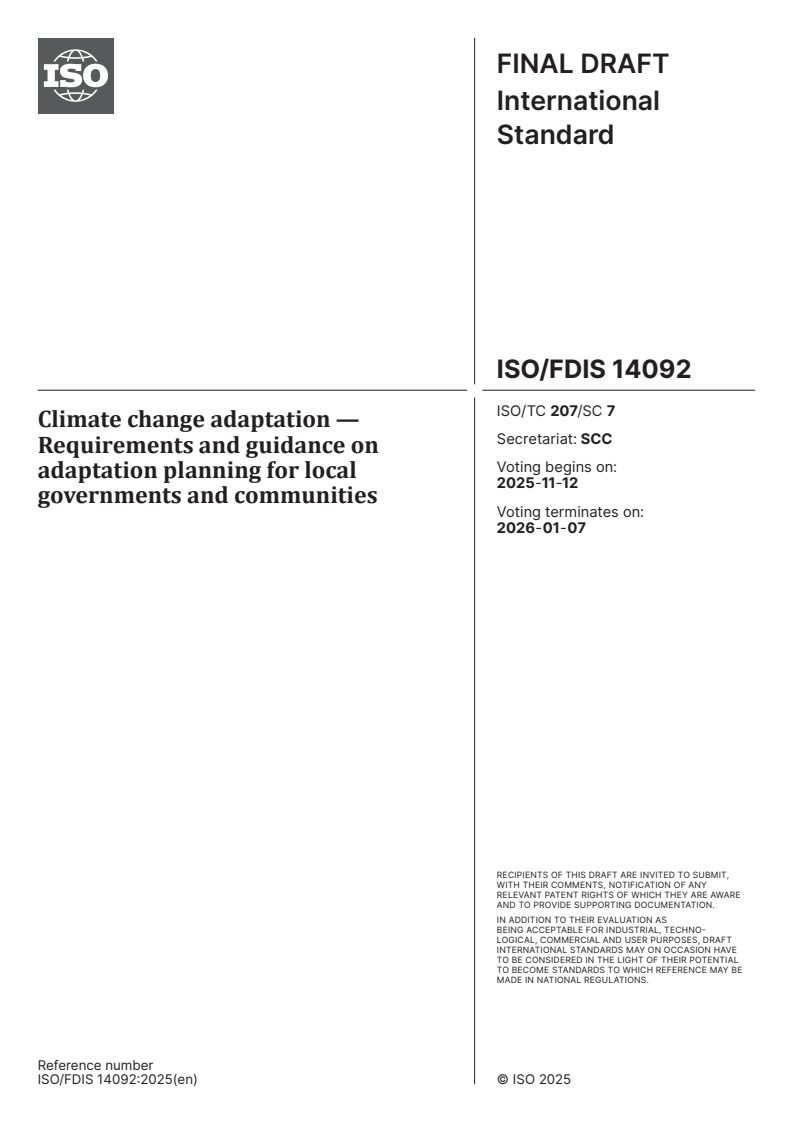
FINAL DRAFT
International
Standard
ISO/TC 207/SC 7
Climate change adaptation —
Secretariat: SCC
Requirements and guidance on
Voting begins on:
adaptation planning for local
2025-11-12
governments and communities
Voting terminates on:
2026-01-07
RECIPIENTS OF THIS DRAFT ARE INVITED TO SUBMIT,
WITH THEIR COMMENTS, NOTIFICATION OF ANY
RELEVANT PATENT RIGHTS OF WHICH THEY ARE AWARE
AND TO PROVIDE SUPPOR TING DOCUMENTATION.
IN ADDITION TO THEIR EVALUATION AS
BEING ACCEPTABLE FOR INDUSTRIAL, TECHNO
LOGICAL, COMMERCIAL AND USER PURPOSES, DRAFT
INTERNATIONAL STANDARDS MAY ON OCCASION HAVE
TO BE CONSIDERED IN THE LIGHT OF THEIR POTENTIAL
TO BECOME STAN DARDS TO WHICH REFERENCE MAY BE
MADE IN NATIONAL REGULATIONS.
Reference number
FINAL DRAFT
International
Standard
ISO/TC 207/SC 7
Climate change adaptation —
Secretariat: SCC
Requirements and guidance on
Voting begins on:
adaptation planning for local
governments and communities
Voting terminates on:
RECIPIENTS OF THIS DRAFT ARE INVITED TO SUBMIT,
WITH THEIR COMMENTS, NOTIFICATION OF ANY
RELEVANT PATENT RIGHTS OF WHICH THEY ARE AWARE
AND TO PROVIDE SUPPOR TING DOCUMENTATION.
© ISO 2025
IN ADDITION TO THEIR EVALUATION AS
All rights reserved. Unless otherwise specified, or required in the context of its implementation, no part of this publication may
BEING ACCEPTABLE FOR INDUSTRIAL, TECHNO
LOGICAL, COMMERCIAL AND USER PURPOSES, DRAFT
be reproduced or utilized otherwise in any form or by any means, electronic or mechanical, including photocopying, or posting on
INTERNATIONAL STANDARDS MAY ON OCCASION HAVE
the internet or an intranet, without prior written permission. Permission can be requested from either ISO at the address below
TO BE CONSIDERED IN THE LIGHT OF THEIR POTENTIAL
or ISO’s member body in the country of the requester.
TO BECOME STAN DARDS TO WHICH REFERENCE MAY BE
MADE IN NATIONAL REGULATIONS.
ISO copyright office
CP 401 • Ch. de Blandonnet 8
CH-1214 Vernier, Geneva
Phone: +41 22 749 01 11
Email: copyright@iso.org
Website: www.iso.org
Published in Switzerland Reference number
ii
Contents Page
Foreword .v
Introduction .vi
1 Scope . 1
2 Normative references . 1
3 Terms and definitions . 1
4 Principles . 5
4.1 Accountability .5
4.2 Continuous learning and improvement .5
4.3 Flexibility.5
4.4 Mainstreaming and embedding .5
4.5 Practicality .5
4.6 Prioritization .5
4.7 Proportionality .6
4.8 Relevance .6
4.9 Transparency .6
5 Pre-planning . 6
5.1 General .6
5.2 Framing adaptation .6
5.3 Roles, responsibilities and duties of the teams .7
5.3.1 Core decision-making team .7
5.3.2 Facilitation team .7
5.3.3 Interested parties .9
5.3.4 Agreement and approval .9
6 Assessing climate change risks including opportunities . 9
6.1 General .9
6.2 Identifying climate change .10
6.3 Analysing climate change impacts .11
6.4 Climate change risk assessment methods . 13
6.4.1 General . 13
6.4.2 Climate change risk assessment .14
6.4.3 Vulnerability assessment .14
6.4.4 Thresholds analysis . 15
6.4.5 Defining areas and sectors where adaptation is needed . 15
6.5 Assessing adaptive capacity . 15
6.6 Identifying opportunities .17
6.7 Identifying uncertainties .17
7 Formulating the adaptation plan . 17
7.1 General .17
7.2 Planning considering the policy context .18
7.3 Identification of potential adaptation measures.19
7.4 Assessment of adaptation measures .19
7.5 Decision-making . 20
7.5.1 General . 20
7.5.2 Interested parties’ engagement .21
7.5.3 Selection of climate change adaptation measures .21
7.5.4 Short, medium and long lifespan decisions . 22
7.5.5 Documenting the decision . 22
7.6 Local adaptation plan . 23
7.6.1 General . 23
7.6.2 Scope of the plan .24
7.6.3 Boundaries of the system .24
7.6.4 Formulation and presentation .24
iii
7.6.5 Implementation . 26
7.6.6 Monitoring and evaluation . 26
7.6.7 Consultation on the draft adaptation plan . 26
7.6.8 Confirmation and authorization. 26
7.6.9 Publication and archive . 26
8 Implementation . .27
8.1 Leadership and commitment .27
8.2 Preparation for implementation .27
8.3 Implementation plan . 28
9 Monitoring and evaluation . .28
10 Reporting and communication .29
Annex A (informative) Example tables of contents of local adaptation plans .30
Annex B (informative) Tools for local adaptation planning .35
Annex C (informative) Indicators for monitoring and evaluation in local adaptation planning .38
Annex D (informative) Informative guidelines on climate change adaptation .39
Bibliography . 41
iv
Foreword
ISO (the International Organization for Standardization) is a worldwide federation of national standards
bodies (ISO member bodies). The work of preparing International Standards is normally carried out through
ISO technical committees. Each member body interested in a subject for which a technical committee
has been established has the right to be represented on that committee. International organizations,
governmental and non-governmental, in liaison with ISO, also take part in the work. ISO collaborates closely
with the International Electrotechnical Commission (IEC) on all matters of electrotechnical standardization.
The procedures used to develop this document and those intended for its further maintenance are described
in the ISO/IEC Directives, Part 1. In particular, the different approval criteria needed for the different types
of ISO document should be noted. This document was drafted in accordance with the editorial rules of the
ISO/IEC Directives, Part 2 (see www.iso.org/directives).
ISO draws attention to the possibility that the implementation of this document may involve the use of (a)
patent(s). ISO takes no position concerning the evidence, validity or applicability of any claimed patent
rights in respect thereof. As of the date of publication of this document, ISO had not received notice of (a)
patent(s) which may be required to implement this document. However, implementers are cautioned that
this may not represent the latest information, which may be obtained from the patent database available at
www.iso.org/patents. ISO shall not be held responsible for identifying any or all such patent rights.
Any trade name used in this document is information given for the convenience of users and does not
constitute an endorsement.
For an explanation of the voluntary nature of standards, the meaning of ISO specific terms and expressions
related to conformity assessment, as well as information about ISO’s adherence to the World Trade
Organization (WTO) principles in the Technical Barriers to Trade (TBT), see www.iso.org/iso/foreword.html.
This document was prepared by Technical Committee ISO/TC 207, Environmental management,
Subcommittee SC 7, Greenhouse gas and climate change management and related activities.
This first edition cancels and replaces ISO/TS 14092:2020, which has been technically revised.
The main changes are as follows:
— guidance on climate change adaptation has been added in Annex D;
— the information has been updated throughout to reflect the current situation.
Any feedback or questions on this document should be directed to the user’s national standards body. A
complete listing of these bodies can be found at www.iso.org/members.html.
v
Introduction
Preparing for risks posed by climate change and planning for adaptation at local government and community
levels are essential for the safety and security of society, as well as for its economic, environmental and social
well-being. Changes in the climate, often reflected by floods, heatwaves, droughts, coastal erosion and other
impacts that have been identified across the globe, pose threats to people’s lives, property and economic
well-being, and to ecosystems. The United Nations (UN) Intergovernmental Panel on Climate Change (IPCC)
has projected that global warming from past anthropogenic emissions will persist for centuries to millennia
and will continue to cause further long-term changes in the climate system such as sea-level rise, with
[25]
associated impacts.
This document provides guidance for local governments and communities on how to prepare for such threats
and the associated risks. It recognizes that the impacts posed by climate change vary widely from region to
region, and directly affect communities’ well-being and local governments including the public services they
offer, as well as the safety and security of individuals within their jurisdiction. It is the responsibility of local
governments and communities to provide leadership in planning and preparing to manage these risks.
This document also describes how to develop an adaptation plan at the local government and community
levels. The planning process details why and how to establish an appropriate (well-structured and
collaborative) governance structure and the elements of the adaptation planning and implementation
processes. These details include establishing a facilitation team, assessing risks and developing an effective
plan, and importantly, monitoring the progress of adaptation implementation and evaluating its achievement
with the aim of improving the plan. The step-by-step process presented enables the local adaptation plan to
be tailored to suit the climatic, environmental and societal conditions in each case. Applying this document
will lead to developing a robust, effective adaptation plan that can be implemented, promoting appropriate
climate action today and in the future.
The following two standards are important and interrelated to this document:
— ISO 14091 gives guidelines for assessing the risks related to the potential impacts of climate change. It
describes how to understand vulnerability and how to develop and implement a sound risk assessment in
the context of climate change. It can be used for assessing both present and future climate change risks.
Risk assessment in accordance with ISO 14091 provides a basis for climate change adaptation planning,
implementation, and monitoring and evaluation for any organization, regardless of size, type and nature.
ISO 14091 should be referred to in order to accommodate various user situations and conditions.
— ISO 14093 establishes an approach and methodology for a country-based mechanism to channel climate
finance to subnational authorities to support climate change adaptation and to increase local resilience
thereby contributing to the achievement of the goals of the 2015 Paris Agreement of the United Nations
Framework Convention on Climate Change (UNFCCC) and the UN Sustainable Development Goals (SDGs).
The country-based mechanism uses performance-based climate resilience grants (PBCRGs) which
ensure programming and verification of climate change expenditures at the local level, offering strong
incentives for performance improvements in enhanced resilience. ISO 14093 provides requirements
and guidelines and is applicable to organizations such as national and subnational authorities, donors,
companies, financial institutions and international organizations that are involved in implementing a
country-based mechanism for channelling climate finance to subnational authorities to support climate
change adaptation and resilience. ISO 14093 should be referred to appropriately to manage climate
funds, etc.
It is important to note that the climate is changing, and planning and implementing adaptation is a continuous
learning and improvement process that requires sustained attention and action. This document is designed
to help local governments and communities in taking initial action to create a safe, socially and economically
secure and sustainable society that is resilient to the current and future impacts of climate change.
The framework is designed in accordance with ISO 14090:2019. This framework is given in Figure 1.
vi
Figure 1 — Logical framework of this document
While the perspective of more vulnerable regions regarding climate change adaptation can be recognized
as an important perspective, it has not been incorporated into this document. The local government and
community should establish, implement and maintain an adaptation policy with consideration for vulnerable
communities, including social and economic aspects in addition to climate risks in the right context.
vii
FINAL DRAFT International Standard ISO/FDIS 14092:2025(en)
Climate change adaptation — Requirements and guidance on
adaptation planning for local governments and communities
1 Scope
This document specifies requirements and gives guidance on adaptation planning for local governments
and communities.
This document supports local governments and communities in adapting to climate change based on
vulnerability, impacts and risk assessments. In working with relevant interested parties, it also supports
the setting of priorities, and the development and subsequent updating of an adaptation plan.
2 Normative references
There are no normative references in this document.
3 Terms and definitions
For the purposes of this document, the following terms and definitions apply.
ISO and IEC maintain terminology databases for use in standardization at the following addresses:
— ISO Online browsing platform: available at https:// www .iso .org/ obp
— IEC Electropedia: available at https:// www .electropedia .org/
3.1
climate change adaptation
adaptation to climate change
process of adjustment to actual or expected climate (3.3) and its effects
Note 1 to entry: In human systems, adaptation seeks to moderate or avoid harm, or exploit beneficial opportunities.
Note 2 to entry: In some natural systems, human intervention can facilitate adjustment to expected climate and its
effects.
[24]
[SOURCE: IPCC, 2014 , Annex II: Glossary, modified — “to climate change” added to the term. Admitted
term added.]
3.2
adaptive capacity
ability of systems, institutions, humans and other organisms to adjust to potential damage, to take advantage
of opportunities or to respond to consequences
Note 1 to entry: Coping capacity is the ability of people, organizations (3.16), and systems, using available skills,
resources, and opportunities, to address, manage, and overcome adverse conditions.
[24]
[SOURCE: IPCC, 2014 , Annex II: Glossary, modified — Note 1 to entry added.]
3.3
climate
statistical description of weather in terms of the mean and variability of relevant quantities over a period of
time ranging from months to thousands or millions of years
Note 1 to entry: The classical period for averaging these variables is 30 years, as defined by the World Meteorological
Organization.
Note 2 to entry: The relevant quantities are most often surface variables such as temperature, precipitation and wind.
[24]
[SOURCE: IPCC, 2014 , Annex II: Glossary, modified — Rigorous definition of climate in a narrow sense used.]
3.4
climate change
change in climate (3.3) that persists for an extended period, typically decades or longer
Note 1 to entry: Climate change can be identified by such means as statistical tests (e.g. on changes in the mean,
variability).
Note 2 to entry: Climate change can be due to natural processes, internal to the climate system, or external forcings
such as modulations of the solar cycles, volcanic eruptions and persistent anthropogenic changes in the composition of
the atmosphere or in land use.
[24]
[SOURCE: IPCC, 2014 , Annex II: Glossary, modified — Text reorganized and revised.]
3.5
climate projection
simulated response of the climate (3.3) system to a scenario of future emission or concentration of
greenhouse gases and aerosols, generally derived using climate models
Note 1 to entry: Climate projections are distinguished from climate predictions in order to emphasize that climate
projections depend upon the emission/concentration/radiative forcing scenario used, which are based on assumptions
concerning, for example, future socioeconomic and technological developments that can be, but are not always,
realized.
[24]
[SOURCE: IPCC, 2014 , Annex II: Glossary, modified — Note 1 to entry revised.]
3.6
climate scenario
plausible and often simplified representation of the future climate (3.3), based on an internally consistent
set of climatological relationships that has been constructed for explicit use in investigating the potential
consequences of anthropogenic climate change (3.4)
Note 1 to entry: Climate scenario often serves as input to impact (3.10) models.
[24]
[SOURCE: IPCC, 2014 , Annex II: Glossary, modified — Last sentence about climate projections deleted.]
3.7
community
group of people with an arrangement of responsibilities, activities, relationships and with common interests
in the impacts (3.10) of climate change (3.4)
Note 1 to entry: A community can also be an organization (3.16) or institute (e.g. hospital, school, volunteer group,
etc.) or a group of people living or working in the same place or having a particular characteristic in common.
3.8
exposure
presence of people, livelihoods, species or ecosystems, environmental functions, services, and resources,
infrastructure, or economic, social, or cultural assets in places and settings that can be affected
Note 1 to entry: Exposure can change over time (e.g. as a result of urban development and land-use change).
[24]
[SOURCE: IPCC, 2014 , Annex II: Glossary, modified — “adversely” deleted from before “affected” in the
definition. Note 1 to entry added.]
3.9
hazard
potential source of harm
Note 1 to entry: The potential for harm can be in terms of loss of life, injury or other health impacts (3.10), as well as
damage and loss to property, infrastructure, livelihoods, service provision, ecosystems and environmental resources.
Note 2 to entry: In this document, the term usually refers to climate-related physical events or trends or their physical
impacts.
Note 3 to entry: Hazard comprises slow-onset developments (e.g. rising temperatures over the long term) as well as
rapidly developing climatic extremes (e.g. heatwave, landslide) or increased variability.
[SOURCE: ISO/IEC Guide 51:2014, 3.2, modified —Notes 1 and 2 to entry added to reflect the definition of
[24] ,
“hazard” in IPCC, 2014 , Annex II: Glossary. Note 3 to entry added.]
3.10
impact
effect on natural and human systems
Note 1 to entry: In the context of climate change (3.4), the term “impact” is used primarily to refer to the effects on
natural and human systems of extreme weather and climate events and of climate change. Impacts generally refer to
effects on lives, livelihoods, health, ecosystems, economies, societies, cultures, services and infrastructure due to the
interaction of climate change or hazardous climate events occurring within a specific time period and the vulnerability
(3.19) of an exposed society or system. Impacts are also referred to as “consequences” and “outcomes”. The impacts
of climate change on geophysical systems, including floods, droughts and sea level rise, are a subset of impacts called
“physical impacts”.
[24]
[SOURCE: IPCC, 2014 , Annex II: Glossary, modified — Term changed to singular form.]
3.11
indicator
quantitative, qualitative or binary variable that can be measured or described, in response to a defined
criterion
[SOURCE: ISO 13065:2015, 3.27]
3.12
interested party
person or organization (3.16) that can affect, be affected by, or perceive itself to be affected by a decision or
activity
Note 1 to entry: Customers, communities (3.7), suppliers, regulators, non-governmental organizations, investors and
employees.
Note 2 to entry: To “perceive itself to be affected” means the perception has been made known to the organization.
1)
[SOURCE: ISO 14001:—, 3.1.7]
3.13
local adaptation plan
plan of action identifying and addressing the impacts (3.10) of climate change (3.4) in the area of responsibility
of a local government (3.14) or community (3.7)
Note 1 to entry: Such plan of action may contain priorities and planned activities for identifying and addressing the
impacts of climate change, including those associated with climate variability and extremes. It may include a mix of
policies, projects, programmes and measures which are updated periodically.
1) Under preparation.
3.14
local government
administration of states, provinces, etc. (large local governments), which are subordinate to the major
political unit and national government, as well as counties, districts, cities, towns, etc. (small local
governments), which are subordinate to states and provinces, and the services they provide
3.15
national adaptation plan
national document containing adaptation priorities and planned activities (policies, projects and
programmes) including an implementation strategy for a given period (e.g. three to five years)
Note 1 to entry: It was agreed in 2010 under the United Nations Framework Convention on Climate Change (UNFCCC)
that Parties would formulate and implement national adaptation plans, as a means that enables them to identify their
medium- and long-term adaptation needs and to implement strategies and programmes to address those needs.
[35]
[SOURCE: United Nations Framework Convention on Climate Change, 2012, 5.4, modified — Note 1 to entry.]
3.16
organization
person or group of people that has its own functions with responsibilities, authorities and relationships to
achieve its objectives
Note 1 to entry: The concept of organization includes, but is not limited to sole-trader, company, corporation, firm,
enterprise, authority, partnership, charity or institution, or part or combination thereof, whether incorporated or not,
public or private
Note 2 to entry: If the organization is part of a larger entity, the term “organization” refers only to the part of the larger
entity that is within the scope of the environmental management system.
[SOURCE: ISO 14001:—, 3.1.5]
3.17
risk
effect of uncertainty
Note 1 to entry: An effect is a deviation from the expected. It can be positive, negative or both. An effect can arise as
a result of a response, or failure to respond, to an opportunity or to a threat related to achieving defined objectives.
Note 2 to entry: Uncertainty is the state, even partial, of deficiency of information related to, understanding or
knowledge of an event, its consequence, or likelihood.
Note 3 to entry: Risk is often characterized by reference to potential “events” and “consequences”, or a combination
of these.
Note 4 to entry: Risk is often expressed in terms of a combination of the consequences of an event (including changes
in circumstances) and the associated “likelihood” of occurrence.
3.18
sensitivity
degree to which a system or species is affected, either adversely or beneficially, by climate (3.3) variability
or change
Note 1 to entry: The effect may be direct (e.g. a change in the health and functioning of green infrastructure in
response to a change in the mean, range or variability of temperature) or indirect (e.g. damages caused by an increase
in the frequency of coastal flooding due to sea level rise).
[24]
[SOURCE: IPCC, 2014 , Annex II: Glossary]
3.19
vulnerability
propensity or predisposition to be adversely affected
Note 1 to entry: Vulnerability encompasses a variety of concepts and elements including sensitivity (3.18) or
susceptibility to harm and lack of capacity to cope and adapt.
Note 2 to entry: Vulnerability is the degree to which an ecological, social and economic system is susceptible to, or
unable to cope with, adverse climate change (3.4) impacts (3.10), including climate (3.3) variability and extremes.
[24]
[SOURCE: IPCC, 2014 , Annex II: Glossary, modified — Note 2 to entry added.]
3.20
maladaptation
actions intended to contribute to climate change adaptation (3.1), but which can lead to increased risk (3.17)
of adverse climate-related outcomes, increased vulnerability (3.19) to climate change (3.4), or diminished
welfare, now or in the future
[SOURCE: ISO 14093:2022, 3.1.3.9]
4 Principles
4.1 Accountability
The local government and community acknowledge and assume responsibility to address and plan for their
climate change adaptation, recognizing the roles of higher levels government, etc. They accept appropriate
scrutiny from authorized agencies or parties, and also accept a duty to respond to this scrutiny.
NOTE 1 This principal refers to ISO 14090:2019, 4.11.
NOTE 2 The community acknowledges its role in collaborating with local government in adaptation activity.
4.2 Continuous learning and improvement
Continuous learning and improvement is fundamental for climate change adaptation where there are
uncertainties in knowledge, but also continuous changes in the drivers of change, the knowledge and
evidence available, and the context within which the responses are to be identified and implemented.
4.3 Flexibility
Explore various measures to meet goals and objectives by taking technical, social, administrative, political,
legal, environmental and economic circumstances into account to accommodate a wide range of data
availabilities and technical and institutional capacities.
4.4 Mainstreaming and embedding
Climate change adaptation is most effective when it is integrated into the local government’s and
community’s operations (e.g. policies, plans, procedures, risk management, implementation).
NOTE 1 This principal refers to ISO 14090:2019, 4.4.
NOTE 2 A community’s understanding and endorsement of this integration is essential to success.
4.5 Practicality
Set goals and objectives to be practical and achievable. Impractical goals can prevent climate change
adaptation from achieving or effectively achieving the desired benefits. Focus on indicators/metrics that are
relatively easy to measure and where the underlying data are available. Aggregate and compare them across
scales so as not to put in place additional burdens.
4.6 Prioritization
At the time of identifying the content of adaptation plans including the adaptation measures to implement, it
is not necessary or always possible to cover all areas. The local government and community should prioritize
the climate change risks in order to determine where adaptation needs are higher by assessing the relative
characteristics of the risks (magnitude, likelihood and urgency). This also takes into account the capacities
of interested parties and the capacities and opportunities of the local government and community to act.
4.7 Proportionality
Undertake actions that are most effective under the current circumstances, taking into account economic,
social, cultural, and political contexts. These actions should be based on existing capabilities, knowledge, and
the evidence base when identifying and assessing adaptation measures, while also aspiring to continuous
improvement.
4.8 Relevance
Facilitate assessments leading to information for adaptation planning that is meaningful to decision-makers
and practitioners, including at appropriate spatial scales and for relevant time durations.
4.9 Transparency
Reports and communications on climate change adaptation are based on an open, comprehensive and
understandable presentation of information for interested parties.
NOTE This principal refers to ISO 14090:2019, 4.10.
5 Pre-planning
5.1 General
The local government and community shall agree and decide on the process, including schedule and
means for formulating or contributing an adaptation plan prior to undertaking the planning. It should be
recognized that there are benefits to have a collaborative relationship between plans formulated at the
local government and community levels. It is the responsibility of the local government and community to
formulate an adaptation plan that will support efforts to avoid or minimize the damage, loss and potential
maladaptation, etc., which can potentially be caused by impacts of current and future climate change within
their jurisdiction or area.
The local government and community shall prepare:
— for the adaptation planning to be formulated according to Clauses 6 to 10;
— so that the planning process is not limited, interrupted or halted due to insufficient preparation.
The local government and community should consider their level of preparation and the nature and scope of
the preparation to deliver the process, and reconsider these when they reassess or revise the adaptation plan.
5.2 Framing adaptation
The local government and community should establish, implement and maintain an adaptation policy.
The adaptation policy shall:
a) be appropriate for the purpose and context of their jurisdiction, giving consideration to relevant
legislation and any policies or plans (e.g. spatial, economic or municipal plans), and to climate change
risks and associated vulnerabilities of its activities, services, etc.;
b) provide a framework for setting adaptation objectives, boundaries and timescales;
c) include commitment to facilitate the development and implementation of the adaptation policy;
d) include commitment to continual improvement of the local adaptation plan, within the associated
implementation, and monitoring and evaluation plans to enhance the adaptation plan’s effectiveness
and performance;
e) be long-term and sustainable while being timely and effective;
f) be recorded, revisited and amended including according to changing priorities;
g) be communicated within the entity and to interested parties as appropriate.
5.3 Roles, responsibilities and duties of the teams
5.3.1 Core decision-making team
The local government and community shall identify and appoint members of a core decision-making team.
This team should involve the governor or the mayor, or an equivalent role, and leaders of departments or
sections who have decision-making authority in the local government and community.
This core decision-making team shall:
— have the power for taking those decisions made in the process of the preparation and planning;
— take accountability for the formulation of the local adaptation plan and the effectiveness of the actions
specified in the plan;
— communicate the importance of effective adaptation and its management and of conforming to the
adaptation framework requirements within their jurisdiction and areas of responsibility;
— approve and support the actions of the facilitation team and relevant persons to contribute to the
effectiveness of the adaptation action;
— support other relevant management roles to demonstrate their leadership as it applies to their areas of
responsibility;
— mobilize financial resources, and at that time, consider using climate funds or adaptation funds, if
available (e.g. the Green Climate Fund, the Global Environment Facility);
— seek cooperation and assistance from appropriate parties (e.g. the state, higher governance/
administrative entities, neighbouring local governments and communities), if and where necessary.
5.3.2 Facilitation team
The local government and community should establish a facilitation team to lead the adaptation planning
process. In establishing a facilitation team, the core decision-making team shall endorse its constitution,
including agreeing and approving its membership and the scope of the actions to be undertaken by the
facilitation team.
A facilitation team should include:
— members from relevant departments whose areas of responsibility cover sectors and areas in which
climate change risks are recognized;
— one or more experts, internal or external as feasible, whose speciality is in climate science, disaster
management, ecosystem, economic and social science, and others that are relevant to risk, vulnerability,
exposure and adaptation assessments.
In the preparation process, the facilitation team should:
— establish its roles and responsibilities;
— establish a network with relevant organizations such as higher administration levels, research institutes,
universities, local meteorological agencies and other institutes that provide necessary and credible
information or evidence that are needed to support the planning process;
— review the national adaptation plan and other relevant policies and programmes (see 7.2) to identify and
bring for consideration relevant aspects, including strategies and plans that should be considered within
the adaptation planning process.
The facilitation team wo
...
ISO/DIS FDIS 14092:2025(en)
ISO/TC 207/SC 7
Secretariat: SCC
Date: 2025-05-2610-28
Adaptation to climateClimate change adaptation — Requirements
and guidance on adaptation planning for local governments and
communities
DISFDIS stage
All rights reserved. Unless otherwise specified, or required in the context of its implementation, no part of this publication
may be reproduced or utilized otherwise in any form or by any means, electronic or mechanical, including photocopying,
or posting on the internet or an intranet, without prior written permission. Permission can be requested from either ISO
at the address below or ISO’s member body in the country of the requester.
ISO copyright office
CP 401 • Ch. de Blandonnet 8
CH-1214 Vernier, Geneva
Phone: + 41 22 749 01 11
E-mail: copyright@iso.org
Website: www.iso.org
Published in Switzerland
ii
Contents
Foreword . v
Introduction . vi
1 Scope . 1
2 Normative references . 1
3 Terms and definitions . 1
4 Principles . 5
4.1 Accountability . 5
4.2 Continuous learning and improvement . 5
4.3 Flexibility . 5
4.4 Mainstreaming and embedding . 6
4.5 Practicality . 6
4.6 Prioritization . 6
4.7 Proportionality . 6
4.8 Relevance . 6
4.9 Transparency . 6
5 Pre-planning . 6
5.1 General . 6
5.2 Framing adaptation . 7
5.3 Roles, responsibilities and duties of the teams . 7
6 Assessing climate change risks including opportunities . 10
6.1 General . 10
6.2 Identifying climate change . 11
6.3 Analysing climate change impacts . 11
6.4 Climate change risk assessment methods . 14
6.5 Assessing adaptive capacity . 17
6.6 Identifying opportunities . 18
6.7 Identifying uncertainties . 19
7 Formulating the adaptation plan . 19
7.1 General . 19
7.2 Planning considering the policy context . 20
7.3 Identification of potential adaptation measures . 21
7.4 Assessment of adaptation measures . 21
7.5 Decision-making . 22
7.6 Local adaptation plan . 25
8 Implementation . 29
8.1 Leadership and commitment . 29
8.2 Preparation for implementation . 30
8.3 Implementation plan . 30
9 Monitoring and evaluation . 31
10 Reporting and communication . 32
Annex A (informative) Example tables of contents of local adaptation plans . 33
Annex B (informative) Tools for local adaptation planning . 38
Annex C (informative) Indicators for monitoring and evaluation in local adaptation planning . 44
Annex D (informative) Informative guidelines on climate change adaptation . 45
iii
Bibliography . 47
iv
Foreword
ISO (the International Organization for Standardization) is a worldwide federation of national standards
bodies (ISO member bodies). The work of preparing International Standards is normally carried out through
ISO technical committees. Each member body interested in a subject for which a technical committee has been
established has the right to be represented on that committee. International organizations, governmental and
non-governmental, in liaison with ISO, also take part in the work. ISO collaborates closely with the
International Electrotechnical Commission (IEC) on all matters of electrotechnical standardization.
The procedures used to develop this document and those intended for its further maintenance are described
in the ISO/IEC Directives, Part 1. In particular, the different approval criteria needed for the different types of
ISO document should be noted. This document was drafted in accordance with the editorial rules of the
ISO/IEC Directives, Part 2 (see www.iso.org/directives).
ISO draws attention to the possibility that the implementation of this document may involve the use of (a)
patent(s). ISO takes no position concerning the evidence, validity or applicability of any claimed patent rights
in respect thereof. As of the date of publication of this document, ISO had not received notice of (a) patent(s)
which may be required to implement this document. However, implementers are cautioned that this may not
represent the latest information, which may be obtained from the patent database available at
www.iso.org/patents. ISO shall not be held responsible for identifying any or all such patent rights.
Any trade name used in this document is information given for the convenience of users and does not
constitute an endorsement.
For an explanation of the voluntary nature of standards, the meaning of ISO specific terms and expressions
related to conformity assessment, as well as information about ISO’s adherence to the World Trade
Organization (WTO) principles in the Technical Barriers to Trade (TBT), see www.iso.org/iso/foreword.html.
This document was prepared by Technical Committee ISO/TC 207, Environmental management,
Subcommittee SC 7, Greenhouse gas and climate change management and related activities.
This secondfirst edition cancels and replaces the first edition (ISO/TS 14092:2020),, which has been
technically revised.
The main changes are as follows:
— guidance on climate change adaptation has been added in Annex DAnnex D;;
— the information has been updated throughout to reflect the current situation.
Any feedback or questions on this document should be directed to the user’s national standards body. A
complete listing of these bodies can be found at www.iso.org/members.html.
v
Introduction
Preparing for risks posed by climate change and planning for adaptation at local government and community
levels are essential for the safety and security of society, as well as for its economic, environmental and social
well-being. Changes in the climate, often reflected by floods, heatwaves, droughts, coastal erosion and other
impacts that have been identified across the globe, pose threats to people’s lives, property and economic well-
being, and to ecosystems. The United Nations (UN) Intergovernmental Panel on Climate Change (IPCC) has
projected that global warming from past anthropogenic emissions will persist for centuries to millennia and
will continue to cause further long-term changes in the climate system such as sea-level rise, with associated
[25 ]
impacts. .
This document provides guidance for local governments and communities on how to prepare for such threats
and the associated risks. It recognizes that the impacts posed by climate change vary widely from region to
region, and directly affect communities’ well-being and local governments including the public services they
offer, as well as the safety and security of individuals within their jurisdiction. It is the responsibility of local
governments and communities to provide leadership in planning and preparing to manage these risks.
This document also describes how to develop an adaptation plan at the local government and community
levels. The planning process details why and how to establish an appropriate (well-structured and
collaborative) governance structure and the elements of the adaptation planning and implementation
processes. These details include establishing a facilitation team, assessing risks and developing an effective
plan, and importantly, monitoring the progress of adaptation implementation and evaluating its achievement
with the aim of improving the plan. The step-by-step process presented enables the local adaptation plan to
be tailored to suit the climatic, environmental and societal conditions in each case. Applying this document
will lead to developing a robust, effective adaptation plan that can be implemented, promoting appropriate
climate action today and in the future.
The following two standards are important and interrelated to this document:
— ISO 14091 gives guidelines for assessing the risks related to the potential impacts of climate change. It
describes how to understand vulnerability and how to develop and implement a sound risk assessment in
the context of climate change. It can be used for assessing both present and future climate change risks.
Risk assessment in accordance with ISO 14091 provides a basis for climate change adaptation planning,
implementation, and monitoring and evaluation for any organization, regardless of size, type and nature.
ISO 14091 should be referred to in order to accommodate various user situations and conditions.
— ISO 14093 establishes an approach and methodology for a country-based mechanism to channel climate
finance to subnational authorities to support climate change adaptation and to increase local resilience
thereby contributing to the achievement of the goals of the 2015 Paris Agreement of the United Nations
Framework Convention on Climate Change (UNFCCC) and the UN Sustainable Development Goals (SDGs).
The country-based mechanism uses performance-based climate resilience grants (PBCRGs) which ensure
programming and verification of climate change expenditures at the local level, offering strong incentives
for performance improvements in enhanced resilience. ISO 14093 provides requirements and guidelines
and is applicable to organizations such as national and subnational authorities, donors, companies,
financial institutions and international organizations that are involved in implementing a country-based
mechanism for channelling climate finance to subnational authorities to support climate change
adaptation and resilience. ISO 14093 should be referred to appropriately to manage climate funds, etc.
It is important to note that the climate is changing, and planning and implementing adaptation is a continuous
learning and improvement process that requires sustained attention and action. This document is designed to
help local governments and communities in taking initial action to create a safe, socially and economically
secure and sustainable society that is resilient to the current and future impacts of climate change.
vi
Figure 1 —Logical framework of this document
The framework is designed in accordance with ISO 14090:2019 And this. This framework is given in
Figure 1Figure1.
vii
Figure 1 — Logical framework of this document
While the perspective of more vulnerable regions regarding climate change adaptation can be recognized as
an important perspective, it has not been incorporated into this document. The local government and
community should establish, implement and maintain an adaptation policy with consideration for vulnerable
communities, including social and economic aspects in addition to climate risks in the right context.
viii
Adaptation to climateClimate change adaptation — Requirements and
guidance on adaptation planning for local governments and
communities
1 Scope
This document specifies requirements and gives guidance on adaptation planning for local governments and
communities.
This document supports local governments and communities in adapting to climate change based on
vulnerability, impacts and risk assessments. In working with relevant interested parties, it also supports the
setting of priorities, and the development and subsequent updating of an adaptation plan.
2 Normative references
There are no normative references in this document.
3 Terms and definitions
For the purposes of this document, the following terms and definitions apply.
ISO and IEC maintain terminology databases for use in standardization at the following addresses:
— ISO Online browsing platform: available at https://www.iso.org/obp
— IEC Electropedia: available at https://www.electropedia.org/
3.1
climate change adaptation
adaptation to climate change
climate change adaptation
process of adjustment to actual or expected climate (3.3) and its effects
Note 1 to entry: In human systems, adaptation seeks to moderate or avoid harm, or exploit beneficial opportunities.
Note 2 to entry: In some natural systems, human intervention can facilitate adjustment to expected climate and its effects.
[24 [X7] ]
[SOURCE: IPCC, 2014 , , Annex II: Glossary, modified — “to climate change” added to the term. Admitted
term added.]
3.2
adaptive capacity
ability of systems, institutions, humans and other organisms to adjust to potential damage, to take advantage
of opportunities or to respond to consequences
Note 1 to entry: Coping capacity is the ability of people, organizations (3.16), and systems, using available skills,
resources, and opportunities, to address, manage, and overcome adverse conditions.
[24 [X7] ]
[SOURCE: IPCC, 2014 , , Annex II: Glossary, modified — Note 1 to entry added.]
3.3
climate
statistical description of weather in terms of the mean and variability of relevant quantities over a period of
time ranging from months to thousands or millions of years
Note 1 to entry: The classical period for averaging these variables is 30 years, as defined by the World Meteorological
Organization.
Note 2 to entry: The relevant quantities are most often surface variables such as temperature, precipitation and wind.
[24 [X7] ]
[SOURCE: IPCC, 2014 , , Annex II: Glossary, modified — Rigorous definition of climate in a narrow sense
used.]
3.4
climate change
change in climate (3.3) that persists for an extended period, typically decades or longer
Note 1 to entry: Climate change can be identified by such means as statistical tests (e.g. on changes in the mean,
variability).
Note 2 to entry: Climate change can be due to natural processes, internal to the climate system, or external forcings such
as modulations of the solar cycles, volcanic eruptions and persistent anthropogenic changes in the composition of the
atmosphere or in land use.
[24 [X7] ]
[SOURCE: IPCC, 2014 , , Annex II: Glossary, modified — Text reorganized and revised.]
3.5
climate projection
simulated response of the climate (3.3) system to a scenario of future emission or concentration of greenhouse
gases and aerosols, generally derived using climate models
Note 1 to entry: Climate projections are distinguished from climate predictions in order to emphasize that climate
projections depend upon the emission/concentration/radiative forcing scenario used, which are based on assumptions
concerning, for example, future socioeconomic and technological developments that can be, but are not always, realized.
[24 [X7] ]
[SOURCE: IPCC, 2014 , , Annex II: Glossary, modified — Note 1 to entry revised.]
3.6
climate scenario
plausible and often simplified representation of the future climate (3.3), based on an internally consistent set
of climatological relationships that has been constructed for explicit use in investigating the potential
consequences of anthropogenic climate change (3.4)
Note 1 to entry: Climate scenario often serves as input to impact (3.10) models.
[24 [X7] ]
[SOURCE: IPCC, 2014 , , Annex II: Glossary, modified — Last sentence about climate projections deleted.]
3.7
community
group of people with an arrangement of responsibilities, activities, relationships and with common interests
in the impacts (3.10) of climate change (3.4)
Note 1 to entry: A community can also be an organization (3.16) or institute (e.g. hospital, school, volunteer group, etc.)
or a group of people living or working in the same place or having a particular characteristic in common.
3.8
exposure
presence of people, livelihoods, species or ecosystems, environmental functions, services, and resources,
infrastructure, or economic, social, or cultural assets in places and settings that can be affected
Note 1 to entry: Exposure can change over time (e.g. as a result of urban development and land-use change).
[24 [X7] ]
[SOURCE: IPCC, 2014 , , Annex II: Glossary, modified — “adversely” deleted from before “affected” in the
definition. Note 1 to entry added.]
3.9
hazard
potential source of harm
Note 1 to entry: The potential for harm can be in terms of loss of life, injury or other health impacts (3.10), as well as
damage and loss to property, infrastructure, livelihoods, service provision, ecosystems and environmental resources.
Note 2 to entry: In this document, the term usually refers to climate-related physical events or trends or their physical
impacts.
Note 3 to entry: Hazard comprises slow-onset developments (e.g. rising temperatures over the long term) as well as
rapidly developing climatic extremes (e.g. heatwave, landslide) or increased variability.
[SOURCE: ISO/IEC Guide 51:2014, 3.2, modified —Notes 1 and 2 to entry added to reflect the definition of
[24 [X7],] ,
“hazard” in IPCC, 2014 , Annex II: Glossary. Note 3 to entry added.]
3.10
impact
effect on natural and human systems
Note 1 to entry: In the context of climate change (3.4), the term “impact” is used primarily to refer to the effects on natural
and human systems of extreme weather and climate events and of climate change. Impacts generally refer to effects on
lives, livelihoods, health, ecosystems, economies, societies, cultures, services and infrastructure due to the interaction of
climate change or hazardous climate events occurring within a specific time period and the vulnerability (3.19) of an
exposed society or system. Impacts are also referred to as “consequences” and “outcomes”. The impacts of climate change
on geophysical systems, including floods, droughts and sea level rise, are a subset of impacts called “physical impacts”.
[24 [X7] ]
[SOURCE: IPCC, 2014 , , Annex II: Glossary, modified — Term changed to singular form.]
3.11
indicator
quantitative, qualitative or binary variable that can be measured or described, in response to a defined
criterion
[SOURCE: ISO 13065:2015, 3.27]
3.12
interested party
person or organization (3.16) that can affect, be affected by, or perceive itself to be affected by a decision or
activity
Note 1 to entry: Examples of interested parties can include customers Customers, communities (3.7,), suppliers, regulators,
non-governmental organizations, investors and employees.
Note 2 to entry: To “perceive itself to be affected” means the perception has been made known to the organization.
1)
[SOURCE: ISO 14001:2015, 3.1.6, modified — Example modified.]:—, 3.1.7]
1)
Under preparation.
3.13
local adaptation plan
plan of action identifying and addressing the impacts (3.10) of climate change (3.4) in the area of responsibility
of a local government (3.14) or community (3.7)
Note 1 to entry: Such plan of action may contain priorities and planned activities for identifying and addressing the
impacts of climate change, including those associated with climate variability and extremes. It may include a mix of
policies, projects, programmes and measures which are updated periodically.
3.14
local government
administration of states, provinces, etc. (large local governments), which are subordinate to the major political
unit and national government, as well as counties, districts, cities, towns, etc. (small local governments), which
are subordinate to states and provinces, and the services they provide
3.15
national adaptation plan
national document containing adaptation priorities and planned activities (policies, projects and
programmes) including an implementation strategy for a given period (e.g. three to five years)
Note 1 to entry: It was agreed in 2010 under the United Nations Framework Convention on Climate Change (UNFCCC)
that Parties would formulate and implement national adaptation plans, as a means that enables them to identify their
medium- and long-term adaptation needs and to implement strategies and programsprogrammes to address those needs.
[35 ]
[SOURCE: United Nations Framework Convention on Climate Change, 2012, ] 5.4, modified — Note 1 to
entry.]
3.16
organization
person or group of people that has its own functions with responsibilities, authorities and relationships to
achieve its objectives
Note 1 to entry: The concept of organization includes, but is not limited to sole-trader, company, corporation, firm,
enterprise, authority, partnership, charity or institution, or part or combination thereof, whether incorporated or not,
public or private
Note 2 to entry: If the organization is part of a larger entity, the term “organization” refers only to the part of the larger
entity that is within the scope of the environmental management system.
[SOURCE: ISO 14001:2015,:—, 3.1.45]
3.17
risk
effect of uncertainty
Note 1 to entry: An effect is a deviation from the expected. It can be positive, negative or both. An effect can arise as a
result of a response, or failure to respond, to an opportunity or to a threat related to achieving defined objectives.
Note 2 to entry: Uncertainty is the state, even partial, of deficiency of information related to, understanding or knowledge
of an event, its consequence, or likelihood.
Note 3 to entry: Risk is often characterized by reference to potential “events” (as defined in ISO Guide 73:2009, 3.5.1.3)
and “consequences” (as defined in ISO Guide 73:2009, 3.6.1.3),”, or a combination of these.
Note 4 to entry: Risk is often expressed in terms of a combination of the consequences of an event (including changes in
circumstances) and the associated “likelihood” (as defined in ISO Guide 73:2009, 3.6.1.1) of occurrence.
[SOURCE: ISO 14001:2015, 3.2.10, modified — Note 1 to entry modified.]
3.18
sensitivity
degree to which a system or species is affected, either adversely or beneficially, by climate (3.3) variability or
change
Note 1 to entry: The effect may be direct (e.g. a change in the health and functioning of green infrastructure in response
to a change in the mean, range or variability of temperature) or indirect (e.g. damages caused by an increase in the
frequency of coastal flooding due to sea level rise).
[24 [X7] ]
[SOURCE: IPCC, 2014 , , Annex II: Glossary]
3.19
vulnerability
propensity or predisposition to be adversely affected
Note 1 to entry: Vulnerability encompasses a variety of concepts and elements including sensitivity (3.18) or
susceptibility to harm and lack of capacity to cope and adapt.
Note 2 to entry: Vulnerability is the degree to which an ecological, social and economic system is susceptible to, or unable
to cope with, adverse climate change (3.4) impacts (3.10), including climate (3.3) variability and extremes.
[24[X7] ]
[SOURCE: IPCC, 2014 , , Annex II: Glossary, modified — Note 2 to entry added.]
3.20
maladaptation
actions intended to contribute to climate change adaptation (3.1), but which can lead to increased risk (3.17)
of adverse climate-related outcomes, increased vulnerability (3.19) to climate change (3.4), or diminished
welfare, now or in the future
[SOURCE: ISO 14093:2022, 3.1.3.9]
4 Principles
4.1 Accountability
The local government and community acknowledge and assume responsibility to address and plan for their
climate change adaptation, recognizing the roles of higher levels government, etc. They accept appropriate
scrutiny from authorized agencies or parties, and also accept a duty to respond to this scrutiny.
NOTE 1 This principal refers to ISO 14090:2019, 4.11.
NOTE 2 The community acknowledges its role in collaborating with local government in adaptation activity.
4.2 Continuous learning and improvement
Continuous learning and improvement is fundamental for climate change adaptation where there are
uncertainties in knowledge, but also continuous changes in the drivers of change, the knowledge and evidence
available, and the context within which the responses are to be identified and implemented.
4.3 Flexibility
Explore various measures to meet goals and objectives by taking technical, social, administrative, political,
legal, environmental and economicaleconomic circumstances into account to accommodate a wide range of
data availabilities and technical and institutional capacities.
4.4 Mainstreaming and embedding
Climate change adaptation is most effective when it is integrated into the local government’s and community’s
operations (e.g. policies, plans, procedures, risk management, implementation).
NOTE 1 This principal refers to ISO 14090:2019, 4.4.
NOTE 2 A community’s understanding and endorsement of this integration is essential to success.
4.5 Practicality
Set goals and objectives to be practical and achievable. Impractical goals can prevent climate change
adaptation from achieving or effectively achieving the desired benefits. Focus on indicators/metrics that are
relatively easy to measure and where the underlying data are available. Aggregate and compare them across
scales so as not to put in place additional burdens.
4.6 Prioritization
At the time of identifying the content of adaptation plans including the adaptation measures to implement, it
is not necessary or always possible to cover all areas. The local government and community should prioritize
the climate change risks in order to determine where adaptation needs are higher by assessing the relative
characteristics of the risks (magnitude, likelihood and urgency). This also takes into account the capacities of
interested parties and the capacities and opportunities of the local government and community to act.
4.7 Proportionality
Undertake actions that are most effective under the current circumstances, taking into account economic,
social, cultural, and political contexts. These actions should be based on existing capabilities, knowledge, and
the evidence base when identifying and assessing adaptation measures, while also aspiring to continuous
improvement.
4.8 Relevance
Facilitate assessments leading to information for adaptation planning that is meaningful to decision-makers
and practitioners, including at appropriate spatial scales and for relevant time durations.
4.9 Transparency
Reports and communications on climate change adaptation are based on an open, comprehensive and
understandable presentation of information for interested parties.
NOTE This principal refers to ISO 14090:2019, 4.10.
5 Pre-planning
5.1 General
The local government and community shall agree and decide on the process, including schedule and means
for formulating or contributing an adaptation plan prior to undertaking the planning. It should be recognized
that there are benefits to have a collaborative relationship between plans formulated at the local government
and community levels. It is the responsibility of the local government and community to formulate an
adaptation plan that will support efforts to avoid or minimize the damage, loss and potential maladaptation,
etc., which maycan potentially be caused by impacts of current and future climate change within their
jurisdiction or area.
The local government and community shall prepare:
— for the adaptation planning to be formulated according to Clauses 6 to 10;
— so that the planning process is not limited, interrupted or halted due to insufficient preparation.
The local government and community should consider their level of preparation and the nature and scope of
the preparation to deliver the process, and reconsider these when they reassess or revise the adaptation plan.
5.2 Framing adaptation
The local government and community should establish, implement and maintain an adaptation policy.
The adaptation policy shall:
a) be appropriate for the purpose and context of their jurisdiction, giving consideration to relevant
legislation and any policies or plans (e.g. spatial, economic or municipal plans), and to climate change risks
and associated vulnerabilities of its activities, services, etc.;
b) provide a framework for setting adaptation objectives, boundaries and timescales;
c) include commitment to facilitate the development and implementation of the adaptation policy;
d) include commitment to continual improvement of the local adaptation plan, within the associated
implementation, and monitoring and evaluation plans to enhance the adaptation plan’s effectiveness and
performance;
e) be long-term and sustainable while being timely and effective;
f) be recorded, revisited and amended including according to changing priorities;
g) be communicated within the entity and to interested parties as appropriate.
5.3 Roles, responsibilities and duties of the teams
5.3.1 Core decision-making team
The local government and community shall identify and appoint members of a core decision-making team.
This team should involve the governor or the mayor, or an equivalent role, and leaders of departments or
sections who have decision-making authority in the local government and community.
This core decision-making team shall:
— have the power for taking those decisions made in the process of the preparation and planning;
— take accountability for the formulation of the local adaptation plan and the effectiveness of the actions
specified in the plan;
— communicate the importance of effective adaptation and its management and of conforming to the
adaptation framework requirements within their jurisdiction and areas of responsibility;
— approve and support the actions of the facilitation team and relevant persons to contribute to the
effectiveness of the adaptation action;
— support other relevant management roles to demonstrate their leadership as it applies to their areas of
responsibility;
— mobilize financial resources, and at that time, consider using climate funds or adaptation funds, if available
(e.g. the Green Climate Fund, the Global Environment Facility);
— seek cooperation and assistance from appropriate parties (e.g. the state, higher
governance/administrative entities, neighbouring local governments and communities), if and where
necessary.
5.3.2 Facilitation team
The local government and community should establish a facilitation team to lead the adaptation planning
process. In establishing a facilitation team, the core decision-making team shall endorse its constitution,
including agreeing and approving its membership and the scope of the actions to be undertaken by the
facilitation team.
A facilitation team should include:
— members from relevant departments whose areas of responsibility cover sectors and areas in which
climate change risks are recognized;
— one or more experts, internal or external as feasible, whose speciality is in climate science, disaster
management, ecosystem, economic and social science, and others that are relevant to risk, vulnerability,
exposure and adaptation assessments.
In the preparation process, the facilitation team should:
— establish its roles and responsibilities;
— establish a network with relevant organizations such as higher administration levels, research institutes,
universities, local meteorological agencies and other institutes that provide necessary and credible
information or evidence that are needed to support the planning process;
— review the national adaptation plan and other relevant policies and programmes (see 7.2) to identify and
bring for consideration relevant aspects, including strategies and plans that should be considered within
the adaptation planning process.
The facilitation team working with the engaged interested parties should establish a work programme for the
adaptation planning process including:
— steps and tasks that comprise the adaptation planning process;
— proposed timing and resources associated with each step and task;
— expectations of roles and responsibilities of members of the team and engaged interested parties;
— risks and risk management measures associated with undertaking the adaptation planning process;
— expected decision points and outcomes for each step and task.
The facilitation team should seek confirmation from the core decision-making team regarding elements of the
work programme.
Missions of a facilitation team should include:
— confirming the progress of the planning and sharing that progress with the core decision-making team,
relevant departments, experts and interested parties;
— identifying challenges and difficulties found in the planning process and seeking solutions;
— promoting collaboration among relevant departments, experts and interested parties;
— promoting continual improvement and sharing of best practices;
— sharing information on adaptation measures and their implementation, particularly in the context of
monitoring and evaluation and cross-sector/function implications as appropriate;
— engaging with interested parties to foster their involvement in the adaptation planning process and
implementation, including through the use of informational mechanisms and forums for public
participation.
The facilitation team should assess the adaptive capacity and capabilities of the local government and
community and determine the scope of the adaptation actions by:
— identifying:
— the required levels of expertise and knowledge;
— information and data sources;
— their availability and gaps;
— assessing and proving the availability of resources needed for the adaptation actions;
— ensuring that the adaptation policy and objectives are established and are compatible with the strategic
direction and the context of the local government and community;
— assessing its capability to undertake climate change adaptation, and identifying any gaps and means of
addressing these;
— assessing the identified potential adaptation measures in terms of their contributions to achieving the
intended outcomes.
The facilitation team shall document the results of their assessments, including the basis for those results, and
shall identify and describe capacity gaps to inform the need for further action.
5.3.3 Interested parties
The local government and community shall identify and engage interested parties to enhance the legitimacy
and breadth of knowledge and expertise considered within the adaptation planning process and to engender
broader commitment to the outcomes of the process. The facilitation team should develop a plan to engage
with interested parties early and throughout the adaptation planning process. There should be an analysis to
support the identification of interested parties, including identifying who will be affected by climate change
or adaptation measures and who can influence and inform the adaptation planning process. This analysis
should lead to a strategy and plan as to whom, how and when they should be engaged. When engaging them
it is also important to understand their perspectives on risks, potential solutions and implementation, as well
as analysis, monitoring, measurement and evaluating adaptation measures. Consultation with and engaging
interested parties can also facilitate knowledge sharing about climate change adaptation as well as
participation in the climate change adaptation process. Although, vulnerable communities such as indigenous
populations, peasants, rural communities, and those in densely populated areas are often affected by climate
change, there have historically been cases where sufficient consideration was not given. The local government
and community should take measures to ensure their active participation through the development of
guidelines, etc.
Interested parties can include:
— citizens and people who live, work, commute to or visit the area within the jurisdiction of the local
government and community (also youths and young people to reach intergenerational justice);
— entities under the authority of the local government and community (e.g. public service suppliers such as
gas, water and transport);
— private sector (business and industry) within the jurisdiction or the area of the local government and
community;
— regulatory authorities;
— neighbouring local, regional governments or communities, and national government authorities;
— non-governmental organizations.
5.3.4 Agreement and approval
The local government and community shall agree on and approve the formulation of the local adaptation plan.
The agreement should involve relevant departments of the sectors where current and future risks of climate
change are identified or recognized. The approval should involve all the leaders of the said departments and
the core decision-making team of the local government and community.
6 Assessing climate change risks including opportunities
6.1 General
The local government and community shall identify property (including open space), infrastructure,
(including data transfer), services, vulnerable groups, and social and economic activities under their control
or that they influence that are currently vulnerable and exposed to climate variability and change. This
knowledge will provide an initial focus for gathering information and data as well as for the adaptation
planning process including engagement efforts. The facilitation team and interested parties engaged should
prioritize the climate change risks in order to determine where adaptation needs are higher by assessing the
relative characteristics of the risks (magnitude, likelihood and urgency). Assessing such risks and associated
vulnerability is crucial for the local government and community to support efforts related to identifying
potential adaptation measures and when formulating the local adaptation plan. It is important to identify these
potential adaptation measures in the context of their contributions to achieving the desired objectives and
outcomes.
The local government and community should consider including:
— target sectors, area of operations (above the surface, below the surface, on the surface) and districts to be
assessed;
— boundaries (for further details, see ISO 14090:2019, Annex A);
— the particular social groups (e.g. rural communities, elderly people, indigenous people, women/men,
certain parts of the work force) to be considered;
—
...
Questions, Comments and Discussion
Ask us and Technical Secretary will try to provide an answer. You can facilitate discussion about the standard in here.
Loading comments...