

ISO 1035-1:1980
(Main)Hot-rolled steel bars — Part 1: Dimensions of round bars
General Information
- Abstract
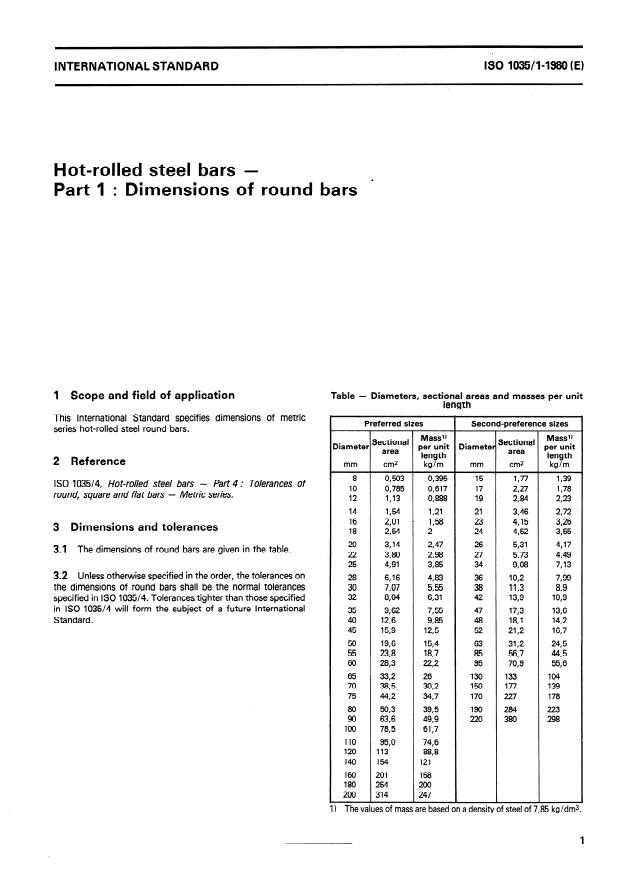
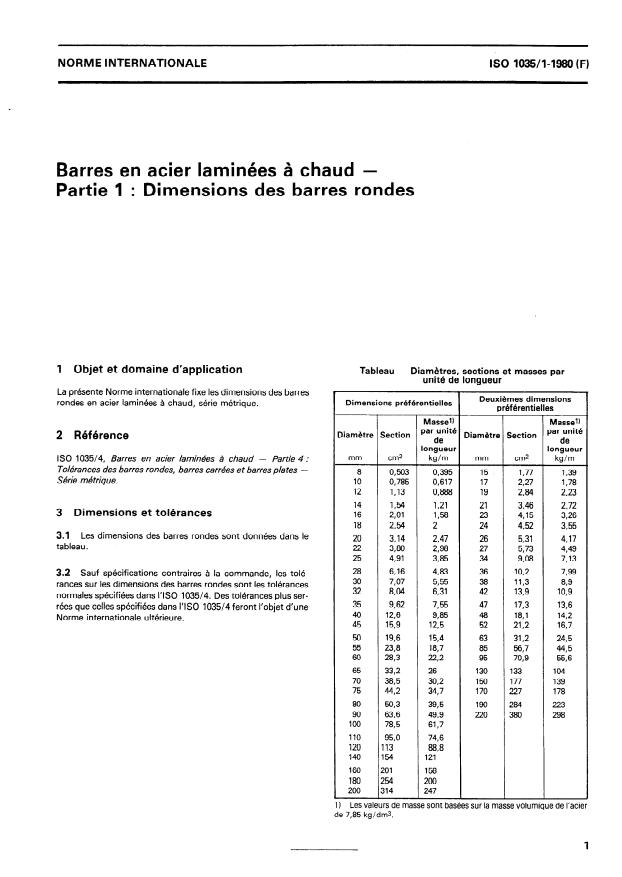
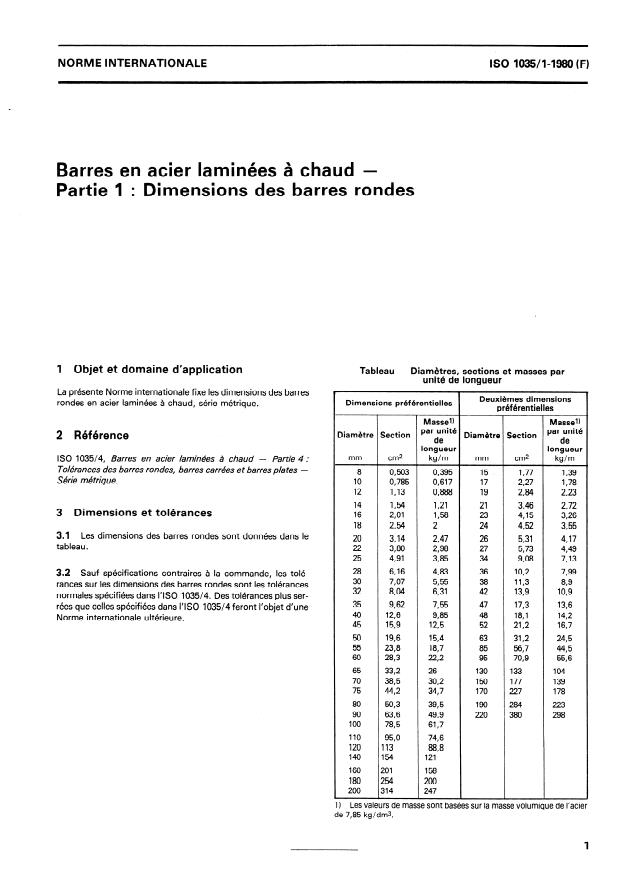
Specifies dimensions and tolerances of metric series hot-rolled steel round bars. A table shows diameters, sectional areas and masses per unit length.
- Status
- Withdrawn
- Publication Date
- 30-Sep-1980
- Technical Committee
- ISO/TC 17/SC 3 - Steels for structural purposes
- Drafting Committee
- ISO/TC 17/SC 3 - Steels for structural purposes
- Current Stage
- 9599 - Withdrawal of International Standard
- Start Date
- 11-May-2026
- Completion Date
- 29-Aug-2026
Buy Documents

ISO 1035-1:1980 - Hot-rolled steel bars — Part 1: Dimensions of round bars Released:10/1/1980

ISO 1035-1:1980 - Barres en acier laminées a chaud — Partie 1: Dimensions des barres rondes Released:10/1/1980

ISO 1035-1:1980 - Barres en acier laminées a chaud — Partie 1: Dimensions des barres rondes Released:10/1/1980
Overview
ISO 1035-1:1980 - Hot-rolled steel bars - Part 1: Dimensions of round bars specifies the metric preferred and second‑preference sizes, sectional areas and masses per unit length for hot‑rolled steel round bars. The standard provides a tabulated set of diameters and corresponding sectional areas and masses (values are based on a steel density of 7.85 kg/dm³, as stated in the document). Unless otherwise ordered, dimensional tolerances follow the normative tolerances referenced in ISO 1035-4.
Key topics
- Metric preferred and second‑preference sizes for hot‑rolled round bars (diameters listed in the standard’s table).
- Tabulated data showing diameter, sectional area and mass per unit length for each nominal size.
- Tolerances: normal tolerances on dimensions are specified by ISO 1035-4 and apply unless tighter tolerances are requested in the order.
- Basis for mass values: masses in the table are calculated using a steel density of 7.85 kg/dm³ (as noted in the standard).
- Scope boundaries: applies specifically to hot‑rolled metric round bars; it is a technical revision that supersedes earlier IS0 Recommendation R 1035/1-1969.
Sample entries from the ISO 1035‑1 table (illustrative):
- 8 mm - area 0.503 cm² - mass 0.395 kg/m
- 10 mm - area 0.785 cm² - mass 0.617 kg/m
- 20 mm - area 3.14 cm² - mass 2.47 kg/m
- 50 mm - area 19.6 cm² - mass 15.4 kg/m
- 100 mm - area 78.5 cm² - mass 61.7 kg/m
- 200 mm - area 314 cm² - mass 247 kg/m
Applications
ISO 1035‑1 is used by:
- Steel producers and mills for defining and producing standard hot‑rolled round bar sizes.
- Procurement and purchasing teams specifying material sizes and mass for orders and cost estimation.
- Structural and mechanical engineers for material selection, mass calculations and design checks.
- Manufacturers, fabricators and machinists who need standardized diameters and mass per metre for inventory, cutting and process planning.
- BIM/CAD libraries and material databases to ensure consistent sizing and weight data across projects.
Practical benefits include accurate weight estimation, streamlined procurement, clearer specification of tolerances, and improved interchangeability of steel round bars.
Related standards
- ISO 1035-4 - Tolerances of round, square and flat bars (normative reference for dimensional tolerances in ISO 1035‑1).
- ISO 1035 series - other parts cover different product requirements and tolerances for hot‑rolled bars.
Relations
- Effective Date
- 25-Aug-2026
- Effective Date
- 25-Aug-2026
- Effective Date
- 25-Aug-2026
- Effective Date
- 01-Jul-2026
- Effective Date
- 01-Jun-2024
Buy Documents
ISO 1035-1:1980 - Hot-rolled steel bars — Part 1: Dimensions of round bars Released:10/1/1980
ISO 1035-1:1980 - Barres en acier laminées a chaud — Partie 1: Dimensions des barres rondes Released:10/1/1980
ISO 1035-1:1980 - Barres en acier laminées a chaud — Partie 1: Dimensions des barres rondes Released:10/1/1980
Get Certified
Connect with accredited certification bodies for this standard

Element Materials Technology
Materials testing and product certification.

Inštitut za kovinske materiale in tehnologije
Institute of Metals and Technology. Materials testing, metallurgical analysis, NDT.
Sponsored listings
Frequently Asked Questions
ISO 1035-1:1980 is a standard published by the International Organization for Standardization (ISO). Its full title is "Hot-rolled steel bars — Part 1: Dimensions of round bars". This standard covers: Specifies dimensions and tolerances of metric series hot-rolled steel round bars. A table shows diameters, sectional areas and masses per unit length.
Specifies dimensions and tolerances of metric series hot-rolled steel round bars. A table shows diameters, sectional areas and masses per unit length.
ISO 1035-1:1980 is classified under the following ICS (International Classification for Standards) categories: 77.140.60 - Steel bars and rods. The ICS classification helps identify the subject area and facilitates finding related standards.
ISO 1035-1:1980 has the following relationships with other standards: It is inter standard links to EN 13574:2001, EN ISO 4957:1999, EN ISO 4957:2018, EN ISO 20650:2026, ISO 1035:2026. Understanding these relationships helps ensure you are using the most current and applicable version of the standard.
ISO 1035-1:1980 is available in PDF format for immediate download after purchase. The document can be added to your cart and obtained through the secure checkout process. Digital delivery ensures instant access to the complete standard document.
Standards Content (Sample)
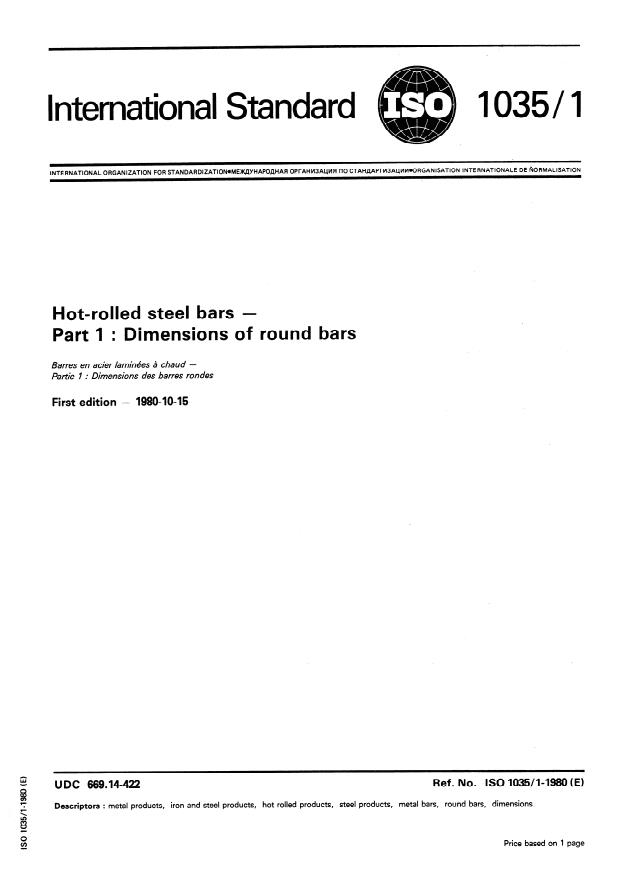
International Standard
~~ _ ~~
INTERNATIONAL ORGANIZATION FOR STANDARDIZATIONWlEIKAYHAPO~HAR OPTAHl43AL&lR l-l0 CTAH~PTM3ALW.ORGANlSATlON INTERNATIONALE DE bJORMALISATION
Hot-rolled steel bars -
Part 1 I Dimensions of round bars
Barres en acier laminkes si chaud -
Partie 1 : Dimensions des barres rondes
First edition - 198O-lo-15
UDC 669.14422
Ref. No. IS0 1035/l-1980 (E)
Descriptors : metal products, iron and steel products, hot rolled products, steel products, metal bars, round bars, dimensions.
Price based on 1 page
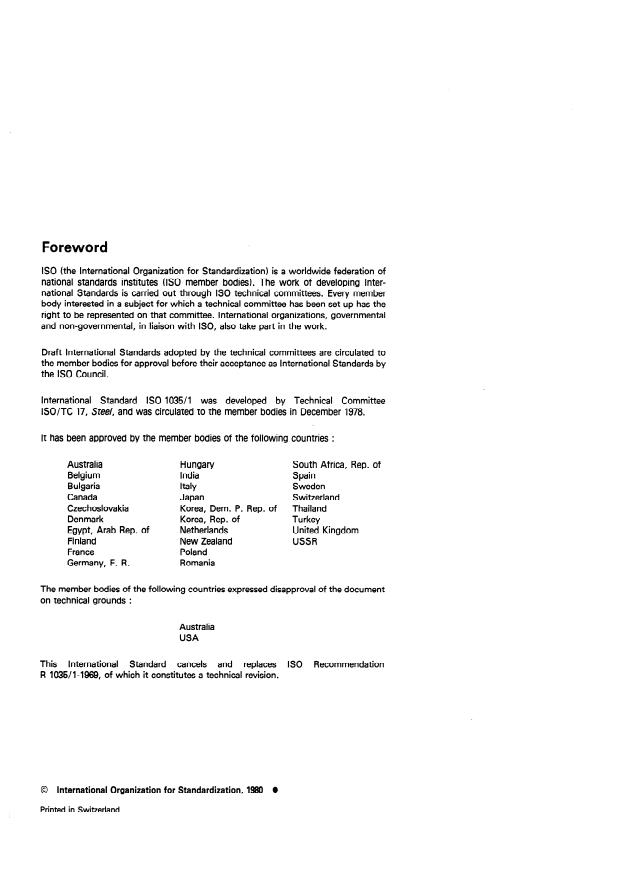
Foreword
IS0 (the International Organization for Standardization) is a worldwide federation of
national standards institutes (IS0 member bodies). The work of developing Inter-
national Standards is carried out through IS0 technical committees. Every member
body interested in a subject for which a technical committee has been set up has the
right to be represented on that committee. International organizations, governmental
and non-governmental, in liaison with ISO, also take part in the work.
Draft International Standards adopted by the technical committees are circulated to
the member bodies for approval before their acceptance as International Standards by
the IS0 Council.
International Standard IS0 1035/l was developed by Technical Committee
ISO/TC 17, Steel, and was circulated to the member bodies in December 1978.
It has been approved by the member bodies of the following countries :
Australia Hungary South Africa, Rep. of
Belgium India Spain
Bulgaria Italy Sweden
Canada Japan Switzerland
Czechoslovakia Korea, Dem. P. Rep. of Thailand
Denmark Korea, Rep. of Turkey
Egypt, Arab Rep. of Netherlands United Kingdom
Finland New Zealand USSR
France Poland
Germany, F. R. Romania
The member bodies of the following countries expressed disapproval of the document
on technical
grounds :
Australia
USA
This International Standard cancels and replaces IS0 Recommendation
R 1035/l-1969,
...
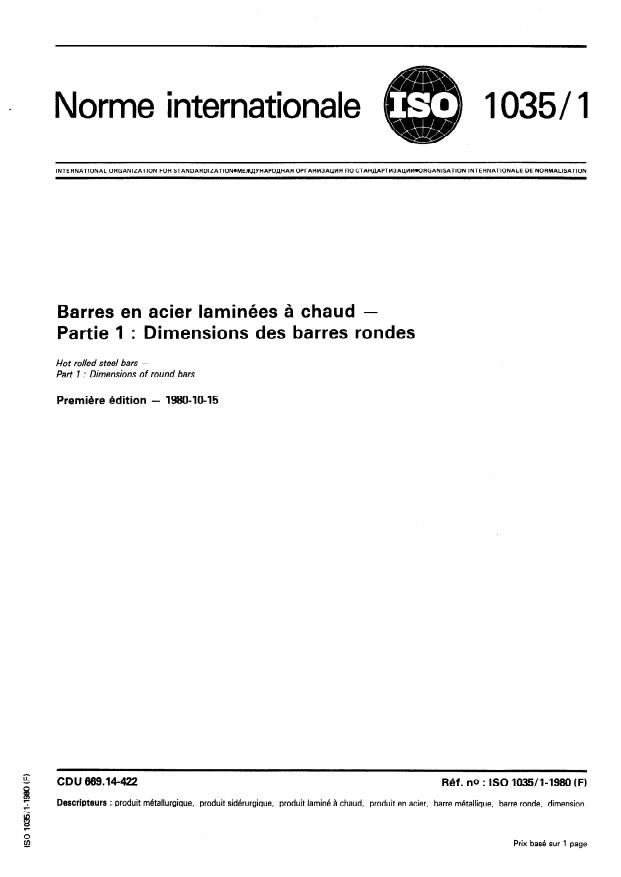
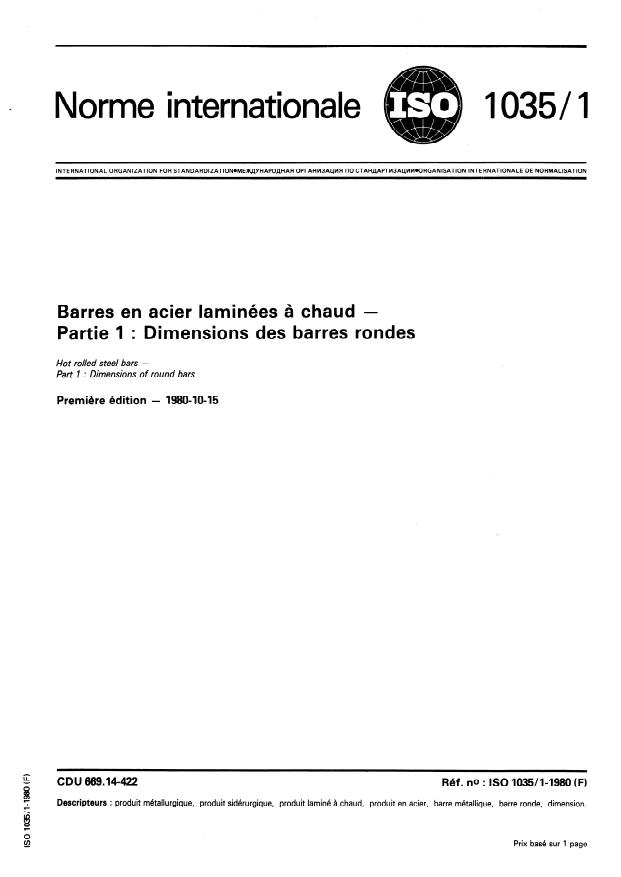
Norme internationale
INTERNATIONAL ORGANIZATION FOR STANDARDIZATION.ME~YHAPO~HAR OPTAHMJALWI l-l0 CTAH&VWl3A~MbWORGANISATION INTERNATIONALE DE NORMALISATION
Barres en acier laminées à chaud -
Partie 1 I Dimensions des barres rondes
Ho t-rolled steel bars -
Part I : Dimensions of round bars
Première édition - 1980-10-15
îî
-
CDU 669.14422 R6f. n* : ISO 1035/1-1980 (FI
F
I Descripteurs : produit mtltallurgique, produit sidérurgique, produit laminé à chaud, produit en acier, barre métallique, barre ronde, dimension.
v-
Prix basé sur 1 page
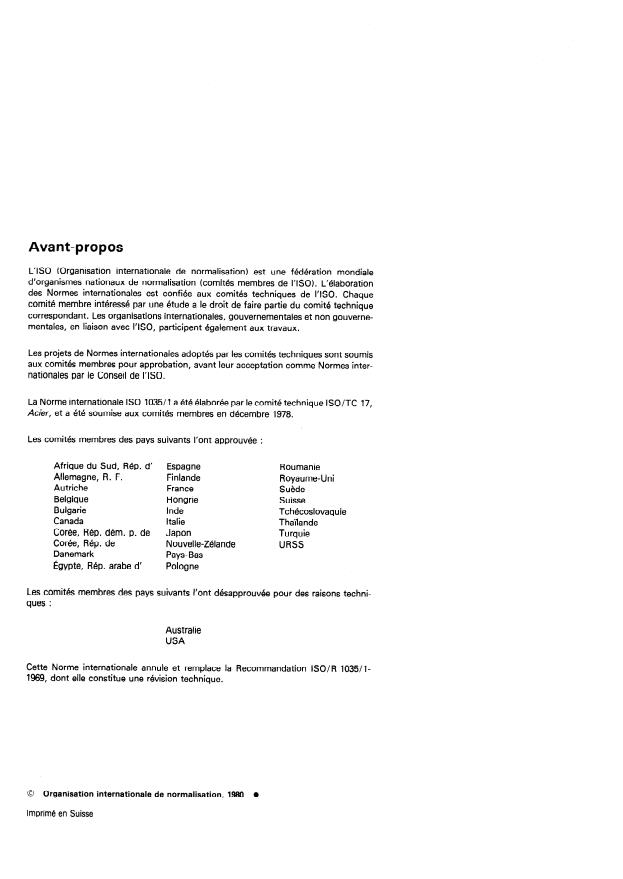
Avant-propos
L’ISO (Organisation internationale de normalisation) est une fédération mondiale
d’organismes nationaux de normalisation (comités membres de I’ISO). L’élaboration
des Normes internationales est confiée aux comités techniques de I’ISO. Chaque
comité membre intéressé par une étude a le droit de faire partie du comité technique
correspondant. Les organisations internationales, gouvernementales et non gouverne-
mentales, en liaison avec I’ISO, participent également aux travaux.
Les projets de Normes internationales adoptés par les comités techniques sont soumis
aux comités membres pour approbation, avant leur acceptation comme Normes inter-
nationales par le Conseil de I’ISO.
La Norme internationale ISO 1035/1 a été élaborée par le comité technique ISO/TC 17,
Acier, et a été soumise aux comités membres en décembre 1978.
Les comités membres des pays suivants l’ont approuvée :
Afrique du Sud, Rép. d’ Espagne Roumanie
Allemagne, R. F. Finlande
Royaume-Uni
Au triche France Suède
Belgique Hongrie Suisse
Bulgarie Inde Tchécoslovaquie
Canada Italie Thailande
Corée, Rép. dem. p. de Japon Turquie
Corée, Rép. de Nouvelle-Zélande URSS
Danemark
Pays-Bas
Égypte, Rép. arabe d’ Pologne
Les comités membres des pays suivants l’ont désapprouvée pour des raisons techni-
ques :
Australie
USA
Cette Norme internationale annule et remplace la Recommandation ISO/R 1035/1-
1969, dont elle constitue une révision technique.
0 Organisat
...
Norme internationale
INTERNATIONAL ORGANIZATION FOR STANDARDIZATION.ME~YHAPO~HAR OPTAHMJALWI l-l0 CTAH&VWl3A~MbWORGANISATION INTERNATIONALE DE NORMALISATION
Barres en acier laminées à chaud -
Partie 1 I Dimensions des barres rondes
Ho t-rolled steel bars -
Part I : Dimensions of round bars
Première édition - 1980-10-15
îî
-
CDU 669.14422 R6f. n* : ISO 1035/1-1980 (FI
F
I Descripteurs : produit mtltallurgique, produit sidérurgique, produit laminé à chaud, produit en acier, barre métallique, barre ronde, dimension.
v-
Prix basé sur 1 page
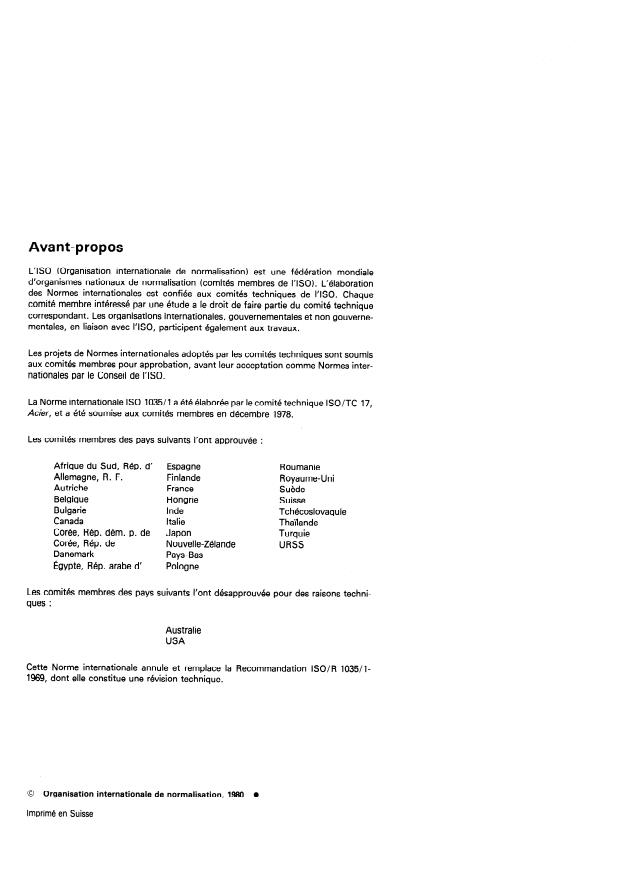
Avant-propos
L’ISO (Organisation internationale de normalisation) est une fédération mondiale
d’organismes nationaux de normalisation (comités membres de I’ISO). L’élaboration
des Normes internationales est confiée aux comités techniques de I’ISO. Chaque
comité membre intéressé par une étude a le droit de faire partie du comité technique
correspondant. Les organisations internationales, gouvernementales et non gouverne-
mentales, en liaison avec I’ISO, participent également aux travaux.
Les projets de Normes internationales adoptés par les comités techniques sont soumis
aux comités membres pour approbation, avant leur acceptation comme Normes inter-
nationales par le Conseil de I’ISO.
La Norme internationale ISO 1035/1 a été élaborée par le comité technique ISO/TC 17,
Acier, et a été soumise aux comités membres en décembre 1978.
Les comités membres des pays suivants l’ont approuvée :
Afrique du Sud, Rép. d’ Espagne Roumanie
Allemagne, R. F. Finlande
Royaume-Uni
Au triche France Suède
Belgique Hongrie Suisse
Bulgarie Inde Tchécoslovaquie
Canada Italie Thailande
Corée, Rép. dem. p. de Japon Turquie
Corée, Rép. de Nouvelle-Zélande URSS
Danemark
Pays-Bas
Égypte, Rép. arabe d’ Pologne
Les comités membres des pays suivants l’ont désapprouvée pour des raisons techni-
ques :
Australie
USA
Cette Norme internationale annule et remplace la Recommandation ISO/R 1035/1-
1969, dont elle constitue une révision technique.
0 Organisat
...