


ISO 14400:2021
(Main)Road vehicles - Wheels and rims - Use, general maintenance and safety requirements and out-of-service conditions
Road vehicles - Wheels and rims - Use, general maintenance and safety requirements and out-of-service conditions
This document specifies requirements for the use, general maintenance and safety of wheels and rims including multi-piece wheels and rims. This document defines their out-of-service conditions, such as cracked, worn and bent wheels and rim components. It is applicable to wheels intended for use on road as defined in ISO 3833 and off road vehicles. This document does not include mopeds and motorcycles.
Véhicules routiers — Roues et jantes — Exigences en matière d'utilisation, de maintenance générale et de sécurité, et conditions de mise hors service
General Information
Relations
Overview
ISO 14400:2021 - Road vehicles - Wheels and rims - Use, general maintenance and safety requirements and out-of-service conditions - provides guidance and mandatory requirements to ensure the safe use and servicing of vehicle wheels and rims, including multi-piece wheels. The standard applies to road vehicles (as defined in ISO 3833) and off‑road vehicles, and it explicitly excludes mopeds and motorcycles. It covers safe mounting/removal, lubrication, fastener torquing, inspection, and defined out-of-service conditions (cracks, wear, deformation, corrosion).
Key topics and requirements
- Scope and terminology: Uses terms from ISO 3911 (vocabulary, designation and marking).
- Use & general maintenance: Identification of wheel parts, correct mating of wheel centre to hub and brake parts, and the use of neutral non‑aggressive mounting pastes or liquids.
- Mounting and removal:
- Performed by trained personnel using correct tools.
- Special rules for multi-piece rims (correct positioning of lock rings, O‑rings, no hammer corrections).
- Inflate tyres only in a safety cage or with safety chains; avoid standing in predicted trajectories of explosive separation.
- Studs and nuts: Correct studs/nuts for each wheel; tighten in the manufacturer’s specified cross‑sequence and to the specified torque (verify torque after ~50 km and periodically).
- General safety requirements: Do not repair critical wheel components by welding or adding material; inspect for fractures, cracks, deformation, heavy wear, corrosion.
- Out‑of‑service conditions: Detailed tables and figures list typical failures (bolt‑hole cracks, bead‑seat cracks, rim‑gutter cracks, lock‑ring cracks, excessive run‑out, corrosion, etc.) and probable causes-components with these conditions must be removed from service.
Practical applications
- Use ISO 14400:2021 as a reference for developing workshop procedures, inspection checklists, maintenance schedules, and safety training for wheel handling.
- Integrate the standard into fleet maintenance programs to reduce wheel‑related failures and servicing accidents.
- Apply the out‑of‑service criteria during pre‑trip inspections, wheel remanufacture quality checks, and aftermarket wheel acceptance.
Who should use this standard
- Vehicle manufacturers and chassis suppliers
- Fleet operators and heavy‑vehicle maintenance managers
- Service and repair workshops, tyre fitters and wheel technicians
- Safety inspectors, regulatory bodies, and quality auditors
- Wheel and rim manufacturers and remanufacturers
Related standards
- ISO 3911 - Wheels and rims for pneumatic tyres: vocabulary, designation and marking (normative reference)
- ISO 3833 - Defines vehicle categories referenced in the scope
Keywords: ISO 14400:2021, wheels and rims standard, wheel maintenance, wheel safety, out-of-service conditions, multi-piece wheels, wheel mounting, wheel inspection, vehicle maintenance.
Standards Content (Sample)
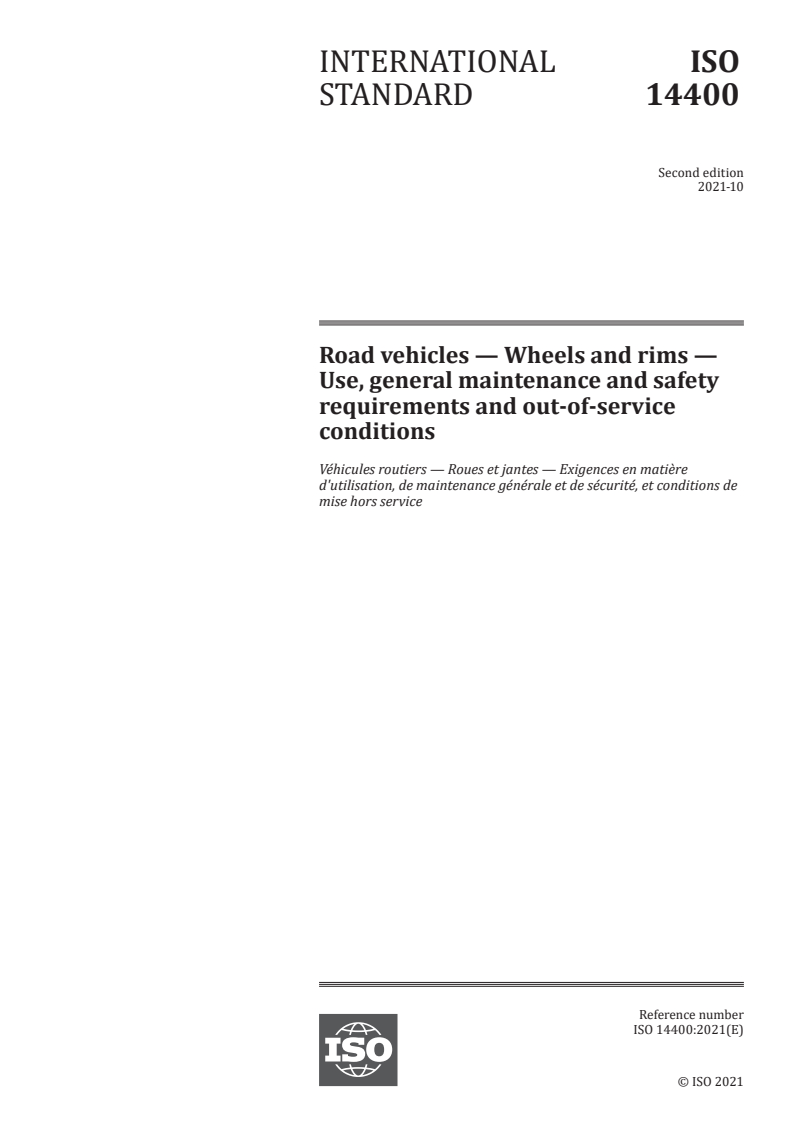
INTERNATIONAL ISO
STANDARD 14400
Second edition
2021-10
Road vehicles — Wheels and rims —
Use, general maintenance and safety
requirements and out-of-service
conditions
Véhicules routiers — Roues et jantes — Exigences en matière
d'utilisation, de maintenance générale et de sécurité, et conditions de
mise hors service
Reference number
© ISO 2021
All rights reserved. Unless otherwise specified, or required in the context of its implementation, no part of this publication may
be reproduced or utilized otherwise in any form or by any means, electronic or mechanical, including photocopying, or posting on
the internet or an intranet, without prior written permission. Permission can be requested from either ISO at the address below
or ISO’s member body in the country of the requester.
ISO copyright office
CP 401 • Ch. de Blandonnet 8
CH-1214 Vernier, Geneva
Phone: +41 22 749 01 11
Email: copyright@iso.org
Website: www.iso.org
Published in Switzerland
ii
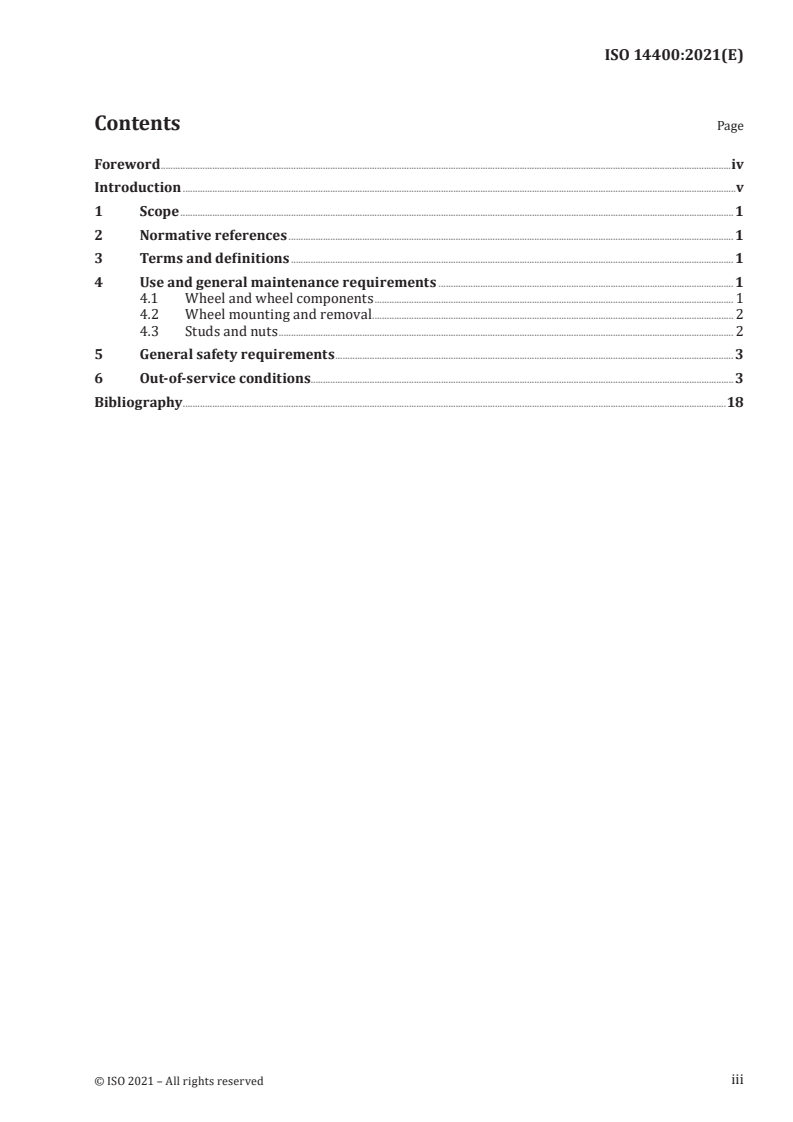
Contents Page
Foreword .iv
Introduction .v
1 Scope . 1
2 Normative references . 1
3 Terms and definitions . 1
4 Use and general maintenance requirements . 1
4.1 Wheel and wheel components . 1
4.2 Wheel mounting and removal . . 2
4.3 Studs and nuts . 2
5 General safety requirements . 3
6 Out-of-service conditions.3
Bibliography .18
iii
Foreword
ISO (the International Organization for Standardization) is a worldwide federation of national standards
bodies (ISO member bodies). The work of preparing International Standards is normally carried out
through ISO technical committees. Each member body interested in a subject for which a technical
committee has been established has the right to be represented on that committee. International
organizations, governmental and non-governmental, in liaison with ISO, also take part in the work.
ISO collaborates closely with the International Electrotechnical Commission (IEC) on all matters of
electrotechnical standardization.
The procedures used to develop this document and those intended for its further maintenance are
described in the ISO/IEC Directives, Part 1. In particular, the different approval criteria needed for the
different types of ISO documents should be noted. This document was drafted in accordance with the
editorial rules of the ISO/IEC Directives, Part 2 (see www.iso.org/directives).
Attention is drawn to the possibility that some of the elements of this document may be the subject of
patent rights. ISO shall not be held responsible for identifying any or all such patent rights. Details of
any patent rights identified during the development of the document will be in the Introduction and/or
on the ISO list of patent declarations received (see www.iso.org/patents).
Any trade name used in this document is information given for the convenience of users and does not
constitute an endorsement.
For an explanation of the voluntary nature of standards, the meaning of ISO specific terms and
expressions related to conformity assessment, as well as information about ISO's adherence to
the World Trade Organization (WTO) principles in the Technical Barriers to Trade (TBT), see
www.iso.org/iso/foreword.html.
This document was prepared by Technical Committee ISO/TC 22, Road vehicles, Subcommittee SC 33,
Vehicle dynamics and chassis components.
This second edition cancels and replaces the first edition (ISO 14400:2005), which has been technically
revised.
The main changes are as follows:
— added off-road vehicles to the scope since the sections apply equally to that as well as road vehicles.
Any feedback or questions on this document should be directed to the user’s national standards body. A
complete listing of these bodies can be found at www.iso.org/members.html.
iv
Introduction
The purpose of this document is to ensure the safe operation of vehicles. The wheel is a highly stressed
component of the vehicle that in service may be subject to extreme forces. Therefore, it is absolutely
necessary to handle these parts with care and to pay particular attention to their mounting, removal
and maintenance in order to ensure safe operations and to prevent servicing accidents.
v
INTERNATIONAL STANDARD ISO 14400:2021(E)
Road vehicles — Wheels and rims — Use, general
maintenance and safety requirements and out-of-service
conditions
1 Scope
This document specifies requirements for the use, general maintenance and safety of wheels and rims
including multi-piece wheels and rims. This document defines their out-of-service conditions, such as
cracked, worn and bent wheels and rim components. It is applicable to wheels intended for use on road
as defined in ISO 3833 and off road vehicles. This document does not include mopeds and motorcycles.
2 Normative references
The following documents are referred to in the text in such a way that some or all of their content
constitutes requirements of this document. For dated references, only the edition cited applies. For
undated references, the latest edition of the referenced document (including any amendments) applies.
ISO 3911, Wheels and rims for pneumatic tyres — Vocabulary, designation and marking
3 Terms and definitions
For the purposes of this document, the terms and definitions given in ISO 3911 apply.
ISO and IEC maintain terminology databases for use in standardization at the following addresses:
— ISO Online browsing platform: available at https:// www .iso .org/ obp
— IEC Electropedia: available at https:// www .electropedia .org/
4 Use and general maintenance requirements
WARNING — On multi-piece rims, the use of the wrong ring components can result in catastrophic
wheel failure.
4.1 Wheel and wheel components
Wheels or parts of wheels which cannot be identified shall not be used even if they seem to have the
correct functions and the identical dimensions. The characteristics of the wheel centre shall correspond
exactly to vehicle parts, especially the axle hub and the brake, in order to guarantee a proper fitting and
an effective load transmission.
A neutral non-aggressive mounting paste or liquid shall be used to lubricate the tyre beads. The hub,
studs, nuts and the wheel attachment face shall be carefully cleaned. In the case of multi-piece wheels,
all contact surfaces shall be cleaned.
Inspect parts for out-of-service conditions, see Clause 6. If cleaning does not restore the original
condition for the mating surfaces or if the parts have any of the conditions described in Clause 6, the
parts shall be replaced.
4.2 Wheel mounting and removal
Mounting and removal of wheels shall be carried out by trained personnel only. Only the correct tools
shall be used to carry out the various operations.
On multi-piece rims, prior to inflation of the tyre, the correct positioning of the lock ring, the loose
flange ring and rubber O-rings, or sealing rings if applicable, shall be carefully checked, always avoiding
any correction by means of a hammer. In the case of incorrect positioning, all the air shall be let out of
tyre and the whole mounting procedure repeated.
When inflating tyres, the wheel shall be placed in a safety cage or else safety chains shall be put round
the wheel. The operator shall not stay in the near dangerous areas or trajectories. Trajectory means
any potential path or route that a rim wheel component can travel during an explosive separation, or
the
...
Frequently Asked Questions
ISO 14400:2021 is a standard published by the International Organization for Standardization (ISO). Its full title is "Road vehicles - Wheels and rims - Use, general maintenance and safety requirements and out-of-service conditions". This standard covers: This document specifies requirements for the use, general maintenance and safety of wheels and rims including multi-piece wheels and rims. This document defines their out-of-service conditions, such as cracked, worn and bent wheels and rim components. It is applicable to wheels intended for use on road as defined in ISO 3833 and off road vehicles. This document does not include mopeds and motorcycles.
This document specifies requirements for the use, general maintenance and safety of wheels and rims including multi-piece wheels and rims. This document defines their out-of-service conditions, such as cracked, worn and bent wheels and rim components. It is applicable to wheels intended for use on road as defined in ISO 3833 and off road vehicles. This document does not include mopeds and motorcycles.
ISO 14400:2021 is classified under the following ICS (International Classification for Standards) categories: 43.040.50 - Transmissions, suspensions. The ICS classification helps identify the subject area and facilitates finding related standards.
ISO 14400:2021 has the following relationships with other standards: It is inter standard links to ISO 14400:2005. Understanding these relationships helps ensure you are using the most current and applicable version of the standard.
You can purchase ISO 14400:2021 directly from iTeh Standards. The document is available in PDF format and is delivered instantly after payment. Add the standard to your cart and complete the secure checkout process. iTeh Standards is an authorized distributor of ISO standards.
Die ISO 14400:2021 ist ein umfassendes Dokument, das klare Anforderungen für die Nutzung, die allgemeine Wartung und die Sicherheitsstandards von Rädern und Felgen festlegt. Diese Norm befasst sich insbesondere mit mehrteiligen Rädern und Felgen und definiert wichtige Ausfallbedingungen, wie z.B. Risse, Abnutzung und verbogene Rad- und Felgenkomponenten. Ein wesentlicher Vorteil dieser Norm ist ihre Anwendbarkeit sowohl für Straßenfahrzeuge als auch für Offroad-Fahrzeuge, was ihre Relevanz in verschiedenen Fahrzeugkategorien erhöht. Sie legt spezifische Sicherheitsanforderungen fest, die dazu beitragen, die Sicherheit von Fahrern und Fahrzeugen zu gewährleisten. Die präzisen Vorgaben zur Wartung und Nutzung von Rädern und Felgen unterstützen nicht nur die Lebensdauer der Komponenten, sondern auch die allgemeine Leistungsfähigkeit der Fahrzeuge. Darüber hinaus ist die Norm benutzerfreundlich und bietet klare Leitlinien, die insbesondere für Mechaniker und Fahrzeugbesitzer von Bedeutung sind. Sie ermöglicht eine einfache Identifizierung von Verschleißerscheinungen und Ausfallbedingungen, was eine proaktive Wartung fördert und die Sicherheit auf der Straße erhöht. Die ISO 14400:2021 hat daher eine erhebliche Bedeutung für die gesamte Automobilindustrie, da sie einen strukturierten Rahmen für die Handhabung von Rädern und Felgen bietet. Ihre konsequente Anwendung kann dazu beitragen, Unfälle zu minimieren, die durch Unkenntnis oder Vernachlässigung der Wartungsanforderungen verursacht werden könnten.
La norme ISO 14400:2021 s'avère essentielle dans le secteur des véhicules routiers, en abordant les roues et les jantes. Son champ d'application est clairement défini, englobant non seulement l'utilisation, mais également l'entretien général et les exigences de sécurité. Cette norme est particulièrement pertinente pour les roues destinées à un usage sur route, conformément à la définition établie par la norme ISO 3833, tout en prenant en compte les véhicules tout terrain. Parmi les points forts de la norme ISO 14400:2021, on trouve la clarté des exigences relatives à l'entretien, qui contribuent à maximiser la sécurité des utilisateurs. La norme identifie également les conditions déclassées des roues et des composants de jantes, telles que les roues fissurées, usées ou déformées. Ce niveau de détail permet non seulement une compréhension approfondie des risques associés à l'utilisation de roues endommagées, mais facilite également la mise en œuvre de pratiques de maintenance rigoureuses. La pertinence de l'ISO 14400:2021 réside dans son application dédiée aux véhicules routiers, excluant les cyclomoteurs et les motos. Cela permet d'affiner son approche et de se concentrer sur les exigences spécifiques à un large éventail de véhicules, tout en assurant la sécurité et la fiabilité des roues et des jantes. Ainsi, cette norme apparaît comme un document incontournable pour les fabricants et les utilisateurs souhaitant garantir non seulement la conformité réglementaire, mais aussi la performance et la sécurité de leurs véhicules.
ISO 14400:2021 は、道路車両のホイールおよびリムに関する重要な標準であり、その適用範囲は非常に広いです。この文書は、ホイールとリム、特に多部品ホイールおよびリムの使用、一般的なメンテナンス、安全要件について規定しています。また、その使用停止条件として、亀裂、摩耗、曲がりといったホイールおよびリムコンポーネントの状態を定義しています。 この標準の強みは、道路用およびオフロード車両に対する明確な要求事項を提供している点です。ISO 3833で定義された道路車両のホイールに特化しているため、業界の専門家にとって非常に信頼性の高い参照となります。特に、業界全体での安全性向上につながるリムおよびホイールのメンテナンス方法に関する指針を提供していることは、ドライバーや整備士にとっても大きな利益となります。 さらに、使用停止条件の明確な定義は、ホイールおよびリムの劣化を把握し、適切な処置を講じるための重要な手助けとなります。このように、ISO 14400:2021は、ロードビークルに関するホイールとリムの安全性を確保するための基準として、非常に関連性が高く、業界全体において重要な役割を果たしています。
The ISO 14400:2021 standard on "Road vehicles - Wheels and rims - Use, general maintenance and safety requirements and out-of-service conditions" plays a critical role in the automotive industry by outlining essential guidelines for the proper use and upkeep of wheels and rims, including multi-piece varieties. The comprehensive scope of the document makes it applicable to a wide range of vehicles, specifically catering to both road and off-road applications, thereby ensuring a broad impact across different vehicle categories-though it notably excludes mopeds and motorcycles. One of the significant strengths of ISO 14400:2021 is its emphasis on safety. By defining out-of-service conditions such as cracked, worn, and bent wheels and rim components, this standard provides a clear framework for identifying when wheels and rims no longer meet safety requirements. This is vital for preventing accidents and ensuring the safety of drivers and passengers alike. Furthermore, the standard's structured approach to general maintenance outlines best practices, which can aid vehicle operators in prolonging the lifespan of their wheel and rim systems. The specificity in addressing multi-piece wheels adds depth to the guidance, as these components often require unique considerations and maintenance strategies. The relevance of ISO 14400:2021 cannot be overstated, especially considering the increasing focus on vehicle safety and performance in the automotive sector. Compliance with this standard aids manufacturers, maintenance professionals, and vehicle owners in meeting safety regulations while promoting best practices in wheel and rim management. Ultimately, ISO 14400:2021 serves as an essential document that supports a safer and more efficient automotive environment through its robust guidelines on the use, maintenance, and identification of out-of-service conditions for wheels and rims.
ISO 14400:2021 표준은 도로 차량의 바퀴와 림에 대한 사용, 일반 유지 관리 및 안전 요구 사항을 명확하게 규정하고 있습니다. 이 표준의 범위는 다중 조각 바퀴와 림을 포함한 다양한 종류의 바퀴와 림에 대한 요구 사항을 다루며, 이러한 요소들이 도로에서 사용되는 것을 기준으로 하고 있습니다. ISO 3833에서 정의한 도로 차량 및 오프로드 차량에도 적용됩니다. 특히, 이 표준은 바퀴와 림의 부품이 금이 가거나 마모되거나 휘어졌을 때의 사용 불능 상태를 명확하게 정의하고 있어, 도로 안전을 확보하는 데 중요한 기준이 됩니다. ISO 14400:2021의 주요 강점은 다양한 차량 유형에 맞춘 포괄적인 유지 관리 지침을 제공함으로써, 바퀴와 림의 성능 및 안전성을 높일 수 있다는 점입니다. 이를 통해 차량 소유자 및 운영자들은 정기적인 점검과 유지 관리를 통해 사고를 예방하고, 차량의 전반적인 안정성을 향상시킬 수 있습니다. 또한, 바퀴와 림의 안전성을 보장하기 위해 필요한 조건을 명시함으로써, 산업 전반에 걸쳐 표준화된 접근 방식을 촉진합니다. 이 문서는 도로에서의 바퀴와 림의 적절한 유지 관리 및 사용에 대한 명확하고 유익한 지침을 제공하여, 관련 업계 및 사용자들에게 매우 적절하고 중요한 자원으로 자리잡고 있습니다. 이는 모든 차량 운영자가 차량 안전을 극대화하는 데 필수적인 정보로 작용할 것입니다. 따라서 ISO 14400:2021은 도로 차량의 안전한 운행을 위한 중추적인 표준이라 할 수 있습니다.
Questions, Comments and Discussion
Ask us and Technical Secretary will try to provide an answer. You can facilitate discussion about the standard in here.
Loading comments...