

ISO/DTS 5112
(Main)Road vehicles — Guidelines for auditing cybersecurity engineering
- Abstract
In addition to the guidelines in ISO 19011, this document provides guidelines to organizations that contribute to the achievement of road vehicle cybersecurity throughout the supply chain on: — managing an audit programme for a cybersecurity management system (CSMS); — conducting organizational CSMS audits; — competencies of CSMS auditors; and — providing evidence during CSMS audits. Elements of the CSMS are based on the processes described in ISO/SAE 21434. This document is applicable to those needing to understand or conduct internal or external audits of a CSMS or to manage a CSMS audit programme. This document does not provide guidelines on cybersecurity assessments.
- Status
- Not Published
- Technical Committee
- ISO/TC 22/SC 32 - Electrical and electronic components and general system aspects
- Drafting Committee
- ISO/TC 22/SC 32/WG 11 - Cybersecurity
- Current Stage
- 5020 - FDIS ballot initiated: 2 months. Proof sent to secretariat
- Start Date
- 28-Aug-2026
- Completion Date
- 28-Aug-2026
Buy Documents

ISO/DTS 5112 - Road vehicles — Guidelines for auditing cybersecurity engineering
REDLINE ISO/DTS 5112 - Road vehicles — Guidelines for auditing cybersecurity engineering
ISO/DTS 5112 is an ISO Technical Specification for road vehicles. It gives guidelines for auditing cybersecurity engineering across the automotive supply chain, covering CSMS audit programmes, organizational CSMS audits, auditor competence, and the evidence to review during those audits.
It is written for organizations that need to plan, conduct, or receive internal, second-party, or third-party CSMS audits. The document is based on ISO 19011 for auditing methods and on ISO/SAE 21434 for the cybersecurity processes and objectives used as audit criteria.
What does ISO/DTS 5112 specify?
ISO/DTS 5112 specifies how to audit a cybersecurity management system (CSMS) in the road vehicle domain. It adds automotive-specific guidance to ISO 19011 and explicitly excludes cybersecurity assessments.
The document is organized into:
- Clause 1 Scope
- Clause 2 Normative references
- Clause 3 Terms and definitions
- Clause 4 Principles of auditing
- Clause 5 Managing an audit programme
- Clause 6 Conducting an audit
- Clause 7 Competence and evaluation of auditors
- Annex A and Annex B, both informative
| Annex | What it covers |
|---|---|
| Annex A | An audit questionnaire mapped to ISO/SAE 21434 objectives, with example evidence |
| Annex B | Auditor competences for CSMS auditing, including knowledge areas and ways to demonstrate competence |
In practice, the document tells an organization what to organize before an audit, what to check during the audit, and what competence the audit team needs.
What are the key requirements of ISO/DTS 5112?
Audit programme management
Clause 5 adapts the ISO 19011 audit programme model to CSMS audits. The programme should be built around cybersecurity objectives, the organization’s place in the supply chain, and the risks linked to the auditee’s products and processes.
- Clause 5.2 says audit programme objectives can include checking achievement of ISO/SAE 21434 objectives, verifying legal and contractual conformity, and evaluating CSMS effectiveness. In practice, this helps a manager define why the audit is being done, not just when.
- Clause 5.4.2 says the programme manager should understand the cybersecurity standards used by the auditee, the relevant automotive processes, and how to map organization-specific processes to the audit criteria. That matters because CSMS audits depend on how the organization actually works.
- Clause 5.4.3 says the audit programme scope can vary with the auditee’s size, its role in the cybersecurity supply chain, and the need to protect cybersecurity-related information. This means the audit plan should match the actual exposure and business context.
Audit planning and evidence
Clause 6 links audit planning to ISO/SAE 21434 objectives and requires attention to confidentiality, access, and the use of evidence.
- Clause 6.3.2 says the audit should be planned using a questionnaire aligned to ISO/SAE 21434 objectives. Annex A provides the example questionnaire, so the audit is anchored in specific cybersecurity topics rather than general management-system questions.
- Clause 6.4.3 and 6.4.4 require agreement on what information will be shared, how communication will work, and how ad hoc changes or missing evidence will be handled. In practice, this is important where suppliers, confidential work products, or controlled environments are involved.
- Clause 6.4.7 allows evidence to come from documented information, observation of cybersecurity processes and methods, and observation of the engineering environment. That means auditors are not limited to paperwork alone.
- Clause 6.4.5 says unavailable confidential evidence should be considered when judging confidence in the findings and reported without exposing sensitive information. This helps keep the audit report usable while protecting restricted data.
Findings, conclusions, and follow-up
Clause 6 also defines how findings are graded and how the overall audit result is decided.
- Clause 6.4.8 grades findings as conformity, minor nonconformity, or major nonconformity based on achievement of objectives. This is practical because the audit is judged by whether cybersecurity objectives are met, not by a numerical score.
- Clause 6.4.9 uses those findings to reach an overall pass, conditional pass, or fail. A conditional pass depends on minor nonconformities not undermining the overall effectiveness of the CSMS.
- Clause 6.4.9 also requires corrective actions after a failed or conditionally passed audit, with root-cause analysis by the auditee. That links the audit to improvement, not just reporting.
- Clauses 6.5 to 6.7 require controlled distribution of the report, agreed treatment of retained notes and confidential information, and follow-up on findings. In practice, this is how the audit is closed and tracked.
Auditor competence
Clause 7 and Annex B focus on who can audit a CSMS and what they need to know.
- Clause 7.2.3 says the audit team should understand automotive technologies, road-vehicle cybersecurity processes, cybersecurity management systems, and ISO/SAE 21434. This matters because the team must judge both management process and technical cybersecurity context.
- Clause 7.2.3.3 also points to knowledge of verification, validation, production, operation, and incident response. That allows the auditor to follow the CSMS across the lifecycle.
- Clause 7.2.1 notes that competence should reflect relevant standards, legal requirements, and dependencies with other management systems such as an information security management system (ISMS) or a software update management system (SUMS).
- Annex B explains how competence can be demonstrated through qualifications, training records, professional development, and audit experience.
What terms does ISO/DTS 5112 define?
- Audit - An examination of a process to determine how far the process objectives are achieved.
- Cybersecurity management system (CSMS) - A risk-based organizational system of processes, responsibilities, and governance used to manage threats to road vehicles.
- Risk - In this document, cybersecurity risk means the effect of uncertainty on road vehicle cybersecurity, expressed through attack feasibility and impact.
- Supply chain - The linked set of organizations that act as customer, supplier, or both, including vehicle developers, component makers, and service providers.
- Cybersecurity assessment - The document uses this term as a separate activity from the CSMS audit, and states that such assessments are outside its scope.
Who uses ISO/DTS 5112?
ISO/DTS 5112 is used by organizations involved in automotive cybersecurity engineering anywhere in the supply chain. That includes OEMs, tier 1 suppliers, tier 2 suppliers, component manufacturers, and service providers.
It is also used by:
- internal audit teams
- second-party auditors working for customers
- third-party auditors, including certification-related audits
- managers of CSMS audit programmes
- organizations involved in auditor training or personnel certification
In practice, these users apply it to plan audit programmes, prepare checklists, assess evidence, judge CSMS performance, and evaluate auditor competence.
What changed in ISO/DTS 5112 from the previous edition?
The foreword states that this document cancels and replaces ISO/PAS 5112:2022 and that it was technically revised. The stated main changes are conversion from a Publicly Available Specification (PAS) to a Technical Specification (TS) and additional modifications, including an adjusted scope.
Which standards are used with ISO/DTS 5112?
ISO/DTS 5112 is built around two main referenced standards:
- ISO 19011:2026, Guidelines for auditing management systems - provides the audit principles and general audit-process framework used throughout the document.
- ISO/SAE 21434:2021, Road vehicles - Cybersecurity engineering - provides the cybersecurity lifecycle processes, objectives, and terms that form the audit criteria.
- ISO 19011:2018, Guidelines for auditing management systems - is also cited in the document’s clause references.
What does the ISO/DTS 5112 document contain?
The document contains audit guidance, not a certification scheme or a cybersecurity assessment method. Its main body combines general audit management with automotive cybersecurity-specific additions for scope setting, evidence handling, findings, conclusions, and competence.
Annex A provides a structured questionnaire mapped to ISO/SAE 21434 objectives. It is meant to help auditors check areas such as cybersecurity management, monitoring, risk assessment, development, post-development activities, and distributed cybersecurity activities.
Annex B summarizes auditor competences by CSMS activity. It also describes knowledge areas such as cybersecurity processes, automotive technology, testing methods, and supply-chain-related cybersecurity risks, together with examples of how competence can be demonstrated.
Relations
- Effective Date
- 16-Aug-2025
Buy Documents
ISO/DTS 5112 - Road vehicles — Guidelines for auditing cybersecurity engineering
REDLINE ISO/DTS 5112 - Road vehicles — Guidelines for auditing cybersecurity engineering
Get Certified
Connect with accredited certification bodies for this standard

TÜV Rheinland
TÜV Rheinland is a leading international provider of technical services.

TÜV SÜD
TÜV SÜD is a trusted partner of choice for safety, security and sustainability solutions.

BSI Group
BSI (British Standards Institution) is the business standards company that helps organizations make excellence a habit.
Sponsored listings
Frequently Asked Questions
ISO/DTS 5112 is a draft published by the International Organization for Standardization (ISO). Its full title is "Road vehicles — Guidelines for auditing cybersecurity engineering". This standard covers: In addition to the guidelines in ISO 19011, this document provides guidelines to organizations that contribute to the achievement of road vehicle cybersecurity throughout the supply chain on: — managing an audit programme for a cybersecurity management system (CSMS); — conducting organizational CSMS audits; — competencies of CSMS auditors; and — providing evidence during CSMS audits. Elements of the CSMS are based on the processes described in ISO/SAE 21434. This document is applicable to those needing to understand or conduct internal or external audits of a CSMS or to manage a CSMS audit programme. This document does not provide guidelines on cybersecurity assessments.
In addition to the guidelines in ISO 19011, this document provides guidelines to organizations that contribute to the achievement of road vehicle cybersecurity throughout the supply chain on: — managing an audit programme for a cybersecurity management system (CSMS); — conducting organizational CSMS audits; — competencies of CSMS auditors; and — providing evidence during CSMS audits. Elements of the CSMS are based on the processes described in ISO/SAE 21434. This document is applicable to those needing to understand or conduct internal or external audits of a CSMS or to manage a CSMS audit programme. This document does not provide guidelines on cybersecurity assessments.
ISO/DTS 5112 is classified under the following ICS (International Classification for Standards) categories: 03.120.20 - Product and company certification. Conformity assessment; 43.040.15 - Car informatics. On board computer systems. The ICS classification helps identify the subject area and facilitates finding related standards.
ISO/DTS 5112 has the following relationships with other standards: It is inter standard links to ISO/PAS 5112:2022. Understanding these relationships helps ensure you are using the most current and applicable version of the standard.
ISO/DTS 5112 is available in PDF format for immediate download after purchase. The document can be added to your cart and obtained through the secure checkout process. Digital delivery ensures instant access to the complete standard document.
Standards Content (Sample)
FINAL DRAFT
Technical
Specification
ISO/TC 22/SC 32
Road vehicles — Guidelines for
Secretariat: JISC
auditing cybersecurity engineering
Voting begins on:
Véhicules routiers — Lignes directrices pour l’audit de l’ingénierie 2026-08-28
de la cybersécurité
Voting terminates on:
2026-10-23
RECIPIENTS OF THIS DRAFT ARE INVITED TO SUBMIT,
WITH THEIR COMMENTS, NOTIFICATION OF ANY
RELEVANT PATENT RIGHTS OF WHICH THEY ARE AWARE
AND TO PROVIDE SUPPOR TING DOCUMENTATION.
IN ADDITION TO THEIR EVALUATION AS
BEING ACCEPTABLE FOR INDUSTRIAL, TECHNO
LOGICAL, COMMERCIAL AND USER PURPOSES, DRAFT
INTERNATIONAL STANDARDS MAY ON OCCASION HAVE
TO BE CONSIDERED IN THE LIGHT OF THEIR POTENTIAL
TO BECOME STAN DARDS TO WHICH REFERENCE MAY BE
MADE IN NATIONAL REGULATIONS.
Reference number
FINAL DRAFT
Technical
Specification
ISO/TC 22/SC 32
Road vehicles — Guidelines for
Secretariat: JISC
auditing cybersecurity engineering
Voting begins on:
Véhicules routiers — Lignes directrices pour l’audit de l’ingénierie
de la cybersécurité
Voting terminates on:
RECIPIENTS OF THIS DRAFT ARE INVITED TO SUBMIT,
WITH THEIR COMMENTS, NOTIFICATION OF ANY
RELEVANT PATENT RIGHTS OF WHICH THEY ARE AWARE
AND TO PROVIDE SUPPOR TING DOCUMENTATION.
© ISO 2026
IN ADDITION TO THEIR EVALUATION AS
All rights reserved. Unless otherwise specified, or required in the context of its implementation, no part of this publication may
BEING ACCEPTABLE FOR INDUSTRIAL, TECHNO
LOGICAL, COMMERCIAL AND USER PURPOSES, DRAFT
be reproduced or utilized otherwise in any form or by any means, electronic or mechanical, including photocopying, or posting on
INTERNATIONAL STANDARDS MAY ON OCCASION HAVE
the internet or an intranet, without prior written permission. Permission can be requested from either ISO at the address below
TO BE CONSIDERED IN THE LIGHT OF THEIR POTENTIAL
or ISO’s member body in the country of the requester.
TO BECOME STAN DARDS TO WHICH REFERENCE MAY BE
MADE IN NATIONAL REGULATIONS.
ISO copyright office
CP 401 • Ch. de Blandonnet 8
CH-1214 Vernier, Geneva
Phone: +41 22 749 01 11
Email: copyright@iso.org
Website: www.iso.org
Published in Switzerland Reference number
ii
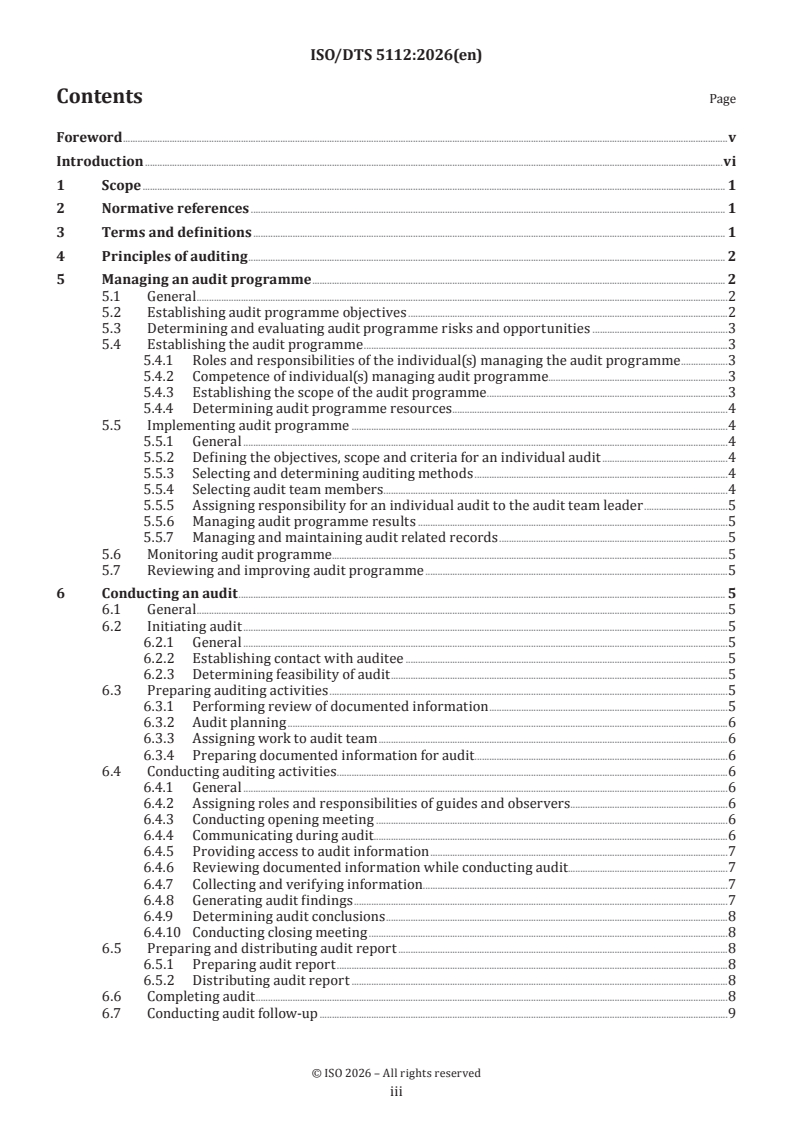
Contents Page
Foreword .v
Introduction .vi
1 Scope . 1
2 Normative references . 1
3 Terms and definitions . 1
4 Principles of auditing . 2
5 Managing an audit programme . 2
5.1 General .2
5.2 Establishing audit programme objectives .2
5.3 Determining and evaluating audit programme risks and opportunities .3
5.4 Establishing the audit programme .3
5.4.1 Roles and responsibilities of the individual(s) managing the audit programme .3
5.4.2 Competence of individual(s) managing audit programme.3
5.4.3 Establishing the scope of the audit programme .3
5.4.4 Determining audit programme resources .4
5.5 Implementing audit programme .4
5.5.1 General .4
5.5.2 Defining the objectives, scope and criteria for an individual audit .4
5.5.3 Selecting and determining auditing methods .4
5.5.4 Selecting audit team members . .4
5.5.5 Assigning responsibility for an individual audit to the audit team leader .5
5.5.6 Managing audit programme results .5
5.5.7 Managing and maintaining audit related records .5
5.6 Monitoring audit programme . .5
5.7 Reviewing and improving audit programme .5
6 Conducting an audit . 5
6.1 General .5
6.2 Initiating audit .5
6.2.1 General .5
6.2.2 Establishing contact with auditee .5
6.2.3 Determining feasibility of audit .5
6.3 Preparing auditing activities .5
6.3.1 Performing review of documented information .5
6.3.2 Audit planning .6
6.3.3 Assigning work to audit team .6
6.3.4 Preparing documented information for audit .6
6.4 Conducting auditing activities .6
6.4.1 General .6
6.4.2 Assigning roles and responsibilities of guides and observers . .6
6.4.3 Conducting opening meeting .6
6.4.4 Communicating during audit.6
6.4.5 Providing access to audit information .7
6.4.6 Reviewing documented information while conducting audit.7
6.4.7 Collecting and verifying information.7
6.4.8 Generating audit findings .7
6.4.9 Determining audit conclusions .8
6.4.10 Conducting closing meeting .8
6.5 Preparing and distributing audit report .8
6.5.1 Preparing audit report .8
6.5.2 Distributing audit report .8
6.6 Completing audit .8
6.7 Conducting audit follow-up .9
iii
7 Competence and evaluation of auditors . 9
7.1 General .9
7.2 Determining auditor competence .9
7.2.1 General .9
7.2.2 Personal behaviour .9
7.2.3 Knowledge and skills .9
7.2.4 Achieving auditor competence .10
7.2.5 Achieving audit team leader competence .10
7.3 Establishing auditor evaluation criteria .10
7.4 Selecting appropriate auditor evaluation method .10
7.5 Conducting auditor evaluation .10
7.6 Maintaining and improving auditor competence .10
Annex A (informative) Audit questionnaire .11
Annex B (informative) Auditor competences . 19
Bibliography .21
iv
Foreword
ISO (the International Organization for Standardization) is a worldwide federation of national standards
bodies (ISO member bodies). The work of preparing International Standards is normally carried out through
ISO technical committees. Each member body interested in a subject for which a technical committee
has been established has the right to be represented on that committee. International organizations,
governmental and non-governmental, in liaison with ISO, also take part in the work. ISO collaborates closely
with the International Electrotechnical Commission (IEC) on all matters of electrotechnical standardization.
The procedures used to develop this document and those intended for its further maintenance are described
in the ISO/IEC Directives, Part 1. In particular, the different approval criteria needed for the different types
of ISO document should be noted. This document was drafted in accordance with the editorial rules of the
ISO/IEC Directives, Part 2 (see www.iso.org/directives).
ISO draws attention to the possibility that the implementation of this document may involve the use of (a)
patent(s). ISO takes no position concerning the evidence, validity or applicability of any claimed patent
rights in respect thereof. As of the date of publication of this document, ISO had not received notice of (a)
patent(s) which may be required to implement this document. However, implementers are cautioned that
this may not represent the latest information, which may be obtained from the patent database available at
www.iso.org/patents. ISO shall not be held responsible for identifying any or all such patent rights.
Any trade name used in this document is information given for the convenience of users and does not
constitute an endorsement.
For an explanation of the voluntary nature of standards, the meaning of ISO specific terms and expressions
related to conformity assessment, as well as information about ISO's adherence to the World Trade
Organization (WTO) principles in the Technical Barriers to Trade (TBT), see www.iso.org/iso/foreword.html.
This document was prepared by Technical Committee ISO/TC 22, Road vehicles, Subcommittee SC 32,
Electrical and electronic components and general system aspects.
This second edition cancels and replaces the first edition (ISO/PAS 5112:2022), which has been technically
revised.
The main changes are as follows:
— document type converted from Publicly Available Specification (PAS) to Technical Specification (TS);
— additional modifications to the document, including adjusting the scope.
Any feedback or questions on this document should be directed to the user’s national standards body. A
complete listing of these bodies can be found at www.iso.org/members.html.
v
Introduction
This document is related to ISO/SAE 21434 and extends ISO 19011 to the automotive domain.
This document is intended for organizations involved in automotive cybersecurity engineering in any part
of the automotive supply chain and for organizations needing to conduct audits. This document can be used
for audits of varying scope.
This document is adapted to fit the scope of an automotive cybersecurity engineering audit programme.
Cybersecurity audits in this document are aimed at cybersecurity activities at the organizational level.
While results from past projects can be used as evidence for implemented and applied processes, the project
and product levels are not in the focus of this document.
This document provides guidelines on the management of an audit programme, on the planning and
conducting of management system audits, as well as on the competence and evaluation of an audit team. An
audit can be conducted against a range of audit criteria. This document gives a set of audit criteria based on
ISO/SAE 21434 objectives. In addition, Annex A contains an example questionnaire that can be adapted.
This document can be used for internal audits (first party), for audits conducted by organizations on their
external parties (second party) and for external audits conducted by third parties (e.g. for the purpose of
certification). This document can also be useful to organizations involved in auditor training or personnel
certification.
vi
FINAL DRAFT Technical Specification ISO/DTS 5112:2026(en)
Road vehicles — Guidelines for auditing cybersecurity
engineering
1 Scope
This document provides guidelines to organizations that contribute to the achievement of road vehicle
cybersecurity throughout the supply chain on:
— managing an audit programme for a cybersecurity management system (CSMS);
— conducting organizational CSMS audits;
— competencies of CSMS auditors; and
— providing evidence during CSMS audits.
This document is in addition to the guidelines in ISO 19011. Elements of the CSMS are based on the processes
described in ISO/SAE 21434. This document is applicable to those needing to understand or conduct internal
or external audits of a CSMS or to manage a CSMS audit programme.
This document does not provide guidelines on cybersecurity assessments.
2 Normative references
The following documents are referred to in the text in such a way that some or all of their content constitutes
requirements of this document. For dated references, only the edition cited applies. For undated references,
the latest edition of the referenced document (including any amendments) applies.
ISO 19011:2026, Guidelines for auditing management systems
ISO/SAE 21434, Road vehicles — Cybersecurity engineering
3 Terms and definitions
For the purposes of this document, the terms and definitions given in ISO 19011, ISO/SAE 21434 and the
following apply.
ISO and IEC maintain terminology databases for use in standardization at the following addresses:
— ISO Online browsing platform: available at https:// www .iso .org/ obp
— IEC Electropedia: available at https:// www .electropedia .org/
3.1
audit
examination of a process to determine the extent to which the process objectives are achieved
Note 1 to entry: “Audit” is defined in ISO 19011 and ISO/SAE 21434. The definition of ISO/SAE 21434 is used in this
document to support compatibility between this document and ISO/SAE 21434.
[SOURCE: ISO/SAE 21434:2021, 3.1.6, modified — Note 1 to entry has been added.]
3.2
cybersecurity management system
CSMS
systematic risk-based approach defining organisational processes, responsibilities and governance to
manage risk (3.3) associated with threats to road vehicles and protect them from threats
[9]
[SOURCE: UN E/ECE/TRANS/505/Rev.3/Add.154 , 2.3, modified — added “road” to clarify application
domain, replaced “treat” with “manage”, removed “cyber”, replaced “cyber attacks” with “threats”.]
3.3
risk
cybersecurity risk
effect of uncertainty on road vehicle cybersecurity expressed in terms of attack feasibility and impact
Note 1 to entry: ISO 19011 uses a broader definition of the term risk.
[SOURCE: ISO/SAE 21434:2021, 3.1.29, modified — Note 1 to entry has been added.]
3.4
supply chain
set of organizations with a linked set of resources and processes, each of which acts as a customer, supplier,
or both to form successive supplier relationships established upon placement of a purchase order, agreement,
or other formal sourcing agreement.
Note 1 to entry: A supply chain includes organizations involved in the manufacturing, design and development of
vehicles, or service providers involved in the operation, management, and delivery of services.
Note 2 to entry: The supply chain view is relative to the position of the customer.
[SOURCE: ISO/IEC 27036-1:2021, 3.10, modified — “acquirer” replaced by “customer" and Note 1 to entry
has been modified.]
4 Principles of auditing
The principles of auditing of ISO 19011:2026, Clause 4 apply. In addition, the following guidance applies.
The guidelines given in this document are aimed at what ISO/SAE 21434 defines as an organizational
cybersecurity audit. Product level topics are not in the scope of this document. Regarding products, a
cybersecurity assessment based on ISO/SAE 21434 is used to judge the cybersecurity of the item or
component.
5 Managing an audit programme
5.1 General
The guidelines of ISO 19011:2026, 5.1 apply.
5.2 Establishing audit programme objectives
The guidelines of ISO 19011:2026, 5.2 apply. In addition, the following guidance applies.
The audit programme objectives can be based on consideration of the following:
a) demonstration of the achievement of the objectives of ISO/SAE 21434;
b) specific cybersecurity risks associated with the auditee's products;
c) specifics related to the organization’s role in the automotive supply chain; and
EXAMPLE 1 An organization’s role can be original equipment manufacturer (OEM), tier 1 supplier, tier 2
supplier, component manufacturer.
NOTE Organizations in the supply chain include organizations which develop components out of context, e.g.
before the placement of a purchase order, agreement, or other formal sourcing agreement.
d) clarification of whether the audit includes an evaluation of methods applied in the CSMS processes.
EXAMPLE 2 Specific audit programme objectives can include:
— verification of conformity of the CSMS with relevant legal and contractual requirements;
— obtaining and maintaining confidence in the auditee’s CSMS to identify, analyse and evaluate the cybersecurity
risk and to take corresponding necessary action; and
— evaluating the effectiveness of the CSMS to address cybersecurity risks.
5.3 Determining and evaluating audit programme risks and opportunities
The guidelines of ISO 19011:2026, 5.3 apply.
5.4 Establishing the audit programme
5.4.1 Roles and responsibilities of the individual(s) managing the audit programme
The guidelines of ISO 19011:2026, 5.4.1 apply.
5.4.2 Competence of individual(s) managing audit programme
The guidelines of ISO 19011:2026, 5.4.2 apply. In addition, the following guidance applies.
The individual(s) managing the CSMS audit programme should have the following competences:
a) knowledge of the standards regarding cybersecurity that are used by the auditee to establish and
maintain the CSMS;
b) knowledge of the general processes used by the automotive industry that are relevant for the phase of
the cybersecurity lifecycle which is evaluated within the specific scope of the audit (e.g. processes for
software development in the automotive domain);
c) ability to map the organization-specific processes, guidelines and rules with the audit criteria; and
d) if a combined audit is conducted, the ability to coordinate with other management system audit
programmes.
[8]
EXAMPLE A combined audit with IATF 16949 .
NOTE Considered competence can also include experience in audit or assessment of automotive processes based
[8] [10]
on automotive standards or guidelines, e.g. IATF 16949, ISO 9001, the ISO 26262 series, and ASPICE .
5.4.3 Establishing the scope of the audit programme
The guidelines of ISO 19011:2026, 5.4.3 apply. In addition, the following guidance applies.
The scope of an audit programme can vary and can be impacted by the following factors:
a) size of the auditee and extent to which the auditee is involved in cybersecurity processes;
b) the cybersecurity-related supply chain and determination of which entities in the supply chain are in
scope; and
c) importance of preserving cybersecurity property of information within the scope of the cybersecurity
processes.
5.4.4 Determining audit programme resources
The guidelines of ISO 19011:2026, 5.4.4 apply.
5.5 Implementing audit programme
5.5.1 General
The guidelines of ISO 19011:2026, 5.5.1 apply.
5.5.2 Defining the objectives, scope and criteria for an individual audit
The guidelines of ISO 19011:2026, 5.5.2 apply. In addition, the following guidance applies.
The audit scope should include the CSMS processes used by the auditee during the phases of the cybersecurity
lifecycle that are within the specific scope of the audit.
EXAMPLE 1 A tier 2 supplier might not be audited for all phases of the cybersecurity lifecycle.
The audit criteria should be defined following 6.4.8 and 6.4.9.
The audit scope may include the whole organization or one or more clearly delineated organizational units.
NOTE 1 Clearly delineated organizational units are those that have separate organizational structures and
processes.
If the CSMS process depends on interactions with other organizational processes, the interfaces and
dependencies should be identified.
NOTE 2 Interfaces can include how work products are exchanged.
Shared functions outside the organization may be included in the scope of the audit with clearly defined
interfaces. If an organization depends on another organization to achieve the objectives of CSMS processes,
the contributing organization should be identified. The extent to which the organization manages the
dependencies on external organizations to realize its CSMS should be determined.
Distributed cybersecurity activities, defined in a cybersecurity interface agreement, may be included in the
scope of the audit.
EXAMPLE 2 Cybersecurity monitoring and cybersecurity incident response.
The audit objectives can include the confirmation of the suitability of the implemented processes and applied
methods and criteria to achieve the objectives of ISO/SAE 21434.
The auditee may perform an internal audit to identify and resolve shortcomings in the CSMS before an
external audit is conducted. If an external audit is planned as part of the audit programme, the scope and
objectives of both internal and external audits should be aligned.
A subsequent follow-up audit to address identified minor non-conformities of a conditionally-passed audit
may focus solely on the identified deficiencies noted.
5.5.3 Selecting and determining auditing methods
The guidelines of ISO 19011:2026, 5.5.3 apply.
5.5.4 Selecting audit team members
The guidelines of ISO 19011:2026, 5.5.4 apply.
5.5.5 Assigning responsibility for an individual audit to the audit team leader
The guidelines of ISO 19011:2026, 5.5.5 apply.
5.5.6 Managing audit programme results
The guidelines of ISO 19011:2026, 5.5.6 apply.
5.5.7 Managing and maintaining audit related records
The guidelines of ISO 19011:2026, 5.5.7 apply.
5.6 Monitoring audit programme
The guidelines of ISO 19011:2026, 5.6 apply.
5.7 Reviewing and improving audit programme
The guidelines of ISO 19011:2026, 5.7 apply.
6 Conducting an audit
6.1 General
The guidelines of ISO 19011:2026, 6.1 apply.
6.2 Initiating audit
6.2.1 General
The guidelines of ISO 19011:2026, 6.2.1 apply.
6.2.2 Establishing contact with auditee
The guidelines of ISO 19011:2026, 6.2.2 apply. In addition, the following guidance applies.
Auditor and auditee should mutually agree on information that is not to be disclosed.
Information can be classified as confidential and sensitive. Access to such information can be limited to
selected audit team members.
EXAMPLE Documents can only be viewed in an area controlled by the auditee. Transfer and processing of the
documents outside this environment is prohibited.
6.2.3 Determining feasibility of audit
The guidelines of ISO 19011:2026, 6.2.3 apply.
6.3 Preparing auditing activities
6.3.1 Performing review of documented information
The guidelines of ISO 19011:2026, 6.3.1 apply.
6.3.2 Audit planning
6.3.2.1 Risk-based approach to planning
The guidelines of ISO 19011:2026, 6.3.2.1 apply.
6.3.2.2 Audit planning details
The guidelines of ISO 19011:2026, 6.3.2.2 apply. In addition, the following guidance applies.
The audit should be planned to address the corresponding objectives of ISO/SAE 21434 by means of a
questionnaire.
NOTE See Annex A for an example questionnaire.
6.3.3 Assigning work to audit team
The guidelines of ISO 19011:2026, 6.3.3 apply.
6.3.4 Preparing documented information for audit
The guidelines of ISO 19011:2026, 6.3.4 apply.
6.4 Conducting auditing activities
6.4.1 General
The guidelines of ISO 19011:2026, 6.4.1 apply.
6.4.2 Assigning roles and responsibilities of guides and observers
The guidelines of ISO 19011:2026, 6.4.2 apply.
6.4.3 Conducting opening meeting
The guidelines of ISO 19011:2026, 6.4.3 apply. In addition, the following guidance applies.
The audit team and the auditee should agree on:
a) information and/or material types and dissemination of the information to the audit team, location of
the information and/or materials, other evidences;
b) the procedure to add audit team members on an ad-hoc basis;
c) auditing processes and methods of auditi
...
Date: 2022-03
ISO/TC 22/SC 32/WG 11
Secretariat: DIN JISC
Date: 2026-08-14
Road vehicles – — Guidelines for auditing cybersecurity engineering
Véhicules routiers — Lignes directrices pour l’audit de l’ingénierie de la cybersécurité
All rights reserved. Unless otherwise specified, or required in the context of its implementation, no part of this publication
may be reproduced or utilized otherwise in any form or by any means, electronic or mechanical, including photocopying,
or posting on the internet or an intranet, without prior written permission. Permission can be requested from either ISO
at the address below or ISO’s member body in the country of the requester.
ISO copyright office
CP 401 • Ch. de Blandonnet 8
CH-1214 Vernier, Geneva
Phone: + 41 22 749 01 11
Fax: +41 22 749 09 47
EmailE-mail: copyright@iso.org
Website: www.iso.org
Published in Switzerland
ii
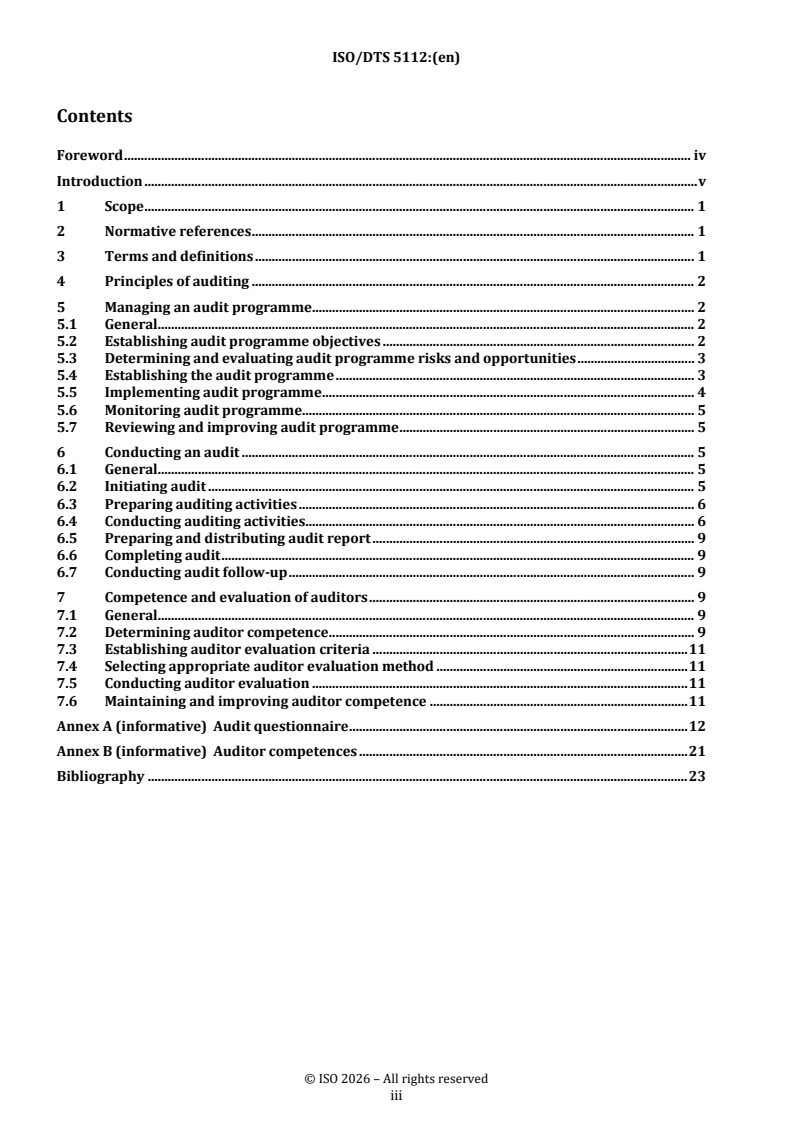
Contents
Foreword . iv
Introduction . v
1 Scope . 1
2 Normative references . 1
3 Terms and definitions . 1
4 Principles of auditing . 2
5 Managing an audit programme . 2
5.1 General. 2
5.2 Establishing audit programme objectives . 2
5.3 Determining and evaluating audit programme risks and opportunities . 3
5.4 Establishing the audit programme . 3
5.5 Implementing audit programme . 4
5.6 Monitoring audit programme. 5
5.7 Reviewing and improving audit programme . 5
6 Conducting an audit . 5
6.1 General. 5
6.2 Initiating audit . 5
6.3 Preparing auditing activities . 6
6.4 Conducting auditing activities . 6
6.5 Preparing and distributing audit report . 9
6.6 Completing audit . 9
6.7 Conducting audit follow-up . 9
7 Competence and evaluation of auditors . 9
7.1 General. 9
7.2 Determining auditor competence . 9
7.3 Establishing auditor evaluation criteria . 11
7.4 Selecting appropriate auditor evaluation method . 11
7.5 Conducting auditor evaluation . 11
7.6 Maintaining and improving auditor competence . 11
Annex A (informative) Audit questionnaire . 12
Annex B (informative) Auditor competences . 21
Bibliography . 23
iii
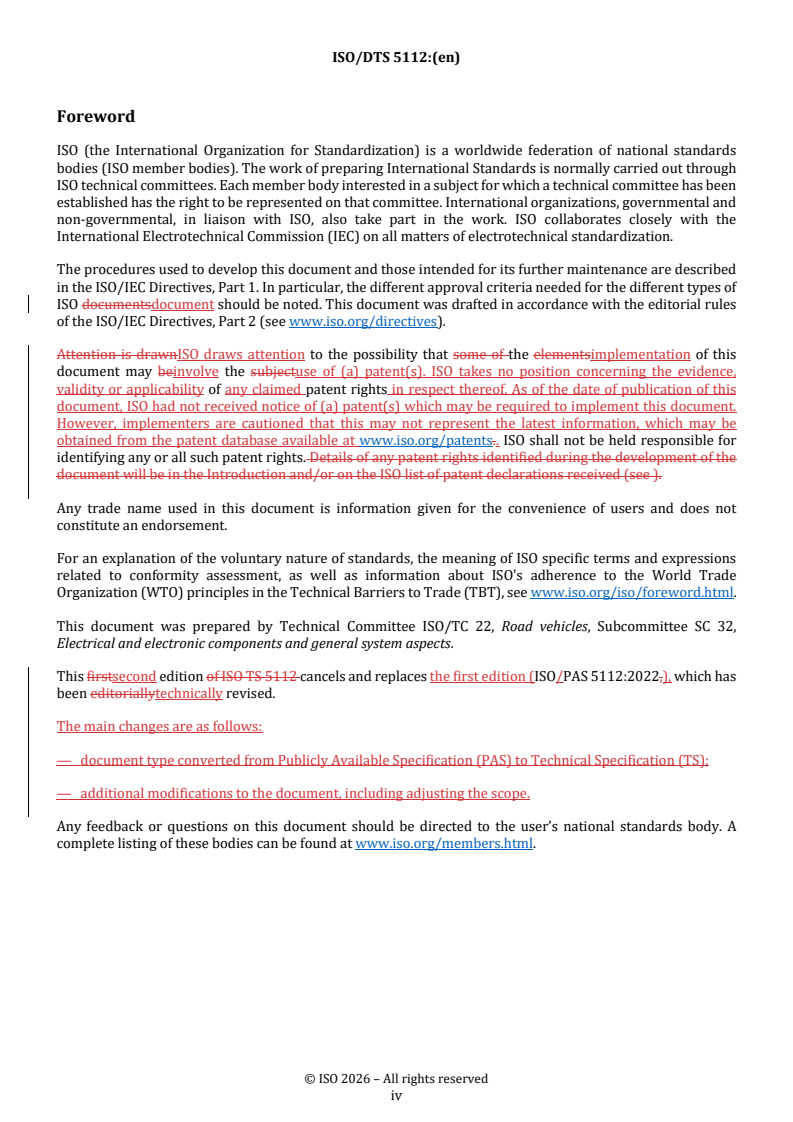
Foreword
ISO (the International Organization for Standardization) is a worldwide federation of national standards
bodies (ISO member bodies). The work of preparing International Standards is normally carried out through
ISO technical committees. Each member body interested in a subject for which a technical committee has been
established has the right to be represented on that committee. International organizations, governmental and
non-governmental, in liaison with ISO, also take part in the work. ISO collaborates closely with the
International Electrotechnical Commission (IEC) on all matters of electrotechnical standardization.
The procedures used to develop this document and those intended for its further maintenance are described
in the ISO/IEC Directives, Part 1. In particular, the different approval criteria needed for the different types of
ISO documentsdocument should be noted. This document was drafted in accordance with the editorial rules
of the ISO/IEC Directives, Part 2 (see www.iso.org/directives).
Attention is drawnISO draws attention to the possibility that some of the elementsimplementation of this
document may beinvolve the subjectuse of (a) patent(s). ISO takes no position concerning the evidence,
validity or applicability of any claimed patent rights in respect thereof. As of the date of publication of this
document, ISO had not received notice of (a) patent(s) which may be required to implement this document.
However, implementers are cautioned that this may not represent the latest information, which may be
obtained from the patent database available at www.iso.org/patents. ISO shall not be held responsible for
identifying any or all such patent rights. Details of any patent rights identified during the development of the
document will be in the Introduction and/or on the ISO list of patent declarations received (see ).
Any trade name used in this document is information given for the convenience of users and does not
constitute an endorsement.
For an explanation of the voluntary nature of standards, the meaning of ISO specific terms and expressions
related to conformity assessment, as well as information about ISO's adherence to the World Trade
Organization (WTO) principles in the Technical Barriers to Trade (TBT), see www.iso.org/iso/foreword.html.
This document was prepared by Technical Committee ISO/TC 22, Road vehicles, Subcommittee SC 32,
Electrical and electronic components and general system aspects.
This firstsecond edition of ISO TS 5112 cancels and replaces the first edition (ISO/PAS 5112:2022,), which has
been editoriallytechnically revised.
The main changes are as follows:
— document type converted from Publicly Available Specification (PAS) to Technical Specification (TS);
— additional modifications to the document, including adjusting the scope.
Any feedback or questions on this document should be directed to the user’s national standards body. A
complete listing of these bodies can be found at www.iso.org/members.html.
iv
Introduction
This document is related to ISO/SAE 21434 Road vehicles — Cybersecurity engineering and extends ISO 19011
Guidelines for auditing management systems to the automotive domain.
This document is intended for organizations involved in automotive cybersecurity engineering in any part of
the automotive supply chain and for organizations needing to conduct audits. This document can be used for
audits of varying scope.
This document is adapted to fit the scope of an automotive cybersecurity engineering audit programme.
Cybersecurity audits in this document are aimed at cybersecurity activities at the organizational level. While
results from past projects can be used as evidence for implemented and applied processes, the project and
product levels are not in the focus of this document.
This document provides guidelines on the management of an audit programme, on the planning and
conducting of management system audits, as well as on the competence and evaluation of an audit team. An
audit can be conducted against a range of audit criteria. This document gives a set of audit criteria based on
ISO/SAE 21434 objectives. In addition, Annex AAnnex A contains an example questionnaire that can be
adapted.
This document can be used for internal audits (first party), for audits conducted by organizations on their
external parties (second party) and for external audits conducted by third parties (e.g. for the purpose of
certification). This document can also be useful to organizations involved in auditor training or personnel
certification.
v
Road vehicles – — Guidelines for auditing cybersecurity engineering
1 Scope
In addition to the guidelines in ISO 19011, thisThis document provides guidelines to organizations that
contribute to the achievement of road vehicle cybersecurity throughout the supply chain on:
— — managing an audit programme for a cybersecurity management system (CSMS);
— — conducting organizational CSMS audits;
— — competencies of CSMS auditors; and
— — providing evidence during CSMS audits.
This document is in addition to the guidelines in ISO 19011. Elements of the CSMS are based on the processes
described in ISO/SAE 21434. This document is applicable to those needing to understand or conduct internal
or external audits of a CSMS or to manage a CSMS audit programme.
This document does not provide guidelines on cybersecurity assessments.
2 Normative references
The following documents are referred to in the text in such a way that some or all of their content constitutes
requirements of this document. For dated references, only the edition cited applies. For undated references,
the latest edition of the referenced document (including any amendments) applies.
ISO 19011:2026, Guidelines for auditing management systems
ISO/SAE 21434:2021, Road vehicles — Cybersecurity engineering
ISO 19011:2018, Guidelines for auditing management systems
3 Terms and definitions
For the purposes of this document, the terms and definitions given in ISO 19011, ISO/SAE 21434, ISO 19011
and the following apply.
ISO and IEC maintain terminology databases for use in standardization at the following addresses:
— — ISO Online browsing platform: available at https://www.iso.org/obp
— — IEC Electropedia: available at https://www.electropedia.org/
3.1 3.1
audit
examination of a process to determine the extent to which the process objectives are achieved
Note 1 to entry: “Audit” is defined in ISO 19011 and ISO/SAE 21434. The definition of ISO/SAE 21434 is used in this
document to support compatibility between this document and ISO/SAE 21434.
[SOURCE: ISO/SAE 21434:2021, 3.1.6, modified — Note 1 to entry has been added.]
3.2 3.2
cybersecurity management system
CSMS
systematic risk-based approach defining organisational processes, responsibilities and governance to manage
risk (3.3(3.3)) associated with threats to road vehicles and protect them from threats
[9]
[SOURCE: UN E/ECE/TRANS/505/Rev.3/Add.154 Reference [9],, 2.3, modified — added “road” to clarify
application domain, replaced “treat” with “manage”, removed “cyber”, replaced “cyber attacks” with “threats”.]
3.3 3.3
risk
cybersecurity risk
effect of uncertainty on road vehicle cybersecurity expressed in terms of attack feasibility and impact
Note 1 to entry: ISO 19011 uses a broader definition of the term risk.
[SOURCE: ISO/SAE 21434:2021, 3.1.29, modified — Note 1 to entry has been added.]
3.4 3.4
supply chain
set of organizations with a linked set of resources and processes, each of which acts as a customer, supplier,
or both to form successive supplier relationships established upon placement of a purchase order, agreement,
or other formal sourcing agreement.
Note 1 to entry: A supply chain includes organizations involved in the manufacturing, design and development of
vehicles, or service providers involved in the operation, management, and delivery of services.
Note 2 to entry: The supply chain view is relative to the position of the customer.
[SOURCE: ISO/IEC 27036-1:2021, 3.10, modified — “acquirer” replaced by “customer" and Note 1 to entry has
been modified.]
4 Principles of auditing
The principles of auditing of ISO 19011:20182026, Clause 4 apply. In addition, the following guidance applies.
The guidelines given in this document are aimed at what ISO/SAE 21434 defines as an organizational
cybersecurity audit. Product level topics are not in the scope of this document. Regarding products, a
cybersecurity assessment based on ISO/SAE 21434 is used to judge the cybersecurity of the item or
component.
5 Managing an audit programme
5.1 General
The guidelines of ISO 19011:20182026, 5.1 apply.
5.2 Establishing audit programme objectives
The guidelines of ISO 19011:20182026, 5.2 apply. In addition, the following guidance applies.
The audit programme objectives can be based on consideration of the following:
a) a) demonstration of the achievement of the objectives of ISO/SAE 21434;
b) b) specific cybersecurity risks associated with the auditee's products;
c) c) specifics related to the organization’s role in the automotive supply chain; and
EXAMPLE 1 An organization’s role can be original equipment manufacturer (OEM), tier 1 supplier, tier 2 supplier,
component manufacturer.
NOTE Organizations in the supply chain include organizations which develop components out of context, e.g.
before the placement of a purchase order, agreement, or other formal sourcing agreement.
d) d) clarification of whether the audit includes an evaluation of methods applied in the CSMS
processes.
EXAMPLE 2 Specific audit programme objectives can include:
— — verification of conformity of the CSMS with relevant legal and contractual requirements;
— — obtaining and maintaining confidence in the auditee’s CSMS to identify, analyse and evaluate the cybersecurity
risk and to take corresponding necessary action; and
— — evaluating the effectiveness of the CSMS to address cybersecurity risks.
5.3 Determining and evaluating audit programme risks and opportunities
The guidelines of ISO 19011:20182026, 5.3 apply.
5.4 Establishing the audit programme
5.4.1 Roles and responsibilities of the individual(s) managing the audit programme
The guidelines of ISO 19011:20182026, 5.4.1 apply.
5.4.2 Competence of individual(s) managing audit programme
The guidelines of ISO 19011:20182026, 5.4.2 apply. In addition, the following guidance applies.
The individual(s) managing the CSMS audit programme should have the following competences:
a) a) knowledge of the standards regarding cybersecurity that are used by the auditee to establish
and maintain the CSMS;
nowledge of the general processes used by the automotive industry that are relevant for the
b) b) k
phase of the cybersecurity lifecycle which is evaluated within the specific scope of the audit (e.g. processes
for software development in the automotive domain);
c) c) ability to map the organization-specific processes, guidelines and rules with the audit criteria;
and
d) d) if a combined audit is conducted, the ability to coordinate with other management system audit
programmes.
[8][8]
EXAMPLE A combined audit with IATF 16949 .
NOTE Considered competence can also include experience in audit or assessment of automotive processes based on
[8] [8] [2] [5] [10][10]
automotive standards or guidelines, e.g. IATF 16949 , , ISO 9001 ,, the ISO 26262 series ,, and ASPICE .
5.4.3 Establishing extentthe scope of the audit programme
The guidelines of ISO 19011:20182026, 5.4.3 apply. In addition, the following guidance applies.
The extentscope of an audit programme can vary and can be impacted by the following factors:
a) a) size of the auditee and extent to which the auditee is involved in cybersecurity processes;
b) b) the cybersecurity-related supply chain and determination of which entities in the supply chain
are in scope; and
c) c) importance of preserving cybersecurity property of information within the scope of the
cybersecurity processes.
5.4.4 Determining audit programme resources
The guidelines of ISO 19011:20182026, 5.4.4 apply.
5.5 Implementing audit programme
5.5.1 General
The guidelines of ISO 19011:20182026, 5.5.1 apply.
5.5.2 Defining the objectives, scope and criteria for an individual audit
The guidelines of ISO 19011:20182026, 5.5.2 apply. In addition, the following guidance applies.
The audit scope should include the CSMS processes used by the auditee during the phases of the cybersecurity
lifecycle that are within the specific scope of the audit.
EXAMPLE 1 A tier 2 supplier might not be audited for all phases of the cybersecurity lifecycle.
The audit criteria should be defined following 6.4.86.4.8 and 6.4.96.4.9.
The audit scope may include the whole organization or one or more clearly delineated organizational units.
NOTE 1 Clearly delineated organizational units are those that have separate organizational structures and processes.
If the CSMS process depends on interactions with other organizational processes, the interfaces and
dependencies should be identified.
NOTE 2 Interfaces can include how work products are exchanged.
Shared functions outside the organization may be included in the scope of the audit with clearly defined
interfaces. If an organization depends on another organization to achieve the objectives of CSMS processes,
the contributing organization should be identified. The extent to which the organization manages the
dependencies on external organizations to realize its CSMS should be determined.
Distributed cybersecurity activities, defined in a cybersecurity interface agreement, may be included in the
scope of the audit.
EXAMPLE 2 Cybersecurity monitoring and cybersecurity incident response.
The audit objectives can include the confirmation of the suitability of the implemented processes and applied
methods and criteria to achieve the objectives of ISO/SAE 21434.
The auditee may perform an internal audit to identify and resolve shortcomings in the CSMS before an external
audit is conducted. If an external audit is planned as part of the audit programme, the scope and objectives of
both internal and external audits should be aligned.
A subsequent follow-up audit to address identified minor non-conformities of a conditionally-passed audit
may focus solely on the identified deficiencies noted.
5.5.3 Selecting and determining auditauditing methods
The guidelines of ISO 19011:20182026, 5.5.3 apply.
5.5.4 Selecting audit team members
The guidelines of ISO 19011:20182026, 5.5.4 apply.
5.5.5 Assigning responsibility for an individual audit to the audit team leader
The guidelines of ISO 19011:20182026, 5.5.5 apply.
5.5.6 Managing audit programme results
The guidelines of ISO 19011:20182026, 5.5.6 apply.
5.5.7 Managing and maintaining audit programmerelated records
The guidelines of ISO 19011:20182026, 5.5.7 apply.
5.6 Monitoring audit programme
The guidelines of ISO 19011:20182026, 5.6 apply.
5.7 Reviewing and improving audit programme
The guidelines of ISO 19011:20182026, 5.7 apply.
6 Conducting an audit
6.1 General
The guidelines of ISO 19011:20182026, 6.1 apply.
6.2 Initiating audit
6.2.1 General
The guidelines of ISO 19011:20182026, 6.2.1 apply.
6.2.2 Establishing contact with auditee
The guidelines of ISO 19011:20182026, 6.2.2 apply. In addition, the following guidance applies.
Auditor and auditee should mutually agree on information that is not to be disclosed.
Information can be classified as confidential and sensitive. Access to such information can be limited to
selected audit team members.
EXAMPLE Documents can only be viewed in an area controlled by the auditee. Transfer and processing of the
documents outside this environment is prohibited.
6.2.3 Determining feasibility of audit
The guidelines of ISO 19011:20182026, 6.2.3 apply.
6.3 Preparing auditauditing activities
6.3.1 Performing review of documented information
The guidelines of ISO 19011:20182026, 6.3.1 apply.
6.3.2 Audit planning
6.3.2.1 Risk-based approach to planning
The guidelines of ISO 19011:20182026, 6.3.2.1 apply.
6.3.2.2 Audit planning details
The guidelines of ISO 19011:20182026, 6.3.2.2 apply. In addition, the following guidance applies.
The audit should be planned to address the corresponding objectives of ISO/SAE 21434 by means of a
questionnaire.
NOTE See Annex AAnnex A for an example questionnaire.
6.3.3 Assigning work to audit team
The guidelines of ISO 19011:20182026, 6.3.3 apply.
6.3.4 Preparing documented information for audit
The guidelines of ISO 19011:20182026, 6.3.4 apply.
6.4 Conducting auditauditing activities
6.4.1 General
The guidelines of ISO 19011:20182026, 6.4.1 apply.
6.4.2 Assigning roles and responsibilities of guides and observers
The guidelines of ISO 19011:20182026, 6.4.2 apply.
6.4.3 Conducting opening meeting
The guidelines of ISO 19011:20182026, 6.4.3 apply. In addition, the following guidance applies.
The audit team and the auditee should agree on:
a) a) information and/or material types and dissemination of the information to the audit team,
location of the information and/or materials, other evidences;
b) b) the procedure to add audit team members on an ad-hoc basis;
c) c) auditing processes and methods of auditing the supply-chain partners (outsourced partners);
d) d) the method of communication on an ad-hoc basis; and
e) e) availability and access to required information.
6.4.4 Communicating during audit
The guidelines of ISO 19011:20182026, 6.4.4 apply. In addition, the following guidance applies.
The audit team and auditee should communicate regarding:
a) a) deviation from audit approaches or methods;
b) b) deviation from expectations with respect to the objectives of the audit program;
c) c) deviation from the point of contact availability;
d) d) deviation from declared communication procedure;
e) e) absence of evidence or documentation due to the confidentiality and/or sensitivity of the
evidence or documentation during the audit;
f) f) deviation from declared organizational cybersecurity processes; and
g) g) cybersecurity risks encountered during the audit.
6.4.5 AuditProviding access to audit information availability and access
The guidelines of ISO 19011:20182026, 6.4.5 apply. In addition, the following guidance applies.
Relevant third party, partner, supplier, and stakeholder information should be provided, if such information
can be shared.
Request for access to confidential information should be justified including an explanation of the need
regarding scope and depth of the requested information.
NOTE Audit information availability and access are included in 6.2.26.2.2 regarding the planning of information
access, in 6.4.46.4.4 for the communication of unavailable information during the audit and in 6.66.6 regarding the
handling of information access for auditors in the completion of an audit.
If any audit evidence is unavailable to the audit team during the audit due to confidentiality and/or sensitivity,
the audit team leader should:
— — determine the extent to which this affects the confidence in the audit findings and conclusion; and
— — reflect this in the audit report without compromising the sensitivity of the unavailable evidence.
6.4.6 Reviewing documented information while conducting audit
The guidelines of ISO 19011:20182026, 6.4.6 apply.
6.4.7 Collecting and verifying information
The guidelines of ISO 19011:20182026, 6.4.7 apply. In addition, the following guidance applies.
Methods to collect relevant information during the audit can include:
a) a) review of documented information on policy and rules on the engineering of items and
components;
b) b) observation of cybersecurity processes and methods; and
EXAMPLE Project related work products.
c) c) observation of engineering environment.
6.4.8 Generating audit findings
The guidelines of ISO 19011:20182026, 6.4.8 apply. In addition, the following guidance applies.
Findings should be graded based on the guidance in Table 1Table 1 by conformity or nonconformity to
objectives instead of quantitative gradations.
Table 1 — Criteria for grading of findings
Criteria Grade
Objective evidence regarding full achievement of all objectives Conformity
Minor deviations were observed. Minor nonconformity
Major deviations were observed, one or more objectives are not achieved. Major nonconformity
A rationale should be provided for all unfulfilled audit criteria that leads to nonconformity.
6.4.9 Determining audit conclusions
The guidelines of ISO 19011:20182026, 6.4.9 apply. In addition, the following guidance applies.
The conclusion of the audit should be derived out of the grading of all findings in accordance with the criteria
defined in Table 2Table 2.
Table 2 — Criteria for deriving overall audit conclusions
Criteria Audit conclusion
There are no major nonconformities and no minor Pass
nonconformities.
There is one or more minor nonconformities, but no Conditional pass
major nonconformities. Identified minor
nonconformities do not call into question the overall
effectiveness of the CSMS.
One or more major nonconformities or several minor Fail
nonconformities that, due to their number or in their
dependencies, call into question the overall
effectiveness of the CSMS.
For a failed or conditionally passed audit, corrective actions should be defined. The auditee should analyse the
root causes and specify corrective
...