


ISO 17792:2006
(Main)Milk, milk products and mesophilic starter cultures — Enumeration of citrate-fermenting lactic acid bacteria — Colony-count technique at 25 degrees C
Milk, milk products and mesophilic starter cultures — Enumeration of citrate-fermenting lactic acid bacteria — Colony-count technique at 25 degrees C
ISO 17792|IDF 180:2006 specifies methods for the enumeration of citrate-fermenting lactic acid bacteria using a colony-count technique at 25 °C. The methods are applicable to dairy starter cultures and dairy products where these characteristic microorganisms are present.
Lait, produits laitiers et ferments mésophiles — Dénombrement des bactéries lactiques fermentant le citrate — Technique de comptage des colonies à 25 degrés C
L'ISO 17792:2006 spécifie des méthodes de dénombrement des bactéries lactiques fermentant le citrate à l'aide d'une technique par comptage des colonies à 25 °C. Ces méthodes sont applicables aux ferments lactiques et aux produits laitiers dans lesquels ces micro-organismes caractéristiques sont présents.
General Information
- Status
- Published
- Publication Date
- 25-Jul-2006
- Technical Committee
- ISO/TC 34/SC 5 - Milk and milk products
- Drafting Committee
- ISO/TC 34/SC 5 - Milk and milk products
- Current Stage
- 9093 - International Standard confirmed
Overview
ISO 17792:2006 (IDF 180:2006) specifies a standardized colony-count technique at 25 °C for the enumeration of citrate‑fermenting lactic acid bacteria in milk, milk products and mesophilic starter cultures. The method targets characteristic citrate‑fermenting species (e.g., Lactococcus lactis biovar diacetylactis and Leuconostoc spp.) and is applicable where these microorganisms are present in dairy starter cultures and finished dairy products.
Key Topics and Requirements
- Scope and organisms: Enumeration of mesophilic citrate‑fermenting lactic acid bacteria that form lenticular colonies (about 0.5–1.2 mm) on selective media.
- Colony-count principle: Prepare decimal dilutions, plate on selective media, incubate aerobically at 25 °C, and count characteristic colonies at appropriate dilution levels to calculate counts per gram.
- Selective media: Uses a modified Nickels and Leesment medium with additions such as calcium lactate, calcium citrate suspension, starter culture serum and the chromogenic substrate X‑gal to differentiate species by colony color/zone formation.
- Antibiotic-supplemented variant: A Nickels and Leesment + vancomycin medium is specified for selective enumeration of leuconostocs (incubation 3–5 days).
- Incubation times: Typical aerobic incubation - 72 h on modified medium followed by X‑gal addition and an additional ~24 h; vancomycin plates incubated 3–5 days.
- Confirmation and calculation: Colonies are confirmed by appropriate tests; results are calculated and expressed according to the standard, with precision data and reporting requirements included.
- Safety and quality: The standard notes hazards (X‑gal, vancomycin) and refers to use of analytical‑grade reagents, sterile technique, suitable diluents and water quality.
Applications and Users
Who benefits from ISO 17792:2006:
- Dairy microbiology and quality control laboratories performing routine enumeration of starter culture components.
- Starter-culture manufacturers monitoring citrate‑fermenting strains (L. lactis biovar diacetylactis, Leuconostoc spp.).
- Regulatory, research and product development teams assessing microbial composition in cheeses, fermented milks and related dairy products. Practical uses include quality assurance of starter cultures, troubleshooting fermentation defects, and verifying label claims for culture composition.
Related Standards
- ISO 7218 - General rules for microbiological examinations of food and animal feeding stuffs.
- ISO 8261 / IDF 122 - Guidance for preparation of test samples, initial suspensions and decimal dilutions.
- ISO 565 - Test sieves (used for media preparation steps described).
Keywords: ISO 17792:2006, citrate‑fermenting lactic acid bacteria, milk products, colony‑count technique, Nickels and Leesment medium, X‑gal, vancomycin, dairy starter cultures, enumeration, 25 °C.
ISO 17792:2006 - Milk, milk products and mesophilic starter cultures -- Enumeration of citrate-fermenting lactic acid bacteria -- Colony-count technique at 25 degrees C
ISO 17792:2006 - Lait, produits laitiers et ferments mésophiles -- Dénombrement des bactéries lactiques fermentant le citrate -- Technique de comptage des colonies a 25 degrés C
Get Certified
Connect with accredited certification bodies for this standard

BSI Group
BSI (British Standards Institution) is the business standards company that helps organizations make excellence a habit.

Bureau Veritas
Bureau Veritas is a world leader in laboratory testing, inspection and certification services.

DNV
DNV is an independent assurance and risk management provider.
Sponsored listings
Frequently Asked Questions
ISO 17792:2006 is a standard published by the International Organization for Standardization (ISO). Its full title is "Milk, milk products and mesophilic starter cultures — Enumeration of citrate-fermenting lactic acid bacteria — Colony-count technique at 25 degrees C". This standard covers: ISO 17792|IDF 180:2006 specifies methods for the enumeration of citrate-fermenting lactic acid bacteria using a colony-count technique at 25 °C. The methods are applicable to dairy starter cultures and dairy products where these characteristic microorganisms are present.
ISO 17792|IDF 180:2006 specifies methods for the enumeration of citrate-fermenting lactic acid bacteria using a colony-count technique at 25 °C. The methods are applicable to dairy starter cultures and dairy products where these characteristic microorganisms are present.
ISO 17792:2006 is classified under the following ICS (International Classification for Standards) categories: 67.100.01 - Milk and milk products in general. The ICS classification helps identify the subject area and facilitates finding related standards.
ISO 17792:2006 is available in PDF format for immediate download after purchase. The document can be added to your cart and obtained through the secure checkout process. Digital delivery ensures instant access to the complete standard document.
Standards Content (Sample)
INTERNATIONAL ISO
STANDARD 17792
IDF
First edition
2006-08-01
Milk, milk products and mesophilic
starter cultures — Enumeration of citrate-
fermenting lactic acid bacteria — Colony-
count technique at 25 °C
Lait, produits laitiers et ferments mésophiles — Dénombrement des
bactéries lactiques fermentant le citrate — Technique de comptage des
colonies à 25 °C
Reference numbers
IDF 180:2006(E)
©
ISO and IDF 2006
IDF 180:2006(E)
PDF disclaimer
This PDF file may contain embedded typefaces. In accordance with Adobe's licensing policy, this file may be printed or viewed but
shall not be edited unless the typefaces which are embedded are licensed to and installed on the computer performing the editing. In
downloading this file, parties accept therein the responsibility of not infringing Adobe's licensing policy. Neither the ISO Central
Secretariat nor the IDF accepts any liability in this area.
Adobe is a trademark of Adobe Systems Incorporated.
Details of the software products used to create this PDF file can be found in the General Info relative to the file; the PDF-creation
parameters were optimized for printing. Every care has been taken to ensure that the file is suitable for use by ISO member bodies
and IDF national committees. In the unlikely event that a problem relating to it is found, please inform the ISO Central Secretariat at the
address given below.
© ISO and IDF 2006
All rights reserved. Unless otherwise specified, no part of this publication may be reproduced or utilized in any form or by any means,
electronic or mechanical, including photocopying and microfilm, without permission in writing from either ISO or IDF at the respective
address below.
ISO copyright office International Dairy Federation
Case postale 56 • CH-1211 Geneva 20 Diamant Building • Boulevard Auguste Reyers 80 • B-1030 Brussels
Tel. + 41 22 749 01 11 Tel. + 32 2 733 98 88
Fax + 41 22 749 09 47 Fax + 32 2 733 04 13
E-mail copyright@iso.org E-mail info@fil-idf.org
Web www.iso.org Web www.fil-idf.org
Published in Switzerland
ii © ISO and IDF 2006 – All rights reserved
IDF 180:2006(E)
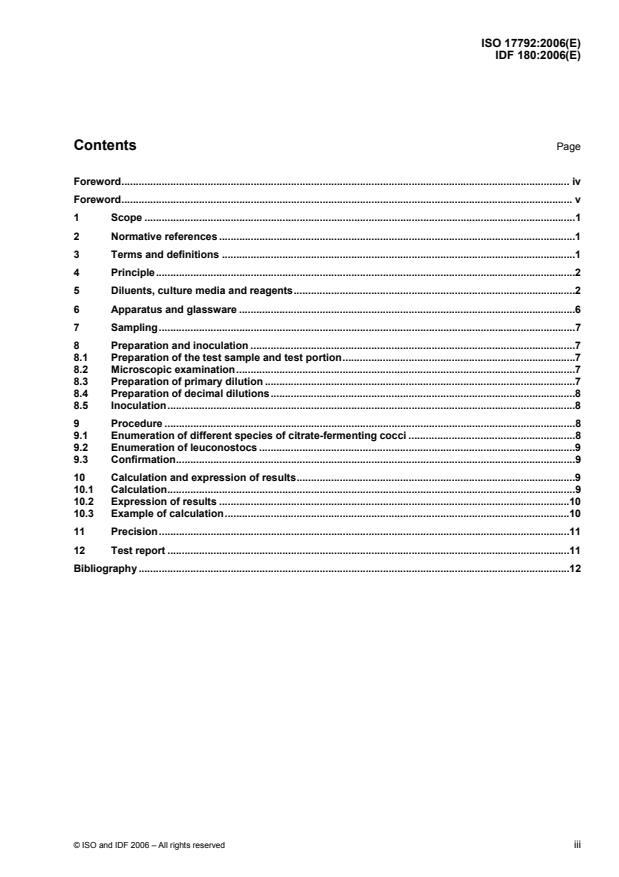
Contents Page
Foreword. iv
Foreword. v
1 Scope .1
2 Normative references .1
3 Terms and definitions .1
4 Principle.2
5 Diluents, culture media and reagents.2
6 Apparatus and glassware .6
7 Sampling.7
8 Preparation and inoculation .7
8.1 Preparation of the test sample and test portion.7
8.2 Microscopic examination.7
8.3 Preparation of primary dilution .7
8.4 Preparation of decimal dilutions.8
8.5 Inoculation.8
9 Procedure .8
9.1 Enumeration of different species of citrate-fermenting cocci .8
9.2 Enumeration of leuconostocs .9
9.3 Confirmation.9
10 Calculation and expression of results.9
10.1 Calculation.9
10.2 Expression of results .10
10.3 Example of calculation.10
11 Precision.11
12 Test report .11
Bibliography .12
IDF 180:2006(E)
Foreword
ISO (the International Organization for Standardization) is a worldwide federation of national standards
bodies (ISO member bodies). The work of preparing International Standards is normally carried out through
ISO technical committees. Each member body interested in a subject for which a technical committee has
been established has the right to be represented on that committee. International organizations, governmental
and non-governmental, in liaison with ISO, also take part in the work. ISO collaborates closely with the
International Electrotechnical Commission (IEC) on all matters of electrotechnical standardization.
International Standards are drafted in accordance with the rules given in the ISO/IEC Directives, Part 2.
The main task of technical committees is to prepare International Standards. Draft International Standards
adopted by the technical committees are circulated to the member bodies for voting. Publication as an
International Standard requires approval by at least 75 % of the member bodies casting a vote.
Attention is drawn to the possibility that some of the elements of this document may be the subject of patent
rights. ISO shall not be held responsible for identifying any or all such patent rights.
ISO 17792⎪IDF 180 was prepared by Technical Committee ISO/TC 34, Food products, Subcommittee SC 5,
Milk and milk products, and the International Dairy Federation (IDF). It is being published jointly by ISO and
IDF.
iv © ISO and IDF 2006 – All rights reserved
IDF 180:2006(E)
Foreword
IDF (the International Dairy Federation) is a worldwide federation of the dairy sector with a National
Committee in every member country. Every National Committee has the right to be represented on the IDF
Standing Committees carrying out the technical work. IDF collaborates with ISO in the development of
standard methods of analysis and sampling for milk and milk products.
Draft International Standards adopted by the Action Teams and Standing Committees are circulated to the
National Committees for voting. Publication as an International Standard requires approval by at least 50 % of
IDF National Committees casting a vote.
Attention is drawn to the possibility that some of the elements of this document may be the subject of patent
rights. IDF shall not be held responsible for identifying any or all such patent rights.
ISO 17792⎪IDF 180 was prepared by the International Dairy Federation (IDF) and Technical Committee
ISO/TC 34, Food products, Subcommittee SC 5, Milk and milk products. It is being published jointly by IDF
and ISO.
All work was carried out by the Joint ISO-IDF Action Team on Lactic acid bacteria starters, of the Standing
Committee on Microbiological methods of analysis, under the aegis of its project leader, Prof. B. Bianchi-
Salvadori (IT).
This edition of ISO 17792⎪IDF 180 cancels and replaces IDF 180:1997, which has been technically revised.
INTERNATIONAL STANDARD
IDF 180:2006(E)
Milk, milk products and mesophilic starter cultures —
Enumeration of citrate-fermenting lactic acid bacteria —
Colony-count technique at 25 °C
1 Scope
This International Standard specifies methods for the enumeration of citrate-fermenting lactic acid bacteria
using a colony-count technique at 25 °C.
The methods are applicable to dairy starter cultures and dairy products where these characteristic
microorganisms are present.
2 Normative references
The following referenced documents are indispensable for the application of this document. For dated
references, only the edition cited applies. For undated references, the latest edition of the referenced
document (including any amendments) applies.
ISO 565, Test sieves — Metal wire cloth, perforated, metal, plate and electroformed sheet — Nominal sizes of
openings
ISO 7218, Microbiology of food and animal feeding stuffs — General rules for microbiological examinations
ISO 8261⎪IDF 122, Milk and milk products — General guidance for the preparation of test samples, initial
suspensions and decimal dilutions for microbiological examination
3 Terms and definitions
For the purposes of this document, the following terms and definitions apply.
3.1
citrate-fermenting bacteria
homofermentative and heterofermentative lactic acid bacteria that form lenticular colonies with a diameter
between 0,5 mm and 1,2 mm in selective media containing citrate and special indicators as specified in this
International Standard
NOTE The most important citrate-fermenting mesophilic lactic acid bacteria belong to the following species.
a) For lactococci:
⎯ Lactococcus lactis subsp. lactis biovar diacetylactis;
microscopic appearance: lactococci are normally spherical or ovoid cells (0,4 µm to 1,0 µm), occurring in pairs
or chains; they are non-spore-forming, Gram-positive, non-motile and catalase-negative.
IDF 180:2006(E)
b) For leuconostocs:
⎯ Leuconostoc mesenteroides subsp. cremoris;
⎯ Leuconostoc mesenteroides subsp. mesenteroides;
⎯ Leuconostoc mesenteroides subsp. dextranicum;
⎯ Leuconostoc lactis;
microscopic appearance: leuconostocs are generally spherical or lenticular cells (0,4 µm to 0,5 µm), occurring in
pairs or chains; they are non-spore-forming, Gram-positive, non-motile and catalase-negative.
4 Principle
4.1 Decimal dilutions of the sample are inoculated into:
[4] [3]
a) Nickels and Leesment medium , modified , followed by aerobic incubation at 25 °C for 72 h, for the
count of citrate (zones) and non-citrate (no zones) fermenting bacteria. Then X-gal is added followed by
aerobic incubation at room temperature for 24 h to differentiate between L. lactis subsp. lactis biovar
diacetylactis (white colonies with zones) and leuconostoc species (blue colonies with or without zones).
[4]
b) Nickels and Leesment medium plus vancomycin, followed by aerobic incubation at 25 °C for 3 days to
5 days, for the enumeration of leuconostocs.
4.2 Colonies are counted and confirmed by means of appropriate tests.
4.3 The number of characteristic microorganisms per gram of sample is calculated from the number of
colonies obtained on plates at dilution levels so as to give a significant result.
5 Diluents, culture media and reagents
5.1 General
Use only reagents of recognized analytical grade, unless otherwise specified, and distilled or demineralized
water or water of equivalent purity.
[2]
Tests to determine the suitability of water for microbiological applications have been published .
CAUTION — Some reagents are toxic and/or dangerous and can cause allergy through inhalation and
skin contact.
5.2 Basic materials
See ISO 8261⎪IDF 122 and ISO 7218.
5.3 Diluent
See ISO 8261⎪IDF 122.
2 © ISO and IDF 2006 – All rights reserved
IDF 180:2006(E)
5.4 Culture media
[3]
5.4.1 Nickels and Leesment medium + X-gal
NOTE The main problem with the use of modified Nickels and Leesment medium is the poor growth of non-
fermenting bacteria. These bacteria grow abundantly but are so small that they can be mistaken for the particles of
insoluble calcium citrate.
5.4.1.1 Basic medium
5.4.1.1.1 Composition
Tryptic digest of casein 20,0 g
Yeast extract 5,0 g
Gelatine 2,5 g
Glucose (C H O) 5,0 g
6 12 6
Lactose (C H O) 5,0 g
12 22 11
Sodium chloride (NaCl) 4,0 g
Trisodium citrate dihydrate (C H Na O ·2HO) 2,0 g
6 5 3 7 2
a
Agar
(12,0 to 15,0) g
Water up to 1 000 ml
a
Depending on the gel strength of the agar.
5.4.1.1.2 Preparation
Suspend separately each of the above-mentioned components in the water. Heat the suspension to boiling
under frequent agitation to dissolve all components completely. Mix the thus-dissolved components well. Add
water to a final volume of 1 000 ml.
Distribute the medium into bottles and sterilize in an autoclave set at 121 °C ± 1 °C for 15 min. If necessary,
adjust the pH by using the required pH-adjusting reagent (5.5) and pH meter (6.7), so that after sterilization
the pH is between 6,6 and 6,7.
5.4.1.2 Calcium lactate solution
5.4.1.2.1 Composition
Calcium lactate pentahydrate (C H CaO ·5HO) 8,0 g
6 10 6 2
Water 100 ml
5.4.1.2.2 Preparation
Dissolve the calcium lactate pentahydrate in the water by heating. Sterilize in an autoclave set at
121 °C ± 1 °C for 15 min.
IDF 180:2006(E)
5.4.1.3 Calcium citrate suspension
5.4.1.3.1 Composition
Tricalcium dicitrate tetrahydrate (C H Ca O ·4HO) 13,3 g
12 10 3 14 2
Carboxymethylcellulose (CMC) 0,8 g
Water up to 100 ml
5.4.1.3.2 Preparation
Grind the calcium citrate tetrahydrate, which has previously been sifted through a sieve of 0,8 mm nominal
aperture size (see ISO 565), and the CMC together in a mortar.
Slowly add prewarmed water at approximately 45 °C to a final volume of 100 ml. Blend the obtained mixture
for 10 min and vacuum filter through cotton cloth. Sterilize the filtered suspension in an autoclave set at
121 °C ± 1 °C for 15 min.
NOTE Approximately 30 % of the calcium citrate is lost during filtration.
5.4.1.4 Starter culture serum
Prepare the starter culture medium by growing a L-, D- or LD-starter culture in autoclaved skimmed or
autoclaved recombined skimmed milk at 25 °C ± 1 °C for 24 h.
Filter through filter paper and sterilize the filtrate at 115 °C ± 1 °C for 15 min. Remove any sediment by
decantation and sterilize 200 ml of filtrate once again.
5.4.1.5 X-gal solution
CAUTION — X-gal and NMP are toxic and must be handled in a
...
NORME ISO
INTERNATIONALE 17792
FIL
Première édition
2006-08-01
Lait, produits laitiers et ferments
mésophiles — Dénombrement des
bactéries lactiques fermentant le
citrate — Technique de comptage
des colonies à 25 °C
Milk, milk products and mesophilic starter cultures — Enumeration
of citrate-fermenting lactic acid bacteria — Colony-count technique
at 25 °C
Numéros de référence
FIL 180:2006(F)
©
ISO et FIL 2006
FIL 180:2006(F)
PDF – Exonération de responsabilité
Le présent fichier PDF peut contenir des polices de caractères intégrées. Conformément aux conditions de licence d'Adobe, ce fichier
peut être imprimé ou visualisé, mais ne doit pas être modifié à moins que l'ordinateur employé à cet effet ne bénéficie d'une licence
autorisant l'utilisation de ces polices et que celles-ci y soient installées. Lors du téléchargement de ce fichier, les parties concernées
acceptent de fait la responsabilité de ne pas enfreindre les conditions de licence d'Adobe. Le Secrétariat central de l'ISO et la FIL
déclinent toute responsabilité en la matière.
Adobe est une marque déposée d'Adobe Systems Incorporated.
Les détails relatifs aux produits logiciels utilisés pour la création du présent fichier PDF sont disponibles dans la rubrique General Info
du fichier; les paramètres de création PDF ont été optimisés pour l'impression. Toutes les mesures ont été prises pour garantir
l'exploitation de ce fichier par les comités membres de l'ISO et les comités nationaux de la FIL. Dans le cas peu probable où
surviendrait un problème d'utilisation, veuillez en informer le Secrétariat central de l'ISO à l'adresse donnée ci-dessous.
© ISO et FIL 2006
Droits de reproduction réservés. Sauf prescription différente, aucune partie de cette publication ne peut être reproduite ni utilisée sous
quelque forme que ce soit et par aucun procédé, électronique ou mécanique, y compris la photocopie et les microfilms, sans l'accord écrit
soit de l'ISO, soit de la FIL aux adresses respectives ci-après.
ISO copyright office Fédération Internationale de Laiterie
Case postale 56 • CH-1211 Geneva 20 Diamant Building • Boulevard Auguste Reyers 80 • B-1030 Bruxelles
Tel. + 41 22 749 01 11 Tel. + 32 2 733 98 88
Fax + 41 22 749 09 47 Fax + 32 2 733 04 13
E-mail copyright@iso.org E-mail info@fil-idf.org
Web www.iso.org Web www.fil-idf.org
Publié en Suisse
ii © ISO et FIL 2006 – Tous droits réservés
FIL 180:2006(F)
Sommaire Page
Avant-propos. iv
Avant-propos. v
1 Domaine d'application. 1
2 Références normatives. 1
3 Termes et définitions. 1
4 Principe. 2
5 Diluants, milieux de culture et réactifs. 2
6 Appareillage et verrerie. 6
7 Échantillonnage . 7
8 Préparation et ensemencement . 7
8.1 Préparation de l’échantillon et de la prise d’essai . 7
8.2 Examen microscopique. 7
8.3 Préparation de la dilution primaire . 8
8.4 Préparation des dilutions décimales . 8
8.5 Ensemencement. 8
9 Mode opératoire. 8
9.1 Dénombrement des différentes espèces de coques fermentant le citrate. 8
9.2 Dénombrement des leuconostocs. 9
9.3 Confirmation. 9
10 Calcul et expression des résultats. 9
10.1 Calcul. 9
10.2 Expression des résultats d’essai. 10
10.3 Exemple de calcul. 11
11 Fidélité. 11
12 Rapport d’essai . 11
Bibliographie . 12
© ISO et FIL 2006 – Tous droits réservés iii
FIL 180:2006(F)
Avant-propos
L'ISO (Organisation internationale de normalisation) est une fédération mondiale d'organismes nationaux de
normalisation (comités membres de l'ISO). L'élaboration des Normes internationales est en général confiée
aux comités techniques de l'ISO. Chaque comité membre intéressé par une étude a le droit de faire partie du
comité technique créé à cet effet. Les organisations internationales, gouvernementales et non
gouvernementales, en liaison avec l'ISO participent également aux travaux. L'ISO collabore étroitement avec
la Commission électrotechnique internationale (CEI) en ce qui concerne la normalisation électrotechnique.
Les Normes internationales sont rédigées conformément aux règles données dans les Directives ISO/CEI,
Partie 2.
La tâche principale des comités techniques est d'élaborer les Normes internationales. Les projets de Normes
internationales adoptés par les comités techniques sont soumis aux comités membres pour vote. Leur
publication comme Normes internationales requiert l'approbation de 75 % au moins des comités membres
votants.
L'attention est appelée sur le fait que certains des éléments du présent document peuvent faire l'objet de
droits de propriété intellectuelle ou de droits analogues. L'ISO ne saurait être tenue pour responsable de ne
pas avoir identifié de tels droits de propriété et averti de leur existence.
L'ISO 17792⎪FIL 180 a été élaborée par le comité technique ISO/TC 34, Produits alimentaires, sous-comité
SC 5, Lait et produits laitiers, et la Fédération internationale de laiterie (FIL). Elle est publiée conjointement
par l'ISO et la FIL.
iv © ISO et FIL 2006 – Tous droits réservés
FIL 180:2006(F)
Avant-propos
La FIL (Fédération internationale de laiterie) est une fédération mondiale du secteur laitier avec un Comité
National dans chacun de ses pays membres. Chaque Comité National a le droit de faire partie des Comités
permanents de la FIL auxquels sont confiés les travaux techniques. La FIL collabore avec l’ISO pour
l’élaboration de méthodes normalisées d’analyse et d’échantillonnage pour le lait et les produits laitiers.
Les projets de Normes internationales adoptés par les Équipes d’Action et les Comités permanents sont
soumis aux Comités Nationaux pour vote. Leur publication comme Normes internationales requiert
l’approbation de 50 % au moins des Comités Nationaux votants.
L'attention est appelée sur le fait que certains des éléments du présent document peuvent faire l'objet de
droits de propriété intellectuelle ou de droits analogues. L'ISO ne saurait être tenue pour responsable de ne
pas avoir identifié de tels droits de propriété et averti de leur existence.
La Norme internationale ISO 17792⎪FIL 180 a été élaborée par le comité technique ISO/TC 34 Produits
alimentaires, sous-comité SC 5 Lait et produits laitiers, et la Fédération internationale de laiterie (FIL). Elle est
publiée conjointement par l’ISO et la FIL.
L’ensemble des travaux a été confié à l’Équipe d’Action mixte ISO-FIL, Ferments de bactéries lactiques du
comité permanent Méthodes microbiologiques d’analyse, sous la conduite de son chef de projet,
Monsieur B. Bianchi-Salvadori (Italie).
Cette première édition de l’ISO 17792⎪FIL 180 annule et remplace la première édition de la FIL 180:1997, qui
a fait l’objet d’une révision technique.
© ISO et FIL 2006 – Tous droits réservés v
NORME INTERNATIONALE
FIL 180:2006(F)
Lait, produits laitiers et ferments mésophiles — Dénombrement
des bactéries lactiques fermentant le citrate — Technique de
comptage des colonies à 25 °C
1 Domaine d'application
La présente Norme internationale spécifie des méthodes de dénombrement des bactéries lactiques
fermentant le citrate, à l’aide d’une technique par comptage des colonies à 25 °C.
Ces méthodes sont applicables aux ferments lactiques et aux produits laitiers dans lesquels ces
micro-organismes caractéristiques sont présents.
2 Références normatives
Les documents de référence suivants sont indispensables pour l'application du présent document. Pour les
références datées, seule l'édition citée s'applique. Pour les références non datées, la dernière édition du
document de référence s'applique (y compris les éventuels amendements).
ISO 565, Tamis de contrôle — Tissus métalliques, tôles métalliques perforées et feuilles électroformées —
Dimensions nominales des ouvertures
ISO 7218, Microbiologie des aliments — Règles générales pour les examens microbiologiques
ISO 8261 ⎢FIL 122, Lait et produits laitiers — Lignes directrices générales pour la préparation des échantillons
pour essai, de la suspension mère et des dilutions décimales en vue de l’examen microbiologique
3 Termes et définitions
Pour les besoins du présent document, les termes et définitions suivants s'appliquent.
3.1
bactérie fermentant le citrate
bactérie lactique homofermentaire ou hétérofermentaire, formant des colonies lenticulaires d’un diamètre
compris entre 0,5 mm et 1,2 mm dans des milieux sélectifs contenant du citrate et les indicateurs spécifiques
spécifiés dans la présente Norme internationale
NOTE Les bactéries lactiques mésophiles fermentant le citrate les plus souvent rencontrées appartiennent aux
espèces suivantes.
a) Pour les lactocoques:
⎯ Lactococcus lactis subsp. lactis biovar diacetylactis.
Aspect microscopique: Les lactocoques sont généralement des cellules sphériques ou ovoïdes (de
0,4 µm à 1,0 µm), en paires ou en chaînes. Elles sont asporulées, Gram-positifs, non mobiles et catalase-
négative.
© ISO et FIL 2006 – Tous droits réservés 1
FIL 180:2006(F)
b) Pour les leuconostocs:
⎯ Leuconostoc mesenteroides subsp. cremoris;
⎯ Leuconostoc mesenteroides subsp. mesenteroides;
⎯ Leuconostoc mesenteroides subsp. dextranicum;
⎯ Leuconostoc lactis.
Aspect microscopique: Les leuconostocs sont généralement des cellules sphériques ou ovoïdes (de
0,4 µm à 0,5 µm), en paires ou en chaînes. Elles sont asporulées, Gram-positifs, non mobiles et catalase-
négative.
4 Principe
4.1 Ensemencement de dilutions décimales de l’échantillon dans:
[4] [3]
a) Milieu de Nickels et Leesment modifié par Vogensen et al. , suivi d’une incubation en aérobiose à
25 °C pendant 72 h, pour le dénombrement des bactéries fermentant le citrate (avec halo) ou non (sans
halo). Puis, ajout de X-gal suivi d’une incubation en aérobiose à température ambiante pendant 24 h pour
la différenciation entre les espèces L. lactis subsp. lactis biovar diacetylactis (colonies blanches avec
halo) et leuconostoc (colonies bleues avec ou sans halo).
[4]
b) Milieu de Nickels et Leesment plus vancomycine, suivi d’une incubation en aérobiose à 25 °C pendant
3 jours à 5 jours, pour le dénombrement des leuconostocs.
4.2 Comptage des colonies et confirmation par des essais appropriés.
4.3 Calcul du nombre de micro-organismes caractéristiques par gramme d’échantillon, à partir du nombre
de colonies obtenu sur les boîtes de Pétri à des niveaux de dilution permettant d’obtenir un résultat significatif.
5 Diluants, milieux de culture et réactifs
5.1 Généralités
Sauf spécification contraire, utiliser uniquement des réactifs de qualité analytique reconnue et de l’eau distillée
ou déminéralisée, ou de pureté équivalente.
Les essais servant à déterminer si l’eau est appropriée ou non pour des applications microbiologiques ont été
[2]
publiés .
ATTENTION — Certains réactifs sont toxiques et/ou dangereux et peuvent provoquer des allergies par
inhalation ou par contact avec la peau.
5.2 Composants de base
Voir l’ISO 8261⎪FIL 122 et l’ISO 7218.
5.3 Diluant
Voir ISO 8261⎪FIL 122.
2 © ISO et FIL 2006 – Tous droits réservés
FIL 180:2006(F)
5.4 Milieux de culture
[3]
5.4.1 Milieu de Nickels et Leesment + X-gal
NOTE Le principal problème de l’usage du milieu de Nickels et Leesment modifié est la faible croissance des
bactéries lactiques ne fermentant pas le citrate. La croissance de ces bactéries est importante, mais ces bactéries sont
trop petites et risquent d’être confondues avec les particules du citrate de calcium insoluble.
5.4.1.1 Milieu de base
5.4.1.1.1 Composition
Digestion trypsique de caséine 20,0 g
Extrait de levure 5,0 g
Gélatine 2,5 g
Glucose (C H O) 5,0 g
6 12 6
Lactose (C H O) 5,0 g
12 22 11
Chlorure de sodium (NaCl) 4,0 g
Citrate trisodique dihydraté (C H Na O ,2HO) 2,0 g
6 5 3 7 2
a
Agar (de 12,0 g à 15,0 g)
Eau 1 000 ml
a
Selon le pouvoir gélifiant de l’agar.
5.4.1.1.2 Préparation
Mettre en suspension dans l’eau chacun des ingrédients séparément. Chauffer jusqu’à ébullition en agitant
fréquemment afin de dissoudre complètement tous les ingrédients. Ensuite, les mélanger soigneusement.
Ajouter de l’eau jusqu’à un volume de 1 000 ml.
Répartir le milieu dans des flacons et stériliser à l’autoclave réglé à 121 °C ± 1 °C pendant 15 min. Si
nécessaire, ajuster le pH à l’aide d’un réactif d’ajustement (5.5) et du pH-mètre (6.7), de manière qu’après la
stérilisation, le pH ait une valeur comprise entre 6,6 et 6,7.
5.4.1.2 Solution de lactate de calcium
5.4.1.2.1 Composition
Lactate de calcium pentahydraté (C H CaO ,5HO) 8,0 g
6 10 6 2
Eau 100 ml
5.4.1.2.2 Préparation
Dissoudre dans l’eau le lactate de calcium pentahydraté en chauffant. Stériliser à l’autoclave réglé
à 121 C ± 1 °C pendant 15 min.
© ISO et FIL 2006 – Tous droits réservés 3
FIL 180:2006(F)
5.4.1.3 Suspension de citrate de calcium
5.4.1.3.1 Composition
Dicitrate tricalcique tétrahydraté (C H Ca O ,4HO) 13,3 g
12 10 3 14 2
Carboxyméthylcellulose (CMC) 0,8 g
Eau 100 ml
5.4.1.3.2 Préparation
Dans un mortier, broyer le CMC et le citrate de calcium tétrahydraté, préalablement passé dans un tamis
ayant une ouverture de maille nominale de 0,8 mm (voir l’ISO 565).
Ajouter lentement de l’eau préchauffée à environ 45 °C jusqu’à obtenir un volume de 100 ml. Mélanger
pendant 10 min et filtrer à travers un chiffon de coton. Stériliser le filtrat à l’autoclave réglé à 121 °C ± 1 °C
pendant 15 min.
NOTE Environ 30 % du citrate de calcium est perdu au cours de la filtration.
5.4.1.4 Sérum de levain
Préparer le sérum de levain, en ensemençant un sérum de levain L-, D- ou LD dans un lait écrémé ou un lait
écrémé reconstitué dans un autoclave durant 24 h à 25 °C ± 1 °C.
Filtrer à travers un papier-filtre et stériliser le filtrat à 115 °C ± 1 °C pendant 15 min. Éliminer les sédiments par
décantation et stériliser de nouveau 200 ml de filtrat.
5.4.1.5 Solution de X-gal
ATTENTION — Le X-gal et le NMP sont toxiques et doivent être manipulés sous une hotte aspirante.
5.4.1.5.1 Composition
400 mg
5-Bromo-4-chloro-3-indolyl-β-D-galactopyranoside (X-gal)
N-Méthyl-2-pyrrolidone (NMP) 100 ml
5.4.1.5.2 Préparation
Dissoudre le X-gal dans
...
Questions, Comments and Discussion
Ask us and Technical Secretary will try to provide an answer. You can facilitate discussion about the standard in here.
Loading comments...