

ISO 4623-1:2018
(Main)Paints and varnishes — Determination of resistance to filiform corrosion — Part 1: Steel substrates
General Information
- Abstract
This document describes a test procedure for assessing the protective action of coatings of paints or varnishes on steel against filiform corrosion arising from a scribed mark cut through the coating. It is only suitable for assessing the performance of the coating/substrate combination tested. It is not suitable for predicting the performance of the coating on different substrates.
- Status
- Published
- Publication Date
- 04-Oct-2018
- Technical Committee
- ISO/TC 35/SC 9 - General test methods for paints and varnishes
- Drafting Committee
- ISO/TC 35/SC 9/WG 31 - Properties after application
- Current Stage
- 9093 - International Standard confirmed
- Start Date
- 02-May-2024
- Completion Date
- 29-Aug-2026
Buy Documents
ISO 4623-1:2018 - Paints and varnishes -- Determination of resistance to filiform corrosion
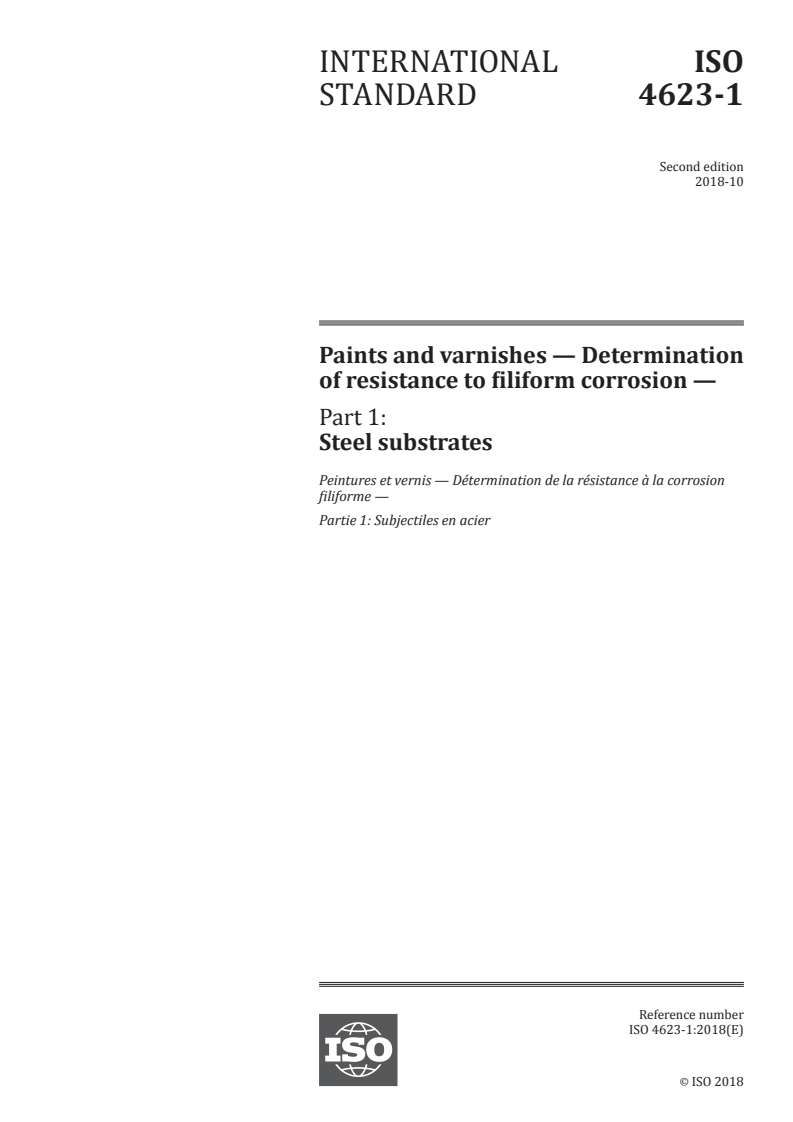
ISO 4623-1:2018 - Paints and varnishes — Determination of resistance to filiform corrosion — Part 1: Steel substrates/5/2018
ISO 4623-1:2018 - Peintures et vernis -- Détermination de la résistance a la corrosion filiforme
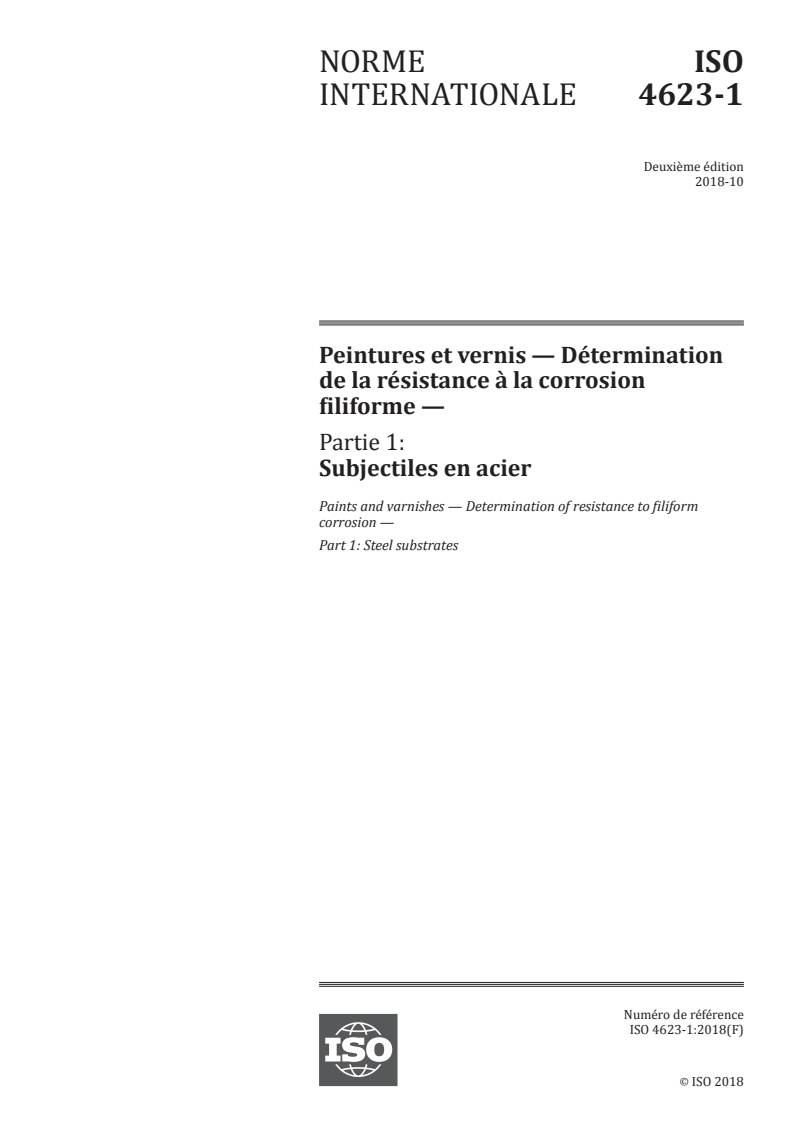
ISO 4623-1:2018 - Peintures et vernis — Détermination de la résistance à la corrosion filiforme — Partie 1: Subjectiles en acier/5/2018
Overview
ISO 4623-1:2018 specifies a laboratory test method to assess the resistance of paints and varnishes on steel substrates to filiform corrosion initiated from a scribed break in the coating. The procedure evaluates the protective action of a specific coating/substrate combination by deliberately introducing chloride at a scribe and exposing the panel under controlled temperature and humidity. Results are only valid for the tested combination and are not predictive for different substrates.
Key topics and technical requirements
- Scope & limitation: Designed for coated steel test panels; results apply only to the tested coating/substrate pair.
- Test principle: Create defined scribe(s) through the coating, introduce sodium chloride by dipping or salt fog, then expose panels at 40 °C and 80 % relative humidity to encourage filiform corrosion growth.
- Test panels: Ground steel panels per ISO 1514, minimum size 150 × 75 × 0.3 mm; back and edges coated; coating thickness measured per ISO 2808.
- Scribing: Two perpendicular scribes at least 30 mm long; cutting edge must fully penetrate the coating; use a mechanical scribing device where possible and verify metal visibility at ×10 magnification.
- Initiation techniques:
- Dipping: Immerse scribed panel in 1 g/L NaCl solution for 30–60 s, remove excess drops, place in the test cabinet; repeat every 3–4 days as specified.
- Salt fog: Expose to neutral salt fog per ISO 9227; for durable systems salt fog exposure usually does not exceed 4 h.
- Exposure conditions: Test cabinet maintained at (40 ± 2) °C and (80 ± 5) % RH. If automatic control is unavailable, a saturated ammonium sulfate solution provides ~79 % RH at 40 °C (guidance in Annex A).
- Evaluation & reporting: Assess filiform corrosion extent using agreed criteria or ISO 4628-10; perform tests in duplicate and report sampling, conditioning (ISO 3270), apparatus, scribe method, exposure cycles, and measured coating thickness.
Applications and users
ISO 4623-1 is used for:
- Quality control and batch acceptance testing of industrial, marine, and automotive coatings on steel
- Product development and comparative performance testing
- Failure analysis and warranty evaluations involving filiform corrosion Primary users include coatings manufacturers, independent test laboratories, corrosion engineers, specification writers, and procurement teams.
Related standards
- ISO 4623-2 (related part)
- ISO 4628-10 (evaluation)
- ISO 1513, ISO 1514, ISO 2808, ISO 3270, ISO 4618, ISO 15528, ISO 9227, ISO 17872
Keywords: ISO 4623-1, filiform corrosion, paint testing, steel substrates, coating performance, salt fog, dipping technique, scribing, test cabinet, corrosion resistance.
Relations
- Effective Date
- 12-Feb-2026
- Effective Date
- 06-Jun-2022
- Effective Date
- 18-Jun-2016
Buy Documents
ISO 4623-1:2018 - Paints and varnishes -- Determination of resistance to filiform corrosion
ISO 4623-1:2018 - Paints and varnishes — Determination of resistance to filiform corrosion — Part 1: Steel substrates/5/2018
ISO 4623-1:2018 - Peintures et vernis -- Détermination de la résistance a la corrosion filiforme
ISO 4623-1:2018 - Peintures et vernis — Détermination de la résistance à la corrosion filiforme — Partie 1: Subjectiles en acier/5/2018
Frequently Asked Questions
ISO 4623-1:2018 is a standard published by the International Organization for Standardization (ISO). Its full title is "Paints and varnishes — Determination of resistance to filiform corrosion — Part 1: Steel substrates". This standard covers: This document describes a test procedure for assessing the protective action of coatings of paints or varnishes on steel against filiform corrosion arising from a scribed mark cut through the coating. It is only suitable for assessing the performance of the coating/substrate combination tested. It is not suitable for predicting the performance of the coating on different substrates.
This document describes a test procedure for assessing the protective action of coatings of paints or varnishes on steel against filiform corrosion arising from a scribed mark cut through the coating. It is only suitable for assessing the performance of the coating/substrate combination tested. It is not suitable for predicting the performance of the coating on different substrates.
ISO 4623-1:2018 is classified under the following ICS (International Classification for Standards) categories: 87.040 - Paints and varnishes. The ICS classification helps identify the subject area and facilitates finding related standards.
ISO 4623-1:2018 has the following relationships with other standards: It is inter standard links to EN ISO 4623-1:2018, ISO 7755-5:2013, ISO 4623-1:2000. Understanding these relationships helps ensure you are using the most current and applicable version of the standard.
ISO 4623-1:2018 is available in PDF format for immediate download after purchase. The document can be added to your cart and obtained through the secure checkout process. Digital delivery ensures instant access to the complete standard document.
Standards Content (Sample)
INTERNATIONAL ISO
STANDARD 4623-1
Second edition
2018-10
Paints and varnishes — Determination
of resistance to filiform corrosion —
Part 1:
Steel substrates
Peintures et vernis — Détermination de la résistance à la corrosion
filiforme —
Partie 1: Subjectiles en acier
Reference number
©
ISO 2018
© ISO 2018
All rights reserved. Unless otherwise specified, or required in the context of its implementation, no part of this publication may
be reproduced or utilized otherwise in any form or by any means, electronic or mechanical, including photocopying, or posting
on the internet or an intranet, without prior written permission. Permission can be requested from either ISO at the address
below or ISO’s member body in the country of the requester.
ISO copyright office
CP 401 • Ch. de Blandonnet 8
CH-1214 Vernier, Geneva
Phone: +41 22 749 01 11
Fax: +41 22 749 09 47
Email: copyright@iso.org
Website: www.iso.org
Published in Switzerland
ii © ISO 2018 – All rights reserved
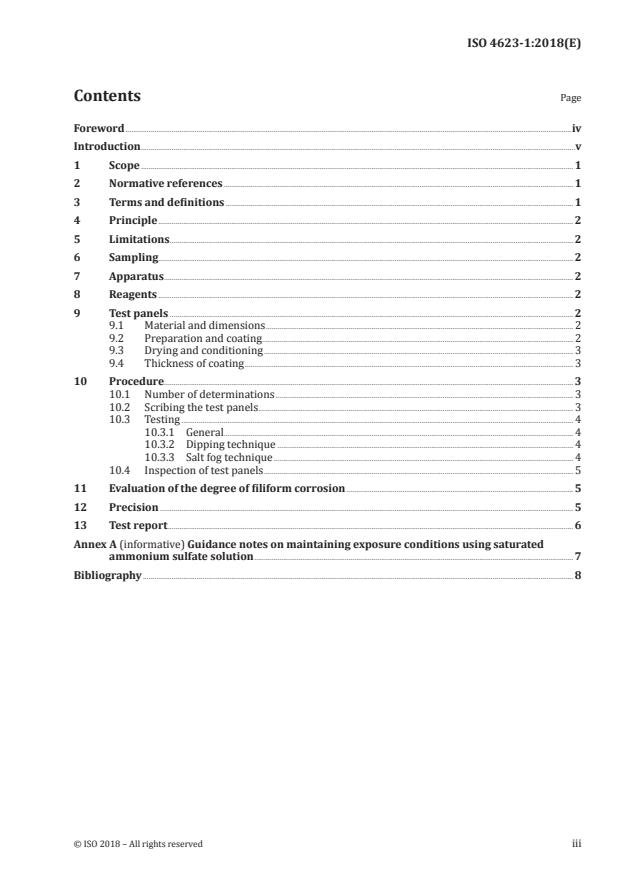
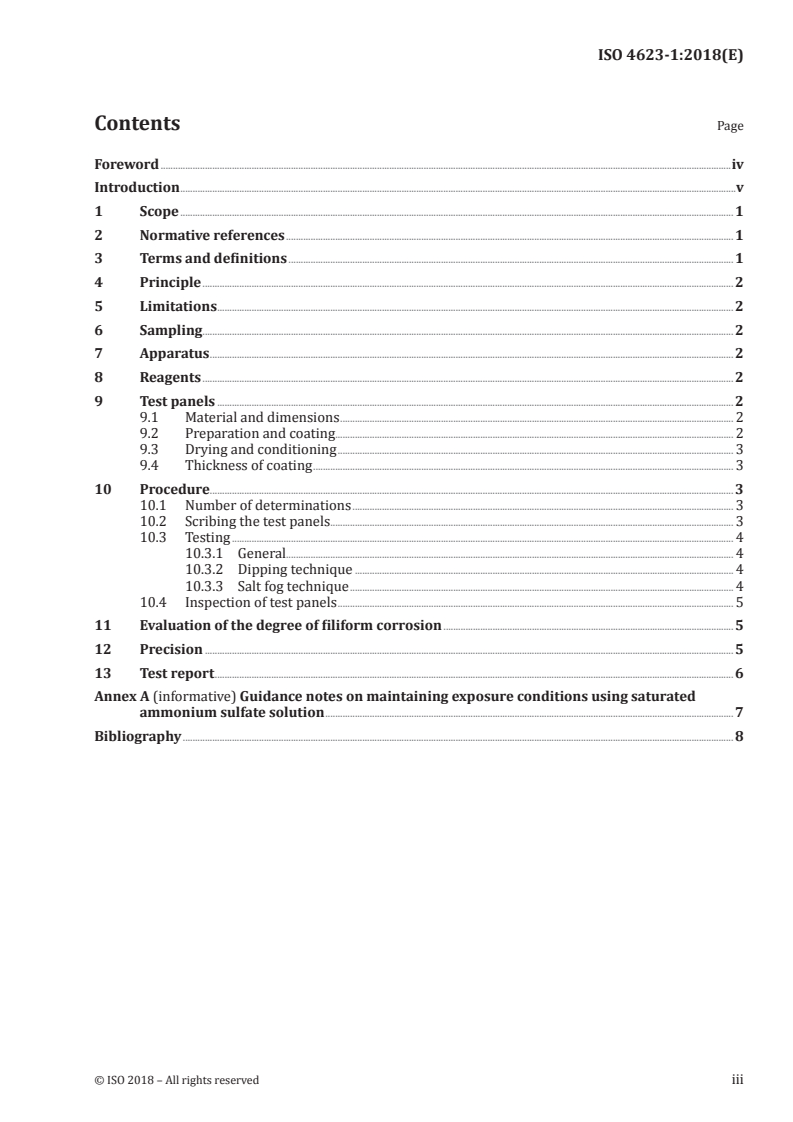
Contents Page
Foreword .iv
Introduction .v
1 Scope . 1
2 Normative references . 1
3 Terms and definitions . 1
4 Principle . 2
5 Limitations . 2
6 Sampling . 2
7 Apparatus . 2
8 Reagents . 2
9 Test panels . 2
9.1 Material and dimensions . 2
9.2 Preparation and coating . . 2
9.3 Drying and conditioning . 3
9.4 Thickness of coating . 3
10 Procedure. 3
10.1 Number of determinations . 3
10.2 Scribing the test panels . 3
10.3 Testing . 4
10.3.1 General. 4
10.3.2 Dipping technique . 4
10.3.3 Salt fog technique . 4
10.4 Inspection of test panels . 5
11 Evaluation of the degree of filiform corrosion . 5
12 Precision . 5
13 Test report . 6
Annex A (informative) Guidance notes on maintaining exposure conditions using saturated
ammonium sulfate solution . 7
Bibliography . 8
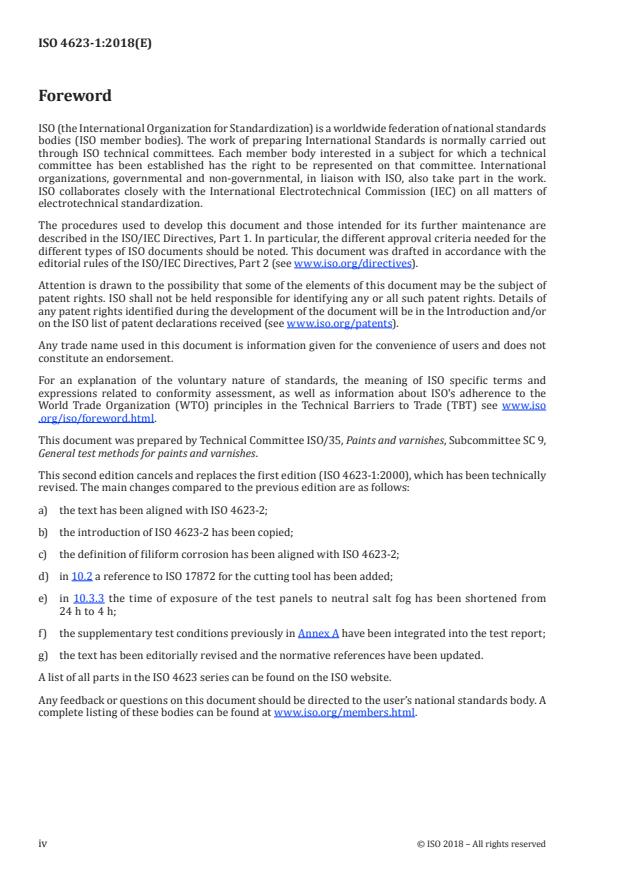
Foreword
ISO (the International Organization for Standardization) is a worldwide federation of national standards
bodies (ISO member bodies). The work of preparing International Standards is normally carried out
through ISO technical committees. Each member body interested in a subject for which a technical
committee has been established has the right to be represented on that committee. International
organizations, governmental and non-governmental, in liaison with ISO, also take part in the work.
ISO collaborates closely with the International Electrotechnical Commission (IEC) on all matters of
electrotechnical standardization.
The procedures used to develop this document and those intended for its further maintenance are
described in the ISO/IEC Directives, Part 1. In particular, the different approval criteria needed for the
different types of ISO documents should be noted. This document was drafted in accordance with the
editorial rules of the ISO/IEC Directives, Part 2 (see www .iso .org/directives).
Attention is drawn to the possibility that some of the elements of this document may be the subject of
patent rights. ISO shall not be held responsible for identifying any or all such patent rights. Details of
any patent rights identified during the development of the document will be in the Introduction and/or
on the ISO list of patent declarations received (see www .iso .org/patents).
Any trade name used in this document is information given for the convenience of users and does not
constitute an endorsement.
For an explanation of the voluntary nature of standards, the meaning of ISO specific terms and
expressions related to conformity assessment, as well as information about ISO's adherence to the
World Trade Organization (WTO) principles in the Technical Barriers to Trade (TBT) see www .iso
.org/iso/foreword .html.
This document was prepared by Technical Committee ISO/35, Paints and varnishes, Subcommittee SC 9,
General test methods for paints and varnishes.
This second edition cancels and replaces the first edition (ISO 4623-1:2000), which has been technically
revised. The main changes compared to the previous edition are as follows:
a) the text has been aligned with ISO 4623-2;
b) the introduction of ISO 4623-2 has been copied;
c) the definition of filiform corrosion has been aligned with ISO 4623-2;
d) in 10.2 a reference to ISO 17872 for the cutting tool has been added;
e) in 10.3.3 the time of exposure of the test panels to neutral salt fog has been shortened from
24 h to 4 h;
f) the supplementary test conditions previously in Annex A have been integrated into the test report;
g) the text has been editorially revised and the normative references have been updated.
A list of all parts in the ISO 4623 series can be found on the ISO website.
Any feedback or questions on this document should be directed to the user’s national standards body. A
complete listing of these bodies can be found at www .iso .org/members .html.
iv © ISO 2018 – All rights reserved
Introduction
A scribe mark cut through a coating of paints or varnishes on metal can give rise to various types of
corrosion, such as blistering of the coating, corrosion of the metal under the coating, as well as filiform
corrosion. Filiform corrosion tends to develop under specific conditions of temperature and relative
humidity and when traces of acids, bases, or salts are present either under the paint coating or at breaks
in the coating. These conditions are often found in marine and/or industrial environments. A certain
amount of under-corrosion of the coating, starting from the scribe mark, will always occur. Filiform
corrosion, however, is considered to be present only if the typical pattern in the form of threads is
obvious.
INTERNATIONAL STANDARD ISO 4623-1:2018(E)
Paints and varnishes — Determination of resistance to
filiform corrosion —
Part 1:
Steel substrates
1 Scope
This document describes a test procedure for assessing the protective action of coatings of paints or
varnishes on steel against filiform corrosion arising from a scribed mark cut through the coating.
It is only suitable for assessing the performance of the coating/substrate combination tested. It is not
suitable for predicting the performance of the coating on different substrates.
2 Normative references
The following documents are referred to in the text in such a way that some or all of their content
constitutes requirements of this document. For dated references, only the edition cited applies. For
undated references, the latest edition of the referenced document (including any amendments) applies.
ISO 1513, Paints and varnishes — Examination and preparation of test samples
ISO 1514, Paints and varnishes — Standard panels for testing
1)
ISO 2808, Paints and varnishes — Determination of film thickness
ISO 3270, Paints and varnishes and their raw materials — Temperatures and humidities for conditioning
and testing
ISO 4618, Paints and varnishes — Terms and definitions
ISO 15528, Paints, varnishes and raw materials for paints and varnishes — Sampling
3 Terms and definitions
For the purposes of this document, the terms and definitions given in ISO 4618 and the following apply.
ISO and IEC maintain terminological databases for use in standardization at the following addresses:
— ISO Online browsing platform: available at https: //www .iso .org/obp
— IEC Electropedia: available at http: //www .electropedia .org/
3.1
filiform corrosion
type of corrosion proceeding under a coat of paint, varnish,
...
INTERNATIONAL ISO
STANDARD 4623-1
Second edition
2018-10
Paints and varnishes — Determination
of resistance to filiform corrosion —
Part 1:
Steel substrates
Peintures et vernis — Détermination de la résistance à la corrosion
filiforme —
Partie 1: Subjectiles en acier
Reference number
©
ISO 2018
© ISO 2018
All rights reserved. Unless otherwise specified, or required in the context of its implementation, no part of this publication may
be reproduced or utilized otherwise in any form or by any means, electronic or mechanical, including photocopying, or posting
on the internet or an intranet, without prior written permission. Permission can be requested from either ISO at the address
below or ISO’s member body in the country of the requester.
ISO copyright office
CP 401 • Ch. de Blandonnet 8
CH-1214 Vernier, Geneva
Phone: +41 22 749 01 11
Fax: +41 22 749 09 47
Email: copyright@iso.org
Website: www.iso.org
Published in Switzerland
ii © ISO 2018 – All rights reserved
Contents Page
Foreword .iv
Introduction .v
1 Scope . 1
2 Normative references . 1
3 Terms and definitions . 1
4 Principle . 2
5 Limitations . 2
6 Sampling . 2
7 Apparatus . 2
8 Reagents . 2
9 Test panels . 2
9.1 Material and dimensions . 2
9.2 Preparation and coating . . 2
9.3 Drying and conditioning . 3
9.4 Thickness of coating . 3
10 Procedure. 3
10.1 Number of determinations . 3
10.2 Scribing the test panels . 3
10.3 Testing . 4
10.3.1 General. 4
10.3.2 Dipping technique . 4
10.3.3 Salt fog technique . 4
10.4 Inspection of test panels . 5
11 Evaluation of the degree of filiform corrosion . 5
12 Precision . 5
13 Test report . 6
Annex A (informative) Guidance notes on maintaining exposure conditions using saturated
ammonium sulfate solution . 7
Bibliography . 8
Foreword
ISO (the International Organization for Standardization) is a worldwide federation of national standards
bodies (ISO member bodies). The work of preparing International Standards is normally carried out
through ISO technical committees. Each member body interested in a subject for which a technical
committee has been established has the right to be represented on that committee. International
organizations, governmental and non-governmental, in liaison with ISO, also take part in the work.
ISO collaborates closely with the International Electrotechnical Commission (IEC) on all matters of
electrotechnical standardization.
The procedures used to develop this document and those intended for its further maintenance are
described in the ISO/IEC Directives, Part 1. In particular, the different approval criteria needed for the
different types of ISO documents should be noted. This document was drafted in accordance with the
editorial rules of the ISO/IEC Directives, Part 2 (see www .iso .org/directives).
Attention is drawn to the possibility that some of the elements of this document may be the subject of
patent rights. ISO shall not be held responsible for identifying any or all such patent rights. Details of
any patent rights identified during the development of the document will be in the Introduction and/or
on the ISO list of patent declarations received (see www .iso .org/patents).
Any trade name used in this document is information given for the convenience of users and does not
constitute an endorsement.
For an explanation of the voluntary nature of standards, the meaning of ISO specific terms and
expressions related to conformity assessment, as well as information about ISO's adherence to the
World Trade Organization (WTO) principles in the Technical Barriers to Trade (TBT) see www .iso
.org/iso/foreword .html.
This document was prepared by Technical Committee ISO/35, Paints and varnishes, Subcommittee SC 9,
General test methods for paints and varnishes.
This second edition cancels and replaces the first edition (ISO 4623-1:2000), which has been technically
revised. The main changes compared to the previous edition are as follows:
a) the text has been aligned with ISO 4623-2;
b) the introduction of ISO 4623-2 has been copied;
c) the definition of filiform corrosion has been aligned with ISO 4623-2;
d) in 10.2 a reference to ISO 17872 for the cutting tool has been added;
e) in 10.3.3 the time of exposure of the test panels to neutral salt fog has been shortened from
24 h to 4 h;
f) the supplementary test conditions previously in Annex A have been integrated into the test report;
g) the text has been editorially revised and the normative references have been updated.
A list of all parts in the ISO 4623 series can be found on the ISO website.
Any feedback or questions on this document should be directed to the user’s national standards body. A
complete listing of these bodies can be found at www .iso .org/members .html.
iv © ISO 2018 – All rights reserved
Introduction
A scribe mark cut through a coating of paints or varnishes on metal can give rise to various types of
corrosion, such as blistering of the coating, corrosion of the metal under the coating, as well as filiform
corrosion. Filiform corrosion tends to develop under specific conditions of temperature and relative
humidity and when traces of acids, bases, or salts are present either under the paint coating or at breaks
in the coating. These conditions are often found in marine and/or industrial environments. A certain
amount of under-corrosion of the coating, starting from the scribe mark, will always occur. Filiform
corrosion, however, is considered to be present only if the typical pattern in the form of threads is
obvious.
INTERNATIONAL STANDARD ISO 4623-1:2018(E)
Paints and varnishes — Determination of resistance to
filiform corrosion —
Part 1:
Steel substrates
1 Scope
This document describes a test procedure for assessing the protective action of coatings of paints or
varnishes on steel against filiform corrosion arising from a scribed mark cut through the coating.
It is only suitable for assessing the performance of the coating/substrate combination tested. It is not
suitable for predicting the performance of the coating on different substrates.
2 Normative references
The following documents are referred to in the text in such a way that some or all of their content
constitutes requirements of this document. For dated references, only the edition cited applies. For
undated references, the latest edition of the referenced document (including any amendments) applies.
ISO 1513, Paints and varnishes — Examination and preparation of test samples
ISO 1514, Paints and varnishes — Standard panels for testing
1)
ISO 2808, Paints and varnishes — Determination of film thickness
ISO 3270, Paints and varnishes and their raw materials — Temperatures and humidities for conditioning
and testing
ISO 4618, Paints and varnishes — Terms and definitions
ISO 15528, Paints, varnishes and raw materials for paints and varnishes — Sampling
3 Terms and definitions
For the purposes of this document, the terms and definitions given in ISO 4618 and the following apply.
ISO and IEC maintain terminological databases for use in standardization at the following addresses:
— ISO Online browsing platform: available at https: //www .iso .org/obp
— IEC Electropedia: available at http: //www .electropedia .org/
3.1
filiform corrosion
type of corrosion proceeding under a coat of paint, varnish,
...
NORME ISO
INTERNATIONALE 4623-1
Deuxième édition
2018-10
Peintures et vernis — Détermination
de la résistance à la corrosion
filiforme —
Partie 1:
Subjectiles en acier
Paints and varnishes — Determination of resistance to filiform
corrosion —
Part 1: Steel substrates
Numéro de référence
©
ISO 2018
DOCUMENT PROTÉGÉ PAR COPYRIGHT
© ISO 2018
Tous droits réservés. Sauf prescription différente ou nécessité dans le contexte de sa mise en œuvre, aucune partie de cette
publication ne peut être reproduite ni utilisée sous quelque forme que ce soit et par aucun procédé, électronique ou mécanique,
y compris la photocopie, ou la diffusion sur l’internet ou sur un intranet, sans autorisation écrite préalable. Une autorisation peut
être demandée à l’ISO à l’adresse ci-après ou au comité membre de l’ISO dans le pays du demandeur.
ISO copyright office
Case postale 401 • Ch. de Blandonnet 8
CH-1214 Vernier, Genève
Tél.: +41 22 749 01 11
Fax: +41 22 749 09 47
E-mail: copyright@iso.org
Web: www.iso.org
Publié en Suisse
ii © ISO 2018 – Tous droits réservés
Sommaire Page
Avant-propos .iv
Introduction .v
1 Domaine d'application . 1
2 Références normatives . 1
3 Termes et définitions . 1
4 Principe . 2
5 Limites . 2
6 Échantillonnage . 2
7 Appareillage . 2
8 Réactifs . 2
9 Panneaux d'essai . 3
9.1 Matériau et dimensions . 3
9.2 Préparation et revêtement . 3
9.3 Séchage et conditionnement . 3
9.4 Épaisseur du revêtement . 3
10 Mode opératoire. 3
10.1 Nombre de déterminations . 3
10.2 Réalisation des rayures sur les panneaux d'essai . 3
10.3 Essai . 4
10.3.1 Généralités . 4
10.3.2 Technique du trempage . 4
10.3.3 Technique du brouillard salin . 4
10.4 Contrôle des panneaux d'essai . 5
11 Évaluation du degré de corrosion filiforme . 5
12 Fidélité . 5
13 Rapport d'essai . 6
Annexe A (informative) Recommandations pour maintenir les conditions d'exposition
au moyen d'une solution saturée de sulfate d'ammonium . 7
Bibliographie . 8
Avant-propos
L'ISO (Organisation internationale de normalisation) est une fédération mondiale d'organismes
nationaux de normalisation (comités membres de l'ISO). L'élaboration des Normes internationales est
en général confiée aux comités techniques de l'ISO. Chaque comité membre intéressé par une étude
a le droit de faire partie du comité technique créé à cet effet. Les organisations internationales,
gouvernementales et non gouvernementales, en liaison avec l'ISO participent également aux travaux.
L'ISO collabore étroitement avec la Commission électrotechnique internationale (IEC) en ce qui
concerne la normalisation électrotechnique.
Les procédures utilisées pour élaborer le présent document et celles destinées à sa mise à jour sont
décrites dans les Directives ISO/IEC, Partie 1. Il convient, en particulier, de prendre note des différents
critères d'approbation requis pour les différents types de documents ISO. Le présent document a été
rédigé conformément aux règles de rédaction données dans les Directives ISO/IEC, Partie 2 (voir www
.iso .org/directives).
L'attention est attirée sur le fait que certains des éléments du présent document peuvent faire l'objet de
droits de propriété intellectuelle ou de droits analogues. L'ISO ne saurait être tenue pour responsable
de ne pas avoir identifié de tels droits de propriété et averti de leur existence. Les détails concernant
les références aux droits de propriété intellectuelle ou autres droits analogues identifiés lors de
l'élaboration du document sont indiqués dans l'Introduction et/ou dans la liste des déclarations de
brevets reçues par l'ISO (voir www .iso .org/brevets).
Les appellations commerciales éventuellement mentionnées dans le présent document sont données
pour information, par souci de commodité, à l’intention des utilisateurs et ne sauraient constituer un
engagement.
Pour une explication de la nature volontaire des normes, la signification des termes et expressions
spécifiques de l'ISO liés à l'évaluation de la conformité, ou pour toute information au sujet de l'adhésion
de l'ISO aux principes de l’Organisation mondiale du commerce (OMC) concernant les obstacles
techniques au commerce (OTC), voir www .iso .org/avant -propos.
Le présent document a été élaboré par le comité technique ISO/TC 35, Peintures et vernis, sous-comité
SC 9, Méthodes générales d'essai des peintures et vernis.
Cette deuxième édition annule et remplace la première édition (ISO 4623-1:2000), qui a fait l'objet d'une
révision technique. Les principales modifications par rapport à l'édition précédente sont les suivantes:
a) le texte a été aligné sur celui de l'ISO 4623-2;
b) l'introduction de l'ISO 4623-2 a été reproduite;
c) la définition de la corrosion filiforme a été alignée sur celle de l'ISO 4623-2;
d) en 10.2, une référence à l'ISO 17872 concernant l'outil à rayer a été ajoutée;
e) en 10.3.3, le temps d'exposition des panneaux d'essai au brouillard salin neutre a été ramené
de 24 h à 4 h;
f) les conditions d'essai supplémentaires qui étaient énoncées dans l'Annexe A ont été intégrées au
rapport d'essai;
g) le texte a fait l'objet d'une révision rédactionnelle et les références normatives d'une mise à jour.
Une liste de toutes les parties de la série ISO 4623 se trouve sur le site web de l'ISO.
Il convient que l'utilisateur adresse tout retour d'information ou toute question concernant le présent
document à l'organisme national de normalisation de son pays. Une liste exhaustive desdits organismes
se trouve à l'adresse www .iso .org/members .html.
iv © ISO 2018 – Tous droits réservés
Introduction
Une rayure effectuée sur une peinture ou un vernis recouvrant du métal peut entraîner différents
types de corrosion, comme un cloquage du revêtement, une corrosion du métal sous le revêtement ou
une corrosion filiforme. La corrosion filiforme a tendance à se développer dans certaines conditions
de température et d'humidité relative et lorsque des traces d'acides, de bases ou de sels sont présentes
sous le revêtement de peinture ou dans les fissures du revêtement de peinture. Ces conditions sont
fréquentes dans les environnements marins et/ou industriels. Une certaine quantité de corrosion sous-
jacente du revêtement se produit toujours à partir de la rayure. Cependant, on considère qu'il n'y a
corrosion filiforme que lorsque l'on observe le motif caractéristique en forme de fils.
NORME INTERNATIONALE ISO 4623-1:2018(F)
Peintures et vernis — Détermination de la résistance à la
corrosion filiforme —
Partie 1:
Subjectiles en acier
1 Domaine d'application
Le présent document décrit un mode opératoire d'essai permettant d'évaluer l'action protectrice des
revêtements de peinture et de vernis sur acier contre la corrosion filiforme ayant pour origine une
rayure du revêtement.
Il permet seulement d'évaluer la performance de la combinaison revêtement/subjectile soumise à essai,
mais ne permet pas de prédire l'efficacité du revêtement sur différents subjectiles.
2 Références normatives
Les documents suivants cités dans le texte constituent, pour tout ou partie de leur contenu, des
exigences du présent document. Pour les références datées, seule l'édition citée s'applique. Pour les
références non datées, la dernière édition du document de référence s'applique (y compris les éventuels
amendements).
ISO 1513, Peintures et vernis — Examen et préparation des échantillons pour essai
ISO 1514, Peintures et vernis — Panneaux normalisés pour essai
1)
ISO 2808, Peintures et vernis — Détermination de l'épaisseur du feuil
ISO 3270, Peintures et vernis et leurs matières premières — Températures et humidités pour le
conditionnement et l'essai
ISO 4618, Peintures et vernis — Termes et définitions
ISO 15528, Peintures, vernis et matières premières pour peintures et vernis — Échantillonnage
3 Termes et définitions
Pour les besoins du présent document, les termes et définitions de l'ISO 4618 ainsi que les suivants
s'appliquent.
L'ISO et l'IEC tiennent à jour des bases de données terminologiques destinées à être utilisées en
normalisation, consultables aux adresses suivantes:
— ISO Online browsing platform: disponible à l'adresse https: //www .iso .org/obp
— IEC Electropedia: disponible à l'adresse http: //www .electropedia .org/
1) En cours d’élaboration. Stade au moment de la publication ISO/DIS 2808:2018.
3.1
corrosion filiforme
type de corrosion se développant sous une couche de peinture, de vernis ou de produit assimilé, sous
forme de fils qui prennent généralement naissance au niveau des bords nus ou des zones endommagées
du revêtement
Note 1 à l'article: En général, les fils ont une longueur et
...
NORME ISO
INTERNATIONALE 4623-1
Deuxième édition
2018-10
Peintures et vernis — Détermination
de la résistance à la corrosion
filiforme —
Partie 1:
Subjectiles en acier
Paints and varnishes — Determination of resistance to filiform
corrosion —
Part 1: Steel substrates
Numéro de référence
©
ISO 2018
DOCUMENT PROTÉGÉ PAR COPYRIGHT
© ISO 2018
Tous droits réservés. Sauf prescription différente ou nécessité dans le contexte de sa mise en œuvre, aucune partie de cette
publication ne peut être reproduite ni utilisée sous quelque forme que ce soit et par aucun procédé, électronique ou mécanique,
y compris la photocopie, ou la diffusion sur l’internet ou sur un intranet, sans autorisation écrite préalable. Une autorisation peut
être demandée à l’ISO à l’adresse ci-après ou au comité membre de l’ISO dans le pays du demandeur.
ISO copyright office
Case postale 401 • Ch. de Blandonnet 8
CH-1214 Vernier, Genève
Tél.: +41 22 749 01 11
Fax: +41 22 749 09 47
E-mail: copyright@iso.org
Web: www.iso.org
Publié en Suisse
ii © ISO 2018 – Tous droits réservés
Sommaire Page
Avant-propos .iv
Introduction .v
1 Domaine d'application . 1
2 Références normatives . 1
3 Termes et définitions . 1
4 Principe . 2
5 Limites . 2
6 Échantillonnage . 2
7 Appareillage . 2
8 Réactifs . 2
9 Panneaux d'essai . 3
9.1 Matériau et dimensions . 3
9.2 Préparation et revêtement . 3
9.3 Séchage et conditionnement . 3
9.4 Épaisseur du revêtement . 3
10 Mode opératoire. 3
10.1 Nombre de déterminations . 3
10.2 Réalisation des rayures sur les panneaux d'essai . 3
10.3 Essai . 4
10.3.1 Généralités . 4
10.3.2 Technique du trempage . 4
10.3.3 Technique du brouillard salin . 4
10.4 Contrôle des panneaux d'essai . 5
11 Évaluation du degré de corrosion filiforme . 5
12 Fidélité . 5
13 Rapport d'essai . 6
Annexe A (informative) Recommandations pour maintenir les conditions d'exposition
au moyen d'une solution saturée de sulfate d'ammonium . 7
Bibliographie . 8
Avant-propos
L'ISO (Organisation internationale de normalisation) est une fédération mondiale d'organismes
nationaux de normalisation (comités membres de l'ISO). L'élaboration des Normes internationales est
en général confiée aux comités techniques de l'ISO. Chaque comité membre intéressé par une étude
a le droit de faire partie du comité technique créé à cet effet. Les organisations internationales,
gouvernementales et non gouvernementales, en liaison avec l'ISO participent également aux travaux.
L'ISO collabore étroitement avec la Commission électrotechnique internationale (IEC) en ce qui
concerne la normalisation électrotechnique.
Les procédures utilisées pour élaborer le présent document et celles destinées à sa mise à jour sont
décrites dans les Directives ISO/IEC, Partie 1. Il convient, en particulier, de prendre note des différents
critères d'approbation requis pour les différents types de documents ISO. Le présent document a été
rédigé conformément aux règles de rédaction données dans les Directives ISO/IEC, Partie 2 (voir www
.iso .org/directives).
L'attention est attirée sur le fait que certains des éléments du présent document peuvent faire l'objet de
droits de propriété intellectuelle ou de droits analogues. L'ISO ne saurait être tenue pour responsable
de ne pas avoir identifié de tels droits de propriété et averti de leur existence. Les détails concernant
les références aux droits de propriété intellectuelle ou autres droits analogues identifiés lors de
l'élaboration du document sont indiqués dans l'Introduction et/ou dans la liste des déclarations de
brevets reçues par l'ISO (voir www .iso .org/brevets).
Les appellations commerciales éventuellement mentionnées dans le présent document sont données
pour information, par souci de commodité, à l’intention des utilisateurs et ne sauraient constituer un
engagement.
Pour une explication de la nature volontaire des normes, la signification des termes et expressions
spécifiques de l'ISO liés à l'évaluation de la conformité, ou pour toute information au sujet de l'adhésion
de l'ISO aux principes de l’Organisation mondiale du commerce (OMC) concernant les obstacles
techniques au commerce (OTC), voir www .iso .org/avant -propos.
Le présent document a été élaboré par le comité technique ISO/TC 35, Peintures et vernis, sous-comité
SC 9, Méthodes générales d'essai des peintures et vernis.
Cette deuxième édition annule et remplace la première édition (ISO 4623-1:2000), qui a fait l'objet d'une
révision technique. Les principales modifications par rapport à l'édition précédente sont les suivantes:
a) le texte a été aligné sur celui de l'ISO 4623-2;
b) l'introduction de l'ISO 4623-2 a été reproduite;
c) la définition de la corrosion filiforme a été alignée sur celle de l'ISO 4623-2;
d) en 10.2, une référence à l'ISO 17872 concernant l'outil à rayer a été ajoutée;
e) en 10.3.3, le temps d'exposition des panneaux d'essai au brouillard salin neutre a été ramené
de 24 h à 4 h;
f) les conditions d'essai supplémentaires qui étaient énoncées dans l'Annexe A ont été intégrées au
rapport d'essai;
g) le texte a fait l'objet d'une révision rédactionnelle et les références normatives d'une mise à jour.
Une liste de toutes les parties de la série ISO 4623 se trouve sur le site web de l'ISO.
Il convient que l'utilisateur adresse tout retour d'information ou toute question concernant le présent
document à l'organisme national de normalisation de son pays. Une liste exhaustive desdits organismes
se trouve à l'adresse www .iso .org/members .html.
iv © ISO 2018 – Tous droits réservés
Introduction
Une rayure effectuée sur une peinture ou un vernis recouvrant du métal peut entraîner différents
types de corrosion, comme un cloquage du revêtement, une corrosion du métal sous le revêtement ou
une corrosion filiforme. La corrosion filiforme a tendance à se développer dans certaines conditions
de température et d'humidité relative et lorsque des traces d'acides, de bases ou de sels sont présentes
sous le revêtement de peinture ou dans les fissures du revêtement de peinture. Ces conditions sont
fréquentes dans les environnements marins et/ou industriels. Une certaine quantité de corrosion sous-
jacente du revêtement se produit toujours à partir de la rayure. Cependant, on considère qu'il n'y a
corrosion filiforme que lorsque l'on observe le motif caractéristique en forme de fils.
NORME INTERNATIONALE ISO 4623-1:2018(F)
Peintures et vernis — Détermination de la résistance à la
corrosion filiforme —
Partie 1:
Subjectiles en acier
1 Domaine d'application
Le présent document décrit un mode opératoire d'essai permettant d'évaluer l'action protectrice des
revêtements de peinture et de vernis sur acier contre la corrosion filiforme ayant pour origine une
rayure du revêtement.
Il permet seulement d'évaluer la performance de la combinaison revêtement/subjectile soumise à essai,
mais ne permet pas de prédire l'efficacité du revêtement sur différents subjectiles.
2 Références normatives
Les documents suivants cités dans le texte constituent, pour tout ou partie de leur contenu, des
exigences du présent document. Pour les références datées, seule l'édition citée s'applique. Pour les
références non datées, la dernière édition du document de référence s'applique (y compris les éventuels
amendements).
ISO 1513, Peintures et vernis — Examen et préparation des échantillons pour essai
ISO 1514, Peintures et vernis — Panneaux normalisés pour essai
1)
ISO 2808, Peintures et vernis — Détermination de l'épaisseur du feuil
ISO 3270, Peintures et vernis et leurs matières premières — Températures et humidités pour le
conditionnement et l'essai
ISO 4618, Peintures et vernis — Termes et définitions
ISO 15528, Peintures, vernis et matières premières pour peintures et vernis — Échantillonnage
3 Termes et définitions
Pour les besoins du présent document, les termes et définitions de l'ISO 4618 ainsi que les suivants
s'appliquent.
L'ISO et l'IEC tiennent à jour des bases de données terminologiques destinées à être utilisées en
normalisation, consultables aux adresses suivantes:
— ISO Online browsing platform: disponible à l'adresse https: //www .iso .org/obp
— IEC Electropedia: disponible à l'adresse http: //www .electropedia .org/
1) En cours d’élaboration. Stade au moment de la publication ISO/DIS 2808:2018.
3.1
corrosion filiforme
type de corrosion se développant sous une couche de peinture, de vernis ou de produit assimilé, sous
forme de fils qui prennent généralement naissance au niveau des bords nus ou des zones endommagées
du revêtement
Note 1 à l'article: En général, les fils ont une longueur et
...