

ISO 13511:2025
(Main)Petroleum products and lubricants — Rheological properties of lubricating greases — Determination of the consistency of greases with metal soap thickener by an oscillatory rheometer with a cone/plate measuring system
General Information
- Abstract
This document specifies a procedure to determine the consistency of a metal-saponified lubricating grease by an oscillatory rheometer. This test method is applicable for fresh, as well as used, lubricating greases where only small quantities of the grease are present and the worked penetration that is usually used cannot be determined due to the small quantity. The determined calibration is only valid for metal-saponified lubricating greases like lithium, lithium-calcium and, also, lithium- and calcium complex. The method described in this document is applicable for lubricating greases with NLGI grades 00, 0, 1, 2 and 3 according to ISO 6743-99.
- Status
- Published
- Publication Date
- 18-Mar-2025
- Current Stage
- 6060 - International Standard published
- Start Date
- 19-Mar-2025
- Due Date
- 08-Jun-2025
- Completion Date
- 19-Mar-2025
Buy Documents
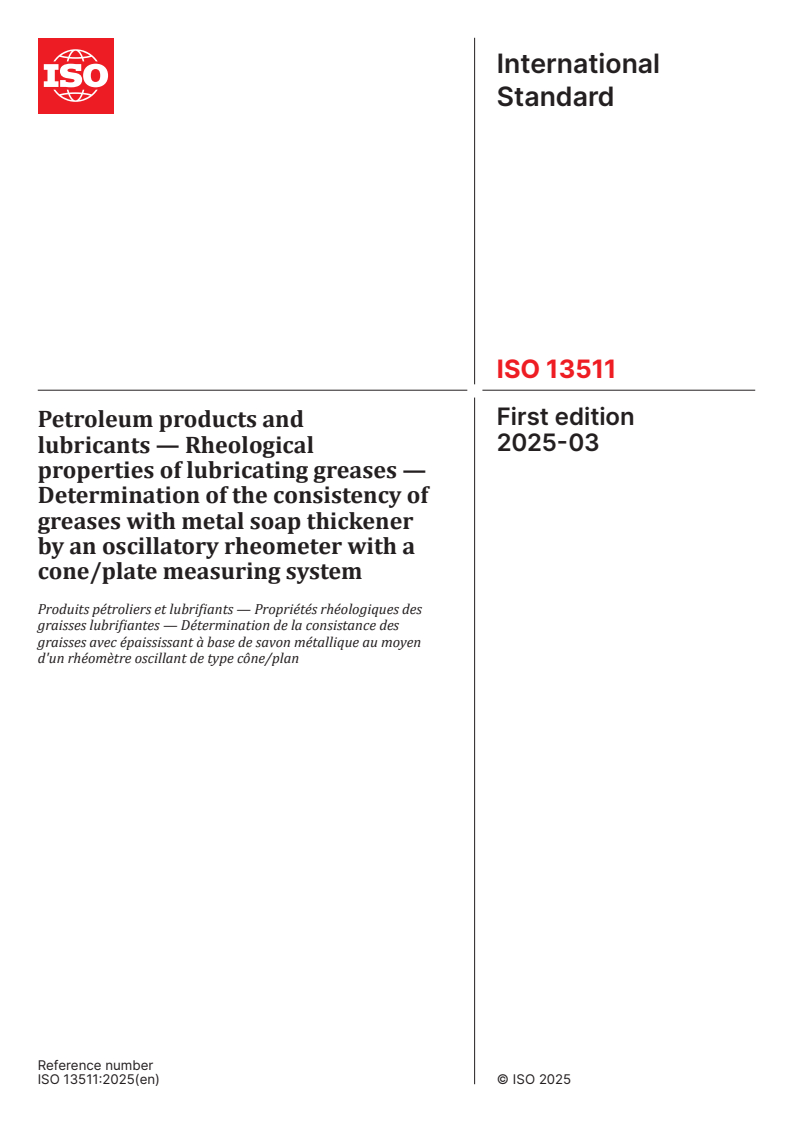
ISO 13511:2025 - Petroleum products and lubricants — Rheological properties of lubricating greases — Determination of the consistency of greases with metal soap thickener by an oscillatory rheometer with a cone/plate measuring system Released:19. 03. 2025
ISO 13511:2025 - Produits pétroliers et lubrifiants — Propriétés rhéologiques des graisses lubrifiantes — Détermination de la consistance des graisses avec épaississant a base de savon métallique au moyen d'un rhéometre oscillant de type cône/plan Released:19. 03. 2025
Overview - ISO 13511:2025 (lubricating greases consistency by rheometer)
ISO 13511:2025 specifies a laboratory procedure to determine the consistency of metal‑saponified lubricating greases using an oscillatory rheometer with a cone/plate measuring system. The method is intended for small sample quantities (fresh or used greases) where the conventional worked‑penetration test is not feasible. It is applicable to greases thickened with metal soaps (e.g., lithium, lithium‑calcium and lithium‑/calcium‑complex) and for NLGI grades 00, 0, 1, 2 and 3 (see ISO 6743‑99).
Key topics and technical requirements
- Measurement principle: Oscillatory amplitude (strain) sweep at 25 °C with a cone/plate geometry to determine loss modulus (G'') as a function of shear deformation; derive shear stress and shear rate and extrapolate an intercept (τ0) for consistency.
- Apparatus specifications:
- Air‑bearing oscillatory rheometer with cone/plate system.
- Cone: 25 mm diameter, Ra ≈ 0.8 µm, angle (1.00 ± 0.02)°, temperature control to ±0.1 °C.
- Test parameters:
- Tempering and measurement at 25 °C.
- Strain sweep from 0.01% to 1 000% with 10 points per decade; angular frequency 10 rad·s‑1.
- Procedure steps: sampling (ISO 23572), cleaning, tempering, set measuring gap, filling without trapped air, amplitude test, and data evaluation.
- Data evaluation:
- Convert shear deformation to shear rate using factor 0.071 (derived in Annex A).
- Calculate shear stress from loss modulus and shear deformation; plot shear stress vs. shear rate and use linear regression through the last four points to read y‑intercept τ0.
- Convert τ0 empirically to a worked‑penetration equivalent (0.1 mm units) using the provided formula.
- Scope limits: Calibration is valid only for metal‑saponified greases; not intended for other thickener chemistries.
Applications and users
- Who uses it: lubricant manufacturers, quality control and analytical laboratories, R&D teams, tribologists, equipment OEMs, and maintenance/forensics labs needing consistency assessment from limited or used grease samples.
- Practical uses:
- Quality control of grease batches when sample volume is limited.
- Assessment of used greases from field samples (small quantities).
- R&D and formulation comparisons for metal‑soap thickened greases.
- Correlating rheometric data to traditional worked‑penetration and NLGI grade assignments.
Related standards
- ISO 6743‑99 - NLGI grade classification reference
- ISO 23572 - Sampling of lubricating greases
Keywords: ISO 13511:2025, lubricating greases, rheological properties, consistency test, oscillatory rheometer, cone/plate, metal soap thickener, NLGI grade, worked penetration, lithium grease.
Buy Documents
ISO 13511:2025 - Petroleum products and lubricants — Rheological properties of lubricating greases — Determination of the consistency of greases with metal soap thickener by an oscillatory rheometer with a cone/plate measuring system Released:19. 03. 2025
ISO 13511:2025 - Produits pétroliers et lubrifiants — Propriétés rhéologiques des graisses lubrifiantes — Détermination de la consistance des graisses avec épaississant a base de savon métallique au moyen d'un rhéometre oscillant de type cône/plan Released:19. 03. 2025
Get Certified
Connect with accredited certification bodies for this standard

Element Materials Technology
Materials testing and product certification.

ABS Group Brazil
ABS Group certification services in Brazil.

ABS Quality Evaluations Inc.
American Bureau of Shipping quality certification.
Sponsored listings
Frequently Asked Questions
ISO 13511:2025 is a standard published by the International Organization for Standardization (ISO). Its full title is "Petroleum products and lubricants — Rheological properties of lubricating greases — Determination of the consistency of greases with metal soap thickener by an oscillatory rheometer with a cone/plate measuring system". This standard covers: This document specifies a procedure to determine the consistency of a metal-saponified lubricating grease by an oscillatory rheometer. This test method is applicable for fresh, as well as used, lubricating greases where only small quantities of the grease are present and the worked penetration that is usually used cannot be determined due to the small quantity. The determined calibration is only valid for metal-saponified lubricating greases like lithium, lithium-calcium and, also, lithium- and calcium complex. The method described in this document is applicable for lubricating greases with NLGI grades 00, 0, 1, 2 and 3 according to ISO 6743-99.
This document specifies a procedure to determine the consistency of a metal-saponified lubricating grease by an oscillatory rheometer. This test method is applicable for fresh, as well as used, lubricating greases where only small quantities of the grease are present and the worked penetration that is usually used cannot be determined due to the small quantity. The determined calibration is only valid for metal-saponified lubricating greases like lithium, lithium-calcium and, also, lithium- and calcium complex. The method described in this document is applicable for lubricating greases with NLGI grades 00, 0, 1, 2 and 3 according to ISO 6743-99.
ISO 13511:2025 is classified under the following ICS (International Classification for Standards) categories: 75.100 - Lubricants, industrial oils and related products. The ICS classification helps identify the subject area and facilitates finding related standards.
ISO 13511:2025 is available in PDF format for immediate download after purchase. The document can be added to your cart and obtained through the secure checkout process. Digital delivery ensures instant access to the complete standard document.
Standards Content (Sample)
International
Standard
ISO 13511
First edition
Petroleum products and
2025-03
lubricants — Rheological
properties of lubricating greases —
Determination of the consistency of
greases with metal soap thickener
by an oscillatory rheometer with a
cone/plate measuring system
Produits pétroliers et lubrifiants — Propriétés rhéologiques des
graisses lubrifiantes — Détermination de la consistance des
graisses avec épaississant à base de savon métallique au moyen
d'un rhéomètre oscillant de type cône/plan
Reference number
© ISO 2025
All rights reserved. Unless otherwise specified, or required in the context of its implementation, no part of this publication may
be reproduced or utilized otherwise in any form or by any means, electronic or mechanical, including photocopying, or posting on
the internet or an intranet, without prior written permission. Permission can be requested from either ISO at the address below
or ISO’s member body in the country of the requester.
ISO copyright office
CP 401 • Ch. de Blandonnet 8
CH-1214 Vernier, Geneva
Phone: +41 22 749 01 11
Email: copyright@iso.org
Website: www.iso.org
Published in Switzerland
ii
Contents Page
Foreword .iv
1 Scope . 1
2 Normative references . 1
3 Terms and definitions . 1
4 Symbols . 2
5 Principle . 2
6 Reagents and materials . 2
7 Apparatus . 2
8 Sampling . 3
9 Procedure . 3
9.1 Cleaning of the measuring system .3
9.2 Tempering .3
9.3 Setting the measuring gap and filling the measuring system cone/plate .3
9.4 Measurement .3
10 Evaluation . 4
11 Expression of results . 7
12 Precision . 8
12.1 General .8
12.2 Repeatability, r .8
12.3 Reproducibility, R .8
13 Test report . 8
Annex A (informative) Explanation and the derivation of the factor 0,071 . 9
Bibliography . 14
iii
Foreword
ISO (the International Organization for Standardization) is a worldwide federation of national standards
bodies (ISO member bodies). The work of preparing International Standards is normally carried out through
ISO technical committees. Each member body interested in a subject for which a technical committee
has been established has the right to be represented on that committee. International organizations,
governmental and non-governmental, in liaison with ISO, also take part in the work. ISO collaborates closely
with the International Electrotechnical Commission (IEC) on all matters of electrotechnical standardization.
The procedures used to develop this document and those intended for its further maintenance are described
in the ISO/IEC Directives, Part 1. In particular, the different approval criteria needed for the different types
of ISO document should be noted. This document was drafted in accordance with the editorial rules of the
ISO/IEC Directives, Part 2 (see www.iso.org/directives).
ISO draws attention to the possibility that the implementation of this document may involve the use of (a)
patent(s). ISO takes no position concerning the evidence, validity or applicability of any claimed patent
rights in respect thereof. As of the date of publication of this document, ISO had not received notice of (a)
patent(s) which may be required to implement this document. However, implementers are cautioned that
this may not represent the latest information, which may be obtained from the patent database available at
www.iso.org/patents. ISO shall not be held responsible for identifying any or all such patent rights.
Any trade name used in this document is information given for the convenience of users and does not
constitute an endorsement.
For an explanation of the voluntary nature of standards, the meaning of ISO specific terms and expressions
related to conformity assessment, as well as information about ISO's adherence to the World Trade
Organization (WTO) principles in the Technical Barriers to Trade (TBT), see www.iso.org/iso/foreword.html.
This document was prepared by Technical Committee ISO/TC 28, Petroleum and related products, fuels and
lubricants from natural or synthetic sources.
Any feedback or questions on this document should be directed to the user’s national standards body. A
complete listing of these bodies can be found at www.iso.org/members.html.
iv
International Standard ISO 13511:2025(en)
Petroleum products and lubricants — Rheological properties
of lubricating greases — Determination of the consistency
of greases with metal soap thickener by an oscillatory
rheometer with a cone/plate measuring system
1 Scope
This document specifies a procedure to determine the consistency of a metal-saponified lubricating grease
by an oscillatory rheometer.
This test method is applicable for fresh, as well as used, lubricating greases where only small quantities of
the grease are present and the worked penetration that is usually used cannot be determined due to the
small quantity.
The determined calibration is only valid for metal-saponified lubricating greases like lithium, lithium-
calcium and, also, lithium- and calcium complex.
The method described in this document is applicable for lubricating greases with NLGI grades 00, 0, 1, 2 and
3 according to ISO 6743-99.
2 Normative references
The following documents are referred to in the text in such a way that some or all of their content constitutes
requirements of this document. For dated references, only the edition cited applies. For undated references,
the latest edition of the referenced document (including any amendments) applies.
ISO 23572, Petroleum products — Lubricating greases — Sampling of greases
3 Terms and definitions
For the purposes of this document, the following terms and definitions apply.
ISO and IEC maintain terminology databases for use in standardization at the following addresses:
— ISO Online browsing platform: available at https:// www .iso .org/ obp
— IEC Electropedia: available at https:// www .electropedia .org/
3.1
shear deformation
shear strain
γ
deformation of the sample generated by tangential deflection
Note 1 to entry: The shear deformation is dimensionless. It is often given in per cent (%), where 100 % = 1.
3.2
loss modulus
G''
component of shear stress (3.3) which exhibits a phase shift of δ = π/2 = 90° to the shear strain (3.1)
Note 1 to entry: The loss modulus represents the viscous part of the viscoelastic behaviour of the sample and is given
in pascals (Pa).
[SOURCE: ISO/DIS 13227:2024, 3.4]
3.3
shear stress
τ
quotient of tangential force to area
Note 1 to entry: The unit of the shear stress is Pascal (Pa).
3.4
shear rate
γγ
change in shear deformation (3.1) over time
-1
Note 1 to entry: The unit of the shear rate is reciprocal seconds (s ).
4 Symbols
For the purposes of this document, the symbols listed in Table 1 apply.
Table 1 — Symbols
Symbol Designation Unit
τ shear stress, calculated by the loss modulus Pa
calc
-1
τ shear stress, at shear rate 0 s Pa
-1
γγ shear rate, calculated by the shear deformation s
calc
γ shear deformation %
G'' loss modulus Pa
τ shear stress Pa
-1
γγ
shear rate s
5 Principle
A lubricating grease sample is tested at 25 °C with an oscillatory test using a cone-plate measuring system.
The loss modulus is determined as a function of the shear deformation. The worked penetration and the
NLGI grade can then be determined from these values.
6 Reagents and materials
6.1 Solvent, suitable to clean the equipment without any residue.
7 Apparatus
Usual laboratory apparatus and glassware, together with the following shall be used.
7.1 Oscillatory rheometer, air-bearing, equipped with a cone/plate measuring system.
7.2 Cone/plate measuring system, with a cone diameter of 25 mm, Ra roughness of 0,8 µm, an angle of
(1,00 ± 0,02)°, and which can be tempered to ±0,1 °C.
7.3 Temperature control unit, allowing the temperature of the sample to be adjusted within ±0,1 °C.
8 Sampling
Sampling shall be conducted in accordance with ISO 23572.
9 Procedure
9.1 Cleaning of the measuring system
Before commencing the test, any residue shall be removed from the cone/plate system with a suitable
solvent and afterwards the system shall be dried.
9.2 Tempering
The temperature of the measuring arrangement shall be 25 °C at the start of the test.
9.3 Setting the measuring gap and filling the measuring system cone/plate
After the temperature control has taken place, the zero point (based on the distance between the cone and
the plate) shall be set (manually or automatically with the aid of a suitable measuring programme).
The distance shall be set at the measuring temperature, because the gap has a big influence on the
measurement results.
Using a spatula, a sufficient amount of grease (with a small excess) shall be applied to the centre of the plate,
free of air bubbles. The required amount of grease shall be taken from the operating instructions of the
measuring system. The sample shall not be manually distributed on the plate before the cone is lowered,
but automatically distributed when the measuring gap is approached. To fill the gap correctly, a measuring
gap of 20 % above the final measuring gap shall be approached first. This position is often specified by the
device manufacturer, the so-called trimming position. Then the excess lubricant on the edge of the cone/
plate shall be wiped off. Afterwards, the measuring gap (as specified by the device manufacturer) shall be
approached. The device-specific distance between the cone and the plate has a significant influence on the
measurement result and shall therefore be set carefully.
When taking samples, bear in mind that inhomogeneities, impurities and trapped air bubbles can falsify
the measurement results. It can therefore be necessary to evaluate the sample in this respect prior to the
measurement. Furthermore, in case that the maximum particle size of solid and hard particles is larger than
1/10 of the measuring gap, they can even damage the measuring system.
The rheological behaviour of lubricating greases strongly depends on the previous treatment. Storage over
weeks and months can change the lubricating grease. Lubricating greases often become harder if separation
of oil has occurred. Also, this ca
...
Norme
internationale
ISO 13511
Première édition
Produits pétroliers et lubrifiants —
2025-03
Propriétés rhéologiques des graisses
lubrifiantes — Détermination
de la consistance des graisses
avec épaississant à base de savon
métallique au moyen d'un rhéomètre
oscillant de type cône/plan
Petroleum products and lubricants — Rheological properties
of lubricating greases — Determination of the consistency of
greases with metal soap thickener by an oscillatory rheometer
with a cone/plate measuring system
Numéro de référence
DOCUMENT PROTÉGÉ PAR COPYRIGHT
© ISO 2025
Tous droits réservés. Sauf prescription différente ou nécessité dans le contexte de sa mise en œuvre, aucune partie de cette
publication ne peut être reproduite ni utilisée sous quelque forme que ce soit et par aucun procédé, électronique ou mécanique,
y compris la photocopie, ou la diffusion sur l’internet ou sur un intranet, sans autorisation écrite préalable. Une autorisation peut
être demandée à l’ISO à l’adresse ci-après ou au comité membre de l’ISO dans le pays du demandeur.
ISO copyright office
Case postale 401 • Ch. de Blandonnet 8
CH-1214 Vernier, Genève
Tél.: +41 22 749 01 11
E-mail: copyright@iso.org
Web: www.iso.org
Publié en Suisse
ii
Sommaire Page
Avant-propos .iv
1 Domaine d'application . 1
2 Références normatives . 1
3 Termes et définitions . 1
4 Symboles . 2
5 Principe. 2
6 Réactifs et matériaux . 2
7 Appareillage . 2
8 Échantillonnage . 3
9 Mode opératoire . 3
9.1 Nettoyage du système de mesure .3
9.2 Mise en température .3
9.3 Réglage de l'entrefer et remplissage du système de mesure cône/plan .3
9.4 Mesures .3
10 Évaluation . 4
11 Expression des résultats . 7
12 Fidélité . 8
12.1 Généralités .8
12.2 Répétabilité, r .8
12.3 Reproductibilité, R . .8
13 Rapport d’essai . 8
Annexe A (informative) Explication et calcul du facteur 0,071 . 9
Bibliographie . 14
iii
Avant-propos
L'ISO (Organisation internationale de normalisation) est une fédération mondiale d'organismes nationaux
de normalisation (comités membres de l'ISO). L'élaboration des Normes internationales est en général
confiée aux comités techniques de l'ISO. Chaque comité membre intéressé par une étude a le droit de faire
partie du comité technique créé à cet effet. Les organisations internationales, gouvernementales et non
gouvernementales, en liaison avec l'ISO participent également aux travaux. L'ISO collabore étroitement avec
la Commission électrotechnique internationale (IEC) en ce qui concerne la normalisation électrotechnique.
Les procédures utilisées pour élaborer le présent document et celles destinées à sa mise à jour sont
décrites dans les Directives ISO/IEC, Partie 1. Il convient, en particulier, de prendre note des différents
critères d'approbation requis pour les différents types de documents ISO. Le présent document a
été rédigé conformément aux règles de rédaction données dans les Directives ISO/IEC, Partie 2 (voir
www.iso.org/directives).
L’ISO attire l’attention sur le fait que la mise en application du présent document peut entraîner l’utilisation
d’un ou de plusieurs brevets. L’ISO ne prend pas position quant à la preuve, à la validité et à l’applicabilité de
tout droit de propriété revendiquée à cet égard. À la date de publication du présent document, l’ISO n’avait
pas reçu de notification qu’un ou plusieurs brevets pouvaient être nécessaires à sa mise en application.
Toutefois, il y a lieu d’avertir les responsables de la mise en application du présent document que des
informations plus récentes sont susceptibles de figurer dans la base de données de brevets, disponible à
l'adresse www.iso.org/brevets. L’ISO ne saurait être tenue pour responsable de ne pas avoir identifié tout ou
partie de tels droits de propriété.
Les appellations commerciales éventuellement mentionnées dans le présent document sont données pour
information, par souci de commodité, à l’intention des utilisateurs et ne sauraient constituer un engagement.
Pour une explication de la nature volontaire des normes, la signification des termes et expressions
spécifiques de l'ISO liés à l'évaluation de la conformité, ou pour toute information au sujet de l'adhésion de
l'ISO aux principes de l’Organisation mondiale du commerce (OMC) concernant les obstacles techniques au
commerce (OTC), voir www.iso.org/avant-propos.
Le présent document a été élaboré par le comité technique ISO/TC 28, Produits pétroliers et produits connexes,
combustibles et lubrifiants d’origine synthétique ou biologique.
Il convient que l’utilisateur adresse tout retour d’information ou toute question concernant le présent
document à l’organisme national de normalisation de son pays. Une liste exhaustive desdits organismes se
trouve à l’adresse www.iso.org/members.html.
iv
Norme internationale ISO 13511:2025(fr)
Produits pétroliers et lubrifiants — Propriétés rhéologiques
des graisses lubrifiantes — Détermination de la consistance
des graisses avec épaississant à base de savon métallique au
moyen d'un rhéomètre oscillant de type cône/plan
1 Domaine d'application
Le présent document spécifie un mode opératoire pour déterminer la consistance d’une graisse avec
épaississant à base de savon métallique au moyen d'un rhéomètre oscillant.
Cette méthode d'essai est applicable aux graisses lubrifiantes neuves ou usagées, lorsque seules de petites
quantités de graisse sont présentes et que la pénétrabilité travaillée qui est habituellement utilisée ne peut
pas être déterminée en raison de la faible quantité disponible.
L'étalonnage déterminé n'est valable que pour les graisses lubrifiantes à savons de lithium, lithium-calcium
ou encore complexe lithium-calcium.
La méthode décrite dans le présent document est applicable aux graisses lubrifiantes d'indices NLGI 00, 0, 1,
[1]
2 et 3 selon la norme ISO 6743-99 .
2 Références normatives
Les documents suivants sont cités dans le texte de sorte qu’ils constituent, pour tout ou partie de leur
contenu, des exigences du présent document. Pour les références datées, seule l’édition citée s’applique. Pour
les références non datées, la dernière édition du document de référence s'applique (y compris les éventuels
amendements).
ISO 23572, Produits pétroliers — Graisses lubrifiantes — Échantillonnage des graisses
3 Termes et définitions
Pour les besoins du présent document, les termes et définitions suivants s’appliquent.
L’ISO et l’IEC tiennent à jour des bases de données terminologiques destinées à être utilisées en normalisation,
consultables aux adresses suivantes:
— ISO Online browsing platform: disponible à l’adresse https:// www .iso .org/ obp
— IEC Electropedia: disponible à l’adresse https:// www .electropedia .org/
3.1
déformation de cisaillement
γ
déformation de l'échantillon générée par la déviation tangentielle
Note 1 à l'article: La déformation de cisaillement n’a pas de dimension. Elle est souvent exprimée en pour cent (%), où
100 % = 1.
3.2
module de perte de cisaillement
G”
composante de la contrainte de cisaillement (3.3) qui présente un déphasage de δ = π/2 = 90° par rapport à la
déformation de cisaillement (3.1)
Note 1 à l'article: Le module de perte de cisaillement représente la partie visqueuse du comportement viscoélastique
de l'échantillon et est exprimé en pascals (Pa).
[SOURCE: ISO/DIS 13227:2024, 3.4]
3.3
contrainte de cisaillement
τ
quotient de la force tangentielle sur la surface
Note 1 à l'article: L’unité de la contrainte de cisaillement τ est le pascal (Pa).
3.4
vitesse de cisaillement
γγ
changement de la déformation de cisaillement (3.1) au cours du temps
−1
Note 1 à l'article: L’unité de la vitesse de cisaillement est la seconde réciproque (s ).
4 Symboles
Pour les besoins du présent document, les symboles listés dans le Tableau 1 s’appliquent.
Tableau 1 — Symboles
Symbole Désignation Unité
τ contrainte de cisaillement, calculée à partir du module de perte de cisaillement Pa
calc
−1
τ contrainte de cisaillement, à la vitesse de cisaillement de 0 s Pa
−1
γ vitesse de cisaillement, calculée à partir de la déformation de cisaillement s
calc
γ déformation de cisaillement %
G'' module de perte de cisaillement Pa
τ contrainte de cisaillement Pa
−1
γ vitesse de cisaillement
s
5 Principe
Un échantillon de graisse lubrifiante est testé à 25 °C via un essai oscillatoire à l'aide d'un système de mesure
cône/plan.
Le module de perte de cisaillement est déterminé en fonction de la déformation de cisaillement. La
pénétrabilité travaillée et l'indice NLGI peuvent ensuite être déterminés à partir de ces valeurs.
6 Réactifs et matériaux
6.1 Solvant, adapté au nettoyage de l’équipement sans résidus.
7 Appareillage
L'appareillage et la verrerie courants d’un laboratoire, ainsi que les éléments suivants doivent être utilisés.
7.1 Rhéomètre oscillant, à palier à air, équipé d'un système de mesure cône/plan.
7.2 Système de mesure cône/plan, avec un diamètre de cône de 25 mm, une rugosité Ra de 0,8 µm, un
angle de (1,00 ± 0,02)° et qui peut être régulé en température à ±0,1 °C.
7.3 Unité de contrôle de la température, permettant à la température de l'échantillon d’être ajustée
à ±0,1 °C près.
8 Échantillonnage
L'échantillonnage doit être effectué conformément à la norme ISO 23572.
9 Mode opératoire
9.1 Nettoyage du système de mesure
Avant d'effectuer l'essai, tout résidu doit être éliminé du système cône/plan à l'aide d’un solvant adapté, puis
le système doit être séché.
9.2 Mise en température
La température du dispositif de mesure doit être de 25 °C au début de l'essai.
9.3 Réglage de l'entrefer et remplissage du système de mesure cône/plan
Une fois le contrôle de la température effectué, le point zéro (basé sur la distance entre le cône et le plateau)
doit être réglé (manuellement ou automatiquement à l'aide d'un programme de mesure approprié).
La distance doit être réglée à la température de mesure, car l'entrefer a une grande influence sur les résultats
de mesure.
A l'aide d'une spatule, une quantité suffisante de graisse lubrifiante (avec un petit excédent) doit être
appliquée au centre du plateau, en veillant à ce qu'il n'y ait pas de bulles d'air. La quantité de graisse
lubrifiante requise doit être sélectionnée conformément au manuel d'instructions du système de mesure.
L'échantillon ne doit pas être réparti manuellement sur le plateau avant l'abaissement du cône, mais
automatiquement lorsque l'entrefer est déterminé. Afin de remplir correctement l'espace, un entrefer de
20 % supérieur à l'entrefer final doit être choisi en premier lieu. Cette position, appelée position d'ajustage,
est souvent spécifiée par le fabricant de l'appareil. Ensuite, l'excès de lubrifiant sur le bord du cône/plateau
doit être essuyé. Puis, l'entrefer (tel que spécifié par le fabricant de l'appareil) doit être respecté. La distance
spécifique à l'appareil entre le cône et le plateau a une influence significative sur le résultat de la mesure et
doit donc être réglée avec soin.
Lors du prélèvement d'échantillons, garder à l'esprit que les inhomogénéités, les impuretés et les bulles d'air
piégées peuvent fausser les résultats de la mesure. Il peut donc être nécessaire d'évaluer l'échantillon à cet
égard avant la mesure. Par ailleurs, si la taille maximale des particules solides et dures est supérieure à 1/10
de l'entrefer, elles peuvent même endommager le système de mesure.
Le comportement rhéologique des graisses lubrifiantes dépend fortement du traitement précédent. Un
stockage de plusieurs semaines ou mois peut modifier la graisse lubrifiante. Les graisses lubrifiantes
deviennent souvent plus dures s'il y a eu séparation de l'huile. Aussi, cela peut fausser les résultats de mesure.
9.4 Mesures
Après avoir correctement rempli le système de mesure avec l'échantillon de graisse lubrifiante, le programme
de mesure du T
...