


ISO 14966:2002/Cor 1:2007
(Corrigendum)Ambient air — Determination of numerical concentration of inorganic fibrous particles — Scanning electron microscopy method — Technical Corrigendum 1
Ambient air — Determination of numerical concentration of inorganic fibrous particles — Scanning electron microscopy method — Technical Corrigendum 1
This International Standard specifies a method using scanning electron microscopy for determination of the concentration of inorganic fibrous particles in the air. The method specifies the use of gold-coated, capillary-pore, track-etched membrane filters, through which a known volume of air has been drawn. Using energy-dispersive X-ray analysis, the method can discriminate between fibres with compositions consistent with those of the asbestos varieties (e.g. serpentine and amphibole), gypsum, and other inorganic fibres. Annex C provides a summary of fibre types which can be measured. This International Standard is applicable to the measurement of the concentrations of inorganic fibrous particles in ambient air. The method is also applicable for determining the numerical concentrations of inorganic fibrous particles in the interior atmospheres of buildings, for example to determine the concentration of airborne inorganic fibrous particles remaining after the removal of asbestos-containing products.
The range of concentrations for fibres with lengths greater than 5 µm, in the range of widths which can be detected under standard measurement conditions (see 6.2), is approximately 3 fibres to 200 fibres per square millimetre of filter area. The air concentrations, in fibres per cubic metre, represented by these values are a function of the volume of air sampled. NOTE The ability of the method to detect and classify fibres with widths lower than 0,2 µm is limited. If airborne fibres in the atmosphere being sampled are predominantly 0,2 µm in width, a transmission electron microscopy method such as ISO 10312 can be used to determine the smaller fibres.
Air ambiant — Détermination de la concentration en nombre des particules inorganiques fibreuses — Méthode par microscopie électronique à balayage — Rectificatif technique 1
Zunanji zrak - Določevanje numerične koncentracije anorganskih vlaknastih delcev - Metoda štetja z elektronskim mikroskopom - Popravek
Ta mednarodni standard določa metodo z uporabo vrstičnega elektronskega mikroskopa za določevanje koncentracije anorganskih vlaknastih delcev v zraku. Metoda določa uporabo z zlatom prevlečenih membranskih filtrov s kapilarnimi porami, skozi katere se spusti znan volumen zraka. Z uporabo energijske disperzijske rentgenske analize metoda lahko ločuje med vlakni s sestavo različnih azbestov (npr. serpentina in amfibola), mavca in drugih anorganskih vlaken. Dodatek C podaja povzetek vrst vlaken, ki se lahko merijo. Ta mednarodni standard velja za merjenje koncentracij anorganskih vlaknastih delcev v zunanjem zraku. Metoda velja tudi za določevanje številčne koncentracije anorganskih vlaknastih delcev v notranjih atmosferah stavb, na primer za določevanje koncentracije anorganskih vlaknastih delcev v zraku, ki ostanejo po odstranitvi azbestnih proizvodov. Razpon koncentracij za vlakna z dolžinami nad 5 µm v razponu širin, ki se lahko zaznavajo v standardnih okoliščinah merjenja (glej 6.2), je približno od 3 do 200 vlaken na kvadratni milimeter površine filtra. Koncentracije v zraku, v vlaknih na kubični meter, ki jih predstavljajo te vrednosti, so funkcija volumna vzorčenega zraka.
OPOMBA: Zmožnost metode za odkrivanje in klasifikacijo vlaken s širinami pod 0,2 µm je omejena. Če so vlakna v zraku vzorčene atmosfere večinoma široka 0,2 µm, se za določevanje manjših vlaken lahko uporabi metoda s presevnim elektronskim mikroskopom, kot je metoda iz ISO 10312.
General Information
- Status
- Withdrawn
- Publication Date
- 02-Jul-2007
- Withdrawal Date
- 02-Jul-2007
- Technical Committee
- ISO/TC 146/SC 3 - Ambient atmospheres
- Drafting Committee
- ISO/TC 146/SC 3/WG 1 - Determination of asbestos fibre content
- Current Stage
- 9599 - Withdrawal of International Standard
- Start Date
- 13-Dec-2019
- Completion Date
- 14-Feb-2026
Relations
- Effective Date
- 06-Jun-2022
- Effective Date
- 22-Mar-2018
- Effective Date
- 12-May-2008
- Effective Date
- 15-Apr-2008



Get Certified
Connect with accredited certification bodies for this standard

NSF International
Global independent organization facilitating standards development and certification.

CIS Institut d.o.o.
Personal Protective Equipment (PPE) certification body. Notified Body NB-2890 for EU Regulation 2016/425 PPE.

Kiwa BDA Testing
Building and construction product certification.
Sponsored listings
Frequently Asked Questions
ISO 14966:2002/Cor 1:2007 is a corrigendum published by the International Organization for Standardization (ISO). Its full title is "Ambient air — Determination of numerical concentration of inorganic fibrous particles — Scanning electron microscopy method — Technical Corrigendum 1". This standard covers: This International Standard specifies a method using scanning electron microscopy for determination of the concentration of inorganic fibrous particles in the air. The method specifies the use of gold-coated, capillary-pore, track-etched membrane filters, through which a known volume of air has been drawn. Using energy-dispersive X-ray analysis, the method can discriminate between fibres with compositions consistent with those of the asbestos varieties (e.g. serpentine and amphibole), gypsum, and other inorganic fibres. Annex C provides a summary of fibre types which can be measured. This International Standard is applicable to the measurement of the concentrations of inorganic fibrous particles in ambient air. The method is also applicable for determining the numerical concentrations of inorganic fibrous particles in the interior atmospheres of buildings, for example to determine the concentration of airborne inorganic fibrous particles remaining after the removal of asbestos-containing products. The range of concentrations for fibres with lengths greater than 5 µm, in the range of widths which can be detected under standard measurement conditions (see 6.2), is approximately 3 fibres to 200 fibres per square millimetre of filter area. The air concentrations, in fibres per cubic metre, represented by these values are a function of the volume of air sampled. NOTE The ability of the method to detect and classify fibres with widths lower than 0,2 µm is limited. If airborne fibres in the atmosphere being sampled are predominantly 0,2 µm in width, a transmission electron microscopy method such as ISO 10312 can be used to determine the smaller fibres.
This International Standard specifies a method using scanning electron microscopy for determination of the concentration of inorganic fibrous particles in the air. The method specifies the use of gold-coated, capillary-pore, track-etched membrane filters, through which a known volume of air has been drawn. Using energy-dispersive X-ray analysis, the method can discriminate between fibres with compositions consistent with those of the asbestos varieties (e.g. serpentine and amphibole), gypsum, and other inorganic fibres. Annex C provides a summary of fibre types which can be measured. This International Standard is applicable to the measurement of the concentrations of inorganic fibrous particles in ambient air. The method is also applicable for determining the numerical concentrations of inorganic fibrous particles in the interior atmospheres of buildings, for example to determine the concentration of airborne inorganic fibrous particles remaining after the removal of asbestos-containing products. The range of concentrations for fibres with lengths greater than 5 µm, in the range of widths which can be detected under standard measurement conditions (see 6.2), is approximately 3 fibres to 200 fibres per square millimetre of filter area. The air concentrations, in fibres per cubic metre, represented by these values are a function of the volume of air sampled. NOTE The ability of the method to detect and classify fibres with widths lower than 0,2 µm is limited. If airborne fibres in the atmosphere being sampled are predominantly 0,2 µm in width, a transmission electron microscopy method such as ISO 10312 can be used to determine the smaller fibres.
ISO 14966:2002/Cor 1:2007 is classified under the following ICS (International Classification for Standards) categories: 13.040.20 - Ambient atmospheres. The ICS classification helps identify the subject area and facilitates finding related standards.
ISO 14966:2002/Cor 1:2007 has the following relationships with other standards: It is inter standard links to ISO 14966:2002, ISO 14966:2019; is excused to SIST ISO 14966:2004, ISO 14966:2002. Understanding these relationships helps ensure you are using the most current and applicable version of the standard.
ISO 14966:2002/Cor 1:2007 is available in PDF format for immediate download after purchase. The document can be added to your cart and obtained through the secure checkout process. Digital delivery ensures instant access to the complete standard document.
Standards Content (Sample)
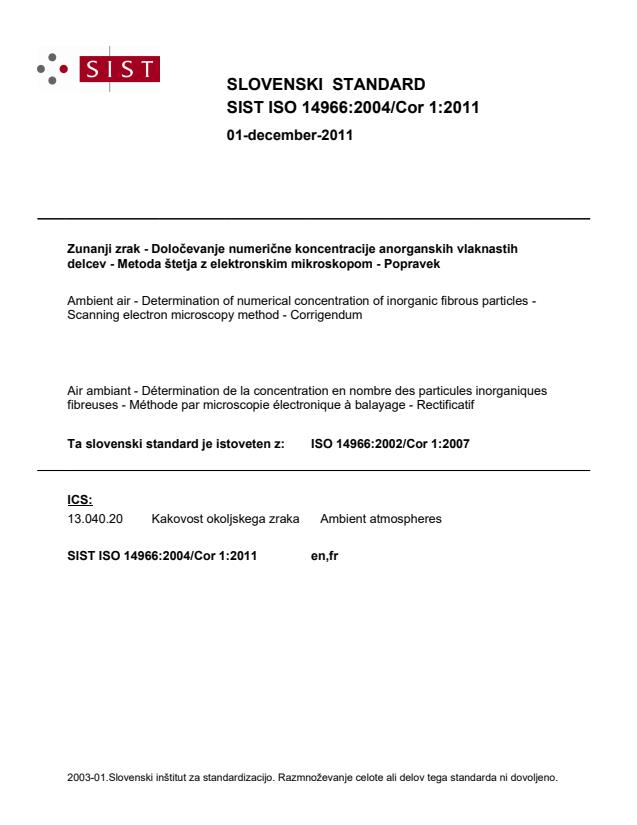
2003-01.Slovenski inštitut za standardizacijo. Razmnoževanje celote ali delov tega standarda ni dovoljeno.DNQDVWLKAir ambiant - Détermination de la concentration en nombre des particules inorganiques fibreuses - Méthode par microscopie électronique à balayage - RectificatifAmbient air - Determination of numerical concentration of inorganic fibrous particles - Scanning electron microscopy method - Corrigendum13.040.20Kakovost okoljskega zrakaAmbient atmospheresICS:Ta slovenski standard je istoveten z:ISO 14966:2002/Cor 1:2007SIST ISO 14966:2004/Cor 1:2011en,fr01-december-2011SIST ISO 14966:2004/Cor 1:2011SLOVENSKI
STANDARD
ICS
13.040.20 Ref. No. ISO 14966:2002/Cor.1:2007(E)©
ISO 2007 – All rights reserved Published in
...
Questions, Comments and Discussion
Ask us and Technical Secretary will try to provide an answer. You can facilitate discussion about the standard in here.
Loading comments...