

ISO 9693:2026
(Main)Dentistry — Compatibility testing for metal-ceramic and ceramic-ceramic systems
- Abstract
This document specifies requirements and test methods to assess the thermomechanical compatibility between a veneering ceramic and a metallic or ceramic substructure material used for dental restorations. This document applies only to the materials used in combination. Conformity cannot be claimed for a single material. For requirements for ceramic materials, see ISO 6872. For requirements for metallic materials see ISO 22674.
- Status
- Published
- Publication Date
- 26-Jul-2026
- Technical Committee
- ISO/TC 106/SC 2 - Prosthodontic materials
- Drafting Committee
- ISO/TC 106/SC 2/WG 1 - Dental ceramics
- Current Stage
- 6060 - International Standard published
- Start Date
- 27-Jul-2026
- Due Date
- 06-Apr-2027
- Completion Date
- 27-Jul-2026
Buy Documents
ISO 9693:2026 - Dentistry — Compatibility testing for metal-ceramic and ceramic-ceramic systems
ISO 9693:2026 - Médecine bucco-dentaire — Essais de compatibilité pour systèmes métallo-céramiques et céramo-céramiques
ISO 9693:2026 is an ISO standard for dentistry that specifies requirements and test methods for checking thermomechanical compatibility between a veneering ceramic and a metallic or ceramic substructure material used in dental restorations. It is written for the material combination as a whole, so conformity is judged on the pair, not on a single material by itself.
What does ISO 9693:2026 specify?
ISO 9693:2026 covers compatibility testing for metal-ceramic and ceramic-ceramic systems used in dental restorations. The document is organized into Scope, Normative references, Terms and definitions, Requirements, Sampling, Test methods, and Test report, followed by a Bibliography.
The scope states that the standard applies only when the veneering ceramic and the substructure material are used together. It also points readers to ISO 6872 for ceramic materials and ISO 22674 for metallic materials, because those standards cover the base material requirements.
What are the key requirements of ISO 9693:2026?
ISO 9693:2026 sets up three main checks: material suitability, mechanical compatibility, and thermal shock resistance. In practice, that means you need the right base materials, the right test specimens, and the right test report to show the pair behaves acceptably together.
Material properties and sampling
- Clause 4.2.1 requires each component material to meet its own material standard - ISO 6872 for ceramics or ISO 22674 for metals. This matters because the compatibility test does not replace the basic material specification.
- Clause 4.2.2 requires thermal expansion to be determined for both veneer and substructure using the same measurement protocol. This makes the values comparable in quality control.
- Clause 5 requires test material from the same lot, and metallic material must be unused. The veneering ceramic is tested in the shade variant most commonly used. This helps keep the test representative and traceable.
- Clause 4.1 sends biocompatibility questions to ISO 10993-1 and ISO 7405. ISO 9693:2026 is not the place for biological safety testing.
De-bonding and crack-initiation
- Clause 4.2.3 requires the substrate elastic modulus to be determined so the bending results can be interpreted correctly.
- For metallic substructures, the de-bonding/crack-initiation strength with at least one nominated veneering ceramic must be greater than 25 MPa.
- For ceramic substructures, the test is used only for zirconia-veneering ceramic combinations, and the strength must be greater than 20 MPa.
- Clause 6.4 uses six specimens, a three-point bending setup, and a cross-head speed of 1.5 mm/min. The specimen geometry and veneer thickness are tightly controlled so the result reflects the material pair, not specimen variation.
- The system passes if at least four of six specimens meet the requirement, with a repeat test if exactly three pass. That gives a clear pass/fail rule for routine evaluation.
Thermal shock resistance
- Clause 4.2.4 requires at least one thermocycling test according to 6.5.3 or 6.5.4.
- The fixed-interval method uses hot and cold water cycling, and the increasing-interval method steps the temperature difference upward. Both are meant to reveal cracking under repeated hot-cold stress.
- Clause 6.5.2 uses either a veneered three-unit prosthesis or at least five anterior crowns, depending on the intended use. The test report must include the full setup, because laboratories may adapt the arrangement to the material combination.
What terms does ISO 9693:2026 define?
- Veneering ceramic - the full structure of fired ceramic layers applied to a substrate material.
- Conditioning - treating the substructure to improve bonding of the veneering ceramic.
- Liner - a substance fired onto the substructure to improve aesthetics and/or adhesion of the veneering ceramic.
- Substructure material - the metallic or ceramic base onto which the veneer is applied.
- De-bonding/crack-initiation strength - the strength calculated from the bending fracture result to show how well the veneer-substructure pair resists separation or cracking.
- Glass transition temperature - a property determined for the veneering ceramic and reported as part of the compatibility assessment.
Who uses ISO 9693:2026?
ISO 9693:2026 is used by manufacturers of dental veneering ceramics, metallic substructure materials, and ceramic substructure materials when they validate material combinations for restorations. It is also used by testing laboratories, quality managers, and technical teams who need a repeatable way to compare compatibility results and document them in a report.
What changed in ISO 9693:2026 from the previous edition?
ISO 9693:2026 replaces ISO 9693:2019 and is described as a minor revision.
- The dated references to ISO 6872 and ISO 22674 were updated.
Which standards are used with ISO 9693:2026?
| Standard | What it contributes |
|---|---|
| ISO 1942 | Dentistry vocabulary used for terms and definitions. |
| ISO 6872:2024 | Ceramic material requirements, thermal expansion test methods, and glass transition temperature. |
| ISO 22674:2022 | Metallic material requirements, thermal expansion methods, and Young's modulus test method. |
| ISO 10993-1 | Reference for assessing biological risk. |
| ISO 7405 | Dentistry-specific biocompatibility evaluation reference. |
| ISO 3950 | Tooth designation system used in the thermocycling specimen geometry note. |
What does the ISO 9693:2026 document contain?
ISO 9693:2026 contains a three-point bending de-bonding/crack-initiation test, including specimen preparation, force measurement, a coefficient-k diagram, and a formula for converting fracture force to strength. It also contains two thermal shock procedures - fixed temperature interval and increasing temperature interval - with apparatus, transfer times, and microscopy-based crack inspection.
The document includes specimen preparation guidance for both metallic and ceramic substructures, plus reporting requirements for material identification, test conditions, measured values, deviations, and unusual observations. Figure 1 shows the test specimen configuration, Figure 2 shows how to read coefficient k, and Figure 3 gives the numerical calculation flow for de-bonding/crack-initiation strength.
Relations
- Effective Date
- 12-Feb-2026
- Effective Date
- 20-Oct-2025
- Revises
ISO 9693:2019 - Dentistry — Compatibility testing for metal-ceramic and ceramic-ceramic systems - Effective Date
- 16-Oct-2025
Buy Documents
ISO 9693:2026 - Dentistry — Compatibility testing for metal-ceramic and ceramic-ceramic systems
ISO 9693:2026 - Médecine bucco-dentaire — Essais de compatibilité pour systèmes métallo-céramiques et céramo-céramiques
Get Certified
Connect with accredited certification bodies for this standard

BSI Group
BSI (British Standards Institution) is the business standards company that helps organizations make excellence a habit.

TÜV Rheinland
TÜV Rheinland is a leading international provider of technical services.

TÜV SÜD
TÜV SÜD is a trusted partner of choice for safety, security and sustainability solutions.
Sponsored listings
Frequently Asked Questions
ISO 9693:2026 is a standard published by the International Organization for Standardization (ISO). Its full title is "Dentistry — Compatibility testing for metal-ceramic and ceramic-ceramic systems". This standard covers: This document specifies requirements and test methods to assess the thermomechanical compatibility between a veneering ceramic and a metallic or ceramic substructure material used for dental restorations. This document applies only to the materials used in combination. Conformity cannot be claimed for a single material. For requirements for ceramic materials, see ISO 6872. For requirements for metallic materials see ISO 22674.
This document specifies requirements and test methods to assess the thermomechanical compatibility between a veneering ceramic and a metallic or ceramic substructure material used for dental restorations. This document applies only to the materials used in combination. Conformity cannot be claimed for a single material. For requirements for ceramic materials, see ISO 6872. For requirements for metallic materials see ISO 22674.
ISO 9693:2026 is classified under the following ICS (International Classification for Standards) categories: 11.060.10 - Dental materials. The ICS classification helps identify the subject area and facilitates finding related standards.
ISO 9693:2026 has the following relationships with other standards: It is inter standard links to EN ISO 9693:2026, ISO 24682:2024, ISO 9693:2019. Understanding these relationships helps ensure you are using the most current and applicable version of the standard.
ISO 9693:2026 is available in PDF format for immediate download after purchase. The document can be added to your cart and obtained through the secure checkout process. Digital delivery ensures instant access to the complete standard document.
Standards Content (Sample)
International
Standard
ISO 9693
Fourth edition
Dentistry — Compatibility testing
2026-07
for metal-ceramic and ceramic-
ceramic systems
Médecine bucco-dentaire — Essais de compatibilité pour
systèmes métallo-céramiques et céramo-céramiques
Reference number
© ISO 2026
All rights reserved. Unless otherwise specified, or required in the context of its implementation, no part of this publication may
be reproduced or utilized otherwise in any form or by any means, electronic or mechanical, including photocopying, or posting on
the internet or an intranet, without prior written permission. Permission can be requested from either ISO at the address below
or ISO’s member body in the country of the requester.
ISO copyright office
CP 401 • Ch. de Blandonnet 8
CH-1214 Vernier, Geneva
Phone: +41 22 749 01 11
Email: copyright@iso.org
Website: www.iso.org
Published in Switzerland
ii
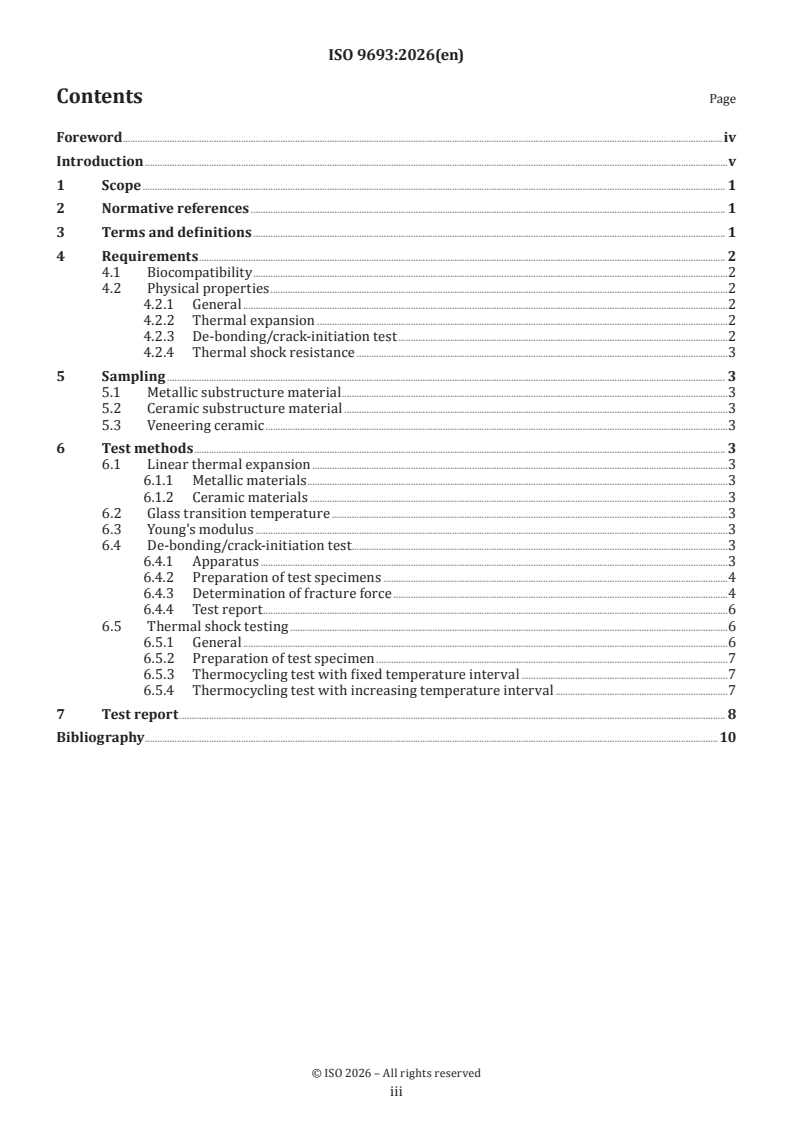
Contents Page
Foreword .iv
Introduction .v
1 Scope . 1
2 Normative references . 1
3 Terms and definitions . 1
4 Requirements . 2
4.1 Biocompatibility .2
4.2 Physical properties .2
4.2.1 General .2
4.2.2 Thermal expansion .2
4.2.3 De-bonding/crack-initiation test .2
4.2.4 Thermal shock resistance .3
5 Sampling . 3
5.1 Metallic substructure material .3
5.2 Ceramic substructure material .3
5.3 Veneering ceramic .3
6 Test methods . 3
6.1 Linear thermal expansion .3
6.1.1 Metallic materials .3
6.1.2 Ceramic materials .3
6.2 Glass transition temperature .3
6.3 Young's modulus .3
6.4 De-bonding/crack-initiation test.3
6.4.1 Apparatus .3
6.4.2 Preparation of test specimens .4
6.4.3 Determination of fracture force .4
6.4.4 Test report .6
6.5 Thermal shock testing .6
6.5.1 General .6
6.5.2 Preparation of test specimen .7
6.5.3 Thermocycling test with fixed temperature interval .7
6.5.4 Thermocycling test with increasing temperature interval .7
7 Test report . 8
Bibliography .10
iii
Foreword
ISO (the International Organization for Standardization) is a worldwide federation of national standards
bodies (ISO member bodies). The work of preparing International Standards is normally carried out through
ISO technical committees. Each member body interested in a subject for which a technical committee
has been established has the right to be represented on that committee. International organizations,
governmental and non-governmental, in liaison with ISO, also take part in the work. ISO collaborates closely
with the International Electrotechnical Commission (IEC) on all matters of electrotechnical standardization.
The procedures used to develop this document and those intended for its further maintenance are described
in the ISO/IEC Directives, Part 1. In particular, the different approval criteria needed for the different types
of ISO document should be noted. This document was drafted in accordance with the editorial rules of the
ISO/IEC Directives, Part 2 (see www.iso.org/directives).
ISO draws attention to the possibility that the implementation of this document may involve the use of (a)
patent(s). ISO takes no position concerning the evidence, validity or applicability of any claimed patent
rights in respect thereof. As of the date of publication of this document, ISO had not received notice of (a)
patent(s) which may be required to implement this document. However, implementers are cautioned that
this may not represent the latest information, which may be obtained from the patent database available at
www.iso.org/patents. ISO shall not be held responsible for identifying any or all such patent rights.
Any trade name used in this document is information given for the convenience of users and does not
constitute an endorsement.
For an explanation of the voluntary nature of standards, the meaning of ISO specific terms and expressions
related to conformity assessment, as well as information about ISO's adherence to the World Trade
Organization (WTO) principles in the Technical Barriers to Trade (TBT), see www.iso.org/iso/foreword.html.
This document was prepared by Technical Committee ISO/TC 106, Dentistry, Subcommittee SC 2,
Prosthodontic materials, in collaboration with the European Committee for Standardization (CEN) Technical
Committee CEN/TC 55, Dentistry, in accordance with the Agreement on technical cooperation between ISO
and CEN (Vienna Agreement).
This fourth edition cancels and replaces the third edition ISO 9693:2019, of which it constitutes a minor
revision.
The main changes are as follows:
— Dated references to ISO 6872 and ISO 22674 have been updated.
Any feedback or questions on this document should be directed to the user’s national standards body. A
complete listing of these bodies can be found at www.iso.org/members.html.
iv
Introduction
Dental veneering ceramics and metal alloys or substructure ceramics are suitable materials for the fabrication
of dental restorations. Compatibility between the veneering ceramic and the substructure material under
mechanical and thermal loading is essential if they are to function in a prosthetic construction.
This document specifies requirements and test methods for assessing the risk of failure associated with
masticatory forces and the oral environment.
v
International Standard ISO 9693:2026(en)
Dentistry — Compatibility testing for metal-ceramic and
ceramic-ceramic systems
1 Scope
This document specifies requirements and test methods to assess the thermomechanical compatibility
between a veneering ceramic and a metallic or ceramic substructure material used for dental restorations.
This document applies only to the materials used in combination. Conformity cannot be claimed for a single
material.
For requirements for ceramic materials, see ISO 6872. For requirements for metallic materials see ISO 22674.
2 Normative references
The following documents are referred to in the text in such a way that some or all of their content constitutes
requirements of this document. For dated references, only the edition cited applies. For undated references,
the latest edition of the referenced document (including any amendments) applies.
ISO 1942, Dentistry — Vocabulary
ISO 6872:2024, Dentistry — Ceramic materials
ISO 22674:2022, Dentistry — Metallic materials for fixed and removable restorations and appliances
3 Terms and definitions
For the purposes of this document, the terms and definitions given in ISO 1942, ISO 6872, ISO 22674 and the
following apply.
ISO and IEC maintain terminology databases for use in standardization at the following addresses:
— ISO Online browsing platform: available at https:// www .iso .org/ obp
— IEC Electropedia: available at https:// www .electropedia .org/
3.1
veneering ceramic
full structure of fired ceramic layers applied to a substrate material
3.2
conditioning
process of treating the substructure to enhance the bonding of the veneering ceramic (3.1)
3.3
liner
substance, applied to the substructure and fired under appropriate time-temperature conditions, with
the purpose to improve aesthetics and/or adherence of the veneering ceramic to the coated substructure-
surface
4 Requirements
4.1 Biocompatibility
Specific qualitative and quantitative test methods for demonstrating freedom from unacceptable biological
risks are not included in this document, but, for the assessment of such biological risks, reference should be
made to ISO 10993-1 and ISO 7405.
4.2 Physical properties
4.2.1 General
The individual component materials shall fulfil the requirements of ISO 6872 for ceramics or ISO 22674 for
metallic materials. The materials shall also be in accordance with the requirements of 4.2.2 to 4.2.4 where
applicable.
In particular, the elastic modulus of the substrate material shall be determined in order to interpret the
measurements in the de-bonding test.
4.2.2 Thermal expansion
The coefficients of thermal expansion of the substructure ceramic and the veneering ceramic shall be
determined according to ISO 6872.
The coefficients of thermal expansion of the metall
...
Norme
internationale
ISO 9693
Quatrième édition
Médecine bucco-dentaire — Essais
2026-07
de compatibilité pour systèmes
métallo-céramiques et céramo-
céramiques
Dentistry — Compatibility testing for metal-ceramic and
ceramic-ceramic systems
Numéro de référence
DOCUMENT PROTÉGÉ PAR COPYRIGHT
© ISO 2026
Tous droits réservés. Sauf prescription différente ou nécessité dans le contexte de sa mise en œuvre, aucune partie de cette
publication ne peut être reproduite ni utilisée sous quelque forme que ce soit et par aucun procédé, électronique ou mécanique,
y compris la photocopie, ou la diffusion sur l’internet ou sur un intranet, sans autorisation écrite préalable. Une autorisation peut
être demandée à l’ISO à l’adresse ci-après ou au comité membre de l’ISO dans le pays du demandeur.
ISO copyright office
Case postale 401 • Ch. de Blandonnet 8
CH-1214 Vernier, Genève
Tél.: +41 22 749 01 11
E-mail: copyright@iso.org
Web: www.iso.org
Publié en Suisse
ii
Sommaire Page
Avant-propos .iv
Introduction .v
1 Domaine d’application . 1
2 Références normatives . 1
3 Termes et définitions . 1
4 Exigences . 2
4.1 Biocompatibilité .2
4.2 Propriétés physiques .2
4.2.1 Généralités .2
4.2.2 Dilatation thermique .2
4.2.3 Essai d’adhésion .2
4.2.4 Résistance au choc thermique .3
5 Échantillonnage . 3
5.1 Matériau d’infrastructure métallique .3
5.2 Matériau d’infrastructure céramique .3
5.3 Céramique de recouvrement .3
6 Méthodes d’essai . 3
6.1 Dilatation thermique linéaire.3
6.1.1 Matériaux métalliques.3
6.1.2 Matériaux céramiques .3
6.2 Température de transition vitreuse .3
6.3 Module de Young .3
6.4 Essai d’adhésion .3
6.4.1 Appareillage.3
6.4.2 Préparation des éprouvettes .4
6.4.3 Détermination de la force de rupture .4
6.4.4 Rapport d’essai .6
6.5 Essai de résistance au choc thermique .6
6.5.1 Généralités .6
6.5.2 Préparation de l’éprouvette .7
6.5.3 Essai de thermocyclage avec intervalles de température fixes .7
6.5.4 Essai de thermocyclage avec intervalles de température croissants .7
7 Rapport d’essai . 8
Bibliographie . 10
iii
Avant-propos
L’ISO (Organisation internationale de normalisation) est une fédération mondiale d’organismes nationaux
de normalisation (comités membres de l’ISO). L’élaboration des Normes internationales est en général
confiée aux comités techniques de l’ISO. Chaque comité membre intéressé par une étude a le droit de faire
partie du comité technique créé à cet effet. Les organisations internationales, gouvernementales et non
gouvernementales, en liaison avec l’ISO participent également aux travaux. L’ISO collabore étroitement avec
la Commission électrotechnique internationale (IEC) en ce qui concerne la normalisation électrotechnique.
Les procédures utilisées pour élaborer le présent document et celles destinées à sa mise à jour sont
décrites dans les Directives ISO/IEC, Partie 1. Il convient, en particulier, de prendre note des différents
critères d’approbation requis pour les différents types de documents ISO. Le présent document
a été rédigé conformément aux règles de rédaction données dans les Directives ISO/IEC, Partie 2
(voir www.iso.org/directives).
L’ISO attire l’attention sur le fait que la mise en application du présent document peut entraîner l’utilisation
d’un ou de plusieurs brevets. L’ISO ne prend pas position quant à la preuve, à la validité et à l’applicabilité de
tout droit de brevet revendiqué à cet égard. À la date de publication du présent document, l’ISO n’avait pas
reçu notification qu’un ou plusieurs brevets pouvaient être nécessaires à sa mise en application. Toutefois,
il y a lieu d’avertir les responsables de la mise en application du présent document que des informations
plus récentes sont susceptibles de figurer dans la base de données de brevets, disponible à l’adresse
www.iso.org/brevets. L’ISO ne saurait être tenue pour responsable de ne pas avoir identifié de tels droits de
propriété et averti de leur existence.
Les appellations commerciales éventuellement mentionnées dans le présent document sont données pour
information, par souci de commodité, à l’intention des utilisateurs et ne sauraient constituer un engagement.
Pour une explication de la nature volontaire des normes, la signification des termes et expressions
spécifiques de l’ISO liés à l’évaluation de la conformité, ou pour toute information au sujet de l’adhésion de
l’ISO aux principes de l’Organisation mondiale du commerce (OMC) concernant les obstacles techniques au
commerce (OTC), voir www.iso.org/avant-propos.
Le présent document a été élaboré par le comité technique ISO/TC 106, Médecine bucco-dentaire, sous-comité
SC 2, Produits pour prothèses dentaires, en collaboration avec le comité technique CEN/TC 55, Médecine bucco-
dentaire, du Comité européen de normalisation (CEN), conformément à l’Accord de coopération technique
entre l’ISO et le CEN (Accord de Vienne).
Cette quatrième édition annule et remplace la troisième édition de l’ISO 9693:2019, qui a fait l’objet d’une
révision mineure.
Les principales modifications sont les suivantes:
— Les références datées à l’ISO 6872 et à l’ISO 22674 ont été mises à jour.
Il convient que l’utilisateur adresse tout retour d’information ou toute question concernant le présent
document à l’organisme national de normalisation de son pays. Une liste exhaustive desdits organismes se
trouve à l’adresse www.iso.org/fr/members.html.
iv
Introduction
Les céramiques dentaires de recouvrement et les alliages métalliques ou les céramiques d’infrastructure
dentaires conviennent pour fabriquer des restaurations dentaires. Leur compatibilité sous charge
mécanique et thermique est primordiale dans les cas où ils sont destinés à être utilisés dans une restauration
prothétique.
Le présent document spécifie des exigences et des méthodes d’essai permettant d’évaluer les risques de
défaillance liés aux forces masticatoires et à l’environnement buccal.
v
Norme internationale ISO 9693:2026(fr)
Médecine bucco-dentaire — Essais de compatibilité pour
systèmes métallo-céramiques et céramo-céramiques
1 Domaine d’application
Le présent document spécifie des exigences et des méthodes d’essai qui permettent d’évaluer la compatibilité
thermomécanique entre une céramique de recouvrement et un matériau d’infrastructure métallique ou
céramique utilisés pour des restaurations dentaires.
Le présent document s’applique uniquement aux matériaux combinés. La conformité ne peut pas être
déclarée pour un matériau individuel.
Pour obtenir les exigences relatives aux matériaux céramiques, voir l’ISO 6872. Pour obtenir les exigences
relatives aux matériaux métalliques, voir l’ISO 22674.
2 Références normatives
Les documents suivants sont cités dans le texte de sorte qu’ils constituent, pour tout ou partie de leur
contenu, des exigences du présent document. Pour les références datées, seule l’édition citée s’applique. Pour
les références non datées, la dernière édition du document de référence s’applique (y compris les éventuels
amendements).
ISO 1942, Médecine bucco-dentaire — Vocabulaire
ISO 6872:2024, Médecine bucco-dentaire — Matériaux céramiques
ISO 22674:2022, Médecine bucco-dentaire — Matériaux métalliques pour les restaurations fixes et amovibles et
les appareils
3 Termes et définitions
Pour les besoins du présent document, les termes et les définitions de l’ISO 1942, l’ISO 6872, l’ISO 22674
ainsi que les suivants s’appliquent.
L’ISO et l’IEC tiennent à jour des bases de données terminologiques destinées à être utilisées en normalisation,
consultables aux adresses suivantes:
— ISO Online browsing platform: disponible à l’adresse https:// www .iso .org/ obp
— IEC Electropedia: disponible à l’adresse https:// www .electropedia .org/
3.1
céramique de recouvrement
matériau céramique destiné à être stratifié et cuit sur une infrastructure
3.2
traitement préparatoire
procédé de traitement de l’infrastructure visant à améliorer l’adhésion de la céramique de recouvrement (3.1)
3.3
couche de liner
substance, appliquée sur l’infrastructure et cuite à une température et pendant une période appropriées,
dans le but d’améliorer l’esthétique et/ou l’adhésion de la céramique de recouvrement à la surface de
l’infrastructure recouverte
4 Exigences
4.1 Biocompatibilité
Le présent document n’inclut pas de méthodes d’essai qualitatives et quantitatives spécifiques permettant
de démontrer l’absence de risques biologiques inacceptables, mais, lors de l’évaluation de ces risques
biologiques, il convient de se reporter à l’ISO 10993-1 et à l’ISO 7405.
4.2 Propriétés physiques
4.2.1 Généralités
Chaque matériau doit satisfaire aux exigences de l’ISO 6872 relatives aux matériaux céramiques ou de
l’ISO 22674 relative aux matériaux métalliques. Les matériaux doivent également être conformes aux
exigences de 4.2.2 à 4.2.4, le cas échéant.
En particulier, le module d’élasticité du substrat doit être déterminé afin d’interpréter les mesurages
effectués lors de l’essai d’adhésion.
4.2.2 Dilatation thermique
Les coefficients de dilatation thermique de la céramique d’infrastructure et de la céramique de recouvrement
doivent être déterminés selon l’ISO 6872.
Les coefficients de dilatation thermique du matériau d’infrastructure métallique doivent être déterminés
selon l’ISO 22674.
Le même protocole de mesure doit être utilisé pour les matériaux de recouvrement et d’infrastructure
(par exemple la même température minimale).
Essai effectué conformément au 6.1.
NOTE Les valeurs obtenues lors du mesurage des coefficients de dilatation thermique linéaire sont comparées
aux valeurs indiquées par le fabricant et ainsi utilisées comme moyen de contrôler la qualité, mais ces valeurs ne
constituent pas une garantie que l’infrastructure céramique ou métallique et la céramique de recouvrement sont
compatibles.
4.2.3 Essai d’adhésion
4.2.3.1 Matériau d’infrastructure métallique
L’adhésion entre le matériau d’infrastructure métallique et une ou plusieurs céram
...