

ISO/DTR 27245
(Main)Cranes — Tower cranes — International Standards for design, manufacture, use and maintenance requirements and recommendations
- Abstract
ISO 27245:2007 provides a list of International Standards that can be completely or partly applied in the design of tower cranes. A bibliography refers to other useful documents.
- Status
- Not Published
- Technical Committee
- ISO/TC 96/SC 7 - Tower cranes
- Drafting Committee
- ISO/TC 96/SC 7 - Tower cranes
- Current Stage
- 5020 - FDIS ballot initiated: 2 months. Proof sent to secretariat
- Start Date
- 24-Aug-2026
- Completion Date
- 24-Aug-2026
Buy Documents

ISO/DTR 27245 - Cranes — Tower cranes — International Standards for design, manufacture, use and maintenance requirements and recommendations
REDLINE ISO/DTR 27245 - Cranes — Tower cranes — International Standards for design, manufacture, use and maintenance requirements and recommendations
ISO/DTR 27245 is an ISO Technical Report from ISO on tower cranes. It lists International Standards that can be applied, fully or partly, to the design of tower cranes, and it points to other documents useful for manufacture, use and maintenance. For engineers, quality managers and buyers, it works as a guided map to the standards set around tower cranes rather than as a requirements standard itself.
What does ISO/DTR 27245 specify?
ISO/DTR 27245 specifies which International Standards are relevant to tower cranes and what each one covers in broad terms. The report also points readers to additional documents, including FEM publications, European standards and national standards, when they may help with design, manufacture, use or maintenance.
The document is organized as a short front matter, then Scope, Normative references, Terms and definitions, and Clause 4, which is the main list of tower-crane standards. Clause 4 is split into 4.1 General and 4.2 Additional International Standards useful for tower cranes. A bibliography follows with other tower-crane references.
What are the key requirements of ISO/DTR 27245?
ISO/DTR 27245 does not set technical requirements for a crane by itself. Its main job is to identify the standards a tower-crane project usually needs to use for design, safety, operation and maintenance, so that the right technical documents are selected from the start.
Design loads, classification and proof of competence
Clause 4 points first to the standards that define how tower cranes are classified and how loads are handled in design. ISO 4301-3 classifies tower cranes for construction work using working cycles, load spectrum factor, average displacements and additional calculation factors, while ISO 4301-1 gives the general crane classification basis. ISO 4302 covers wind load assessment, and ISO 8686-3 applies load and load-combination principles to tower cranes.
In practice, these standards tell the designer what operating life, duty pattern and load cases to consider. ISO 8686-3 and ISO 4301-3 also note that tower cranes for construction work are equipped with a hook as the load-handling device, so different values may be needed if the crane is used for other purposes or with other load-handling devices.
Structural competence and special loads
Clause 4 links tower-crane design to the proof-of-competence standards for steel structures and related components. ISO 20332 covers proof of competence of steel structures, ISO 11031 covers seismic loads, ISO 23778 covers hydraulic cylinders in crane applications, and ISO 17440 covers forged steel hooks.
This matters because these are the documents used to show that the structure and load-carrying parts can withstand the expected loads. If the crane has hydraulic cylinders in the load path, or is to be designed for seismic conditions, the project has to include those specific methods.
Rope, wheel and mechanism requirements
ISO/DTR 27245 points to ISO 4309 for wire rope care, maintenance, examination and discard, and to ISO 16625 for selecting wire ropes, drums and sheaves. It also lists ISO 10972-1 and ISO 10972-3 for mechanism requirements, and ISO 16881-1 for wheel sizing and trolley-track supporting structure.
For a designer or maintenance team, these are the documents that define how to choose components, how to inspect them, and when to replace them. They are particularly relevant where rope wear, drum geometry, sheave selection or trolley-track loading affects safe service life.
Operator interface, cabins and signs
Clause 4 includes ISO 7752-3 for tower-crane controls, ISO 8566-3 for cabins and control stations, ISO 7296-3 for graphical symbols on tower cranes, ISO 9942-3 for information labels, and ISO 13200 for safety signs and hazard pictorials. The general companion parts ISO 7752-1, ISO 8566-1, ISO 7296-1 and ISO 9942-1 are also named.
These standards matter because the operator has to read controls, labels and warnings quickly and correctly. They are the basis for a consistent cab layout, familiar symbols and visible safety information.
Testing, inspection, manuals and safe use
ISO 4310 covers tests, inspections and procedures for checking conformance and rated-load capability. ISO 9927-3 covers regular inspections for tower cranes, ISO 9928-1 covers the operating manual, and ISO 12480-3 covers safe use, including planning, erection, dismantling, special base, operation and maintenance.
In practice, these standards support commissioning, routine inspection and site rules. They are the documents a buyer, site manager or service company uses to define what must be checked, recorded and trained before and during use.
Training and competency
ISO 9926-3 covers training subjects for tower-crane operators, ISO 23853 covers training of slingers and signallers, and ISO 15513 sets competency requirements for crane drivers, slingers, signallers and assessors. ISO 9926-1 gives the general training framework.
This is important for employers and contractors because it defines the training and competence basis for the people who operate and support the crane. It helps specify who may drive, sling, signal and assess work on site.
Access, guarding and limiting devices
Clause 4 also points to ISO 11660-3 for access, guards and restraints on tower cranes, and to ISO 10245-3 for tower-crane limiting and indicating devices, with ISO 10245-1 as the general basis. These standards are used alongside the general access and safety provisions in ISO 11660-1.
For practical use, these documents help define safe access for erection, dismantling, inspection and maintenance, and they set the framework for devices that warn, limit or inform the operator during crane motion.
Who uses ISO/DTR 27245?
ISO/DTR 27245 is used by tower-crane designers, manufacturers, purchasers, project engineers, testing and inspection personnel, training providers, operators and maintenance planners. It is especially useful when a project has to decide which ISO standard applies to structure, ropes, controls, training, safe use, signage or inspection.
For buyers and quality managers, it is a reference for writing technical specifications and checking that the supplier is using the right companion standards. For site and service teams, it helps align inspection, operation and maintenance documents with the wider ISO crane framework.
What changed in ISO/DTR 27245 from the previous edition?
ISO/DTR 27245:2026 replaces ISO/TR 27245:2007. The foreword says this second edition is technically revised, the list of standards applicable to tower cranes has been updated in Clause 2, and Annex A has been removed.
Which standards are used with ISO/DTR 27245?
The report points to a wider set of standards that support tower-crane work across design, operation and documentation. The main groups are:
| Standards | What they contribute |
|---|---|
| ISO 4301-1, ISO 4301-3, ISO 4302, ISO 8686-1, ISO 8686-3, ISO 11031, ISO 20332, ISO 23778, ISO 17440, ISO 16625, ISO 16881-1 | Classification, wind loads, load combinations, seismic loads, structural proof of competence, hydraulic cylinders, hooks, ropes and wheel/rail loading |
| ISO 4306-1, ISO 4306-3, ISO/TS 15696, ISO 7296-1, ISO 7296-3, ISO 9942-1, ISO 9942-3, ISO 13200, ISO 3864-1, ISO 3864-2, ISO 3864-3, ISO 7000, ISO 7010 | Vocabulary, symbols, labels, safety signs and graphical presentation |
| ISO 7752-1, ISO 7752-3, ISO 8566-1, ISO 8566-3, IEC 62745 | Controls, cabins, control stations and cableless control systems |
| ISO 4310, ISO 4309, ISO 9927-1, ISO 9927-3, ISO 9928-1, ISO 12478-1, ISO 12480-1, ISO 12480-3, ISO 10973 | Testing, inspections, operating and maintenance manuals, safe use and spare-parts manuals |
| ISO 9926-1, ISO 9926-3, ISO 15513, ISO 23853 | Training and competency for operators, slingers and signallers |
| ISO 12100, ISO 13849-1, ISO 20607, IEC 60204-32, ISO 3744, ISO 4871, ISO 11203, ISO/TR 11688-1, ISO/TR 11688-2 | Machinery safety, safety-related control systems, instruction handbooks, electrical equipment and acoustics |
The bibliography also points to FEM 1.001, EN 14439, AS 1418.4, AS 2550.4, BS 7121 parts 1, 2 and 5, and ASME B30.3 and B30.29 as other useful tower-crane references.
What does the ISO/DTR 27245 document contain?
ISO/DTR 27245 contains a short foreword, the scope, and a main list of standards for tower cranes with short abstracts for each entry. It also separates general tower-crane-related standards from additional standards that are useful when the crane project needs broader machinery-safety, electrical, acoustic or graphical-symbol guidance.
The document is therefore most useful as a reference checklist for design teams, spec writers, inspectors and trainers. It helps them identify which standards cover classification, loads, controls, structure, ropes, testing, training, use and maintenance before work starts.
Relations
- Effective Date
- 20-Apr-2024
Buy Documents
ISO/DTR 27245 - Cranes — Tower cranes — International Standards for design, manufacture, use and maintenance requirements and recommendations
REDLINE ISO/DTR 27245 - Cranes — Tower cranes — International Standards for design, manufacture, use and maintenance requirements and recommendations
Frequently Asked Questions
ISO/DTR 27245 is a draft published by the International Organization for Standardization (ISO). Its full title is "Cranes — Tower cranes — International Standards for design, manufacture, use and maintenance requirements and recommendations". This standard covers: ISO 27245:2007 provides a list of International Standards that can be completely or partly applied in the design of tower cranes. A bibliography refers to other useful documents.
ISO 27245:2007 provides a list of International Standards that can be completely or partly applied in the design of tower cranes. A bibliography refers to other useful documents.
ISO/DTR 27245 is classified under the following ICS (International Classification for Standards) categories: 53.020.20 - Cranes. The ICS classification helps identify the subject area and facilitates finding related standards.
ISO/DTR 27245 has the following relationships with other standards: It is inter standard links to ISO/TR 27245:2007. Understanding these relationships helps ensure you are using the most current and applicable version of the standard.
ISO/DTR 27245 is available in PDF format for immediate download after purchase. The document can be added to your cart and obtained through the secure checkout process. Digital delivery ensures instant access to the complete standard document.
Standards Content (Sample)
FINAL DRAFT
Technical
Report
ISO/TC 96/SC 7
Cranes — Tower cranes —
Secretariat: AFNOR
International Standards for
Voting begins on:
design, manufacture, use and
2026-08-24
maintenance requirements and
Voting terminates on:
recommendations
2026-10-19
Appareils de levage à charge suspendue — Grues à tour —
Normes internationales sur les exigences et les recommandations
de conception, de fabrication, d'utilisation et de maintenance
RECIPIENTS OF THIS DRAFT ARE INVITED TO SUBMIT,
WITH THEIR COMMENTS, NOTIFICATION OF ANY
RELEVANT PATENT RIGHTS OF WHICH THEY ARE AWARE
AND TO PROVIDE SUPPOR TING DOCUMENTATION.
IN ADDITION TO THEIR EVALUATION AS
BEING ACCEPTABLE FOR INDUSTRIAL, TECHNO
LOGICAL, COMMERCIAL AND USER PURPOSES, DRAFT
INTERNATIONAL STANDARDS MAY ON OCCASION HAVE
TO BE CONSIDERED IN THE LIGHT OF THEIR POTENTIAL
TO BECOME STAN DARDS TO WHICH REFERENCE MAY BE
MADE IN NATIONAL REGULATIONS.
Reference number
FINAL DRAFT
Technical
Report
ISO/TC 96/SC 7
Cranes — Tower cranes —
Secretariat: AFNOR
International Standards for
Voting begins on:
design, manufacture, use and
maintenance requirements and
Voting terminates on:
recommendations
Appareils de levage à charge suspendue — Grues à tour —
Normes internationales sur les exigences et les recommandations
de conception, de fabrication, d'utilisation et de maintenance
RECIPIENTS OF THIS DRAFT ARE INVITED TO SUBMIT,
WITH THEIR COMMENTS, NOTIFICATION OF ANY
RELEVANT PATENT RIGHTS OF WHICH THEY ARE AWARE
AND TO PROVIDE SUPPOR TING DOCUMENTATION.
© ISO 2026
IN ADDITION TO THEIR EVALUATION AS
All rights reserved. Unless otherwise specified, or required in the context of its implementation, no part of this publication may
BEING ACCEPTABLE FOR INDUSTRIAL, TECHNO
LOGICAL, COMMERCIAL AND USER PURPOSES, DRAFT
be reproduced or utilized otherwise in any form or by any means, electronic or mechanical, including photocopying, or posting on
INTERNATIONAL STANDARDS MAY ON OCCASION HAVE
the internet or an intranet, without prior written permission. Permission can be requested from either ISO at the address below
TO BE CONSIDERED IN THE LIGHT OF THEIR POTENTIAL
or ISO’s member body in the country of the requester.
TO BECOME STAN DARDS TO WHICH REFERENCE MAY BE
MADE IN NATIONAL REGULATIONS.
ISO copyright office
CP 401 • Ch. de Blandonnet 8
CH-1214 Vernier, Geneva
Phone: +41 22 749 01 11
Email: copyright@iso.org
Website: www.iso.org
Published in Switzerland Reference number
ii
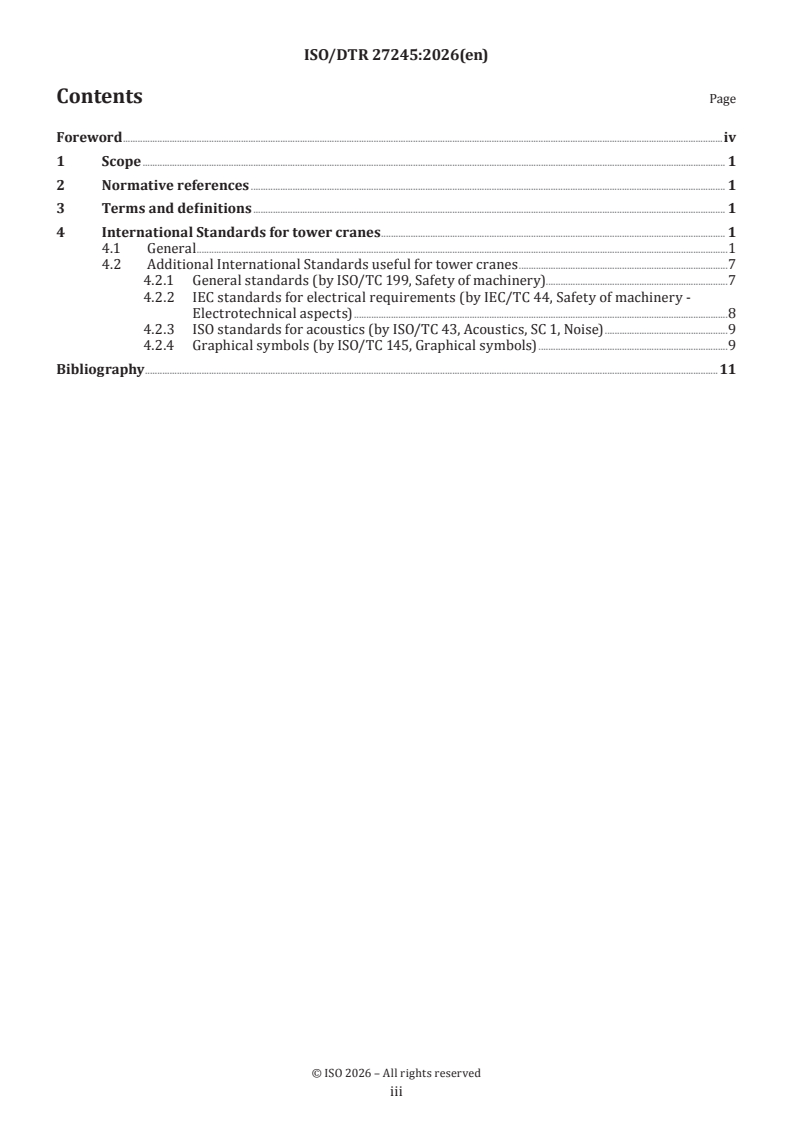
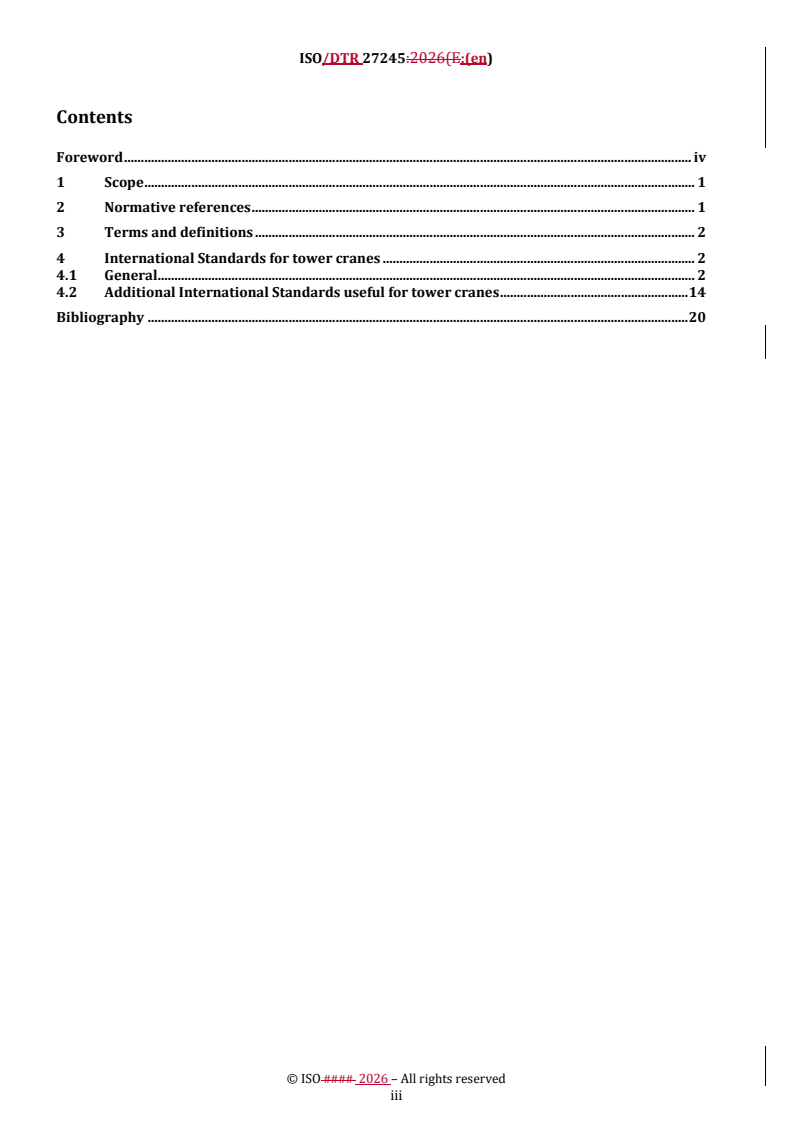
Contents Page
Foreword .iv
1 Scope . 1
2 Normative references . 1
3 Terms and definitions . 1
4 International Standards for tower cranes . 1
4.1 General .1
4.2 Additional International Standards useful for tower cranes .7
4.2.1 General standards (by ISO/TC 199, Safety of machinery).7
4.2.2 IEC standards for electrical requirements (by IEC/TC 44, Safety of machinery -
Electrotechnical aspects) .8
4.2.3 ISO standards for acoustics (by ISO/TC 43, Acoustics, SC 1, Noise) .9
4.2.4 Graphical symbols (by ISO/TC 145, Graphical symbols) .9
Bibliography .11
iii
Foreword
ISO (the International Organization for Standardization) is a worldwide federation of national standards
bodies (ISO member bodies). The work of preparing International Standards is normally carried out through
ISO technical committees. Each member body interested in a subject for which a technical committee
has been established has the right to be represented on that committee. International organizations,
governmental and non-governmental, in liaison with ISO, also take part in the work. ISO collaborates closely
with the International Electrotechnical Commission (IEC) on all matters of electrotechnical standardization.
The procedures used to develop this document and those intended for its further maintenance are described
in the ISO/IEC Directives, Part 1. In particular, the different approval criteria needed for the different types
of ISO documents should be noted. This document was drafted in accordance with the editorial rules of the
ISO/IEC Directives, Part 2 (see www.iso.org/directives).
ISO draws attention to the possibility that the implementation of this document may involve the use of (a)
patent(s). ISO takes no position concerning the evidence, validity or applicability of any claimed patent
rights in respect thereof. As of the date of publication of this document, ISO had not received notice of (a)
patent(s) which may be required to implement this document. However, implementers are cautioned that
this may not represent the latest information, which may be obtained from the patent database available at
www.iso.org/patents. ISO shall not be held responsible for identifying any or all such patent rights.
Any trade name used in this document is information given for the convenience of users and does not
constitute an endorsement.
For an explanation of the voluntary nature of standards, the meaning of ISO specific terms and expressions
related to conformity assessment, as well as information about ISO's adherence to the World Trade
Organization (WTO) principles in the Technical Barriers to Trade (TBT), see www.iso.org/iso/foreword.html.
This document was prepared by Technical Committee ISO/TC 96, Cranes, Subcommittee SC 7, Tower cranes.
This second edition cancels and replaces the first edition (ISO/TR 27245:2007), which has been technically
revised.
The main changes are as follows:
— the list of standards applicable to tower cranes has been updated;
— Annex A has been removed.
Any feedback or questions on this document should be directed to the user’s national standards body. A
complete listing of these bodies can be found at www.iso.org/members.html.
iv
FINAL DRAFT Technical Report ISO/DTR 27245:2026(en)
Cranes — Tower cranes — International Standards for
design, manufacture, use and maintenance requirements and
recommendations
1 Scope
This document provides a list of International Standards that can be completely or partly applied in the
design of tower cranes. The bibliography refers to other useful documents (FEM publications, European
standards and national standards).
2 Normative references
There are no normative references in this document.
3 Terms and definitions
No terms and definitions are listed in this document.
ISO and IEC maintain terminology databases for use in standardization at the following addresses:
— ISO Online browsing platform: available at https:// www .iso .org/ obp
— IEC Electropedia: available at https:// www .electropedia .org/
4 International Standards for tower cranes
4.1 General
ISO 4301-1 Cranes — Classification — Part 1: General
Abstract: It establishes a general classification of cranes and mechanisms based on
the service conditions, mainly expressed by the following:
— the total number of working cycles to be carried out during the specified design
life of the crane;
— the load spectrum factor which represents the relative frequencies of loads to be
handled;
— the average displacements.
ISO 4301-3 Cranes — Classification — Part 3: Tower cranes
Abstract: It provides the classification of tower cranes for construction work as
defined in ISO 4306-3, and gives specific requirements for steel supporting structure,
mechanisms, ropes and further components basing on standard service conditions,
mainly expressed by the following:
— the number of working cycles;
— the load spectrum factor;
— the average displacements;
— additional values for factors to be used at the structural or mechanical calcula-
tion.
Tower cranes for construction work are exclusively equipped with a hook as
load-handling device.
For tower cranes intended to be used for other purposes and/or equipped with other
load handling devices, other values according to the specified usage of the tower
crane can result.
ISO 4302 Cranes — Wind load assessment
Abstract: It establishes general methods for calculating wind loads (for in-service
and out-of-service conditions), which are included in the load combinations stated in
ISO 8686-1 and used for proofs of competence such as those given in ISO 20332 for
the structural components of cranes.
It provides a simplified method of calculation and assumes that:
— the wind can blow horizontally from any direction;
— the wind blows at a constant speed;
— there is a static reaction to the wind load applied to the crane structure.
It includes built-in allowances for the effects of gusting (fluctuation in wind speed)
and for dynamic response. It gives guidance on when to secure the crane for out-of-
service conditions.
ISO 4306-1 Cranes — Vocabulary — Part 1: General
Abstract: It establishes a vocabulary of the most commonly used terms in the field
of cranes and defines terms concerning the main crane types and classifications,
parameters, general concepts and component parts.
ISO 4306-3 Cranes — Vocabulary — Part 3: Tower cranes
Abstract: It establishes a vocabulary of the most commonly used terms in the field of
cranes.
It gives the general definition of a tower crane and illustrates the terminology used
with each type of tower crane by the use of figures with referenced term numbers.
It is applicable to
— tower cranes that can be assembled and dismantled (by element or self-erecting
cranes),
— permanently erected tower cranes, and
— mobile self-erecting tower cranes.
It is not applicable to
— mobile cranes, or
— erection masts, with or without jibs.
ISO 4309 Cranes — Wire ropes — Care and maintenance, inspection and discard
Abstract: It establishes general principles for the care and maintenance, and inspec-
tion and discard of steel wire ropes used on cranes and hoists.
In addition to guidance on storage, handling, installation and maintenance, it pro-
vides discard criteria for those running ropes which are subjected to multi-layer
spooling, where both field experience and testing demonstrate that deterioration is
significantly greater at the crossover zones on the drum than at any other section of
rope in the system.
It also provides more realistic discard criteria covering decreases in rope diameter
and corrosion and gives a method for assessing the combined effect of deterioration
at any position in the rope.
It applies to rope on cranes, winches and hoists used for hook, grabbing, magnet,
ladle, excavator or stacking duties, whether operated manually, electrically or hy-
draulically.
It also applies to rope used on hoists and hoist blocks.
ISO 4310 Cranes — Test code and procedures
Abstract: It specifies tests, inspections and procedures for verifying the conformance
of a crane with its operational specifications and capability to lift rated loads.
ISO 7296-1 Cranes — Graphical symbols — Part 1: General
Abstract: It gives 67 symbols and defines the various colours to be used with cranes.
Contains the alphabetical indexes in English, French and Russian.
ISO 7296-3 Cranes — Graphic symbols — Part 3: Tower cranes
Abstract: It establishes graphical symbols for use on operator controls and other
displays on tower cranes as defined in ISO 4306-3.
ISO 7752-1 Cranes — Control layout and characteristics — Part 1: General principles
Abstract: It establishes principles and requirements for the controls of cranes. It
deals with the arrangement of those controls used in positioning loads and serves
as a general basis for the elaboration of detailed standards covering the controls of
particular types of cranes.
ISO 7752-3 Cranes — Control layout and characteristics — Part 3: Tower cranes
Abstract: It specifies the particular requirements for controls for tower cranes as de-
fined in ISO 4306-3 and the arrangement of basic control used for positioning loads.
NOTE For the general principles and requirements for the controls of cranes, see
ISO 7752-1.
ISO 8566-1 Cranes — Cabins and control stations — Part 1: General
Abstract: It specifies the general requirements for cabins and control stations from
which cranes, as defined in ISO 4306-1, are operated.
ISO 8566-3 Cranes — Cabins and control stations — Part 3: Tower cranes
Abstract: It specifies the requirements for cabins and control stations for tower
cranes as defined in ISO 4306-3. It is intended to be used in conjunction with
ISO 8566-1.
ISO 8686-1 Cranes — Design principles for loads and load combinations — Part 1: General
Abstract: It establishes general methods for the calculating loads and principles to
be used in the selection of load combinations for proofs of competence in accordance
with ISO 20332 for the structural and mechanical components of cranes as defined in
ISO 4306-1.
It is based on rigid body kinetic analysis and elastostatic analysis but expressly per-
mits the use of more advanced methods (calculations or tests) to evaluate the effects
of loads and load combinations, and the values of dynamic load factors, where it can
be demonstrated that these provide at least equivalent levels of competence.
It provides for two distinct kinds of application:
a) the general form, content and ranges of parameter values for more specific stand-
ards to be developed for specific types of cranes;
b) a framework for agreement on loads and load combinations between a design-
er or manufacturer and a crane purchaser for those types of cranes where specific
standards do not exist.
ISO 8686-3 Cranes — Design principles for loads and load combinations — Part 3: Tower cranes
Abstract: It establishes the application of ISO 8686-1 to tower cranes for construction
work as defined in ISO 4306-3 and gives specific requirements and values for factors
to be used at the structural calculation.
Tower cranes for construction work are exclusively equipped with a hook as the
load-handling device.
For tower cranes intended to be used for other purposes and/or with other load-han-
dling devices, other values can be necessary according to the tower crane usage
specification.
ISO 9926-1 Cranes — Training of drivers — Part 1: General
Abstract: It specifies the minimum training to be given to trainee drivers of cranes,
to develop basic operational skills and to impart the requisite knowledge for the
proper use of those skills.
It defines the overall training scheme within which specific training should be given
for each type of crane (for example tower cranes, mobile cranes).
It assumes that the trainees have no previous practical experience in driving cranes.
It does not specify any procedure for evaluating their capabilities or qualifications.
ISO 9926-3 Cranes — Training of drivers — Part 3: Tower cranes
Abstract: It covers the specific subjects considered necessary for training tower
crane operators.
ISO 9927-1 Cranes — Inspections — Part 1: General
Abstract: It specifies the general requirements for inspections to be carried out on
cranes as defined in ISO 4306-1.
ISO 9927-3 Cranes — Inspections — Part 3: Tower cranes
Abstract: It specifies the regular inspections to be carried out on tower cranes. It
does not cover inspection prior to the first use of a tower crane.
ISO 9928-1 Cranes — Crane operating manual — Part 1: General
Abstract: It specifies general requirements for the contents of a crane operating man-
ual.
ISO 9942-1 Cranes — Information labels — Part 1: General
Abstract: It specifies the minimum requirements for labels for the identification
(marking) and the operation of cranes.
ISO 9942-3 Cranes — Information labels — Part 3: Tower cranes
Abstract: It specifies the minimum requirements for labels for the identification
(marking) and the operation of tower cranes.
ISO 10245-1 Cranes — Limiting and
...
ISO/TR DTR 27245:2026(E)
ISO/TC 96/SC 7
Secretariat: AFNOR
Date: 2026-0108-10
Cranes — Tower cranes — International Standards for design,
manufacture, use and maintenance requirements and
recommendations
WD/CD/DIS/FDIS stage
Warning for WDs and CDs
This document is not an ISO International Standard. It is distributed for review and comment. It is subject to change
without notice and may not be referred to as an International Standard.
Recipients of this draft are invited to submit, with their comments, notification of any relevant patent rights of which
they are aware and to provide supporting documentation.
A model document of an International Standard (the Model International Standard) is available at:
Appareils de levage à charge suspendue — Grues à tour — Normes internationales sur les exigences et les
recommandations de conception, de fabrication, d'utilisation et de maintenance
© ISO #### – All rights reserved
ISO #####-#:####(X/DTR 27245:(en)
All rights reserved. Unless otherwise specified, or required in the context of its implementation, no part of this publication
may be reproduced or utilized otherwise in any form or by any means, electronic or mechanical, including photocopying,
or posting on the internet or an intranet, without prior written permission. Permission can be requested from either ISO
at the address below or ISO’s member body in the country of the requester.
ISO copyright office
CP 401 • Ch. de Blandonnet 8
CH-1214 Vernier, Geneva
Phone: + 41 22 749 01 11
EmailE-mail: copyright@iso.org
Website: www.iso.orgwww.iso.org
Published in Switzerland
© ISO #### 2026 – All rights reserved
ii
Contents
Foreword . iv
1 Scope . 1
2 Normative references . 1
3 Terms and definitions . 2
4 International Standards for tower cranes . 2
4.1 General . 2
4.2 Additional International Standards useful for tower cranes . 14
Bibliography . 20
© ISO #### 2026 – All rights reserved
iii
ISO #####-#:####(X/DTR 27245:(en)
Foreword
ISO (the International Organization for Standardization) is a worldwide federation of national standards
bodies (ISO member bodies). The work of preparing International Standards is normally carried out through
ISO technical committees. Each member body interested in a subject for which a technical committee has been
established has the right to be represented on that committee. International organizations, governmental and
non-governmental, in liaison with ISO, also take part in the work. ISO collaborates closely with the
International Electrotechnical Commission (IEC) on all matters of electrotechnical standardization.
The procedures used to develop this document and those intended for its further maintenance are described
in the ISO/IEC Directives, Part 1. In particular, the different approval criteria needed for the different types of
ISO documents should be noted. This document was drafted in accordance with the editorial rules of the
ISO/IEC Directives, Part 2 (see www.iso.org/directives).
ISO draws attention to the possibility that the implementation of this document may involve the use of (a)
patent(s). ISO takes no position concerning the evidence, validity or applicability of any claimed patent rights
in respect thereof. As of the date of publication of this document, ISO had not received notice of (a) patent(s)
which may be required to implement this document. However, implementers are cautioned that this may not
represent the latest information, which may be obtained from the patent database available at
www.iso.org/patents. ISO shall not be held responsible for identifying any or all such patent rights.
Any trade name used in this document is information given for the convenience of users and does not
constitute an endorsement.
For an explanation of the voluntary nature of standards, the meaning of ISO specific terms and expressions
related to conformity assessment, as well as information about ISO's adherence to the World Trade
Organization (WTO) principles in the Technical Barriers to Trade (TBT), see www.iso.org/iso/foreword.html.
This document was prepared by Technical Committee ISO/TC 96, Cranes, Subcommittee SC 7, Tower cranes.
This second edition cancels and replaces the first edition (ISO/TR 27245:2007), which has been technically
revised.
The main changes are as follows:
— — the list of standards applicable to tower cranes has been updated in Clause 2;
— — Annex A has been deletedremoved.
Any feedback or questions on this document should be directed to the user’s national standards body. A
complete listing of these bodies can be found at www.iso.org/members.html.
© ISO #### 2026 – All rights reserved
iv
Cranes — Tower cranes — International Standards for design,
manufacture, use and maintenance requirements and
recommendations
1 Scope
This Technical Reportdocument provides a list of International Standards that can be completely or partly
applied in the design of tower cranes. AThe bibliography refers to other useful documents (FEM publications,
European standards and national standards).
2 Requirements
2.1 Particular international standards for tower cranes
2.21.1 ISO 4301-1 Cranes— Classification — Part 1: General
Abstract: Establishes a general classification of cranes and mechanisms based on the
service conditions, mainly expressed by the following:
— the total number of working cycles to be carried out during the specified design life
of the crane;
— the load spectrum factor which represents the relative frequencies of loads to be
handled;
— the average displacements.
ISO 4301-3 Cranes — Classification — Part 3: Tower cranes
Abstract: Provides the classification of tower cranes for construction work as defined
in ISO 4306-3, and gives specific requirements for steel supporting structure,
mechanisms, ropes and further components basing on standard service conditions,
mainly expressed by the following:
— the number of working cycles;
— the load spectrum factor;
— the average displacements; and
— additional values for factors to be used at the structural or mechanical calculation.
2 Tower cranes for construction workNormative references
There are exclusively equipped with a hook as load-handling device.
For tower cranes intended to be used for other purposes and/or equipped with other
load handling devices, other values according to the specified usage of the tower crane
may result.
ISO 4302 Cranes — Wind load assessment
Abstract: Establishes general methods for calculating wind loads (for in-service and
out-of-service conditions), which are included in the load combinations stated in
ISO 8686-1 and used for proofs of competence such as those given in ISO 20332 for the
structural components of cranes.
It provides a simplified method of calculation and assumes that
— the wind may blow horizontally from any direction,
— the wind blows at a constant speed,
— there is a static reaction to the wind load applied to the crane structure.
© ISO #### 2026 – All rights reserved
It includes built-in allowances for the effects of gusting (fluctuation in wind speed) and
for dynamic response. It gives guidance on when to secure the crane for out-of-service
conditions.
ISO 4306-1 Cranes — Vocabulary — Part 1: General
Abstract: Establishes a vocabulary of the most commonly used terms in the field of
cranes and defines terms concerning the main crane types and classifications,
parameters, general concepts and component parts.
ISO 4306-3 Cranes — Vocabulary — Part 3: Tower cranes
Abstract: Establishes a vocabulary of the most commonly used terms in the field of
cranes.
This part of ISO 4306 gives the general definition of a tower crane and illustrates the
terminology used with each type of tower crane by the use of figures with referenced
term numbers.
It is applicable to
— tower cranes that can be assembled and dismantled (by element or self-erecting
cranes),
— permanently erected tower cranes, and
— mobile self-erecting tower cranes.
It is not applicable to
— mobile cranes, or
— erection masts, with or without jibs.
ISO 4309 Cranes — Wire ropes — Care, maintenance, installation, examination and discard
Abstract: Establishes general principles for the care and maintenance, and inspection
and discard of steel wire ropes used on cranes and hoists.
In addition to guidance on storage, handling, installation and maintenance, no normative references in this
document provides discard criteria for those running ropes which are subjected to multi-layer spooling, where
both field experience and testing demonstrate that deterioration is significantly greater at the crossover zones
on the drum than at any other section of rope in the system.
3 Terms and definitions
No terms and definitions are listed in this document.
ISO and IEC maintain terminology databases for use in standardization at the following addresses:
— ISO Online browsing platform: available at https://www.iso.org/obp
— IEC Electropedia: available at https://www.electropedia.org/
4 International Standards for tower cranes
4.1 General
It also provides more realistic discard criteria covering decreases in rope diameter and
corrosion and gives a method for assessing the combined effect of deterioration at any
position in the rope.
ISO 4309applies to rope on cranes, winches and hoists used for hook, grabbing, magnet,
ladle, excavator or stacking duties, whether operated manually, electrically or
hydraulically.
© ISO #### 2026 – All rights reserved
It also applies to rope used on hoists and hoist blocks.
ISO 4310 Cranes — Test code and procedures
Abstract: Specifies tests, inspections and procedures for verifying the conformance of
a crane with its operational specifications and capability to lift rated loads.
ISO 7296-1 Cranes — Graphical symbols — Part 1: General (including amendment 1)
Abstract: Gives 67 symbols and defines the various colours to be used with cranes.
Contains the alphabetical indexes in English, French and Russian.
ISO 7296-3 Cranes — Graphic symbols — Part 3: Tower cranes
Abstract: ISO 7296-3:2006 establishes graphical symbols for use on operator controls
and other displays on tower cranes as defined in ISO 4306-3.
ISO 7752-1 Cranes - Controls — Layout and characteristics — Part 1: General principles
Abstract: Establishes principles and requirements for the controls of cranes. It deals
with the arrangement of those controls used in positioning loads and serves as a
general basis for the elaboration of detailed standards covering the controls of
particular types of cranes.
ISO 7752-3 Cranes — Controls — Layout and characteristics — Part 3: Tower cranes
Abstract: Specifies the particular requirements for controls for tower cranes as defined
in ISO 4306-3 and the arrangement of basic control used for positioning loads.
NOTE For the general principles and requirements for the controls of cranes, see
ISO 7752-1.
ISO 8566-1 Cranes — Cabins and control stations — Part 1: General
Abstract: Specifies the general requirements for cabins and control stations from which
cranes, as defined in ISO 4306-1, are operated.
ISO 8566-3 Cranes — Cabins — Part 3: Tower cranes
Abstract: Specifies the requirements for cabins and control stations for tower cranes as
defined in ISO 4306-3. It is intended to be used in conjunction with ISO 8566-1.
ISO 8686-1 Cranes — Design principles for loads and load combinations — Part 1: General
Abstract: Establishes general methods for the calculating loads and principles to be
used in the selection of load combinations for proofs of competence in accordance with
ISO 20332 for the structural and mechanical components of cranes as defined in
ISO 4306-1.
It is based on rigid body kinetic analysis and elastostatic analysis but expressly
permits the use of more advanced methods (calculations or tests) to evaluate the effects
of loads and load combinations, and the values of dynamic load factors, where it can be
demonstrated that these provide at least equivalent levels of competence.
This part of ISO 8686 provides for two distinct kinds of application:
a) the general form, content and ranges of parameter values for more specific
standards to be developed for specific types of cranes;
© ISO #### 2026 – All rights reserved
b) a framework for agreement on loads and load combinations between a designer or
manufacturer and a crane purchaser for those types of cranes where specific standards
do not exist.
ISO 8686-3 Cranes — Design principles for loads and load combinations — Part 3: Tower cranes
Abstract: Establishes the application of ISO 8686-1 to tower cranes for construction
work as defined in ISO 4306-3 and gives specific requirements and values for factors
to be used at the structural calculation.
Tower cranes for construction work are exclusively equipped with a hook as the load-
handling device.
For tower cranes intended to be used for other purposes and/or with other load-
handling devices, other values can be necessary according to the tower crane usage
specification.
ISO 9926-1 Cranes — Training of drivers — Part 1: General
Abstract: Specifies the minimum training to be given to trainee drivers of cranes, to
develop basic operational skills and to impart the requisite knowledge for the proper
use of those skills.
It defines the overall training scheme within which specific training should be given for
each type of crane (for example tower cranes, mobile cranes, etc.).
It assumes that the trainees have no previous practical experience in driving cranes. It
does not specify any procedure for evaluating their capabilities or qualifications.
ISO 9926-3 Cranes — Training of drivers — Part 3: Tower cranes
Abstract: Covers the specific subjects considered necessary for training tower crane
operators.
ISO 9927-1 Cranes — Inspections — Part 1: General
Abstract: Specifies the general requirements for inspections to be carried out on cranes
as defined in ISO 4306-1.
ISO 9927-3 Cranes — Inspections — Part 3: Tower cranes
Abstract: Specifies the regular inspections to be carried out on tower cranes. It does not
cover inspection prior to the first use of a tower crane.
ISO 9928-1 Cranes — Crane operating manual — Part 1: General
Abstract: Specifies general requirements for the contents of a crane operating manual.
ISO 9942-1 Cranes — Information labels — Part 1: General
Abstract: Specifies the minimum requirements for labels for the identification
(marking) and the operation of cranes.
ISO 9942-3 Cranes — Information labels — Part 3: Tower cranes
Abstract: Specifies the minimum requirements for labels for the identification
(marking) and the operation of tower cranes.
ISO 10245-1 Cranes — Limiting and indicating devices — Part 1: General
Abstract: Specifies general requirements for limiting and indicating devices for cranes
that are applicable to loads and motions, performance and environment. These devices
restrict operation and/ or provide the operator or other persons with operational
information.
© ISO #### 2026 – All rights reserved
ISO 10245-3 Cranes — Limiting and indicating devices — Part 3: Tower cranes
Abstract: Gives requirements specific to tower cranes for limiting and indicating
devices.
It is not applicable to end stops such as buffers used to stop trolleying, travelling or
luffing movements, nor to erection, dismantling operations or the changing of a crane's
configuration.
ISO 10972-1 Cranes — Requirements for mechanisms — Part 1: General
Abstract: Establishes requirements which apply generally to mechanisms and related
components of cranes and lifting appliances as described in ISO 4306-1, ISO 4306-2
and ISO 4306-3.
Requirements concern:
a) general layout and design of mechanisms;
b) selection and/or design requirements of components;
c) instructions for manufacture, mounting, installation and testing.
Rules for proof of competence calculation regarding different limit states (yield
strength, fatigue, wear) are excluded from this part of ISO 10972.
ISO 10972-3 Cranes — Requirements for mechanisms — Part 3: Tower cranes
Abstract: Establishes requirements which apply specifically to the mechanisms and
related components of tower cranes, in addition to the general requirements given in
ISO 10972-1.
These additional requirements concern:
a) the arrangement, features and characteristics of the crane mechanisms, and
b) the minimum requirements for certain mechanism components.
Rules for the proof of competence calculation regarding different limit states (yield
strength, fatigue, wear) are excluded from this part of ISO 10972.
This part of ISO 10972 is not applicable to the climbing mechanisms and related
components used on tower cranes, nor to the climbing frame.
ISO 10973 Cranes — Spare parts manual
Abstract: Provides guidelines on the general requirements necessary for the
preparation and presentation of spare-parts manuals for cranes.
ISO 11031 Cranes — Principles for seismically resistant design
Abstract: establishes general methods for calculating seismic loads to be used as
defined in the ISO 8686 series and for proof of competence as defined in ISO 20332, for
the structure and mechanical components of cranes.
ISO 11660-1 Cranes — Access, guards and restraints — Part 1: General
Abstract: Establishes the general requirements for access to control stations and other
areas of cranes as defined in ISO 4306-1, during normal operations, maintenance,
inspection, erection, dismantling and emergency. It also deals with guards and
restraints in general, concerning the protection of persons on or near the crane with
regard to moving parts, falling objects or live parts.
ISO 11660-3 Cranes — Access, guards and restraints — Part 3: Tower cranes
Abstract: Establishes the particular requirements relating to access, guards and
restraints for tower cranes as defined in ISO 4306-3. ISO 11660-1 establishes the
general requirements for access to control stations and other areas of cranes as defined
© ISO #### 2026 – All rights reserved
in ISO 4306-1, during normal operations, maintenance, inspection, erection and
dismantling. It also deals with guards and restraints in general, concerning the
protection of persons on or near the crane with regard to moving parts, falling objects
or live parts.
ISO 12478-1 Cranes — Maintenance manual — Part 1: General
Abstract: Establishes guidelines on the general requirements necessary for the
preparation and presentation of maintenance manuals for cranes.
ISO 12480-1 Cranes — Safe use — Part 1: General
Abstract: Establishes required practices for the safe use of cranes, including safe
systems of work, management, planning, selection, erection and dismantling, operation
and maintenance of cranes and the selection of drivers, slingers and signallers. It does
not cover manually operated (non-powered) cranes, cranes in which at least one of its
motions is manually operated and cranes mounted on water-borne vessels, except in
those circumstances where a land-based crane is temporarily affixed to a vessel.
ISO 12480-3 Cranes — Safe use — Part 3: Tower cranes
Abstract: Establishes required practices for the safe use of tower cranes.
Subjects covered include safe systems of work, management, planning, selection,
erection and dismantling, special base, operation and maintenance of cranes and the
selection of operators, slingers and signalers. It does not cover manually (non-
powered) operated cranes, or cranes in which at least one of its motions is manually
operated.
ISO 13200 Cranes — Safety signs and hazard pictorials — General principles
Abstract: Establishes general principles for the design and application of safety signs
and hazard pictorials permanently affixed to cranes. It describes the basic safety sign
formats, specifies colours for safety signs and provides guidance on developing the
various panels that together constitute a safety sign.
ISO 15513 Cranes — Competency requirements for crane drivers (operators), slingers, signallers and
assessors
Abstract: Gives competency requirements applicable for the selection, training,
assessment and verification of crane drivers (operators), slingers, signallers and their
assessors.
It does not cover additional competency requirements needed for special operations,
e.g. man-lifting, pile-driving or pile-pulling.
ISO/TS 15696 Cranes — List of equivalent terms
Abstract: Establishes a list of equivalent terms in English, French and Russian, drawn
from the most commonly used terms in the field of cranes and defined or listed in
International Standards developed by ISO Technical Committee ISO/TC 96. This
Technical Specification contains terms concerning the main types of crane, parameters,
general concepts and component parts.
ISO 16625 Cranes and hoists — Selection of wire ropes, drums and sheaves
Abstract: Provides a proof of competence and criteria for the selection of steel wire
ropes used in cranes as defined in ISO 4306-1.
The influence of the geometry of the rope drive, as well as drum and sheave geometry,
are incorporated in the proof of competence.
© ISO #### 2026 – All rights reserved
© ISO #### 2026 – All rights reserved
ISO 16881-1 Cranes — Design calculation for rail wheels and associated trolley track supporting
structure — Part 1: General
Abstract: Gives the requirements for the selection of the size for iron or steel wheels
and presents the formulae for the local stresses in crane structures due to the effects of
the wheel loads.
ISO 17440 Cranes — General design — Limit states and proof of competence of forged steel hooks
Abstract: Specifies general conditions, requirements and methods to prevent hazards
in hooks as part of all types of cranes. Intended to be used together with the other
relevant International Standards in its series.
ISO 20332 Cranes — Proof of competence of steel structures
Abstract: Sets forth general conditions, requirements, methods, and parameter values
for performing proof-of-competence determinations of the steel structures of cranes
based upon the limit state method. It is intended to be used together with the loads and
load combinations of the applicable parts of ISO 8686.
ISO 23778 Proof of competence of hydraulic cylinders in crane applications
Abstract: Applies to hydraulic cylinders that are part of the load carrying structure of
cranes. It is intended to be used together with the ISO 8686 series and ISO 20332, and
as such they specify general conditions, requirements and methods to prevent
mechanical hazards of hydraulic cylinders, by design and theoretical verification.
This document does not apply to hydraulic piping, hoses, connectors and valves used
with the cylinders, or cylinders made from other material than (carbon) steel.
ISO 23853 Cranes — Training of slingers and signallers
Abstract: Specifies the minimum training to be given to trainee crane slingers and crane
signallers to develop the basic slinging skills and to impart the requisite knowledge for
competency required for slingers and signallers as defined in ISO 15513.
ISO 4301-1 Cranes — Classification — Part 1: General
Abstract: It establishes a general classification of cranes and mechanisms based on the
service conditions, mainly expressed by the following:
— the total number of working cycles to be carried out during the specified design
life of the crane;
— the load spectrum factor which represents the relative frequencies of loads to be
handled;
— the average displacements.
ISO 4301-3 Cranes — Classification — Part 3: Tower cranes
Abstract: It provides the classification of tower cranes for construction work as
defined in ISO 4306-3, and gives specific requirements for steel supporting structure,
mechanisms, ropes and further components basing on standard service conditions,
mainly expressed by the following:
— the number of working cycles;
— the load spectrum factor;
— the average displacements;
— additional values for factors to be used at the structural or mechanical calculation.
Tower cranes for construction work are exclusively equipped with a hook as load-
handling device.
© ISO #### 2026 – All rights reserved
For tower cranes intended to be used for other purposes and/or equipped with other
load handling devices, other values according to the specified usage of the tower crane
can result.
ISO 4302 Cranes — Wind load assessment
Abstract: It establishes general methods for calculating wind loads (for in-service and
out-of-service conditions), which are included in the load combinations stated in
ISO 8686-1 and used for proofs of competence such as those given in ISO 20332 for
the structural components of cranes.
It provides a simplified method of calculation and assumes that:
— the wind can blow horizontally from any direction;
— the wind blows at a constant speed;
— there is a static reaction to the wind load applied to the crane structure.
It includes built-in allowances for the effects of gusting (fluctuation in wind speed)
and for dynamic response. It gives guidance on when to secure the crane for out-of-
service conditions.
ISO 4306-1 Cranes — Vocabulary — Part 1: General
Abstract: It establishes a vocabulary of the most commonly used terms in the field of
cranes and defines terms concerning the main crane types and classifications,
parameters, general concepts and component parts.
ISO 4306-3 Cranes — Vocabulary — Part 3: Tower cranes
Abstract: It establishes a vocabulary of the most commonly used terms in the field of
cranes.
It gives the general definition of a tower crane and illustrates the terminology used
with each type of tower crane by the use of figures with referenced term numbers.
It is applicable to
— tower cranes that can be assembled and dismantled (by element or self-erecting
cranes),
— permanently erected tower cranes, and
— mobile self-erecting tower cranes.
It is not applicable to
— mobile cranes, or
— erection masts, with or without jibs.
ISO 4309 Cranes — Wire ropes — Care and maintenance, inspection and discard
Abstract: It establishes general principles for the care and maintenance, and
inspection and discard of steel wire ropes used on cranes and hoists.
In addition to guidance on storage, handling, installation and maintenance, it provides
discard criteria for those running ropes which are subjected to multi-layer spooling,
where both field experience and testing demonstrate that deterioration is significantly
greater at the crossover zones on the drum than at any other section of rope in the
system.
It also provides more realistic discard criteria covering decreases in rope diameter
and corrosion and gives a method for assessing the combined effect of deterioration at
any position in the rope.
It applies to rope on cranes, winches and hoists used for hook, grabbing, magnet, ladle,
excavator or stacking duties, whether operated manually, electrically or hydraulically.
It also applies to rope used on hoists and hoist blocks.
ISO 4310 Cranes — Test code and procedures
© ISO #### 2026 – All rights reserved
Abstract: It specifies tests, inspections and procedures for verifying the conformance
of a crane with its operational specifications and capability to lift rated loads.
ISO 7296-1 Cranes — Graphical symbols — Part 1: General
Abstract: It gives 67 symbols and defines the various colours to be used with cranes.
Contains the alphabetical indexes in English, French and Russian.
ISO 7296-3 Cranes — Graphic symbols — Part 3: Tower cranes
Abstract: It establishes graphical symbols for use on operator controls and other
displays on tower cranes as defined in ISO 4306-3.
ISO 7752-1 Cranes — Control layout and characteristics — Part 1: General principles
Abstract: It establishes principles and requirements for the controls of cranes. It deals
with the arrangement of those controls used in positioning loads and serves as a
general basis for the elaboration of detailed standards covering the controls of
particular types of cranes.
ISO 7752-3 Cranes — Control layout and characteristics — Part 3: Tower cranes
Abstract: It specifies the particular requirements for controls for tower cranes as
defined in ISO 4306-3 and the arrangement of basic control used for positioning loads.
For the general principles and requirements for the controls of cranes,
see ISO 7752-1.
ISO 8566-1 Cranes — Cabins and control stations — Part 1: General
Abstract:
...