

ISO 5878:1982/Amd 1:1990
(Amendment)Reference atmospheres for aerospace use — Amendment 1
General Information
- Abstract
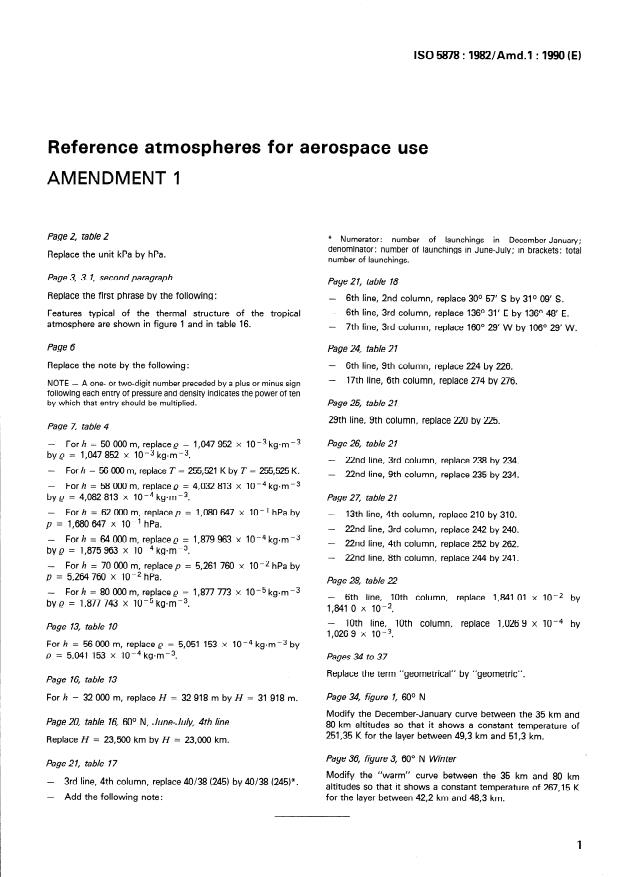
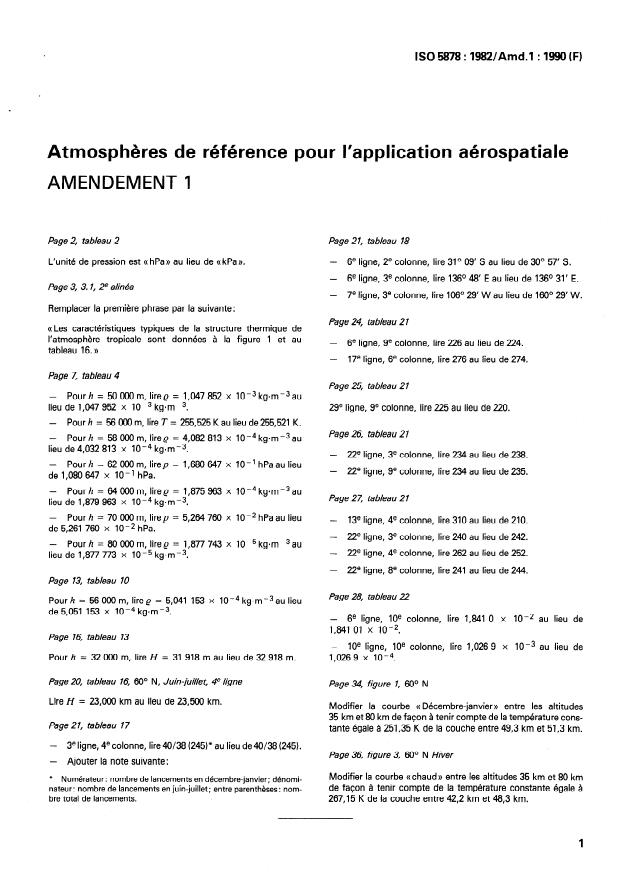
Mainly amends numerical values in table 4 on page 7, table 10 on page 13, table 13 on page 16, table 16 on page 20, tables 17 and 18 on page 21, table 21 on pages 24 to 27, table 22 on page 28. Modifies curves in figures 1 and 3 on pages 34 and 36.
- Status
- Published
- Publication Date
- 21-Nov-1990
- Technical Committee
- ISO/TC 20/SC 6 - Standard atmosphere
- Drafting Committee
- ISO/TC 20/SC 6 - Standard atmosphere
- Current Stage
- 9093 - International Standard confirmed
- Start Date
- 22-Nov-2024
- Completion Date
- 29-Aug-2026
Buy Documents

ISO 5878:1982/Amd 1:1990 - Reference atmospheres for aerospace use — Amendment 1 Released:11/22/1990

ISO 5878:1982/Amd 1:1990 - Atmospheres de référence pour l'application aérospatiale — Amendement 1 Released:11/22/1990

ISO 5878:1982/Amd 1:1990 - Atmospheres de référence pour l'application aérospatiale — Amendement 1 Released:11/22/1990
Overview
ISO 5878:1982/Amd 1:1990 Reference atmospheres for aerospace use - Amendment 1 is an official amendment to the international standard ISO 5878, developed by the International Organization for Standardization (ISO). This amendment updates and corrects several numerical values in tables and graphical figures critical for establishing standardized reference atmospheres in aerospace applications. These reference atmospheres underpin aerospace engineering, meteorological analysis, aerodynamic calculations, and simulation models by providing consistent atmospheric profiles crucial for design and testing in the aerospace industry.
Key Topics
- Reference Atmospheres: The standard specifies temperature, pressure, and density values at various altitudes necessary for aerospace calculations.
- Corrections of Numerical Values: Updates are made to numerical values in several tables (e.g., Tables 4, 10, 13, 16, 17, 18, 21, and 22) to improve accuracy.
- Modifications to Figures: Curves shown in Figures 1 and 3, representing thermal structure and related atmospheric parameters, are revised for enhanced precision.
- Unit Consistency: Pressure units and geographical coordinates are corrected for regulatory and scientific coherence.
- Data Accuracy: Adjustments ensure that values for critical parameters such as temperature, pressure, density, and geographical positions align with the most updated knowledge and usage in aerospace contexts.
Applications
The updates within ISO 5878:1982/Amd 1:1990 hold broad practical value across multiple sectors:
- Aerospace Engineering: Accurate reference atmosphere data is fundamental for aircraft and spacecraft design, from aerodynamic modeling to systems testing and certification processes.
- Flight Simulation: Realistic atmospheric parameterization enhances simulation fidelity for pilot training and mission rehearsal.
- Meteorological Analysis: Standardized datasets support weather prediction models and climatological studies relevant to flight planning and aerospace operations.
- Performance Calculations: Consistent atmospheric properties allow for standardized calculations of lift, drag, thrust, and thermal loads during aerospace system development.
- Research and Development: Enables researchers and engineers to benchmark systems under commonly accepted environmental assumptions, promoting interoperability and reliability.
- Safety and Regulation: Regulatory authorities and safety engineers rely on standardized atmospheric reference data to evaluate compliance and operational safety.
Related Standards
ISO 5878:1982/Amd 1:1990 is directly linked to several international and industry standards within aerospace and meteorology:
- ISO 5878:1982 - The original base standard for reference atmospheres in aerospace applications.
- ISO/TC 20/SC 6 - The ISO subcommittee on standard atmospheres and related methods.
- World Meteorological Organization (WMO) reference documents - Used worldwide for meteorological data standardization.
- ICAO Standard Atmosphere - International Civil Aviation Organization's atmospheric models for performance calculations.
- MIL-STD-210 - US military standard for climatic conditions and weather data, often referenced in military aerospace engineering alongside ISO standards.
By maintaining up-to-date atmospheric profiles and correction of technical data, ISO 5878:1982/Amd 1:1990 ensures the ongoing accuracy and reliability of aerospace design, regulatory compliance, and safe operations globally. Implementing the corrections prescribed in this amendment supports high-quality, data-driven aerospace innovation and operational excellence.
Relations
- Effective Date
- 06-Jun-2022
- Effective Date
- 07-Jan-2025
- Effective Date
- 15-Apr-2008
Buy Documents
ISO 5878:1982/Amd 1:1990 - Reference atmospheres for aerospace use — Amendment 1 Released:11/22/1990
ISO 5878:1982/Amd 1:1990 - Atmospheres de référence pour l'application aérospatiale — Amendement 1 Released:11/22/1990
ISO 5878:1982/Amd 1:1990 - Atmospheres de référence pour l'application aérospatiale — Amendement 1 Released:11/22/1990
Get Certified
Connect with accredited certification bodies for this standard

BSI Group
BSI (British Standards Institution) is the business standards company that helps organizations make excellence a habit.

Bureau Veritas
Bureau Veritas is a world leader in laboratory testing, inspection and certification services.

DNV
DNV is an independent assurance and risk management provider.
Sponsored listings
Frequently Asked Questions
ISO 5878:1982/Amd 1:1990 is a standard published by the International Organization for Standardization (ISO). Its full title is "Reference atmospheres for aerospace use — Amendment 1". This standard covers: Mainly amends numerical values in table 4 on page 7, table 10 on page 13, table 13 on page 16, table 16 on page 20, tables 17 and 18 on page 21, table 21 on pages 24 to 27, table 22 on page 28. Modifies curves in figures 1 and 3 on pages 34 and 36.
Mainly amends numerical values in table 4 on page 7, table 10 on page 13, table 13 on page 16, table 16 on page 20, tables 17 and 18 on page 21, table 21 on pages 24 to 27, table 22 on page 28. Modifies curves in figures 1 and 3 on pages 34 and 36.
ISO 5878:1982/Amd 1:1990 is classified under the following ICS (International Classification for Standards) categories: 49.020 - Aircraft and space vehicles in general. The ICS classification helps identify the subject area and facilitates finding related standards.
ISO 5878:1982/Amd 1:1990 has the following relationships with other standards: It is inter standard links to ISO 5878:1982, ISO/FDIS 5878; is excused to ISO 5878:1982. Understanding these relationships helps ensure you are using the most current and applicable version of the standard.
ISO 5878:1982/Amd 1:1990 is available in PDF format for immediate download after purchase. The document can be added to your cart and obtained through the secure checkout process. Digital delivery ensures instant access to the complete standard document.
Standards Content (Sample)
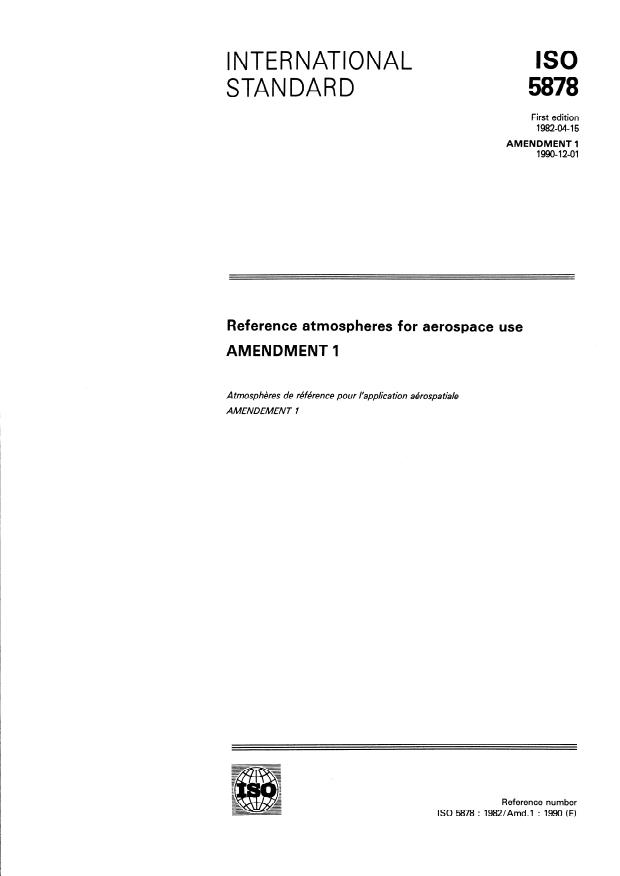
INTERNATIONAL ISO
STANDARD
First edition
1982-04-15
AMENDMENT 1
1990-12-01
Reference atmospheres for aerospace use
AMENDMENT 1
A tmosphkres de r&f&ence pour llapplica tion akospa tiale
AMENDEMENT I
Reference number
ISO 5878 : 1982/Amd.l : 1990 (EI
ISO 5878 : 1982/Amd.l : 1990 (E)
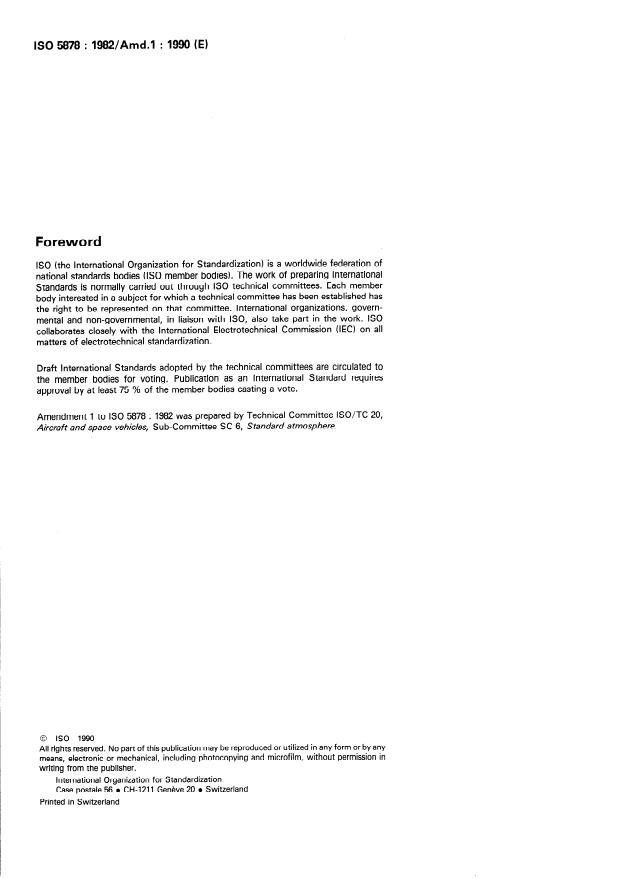
Foreword
ISO (the International Organization for Standardization) is a worldwide federation of
national Standards bodies (ISO member bodies). The work of preparing International
Standards is normally carried out through ISO technical committees. Esch member
body interested in a subject for which a technical committee has been established has
the right to be represented on that committee. International organizations, govern-
mental and non-governmental, in liaison with ISO, also take part in the work. ISO
collaborates closely with the International Electrotechnical Commission (IEC) on all
matters of electrotechnical standardization.
Draft International Standards adopted by the technical committees are circulated to
the member bodies for voting. Publication as an International Standard requires
approval by at least 75 % of the member bodies casting a vote.
Amendment 1 to ISO 5878 : 1982 was prepared by Technical Committee ISO/TC 20,
Aircraft and space vehicles, Sub-Committee SC 6, Standard atmosphere.
0 ISO 1990
All rights reserved. No part of this publication may be reproduced or utilized in any form or by any
means, electronie or mechanical, including photocopying and microfilm, without Permission in
writing from the publisher.
International Organkation for Standardization
Case postale 56 l CH-1211 Geneve 20 l Switzerland
Printed in Switzerland
ISO 5878 : 1982/Amd.l : 1990 (E)
Reference atmospheres for aerospace use
AMENDMENT 1
Page 2, table 2
* Numerator :
number of launchings in December-January;
denominator: number of launchings in June-July; in brackets: total
Replace the unit kPa by hPa.
number of launchings.
Page 3, 3.7, second Paragraph
Page 27, table 78
Replace the first Phrase by the following:
- 6th line, 2nd column, replace 30° 57’ S by 31° 09’ S.
- 6th line, 3rd column, replace 136O 31’ E by 136O 48’ E.
Features typical of the thermal structure of the tropical
atmosphere are shown in figure 1 and in table 16.
- 7th line, 3rd column, replace 160° 29’ W by 106O 29’ W.
Page 6 Page 24, table 27
- 6th line, 9th column, replace 224 by 226.
Rep
...
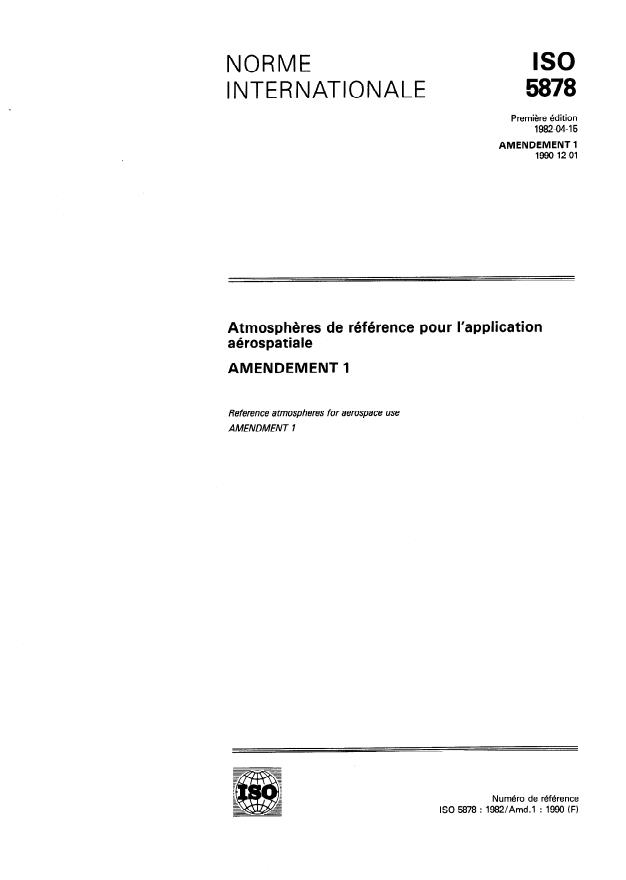
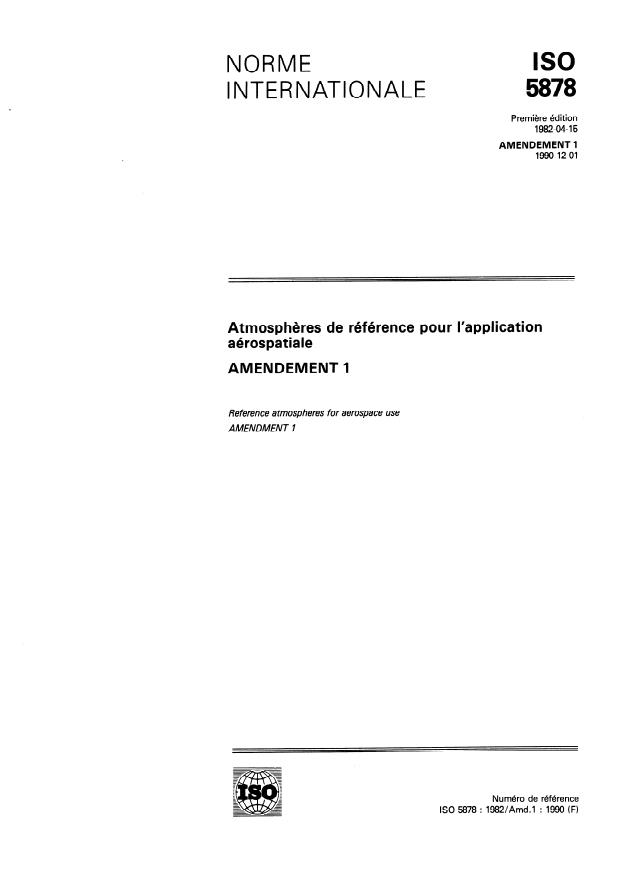
NORME ISO
INTERNATIONALE 5878
Première édition
1982-04-15
AMENDEMENT 1
1990-12-01
Atmosphères de référence pour l’application
aérospatiale
Reference atmospheres for aerospace use
AMENDMENT 1
Numéro de référence
ISO 5878 : 1982/Amd.l : 1990 (FI
ISO 5878 : 1982/Amd.l : 1990 (FI
Avant-propos
L’ISO (Organisation internationale de normalisation) est une fédération mondiale
d’organismes nationaux de normalisation (comités membres de I’ISO). L’élaboration
des Normes internationales est en général confiée aux comités techniques de I’ISO.
Chaque comité membre intéressé par une étude a le droit de faire partie du comité
technique créé à cet effet. Les organisations internationales, gouvernementales et non
gouvernementales, en liaison avec I’ISO participent également aux travaux. L’ISO col-
labore étroitement avec la Commission électrotechnique internationale (CEI) en ce qui
concerne la normalisation électrotechnique.
Les projets de Normes internationales adoptés par les comités techniques sont soumis
aux comités membres pour vote. Leur publication comme Normes internationales re-
quiert l’approbation de 75 % au moins des comités membres votants.
L’Amendement 1 à la Norme internationale ISO 5878 : 1982 a été élaboré par le comité
technique ISO/TC 20, Aéronautique et espace, sous-comité SC 6, Atmosphère type.
0 ISO 1990
Droits de reproduction réservés. Aucune partie de cette publication ne peut être reproduite ni
utilisée sous quelque forme que ce soit et par aucun procédé, électronique ou mécanique,
y compris la photocopie et les microfilms, sans l’accord écrit de l’éditeur.
Organisation internationale de normalisation
Case postale 56 l CH-1211 Genève 20 l Suisse
Imprimé en Suisse
ISO 5878 : 1982/Amd.l : 1990 (FI
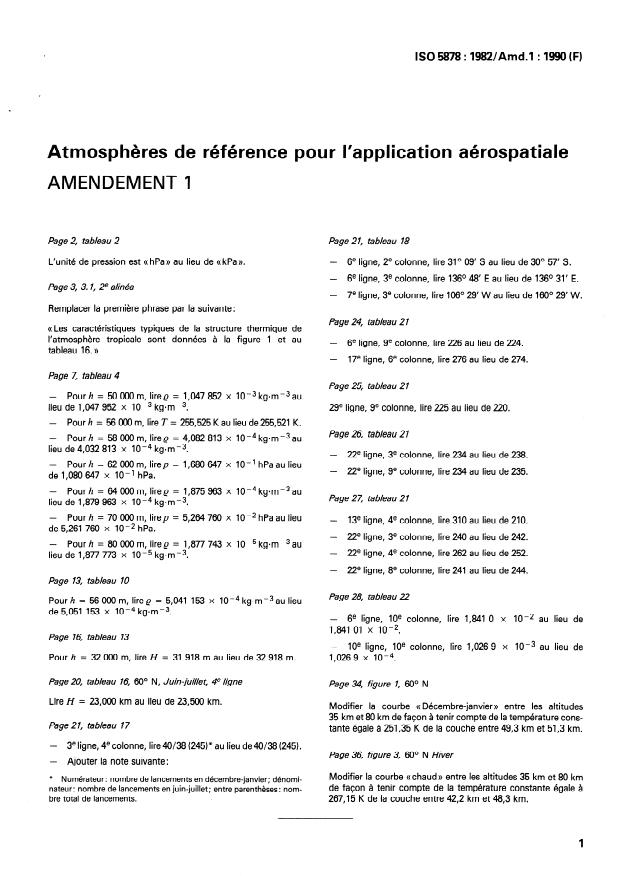
Atmosphères de référence pour l’application aérospatiale
AMENDEMENT 1
Page 2, tableau (2
Page 27, tableau 78
L’unité de pression est (( hPa N au lieu de (( kPa N. - 6e ligne, 2e colonne, lire 31° 09’ S au lieu de 30° 57’ S.
- 6e ligne, 3e colonne, lire 136O 48’ E au lieu de 136O 31’ E.
Page 3, 3.7, 2e alinéa
- 7e ligne, 3e colonne, lire 106O 29’ W au lieu de 160° 29’ W.
Remplacer la première phrase par la suivante:
Page 24, tableau 27
((Les caractéristiques typiques de la structure thermique de
I’atmosphére tropicale sont données à la figure 1 et au
- 6e ligne, ge colonne, lire 226 au lieu de 224.
tableau 16. H
- 17e ligne,
...
NORME ISO
INTERNATIONALE 5878
Première édition
1982-04-15
AMENDEMENT 1
1990-12-01
Atmosphères de référence pour l’application
aérospatiale
Reference atmospheres for aerospace use
AMENDMENT 1
Numéro de référence
ISO 5878 : 1982/Amd.l : 1990 (FI
ISO 5878 : 1982/Amd.l : 1990 (FI
Avant-propos
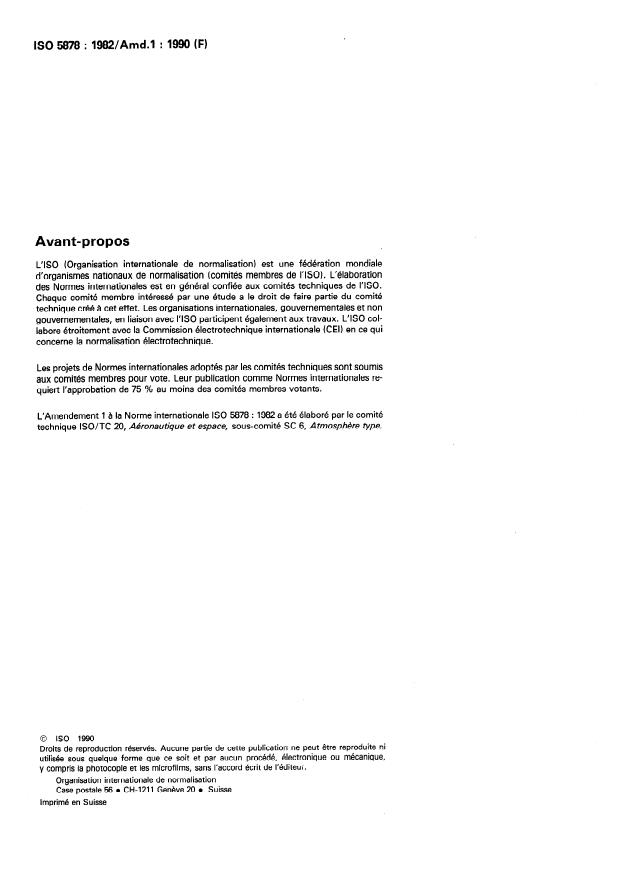
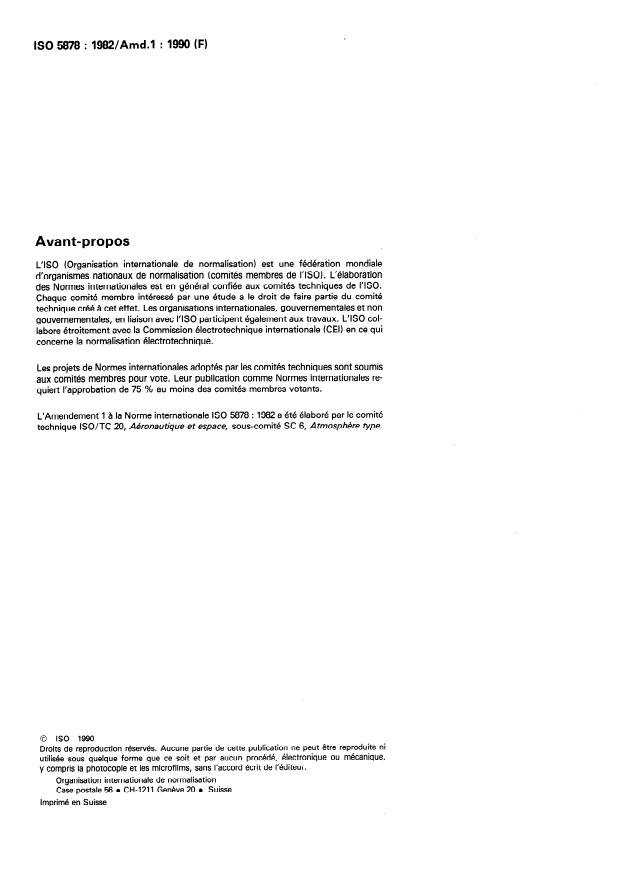
L’ISO (Organisation internationale de normalisation) est une fédération mondiale
d’organismes nationaux de normalisation (comités membres de I’ISO). L’élaboration
des Normes internationales est en général confiée aux comités techniques de I’ISO.
Chaque comité membre intéressé par une étude a le droit de faire partie du comité
technique créé à cet effet. Les organisations internationales, gouvernementales et non
gouvernementales, en liaison avec I’ISO participent également aux travaux. L’ISO col-
labore étroitement avec la Commission électrotechnique internationale (CEI) en ce qui
concerne la normalisation électrotechnique.
Les projets de Normes internationales adoptés par les comités techniques sont soumis
aux comités membres pour vote. Leur publication comme Normes internationales re-
quiert l’approbation de 75 % au moins des comités membres votants.
L’Amendement 1 à la Norme internationale ISO 5878 : 1982 a été élaboré par le comité
technique ISO/TC 20, Aéronautique et espace, sous-comité SC 6, Atmosphère type.
0 ISO 1990
Droits de reproduction réservés. Aucune partie de cette publication ne peut être reproduite ni
utilisée sous quelque forme que ce soit et par aucun procédé, électronique ou mécanique,
y compris la photocopie et les microfilms, sans l’accord écrit de l’éditeur.
Organisation internationale de normalisation
Case postale 56 l CH-1211 Genève 20 l Suisse
Imprimé en Suisse
ISO 5878 : 1982/Amd.l : 1990 (FI
Atmosphères de référence pour l’application aérospatiale
AMENDEMENT 1
Page 2, tableau (2
Page 27, tableau 78
L’unité de pression est (( hPa N au lieu de (( kPa N. - 6e ligne, 2e colonne, lire 31° 09’ S au lieu de 30° 57’ S.
- 6e ligne, 3e colonne, lire 136O 48’ E au lieu de 136O 31’ E.
Page 3, 3.7, 2e alinéa
- 7e ligne, 3e colonne, lire 106O 29’ W au lieu de 160° 29’ W.
Remplacer la première phrase par la suivante:
Page 24, tableau 27
((Les caractéristiques typiques de la structure thermique de
I’atmosphére tropicale sont données à la figure 1 et au
- 6e ligne, ge colonne, lire 226 au lieu de 224.
tableau 16. H
- 17e ligne,
...