


ISO 1101:2017
(Main)Geometrical product specifications (GPS) - Geometrical tolerancing - Tolerances of form, orientation, location and run-out
Geometrical product specifications (GPS) - Geometrical tolerancing - Tolerances of form, orientation, location and run-out
ISO 1101:2017 defines the symbol language for geometrical specification of workpieces and the rules for its interpretation. It provides the foundation for geometrical specification. The illustrations in this document are intended to illustrate how a specification can be fully indicated with visible annotation (including e.g. TEDs). NOTE 1 Other International Standards referenced in Clause 2 and in Tables 3 and 4 provide more detailed information on geometrical tolerancing. NOTE 2 This document gives rules for explicit and direct indications of geometrical specifications. Alternatively, the same specifications can be indicated indirectly in accordance with ISO 16792 by attaching them to a 3D CAD model. In this case, it is possible that some elements of the specification are available through a query function or other interrogation of information on the model instead of being indicated using visible annotation
Spécification géométrique des produits (GPS) — Tolérancement géométrique — Tolérancement de forme, orientation, position et battement
ISO 1101:2017 définit le langage symbolique utilisé pour la spécification géométrique des pièces, ainsi que ses règles d'interprétation. Il établit la base de la spécification géométrique. Les illustrations du présent document visent à illustrer la façon dont une spécification peut être indiquée dans son intégralité avec annotation visible (y compris par exemple les TEDs). NOTE 1 D'autres Normes internationales, citées à l'Article 2 et dans les Tableaux 3 et 4, fournissent des informations plus détaillées sur le tolérancement géométrique. NOTE 2 Le présent document spécifie les règles pour des indications explicites et directes des spécifications géométriques. Les mêmes spécifications peuvent également être indiquées de façon indirecte, conformément à l'ISO 16792, en les rattachant à un modèle CAO en 3D. Dans ce cas, il est possible que certains éléments de la spécification soient disponibles par une fonction de requête ou d'une autre méthode d'interrogation des informations sur le modèle, plutôt que d'être indiqués au moyen d'une annotation visible.
General Information
Relations
Overview
ISO 1101:2017 - Geometrical product specifications (GPS) - Geometrical tolerancing - Tolerances of form, orientation, location and run-out - defines the graphical symbol language and interpretation rules used to specify geometric requirements on engineering drawings and models. The standard provides the foundation for geometrical tolerancing, showing how to indicate tolerances of form, orientation, location and run‑out with visible annotation (including Theoretically Exact Dimensions (TEDs)) or indirectly by attaching specifications to a 3D CAD model (per ISO 16792).
Key topics and requirements
ISO 1101:2017 organizes the geometrical tolerancing system and covers:
- Symbols and tolerance frame - standardized symbol language for form, orientation, location and run‑out characteristics and how to build the tolerance indicator.
- Toleranced features & tolerance zones - rules for defining tolerance zones (defaults, variable width, cylindrical and spherical zones).
- Datum and datum systems - how to indicate datum features, datum section rules, and datum-related specifications.
- Geometrical characteristic definitions - straightness, flatness, roundness, cylindricity, line & surface profile, parallelism, perpendicularity, angularity, position, concentricity/coaxiality, symmetry, circular and total run‑out.
- Special topics - stacked tolerances, restrictive specifications, projected toleranced features, moveable assemblies, intersection/orientation/collection planes, direction features and graphical language conventions.
- Theoretically Exact Dimensions (TEDs) - illustration and use in visible annotation.
- References to additional international standards (Clause 2, Tables 3 & 4) for more detailed tolerancing guidance.
Practical applications
ISO 1101:2017 is essential for:
- Creating unambiguous engineering drawings and 3D CAD annotations with consistent geometric requirements.
- Defining inspection criteria and measurement procedures for manufacturing and metrology.
- Specifying tolerance zones used in tolerance stack-ups, GD&T planning and quality control.
- Communicating design intent across supply chains - from design and manufacturing to inspection and procurement.
Who should use this standard
- Mechanical and design engineers drafting parts and assemblies
- Metrologists and quality engineers developing inspection plans
- CAM programmers and manufacturing engineers responsible for producibility
- CAD specialists applying model-based definition (MBD) and ISO 16792 workflows
- Technical trainers and standards committees implementing GPS/GD&T practices
Related standards
ISO 1101:2017 is part of the GPS suite and is commonly used with:
- ISO 16792 (CAD practices for MBD)
- Other ISO GPS documents referenced in Clause 2 and tables of ISO 1101 for detailed characteristic definitions and measurement methods
Using ISO 1101:2017 ensures consistent, internationally recognized geometrical tolerancing language for clearer specifications, better interchange of CAD/technical data, and improved manufacturability and inspection.


Standards Content (Sample)
INTERNATIONAL ISO
STANDARD 1101
Fourth edition
2017-02
Geometrical product specifications
(GPS) — Geometrical tolerancing
— Tolerances of form, orientation,
location and run-out
Spécification géométrique des produits (GPS) — Tolérancement
géométrique — Tolérancement de forme, orientation, position et
battement
Reference number
©
ISO 2017
© ISO 2017, Published in Switzerland
All rights reserved. Unless otherwise specified, no part of this publication may be reproduced or utilized otherwise in any form
or by any means, electronic or mechanical, including photocopying, or posting on the internet or an intranet, without prior
written permission. Permission can be requested from either ISO at the address below or ISO’s member body in the country of
the requester.
ISO copyright office
Ch. de Blandonnet 8 • CP 401
CH-1214 Vernier, Geneva, Switzerland
Tel. +41 22 749 01 11
Fax +41 22 749 09 47
copyright@iso.org
www.iso.org
ii © ISO 2017 – All rights reserved
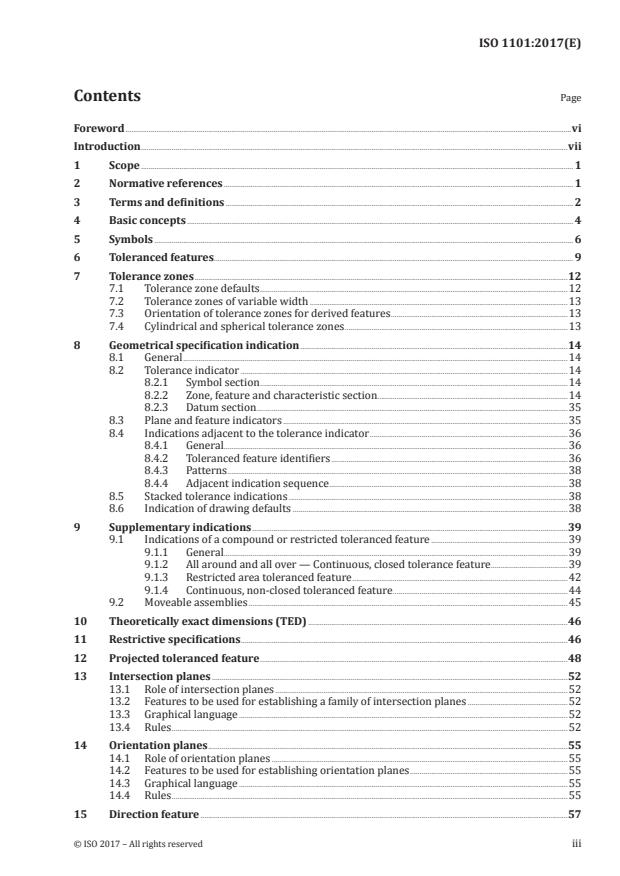
Contents Page
Foreword .vi
Introduction .vii
1 Scope . 1
2 Normative references . 1
3 Terms and definitions . 2
4 Basic concepts . 4
5 Symbols . 6
6 Toleranced features . 9
7 Tolerance zones .12
7.1 Tolerance zone defaults .12
7.2 Tolerance zones of variable width .13
7.3 Orientation of tolerance zones for derived features .13
7.4 Cylindrical and spherical tolerance zones .13
8 Geometrical specification indication .14
8.1 General .14
8.2 Tolerance indicator .14
8.2.1 Symbol section .14
8.2.2 Zone, feature and characteristic section .14
8.2.3 Datum section.35
8.3 Plane and feature indicators .35
8.4 Indications adjacent to the tolerance indicator .36
8.4.1 General.36
8.4.2 Toleranced feature identifiers .36
8.4.3 Patterns .38
8.4.4 Adjacent indication sequence .38
8.5 Stacked tolerance indications .38
8.6 Indication of drawing defaults .38
9 Supplementary indications .39
9.1 Indications of a compound or restricted toleranced feature .39
9.1.1 General.39
9.1.2 All around and all over — Continuous, closed tolerance feature .39
9.1.3 Restricted area toleranced feature .42
9.1.4 Continuous, non-closed toleranced feature .44
9.2 Moveable assemblies .45
10 Theoretically exact dimensions (TED) .46
11 Restrictive specifications .46
12 Projected toleranced feature .48
13 Intersection planes .52
13.1 Role of intersection planes .52
13.2 Features to be used for establishing a family of intersection planes .52
13.3 Graphical language .52
13.4 Rules .52
14 Orientation planes .55
14.1 Role of orientation planes .55
14.2 Features to be used for establishing orientation planes .55
14.3 Graphical language .55
14.4 Rules .55
15 Direction feature .57
15.1 Role of direction features .57
15.2 Features to be used for establishing direction features .59
15.3 Graphical language .59
15.4 Rules .59
16 Collection plane .60
16.1 Role of collection planes .60
16.2 Features to be used for establishing collection planes .61
16.3 Graphical language .61
16.4 Rules .61
17 Definitions of geometrical specifications .61
17.1 General .61
17.2 Straightness specification .61
17.3 Flatness specification .64
17.4 Roundness specification .64
17.5 Cylindricity specification .66
17.6 Line profile specification not related to a datum .67
17.7 Line profile specification related to a datum system .68
17.8 Surface profile specification not related to a datum.70
17.9 Surface profile specification related to a datum .70
17.10 Parallelism specification .71
17.10.1 General.71
17.10.2 Parallelism specification of a median line related to a datum system .72
17.10.3 Parallelism specification of a median line related to a datum straight line .75
17.10.4 Parallelism specification of a median line related to a datum plane .76
17.10.5 Parallelism specification of a set of lines in a surface related to a datum plane .77
17.10.6 Parallelism specification of a planar surface related to a datum straight line .77
17.10.7 Parallelism specification of a planar surface related to a datum plane .78
17.11 Perpendicularity specification .79
17.11.1 General.79
17.11.2 Perpendicularity specification of a median line related to a datum straight line .79
17.11.3 Perpendicularity specification of a median line related to a datum system .80
17.11.4 Perpendicularity specification of a median line related to a datum plane .82
17.11.5 Perpendicularity specification of a planar surface related to a datum
straight line .83
17.11.6 Perpendicularity specification of a planar surface related to a datum plane .83
17.12 Angularity specification .84
17.12.1 General.84
17.12.2 Angularity specification of a median line related to a datum straight line .84
17.12.3 Angularity specification for a median line related to a datum system .86
17.12.4 Angularity specification for a planar surface related to a datum straight line.87
17.12.5 Angularity specification for a planar surface related to a datum plane .88
17.13 Position specification .89
17.13.1 General.89
17.13.2 Position specification of a derived point .89
17.13.3 Position specification of a median line .90
17.13.4 Position specification of a median plane .94
17.13.5 Position specification of a planar surface .96
17.14 Concentricity and coaxiality specification .97
17.14.1 General.97
17.14.2 Concentricity specification of a point .97
17.14.3 Coaxiality specification of an axis .98
17.15 Symmetry specification .100
17.15.1 General.100
17.15.2 Symmetry specification of a median plane .100
17.16 Circular run-out specification .101
17.16.1 General.101
17.16.2 Circular run-out specification — Radial .101
iv © ISO 2017 – All rights reserved
17.16.3 Circular run-out specification — Axial .103
17.16.4 Circular runout in any direction .104
17.16.5 Circular run-out specification in a specified direction .106
17.17 Total run-out specification.107
17.17.1 General.107
17.17.2 Total run-out specification — Radial .107
17.17.3 Total run-out specification – Axial .108
Annex A (informative) Deprecated and former practices .110
Annex B (informative) Explicit and implicit rules for geometrical tolerance zones .119
Annex C (informative) Filters .125
Annex D (normative) ISO special specification elements for form .128
Annex E (informative) Filter details .129
Annex F (normative) Relations and dimensions of graphical symbols .142
Annex G (informative) Relation to the GPS matrix model .144
Bibliography .145
Foreword
ISO (the International Organization for Standardization) is a worldwide federation of national standards
bodies (ISO member bodies). The work of preparing International Standards is normally carried out
through ISO technical committees. Each member body interested in a subject for which a technical
committee has been established has the right to be represented on that committee. International
organizations, governmental and non-governmental, in liaison with ISO, also take part in the work.
ISO collaborates closely with the International Electrotechnical Commission (IEC) on all matters of
electrotechnical standardization.
The procedures used to develop this document and those intended for its further maintenance are
described in the ISO/IEC Directives, Part 1. In particular the different approval criteria needed for the
different types of ISO documents should be noted. This document was drafted in accordance with the
editorial rules of the ISO/IEC Directives, Part 2 (see www .iso .org/ directives).
Attention is drawn to the possibility that some of the elements of this document may be the subject of
patent rights. ISO shall not be held responsible for identifying any or all such patent rights. Details of
any patent rights identified during the development of the document will be in the Introduction and/or
on the ISO list of patent declarations received (see www .iso .org/ patents).
Any trade name used in this document is information given for the convenience of users and does not
constitute an endorsement.
For an explanation on the meaning of ISO specific terms and expressions related to conformity assessment,
as well as information about ISO’s adherence to the World Trade Organization (WTO) principles in the
Technical Barriers to Trade (TBT) see the following URL: www . i so .org/ iso/ foreword .html.
This document was prepared by Technical Committee ISO/TC 213, Dimensional and geometrical product
specifications and verifications.
This fourth edition cancels and replaces the third edition (ISO 1101:2012), which has been technically
revised.
It also incorporates the Technical Corrigendum ISO 1101:2012/Cor.1:2013.
The main changes are as follows.
— Tools have been added to specify the filtering of the toleranced feature and a line type has been
designated for its illustration.
— Tools have been added to tolerance associated features.
— Tools have been added to specify form characteristics by specifying the reference feature association
and the specified parameter.
— Tools have been added to specify the constraints to the tolerance zone.
— The rules for specifications using “all around” or “all over” modifiers have been clarified.
— The direction of the tolerance zone in the case of roundness tolerances for revolute surfaces that are
neither cylindrical nor spherical, e.g. cones shall now always be indicated to avoid an exception to
the general rule that specifications for integral features apply perpendicular to the surface.
— The “from-to” symbol has been retired and replaced by the “between” symbol.
vi © ISO 2017 – All rights reserved
Introduction
This document is a geometrical product specification (GPS) standard and is to be regarded as a general
GPS standard (see ISO 14638). It influences chain links A, B and C of the chain of standards on form,
orientation, location and run out.
The ISO GPS Masterplan given in ISO 14638 gives an overview of the ISO GPS system of which this
document is a part. The fundamental rules of ISO GPS given in ISO 8015 apply to this document.
The default decision rules given in ISO 14253-1 apply to specifications made in accordance with this
document, unless otherwise stated.
For more detailed information on the relation of this document to the GPS matrix model, see Annex G.
This document represents the initial basis and describes the required fundamentals for geometrical
tolerancing. Nevertheless, it is advisable to consult the separate standards referenced in Clause 2 and in
Tables 3 and 4 for more detailed information.
For the presentation of lettering (proportions and dimensions), see ISO 3098-2.
All figures in this document for the 2D drawing indications have been drawn in first-angle projection
with dimensions and tolerances in millimetres. It should be understood that third-angle projection
and other units of measurement could have been used equally well without prejudice to the principles
established. For all figures giving specification examples in 3D, the dimensions and tolerances are the
same as for the similar figures shown in 2D.
The figures in this document represent either 2D drawing views or 3D axonometric views on 2D
drawings and are intended to illustrate how a specification can be fully indicated with visible
annotation. For possibilities of illustrating a specification where elements of the specification may be
available through a query function or other interrogation of information on the 3D CAD model and rules
for attaching specifications to 3D CAD models, see ISO 16792.
The figures in this document illustrate the text and are not intended to reflect an actual application.
Consequently, the figures are not fully dimensioned and specified, showing only the relevant general
principles. Neither are the figures intended to imply a particular display requirement in terms of
whether hidden detail, tangent lines or other annotations are shown or not shown. Many figures have
lines or details removed for clarity, or added or extended to assist with the illustration of the text. See
Table 1 for the line types used in definition figures.
In order for a GPS specification to be unambiguous, the partition defining the boundary of the toleranced
feature, as well as the filtering, has to be well defined. Currently, the detailed rules for partitioning and
the default for filtering are not defined in GPS standards.
For a definitive presentation (proportions and dimensions) of the symbolization for geometrical
tolerancing, see ISO 7083 and Annex F.
Annex A has been provided for information only. It presents previous drawing indications that have
been omitted here and are no longer used.
For the purposes of this document, the terms “axis” and “median plane” are used for derived features
of perfect form, and the terms “median line” and “median surface” for derived features of imperfect
form. Furthermore, the following line types have been used in the explanatory illustrations, i.e. those
representing non-technical drawings for which the rules of ISO 128 (all parts) apply.
Table 1
Line type
Feature level Feature type Details
Visible Behind plane/surface
point
integral feature line/axis wide continuous narrow dashed
surface/plane
Nominal feature
point
narrow long dashed narrow dashed
derived feature line/axis
dotted dotted
surface/plane
surface wide freehand con- narrow freehand
Real feature integral feature
tinuous dashed
point
integral feature line wide short dashed narrow short dashed
surface
Extracted feature
point
derived feature line wide dotted narrow dotted
surface
line
Filtered feature integral feature continuous narrow continuous narrow
surface
point
narrow dou-
wide doubled-dashed
integral feature straight line ble-dashed dou-
double-dotted
ble-dotted
plane
point
narrow long dashed wide dashed
Associated feature derived feature straight line (axis)
double-dotted double-dotted
plane
point
wide long dashed narrow long dashed
datum line/axis
double-short dashed double-short dashed
surface/plane
Tolerance zone limits, line
continuous narrow narrow dashed
tolerance planes
surface
Section, illustration line
narrow long dashed narrow dashed
plane, drawing plane,
surface short dashed short dashed
aid plane
Extension, dimension, line
leader and reference continuous narrow narrow dashed
lines
viii © ISO 2017 – All rights reserved
INTERNATIONAL STANDARD ISO 1101:2017(E)
Geometrical product specifications (GPS) — Geometrical
tolerancing — Tolerances of form, orientation, location
and run-out
IMPORTANT — The illustrations included in this document are intended to illustrate the text
and/or to provide examples of the related technical drawing specification; these illustrations are
not fully dimensioned and toleranced, showing only the relevant general principles. In particular,
many illustrations do not contain filter specifications. As a consequence, the illustrations are
not a representation of a complete workpiece, and are not of a quality that is required for use in
industry (in terms of full conformity with the standards prepared by ISO/TC 10 and ISO/TC 213),
and as such are not suitable for projection for teaching purposes.
1 Scope
This document defines the symbol language for geometrical specification of workpieces and the rules
for its interpretation.
It provides the foundation for geometrical specification.
The illustrations in this document are intended to illustrate how a specification can be fully indicated
with visible annotation (including e.g. TEDs).
NOTE 1 Other International Standards referenced in Clause 2 and in Tables 3 and 4 provide more detailed
information on geometrical tolerancing.
NOTE 2 This document gives rules for explicit and direct indications of geometrical specifications.
Alternatively, the same specifications can be indicated indirectly in accordance with ISO 16792 by attaching
them to a 3D CAD model. In this case, it is possible that some elements of the specification are available through
a query function or other interrogation of information on the model instead of being indicated using visible
annotation.
2 Normative references
The following documents are referred to in the text in such a way that some or all of their content
constitutes requirements of this document. For dated references, only the edition cited applies. For
undated references, the latest edition of the referenced document (including any amendments) applies.
ISO 128-24:1999, Technical drawings — General principles of presentation — Part 24: Lines on mechanical
engineering drawings
ISO 1660, Technical drawings — Dimensioning and tolerancing of profiles
ISO 2692:2014, Geometrical product specifications (GPS) — Geometrical tolerancing — Maximum material
requirement (MMR), least material requirement (LMR) and reciprocity requirement (RPR)
ISO 5458, Geometrical Product Specifications (GPS) — Geometrical tolerancing — Positional tolerancing
ISO 5459, Geometrical product specifications (GPS) — Geometrical tolerancing — Datums and datum systems
ISO 8015:2011, Geometrical product specifications (GPS) — Fundamentals — Concepts, principles and rules
ISO 10579:2010, Geometrical product specifications (GPS) — Dimensioning and tolerancing — Non-
rigid parts
ISO 13715, Technical drawings — Edges of undefined shape — Vocabulary and indications
ISO 16610 (all parts), Geometrical product specifications (GPS) — Filtration
ISO 17450-1:2011, Geometrical product specifications (GPS) — General concepts — Part 1: Model for
geometrical specification and verification
ISO 17450-2, Geometrical product specifications (GPS) — General concepts — Part 2: Basic tenets,
specifications, operators, uncertainties and ambiguities
ISO 17450-3, Geometrical product specifications (GPS) — General concepts — Part 3: Toleranced features
ISO 22432, Geometrical product specifications (GPS) — Features utilized in specification and verification
ISO 25378:2011, Geometrical product specifications (GPS) — Characteristics and conditions — definitions
3 Terms and definitions
For the purpose of this document, the terms and definitions given in ISO 8015, the ISO 16610 series,
ISO 17450-1, ISO 17450-2, ISO 17450-3, ISO 22432, ISO 25378 and the following apply.
ISO and IEC maintain terminological databases for use in standardization at the following addresses:
— IEC Electropedia: available at http:// www .electropedia .org/
— ISO Online browsing platform: available at https:// www .iso .org/ obp/
3.1
tolerance zone
space limited by and including one or two ideal lines or surfaces, and characterized by one or more
linear dimensions, called a tolerance
Note 1 to entry: See also 4.4.
3.2
intersection plane
plane, established from an extracted feature of the workpiece, identifying a line on an extracted surface
(integral or median) or a point on an extracted line
Note 1 to entry: The use of intersection planes makes it possible to define toleranced features independent of
the view.
Note 2 to entry: For areal surface texture, the intersection plane can be used to define the orientation of the
evaluation area, see ISO 25178-1.
3.3
orientation plane
plane, established from an extracted feature of the workpiece, identifying the orientation of the
tolerance zone
Note 1 to entry: The use of an orientation plane makes it possible to define the direction of the planes or cylinder
that limit the tolerance zone independent of the TEDs (for location) or of the datum (for orientation). The
orientation plane is only used for this purpose when the toleranced feature is a median feature (centre point,
median straight line) and the tolerance zone is defined by two parallel straight lines or two parallel planes or, for
a centre point, a cylinder.
Note 2 to entry: The use of an orientation plane also makes it possible to define the orientation of a rectangular
restricted area.
2 © ISO 2017 – All rights reserved
3.4
direction feature
ideal feature, established from an extracted feature of the workpiece, identifying the direction of local
deviations
Note 1 to entry: The direction feature can be a plane, a cylinder or a cone.
Note 2 to entry: For a line in a surface, the use of a direction feature makes it possible to change the direction of
the width of the tolerance zone.
Note 3 to entry: The direction feature is used when the tolerance value applies in a specified direction instead of
normal to the specified geometry.
Note 4 to entry: The direction feature is constructed from the datum indicated in the second compartment of
the direction feature indicator. The geometry of the direction feature depends on the geometry of the toleranced
feature.
3.5
compound continuous feature
single feature composed of more than one single feature joined together without gaps
Note 1 to entry: A compound continuous feature can be closed or not.
Note 2 to entry: A non-closed compound continuous feature can be defined using the “between” symbol (see 9.1.4)
and, if applicable, the UF modifier.
Note 3 to entry: A closed compound continuous feature can be defined using the “all around” symbol (see 9.1.2)
and the UF modifier. In this case, it is a set of single features whose intersection with any plane parallel to a
collection plane is a line or a point.
Note 4 to entry: A closed compound continuous feature can be defined using the “all over” symbol (see 9.1.2) and
the UF modifier.
3.6
collection plane
plane, established from a feature on the workpiece, defining a closed compound continuous feature
Note 1 to entry: The collection plane is always used when the “all around” symbol is applied.
3.7
theoretically exact dimension
TED
linear or angular dimension used in GPS operations to define theoretically exact geometry, extents,
locations and orientations of features
Note 1 to entry: For the purpose of this document, the term “theoretically exact dimension” has been
abbreviated as TED.
Note 2 to entry: A TED can be used to define the following:
— the nominal shape and dimensions of features;
— the definition of theoretically exact features (TEF);
— the location and dimensions of portions of features, including restricted toleranced features;
— the length of projected toleranced features;
— the relative location and orientation of two or more tolerance zones;
— the relative location and orientation of datum targets, including moveable datum targets;
— the location and orientation of tolerance zones relative to datums and datum systems;
— the direction of the width of tolerance zones.
Note 3 to entry: A TED can be explicit or implicit. When indicated, an explicit TED is indicated by a rectangular
frame including a value and sometimes an associated symbol, e.g. ø or R. On 3D models, explicit TEDs may be
available by queries.
Note 4 to entry: An implicit TED is not indicated. An implicit TED is one of the following: 0 mm, 0°, 90°, 180°, 270°
and the angular distance between equally spaced features on a complete circle.
Note 5 to entry: TEDs are not affected by individual or general specifications.
3.8
theoretically exact feature
TEF
nominal feature with ideal shape, size, orientation and location, as applicable
Note 1 to entry: A theoretically exact feature (TEF) can have any shape and can be defined by explicitly indicated
theoretically exact dimensions (TEDs) or implicitly defined in CAD data.
Note 2 to entry: The theoretically exact location and orientation, if applicable, is relative to the indicated datum
system for the specification of the corresponding actual feature.
Note 3 to entry: See also ISO 25378.
EXAMPLE 1 The spherical surface shown in Figure 110 is a theoretically exact feature, with a defined spherical
radius and a defined location and orientation relative to datum A.
EXAMPLE 2 A virtual condition, e.g. a maximum material virtual condition (MMVC) according to ISO 2692 is a
theoretically exact feature.
3.9
united feature
compound integral feature which may or may not be continuous, considered as a single feature
Note 1 to entry: A united feature can have a derived feature.
Note 2 to entry: The definition of a united feature is intentionally very broad to avoid excluding any useful
applications. However, it is not intended that a united feature can be used to define something that is by nature
several separate features. For example, building a united feature from two parallel, non-coaxial cylindrical
features, or two parallel, non-coaxial rectangular tubes (each built from two perpendicular pairs of parallel
planes) is not an intended use.
EXAMPLE 1 A cylindrical feature defined from a set of arc features, such as the outside diameter of a spline, is
an intended use of a united feature, see Figure 48.
EXAMPLE 2 Two complete coaxial cylinders, which do not have the same nominal diameter, cannot be
considered as a united feature.
4 Basic concepts
4.1 Geometrical tolerances shall be specified in accordance with functional requirements.
Manufacturing and inspection requirements can also influence geometrical tolerancing.
NOTE Indicating geometrical tolerances does not necessarily imply the use of any particular method of
production, measurement or gauging.
4.2 A geometrical tolerance applied to a feature defines the tolerance zone around the reference
feature within which the toleranced feature shall be contained.
NOTE 1 In some cases, i.e. when using the characteristic parameter modifiers introduced in this document,
see Figure 13, geometrical specifications can define characteristics instead of zones.
NOTE 2 All dimensions given in the figures in this document are in millimetres.
4 © ISO 2017 – All rights reserved
4.3 A feature is a specific portion of the workpiece, such as a point, a line or a surface; these features
can be integral features (e.g. the external surface of a cylinder) or derived features (e.g. a median line or
median surface). See ISO 17450-1.
4.4 Depending on the characteristic to be specified and the manner in which it is specified, the
tolerance zone is one of the following:
— the space within a circle;
— the space between two concentric circles;
— the space between two parallel circles on a conical surface;
— the space between two parallel circles of the same diameter;
— the space between two equidistant complex lines or two parallel straight lines;
— the space between two non-equidistant complex lines or two non-parallel straight lines;
— the space within a cylinder;
— the space between two coaxial cylinders;
— the space within a cone;
— the space within a single complex surface;
— the space between two equidistant complex surfaces or two parallel planes;
— the space within a sphere;
— the space between two non-equidistant complex surfaces or two non-parallel planes.
NOTE The tolerance zone may be defined in the CAD model.
4.5 Unless a more restrictive indication is required, for example by an explanatory note, the toleranced
feature may be of any form, orientation and/or location within this tolerance zone.
4.6 The specification applies to the whole extent of the considered feature unless otherwise specified.
See Clauses 11 and 12.
Currently, the detailed rules for partitioning (defining the boundary of the toleranced feature) are not
elaborated in GPS standards. This leads to an ambiguity of specification.
4.7 Geometrical specifications which are assigned to features related to a datum(s) do not limit the
form deviations of the datum feature(s) itself.
4.8 For functional reasons, one or more characteristics can be specified to define the geometrical
deviations of a feature. Certain types of specifications, which limit the geometrical deviations of a
toleranced feature, can also limit other types of deviations for the same feature.
— A location specification controls location deviation, orientation deviation and form deviation of the
toleranced feature.
— An orientation specification controls orientation and form deviations of the toleranced feature but
cannot control its location.
— A form specification controls only form deviations of the toleranced feature.
5 Symbols
The symbols used in symbol section of the tolerance indicator are defined in Table 2.
The symbols used in zone, feature and characteristic section of the tolerance indicator are defined in
Table 3. Annex C defines the meaning of the filtration symbols and Annex D defines the meaning of
association symbol and parameter (of characteristic) symbols.
Some symbols defined in other standards and used in ISO 1101 are presented in Table 4 for information.
For filter symbols, see Ta
...
NORME ISO
INTERNATIONALE 1101
Quatrième édition
2017-02
Spécification géométrique des
produits (GPS) — Tolérancement
géométrique — Tolérancement
de forme, orientation, position et
battement
Geometrical product specifications (GPS) — Geometrical tolerancing
— Tolerances of form, orientation, location and run-out
Numéro de référence
©
ISO 2017
DOCUMENT PROTÉGÉ PAR COPYRIGHT
© ISO 2017, Publié en Suisse
Droits de reproduction réservés. Sauf indication contraire, aucune partie de cette publication ne peut être reproduite ni utilisée
sous quelque forme que ce soit et par aucun procédé, électronique ou mécanique, y compris la photocopie, l’affichage sur
l’internet ou sur un Intranet, sans autorisation écrite préalable. Les demandes d’autorisation peuvent être adressées à l’ISO à
l’adresse ci-après ou au comité membre de l’ISO dans le pays du demandeur.
ISO copyright office
Ch. de Blandonnet 8 • CP 401
CH-1214 Vernier, Geneva, Switzerland
Tel. +41 22 749 01 11
Fax +41 22 749 09 47
copyright@iso.org
www.iso.org
ii © ISO 2017 – Tous droits réservés
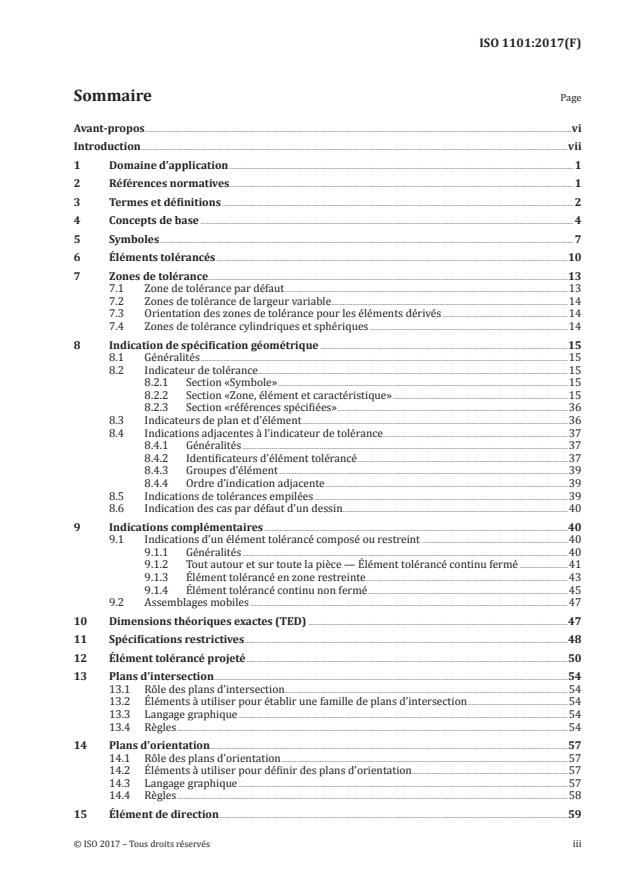
Sommaire Page
Avant-propos .vi
Introduction .vii
1 Domaine d’application .1
2 Références normatives .1
3 Termes et définitions . 2
4 Concepts de base .4
5 Symboles . 7
6 Éléments tolérancés .10
7 Zones de tolérance .13
7.1 Zone de tolérance par défaut .13
7.2 Zones de tolérance de largeur variable .14
7.3 Orientation des zones de tolérance pour les éléments dérivés .14
7.4 Zones de tolérance cylindriques et sphériques .14
8 Indication de spécification géométrique .15
8.1 Généralités .15
8.2 Indicateur de tolérance .15
8.2.1 Section «Symbole» .15
8.2.2 Section «Zone, élément et caractéristique» .15
8.2.3 Section «références spécifiées» .36
8.3 Indicateurs de plan et d’élément .36
8.4 Indications adjacentes à l’indicateur de tolérance .37
8.4.1 Généralités .37
8.4.2 Identificateurs d’élément tolérancé .37
8.4.3 Groupes d’élément .39
8.4.4 Ordre d’indication adjacente .39
8.5 Indications de tolérances empilées .39
8.6 Indication des cas par défaut d’un dessin .40
9 Indications complémentaires .40
9.1 Indications d’un élément tolérancé composé ou restreint .40
9.1.1 Généralités .40
9.1.2 Tout autour et sur toute la pièce — Élément tolérancé continu fermé .41
9.1.3 Élément tolérancé en zone restreinte .43
9.1.4 Élément tolérancé continu non fermé .45
9.2 Assemblages mobiles .47
10 Dimensions théoriques exactes (TED) .47
11 Spécifications restrictives .48
12 Élément tolérancé projeté .50
13 Plans d’intersection .54
13.1 Rôle des plans d’intersection .54
13.2 Éléments à utiliser pour établir une famille de plans d’intersection .54
13.3 Langage graphique .54
13.4 Règles .54
14 Plans d’orientation .57
14.1 Rôle des plans d’orientation .57
14.2 Éléments à utiliser pour définir des plans d’orientation .57
14.3 Langage graphique .57
14.4 Règles .58
15 Élément de direction .59
15.1 Rôle des éléments de direction .59
15.2 Éléments à utiliser pour établir des éléments de direction .61
15.3 Langage graphique .61
15.4 Règles .62
16 Plan de collection .63
16.1 Rôle des plans de collection .63
16.2 Éléments à utiliser pour définir des plans de collection .63
16.3 Langage graphique .63
16.4 Règles .63
17 Définitions des spécifications géométriques .63
17.1 Généralités .63
17.2 Spécification de rectitude .63
17.3 Spécification de planéité .66
17.4 Spécification de circularité .66
17.5 Spécification de cylindricité .68
17.6 Spécification de profil de ligne ne se rapportant pas à une référence spécifiée .69
17.7 Spécification de profil de ligne se rapportant à un système de références spécifiées .71
17.8 Spécification de profil de surface ne se rapportant pas à une référence spécifiée .72
17.9 Spécification de profil de surface se rapportant à une référence spécifiée .73
17.10 Spécification de parallélisme .74
17.10.1 Généralités .74
17.10.2 Spécification de parallélisme d’une ligne médiane par rapport à un
système de références spécifiées .74
17.10.3 Spécification de parallélisme d’une ligne médiane par rapport à une
droite de référence spécifiée .77
17.10.4 Spécification de parallélisme d’une ligne médiane par rapport à un plan
de référence spécifiée .78
17.10.5 Spécification de parallélisme d’un ensemble de lignes d’une surface par
rapport à un plan de référence spécifiée .79
17.10.6 Spécification de parallélisme d’une surface plane par rapport à une droite
de référence spécifiée .79
17.10.7 Spécification de parallélisme d’une surface plane par rapport à un plan de
référence spécifiée .80
17.11 Spécification de perpendicularité .81
17.11.1 Généralités .81
17.11.2 Spécification de perpendicularité d’une ligne médiane par rapport à une
droite de référence spécifiée .81
17.11.3 Spécification de perpendicularité d’une ligne médiane par rapport à un
système de références spécifiées .82
17.11.4 Spécification de perpendicularité d’une ligne médiane par rapport à un
plan de référence spécifiée .84
17.11.5 Spécification de perpendicularité d’une surface plane par rapport à une
droite de référence spécifiée .85
17.11.6 Spécification de perpendicularité d’une surface plane par rapport à un
plan de référence spécifiée .86
17.12 Spécification d’inclinaison .87
17.12.1 Généralités .87
17.12.2 Spécification d’inclinaison d’une ligne médiane par rapport à une droite
de référence spécifiée .87
17.12.3 Spécification d’inclinaison d’une ligne médiane par rapport à un système
de références spécifiées .89
17.12.4 Spécification d’inclinaison d’une surface plane par rapport à une droite de
référence spécifiée .90
17.12.5 Spécification d’inclinaison d’une surface plane par rapport à un plan de
référence spécifiée .91
17.13 Spécification de localisation .92
17.13.1 Généralités .92
iv © ISO 2017 – Tous droits réservés
17.13.2 Spécification de localisation d’un point dérivé .92
17.13.3 Spécification de localisation d’une ligne médiane .93
17.13.4 Spécification de localisation d’un plan médian .97
17.13.5 Spécification de localisation d’une surface plane .99
17.14 Spécification de concentricité et de coaxialité .100
17.14.1 Généralités .100
17.14.2 Spécification de concentricité d’un point .100
17.14.3 Spécification de coaxialité d’un axe .101
17.15 Spécification de symétrie .103
17.15.1 Généralités .103
17.15.2 Spécification de symétrie d’un plan médian .103
17.16 Spécification de battement circulaire .104
17.16.1 Généralités .104
17.16.2 Spécification de battement circulaire radial .104
17.16.3 Spécification de battement circulaire axial .106
17.16.4 Battement circulaire dans une direction quelconque .107
17.16.5 Spécification de battement circulaire dans une direction spécifiée .109
17.17 Spécification de battement total .110
17.17.1 Généralités .110
17.17.2 Spécification de battement total radial .110
17.17.3 Spécification de battement total — Axial .111
Annexe A (informative) Anciennes pratiques et pratiques déconseillées.113
Annexe B (informative) Règles explicites et implicites pour les zones de
tolérance géométrique .122
Annexe C (informative) Filtres .128
Annexe D (normative) Composants de spécification particulière ISO de forme .131
Annexe E (informative) Détails concernant les filtres .132
Annexe F (normative) Relations et dimensions des symboles graphiques .146
Annexe G (informative) Relation avec le modèle de matrice GPS .148
Bibliographie .149
Avant-propos
L’ISO (Organisation internationale de normalisation) est une fédération mondiale d’organismes
nationaux de normalisation (comités membres de l’ISO). L’élaboration des Normes internationales est
en général confiée aux comités techniques de l’ISO. Chaque comité membre intéressé par une étude
a le droit de faire partie du comité technique créé à cet effet. Les organisations internationales,
gouvernementales et non gouvernementales, en liaison avec l’ISO participent également aux travaux.
L’ISO collabore étroitement avec la Commission électrotechnique internationale (IEC) en ce qui
concerne la normalisation électrotechnique.
Les procédures utilisées pour élaborer le présent document et celles destinées à sa mise à jour sont
décrites dans les Directives ISO/IEC, Partie 1. Il convient, en particulier de prendre note des différents
critères d’approbation requis pour les différents types de documents ISO. Le présent document a été
rédigé conformément aux règles de rédaction données dans les Directives ISO/IEC, Partie 2 (voir www
.iso .org/ directives).
L’attention est appelée sur le fait que certains des éléments du présent document peuvent faire l’objet de
droits de propriété intellectuelle ou de droits analogues. L’ISO ne saurait être tenue pour responsable
de ne pas avoir identifié de tels droits de propriété et averti de leur existence. Les détails concernant
les références aux droits de propriété intellectuelle ou autres droits analogues identifiés lors de
l’élaboration du document sont indiqués dans l’Introduction et/ou dans la liste des déclarations de
brevets reçues par l’ISO (voir www .iso .org/ brevets).
Les appellations commerciales éventuellement mentionnées dans le présent document sont données
pour information, par souci de commodité, à l’intention des utilisateurs et ne sauraient constituer un
engagement.
Pour une explication de la signification des termes et expressions spécifiques de l’ISO liés à l’évaluation
de la conformité, ou pour toute information au sujet de l’adhésion de l’ISO aux principes de l’Organisation
mondiale du commerce (OMC) concernant les obstacles techniques au commerce (OTC), voir le lien
suivant: w w w . i s o .org/ iso/ fr/ avant -propos .html
Le présent document a été préparé par le comité technique ISO/TC 213, Spécifications et vérification
dimensionnelles et géométriques des produits.
Cette quatrième édition annule et remplace la troisième édition (ISO 1101:2012), qui a fait l’objet d’une
révision technique.
Elle incorpore également le Rectificatif technique ISO 1101:2012/Cor.1:2013.
Les principaux changements sont les suivants.
— Ajout d’outils permettant de spécifier le filtrage de l’élément tolérancé et désignation d’un type de
ligne à des fins d’illustration.
— Ajout d’outils permettant de tolérancer les éléments associés.
— Ajout d’outils permettant de spécifier les caractéristiques de forme en spécifiant l’association
d’élément d’évaluation et le paramètre tolérancé.
— Ajout d’outils permettant de spécifier les contraintes relatives à la zone de tolérance.
— Clarification des règles applicables aux spécifications utilisant les modificateurs «tout autour» ou
«sur toute la pièce».
— Obligation maintenant de toujours indiquer la direction de la zone de tolérance dans le cas des
tolérances de circularité des surfaces de révolution qui ne sont ni cylindriques ni sphériques, par
exemple des cônes, pour éviter une exception à la règle générale selon laquelle les spécifications
applicables aux éléments intégraux s’appliquent perpendiculairement à la surface.
— Retrait du symbole «de-à» remplacé par le symbole «entre».
vi © ISO 2017 – Tous droits réservés
Introduction
Le présent document est une norme de spécification géométrique des produits (GPS) et doit être
considérée comme une norme GPS générale (voir l’ISO 14638). Elle influence les maillons A, B et C de la
chaîne de normes sur la forme, l’orientation, la position et le battement.
Le schéma directeur ISO GPS donné dans l’ISO 14638 donne une vue d’ensemble du système ISO GPS,
dont le présent document fait partie. Les principes fondamentaux de l’ISO GPS donnés dans l’ISO 8015
s’appliquent au présent document. Les règles de décision par défaut données dans l’ISO 14253-1
s’appliquent aux spécifications faites conformément au présent document, sauf indication contraire.
Pour de plus amples informations sur la relation du présent document avec le modèle de matrice GPS,
voir l’Annexe G.
Le présent document donne les premières bases et décrit les notions fondamentales requises du
tolérancement géométrique. Il est cependant conseillé de consulter les autres normes référencées à
l’Article 2 et dans les Tableaux 3 et 4 pour de plus amples informations.
La présentation de l’écriture (proportions et dimensions) est décrite dans l’ISO 3098-2.
Toutes les figures du présent document pour les indications des dessins en 2D ont été tracées par
projection du premier dièdre avec des dimensions et des tolérances en millimètres. Il est entendu que
la projection du troisième dièdre et d’autres unités de mesurage pourraient être utilisées de la même
façon sans nuire aux principes établis. Pour toutes les figures donnant des exemples de spécification en
3D, les dimensions et les tolérances sont les mêmes que pour les figures similaires données en 2D.
Les figures du présent document sont soit des vues de dessins en 2D, soit des vues axonométriques en
3D de dessins en 2D, et elles visent à illustrer la façon dont une spécification peut être indiquée dans
son intégralité avec une annotation visible. Pour connaître les possibilités en matière de représentation
d’une spécification dont les éléments de spécification peuvent être disponibles via une fonction de
recherche ou toute autre interrogation des données sur le modèle CAO en 3D, ainsi que les règles
applicables au rattachement des spécifications aux modèles CAO en 3D, voir ISO 16792.
Les figures du présent document illustrent le texte et ne prétendent pas refléter des applications réelles.
En conséquence, les figures ne sont pas complètement cotées et spécifiées; elles illustrent seulement
les principes généraux concernés. Les figures ne sont pas non plus destinées à impliquer une exigence
particulière de présentation, à savoir si un détail caché, des lignes tangentes ou d’autres annotations
sont indiqués ou non. Plusieurs figures ont des lignes ou des détails qui ont été supprimés pour des
besoins de clarté, ou ajoutés ou étendus pour les besoins d’illustration du texte. Voir Tableau 1 pour les
types de trait utilisés dans les figures donnant les définitions.
Afin d’éliminer toute ambiguïté d’une spécification GPS, la partition définissant la limite de l’élément
tolérancé, ainsi que le filtrage, doivent être clairement définies. Les règles détaillées de partitionnement
et le filtrage par défaut ne sont pas actuellement définis dans les normes GPS.
La présentation complète (proportions et dimensions) des symboles de tolérancement géométrique est
décrite dans l’ISO 7083 et à l’Annexe F.
L’Annexe A a été donnée uniquement pour information. Elle présente des indications de dessin
antérieures, qui ont été retirées de la norme et ne sont plus utilisées.
Pour les besoins du présent document, les termes «axe» et «plan médian» sont utilisés pour des
éléments dérivés de forme parfaite, et les termes «ligne médiane» et «surface médiane» pour des
éléments dérivés de forme imparfaite. De plus, les types de traits suivants ont été utilisés dans les
illustrations explicatives, c’est-à-dire celles représentant des dessins non techniques pour lesquels les
règles de l’ISO 128 (toutes les parties) s’appliquent.
Tableau 1
Type de trait
Niveau d’élément Type d’élément Détails
Plan/surface
Visible
caché(e)
point
élément intégral ligne/axe continu fort interrompu fin
surface/plan
Élément nominal
point
mixte fin à un point mixte fin à un point
élément dérivé ligne/axe
et un tiret long et un tiret
surface /plan
continu fort interrompu fin
Élément réel élément intégral surface
ondulé ondulé
point
élément intégral ligne interrompu court fort interrompu court fin
surface
Élément extrait
point
élément dérivé ligne pointillé fort pointillé fin
surface
ligne
Élément filtré élément intégral continu fin continu fin
surface
point mixte fin
mixte fort à deux
élément intégral ligne droite à deux points
points et deux tirets
plan et deux tirets
point
mixte fin à deux mixte fort à deux
Élément associé élément dérivé ligne droite (axe)
points et un tiret long points et un tiret long
plan
point mixte fort à un tiret mixte fin à un tiret
référence spécifiée ligne/axe long et deux tirets long et deux tirets
surface/plan courts courts
Limites de zone de
ligne
tolérance, plans de continu fin interrompu fin
surface
tolérance
Section, plan d’illus-
ligne mixte fin à un tiret mixte fin à un tiret
tration, plan de
surface long et un tiret court et un tiret court
dessin, plan d’aide
Ligne d’attache, ligne
de dimension, ligne
ligne continu fin interrompu fin
repère et ligne de
référence
viii © ISO 2017 – Tous droits réservés
NORME INTERNATIONALE ISO 1101:2017(F)
Spécification géométrique des produits (GPS) —
Tolérancement géométrique — Tolérancement de forme,
orientation, position et battement
IMPORTANT — Les illustrations incluses dans le présent document ont pour objectif d’illustrer
le texte et/ou de fournir des exemples pour les spécifications de dessin technique s’y rapportant;
ces illustrations ne sont pas complètement cotées ni tolérancées, et ne montrent que l’aspect
général des principes correspondants. En particulier plusieurs illustrations ne présentent pas
de spécifications de filtre. En conséquence, ces illustrations ne sont pas une représentation
complète d’une pièce, et ne sont pas du niveau de qualité requis pour un usage industriel (en
termes de parfaite conformité avec les normes préparées par l’ISO/TC 10 et l’ISO/TC 213), et
elles ne sont donc pas, en tant que telles, appropriées pour une projection à usage éducatif.
1 Domaine d’application
Le présent document définit le langage symbolique utilisé pour la spécification géométrique des pièces,
ainsi que ses règles d’interprétation.
Il établit la base de la spécification géométrique.
Les illustrations du présent document visent à illustrer la façon dont une spécification peut être
indiquée dans son intégralité avec annotation visible (y compris par exemple les TEDs).
NOTE 1 D’autres Normes internationales, citées à l’Article 2 et dans les Tableaux 3 et 4, fournissent des
informations plus détaillées sur le tolérancement géométrique.
NOTE 2 Le présent document spécifie les règles pour des indications explicites et directes des spécifications
géométriques. Les mêmes spécifications peuvent également être indiquées de façon indirecte, conformément
à l’ISO 16792, en les rattachant à un modèle CAO en 3D. Dans ce cas, il est possible que certains éléments de
la spécification soient disponibles par une fonction de requête ou d’une autre méthode d’interrogation des
informations sur le modèle, plutôt que d’être indiqués au moyen d’une annotation visible.
2 Références normatives
Les documents suivants sont référencés dans le texte de telle manière que tout ou partie de leur contenu
soit considéré comme une exigence du présent document. Pour les références datées, seule l’édition
citée s’applique. Pour les références non datées, la dernière édition du document de référence s’applique
(y compris les éventuels amendements).
ISO 128-24:1999, Dessins techniques — Principes généraux de représentation — Partie 24: Traits utilisés
pour les dessins industriels
ISO 1660, Dessins techniques — Cotation et tolérancement des profils
ISO 2692:2014, Spécification géométrique des produits (GPS) — Tolérancement géométrique — Exigence
du maximum de matière (MMR), exigence du minimum de matière (LMR) et exigence de réciprocité (RPR)
ISO 5458, Spécification géométrique des produits (GPS) — Tolérancement géométrique — Tolérancement
de localisation
ISO 5459, Spécification géométrique des produits (GPS) — Tolérancement géométrique — Références
spécifiées et systèmes de références spécifiées
ISO 8015:2011, Spécification géométrique des produits (GPS) — Principes fondamentaux — Concepts,
principes et règles
ISO 10579:2010, Spécification géométrique des produits (GPS) — Cotation et tolérancement — Pièces
non rigides
ISO 13715, Dessins techniques — Arêtes de forme non définie — Vocabulaire et indications sur les dessins
ISO 16610 (toutes les parties), Spécification géométrique des produits (GPS) — Filtrage
ISO 17450-1:2011, Spécification géométrique des produits (GPS) — Concepts généraux — Partie 1: Modèle
pour la spécification et la vérification géométriques
ISO 17450-2, Spécification géométrique des produits (GPS) — Concepts généraux — Partie 2: Principes de
base, spécifications, opérateurs, incertitudes et ambiguïtés
ISO 17450-3, Spécification géométrique des produits (GPS) — Concepts généraux — Partie 3: Éléments
tolérancés
ISO 22432, Spécification géométrique des produits (GPS) — Éléments utilisés en spécification et vérification
ISO 25378:2011, Spécification géométrique des produits — Caractéristiques et conditions — Définitions
3 Termes et définitions
Pour les besoins du présent document, les termes et définitions donnés dans l’ISO 8015, la
série ISO 16610, l’ISO 17450-1, l’ISO 17450-2, l’ISO 17450-3, l’ISO 22432, l’ISO 25378, ainsi que les
suivants s’appliquent.
L’ISO et l’IEC tiennent à jour des bases de données terminologiques destinées à être utilisées en
normalisation, consultables aux adresses suivantes:
— IEC Electropedia: disponible à l’adresse http:// www .electropedia .org/
— ISO Online Browsing Platform: disponible à l’adresse https:// www .iso .org/ obp/
3.1
zone de tolérance
espace limité par et incluant une ou deux lignes ou surfaces parfaites, et caractérisé par une ou plusieurs
dimensions linéaires, appelées tolérance
Note 1 à l’article: Voir également 4.4.
3.2
plan d’intersection
plan, établi à partir d’un élément extrait de la pièce, identifiant une ligne sur une surface extraite
(intégrale ou médiane) ou un point sur une ligne extraite
Note 1 à l’article: L’utilisation du plan d’intersection permet de définir des éléments tolérancés indépendamment
de la vue.
Note 2 à l’article: Pour l’état de surface surfacique, le plan d’intersection peut être utilisé pour définir l’orientation
de la zone d’évaluation; voir l’ISO 25178-1.
3.3
plan d’orientation
plan, établi à partir d’un élément extrait de la pièce, identifiant l’orientation de la zone de tolérance
Note 1 à l’article: L’utilisation d’un plan d’orientation permet de définir la direction des plans ou du cylindre qui
limitent la zone de tolérance indépendamment du modèle des TEDs (pour la position) ou de la référence spécifiée
(pour l’orientation). Le plan d’orientation n’est utilisé à cette fin que lorsque l’élément tolérancé est un élément
médian (point central, droite médiane) et que la zone de tolérance est définie par deux droites parallèles, par
deux plans parallèles ou, dans le cas d’un point médian, par un cylindre.
2 © ISO 2017 – Tous droits réservés
Note 2 à l’article: L’utilisation d’un plan d’orientation permet de définir l’orientation d’une zone restreinte
rectangulaire.
3.4
élément de direction
élément idéal, établi à partir d’un élément extrait de la pièce, identifiant l’orientation des écarts locaux
Note 1 à l’article: L’élément de direction peut être un plan, un cylindre ou un cône.
Note 2 à l’article: Pour une ligne d’une surface, l’utilisation d’un élément de direction permet de changer la
direction de la largeur de la zone de tolérance.
Note 3 à l’article: L’élément de direction est utilisé lorsque la valeur de la tolérance s’applique dans une direction
spécifiée et non selon la normale à la géométrie spécifiée.
Note 4 à l’article: L’élément de direction est construit à partir de la référence spécifiée indiquée dans la deuxième
case de l’indicateur de l’élément de direction. La géométrie de l’élément de direction dépend de la géométrie de
l’élément tolérancé.
3.5
élément composé continu
élément simple composé de plusieurs éléments simples réunis sans espace entre eux
Note 1 à l’article: Un élément composé continu peut être fermé ou non.
Note 2 à l’article: Un élément composé continu non fermé peut être défini en utilisant le symbole «entre»
(voir 9.1.4) et, le cas échéant, le modificateur UF.
Note 3 à l’article: Un élément composé continu fermé peut être défini en utilisant le symbole «tout autour»
(voir 9.1.2) et le modificateur UF. Dans ce cas, c’est un ensemble d’éléments simples, dont l’intersection avec les
plans parallèles au plan de collection est une ligne ou un point.
Note 4 à l’article: Un élément composé continu fermé peut être défini en utilisant le symbole «sur toute la pièce»
(voir 9.1.2) et le modificateur UF.
3.6
plan de collection
plan, établi à partir d’un élément sur une pièce, définissant un élément composé continu fermé
Note 1 à l’article: Le plan de collection est toujours utilisé lorsque le symbole «tout autour» s’applique.
3.7
dimension théorique exacte
TED
dimension linéaire ou angulaire utilisée dans les opérations GPS afin de définir la géométrie, les
étendues, les positions et les orientations théoriquement exactes des éléments
Note 1 à l’article: Pour les besoins du présent document, le terme «dimension théorique exacte» a été abrégé
par TED.
Note 2 à l’article: Une TED peut être utilisée pour définir:
— la forme et les dimensions nominales des éléments;
— la définition des éléments théoriques exacts (TEF);
— la position et les dimensions de portions d’éléments, y compris des éléments tolérancés restreints;
— la longueur des éléments tolérancés projetés;
— la position et l’orientation relatives d’au moins deux zones de tolérance;
— la position et l’orientation relatives de références partielles, y compris de références partielles mobiles;
— la position et l’orientation des zones de tolérance par rapport aux références spécifiées et aux systèmes de
références spécifiées;
— la direction de la largeur des zones de tolérance.
Note 3 à l’article: Une TED peut être explicite ou implicite. Une TED explicite, lorsqu’elle est indiquée, est repérée
par un cadre rectangulaire comprenant une valeur, parfois associé à un symbole, par exemple ø ou R. Sur les
modèles 3D, les TED explicites peuvent être disponibles sur demande.
Note 4 à l’article: Une TED implicite n’est pas indiquée. Une TED implicite correspond à: 0 mm, 0°, 90°, 180°, 270°
et à la distance angulaire entre des éléments équidistants sur un cercle complet.
Note 5 à l’article: Les TED ne sont pas affectées par les spécifications individuelles ou générales.
3.8
élément théorique exact
TEF
élément nominal présentant une forme, une taille, une orientation et une position parfaites, si
applicables
Note 1 à l’article: Un élément théorique exact (TEF) peut se présenter sous n’importe quelle forme et peut être
défini par des dimensions théoriques exactes (TED) explicitement indiquées, ou être implicitement défini dans
des données CAO.
Note 2 à l’article: La position et l’orientation théoriques exactes, si applicables, se rapportent au système de
références spécifiées indiqué pour la spécification de l’élément réel correspondant.
Note 3 à l’article: Voir aussi l’ISO 25378.
EXEMPLE 1 La surface sphérique présentée sur la Figure 110 est un élément théorique exact, ayant un rayon
sphérique défini ainsi qu’une position et une orientation définies par rapport à la référence spécifiée A.
EXEMPLE 2 Un état virtuel, par exemple un état virtuel au maximum de matière (MMVC) conformément à
l’ISO 2692, est un élément théorique exact.
3.9
élément unifié
élément intégral composé qui peut être continu ou non, considéré comme un élément simple
Note 1 à l’article: Un élément unifié peut avoir un élément dérivé.
Note 2 à l’article: La définition d’un élément unifié est volontairement très large pour n’exclure aucune application
utile. Cependant, cette définition n’est pas destinée à permettre d’utiliser un élément unifié pour définir quelque
chose qui, de par sa nature même, se compose de plusieurs éléments distincts. Par exemple, construire un élément
unifié à partir de deux éléments cylindriques parallèles non coaxiaux, ou de deux tubes rectangulaires parallèles
non coaxiaux (chacun construit à partir de deux couples de plans parallèles, perpendiculaires entre eux), ne fait
pas partie de l’usage prévu.
EXEMPLE 1 Un élément cylindrique défini à partir d’un ensemble d’éléments arcs, tel que le diamètre externe
d’une cannelure, répond à l’usage prévu d’un élément unifié, voir Figure 48.
EXEMPLE 2 Deux cylindres coaxiaux complets de diamètre nominal différent ne
...
Frequently Asked Questions
ISO 1101:2017 is a standard published by the International Organization for Standardization (ISO). Its full title is "Geometrical product specifications (GPS) - Geometrical tolerancing - Tolerances of form, orientation, location and run-out". This standard covers: ISO 1101:2017 defines the symbol language for geometrical specification of workpieces and the rules for its interpretation. It provides the foundation for geometrical specification. The illustrations in this document are intended to illustrate how a specification can be fully indicated with visible annotation (including e.g. TEDs). NOTE 1 Other International Standards referenced in Clause 2 and in Tables 3 and 4 provide more detailed information on geometrical tolerancing. NOTE 2 This document gives rules for explicit and direct indications of geometrical specifications. Alternatively, the same specifications can be indicated indirectly in accordance with ISO 16792 by attaching them to a 3D CAD model. In this case, it is possible that some elements of the specification are available through a query function or other interrogation of information on the model instead of being indicated using visible annotation
ISO 1101:2017 defines the symbol language for geometrical specification of workpieces and the rules for its interpretation. It provides the foundation for geometrical specification. The illustrations in this document are intended to illustrate how a specification can be fully indicated with visible annotation (including e.g. TEDs). NOTE 1 Other International Standards referenced in Clause 2 and in Tables 3 and 4 provide more detailed information on geometrical tolerancing. NOTE 2 This document gives rules for explicit and direct indications of geometrical specifications. Alternatively, the same specifications can be indicated indirectly in accordance with ISO 16792 by attaching them to a 3D CAD model. In this case, it is possible that some elements of the specification are available through a query function or other interrogation of information on the model instead of being indicated using visible annotation
ISO 1101:2017 is classified under the following ICS (International Classification for Standards) categories: 01.100.20 - Mechanical engineering drawings; 17.040.10 - Limits and fits. The ICS classification helps identify the subject area and facilitates finding related standards.
ISO 1101:2017 has the following relationships with other standards: It is inter standard links to ISO/IEC 40500:2012, ISO 1101:2012. Understanding these relationships helps ensure you are using the most current and applicable version of the standard.
You can purchase ISO 1101:2017 directly from iTeh Standards. The document is available in PDF format and is delivered instantly after payment. Add the standard to your cart and complete the secure checkout process. iTeh Standards is an authorized distributor of ISO standards.
Questions, Comments and Discussion
Ask us and Technical Secretary will try to provide an answer. You can facilitate discussion about the standard in here.
Loading comments...