

ISO/FDIS 18436-8
(Main)Condition monitoring and diagnostics of machines — Requirements for training and certification of personnel — Part 8: Ultrasound
- Abstract
ISO 18436-8:2013 specifies the requirements for qualification and assessment of personnel who perform machinery condition monitoring and diagnostics using ultrasound. A certificate or declaration of conformity to ISO 18436-8:2013 provides recognition of the qualifications and competence of individuals to perform ultrasound measurements and analysis for machinery condition monitoring using ultrasound equipment. It is possible that this procedure is not applicable to specialized equipment or other specific situations. ISO 18436-8:2013 specifies a three-category classification programme that is based on the technical areas delineated herein, consistent with ISO 18436-1 and ISO 18436-3.
- Status
- Not Published
- Technical Committee
- ISO/TC 108/SC 5 - Condition monitoring and diagnostics of machine systems
- Drafting Committee
- ISO/TC 108/SC 5/WG 15 - Ultrasonics
- Current Stage
- 5000 - Final text received or FDIS registered for formal approval - 50 Approval
- Start Date
- 23-Oct-2026
- Due Date
- 01-Nov-2026
- Completion Date
- 01-Nov-2026

ISO/FDIS 18436-8 is an ISO draft standard for training and certification of personnel who perform machinery condition monitoring and diagnostics using ultrasound. It specifies a three-category certification scheme for people who take ultrasound measurements, analyse results, and report on machine condition. The document also links certification to training, experience, and examination requirements so that employers and certification bodies can judge competence in a consistent way.
What does ISO/FDIS 18436-8 specify?
ISO/FDIS 18436-8 specifies the general requirements for qualifying and assessing personnel who use ultrasound equipment for machinery condition monitoring. The scope says a certificate or declaration of conformity recognizes an individual’s qualifications, experience, and competence for ultrasound measurements and analysis.
The document is organized into scope, normative references, terms and definitions, classification of personnel, eligibility, examination, and a normative Annex A on training course requirements. The scope also notes that the procedure may not apply to specialized equipment or other specific situations.
What are the key requirements of ISO/FDIS 18436-8?
ISO/FDIS 18436-8 sets out how ultrasound personnel are classified, what they must learn, how they qualify, and how they are examined. In practice, it is the document a certification body or employer uses to decide whether a person is ready to work independently, to direct others, or to set up a programme.
Personnel categories
Clause 4 uses three categories. Category I covers people who perform ultrasound measurements using established procedures and handle routine data collection and basic fault detection. Category II adds the ability to choose techniques, set up equipment, analyse signals, and guide Category I personnel. Category III covers the full level: programme development, troubleshooting, diagnosis, prognosis, acceptance criteria, and instruction of lower categories.
This matters because the standard ties authority to task complexity. A higher category is not just more experience - it adds the right to select methods, interpret results more broadly, and define programme rules.
Eligibility and prior learning
Clause 5 says candidates need a suitable combination of education, training, and experience. It also recommends hearing checks for candidates who use headphones, because good hearing affects the quality of ultrasound interpretation.
Clause 5 also recognizes prior learning. Candidates already certified in vibration analysis or acoustic emission may have reduced experience requirements. For employers, that means some related diagnostic skills can count toward ultrasound certification when the assessment body accepts them.
Training content
Clause 5 requires training based on Annex A. Annex A provides the training syllabus for ultrasound condition monitoring and diagnostics of machines, including principles of ultrasound, instrumentation and sensors, data acquisition, data storage and management, condition monitoring principles, applications to machine systems, severity determination, and programme implementation and reporting.
The practical point is that training is not just theory. The syllabus includes application areas such as leak detection, valve inspection, steam trap inspection, electrical inspection, hydraulic systems, bearing lubrication, bearing inspection, gearbox inspection, pump inspection, and electric motor inspection.
Examination
Clause 6 requires an examination for each category, with practical questions linked to the job tasks in Clause 4 and the syllabus in Annex A. Category I examination papers are split into a general ultrasound part and a practical application part. Category III may also include diagnosis, prognosis, and solution recommendation content.
This matters because certification is based on both knowledge and job-relevant application, not on training attendance alone.
What terms does ISO/FDIS 18436-8 define?
ISO/FDIS 18436-8 relies on terms from ISO 13372, ISO/IEC 17000, and ISO 18436-1, and it uses several recurring abbreviations in the syllabus.
- Condition monitoring (CM) - monitoring machine condition by measurement so that changes, faults, or degradation can be detected early.
- Vibration analysis (VA) - a related condition monitoring technology used as a comparison or supplementary method.
- Infrared thermography (IRT) - a thermal condition monitoring method listed alongside ultrasound as a supplementary technology.
- Acoustic emission (AE) - another diagnostic technology and a prior-learning route referenced by the standard.
- Motor current analysis (MCA) - a supplementary monitoring method listed in the training syllabus.
- Assessment body - the body that evaluates evidence of training, experience, and competence for certification.
- Certification body - the body that runs the certification process and conducts examinations.
Who uses ISO/FDIS 18436-8?
ISO/FDIS 18436-8 is used by certification bodies, assessment bodies, training bodies, employers, and personnel working in condition monitoring. It is relevant to maintenance, reliability, and diagnostics work in industries that use ultrasound for machinery and plant condition assessment.
The introduction points to use in manufacturing and in applications such as compressed air leaks, vacuum leaks, steam leaks, steam traps, valves, low-, medium-, and high-voltage electrical systems, tightness testing, and bearing lubrication programmes.
What changed in ISO/FDIS 18436-8 from the previous edition?
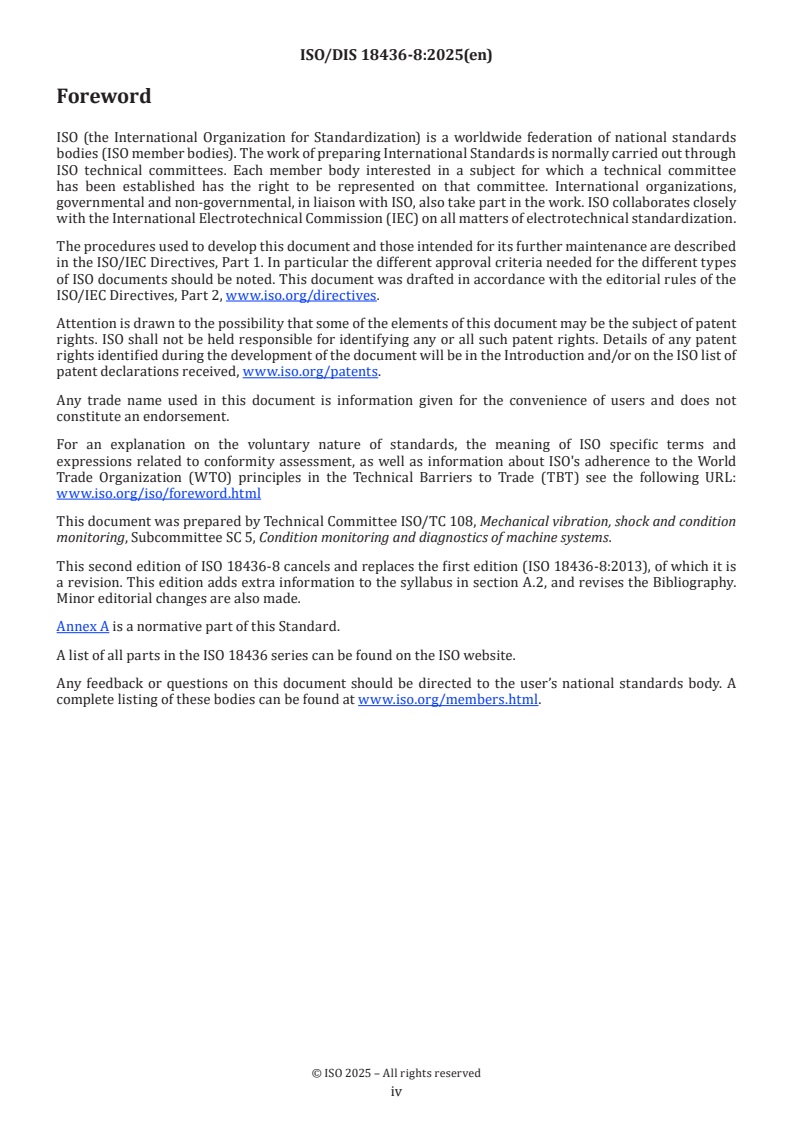
ISO/FDIS 18436-8 is the second edition and it cancels and replaces ISO 18436-8:2013. The foreword says this edition adds extra information to the syllabus in Annex A, revises the bibliography, and makes minor editorial changes.
Which standards are used with ISO/FDIS 18436-8?
| Standard | What it contributes |
|---|---|
| ISO 13372 | Vocabulary for condition monitoring and diagnostics of machines |
| ISO/IEC 17000 | Vocabulary and general principles for conformity assessment |
| ISO 18436-1 | Certification-body requirements and the certification process |
| ISO 18436-2 | Prior-learning reference for vibration analyst certification |
| ISO 18436-3 | Training-body and training-process requirements |
| ISO 18436-6 | Prior-learning reference for acoustic emission certification |
What does the ISO/FDIS 18436-8 document contain?
ISO/FDIS 18436-8 contains the scope, the referenced standards it depends on, and the classification structure for ultrasound certification personnel. Clause 4 describes the tasks and responsibilities for Categories I, II, and III.
Clause 5 covers eligibility through education, training, experience, and recognition of prior learning. Clause 6 sets the examination structure and conduct. Annex A provides the normative training syllabus, with both an overview and a detailed topic list that training and assessment bodies can use to design courses, verify coverage, and align certification decisions with job tasks.
Relations
- Effective Date
- 04-Nov-2023
Get Certified
Connect with accredited certification bodies for this standard

BSI Group
BSI (British Standards Institution) is the business standards company that helps organizations make excellence a habit.

Bureau Veritas
Bureau Veritas is a world leader in laboratory testing, inspection and certification services.

DNV
DNV is an independent assurance and risk management provider.
Sponsored listings
Frequently Asked Questions
ISO/FDIS 18436-8 is a draft published by the International Organization for Standardization (ISO). Its full title is "Condition monitoring and diagnostics of machines — Requirements for training and certification of personnel — Part 8: Ultrasound". This standard covers: ISO 18436-8:2013 specifies the requirements for qualification and assessment of personnel who perform machinery condition monitoring and diagnostics using ultrasound. A certificate or declaration of conformity to ISO 18436-8:2013 provides recognition of the qualifications and competence of individuals to perform ultrasound measurements and analysis for machinery condition monitoring using ultrasound equipment. It is possible that this procedure is not applicable to specialized equipment or other specific situations. ISO 18436-8:2013 specifies a three-category classification programme that is based on the technical areas delineated herein, consistent with ISO 18436-1 and ISO 18436-3.
ISO 18436-8:2013 specifies the requirements for qualification and assessment of personnel who perform machinery condition monitoring and diagnostics using ultrasound. A certificate or declaration of conformity to ISO 18436-8:2013 provides recognition of the qualifications and competence of individuals to perform ultrasound measurements and analysis for machinery condition monitoring using ultrasound equipment. It is possible that this procedure is not applicable to specialized equipment or other specific situations. ISO 18436-8:2013 specifies a three-category classification programme that is based on the technical areas delineated herein, consistent with ISO 18436-1 and ISO 18436-3.
ISO/FDIS 18436-8 is classified under the following ICS (International Classification for Standards) categories: 03.100.30 - Management of human resources; 17.160 - Vibrations, shock and vibration measurements. The ICS classification helps identify the subject area and facilitates finding related standards.
ISO/FDIS 18436-8 has the following relationships with other standards: It is inter standard links to ISO 18436-8:2013. Understanding these relationships helps ensure you are using the most current and applicable version of the standard.
ISO/FDIS 18436-8 is available in PDF format for immediate download after purchase. The document can be added to your cart and obtained through the secure checkout process. Digital delivery ensures instant access to the complete standard document.
Standards Content (Sample)
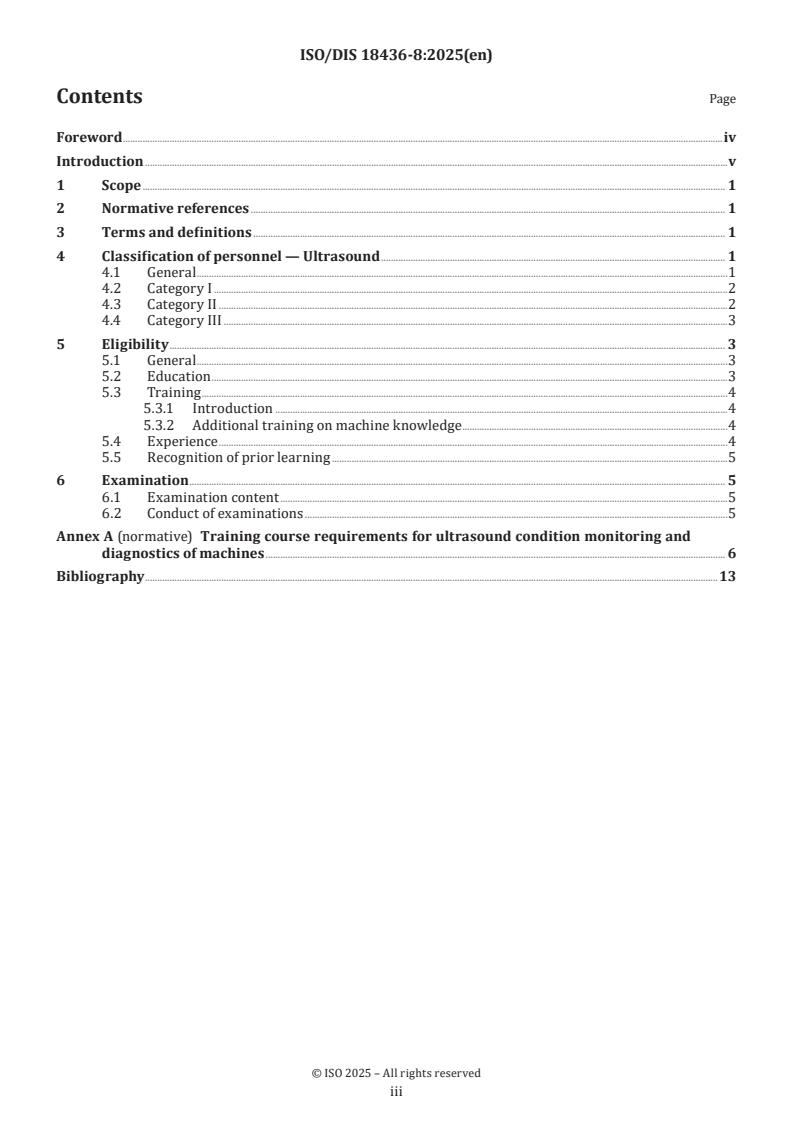
Contents
- Introduction
- 1 Scope
- 2 Normative references
- 3 Terms and definitions
- 4 Classification of personnel — Ultrasound
- 4.1 General
- 4.2 Category I
- 4.3 Category II
- 4.4 Category III
- 5 Eligibility
- 5.1 General
- 5.2 Education
- 5.3 Training
- 5.4 Experience
- 5.5 Recognition of prior learning
- 6 Examination
- 6.1 Examination content
- 6.2 Conduct of examinations
- Annex A
- 1.01 Basics of sound • — — Be aware of the basics of sound
- 1.02 Sound wave motion • — — Be aware of longitudinal versus
- 5.01 What is condition monitoring • — — Be aware of CM and why is it useful
- 5.03 CM using ultrasound • — — Be aware of why and when ultra-
- Bibliography
Introduction
The use of ultrasound technology in condition monitoring is one of the key activities in predictive or condition-based maintenance programmes for most industries. Other non-intrusive technologies including acoustic emission, infrared thermography, vibration analysis, lubricant analysis, wear debris analysis, and motor current analysis are also used as condition monitoring techniques. Those in the manufacturing industry who have diligently and consistently applied these technologies have experienced a return on investment far exceeding their expectations. However, the effectiveness of these programmes depends on the capabilities of individuals who perform the measurements and analyse the data. This part of ISO 18436 defines the requirements for personnel to become qualified to apply the non-intrusive condition monitoring and diagnostics technology of ultrasound.
Ultrasound expands the concepts of condition monitoring to non-rotating applications such as:
- Compressed air leaks
- Vacuum leaks
- Steam leaks
- Steam traps
- Valves
- Low-, Medium- and High-Voltage electrical systems
- Tightness testing of plant, shipping and structures Ultrasound also plays an important part in developing an on-condition lubrication programme for bearings. A programme, administered by assessment certification body, has been developed to train and assess the competence of personnel whose duties require the appropriate theoretical, practical and application knowledge of this condition monitoring technique.
This part of ISO 18436 defines the requirements for personnel to become certified to apply the non-intrusive condition monitoring and diagnostics technology of ultrasound.
DRAFT International Standard ISO/DIS 18436-8:2025(en) Condition monitoring and diagnostics of machines — Requirements for training and certification of personnel — Part 8:
Ultrasound
1 Scope
This part of ISO 18436 specifies the general requirements for training and certification of personnel who perform machinery condition monitoring and diagnostics using ultrasound. A certificate or declaration of conformity meeting the requirements of this part of ISO 18436 provides recognition of the qualifications, experience and competence of individuals to perform ultrasound measurements and analysis for machinery condition monitoring using ultrasound equipment. This part of ISO 18436 specifies a three-category certification programme that is based on the technical areas described in this document.
2 Normative references
The following documents, in whole or in part, are normatively referenced in this document and are indispensable for its application. For dated references, only the edition cited applies. For undated references, the latest edition of the referenced document (including any amendments) applies. ISO 13372, Condition monitoring and diagnostics of machines — Vocabulary ISO/IEC 17000, Conformity assessment — Vocabulary and general principles ISO 18436-1, Condition monitoring and diagnostics of machine systems — Requirements for certification of personnel — Part 1: Sector specific requirements for certification bodies and the certification process
3 Terms and definitions
For the purposes of this document, the terms and definitions given in ISO 13372, ISO/IEC 17000 and ISO 18436-1 apply.
ISO and IEC maintain terminological databases for use in standardization at the following addresses:
- ISO Online browsing platform: available at https:// www .iso .org/ obp/
- IEC Electropedia: available at https:// www .electropedia .org/
4 Classification of personnel — Ultrasound
4.1 General
Individuals certified as conforming to the requirements of this part of ISO 18436 shall be classified in one of three categories, depending upon their qualifications and experience. They shall have demonstrated the necessary knowledge and skills in ultrasound condition monitoring for their certification category as indicated in clauses 4.2 to 4.4.
ISO/DIS 18436-8:2025(en) Personnel certified to category II are required to have all the knowledge and skills expected of personnel certified to category I, while personnel certified as category III are required to have all the knowledge and skills expected of personnel certified to category II.
In clauses 4.2 to 4.4, an outline is given of the typical job tasks, competencies and skills required in each category. Detailed recommended topics and sub-topics are shown in Annex A, Tables A.1 and A.2
4.2 Category I
Individuals certified to category I are qualified to perform ultrasound measurements according to established and recognized procedures. Personnel certified to category I shall be able to:
a) apply a specified ultrasound measurement technique. However, persons classified to category I shall not be regarded as competent to choose the test method or technique used; b) set up and operate the ultrasound equipment for safe data collection; c) verify the integrity of collected data and prevent or control poor data and error sources; d) perform basic fault detection, severity assessment and diagnosis in accordance with established instructions; e) record and categorize the results in terms of written criteria; f) maintain a database of results and trends; g) verify the sensitivity of ultrasound instruments and systems; h) evaluate and report test results in accordance with instructions highlighting areas of concern and; i) recognize and prevent or control factors that result in the acquisition of poor quality data.
4.3 Category II
Individuals certified to category II are qualified to perform and/or direct ultrasound analysis according to established and recognized procedures, and are aware of the limitations of the ultrasound method. Personnel certified to category II shall be able to:
a) select the appropriate ultrasound measurement technique and understand its limitations; b) specify the appropriate hardware and software to be used; c) set up and verify equipment settings; d) apply ultrasound theory and techniques where no procedures exist; e) measure and perform diagnosis of ultrasound signals inclusive of amplitude, frequency and time domain analysis; f) classify and evaluate the test results (including acceptance tests) in accordance with applicable codes, standards, specifications and procedures; g) prepare reports on equipment condition fault diagnoses, recommend appropriate corrective actions, and comment on effectiveness of repairs; h) provide guidance and instruction to category I personnel and; i) be aware of the use of alternative or supplementary condition monitoring (CM) technologies.
ISO/DIS 18436-8:2025(en)
4.4 Category III
Personnel certified to category III are qualified to perform and/or direct all types of ultrasound measurements and analysis and shall be able to:
a) apply ultrasound theory and techniques, including measurement and interpretation of survey results such as amplitude, frequency and time domain processing; b) understand and perform data analysis, including being aware of its limitations; c) determine the ultrasound data acquisition systems and component assemblies required; d) use ultrasound for troubleshooting and fault diagnosis; e) interpret and evaluate standards, codes, specifications, and procedures; f) develop and establish ultrasound programmes, procedures and instructions including determining requirements for periodic or continuous monitoring, and frequency of testing; g) determine severity assessment acceptance criteria for new, in-service and faulty equipment; h) carry out diagnosis and prognosis of ultrasound signal analysis using amplitude, frequency and time domain; i) recommend the use of alternative or supplementary condition monitoring (CM) technologies and; j) provide guidance and instruction to category I and II personnel. NOTE It is the employer's responsibility to ensure that category III personnel have the necessary competency in the required management skills, for example creating budgets, preparing cost justifications, and managing personnel development.
5 Eligibility
5.1 General
Candidates shall have a combination of education, training and experience to ensure that they understand the principles and procedures applicable to ultrasound measurement and analysis. It is advised that all candidates using instrumentation with headphones should be given hearing examinations to ensure natural or corrected hearing acuity exists in at least one ear. A record of the results should be retained and presented to the assessment body upon request. The individual should be capable of hearing a standard pure tone audiometry with results of an average of 25 dB hearing level or lower. This examination should be administered upon initial certification and upon recertification. The examinations shall be administered by a licensed professional and a record of the test made available to the assessment body upon request.
5.2 Education
It is not necessary that candidates seeking certification provide evidence of formal education to establish eligibility. Candidates should be able to manipulate simple algebraic equations, use a basic scientific calculator (including trigonometric and logarithmic functions) and be familiar with the operation of personal computers. Successful completion of 2 or more years of an engineering skills or technology programme at an accredited college, university, or technical school is highly recommended for candidates seeking certification to category III.
ISO/DIS 18436-8:2025(en)
5.3 Training
5.3.1 Introduction
To be eligible to apply for certification based on this part of ISO 18436, the candidate shall provide evidence of successful completion of training based on the requirements of Table A.2. The training syllabus in Table A.2 includes the requirement for practical knowledge and practical skills training, within the relevant topics. The minimum duration of cumulative training is shown in Table 1. Training should be in the form of lectures, demonstrations, practical exercises, or formal training courses. Qualification requirements shall be in accordance with this part of ISO 18436. Training time devoted to each topic shall be in accordance with the requirements of Table 1 and Annex A Tables A.1 and A.2. Table 1 — Minimum duration of cumulative training Durations in hours Category I Category II Category III 32 64 96 Training may be modularized into two or more subject areas covering general scientific principles and application-specific knowledge in order to allow mutual recognition between non-destructive testing (NDT) and condition monitoring assessment bodies. It is recognized that subject contents may overlap, in which case the minimum training durations in Table 1 may be reduced by up to 10 %.
5.3.2 Additional training on machine knowledge
In addition to the training hours shown in Table 1 and detailed in Annex A, it is recommended that candidates attend machinery and component training, or equivalent on-the-job training of at least one half the duration of the "Applications to machine systems" subject area as specified in Table A.1. Such training may be inclusive of any college or university education, or provided as additional courses or on-the-job training by an employer to specific requirements. If undertaken, the additional training should cover the design, manufacturing, installation, operation, and maintenance principles of machines and components, the failure modes and mechanisms associated with each principle, and the typical vibratory behaviours associated with each mechanism. Such training may be validated by verifiable records.
5.4 Experience
To be eligible to apply for certification based on this part of ISO 18436, the candidate shall provide evidence to the assessment or certification body, of experience in the field of ultrasound condition monitoring in accordance with Table 2.
Experience in the method shall include time performing the CM method, report writing, test preparation and coordination. Category II and III candidates may claim hours spent in supervision and management of CM personnel, preparation of training material and training of personnel. Table 2 — Minimum cumulative experience requirements Durations in months Category I Category II Category III 6 12 36 Candidates shall keep verifiable documentary evidence of experience. Candidates for categories I and II shall have this evidence validated by a person certified at category II or higher, or in the absence of such persons, by the candidate's technical supervisor.
Candidates for category III shall have this evidence validated by a category III person, or in the absence of a category III person, by the candidate’s technical supervisor or by peer-review authorised by the assessment or certification body.
ISO/DIS 18436-8:2025(en) Designation of a person as category I is not a prerequisite for certification as category II. However, certification of a person as category III requires previous certification at the lower category. At each higher classification category, the breadth and depth of experience is expected to be greater than at the previous lower category
5.5 Recognition of prior learning
Prior learning in signal analysis and diagnostic methods on machines shall be taken into account by the assessment body.
For candidates certified to vibration analyst category II or higher in accordance with ISO 18436-2, or certified to acoustic emission category II or higher in accordance with ISO 18436-6, the required cumulative experience shall be 1/3 of that stated in Table 2.
For candidates certified to vibration analyst category I in accordance with ISO 18436-2, or certified to acoustic emission category I in accordance with ISO 18436-6, the required cumulative experience shall be 1/2 of that stated in Table 2.
...