

ISO 21300
(Main)Traditional Chinese medicine — Guidelines and specification for Chinese materia medica
- Abstract
This document specifies the general requirements for Chinese materia medica specification. This specification is relevant for dividing Chinese materia medica into categories. It provides guidelines for writing the specifications of individual Chinese materia medica.
- Status
- Not Published
- Technical Committee
- ISO/TC 249 - Traditional Chinese medicine
- Current Stage
- 6000 - International Standard under publication
- Start Date
- 10-Sep-2026
- Completion Date
- 10-Oct-2026
Buy Documents

ISO/FDIS 21300 - Traditional Chinese medicine — Guidelines and specification for Chinese materia medica
REDLINE ISO/FDIS 21300 - Traditional Chinese medicine — Guidelines and specification for Chinese materia medica
ISO 21300 is an ISO document for Traditional Chinese medicine that gives guidelines and general specification principles for Chinese materia medica. It helps users divide Chinese materia medica into categories and write individual specifications. In practice, it is used to define what to check, describe, mark, and document for quality control and trade.
What does ISO 21300 specify?
ISO 21300 specifies general requirements and guidelines for Chinese materia medica specification. Clause 1 sets the scope, Clause 2 points to a referenced labelling standard, Clause 3 defines key terms, Clause 4 gives quality recommendations, Clause 5 sets out indicators used to distinguish categories, and Clause 6 covers marking, labelling, packaging, transport, and storage.
The document is organized as Clauses 1 to 6, followed by a bibliography. The structure matters because it moves from definitions and quality checks to the practical information needed to identify and handle material correctly.
What are the key requirements of ISO 21300?
ISO 21300 focuses on the quality indicators and classification features that should be described for Chinese materia medica. It tells users what to assess and what to record so that different lots or categories can be separated in a consistent way.
Quality recommendations in Clause 4
- Total ash should be determined. This gives a basic view of inorganic residue and helps screen material quality.
- Sulfated ash and ash insoluble in hydrochloric acid should be determined depending on the characteristics of the Chinese materia medica. These checks help judge mineral contamination or residue behavior when the material is burned and tested.
- Heavy metals, pesticide residues, sulfur dioxide, and aflatoxin should be determined depending on the characteristics of the Chinese materia medica. In practice, this means the user selects the tests that fit the material and its risk profile.
- Foreign matter should be determined. This supports sorting out unwanted material before the product is accepted or processed.
- Identification should be made through marker compounds. This helps confirm that the material matches the intended Chinese materia medica.
Specification indicators in Clause 5
ISO 21300 says the specification should distinguish categories when appearance changes with origin, growing method, medicinal parts, harvest time, primary processing, extraneous matter rate, or morphology. Each of these factors can change the look of the material, so they need to be stated in the specification rather than assumed.
For morphology, the document highlights practical measures such as individual number per 500 g, length per piece, thickness per piece, diameter per piece, and colour. That matters because two materials with the same name can still need separate category descriptions if their size or appearance is different.
Marking, labelling, packaging, transport and storage in Clause 6
ISO 21300 says the product name, net weight or quantity, and storage method should be marked on each container or package, or attached as a label. It also says the marking and labelling method from ISO 21371 should apply. Packaging methods that can affect quality should be reported, and special transport and storage requirements such as temperature or storage time should be stated.
What terms does ISO 21300 define?
- Chinese materia medica (CMM) - medicinal parts of medicinal plants, animals, or minerals after preliminary processing, used as raw materials for decoction pieces in Chinese medicines.
- Specification - an explicit set of requirements to be satisfied for Chinese materia medica.
- Category - a collection of Chinese materia medica of the same species with common features.
- Primary processing - the pre-treatment stage during collecting and harvesting that transforms raw materials into medicinal materials.
- Extraneous matter rate - the proportion of material from a given plant that is not retained for use as Chinese materia medica.
- Origin - the biological species of the Chinese materia medica.
Who uses ISO 21300?
ISO 21300 is used by people who prepare, classify, test, buy, and handle Chinese materia medica. That includes manufacturers, processors, laboratory staff, quality managers, suppliers, distributors, and buyers in the traditional medicine supply chain.
It is also useful for anyone who needs to compare lots that differ by origin, cultivation, medicinal part, harvest time, or primary processing. In practice, the standard supports specification writing, incoming inspection, quality control, packaging decisions, and label review.
What changed in ISO 21300 from the previous edition?
ISO 21300 is the second edition and it cancels and replaces ISO 21300:2019. The foreword states two main changes: the title of Clause 4 was changed from “Requirements” to “Recommendations”, and in 4.4 to 4.9 the wording changed from “shall” to “should”.
Which standards are used with ISO 21300?
- ISO 21371 - used in Clause 6 for the marking and labelling method of products intended for oral or topical use.
- ISO 18662-1 - provides the vocabulary source for the definition of Chinese materia medica in 3.1 and is also listed in the bibliography.
What does the ISO 21300 document contain?
ISO 21300 contains clause-by-clause guidance and worked examples for describing and distinguishing Chinese materia medica. The examples show how categories can vary by origin, growing method, medicinal part, harvest time, primary processing, extraneous matter rate, and appearance.
Figures in the document illustrate differences such as cross-section colour, weight, length, thickness, diameter, and overall colour using named materials like Curcumae Radix, Saposhnikoviae Radix, Notoginseng Radix et Rhizoma, Forsythiae Fructus, Dioscoreae Rhizoma, Lonicerae Japonicae Flos, Rehmanniae Radix, Asparagi Radix, Magnoliae Officinalis Cortex, Paeoniae Radix Alba, and Euodiae Fructus. Clause 6 adds practical handling topics for marking, packaging, transport, and storage so the specification can be used in real supply chains.
Relations
- Effective Date
- 08-Feb-2025
Buy Documents
ISO/FDIS 21300 - Traditional Chinese medicine — Guidelines and specification for Chinese materia medica
REDLINE ISO/FDIS 21300 - Traditional Chinese medicine — Guidelines and specification for Chinese materia medica
Get Certified
Connect with accredited certification bodies for this standard

BSI Group
BSI (British Standards Institution) is the business standards company that helps organizations make excellence a habit.

TÜV Rheinland
TÜV Rheinland is a leading international provider of technical services.

TÜV SÜD
TÜV SÜD is a trusted partner of choice for safety, security and sustainability solutions.
Sponsored listings
Frequently Asked Questions
ISO 21300 is a draft published by the International Organization for Standardization (ISO). Its full title is "Traditional Chinese medicine — Guidelines and specification for Chinese materia medica". This standard covers: This document specifies the general requirements for Chinese materia medica specification. This specification is relevant for dividing Chinese materia medica into categories. It provides guidelines for writing the specifications of individual Chinese materia medica.
This document specifies the general requirements for Chinese materia medica specification. This specification is relevant for dividing Chinese materia medica into categories. It provides guidelines for writing the specifications of individual Chinese materia medica.
ISO 21300 is classified under the following ICS (International Classification for Standards) categories: 11.020.99 - Other standards related to health care in general. The ICS classification helps identify the subject area and facilitates finding related standards.
ISO 21300 has the following relationships with other standards: It is inter standard links to ISO 21300:2019. Understanding these relationships helps ensure you are using the most current and applicable version of the standard.
ISO 21300 is available in PDF format for immediate download after purchase. The document can be added to your cart and obtained through the secure checkout process. Digital delivery ensures instant access to the complete standard document.
Standards Content (Sample)
FINAL DRAFT
International
Standard
ISO/FDIS 21300
ISO/TC 249/SC 1
Traditional Chinese medicine —
Secretariat: SAC
Guidelines and specification for
Voting begins on:
Chinese materia medica
2026-07-15
Médecine traditionnelle chinoise — Lignes directrices et
Voting terminates on:
spécification relatives aux matières médicales chinoises
2026-09-09
RECIPIENTS OF THIS DRAFT ARE INVITED TO SUBMIT,
WITH THEIR COMMENTS, NOTIFICATION OF ANY
RELEVANT PATENT RIGHTS OF WHICH THEY ARE AWARE
AND TO PROVIDE SUPPOR TING DOCUMENTATION.
IN ADDITION TO THEIR EVALUATION AS
BEING ACCEPTABLE FOR INDUSTRIAL, TECHNO
LOGICAL, COMMERCIAL AND USER PURPOSES, DRAFT
INTERNATIONAL STANDARDS MAY ON OCCASION HAVE
TO BE CONSIDERED IN THE LIGHT OF THEIR POTENTIAL
TO BECOME STAN DARDS TO WHICH REFERENCE MAY BE
MADE IN NATIONAL REGULATIONS.
Reference number
ISO/FDIS 21300:2026(en) © ISO 2026
FINAL DRAFT
ISO/FDIS 21300:2026(en)
International
Standard
ISO/FDIS 21300
ISO/TC 249/SC 1
Traditional Chinese medicine —
Secretariat: SAC
Guidelines and specification for
Voting begins on:
Chinese materia medica
Médecine traditionnelle chinoise — Lignes directrices et
Voting terminates on:
spécification relatives aux matières médicales chinoises
RECIPIENTS OF THIS DRAFT ARE INVITED TO SUBMIT,
WITH THEIR COMMENTS, NOTIFICATION OF ANY
RELEVANT PATENT RIGHTS OF WHICH THEY ARE AWARE
AND TO PROVIDE SUPPOR TING DOCUMENTATION.
© ISO 2026
IN ADDITION TO THEIR EVALUATION AS
All rights reserved. Unless otherwise specified, or required in the context of its implementation, no part of this publication may
BEING ACCEPTABLE FOR INDUSTRIAL, TECHNO
LOGICAL, COMMERCIAL AND USER PURPOSES, DRAFT
be reproduced or utilized otherwise in any form or by any means, electronic or mechanical, including photocopying, or posting on
INTERNATIONAL STANDARDS MAY ON OCCASION HAVE
the internet or an intranet, without prior written permission. Permission can be requested from either ISO at the address below
TO BE CONSIDERED IN THE LIGHT OF THEIR POTENTIAL
or ISO’s member body in the country of the requester.
TO BECOME STAN DARDS TO WHICH REFERENCE MAY BE
MADE IN NATIONAL REGULATIONS.
ISO copyright office
CP 401 • Ch. de Blandonnet 8
CH-1214 Vernier, Geneva
Phone: +41 22 749 01 11
Email: copyright@iso.org
Website: www.iso.org
Published in Switzerland Reference number
ISO/FDIS 21300:2026(en) © ISO 2026
ii
ISO/FDIS 21300:2026(en)
Contents Page
Foreword .iv
Introduction .v
1 Scope . 1
2 Normative references . 1
3 Terms and definitions . 1
4 Recommedations . 2
4.1 Total ash .2
4.2 Sulfated ash .2
4.3 Ash insoluble in hydrochloric acid .2
4.4 Heavy metals .2
4.5 Foreign matter .2
4.6 Identification .2
4.7 Pesticide residues .2
4.8 Sulfur dioxide . .2
4.9 Aflatoxin .2
5 Specificiation indicators . 3
5.1 Origin .3
5.2 Growing method .3
5.3 Medicinal parts .4
5.4 Harvest time .4
5.5 Primary processing .5
5.6 Extraneous matter rate .5
5.7 Morphology . .6
5.7.1 Individual number per 500 g .6
5.7.2 Length per piece .6
5.7.3 Thickness per piece .7
5.7.4 Diameter per piece.7
5.7.5 Colour .8
6 Marking, labelling, packaging, transport and storage . 8
6.1 Marking and labelling .8
6.2 Packaging .8
6.3 Transport and storage .8
Bibliography . 9
iii
ISO/FDIS 21300:2026(en)
Foreword
ISO (the International Organization for Standardization) is a worldwide federation of national standards
bodies (ISO member bodies). The work of preparing International Standards is normally carried out through
ISO technical committees. Each member body interested in a subject for which a technical committee
has been established has the right to be represented on that committee. International organizations,
governmental and non-governmental, in liaison with ISO, also take part in the work. ISO collaborates closely
with the International Electrotechnical Commission (IEC) on all matters of electrotechnical standardization.
The procedures used to develop this document and those intended for its further maintenance are described
in the ISO/IEC Directives, Part 1. In particular, the different approval criteria needed for the different types
of ISO document should be noted. This document was drafted in accordance with the editorial rules of the
ISO/IEC Directives, Part 2 (see www.iso.org/directives).
ISO draws attention to the possibility that the implementation of this document may involve the use of (a)
patent(s). ISO takes no position concerning the evidence, validity or applicability of any claimed patent
rights in respect thereof. As of the date of publication of this document, ISO had not received notice of (a)
patent(s) which may be required to implement this document. However, implementers are cautioned that
this may not represent the latest information, which may be obtained from the patent database available at
www.iso.org/patents. ISO shall not be held responsible for identifying any or all such patent rights.
Any trade name used in this document is information given for the convenience of users and does not
constitute an endorsement.
For an explanation of the voluntary nature of standards, the meaning of ISO specific terms and expressions
related to conformity assessment, as well as information about ISO's adherence to the World Trade
Organization (WTO) principles in the Technical Barriers to Trade (TBT), see www.iso.org/iso/foreword.html.
This document was prepared by Technical Committee ISO/TC 249, Traditional medicine, Subcommittee SC 1,
Traditional Chinese medicine.
This second edition cancels and replaces the first edition (ISO 21300:2019), which has been technically
revised.
The main changes are as follows:
— Title of Clause 4 has been changed from "Requirements" to “Recommendations”;
— 4.4, 4.5,4.6, 4.7, 4.8,4.9, the word “shall” has been changed to “should”.
Any feedback or questions on this document should be directed to the user’s national standards body. A
complete listing of these bodies can be found at www.iso.org/members.html.
iv
ISO/FDIS 21300:2026(en)
Introduction
Chinese materia medica is a special commodity used for preventing and treating diseases. As an important
component of traditional medicine, the quality of Chinese materia medica directly affects clinical efficacy
and safety. However, due to the wide range of sources and diverse cultivation and processing methods of
Chinese materia medica, there is a lack of unified standards for the specifications of Chinese materia medica
in the global market, resulting in uneven quality and causing inconvenience to the production, circulation
and use of Chinese materia medica. In order to ensure the quality of Chinese materia medica, it is important
to establish a unified standard for the specifications of Chinese materia medica.
There are many factors that affect the specific
...
Formatted: French (France)
ISO/DISFDIS 21300
Formatted: French (France)
ISO/TC 249/SC 1
Secretariat: SAC
Date: 2026-03-2707-01
Traditional Chinese medicine — Guidelines and specification for
Chinese materia medica
Médecine traditionnelle chinoise — Lignes directrices et spécification relatives aux matières médicales
chinoises
DISFDIS stage
VVoottiing bng beegiginsns o on:n: 202 20255--0505--2828
VoVotintingg t tererminminatateses o onn:: 22002255--0088--2020
ISO/DISFDIS 21300:2026(en)
All rights reserved. Unless otherwise specified, or required in the context of its implementation, no part of this publication
may be reproduced or utilized otherwise in any form or by any means, electronic or mechanical, including photocopying,
or posting on the internet or an intranet, without prior written permission. Permission can be requested from either ISO
at the address below or ISO’s member body in the country of the requester.
ISO copyright office
CP 401 • Ch. de Blandonnet 8
CH-1214 Vernier, Geneva
Phone: + 41 22 749 01 11
Formatted: French (France)
E-mail: copyright@iso.org
Website: www.iso.org
Published in Switzerland
ii
ISO/DISFDIS 21300:2026(en)
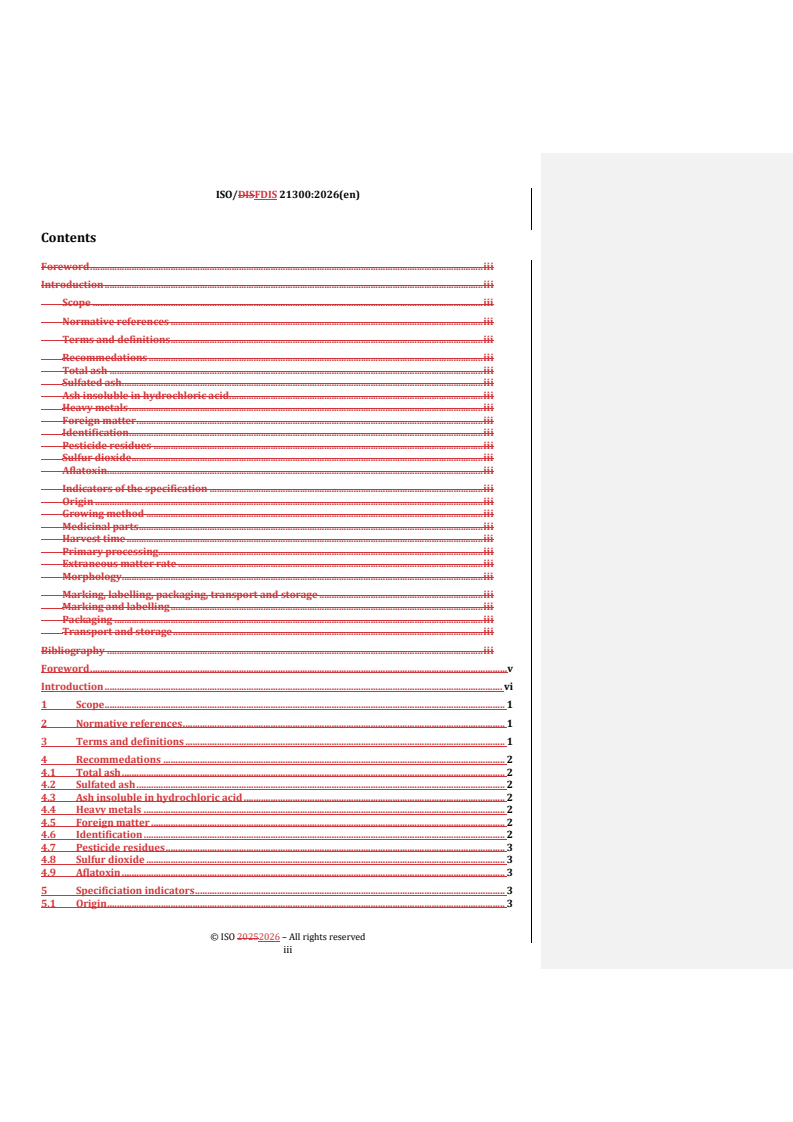
Contents
Foreword . iii
Introduction . iii
Scope . iii
Normative references . iii
Terms and definitions . iii
Recommedations . iii
Total ash . iii
Sulfated ash . iii
Ash insoluble in hydrochloric acid . iii
Heavy metals . iii
Foreign matter . iii
Identification . iii
Pesticide residues . iii
Sulfur dioxide . iii
Aflatoxin . iii
Indicators of the specification . iii
Origin . iii
Growing method . iii
Medicinal parts . iii
Harvest time . iii
Primary processing . iii
Extraneous matter rate . iii
Morphology . iii
Marking, labelling, packaging, transport and storage . iii
Marking and labelling . iii
Packaging . iii
Transport and storage . iii
Bibliography . iii
Foreword . v
Introduction . vi
1 Scope . 1
2 Normative references . 1
3 Terms and definitions . 1
4 Recommedations . 2
4.1 Total ash . 2
4.2 Sulfated ash . 2
4.3 Ash insoluble in hydrochloric acid . 2
4.4 Heavy metals . 2
4.5 Foreign matter . 2
4.6 Identification . 2
4.7 Pesticide residues . 3
4.8 Sulfur dioxide . 3
4.9 Aflatoxin . 3
5 Specificiation indicators . 3
5.1 Origin . 3
iii
ISO/DISFDIS 21300:2026(en)
5.2 Growing method . 4
5.3 Medicinal parts . 4
5.4 Harvest time . 5
5.5 Primary processing . 6
5.6 Extraneous matter rate . 7
5.7 Morphology . 8
6 Marking, labelling, packaging, transport and storage . 13
6.1 Marking and labelling . 13
6.2 Packaging . 13
6.3 Transport and storage . 13
Bibliography . 14
iv
ISO/DISFDIS 21300:2026(en)
Foreword
ISO (the International Organization for Standardization) is a worldwide federation of national standards
bodies (ISO member bodies). The work of preparing International Standards is normally carried out through
ISO technical committees. Each member body interested in a subject for which a technical committee has been
established has the right to be represented on that committee. International organizations, governmental and
non-governmental, in liaison with ISO, also take part in the work. ISO collaborates closely with the
International Electrotechnical Commission (IEC) on all matters of electrotechnical standardization.
The procedures used to develop this document and those intended for its further maintenance are described
in the ISO/IEC Directives, Part 1. In particular, the different approval criteria needed for the different types of
ISO documentsdocument should be noted. This document was drafted in accordance with the editorial rules
of the ISO/IEC Directives, Part 2 (see www.iso.org/directives).
Field Code Changed
Attention is drawnISO draws attention to the possibility that some of the elementsimplementation of this
document may beinvolve the subjectuse of (a) patent(s). ISO takes no position concerning the evidence,
validity or applicability of any claimed patent rights. in respect thereof. As of the date of publication of this
document, ISO had not received notice of (a) patent(s) which may be required to implement this document.
However, implementers are cautioned that this may not represent the latest information, which may be
obtained from the patent database available at www.iso.org/patents. ISO shall not be held responsible for
identifying any or all such patent rights. Details of any patent rights identified during the development of the
document will be in the Introduction and/or on the ISO list of patent declarations received (see
www.iso.org/patents).
Any trade name used in this document is information given for the convenience of users and does not
constitute an endorsement.
For an explanation of the voluntary nature of standards, the meaning of ISO specific terms and expressions
related to conformity assessment, as well as information about ISO's adherence to the World Trade
Organization (WTO) principles in the Technical Barriers to Trade (TBT) see www.iso.org/iso/foreword.html),
see www.iso.org/iso/foreword.html.
This document was prepared by Technical Committee ISO/TC 249, Traditional medicine, Subcommittee SC 1,
Traditional Chinese medicine.
This second edition cancels and replaces the first edition (ISO 21300:2019), which has been technically
revised.
The main changes are as follows:
— — the titleTitle of Clause 4 has been changed from "Requirements" to “Recommendations”;
Formatted: List Continue 1
— — in 4.4, 4.5,4.6, 4.7, 4.8,4.9, the word “shall” has been changed to “should”;”.
Any feedback or questions on this document should be directed to the user’s national standards body. A
complete listing of these bodies can be found at www.iso.org/members.html.
v
ISO/DISFDIS 21300:2026(en)
Introduction
Chinese materia medica is a special commodity used for preventing and treating diseases. As an important
component of traditional medicine, the quality of Chinese materia medica directly affects the clinical efficacy
and safety. However, due to the wide range of sources and diverse cultivation and processing methods of
Chinese materia medica, there is a lack of unified standards for the specifications of Chinese materia medica
in the global market, resulting in uneven quality and causing inconvenience to the production, circulation and
use of Chinese materia medica. In order to ensure the quality of Chinese materia medica, it is particularly
important to establish a unified standard for the specifications of Chinese materia medica.
There are many factors tha
...