

ISO 16851:2012
(Main)Textile conveyor belts — Determination of the net length of an endless (spliced) conveyor belt
General Information
- Abstract
ISO 16851:2012 specifies a method for determining the net length of an endless (spliced) conveyor belt. It applies to all types of construction of conveyor belting with the exception of belts containing steel cord reinforcement. It is not suitable or valid for light conveyor belts described in ISO 21183-1.
- Status
- Published
- Publication Date
- 28-Nov-2012
- Technical Committee
- ISO/TC 41/SC 3 - Conveyor belts
- Drafting Committee
- ISO/TC 41/SC 3 - Conveyor belts
- Current Stage
- 9093 - International Standard confirmed
- Start Date
- 05-Sep-2023
- Completion Date
- 29-Aug-2026
Buy Documents

ISO 16851:2012 - Textile conveyor belts -- Determination of the net length of an endless (spliced) conveyor belt
ISO 16851:2012 - Textile conveyor belts — Determination of the net length of an endless (spliced) conveyor belt/29/2012

ISO 16851:2012 - Courroies transporteuses a carcasse textile -- Méthode de mesurage de la longueur nette d'une courroie transporteuse sans fin (jonctionnée)

ISO 16851:2012 - Courroies transporteuses à carcasse textile — Méthode de mesurage de la longueur nette d'une courroie transporteuse sans fin (jonctionnée)/29/2012
Overview
ISO 16851:2012 specifies a reproducible method to determine the net length of an endless (spliced) textile conveyor belt. The procedure applies to all textile construction belts except those containing steel-cord reinforcement and is not suitable for light conveyor belts covered by ISO 21183-1. The standard is intended to support consistent acceptance testing, splicing verification and quality control of conveyor belting.
Key Topics
Apparatus
- A calibrated steel tape measure graduated in millimetres is required.
Preparation and procedure
- Lay the endless belt flat and free from tension; measurements are taken on the inside (flat) surface only.
- Mark a start point A on the inside edge. Mark B at a distance determined by belt circumferential length:
- For belts up to 30 m: each individual measurement is between one quarter and one third of nominal circumference (final segment may be shorter).
- For belts greater than 30 m: each measurement shall be between 7.5 m and one third of nominal circumference (final segment may be shorter than 7.5 m).
- Measure sequential segments AB, BC, CD, … until the final segment XA is recorded.
- In case of dispute, measurements should be taken at a standard atmosphere as specified in ISO 18573.
Calculation
The net endless length l is obtained by summing the consecutive measured segments and deducting the allowance for inside-surface compression:
l = (AB + BC + CD + ... + XA) - π·dwhere d is the belt thickness and results are expressed in millimetres.
Test report - the report shall include reference to ISO 16851, belt identification, net length (mm) and measurement date.
Applications
ISO 16851:2012 delivers practical value for:
- Splicing and installation - verify that splice length and belt circumference meet specifications before fitting.
- Quality control and acceptance - standardised net length measurement for supplier/customer agreements.
- Inventory and maintenance planning - accurate length data supports spare-belt stock and refurbishment decisions.
The method improves repeatability of length measurement, reduces disputes, and helps ensure correct belt tracking and equipment compatibility.
Related Standards
- ISO 18573 - test atmospheres and conditioning periods referenced for measurement conditions.
- ISO 14890 - provides tolerances on lengths of endless conveyor belts.
- ISO 21183-1 - covers light conveyor belts (this ISO 16851 procedure is not suitable for those belts).
For procurement, acceptance testing and technical documentation, reference ISO 16851:2012 to ensure consistent, defensible net length measurement of textile endless (spliced) conveyor belts.
Relations
- Effective Date
- 25-Aug-2026
- Effective Date
- 01-Jul-2026
- Effective Date
- 04-Mar-2026
- Effective Date
- 12-Feb-2026
- Effective Date
- 06-Jun-2022
- Effective Date
- 26-Nov-2011
Buy Documents
ISO 16851:2012 - Textile conveyor belts -- Determination of the net length of an endless (spliced) conveyor belt
ISO 16851:2012 - Textile conveyor belts — Determination of the net length of an endless (spliced) conveyor belt/29/2012
ISO 16851:2012 - Courroies transporteuses a carcasse textile -- Méthode de mesurage de la longueur nette d'une courroie transporteuse sans fin (jonctionnée)
ISO 16851:2012 - Courroies transporteuses à carcasse textile — Méthode de mesurage de la longueur nette d'une courroie transporteuse sans fin (jonctionnée)/29/2012
Frequently Asked Questions
ISO 16851:2012 is a standard published by the International Organization for Standardization (ISO). Its full title is "Textile conveyor belts — Determination of the net length of an endless (spliced) conveyor belt". This standard covers: ISO 16851:2012 specifies a method for determining the net length of an endless (spliced) conveyor belt. It applies to all types of construction of conveyor belting with the exception of belts containing steel cord reinforcement. It is not suitable or valid for light conveyor belts described in ISO 21183-1.
ISO 16851:2012 specifies a method for determining the net length of an endless (spliced) conveyor belt. It applies to all types of construction of conveyor belting with the exception of belts containing steel cord reinforcement. It is not suitable or valid for light conveyor belts described in ISO 21183-1.
ISO 16851:2012 is classified under the following ICS (International Classification for Standards) categories: 53.040.20 - Components for conveyors. The ICS classification helps identify the subject area and facilitates finding related standards.
ISO 16851:2012 has the following relationships with other standards: It is inter standard links to EN ISO 22721:2023, EN ISO 14890:2026, EN ISO 14890:2013, EN ISO 16851:2013, ISO 13344:2004, ISO 16851:2004. Understanding these relationships helps ensure you are using the most current and applicable version of the standard.
ISO 16851:2012 is available in PDF format for immediate download after purchase. The document can be added to your cart and obtained through the secure checkout process. Digital delivery ensures instant access to the complete standard document.
Standards Content (Sample)
INTERNATIONAL ISO
STANDARD 16851
Second edition
2012-12-01
Textile conveyor belts — Determination
of the net length of an endless (spliced)
conveyor belt
Courroies transporteuses à carcasse textile — Méthode de mesurage
de la longueur nette d’une courroie transporteuse sans fin (jonctionnée)
Reference number
©
ISO 2012
All rights reserved. Unless otherwise specified, no part of this publication may be reproduced or utilized in any form or by any means,
electronic or mechanical, including photocopying and microfilm, without permission in writing from either ISO at the address below or ISO’s
member body in the country of the requester.
ISO copyright office
Case postale 56 • CH-1211 Geneva 20
Tel. + 41 22 749 01 11
Fax + 41 22 749 09 47
E-mail copyright@iso.org
Web www.iso.org
Published in Switzerland
ii © ISO 2012 – All rights reserved
Contents Page
Foreword .iv
1 Scope . 1
2 Apparatus . 1
3 Procedure . 1
4 Calculation and expression of results . 2
5 Test report . 2
Bibliography . 3
Foreword
ISO (the International Organization for Standardization) is a worldwide federation of national standards bodies
(ISO member bodies). The work of preparing International Standards is normally carried out through ISO
technical committees. Each member body interested in a subject for which a technical committee has been
established has the right to be represented on that committee. International organizations, governmental and
non-governmental, in liaison with ISO, also take part in the work. ISO collaborates closely with the International
Electrotechnical Commission (IEC) on all matters of electrotechnical standardization.
International Standards are drafted in accordance with the rules given in the ISO/IEC Directives, Part 2.
The main task of technical committees is to prepare International Standards. Draft International Standards
adopted by the technical committees are circulated to the member bodies for voting. Publication as an
International Standard requires approval by at least 75 % of the member bodies casting a vote.
Attention is drawn to the possibility that some of the elements of this document may be the subject of patent
rights. ISO shall not be held responsible for identifying any or all such patent rights.
ISO 16851 was prepared by Technical Committee TC 41, Pulleys and belts (including veebelts), Subcommittee
SC 3, Conveyor belts,.
This s
...
INTERNATIONAL ISO
STANDARD 16851
Second edition
2012-12-01
Textile conveyor belts — Determination
of the net length of an endless (spliced)
conveyor belt
Courroies transporteuses à carcasse textile — Méthode de mesurage
de la longueur nette d’une courroie transporteuse sans fin (jonctionnée)
Reference number
©
ISO 2012
All rights reserved. Unless otherwise specified, no part of this publication may be reproduced or utilized in any form or by any means,
electronic or mechanical, including photocopying and microfilm, without permission in writing from either ISO at the address below or ISO’s
member body in the country of the requester.
ISO copyright office
Case postale 56 • CH-1211 Geneva 20
Tel. + 41 22 749 01 11
Fax + 41 22 749 09 47
E-mail copyright@iso.org
Web www.iso.org
Published in Switzerland
ii © ISO 2012 – All rights reserved
Contents Page
Foreword .iv
1 Scope . 1
2 Apparatus . 1
3 Procedure . 1
4 Calculation and expression of results . 2
5 Test report . 2
Bibliography . 3
Foreword
ISO (the International Organization for Standardization) is a worldwide federation of national standards bodies
(ISO member bodies). The work of preparing International Standards is normally carried out through ISO
technical committees. Each member body interested in a subject for which a technical committee has been
established has the right to be represented on that committee. International organizations, governmental and
non-governmental, in liaison with ISO, also take part in the work. ISO collaborates closely with the International
Electrotechnical Commission (IEC) on all matters of electrotechnical standardization.
International Standards are drafted in accordance with the rules given in the ISO/IEC Directives, Part 2.
The main task of technical committees is to prepare International Standards. Draft International Standards
adopted by the technical committees are circulated to the member bodies for voting. Publication as an
International Standard requires approval by at least 75 % of the member bodies casting a vote.
Attention is drawn to the possibility that some of the elements of this document may be the subject of patent
rights. ISO shall not be held responsible for identifying any or all such patent rights.
ISO 16851 was prepared by Technical Committee TC 41, Pulleys and belts (including veebelts), Subcommittee
SC 3, Conveyor belts,.
This s
...
NORME ISO
INTERNATIONALE 16851
Deuxième édition
2012-12-01
Courroies transporteuses à carcasse
textile — Méthode de mesurage de
la longueur nette d’une courroie
transporteuse sans fin (jonctionnée)
Textile conveyor belts — Determination of the net length of an endless
(spliced) conveyor belt
Numéro de référence
©
ISO 2012
DOCUMENT PROTÉGÉ PAR COPYRIGHT
Droits de reproduction réservés. Sauf prescription différente, aucune partie de cette publication ne peut être reproduite ni utilisée sous
quelque forme que ce soit et par aucun procédé, électronique ou mécanique, y compris la photocopie et les microfilms, sans l’accord écrit
de l’ISO à l’adresse ci-après ou du comité membre de l’ISO dans le pays du demandeur.
ISO copyright office
Case postale 56 • CH-1211 Geneva 20
Tel. + 41 22 749 01 11
Fax + 41 22 749 09 47
E-mail copyright@iso.org
Web www.iso.org
Publié en Suisse
ii © ISO 2012 – Tous droits réservés
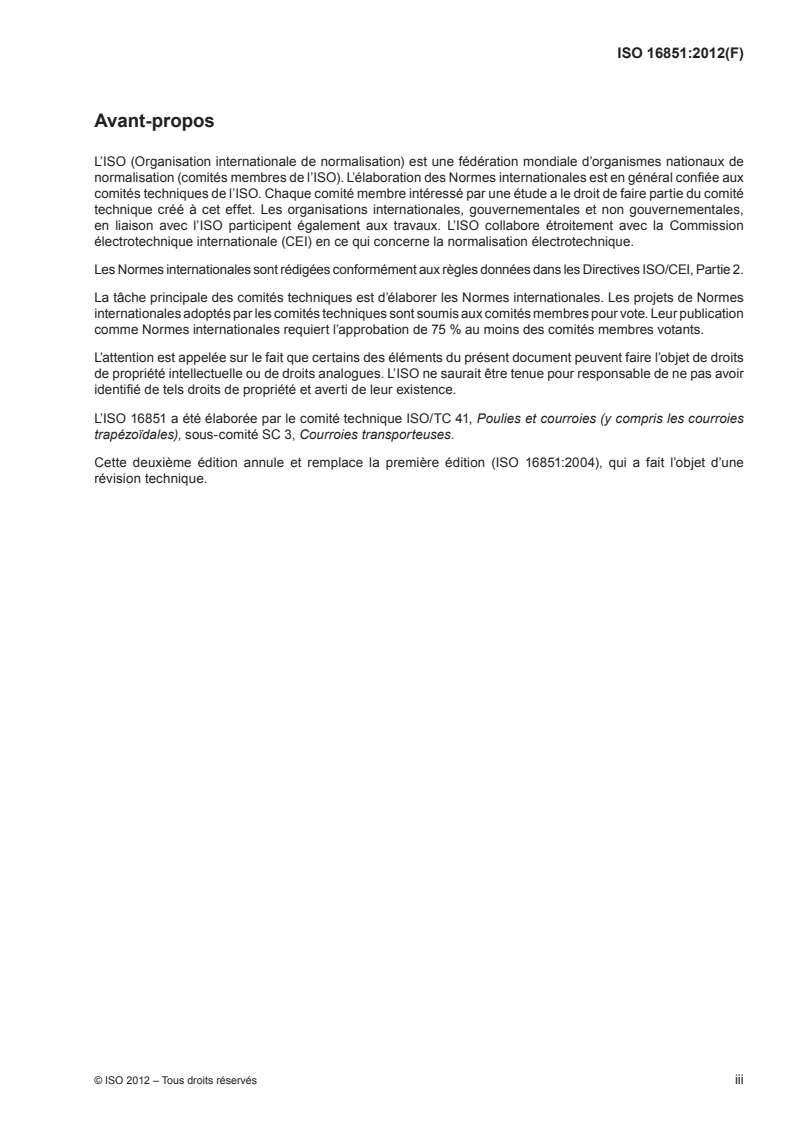
Avant-propos
L’ISO (Organisation internationale de normalisation) est une fédération mondiale d’organismes nationaux de
normalisation (comités membres de l’ISO). L’élaboration des Normes internationales est en général confiée aux
comités techniques de l’ISO. Chaque comité membre intéressé par une étude a le droit de faire partie du comité
technique créé à cet effet. Les organisations internationales, gouvernementales et non gouvernementales,
en liaison avec l’ISO participent également aux travaux. L’ISO collabore étroitement avec la Commission
électrotechnique internationale (CEI) en ce qui concerne la normalisation électrotechnique.
Les Normes internationales sont rédigées conformément aux règles données dans les Directives ISO/CEI, Partie 2.
La tâche principale des comités techniques est d’élaborer les Normes internationales. Les projets de Normes
internationales adoptés par les comités techniques sont soumis aux comités membres pour vote. Leur publication
comme Normes internationales requiert l’approbation de 75 % au moins des comités membres votants.
L’attention est appelée sur le fait que certains des éléments du présent document peuvent faire l’objet de droits
de propriété intellectuelle ou de droits analogues. L’ISO ne saurait être tenue pour responsable de ne pas avoir
identifié de tels droits de propriété et averti de leur existence.
L’ISO 16851 a été élaborée par le comité technique ISO/TC 41, Poulies et courroies (y compris les courroies
trapézoïdales), sous-comité SC 3, Courroies transporteuses.
Cette deuxième édition annule et remplace la première édition (ISO 16851:2004), qui a fait l’objet d’une
révision technique.
NORME INTERNATIONALE ISO 16851:2012(F)
Courroies transporteuses à carcasse textile — Méthode de
mesurage de la longueur nette d’une courroie transporteuse
sans fin (jonctionnée)
1 Domaine d’application
La présente Norme internationale spécifie une méthode de détermination de la longueur nette des courroies
transporteuses sans fin (jonctionnées).
Elle est applicable à tous les types de construction de courroies transporteuses à l’exception de celles ayant
une carcasse en câble d’acier. Elle n’est pas appropriée ou valable pour les courroies transporteuses légères
...
NORME ISO
INTERNATIONALE 16851
Deuxième édition
2012-12-01
Courroies transporteuses à carcasse
textile — Méthode de mesurage de
la longueur nette d’une courroie
transporteuse sans fin (jonctionnée)
Textile conveyor belts — Determination of the net length of an endless
(spliced) conveyor belt
Numéro de référence
©
ISO 2012
DOCUMENT PROTÉGÉ PAR COPYRIGHT
Droits de reproduction réservés. Sauf prescription différente, aucune partie de cette publication ne peut être reproduite ni utilisée sous
quelque forme que ce soit et par aucun procédé, électronique ou mécanique, y compris la photocopie et les microfilms, sans l’accord écrit
de l’ISO à l’adresse ci-après ou du comité membre de l’ISO dans le pays du demandeur.
ISO copyright office
Case postale 56 • CH-1211 Geneva 20
Tel. + 41 22 749 01 11
Fax + 41 22 749 09 47
E-mail copyright@iso.org
Web www.iso.org
Publié en Suisse
ii © ISO 2012 – Tous droits réservés
Avant-propos
L’ISO (Organisation internationale de normalisation) est une fédération mondiale d’organismes nationaux de
normalisation (comités membres de l’ISO). L’élaboration des Normes internationales est en général confiée aux
comités techniques de l’ISO. Chaque comité membre intéressé par une étude a le droit de faire partie du comité
technique créé à cet effet. Les organisations internationales, gouvernementales et non gouvernementales,
en liaison avec l’ISO participent également aux travaux. L’ISO collabore étroitement avec la Commission
électrotechnique internationale (CEI) en ce qui concerne la normalisation électrotechnique.
Les Normes internationales sont rédigées conformément aux règles données dans les Directives ISO/CEI, Partie 2.
La tâche principale des comités techniques est d’élaborer les Normes internationales. Les projets de Normes
internationales adoptés par les comités techniques sont soumis aux comités membres pour vote. Leur publication
comme Normes internationales requiert l’approbation de 75 % au moins des comités membres votants.
L’attention est appelée sur le fait que certains des éléments du présent document peuvent faire l’objet de droits
de propriété intellectuelle ou de droits analogues. L’ISO ne saurait être tenue pour responsable de ne pas avoir
identifié de tels droits de propriété et averti de leur existence.
L’ISO 16851 a été élaborée par le comité technique ISO/TC 41, Poulies et courroies (y compris les courroies
trapézoïdales), sous-comité SC 3, Courroies transporteuses.
Cette deuxième édition annule et remplace la première édition (ISO 16851:2004), qui a fait l’objet d’une
révision technique.
NORME INTERNATIONALE ISO 16851:2012(F)
Courroies transporteuses à carcasse textile — Méthode de
mesurage de la longueur nette d’une courroie transporteuse
sans fin (jonctionnée)
1 Domaine d’application
La présente Norme internationale spécifie une méthode de détermination de la longueur nette des courroies
transporteuses sans fin (jonctionnées).
Elle est applicable à tous les types de construction de courroies transporteuses à l’exception de celles ayant
une carcasse en câble d’acier. Elle n’est pas appropriée ou valable pour les courroies transporteuses légères
...