

ISO 14505-2:2026
(Main)Ergonomics of the thermal environment — Evaluation of thermal environments in vehicles — Part 2: Determination of equivalent temperature
- Abstract
This document specifies requirements and recommendations for the assessment of the thermal conditions inside a vehicle compartment. It can also be applied to other confined spaces with asymmetric climatic conditions. It applies to the assessment of thermal conditions, when deviations from thermal neutrality are relatively small.
- Status
- Published
- Publication Date
- 05-Aug-2026
- Technical Committee
- ISO/TC 159/SC 5 - Ergonomics of the physical environment
- Drafting Committee
- ISO/TC 159/SC 5/WG 1 - Thermal environments
- Current Stage
- 6060 - International Standard published - 60 Publication
- Start Date
- 06-Aug-2026
- Due Date
- 27-Apr-2026
- Completion Date
- 27-Apr-2026
Buy Documents

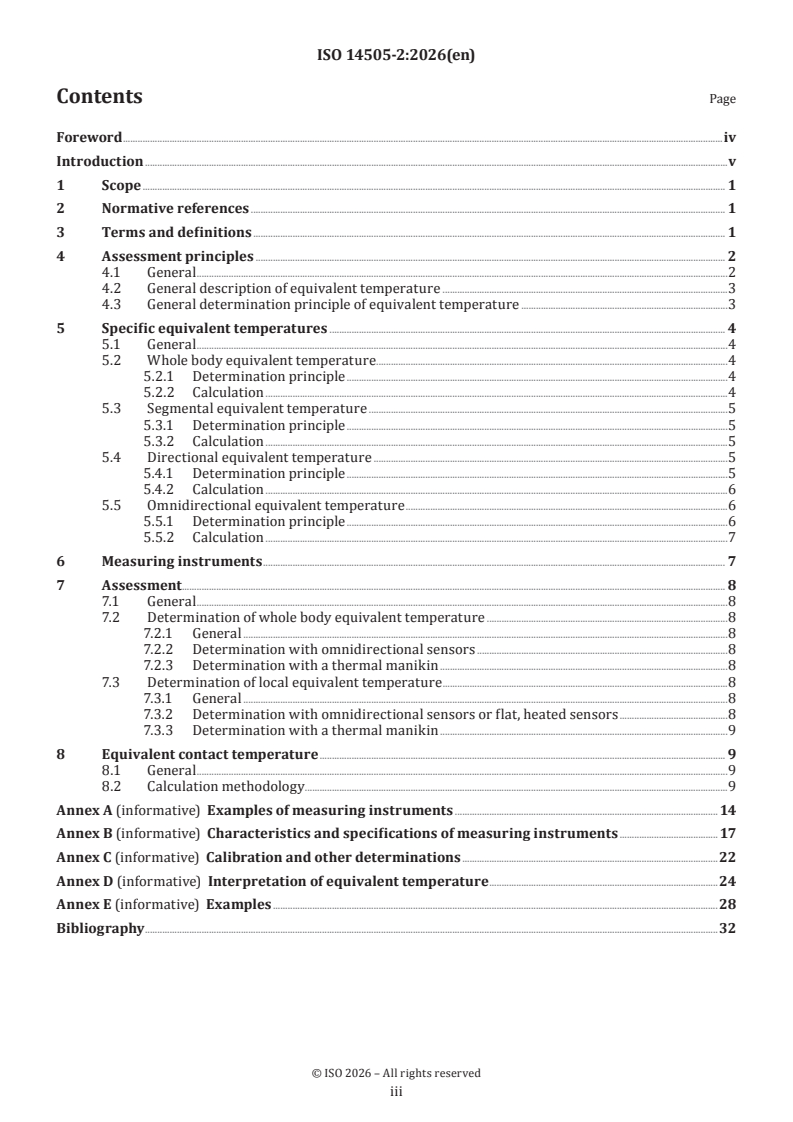

ISO 14505-2:2026 - Ergonomics of the thermal environment — Evaluation of thermal environments in vehicles — Part 2: Determination of equivalent temperature

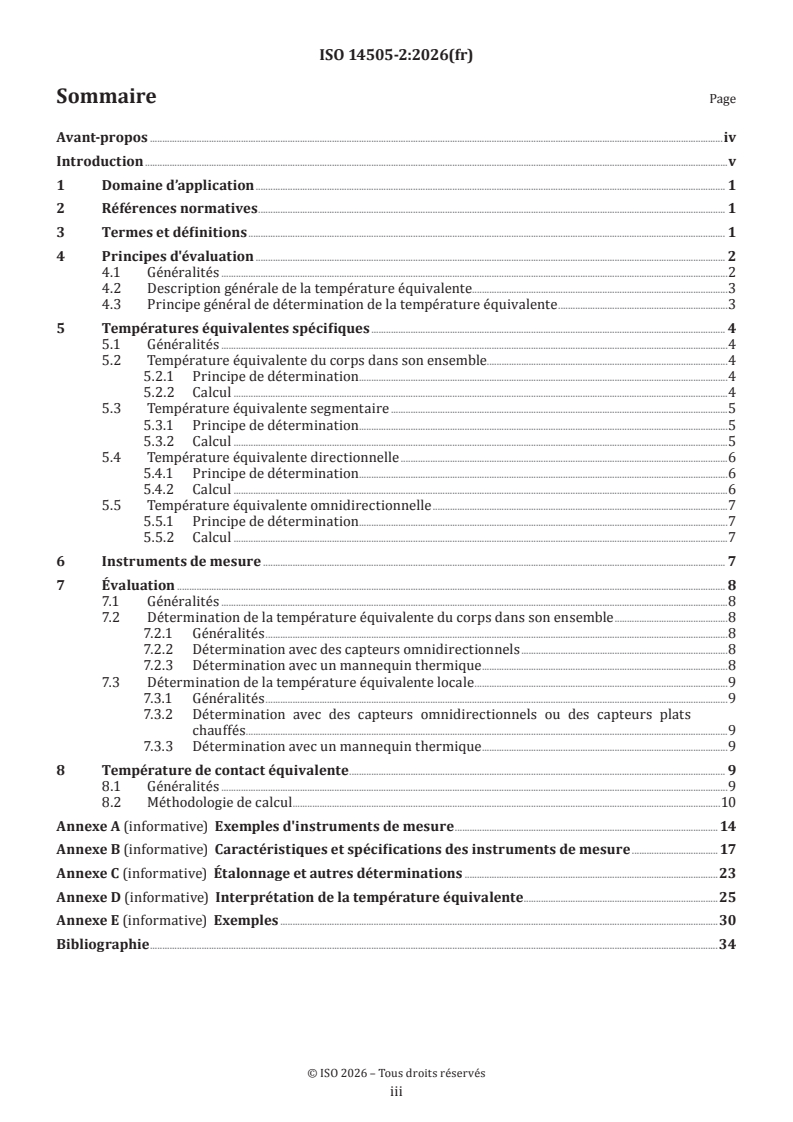

ISO 14505-2:2026 - Ergonomie des ambiances thermiques — Évaluation des ambiances thermiques dans les véhicules — Partie 2: Détermination de la température équivalente
ISO 14505-2:2026 is an International Standard from ISO for assessing thermal conditions inside vehicle compartments, and it can also be applied to other confined spaces with asymmetric climatic conditions. It specifies how to determine equivalent temperature, including whole body, segmental, directional, omnidirectional and equivalent contact temperature, for situations where deviations from thermal neutrality are relatively small.
What does ISO 14505-2:2026 specify?
ISO 14505-2:2026 specifies requirements and recommendations for evaluating thermal conditions inside a vehicle compartment. The document is organized into clauses on scope, references, terms, assessment principles, specific equivalent temperatures, measuring instruments, assessment, and equivalent contact temperature, followed by informative annexes.
| Annex | What it covers |
|---|---|
| Annex A | Examples of measuring instruments |
| Annex B | Characteristics and specifications of measuring instruments |
| Annex C | Calibration and other determinations |
| Annex D | Interpretation of equivalent temperature |
| Annex E | Examples |
The standard focuses on asymmetric thermal conditions, which matter in vehicles because air flow, radiation, heating, cooling, and seat contact can vary around the body. In practice, that means the document is aimed at measuring and comparing local and overall thermal effects, not just a single air temperature.
What are the key requirements of ISO 14505-2:2026?
ISO 14505-2:2026 turns thermal comfort assessment into a physical measurement problem based on equivalent temperature. The main idea is to quantify how much dry heat the body loses by convection and radiation, then relate that to a standard homogeneous environment.
Assessment is based on equivalent temperature
Clause 4 states that equivalent temperature is used as a unified physical measure of climatic effects on dry heat exchange. The document distinguishes total assessment of the whole body from local assessment of specific body parts. In practice, this means a reader should decide whether the question is overall cabin comfort, a local draft, or seat-contact discomfort before selecting a method.
The reference environment is standardized
Clause 4.3 defines the calculation principle using a standard environment with equal air and mean radiant temperature and very low air velocity. The document says the measured heat loss in the actual condition is compared with the calibrated response in that standard environment. That matters because calibration links the sensor or manikin reading to a comparable temperature scale.
Four specific equivalent temperatures are used
Clause 5 defines whole body equivalent temperature, segmental equivalent temperature, directional equivalent temperature, and omnidirectional equivalent temperature. Whole body values use a human-sized, heated sensor or thermal manikin, segmental values focus on selected body parts, directional values use flat heated sensors, and omnidirectional values use an ellipsoid sensor. In practice, this lets users match the instrument to the question - full-body comfort, a local body zone, or directional asymmetry.
Local and total values are built from measured zones and locations
Clauses 5.2 to 5.5 show that the calculations use area-weighted or direction-weighted averages. The document also states that whole body equivalent temperature and total equivalent temperature are not the same, especially in asymmetric climates and with seat contact. For users, that means the report must state the body part, sensor position, direction, and manikin configuration if results are to be compared properly.
Instrument choice affects the result
Clause 6 says the methods in Annexes A and B represent different measuring principles and are not directly comparable with one another. The document points to differences in reliability, relevance, validity, repeatability, accuracy, integration, complexity, cost, and availability. In practice, a buyer or test engineer should choose the method that fits the purpose and keep the same method when comparing products or test runs.
Whole body and local assessment have preferred procedures
Clause 7 says whole body equivalent temperature should preferably be determined with a thermal manikin or by integrating discrete omnidirectional sensors at specified positions in the vehicle seat area. It also says local equivalent temperature can be determined with omnidirectional or flat heated sensors, or with a thermal manikin segment. Measurements are taken at steady state, so the result describes a settled thermal condition rather than a transient warm-up or cool-down moment.
Equivalent contact temperature extends the method to seat contact
Clause 8 adds equivalent contact temperature for contact areas such as the back, seat, and rear thighs. This method includes heat conduction through clothing and the seat, plus sensible and latent heat exchange at the contact interface. In practice, this makes the standard useful for seat heating and seat ventilation assessments, where contact comfort can differ from air-based comfort.
What terms does ISO 14505-2:2026 define?
- Equivalent temperature - the temperature of a standard homogeneous space in which a person exchanges the same heat loss by convection and radiation as in the actual conditions.
- Whole body equivalent temperature - the temperature of an imaginary enclosure that gives the same dry heat exchange for a full-scale human-shaped heated sensor as the real environment.
- Segmental equivalent temperature - the equivalent temperature for one or more selected zones of a thermal manikin representing a body segment.
- Directional equivalent temperature - the equivalent temperature measured with a small flat heated surface for heat exchange in one direction.
- Omnidirectional equivalent temperature - the equivalent temperature measured with a heated ellipsoid that represents heat exchange in all directions.
- Equivalent contact temperature - the uniform temperature of an imaginary contact surface that gives the same conductive dry heat exchange as the real contact area.
- HVAC-system - devices that control the temperature, humidity, and purity of the air in an enclosed space.
Who uses ISO 14505-2:2026?
ISO 14505-2:2026 is used by vehicle manufacturers, HVAC-system developers, seat and interior suppliers, and thermal comfort test laboratories. It is also relevant to ergonomics specialists, quality managers, and technical buyers who need to compare cabin climates or seat comfort under controlled conditions.
In practice, users apply it to vehicle heating and cooling evaluation, warm-up and cool-down testing, seat heating and seat ventilation assessment, and the comparison of thermal manikins or sensor systems. The document also supports product standards for HVAC-system testing in vehicles and similar confined spaces.
What changed in ISO 14505-2:2026 from the previous edition?
ISO 14505-2:2026 cancels and replaces ISO 14505-2:2006/Cor 1:2007 and is technically revised. The main change is the addition of an evaluation method for the contact areas, called equivalent contact temperature.
Which standards are used with ISO 14505-2:2026?
- ISO 13731 - the only normative reference; it provides vocabulary and symbols used in the document.
- ISO 14505-4 - the introduction says methods for calculation of equivalent temperature using thermal factors are described in this part.
- ISO 14505-1 - the bibliography identifies it as the part on principles and methods for assessment of thermal stress in vehicles.
- ISO 14505-3 - the bibliography identifies it as the part on subjective assessment using humans test panels.
- ISO 7726 - listed in the bibliography for instruments used to measure and monitor physical quantities in thermal environments.
- ISO 7730 - used in Annex D for heat-balance interpretation and thermal neutrality.
- ISO/TS 13732-2 - cited in Clause 8 for contact temperature related to the palm area.
- SAE-J-2234 - cited in Clause 5 for weighting local equivalent temperatures into a total value.
What does the ISO 14505-2:2026 document contain?
The document contains calculation principles, calibration rules, and assessment methods, plus worked interpretation schemes. Clause 4 gives the physical basis and formulas for equivalent temperature, Clause 5 sets out the four specific equivalent temperatures, and Clause 8 adds equivalent contact temperature for seat interfaces.
Annex A shows example instruments such as thermal manikins, flat heated sensors, and ellipsoid sensors. Annex B collects specification factors for manikins and sensors, including size, posture, regulation mode, accuracy, repeatability, reproducibility, resolution, and temperature ranges.
Annex C describes calibration and determinations for surface temperature, heat transfer coefficients, recovery time, accuracy, repeatability, reproducibility, and surface properties. Annex D gives interpretation schemes that relate measured values to perceived thermal sensation and comfort, and Annex E gives application examples for steady-state testing, warm-up and cool-down tests, climate quality evaluation, and seat-heating compensation.
Relations
- Effective Date
- 12-Feb-2026
- Effective Date
- 13-May-2023
- Effective Date
- 29-Apr-2023
Buy Documents
ISO 14505-2:2026 - Ergonomics of the thermal environment — Evaluation of thermal environments in vehicles — Part 2: Determination of equivalent temperature
ISO 14505-2:2026 - Ergonomie des ambiances thermiques — Évaluation des ambiances thermiques dans les véhicules — Partie 2: Détermination de la température équivalente
Get Certified
Connect with accredited certification bodies for this standard

TÜV Rheinland
TÜV Rheinland is a leading international provider of technical services.

TÜV SÜD
TÜV SÜD is a trusted partner of choice for safety, security and sustainability solutions.

BSI Group
BSI (British Standards Institution) is the business standards company that helps organizations make excellence a habit.
Sponsored listings
Frequently Asked Questions
ISO 14505-2:2026 is a standard published by the International Organization for Standardization (ISO). Its full title is "Ergonomics of the thermal environment — Evaluation of thermal environments in vehicles — Part 2: Determination of equivalent temperature". This standard covers: This document specifies requirements and recommendations for the assessment of the thermal conditions inside a vehicle compartment. It can also be applied to other confined spaces with asymmetric climatic conditions. It applies to the assessment of thermal conditions, when deviations from thermal neutrality are relatively small.
This document specifies requirements and recommendations for the assessment of the thermal conditions inside a vehicle compartment. It can also be applied to other confined spaces with asymmetric climatic conditions. It applies to the assessment of thermal conditions, when deviations from thermal neutrality are relatively small.
ISO 14505-2:2026 is classified under the following ICS (International Classification for Standards) categories: 13.180 - Ergonomics; 43.020 - Road vehicles in general. The ICS classification helps identify the subject area and facilitates finding related standards.
ISO 14505-2:2026 has the following relationships with other standards: It is inter standard links to EN ISO 14505-2:2026, ISO 6183:2009/Amd 2:2019, ISO 14505-2:2006. Understanding these relationships helps ensure you are using the most current and applicable version of the standard.
ISO 14505-2:2026 is available in PDF format for immediate download after purchase. The document can be added to your cart and obtained through the secure checkout process. Digital delivery ensures instant access to the complete standard document.
Standards Content (Sample)
Contents
- Introduction
- 1 Scope
- 2 Normative references
- 3 Terms and definitions
- 3.1 equivalent temperature
- 3.2 whole body equivalent temperature
- 3.3 segmental equivalent temperature
- 3.4 directional equivalent temperature
- 3.5 omnidirectional equivalent temperature
- 3.6 equivalent contact temperature
- 3.7 segment
- 3.8 zone
- 3.9 heating, ventilating and air-conditioning system
- 4 Assessment principles
- 4.1 General
- 4.2 General description of equivalent temperature
- 4.3 General determination principle of equivalent temperature
- 5 Specific equivalent temperatures
- 5.1 General
- 5.2 Whole body equivalent temperature
- 5.3 Segmental equivalent temperature
- 5.4 Directional equivalent temperature
- 5.5 Omnidirectional equivalent temperature
- 6 Measuring instruments
- 7 Assessment
- 7.1 General
- 7.2 Determination of whole body equivalent temperature
- 7.3 Determination of local equivalent temperature
- 8 Equivalent contact temperature
- 8.1 General
- 8.2 Calculation methodology
- Annex A
- Annex B
- 0 Total 6 Left hand 12 Right thigh
- 1 Face 7 Right hand 13 Left leg
- 2 Scalp 8 Chest 14 Right leg
- 3 Shoulders 9 Back 15 Left foot
- 4 Left arm 10 Seat (+ rear thighs) 16 Right foot
- 5 Right arm 11 Left thigh
- 0 Total 14 Right upper arm inside 28 Left thigh inner
- 1 Face left 15 Right upper arm outside 29 Left thigh outer
- 2 Face right 16 Right lower arm upside 30 Left thigh rear
- 3 Eyes 17 Right lower arm downside 31 Right thigh inner
- 4 Scalp 18 Right hand outside 32 Right thigh outer
- 5 Neck 19 Right hand inside 33 Right thigh rear
- 6 Shoulders front 20 Chest front 34 Left leg front
- 7 Shoulders back 21 Chest left 35 Left leg back
- 8 Left upper arm inside 22 Chest right 36 Right leg front
- 9 Left upper arm outside 23 Stomach 37 Right leg back
- 10 Left lower arm upside 24 Crutch 38 Left foot upside
- 11 Left lower arm downside 25 Upper back 39 Left foot downside
- 12 Left hand outside 26 Lower back 40 Right foot upside
- 13 Left hand inside 27 Seat 41 Right foot downside
- Annex C
- Annex D
- Annex E
- Bibliography
Introduction
The interaction of convective, radiative and conductive heat exchange in a vehicle compartment is very complex. External thermal loads in combination with the internal heating and ventilation system of the vehicle create a local climate that can vary considerably in space and time. Asymmetric thermal conditions arise, and these are often the main cause of complaints of thermal discomfort. In vehicles without or with poor heating, ventilating and air-conditioning system (HVAC-system), thermal stress is determined largely by the impact of the ambient climatic conditions on the vehicle compartment. Subjective evaluation is integrative, as the individual combines into one reaction the combined effect of several thermal stimuli. However, it is not sufficiently detailed or accurate for repeated use. Technical measurements provide detailed and accurate information but must be integrated in order to predict the thermal effects on humans. Since several climatic factors play a role for the final heat exchange of a person, these factors must be integrated to a measure, representing their relative importance. This document includes the equivalent temperature models t for the assessment of the thermal conditions. eq For special consideration of the seat, the equivalent contact temperature t can be applied for body eq,cont compartments in contact to surfaces. Methods for the calculation of t using thermal factors are described eq in ISO 14505-4. The methodology described in this document can also be used in specific performance standards for testing of HVAC-systems for vehicles and similar confined spaces.
International Standard ISO 14505-2:2026(en) Ergonomics of the thermal environment — Evaluation of thermal environments in vehicles — Part 2:
Determination of equivalent temperature
1 Scope
This document specifies requirements and recommendations for the assessment of the thermal conditions inside a vehicle compartment. It can also be applied to other confined spaces with asymmetric climatic conditions.
It applies to the assessment of thermal conditions, when deviations from thermal neutrality are relatively small.
2 Normative references
The following documents are referred to in the text in such a way that some or all of their content constitutes requirements of this document. For dated references, only the edition cited applies. For undated references, the latest edition of the referenced document (including any amendments) applies. ISO 13731, Ergonomics of the thermal environment — Vocabulary and symbols
3 Terms and definitions
For the purposes of this document, the terms and definitions given in ISO 13731 and the following apply. ISO and IEC maintain terminology databases for use in standardization at the following addresses:
- ISO Online browsing platform: available at https:// www .iso .org/ obp
- IEC Electropedia: available at https:// www .electropedia .org/
3.1 equivalent temperature
t eq temperature of a standard homogenous space, in which a person exchanges the same heat loss by convection and radiation as in the actual conditions under assessment Note 1 to entry: The standard homogenous space is defined as an environment in which the mean radiant temperature is equal to the air temperature and there is zero air velocity.
3.2 whole body equivalent temperature
t eq,whole temperature of an imaginary enclosure with the same temperature in air and on surrounding surfaces and with air velocity equal to zero in which a full-scale, human shaped, heated sensor will exchange the same dry heat by radiation and convection as in the actual non-uniform environment
ISO 14505-2:2026(en)
3.3 segmental equivalent temperature
t eq,segment uniform temperature of an imaginary enclosure with the same temperature in air and on surrounding surfaces and with air velocity equal to zero in which one or more selected zones of a thermal manikin will exchange the same dry heat by radiation and convection as in the actual non-uniform environment
3.4 directional equivalent temperature
t eq,direct uniform temperature of an imaginary enclosure with the same temperature in air and on surrounding surfaces and with air velocity equal to zero in which a small flat heated surface will exchange the same dry heat by radiation and convection as in the actual non-uniform environment
3.5 omnidirectional equivalent temperature
t eq,omni uniform temperature of an imaginary enclosure with the same temperature in air and on surrounding surfaces and with air velocity equal to zero in which a heated ellipsoid will exchange the same dry heat by radiation and convection as in the actual non-uniform environment
3.6 equivalent contact temperature
t eq,cont uniform temperature of an imaginary contact surface in a standard homogeneous space, at which a person will exchange the same amount of dry heat through thermal conduction for a virtual clothing insulation as in the actual non-uniform environment Note 1 to entry: The standard homogenous space is defined as an environment in which the mean radiant temperature is equal to the air temperature and there is zero air velocity. In the actual non-uniform environment, the person experiences sensible and latent heat transfer at the considered body parts.
3.7 segment
part of a human-shaped sensor, normally corresponding to a real body-part, consisting of one or several whole zones, for which a segmental equivalent temperature, t , is presented eq,segment
3.8 zone
physical partition of a manikin, which is independently regulated and within which the surface temperature and heat exchange is measured
3.9 heating, ventilating and air-conditioning system
HVAC-system devices that control the temperature, humidity, and purity of the air in an enclosed space
4 Assessment principles
4.1 General
The assessment principle is based on the measurement of the equivalent temperature. The equivalent temperature provides a unified, physical measure of the climatic effects on the human dry heat exchange. On the basis of the actual value for, and the variation in, equivalent temperature, it is possible to predict the conditions for heat balance under conditions in or close to the thermoneutral zone. People’s thermal sensation is primarily influenced by general and local levels and variations in skin surface heat flux. Values for the equivalent temperature of a specified environment have been found to be closely related to how [12] people perceive thermal conditions when exposed to the same environment. This can be used for the interpretation of the t value and assessment of the quality of the environment. eq
ISO 14505-2:2026(en) The climate is assessed in terms of a total equivalent temperature, which describes the level of thermal neutrality.
The climate is also assessed for local effects on specified parts of the human body surface. The local equivalent temperatures determine to what extent the actual body parts fall within the range of acceptable levels of heat loss (local discomfort).
4.2 General description of equivalent temperature
The equivalent temperature is a pure physical quantity, that in a physically sound way integrates the independent effects of convection and radiation on human body heat exchange. This relationship is best described for the overall (whole body) heat exchange. There is limited experience with relations between local dry heat exchange and local equivalent temperature. The standardized definition of t applies only eq for the whole body. Therefore, the definition is modified for the purposes of this document. t does not take eq into account human perception and sensation or other subjective aspects. However, empirical studies show that t values are well related to the subjective perception of the thermal effect. eq
4.3 General determination principle of equivalent temperature
Determination of t is based on Formula (1) and (2) for convective and radiative heat transfer for clothed eq persons. Heat exchange by conduction is assumed to be small and accounted for by radiation and convection. Rh=× tt (1)
rskr Ch=× tt (2)
cska where
R is heat exchange by radiation, in watts per square metre (W/m );
C is heat exchange by convection, in watts per square metre (W/m );
h is the radiation heat transfer coefficient, in watts per square metre Kelvin [W/(m K)]; r
h is the convection heat transfer coefficient, in watts per square metre Kelvin [W/(m K)];
t is the skin temperature, in degrees Celsius (°C); sk t is the mean radiant temperature, in degrees Celsius (°C); r t is the ambient air temperature, in degrees Celsius (°C).
a In practice, the equivalent temperature is determined according to Formula (3) based on the measured convective and radiative heat losses (Formula (4)):
Q tt= − (3) eq s h cal QR=+C (4) where t is the surface temperature, in degrees Celsius (°C); s t is the temperature of the standard environment, in degrees Celsius (°C); eq Q is the measured convective and radiative heat loss during the actual conditions, in watts per
square metre (W/m ); h is the combined heat transfer coefficient, determined during calibration in a standard cal
environment, in watts per square metre Kelvin [W/(m K)].
The standard environment comprises homogenous, uniform thermal conditions with t = t and air velocity a r v , < 0,1 m/s. A suitable calibration procedure is described in the informative Annex C. a
ISO 14505-2:2026(en)
5 Specific equivalent temperatures
5.1 General
As there is no method available for measurement of the true total or local t , four specific equivalent eq temperatures are calculated according to different principles, according to 5.2 to 5.5. Depending on the measuring principles, the following are specified, which are further described in Reference [13]:
a) whole body equivalent temperature; b) segmental equivalent temperature; c) directional equivalent temperature; d) omnidirectional equivalent temperature.
5.2 Whole body equivalent temperature
5.2.1 Determination principle
The principle of determination is to measure the total heat flow from a human-sized test manikin consisting of several zones, each with a specific measured surface temperature similar to that of a human being. Theoretically, whole body equivalent temperature can be measured with thermal manikins or a large number of flat heated sensors attached to an unheated manikin. The accuracy of the result is depending on surface temperature, size of body, number and division of zones, posture etc. An appropriate method to use is a thermal manikin divided into separate, individually heated zones covering the whole body, with surface temperatures close to that of a real human being. A human-sized manikin with only one zone will not determine a realistic whole body t because the thermal conditions vary too much over the surface. The eq more zones the manikin has, the more correct value it will measure.
5.2.2 Calculation
The calculation of the whole body equivalent temperature is based on the Formula (5) depending on the whole body skin temperature, determined by Formula (6), and whole body heat loss, determined by Formula (7).
Q whole tt= − (5) eq,whole sk,whole h cal,whole tA
sk,n n t = (6) sk,whole A
n QA
nn Q = (7) whole A
n where A is a weighting factor based on the surface area; h is determined by calibration in a standard environment (see informative Annex C); cal,whole n is the number of zones of the body (0 < n ≤ N).
In order to be able to compare results from other manikins, the measured t should be presented together eq with specifications of the manikin used, such as regulation principle, skin temperature, number of zones etc. (see informative Annexes A and B).
ISO 14505-2:2026(en)
5.3 Segmental equivalent temperature
5.3.1 Determination principle
The principle of determination is to measure the total heat flow from a segment consisting of one or more zones, each with a specific measured surface temperature similar to that of a human being. The segmental t is based on the heat flow from a certain part of the body, i.e. a segment, such as hand, eq head or chest. The segmental t can only be measured with a full-sized, human-shaped heated sensor, eq e.g. a thermal manikin. The number of zones and the partition between them shall at least be such that it corresponds to the actual segment that the segmental t should be measured for. Some segments, e.g. thigh, eq shall be divided into at least two zones within the segment, because the thermal conditions are different on the front and the rear (seat contact) side in the case of the thigh.
5.3.2 Calculation
The calculation of the segmental equivalent temperature is based on the Formula (8) depending on the segmental skin temperature, determined by Formula (9), and segmental heat loss, determined by Formula (10).
Q segment tt= − (8) eq,segment sk,segment h cal,segment tA
sk,n n t = (9) sk,segment A
n QA
nn Q = (10) segment A
n where h is determined by calibration in a standard environment (see informative Annex C); cal,segment N is the number of zones of the body (0 < n ≤ N).
The segment can be freely chosen, but it shall consist of one or more whole zones. Normally, body parts like head, hands, arms, feet, legs, chest, back and seat are chosen. To be able to compare results from other measurements, the measured t should be presented with specifications about the segment used, such eq as regulation principle, surface temperature, which body part, number, size and partition of zones of the segment (see informative Annexes A and B).
5.4 Directional equivalent temperature
5.4.1 Determination principle
The principle of determination is to measure the total heat flow from a small flat surface with a measured surface temperature. The directional t can be described as a normal vector to the measuring plane in every eq point, defined by magnitude and direction. It refers to the heat exchange within the half-sphere in front of the infinitesimal plane. The directional t can only be measured with a flat sensor, which can be attached to eq an unheated manikin or other positioning device. Several sensors can be used simultaneously to determine directional t at other locations or in other directions, provided that they are positioned so that they do not eq influence each other.
ISO 14505-2:2026(en)
5.4.2 Calculation
The calculation of the directional equivalent temperature is based on the Formula (11) depending on the heat flow from the sensor.
Q direct tt= − (11) eq,directsk,direct h cal,direct where t is the surface temperature of the sensor; sk,direct Q is the heat flow from the sensor; direct h is determined by calibration of the sensor in a standard environment (see informative Annex C). cal,direct A local equivalent temperature, t , can be calculated as an average value from several measurements eq,local at the same location but in different directions. It can be calculated as an arithmetic mean value without weighting factors as shown in Formula (12) or with weighting as shown in Formula (13) to simulate a certain body posture.
t
eq,direct,n t = (12) eq,local n where n is the number of directions.
tt= A (13)
eq,local eq,direct,nn where n is the number of measurements, with Σ(A ) = 1, and A represents body postures. n A total equivalent temperature can be calculated as a weighted mean value of local equivalent temperatures as shown in Formula (14).
tt= A (14)
eq,total eq,local,nn where n is the number of locations, with Σ(A ) = 1.
n In order to be able to compare results from other measurements, the measured t should be presented eq with specifications about the sensor used, such as regulation principle, surface temperature, size and also location and direction of the sensor (see informative Annexes A and B). Whole body t and total t is not eq eq the same. In an asymmetric climate and with seat contact, the difference between them will be considerable.
5.5 Omnidirectional equivalent temperature
5.5.1 Determination principle
The principle of determination is to measure the total heat flow from the surface of an ellipsoid with a measured surface temperature. The omnidirectional t can be described as the weighted mean value of eq the directional t in all directions. The weighting factors for the different directions are dependent of the eq form of the ellipsoid. It refers to the heat exchange in all directions. The omnidirectional t can only be eq measured with an ellipsoid sensor with uniform heat flow over the surface. One or more sensors can be used simultaneously. If more than one sensor is used, it shall be pointed out that the sensors will influence each other as hot surfaces in the sphere that is measured.
ISO 14505-2:2026(en)
5.5.2 Calculation
The calculation of the omnidirectional equivalent temperature is based on the Formula (15) depending on the heat flow from the sensor.
Q omni tt= − (15) eq,omnisk,omni h cal,omni where t is the surface temperature of the sensor; sk,omni Q is the heat flow from the sensor; omni h is determined by calibration of the sensor in a standard environment (see informative Annex C). cal,omni Omnidirectional t determined with one ellipsoid sensor in an asymmetric climate is a local t . A total t eq eq eq can be calculated as an arithmetic mean value from sensors at different locations with weighting factors for different body parts according to SAE-J-2234 as shown in Formula (16). tt= A (16)
eq,total eq,loca,ln n where n is the number of locations, with Σ(A ) = 1.
n In order to be able to compare results from other measurements, the measured t should be presented eq with specifications about the sensor used, such as regulation principle, surface temperature, size and also location and direction of the sensor (see informative Annexes A and B).
6 Measuring instruments
Several measurement methods and instruments, representing different measuring principles, are given in informative Annexes A and B. Depending on needs, a method given in informative Annex A can be selected. Measurement values obtained with principally different methods are not comparable with each other. They represent different levels in terms of:
- reliability;
- relevance;
- validity;
- repeatability;
- accuracy;
- integration;
- complexity;
- cost;
- availability.
Performance and requirements of the specific methods are given in informative Annex B. Requirements for calibration procedures are given in informative Annex C.
ISO 14505-2:2026(en)
7 Assessment
7.1 General
The equivalent temperature represents a quantitative assessment of the conditions for physical heat exchange. The numeric value of t is a temperature level that can come close to “normal” expected room eq temperatures. Higher t values indicate lower heat losses (“warmer”), while lower t values indicate higher eq eq heat losses (“colder”).
The interpretation of equivalent temperature in terms of anticipated perceived thermal sensation is based on series of experiments with participants in which the different types of equivalent temperature have been measured. Examples of interpretation are given in informative Annex C. For some types of equivalent temperature, data are not available for comparison with human responses. Nevertheless, these kinds of measurement can be used for differential measurements of thermal conditions. Application examples for t eq are given in informative Annex E.
7.2 Determination of whole body equivalent temperature
7.2.1 General
Determination of whole body equivalent temperature should preferably be done with measurements using a thermal manikin or by integration of discrete measurements using omnidirectional sensors placed at specified positions in the vehicle cabin.
...
Contents
- Introduction
- 1 Domaine d’application
- 2 Références normatives
- 3 Termes et définitions
- 3.1 température équivalente
- 3.2 température équivalente du corps dans son ensemble
- 3.3 température équivalente segmentaire
- 3.4 température équivalente directionnelle
- 3.5 température équivalente omnidirectionnelle
- 3.6 température de contact équivalente
- 3.7 segment
- 3.8 zone
- 3.9 système de chauffage, ventilation et climatisation d'air
- 4 Principes d'évaluation
- 4.1 Généralités
- 4.2 Description générale de la température équivalente
- 4.3 Principe général de détermination de la température équivalente
- 5 Températures équivalentes spécifiques
- 5.1 Généralités
- 5.2 Température équivalente du corps dans son ensemble
- 5.3 Température équivalente segmentaire
- 5.4 Température équivalente directionnelle
- 5.5 Température équivalente omnidirectionnelle
- 6 Instruments de mesure
- 7 Évaluation
- 7.1 Généralités
- 7.2 Détermination de la température équivalente du corps dans son ensemble
- 7.3 Détermination de la température équivalente locale
- 8 Température de contact équivalente
- 8.1 Généralités
- 8.2 Méthodologie de calcul
- Annexe A
- Annexe B
- 0 Total 6 Main gauche 12 Pied gauche
- 1 Visage 7 Main droite 13 Jambe gauche
- 2 Cuir chevelu 8 Poitrine 14 Jambe droite
- 3 Épaules 9 Dos 15 Pied gauche
- 4 Bras gauche 10 Postérieur (+ dessous des cuisses) 16 Pied droit
- 5 Bras gauche 11 Mollet gauche
- 0 Total 14 Bras droit, intérieur 28 Cuisse gauche, intérieur
- 1 Visage gauche 15 Bras droit, extérieur 29 Cuisse gauche, extérieur
- 2 Visage droit 16 Dessus de l'avant-bras droit 30 Cuisse gauche, arrière
- 3 Yeux 17 Dessous de l'avant-bras droit 31 Cuisse droite, intérieur
- 4 Cuir chevelu 18 Main droite, extérieur 32 Cuisse droite, extérieur
- 5 Cou 19 Main droite, intérieur 33 Cuisse droite, arrière
- 6 Épaules, avant 20 Poitrine, avant 34 Jambe gauche, avant
- 7 Épaules, arrière 21 Poitrine gauche 35 Jambe gauche, arrière
- 8 Bras gauche, intérieur 22 Poitrine droite 36 Jambe droite, avant
- 9 Bras gauche, extérieur 23 Estomac 37 Jambe droite, arrière
- 10 Dessus de l'avant-bras gauche24 Entrejambe 38 Dessus du pied gauche
- 11 Dessous de l'avant-bras 25 Haut du dos 39 Dessous du pied gauche
- 12 Main gauche, extérieur 26 Bas du dos 40 Dessus du pied droit
- 13 Main gauche, intérieur 27 Postérieur 41 Dessous du pied droit
- Annexe C
- Annexe D
- Annexe E
- Bibliographie
Introduction
L'interaction entre les échanges thermiques par convection, par rayonnement et par conduction à l'intérieur d'un habitacle de véhicule ou dans des espaces confinés analogues est très complexe. Les charges thermiques extérieures associées au système de chauffage et de ventilation intérieure du véhicule créent un l’environnement thermique local qui peut varier de façon significative dans l'espace et dans le temps. Des conditions thermiques asymétriques se produisent et celles-ci sont souvent la principale cause de plaintes d'inconfort thermique. Dans les véhicules ne disposant pas d'un système de chauffage, de ventilation et de climatisation (système CVCA) ou dans lesquels ce système fonctionne de façon médiocre, la contrainte thermique est déterminée en général par l'impact des conditions climatiques ambiantes sur l'habitacle du véhicule.
Une évaluation subjective est par nature intégratrice, car l'individu regroupe en une réaction l'effet combiné de plusieurs stimuli thermiques. Cependant, elle n'est pas suffisamment détaillée et précise pour une utilisation répétée. Les mesures physiques fournissent des informations détaillées et précises, mais doivent être intégrées pour prévoir les effets thermiques sur l'homme. Étant donné que plusieurs facteurs climatiques influencent le bilan thermique définitif d'une personne, ces facteurs doivent être intégrés à une mesure respectant leur degré d'importance relative.
Le présent document comprend les modèles de température équivalente t pour l'évaluation des conditions eq thermiques. Pour une considération particulière du siège, la température de contact équivalente t peut eq,cont être appliquée pour les compartiments du corps en contact avec les surfaces. Les méthodes de calcul de la t utilisant des facteurs thermiques sont décrites dans l'ISO 14505-4. La méthode décrite dans le présent eq document peut également être utilisée dans des normes de performance spécifiques en vue de soumettre à essai les systèmes de chauffage, de ventilation et de climatisation (système CVCA) des véhicules et les espaces confinés analogues.
Norme internationale ISO 14505-2:2026(fr) Ergonomie des ambiances thermiques — Évaluation des ambiances thermiques dans les véhicules — Partie 2:
Détermination de la température équivalente
1 Domaine d’application
Le présent document spécifie des exigences et des recommandations relatives à l'évaluation des conditions thermiques à l'intérieur d'un habitacle de véhicule. Elle peut également s'appliquer à d'autres espaces confinés où règnent des conditions climatiques asymétriques.
Elle s'applique à l'évaluation des conditions thermiques, lorsque les écarts par rapport à la neutralité thermique sont relativement faibles.
2 Références normatives
Les documents suivants sont cités dans le texte de sorte qu'ils constituent, pour tout ou partie de leur contenu, des exigences du présent document. Pour les références datées, seule l'édition citée s'applique. Pour les références non datées, la dernière édition du document de référence s'applique (y compris les éventuels amendements).
ISO 13731, Ergonomie des ambiances thermiques — Vocabulaire et symboles
3 Termes et définitions
Pour les besoins du présent document, les termes et les définitions de l'ISO 13731 ainsi que les suivants s'appliquent.
L'ISO et l'IEC tiennent à jour des bases de données terminologiques destinées à être utilisées en normalisation, consultables aux adresses suivantes:
- ISO Online browsing platform: disponible à l'adresse https:// www .iso .org/ obp
- IEC Electropedia: disponible à l'adresse https:// www .electropedia .org/
3.1 température équivalente
t eq température d'un espace homogène normalisé, dans lequel une personne échange la même déperdition de chaleur par convection et par rayonnement que dans les conditions réelles soumises à évaluation Note 1 à l'article: L'espace homogène normalisé est défini comme un environnement dans lequel la température moyenne de rayonnement est égale à la température de l'air et dans lequel la vitesse de l'air est nulle.
3.2 température équivalente du corps dans son ensemble
t eq,whole température d'une enceinte imaginaire, dont la température des surfaces environnantes est égale à la température de l'air et où la vitesse de l'air est égale à zéro, dans laquelle un capteur chauffé, de forme humaine, grandeur nature, échangera la même chaleur sèche par rayonnement et par convection que dans le véritable environnement non uniforme
ISO 14505-2:2026(fr)
3.3 température équivalente segmentaire
t eq,segment température uniforme d'une enceinte imaginaire, dont la température des surfaces environnantes est égale à la température de l'air et où la vitesse de l'air est égale à zéro, dans laquelle une ou plusieurs zones sélectionnées d'un mannequin thermique échangeront la même chaleur sèche par rayonnement et par convection que dans le véritable environnement non uniforme
3.4 température équivalente directionnelle
t eq,direct température uniforme d'une enceinte imaginaire, dont la température des surfaces environnantes est égale à la température de l'air et où la vitesse de l'air est égale à zéro, dans laquelle une petite surface plate et chauffée échangera la même chaleur sèche par rayonnement et par convection que dans le véritable environnement non uniforme
3.5 température équivalente omnidirectionnelle
t eq,omni température uniforme d'une enceinte imaginaire, dont la température des surfaces environnantes est égale à la température de l'air et où la vitesse de l'air est égale à zéro, dans laquelle un ellipsoïde chauffé échangera la même chaleur sèche par rayonnement et par convection que dans le véritable environnement non uniforme
3.6 température de contact équivalente
t eq,cont température uniforme d'une surface de contact imaginaire dans un espace homogène normalisé, à laquelle une personne échangera la même quantité de chaleur sèche par conduction thermique pour une isolation de vêtements virtuels que dans l'environnement réel non uniforme Note 1 à l'article: L'espace homogène normalisé est défini comme un environnement dans lequel la température moyenne de rayonnement est égale à la température de l'air et dans lequel la vitesse de l'air est nulle. Dans l'environnement réel non uniforme, la personne éprouve un transfert de chaleur sensible et latent aux parties du corps considérées.
3.7 segment
partie d'un capteur de forme humaine correspondant en général à une partie réelle du corps, constituée d'une ou plusieurs zones entières pour lesquelles une température équivalente segmentaire, t , est eq,segment déterminée
3.8 zone
division physique d'un mannequin, régulée de manière indépendante, à l'intérieur de laquelle sont mesurés la température de surface et l'échange de chaleur
3.9 système de chauffage, ventilation et climatisation d'air
système CVCA dispositifs qui contrôlent la température, l'humidité et la pureté de l'air dans un espace clos
4 Principes d'évaluation
4.1 Généralités
Le principe d'évaluation est fondé sur le mesurage de la température équivalente. La température équivalente fournit une estimation physique unifiée des effets climatiques sur l'échange de chaleur sèche du corps humain. En se basant sur la valeur réelle de la température équivalente et sur la variation de celle-ci, il est possible de prévoir les conditions propices à un équilibre thermique dans les conditions régnant dans
ISO 14505-2:2026(fr) la zone de neutralité thermique ou proches de celle-ci. La sensation thermique des personnes est influencée principalement par des niveaux locaux et généraux et par des variations de flux de chaleur au niveau de la surface cutanée. Les valeurs de la température équivalente d'un environnement spécifié se sont révélées [12] étroitement liées aux votes de sensation thermique des personnes exposées au même environnement . Cela peut être utilisé pour l'interprétation de la valeur de t et l'évaluation de la qualité de l'environnement. eq L’environnement thermique est évalué en termes de température équivalente totale, qui décrit le niveau de neutralité thermique.
L’environnement thermique est également évalué au niveau des effets locaux sur des parties spécifiées de la surface du corps humain. Les températures équivalentes locales déterminent dans quelle mesure les véritables parties du corps subissent des déperditions de chaleur demeurant dans des limites acceptables (inconfort local).
4.2 Description générale de la température équivalente
La température équivalente est une grandeur physique pure qui intègre les effets indépendants de la convection et du rayonnement sur l'échange de chaleur du corps humain. L'échange de chaleur globale (corps dans son ensemble) fournit la meilleure description de ce rapport. Pour les rapports entre l'échange de chaleur sèche locale et la température équivalente locale, l'expérience acquise est limitée. La définition normalisée de la t s'applique uniquement au corps dans son ensemble. Par conséquent, la définition est eq modifiée pour les besoins du présent document. La t ne prend pas en compte la perception et la sensation eq humaines ou d'autres aspects subjectifs. Cependant, des études empiriques montrent que les valeurs de t eq sont étroitement liées à la perception subjective de l'effet thermique.
4.3 Principe général de détermination de la température équivalente
La détermination de la t est basée sur les Formules (1) et (2) relatives au transfert de chaleur par convection eq et par rayonnement pour des personnes vêtues. L'échange de chaleur par conduction est supposé faible et est calculé en fonction du rayonnement et de la convection:
Rh tt (1)
rskr Ch tt (2)
cska où
R est l'échange de chaleur par rayonnement, en watts par mètre carré (W/m );
C est l'échange de chaleur par convection, en watts par mètre carré (W/m ); h est le coefficient de transfert de chaleur par rayonnement, en watts par mètre carré Kelvin [W/ r
(m K)]; h est le coefficient de transfert de chaleur par convection, en watts par mètre carré Kelvin [W/
(m K)]; t est la température cutanée, en degrés Celsius (°C); sk t est la température moyenne de rayonnement, en degrés Celsius (°C); r t est la température de l'air ambiant, en degrés Celsius (°C). a Dans la pratique, la température équivalente est déterminée selon la Formule (3) sur la base des déperditions de chaleur par convection et par rayonnement mesurées (Formule (4)):
Q tt (3) eq s h cal
ISO 14505-2:2026(fr) QR C (4) où t est la température de surface, en degrés Celsius (°C); s t est la température de l'environnement normalisé, en degrés Celsius (°C); eq Q est la déperdition de chaleur par convection et par rayonnement mesurée dans les conditions
réelles, en watts par mètre carré (W/m ); h est le coefficient combiné de transfert de chaleur, déterminé lors de l'étalonnage dans un cal
environnement normalisé, en watts par mètre carré Kelvin [W/(m K)]. L'environnement normalisé comprend des conditions thermiques uniformes et homogènes avec t = t et la a r vitesse de l'air, v , < 0,1 m/s. Un mode opératoire d'étalonnage approprié est décrit dans l’Annexe C a informative.
5 Températures équivalentes spécifiques
5.1 Généralités
Étant donné qu'il n'existe aucune méthode pour mesurer la t totale réelle ou locale, quatre températures eq équivalentes spécifiques sont calculées en fonction de différents principes de mesurage décrits en 5.2 à 5.5. En fonction des principes de mesurage, les éléments suivants sont spécifiés, et sont décrits plus en détail dans la Référence [13]:
a) température équivalente du corps dans son ensemble; b) température équivalente segmentaire; c) température équivalente directionnelle; d) température équivalente omnidirectionnelle.
5.2 Température équivalente du corps dans son ensemble
5.2.1 Principe de détermination
Le principe de la détermination consiste à mesurer le flux total de chaleur émise d'un mannequin d'essai de taille humaine comprenant plusieurs zones, chacune avec une température de surface mesurée spécifique similaire à celle d'un être humain. Théoriquement, la température équivalente du corps dans son ensemble peut être mesurée avec des mannequins thermiques ou un nombre important de capteurs plats chauffés attachés à un mannequin non chauffé. L'exactitude du résultat est fonction de la température de surface, de la taille du corps, du nombre de zones et leur division, de la posture, etc. Une méthode appropriée consiste à utiliser un mannequin thermique divisé en zones distinctes, chauffées individuellement, couvrant l'ensemble du corps, avec des températures de surface proches de celles d'un véritable être humain. Un mannequin de taille humaine avec seulement une zone ne permettra pas de déterminer une t réaliste d'un corps dans eq son ensemble, car les conditions thermiques varient trop sur toute la surface. Plus il y a de zones sur le mannequin, plus la valeur mesurée sera correcte.
5.2.2 Calcul
Le calcul de la température équivalente du corps dans son ensemble est fondé sur la Formule (5) en fonction de la température cutanée du corps dans son ensemble, déterminée par la Formule (6), et de la déperdition de chaleur du corps dans son ensemble, déterminée par la Formule (7). Q whole tt (5) eq,,wholeskwhole h calw, hole
ISO 14505-2:2026(fr) tA
sk,nn t (6) sk,whole A n QA
nn Q (7) whole A n où A est une fonction de pondération basée sur l'aire de surface; h est déterminé par étalonnage dans un environnement normalisé (voir Annexe C informative); cal,whole n est le nombre de zones du corps (0 < n ≤ N).
Pour pouvoir comparer les résultats obtenus d'autres mannequins, il convient que la valeur de t eq mesurée soit présentée avec les spécifications du mannequin utilisé, telles que le principe de régulation, la température cutanée, le nombre de zones, etc. (voir Annexes informatives Annexe A et Annexe B).
5.3 Température équivalente segmentaire
5.3.1 Principe de détermination
Le principe de la détermination consiste à mesurer le flux total de chaleur émise d'un segment comprenant une ou plusieurs zones, chacune avec une température de surface mesurée spécifique similaire à celle d'un être humain.
La t segmentaire est basée sur le flux de chaleur émise par une certaine partie du corps, c'est-à-dire un eq segment, comme la main, la tête ou la poitrine. La t segmentaire peut seulement être mesurée à l'aide eq d'un capteur chauffé de forme humaine, grandeur nature, par exemple un mannequin thermique. Le nombre de zones et leur répartition doivent correspondre au moins au segment réel pour lequel il convient que la t segmentaire soit mesurée. Certains segments, par exemple la cuisse, doivent être divisés en au moins eq deux zones à l'intérieur du même segment, car les conditions thermiques sont différentes sur la face avant et la face arrière (contact avec le siège) de la cuisse.
5.3.2 Calcul
Le calcul de la température équivalente segmentaire est fondé sur la Formule (8) en fonction de la température cutanée segmentaire, déterminée par la Formule (9), et de la déperdition de chaleur segmentaire, déterminée par la Formule (10).
Q segment tt (8) eq,,segmentsksegment h cals, egment tA
sk,nn t (9) sk,segment A n QA
nn Q (10) segment A n où h est déterminé par étalonnage dans un environnement normalisé (voir Annexe C informative); cal,segment N est le nombre de zones du corps (0 < n ≤ N).
Le segment peut être choisi librement mais il doit comprendre une ou plusieurs zones entières. Normalement, les parties du corps telles la tête, les mains, les bras, les pieds, la poitrine, le dos et le postérieur sont choisies. Pour pouvoir comparer les résultats obtenus avec d'autres mesurages, il convient que la valeur de t eq mesurée soit présentée avec les spécifications sur le segment utilisé, telles que le principe de régulation,
ISO 14505-2:2026(fr) la température de surface, la partie du corps, le nombre, la taille et la division des zones du segment (voir Annexe A et Annexe B informatives).
5.4 Température équivalente directionnelle
5.4.1 Principe de détermination
Le principe de la détermination est de mesurer le flux total de chaleur émise d'une petite surface plate avec une température de surface mesurée. La t directionnelle peut être décrite comme un vecteur normal eq au plan de mesurage en chaque point, défini par l'ampleur et la direction. Elle se rapporte à l'échange de chaleur à l'intérieur de la demi-sphère à l'avant du plan infinitésimal. La t directionnelle peut seulement eq être mesurée à l'aide d'un capteur plat, lequel peut être attaché à un mannequin chauffé ou autre dispositif de positionnement. Plusieurs capteurs peuvent être utilisés simultanément pour déterminer la t eq directionnelle à d'autres emplacements ou dans d'autres directions, à condition qu'ils soient positionnés de manière à ne pas avoir d'incidence les uns sur les autres.
5.4.2 Calcul
Le calcul de la température équivalente directionnelle est fondé sur la Formule (11) en fonction du flux de chaleur émise par le capteur.
Q direct tt (11) eq,,direct sk direct h cald, irect où t est la température de surface du capteur; sk,direct Q est le flux de chaleur émise par le capteur; direct h est déterminé par étalonnage du capteur dans un environnement normalisé (voir Annexe C cal,direct informative).
Une température équivalente locale, t , peut être calculée sous forme d'une valeur moyenne à partir eq,local de plusieurs mesurages effectués au même emplacement mais dans différentes directions. Elle peut être calculée sous forme d'une moyenne arithmétique sans fonction de pondération, comme indiqué dans la Formule (12), ou avec pondération, comme indiqué dans la Formule (13), afin de simuler une posture particulière du corps:
t eq,,direct n t (12) eq,local n où n est le nombre de directions:
tt A (13)
eq,,localeqdirectn, n où n est le nombre de mesurages avec Σ(A ) = 1 et A représente des postures corporelles. n Une température équivalente totale peut être calculée sous forme d'une moyenne pondérée de températures équivalentes locales, comme indiqué dans la Formule (14):
tt A (14)
eq,,totaleqlocal,nn où n est le nombre d'emplacements avec Σ(A ) = 1.
n Pour pouvoir comparer les résultats obtenus avec d'autres mesurages, il convient que la valeur de t eq mesurée soit présentée avec les spécifications sur le capteur utilisé, telles que le principe de régulation, la température de surface, la taille ainsi que l'emplacement et la direction du capteur (voir Annexe A et Annexe B informatives). La t du corps dans son ensemble et la t totale n'est pas la même. Dans un environnement eq eq thermique asymétrique et avec contact avec le siège, la différence sera considérable.
ISO 14505-2:2026(fr)
5.5 Température équivalente omnidirectionnelle
5.5.1 Principe de détermination
Le principe de la détermination est de mesurer le flux total de chaleur émise par la surface d'un ellipsoïde avec une température de surface mesurée. La t omnidirectionnelle peut être décrite comme la valeur eq moyenne pondérée de la t directionnelle dans toutes les directions. Les fonctions de pondération pour eq les différentes directions dépendent de la forme de l'ellipsoïde. Elle se rapporte à l'échange de chaleur dans toutes les directions. La t omnidirectionnelle peut seulement être mesurée à l'aide d'un capteur ellipsoïdal eq avec un flux de chaleur uniforme sur toute la surface. Un ou plusieurs capteurs peuvent être utilisés simultanément. En cas d'utilisation de plusieurs capteurs, il doit être signalé que, en tant que surfaces chaudes, les capteurs auront une incidence les uns sur les autres dans la sphère soumise au mesurage.
...