

ISO/IEC 24216-1:2026
(Main)Information technology — User interface requirements and guidelines on avatars — Part 1: General
- Abstract
This document provides requirements and recommendations for creators, designers, producers, exhibitors and distributors of user interfaces using avatars in their systems, applications and contents. This document defines the term “avatar” and provides a categorization of avatars based on their presentation and function. This document also refers to considerations of ethical and usability aspects in the design, distribution and operation processes of avatars. This document applies to all fields of information technology that use avatars in their content, including entertainment and business applications in virtual reality, augmented reality, mixed reality, cyber-physical systems, metaverse and interverse.
- Status
- Published
- Publication Date
- 24-May-2026
- Technical Committee
- ISO/IEC JTC 1/SC 35 - User interfaces
- Drafting Committee
- ISO/IEC JTC 1/SC 35/WG 2 - Graphical user interface and interaction
- Current Stage
- 6060 - International Standard published
- Start Date
- 25-May-2026
- Due Date
- 30-Aug-2027
- Completion Date
- 25-May-2026

ISO/IEC 24216-1:2026 is an ISO standard that gives user interface requirements and guidelines on avatars. It defines avatar and classifies avatars by presentation and function for people who create, design, produce, exhibit, or distribute systems, applications, and content that use avatars. The standard also addresses ethical and usability considerations in avatar design, distribution, and operation.
What does ISO/IEC 24216-1:2026 specify?
ISO/IEC 24216-1:2026 specifies how avatar-based user interfaces should be described, categorized, presented, and managed. It applies to information technology content in entertainment and business, including virtual reality, augmented reality, mixed reality, cyber-physical systems, metaverse, and interverse.
The structure runs from Scope and Terms and definitions through avatar descriptions, avatar categories, appearance design, non-verbal communication, sensory feedback, embodiment, ethical confirmation, management of avatar, and personality of avatar. In practice, the standard is meant to help teams tell users what an avatar does, what kind of avatar it is, and what limits or controls apply before use.
What are the key requirements of ISO/IEC 24216-1:2026?
Identifying and describing avatars
ISO/IEC 24216-1:2026 requires avatars to be identified by a combination of the attribute categories in Clause 5. Systems or content using avatars shall inform users about the use of avatars and about the attribute categories before use.
Clause 4 also requires the explanation and the location of that explanation to be accessible. For implementers, that means the description should be available in a form users can actually reach and understand during setup or consent.
Classifying the avatar type
ISO/IEC 24216-1:2026 gives a detailed category set for avatar presentation and function in Clause 5. The categories cover body tracking, finger tracking, facial tracking, visibility of body parts, shape, perspective, appearance, input device information, body ownership, and source of the avatar.
This matters because the standard expects teams to describe the avatar with concrete labels such as Face-sync, Finger-select, 1PP, or 3PP, rather than vague marketing terms. Table 1 in 5.1 sets the body-tracking categories, and the later subclauses define the other category families.
Presenting appearance and communication functions
ISO/IEC 24216-1:2026 requires images of available avatars to be shown before use, or explained in text if images are difficult to provide. It also requires available variations of facial expressions and gestures, body, and hand expressions to be shown before use.
For practice, this means users should know what an avatar can look like and what non-verbal signals it can send before they commit to using it. The standard also expects these functions to reflect diverse cultures.
Handling sensory feedback and embodiment
ISO/IEC 24216-1:2026 says users should be informed before use if avatars provide feedback beyond audio or visual information. The explanation should cover modality, the body region stimulated, the stimulus, and the stimulus intensity.
The standard also says embodiment should match the purpose of the content and should be customizable. That matters for content such as horror or accident simulation, where a lower level of embodiment may be more suitable.
Confirming ethics and controlling use
ISO/IEC 24216-1:2026 requires avatars to be confirmed as ethically appropriate for intended users and for other users who view or interact with them. Clause 10 covers appearance, gender and gender identity, culture, sexual expression, and violence.
Clauses 11 and 12 add management rules: avatar actions should match the intended characteristics, limits on actions or expression should be included in avatar data where defined, and avatar data should state the owner’s intended user range and action range. This helps prevent misuse, unwanted conflict, or use that goes beyond the avatar creator’s intent.
What terms does ISO/IEC 24216-1:2026 define?
- Avatar - A graphical object that represents a user; it does not have to resemble a human and excludes automatically operated computer graphics characters such as non-player characters.
- Full-body - A body-tracking category that uses five or more tracking points; when there are more than six, the number is stated.
- Face-sync - A facial-tracking category where the user’s facial expression is tracked and reflected directly on the avatar’s face.
- 1PP (First person perspective) - A perspective where the viewing position is near the avatar’s eye position.
- 3PP (Third person perspective) - A perspective where the viewing position is far from the avatar’s eye position and the avatar is shown ahead of the viewer.
- Another-self - A body-ownership category where the avatar feels like the user’s body in the experience world, but not the same as the user’s real-world body.
- Source-user - An avatar created based on the user in the real world.
- No-source - An avatar created originally without reference to a specific person, animal, cartoon character, or object.
Who uses ISO/IEC 24216-1:2026?
ISO/IEC 24216-1:2026 is used by creators, designers, producers, exhibitors, and distributors of avatar-based systems, applications, and content. It is relevant to product teams, UX teams, compliance or quality managers, and buyers who need to describe avatar capabilities and user-facing conditions clearly.
It is especially relevant in VR, AR, MR, cyber-physical systems, metaverse, and interverse projects. Typical tasks include labeling avatar types, preparing user disclosures, checking ethical fit, defining limits on expression or action, and deciding what users can customize.
Which standards are used with ISO/IEC 24216-1:2026?
ISO/IEC 20071 (all parts) is cited for accessible explanations and accessibility considerations for users who cannot access text in the usual way. Clause 4.3 points to this series when describing how avatar-use information should be made accessible.
What does the ISO/IEC 24216-1:2026 document contain?
ISO/IEC 24216-1:2026 contains a classification scheme for avatars, including Table 1 for body tracking and detailed category lists for finger tracking, facial tracking, appearance, perspective, and source. It also includes examples that show how to name avatar types in practice.
The later clauses provide guidance for appearance design, non-verbal communication, sensory feedback, embodiment, ethical confirmation, management of avatar actions, and personality-related use. The document is written to support design reviews, user information flows, and checks on whether an avatar’s functions and limits match the intended use.
Get Certified
Connect with accredited certification bodies for this standard

BSI Group
BSI (British Standards Institution) is the business standards company that helps organizations make excellence a habit.

CIS Institut d.o.o.
Personal Protective Equipment (PPE) certification body. Notified Body NB-2890 for EU Regulation 2016/425 PPE.

Kiwa BDA Testing
Building and construction product certification.
Sponsored listings
Frequently Asked Questions
ISO/IEC 24216-1:2026 is a standard published by the International Organization for Standardization (ISO). Its full title is "Information technology — User interface requirements and guidelines on avatars — Part 1: General". This standard covers: This document provides requirements and recommendations for creators, designers, producers, exhibitors and distributors of user interfaces using avatars in their systems, applications and contents. This document defines the term “avatar” and provides a categorization of avatars based on their presentation and function. This document also refers to considerations of ethical and usability aspects in the design, distribution and operation processes of avatars. This document applies to all fields of information technology that use avatars in their content, including entertainment and business applications in virtual reality, augmented reality, mixed reality, cyber-physical systems, metaverse and interverse.
This document provides requirements and recommendations for creators, designers, producers, exhibitors and distributors of user interfaces using avatars in their systems, applications and contents. This document defines the term “avatar” and provides a categorization of avatars based on their presentation and function. This document also refers to considerations of ethical and usability aspects in the design, distribution and operation processes of avatars. This document applies to all fields of information technology that use avatars in their content, including entertainment and business applications in virtual reality, augmented reality, mixed reality, cyber-physical systems, metaverse and interverse.
ISO/IEC 24216-1:2026 is classified under the following ICS (International Classification for Standards) categories: 13.180 - Ergonomics; 35.180 - IT Terminal and other peripheral equipment. The ICS classification helps identify the subject area and facilitates finding related standards.
ISO/IEC 24216-1:2026 is available in PDF format for immediate download after purchase. The document can be added to your cart and obtained through the secure checkout process. Digital delivery ensures instant access to the complete standard document.
Standards Content (Sample)
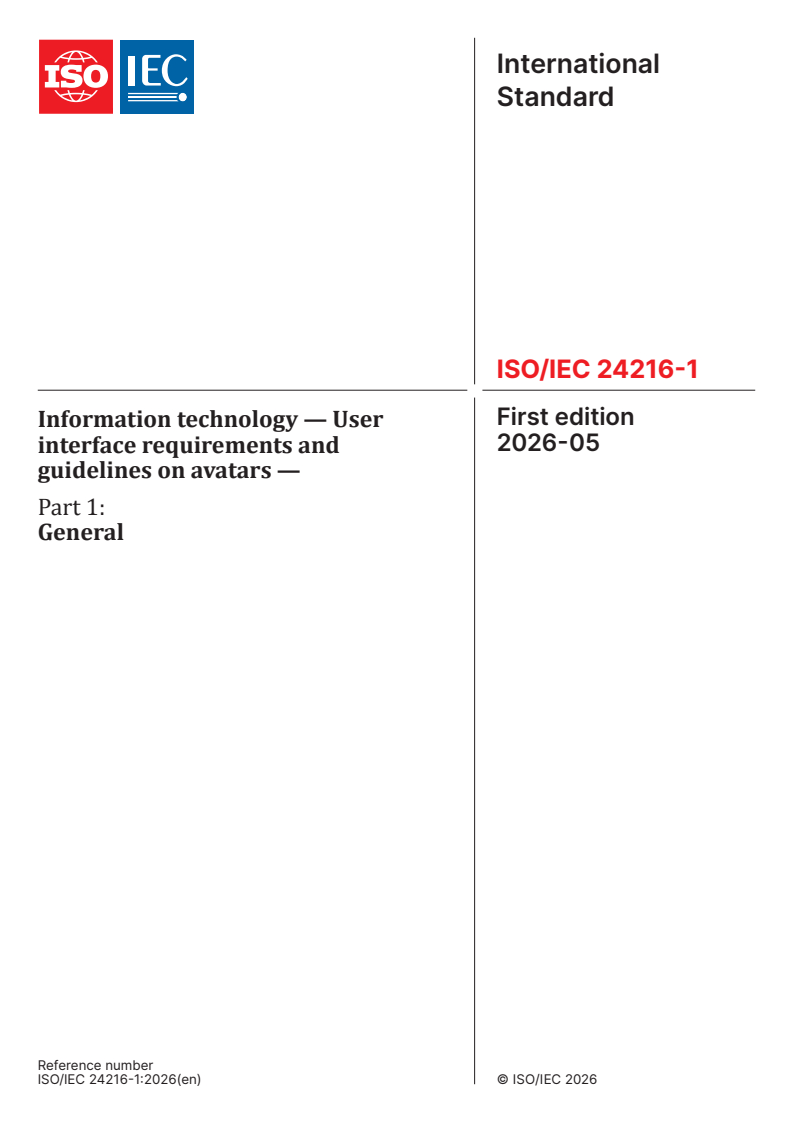
International
Standard
ISO/IEC 24216-1
First edition
Information technology — User
2026-05
interface requirements and
guidelines on avatars —
Part 1:
General
Reference number
© ISO/IEC 2026
All rights reserved. Unless otherwise specified, or required in the context of its implementation, no part of this publication may
be reproduced or utilized otherwise in any form or by any means, electronic or mechanical, including photocopying, or posting on
the internet or an intranet, without prior written permission. Permission can be requested from either ISO at the address below
or ISO’s member body in the country of the requester.
ISO copyright office
CP 401 • Ch. de Blandonnet 8
CH-1214 Vernier, Geneva
Phone: +41 22 749 01 11
Email: copyright@iso.org
Website: www.iso.org
Published in Switzerland
© ISO/IEC 2026 – All rights reserved
ii
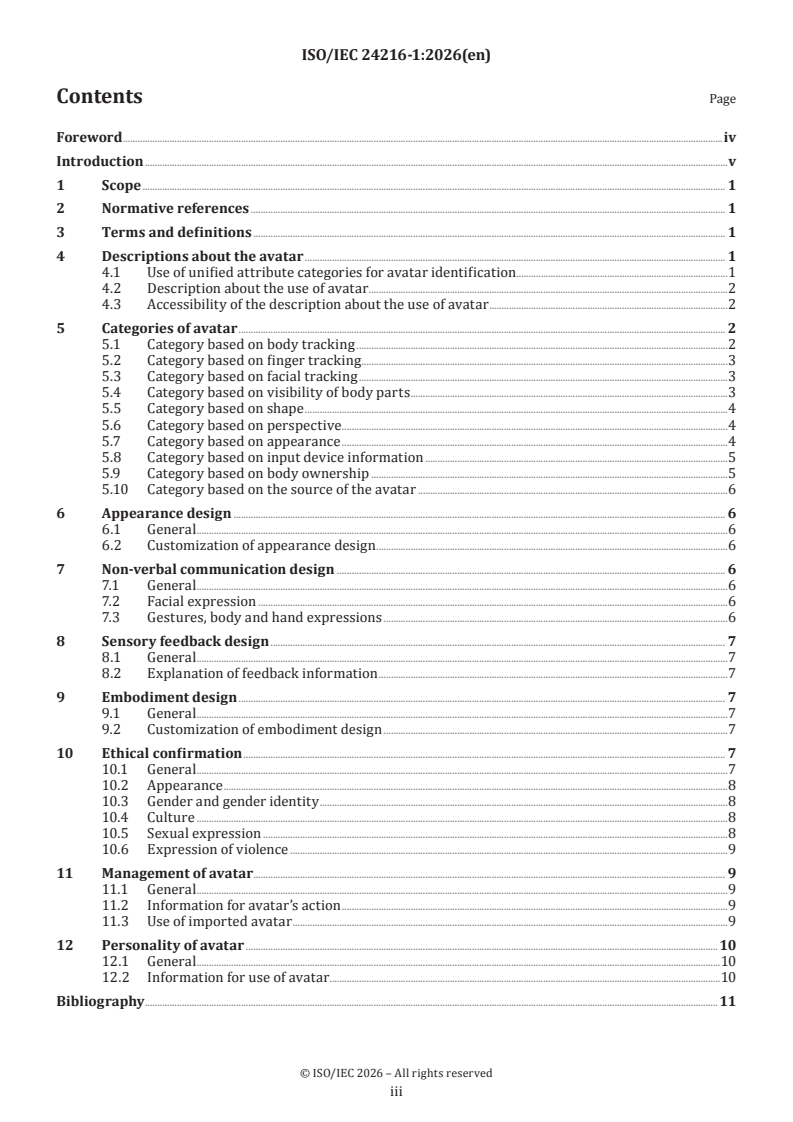
Contents Page
Foreword .iv
Introduction .v
1 Scope . 1
2 Normative references . 1
3 Terms and definitions . 1
4 Descriptions about the avatar . 1
4.1 Use of unified attribute categories for avatar identification .1
4.2 Description about the use of avatar .2
4.3 Accessibility of the description about the use of avatar .2
5 Categories of avatar . 2
5.1 Category based on body tracking .2
5.2 Category based on finger tracking . .3
5.3 Category based on facial tracking .3
5.4 Category based on visibility of body parts .3
5.5 Category based on shape .4
5.6 Category based on perspective .4
5.7 Category based on appearance .4
5.8 Category based on input device information .5
5.9 Category based on body ownership .5
5.10 Category based on the source of the avatar .6
6 Appearance design . 6
6.1 General .6
6.2 Customization of appearance design .6
7 Non-verbal communication design . 6
7.1 General .6
7.2 Facial expression .6
7.3 Gestures, body and hand expressions .6
8 Sensory feedback design . 7
8.1 General .7
8.2 Explanation of feedback information .7
9 Embodiment design . 7
9.1 General .7
9.2 Customization of embodiment design .7
10 Ethical confirmation . 7
10.1 General .7
10.2 Appearance .8
10.3 Gender and gender identity .8
10.4 Culture .8
10.5 Sexual expression .8
10.6 Expression of violence .9
11 Management of avatar. 9
11.1 General .9
11.2 Information for avatar’s action .9
11.3 Use of imported avatar .9
12 Personality of avatar .10
12.1 General .10
12.2 Information for use of avatar.10
Bibliography .11
© ISO/IEC 2026 – All rights reserved
iii
Foreword
ISO (the International Organization for Standardization) and IEC (the International Electrotechnical
Commission) form the specialized system for worldwide standardization. National bodies that are
members of ISO or IEC participate in the development of International Standards through technical
committees established by the respective organization to deal with particular fields of technical activity.
ISO and IEC technical committees collaborate in fields of mutual interest. Other international organizations,
governmental and non-governmental, in liaison with ISO and IEC, also take part in the work.
The procedures used to develop this document and those intended for its further maintenance are described
in the ISO/IEC Directives, Part 1. In particular, the different approval criteria needed for the different types
of documents should be noted. This document was drafted in accordance with the editorial rules of the ISO/
IEC Directives, Part 2 (see www.iso.org/directives or www.iec.ch/members_experts/refdocs).
ISO and IEC draw attention to the possibility that the implementation of this document may involve the
use of (a) patent(s). ISO and IEC take no position concerning the evidence, validity or applicability of any
claimed patent rights in respect thereof. As of the date of publication of this document, ISO and IEC had not
received notice of (a) patent(s) which may be required to implement this document. However, implementers
are cautioned that this may not represent the latest information, which may be obtained from the patent
database available at www.iso.org/patents and https://patents.iec.ch. ISO and IEC shall not be held
responsible for identifying any or all such patent rights.
Any trade name used in this document is information given for the convenience of users and does not
constitute an endorsement.
For an explanation of the voluntary nature of standards, the meaning of ISO specific terms and expressions
related to conformity assessment, as well as information about ISO's adherence to the World Trade
Organization (WTO) principles in the Technical Barriers to Trade (TBT) see www.iso.org/iso/foreword.html.
In the IEC, see www.iec.ch/understanding-standards.
This document was prepared by Joint Technical Committee ISO/IEC JTC 1, Information technology,
Subcommittee SC 35, User interfaces.
A list of all parts in the ISO/IEC 24216 series can be found on the ISO and IEC websites.
Any feedback or questions on this document should be directed to the user’s national standards
body. A complete listing of these bodies can be found at www.iso.org/members.html and
www.iec.ch/national-committees.
© ISO/IEC 2026 – All rights reserved
iv
Introduction
This document provides user interface guidelines on avatars, identification of avatars by categories of
presentation and functions about avatar user interfaces. The purpose of this document is to improve
accessibility and usability for both users and providers of contents using avatars by clarifying the terms and
design considerations of features and functions. This document contributes to the respect for diversity and
the prevention of human rights violations in the use of avatars. This document helps users appropriately
express their own identity through avatars and prevents them from being forced to use an unpreferred
avatar. This document helps prevent the problem of giving a negative image to avatars contrary to the
creator's intention.
In this document, requirements and recommendations are addressed by the data and functions of an avatar
itself, by the content using the avatar, or by the system or application that provides the content.
© ISO/IEC 2026 – All rights reserved
v
International Standard ISO/IEC 24216-1:2026(en)
Information technology — User interface requirements and
guidelines on avatars —
Part 1:
General
1 Scope
This document provides requirements and recommendations for creators, designers, producers, exhibitors
and distributors of user interfaces using avatars in their systems, applications and contents.
This document defines the term “avatar” and provides a categorization of avatars based on their presentation
and function.
This document also refers to considerations of ethical and usability aspects in the design, distribution and
operation processes of avatars.
This document applies to all fields of information technology that use avatars in their content, including
entertainment and business applications in virtual reality, augmented reality, mixed reality, cyber-physical
systems, metaverse and interverse.
2 Normative references
There are no normative references in this document.
3 Terms and definitions
For the purposes of this document, the following terms and definitions apply.
ISO and IEC maintain terminology databases for use in standardization at the following addresses:
— ISO Online browsing platform: available at https:// www .iso .org/ obp
— IEC Electropedia: available at https:// www .electropedia .org/
3.1
avatar
graphical object that represents a user
Note 1 to entry: An avatar does not necessarily resemble a human.
Note 2 to entry: An avatar may be based on a real-world object (e.g. tanks) or person (e.g. fictional superheroes).
Note 3 to entry: This definition excludes computer graphics characters that are automatically operated by computer
programs, such as non-player characters.
4 Descriptions about the avatar
4.1 Use of unified attribute categories for avatar identification
Avatars shall be identified by a combination of the categories of attributes defined in Clause 5.
© ISO/IEC 2026 – All rights reserved
The usability of an avatar and the user experience vary depending on the design of the avatar. For this
reason, the kind of avatar that is to be used by users should be clearly stated in advance. This does not apply
to general descriptions regarding avatars of all categories.
EXAMPLE
This content is experienced through avatars from the following categories:
— Body tracking: full-body (7);
— Finger tracking: finger-semi-tracking;
— Facial tracking: face-sync (eye, mouth);
— Visibility of body parts: whole body;
— Shape: deformed;
— Perspective: third person perspective (3PP);
— Appearance: anime-style;
— Input devices: controller, motion sensor, face sensor, microphone;
— Body ownership: another-self;
— Source of avatar: no-source.
4.2 Description about the use of avatar
Systems or applications that provide content using avatars shall inform users about the use of avatars prior
to use.
Systems or applications that provide content using avatars shall inform users about attribute categories for
avatars prior to use.
4.3 Accessibility of the description about the use of avatar
An explanation about the use of avatars shall be accessible to users.
The locations or sites where such descriptions are provided shall be accessible to users.
NOTE 1 ISO/IEC 20071 series provides information on accessible explanations.
NOTE 2 The description can be located somewhere outside the main system or application that the user can access
during the process of getting started. For example, it can be found in a content website that can be accessed via a link
on a screen that provides consent for use.
NOTE 3 ISO/IEC 20071 series outlines considerations for users for whom textual display is not accessible.
5 Categories of avatar
5.1 Category based on body tracking
A category based on body tracking should be distinguished as shown in Table 1.
© ISO/IEC 2026 – All rights reserved
...