

ISO 8616:2026
(Main)Specification of monitoring technology for karst critical zones
General Information
- Abstract
This document specifies requirements and provides guidance for the construction of monitoring stations of karst critical zones, the monitoring of processes (specific processes), the monitoring data collection and processing, and sharing and service of monitoring information. This document applies to karst critical zones of different types—differing in lithology, altitude, and climatic zones, and proper monitoring adjustment is allowed for different types.
- Status
- Published
- Publication Date
- 12-Apr-2026
- Technical Committee
- ISO/TC 319 - Karst
- Drafting Committee
- ISO/TC 319 - Karst
- Current Stage
- 6060 - International Standard published
- Start Date
- 13-Apr-2026
- Due Date
- 04-Feb-2027
- Completion Date
- 13-Apr-2026


Overview
ISO 8616:2026 - Specification of monitoring technology for karst critical zones - establishes comprehensive international requirements and guidance for the construction, operation, and management of monitoring stations in karst critical zones. The document also details the processes of monitoring key environmental parameters, data collection and processing, as well as mechanisms for sharing and serving monitoring information. ISO 8616:2026 addresses various types of karst areas, accounting for variability in lithology, altitude, and climatic conditions. The standard promotes adaptable monitoring strategies to suit different karst environments, supporting robust data-driven decisions for research and environmental management.
Key Topics
Construction of Monitoring Stations
- Guidelines for station layout: Emphasis on representativeness and demand-oriented approaches to ensure stations reflect typical karst features and serve distinct research goals.
- Different station types: Differentiation between node stations (for comprehensive monitoring) and backbone stations (focusing on key environmental indicators).
- Site selection criteria: Consideration of land suitability, meteorological and hydrological monitoring capabilities, and researcher support infrastructure.
- Maintenance and Management: Requirement for dedicated personnel for continuous operation, regular data collection, and comprehensive record-keeping.
Environmental Monitoring Processes
- Holistic monitoring: Systematic investigation and monitoring of soil, vegetation, rocks, and hydrological-meteorological elements.
- Specific monitoring applications: Focus on loss and leakage of soil and water, carbon-water-calcium cycling, carbon sink flux, and water environment dynamics.
- Process accuracy and continuity: Standardized, consistent, and regular monitoring cycles to ensure high-quality, comparable data.
Data Management and Processing
- Database construction: Centralized top-level monitoring database supports data standardization, massive storage, metadata, and compatibility with established GIS platforms.
- Data collection and storage: Secure real-time data transmission and centralized storage to uphold data integrity and accessibility.
- Data product classification: Distinction between basic, raw, and processed data products, including geographical, geological, meteorological, and analytical datasets.
- Quality assurance: Emphasis on standardized data quality evaluation systems and complete data audit trails.
Information Sharing and Service
- User rights classification: Secure sharing and access based on data confidentiality and user needs.
- Service provision: Online and offline data services through Web-based technologies, offering metadata retrieval, monitoring information access, and data analysis tools.
- System security: Comprehensive framework for information security, encompassing infrastructure and software measures, user permission control, regular system backups, and monitoring.
Applications
The implementation of ISO 8616:2026 is vital for:
- Scientific research: Supporting integrated, comparable studies of karst processes, hydrology, and geochemical cycles globally.
- Environmental management: Informing sustainable resource management, conservation practices, and climate adaptation strategies in karst regions.
- Policy development: Providing standardized methods and data-sharing infrastructure to support evidence-based policy and regulatory frameworks.
- Data interoperability: Enabling cross-institutional and international collaboration through standardized data formats, collection, and sharing protocols.
Organizations, research institutions, and government agencies involved in karst monitoring, geological/environmental studies, and sustainable resource management will benefit from adopting ISO 8616:2026.
Related Standards
For a comprehensive approach to monitoring and data management in karst environments, the following standards and guidelines may be relevant:
- GB/T 43216-2023: Chinese national standard which served as a reference for ISO 8616:2026.
- ISO/IEC directives: General rules for standards development and documentation.
- GIS data exchange standards: For geospatial data handling and sharing.
- ISO 19115: Geographic information - Metadata (for data documentation and interoperability).
Adhering to ISO 8616:2026 ensures a harmonized, high-quality approach to monitoring karst critical zones, ultimately advancing research, conservation, and sustainable management of these unique geological areas.
Frequently Asked Questions
ISO 8616:2026 is a standard published by the International Organization for Standardization (ISO). Its full title is "Specification of monitoring technology for karst critical zones". This standard covers: This document specifies requirements and provides guidance for the construction of monitoring stations of karst critical zones, the monitoring of processes (specific processes), the monitoring data collection and processing, and sharing and service of monitoring information. This document applies to karst critical zones of different types—differing in lithology, altitude, and climatic zones, and proper monitoring adjustment is allowed for different types.
This document specifies requirements and provides guidance for the construction of monitoring stations of karst critical zones, the monitoring of processes (specific processes), the monitoring data collection and processing, and sharing and service of monitoring information. This document applies to karst critical zones of different types—differing in lithology, altitude, and climatic zones, and proper monitoring adjustment is allowed for different types.
ISO 8616:2026 is classified under the following ICS (International Classification for Standards) categories: 07.060 - Geology. Meteorology. Hydrology. The ICS classification helps identify the subject area and facilitates finding related standards.
ISO 8616:2026 is available in PDF format for immediate download after purchase. The document can be added to your cart and obtained through the secure checkout process. Digital delivery ensures instant access to the complete standard document.
Standards Content (Sample)
International
Standard
ISO 8616
First edition
Specification of monitoring
2026-04
technology for karst critical zones
Reference number
© ISO 2026
All rights reserved. Unless otherwise specified, or required in the context of its implementation, no part of this publication may
be reproduced or utilized otherwise in any form or by any means, electronic or mechanical, including photocopying, or posting on
the internet or an intranet, without prior written permission. Permission can be requested from either ISO at the address below
or ISO’s member body in the country of the requester.
ISO copyright office
CP 401 • Ch. de Blandonnet 8
CH-1214 Vernier, Geneva
Phone: +41 22 749 01 11
Email: copyright@iso.org
Website: www.iso.org
Published in Switzerland
ii
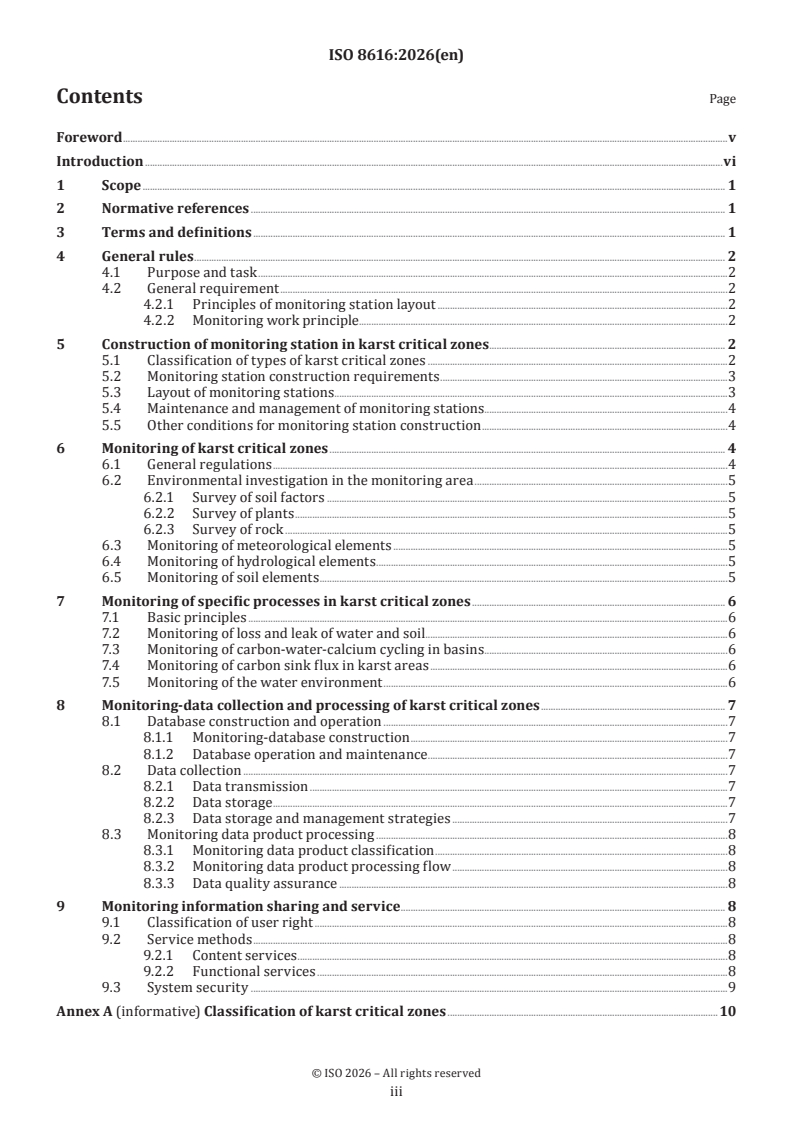
Contents Page
Foreword .v
Introduction .vi
1 Scope . 1
2 Normative references . 1
3 Terms and definitions . 1
4 General rules . 2
4.1 Purpose and task .2
4.2 General requirement .2
4.2.1 Principles of monitoring station layout .2
4.2.2 Monitoring work principle.2
5 Construction of monitoring station in karst critical zones . 2
5.1 Classification of types of karst critical zones .2
5.2 Monitoring station construction requirements .3
5.3 Layout of monitoring stations . .3
5.4 Maintenance and management of monitoring stations.4
5.5 Other conditions for monitoring station construction .4
6 Monitoring of karst critical zones .4
6.1 General regulations .4
6.2 Environmental investigation in the monitoring area .5
6.2.1 Survey of soil factors .5
6.2.2 Survey of plants .5
6.2.3 Survey of rock .5
6.3 Monitoring of meteorological elements .5
6.4 Monitoring of hydrological elements .5
6.5 Monitoring of soil elements .5
7 Monitoring of specific processes in karst critical zones . 6
7.1 Basic principles .6
7.2 Monitoring of loss and leak of water and soil.6
7.3 Monitoring of carbon-water-calcium cycling in basins .6
7.4 Monitoring of carbon sink flux in karst areas .6
7.5 Monitoring of the water environment .6
8 Monitoring-data collection and processing of karst critical zones .7
8.1 Database construction and operation .7
8.1.1 Monitoring-database construction .7
8.1.2 Database operation and maintenance .7
8.2 Data collection .7
8.2.1 Data transmission .7
8.2.2 Data storage .7
8.2.3 Data storage and management strategies .7
8.3 Monitoring data product processing .8
8.3.1 Monitoring data product classification .8
8.3.2 Monitoring data product processing flow .8
8.3.3 Data quality assurance .8
9 Monitoring information sharing and service . 8
9.1 Classification of user right .8
9.2 Service methods .8
9.2.1 Content services .8
9.2.2 Functional services .8
9.3 System security .9
Annex A (informative) Classification of karst critical zones .10
iii
Annex B (informative) Classification of survey and monitoring index of karst critical zone .12
Bibliography . 14
iv
Foreword
ISO (the International Organization for Standardization) is a worldwide federation of national standards
bodies (ISO member bodies). The work of preparing International Standards is normally carried out through
ISO technical committees. Each member body interested in a subject for which a technical committee
has been established has the right to be represented on that committee. International organizations,
governmental and non-governmental, in liaison with ISO, also take part in the work. ISO collaborates closely
with the International Electrotechnical Commission (IEC) on all matters of electrotechnical standardization.
The procedures used to develop this document and those intended for its further maintenance are described
in the ISO/IEC Directives, Part 1. In particular, the different approval criteria needed for the different types
of ISO document should be noted. This document was drafted in accordance with the editorial rules of the
ISO/IEC Directives, Part 2 (see www.iso.org/directives).
ISO draws attention to the possibility that the implementation of this document may involve the use of (a)
patent(s). ISO takes no position concerning the evidence, validity or applicability of any claimed patent
rights in respect thereof. As of the date of publication of this document, ISO had not received notice of (a)
patent(s) which may be required to implement this document. However, implementers are cautioned that
this may not represent the latest information, which may be obtained from the patent database available at
www.iso.org/patents. ISO shall not be held responsible for identifying any or all such patent rights.
Any trade name used in this document is information given for the convenience of users and does not
constitute an endorsement.
For an explanation of the voluntary nature of standards, the meaning of ISO specific terms and expressions
related to conformity assessment, as well as information about ISO's adherence to the World Trade
Organization (WTO) principles in the Technical Barriers to Trade (TBT), see www.iso.org/iso/foreword.html.
This document was prepared by Technical Committee ISO/TC 319, Karst.
Any feedback or questions on this document should be directed to the user’s national standards body. A
complete listing of these bodies can be found at www.iso.org/members.html.
v
Introduction
The karst critical zones on earth stand out with their distinct structures and marked features due to their
typical ground morphology, geological structure, and special physical, chemical, and biological processes.
These characteristics contribute to prominent problems of various types. Current research on critical zones
has not yet extended to karst areas.
This document aims to inform the monitoring of karst critical zones and the development of data-sharing
standards through the classification of karst critical zones and construction of a world-level monitoring
station network for karst critical zones. Based on previous geological surveys and monitoring achievements,
Chinese national standard GB/T 43216-2023 was published.
vi
International Standard ISO 8616:2026(en)
Specification of monitoring technology for karst critical zones
1 Scope
This document specifies requirements and provides guidance for the construction of monitoring stations
of karst critical zones, the monitoring of processes (specific processes), the monitoring data collection and
processing, and sharing and service of monitoring information.
This document applies to karst critical zones of different types—differing in lithology, altitude, and climatic
zones, and proper monitoring adjustment is allowed for different types.
2 Normative references
There are no normative references in this document.
3 Terms and definitions
For the purposes of this document, the following terms and definitions apply.
ISO and IEC maintain terminology databases for use in standardization at the following addresses:
— ISO Online browsing platform: available at https:// www .iso .org/ obp
— IEC Electropedia: available at https:// www .electropedia .org/
3.1
critical zone
zones where different spheres interact, which expand from the forest canopy and soil to aquifers
Note 1 to entry: The different surfaces spheres that can interact include the lithosphere, pedosphere, biosphere,
hydrosphere, and atmosphere.
Note 2 to entry: The weathering crust stands as a major critical zone, where weathering and pedogenesis of rocks
make a great difference in the control of surface habitats, transformation of landforms of the earth, and maintenance
of living resources through critical physical, chemical, and biological processes.
3.2
karst critical zone
critical zones (3.1) in karst areas share distinct structures and marked features (large thickness, strong
heterogeneity, and extensive and diverse fauna and flora) due to the geological structure and special
physical, chemical, and biological processes, and confront resource and environment problems
3.3
node station
holistic monitoring site covering all monitoring indicators in different karst critical zones (3.2)
3.4
backbone station
representative site for systematic monitoring with the characteristic index included in Annex B
3.5
mapping, monitoring and modelling system
3M system
critical zone (3.2) research following the technical route of mapping, monitoring and modelling (3M)
4 General rules
4.1 Purpose and task
The purpose of karst critical zone monitoring work is to capture the interaction of hydrological processes,
geochemical processes and biological processes in karst critical zones, thus understanding the difference
between karst critical zone structures and the evolution trend of karst environment and solving the
resource and environment problems in karst areas, while in service of the correlation study of global karst
critical zones.
4.2 General requirement
4.2.1 Principles of monitoring station layout
4.2.1.1 Representativeness principle
The layout of node stations should meet the recommendation of typical structure characteristics of the karst
critical zone in the karst system where the monitoring work is located. The layout of backbone stations
should meet the recommendation of single significant characteristics such as karst form and hydrodynamic
condition of karst critical zones in the karst system where the monitoring work is located.
4.2.1.2 Demand-oriented principle
At least one special target should be set for a monitoring station. Monitoring stations that serve the
comparison between karst critical zones across the world should work for one basic target of understanding
hydrodynamic processes under different karst morphologies and its driving the formation of karst.
Monitoring stations at the regional level should get involved in the overall pursuit of knowledge of the trend
of evolution of local ecological environment. This requires a specific research target to be set following
regional climate and human activity.
4.2.2 Monitoring work principle
4.2.2.1 Continuity principle
The monitoring work should be continuous in time, and the monitoring cycle can be divided into monthly,
seasonal and annual monitoring.
4.2.2.2 Accuracy principle
The monitoring should be accurate, and the accuracy of the monitoring data should be achieved through
data verification and parallel monitoring.
4.2.2.3 Standardization principle
The data obtained from monitoring should be standardized to facilitate subsequent data processing and
calculation.
5 Construction of monitoring station in karst critical zones
5.1 Classification of types of karst critical zones
According to the climate, the karst critical zones are divided into seven categories:
— humid tropical karst;
— humid subtropical karst;
— temperate humid karst;
— arid and semi-arid karst;
— Mediterranean karst;
— polar and alpine mountain karst;
— glaciokarst.
The main distribution areas and development characteristics of the global karst critical zones are
demonstrated in Annex A.
5.2 Monitoring station construction requirements
In the typical distribution area (see Annex A), a representative watershed should be selected to establish a
node station. The representative watershed should cover a relatively complete hydrological system. In the
same subclass, a representative watershed with a prominent environmental problem characteristic index
in karst critical zones should be selected to establish the backbone station. The hydrologic system should
be able to reflect the dynamic process of water circulation and transformation, and the size is not specified.
In arid areas, the monitoring stations should focus on the influence of the precipitation recharge process
and groundwater exploitation activities on the system. The monitoring stations in the humid area focus on
the process of runoff and drainage, and the process of ice and snow recharge in the alpine area.
The monitoring station should clarify the input and output process of substances and should be combined
with the existing hydrological and meteorological monitoring station. For the system with no identified
boundary or facing difficulty in measuring the quantity of discharge and extraction, it is not recommended
to be used as a monitoring station. A system should have a definite physical structure, identified major
aquifer system and hydrogeological parameters.
The monitoring station should have the capacity to meet continuous monitoring, including water and
electricity facilities, waterproof and sunscreen facilities, monitoring instrument maintenance, monitoring
process tracking and data transmission.
5.3 Layout of monitoring stations
Based on research achievements, the monitoring system with stations should be set up according to the
type of karst critical zones. At least the following karst types should be included in the plan of layout of node
stations:
— Southern China;
— Southeast Asia;
— North China and East Asia;
— Zagros Mountain of Iran;
— Central Asia and Ural;
— Balkan Peninsula;
— Dinaric karst;
— European Alps;
— North Sahara in Africa;
— Australia;
— Great Lakes Region in North America;
— Sinkhole plain in North America and Gulf of Mexico.
To reflect different requirements on station monitoring, both node stations for comprehensive monitoring
and backbone stations to highlight single environmental factors should be set up and complement each
other. Node stations should precede backbone stations in construction. Backbone stations are potentially
not necessary if node stations fulfil all requirements. The principle of operability and problem-oriented
construction also applies to backbone stations, but the principle of representation is not mandatory.
5.4 Maintenance and management of monitoring stations
Staff should be designated to maintain and manage monitoring stations; special funds should be created for
each station; data should be managed by special staff.
At least one management staff should be designated for the maintenance of instruments and collection
of data to ensure that data can be continuously received. Sufficient funds should be provided for each
monitoring station to su
...