

ISO 4948-1:1982
(Main)Steels — Classification — Part 1: Classification of steels into unalloyed and alloy steels based on chemical composition
General Information
- Abstract
This part of ISO 4948 defines steel and gives 2.0 % carbon as the usual dividing line between steel and cast iron. The classification based on the specified values for the ladle analyses of the elements given in the table.
- Status
- Published
- Publication Date
- 31-May-1982
- Technical Committee
- ISO/TC 17 - Steel
- Drafting Committee
- ISO/TC 17 - Steel
- Current Stage
- 9092 - International Standard to be revised
- Start Date
- 09-Jan-2025
- Completion Date
- 29-Aug-2026
Buy Documents

ISO 4948-1:1982 - Steels — Classification — Part 1: Classification of steels into unalloyed and alloy steels based on chemical composition Released:6/1/1982

ISO 4948-1:1982 - Aciers — Classification — Partie 1: Classification en aciers alliés et en aciers non alliés basée sur la composition chimique Released:6/1/1982

ISO 4948-1:1982 - Aciers — Classification — Partie 1: Classification en aciers alliés et en aciers non alliés basée sur la composition chimique Released:6/1/1982
Overview
ISO 4948-1:1982 is an internationally recognized standard published by the International Organization for Standardization (ISO) that establishes a systematic classification of steels based on their chemical composition. This part of the ISO 4948 series specifically differentiates between unalloyed (plain carbon) and alloy steels. The classification framework hinges on the chemical element content determined by ladle analysis, with a critical threshold of 2.0% carbon content serving as the dividing line between steel and cast iron.
This standard is vital for steel producers, metallurgists, engineers, and quality control professionals seeking to ensure consistent categorization, labeling, and specification of steels in manufacturing, procurement, and research worldwide.
Key Topics
Definition of Steel
Steel is defined as a material predominantly composed of iron, with carbon content generally less than 2.0%. Certain chromium steels may exceed this carbon limit but 2.0% remains the practical dividing point from cast iron.Classification Criteria
Steels are classified into two primary categories:- Unalloyed (Non-Alloy) Steels: Contain chemical elements below specified threshold values (e.g., carbon, manganese, silicon, chromium, nickel).
- Alloy Steels: Have one or more alloying element concentrations equal to or above specified limits which influence mechanical and physical properties.
Chemical Composition Limits
The standard sets precise limits for various elements such as:- Carbon (C) - below 2.0% for steel
- Manganese (Mn) - typically max 1.65% for non-alloy steels, 1.80% max when only a maximum is specified
- Chromium (Cr) - 0.30%
- Nickel (Ni) - 0.30%
- Molybdenum (Mo), Vanadium (V), Titanium (Ti), and others are defined with specific thresholds to separate alloy steels.
Elements like bismuth, lead, selenium, tellurium, and lanthanides require special consideration and usually are excluded from basic alloy/non-alloy tariff classifications.
Use of Ladle Analysis
Classification relies on ladle analysis values from the melt rather than final product tests, establishing a consistent and industry-standard approach to steel designation.Handling Variations
The standard allows for classification adjustments if product inspection data significantly deviates from ladle analyses, requiring validation to maintain class designation integrity.
Applications
Industrial Steel Manufacturing
ISO 4948-1 ensures a uniform classification system, helping manufacturers specify and control steel grades during production planning and quality assurance.Material Procurement and Supply Chain
Enables purchasers and suppliers globally to communicate clearly about steel types, avoiding ambiguity and ensuring compliance with technical requirements.Metallurgical Research
Facilitates comparison of steels based on composition, supporting development of new steel grades and improving material properties through controlled alloying.Standards Compliance and Certification
Assists regulatory bodies and certification agencies in verifying steel classifications for construction, automotive, aerospace, and machinery applications where material standards are critical.
Related Standards
- ISO 4948-2 – Classification of alloy and non-alloy steels based on main quality classes and principal property or application characteristics.
- ISO 657 – Steel grades and designation.
- ISO 683 series – Heat-treatable and alloy steels specifications.
- EN 10027-1 – Designation systems for steels – Part 1: Steel names.
- ASTM A6/A6M – Standard Specification for General Requirements for Rolled Structural Steel Bars, Plates, Shapes, and Sheet Piling.
Summary
ISO 4948-1:1982 is a foundational international standard that provides a clear and scientifically grounded method to classify steels into unalloyed and alloy categories based on chemical composition analysis. Its application improves product consistency, industry communication, and material traceability across the global steel manufacturing and supply chain sectors. Adherence to this classification standard supports quality control and ensures materials meet specified mechanical properties and performance criteria.
Keywords: ISO 4948-1, steel classification, alloy steels, unalloyed steels, chemical composition, ladle analysis, carbon content, steel standard, ISO steel classification, metallurgical standards.
Relations
- Effective Date
- 25-Aug-2026
- Effective Date
- 25-Aug-2026
- Effective Date
- 25-Aug-2026
- Effective Date
- 25-Aug-2026
- Effective Date
- 25-Aug-2026
- Effective Date
- 25-Aug-2026
- Effective Date
- 25-Aug-2026
- Effective Date
- 25-Aug-2026
- Effective Date
- 25-Aug-2026
- Effective Date
- 25-Aug-2026
- Effective Date
- 25-Aug-2026
- Effective Date
- 25-Aug-2026
- Effective Date
- 25-Aug-2026
- Effective Date
- 25-Aug-2026
- Effective Date
- 25-Aug-2026
Buy Documents
ISO 4948-1:1982 - Steels — Classification — Part 1: Classification of steels into unalloyed and alloy steels based on chemical composition Released:6/1/1982
ISO 4948-1:1982 - Aciers — Classification — Partie 1: Classification en aciers alliés et en aciers non alliés basée sur la composition chimique Released:6/1/1982
ISO 4948-1:1982 - Aciers — Classification — Partie 1: Classification en aciers alliés et en aciers non alliés basée sur la composition chimique Released:6/1/1982
Get Certified
Connect with accredited certification bodies for this standard

Element Materials Technology
Materials testing and product certification.

Inštitut za kovinske materiale in tehnologije
Institute of Metals and Technology. Materials testing, metallurgical analysis, NDT.
Sponsored listings
Frequently Asked Questions
ISO 4948-1:1982 is a standard published by the International Organization for Standardization (ISO). Its full title is "Steels — Classification — Part 1: Classification of steels into unalloyed and alloy steels based on chemical composition". This standard covers: This part of ISO 4948 defines steel and gives 2.0 % carbon as the usual dividing line between steel and cast iron. The classification based on the specified values for the ladle analyses of the elements given in the table.
This part of ISO 4948 defines steel and gives 2.0 % carbon as the usual dividing line between steel and cast iron. The classification based on the specified values for the ladle analyses of the elements given in the table.
ISO 4948-1:1982 is classified under the following ICS (International Classification for Standards) categories: 77.080.20 - Steels. The ICS classification helps identify the subject area and facilitates finding related standards.
ISO 4948-1:1982 has the following relationships with other standards: It is inter standard links to EN ISO 4957:2018, EN ISO 16120-4:2011, EN ISO 683-4:2018, EN ISO 683-3:2019, EN ISO 4957:1999, EN ISO 683-17:2023, EN ISO 16120-2:2011, EN ISO 13680:2010, EN ISO 683-17:2014, EN ISO 683-5:2021, EN ISO 16120-1:2011, EN ISO 13680:2020, EN ISO 683-7:2024, EN ISO 683-3:2018, EN ISO 683-1:2018. Understanding these relationships helps ensure you are using the most current and applicable version of the standard.
ISO 4948-1:1982 is available in PDF format for immediate download after purchase. The document can be added to your cart and obtained through the secure checkout process. Digital delivery ensures instant access to the complete standard document.
Standards Content (Sample)
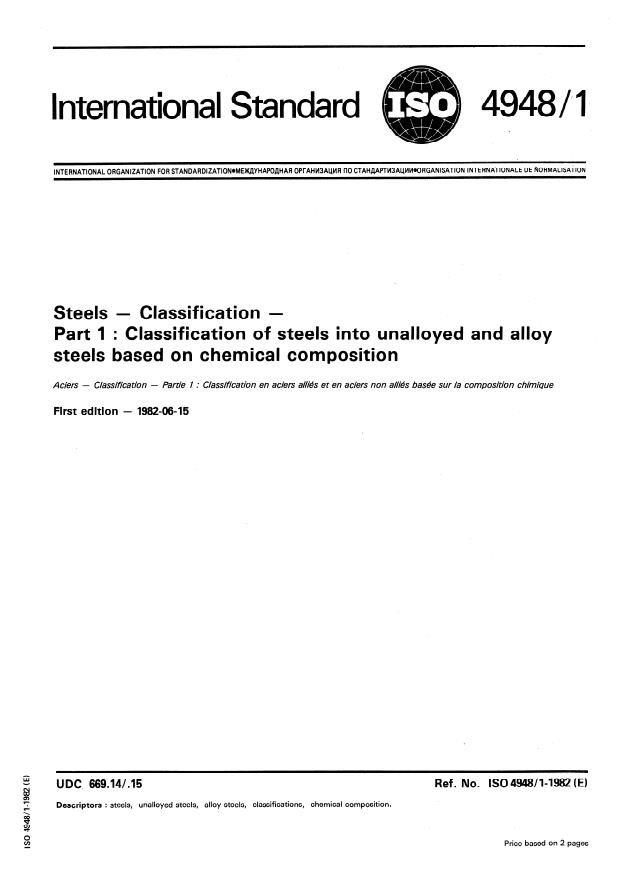
4948/1,
International Standard
INTERNATIONAL ORGANIZATION FOR STANDARDIZATION.ME)I(LZYHAPO~HAR OPrAHM3AuMR I-IO CTAH~PTbl3A~lMWORGANISATION INTERNATIONALE DE ~ORMALISA~ION
Steels - Classification -
Part 1 : Classification of steels into unalloyed and alloy
steels based on Chemical composition
Aciers -
Classifica tion - Partie 1 : Classification en aciers alt& et en aciers non alli& bade sur Ia composition chimique
First edition - 1982-06-15
UDC, 669.14/.15 Ref. No. ISO 4948/1-1982 (EI
Descriptors : steeis, unalloyed steels, alloy steels, classifications, Chemical composition.
Price based on 2 pages
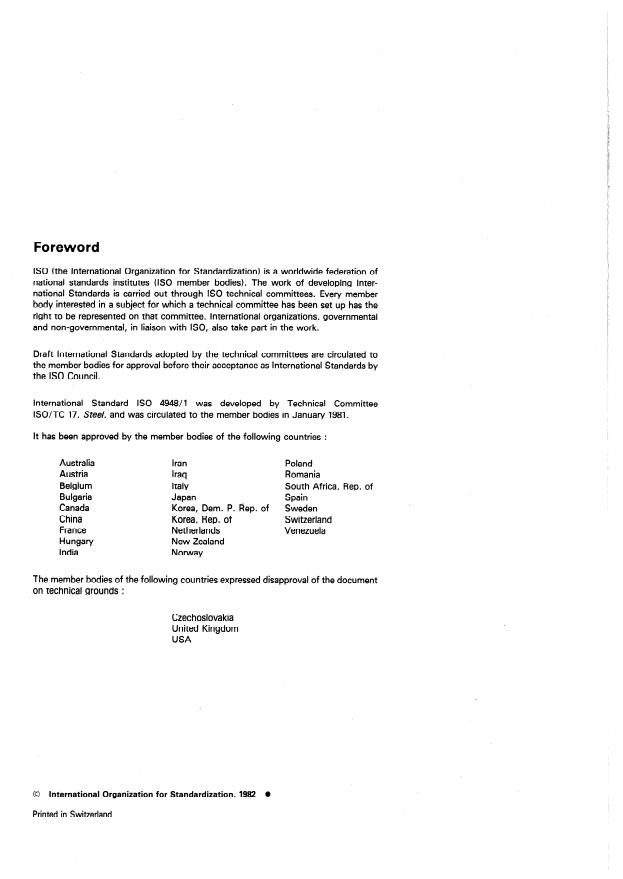
Foreword
ISO (the International Organization for Standardization) is a worldwide federation of
national Standards institutes (ISO member bedies). The work of developing Inter-
national Standards is carried out through ISO technical committees. Every member
body interested in a subject for which a technical committee has been set up has the
right to be represented on that committee. International organizations, governmental
and non-governmental, in liaison with ISO, also take part in the work.
Draft International Standards adopted by the technical committees are circulated to
the member bodies for approval before their acceptance as International Standards by
the ISO Council.
International Standard ISO 494811 was developed by Technical Committee
ISO/TC 17, Steel, and was circulated to the member bodies in January 1981.
lt has been approved by the member bodies of the following countries :
Australia Iran Poland
Romania
Austria Iraq
Italy South Africa, Rep. of
Belgium
Bulgaria Japan Spain
Sweden
Canada Korea, Dem. P. Rep. of
Switzerland
China Korea, Rep. of
France Netherlands Venezuela
Hungary New Zealand
Norway
India
The member bodies of following countries expressed d isapproval of the docu
on technical grounds :
Czechoslovakia
United Kingdom
USA
0 International Organkation for Standardkation, 1982 0
Printed in Switzerland
-
y>
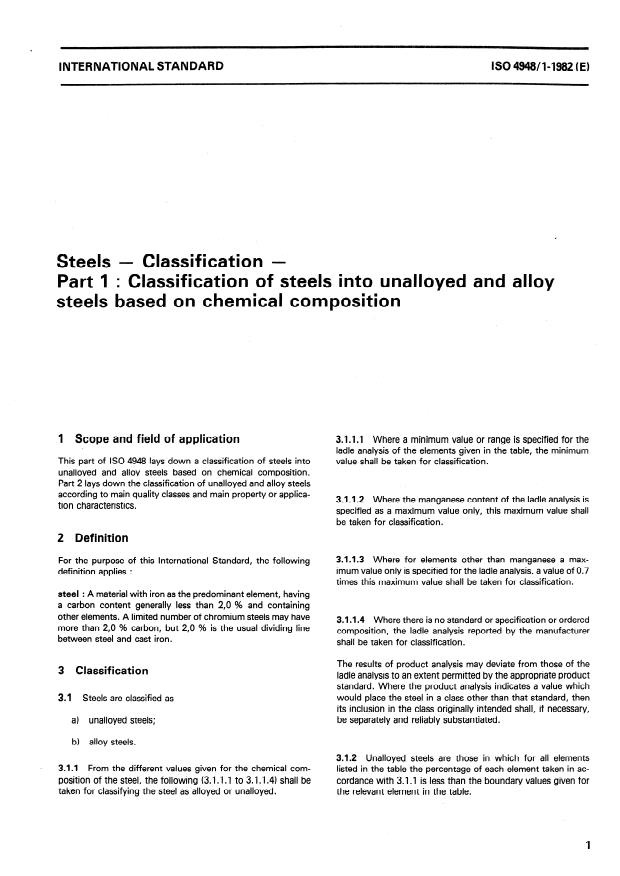
INTERNATIONAL STANDARD ISO 4948/1-1982 (E)
Classification -
Steels -
Iloyed and alloy
Part 1 : Classification of steels into un
steels based on Chemical composition
1 Scope and field of application 3.1.1 .I Where a minimum value or range is specified for the
ladle analysis of the elements given in the table, the minimum
This part of ISO 4948 lays down a classification of steels into value shall be taken for classification.
unalloyed and alloy steels based on Chemical composition.
Part 2 lays down the classification of unalloyed and alloy steels
according to main quality classes and main property or applica-
3.1.1.2 Where the manganese content of the ladle analysis is
tion characteristics.
specified as a maximum value only, t
...
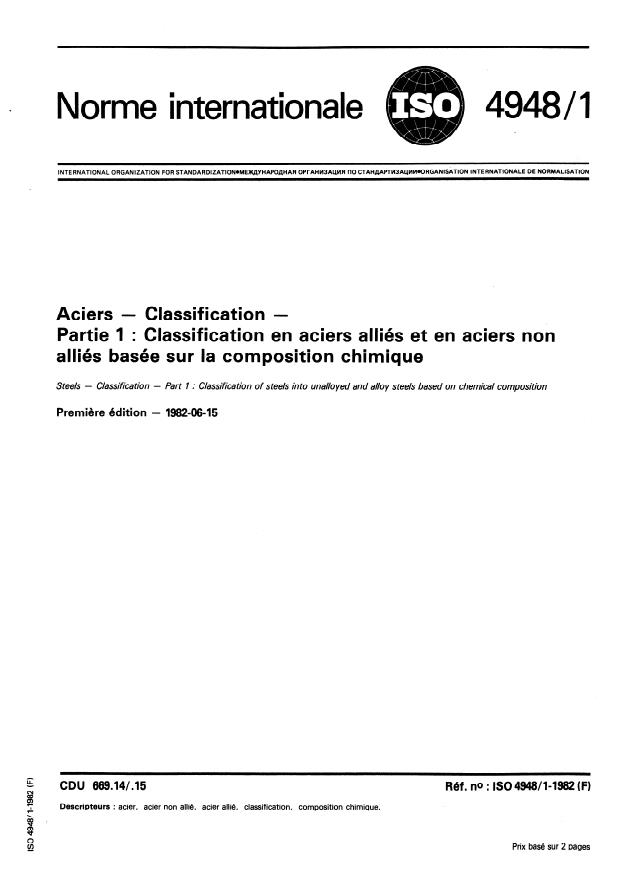
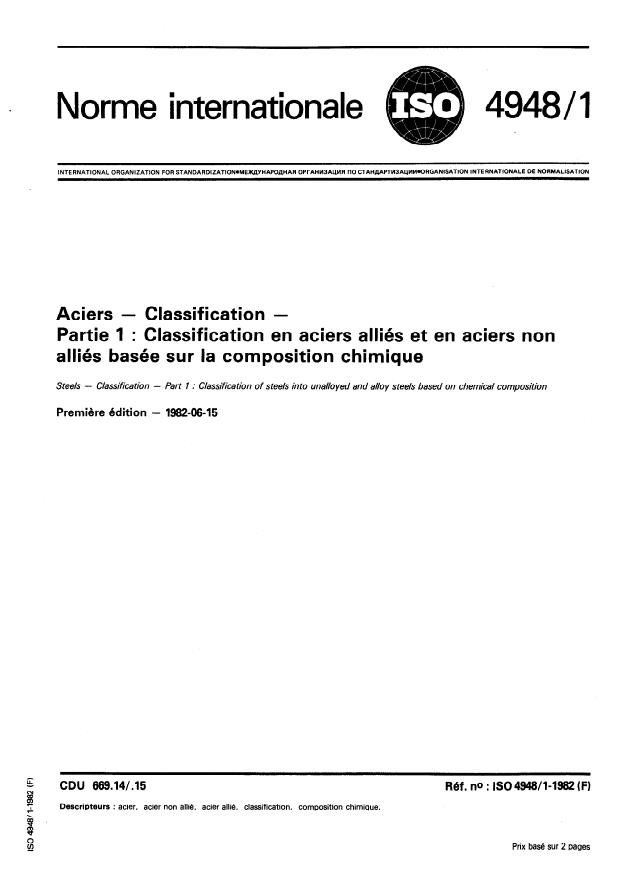
Norme internationale
INTERNATIONAL ORGANIZATION FOR STANDARDIZATIONWbIE~YHAPO~HAR OPTAHH3Al&lfl Il0 CTAH&WTM3Al@WORGANlS~TlON INTERNATIONALE DE NORMALISATION
Aciers - Classification -
Partie 1 : Classification en aciers alliés et en aciers non
alliés basée sur la composition chimique
Steels - Classifiea tion - Part 1 : Classification of steels into unalo yed and allo y steels based on chemical composition
Première édition - 1962-06-15
iî
Y
CDU 669.14/.15
Réf. no : ISO 4948/1-1962 (FI
cv
4:
I Descripteurs : acier, acier non allié, acier allié, classification, composition chimique.
F-
\
3 ’
%
53 Prix basé sur 2 pages
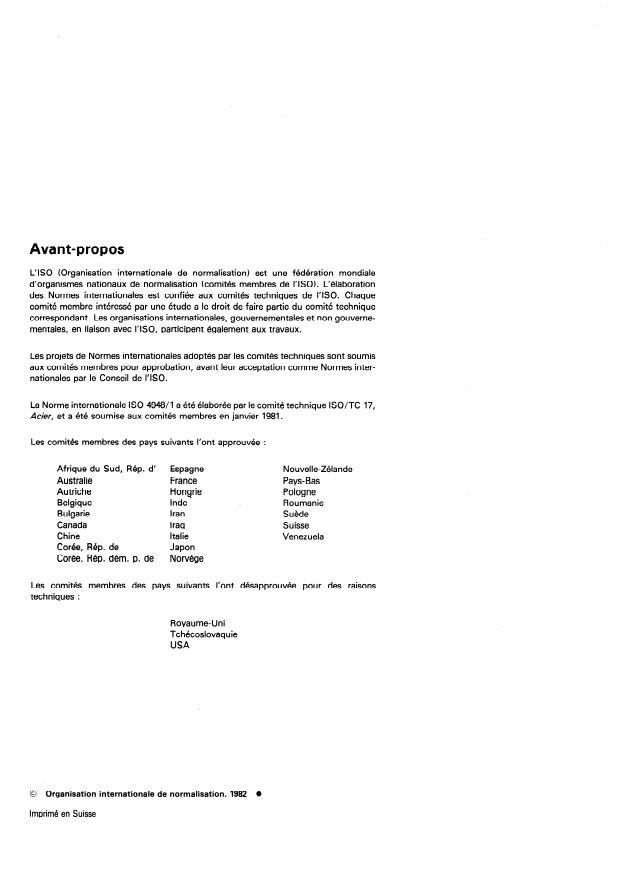
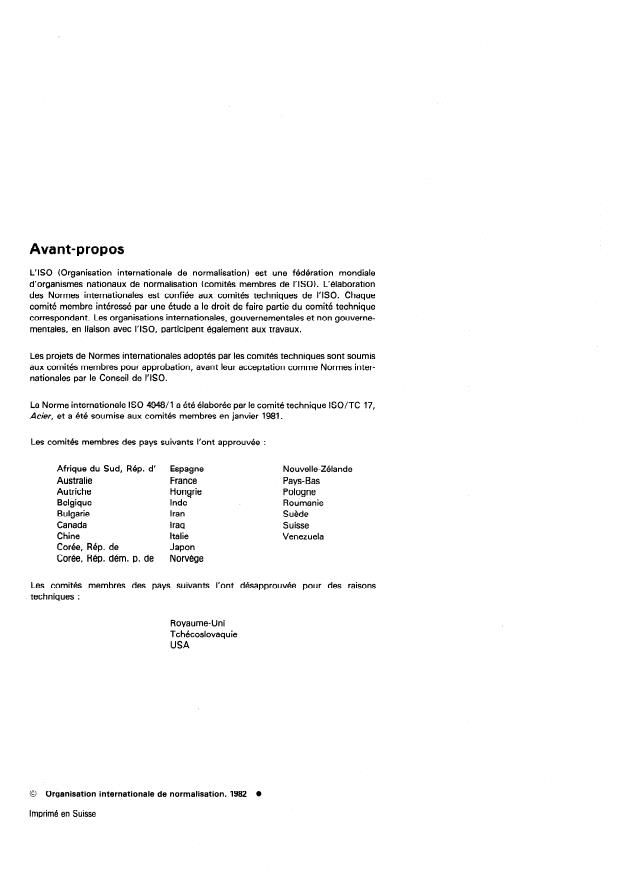
Avant-propos
L’ISO (Organisation internationale de normalisation) est une fédération mondiale
d’organismes nationaux de normalisation (comités membres de I’ISO). L’élaboration
des Normes internationales est confiée aux comités techniques de I’ISO. Chaque
comité membre intéressé par une étude a le droit de faire partie du comité technique
correspondant. Les organisations internationales, gouvernementales et non gouverne-
mentales, en liaison avec I’ISO, participent également aux travaux.
Les projets de Normes internationales adoptés par les comités techniques sont soumis
aux comités membres pour approbation, avant leur acceptation comme Normes inter-
nationales par le Conseil de I’ISO.
La Norme internationale ISO 4948/1 a été élaborée par le comité technique ISO/TC 17,
Acier, et a été soumise aux comités membres en janvier 1981.
Les comités membres des pays suivants l’ont approuvée :
Afrique du Sud, Rép. d’ Espagne Nouvelle-Zélande
Australie France Pays-Bas
Autriche Hongrie Pologne
Belgique Inde ’
Roumanie
Bulgarie Iran Suéde
Canada Iraq Suisse
Chine Italie
Venezuela
Corée, Rép. de Japon
Corée, Rép. dem. p. de
Norvège
Les comités membres des pays suivants l’ont désapprouvée pour des raisons
techniques :
Royaume-Uni
Tchécoslovaquie
USA
@ Organisation internationale de normalisation, 1982 0
Imprimé en Suisse
ISO 4948/1-1982 (F)
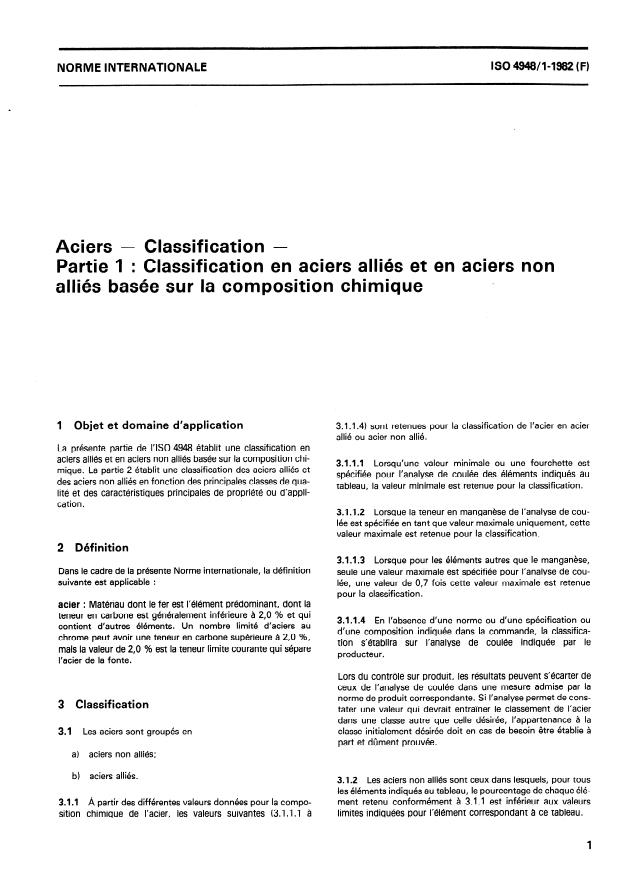
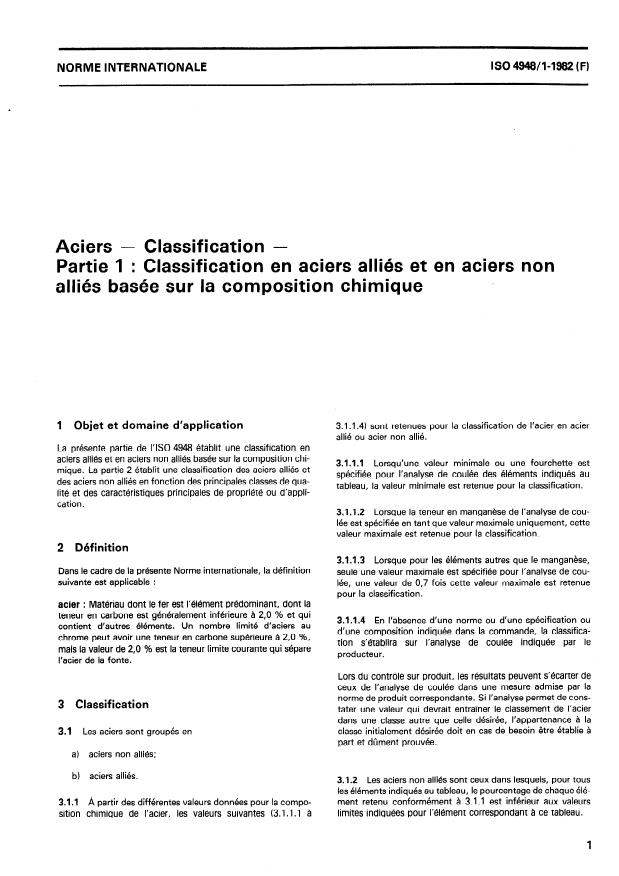
NORME INTERNATIONALE
Classification -
Aciers -
Partie 1 : Classification en aciers alliés et en aciers non
alliés basée sur la composition chimique
1 Objet et domaine d’application 3.1 .1.4) sont retenues pour la classification de l’acier en acier
allié ou acier non allié.
La présente partie de I’ISO 4948 établit une classification en
aciers alliés et en aciers non alliés basée sur la composition chi-
3.1.1.1 Lorsqu’une valeur minimale ou une fourchette est
mique. La partie 2 établit une classification des aciers alliés et
spécifiée pour l’analyse de coulée des éléments indiqués au
des aciers non alliés en fonction des principales classes de qua-
tableau, la valeur minimale est retenue pour la classification.
lité et des caractéristiques principales de propriété ou d’appli-
cation.
3.1.1.2 Lorsque la teneur en manganèse de l’analyse de cou-
lée est spécifiée en tant que valeur maxi
...
Norme internationale
INTERNATIONAL ORGANIZATION FOR STANDARDIZATIONWbIE~YHAPO~HAR OPTAHH3Al&lfl Il0 CTAH&WTM3Al@WORGANlS~TlON INTERNATIONALE DE NORMALISATION
Aciers - Classification -
Partie 1 : Classification en aciers alliés et en aciers non
alliés basée sur la composition chimique
Steels - Classifiea tion - Part 1 : Classification of steels into unalo yed and allo y steels based on chemical composition
Première édition - 1962-06-15
iî
Y
CDU 669.14/.15
Réf. no : ISO 4948/1-1962 (FI
cv
4:
I Descripteurs : acier, acier non allié, acier allié, classification, composition chimique.
F-
\
3 ’
%
53 Prix basé sur 2 pages
Avant-propos
L’ISO (Organisation internationale de normalisation) est une fédération mondiale
d’organismes nationaux de normalisation (comités membres de I’ISO). L’élaboration
des Normes internationales est confiée aux comités techniques de I’ISO. Chaque
comité membre intéressé par une étude a le droit de faire partie du comité technique
correspondant. Les organisations internationales, gouvernementales et non gouverne-
mentales, en liaison avec I’ISO, participent également aux travaux.
Les projets de Normes internationales adoptés par les comités techniques sont soumis
aux comités membres pour approbation, avant leur acceptation comme Normes inter-
nationales par le Conseil de I’ISO.
La Norme internationale ISO 4948/1 a été élaborée par le comité technique ISO/TC 17,
Acier, et a été soumise aux comités membres en janvier 1981.
Les comités membres des pays suivants l’ont approuvée :
Afrique du Sud, Rép. d’ Espagne Nouvelle-Zélande
Australie France Pays-Bas
Autriche Hongrie Pologne
Belgique Inde ’
Roumanie
Bulgarie Iran Suéde
Canada Iraq Suisse
Chine Italie
Venezuela
Corée, Rép. de Japon
Corée, Rép. dem. p. de
Norvège
Les comités membres des pays suivants l’ont désapprouvée pour des raisons
techniques :
Royaume-Uni
Tchécoslovaquie
USA
@ Organisation internationale de normalisation, 1982 0
Imprimé en Suisse
ISO 4948/1-1982 (F)
NORME INTERNATIONALE
Classification -
Aciers -
Partie 1 : Classification en aciers alliés et en aciers non
alliés basée sur la composition chimique
1 Objet et domaine d’application 3.1 .1.4) sont retenues pour la classification de l’acier en acier
allié ou acier non allié.
La présente partie de I’ISO 4948 établit une classification en
aciers alliés et en aciers non alliés basée sur la composition chi-
3.1.1.1 Lorsqu’une valeur minimale ou une fourchette est
mique. La partie 2 établit une classification des aciers alliés et
spécifiée pour l’analyse de coulée des éléments indiqués au
des aciers non alliés en fonction des principales classes de qua-
tableau, la valeur minimale est retenue pour la classification.
lité et des caractéristiques principales de propriété ou d’appli-
cation.
3.1.1.2 Lorsque la teneur en manganèse de l’analyse de cou-
lée est spécifiée en tant que valeur maxi
...