

ISO 17132:2007
(Main)Paints and varnishes — T-bend test
General Information
- Abstract
ISO 17132:2007 describes a method of evaluating the flexibility and adhesion of an organic coating on a metallic substrate by observing the cracking or loss of adhesion when a coated test panel is bent. The method can be used to confirm whether paints, varnishes or related products meet a given test requirement in a pass/fail test, or to determine the minimum bending diameter at which cracking does not occur.
- Status
- Published
- Publication Date
- 30-Sep-2007
- Technical Committee
- ISO/TC 35/SC 9 - General test methods for paints and varnishes
- Drafting Committee
- ISO/TC 35/SC 9/WG 31 - Properties after application
- Current Stage
- 9093 - International Standard confirmed
- Start Date
- 01-Nov-2021
- Completion Date
- 29-Aug-2026
Buy Documents
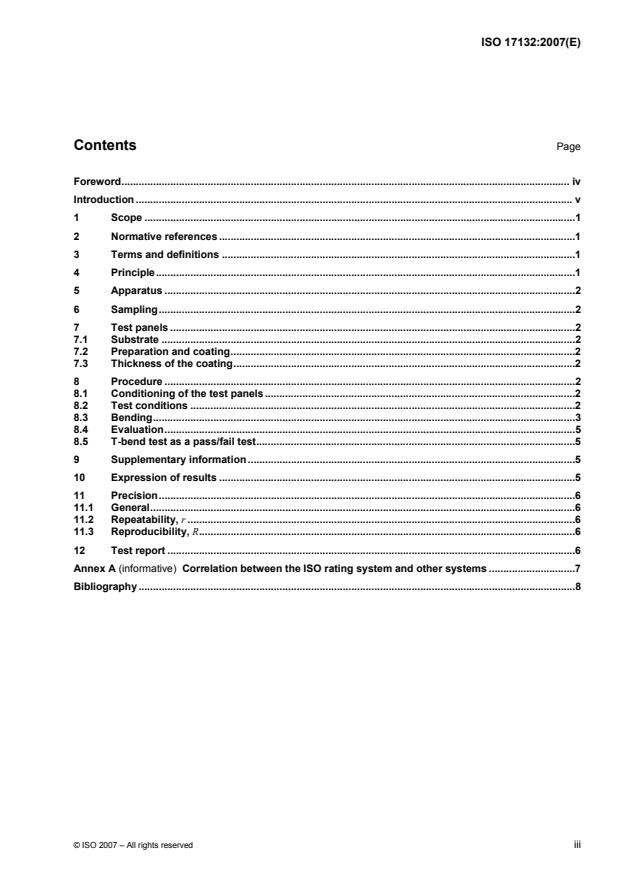
ISO 17132:2007 - Paints and varnishes — T-bend test Released:10/1/2007
ISO 17132:2007 - Peintures et vernis — Essai de pliage en T Released:10/1/2007
ISO 17132:2007 - Paints and varnishes — T-bend test Released:4/28/2010
Overview
ISO 17132:2007 - Paints and varnishes - T-bend test - specifies a standardized method for evaluating the flexibility and adhesion of an organic coating on a metallic substrate by bending a coated test panel and observing cracking or loss of adhesion. The method can be used as a pass/fail check or to determine the minimum bending diameter (or equivalent) at which cracking does not occur. Typical conditioning and test conditions are given (e.g., 16 h at 23 ± 2 °C and 50 ± 5 % RH).
Key topics and requirements
- Test principle: Bend coated panels 180° (coated side outside) around mandrels, spacer panels, or by repeated folding; inspect for cracking or flaking.
- T‑bend rating: Expressed as the minimum number of panel thicknesses (mandrel method), number of spacers (spacer method) or number of additional folds (folding method) at which no failure occurs.
- Apparatus & inspection:
- Vice with smooth jaws; optional mandrels or uncoated spacer panels.
- Magnifying glass (×5 to ×10) for visual inspection.
- Adhesive tape (6–10 N/25 mm per IEC 60454‑2) for tape pull-off adhesion check.
- Specimen preparation: Use representative samples and standard test panels prepared per ISO 1513 and ISO 1514; measure dry film thickness per ISO 2808.
- Conditioning & test environment: Default conditioning and testing at (23 ± 2) °C and (50 ± 5) % RH unless otherwise agreed.
- Evaluation: Examine bends immediately (excluding 5 mm from panel edges). Use tape pull-off or magnification to detect loss of adhesion. Report whether failures were cracking only, adhesion loss only, or both.
- Supplementary information: Test panel material/shape, coating application and drying/stoving details, film thickness, and whether the test is classification or pass/fail should be specified by contracting parties.
Applications and users
ISO 17132:2007 is used to:
- Verify flexibility and adhesion of paints, varnishes and coil coatings on metallic substrates.
- Confirm compliance with contractual or specification requirements (quality control, incoming inspection).
- Support product development and comparative performance testing in R&D. Primary users:
- Coating and paint manufacturers
- Quality control and materials testing laboratories
- Metal fabricators and coil coaters
- Specifiers, procurement teams and standards bodies
Related standards
- ISO 1513, ISO 1514, ISO 2808 (sample, panel prep, film thickness)
- Other cracking/detachment tests: ISO 1519, ISO 1520, ISO 6272, ISO 6860
- Comparable national standards: ASTM D4145, EN 13523‑7, JIS G 3312
Keywords: ISO 17132:2007, T‑bend test, paint flexibility, adhesion test, metallic substrate, pass/fail test, minimum bending diameter, film thickness.
Relations
- Effective Date
- 12-Feb-2026
Buy Documents
ISO 17132:2007 - Paints and varnishes — T-bend test Released:10/1/2007
ISO 17132:2007 - Peintures et vernis — Essai de pliage en T Released:10/1/2007
ISO 17132:2007 - Paints and varnishes — T-bend test Released:4/28/2010
Frequently Asked Questions
ISO 17132:2007 is a standard published by the International Organization for Standardization (ISO). Its full title is "Paints and varnishes — T-bend test". This standard covers: ISO 17132:2007 describes a method of evaluating the flexibility and adhesion of an organic coating on a metallic substrate by observing the cracking or loss of adhesion when a coated test panel is bent. The method can be used to confirm whether paints, varnishes or related products meet a given test requirement in a pass/fail test, or to determine the minimum bending diameter at which cracking does not occur.
ISO 17132:2007 describes a method of evaluating the flexibility and adhesion of an organic coating on a metallic substrate by observing the cracking or loss of adhesion when a coated test panel is bent. The method can be used to confirm whether paints, varnishes or related products meet a given test requirement in a pass/fail test, or to determine the minimum bending diameter at which cracking does not occur.
ISO 17132:2007 is classified under the following ICS (International Classification for Standards) categories: 87.040 - Paints and varnishes. The ICS classification helps identify the subject area and facilitates finding related standards.
ISO 17132:2007 has the following relationships with other standards: It is inter standard links to EN ISO 17132:2007. Understanding these relationships helps ensure you are using the most current and applicable version of the standard.
ISO 17132:2007 is available in PDF format for immediate download after purchase. The document can be added to your cart and obtained through the secure checkout process. Digital delivery ensures instant access to the complete standard document.
Standards Content (Sample)
INTERNATIONAL ISO
STANDARD 17132
First edition
2007-10-01
Paints and varnishes — T-bend test
Peintures et vernis — Essai de pliage en T
Reference number
©
ISO 2007
PDF disclaimer
This PDF file may contain embedded typefaces. In accordance with Adobe's licensing policy, this file may be printed or viewed but
shall not be edited unless the typefaces which are embedded are licensed to and installed on the computer performing the editing. In
downloading this file, parties accept therein the responsibility of not infringing Adobe's licensing policy. The ISO Central Secretariat
accepts no liability in this area.
Adobe is a trademark of Adobe Systems Incorporated.
Details of the software products used to create this PDF file can be found in the General Info relative to the file; the PDF-creation
parameters were optimized for printing. Every care has been taken to ensure that the file is suitable for use by ISO member bodies. In
the unlikely event that a problem relating to it is found, please inform the Central Secretariat at the address given below.
© ISO 2007
All rights reserved. Unless otherwise specified, no part of this publication may be reproduced or utilized in any form or by any means,
electronic or mechanical, including photocopying and microfilm, without permission in writing from either ISO at the address below or
ISO's member body in the country of the requester.
ISO copyright office
Case postale 56 • CH-1211 Geneva 20
Tel. + 41 22 749 01 11
Fax + 41 22 749 09 47
E-mail copyright@iso.org
Web www.iso.org
Published in Switzerland
ii © ISO 2007 – All rights reserved
Contents Page
Foreword. iv
Introduction . v
1 Scope .1
2 Normative references .1
3 Terms and definitions .1
4 Principle.1
5 Apparatus .2
6 Sampling.2
7 Test panels .2
7.1 Substrate .2
7.2 Preparation and coating.2
7.3 Thickness of the coating.2
8 Procedure .2
8.1 Conditioning of the test panels .2
8.2 Test conditions .2
8.3 Bending.3
8.4 Evaluation.5
8.5 T-bend test as a pass/fail test.5
9 Supplementary information.5
10 Expression of results .5
11 Precision.6
11.1 General.6
11.2 Repeatability, r .6
11.3 Reproducibility, R.6
12 Test report .6
Annex A (informative) Correlation between the ISO rating system and other systems .7
Bibliography .8
Foreword
ISO (the International Organization for Standardization) is a worldwide federation of national standards bodies
(ISO member bodies). The work of preparing International Standards is normally carried out through ISO
technical committees. Each member body interested in a subject for which a technical committee has been
established has the right to be represented on that committee. International organizations, governmental and
non-governmental, in liaison with ISO, also take part in the work. ISO collaborates closely with the
International Electrotechnical Commission (IEC) on all matters of electrotechnical standardization.
International Standards are drafted in accordance with the rules given in the ISO/IEC Directives, Part 2.
The main task of technical committees is to prepare International Standards. Draft International Standards
adopted by the technical committees are circulated to the member bodies for voting. Publication as an
International Standard requires approval by at least 75 % of the member bodies casting a vote.
Attention is drawn to the possibility that some of the elements of this document may be the subject of patent
rights. ISO shall not be held responsible for identifying any or all such patent rights.
ISO 17132 was prepared by Technical Committee ISO/TC 35, Paints and varnishes, Subcommittee SC 9,
General test methods for paints and varnishes.
iv © ISO 2007 – All rights reserved
Introduction
This International Standard is one of five standards which specify empirical test procedures for assessing the
resistance of coatings of paints, varnishes and related products to cracking and/or detachment from the
substrate under different conditions of deformation. The other International Standards are ISO 1519,
ISO 1520, ISO 6272 and ISO 6860.
The T-bend test has already been standardized in the USA (ASTM D 4145), Europe (EN 13523-7) and Japan
(JIS G 3312). The test methods in these standards are basically the same, but differ from each other in details
such as
⎯ whether the coated test panel is folded back on itself or is bent round a mandrel or a test panel used as a
spacer;
⎯ the way in which the test result is expressed.
In this International Standard, the basic contents common to the US, European and Japanese standards have
been adopted, but details in which the US, European and Japanese standards differ, in particular the use of a
mandrel or spacer panels, have been made subject to agreement between the interested parties.
INTERNATIONAL STANDARD ISO 17132:2007(E)
Paints and varnishes — T-bend test
1 Scope
This International Standard describes a method of evaluating the flexibility and adhesion of an organic coating
on a metallic substrate by observing the cracking or loss of adhesion when a coated test panel is bent.
The method can be used to confirm whether paints, varnishes or related products meet a given test
requirement in a pass/fail test, or to determine the minimum bending diameter at which cracking does not
occur.
2 Normative references
The following referenced documents are indispensable for the application of this document. For dated
references, only the edition cited applies. For undated references, the latest edition of the referenced
document (including any amendments) applies.
ISO 1513, Paints and varnishes — Examination and preparation of samples for testing
ISO 1514, Paints and varnishes — Standard panels for testing
ISO 2808, Paints and varnishes — Determination of film thickness
ISO 15528, Paints, varnishes and raw materials for paints and varnishes — Sampling
IEC 60454-2, Specification for pressure-sensitive adhesive tapes for electrical purposes — Part 2: Methods of
test
3 Terms and definitions
For the purposes of this document, the following terms and definitions apply.
3.1
T-bend test
test designed to determine the flexibility of a paint coating by bending a coated test panel through 180°
3.2
T-bend rating
minimum number of spacers of defined thickness around which a coated test panel can be bent (or, if bent
around a mandrel, the number of spacers equivalent to the diameter of the mandrel) without cracking or loss
of adhesion (flaking) of the coating occurring
4 Principle
Coated panels are bent back on themselves to 180°, with the coated surface on the outside of the bend, at
progressively less severe radii of curvature, the radii of curvature being defined by spacers or mandrels. After
bending, each panel is examined with a magnifying glass for cracking of the coating and by a tape pull-off test
for loss of adhesion of the coating. The minimum diameter to which the test panel can be bent without
cracking or loss of adhesion, i.e. when failures no longer occur, is taken as the T-bend rating.
Visual examination with a magnifying glass can also be used to determine whether there is any loss of
adhesion.
5 Apparatus
5.1 Vice, with flat and smooth jaws. This is used to hold one end of the test piece firmly in place at the start
of the bending test.
If the test panel is not bent around itself, a series of bending mandrels with smoothly rounded ends may be
used as guides around which the test panel is bent (see Figure 1).
By agreement between the interested parties, one or more uncoated panels may also be used as mandrels.
5.2 Magnifying glass, × 5 to × 10 magnification.
5.3 Adhesive tape, with an adhesive strength between 6 N/25 mm width and 10 N/25 mm width when
determined in accordance with IEC 60454-2.
6 Sampling
Take a representative sample of the product to be tested, as described in ISO 15528.
Examine and prepare e
...
NORME ISO
INTERNATIONALE 17132
Première édition
2007-10-01
Peintures et vernis — Essai de pliage
en T
Paints and varnishes — T-bend test
Numéro de référence
©
ISO 2007
PDF – Exonération de responsabilité
Le présent fichier PDF peut contenir des polices de caractères intégrées. Conformément aux conditions de licence d'Adobe, ce fichier
peut être imprimé ou visualisé, mais ne doit pas être modifié à moins que l'ordinateur employé à cet effet ne bénéficie d'une licence
autorisant l'utilisation de ces polices et que celles-ci y soient installées. Lors du téléchargement de ce fichier, les parties concernées
acceptent de fait la responsabilité de ne pas enfreindre les conditions de licence d'Adobe. Le Secrétariat central de l'ISO décline toute
responsabilité en la matière.
Adobe est une marque déposée d'Adobe Systems Incorporated.
Les détails relatifs aux produits logiciels utilisés pour la création du présent fichier PDF sont disponibles dans la rubrique General Info
du fichier; les paramètres de création PDF ont été optimisés pour l'impression. Toutes les mesures ont été prises pour garantir
l'exploitation de ce fichier par les comités membres de l'ISO. Dans le cas peu probable où surviendrait un problème d'utilisation,
veuillez en informer le Secrétariat central à l'adresse donnée ci-dessous.
DOCUMENT PROTÉGÉ PAR COPYRIGHT
© ISO 2007
Droits de reproduction réservés. Sauf prescription différente, aucune partie de cette publication ne peut être reproduite ni utilisée sous
quelque forme que ce soit et par aucun procédé, électronique ou mécanique, y compris la photocopie et les microfilms, sans l'accord écrit
de l'ISO à l'adresse ci-après ou du comité membre de l'ISO dans le pays du demandeur.
ISO copyright office
Case postale 56 • CH-1211 Geneva 20
Tel. + 41 22 749 01 11
Fax. + 41 22 749 09 47
E-mail copyright@iso.org
Web www.iso.org
Publié en Suisse
ii © ISO 2007 – Tous droits réservés
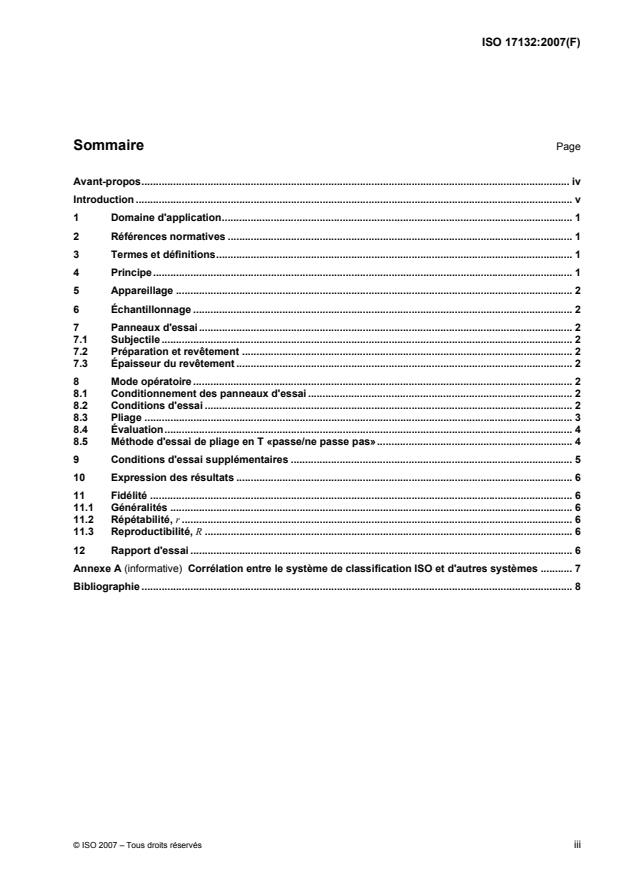
Sommaire Page
Avant-propos. iv
Introduction . v
1 Domaine d'application. 1
2 Références normatives . 1
3 Termes et définitions. 1
4 Principe. 1
5 Appareillage . 2
6 Échantillonnage . 2
7 Panneaux d'essai. 2
7.1 Subjectile . 2
7.2 Préparation et revêtement . 2
7.3 Épaisseur du revêtement . 2
8 Mode opératoire . 2
8.1 Conditionnement des panneaux d'essai .2
8.2 Conditions d'essai . 2
8.3 Pliage . 3
8.4 Évaluation. 4
8.5 Méthode d'essai de pliage en T «passe/ne passe pas». 4
9 Conditions d'essai supplémentaires . 5
10 Expression des résultats . 6
11 Fidélité . 6
11.1 Généralités . 6
11.2 Répétabilité, r . 6
11.3 Reproductibilité, R .6
12 Rapport d'essai . 6
Annexe A (informative) Corrélation entre le système de classification ISO et d'autres systèmes . 7
Bibliographie . 8
Avant-propos
L'ISO (Organisation internationale de normalisation) est une fédération mondiale d'organismes nationaux de
normalisation (comités membres de l'ISO). L'élaboration des Normes internationales est en général confiée
aux comités techniques de l'ISO. Chaque comité membre intéressé par une étude a le droit de faire partie du
comité technique créé à cet effet. Les organisations internationales, gouvernementales et non
gouvernementales, en liaison avec l'ISO participent également aux travaux. L'ISO collabore étroitement avec
la Commission électrotechnique internationale (CEI) en ce qui concerne la normalisation électrotechnique.
Les Normes internationales sont rédigées conformément aux règles données dans les Directives ISO/CEI,
Partie 2.
La tâche principale des comités techniques est d'élaborer les Normes internationales. Les projets de Normes
internationales adoptés par les comités techniques sont soumis aux comités membres pour vote. Leur
publication comme Normes internationales requiert l'approbation de 75 % au moins des comités membres
votants.
L'attention est appelée sur le fait que certains des éléments du présent document peuvent faire l'objet de
droits de propriété intellectuelle ou de droits analogues. L'ISO ne saurait être tenue pour responsable de ne
pas avoir identifié de tels droits de propriété et averti de leur existence.
L'ISO 17132 a été élaborée par le comité technique ISO/TC 35, Peintures et vernis, sous-comité SC 9,
Méthodes générales d'essais des peintures et vernis.
iv © ISO 2007 – Tous droits réservés
Introduction
La présente Norme internationale est l'une des cinq normes spécifiant des méthodes d'essai empiriques
d'évaluation de la résistance des revêtements de peinture, vernis et produits assimilés à la fissuration et/ou au
décollement du subjectile dans différentes conditions de déformation. Les autres Normes internationales sont
l'ISO 1519, l'ISO 1520, l'ISO 6272 et l'ISO 6860.
L'essai de pliage en T a déjà été normalisé aux États-Unis (ASTM D 4145), en Europe (EN 13523-7) et au
Japon (JIS G 3312). Les méthodes d'essai présentées dans ces normes sont fondamentalement identiques
mais diffèrent sur des points tels que:
⎯ la manière dont le panneau d'essai est plié: il peut être replié sur lui-même, ou plié autour d'une matrice
ou encore plié en utilisant un panneau d'essai comme espaceur;
⎯ la façon dont les résultats d'essai sont exprimés.
Dans la présente Norme internationale, le contenu fondamental commun aux normes américaine, européenne
et japonaise a été adopté, mais les points sur lesquels ces normes diffèrent, en particulier l'utilisation d'une
matrice ou de panneaux espaceurs, sont conditionnés à l'accord entre les parties intéressées.
NORME INTERNATIONALE ISO 17132:2007(F)
Peintures et vernis — Essai de pliage en T
1 Domaine d'application
La présente Norme internationale spécifie une méthode d'évaluation de la flexibilité et de l'adhérence d'un
revêtement organique appliqué sur un subjectile métallique basée sur l'observation de la fissuration ou de la
perte d'adhérence lors du pliage d'un panneau.
La méthode spécifiée peut être appliquée afin de déterminer si les peintures, vernis et produits assimilés
satisfont ou non (essai «passe/ne passe pas») aux conditions d'un essai donné ou afin de déterminer le
diamètre minimal de pliage sans fissuration.
2 Références normatives
Les documents de référence suivants sont indispensables pour l'application du présent document. Pour les
références datées, seule l'édition citée s'applique. Pour les références non datées, la dernière édition du
document de référence (y compris les éventuels amendements) s'applique.
ISO 1513, Peintures et vernis — Examen et préparation des échantillons pour essais
ISO 1514, Peintures et vernis — Panneaux normalisés pour essais
ISO 2808, Peintures et vernis — Détermination de l'épaisseur du feuil
ISO 15528, Peintures, vernis et matières premières pour peintures et vernis — Échantillonnage
CEI 60454-2, Spécification pour rubans adhésifs sensibles à la pression à usages électriques — Partie 2:
Méthodes d'essai
3 Termes et définitions
Pour les besoins du présent document, les termes et définitions suivants s'appliquent.
3.1
essai de pliage en T
essai destiné à déterminer la flexibilité d'une peinture lors de la déformation par pliage du panneau revêtu
3.2
taux de pliage en T
nombre minimal d'épaisseurs de subjectile autour desquelles le panneau revêtu est plié ou, dans le cas d'un
pliage autour d'une matrice, nombre d'épaisseurs de subjectile équivalant au diamètre de la matrice, avant
rupture ou décollement du revêtement
4 Principe
Les panneaux revêtus sont repliés sur eux-mêmes à 180°, le côté revêtu du panneau étant à l'extérieur après
le pliage, autour de matrices ou d'espaceurs choisis de sorte à obtenir un pliage avec un rayon de courbure
croissant. Après le pliage, les panneaux sont examinés à la loupe pour déceler une éventuelle fissuration du
revêtement et un essai d'arrachement au ruban adhésif est effectué pour déterminer s'il y a une perte
d'adhérence du revêtement. Le diamètre minimal auquel le panneau peut être plié sans fissuration ou perte
d'adhérence, c'est-à-dire sans qu'un défaut n'apparaisse, est pris comme le taux de pliage en T.
5 Appareillage
5.1 Étau, à mâchoires de serrage plates et lisses. Il sert à maintenir solidement un côté du panneau d'essai
au début du pliage.
Si le panneau d'essai n'est pas plié sur lui-même, il est possible d'utiliser une série de matrices de pliage
ayant des extrémités légèrement arrondies afin de servir de guide autour duquel le panneau d'essai est plié
(voir Figure 1).
Si convenu entre les parties intéressées, il est également possible d'utiliser un ou plusieurs panneaux non
revêtus comme matrices.
5.2 Loupe, de grossissement compris entre ×5 et ×10.
5.3 Ruban adhésif, ayant une force d'adhérence comprise entre 6 N/25 mm de large et 10 N/25 mm de
large, évalué conformément à la CEI 60454-2.
6 Échantillonnage
Prélever un échantillon représentatif du produit à soumettre à essai, conformément à l'ISO 15528.
Examiner et préparer chaque échantillon pour essai conformément à l'ISO 1513.
7 Panneaux d'essai
7.1 Subjectile
Sauf accord contraire, utiliser des panneaux d'essai rectangulaires en acier. Les surfaces des panneaux
doivent être planes.
7.2 Préparation et revêtement
Sauf accord contraire, préparer chaque panneau d'essai conformément à l'ISO 1514 avant de le revêtir en
utilisant la méthode d'application spécifiée (voir Article 9), le sécher, le faire durcir ou l'étuver.
7.3 Épaisseur du revêtement
Déterminer l'épaisseur du revêtement sec, en micromètres, selon l'une des méthodes indiquées dans
l'ISO 2808.
8 Mode opératoire
8.1 Conditionnement
...
МЕЖДУНАРОДНЫЙ ISO
СТАНДАРТ 17132
Первое издание
2007-10-01
Краски и лаки. Испытание на изгиб
таврового образца
Paints and varnishes – T-bend test
Ответственность за подготовку русской версии несёт GOST R
(Российская Федерация) в соответствии со статьёй 18.1 Устава ISO
Ссылочный номер
©
ISO 2007
Отказ от ответственности при работе в PDF
Настоящий файл PDF может содержать интегрированные шрифты. В соответствии с условиями лицензирования, принятыми
фирмой Adobe, этот файл можно распечатать или смотреть на экране, но его нельзя изменить, пока не будет получена
лицензия на интегрированные шрифты и они не будут установлены на компьютере, на котором ведется редактирование. В
случае загрузки настоящего файла заинтересованные стороны принимают на себя ответственность за соблюдение
лицензионных условий фирмы Adobe. Центральный секретариат ISO не несет никакой ответственности в этом отношении.
Adobe - торговый знак фирмы Adobe Systems Incorporated.
Подробности, относящиеся к программным продуктам, использованные для создания настоящего файла PDF, можно найти в
рубрике General Info файла; параметры создания PDF были оптимизированы для печати. Были приняты во внимание все
меры предосторожности с тем, чтобы обеспечить пригодность настоящего файла для использования комитетами-членами
ISO. В редких случаях возникновения проблемы, связанной со сказанным выше, просьба проинформировать Центральный
секретариат по адресу, приведенному ниже.
ДОКУМЕНТ ЗАЩИЩЕН АВТОРСКИМ ПРАВОМ
:
()© ISO 2007
Все права сохраняются. Если не указано иное, никакую часть настоящей публикации нельзя копировать или использовать в
какой-либо форме или каким-либо электронным или механическим способом, включая фотокопии и микрофильмы, без
предварительного письменного согласия ISO, которое должно быть получено после запроса о разрешении, направленного по
адресу, приведенному ниже, или в комитет-член ISO в стране запрашивающей стороны.
ISO copyright office
Case postale 56 • CH-1211 Geneva 20
Tel. + 41 22 749 01 11
Fax + 41 22 749 09 47
E-mail copyright@iso.org
Web www.iso.org
Опубликовано в Швейцарии
ii © ISO 2007 – Все права сохраняются
Содержание Страница
Предисловие .iv
Введение .v
1 Область применения .1
2 Нормативные ссылки .1
3 Термины и определения .1
4 Сущность метода.2
5 Аппаратура.2
6 Отбор образцов .2
7 Испытуемые пластины .2
7.1 Подложка.2
7.2 Подготовка и покрытие .3
7.3 Толщина покрытия.3
8 Методика .3
8.1 Кондиционирование испытуемых пластин.3
8.2 Условия испытания.3
8.3 Изгибание.3
8.4 Оценка.5
8.5 Испытание на изгиб таврового образца как испытание до отказа.6
9 Дополнительная информация.6
10 Выражение результатов .6
11 Прецизионность.7
11.1 Общее.7
11.2 Повторяемость, r .7
11.3 Воспроизводимость, R.7
12 Протокол испытания.7
Приложение А (информативное) Корреляция между системой оценки ISO и другими
системами .9
Библиография.10
Предисловие
Международная организация по стандартизации (ISO) является всемирной федерацией,
объединяющей национальные органы по стандартизации (комитеты-члены ISO). Работа по разработке
международных стандартов, как правило, ведется в технических комитетах ISO. Каждый комитет-член,
заинтересованной в разработке теме, ради которой был образован данный технический комитет,
имеет право быть представленным в этом комитете. Международные организации, правительственные
и неправительственные, поддерживающие связь с ISO, также принимают участие в ее работе. ISO
тесно сотрудничает с Международной Электротехнической Комиссией (IEC) по всем вопросам
стандартизации в области электротехники.
Международные стандарты разрабатываются в соответствии с правилами, приведенными в Части 2
Директив ISO/IEC.
Основное назначение технических комитетов заключается в разработке Международных стандартов.
Проекты международных стандартов, принятые техническими комитетами, рассылаются комитетам-
членам на голосование. Для опубликования международного стандарта требуется собрать не менее
75 % положительных голосов комитетов-членов, принявших участие в голосовании.
Обращается внимание на тот факт, что некоторые элементы настоящего документа могут являться
предметом патентных прав. ISO не несет ответственность за идентификацию части или всех подобных
патентных прав.
ISO 17132 разработан Техническим комитетом ISO/TC 35, Краски и лаки, Подкомитетом SC 9, Общие
методы испытания для красок и лаков.
iv © ISO 2007 – Все права сохраняются
Введение
Настоящий международный стандарт является одним из пяти стандартов, которые устанавливают
эмпирические методики испытаний для оценки сопротивления покрытий из красок, лаков и
родственных продуктов растрескиванию и/или отделению от подложки при различных условиях
деформации. Остальные международные стандарты: ISO 1519, ISO 1520, ISO 6272 и ISO 6860.
Испытание на изгиб таврового образца уже было стандартизировано в США (ASTM D 4145), Европе
(EN 13523-7) и Японии (JIS G 3312). Методы испытания в этих стандартах, в основном, одинаковые,
однако различаются в деталях, например:
⎯ была ли испытуемая пластина с покрытием отбортована на свою обратную поверхность или
изогнута на оправке или испытуемой пластине, используемой в качестве распорки;
⎯ способ, в соответствии с которым были выражены результаты испытания.
В настоящем международном стандарте адаптированы основные принципы, общие для американских,
европейских и японских стандартов; вместе с тем, детали, в которых расходятся американские,
европейские и японские стандарты, например, использование оправки или распорных пластин,
подлежат согласованию между заинтересованными сторонами.
МЕЖДУНАРОДНЫЙ СТАНДАРТ ISO 17132:2007(R)
Краски и лаки. Испытание на изгиб таврового образца
1 Область применения
Настоящий международный стандарт описывает метод оценки гибкости и сцепления органического
покрытия на металлической подложке путем наблюдения растрескивания или потери сцепления при
изгибе испытуемой пластины с покрытием.
Данный метод может использоваться для подтверждения соответствия красок, лаков и родственных
продуктов заданным требованиям на проведение испытаний до отказа или для определения
минимального диаметра изгиба, при кoтором не отмечается растрескивание.
2 Нормативные ссылки
Нижеследующие документы являются обязательными для применения настоящего документа. В
отношении датированных ссылочных документов действительно только указанное издание. В
отношении недатированных ссылок применимо последнее издание данного документа, включая
любые поправки к нему.
ISO 1513, Краски и лаки. Контроль и приготовление образцов для испытания
ISO 1514, Краски и лаки. Стандартные пластины для испытания
ISO 2808, Краски и лаки. Определение толщины пленки
ISO 15528, Краски, лаки и сырье для них. Отбор образцов
IEC 60454-2, Ленты электроизоляционные самоклеющиеся. Часть 2. Методы испытания
3 Термины и определения
Исходя из назначения данного документы, применимы следующие термины и определения.
3.1
испытание на изгиб таврового образца
T-bend test
испытание, предназначенное для определения гибкости лакокрасочного покрытия путем изгиба
пластины с покрытием на 180°
3.2
характеристика изгиба таврового образца
T-bend rating
минимальное количество распорок определенной толщины, на которых испытуемая пластина с
покрытием может быть изогнута (или при изгибе вокруг оправки – количество распорок, эквивалентных
диаметру оправкиl) без растрескивания или потери сцепления (отслаивания) покрытия
4 Сущность метода
Покрытые пластины загибают на 180° (при этом покрытая поверхность находится снаружи изгиба) при
постепенно меньшими радиусами кривизны; радиусы кривизны определяются распорками или
оправками. После изгибания каждая пластина исследуется с помощью увеличительного стекла на
предмет обнаружения трещин в покрытии и с помощью испытания на прочность покрытия.
Минимальный диаметр, до которого может быть изогнута испытуемая пластина без образования
трещин или потери сцепления, т.е. когда перестает отмечаться разрушение, принимается за оценку
изгиба таврового образца.
Визуальное исследование с помощью увеличительного стекла также может использоваться для
определения степени потери сцепления.
5 Аппаратура
5.1 Тиски, с плоскими и гладкими щеками. Используются для надежного удержания одного конца
образца перед испытанием на изгиб.
Если пластина не загибается на себя, может использоваться ряд гибочных оправок с гладко
скругленными краями в качестве направляющих, на которых загибают данную испытуемую пластину
(см. Рисунок 1).
По соглашению между заинтересованными сторонами одна или несколько пластин без покрытия
также могут использоваться в качестве оправок.
5.2 Увеличительное стекло, с увеличением от × 5 до × 10.
5.3 Клейкая лента, с прочностью сцепления между 6 Н/25 мм ширины и 10 Н/25 мм ширины при
определении в соответствии с IEC 60454-2.
6 Отбор образцов
Берут типичный образец испытуемого продукта согласно описанию в ISO 15528.
Исследуют и подготавливают каждый образец для испытания согласно описанию в ISO 1513.
7 Испытуемые пластины
7.1 Подложка
Если не оговорено иное, для испытания используют прямоугольные стальные пластины. Поверхности
пластин должны быть ровными.
2 © ISO 2007 – Все права сохраняются
7.2 Подготовка и покрытие
Если не оговорено иное, подготавливают каждую испытуемую пластину
...