

ISO/DTR 37127-1
(Main)Sustainable cities and communities — Artificial Intelligence (AI) applications in smart city operating models — Part 1: Case studies
- Status
- Not Published
- Technical Committee
- ISO/TC 268 - Sustainable cities and communities
- Current Stage
- 5000 - Final text received or FDIS registered for formal approval - 50 Approval
- Start Date
- 25-Sep-2026
Buy Documents

ISO/DTR 37127-1 - Sustainable cities and communities — Artificial Intelligence (AI) applications in smart city operating models — Part 1: Case studies

REDLINE ISO/DTR 37127-1 - Sustainable cities and communities — Artificial Intelligence (AI) applications in smart city operating models — Part 1: Case studies
ISO/DTR 37127-1 is an ISO Technical Report on artificial intelligence (AI) applications in smart city operating models, focused on case studies. It looks at how cities are using AI in governance, services, infrastructure, and performance management, and how the principles in ISO 37106 can support those uses. The document is written for city leaders, planners, service managers, and standards developers who want practical examples of AI in a smart and sustainable community context.
What does ISO/DTR 37127-1 specify?
ISO/DTR 37127-1 provides case studies on the effective deployment of AI applications in smart city operating models. Its scope covers urban planning, policy and regulation, public service provision, and coordinated partnerships, and it uses those cases to show how ISO 37106 principles can improve outcomes for sustainable communities.
The document is organized into an introduction, clauses 1 to 11, and a bibliography. Clause 4 sets out the framework based on ISO 37106, Clause 5 describes how the case studies were collected and grouped, Clauses 6 to 9 cover four AI application domains, Clause 10 presents cross-cutting city examples, and Clause 11 draws conclusions and identifies directions for future standardization.
What are the key requirements of ISO/DTR 37127-1?
The report uses ISO 37106 as the main operating-model lens
Clause 4 presents ISO 37106 as the framework for understanding AI in smart communities. It contrasts siloed city operations with a smart city operating model built around Smart Data, city data treated as an asset, community-led innovation, citizen-centric services, flexible outcome-based budgets, and city-wide governance and coordination.
In practice, this means AI is not treated as a standalone technology project. Cities are encouraged to judge AI against how well it supports cross-department coordination, shared data use, and citizen value.
Clause 5 structures the case studies around city functions and outcomes
Clause 5 explains the framework used to collect and analyze the cases. It combines the 19 city service themes in ISO 37120 with the city-wide delivery processes from ISO 37106 and the sustainable community purposes from ISO 37101.
This matters because it gives readers a way to compare very different AI projects on a common basis. A transport application, a flood-warning system, and a citizen portal can all be assessed within the same city operating model.
Clause 6 shows how cities govern AI itself
Clause 6 focuses on city-led governance of AI. The examples highlight ethics frameworks, public registers of algorithms, testing and assurance tools, and citizen engagement around acceptable uses of AI.
For a city, this means AI governance is not only about technical performance. It also involves transparency, accountability, data protection, bias mitigation, and the ability to explain how AI is used in public administration.
Clause 7 organizes AI around three city-wide governance processes
Clause 7 uses three ISO 37106 delivery processes: Strategy Management, Citizen-centric Service Management, and Digital and Physical Resource Management. The clause shows how AI can support policy simulation, demand forecasting, performance monitoring, chatbots, proactive outreach, and predictive maintenance.
The practical point is that AI can improve coordination across departments when it is tied to these cross-cutting processes. It helps city leaders align plans, improve service journeys, and manage infrastructure as a connected system rather than as isolated assets.
Clause 8 maps AI to individual city service themes
Clause 8 applies the framework to individual services using the 19 themes from ISO 37120. The case examples include energy, environment, health, housing, safety, transportation, wastewater, and other service areas.
This is useful for buyers and implementers because it shows where AI is already being used in daily operations. It also shows that local AI projects can become building blocks for wider city transformation if they are designed for reuse and integration.
Clause 9 links AI to benefit realization
Clause 9 shows how AI can support benefit mapping, benefit tracking, and benefit management. It uses AI for scenario modelling, stakeholder sentiment analysis, automated performance tracking, KPI correlation and forecasting, dashboards, and continuous improvement.
In practice, this means cities can move from reporting activity to managing outcomes. AI is used to help leaders see whether a program is delivering the intended social, environmental, economic, or resilience benefits.
Clause 10 brings the model together in cross-cutting cases
Clause 10 highlights Dubai, London, Shanghai, and Korea as integrated examples. These cases show city-wide or nationally coordinated approaches that combine governance of AI, strategy, services, resource management, and performance measurement.
The practical value is that the report shows scaling patterns, not just isolated pilots. Readers can see how shared platforms, open data, and coordinated governance help cities move AI beyond single-use deployments.
What terms does ISO/DTR 37127-1 define?
- Artificial intelligence (AI) - In this document, AI refers to systems used for analysis, prediction, automation, simulation, and decision support in city governance and services.
- Smart city operating model - The ISO 37106 framework for coordinating city strategy, services, data, and governance across traditional silos.
- Benefit Realization Framework - The ISO 37106 approach for linking city activities to intended outcomes, tracking progress, and adjusting delivery based on evidence.
- Smart Data - City data made available in real time and in open, interoperable formats so it can be reused across services and stakeholders.
- Citizen-centric service management - A city-wide way of designing and delivering services around user needs, rather than around departmental structures.
- Digital and Physical Resource Management - The coordinated management of physical assets and digital infrastructure across their life cycle, from design to decommissioning.
- MyData - A consent-based data-sharing approach used in the Helsinki example, where individuals keep control over personal data and permissions.
Who uses ISO/DTR 37127-1?
ISO/DTR 37127-1 is used by city governments, municipal departments, and smart city program teams that are planning or evaluating AI use in public services and urban management. It is also relevant to quality managers, data governance teams, digital transformation leads, and policy teams working on ethics, transparency, and accountability.
The document is useful in sectors such as transport, energy, health, housing, waste, water, public safety, planning, and community services. It also supports standards bodies, researchers, and solution providers who need a shared framework for describing and comparing city AI case studies.
Which standards are used with ISO/DTR 37127-1?
- ISO 37100:2026 - Provides the vocabulary used for the terms and definitions in the document.
- ISO 37101:2016 - Sets the management framework for sustainable development in communities and links AI use to strategic purposes.
- ISO 37106:2021 - Supplies the smart city operating model that structures the whole report.
- ISO/TS 37107:2019 - Provides the maturity framework for assessing progress toward the smart city operating model.
- ISO 37120:2018 - Supplies the 19 core city service themes used to organize many of the case studies.
- ISO 37122 - Adds indicators for smart cities, which the report connects to AI-enabled city development.
- ISO 37123 - Adds indicators for resilient cities, which supports the report’s resilience and continuity focus.
What does the ISO/DTR 37127-1 document contain?
The document contains a framework figure, case-study tables, and city examples grouped by governance, operations, services, and impact management. Tables 1 to 10 present examples from cities such as Dubai, Amsterdam, Singapore, Helsinki, Barcelona, Shanghai, London, and several Korean cities, showing how AI is being applied in real urban settings.
It also includes conclusions that draw common lessons from 27 cities across four continents. Those conclusions point to integrated operating models, shared data platforms, citizen-centric service design, AI governance, and measurable outcomes as the main themes for future work.
Buy Documents
ISO/DTR 37127-1 - Sustainable cities and communities — Artificial Intelligence (AI) applications in smart city operating models — Part 1: Case studies
REDLINE ISO/DTR 37127-1 - Sustainable cities and communities — Artificial Intelligence (AI) applications in smart city operating models — Part 1: Case studies
Get Certified
Connect with accredited certification bodies for this standard

BSI Group
BSI (British Standards Institution) is the business standards company that helps organizations make excellence a habit.

Bureau Veritas
Bureau Veritas is a world leader in laboratory testing, inspection and certification services.

DNV
DNV is an independent assurance and risk management provider.
Sponsored listings
Frequently Asked Questions
ISO/DTR 37127-1 is a draft published by the International Organization for Standardization (ISO). Its full title is "Sustainable cities and communities — Artificial Intelligence (AI) applications in smart city operating models — Part 1: Case studies". This standard covers: Sustainable cities and communities — Artificial Intelligence (AI) applications in smart city operating models — Part 1: Case studies
Sustainable cities and communities — Artificial Intelligence (AI) applications in smart city operating models — Part 1: Case studies
ISO/DTR 37127-1 is classified under the following ICS (International Classification for Standards) categories: 13.020.20 - Environmental economics. Sustainability; 35.240.99 - IT applications in other fields. The ICS classification helps identify the subject area and facilitates finding related standards.
ISO/DTR 37127-1 is available in PDF format for immediate download after purchase. The document can be added to your cart and obtained through the secure checkout process. Digital delivery ensures instant access to the complete standard document.
Standards Content (Sample)
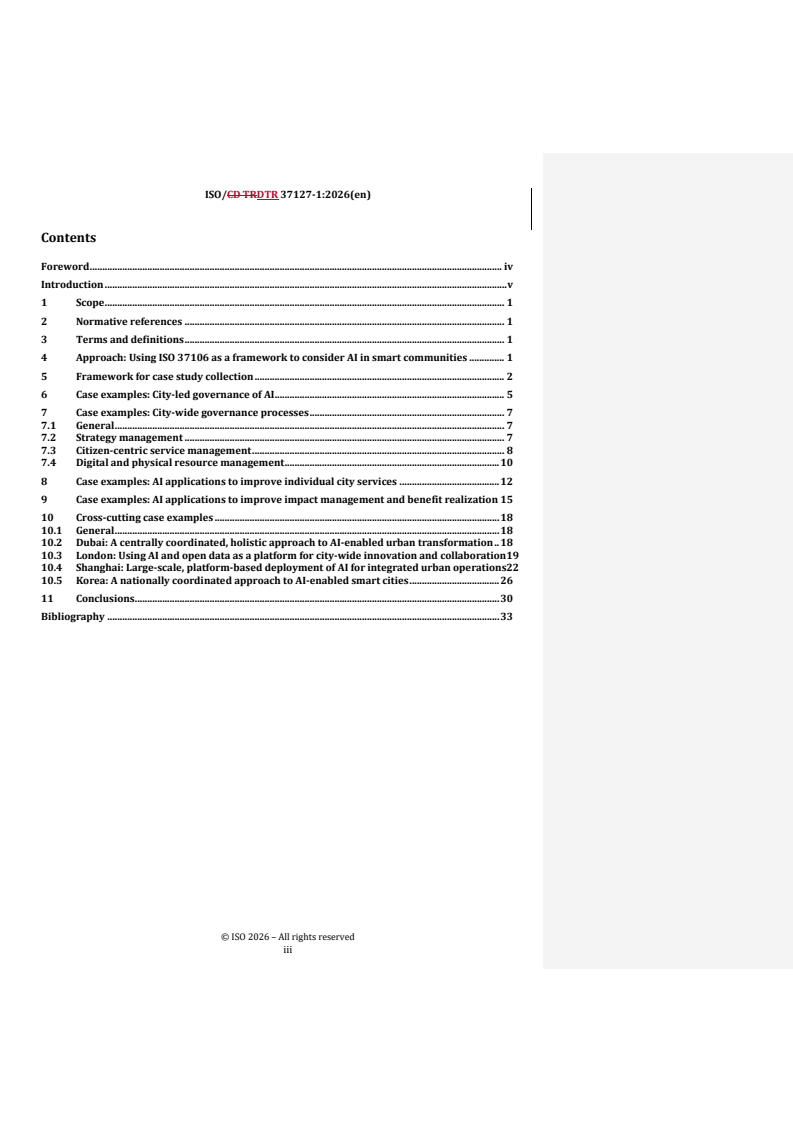
Contents
- Introduction
- 1 Scope
- 2 Normative references
- 3 Terms and definitions
- 4 Approach: Using ISO 37106 as a framework to consider AI in smart communities
- 5 Framework for case study collection
- 6 Case examples: City-led governance of AI
- 7 Case examples: City-wide governance processes
- 7.1 General
- 7.2 Strategy management
- 7.3 Citizen-centric service management
- 7.4 Digital and physical resource management
- 8 Case examples: AI applications to improve individual city services
- 9 Case examples: AI applications to improve impact management and benefit
- 10 Cross-cutting case examples
- 10.1 General
- 10.2 Dubai: A centrally coordinated, holistic approach to AI-enabled urban transformation
- 1. City-led — Establishment of Dubai AI Ethics Board to guide responsible development and
- 10.3 London: Using AI and open data as a platform for city-wide innovation and
- 10.4 Shanghai: Large-scale, platform-based deployment of AI for integrated urban
- 10.5 Korea: A nationally coordinated approach to AI-enabled smart cities
- 2. AI Applications Strategy management
- 11 Conclusions
- Bibliography
Introduction
This document presents case studies on the application of artificial intelligence (AI) to the governance of smart and sustainable communities, identifying good practices and areas where future work on standardization could support community leaders in securing maximum benefits from AI. The global transition toward smart and sustainable cities is a response to the increasing complexities of urbanization, population growth and environmental challenges. Cities are now at the forefront of global sustainability and innovation, with technological advancements providing unprecedented opportunities to improve efficiency, resilience and citizen well-being. One of the most critical enablers of this transformation is AI, which is reshaping how cities are governed, how services are delivered, and how communities interact with urban infrastructure. These changes are already delivering significant benefits but also give rise to concerns and uncertainties – for example, about AI ethics and AI’s potential impacts on employment. Communities already have access to a substantial suite of International Standards that provide a consistent [1] and widely recognised foundation for sustainable and smart development. ISO 37101 establishes a management system for sustainable development, enabling communities to define and pursue strategic [2] [3] purposes across economic, environmental and social dimensions. ISO 37120 , ISO 37122 and [4] ISO 37123 provide harmonized indicators across 19 core city service themes, supporting benchmarking, [5] transparency and continuous improvement. ISO 37106 complements these by setting out a best-practice smart city operating model, helping cities break down silos, join up services and ensure that digital [6] transformation delivers tangible benefits for residents. ISO/TS 37107 provides a maturity framework to measure communities’ progress towards that smart city operating model. Against this backdrop, several important questions arise. How are cities beginning to apply AI in ways that strengthen or transform their existing governance and service delivery models? Does AI simply represent an extension of familiar digital tools, or does it introduce qualitatively new capabilities that involve changes in leadership, accountability, data governance, and organisational culture? What does “good practice” look like, and how can cities ensure that AI adoption remains ethical, transparent and aligned with the strategic [1] purposes defined under ISO 37101 ?
Given that most cities are still in the early stages of deploying AI at scale, there are not yet definitive answers. Instead, there is a growing collection of early experiences – some promising, some experimental – from which useful patterns and lessons can already be observed. This document establishes an initial evidence base by gathering case studies from cities across the world, complemented by targeted desk research. These examples – drawn from twenty-seven cities across four continents – illustrate how AI is beginning to enhance city-wide governance, improve operational coordination, strengthen public services, and support benefit realization. They also indicate areas where future standardization can help cities deploy AI responsibly, effectively, and as part of a coherent smart city operating model.
FINAL DRAFT Technical Report ISO/DTR 37127-1:2026(en) Sustainable cities and communities — Artificial Intelligence (AI) applications in smart city operating models — Part 1:
Case studies
1 Scope
This document provides case studies related to the effective deployment of AI applications in smart city operating models, including urban planning, introducing policy and regulations, public services provision, [5] and coordinated partnerships. It demonstrates how the principles in ISO 37106 can enhance outcomes for sustainable communities through AI deployment, and it provides input for future standardization.
2 Normative references
The following documents are referred to in the text in such a way that some or all of their content constitutes requirements of this document. For dated references, only the edition cited applies. For undated references, the latest edition of the referenced document (including any amendments) applies. ISO 37100, Sustainable cities and communities — Vocabulary
3 Terms and definitions
For the purposes of this document, the terms and definitions given in ISO 37100 apply. ISO and IEC maintain terminology databases for use in standardization at the following addresses:
- ISO Online browsing platform: available at https:// www .iso .org/ obp
- IEC Electropedia: available at https:// www .electropedia .org/
4 Approach: Using ISO 37106 as a framework to consider AI in smart communities
[5] ISO 37106 provides a structured framework to guide city leaders in transitioning from traditional city governance to a smart city operating model. The traditional model is characterized by vertical silos, where different city functions (e.g. transport, utilities, public safety) operate independently. This limits data sharing, citizen engagement and efficiency. In contrast, the smart city operating model promotes integration and collaboration across city functions. Common features of cities at the forefront of this transition include:
- investing in smart data – making city data available in real-time, open and interoperable formats to optimize resources;
- managing city data as an asset – treating data as a shared resource among city departments and external stakeholders;
- community-led innovation – encouraging businesses, citizens and civic organizations to contribute to innovation using city data;
- citizen-centric services – offering integrated, accessible public services based on user needs rather than bureaucratic structures;
ISO/DTR 37127-1:2026(en) - flexible, outcome-based budgets – aligning funding with city-wide goals instead of isolated departmental budgets; - city-wide governance and coordination – ensuring strategic alignment across all stakeholders to drive transformation.
The rapid evolution of AI makes this shift to smart governance even more urgent, accelerating the pace and scale of technology-driven change in cities. AI is no longer a futuristic concept; it is actively shaping cities today, and its potential is being harnessed responsibly to ensure sustainable urban development. [5] This document explores best practices in the application of AI to city governance, using ISO 37106 as a key starting point – as described in the following sections. In doing so, it also explores how communities are:
- applying AI within individual services – taking as its framework the 19 city themes listed in ISO 37120 [2] [3] [4] , ISO 37122 and ISO 37123 of city indicators;
- using these innovations to drive progress towards the UN Sustainable Development Goals and the [1] strategic purposes of a sustainable community that are mapped out in ISO 37101 . Case study information in this document is derived from a combination of desk research, interviews with city leaders and an international workshop on ‘AI in smart and sustainable cities and communities’ hosted [7] on a hybrid basis (in-person and video conference) in Chengdu, China, on 12 December 2025 .
5 Framework for case study collection
Figure 1 below summarizes how key elements of existing International Standards for smart and sustainable [1] [5] [2] communities – ISO 37101 , ISO 37106 and ISO 37120 – have been used to create a framework for collecting and analysing case studies on the application of AI to urban innovation.
ISO/DTR 37127-1:2026(en) Key [5] components of ISO 37106 operating model [2] community service themes (as measured in ISO 37120 ) [1] ISO 37101 purposes of a sustainable community AI domains assessed via case studies in this document Figure 1 — Framework for collecting case studies on the application of AI to smart city operating models The top panel of Figure 1 summarizes:
[2] - At its centre, the 19 core themes of a city described in ISO 37120 : economy, education, energy, environment and climate change, finance, governance, health, housing, population and social conditions, recreation, safety, solid waste, sport and culture, telecommunication, transportation, urban/local agriculture and food security, urban planning, wastewater, and water. - Surrounding these individual services, the key elements of the smart city operating model described [5] in ISO 37106 . This operating model is built around a set of delivery principles that guide how smart 1) city initiatives can be approached , supported by three cross-cutting city-wide delivery processes to be coordinated across traditional silos. These are:
- strategy management – aligning vision, policy, and investment at a whole-city level; - citizen-centric service management – designing and delivering services that are integrated, personalized and responsive to community needs; 1) In summary, these state that a smart city is one that is visionary, citizen-centric, digital, and open and collaborative.
ISO/DTR 37127-1:2026(en) - digital and physical asset management – ensuring that all physical and digital infrastructure assets are managed in a coherent, integrated and future-ready way.
[5] ISO 37106 recommends that these processes be supported by both top-down and bottom-up approaches. Top-down coordination ensures strategic alignment across departments and levels of government, while bottom-up approaches empower citizens, communities and local entrepreneurs from both the voluntary and private sectors to innovate with city data and drive new solutions. [5] Finally, the ISO 37106 operating model places emphasis on the need for a clear line of sight between activities and the impacts that city leaders aim to achieve. This is articulated in the standard’s benefit realization framework, which provides cities with a structured approach to planning, managing, monitoring and evaluating city initiatives in ways that deliver defined strategic outcomes and enable the city to adjust [1] course in an agile way. ISO 37101 sets the management framework for outcomes within a sustainable community aligned with UN Sustainable Development Goals.
[5] AI can significantly enhance the implementation and management of the ISO 37106 smart city operating model by strengthening city-wide integration, citizen-centric services and benefit realization. In each of these areas, AI can support both top-down strategic planning and bottom-up community-driven innovation. Furthermore, city authorities can find it helpful to actively govern AI itself to ensure ethical and transparent deployment. This second dimension of AI governance – cities governing AI rather than AI being used to help govern cities – is an equally critical aspect of the smart city discourse. Against that context, the bottom panel of Figure 1 describes four domains in which this document identifies good practice case studies from around the world:
- city-led governance of AI (see Clause 6 of this document for case studies);
- AI applications to enable city-wide governance processes (see Clause 7);
- AI applications to improve individual city services (see Clause 8);
- AI applications to improve impact measurement and benefit realization (see Clause 9). Clause 10 of this document then highlights three leading cities that are making progress in applying AI across every element of the framework illustrated in Figure 1: Dubai, London and Shanghai – and similarly it highlights how Korea’s smart city program is working to do the same on a cross-city, nationally coordinated basis.
Clause 11 concludes by summarizing key findings and providing considerations for future standardization work.
6 Case examples: City-led governance of AI
As Figure 1 emphasizes, the relationship between AI and city governance is bi-directional. On the one hand, AI can make city governance smarter, more responsive, and more citizen-centric – leading to improved operational efficiency, better services and more impactful policy-making. But city governments are also taking the lead in shaping AI governance itself. As AI systems become more deeply embedded in urban life - including through systems working on an agentic basis – cities tend to develop ethical frameworks and regulations to ensure AI is deployed responsibly, fairly, and in alignment with societal values. Some city authorities are already pioneering frameworks to address AI ethics, transparency and accountability, as illustrated in Table 1.
ISO/DTR 37127-1:2026(en) Table 1 — Examples of City-led governance of AI City AI use case Description Dubai AI ethics These guidelines ensure that AI solutions align with the city’s values of fairframework ness, security and accountability. They set out principles to guide the use of AI in the city, including:
- Ethics: AI systems to be fair, accountable, transparent and as explainable as technically possible.
- Security: AI systems to be safe, secure, and controllable by humans. They cannot hurt autonomously, destroy or deceive humans.
- Humanity: AI systems to have human values and to be beneficial to society and government to enable planning for a future in which AI systems become increasingly intelligent.
- Inclusiveness: AI to be governed as a global effort and its benefits to be shared throughout society. AI to promote human values, freedom, and dignity, and AI systems to respect people’s privacy.
See 10.2 for details on how this ethical framework is being applied in a wide range of service areas.
Amsterdam City-wide register Amsterdam has taken an approach to governing AI that emphasises transof algorithms to parency, accountability and public trust. The city recognised early that the ensure responsible increasing use of algorithms in public administration required explicit governdeployment of stra- ance mechanisms, not only technical controls. This led to the development of a tegic tools city AI strategy grounded in ethical principles and co-created with public agencies, researchers, civil society and private-sector partners. A central element of this approach is the public AI Register, which documents how algorithms are used in municipal services, the purposes they serve and the safeguards applied. The register is complemented by internal review processes that assess risks, such as bias, explainability and proportionality before AI systems are deployed. By making AI use visible and subject to scrutiny, Amsterdam reinforces democratic accountability while enabling innovation.
Singapore AI testing and as- Singapore has developed ‘AI Verify’ as a practical framework and open-source surance framework software toolkit to support the responsible governance of AI systems. AI Verify for responsible is designed to test and assess AI applications against a set of internationally public-sector AI recognised principles, drawing on guidance from the OECD, the European deployment Union and Singapore’s own Model AI Governance Framework. The toolkit enables organisations to evaluate aspects such as transparency, explainability, robustness, fairness, and human oversight through a combination of technical tests and process-based self-assessment. While initially developed at the national level, AI Verify is directly relevant to city authorities and public agencies, providing a concrete mechanism to operationalize ethical AI principles within public service contexts. It shows how cities can move beyond high-level ethics statements to adopt practical tools that support the governance of AI in real-world deployments. By providing a common, testable framework aligned with international norms, AI Verify aims to build trust among citizens, service users and suppliers, while enabling innovation to proceed within clear guardrails.
ISO/DTR 37127-1:2026(en) TTabablele 1 1 ((ccoonnttiinnueuedd)) City AI use case Description Montpellier City-led governance Montpellier Méditerranée Métropole has adopted a proactive approach to the of AI through eth- governance of AI that combines ethical leadership, capability-building, and ics, partnership and strong cross-sector partnerships. Recognising that effective public governance citizen engagement of AI requires new skills within city administrations, Montpellier has worked closely with academic institutions, research centres, industry partners, and standards bodies to strengthen public-sector understanding of AI technologies, risks and opportunities. Citizen engagement has played a central role, with participatory processes used to define acceptable uses of AI and to reinforce the principle that AI supports – rather than replaces – human public decision-making. These discussions informed the development of an AI ethics framework and the use of ethics committees to review sensitive AI initiatives, alongside commitments to transparency, data protection and bias mitigation. In parallel, Montpellier has contributed to national standards work led by AFNOR on AI skills and competencies, reflecting the city’s view that governance frameworks are matched by investment in human capability. Together, these elements demonstrate how a city can lead on AI governance by aligning ethics, skills development and multi-stakeholder collaboration to ensure AI delivers public value in line with community values. See Table 5 below for one practical example – in the domain of flood monitoring and emergency management – of how this governance approach translates into real service-level benefits.
7 Case examples: City-wide governance processes
7.1 General
[5] ISO 37106 identifies three core processes to be coordinated across city systems to deliver smart city outcomes at scale: strategy management; citizen-centric service management; and digital and physical asset management. These processes operate at the city-wide level and are cross-cutting in nature: they support transformation across all services and departments and are essential for delivering the outcomes described in the city's vision and strategy.
Each of these delivery processes is a natural focal point for the application of AI. This document, therefore, proposes that they serve as the primary structure for organizing case studies of how cities are deploying AI to support transformation. Key AI applications and potential case study examples in each area are summarized in 7.2, 7.3 and 7.4.
7.2 Strategy management
This process ensures that the city’s vision, policies and investments are aligned and supported by the appropriate resources, delivery plans and feedback mechanisms. It includes setting strategic outcomes, coordinating transformation roadmaps, aligning budget allocations, and defining performance measures and evaluation methods. Strategy management is also responsible for creating a culture of continuous improvement, using data and feedback to track progress, learn, and adapt. AI can support strategy management in various ways – for example, by enabling cities to simulate the impact of policy options, anticipate future needs and track delivery outcomes in real time. Case studies collected under this subclause illustrate how AI is helping cities manage complexity, align activities, and make more [8] informed and adaptive decisions in line with existing legal frameworks, such as the EU’s GDPR . Key AI applications in the domain of strategy management include:
- Policy development informed by automated data integration – AI can process and integrate real-time data from various city systems (e.g. traffic, weather, utilities) for dynamic decision-making.
- Policy impact simulation: AI models simulate potential outcomes of urban policies (e.g. housing, emissions, transport) to support evidence-based decisions.
ISO/DTR 37127-1:2026(en) - Demand forecasting: Machine learning predicts future demands on infrastructure or services, helping align planning with population or climate trends.
...
Contents
- Introduction
- 1 Scope
- 2 Normative references
- 3 Terms and definitions
- 4 Context
- 4 Approach: Using ISO 37106 as a framework to consider AI in smart communities
- 5 Framework for case study collection
- 6 Case examples: City-led governance of AI
- 7 Case examples: City-wide governance processes
- 7.1 General
- 8 Case examples: AI applications to improve individual city services
- 9 Case examples: AI applications to improve impact management and benefit
- 10 Cross-cutting case examples
- 10.1 General
- 1. City-led
- 3. AI Applications to
- 1. City-led
- 1. City-led
- 1. City-led
- 2. AI Applications to Strategy Managementmanagement
- 4. AI applications to
- 4. AI Applications to
- 11 Conclusions and recommendations
- Bibliography
Introduction
This report documentsdocument presents case studies on the application of artificial intelligence (AI) to the governance of smart and sustainable communities, identifying good practices and areas where future work on standardization could support community leaders in securing maximum benefits from AI. The global transition toward smart and sustainable cities is a response to the increasing complexities of urbanization, population growth, and environmental challenges. Cities are now at the forefront of global sustainability and innovation, with technological advancements providing unprecedented opportunities to improve efficiency, resilience, and citizen well-being. One of the most critical enablers of this transformation is AI, which is reshaping how cities are governed, how services are delivered, and how communities interact with urban infrastructure. These changes are already delivering significant benefits, but also give rise to concerns and uncertainties – for example, about AI ethics and AI’s potential impacts on employment. Communities already have access to a substantial suite of ISO standardsInternational Standards that provide [1] a consistent and widely recognised foundation for sustainable and smart development. ISO 37101 establishes a management system for sustainable development, enabling communities to define and pursue [2] [3] strategic purposes across economic, environmental, and social dimensions. ISO 37120 The , ISO 37122 [4] and ISO 37123 its series provide harmonized indicators across 19 core city service themes, supporting [5] benchmarking, transparency and continuous improvement. ISO 37106 complements these by setting out a best-practice smart city operating model, helping cities break down silos, join up services, and ensure that [6] digital transformation delivers tangible benefits for residents. ISO/TS 37107 provides a maturity framework to measure communities’ progress towards that smart city operating model. Against this backdrop, several important questions arise. How are cities beginning to apply AI in ways that strengthen or transform their existing governance and service delivery models? Does AI simply represent an extension of familiar digital tools, or does it introduce qualitatively new capabilities that involve changes in leadership, accountability, data governance, and organisational culture? What does “good practice” look like, and how can cities ensure that AI adoption remains ethical, transparent, and aligned with the strategic [1] purposes defined under ISO 37101:2016 ?
Given that most cities are still in the early stages of deploying AI at scale, there are not yet definitive answers. Instead, there is a growing collection of early experiences —– some promising, some experimental —– from which useful patterns and lessons can already be observed. This Technical Reportdocument establishes an initial evidence base by gathering case studies from cities across the world, complemented by targeted desk research. These examples —– drawn from twenty-seven cities across four continents —– illustrate how AI is beginning to enhance city-wide governance, improve operational coordination, strengthen public services, and support benefit realization. They also indicate areas where future standardization can help cities deploy AI responsibly, effectively, and as part of a coherent smart city operating model.
ISO/CD TRDTR 37127-1:2026(en) Sustainable cities and communities — Artificial Intelligence (AI) applications in smart city operating models — Part 1:
Case studies
1 Scope
This document provides case studies related to the effective deployment of AI applications in smart city operating models, including urban planning, introducing policy and regulations, public services provision, and [5] coordinated partnerships. It demonstrates how the principles in ISO 37106 ISO 37106 can enhance outcomes for sustainable communities through AI deployment, and it provides input for future standardization.
2 Normative references
The following documents are referred to in the text in such a way that some or all of their content constitutes requirements of this document. For dated references, only the edition cited applies. For undated references, the latest edition of the referenced document (including any amendments) applies. ISO 37100:2026, Sustainable cities and communities — Vocabulary
3 Terms and definitions
For the purposes of this document, the terms and definitions given in ISO 37100:2026 and the following apply. ISO and IEC maintain terminology databases for use in standardization at the following addresses:
- ISO Online browsing platform: available at https://www.iso.org/obp
- IEC Electropedia: available at https://www.electropedia.org/
4 Context
4 Approach: Using ISO 37106 as a framework to consider AI in smart communities
[5] ISO 37106 provides a structured framework to guide city leaders in transitioning from traditional city governance to a smart city operating model. The traditional model is characterized by vertical silos, where different city functions (e.g. transport, utilities, public safety) operate independently. This limits data sharing, citizen engagement, and efficiency. In contrast, the smart city operating model promotes integration and collaboration across city functions. Common features of cities at the forefront of this transition include:
- Investinginvesting in Smart Data – Makingsmart data – making city data available in real-time, open, and interoperable formats to optimize resources.;
- Managing City Datamanaging city data as an Asset – Treatingasset – treating data as a shared resource among city departments and external stakeholders.;
- Community-Led Innovation – Encouragingcommunity-led innovation – encouraging businesses, citizens, and civic organizations to contribute to innovation using city data.;
ISO/CD TRDTR 37127-1:2026(en) - Citizen-Centric Services – Offeringcitizen-centric services – offering integrated, accessible public services based on user needs rather than bureaucratic structures.; - Flexible, Outcome-Based Budgets – Aligningflexible, outcome-based budgets – aligning funding with city-wide goals instead of isolated departmental budgets.; - City-Wide Governance and Coordination – Ensuringcity-wide governance and coordination – ensuring strategic alignment across all stakeholders to drive transformation. The rapid evolution of AI makes this shift to smart governance even more urgent, accelerating the pace and scale of technology-driven change in cities. AI is no longer a futuristic concept; it is actively shaping cities today, and its potential areis being harnessed responsibly to ensure sustainable urban development. [5] This document explores best practices in the application of AI to city governance, using ISO 37106 as a key starting point – as described in the following sections. In doing so, it also explores how communities are:
- Applyingapplying AI within individual services – taking as its framework the 19 city themes listed in ISO [2] [3] [4] 37120 the , ISO 37122 and ISO 37123 its series of city indicators.;
- Usingusing these innovations to drive progress towards the UN Sustainable Development Goals and the [1] Strategic Purposesstrategic purposes of a sustainable community that are mapped out in ISO 37101 . Case study information in this document is derived from a combination of desk research, interviews with city leaders, and an international workshop on ‘AI in smart and sustainable cities and communities’ hosted on a [57] hybrid basis (in-person and video conference) in Chengdu, China, on 12 December 12, 2025 . Field Code Changed
5 Framework for case study collection
Figure 1 below summarizes how key elements of existing ISO standardsInternational Standards for smart and [1] [5] [2] sustainable communities – ISO 37101 ,, ISO 37106 and ISO 37120 – have been used to create a framework for collecting and analysing case studies on the application of AI to urban innovation.
ISO/CD TRDTR 37127-1:2026(en)
Key [5] components of ISO 37106 operating model [2] community service themes (as measured in ISO 37120 )
ISO/CD TRDTR 37127-1:2026(en) [1] ISO 37101
purposes of a sustainable community AI domains assessed via case studies in this document Figure 1 — Framework for collecting case studies on the application of AI to smart city operating models The top panel of Figure 1 summarizes:
[2] - At its centre, the 19 core themes of a city described in ISO 37120 : Economy, Education, Energy, Environment: economy, education, energy, environment and climate change, Finance, Governance, Health, Housing, Populationfinance, governance, health, housing, population and social conditions, Recreation, Safety, Solid Waste, Sportrecreation, safety, solid waste, sport and culture, Telecommunication, Transportation, Urbantelecommunication, transportation, urban/local agriculture and food security, Urban Planning, Wastewaterurban planning, wastewater, and Waterwater. - Surrounding these individual services, the key elements of the smart city operating model described in [5] ISO 37106 . This operating model is built around a set of delivery principles that guide how smart city 1) initiatives can be approached , supported by three cross-cutting city-wide delivery processes to be coordinated across traditional silos. These are:
- Strategy Managementstrategy management – aligning vision, policy, and investment at a whole-city level;
1) In summary, these state that a smart city is one that is visionary, citizen-centric, digital, and open and collaborative.
ISO/CD TRDTR 37127-1:2026(en) - Citizen-Centric Service Managementcitizen-centric service management – designing and delivering services that are integrated, personalized, and responsive to community needs; - Digitaldigital and Physical Asset Managementphysical asset management – ensuring that all physical and digital infrastructure assets are managed in a coherent, integrated, and future-ready way.
[5] ISO 37106 recommends that these processes be supported by both top-down and bottom-up approaches. Top-down coordination ensures strategic alignment across departments and levels of government, while bottom-up approaches empower citizens, communities, and local entrepreneurs from both the voluntary and private sectors to innovate with city data and drive new solutions. [5] Finally, the ISO 37106 operating model is itsplaces emphasis on the need for a clear line of sight between activities and the impacts that city leaders aim to achieve. This is articulated in the standard’s Benefit Realization Frameworkbenefit realization framework, which provides cities with a structured approach to planning, managing, monitoring and evaluating city initiatives in ways that deliver defined strategic outcomes [1] and enable the city to adjust course in an agile way. ISO 37101 sets the management framework for outcomes within a sustainable community aligned with UN Sustainable Development Goals. [5] AI can significantly enhance the implementation and management of the ISO 37106 smart city operating model by strengthening city-wide integration, citizen-centric services, and benefit realization. In each of these areas, AI can support both top-down strategic planning and bottom-up community-driven innovation. Furthermore, city authorities willcan find it helpful to actively govern AI itself to ensure ethical and transparent deployment. This second dimension of AI governance – cities governing AI rather than AI being used to help govern cities – is an equally critical aspect of the smart city discourse. Against that context, the bottom panel of Figure 1 describes four domains in which this document identifies good practice case studies from around the world:
- Citycity-led governance of AI (see Clause 6 of this document for case studies));
- AI applications to enable city-wide governance processes (see Clause 7));
- AI applications to improve individual city services (see Clause 8));
- AI applications to improve impact measurement and benefit realization (see Clause 9). Clause 10 of this document then highlights three leading cities that are making progress in applying AI across every element of the framework illustrated atin Figure 1: Dubai, London and Shanghai – and similarly it highlights how Korea’s smart city program is working to do the same on a cross-city, nationally coordinated basis.
Clause 11 concludes by summarizing key findings and making recommendationsproviding considerations for future standardization work.
6 Case examples: City-led governance of AI
As Figure 1 emphasizes, the relationship between AI and city governance is bi-directional. On the one hand, AI can make city governance smarter, more responsive, and more citizen-centric – leading to improved operational efficiency, better services, and more impactful policy-making. This is the focus of the other three AI case study domains shown at . But city governments are also taking the lead in shaping AI governance itself. As AI systems become more deeply embedded in urban life -– including through systems working on an agentic basis – cities tend to develop ethical frameworks and regulations to ensure AI is deployed responsibly, fairly, and in alignment with societal values. Some city authorities are already pioneering frameworks to address AI ethics, transparency, and accountability, as illustrated atin Table 1.
ISO/CD TRDTR 37127-1:2026(en) Table 1 — Examples of City-led governance of AI City AI Use Caseuse Description case Dubai AI Ethics These guidelines ensure that AI solutions align with the city’s values of Frameworkethics fairness, security, and accountability. They set out principles to guide the use framework of AI in the city, including:
- Ethics: AI systems to be fair, accountable, transparent, and as explainable as technically possible.
- Security: AI systems to be safe, secure, and controllable by humans. They cannot be able tohurt autonomously hurt, destroy, or deceive humans.
- Humanity: AI systems to have human values and to be beneficial to society, and government to planenable planning for a future in which AI systems become increasingly intelligent.
- Inclusiveness: AI to be governed as a global effort and theits benefits to be shared throughout society. AI to promote human values, freedom, and dignity, and AI systems to respect people’s privacy.
See 10.2 for details on how this ethical framework is being applied in a wide range of service areas.
Amsterdam City-wide register Amsterdam has taken an approach to governing AI that emphasises of algorithms to transparency, accountability, and public trust. The city recognised early that ensure the increasing use of algorithms in public administration required explicit responsible governance mechanisms, not only technical controls. This led to the deployment of development of a city AI strategy grounded in ethical principles and co-created strategic tools with public agencies, researchers, civil society, and private-sector partners. A central element of this approach is the public AI Register, which documents how algorithms are used in municipal services, the purposes they serve, and the safeguards applied. The register is complemented by internal review processes that assess risks, such as bias, explainability, and proportionality before AI systems are deployed. By making AI use visible and subject to scrutiny, Amsterdam reinforces democratic accountability while enabling innovation.
Singapore AI testing and Singapore has developed ‘AI Verify’ as a practical framework and open-source assurance software toolkit to support the responsible governance of AI systems. AI Verify framework for is designed to test and assess AI applications against a set of internationally responsible recognised principles, drawing on guidance from the OECD, the European public-sector AI Union, and Singapore’s own Model AI Governance Framework. The toolkit deployment enables organisations to evaluate aspects such as transparency, explainability, robustness, fairness, and human oversight through a combination of technical tests and process-based self-assessment. While initially developed at the national level, AI Verify is directly relevant to city authorities and public agencies, providing a concrete mechanism to operationaliseoperationalize ethical AI principles within public service contexts. It shows how cities can move beyond high-level ethics statements to adopt practical tools that support the governance of AI in real-world deployments. By providing a common, testable framework aligned with international norms, AI Verify aims to build trust among citizens, service users, and suppliers, while enabling innovation to proceed within clear guardrails.
Montpellier City-Led Montpellier Méditerranée Métropole has adopted a proactive approach to the Governanceled governance of AI that combines ethical leadership, capability-building, and governance of AI strong cross-sector partnerships. Recognising that effective public governance through Ethics, of AI requires new skills within city administrations, Montpellier has worked
ISO/CD TRDTR 37127-1:2026(en) City AI Use Caseuse Description case Partnershipethics, closely with academic institutions, research centres, industry partners, and partnership and standards bodies to strengthen public-sector understanding of AI technologies, Citizen risks, and opportunities. Citizen engagement has played a central role, with Engagementcitize participatory processes used to define acceptable uses of AI and to reinforce n engagement the principle that AI to support—supports – rather than replace—replaces – human public decision-making. These discussions informed the development of an AI ethics framework and the use of ethics committees to review sensitive AI initiatives, alongside commitments to transparency, data protection, and bias mitigation. In parallel, Montpellier has contributed to national standards work led by AFNOR on AI skills and competencies, reflecting the city’s view that governance frameworks are matched by investment in human capability. Together, these elements demonstrate how a city can lead on AI governance by aligning ethics, skills development, and multi-stakeholder collaboration to ensure AI delivers public value in line with community values. See Table 5 below for one practical example – in the domain of flood monitoring and emergency management -– of how this governance approach translates into real service-level benefits,.
7 Case examples: City-wide governance processes
7.1 General
[5] ISO 37106 identifies three core processes to be coordinated across city systems to deliver smart city outcomes at scale: Strategy Management; Citizenstrategy management; citizen-centric-Service Management service management; and Digitaldigital and Physical Asset Managementphysical asset management. These processes operate at the city-wide level and are cross-cutting in nature: they support transformation across all services and departments, and are essential for delivering the outcomes described in the city's vision and strategy.
Each of these delivery processes is a natural focal point for the application of artificial intelligence.AI. This document and its series, therefore, proposes that they serve as the primary structure for organizing case studies of how cities are deploying AI to support transformation. Key AI applications and potential case study examples in each area are summarized in 7.2, 7.3 and 7.4below..
...