


ISO 8794:2020
(Main)Steel wire ropes - Spliced eye terminations for slings
Steel wire ropes - Spliced eye terminations for slings
This document specifies minimum requirements for spliced eye terminations for wire rope slings. Prototype tests covering the type acceptance of splice methods are also specified in this document.
Câbles en acier — Oeils épissés pour élingues
General Information
Relations
Overview - ISO 8794:2020 (Steel wire ropes - Spliced eye terminations for slings)
ISO 8794:2020 specifies minimum requirements and prototype test methods for spliced eye terminations used on steel wire rope slings. The standard covers acceptable splicing methods (hand and machine-aided), design performance targets and the prototype tests (tensile destruction and durability/fatigue) required for type acceptance of splice methods. It applies primarily to six-stranded round steel wire ropes with fibre or steel cores in ordinary lay (ISO 2408), although the methods can be used for other rope types where appropriate.
Key topics and technical requirements
- Splicing methods and annexes: Descriptions and procedures for
- hand-splicing of turn-back eyes (Annex A),
- hand-splicing of Flemish eyes (Annex B),
- machine-aided hand-splicing of turn-back eyes (Annex C).
- Splicing workmanship: Splices must be performed by qualified splicers; supplier responsibility for training and qualification is required.
- Tuck requirements: Typical splice requires at least five tucks per strand (with at least three full-strand tucks), or the specified alternative arrangement of tucks.
- Design breaking strength: A spliced eye termination must have a design breaking strength of at least 80% of the rope’s minimum breaking force (as per ISO 2408). If the steel core is incorporated with ≥3 tucks, it may be considered load-bearing.
- Prototype testing:
- Tensile test to destruction: Two tests on each of three representative rope sizes (small, mid, large). Tests at ambient 10–35 °C; apply up to 60% of design force quickly, then increase at ≤0.5% of design force rate until break. Eye geometry requirements (h ≥ 15·d, included angle 25°–35°) and minimum tail spacing are specified.
- Durability (fatigue) test: Six assemblies cycled between 15% and 30% of minimum breaking force, at ≤5 Hz, for 20 000 cycles. Post-fatigue breaking strength must be ≥70% of the rope minimum breaking force.
- Safety and test setup: Requirements for guarding and safe test practice due to risk from uncontained wire fragments. Test machines should conform to ISO 7500‑1 and ambient conditions per ISO 3108.
Applications and users
ISO 8794:2020 is used by:
- Rope and sling manufacturers for design, quality control and type approval of spliced eye terminations.
- Rigging contractors, crane and lifting equipment designers and maritime/port operators specifying compliant slings.
- Inspection bodies and safety managers validating splice performance and conformity.
- Procurement teams seeking standardized acceptance criteria for slings in lifting operations.
Practical benefits include improved safety, predictable splice performance, and a clear basis for acceptance testing and supplier qualification.
Related standards
- ISO 2408 - Steel wire ropes: constructions and breaking forces
- ISO 7500-1 - Verification of static uniaxial testing machines (force-measuring system)
- ISO 17893 - Steel wire ropes: definitions, designation and classification
- ISO 3108 - Ambient conditions / testing guidance
For specification or compliance queries, refer to the full ISO 8794:2020 text and national standards bodies.
Standards Content (Sample)
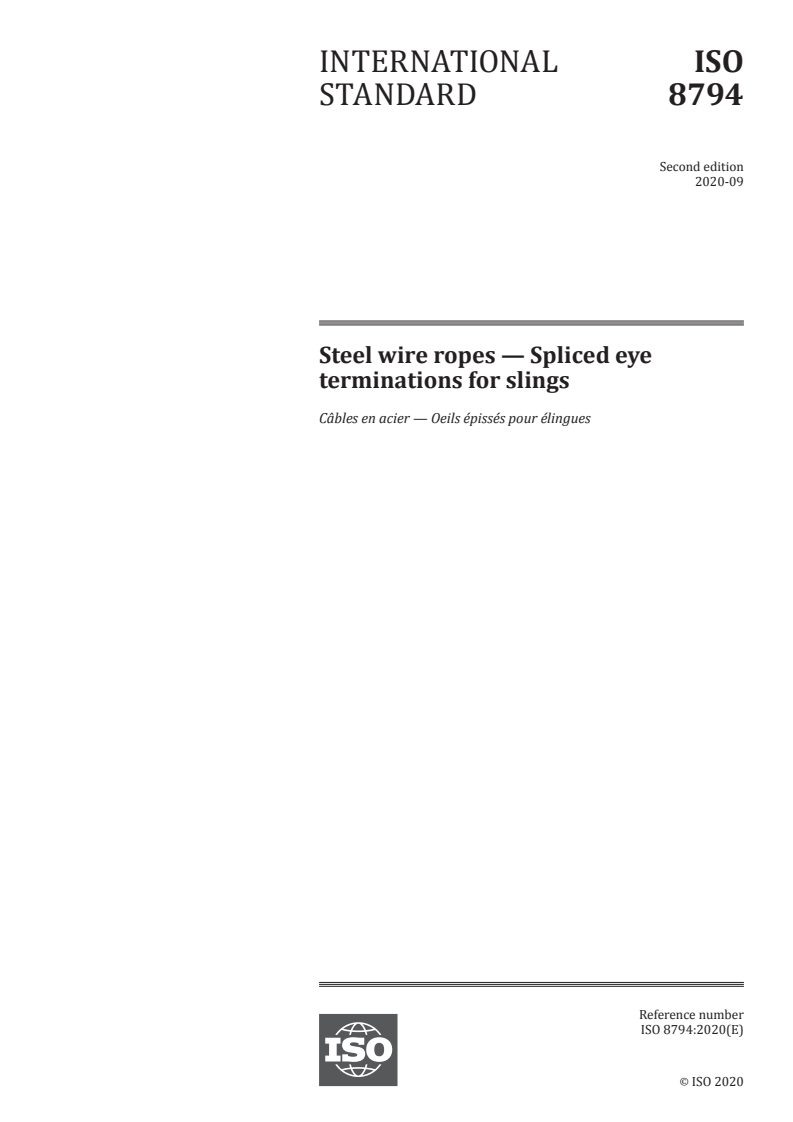
INTERNATIONAL ISO
STANDARD 8794
Second edition
2020-09
Steel wire ropes — Spliced eye
terminations for slings
Câbles en acier — Oeils épissés pour élingues
Reference number
©
ISO 2020
© ISO 2020
All rights reserved. Unless otherwise specified, or required in the context of its implementation, no part of this publication may
be reproduced or utilized otherwise in any form or by any means, electronic or mechanical, including photocopying, or posting
on the internet or an intranet, without prior written permission. Permission can be requested from either ISO at the address
below or ISO’s member body in the country of the requester.
ISO copyright office
CP 401 • Ch. de Blandonnet 8
CH-1214 Vernier, Geneva
Phone: +41 22 749 01 11
Email: copyright@iso.org
Website: www.iso.org
Published in Switzerland
ii © ISO 2020 – All rights reserved
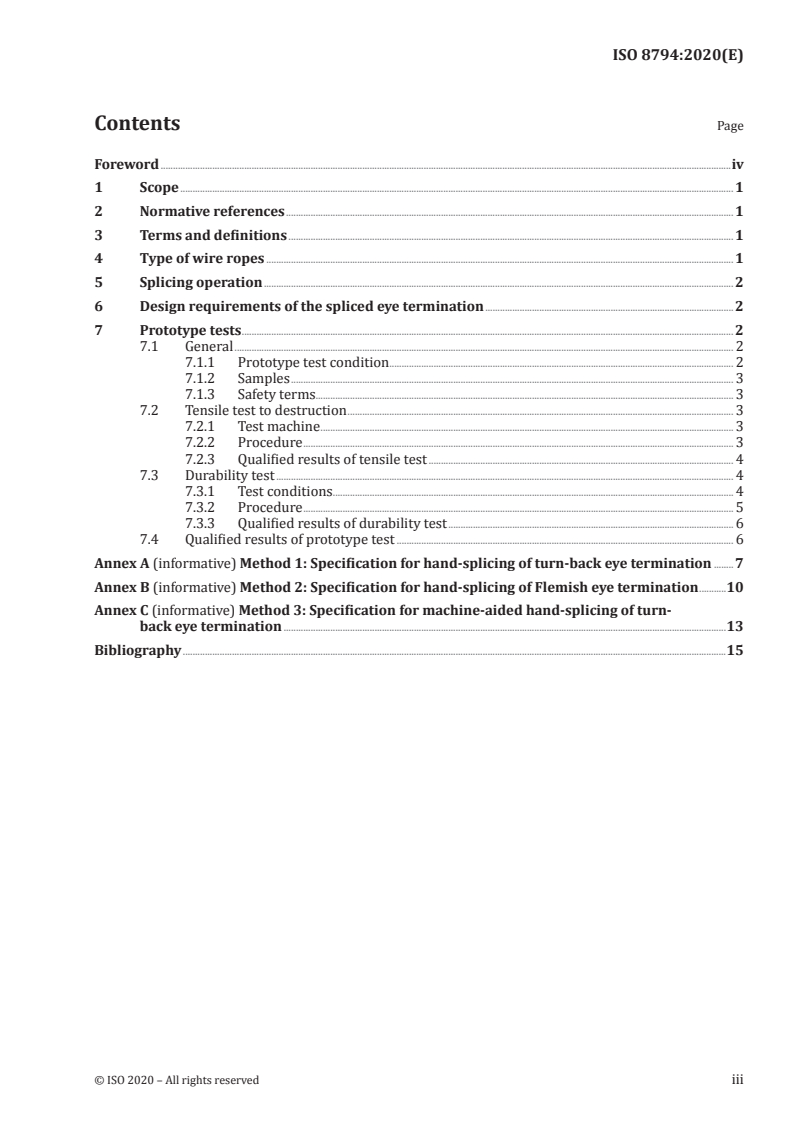
Contents Page
Foreword .iv
1 Scope . 1
2 Normative references . 1
3 Terms and definitions . 1
4 Type of wire ropes . 1
5 Splicing operation . 2
6 Design requirements of the spliced eye termination . 2
7 Prototype tests . 2
7.1 General . 2
7.1.1 Prototype test condition . . 2
7.1.2 Samples . 3
7.1.3 Safety terms. 3
7.2 Tensile test to destruction . 3
7.2.1 Test machine . 3
7.2.2 Procedure . 3
7.2.3 Qualified results of tensile test . 4
7.3 Durability test . 4
7.3.1 Test conditions. 4
7.3.2 Procedure . 5
7.3.3 Qualified results of durability test . 6
7.4 Qualified results of prototype test . 6
Annex A (informative) Method 1: Specification for hand-splicing of turn-back eye termination .7
Annex B (informative) Method 2: Specification for hand-splicing of Flemish eye termination .10
Annex C (informative) Method 3: Specification for machine-aided hand-splicing of turn-
back eye termination .13
Bibliography .15
Foreword
ISO (the International Organization for Standardization) is a worldwide federation of national standards
bodies (ISO member bodies). The work of preparing International Standards is normally carried out
through ISO technical committees. Each member body interested in a subject for which a technical
committee has been established has the right to be represented on that committee. International
organizations, governmental and non-governmental, in liaison with ISO, also take part in the work.
ISO collaborates closely with the International Electrotechnical Commission (IEC) on all matters of
electrotechnical standardization.
The procedures used to develop this document and those intended for its further maintenance are
described in the ISO/IEC Directives, Part 1. In particular, the different approval criteria needed for the
different types of ISO documents should be noted. This document was drafted in accordance with the
editorial rules of the ISO/IEC Directives, Part 2 (see www .iso .org/ directives).
Attention is drawn to the possibility that some of the elements of this document may be the subject of
patent rights. ISO shall not be held responsible for identifying any or all such patent rights. Details of
any patent rights identified during the development of the document will be in the Introduction and/or
on the ISO list of patent declarations received (see www .iso .org/ patents).
Any trade name used in this document is information given for the convenience of users and does not
constitute an endorsement.
For an explanation of the voluntary nature of standards, the meaning of ISO specific terms and
expressions related to conformity assessment, as well as information about ISO's adherence to the
World Trade Organization (WTO) principles in the Technical Barriers to Trade (TBT), see www .iso .org/
iso/ foreword .html.
This document was prepared by Technical Committee ISO/TC 105, Steel wire ropes.
This second edition cancels and replaces the first edition (ISO 8794:1986), which has been technically
revised.
The main changes compared to the previous edition are as follows:
— Clause 3 has been modified (terms and definitions);
— 7.1 has been added (general);
— 7.2 has been modified (tensile test to destruction);
— 7.3 has been modified (durability test);
— 7.4 has been added (qualified results of prototype test);
— Annex B has been added (method 2: specification for hand-splicing of Flemish eye termination);
— Annex C has been added (method 3: specification for machine-aided hand-splicing of turn-back eye
termination.
Any feedback or questions on this document should be directed to the user’s national standards body. A
complete listing of these bodies can be found at www .iso .org/ members .html.
iv © ISO 2020 – All rights reserved
INTERNATIONAL STANDARD ISO 8794:2020(E)
Steel wire ropes — Spliced eye terminations for slings
1 Scope
This document specifies minimum requirements for spliced eye terminations for wire rope slings.
Prototype tests covering the type acceptance of splice methods are also specified in this document.
2 Normative references
The following documents are referred to in the text in such a way that some or all of their content
constitutes requirements of this document. For dated references, only the edition cited applies. For
undated references, the latest edition of the referenced document (including any amendments) applies.
ISO 7500-1, Metallic materials — Verification of static uniaxial testing machines — Part 1: Tension/
compression testing machines — Verification and calibration of the force-measuring system
ISO 17893, Steel wire ropes — Definitions, designation and classification
3 Terms and definitions
For the purposes of this document, the terms and definitions given in ISO 17893 and the following apply.
ISO and IEC maintain terminological databases for use in standardization at the following addresses:
— ISO Online browsing platform: available at https:// www .iso .org/ obp
— IEC Electropedia: available at http:// www .electropedia .org/
3.1
spliced eye termination
loop or eye at the end of a rope made by tucking the ends of the strands back into the main body of the rope
3.1.1
hand-splicing of turn-back eye termination
turn-back eye formed at a rope end secured by means of hand-splicing
3.1.2
hand-splicing of Flemish eye termination
Flemish eye formed at a rope end secured by means of hand-splicing
3.1.3
machine-aided hand-splicing of turn-back eye termination
turn-back eye formed at a rope end by means of a press machine with a plug for tucking and secured by
hand-splicing
3.2
tuck
single reeving of a strand to be spliced under a specified number of strands in the wire rope
4 Type of wire ropes
Six round stranded steel wire ropes with fibre or steel core in ordinary lay specified in ISO 2408 are
suitable for provision of spliced eye terminations. This method could apply to other type of steel wire
ropes for spliced eye terminations.
5 Splicing operation
5.1 The splicing operation shall only be carried out by qualified splicers. The supplier shall be
responsible for ensuring that splicers are properly trained and qualified.
5.2 Examples of approved splicing methods are specified in the Annex A, Annex B and Annex C.
5.3 The splice shall be as one of the descriptions below:
— the splice shall have at least five tucks for each strand, at least three of them with the whole strand;
— the splice shall be made three full strands with four tucks and other three full strands with five
tucks comprising.
NOTE 1 Depending on the rope size, rope construction and the splicing method, more tucks per strand than
given above can be necessary.
NOTE 2 To get a smooth run-out of the splice, it can be advantageous to make the last tuck or the last two
tucks with the half of the wires cut out of the strands.
NOTE 3 Certain national and international conventions exist for regulating the types of spliced eye
terminations to be used in specific applications, e.g. dock works. It is important to take account such regulations
when this document is applied.
5.4 Slings using other splicing methods that conform to the requirements of this document can also be
accepted.
5.5 The wire ends of the spliced strands should be covered with a suitable serving at the option of the
purchaser.
6 Design requirements of the spliced eye termination
The design breaking strength of a spliced eye termination shall be at least 80 % of the minimum
breaking force of the respective wire rope as specified in ISO 2408.
If a steel core is spliced at least three tucks with the strands, it may be considered as a load-bearing
part of the rope.
7 Prototype tests
7.1 General
7.1.1 Prototype test condition
Prototype testing should be carried out before manufacture or if there are any changes in the conditions
as follow:
— when a greater change happened in the structures, raw materials or processes, which may affect
product performance during the production;
— if manufacture considers necessary, when it is discontinued for a period and then production is
resumed;
— if the delivery inspection results are quite different from the design requirement;
— if required by purchaser.
2 © ISO 2020 – All rights reserved
7.1.2 Samples
The tests shall be carried out on three rope sizes which shall represent, respectively, the smallest,
middle and largest of those sizes for which the system is recommended.
Two tests shall be carried out on each size of wire rope for which the splicing method is recommended.
The tests shall be carried out on the highest level of tensile grade for which the system is recommended.
7.1.3 Safety terms
Safety in the test should be a major concern for the operator of the machine, for observers and the
surroundings. Uncontained wires, during testing, can impact and penetrate objects at a great distance.
Adequate safety shields directly around samples, as well as around the operator and observers, should
be used as a minimum.
7.2 Tensile test to destruction
7.2.1 Test machine
The test machine shall be in conformance with ISO 7500-1. In general, the test shall be carried out at
ambient temperature within the limits of 10 °C to 35 °C according to ISO 3108.
7.2.2 Procedure
A spliced eye termination shall be formed without a thimble at each end of each test piece. See Figure 1.
The minimum distance L between the tails of the splices shall be in accordance with Table 1. The
force shall be applied by means of round pi
...
Frequently Asked Questions
ISO 8794:2020 is a standard published by the International Organization for Standardization (ISO). Its full title is "Steel wire ropes - Spliced eye terminations for slings". This standard covers: This document specifies minimum requirements for spliced eye terminations for wire rope slings. Prototype tests covering the type acceptance of splice methods are also specified in this document.
This document specifies minimum requirements for spliced eye terminations for wire rope slings. Prototype tests covering the type acceptance of splice methods are also specified in this document.
ISO 8794:2020 is classified under the following ICS (International Classification for Standards) categories: 77.140.65 - Steel wire, wire ropes and link chains. The ICS classification helps identify the subject area and facilitates finding related standards.
ISO 8794:2020 has the following relationships with other standards: It is inter standard links to ISO 8794:1986. Understanding these relationships helps ensure you are using the most current and applicable version of the standard.
You can purchase ISO 8794:2020 directly from iTeh Standards. The document is available in PDF format and is delivered instantly after payment. Add the standard to your cart and complete the secure checkout process. iTeh Standards is an authorized distributor of ISO standards.
Questions, Comments and Discussion
Ask us and Technical Secretary will try to provide an answer. You can facilitate discussion about the standard in here.
Loading comments...