

ISO 39003:2023
(Main)Road traffic safety (RTS) — Guidance on ethical considerations relating to safety for autonomous vehicles
General Information
- Abstract
This document gives guidance on ethical considerations with regards to road traffic safety of autonomous vehicles (AVs). It is applicable to vehicles in level 5 mode according to SAE J3016 in 2022, as part of its report. This document does not apply to the technical method used to control the decision-making process, nor does it give any guidance on the desired outcomes of those decisions; it gives guidance on ethical aspects for consideration in the design of decision-making process. This document does not set requirements for the outcomes of ethical decisions, nor does it offer guidance on methodology. It only details aspects of the behaviour of AVs for which considerations may be made by the designer/manufacturer to ensure that key aspects are not overlooked or disregarded. This document does not offer the technical precision to prescribe the required controls but would, rather, offer a set of “protocol guidelines” that all decision makers regarding automated driving could choose to self-certify against to assure that the desired necessary ethical considerations were addressed during design and effectively controlled.
- Status
- Published
- Publication Date
- 26-Jul-2023
- Technical Committee
- ISO/TC 241 - Road traffic safety management systems
- Drafting Committee
- ISO/TC 241 - Road traffic safety management systems
- Current Stage
- 6060 - International Standard published
- Start Date
- 27-Jul-2023
- Due Date
- 26-Jul-2023
- Completion Date
- 27-Jul-2023

Overview
ISO 39003:2023 - Road traffic safety (RTS) provides guidance on ethical considerations relating to safety for autonomous vehicles (AVs). It applies specifically to AVs operating at SAE J3016 level 5 (full automation). The standard does not prescribe technical control methods, offer outcomes for ethical decisions, or require specific methodologies. Instead, it identifies ethical aspects and behavioral considerations designers and manufacturers should address and provides a set of protocol-style guidelines that decision makers can use for self‑certification.
Key topics
- Scope & applicability: Focus on level 5 automated driving and road traffic safety; clarifies limits (no technical algorithms or mandated decision outcomes).
- External factors: Road environment and other contextual influences on AV behaviour.
- Stakeholders: Roles and responsibilities for producers, suppliers, distributors, operators, purchasers and government bodies.
- Governance & assessment: Ethical reference frameworks, assessment processes, expression of results, and post‑implementation checks.
- Operationalization of ethics: Values, principles, construction and evaluation of ethical “maxims”, and translation into driving action policies.
- Driving action policies: Practical guidance covering in‑lane behaviour, lane changes, interaction with other road users, unavoidable collisions, yielding to emergency services, failure modes, negotiations and conflict resolution.
- Rule framework: Primary/supporting rules, precautionary vs. performance rules, exceptions, violations, deviations, boundaries (margins, barriers, buffers) and promoters for desirable behaviour.
- Design & sustainability: Considerations for internal/external design impacts and sustainability issues.
- Review: Re‑evaluation following control system updates.
- Informative annexes: Ethical philosophy, sustainability topics, responsibility and accountability, and example action plans.
Practical applications
- Helps AV manufacturers, system designers and suppliers integrate ethics into decision‑making policies without dictating algorithms.
- Supports safety assessors, regulators and certification bodies in evaluating whether design processes considered ethical aspects and accountability.
- Guides operators, fleet managers and procurement teams when specifying acceptable AV behaviour and self‑certification claims.
- Assists policymakers and road authorities in understanding the ethical dimensions of full‑automation deployment.
Who should use it
- AV manufacturers, OEMs and Tier‑1 suppliers
- Designers of decision‑making and behaviour policies for AVs
- Regulators, safety auditors and conformity assessors
- Fleet operators, infrastructure planners and policymakers
Related standards
- References SAE J3016 (2022) for automation levels.
- Intended to complement technical safety and system standards used in AV design (e.g., governance, functional safety, SOTIF, cybersecurity) by providing the ethical context for decision‑making.
Keywords: ISO 39003:2023, road traffic safety, RTS, ethical considerations, autonomous vehicles, AV, SAE J3016 level 5, driving action policies, governance, assessment, self‑certification.
Get Certified
Connect with accredited certification bodies for this standard

Great Wall Tianjin Quality Assurance Center
Established 1993, first batch to receive national accreditation with IAF recognition.
Hong Kong Quality Assurance Agency (HKQAA)
Hong Kong's leading certification body.

Innovative Quality Certifications Pvt. Ltd. (IQCPL)
Known for integrity, providing ethical & impartial Assessment & Certification. CMMI Institute Partner.
Sponsored listings
Frequently Asked Questions
ISO 39003:2023 is a standard published by the International Organization for Standardization (ISO). Its full title is "Road traffic safety (RTS) — Guidance on ethical considerations relating to safety for autonomous vehicles". This standard covers: This document gives guidance on ethical considerations with regards to road traffic safety of autonomous vehicles (AVs). It is applicable to vehicles in level 5 mode according to SAE J3016 in 2022, as part of its report. This document does not apply to the technical method used to control the decision-making process, nor does it give any guidance on the desired outcomes of those decisions; it gives guidance on ethical aspects for consideration in the design of decision-making process. This document does not set requirements for the outcomes of ethical decisions, nor does it offer guidance on methodology. It only details aspects of the behaviour of AVs for which considerations may be made by the designer/manufacturer to ensure that key aspects are not overlooked or disregarded. This document does not offer the technical precision to prescribe the required controls but would, rather, offer a set of “protocol guidelines” that all decision makers regarding automated driving could choose to self-certify against to assure that the desired necessary ethical considerations were addressed during design and effectively controlled.
This document gives guidance on ethical considerations with regards to road traffic safety of autonomous vehicles (AVs). It is applicable to vehicles in level 5 mode according to SAE J3016 in 2022, as part of its report. This document does not apply to the technical method used to control the decision-making process, nor does it give any guidance on the desired outcomes of those decisions; it gives guidance on ethical aspects for consideration in the design of decision-making process. This document does not set requirements for the outcomes of ethical decisions, nor does it offer guidance on methodology. It only details aspects of the behaviour of AVs for which considerations may be made by the designer/manufacturer to ensure that key aspects are not overlooked or disregarded. This document does not offer the technical precision to prescribe the required controls but would, rather, offer a set of “protocol guidelines” that all decision makers regarding automated driving could choose to self-certify against to assure that the desired necessary ethical considerations were addressed during design and effectively controlled.
ISO 39003:2023 is classified under the following ICS (International Classification for Standards) categories: 03.220.20 - Road transport. The ICS classification helps identify the subject area and facilitates finding related standards.
ISO 39003:2023 is available in PDF format for immediate download after purchase. The document can be added to your cart and obtained through the secure checkout process. Digital delivery ensures instant access to the complete standard document.
Standards Content (Sample)
INTERNATIONAL ISO
STANDARD 39003
First edition
2023-07
Road traffic safety (RTS) — Guidance
on ethical considerations relating to
safety for autonomous vehicles
Sécurité routière — Recommandations relatives aux considérations
éthiques en matière de sécurité pour les véhicules autonomes
Reference number
© ISO 2023
All rights reserved. Unless otherwise specified, or required in the context of its implementation, no part of this publication may
be reproduced or utilized otherwise in any form or by any means, electronic or mechanical, including photocopying, or posting on
the internet or an intranet, without prior written permission. Permission can be requested from either ISO at the address below
or ISO’s member body in the country of the requester.
ISO copyright office
CP 401 • Ch. de Blandonnet 8
CH-1214 Vernier, Geneva
Phone: +41 22 749 01 11
Email: copyright@iso.org
Website: www.iso.org
Published in Switzerland
ii
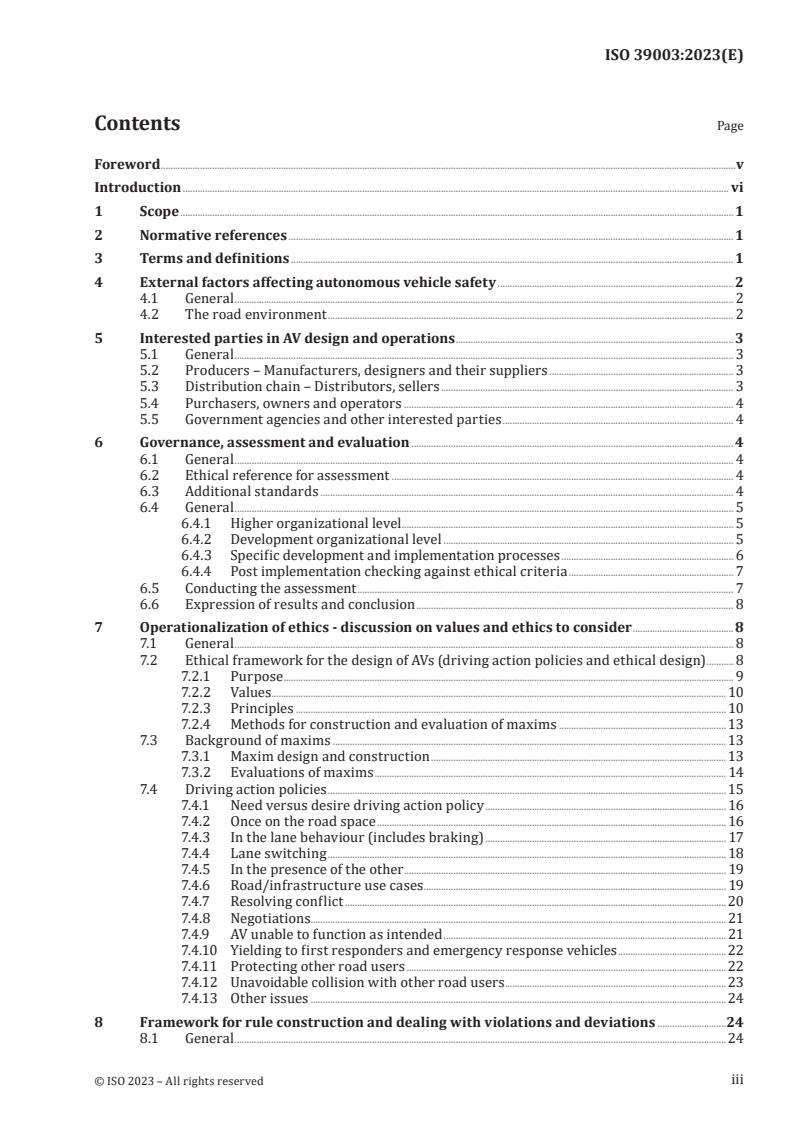
Contents Page
Foreword .v
Introduction . vi
1 Scope . 1
2 Normative references . 1
3 Terms and definitions . 1
4 External factors affecting autonomous vehicle safety . 2
4.1 General . 2
4.2 The road environment . 2
5 Interested parties in AV design and operations . 3
5.1 General . 3
5.2 Producers – Manufacturers, designers and their suppliers . 3
5.3 Distribution chain – Distributors, sellers . 3
5.4 Purchasers, owners and operators . 4
5.5 Government agencies and other interested parties . 4
6 Governance, assessment and evaluation . 4
6.1 General . 4
6.2 Ethical reference for assessment . 4
6.3 Additional standards . 4
6.4 General . 5
6.4.1 Higher organizational level . 5
6.4.2 Development organizational level . 5
6.4.3 Specific development and implementation processes . 6
6.4.4 Post implementation checking against ethical criteria . 7
6.5 Conducting the assessment . 7
6.6 Expression of results and conclusion . 8
7 Operationalization of ethics - discussion on values and ethics to consider .8
7.1 General . 8
7.2 Ethical framework for the design of AVs (driving action policies and ethical design) . 8
7.2.1 Purpose . 9
7.2.2 Values. 10
7.2.3 Principles . 10
7.2.4 Methods for construction and evaluation of maxims .13
7.3 Background of maxims . 13
7.3.1 Maxim design and construction . 13
7.3.2 Evaluations of maxims . 14
7.4 Driving action policies . 15
7.4.1 Need versus desire driving action policy . 16
7.4.2 Once on the road space . 16
7.4.3 In the lane behaviour (includes braking) . 17
7.4.4 Lane switching . 18
7.4.5 In the presence of the other . 19
7.4.6 Road/infrastructure use cases . 19
7.4.7 Resolving conflict .20
7.4.8 Negotiations. 21
7.4.9 AV unable to function as intended . 21
7.4.10 Yielding to first responders and emergency response vehicles .22
7.4.11 Protecting other road users . 22
7.4.12 Unavoidable collision with other road users . 23
7.4.13 Other issues . 24
8 Framework for rule construction and dealing with violations and deviations .24
8.1 General . 24
iii
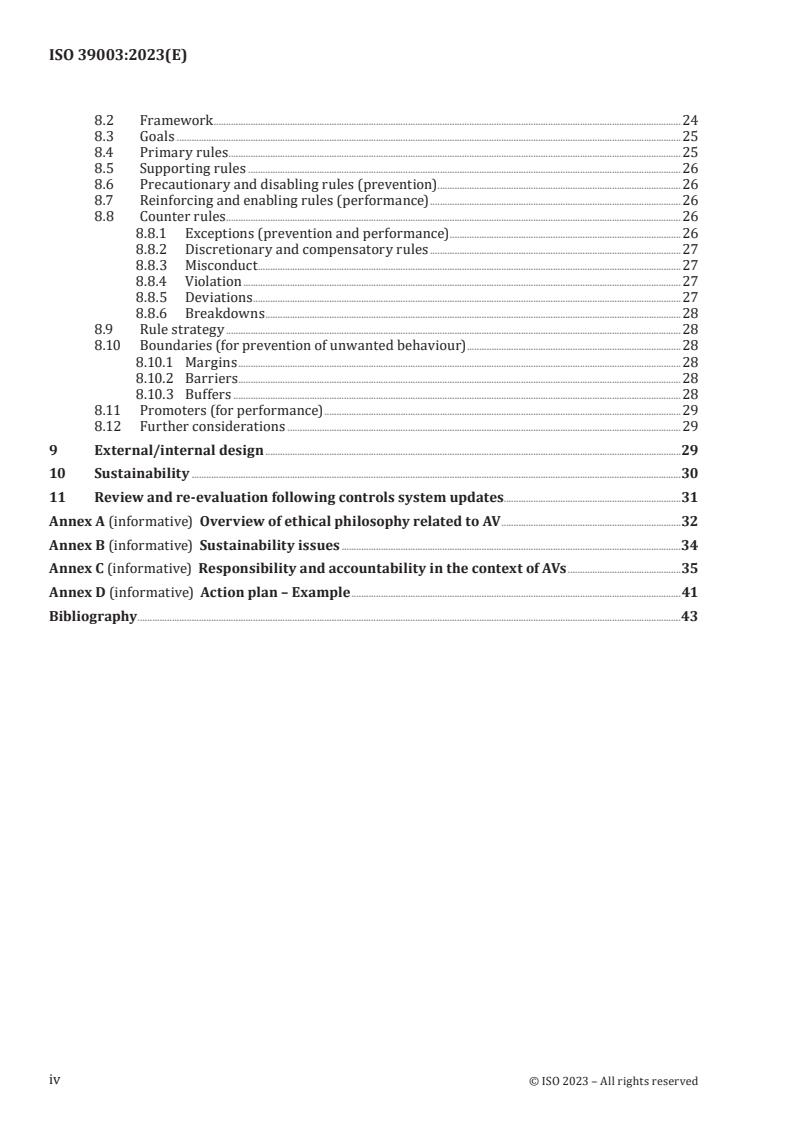
8.2 Framework . 24
8.3 Goals . 25
8.4 Primary rules . 25
8.5 Supporting rules . 26
8.6 Precautionary and disabling rules (prevention) . 26
8.7 Reinforcing and enabling rules (performance) . 26
8.8 Counter rules . 26
8.8.1 Exceptions (prevention and performance) . 26
8.8.2 Discretionary and compensatory rules . 27
8.8.3 Misconduct . 27
8.8.4 Violation . 27
8.8.5 Deviations . 27
8.8.6 Breakdowns .28
8.9 Rule strategy .28
8.10 Boundaries (for prevention of unwanted behaviour) .28
8.10.1 Margins .28
8.10.2 Barriers .28
8.10.3 Buffers .28
8.11 Promoters (for performance) .29
8.12 Further considerations . 29
9 External/internal design .29
10 Sustainability .30
11 Review and re-evaluation following controls system updates .31
Annex A (informative) Overview of ethical philosophy related to AV .32
Annex B (informative) Sustainability issues .34
Annex C (informative) Responsibility and accountability in the context of AVs .35
Annex D (informative) Action plan – Example .41
Bibliography .43
iv
Foreword
ISO (the International Organization for Standardization) is a worldwide federation of national standards
bodies (ISO member bodies). The work of preparing International Standards is normally carried out
through ISO technical committees. Each member body interested in a subject for which a technical
committee has been established has the right to be represented on that committee. International
organizations, governmental and non-governmental, in liaison with ISO, also take part in the work.
ISO collaborates closely with the International Electrotechnical Commission (IEC) on all matters of
electrotechnical standardization.
The procedures used to develop this document and those intended for its further maintenance are
described in the ISO/IEC Directives, Part 1. In particular, the different approval criteria needed for the
different types of ISO documents should be noted. This document was drafted in accordance with the
editorial rules of the ISO/IEC Directives, Part 2 (see www.iso.org/directives).
Attention is drawn to the possibility that some of the elements of this document may be the subject of
patent rights. ISO shall not be held responsible for identifying any or all such patent rights. Details of
any patent rights identified during the development of the document will be in the Introduction and/or
on the ISO list of patent declarations received (see www.iso.org/patents).
Any trade name used in this document is information given for the convenience of users and does not
constitute an endorsement.
For an explanation of the voluntary nature of standards, the meaning of ISO specific terms and
expressions related to conformity assessment, as well as information about ISO's adherence to
the World Trade Organization (WTO) principles in the Technical Barriers to Trade (TBT), see
www.iso.org/iso/foreword.html.
This document was prepared by Technical Committee ISO/TC 241, Road traffic safety management
systems.
Any feedback or questions on this document should be directed to the user’s national standards body. A
complete listing of these bodies can be found at www.iso.org/members.html.
v
Introduction
0.1 General
A long established and commonly held view is that the single most significant factor in road traffic
safety are the actions of the driver. However, the road transport system is a complex socio-technical
system which places high demands on humans to negotiate. Crashes occur since human beings, due
to finite cognitive capacity and physiological limitations, cannot always cope with these demands. To
increase road safety, the road transport system therefore should be designed to support the road user
to cope with this complexity and to mitigate the effects of crashes when this is not possible.
Autonomous vehicles (AVs) have the potential to replace the human driver and to increase road safety
by reducing the risk of human error in daily operations. This will probably take a long time and in
the meantime the capabilities of technology and humans should be combined and integrated in such a
way that the strengths of both are utilized efficiently. Important safety improvements were made over
the last century, but automated driving technology provides new opportunities to improve safety even
further.
AVs are unlikely to gain widespread acceptance until the travelling public feels assured of their
safety and security, not only of passengers but also other vehicles and vulnerable road users. This
includes a behaviour of the AV according to the desires and requirements of society. However, despite
contemporary expectations and a very optimistic view on technology, humans have an extremely
valuable faculty that machines will probably never possess—ethical decision making and judgement.
For real traffic situations the human does not always have the prerequisites to take a rational decision
based on ethics since the time frame is often too narrow. For that reason, many “decisions” are made
instinctively without the possibility of making a well-reasoned and balanced ethical decision. Defining
this element and imparting it on machines is critical for the success of AVs. This can only be achieved by
ensuring that AVs are equipped with driving action policies that align with the general ethical beliefs,
needs, and desires of humanity on a global level, subject to local specific nuances.
To achieve the imprint of global and local ethical considerations in AV design, there is a need for a
framework of ethics involving the necessary stakeholders of different areas. To that objective’s end, it
is important to develop ethical standards for AV behaviour. While there are few standards available,
or under development, that address the engineering and technological aspects of AVs, there are no
International Standards that address aspects concerning the general topics of driving policy and ethical
behaviour, which are also important. Driving policy means a general approach of how an AV makes
a decision and performs manoeuvres. Ethical relevant behaviour represents positive or potentially
negative impact on road users and especially the vulnerable ones as well as the public space at large.
The objective of this document is to lay out a framework for the development of a standard for ethical
and societally accepted driving policy.
0.2 The concept of autonomous vehicles
AVs have the objective to substitute driver, including tasks, decisions, and responsibilities. Hence the
driver behaviour model proposed by Michon (1985) and applied to AVs in Reference [26] (Figure 1)
can be a start to design and operate AVs. The driving task consists of three levels: the strategic level
concerned with the higher-level trip goals (e.g. route choice), the tactical level concerned with the
manoeuvring decisions, including negotiations and interactions with other vehicles, and operational
level concerned with the execution of these tactical and operational behaviours at the level of vehicle
control. There is no strictly hierarchical relationship among these levels.
vi
Figure 1 — Hierarchical model of driving task (source: Reference [26])
Beside this consideration which has a timely sequence, the AV will ideally be designed thoroughly
to ensure safe and secure operation, and the decision base for the desired behaviour established.
Therefore, all necessary information would be available, and the situation will be captured and
understood while different perspectives will support the final decision.
Figure 1 is a generic decomposition of how an AV works. Figure 2 is a more focused and detailed
description of the decision making module (where the ethical considerations resides) Hence a functional
decomposition into the following six layers (Reference [27]) (Figure 2) can provide the first step into
solution space.
vii
Figure 2 — Decomposition layers (source: Reference [27])
— Information access
Information available and accessible.
— Information reception
All necessary information can be captured.
— Information processing
Captured information contain all required classification and identification for further process.
— Situational understanding
Based on information, situation is captured and understood.
— Behavioural decision
Based on designed or trained situational awareness, the desired behaviour is chosen.
— Action
Vehicle transforms whished behaviour into action.
Within this framework, technical realization can differ while the focus of the situation decision will be
comprehensible, accountable, and comparable among different designs. A thorough development will
benefit transparency for action and to take decisions. The work described in this document focuses
primarily on Layer 4 – behavioural decision.
viii
0.3 The concept of ethical considerations for autonomous vehicles
Philosophy helps people question, understand and make sense of the world so they can act properly in
it. This means that decisions and actions are not only intrinsically fair, but that they are also performed
in a way that is balanced with respect with other’s needs, the societal needs and humanistic values,
as well as with respect to the physical world. It is widely accepted that philosophy can be divided into
theoretical philosophy and practical philosophy. Theoretical philosophy consists of subdisciplines such
as ontology, epistemology, logic, and philosophy of mind, amongst others. Practical philosophy consists
of subdisciplines like ethics, political and social philosophy, and aesthetics.
Within ethics there are three main branches: normative ethics, applied ethics as well as meta-ethics.
Normative ethics is the study of ethical action and determining standards for decision making and
conduct (e.g. consequentialism, deontology, virtue ethics, see Annex A). Applied ethics is the application
of standards of ethics to real life situations (e.g. biomedical ethics, AI ethics, political ethics, see
Annex B). In this document, ethics refers to both normative and applied ethics but not to meta-ethics
(which is more concerned with the meaning of ethical concepts such as ‘good’ or ‘bad’ or the nature of
moral judgments. Applied ethics is a flexible and practical way to address ethical considerations in the
development of new technologies because an applied ethics field, such as AV ethics, can borrow from
more than one normative school of ethics. Therefore, the framework offered in this document, although
based on a principle-based approach, can use ideas from deontology and virtue ethics, for example, to
help solve problems. This is a balanced approach; it does not condone one type of normative ethics over
another, it offers a range of perspectives that will help the designer/developer in choosing the best (or
better) decision possible for specific situations.
In summary, ethics is the study of how to choose to act in situations in order to make good and rationally
justifiable decisions. To make decisions, it is necessary to clarify what matters and to understand what
is considered good, bad, right and wrong. Therefore, ethics may be viewed as a tool that helps us create
the difference between a “good” decision and a “bad” one, but also to justify this decision on rational and
intersubjectively acceptable grounds. This is of great importance in the development of AVs because
choices made during the design and development of AV systems determine its “driving behaviour” and
how it caters to its passengers and interacts with other road users (e.g. vulnerable road users). “Driving
behaviour” is what was designed for and programmed into the machine, “conduct” is what actually
transpires as a consequence of applying the driving behaviour to the real world.
This document offers a particular framework for AV ethics which is intended to support the practical
integration of ethics into the AV development process. The framework suggested here builds upon
Socrates conception of the hierarchical nature of philosophy for practical use which has three levels
(see Figure 3). The base level is the conduct that transpires as a consequence of decision and actions
(behaviour), the second level is how these behaviours are governed. Namely what kind of policy and
arrangements are in place to make decisions. The top level is purpose, which behaviour and conduct
will normally align with, in order to achieve the goals and objectives of the entire endeavour. Finally,
knowledge is the “tool” for making sure that the purpose is reasonable and balanced and that the
governance and behaviour/conduct are indeed feasible and appropriate.
ix
Figure 3 — Socrates’ hierarchical nature of philosophy
Figure 4 is a graphical depiction of the framework advocated here for AV ethics. It shares similarities
with other ethical approaches for emerging technologies, it is also unique as it has been created
specifically for the AV context. Essentially, the AV ethics framework provides guidance for reflective
and critical decision making and is composed of four main elements: purpose, values, principles,
and process. The framework approach provides structure and guidance, yet it is flexible enough to
accommodate multicultural perspectives.
Figure 4 — The AV ethics framework for the integration of ethical considerations into the
design and development of AVs
The purpose element refers to the overall goal of integrating ethics into AV design and development.
The purpose is the “why” aspect of the framework or the reason for the existence of this document.
Purpose offers high level (or meta) guidance when decision making, i.e. will a particular decision lead
to an increase in road traffic safety or not. As this is an international standard, the values element
provides guidance on what is important to the world’s population. Therefore, universal values such
as the UN universal values (e.g. human dignity) are recommended in this framework. The principles
element gives more detailed guidance on decision making by identifying the boundaries of a good
x
decision and a bad one as well as directing the attention to specific areas (fairness in AV behaviour and
conduct in the context of other vehicles). The process element refers to two levels of process activities,
governance, and daily operations, which are required to integrate ethics into AV development. Table 1
summarises these four elements.
Specific examples for the values, principles, and process elements are provided in the AV ethics
framework section. The purpose is not an example but a strong recommendation as it contributes to
the overall goal of the ISO traffic management safety series of standards. The values, principles and
processes presented here are relevant and universally acceptable examples but may be changed
according to the requirements and needs of specific countries, societies and organizations. The users
of this document may decide on which values, principles and processes they will use for their work.
Finally, it is acknowledged that an ethics framework is only useful if it is adhered to by all involved and
is well integrated into the AV system development process.
Table 1 — Framework elements and recommended designations
Purpose Overarching goal: increase safety in road traffic systems for all traffic participants
(ISO TC 241)
Values Value set: UN universal values recommended
Principles Principle set: artificial intelligence for people principles recommended (with other
options listed)
Process Governance (e.g. integration of AV ethics into existing governance measures)
Daily operations (e.g. ethical evaluations, operationalization of principles)
xi
INTERNATIONAL STANDARD ISO 39003:2023(E)
Road traffic safety (RTS) — Guidance on ethical
considerations relating to safety for autonomous vehicles
1 Scope
This document gives guidance on ethical considerations with regards to road traffic safety of
autonomous vehicles (AVs).
It is applicable to vehicles in level 5 mode according to SAE J3016 in 2022, as part of its report.
This document does not apply to the technical method used to control the decision-making process,
nor does it give any guidance on the desired outcomes of those decisions; it gives guidance on ethical
aspects for consideration in the design of decision-making process.
This document does not set requirements for the outcomes of ethical decisions, nor does it offer
guidance on methodology. It only details aspects of the behaviour of AVs for which considerations may
be made by the designer/manufacturer to ensure that key aspects are not overlooked or disregarded.
This document does not offer the technical precision to prescribe the required controls but would,
rather, offer a set of “protocol guidelines” that all decision makers regarding automated driving
could choose to self-certify against to assure that the desired necessary ethical considerations were
addressed during design and effectively controlled.
2 Normative references
The following documents are referred to in the text in such a way that some or all of their content
constitutes requirements of this document. For dated references, only the edition cited applies. For
undated references, the latest edition of the referenced document (including any amendments) applies.
ISO 39001, Road traffic safety (RTS) management systems — Requirements with guidance for use
3 Terms and definitions
For the purposes of this document, the terms and definitions given in ISO 39001 and the following apply.
ISO and IEC maintain terminology databases for use in standardization at the following addresses:
— ISO Online browsing platform: available at https:// www .iso .org/ obp
— IEC Electropedia: available at https:// www .electropedia .org/
3.1
autonomous vehicle
AV
vehicle equipped with an automated driving system (ADS) (3.2)
3.2
automated driving system
ADS
system that allows a vehicle to fulfil the requirements for a SAE J3016 level 5 vehicle
3.3
conventional vehicle
vehicle designed to be operated by a conventional driver during part or the entirety of every trip
3.4
AV ethics
branch of applied ethics specific to the ethics of autonomous vehicles (AVs) (3.1)
Note 1 to entry: AV ethics is concerned with the ethical decision-making process of the designers and developers
of AVs while creating and programming AVs. Further, it helps designers and developers of AVs define the
conditions of a good choice and determine which of the options available is the most appropriate one.
3.5
ego vehicle
subject-connected and/or automated vehicle, the behaviour of which is of primary interest in testing,
trialling or operational scenarios
3.6
driving action policy
algorithmic statement that is evaluated TRUE before an action is taken
Note 1 to entry: In essence, the driving action policy constrains the planner from executing a (unethical)
manoeuvre. Many people could consider these as “driving action policies”.
4 External factors affecting autonomous vehicle safety
4.1 General
The following are seven categories of external factors relevant to AV safety:
a) other fully AVs (SAE level 5);
b) other highly or partially AVs (SAE level 4 and below);
c) other conventional vehicles;
d) other mechanical transportation;
e) vulnerable road users;
f) animals;
f) road traffic environment.
NOTE For definition of categories a) to c), see SAE J3016.
4.2 The road environment
In addition to road users and vehicle factors, road and environment conditions are also considered as
contributing factors to crashes. Hence, it is important for AVs to be aware of environmental factors such
as road and topographical conditions and road type (e.g. single-or dual carriageway) throughout the
entire journey route.
Attention should be given, but not limited to the following items.
a) Road conditions:
— road surface (e.g. potholes, slippery, greasy),
— geometric features (e.g. sag curves, crest curves, lane width), and,
— road construction work.
b) Road furniture along the route (e.g. type of guardrail used, road signage, road markings).
c) Road environment:
— topographical condition (e.g. flat, undulating, hilly, mountainous),
— signage (e.g. inadequate, confusing or blocked road signages),
— lighting,
— haze,
— thick fog,
— weather condition (e.g. snow, ice, heavy rain, flood, landslide, crosswind),
— animal crossing, and,
— parked vehicles and potential impact on sightlines.
d) Traffic volume and condition (e.g. during peak hours, festive seasons).
The nature and magnitude of traffic plying on the road plays a significant role and gives rise to a
number of problems if traffic is not properly regulated and controlled due to non-adherence to the
traffic rules which are common features in many developing countries. Therefore, an understanding
of traffic characteristics is a key component to build into autonomous driving systems. If traffic
is allowed to mix with non-motorized traffic (NMT), it would be difficult to ensure that there
would not be any likelihood for occurrence of road crashes. There are many complex issues like
the presence of NMT in the traffic stream to be addressed in a holistic manner in context of ethic
consideration for AVs.
5 Interested parties in AV design and operations
5.1 General
There are four categories of interested parties involved in the design and operations of AVs. Each one is
examined below.
5.2 Producers – Manufacturers, designers and their suppliers
Manufacturers of AVs designing the vehicle carry responsibility toward the users of the vehicle as well
as and towards other road users (vulnerable road users, bystanders, other drivers) for the product and
toward the regulator and operational agencies such as the Department of Motor Vehicles (see C.1 for
a discussion of the concept of responsibility and accountability in AV design.). Manufacturers share
this responsibility with their suppliers. This document, which discusses ethical considerations in the
design of the AV behaviour, provides guidance to manufacturers and their suppliers as to how they
develop ethical relevant components (e.g. vehicle behaviour, interaction with other road users) and
how to document the decision process and decisions accordingly. In particular, the focus is on ethical
considerations in designing vehicle behaviours and decision making.
5.3 Distribution chain – Distributors, sellers
The role of a distributors is to facilitate the bulk transfer of completed vehicles from manufacturers to
sellers. They should address the safety ethical considerations and the guidance within this document
and ensure that no part of the distribution process can compromise any safety features or design of the
vehicle, as manufactured.
The role of a seller is to facilitate the sale of vehicles to users. They should be responsible for ensuring
that all vehicles they sell address the guidance within this document and that the prospective
purchasers are made aware of the relevance of meeting the guidelines in this document (e.g. education
about AV technology and its societal impact).
5.4 Purchasers, owners and operators
Transport authorities generally attempt to optimize the effectiveness of the transport system, maintain
the infrastructure, to improve traffic safety and enhance sustainable development, both for passenger
and freight traffic. In addition, digitalization and the transformation of transport with connected
AVs emerges as an important area to achieve the long-term policy goals set by the authorities, in the
changing environment.
If producers and users work in close coordination, it would be an opportunity of AVs for gaining better
knowledge on the network condition and implementation of more sophisticated network management
strategies. It is contemplated that connected AVs will be in a process to exchange/share a lot more
information about their environment than non-connected and non-autonomous vehicles. This would
provide an impetus to the users to make use of more traffic data to better adjust their network
operation.
5.5 Government agencies and other interested parties
Road safety is a shared responsibility among stakeholders. Government agencies, private sectors and
non-profit organizations significantly influence the automotive market and should ensure that all
vehicles made available are safe and fit for purpose and operated safely.
Government represents interests of all citizens and will always play an important role in effectively
communicating with the producer, supply chain, operators, end users and other related industries,
interested parties and the public in bringing the best possible positive impact on safety.
In order to ensure the ethical behaviour of AVs, the government should consider including ethical
consideration and assessment in regulating safety requirements.
6 Governance, assessment and evaluation
6.1 General
Organizations claiming compliance to this document should undertake an AV ethics assessment where
appropriate and desirable, the outputs of the assessment can be used as a demonstration of AV ethical
compliance to interested external entities.
It is recommended that, if an internal authority is undertaking the assessment, the level of independence
from the organization commissioning the assessment and the organization delivering the automotive
product or service is clearly explained. It is generally accepted that in using an independent body, the
greater the level of independence the higher the degree of objectivity achieved.
The assessment approach should be structured and systematic. It is envisaged that a meaningful report
will be produced as an output of the assessment activity.
6.2 Ethical reference for assessment
It should be clearly stated before the work commences what ethical framework is being used to conduct
the assessment. The assessment framework should be stated in any reports produced. It is possible
that frameworks used in the development of the vehicles may be different to those used in the ethical
assessment. Different organizations could have different ethical perspectives. It is not envisaged that
different ethical starting points are necessarily contradictory or conflicting. It is recommended that
this process be documented with consideration given to checklists or other methodology.
6.3 Additional standards
Where industry-specific, national and international standards are used in the undertaking of the
assessment these should be stated. The scope and degree of utilisation of each standard should be
indicated in any reports produced.
6.4 General
The scope could be an ethical evaluation of the processes contributing to a specific product or service,
or, the ethical processes of the organization in general. The suggested areas of ethical assessment are
as follows:
— higher organizational level;
— development organization level;
— specific development and implementation processes;
— post implementation checking against ethical criteria.
It is envisaged that the assessment scope will cover one or more of these areas. It is also envisaged that
the scope may cover additional areas. Whatever the case, it should be clear what the scope limits are,
for example, what elements of the organization, product, or service are being evaluated.
6.4.1 Higher organizational level
This organizational level is envisaged as the overall business. The assessment should evaluate the
general ethical policy. The aim here is to determine the consistency of the ethical approach flowing
from the higher organization to the product development. The assessment should include, but not be
limited to, an evaluation of the following areas:
— any company-specific or company adopted ethics framework, its applicability to AV ethics, and its
distribution to the internal organizations involved in the development of AVs;
— the representation and championing of AV ethics on the company board and the degree of involvement
with AV ethics at the board level;
— the provision for and support of AV ethics within company policy including:
— the provision and effectiveness of AV ethics training;
— the provision, status, and influence of AV ethics specialists;
— the facilitation of AV ethics through project budgets, planning, scheduling and human resources;
— the requirements placed on suppliers providing equipment or software that facilitates vehicle
autonomy, and the means of acceptance of these items. Measures that prevent the introduction of
hazards owing to the lack of ethical consideration. This includes development and support tools.
6.4.2 Development organizational level
This organizational level is envisaged as the development suborganization that is responsible for
designing and implementing high-level vehicle behaviour. That is behaviour involving the control of the
vehicle within traffic and can be considered the tactical behaviour. The assessment should include, but
not be limited to, an evaluation of the following areas.
— Non-ethics specialists: methods to ensure those involved in the design and implementation of high-
level vehicle behaviour have the appropriate understanding, skills
...