

ISO/TS 23406:2024
(Main)Nuclear sector — Requirements for bodies providing audit and certification of quality management systems for organizations supplying products and services important to nuclear safety (ITNS)
General Information
- Abstract
This document complements the existing requirements of ISO/IEC 17021-1 for bodies providing audit and certification of quality management systems against ISO 19443. NOTE This document can be used as a criteria document for accreditation, peer assessment or other audit processes.
- Status
- Published
- Publication Date
- 01-Apr-2024
- Current Stage
- 6060 - International Standard published
- Start Date
- 02-Apr-2024
- Due Date
- 10-Apr-2024
- Completion Date
- 31-Mar-2024
Buy Documents


ISO/TS 23406:2024 - Nuclear sector — Requirements for bodies providing audit and certification of quality management systems for organizations supplying products and services important to nuclear safety (ITNS) Released:2. 04. 2024


ISO/TS 23406:2024 - Nuclear sector — Requirements for bodies providing audit and certification of quality management systems for organizations supplying products and services important to nuclear safety (ITNS)/9/2025

REDLINE ISO/TS 23406:2024 - Nuclear sector — Requirements for bodies providing audit and certification of quality management systems for organizations supplying products and services important to nuclear safety (ITNS)/9/2025


ISO/TS 23406:2024 - Secteur nucléaire — Exigences pour les organismes procédant a l'audit et a la certification des systemes de management de la qualité d'organisations fournissant des produits et services importants pour la sureté nucléaire (IPSN) Released:2. 04. 2024


ISO/TS 23406:2024 - Secteur nucléaire — Exigences pour les organismes procédant à l'audit et à la certification des systèmes de management de la qualité d'organisations fournissant des produits et services importants pour la sûreté nucléaire (IPSN)/9/2025

REDLINE ISO/TS 23406:2024 - Secteur nucléaire — Exigences pour les organismes procédant à l'audit et à la certification des systèmes de management de la qualité d'organisations fournissant des produits et services importants pour la sûreté nucléaire (IPSN)/9/2025
Overview
ISO/TS 23406:2024 is a technical specification for the nuclear sector that supplements ISO/IEC 17021-1 by defining additional requirements for bodies that audit and certify quality management systems (QMS) of organizations supplying products and services important to nuclear safety (ITNS). It is intended for use as a criteria document for accreditation, peer assessment or other audit processes, and specifically supports certification against ISO 19443.
Key topics and requirements
- Scope and purpose: Complements ISO/IEC 17021-1 to ensure certification bodies apply sector‑specific controls when assessing QMS for nuclear safety supply chains.
- Legal and contractual matters: Certification agreements must require clients to inform the certification body of any start, interruption or resumption of ITNS activities.
- Impartiality, liability and financing: Aligns with ISO/IEC 17021-1 principles to manage conflicts of interest and financial integrity.
- Organizational structure: Certification bodies shall identify a single office with an appointed employee responsible for implementation across locations.
- Resource and competence requirements: Annex A complements ISO/IEC 17021-1 with competence criteria for auditors and technical experts. Auditor qualification is documented, valid for 3 years, and renewal requires demonstration of:
- at least 6 ISO 19443 certification/recertification/surveillance audits in 3 years with a minimum of 20 audit days,
- maintenance of professional knowledge relevant to nuclear QMS,
- participation in mandatory training,
- satisfactory supervision during ISO 19443 audits, and
- absence of significant or recurrent complaints.
- Process requirements: Detailed requirements for pre‑certification activities, application review, audit programme and planning, determining audit time, multi‑site sampling, multi‑standard certifications, initial/recertification audits, surveillance, certification decisions, appeals, complaints and client records.
- Information and confidentiality: Public information, certification documentation, use of marks, confidentiality and information exchange between certification body and client.
- Annexes: Normative and informative annexes include required knowledge/skills, audit result summaries and eligibility criteria for multi‑site sampling.
Practical applications and users
- For certification bodies seeking to audit/certify suppliers in the nuclear industry against ISO 19443.
- For accreditation bodies and peer assessors using ISO/TS 23406 as criteria for evaluating certification bodies.
- For nuclear supply organizations and their compliance teams to understand expectations placed on certifying bodies and the audit process.
- Useful in procurement, regulatory oversight and supplier assurance programs where QMS certification contributes to nuclear safety risk management.
Related standards
- ISO/IEC 17021-1 (conformity assessment - requirements for certification bodies)
- ISO 19443 (QMS specific requirements for organizations in the nuclear supply chain)
- ISO 9000 and ISO/IEC 17000 (terminology and conformity assessment principles)
Keywords: ISO/TS 23406:2024, nuclear sector, quality management systems, certification bodies, ISO 19443, ISO/IEC 17021-1, ITNS, audit, accreditation.
Relations
- Effective Date
- 12-Feb-2026
- Effective Date
- 15-Oct-2022
Buy Documents
ISO/TS 23406:2024 - Nuclear sector — Requirements for bodies providing audit and certification of quality management systems for organizations supplying products and services important to nuclear safety (ITNS) Released:2. 04. 2024
ISO/TS 23406:2024 - Nuclear sector — Requirements for bodies providing audit and certification of quality management systems for organizations supplying products and services important to nuclear safety (ITNS)/9/2025
REDLINE ISO/TS 23406:2024 - Nuclear sector — Requirements for bodies providing audit and certification of quality management systems for organizations supplying products and services important to nuclear safety (ITNS)/9/2025
ISO/TS 23406:2024 - Secteur nucléaire — Exigences pour les organismes procédant a l'audit et a la certification des systemes de management de la qualité d'organisations fournissant des produits et services importants pour la sureté nucléaire (IPSN) Released:2. 04. 2024
ISO/TS 23406:2024 - Secteur nucléaire — Exigences pour les organismes procédant à l'audit et à la certification des systèmes de management de la qualité d'organisations fournissant des produits et services importants pour la sûreté nucléaire (IPSN)/9/2025
REDLINE ISO/TS 23406:2024 - Secteur nucléaire — Exigences pour les organismes procédant à l'audit et à la certification des systèmes de management de la qualité d'organisations fournissant des produits et services importants pour la sûreté nucléaire (IPSN)/9/2025
Get Certified
Connect with accredited certification bodies for this standard

DNV
DNV is an independent assurance and risk management provider.

BSI Group
BSI (British Standards Institution) is the business standards company that helps organizations make excellence a habit.

Bureau Veritas
Bureau Veritas is a world leader in laboratory testing, inspection and certification services.
Sponsored listings
Frequently Asked Questions
ISO/TS 23406:2024 is a technical specification published by the International Organization for Standardization (ISO). Its full title is "Nuclear sector — Requirements for bodies providing audit and certification of quality management systems for organizations supplying products and services important to nuclear safety (ITNS)". This standard covers: This document complements the existing requirements of ISO/IEC 17021-1 for bodies providing audit and certification of quality management systems against ISO 19443. NOTE This document can be used as a criteria document for accreditation, peer assessment or other audit processes.
This document complements the existing requirements of ISO/IEC 17021-1 for bodies providing audit and certification of quality management systems against ISO 19443. NOTE This document can be used as a criteria document for accreditation, peer assessment or other audit processes.
ISO/TS 23406:2024 is classified under the following ICS (International Classification for Standards) categories: 03.120.20 - Product and company certification. Conformity assessment; 27.120.01 - Nuclear energy in general. The ICS classification helps identify the subject area and facilitates finding related standards.
ISO/TS 23406:2024 has the following relationships with other standards: It is inter standard links to CEN ISO/TS 23406:2024, ISO/TS 23406:2020. Understanding these relationships helps ensure you are using the most current and applicable version of the standard.
ISO/TS 23406:2024 is available in PDF format for immediate download after purchase. The document can be added to your cart and obtained through the secure checkout process. Digital delivery ensures instant access to the complete standard document.
Standards Content (Sample)
Technical
Specification
ISO/TS 23406
Second edition
Nuclear sector — Requirements
2024-03
for bodies providing audit and
certification of quality management
systems for organizations supplying
products and services important to
nuclear safety (ITNS)
Secteur nucléaire — Exigences pour les organismes procédant
à l'audit et à la certification des systèmes de management de
la qualité d'organisations fournissant des produits et services
importants pour la sûreté nucléaire (IPSN)
Reference number
© ISO 2024
All rights reserved. Unless otherwise specified, or required in the context of its implementation, no part of this publication may
be reproduced or utilized otherwise in any form or by any means, electronic or mechanical, including photocopying, or posting on
the internet or an intranet, without prior written permission. Permission can be requested from either ISO at the address below
or ISO’s member body in the country of the requester.
ISO copyright office
CP 401 • Ch. de Blandonnet 8
CH-1214 Vernier, Geneva
Phone: +41 22 749 01 11
Email: copyright@iso.org
Website: www.iso.org
Published in Switzerland
ii
Contents Page
Foreword .v
Introduction .vi
1 Scope . 1
2 Normative references . 1
3 Terms and definitions . 1
4 Principles . 1
5 General requirements . 1
5.1 Legal and contractual matters .1
5.2 Management of impartiality .2
5.3 Liability and financing .2
6 Structural requirements . 2
6.1 Organizational structure and top management .2
6.2 Operational control .2
7 Resource requirements . 2
7.1 Competence of personnel .2
7.1.1 General considerations .2
7.1.2 Determination of competence criteria.2
7.1.3 Evaluation processes .2
7.1.4 Other considerations .3
7.2 Personnel involved in the certification activities .3
7.3 Use of individual external auditors and external technical experts .3
7.4 Personnel records .3
7.5 Outsourcing .3
8 Information requirements . 3
8.1 Public information . .3
8.2 Certification documents .4
8.3 Reference to certification and marks .4
8.4 Confidentiality .4
8.5 Information exchange between a certification body and its client .4
9 Process requirements . 4
9.1 Pre-certification activities .4
9.1.1 Application .4
9.1.2 Application review . .4
9.1.3 Audit programme .4
9.1.4 Determining audit time .4
9.1.5 Multi-site sampling . .6
9.1.6 Multiple management systems standards . .7
9.1.7 Organization that does not supply ITNS products and services at the time of the
initial certification audit .7
9.2 Planning audits .7
9.3 Initial certification .7
9.4 Conducting audits .7
9.5 Certification decision . . .8
9.6 Maintaining certification .8
9.7 Appeals .9
9.8 Complaints.9
9.9 Client records .9
10 Management system requirements for certification bodies . 9
Annex A (normative) Required knowledge and skills to determine competence .10
Annex B (informative) Summary of audit results .15
iii
Annex C (normative) Eligibility criteria for multi-site sampling .16
Bibliography . 17
iv
Foreword
ISO (the International Organization for Standardization) is a worldwide federation of national standards
bodies (ISO member bodies). The work of preparing International Standards is normally carried out through
ISO technical committees. Each member body interested in a subject for which a technical committee
has been established has the right to be represented on that committee. International organizations,
governmental and non-governmental, in liaison with ISO, also take part in the work. ISO collaborates closely
with the International Electrotechnical Commission (IEC) on all matters of electrotechnical standardization.
The procedures used to develop this document and those intended for its further maintenance are described
in the ISO/IEC Directives, Part 1. In particular, the different approval criteria needed for the different types
of ISO document should be noted. This document was drafted in accordance with the editorial rules of the
ISO/IEC Directives, Part 2 (see www.iso.org/directives).
ISO draws attention to the possibility that the implementation of this document may involve the use of (a)
patent(s). ISO takes no position concerning the evidence, validity or applicability of any claimed patent
rights in respect thereof. As of the date of publication of this document, ISO had not received notice of (a)
patent(s) which may be required to implement this document. However, implementers are cautioned that
this may not represent the latest information, which may be obtained from the patent database available at
www.iso.org/patents. ISO shall not be held responsible for identifying any or all such patent rights.
Any trade name used in this document is information given for the convenience of users and does not
constitute an endorsement.
For an explanation of the voluntary nature of standards, the meaning of ISO specific terms and expressions
related to conformity assessment, as well as information about ISO's adherence to the World Trade
Organization (WTO) principles in the Technical Barriers to Trade (TBT), see www.iso.org/iso/foreword.html.
This document was prepared by Technical Committee ISO/TC 85, Nuclear energy, nuclear technologies and
radiological protection, in collaboration with ISO Committee on Conformity Assessment (CASCO), and in
collaboration with the European Committee for Standardization (CEN) Technical Committee CEN/TC 430,
Nuclear energy, nuclear technologies, and radiological protection, in accordance with the Agreement on
technical cooperation between ISO and CEN (Vienna Agreement).
This second edition cancels and replaces the first edition (ISO/TS 23406:2020), which has been technically
revised.
The main changes are as follows:
— clarification on the multiple site organization audit duration.
Any feedback or questions on this document should be directed to the user’s national standards body. A
complete listing of these bodies can be found at www.iso.org/members.html.
v
Introduction
Certification of the quality management system (QMS) of an organization supplying products and
services important to nuclear safety (ITNS) is one means of providing assurance that the organization has
implemented a system for the management of quality in line with its policy.
Supplementing ISO/IEC 17021-1 requirements, this document has been developed for the nuclear sector to
assist in the conformity assessment and certification according to ISO 19443.
vi
Technical Specification ISO/TS 23406:2024(en)
Nuclear sector — Requirements for bodies providing
audit and certification of quality management systems for
organizations supplying products and services important to
nuclear safety (ITNS)
1 Scope
This document complements the existing requirements of ISO/IEC 17021-1 for bodies providing audit and
certification of quality management systems against ISO 19443.
NOTE This document can be used as a criteria document for accreditation, peer assessment or other audit
processes.
2 Normative references
The following documents are referred to in the text in such a way that some or all of their content constitutes
requirements of this document. For dated references, only the edition cited applies. For undated references,
the latest edition of the referenced document (including any amendments) applies.
ISO 9000, Quality management systems — Fundamentals and vocabulary
ISO/IEC 17000, Conformity assessment — Vocabulary and general principles
ISO/IEC 17021-1:2015, Conformity assessment — Requirements for bodies providing audit and certification of
management systems — Part 1: Requirements
ISO 19443, Quality management systems — Specific requirements for the application of ISO 9001:2015 by
organizations in the supply chain of the nuclear energy sector supplying products and services important to
nuclear safety (ITNS)
3 Terms and definitions
For the purposes of this document, the terms and definitions given in ISO 9000, ISO/IEC 17000,
ISO/IEC 17021-1 and ISO 19443 apply.
ISO and IEC maintain terminology databases for use in standardization at the following addresses:
— ISO Online browsing platform: available at https:// www .iso .org/ obp
— IEC Electropedia: available at https:// www .electropedia .org/
4 Principles
The principles of ISO/IEC 17021-1:2015, Clause 4, apply.
5 General requirements
5.1 Legal and contractual matters
The requirements of ISO/IEC 17021-1:2015, 5.1, apply and 5.1.2 is complemented as follows.
The certification agreement shall include provision that the certification body is informed by the client of
any starting, interruption or resumption of all activities on ITNS products or services.
5.2 Management of impartiality
The requirements of ISO/IEC 17021-1:2015, 5.2, apply.
5.3 Liability and financing
The requirements of ISO/IEC 17021-1:2015, 5.3, apply.
6 Structural requirements
6.1 Organizational structure and top management
The requirements of ISO/IEC 17021-1:2015, 6.1, apply.
6.2 Operational control
The requirements of ISO/IEC 17021-1:2015, 6.2 apply and 6.2.2 is complemented as follows.
The certification body shall identify a single office location and appoint an employee of this office that has
overall responsibility and authority for the implementation of this document by all its relevant locations.
7 Resource requirements
7.1 Competence of personnel
7.1.1 General considerations
The requirements of ISO/IEC 17021-1:2015, 7.1.1, apply.
7.1.2 Determination of competence criteria
The requirements of ISO/IEC 17021-1:2015, 7.1.2, apply, and ISO/IEC 17021-1:2015, Annex A, is complemented
by Annex A of this document.
7.1.3 Evaluation processes
The requirements of ISO/IEC 17021-1:2015, 7.1.3, apply and are complemented as follows.
— Satisfactory evaluation of auditor competence shall result in a documented auditor qualification.
— The initial qualification shall be based on requirements given in Annex A and is valid for 3 years.
Qualification renewal for a 3-year period shall be based on demonstration of:
— performance of at least 6 ISO 19443 certification, recertification or surveillance audits in 3 years with a
minimum of 20 days of audit,
— maintenance of professional knowledge related to codes, standards, procedures, instructions, and other
documents related to quality management systems in nuclear industry,
— participation in mandatory trainings,
— satisfactory supervision of the auditor performed during an ISO 19443 audit,
— absence of significant or recurrent complaint related to his auditing activities.
At any time, the certification body shall consider taking appropriate action, such as: training, withdrawing
or suspending auditor qualification, in case of:
— no auditing activity during more than one year,
— after a non-satisfactory supervised audit and/or examination of an audit report (e.g. by the certification
body or by an accreditation body),
— following a client’s significant complaint concerning the auditing activity,
— on request of the auditor’s management.
7.1.4 Other considerations
The requirements of ISO/IEC 17021-1:2015, 7.1.4, apply.
7.2 Personnel involved in the certification activities
The requirements of ISO/IEC 17021-1:2015, 7.2, apply and 7.2.8 is complemented as follow.
The certification body shall have at least one person with nuclear industry knowledge involved in the
certification decisions.
The minimum nuclear industry knowledge required for this role shall encompass: ISO/IEC 17021-1,
ISO 19443 and sufficient nuclear industry experience to understand the sector specificities and assess the
contents of the certification audit report and the relevance of its conclusions.
7.3 Use of individual external auditors and external technical experts
The requirements of ISO/IEC 17021-1:2015, 7.3, apply.
7.4 Personnel records
The requirements of ISO/IEC 17021-1:2015, 7.4, apply.
These requirements shall also apply to individual external auditors and external technical experts.
7.5 Outsourcing
The requirements of ISO/IEC 17021-1:2015, 7.5 apply and are complemented as follows.
The certification body shall maintain the responsibility for all functions in Table A.1 and shall not transfer
the responsibility to any other organization.
This doesn’t preclude the certification body’s use of an organization or individuals which operate according
to the certification body’s own procedures and under its control.
8 Information requirements
8.1 Public information
The requirements of ISO/IEC 17021-1:2015, 8.1, apply and are complemented as follows.
The certification body shall make publicly available and accessible:
a) the list of certifications issued;
b) list of data related to certification as listed in ISO/IEC17021 -1: 2015, 8.2.2.
NOTE A good practice is to share the list of public data related to certification with a non-profit association
representing the sector. For example, for the nuclear sector the NQSA association (Nuclear Quality Standard
Association) is collecting the list of public data related to certification.
8.2 Certification documents
The requirements of ISO/IEC 17021-1:2015, 8.2 apply and are complemented as follow.
The certification body shall mention on the certificate “for ITNS activities” before the scope of the certified
activities.
8.3 Reference to certification and marks
The requirements of ISO/IEC 17021-1:2015, 8.3, apply.
8.4 Confidentiality
The requirements of ISO/IEC 17021-1:2015, 8.4 apply and are complemented as follows.
The certification body shall ensure that the client agrees to make public the certification information as
listed in ISO/IEC 17021-1:2015, 8.2.2.
NOTE A good practice is to transmit the certification information to a non-profit association representing the
sector. For information, for the nuclear sector the NQSA association (Nuclear Quality Standard Association) is
collecting the list of public data related to certification.
8.5 Information exchange between a certification body and its client
The requirements of ISO/IEC 17021-1:2015, 8.5 apply and are complemented as follows.
The certification body shall consider provisions (e.g. authorized auditor, security clearance) for access to
specific sensitive information or material as relevant to the certification scope.
The certification body shall provide information and update clients on the data it has transmitted when
drawing up the lists of certifications issued.
9 Process requirements
9.1 Pre-certification activities
9.1.1 Application
The requirements of ISO/IEC 17021-1:2015, 9.1.1 apply.
9.1.2 Application review
The requirements of ISO/IEC 17021-1:2015, 9.1.2 apply.
9.1.3 Audit programme
The requirements of ISO/IEC 17021-1:2015, 9.1.3 apply.
9.1.4 Determining audit time
9.1.4.1 The requirements of ISO/IEC 1702
...
Technical
Specification
ISO/TS 23406
Second edition
Nuclear sector — Requirements
2024-03
for bodies providing audit and
certification of quality management
Corrected version
systems for organizations supplying
2025-07
products and services important to
nuclear safety (ITNS)
Secteur nucléaire — Exigences pour les organismes procédant
à l'audit et à la certification des systèmes de management de
la qualité d'organisations fournissant des produits et services
importants pour la sûreté nucléaire (IPSN)
Reference number
© ISO 2024
All rights reserved. Unless otherwise specified, or required in the context of its implementation, no part of this publication may
be reproduced or utilized otherwise in any form or by any means, electronic or mechanical, including photocopying, or posting on
the internet or an intranet, without prior written permission. Permission can be requested from either ISO at the address below
or ISO’s member body in the country of the requester.
ISO copyright office
CP 401 • Ch. de Blandonnet 8
CH-1214 Vernier, Geneva
Phone: +41 22 749 01 11
Email: copyright@iso.org
Website: www.iso.org
Published in Switzerland
ii
Contents Page
Foreword .v
Introduction .vi
1 Scope . 1
2 Normative references . 1
3 Terms and definitions . 1
4 Principles . 1
5 General requirements . 1
5.1 Legal and contractual matters .1
5.2 Management of impartiality .2
5.3 Liability and financing .2
6 Structural requirements . 2
6.1 Organizational structure and top management .2
6.2 Operational control .2
7 Resource requirements . 2
7.1 Competence of personnel .2
7.1.1 General considerations .2
7.1.2 Determination of competence criteria.2
7.1.3 Evaluation processes .2
7.1.4 Other considerations .3
7.2 Personnel involved in the certification activities .3
7.3 Use of individual external auditors and external technical experts .3
7.4 Personnel records .3
7.5 Outsourcing .3
8 Information requirements . 3
8.1 Public information . .3
8.2 Certification documents .4
8.3 Reference to certification and marks .4
8.4 Confidentiality .4
8.5 Information exchange between a certification body and its client .4
9 Process requirements . 4
9.1 Pre-certification activities .4
9.1.1 Application .4
9.1.2 Application review . .4
9.1.3 Audit programme .4
9.1.4 Determining audit time .4
9.1.5 Multi-site sampling . .6
9.1.6 Multiple management systems standards . .7
9.1.7 Organization that does not supply ITNS products and services at the time of the
initial certification audit .7
9.2 Planning audits .7
9.3 Initial certification .7
9.4 Conducting audits .7
9.5 Certification decision . . .8
9.6 Maintaining certification .8
9.7 Appeals .9
9.8 Complaints.9
9.9 Client records .9
10 Management system requirements for certification bodies . 9
Annex A (normative) Required knowledge and skills to determine competence .10
Annex B (informative) Summary of audit results .15
iii
Annex C (normative) Eligibility criteria for multi-site sampling .16
Bibliography . 17
iv
Foreword
ISO (the International Organization for Standardization) is a worldwide federation of national standards
bodies (ISO member bodies). The work of preparing International Standards is normally carried out through
ISO technical committees. Each member body interested in a subject for which a technical committee
has been established has the right to be represented on that committee. International organizations,
governmental and non-governmental, in liaison with ISO, also take part in the work. ISO collaborates closely
with the International Electrotechnical Commission (IEC) on all matters of electrotechnical standardization.
The procedures used to develop this document and those intended for its further maintenance are described
in the ISO/IEC Directives, Part 1. In particular, the different approval criteria needed for the different types
of ISO document should be noted. This document was drafted in accordance with the editorial rules of the
ISO/IEC Directives, Part 2 (see www.iso.org/directives).
ISO draws attention to the possibility that the implementation of this document may involve the use of (a)
patent(s). ISO takes no position concerning the evidence, validity or applicability of any claimed patent
rights in respect thereof. As of the date of publication of this document, ISO had not received notice of (a)
patent(s) which may be required to implement this document. However, implementers are cautioned that
this may not represent the latest information, which may be obtained from the patent database available at
www.iso.org/patents. ISO shall not be held responsible for identifying any or all such patent rights.
Any trade name used in this document is information given for the convenience of users and does not
constitute an endorsement.
For an explanation of the voluntary nature of standards, the meaning of ISO specific terms and expressions
related to conformity assessment, as well as information about ISO's adherence to the World Trade
Organization (WTO) principles in the Technical Barriers to Trade (TBT), see www.iso.org/iso/foreword.html.
This document was prepared by Technical Committee ISO/TC 85, Nuclear energy, nuclear technologies and
radiological protection, in collaboration with ISO Committee on Conformity Assessment (CASCO), and in
collaboration with the European Committee for Standardization (CEN) Technical Committee CEN/TC 430,
Nuclear energy, nuclear technologies, and radiological protection, in accordance with the Agreement on
technical cooperation between ISO and CEN (Vienna Agreement).
This second edition cancels and replaces the first edition (ISO/TS 23406:2020), which has been technically
revised.
The main changes are as follows:
— clarification on the multiple site organization audit duration.
Any feedback or questions on this document should be directed to the user’s national standards body. A
complete listing of these bodies can be found at www.iso.org/members.html.
This corrected version of ISO/TS 23406:2020 incorporates the following corrections:
— in 9.1.4, the paragraph numbering 9.1.4.1 was deleted at the beginning of the first paragraph;
— in 9.6, in the first paragraph after the list, the sentence was replaced by the following one:
"The requirements of ISO/IEC 17021-1:2015, 9.6.4 are complemented as follow with an added subclause
9.6.4.3.".
v
Introduction
Certification of the quality management system (QMS) of an organization supplying products and
services important to nuclear safety (ITNS) is one means of providing assurance that the organization has
implemented a system for the management of quality in line with its policy.
Supplementing ISO/IEC 17021-1 requirements, this document has been developed for the nuclear sector to
assist in the conformity assessment and certification according to ISO 19443.
vi
Technical Specification ISO/TS 23406:2024(en)
Nuclear sector — Requirements for bodies providing
audit and certification of quality management systems for
organizations supplying products and services important to
nuclear safety (ITNS)
1 Scope
This document complements the existing requirements of ISO/IEC 17021-1 for bodies providing audit and
certification of quality management systems against ISO 19443.
NOTE This document can be used as a criteria document for accreditation, peer assessment or other audit
processes.
2 Normative references
The following documents are referred to in the text in such a way that some or all of their content constitutes
requirements of this document. For dated references, only the edition cited applies. For undated references,
the latest edition of the referenced document (including any amendments) applies.
ISO 9000, Quality management systems — Fundamentals and vocabulary
ISO/IEC 17000, Conformity assessment — Vocabulary and general principles
ISO/IEC 17021-1:2015, Conformity assessment — Requirements for bodies providing audit and certification of
management systems — Part 1: Requirements
ISO 19443, Quality management systems — Specific requirements for the application of ISO 9001:2015 by
organizations in the supply chain of the nuclear energy sector supplying products and services important to
nuclear safety (ITNS)
3 Terms and definitions
For the purposes of this document, the terms and definitions given in ISO 9000, ISO/IEC 17000,
ISO/IEC 17021-1 and ISO 19443 apply.
ISO and IEC maintain terminology databases for use in standardization at the following addresses:
— ISO Online browsing platform: available at https:// www .iso .org/ obp
— IEC Electropedia: available at https:// www .electropedia .org/
4 Principles
The principles of ISO/IEC 17021-1:2015, Clause 4, apply.
5 General requirements
5.1 Legal and contractual matters
The requirements of ISO/IEC 17021-1:2015, 5.1, apply and 5.1.2 is complemented as follows.
The certification agreement shall include provision that the certification body is informed by the client of
any starting, interruption or resumption of all activities on ITNS products or services.
5.2 Management of impartiality
The requirements of ISO/IEC 17021-1:2015, 5.2, apply.
5.3 Liability and financing
The requirements of ISO/IEC 17021-1:2015, 5.3, apply.
6 Structural requirements
6.1 Organizational structure and top management
The requirements of ISO/IEC 17021-1:2015, 6.1, apply.
6.2 Operational control
The requirements of ISO/IEC 17021-1:2015, 6.2 apply and 6.2.2 is complemented as follows.
The certification body shall identify a single office location and appoint an employee of this office that has
overall responsibility and authority for the implementation of this document by all its relevant locations.
7 Resource requirements
7.1 Competence of personnel
7.1.1 General considerations
The requirements of ISO/IEC 17021-1:2015, 7.1.1, apply.
7.1.2 Determination of competence criteria
The requirements of ISO/IEC 17021-1:2015, 7.1.2, apply, and ISO/IEC 17021-1:2015, Annex A, is complemented
by Annex A of this document.
7.1.3 Evaluation processes
The requirements of ISO/IEC 17021-1:2015, 7.1.3, apply and are complemented as follows.
— Satisfactory evaluation of auditor competence shall result in a documented auditor qualification.
— The initial qualification shall be based on requirements given in Annex A and is valid for 3 years.
Qualification renewal for a 3-year period shall be based on demonstration of:
— performance of at least 6 ISO 19443 certification, recertification or surveillance audits in 3 years with a
minimum of 20 days of audit,
— maintenance of professional knowledge related to codes, standards, procedures, instructions, and other
documents related to quality management systems in nuclear industry,
— participation in mandatory trainings,
— satisfactory supervision of the auditor performed during an ISO 19443 audit,
— absence of significant or recurrent complaint related to his auditing activities.
At any time, the certification body shall consider taking appropriate action, such as: training, withdrawing
or suspending auditor qualification, in case of:
— no auditing activity during more than one year,
— after a non-satisfactory supervised audit and/or examination of an audit report (e.g. by the certification
body or by an accreditation body),
— following a client’s significant complaint concerning the auditing activity,
— on request of the auditor’s management.
7.1.4 Other considerations
The requirements of ISO/IEC 17021-1:2015, 7.1.4, apply.
7.2 Personnel involved in the certification activities
The requirements of ISO/IEC 17021-1:2015, 7.2, apply and 7.2.8 is complemented as follow.
The certification body shall have at least one person with nuclear industry knowledge involved in the
certification decisions.
The minimum nuclear industry knowledge required for this role shall encompass: ISO/IEC 17021-1,
ISO 19443 and sufficient nuclear industry experience to understand the sector specificities and assess the
contents of the certification audit report and the relevance of its conclusions.
7.3 Use of individual external auditors and external technical experts
The requirements of ISO/IEC 17021-1:2015, 7.3, apply.
7.4 Personnel records
The requirements of ISO/IEC 17021-1:2015, 7.4, apply.
These requirements shall also apply to individual external auditors and external technical experts.
7.5 Outsourcing
The requirements of ISO/IEC 17021-1:2015, 7.5 apply and are complemented as follows.
The certification body shall maintain the responsibility for all functions in Table A.1 and shall not transfer
the responsibility to any other organization.
This doesn’t preclude the certification body’s use of an organization or individuals which operate according
to the certification body’s own procedures and under its control.
8 Information requirements
8.1 Public information
The requirements of ISO/IEC 17021-1:2015, 8.1, apply and are complemented as follows.
The certification body shall make publicly available and accessible:
a) the list of certifications issued;
b) list of data related to certification as listed in ISO/IEC17021-1:2015, 8.2.2.
NOTE A good practice is to share the list of public data related to certification with a non-profit association
representing the sector. For example, for the nuclear sector the NQSA association (Nuclear Quality Standard
Association) is collecting the list of public data related to certification.
8.2 Certification documents
The requirements of ISO/IEC 17021-1:2015, 8.2 apply and are complemented as follow.
The certification body shall mention on the certificate “for ITNS activities” before the scope of the certified
activities.
8.3 Reference to certification and marks
The requirements of ISO/IEC 17021-1:2015, 8.3, apply.
8.4 Confidentiality
The requirements of ISO/IEC 17021-1:2015, 8.4 apply and are complemented as follows.
The certification body shall ensure that the client agrees to make public the certification information as
listed in ISO/IEC 17021-1:2015, 8.2.2.
NOTE A good practice is to transmit the certification information to a non-profit association representing the
sector. For information, for the nuclear sector the NQSA association (Nuclear Quality Standard Association) is
collecting the list of public data related to certification.
8.5 Information exchange between a certification body and its client
The requirements of ISO/IEC 17021-1:2015, 8.5 apply and are complemented as follows.
The certification body shall consider provisions (e.g. authorized auditor, security clearance) for access to
specific sensitive information or material as relevant to the certification scope.
The certification body shall provide information and update clients on the data it has transmitted when
drawing up the lists of certifications issued.
9 Process requirements
9.1 Pre-certification activities
9.1.1 Application
The requirements of ISO/IEC 17021-1:2015, 9.1.1 apply.
9.1.2 Application review
The
...
ISO/DTSTS 23406:2023(E2024(en)
ISO/TC 85
Secretariat: AFNOR
Date: 2023-11-20
Second edition
2024-03
Corrected version
2025-07
Nuclear sector — Requirements for bodies providing audit and
certification of Qualityquality management systems for organizations
supplying products and services important to nuclear safety (ITNS)
Secteur nucléaire — Exigences pour les organismes procédant à l'audit et à la certification des systèmes de
management de la qualité d'organisations fournissant des produits et services importants pour la sûreté
nucléaire (IPSN)
ISO/DTSTS 23406:2023(E2024(en)
All rights reserved. Unless otherwise specified, or required in the context of its implementation, no part of this publication
may be reproduced or utilized otherwise in any form or by any means, electronic or mechanical, including photocopying,
or posting on the internet or an intranet, without prior written permission. Permission can be requested from either ISO
at the address below or ISO'sISO’s member body in the country of the requester.
ISO Copyright Officecopyright office
CP 401 • Ch. de Blandonnet 8
CH-1214 Vernier, Geneva
Phone: + 41 22 749 01 11
Email:
E-mail: copyright@iso.org
Website: www.iso.org
Published in Switzerland.
ii © ISO 2023 – All rights reserved
ii
ISO/DTSTS 23406:2023(E2024(en)
Contents
Foreword . v
Introduction . vi
1 Scope . 1
2 Normative references . 1
3 Terms and definitions . 1
4 Principles . 1
5 General requirements . 1
5.1 Legal and contractual matters . 1
5.2 Management of impartiality . 2
5.3 Liability and financing . 2
6 Structural requirements . 2
6.1 Organizational structure and top management . 2
6.2 Operational control . 2
7 Resource requirements . 2
7.1 Competence of personnel . 2
7.2 Personnel involved in the certification activities . 3
7.3 Use of individual external auditors and external technical experts . 3
7.4 Personnel records . 3
7.5 Outsourcing . 3
8 Information requirements . 4
8.1 Public information. 4
8.2 Certification documents . 4
8.3 Reference to certification and marks . 4
8.4 Confidentiality . 4
8.5 Information exchange between a certification body and its client . 4
9 Process requirements . 5
9.1 Pre-certification activities . 5
9.2 Planning audits . 8
9.3 Initial certification . 8
9.4 Conducting audits . 8
9.5 Certification decision . 9
9.6 Maintaining certification. 9
9.7 Appeals . 10
9.8 Complaints . 11
9.9 Client records . 11
10 Management system requirements for certification bodies . 11
Annex A (normative) Required knowledge and skills to determine competence . 12
Annex B (informative) Summary of audit results . 17
Annex C (normative) Eligibility criteria for multi-site sampling . 18
Bibliography . 19
iii
ISO/DTSTS 23406:2023(E2024(en)
iv © ISO 2023 – All rights reserved
iv
ISO/DTSTS 23406:2023(E2024(en)
Foreword
ISO (the International Organization for Standardization) is a worldwide federation of national standards
bodies (ISO member bodies). The work of preparing International Standards is normally carried out through
ISO technical committees. Each member body interested in a subject for which a technical committee has been
established has the right to be represented on that committee. International organizations, governmental and
non-governmental, in liaison with ISO, also take part in the work. ISO collaborates closely with the
International Electrotechnical Commission (IEC) on all matters of electrotechnical standardization.
The procedures used to develop this document and those intended for its further maintenance are described
in the ISO/IEC Directives, Part 1. In particular, the different approval criteria needed for the different types of
ISO document should be noted. This document was drafted in accordance with the editorial rules of the
ISO/IEC Directives, Part 2 (see www.iso.org/directives).
ISO draws attention to the possibility that the implementation of this document may involve the use of (a)
patent(s). ISO takes no position concerning the evidence, validity or applicability of any claimed patent rights
in respect thereof. As of the date of publication of this document, ISO had not received notice of (a) patent(s)
which may be required to implement this document. However, implementers are cautioned that this may not
represent the latest information, which may be obtained from the patent database available at
www.iso.org/patents. ISO shall not be held responsible for identifying any or all such patent rights.
Any trade name used in this document is information given for the convenience of users and does not
constitute an endorsement.
For an explanation of the voluntary nature of standards, the meaning of ISO specific terms and expressions
related to conformity assessment, as well as information about ISO's adherence to the World Trade
Organization (WTO) principles in the Technical Barriers to Trade (TBT), see www.iso.org/iso/foreword.html.
This document was prepared by Technical Committee ISO/TC 85, Nuclear energy, nuclear technologies and
radiological protection, in collaboration with ISO Committee on Conformity Assessment (CASCO), and in
collaboration with the European Committee for Standardization (CEN) Technical Committee CEN/TC 430,
Nuclear energy, nuclear technologies, and radiological protection, in accordance with the Agreement on
technical cooperation between ISO and CEN (Vienna Agreement).
This second edition cancels and replaces the first edition (ISO/TS 23406:2020), which has been technically
revised.
The main changes are as follows:
— — clarification on the multiple site organization audit duration.
Any feedback or questions on this document should be directed to the user’s national standards body. A
complete listing of these bodies can be found at www.iso.org/members.html.
This corrected version of ISO/TS 23406:2020 incorporates the following corrections:
— in 9.1.4, the paragraph numbering 9.1.4.1 was deleted at the beginning of the first paragraph;
— in 9.6, in the first paragraph after the list, the sentence was replaced by the following one:
"The requirements of ISO/IEC 17021-1:2015, 9.6.4 are complemented as follow with an added subclause
9.6.4.3.".
v
ISO/DTSTS 23406:2023(E2024(en)
Introduction
Certification of the quality management system (QMS) of an organization supplying products and services
important to nuclear safety (ITNS) is one means of providing assurance that the organization has implemented
a system for the management of quality in line with its policy.
Supplementing ISO/IEC 17021-1 requirements, this document has been developed for the nuclear sector to
assist in the conformity assessment and certification according to ISO 19443.
vi © ISO 2023 – All rights reserved
vi
TECHNICAL SPECIFICATION ISO/DTS 23406:2023(E)
Nuclear sector — Requirements for bodies providing audit and
certification of Qualityquality management systems for organizations
supplying products and services important to nuclear safety (ITNS)
1 Scope
This document complements the existing requirements of ISO/IEC 17021-1 for bodies providing audit and
certification of quality management systems against ISO 19443.
NOTE This document can be used as a criteria document for accreditation, peer assessment or other audit processes.
2 Normative references
The following documents are referred to in the text in such a way that some or all of their content constitutes
requirements of this document. For dated references, only the edition cited applies. For undated references,
the latest edition of the referenced document (including any amendments) applies.
ISO 9000, Quality management systems — Fundamentals and vocabulary
ISO/IEC 17000, Conformity assessment — Vocabulary and general principles
ISO/IEC 17021--1:2015, Conformity assessment — Requirements for bodies providing audit and certification of
management systems — Part 1: Requirements
ISO 19443, Quality management systems — Specific requirements for the application of ISO 9001:2015 by
organizations in the supply chain of the nuclear energy sector supplying products and services important to
nuclear safety (ITNS))
3 Terms and definitions
For the purposes of this document, the terms and definitions given in ISO 9000, ISO/IEC 17000,
ISO/IEC 17021-1 and ISO 19443 apply.
ISO and IEC maintain terminology databases for use in standardization at the following addresses:
— — ISO Online browsing platform: available at https://www.iso.org/obp
— — IEC Electropedia: available at https://www.electropedia.org/
4 Principles
The principles of ISO/IEC 17021-1:2015, Clause 4, apply.
5 General requirements
5.1 Legal and contractual matters
The requirements of ISO/IEC 17021-1:2015, 5.1, apply and 5.1.2 is complemented as follows.
ISO/DTSTS 23406:2023(E2024(en)
The certification agreement shall include provision that the certification body is informed by the client of any
starting, interruption or resumption of all activities on ITNS products or services.
5.2 Management of impartiality
The requirements of ISO/IEC 17021-1:2015, 5.2, apply.
5.3 Liability and financing
The requirements of ISO/IEC 17021-1:2015, 5.3, apply.
6 Structural requirements
6.1 Organizational structure and top management
The requirements of ISO/IEC 17021-1:2015, 6.1, apply.
6.2 Operational control
The requirements of ISO/IEC 17021-1:2015, 6.2 apply and 6.2.2 is complemented as follows.
The certification body shall identify a single office location and appoint an employee of this office that has
overall responsibility and authority for the implementation of this document by all its relevant locations.
7 Resource requirements
7.1 Competence of personnel
7.1.1 General considerations
The requirements of ISO/IEC 17021-1:2015, 7.1.1, apply.
7.1.2 Determination of competence criteria
The requirements of ISO/IEC 17021-1:2015, 7.1.2, apply, and ISO/IEC 17021-1:2015, Annex A, is
complemented by Annex AAnnex A of this document.
7.1.3 Evaluation processes
The requirements of ISO/IEC 17021-1:2015, 7.1.3, apply and are complemented as follows.
— — Satisfactory evaluation of auditor competence shall result in a documented auditor qualification.
— — The initial qualification shall be based on requirements given in Annex AAnnex A and is valid for
3 years.
Qualification renewal for a 3-year period shall be based on demonstration of:
— — performance of at least 6 ISO 19443 certification, recertification or surveillance audits in 3 years with
a minimum of 20 days of audit,
— — maintenance of professional knowledge related to codes, standards, procedures, instructions, and
other documents related to quality management systems in nuclear industry,
2 © ISO 2023 – All rights reserved
ISO/DTSTS 23406:2023(E2024(en)
— — participation in mandatory trainings,
— — satisfactory supervision of the auditor performed during an ISO 19443 audit,
— — absence of significant or recurrent complaint related to his auditing activities.
At any time, the certification body shall consider taking appropriate action, such as: training, withdrawing or
suspending auditor qualification, in case of:
— — no auditing activity during more than one year,
— — after a non-satisfactory supervised audit and/or examination of an audit report (e.g. by the
certification body or by an accreditation body),
— — following a client’s significant complaint concerning the auditing activity,
— — on request of the auditor’s management.
7.1.4 Other considerations
The requirements of ISO/IEC 17021-1:2015, 7.1.4, apply.
7.2 Personnel involved in the certification activities
The requirements of ISO/IEC 17021-1:2015, 7.2, apply and 7.2.8 is complemented as follow.
The certification body shall have at least one person with nuclear industry knowledge involved in the
certification decisions.
The minimum nuclear industry knowledge required for this role shall encompass: ISO/IEC 17021-1,
ISO 19443 and sufficient nuclear industry experience to understand the sector specificities and assess the
contents of the certification audit report and the relevance of its conclusions.
7.3 Use of individual external auditors and external technical experts
The requirements of ISO/IEC 17021-1:2015, 7.3, apply.
7.4 Personnel records
The requirements of ISO/IEC 17021-1:2015, 7.4, apply.
These requirements shall also apply to individual external auditors and external technical experts.
7.5 Outsourcing
The requirements of ISO/IEC 17021-1:2015, 7.5 apply and are complemented as follows.
The certification body shall maintain the responsibility for all functions in Table A.1Table A.1 and shall not
transfer the responsibility to any other organization.
This doesn’t preclude the certification body’s use of an organization or individuals which operate according
to the certification body’s own procedures and under its control.
ISO/DTSTS 23406:2023(E2024(en)
8 Information requirements
8.1 Public information
The requirements of ISO/IEC 17021-1:2015, 8.1, apply and are complemented as follows.
The certification body shall make publicly available and accessible:
a) a) the list of certifications issued;
b) b) list of data related to certification as listed in ISO/IEC17021-1:2015, 8.2.2.
NOTE A good practice is to share the list of public data related to certification with a non-profit association
representing the sector. For example, for the nuclear sector the NQSA association (Nuclear Quality Standard Association)
is collecting the list of public data related to certification.
8.2 Certification documents
The requirements of ISO/IEC 17021-1:2015, 8.2 apply and are complemented as follow.
The certification body shall mention on the certificate “for ITNS activities” before the scope of the certified
activities.
8.3 Reference to certification and marks
The requirements of ISO/IEC 17021-1:2015, 8.3, apply.
8.4 Confidentiality
The requirements of ISO/IEC 17021-1:2015, 8.4 apply and are complemented as follows.
The certification body shall ensure that the client agrees to make public the certification information as listed
in ISO/IEC 17021-1:2015, 8.2.2.
NOTE A good practice is to transmit the certification information to a non-profit association representing the sector.
For information, for the nuclear sector the NQSA association (Nuclear Quality Standard Association) is collecting the list
of public data related to certification.
8.5 Information exchange between a certification body and its client
The requirements of ISO/IEC 17021-1:2015, 8.5 apply and are complemented as follows.
The certification body shall consider provisions (e.g. authorized auditor, security clearance) for access to
specific sensitive information or material as relevant to the certification scope.
The certification body shall provide information and update clients on the data it has transmitted when
drawing up the lists of certifications issued.
4 © ISO 2023 – All rights reserved
ISO/DTSTS 23406:2023(E2024(en)
9 Process requirements
9.1 Pre-certification activities
9.1.1 Application
The requirements of ISO/IEC 17021-1:2015, 9.1.1 apply.
9.1.2 Application review
The requirements of ISO/IEC 17021-1:2015, 9.1.2 apply.
9.1.3 Audit programme
The requirements of ISO/IEC 17021-1:2015, 9.1.3 apply.
9.1.4 Determining audit time
9.1.4.1 The requirements of ISO/IEC 17021-1:2015, 9.1.4 apply and 9.1.4.2 is complemented as follows.
Table 1Table 1 below is intended to be used when the entire management system of an organization is
[ [1]]
undergoing an ISO 19443 audit, without being already ISO 9001 0 certified. The minimum audit duration
for initial, surveillance, and recertification audits are shown in Table 1Table 1. In this configuration, no
reductions are allowed but increases to the minimum required audit duration are expected for areas with
identified risk, complexity or increased scope.
NOTE The definition of audit duration can be found in ISO/IEC TS 17023:2013, 3.7.
If the management system to be certified according to ISO 19443 is only part of a broader integrated
management system, the certification body shall consider the number of employees involved in the nuclear
specific activities and shall increase the time specified by Table 1Table 1 to take into account the quality
management system support functions.
In all cases, the number of employees dedicated to ITNS activities shall be taken into account for the audit
duration calculation and the number of people cannot be reduced.
[ [1]]
If the certification body is already performing the ISO 9001 0 certification of the management system, the
certification body has to apply without reduction the “recertification” duration given in Table 1Table 1 in
order to transition to ISO 19443 certification. The requirements of 9.1.49.1.4 apply in the event of audit being
performed as combined or integrated audits with other management system(s).
Table 1 — Minimum audit duration requirements (audit days)
ISO 19443:2018, 8.3
Number
ISO 19443
of employees
w/o design and development
Annual Annual
Initial Recertification Initial Recertification
surveillance surveillance
1 to 5 2,0 1,0 2,0 2,0 1,0 1,5
6 to 10 2,5 1,0 2,0 2,5 1,0 1,5
11 to 15 3,0 1,5 2,5 2,5 1,0 2,0
16 to 25 3,5 1,5 3,0 3,0 1,5 2,5
ISO/DTSTS 23406:2023(E2024(en)
ISO 1944
...
Spécification
technique
ISO/TS 23406
Deuxième édition
Secteur nucléaire — Exigences
2024-03
pour les organismes procédant
à l'audit et à la certification des
systèmes de management de la
qualité d'organisations fournissant
des produits et services importants
pour la sûreté nucléaire (IPSN)
Nuclear sector — Requirements for bodies providing audit and
certification of quality management systems for organizations
supplying products and services important to nuclear safety (ITNS)
Numéro de référence
DOCUMENT PROTÉGÉ PAR COPYRIGHT
© ISO 2024
Tous droits réservés. Sauf prescription différente ou nécessité dans le contexte de sa mise en œuvre, aucune partie de cette
publication ne peut être reproduite ni utilisée sous quelque forme que ce soit et par aucun procédé, électronique ou mécanique,
y compris la photocopie, ou la diffusion sur l’internet ou sur un intranet, sans autorisation écrite préalable. Une autorisation peut
être demandée à l’ISO à l’adresse ci-après ou au comité membre de l’ISO dans le pays du demandeur.
ISO copyright office
Case postale 401 • Ch. de Blandonnet 8
CH-1214 Vernier, Genève
Tél.: +41 22 749 01 11
E-mail: copyright@iso.org
Web: www.iso.org
Publié en Suisse
ii
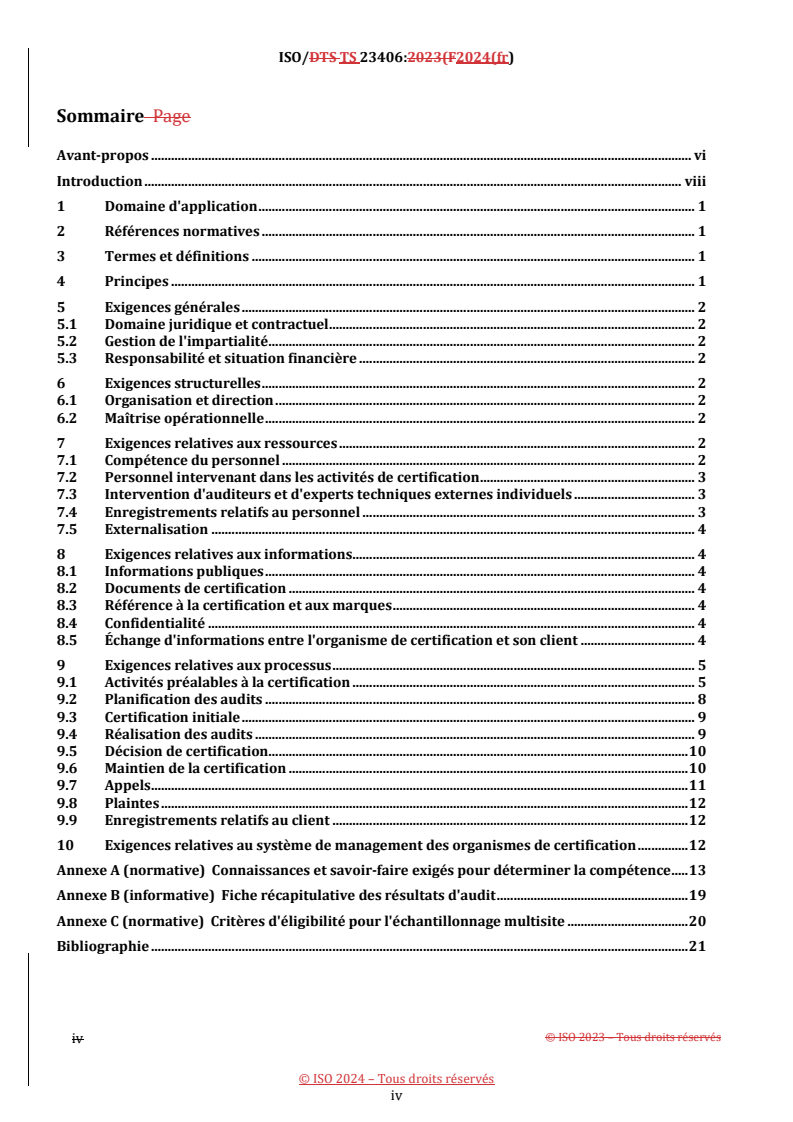
Sommaire Page
Avant-propos .v
Introduction .vi
1 Domaine d'application . 1
2 Références normatives . 1
3 Termes et définitions . 1
4 Principes . 1
5 Exigences générales . . 2
5.1 Domaine juridique et contractuel .2
5.2 Gestion de l'impartialité .2
5.3 Responsabilité et situation financière .2
6 Exigences structurelles . 2
6.1 Organisation et direction .2
6.2 Maîtrise opérationnelle .2
7 Exigences relatives aux ressources . 2
7.1 Compétence du personnel .2
7.1.1 Considérations générales .2
7.1.2 Détermination des critères de compétence .2
7.1.3 Processus d'évaluation.2
7.1.4 Autres considérations .3
7.2 Personnel intervenant dans les activités de certification .3
7.3 Intervention d'auditeurs et d'experts techniques externes individuels .3
7.4 Enregistrements relatifs au personnel .3
7.5 Externalisation .3
8 Exigences relatives aux informations . 4
8.1 Informations publiques . . .4
8.2 Documents de certification .4
8.3 Référence à la certification et aux marques .4
8.4 Confidentialité .4
8.5 Échange d'informations entre l'organisme de certification et son client.4
9 Exigences relatives aux processus . 4
9.1 Activités préalables à la certification .4
9.1.1 Demande de certification .4
9.1.2 Revue de la demande .5
9.1.3 Programme d'audit .5
9.1.4 Détermination du temps d'audit .5
9.1.5 Échantillonnage multisite .6
9.1.6 Normes de systèmes de management multiples .7
9.1.7 Organisation qui ne fournit pas de produits ni de services IPSN au moment de
l'audit de certification initiale .7
9.2 Planification des audits .7
9.3 Certification initiale .8
9.4 Réalisation des audits .8
9.5 Décision de certification .9
9.6 Maintien de la certification .9
9.7 Appels .10
9.8 Plaintes .10
9.9 Enregistrements relatifs au client .10
10 Exigences relatives au système de management des organismes de certification .10
Annexe A (normative) Connaissances et savoir-faire exigés pour déterminer la compétence .11
Annexe B (informative) Fiche récapitulative des résultats d'audit.16
iii
Annexe C (normative) Critères d'éligibilité pour l'échantillonnage multisite . 17
Bibliographie .18
iv
Avant-propos
L'ISO (Organisation internationale de normalisation) est une fédération mondiale d'organismes nationaux
de normalisation (comités membres de l'ISO). L'élaboration des Normes internationales est en général
confiée aux comités techniques de l'ISO. Chaque comité membre intéressé par une étude a le droit de faire
partie du comité technique créé à cet effet. Les organisations internationales, gouvernementales et non
gouvernementales, en liaison avec l'ISO participent également aux travaux. L'ISO collabore étroitement avec
la Commission électrotechnique internationale (IEC) en ce qui concerne la normalisation électrotechnique.
Les procédures utilisées pour élaborer le présent document et celles destinées à sa mise à jour sont
décrites dans les Directives ISO/IEC, Partie 1. Il convient, en particulier, de prendre note des différents
critères d'approbation requis pour les différents types de documents ISO. Le présent document
a été rédigé conformément aux règles de rédaction données dans les Directives ISO/IEC, Partie 2
(voir www.iso.org/directives).
L'ISO attire l'attention sur le fait que la mise en application du présent document peut entraîner l'utilisation
d'un ou de plusieurs brevets. L'ISO ne prend pas position quant à la preuve, à la validité et à l'applicabilité de
tout droit de propriété revendiqué à cet égard. À la date de publication du présent document, l'ISO n'avait pas
reçu notification qu'un ou plusieurs brevets pouvaient être nécessaires à sa mise en application. Toutefois,
il y a lieu d'avertir les responsables de la mise en application du présent document que des informations
plus récentes sont susceptibles de figurer dans la base de données de brevets, disponible à l'adresse
www.iso.org/brevets. L'ISO ne saurait être tenue pour responsable de ne pas avoir identifié tout ou partie de
tels droits de brevet.
Les appellations commerciales éventuellement mentionnées dans le présent document sont données pour
information, par souci de commodité, à l'intention des utilisateurs et ne sauraient constituer un engagement.
Pour une explication de la nature volontaire des normes, la signification des termes et expressions
spécifiques de l'ISO liés à l'évaluation de la conformité, ou pour toute information au sujet de l'adhésion de
l'ISO aux principes de l'Organisation mondiale du commerce (OMC) concernant les obstacles techniques au
commerce (OTC), voir www.iso.org/avant-propos.
Le présent document a été élaboré par le comité technique ISO/TC 85, Énergie nucléaire, technologies
nucléaires et radioprotection, en collaboration avec le comité ISO pour l'évaluation de la conformité (CASCO)
et en collaboration avec le comité technique CEN/TC 430, Énergie nucléaire, technologies nucléaires et
radioprotection, du Comité européen de normalisation (CEN), conformément à l'Accord de coopération
technique entre l'ISO et le CEN (Accord de Vienne).
Cette deuxième édition annule et remplace la première édition (ISO/TS 23406:2020), qui a fait l'objet d'une
révision technique.
Les principales modifications sont les suivantes:
— clarification concernant la durée de l'audit dans les organisations composées de plusieurs sites.
Il convient que l'utilisateur adresse tout retour d'information ou toute question concernant le présent
document à l'organisme national de normalisation de son pays. Une liste exhaustive desdits organismes se
trouve à l'adresse www.iso.org/fr/members.html.
v
Introduction
La certification du système de management de la qualité (SMQ) d'une organisation fournissant des produits
ou services importants pour la sûreté nucléaire (IPSN) est l'un des moyens permettant de garantir que
l'organisation a mis en œuvre un système de management de la qualité conforme à sa politique.
Complétant les exigences de l'ISO/IEC 17021-1, le présent document a été développé pour le secteur nucléaire
afin de faciliter l'évaluation de la conformité et la certification selon l'ISO 19443.
vi
Spécification technique ISO/TS 23406:2024(fr)
Secteur nucléaire — Exigences pour les organismes procédant
à l'audit et à la certification des systèmes de management de
la qualité d'organisations fournissant des produits et services
importants pour la sûreté nucléaire (IPSN)
1 Domaine d'application
Le présent document vient compléter les exigences existantes de l'ISO/IEC 17021-1 pour les organismes
procédant à l'audit et à la certification des systèmes de management de la qualité selon l'ISO 19443.
NOTE Le présent document peut être utilisé comme référentiel pour l'accréditation, l'évaluation par des pairs ou
d'autres processus d'audit.
2 Références normatives
Les documents suivants sont cités dans le texte de sorte qu'ils constituent, pour tout ou partie de leur
contenu, des exigences du présent document. Pour les références datées, seule l'édition citée s'applique. Pour
les références non datées, la dernière édition du document de référence s'applique (y compris les éventuels
amendements).
ISO 9000, Systèmes de management de la qualité — Principes essentiels et vocabulaire
ISO/IEC 17000, Évaluation de la conformité — Vocabulaire et principes généraux
ISO/IEC 17021-1:2015, Évaluation de la conformité — Exigences pour les organismes procédant à l'audit et à la
certification des systèmes de management — Partie 1: Exigences
ISO 19443, Systèmes de management de la qualité — Exigences spécifiques pour l'application de l'ISO 9001:2015
par les organisations de la chaîne d'approvisionnement du secteur de l'énergie nucléaire fournissant des produits
ou services importants pour la sûreté nucléaire (IPSN)
3 Termes et définitions
Pour les besoins du présent document, les termes et les définitions de l'ISO 9000, de l'ISO/IEC 17000, de
l'ISO/IEC 17021-1 et de l'ISO 19443 s'appliquent.
L'ISO et l'IEC tiennent à jour des bases de données terminologiques destinées à être utilisées en normalisation,
consultables aux adresses suivantes:
— ISO Online browsing platform: disponible à l'adresse https:// www .iso .org/ obp
— IEC Electropedia: disponible à l'adresse https:// www .electropedia .org/
4 Principes
Les principes de l'ISO/IEC 17021-1:2015, Article 4 s'appliquent.
5 Exigences générales
5.1 Domaine juridique et contractuel
Les exigences de l'ISO/IEC 17021-1:2015, 5.1 s'appliquent, et le paragraphe 5.1.2 est complété comme suit.
Le contrat de certification doit inclure une disposition selon laquelle l'organisme de certification est informé
par le client de tout début, interruption ou reprise de toutes les activités concernant les produits ou les
services IPSN.
5.2 Gestion de l'impartialité
Les exigences de l'ISO/IEC 17021-1:2015, 5.2 s'appliquent.
5.3 Responsabilité et situation financière
Les exigences de l'ISO/IEC 17021-1:2015, 5.3 s'appliquent.
6 Exigences structurelles
6.1 Organisation et direction
Les exigences de l'ISO/IEC 17021-1:2015, 6.1 s'appliquent.
6.2 Maîtrise opérationnelle
Les exigences de l'ISO/IEC 17021-1:2015, 6.2 s'appliquent et le paragraphe 6.2.2 est complété comme suit.
L'organisme de certification doit identifier un seul site et nommer un employé de ce site qui a la responsabilité
globale et l'autorité pour la mise en œuvre du présent document par tous les sites concernés.
7 Exigences relatives aux ressources
7.1 Compétence du personnel
7.1.1 Considérations générales
Les exigences de l'ISO/IEC 17021-1:2015, 7.1.1 s'appliquent.
7.1.2 Détermination des critères de compétence
Les exigences de l'ISO/IEC 17021-1:2015, 7.1.2 s'appliquent, et l'ISO/IEC 17021-1:2015, Annexe A est
complétée par l'Annexe A du présent document.
7.1.3 Processus d'évaluation
Les exigences de l'ISO/IEC 17021-1:2015, 7.1.3 s'appliquent et sont complétées comme suit:
— la qualification de l'auditeur doit être documentée suite à l'évaluation satisfaisante de ses compétences;
— la qualification initiale doit être prononcée sur la base des exigences figurant dans l'Annexe A et est
valable pour une durée de 3 ans.
La qualification doit être renouvelée pour une période de 3 ans si les preuves suivantes sont apportées:
— la réalisation d'au moins 6 audits de certification, de renouvellement ou de surveillance ISO 19443
en 3 ans avec un minimum de 20 journées d'audit;
— le maintien des connaissances professionnelles liées aux codes, normes, procédures, instructions et
autres documents relatifs aux systèmes de management de la qualité dans l'industrie nucléaire;
— la participation aux formations obligatoires;
— la supervision satisfaisante de l'auditeur pendant un audit ISO 19443;
— l'absence de plaintes significatives ou récurrentes en rapport avec les activités d'audit de l'auditeur.
À tout moment, l'organisme de certification doit envisager de mettre en œuvre des actions appropriées,
telles que: la formation, le retrait ou la suspension de la qualification de l'auditeur dans les cas suivants:
— absence d'activité d'audit pendant plus d'un an;
— supervision non satisfaisante et/ou examen d'un rapport d'audit non satisfaisant (au sein de l'organisme
de certification ou par un organisme d'accréditation);
— suite à une plainte significative formulée par un client concernant l'activité d'audit;
— sur demande de la hiérarchie de l'auditeur.
7.1.4 Autres considérations
Les exigences de l'ISO/IEC 17021-1:2015, 7.1.4 s'appliquent.
7.2 Personnel intervenant dans les activités de certification
Les exigences de l'ISO/IEC 17021-1:2015, 7.2 s'appliquent, et le paragraphe 7.2.8 est complété comme suit.
Au moins une personne ayant une connaissance de l'industrie nucléaire doit être impliquée dans les décisions
de certification au sein de l'organisme de certification.
La connaissance minimale de l'industrie nucléaire requise pour assumer ce rôle doit englober:
l'ISO/IEC 17021-1, l'ISO 19443 et une expérience dans l'industrie nucléaire suffisante pour comprendre les
spécificités du secteur et évaluer le contenu du rapport d'audit de certification ainsi que la pertinence de ses
conclusions.
7.3 Intervention d'auditeurs et d'experts techniques externes individuels
Les exigences de l'ISO/IEC 17021-1:2015, 7.3 s'appliquent.
7.4 Enregistrements relatifs au personnel
Les exigences de l'ISO/IEC 17021-1:2015, 7.4 s'appliquent.
Ces exigences doivent également s'appliquer aux auditeurs et experts techniques externes individuels.
7.5 Externalisation
Les exigences de l'ISO/IEC 17021-1:2015, 7.5 s'appliquent et sont complétées comme suit.
L'organisme de certification doit conserver la responsabilité de toutes les fonctions spécifiées dans le
Tableau A.1 et ne doit pas transférer la responsabilité à une autre organisation.
Cela n'empêche pas l'organisme de certification de faire appel à des organisations ou à des personnes qui
opèrent alors conformément aux procédures de l'organisme de certification et sous son contrôle.
8 Exigences relatives aux informations
8.1 Informations publiques
Les exigences de l'ISO/IEC 17021-1:2015, 8.1 s'appliquent et sont complétées comme suit.
L'organisme de certification doit mettre les documents suivants à la disposition du public:
a) la liste des certifications émises;
b) la liste des données liées à la certification énumérées dans l'ISO/IEC17021 -1: 2015, 8.2.2.
NOTE Une bonne pratique consiste à partager la liste des données publiques liées à la certification avec une
association à but non lucratif qui représente le secteur. Par exemple, dans le secteur nucléaire, l'association NQSA
(Nuclear Quality Standard Association) collecte la liste des données publiques liées à la certification.
8.2 Documents de certification
Les exigences de l'ISO/IEC 17021-1:2015, 8.2 s'appliquent et sont complétées comme suit.
L'organisme de certification doit faire apparaître la mention «pour les activités IPSN» avant le périmètre des
activités certifiées sur le certificat.
8.3 Référence à la certification et aux marques
Les exigences de l'ISO/IEC 17021-1:2015, 8.3 s'appliquent.
8.4 Confidentialité
Les exigences de l'ISO/IEC 17021-1:2015, 8.4 s'appliquent et sont complétées comme suit.
L'organisme de certification doit s'assurer que le client consent à rendre publiques les informations
énumérées dans l'ISO/IEC 17021-1:2015, 8.2.2.
NOTE Une bonne pratique consiste à transmettre les informations relatives à la certification à une association à
but non lucratif qui représente le secteur. Par exemple, dans le secteur nucléaire, l'association NQSA (Nuclear Quality
Standard Association) collecte la liste des données publiques liées à la certification.
8.5 Échange d'informations entre l'organisme de certification et son client
Les exigences de l'ISO/IEC 17021-1:2015, 8.5 s'appliquent et sont complétées comme suit.
L'organisme de certification doit prendre en considération les dispositions (par exemple, auditeur habilité
ou habilitations de sécurité) applicables pour l'accès à des informations ou matériaux sensibles spécifiques,
au regard du périmètre de certification.
L'organisme de certification doit fournir des informations et tenir les clients informés des données qu'il a
transmises pendant la constitution des listes de certifications émises.
9 Exigences relatives aux processus
9.1 Activités préalables à la certification
9.1.1 Demande de certification
Les exigences de l'ISO/IEC 17021-1:2015, 9.1.1 s'appliquent.
9.1.2 Revue de la demande
Les exigences de l'ISO/IEC 17021-1:2015, 9.1.2 s'appliquent.
9.1.3 Programme d'audit
Les exigences de l'ISO/IEC 17021-1:2015, 9.1.3 s'appliquent.
9.1.4 Détermination du temps d'audit
9.1.4.1 Les exigences de l'ISO/IEC 17021-1:2015, 9.1.4 s'appliquent, et le paragraphe 9.1.4.2 est complété
comme suit.
Le Tableau 1 ci-dessous est utilisé lorsque le système de management complet d'une organisation est
[1]
soumis à un audit ISO 19443, sans être déjà certifiée ISO 9001 . La durée minimale des audits initiaux, de
surveillance et de renouvellement de la certification est indiquée dans le Tableau 1. Dans cette configuration,
aucune réduction n'est autorisée, mais des augmentations de la durée minimale d'audit requise sont prévues
pour des domaines présentant un risque, une complexité ou un périmètre élargi identifiés.
NOTE La définition de la durée des audits est donnée dans l'ISO/IEC TS 17023:2013, 3.7.
Si le système de management à certifier conformément à l'ISO 19443 ne représente qu'une partie d'un
système de management intégré plus vaste, l'organisme de certification doit prendre en compte le nombre
d'employés impliqués dans les activités spécifiques au nucléair
...
Spécification
technique
ISO/TS 23406
Deuxième édition
Secteur nucléaire — Exigences
2024-03
pour les organismes procédant
à l'audit et à la certification des
Version corrigée
systèmes de management de la
2025-07
qualité d'organisations fournissant
des produits et services importants
pour la sûreté nucléaire (IPSN)
Nuclear sector — Requirements for bodies providing audit and
certification of quality management systems for organizations
supplying products and services important to nuclear safety (ITNS)
Numéro de référence
DOCUMENT PROTÉGÉ PAR COPYRIGHT
© ISO 2024
Tous droits réservés. Sauf prescription différente ou nécessité dans le contexte de sa mise en œuvre, aucune partie de cette
publication ne peut être reproduite ni utilisée sous quelque forme que ce soit et par aucun procédé, électronique ou mécanique,
y compris la photocopie, ou la diffusion sur l’internet ou sur un intranet, sans autorisation écrite préalable. Une autorisation peut
être demandée à l’ISO à l’adresse ci-après ou au comité membre de l’ISO dans le pays du demandeur.
ISO copyright office
Case postale 401 • Ch. de Blandonnet 8
CH-1214 Vernier, Genève
Tél.: +41 22 749 01 11
E-mail: copyright@iso.org
Web: www.iso.org
Publié en Suisse
ii
Sommaire Page
Avant-propos .v
Introduction .vi
1 Domaine d'application . 1
2 Références normatives . 1
3 Termes et définitions . 1
4 Principes . 1
5 Exigences générales . . 2
5.1 Domaine juridique et contractuel .2
5.2 Gestion de l'impartialité .2
5.3 Responsabilité et situation financière .2
6 Exigences structurelles . 2
6.1 Organisation et direction .2
6.2 Maîtrise opérationnelle .2
7 Exigences relatives aux ressources . 2
7.1 Compétence du personnel .2
7.1.1 Considérations générales .2
7.1.2 Détermination des critères de compétence .2
7.1.3 Processus d'évaluation.2
7.1.4 Autres considérations .3
7.2 Personnel intervenant dans les activités de certification .3
7.3 Intervention d'auditeurs et d'experts techniques externes individuels .3
7.4 Enregistrements relatifs au personnel .3
7.5 Externalisation .3
8 Exigences relatives aux informations . 4
8.1 Informations publiques . . .4
8.2 Documents de certification .4
8.3 Référence à la certification et aux marques .4
8.4 Confidentialité .4
8.5 Échange d'informations entre l'organisme de certification et son client.4
9 Exigences relatives aux processus . 4
9.1 Activités préalables à la certification .4
9.1.1 Demande de certification .4
9.1.2 Revue de la demande .5
9.1.3 Programme d'audit .5
9.1.4 Détermination du temps d'audit .5
9.1.5 Échantillonnage multisite .6
9.1.6 Normes de systèmes de management multiples .7
9.1.7 Organisation qui ne fournit pas de produits ni de services IPSN au moment de
l'audit de certification initiale .7
9.2 Planification des audits .7
9.3 Certification initiale .8
9.4 Réalisation des audits .8
9.5 Décision de certification .9
9.6 Maintien de la certification .9
9.7 Appels .10
9.8 Plaintes .10
9.9 Enregistrements relatifs au client .10
10 Exigences relatives au système de management des organismes de certification .10
Annexe A (normative) Connaissances et savoir-faire exigés pour déterminer la compétence .11
Annexe B (informative) Fiche récapitulative des résultats d'audit.16
iii
Annexe C (normative) Critères d'éligibilité pour l'échantillonnage multisite . 17
Bibliographie .18
iv
Avant-propos
L'ISO (Organisation internationale de normalisation) est une fédération mondiale d'organismes nationaux
de normalisation (comités membres de l'ISO). L'élaboration des Normes internationales est en général
confiée aux comités techniques de l'ISO. Chaque comité membre intéressé par une étude a le droit de faire
partie du comité technique créé à cet effet. Les organisations internationales, gouvernementales et non
gouvernementales, en liaison avec l'ISO participent également aux travaux. L'ISO collabore étroitement avec
la Commission électrotechnique internationale (IEC) en ce qui concerne la normalisation électrotechnique.
Les procédures utilisées pour élaborer le présent document et celles destinées à sa mise à jour sont
décrites dans les Directives ISO/IEC, Partie 1. Il convient, en particulier, de prendre note des différents
critères d'approbation requis pour les différents types de documents ISO. Le présent document
a été rédigé conformément aux règles de rédaction données dans les Directives ISO/IEC, Partie 2
(voir www.iso.org/directives).
L'ISO attire l'attention sur le fait que la mise en application du présent document peut entraîner l'utilisation
d'un ou de plusieurs brevets. L'ISO ne prend pas position quant à la preuve, à la validité et à l'applicabilité de
tout droit de propriété revendiqué à cet égard. À la date de publication du présent document, l'ISO n'avait pas
reçu notification qu'un ou plusieurs brevets pouvaient être nécessaires à sa mise en application. Toutefois,
il y a lieu d'avertir les responsables de la mise en application du présent document que des informations
plus récentes sont susceptibles de figurer dans la base de données de brevets, disponible à l'adresse
www.iso.org/brevets. L'ISO ne saurait être tenue pour responsable de ne pas avoir identifié tout ou partie de
tels droits de brevet.
Les appellations commerciales éventuellement mentionnées dans le présent document sont données pour
information, par souci de commodité, à l'intention des utilisateurs et ne sauraient constituer un engagement.
Pour une explication de la nature volontaire des normes, la signification des termes et expressions
spécifiques de l'ISO liés à l'évaluation de la conformité, ou pour toute information au sujet de l'adhésion de
l'ISO aux principes de l'Organisation mondiale du commerce (OMC) concernant les obstacles techniques au
commerce (OTC), voir www.iso.org/avant-propos.
Le présent document a été élaboré par le comité technique ISO/TC 85, Énergie nucléaire, technologies
nucléaires et radioprotection, en collaboration avec le comité ISO pour l'évaluation de la conformité (CASCO)
et en collaboration avec le comité technique CEN/TC 430, Énergie nucléaire, technologies nucléaires et
radioprotection, du Comité européen de normalisation (CEN), conformément à l'Accord de coopération
technique entre l'ISO et le CEN (Accord de Vienne).
Cette deuxième édition annule et remplace la première édition (ISO/TS 23406:2020), qui a fait l'objet d'une
révision technique.
Les principales modifications sont les suivantes:
— clarification concernant la durée de l'audit dans les organisations composées de plusieurs sites.
Il convient que l'utilisateur adresse tout retour d'information ou toute question concernant le présent
document à l'organisme national de normalisation de son pays. Une liste exhaustive desdits organismes se
trouve à l'adresse www.iso.org/fr/members.html.
La présente version corrigée de l'ISO/TS 23406:2020 inclut les corrections suivantes:
— en 9.1.4, la numérotation de paragraphe 9.1.4.1 a été supprimée au début du premier paragraphe;
— en 9.6, dans le premier paragraphe après la liste, la phrase a été remplacée par la suivante:
"Les exigences de l'ISO/IEC 17021-1:2015, 9.6.4 sont complétées comme suit avec l'ajout d'un paragraphe
9.6.4.3.".
v
Introduction
La certification du système de management de la qualité (SMQ) d'une organisation fournissant des produits
ou services importants pour la sûreté nucléaire (IPSN) est l'un des moyens permettant de garantir que
l'organisation a mis en œuvre un système de management de la qualité conforme à sa politique.
Complétant les exigences de l'ISO/IEC 17021-1, le présent document a été développé pour le secteur nucléaire
afin de faciliter l'évaluation de la conformité et la certification selon l'ISO 19443.
vi
Spécification technique ISO/TS 23406:2024(fr)
Secteur nucléaire — Exigences pour les organismes procédant
à l'audit et à la certification des systèmes de management de
la qualité d'organisations fournissant des produits et services
importants pour la sûreté nucléaire (IPSN)
1 Domaine d'application
Le présent document vient compléter les exigences existantes de l'ISO/IEC 17021-1 pour les organismes
procédant à l'audit et à la certification des systèmes de management de la qualité selon l'ISO 19443.
NOTE Le présent document peut être utilisé comme référentiel pour l'accréditation, l'évaluation par des pairs ou
d'autres processus d'audit.
2 Références normatives
Les documents suivants sont cités dans le texte de sorte qu'ils constituent, pour tout ou partie de leur
contenu, des exigences du présent document. Pour les références datées, seule l'édition citée s'applique. Pour
les références non datées, la dernière édition du document de référence s'applique (y compris les éventuels
amendements).
ISO 9000, Systèmes de management de la qualité — Principes essentiels et vocabulaire
ISO/IEC 17000, Évaluation de la conformité — Vocabulaire et principes généraux
ISO/IEC 17021-1:2015, Évaluation de la conformité — Exigences pour les organismes procédant à l'audit et à la
certification des systèmes de management — Partie 1: Exigences
ISO 19443, Systèmes de management de la qualité — Exigences spécifiques pour l'application de l'ISO 9001:2015
par les organisations de la chaîne d'approvisionnement du secteur de l'énergie nucléaire fournissant des produits
ou services importants pour la sûreté nucléaire (IPSN)
3 Termes et définitions
Pour les besoins du présent document, les termes et les définitions de l'ISO 9000, de l'ISO/IEC 17000, de
l'ISO/IEC 17021-1 et de l'ISO 19443 s'appliquent.
L'ISO et l'IEC tiennent à jour des bases de données terminologiques destinées à être utilisées en normalisation,
consultables aux adresses suivantes:
— ISO Online browsing platform: disponible à l'adresse https:// www .iso .org/ obp
— IEC Electropedia: disponible à l'adresse https:// www .electropedia .org/
4 Principes
Les principes de l'ISO/IEC 17021-1:2015, Article 4 s'appliquent.
5 Exigences générales
5.1 Domaine juridique et contractuel
Les exigences de l'ISO/IEC 17021-1:2015, 5.1 s'appliquent, et le paragraphe 5.1.2 est complété comme suit.
Le contrat de certification doit inclure une disposition selon laquelle l'organisme de certification est informé
par le client de tout début, interruption ou reprise de toutes les activités concernant les produits ou les
services IPSN.
5.2 Gestion de l'impartialité
Les exigences de l'ISO/IEC 17021-1:2015, 5.2 s'appliquent.
5.3 Responsabilité et situation financière
Les exigences de l'ISO/IEC 17021-1:2015, 5.3 s'appliquent.
6 Exigences structurelles
6.1 Organisation et direction
Les exigences de l'ISO/IEC 17021-1:2015, 6.1 s'appliquent.
6.2 Maîtrise opérationnelle
Les exigences de l'ISO/IEC 17021-1:2015, 6.2 s'appliquent et le paragraphe 6.2.2 est complété comme suit.
L'organisme de certification doit identifier un seul site et nommer un employé de ce site qui a la responsabilité
globale et l'autorité pour la mise en œuvre du présent document par tous les sites concernés.
7 Exigences relatives aux ressources
7.1 Compétence du personnel
7.1.1 Considérations générales
Les exigences de l'ISO/IEC 17021-1:2015, 7.1.1 s'appliquent.
7.1.2 Détermination des critères de compétence
Les exigences de l'ISO/IEC 17021-1:2015, 7.1.2 s'appliquent, et l'ISO/IEC 17021-1:2015, Annexe A est
complétée par l'Annexe A du présent document.
7.1.3 Processus d'évaluation
Les exigences de l'ISO/IEC 17021-1:2015, 7.1.3 s'appliquent et sont complétées comme suit:
— la qualification de l'auditeur doit être documentée suite à l'évaluation satisfaisante de ses compétences;
— la qualification initiale doit être prononcée sur la base des exigences figurant dans l'Annexe A et est
valable pour une durée de 3 ans.
La qualification doit être renouvelée pour une période de 3 ans si les preuves suivantes sont apportées:
— la réalisation d'au moins 6 audits de certification, de renouvellement ou de surveillance ISO 19443
en 3 ans avec un minimum de 20 journées d'audit;
— le maintien des connaissances professionnelles liées aux codes, normes, procédures, instructions et
autres documents relatifs aux systèmes de management de la qualité dans l'industrie nucléaire;
— la participation aux formations obligatoires;
— la supervision satisfaisante de l'auditeur pendant un audit ISO 19443;
— l'absence de plaintes significatives ou récurrentes en rapport avec les activités d'audit de l'auditeur.
À tout moment, l'organisme de certification doit envisager de mettre en œuvre des actions appropriées,
telles que: la formation, le retrait ou la suspension de la qualification de l'auditeur dans les cas suivants:
— absence d'activité d'audit pendant plus d'un an;
— supervision non satisfaisante et/ou examen d'un rapport d'audit non satisfaisant (au sein de l'organisme
de certification ou par un organisme d'accréditation);
— suite à une plainte significative formulée par un client concernant l'activité d'audit;
— sur demande de la hiérarchie de l'auditeur.
7.1.4 Autres considérations
Les exigences de l'ISO/IEC 17021-1:2015, 7.1.4 s'appliquent.
7.2 Personnel intervenant dans les activités de certification
Les exigences de l'ISO/IEC 17021-1:2015, 7.2 s'appliquent, et le paragraphe 7.2.8 est complété comme suit.
Au moins une personne ayant une connaissance de l'industrie nucléaire doit être impliquée dans les décisions
de certification au sein de l'organisme de certification.
La connaissance minimale de l'industrie nucléaire requise pour assumer ce rôle doit englober:
l'ISO/IEC 17021-1, l'ISO 19443 et une expérience dans l'industrie nucléaire suffisante pour comprendre les
spécificités du secteur et évaluer le contenu du rapport d'audit de certification ainsi que la pertinence de ses
conclusions.
7.3 Intervention d'auditeurs et d'experts techniques externes individuels
Les exigences de l'ISO/IEC 17021-1:2015, 7.3 s'appliquent.
7.4 Enregistrements relatifs au personnel
Les exigences de l'ISO/IEC 17021-1:2015, 7.4 s'appliquent.
Ces exigences doivent également s'appliquer aux auditeurs et experts techniques externes individuels.
7.5 Externalisation
Les exigences de l'ISO/IEC 17021-1:2015, 7.5 s'appliquent et sont complétées comme suit.
L'organisme de certification doit conserver la responsabilité de toutes les fonctions spécifiées dans le
Tableau A.1 et ne doit pas transférer la responsabilité à une autre organisation.
Cela n'empêche pas l'organisme de certification de faire appel à des organisations ou à des personnes qui
opèrent alors conformément aux procédures de l'organisme de certification et sous son contrôle.
8 Exigences relatives aux informations
8.1 Informations publiques
Les exigences de l'ISO/IEC 17021-1:2015, 8.1 s'appliquent et sont complétées comme suit.
L'organisme de certification doit mettre les documents suivants à la disposition du public:
a) la liste des certifications émises;
b) la liste des données liées à la certification énumérées dans l'ISO/IEC17021-1:2015, 8.2.2.
NOTE Une bonne pratique consiste à partager la liste des données publiques liées à la certification avec une
association à but non lucratif qui représente le secteur. Par exemple, dans le secteur nucléaire, l'association NQSA
(Nuclear Quality Standard Association) collecte la liste des données publiques liées à la certification.
8.2 Documents de certification
Les exigences de l'ISO/IEC 17021-1:2015, 8.2 s'appliquent et sont complétées comme suit.
L'organisme de certification doit faire apparaître la mention «pour les activités IPSN» avant le périmètre des
activités certifiées sur le certificat.
8.3 Référence à la certification et aux marques
Les exigences de l'ISO/IEC 17021-1:2015, 8.3 s'appliquent.
8.4 Confidentialité
Les exigences de l'ISO/IEC 17021-1:2015, 8.4 s'appliquent et sont complétées comme suit.
L'organisme de certification doit s'assurer que le client consent à rendre publiques les informations
énumérées dans l'ISO/IEC 17021-1:2015, 8.2.2.
NOTE Une bonne pratique consiste à transmettre les informations relatives à la certification à une association à
but non lucratif qui représente le secteur. Par exemple, dans le secteur nucléaire, l'association NQSA (Nuclear Quality
Standard Association) collecte la liste des données publiques liées à la certification.
8.5 Échange d'informations entre l'organisme de certification et son client
Les exigences de l'ISO/IEC 17021-1:2015, 8.5 s'appliquent et sont complétées comme suit.
L'organisme de certification doit prendre en considération les dispositions (par exemple, auditeur habilité
ou habilitations de sécurité) applicables pour l'accès à des informations ou matériaux sensibles spécifiques,
au regard du périmètre de certification.
L'organisme de certification doit fournir des informations et tenir les clients informés des données qu'il a
transmises pendant la constitution des listes de certifications émises.
9 Exigences relatives aux processus
9.1 Activités préalables à la certification
9.1.1 Demande de certification
Les exigences de l'ISO/IEC 17021-1:2015, 9.1.1 s'appliquent.
9.1.2 Revue de la demande
Les exigences de l'ISO/IEC 17021-1:2015, 9.1.2 s'appliquent.
9.1.3 Programme d'audit
Les exigences de l'ISO/IEC 17021-1:2015, 9.1.3 s'appliquent.
9.1.4 Détermination du temps d'audit
Les exigences de l'ISO/IEC 17021-1:2015, 9.1.4 s'appliquent, et 9.1.4.2 est complété comme suit.
Le Tableau 1 ci-dessous est utilisé lorsque le système de management complet d'une organisation est
[1]
soumis à un audit ISO 19443, sans être déjà certifiée ISO 9001 . La durée minimale des audits initiaux, de
surveillance et de renouvellement de la certification est indiquée dans le Tableau 1. Dans cette configuration,
aucune réduction n'est autorisée, mais des augmentations de la durée minimale d'audit requise sont prévues
pour des domaines présentant un risque, une complexité ou un périmètre élargi identifiés.
NOTE La définition de la durée des audits est donnée dans l'ISO/IEC TS 17023:2013, 3.7.
Si le système de management à certifier conformément à l'ISO 19443 ne représente qu'une
...
2024-01-09
ISO/DTS TS 23406:2023(F2024(fr)
ISO/TC 85
Secrétariat: AFNOR
Deuxième édition
2024-03
Version corrigée
2025-07
Secteur nucléaire — Exigences pour les organismes procédant à
l'audit et à la certification des systèmes de management de la
qualité d'organisations fournissant des produits et services
importants pour la sûreté nucléaire (IPSN)
Nuclear sector — Requirements for bodies providing audit and certification of quality management
systems for organizations supplying products and services important to nuclear safety (ITNS)
ICS: 03.120.20; 27.120.01; 27.120.01
Type du document: Spécification technique
Sous-type du document:
Stade du document: (50) Approbation
Langue du document: F
DOCUMENT PROTÉGÉ PAR COPYRIGHT
©
Type du document: Spécification technique
Sous-type du document:
Stade du document: (50) Approbation
Langue du document: F
ISO/DTS TS 23406:2023(F2024(fr)
Tous droits réservés. Sauf prescription différente ou nécessité dans le contexte de sa mise en œuvreoeuvre, aucune partie
de cette publication ne peut être reproduite ni utilisée sous quelque forme que ce soit et par aucun procédé, électronique
ou mécanique, y compris la photocopie, ou la diffusion sur l'internetl’internet ou sur un intranet, sans autorisation écrite
préalable. Une autorisation peut être demandée à l'ISOl’ISO à l'adressel’adresse ci-après ou au comité membre de
l'ISOl’ISO dans le pays du demandeur.
ISO Copyright Officecopyright office
Case PostaleCP 401 • • Ch. de Blandonnet 8
CH-1214 Vernier, GenèveGeneva
Tél.: Phone: + 41 22 749 01 11
E-mail: copyright@iso.org
Web: Website: www.iso.org
Publié en Suisse
iii
iii
ISO/DTS TS 23406:2023(F2024(fr)
Sommaire Page
Avant-propos . vi
Introduction . viii
1 Domaine d'application . 1
2 Références normatives . 1
3 Termes et définitions . 1
4 Principes . 1
5 Exigences générales . 2
5.1 Domaine juridique et contractuel . 2
5.2 Gestion de l'impartialité . 2
5.3 Responsabilité et situation financière . 2
6 Exigences structurelles . 2
6.1 Organisation et direction . 2
6.2 Maîtrise opérationnelle . 2
7 Exigences relatives aux ressources . 2
7.1 Compétence du personnel . 2
7.2 Personnel intervenant dans les activités de certification . 3
7.3 Intervention d'auditeurs et d'experts techniques externes individuels . 3
7.4 Enregistrements relatifs au personnel . 3
7.5 Externalisation . 4
8 Exigences relatives aux informations . 4
8.1 Informations publiques . 4
8.2 Documents de certification . 4
8.3 Référence à la certification et aux marques . 4
8.4 Confidentialité . 4
8.5 Échange d'informations entre l'organisme de certification et son client . 4
9 Exigences relatives aux processus . 5
9.1 Activités préalables à la certification . 5
9.2 Planification des audits . 8
9.3 Certification initiale . 9
9.4 Réalisation des audits . 9
9.5 Décision de certification . 10
9.6 Maintien de la certification . 10
9.7 Appels . 11
9.8 Plaintes . 12
9.9 Enregistrements relatifs au client . 12
10 Exigences relatives au système de management des organismes de certification . 12
Annexe A (normative) Connaissances et savoir-faire exigés pour déterminer la compétence . 13
Annexe B (informative) Fiche récapitulative des résultats d'audit . 19
Annexe C (normative) Critères d'éligibilité pour l'échantillonnage multisite . 20
Bibliographie . 21
iv
iv
ISO/DTS TS 23406:2023(F2024(fr)
v
v
ISO/DTS TS 23406:2023(F2024(fr)
Avant-propos
L'ISO (Organisation internationale de normalisation) est une fédération mondiale d'organismes nationaux de
normalisation (comités membres de l'ISO). L'élaboration des Normes internationales est en général confiée
aux comités techniques de l'ISO. Chaque comité membre intéressé par une étude a le droit de faire partie du
comité technique créé à cet effet. Les organisations internationales, gouvernementales et non
gouvernementales, en liaison avec l'ISO participent également aux travaux. L'ISO collabore étroitement avec
la Commission électrotechnique internationale (IEC) en ce qui concerne la normalisation électrotechnique.
Les procédures utilisées pour élaborer le présent document et celles destinées à sa mise à jour sont décrites
dans les Directives ISO/IEC, Partie 1. Il convient, en particulier, de prendre note des différents critères
d'approbation requis pour les différents types de documents ISO. Le présent document a été rédigé
conformément aux règles de rédaction données dans les Directives ISO/IEC, Partie 2
(voir www.iso.org/directives).
L'ISO attire l'attention sur le fait que la mise en application du présent document peut entraîner l'utilisation
d'un ou de plusieurs brevets. L'ISO ne prend pas position quant à la preuve, à la validité et à l'applicabilité de
tout droit de propriété revendiqué à cet égard. À la date de publication du présent document, l'ISO n'avait pas
reçu notification qu'un ou plusieurs brevets pouvaient être nécessaires à sa mise en application. Toutefois, il
y a lieu d'avertir les responsables de la mise en application du présent document que des informations plus
récentes sont susceptibles de figurer dans la base de données de brevets, disponible à l'adresse
www.iso.org/brevets. L'ISO ne saurait être tenue pour responsable de ne pas avoir identifié tout ou partie de
tels droits de brevet.
Les appellations commerciales éventuellement mentionnées dans le présent document sont données pour
information, par souci de commodité, à l'intention des utilisateurs et ne sauraient constituer un engagement.
Pour une explication de la nature volontaire des normes, la signification des termes et expressions spécifiques
de l'ISO liés à l'évaluation de la conformité, ou pour toute information au sujet de l'adhésion de l'ISO aux
principes de l'Organisation mondiale du commerce (OMC) concernant les obstacles techniques au commerce
(OTC), voir www.iso.org/avant-propos.
Le présent document a été élaboré par le comité technique ISO/TC 85, Énergie nucléaire, technologies
nucléaires et radioprotection, en collaboration avec le comité ISO pour l'évaluation de la conformité (CASCO)
et en collaboration avec le comité technique CEN/TC 430, Énergie nucléaire, technologies nucléaires et
radioprotection, du Comité européen de normalisation (CEN), conformément à l'Accord de coopération
technique entre l'ISO et le CEN (Accord de Vienne).
Cette deuxième édition annule et remplace la première édition (ISO/TS 23406:2020), qui a fait l'objet d'une
révision technique.
Les principales modifications sont les suivantes:
— — clarification concernant la durée de l'audit dans les organisations composées de plusieurs sites.
Il convient que l'utilisateur adresse tout retour d'information ou toute question concernant le présent
document à l'organisme national de normalisation de son pays. Une liste exhaustive desdits organismes se
trouve à l'adresse www.iso.org/fr/members.html.
La présente version corrigée de l'ISO/TS 23406:2020 inclut les corrections suivantes:
— en 9.1.4, la numérotation de paragraphe 9.1.4.1 a été supprimée au début du premier paragraphe;
vi
vi
ISO/DTS TS 23406:2023(F2024(fr)
— en 9.6, dans le premier paragraphe après la liste, la phrase a été remplacée par la suivante:
"Les exigences de l'ISO/IEC 17021-1:2015, 9.6.4 sont complétées comme suit avec l'ajout d'un paragraphe
9.6.4.3.".
vii
vii
ISO/DTS TS 23406:2023(F2024(fr)
Introduction
La certification du système de management de la qualité (SMQ) d'une organisation fournissant des produits
ou services importants pour la sûreté nucléaire (IPSN) est l'un des moyens permettant de garantir que
l'organisation a mis en œuvre un système de management de la qualité conforme à sa politique.
Complétant les exigences de l'ISO/IEC 17021--1, le présent document a été développé pour le secteur
nucléaire afin de faciliter l'évaluation de la conformité et la certification selon l'ISO 19443.
viii
viii
SPÉCIFICATION TECHNIQUE ISO/DTS 23406:2023(F)
Secteur nucléaire — Exigences pour les organismes procédant à
l'audit et à la certification des systèmes de management de la qualité
d'organisations fournissant des produits et services importants pour
la sûreté nucléaire (IPSN)
1 Domaine d'application
Le présent document vient compléter les exigences existantes de l'ISO/IEC 17021--1 pour les organismes
procédant à l'audit et à la certification des systèmes de management de la qualité selon l'ISO 19443.
NOTE Le présent document peut être utilisé comme référentiel pour l'accréditation, l'évaluation par des pairs ou
d'autres processus d'audit.
2 Références normatives
Les documents suivants sont cités dans le texte de sorte qu'ils constituent, pour tout ou partie de leur contenu,
des exigences du présent document. Pour les références datées, seule l'édition citée s'applique. Pour les
références non datées, la dernière édition du document de référence s'applique (y compris les éventuels
amendements).
ISO 9000, Systèmes de management de la qualité — Principes essentiels et vocabulaire
ISO/IEC 17000, Évaluation de la conformité — Vocabulaire et principes généraux
ISO/IEC 17021--1:2015, Évaluation de la conformité — Exigences pour les organismes procédant à l'audit et à
la certification des systèmes de management — Partie 1: Exigences
ISO 19443, Systèmes de management de la qualité — Exigences spécifiques pour l'application de l'ISO 9001:2015
par les organisations de la chaîne d'approvisionnement du secteur de l'énergie nucléaire fournissant des produits
ou services importants pour la sûreté nucléaire (IPSN))
3 Termes et définitions
Pour les besoins du présent document, les termes et les définitions de l'ISO 9000, de l'ISO/IEC 17000, de
l'ISO/IEC 17021--1 et de l'ISO 19443 s'appliquent.
L'ISO et l'IEC tiennent à jour des bases de données terminologiques destinées à être utilisées en normalisation,
consultables aux adresses suivantes:
— — ISO Online browsing platform: disponible à l'adresse https://www.iso.org/obp
— — IEC Electropedia: disponible à l'adresse https://www.electropedia.org/
4 Principes
Les principes de l'ISO/IEC 17021--1:2015, Article 4 s'appliquent.
Type du document: Spécification technique
Sous-type du document:
Stade du document: (50) Approbation
Langue du document: F
ISO/DTS TS 23406:2023(F2024(fr)
5 Exigences générales
5.1 Domaine juridique et contractuel
Les exigences de l'ISO/IEC 17021--1:2015, 5.1 s'appliquent, et le paragraphe 5.1.2 est complété comme suit.
Le contrat de certification doit inclure une disposition selon laquelle l'organisme de certification est informé
par le client de tout début, interruption ou reprise de toutes les activités concernant les produits ou les
services IPSN.
5.2 Gestion de l'impartialité
Les exigences de l'ISO/IEC 17021--1:2015, 5.2 s'appliquent.
5.3 Responsabilité et situation financière
Les exigences de l'ISO/IEC 17021--1:2015, 5.3 s'appliquent.
6 Exigences structurelles
6.1 Organisation et direction
Les exigences de l'ISO/IEC 17021--1:2015, 6.1 s'appliquent.
6.2 Maîtrise opérationnelle
Les exigences de l'ISO/IEC 17021--1:2015, 6.2 s'appliquent et le paragraphe 6.2.2 est complété comme suit.
L'organisme de certification doit identifier un seul site et nommer un employé de ce site qui a la responsabilité
globale et l'autorité pour la mise en œuvre du présent document par tous les sites concernés.
7 Exigences relatives aux ressources
7.1 Compétence du personnel
7.1.1 Considérations générales
Les exigences de l'ISO/IEC 17021--1:2015, 7.1.1 s'appliquent.
7.1.2 Détermination des critères de compétence
Les exigences de l'ISO/IEC 17021--1:2015, 7.1.2 s'appliquent, et l'ISO/IEC 17021--1:2015, Annexe A est
complétée par l'Annexe Al'Annexe A du présent document.
7.1.3 Processus d'évaluation
Les exigences de l'ISO/IEC 17021--1:2015, 7.1.3 s'appliquent et sont complétées comme suit:
— — la qualification de l'auditeur doit être documentée suite à l'évaluation satisfaisante de ses
compétences;
— — la qualification initiale doit être prononcée sur la base des exigences figurant dans
l'Annexe Al'Annexe A et est valable pour une durée de 3 ans.
ISO/DTS TS 23406:2023(F2024(fr)
La qualification doit être renouvelée pour une période de 3 ans si les preuves suivantes sont apportées:
— — la réalisation d'au moins 6 audits de certification, de renouvellement ou de surveillance ISO 19443
en 3 ans avec un minimum de 20 journées d'audit;
— — le maintien des connaissances professionnelles liées aux codes, normes, procédures, instructions et
autres documents relatifs aux systèmes de management de la qualité dans l'industrie nucléaire;
— — la participation aux formations obligatoires;
— — la supervision satisfaisante de l'auditeur pendant un audit ISO 19443;
— — l'absence de plaintes significatives ou récurrentes en rapport avec les activités d'audit de l'auditeur.
À tout moment, l'organisme de certification doit envisager de mettre en œuvre des actions appropriées, telles
que: la formation, le retrait ou la suspension de la qualification de l'auditeur dans les cas suivants:
— — absence d'activité d'audit pendant plus d'un an;
— — supervision non satisfaisante et/ou examen d'un rapport d'audit non satisfaisant (au sein de
l'organisme de certification ou par un organisme d'accréditation);
— — suite à une plainte significative formulée par un client concernant l'activité d'audit;
— — sur demande de la hiérarchie de l'auditeur.
7.1.4 Autres considérations
Les exigences de l'ISO/IEC 17021--1:2015, 7.1.4 s'appliquent.
7.2 Personnel intervenant dans les activités de certification
Les exigences de l'ISO/IEC 17021--1:2015, 7.2 s'appliquent, et le paragraphe 7.2.8 est complété comme suit.
Au moins une personne ayant une connaissance de l'industrie nucléaire doit être impliquée dans les décisions
de certification au sein de l'organisme de certification.
La connaissance minimale de l'industrie nucléaire requise pour assumer ce rôle doit englober:
l'ISO/IEC 17021--1, l'ISO 19443 et une expérience dans l'industrie nucléaire suffisante pour comprendre les
spécificités du secteur et évaluer le contenu du rapport d'audit de certification ainsi que la pertinence de ses
conclusions.
7.3 Intervention d'auditeurs et d'experts techniques externes individuels
Les exigences de l'ISO/IEC 17021--1:2015, 7.3 s'appliquent.
7.4 Enregistrements relatifs au personnel
Les exigences de l'ISO/IEC 17021--1:2015, 7.4 s'appliquent.
Ces exigences doivent également s'appliquer aux auditeurs et experts techniques externes individuels.
ISO/DTS TS 23406:2023(F2024(fr)
7.5 Externalisation
Les exigences de l'ISO/IEC 17021--1:2015, 7.5 s'appliquent et sont complétées comme suit.
L'organisme de certification doit conserver la responsabilité de toutes les fonctions spécifiées dans le
Tableau A.1Tableau A.1 et ne doit pas transférer la responsabilité à une autre organisation.
Cela n'empêche pas l'organisme de certification de faire appel à des organisations ou à des personnes qui
opèrent alors conformément aux procédures de l'organisme de certification et sous son contrôle.
8 Exigences relatives aux informations
8.1 Informations publiques
Les exigences de l'ISO/IEC 17021--1:2015, 8.1 s'appliquent et sont complétées comme suit.
L'organisme de certification doit mettre les documents suivants à la disposition du public:
a) a) la liste des certifications émises;
b) b) la liste des données liées à la certification énumérées dans l'ISO/IEC17021-1:2015, 8.2.2.
NOTE Une bonne pratique consiste à partager la liste des données publiques liées à la certification avec une
association à but non lucratif qui représente le secteur. Par exemple, dans le secteur nucléaire, l'association NQSA
(Nuclear Quality Standard Association) collecte la liste des données publiques liées à la certification.
8.2 Documents de certification
Les exigences de l'ISO/IEC 17021--1:2015, 8.2 s'appliquent et sont complétées comme suit.
L'organisme de certification doit faire apparaître la mention «pour les activités IPSN» avant le périmètre des
activités certifiées sur le certificat.
8.3 Référence à la certification et aux marques
Les exigences de l'ISO/IEC 17021--1:2015, 8.3 s'appliquent.
8.4 Confidentialité
Les exigences de l'ISO/IEC 17021--1:2015, 8.4 s'appliquent et sont complétées comme suit.
L'organisme de certification doit s'assurer que le client consent à rendre publiques les informations
énumérées dans l'ISO/IEC 17021--1:2015, 8.2.2.
NOTE Une bonne pratique consiste à transmettre les informations relatives à la certification à une association à but
non lucratif qui représente le secteur. Par exemple, dans le secteur nucléaire, l'association NQSA (Nuclear Quality
Standard Association) collecte la liste des données publiques liées à la certification.
8.5 Échange d'informations entre l'organisme de certification et son client
Les exigences de l'ISO/IEC 17021--1:2015, 8.5 s'appliquent et sont complétées comme suit.
ISO/DTS TS 23406:2023(F2024(fr)
L'organisme de certification doit prendre en considération les dispositions (par exemple, auditeur habilité ou
habilitations de sécurité) applicables pour l'accès à des informations ou matériaux sensibles spécifiques, au
regard du périmètre de certification.
L'organisme de certification doit fournir des informations et tenir les clients informés des données qu'il a
transmises pendant la constitution des listes de certifications émises.
9 Exigences relatives aux processus
9.1 Activités préalables à la certification
9.1.1 Demande de certification
Les exigences de l'ISO/IEC 17021--1:2015, 9.1.1 s'appliquent.
9.1.2 Revue de la demande
Les exigences de l'ISO/IEC 17021--1:2015, 9.1.2 s'appliquent.
9.1.3 Programme d'audit
Les exigences de l'ISO/IEC 17021--1:2015, 9.1.3 s'appliquent.
9.1.4 Détermination du temps d'audit
9.1.4.1 Les exigences de l'ISO/IEC 17021--1:2015, 9.1.4 s'appliquent, et le paragraphe 9.1.4.2 est complété
comme suit.
Le Tableau 1Tableau 1 ci-dessous est utilisé lorsque le système de management complet d'une organisation
[ [1] ]
est soumis à un audit ISO 19443, sans être déjà certifiée ISO 9001 0 . . La durée minimale des audits initiaux,
de surveillance et de renouvellement de la certification est indiquée dans le Tableau 1Tableau 1. Dans cette
configuration, aucune réduction n'est autorisée, mais des augmentations de la durée minimale d'audit requise
sont prévues pour des domaines présentant un risque, une complexité ou un périmètre élargi identifiés.
NOTE La définition de la durée des audits est donnée dans l'ISO/IEC TS 17023:2013, 3.7.
Si le système de management à certifier conformément à l'ISO 19443 ne représente qu'une partie d'un
système de management intégré plus vaste, l'organisme de certification doit prendre en compte le nombre
d'employés impliqués dans les activités spécifiques au nucléaire et doit augmenter les temps définis dans le
Tableau 1Tableau 1,, afin de prendre en considération les fonctions support du système de management de la
qualité.
Dans tous les cas, le nombre d'employés assignés à des activités IPSN doit être pris en compte pour le calcul
de la durée des audits et le nombre de personnes ne peut pas être réduit.
[ [1]]
Si l'organisme de certification effectue déjà la certification ISO 9001 0 du système de management,
l'organisme de certification doit appliquer, sans réduction, la durée du «renouvellement de la certification»
indiquée dans le Tableau 1Tableau 1 lors de la transition vers la certification ISO 19443. Les exigences du
9.1.49.1.4 s'appliquent en cas d'audit combiné ou intégré avec un ou plusieurs autres systèmes de
management.
ISO/DTS TS 23406:2023(F2024(fr)
Tableau 1 — Exigences relatives à la durée minimale d'audit (journées d'audit)
Nombre ISO 19443:2018, 8.3
ISO 19443
d'employés sans conception et développement
Renouvellement Renouvellement
Audit Surveillance Audit Surveillance
de la de la
initial annuelle initial annuelle
certification certification
1 à 5 2,0 1,0 2,0 2,0 1,0 1,5
6 à 10 2,5 1,0 2,0 2,5 1,0 1,5
11 à 15 3,0 1,5 2,5 2,5 1,0 2,0
16 à 25 3,5 1,5 3,0 3,0 1,5 2,5
26 à 45 5,0 2,0 4,0 4,5 2,0 3,5
46 à 65 6,0 2,5 4,5 5,0 2,0 4,0
66 à 85 7,0 3,0 5,5 6,0 2,5 4,5
86 à 100 8,0 3,0 6,0 7,0 3,0 5,0
101 à 125 8,5 3,5 6,5 7,5 3,0 5,5
126 à 175 9,5 4,0 7,0 8,0 3,5 6,0
176 à 275 10,5 4,0 8,0 9,0 3,5 6,5
276 à 425 12,0 5,0 9,0 10,0 4,5 7,5
426 à 625 13,0 5,5 9,5 11,0 4,5 8,0
626 à 875 14,0 5,5 10,5 12,0 5,0 8,5
876 à 1 000 15,0 6,0 11,0 12,5 5,0 9,0
1 001 à 1 175 16,0 6,5 12,0 13,5 5,5 10,0
1 176 à 1 550 17,0 7,0 12,5 14,5 6,0 11,0
1 551
...