

ISO 15883-2:2024
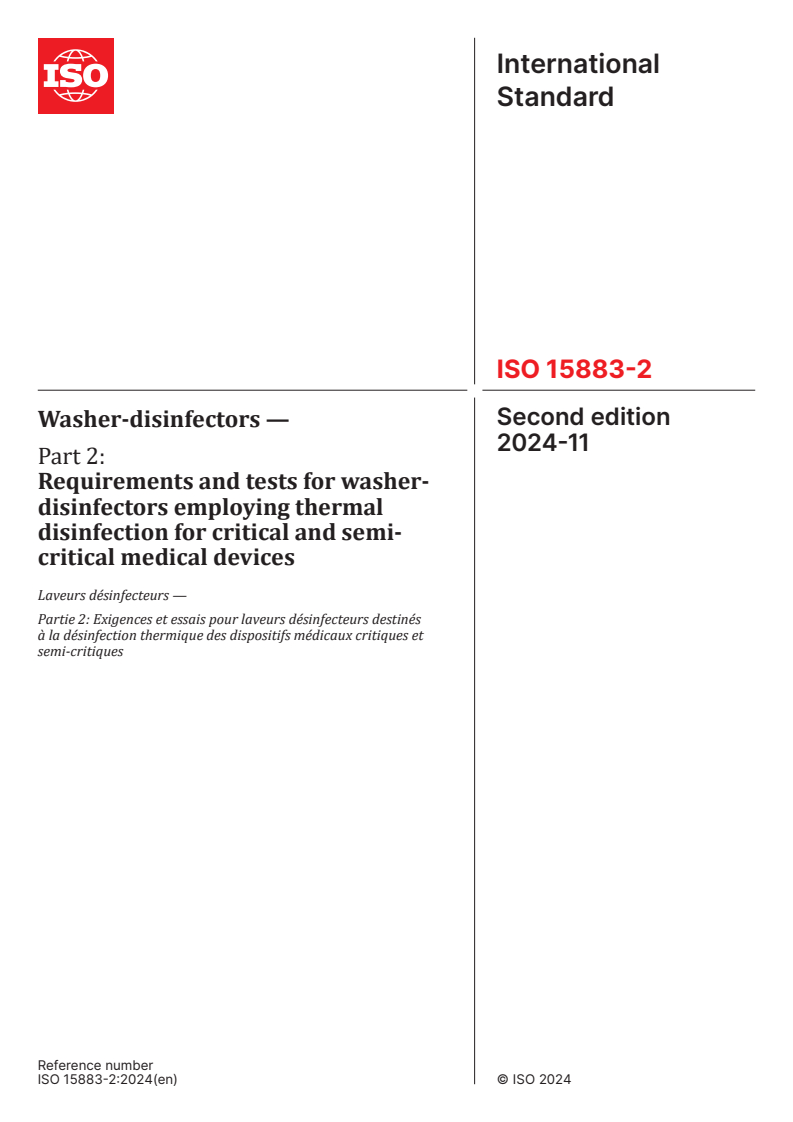
(Main)Washer-disinfectors — Part 2: Requirements and tests for washer-disinfectors employing thermal disinfection for critical and semi-critical medical devices
General Information
- Abstract
This document specifies requirements for washer-disinfectors (WD) that are intended for use for the cleaning and thermal disinfection, in a single operating cycle, of reusable critical and semi-critical medical devices, such as surgical instruments, anaesthetic equipment, and any non-critical devices used in conjunction with critical and semi-critical medical devices, such as bowls, dishes and receivers, utensils and glassware. This document is intended to be used in conjunction with the general requirements specified in ISO 15883-1:2024, except those specified in 4.1.1. NOTE The specified performance requirements of this document cannot ensure the inactivation or removal of the causative agent(s) (prion protein) of transmissible spongiform encephalopathies.
- Status
- Published
- Publication Date
- 05-Nov-2024
- Technical Committee
- ISO/TC 198 - Sterilization of health care products
- Drafting Committee
- ISO/TC 198 - Sterilization of health care products
- Current Stage
- 6060 - International Standard published
- Start Date
- 06-Nov-2024
- Due Date
- 10-Nov-2024
- Completion Date
- 06-Nov-2024
Buy Documents
ISO 15883-2:2024 - Washer-disinfectors — Part 2: Requirements and tests for washer-disinfectors employing thermal disinfection for critical and semi-critical medical devices Released:11/6/2024
ISO 15883-2:2024 - Laveurs désinfecteurs — Partie 2: Exigences et essais pour laveurs désinfecteurs destinés a la désinfection thermique des dispositifs médicaux critiques et semi-critiques Released:11/6/2024
Overview
ISO 15883-2:2024 - "Washer‑disinfectors - Part 2" specifies requirements and test methods for washer‑disinfectors (WD) that use thermal disinfection to process reusable critical and semi‑critical medical devices (for example, surgical instruments, anaesthetic equipment, and associated non‑critical items such as bowls and glassware). It is the second edition, intended to be used together with the general requirements in ISO 15883‑1:2024. The standard clarifies performance, verification and testing for cleaning and thermal disinfection in a single operating cycle and notes that it does not guarantee removal/inactivation of prion agents.
Key topics and technical requirements
- Scope and device types: Applies to critical and semi‑critical medical devices, powered instruments, anaesthetic/respiratory equipment and non‑critical items used with them.
- Performance requirements: Specifies cleaning and thermal disinfection performance criteria (soil removal, maintained process variables, and limitations related to prions).
- Temperature control and thermometry: Requirements and tests for temperature of device outer and inner surfaces, and for defining and verifying the washing temperature band. (The 2024 revision adjusted the washing temperature band limit.)
- Lumen and powered device handling: Special requirements for irrigation, flow verification through lumens and verification of powered devices.
- Water quality: New clause addressing water quality requirements relevant to cleaning/disinfection performance and environmental/regulatory impacts.
- Mechanical and control systems: Requirements for control systems, dosing accuracy (noting certain exceptions), process monitoring and verification.
- Testing for conformity: Defined test programmes for soil removal, thermometric tests, pressure and flow measurements and worst‑case validation.
- Documentation: Information the WD supplier must provide and information purchasers should request; Annex B gives guidance on assigning devices to product families for processing.
Practical applications - who uses this standard
- Manufacturers of washer‑disinfectors - to design, validate and document compliance for thermal WD models.
- Sterile Processing Departments (SPD) in hospitals and clinics - to select appropriate WD cycles and validate processes for surgical and semi‑critical devices.
- Medical device manufacturers - to provide processing instructions consistent with ISO 17664 series and align device families for WD processing.
- Test laboratories and conformity assessors - to run the standardized test programmes for performance verification.
- Regulators and procurement specialists - to specify requirements in purchasing and compliance frameworks.
Related standards
- ISO 15883‑1:2024 (general requirements)
- ISO 15883‑5:2021 (cleaning efficacy criteria)
- ISO 17664‑1:2021 (processing information from device manufacturers)
- IEC 61010‑2‑040 (safety requirements for WD)
- ISO 11139 (terms and definitions referenced)
Keywords: ISO 15883‑2:2024, washer‑disinfectors, thermal disinfection, critical medical devices, semi‑critical devices, cleaning efficacy, lumen irrigation, process verification.
Relations
- Effective Date
- 09-Feb-2026
- Effective Date
- 12-Feb-2026
- Effective Date
- 06-Jun-2022
- Effective Date
- 06-Jun-2022
Buy Documents
ISO 15883-2:2024 - Washer-disinfectors — Part 2: Requirements and tests for washer-disinfectors employing thermal disinfection for critical and semi-critical medical devices Released:11/6/2024
ISO 15883-2:2024 - Laveurs désinfecteurs — Partie 2: Exigences et essais pour laveurs désinfecteurs destinés a la désinfection thermique des dispositifs médicaux critiques et semi-critiques Released:11/6/2024
Get Certified
Connect with accredited certification bodies for this standard

BSI Group
BSI (British Standards Institution) is the business standards company that helps organizations make excellence a habit.

TÜV Rheinland
TÜV Rheinland is a leading international provider of technical services.

TÜV SÜD
TÜV SÜD is a trusted partner of choice for safety, security and sustainability solutions.
Sponsored listings
Frequently Asked Questions
ISO 15883-2:2024 is a standard published by the International Organization for Standardization (ISO). Its full title is "Washer-disinfectors — Part 2: Requirements and tests for washer-disinfectors employing thermal disinfection for critical and semi-critical medical devices". This standard covers: This document specifies requirements for washer-disinfectors (WD) that are intended for use for the cleaning and thermal disinfection, in a single operating cycle, of reusable critical and semi-critical medical devices, such as surgical instruments, anaesthetic equipment, and any non-critical devices used in conjunction with critical and semi-critical medical devices, such as bowls, dishes and receivers, utensils and glassware. This document is intended to be used in conjunction with the general requirements specified in ISO 15883-1:2024, except those specified in 4.1.1. NOTE The specified performance requirements of this document cannot ensure the inactivation or removal of the causative agent(s) (prion protein) of transmissible spongiform encephalopathies.
This document specifies requirements for washer-disinfectors (WD) that are intended for use for the cleaning and thermal disinfection, in a single operating cycle, of reusable critical and semi-critical medical devices, such as surgical instruments, anaesthetic equipment, and any non-critical devices used in conjunction with critical and semi-critical medical devices, such as bowls, dishes and receivers, utensils and glassware. This document is intended to be used in conjunction with the general requirements specified in ISO 15883-1:2024, except those specified in 4.1.1. NOTE The specified performance requirements of this document cannot ensure the inactivation or removal of the causative agent(s) (prion protein) of transmissible spongiform encephalopathies.
ISO 15883-2:2024 is classified under the following ICS (International Classification for Standards) categories: 11.080.10 - Sterilizing equipment. The ICS classification helps identify the subject area and facilitates finding related standards.
ISO 15883-2:2024 has the following relationships with other standards: It is inter standard links to EN ISO 15883-1:2025, EN ISO 15883-2:2025, ISO 23404:2020, ISO 15883-2:2006. Understanding these relationships helps ensure you are using the most current and applicable version of the standard.
ISO 15883-2:2024 is available in PDF format for immediate download after purchase. The document can be added to your cart and obtained through the secure checkout process. Digital delivery ensures instant access to the complete standard document.
Standards Content (Sample)
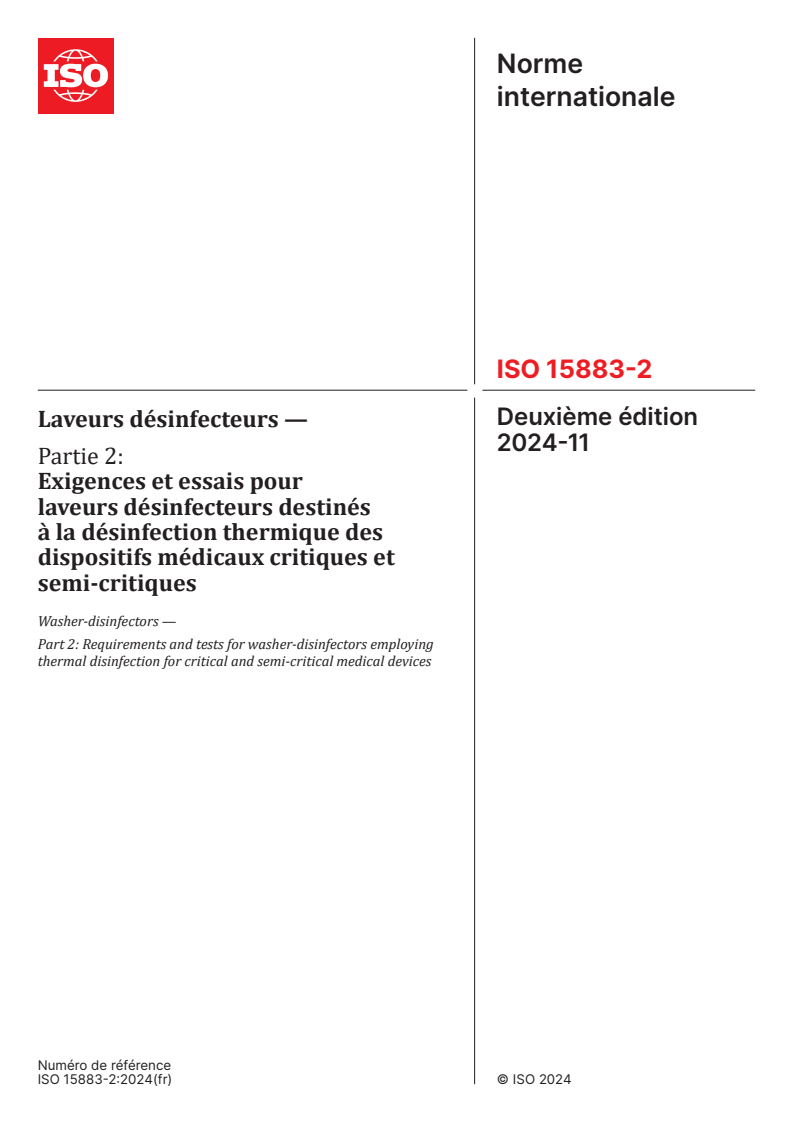
International
Standard
ISO 15883-2
Second edition
Washer-disinfectors —
2024-11
Part 2:
Requirements and tests for washer-
disinfectors employing thermal
disinfection for critical and semi-
critical medical devices
Laveurs désinfecteurs —
Partie 2: Exigences et essais pour laveurs désinfecteurs destinés
à la désinfection thermique des dispositifs médicaux critiques et
semi-critiques
Reference number
© ISO 2024
All rights reserved. Unless otherwise specified, or required in the context of its implementation, no part of this publication may
be reproduced or utilized otherwise in any form or by any means, electronic or mechanical, including photocopying, or posting on
the internet or an intranet, without prior written permission. Permission can be requested from either ISO at the address below
or ISO’s member body in the country of the requester.
ISO copyright office
CP 401 • Ch. de Blandonnet 8
CH-1214 Vernier, Geneva
Phone: +41 22 749 01 11
Email: copyright@iso.org
Website: www.iso.org
Published in Switzerland
ii
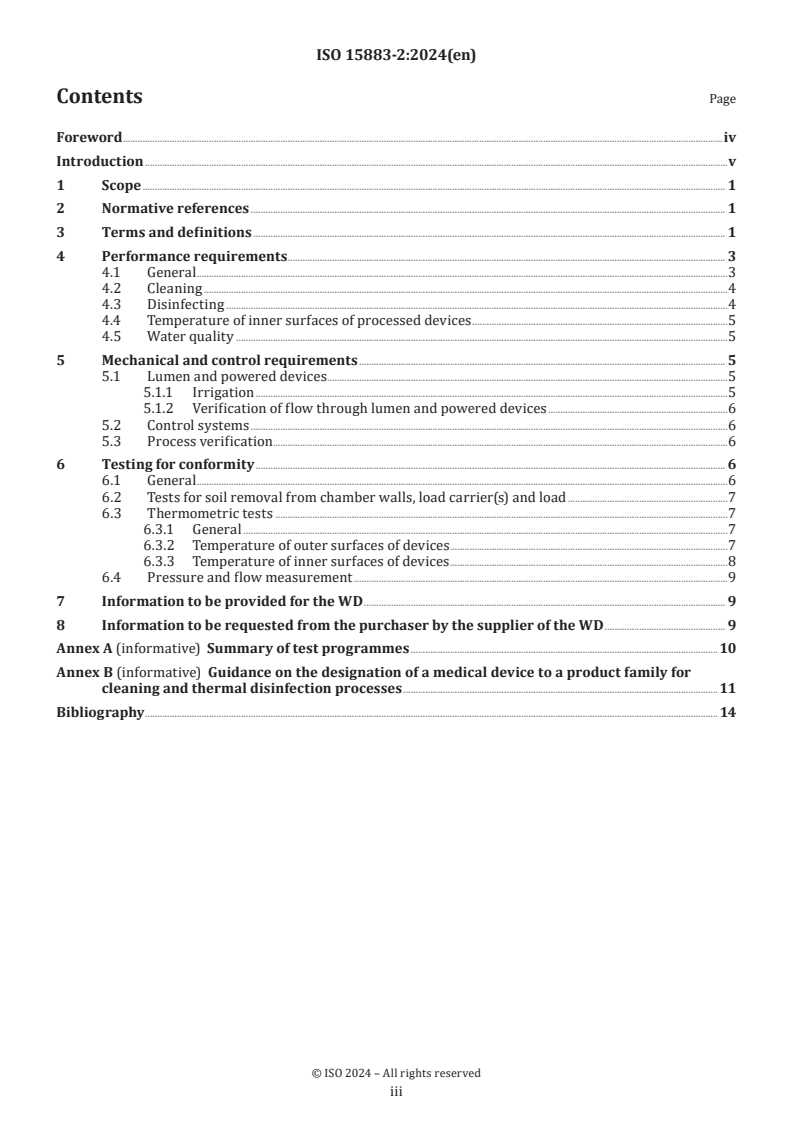
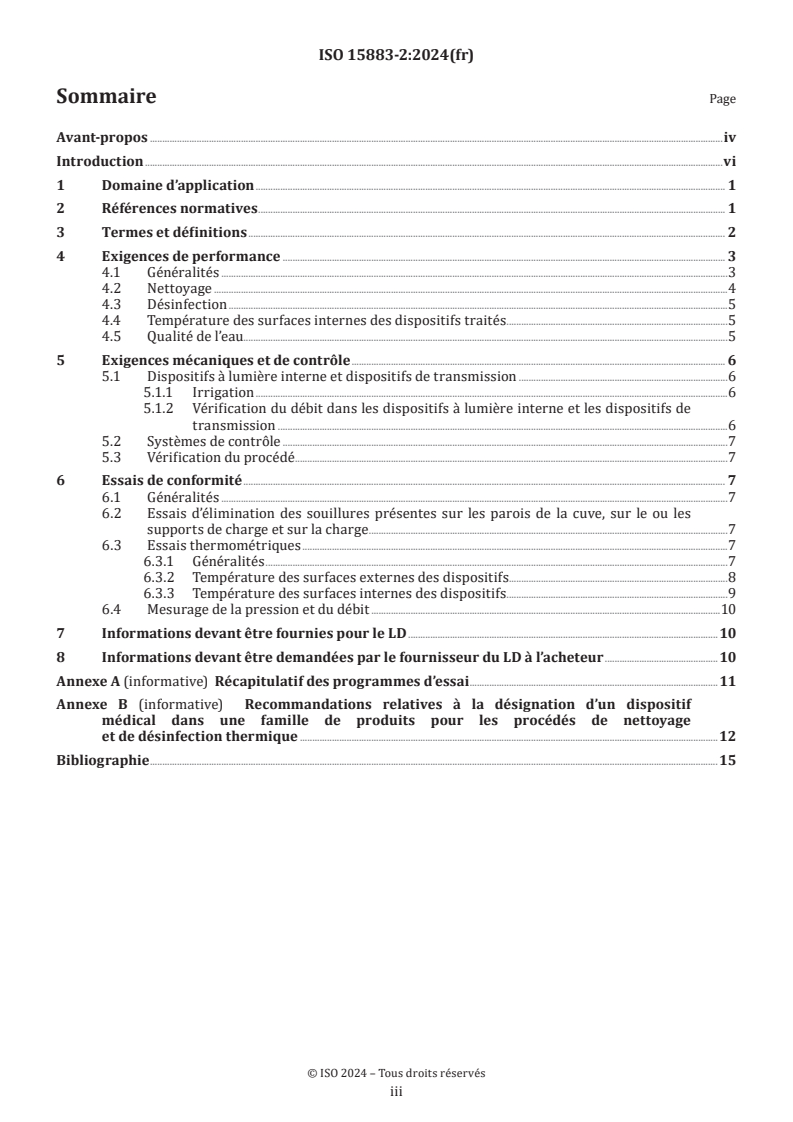
Contents Page
Foreword .iv
Introduction .v
1 Scope . 1
2 Normative references . 1
3 Terms and definitions . 1
4 Performance requirements . . 3
4.1 General .3
4.2 Cleaning .4
4.3 Disinfecting .4
4.4 Temperature of inner surfaces of processed devices .5
4.5 Water quality .5
5 Mechanical and control requirements . 5
5.1 Lumen and powered devices .5
5.1.1 Irrigation .5
5.1.2 Verification of flow through lumen and powered devices .6
5.2 Control systems .6
5.3 Process verification .6
6 Testing for conformity . 6
6.1 General .6
6.2 Tests for soil removal from chamber walls, load carrier(s) and load .7
6.3 Thermometric tests .7
6.3.1 General .7
6.3.2 Temperature of outer surfaces of devices .7
6.3.3 Temperature of inner surfaces of devices .8
6.4 Pressure and flow measurement .9
7 Information to be provided for the WD . 9
8 Information to be requested from the purchaser by the supplier of the WD . 9
Annex A (informative) Summary of test programmes . 10
Annex B (informative) Guidance on the designation of a medical device to a product family for
cleaning and thermal disinfection processes .11
Bibliography . 14
iii
Foreword
ISO (the International Organization for Standardization) is a worldwide federation of national standards
bodies (ISO member bodies). The work of preparing International Standards is normally carried out through
ISO technical committees. Each member body interested in a subject for which a technical committee
has been established has the right to be represented on that committee. International organizations,
governmental and non-governmental, in liaison with ISO, also take part in the work. ISO collaborates closely
with the International Electrotechnical Commission (IEC) on all matters of electrotechnical standardization.
The procedures used to develop this document and those intended for its further maintenance are described
in the ISO/IEC Directives, Part 1. In particular, the different approval criteria needed for the different types
of ISO documents should be noted. This document was drafted in accordance with the editorial rules of the
ISO/IEC Directives, Part 2 (see www.iso.org/directives).
ISO draws attention to the possibility that the implementation of this document may involve the use of (a)
patent(s). ISO takes no position concerning the evidence, validity or applicability of any claimed patent
rights in respect thereof. As of the date of publication of this document, ISO had not received notice of (a)
patent(s) which may be required to implement this document. However, implementers are cautioned that
this may not represent the latest information, which may be obtained from the patent database available at
www.iso.org/patents. ISO shall not be held responsible for identifying any or all such patent rights.
Any trade name used in this document is information given for the convenience of users and does not
constitute an endorsement.
For an explanation of the voluntary nature of standards, the meaning of ISO specific terms and expressions
related to conformity assessment, as well as information about ISO's adherence to the World Trade
Organization (WTO) principles in the Technical Barriers to Trade (TBT), see www.iso.org/iso/foreword.html.
This document was prepared by Technical Committee ISO/TC 198, Sterilization of health care products, in
collaboration with the European Committee for Standardization (CEN) Technical Committee CEN/TC 102,
Sterilizers and associated equipment for processing of medical devices, in accordance with the Agreement on
technical cooperation between ISO and CEN (Vienna Agreement).
This second edition cancels and replaces the first edition (ISO 15883-2:2006), which has been technically
revised.
The main changes are as follows:
— change of title to reflect application to critical and semi-critical medical devices;
— addition of new terms defining critical and semi-critical medical devices, and non-critical devices;
— alignment of other terms and definitions with ISO 11139:2018+Amd 1:2024;
— revision of cross-references to relevant clauses in ISO 15883-1:2024 and ISO 15883-5:2021;
— the upper limit of the washing temperature band reduced to +5 °C;
— addition of a clause on water quality (see 4.5);
— clarification of requirements for lumen and powered devices (see 5.1);
— addition of informative Annex B providing guidance on assigning a medical device to a product family for
cleaning and thermal disinfection processes;
— revision of references in the Bibliography.
A list of all parts in the ISO 15883 series can be found on the ISO website.
Any feedback or questions on this document should be directed to the user’s national standards body. A
complete listing of these bodies can be found at www.iso.org/members.html.
iv
Introduction
This document is the second part of the ISO 15883 series of standards specifying the performance of
washer-disinfectors (WD) and the general requirements for performance applicable to instrument WD. The
requirements given in this document apply to WD used for cleaning and thermal disinfection of critical and
semi-critical medical devices intended for reuse such as:
— surgical instruments, which are divided into instrument product families based on design features,
e.g. instruments without hinges, cavities or lumens, with hinges, with sliding shafts, with lumens,
microsurgical instruments, and complex instruments (e.g. robotic);
— powered instruments;
— anaesthetic and respiratory equipment;
— medical devices comprising glass components;
— any non-critical devices used in conjunction with critical and semi-critical medical devices.
Requirements for WD for other applications, such as for processing non-critical devices and thermolabile
endoscopes, are specified in other parts of the ISO 15883 series of standards.
When processed in the WD, the medical devices can be intended for immediate use or can be intended for
further processing. In both cases, the efficacy of the cleaning and disinfection is of major importance. In
either case, this is for the well-being of the patient. In the latter case, it is also for the safety of the staff
who handles the instruments in the process of inspection, testing and packing as well as ensuring that the
sterilization process is not challenged by residual soil.
The efficacy of disinfection can be impaired if soil removal is incomplete before the start of the disinfection
process. Users should be aware that some medical devices can require pre-treatment, e.g. soaking, brushing,
ultrasonic pre-cleaning, lumen irrigation or any combination of these techniques. Reference should be made
to the medical device instructions for reprocessing (see also the ISO 17664 series).
Safety requirements for WD are given in IEC 61010-2-040.
NOTE Local or national regulations can apply in respect of the potential adverse effects on the quality of water
intended for human consumption or environmental impacts caused by the WD and its intended use.
v
International Standard ISO 15883-2:2024(en)
Washer-disinfectors —
Part 2:
Requirements and tests for washer-disinfectors employing
thermal disinfection for critical and semi-critical medical devices
1 Scope
This document specifies requirements for washer-disinfectors (WD) that are intended for use for the cleaning
and thermal disinfection, in a single operating cycle, of reusable critical and semi-critical medical devices,
such as surgical instruments, anaesthetic equipment, and any non-critical devices used in conjunction with
critical and semi-critical medical devices, such as bowls, dishes and receivers, utensils and glassware.
This document is intended to be used in conjunction with the general requirements specified in
ISO 15883-1:2024, except those specified in 4.1.1.
NOTE The specified performance requirements of this document cannot ensure the inactivation or removal of the
causative agent(s) (prion protein) of transmissible spongiform encephalopathies.
2 Normative references
The following documents are referred to in the text in such a way that some or all of their content constitutes
requirements of this document. For dated references, only the edition cited applies. For undated references,
the latest edition of the referenced document (including any amendments) applies.
ISO 4017, Fasteners — Hexagon head screws — Product grades A and B
ISO 5356-2, Anaesthetic and respiratory equipment — Conical connectors — Part 2: Screw-threaded weight-
bearing connectors
ISO 5361, Anaesthetic and respiratory equipment — Tracheal tubes and connectors
ISO 5362, Anaesthetic and respiratory equipment — Anaesthetic reservoir bags
ISO 5367, Anaesthetic and respiratory equipment — Breathing sets and connectors
ISO 15883-1:2024, Washer-disinfectors — Part 1: General requirements, terms and definitions and tests
ISO 15883-5:2021, Washer-disinfectors — Part 5: Performance requirements and test method criteria for
demonstrating cleaning efficacy
ISO 17664-1:2021, Processing of health care products — Information to be provided by the medical device
manufacturer for the processing of medical devices — Part 1: Critical and semi-critical medical devices
EN 10088-2, Stainless steels — Part 2: Technical delivery conditions for sheet/plate and strip of corrosion
resisting steels for general purposes
3 Terms and definitions
For the purposes of this document, the terms and definitions given in ISO 15883-1:2024 and the following apply.
ISO and IEC maintain terminology databases for use in standardization at the following addresses:
— ISO Online browsing platform: available at https:// www .iso .org/ obp
— IEC Electropedia: available at https:// www .electropedia .org/
3.1
access device
means by which entry to restricted parts of equipment is achieved
Note 1 to entry: This can be by dedicated key, code or tool.
[SOURCE: ISO 11139:2018, 3.4]
3.2
critical medical device
item processed in a washer-disinfector, intended to be introduced directly into, or
have contact with, the vascular system or normally sterile areas of the body
EXAMPLE Surgical instruments.
Note 1 to entry: Critical medical devices usually require sterilization before use.
Note 2 to entry: National regulations can use alternative wording for this term.
[SOURCE: ISO 11139:2018/Amd 1:2024, 3.333]
3.3
non-critical device
item processed in a washer-disinfector, whose surface(s) are intended to contact
intact skin of a body but do not penetrate it, or device not intended for direct patient contact
EXAMPLE Blood pressure cuffs, wheelchairs, trays, bowls, dishes, glassware, receivers, containers for transit.
Note 1 to entry: National regulations can use alternative wording for the definition of this term when applied to
medical devices.
[SOURCE: ISO 11139:2018/Amd 1:2024, 3.357]
3.4
powered device
surgical instrument which gives a rotating and/or oscillating movement to other
surgical instruments
Note 1 to entry: The power applied to the driven instrument can be mechanical (from a motor, either through direct
coupling, flexible axle, or belt) or by the flow of a pressurized fluid or compressed air.
EXAMPLE Dental hand pieces, orthopaedic saws, and drills.
[SOURCE: ISO 11139:2018, 3.199]
3.5
product family
group or subgroup of product characterized by similar attributes determined to be equivalent for evaluation
and processing purposes
Note 1 to entry: Design characteristics present specific challenges during the washing stage of medical devices in a
washer-disinfector.
[SOURCE: ISO 11139:2018, 3.218, modified — Note 1 to entry added.]
3.6
semi-critical medical device
item processed in a washer-disinfector, that, during use, contacts mucous membranes
or non-intact skin of a body
EXAMPLE Some probes, some respiratory therapy equipment.
Note 1 to entry: National regulations can use alternative wording for this term.
[SOURCE: ISO 11139:2018/Amd 1:2024, 3.369]
3.7
washing temperature
minimum temperature of the washing temperature band
[SOURCE: ISO 11139:2018, 3.322]
3.8
washing time
period for which the cycle variables are maintained within the values specified for washing
EXAMPLE Temperature of the load, detergent concentration in the chamber.
[SOURCE: ISO 11139:2018, 3.323, modified — Example added.]
3.9
worst-case
set of conditions, as compared with ideal conditions, justified to pose the highest probability of process or
product failure
Note 1 to entry: The set of conditions do not necessarily induce product or process failure.
Note 2 to entry: The set of conditions should be specified within the limitations of the intended use.
Note 3 to entry: The set of conditions should encompass upper and lower processing limits and circumstances.
[SOURCE: ISO 11139:2018/Amd 1:2024, 3.376]
4 Performance requirements
4.1 General
4.1.1 The requirements of ISO 15883-1:2024 apply with the exception of:
— ISO 15883-1:2024, 4.3.2 (which refers to chemical disinfection);
— ISO 15883-1:2024, 5.7.5 (which refers to the accuracy of dosing systems; see 4.1.6).
4.1.2 The WD shall be designed to clean and thermally disinfect specified medical devices that are
intended to be reused and are designated as compatible with the WD process cycle [see ISO 15883-1:2024,
8.1 b) 2)]. Processing of medical devices in the WD shall be in accordance with the intended use of the WD
and the instructions for processing the device as specified in accordance with ISO 17664-1:2021, Clause 6.
NOTE Some process chemicals or heat can promote fixation of proteinaceous or other soils to the devices to be
cleaned and can therefore interfere with the removal of soil.
4.1.3 The medical devices shall be cleaned and disinfected on the outer surfaces, including covered
surfaces and crevices, and where necessary for their safe use, safe handling and correct functioning, the
inner surfaces. Any necessary dismantling for processing the inner surfaces shall be conducted as specified
in accordance with ISO 17664-1:2021, 6.5.
4.1.4 If necessary for the process success or safety of load items, the WD shall be provided with means to
facilitate the correct alignment of the load and load carrier(s) in the WD chamber.
4.1.5 In order to process lumen devices or powered devices, the WD shall be provided with the load
carrier(s) and necessary connectors that shall be designed to ensure adequate irrigation with process fluids
through each device.
4.1.6 The volume of the process chemical(s) that is/are admitted (see ISO 15883-1:2024, 5.7.2, 5.7.4 and
5.7.6) shall be adjustable by means of an access device that shall deliver the set volume to an accuracy
of ± 5 % or better.
NOTE The volume of water admitted to the WD chamber can affect the effective concentration of process
chemicals.
4.1.7 During any stage of the operating cycle, the process conditions affecting irrigation inside the
pipework system shall be maintained above a specified level that is required for an effective cleaning,
disinfection and rinsing process for any load configurations [e.g. load, load carrier(s), and if applicable, inside
the pipework for connectors].
4.2 Cleaning
4.2.1 Cleaning shall be tested in accordance with the requirements of ISO 15883-1:2024, 4.2 and the
performance requirements and test method criteria specified in ISO 15883-5:2021, Clause 4.
The cleaning process shall also meet the requirements of the test specified in 6.2.
Where applicable, any treatment required prior to cleaning in the WD shall be performed in accordance with
the instructions for use for the load in ISO 17664-1:2021, 6.4 and 6.5, or for WD in ISO 15883-1:2024, 8.1 a).
4.2.2 During the washing stage the following applies:
— the washing time shall start when the temperature at the control sensor of the WD reaches the lower
limit of the first specified washing temperature band;
— the temperatures recorded on the surface of the load and load carrier(s) for the washing stage follow the
temperature profile defined for this stage and are within +5 °C of the relevant set temperature for each
holding time of the stage.
NOTE A washing stage can include two or more washing temperatures.
4.3 Disinfecting
4.3.1 Each operating cycle shall include a thermal disinfection stage for which the time at which the load
is maintained at the disinfection temperature gives an A of at least 600 on all surfaces of the load and load
carrier(s) to be disinfected when tested in accordance with 6.3.
[13]
NOTE 1 See Kremer et al. .
NOTE 2 Thermal disinfection can be achieved by rinsing the load with hot water, exposure to steam or combination
of the two.
The chosen locations of the sensors for thermometric testing shall be appropriate to the load and shall be
justified.
4.3.2 The operating cycle shall include a thermal disinfection stage giving an A of at least 600 on all the
inner surface of the chamber when tested in accordance with 6.3 and ISO 15883-1:2024, 6.8.3.
4.3.3 The WD shall be capable of being set for disinfection stages that deliver an A of at least 3 000.
----------------------
...
Norme
internationale
ISO 15883-2
Deuxième édition
Laveurs désinfecteurs —
2024-11
Partie 2:
Exigences et essais pour
laveurs désinfecteurs destinés
à la désinfection thermique des
dispositifs médicaux critiques et
semi-critiques
Washer-disinfectors —
Part 2: Requirements and tests for washer-disinfectors employing
thermal disinfection for critical and semi-critical medical devices
Numéro de référence
DOCUMENT PROTÉGÉ PAR COPYRIGHT
© ISO 2024
Tous droits réservés. Sauf prescription différente ou nécessité dans le contexte de sa mise en œuvre, aucune partie de cette
publication ne peut être reproduite ni utilisée sous quelque forme que ce soit et par aucun procédé, électronique ou mécanique,
y compris la photocopie, ou la diffusion sur l’internet ou sur un intranet, sans autorisation écrite préalable. Une autorisation peut
être demandée à l’ISO à l’adresse ci-après ou au comité membre de l’ISO dans le pays du demandeur.
ISO copyright office
Case postale 401 • Ch. de Blandonnet 8
CH-1214 Vernier, Genève
Tél.: +41 22 749 01 11
E-mail: copyright@iso.org
Web: www.iso.org
Publié en Suisse
ii
Sommaire Page
Avant-propos .iv
Introduction .vi
1 Domaine d’application . 1
2 Références normatives . 1
3 Termes et définitions . 2
4 Exigences de performance . 3
4.1 Généralités .3
4.2 Nettoyage .4
4.3 Désinfection .5
4.4 Température des surfaces internes des dispositifs traités .5
4.5 Qualité de l’eau.5
5 Exigences mécaniques et de contrôle . 6
5.1 Dispositifs à lumière interne et dispositifs de transmission .6
5.1.1 Irrigation .6
5.1.2 Vérification du débit dans les dispositifs à lumière interne et les dispositifs de
transmission .6
5.2 Systèmes de contrôle .7
5.3 Vérification du procédé . .7
6 Essais de conformité . 7
6.1 Généralités .7
6.2 Essais d’élimination des souillures présentes sur les parois de la cuve, sur le ou les
supports de charge et sur la charge .7
6.3 Essais thermométriques .7
6.3.1 Généralités .7
6.3.2 Température des surfaces externes des dispositifs .8
6.3.3 Température des surfaces internes des dispositifs .9
6.4 Mesurage de la pression et du débit .10
7 Informations devant être fournies pour le LD . 10
8 Informations devant être demandées par le fournisseur du LD à l’acheteur .10
Annexe A (informative) Récapitulatif des programmes d’essai .11
Annexe B (informative) Recommandations relatives à la désignation d’un dispositif
médical dans une famille de produits pour les procédés de nettoyage
et de désinfection thermique .12
Bibliographie .15
iii
Avant-propos
L’ISO (Organisation internationale de normalisation) est une fédération mondiale d’organismes nationaux
de normalisation (comités membres de l’ISO). L’élaboration des Normes internationales est en général
confiée aux comités techniques de l’ISO. Chaque comité membre intéressé par une étude a le droit de faire
partie du comité technique créé à cet effet. Les organisations internationales, gouvernementales et non
gouvernementales, en liaison avec l’ISO participent également aux travaux. L’ISO collabore étroitement avec
la Commission électrotechnique internationale (IEC) en ce qui concerne la normalisation électrotechnique.
Les procédures utilisées pour élaborer le présent document et celles destinées à sa mise à jour sont
décrites dans les Directives ISO/IEC, Partie 1. Il convient, en particulier de prendre note des différents
critères d’approbation requis pour les différents types de documents ISO. Le présent document
a été rédigé conformément aux règles de rédaction données dans les Directives ISO/IEC, Partie 2
(voir www.iso.org/directives).
L’ISO attire l’attention sur le fait que la mise en application du présent document peut entraîner l’utilisation
d’un ou de plusieurs brevets. L’ISO ne prend pas position quant à la preuve, à la validité et à l’applicabilité de tout
droit de propriété revendiqué à cet égard. À la date de publication du présent document, l’ISO n’avait pas reçu
notification qu’un ou plusieurs brevets pouvaient être nécessaires à sa mise en application. Toutefois, il y a lieu
d’avertir les responsables de la mise en application du présent document que des informations plus récentes
sont susceptibles de figurer dans la base de données de brevets, disponible à l’adresse www.iso.org/brevets.
L’ISO ne saurait être tenue pour responsable de ne pas avoir identifié de tels droits de brevet.
Les appellations commerciales éventuellement mentionnées dans le présent document sont données pour
information, par souci de commodité, à l’intention des utilisateurs et ne sauraient constituer un engagement.
Pour une explication de la nature volontaire des normes, la signification des termes et expressions
spécifiques de l’ISO liés à l’évaluation de la conformité, ou pour toute information au sujet de l’adhésion de
l’ISO aux principes de l’Organisation mondiale du commerce (OMC) concernant les obstacles techniques au
commerce (OTC), voir www.iso.org/avant-propos.
Le présent document a été élaboré par le comité ISO/TC 198, Stérilisation des produits de santé, en collaboration
avec le comité technique CEN/TC 102, Stérilisateurs et équipements associés pour le traitement des dispositifs
médicaux, du Comité européen de normalisation (CEN), conformément à l’Accord de coopération technique
entre l’ISO et le CEN (Accord de Vienne).
Cette deuxième édition annule et remplace la première édition (ISO 15883-2:2006), qui a fait l’objet d’une
révision technique.
Les principales modifications sont les suivantes :
— modification du titre pour refléter l’application aux dispositifs médicaux critiques et semi‑critiques ;
— ajout de nouveaux termes définissant les dispositifs médicaux critiques et semi‑critiques, et les dispositifs
non critiques ;
— alignement d’autres termes et définitions sur l’ISO 11139:2018+Amd 1:2024 ;
— révision des références aux articles appropriés de l’ISO 15883‑1:2024 et de l’ISO 15883‑5:2021 ;
— réduction de la limite supérieure de la plage de températures de lavage à +5 °C ;
— ajout d’un article portant sur la qualité de l’eau (voir 4.5) ;
— clarification des exigences relatives aux dispositifs à lumière interne et aux dispositifs de transmission
(voir 5.1) ;
— ajout de l’Annexe B, informative, qui fournit des recommandations relatives à l’affectation d’un dispositif
médical à une famille de produits pour les procédés de nettoyage et de désinfection thermique ;
— révision des références données dans la Bibliographie.
iv
Une liste de toutes les parties de la série ISO 15883 se trouve sur le site web de l’ISO.
Il convient que l’utilisateur adresse tout retour d’information ou toute question concernant le présent
document à l’organisme national de normalisation de son pays. Une liste exhaustive desdits organismes se
trouve à l’adresse www.iso.org/fr/members.html.
v
Introduction
Le présent document est la deuxième partie de la série de normes ISO 15883 spécifiant les performances
des laveurs désinfecteurs (LD) ; il fixe les exigences générales de performances applicables aux laveurs
désinfecteurs d’instruments. Les exigences données dans le présent document s’appliquent aux LD utilisés
pour le nettoyage et la désinfection thermique des dispositifs médicaux critiques et semi-critiques destinés
à être réutilisés, tels que :
— les instruments chirurgicaux qui sont divisés en familles de produits en fonction de leurs caractéristiques
de conception, par exemple instruments sans charnière, cavité ou lumière interne, instruments avec
charnières, avec arbres coulissants, avec lumières internes, instruments microchirurgicaux, et
instruments complexes (robotiques par exemple) ;
— instruments de transmission ;
— équipements d’anesthésie et appareils respiratoires ;
— dispositifs médicaux constitués d’éléments en verre ;
— tout dispositif non critique utilisé conjointement avec des dispositifs médicaux critiques et semi-critiques.
Les exigences applicables aux LD dans le cadre d’autres applications, telles que le traitement des dispositifs
non critiques et des endoscopes thermolabiles, sont spécifiées dans d’autres parties de la série des normes
ISO 15883.
Après avoir été traités dans le LD, les dispositifs médicaux peuvent être destinés à être utilisés
immédiatement, ou peuvent être destinés à être traités. Dans les deux cas, l’efficacité du nettoyage et de la
désinfection revêt une importance majeure. Dans l’un et l’autre cas, cela vise le bien-être du patient. Dans le
second cas, cela vise également la sécurité du personnel chargé de manipuler les instruments lors du procédé
d’inspection, d’essai et d’emballage, ainsi qu’à s’assurer que le procédé de stérilisation n’est pas affecté par la
présence de souillures résiduelles.
L’efficacité de la désinfection peut être amoindrie si la souillure n’a pas été complètement éliminée avant le
début du procédé de désinfection. Il convient que les utilisateurs soient informés que certains dispositifs
médicaux peuvent requérir un prétraitement, par exemple un trempage, un brossage, un nettoyage
préliminaire aux ultrasons, une irrigation de la lumière ou toute combinaison de ces techniques. Il convient
de se reporter aux instructions du dispositif médical concernant le retraitement (voir également la série
ISO 17664).
Les exigences de sécurité pour les LD sont précisées dans l’IEC 61010-2-040.
NOTE Des réglementations locales ou nationales peuvent s’appliquer en ce qui concerne les potentiels effets
négatifs sur la qualité de l’eau destinée à la consommation humaine ou les impacts environnementaux du LD et de son
usage prévu.
vi
Norme internationale ISO 15883-2:2024(fr)
Laveurs désinfecteurs —
Partie 2:
Exigences et essais pour laveurs désinfecteurs destinés à la
désinfection thermique des dispositifs médicaux critiques et
semi-critiques
1 Domaine d’application
Le présent document spécifie les exigences relatives aux laveurs désinfecteurs (LD) destinés à être utilisés
pour le nettoyage et la désinfection thermique, au cours d’un cycle de fonctionnement unique, des dispositifs
médicaux critiques et semi-critiques réutilisables tels que les instruments chirurgicaux, le matériel
d’anesthésie, et de tout dispositif non critique utilisé conjointement avec des dispositifs médicaux critiques
et semi-critiques tels que les bacs, les plats, les récipients, les ustensiles et la verrerie.
Le présent document est destiné à être utilisé conjointement avec les exigences générales spécifiées dans
l’ISO 15883‑1:2024, sauf pour celles qui sont spécifiées en 4.1.1.
NOTE Les exigences de performance spécifiées dans le présent document ne peuvent pas assurer l’inactivation
ou l’élimination de l’agent ou des agents responsables (protéine du prion) des encéphalopathies spongiformes
transmissibles.
2 Références normatives
Les documents suivants sont cités dans le texte de sorte qu’ils constituent, pour tout ou partie de leur
contenu, des exigences du présent document. Pour les références datées, seule l’édition citée s’applique. Pour
les références non datées, la dernière édition du document de référence s’applique (y compris les éventuels
amendements).
ISO 4017, Fixations — Vis à tête hexagonale entièrement filetées — Grades A et B
ISO 5356-2, Matériel d'anesthésie et de réanimation respiratoire — Raccords coniques — Partie 2: Raccords à
vis pouvant supporter un certain poids
ISO 5361, Matériel d'anesthésie et de réanimation respiratoire — Sondes trachéales et raccords
ISO 5362, Matériel d’anesthésie et de réanimation respiratoire — Ballons réservoirs d’anesthésie
ISO 5367, Matériel d'anesthésie et de réanimation respiratoire — Ensembles respiratoires et raccords
ISO 15883-1:2024, Laveurs désinfecteurs — Partie 1 : Exigences générales, termes et définitions et essais.
ISO 15883-5:2021, Laveurs désinfecteurs — Partie 5: Exigences de performance et critères des méthodes d’essai
pour démontrer l’efficacité du nettoyage
ISO 17664-1:2021, Traitement de produits de soins de santé — Informations relatives au traitement des
dispositifs médicaux à fournir par le fabricant du dispositif — Partie 1: Dispositifs médicaux critiques et semi-
critiques
EN 10088-2, Aciers inoxydables — Partie 2 : Conditions techniques de livraison des tôles et bandes en acier de
résistance à la corrosion pour usage général
3 Termes et définitions
Pour les besoins du présent document, les termes et les définitions de l’ISO 15883‑1:2024 ainsi que les
suivants s’appliquent.
L’ISO et l’IEC tiennent à jour des bases de données terminologiques destinées à être utilisées en normalisation,
consultables aux adresses suivantes :
— ISO Online browsing platform : disponible à l’adresse https:// www .iso .org/ obp
— IEC Electropedia : disponible à l’adresse https:// www .electropedia .org/
3.1
dispositif d’accès
moyen utilisé pour permettre l’accès à des parties limitées de l’équipement
Note 1 à l'article: Le dispositif d’accès peut être une clé, un code ou un outil spécifique.
[SOURCE: ISO 11139:2018, 3.4]
3.2
dispositif médical critique
article, traité dans un laveur désinfecteur, destiné à être introduit directement dans
le système vasculaire ou des zones normalement stériles du corps ou à être en contact avec ceux-ci
EXEMPLE Instruments chirurgicaux.
Note 1 à l'article: Les dispositifs médicaux critiques exigent généralement une stérilisation avant utilisation.
Note 2 à l'article: La réglementation nationale peut utiliser une autre formulation.
[SOURCE: ISO 11139:2018/Amd 1:2024, 3.333]
3.3
dispositif non critique
article, traité dans un laveur désinfecteur, dont la ou les surfaces sont destinées à être
en contact avec la peau intacte d’un corps, sans la pénétrer, ou dispositif non destiné à être en contact direct
avec un patient
EXEMPLE Tensiomètres, fauteuils roulants, chariots, bacs, plats, verrerie, récipients, récipients utilisés pour le
transit.
Note 1 à l'article: Certaines réglementations nationales peuvent utiliser une autre formulation pour la définition de ce
terme, lorsqu’il s’agit de dispositifs médicaux.
[SOURCE: ISO 11139:2018/Amd 1:2024, 3.357]
3.4
dispositif de transmission
instrument chirurgical qui applique une rotation et/ou une oscillation à d’autres
instruments chirurgicaux
Note 1 à l'article: La puissance appliquée à l’instrument actionné peut être mécanique (par le biais d’un moteur,
par couplage direct ou via un axe flexible ou une courroie) ou due à l’écoulement d’un fluide pressurisé ou d’air
comprimé.
EXEMPLE Pièces à main dentaires, scies et forets de chirurgie orthopédique.
[SOURCE: ISO 11139:2018, 3.199]
3.5
famille de produits
groupe ou sous-groupe de produits caractérisés par des attributs similaires déterminés comme étant
équivalents pour les besoins de l’évaluation et du traitement
Note 1 à l'article: Les caractéristiques de conception constituent des difficultés particulières lors de la phase de lavage
des dispositifs médicaux dans un laveur désinfecteur.
[SOURCE: ISO 11139:2018, 3.218, modifié — La Note 1 à l’article a été ajoutée.]
3.6
dispositif médical semi-critique
article, traité dans un laveur désinfecteur, qui, au cours de l’utilisation, entre en
contact avec des muqueuses ou une peau non intacte d’un corps
EXEMPLE Certaines sondes, certains équipements de thérapie respiratoire.
Note 1 à l'article: La réglementation nationale peut utiliser une autre formulation.
[SOURCE: ISO 11139:2018/Amd 1:2024, 3.369]
3.7
température de lavage
température minimale de la plage des températures de lavage
[SOURCE: ISO 11139:2018, 3.322]
3.8
temps de lavage
durée pendant laquelle les variables du cycle sont maintenues dans les limites des valeurs spécifiées pour
le lavage
EXEMPLE Température de la charge, et la concentration du détergent dans la chambre.
[SOURCE: ISO 11139:2018, 3.323, modifié — Exemple ajouté.]
3.9
cas le plus défavorable
ensemble de conditions jugées, par comparaison à des conditions idéales, susceptibles de donner la plus
forte probabilité de défaillance d’un procédé ou d’un produit
Note 1 à l'article: L’ensemble de conditions n’induit pas nécessairement une défaillance du procédé ou du produit.
Note 2 à l'article: Il convient de spécifier l’ensemble de conditions au sein des limites de l’utilisation prévue.
Note 3 à l'article: Il convient que l’ensemble de conditions couvre les limites de traitement supérieure et inférieure et
les circonstances.
[SOURCE: ISO 11139:2018/Amd 1:2024, 3.376]
4 Exigences de performance
4.1 Généralités
4.1.1 Les exigences de l’ISO 15883-1:2024 s’appliquent, à l’exception des paragraphes suivants :
— ISO 15883‑1:2024, 4.3.2 (qui fait référence à la désinfection chimique) ;
— ISO 15883‑1:2024, 5.7.5 (qui traite de l’exactitude des systèmes de dosage ; voir 4.1.6).
4.1.2 Le LD doit être conçu pour nettoyer et désinfecter thermiquement des dispositifs médicaux
spécifiés destinés à être réutilisés et considérés comme compatibles avec le cycle de traitement du LD
[voir l’ISO 15883-1:2024, 8.1 b) 2)]. Le traitement des dispositifs médicaux dans le LD doit être conforme
à l’utilisation prévue du LD et aux instructions de traitement du dispositif spécifiées conformément à
l’ISO 17664-1:2021, Article 6.
NOTE Certains produits chimiques du procédé ou la chaleur peuvent favoriser la fixation des souillures
protéiniques ou d’autres souillures aux dispositifs à nettoyer et peuvent par conséquent interférer avec l’élimination
des souillures.
4.1.3 Les dispositifs doivent être nettoyés et désinfectés sur leurs surfaces externes, y compris leurs
surfaces recouvertes et leurs fentes ou rainures, et lorsque cela est nécessaire pour assurer leur sécurité
d’utilisation, de manipulation et/ou leur bon fonctionnement, sur leurs surfaces internes. Tout démontage
nécessaire au traitement des surfaces internes doit être effectué conformément à l’ISO 17664-1:2021, 6.5.
4.1.4 Si cela est nécessaire à la réussite du procédé ou à la sécurité des éléments de la charge, le LD doit
être muni d’un moyen pour faciliter l’alignement correct de la charge et du ou des supports de charge dans la
cuve du LD.
4.1.5 Afin de traiter les dispositifs à lumière interne ou les dispositifs de transmission, le LD doit être
muni du ou des supports de charge et des connecteurs nécessaires, qui doivent être conçus pour assurer
l’irrigation adéquate des fluides du procédé dans chaque dispositif.
4.1.6 Le volume du ou des produits chimiques du procédé admis (voir l’ISO 15883-1:2024, 5.7.2, 5.7.4 et
5.7.6) doit pouvoir être réglé au moyen d’un dispositif d’accès qui doit délivrer le volume programmé avec
une exactitude de ±5 % ou mieux.
NOTE Le volume d’eau admis dans la cuve du LD peut affecter la concentration efficace des produits chimiques du
procédé.
4.1.7 Pendant toutes les phases du cycle de fonctionnement, les conditions de procédé affectant l’irrigation
à l’intérieur du réseau de canalisations doivent être maintenues au‑dessus d’un niveau spécifié qui est requis
pour garantir l’efficacité du processus de nettoyage, de désinfection et de rinçage efficace dans toutes
les configurations de charge (par exemple charge, supports de charge et, le cas échéant, à l’intérieur des
canalisations pour les connecteurs).
4.2 Nettoyage
4.2.1 Le nettoyage doit être soumis à essai conformément aux exigences de l’ISO 15883-1:2024, 4,2 et aux
exigences de performance et aux critères des méthodes d’essai spécifiés dans l’ISO 15883‑5:2021, Article 4.
Le procédé de nettoyage doit aussi répondre aux exigences de l’essai spécifié en 6.2.
Le cas échéant, tout traitement requis avant le nettoyage dans le LD doit être réalisé conformément aux
instructions d’utilisation de la charge spécifiées dans l’ISO 17664‑1:2021, 6.4 et 6.5, ou du LD spécifiées dans
l’ISO 15883-1:2024, 8.1 a).
4.2.2 Pendant la phase de lavage, les conditions suivantes s’appliquent :
— le temps de lavage doit commencer lorsque la température au niveau du capteur de contrôle du LD atteint
la limite inférieure de la première plage de températures de lavage spécifiée ;
— les températures enregistrées à la surface de la charge et du ou des supports de charge respectent le
profil de températures défini pour la phase de lavage et se trouvent à moins de +5 °C de la température
correspondante définie pour chaque temps de maintien de la phase.
NOTE Une phase de lavage peut inclure deux températures de lavage ou plus.
4.3 Désinfection
4.3.1 Chaque cycle de fonctionnement doit inclure une phase de désinfection thermique, pour laquelle la
durée pendant laquelle la charge est maintenue à la température de désinfection fournit une valeur de A
d’au moins 600 sur toutes les surfaces de la charge et du ou des supports de charge à désinfecter quand il est
soumis à essai conformément à 6.3.
[13]
NOTE 1 Voir Kremer et al. .
NOTE 2 La désinfection thermique peut être effectuée en rinçant la charge à l’eau chaude, en l’exposant à la vapeur
ou par combinaison de ces deux méthodes.
Les emplacements de capteurs choisis pour les essais thermométriques doivent être appropriés à la charge
et doivent être justifiés.
4.3.2 Le cycle de fonctionnement doit inclure une phase de désinfection thermique fournissant une valeur
de A d’au moins 600 sur toute la surface interne de la cuve quand il est soumis à essai conformément à 6.3 et
à l’ISO 15883-1:2024, 6.8.3.
4.3.3 Le LD doit pouvoir être programmé pour obtenir des phases de désinfection fournissant une valeur
de A d’au moins 3 000.
NOTE Des réglementations régionales ou nationales peuvent s’appliquer.
4.3.4 Si la désinfection est réalisée à l’aide de vapeur, la température des surfaces de la charge, des parois
de la cuve, de l’évacuation ou de l’espace libre de la cuve
...