

ISO 11197
(Main)Medical supply units
- Abstract
IEC 60601-1:2005+A1:2012, 1.1 is replaced by: This document applies to the basic safety and essential performance of medical supply units, hereafter also referred to as ME equipment. This document applies to medical supply units manufactured within a factory or assembled on site, including cabinetry and other enclosures, which incorporate patient care services. NOTE 1 A party that assembles on site various components intended for patient care services into an enclosure is considered the manufacturer of the medical supply unit. Hazards inherent in the intended function of ME equipment or ME systems within the scope of this document are not covered by specific requirements in this standard, except in of IEC 60601-1:2005+A1:2012, 7.2.13 and 8.4.1 (see 201.1.4). NOTE 2 Refer to IEC 60601-1:2005+A1:2012, 4.2.
- Status
- Not Published
- Technical Committee
- ISO/TC 121/SC 6 - Medical gas supply systems
- Drafting Committee
- ISO/TC 121/SC 6/WG 6 - Medical Supply Units
- Current Stage
- 6000 - International Standard under publication - 60 Publication
- Start Date
- 18-Sep-2026
Buy Documents

ISO/FDIS 11197 - Medical supply units
REDLINE ISO/FDIS 11197 - Medical supply units

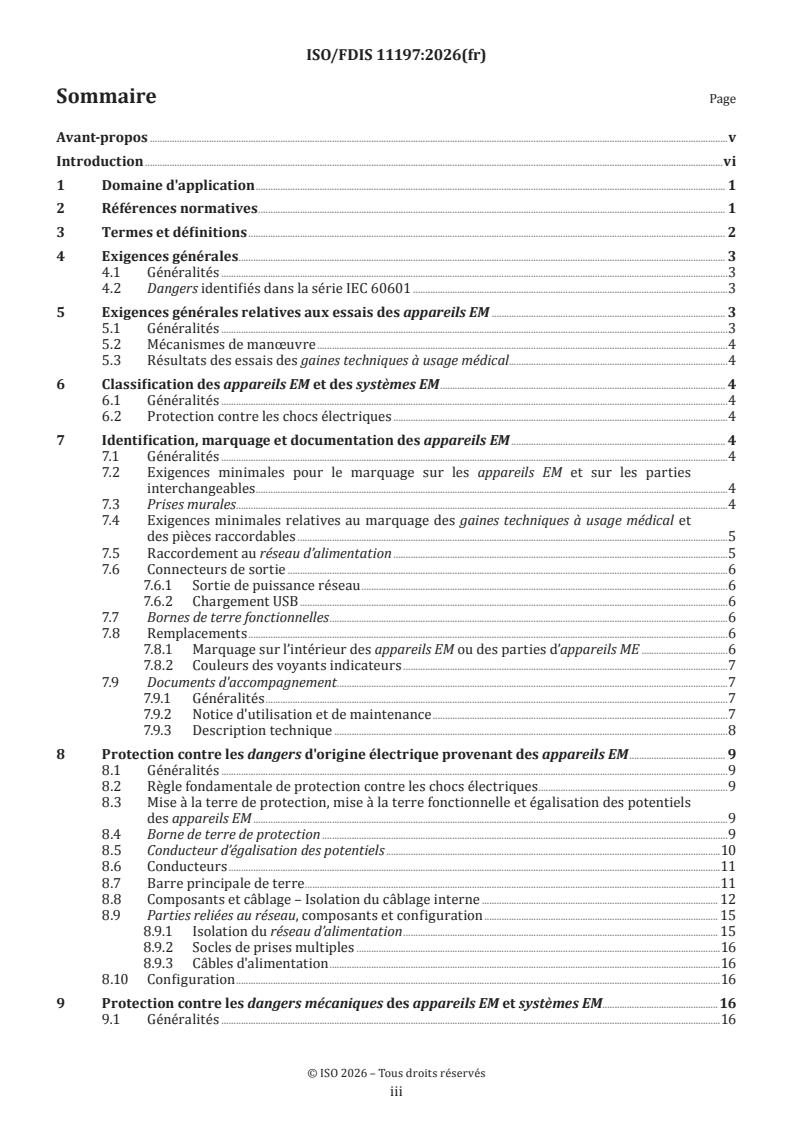
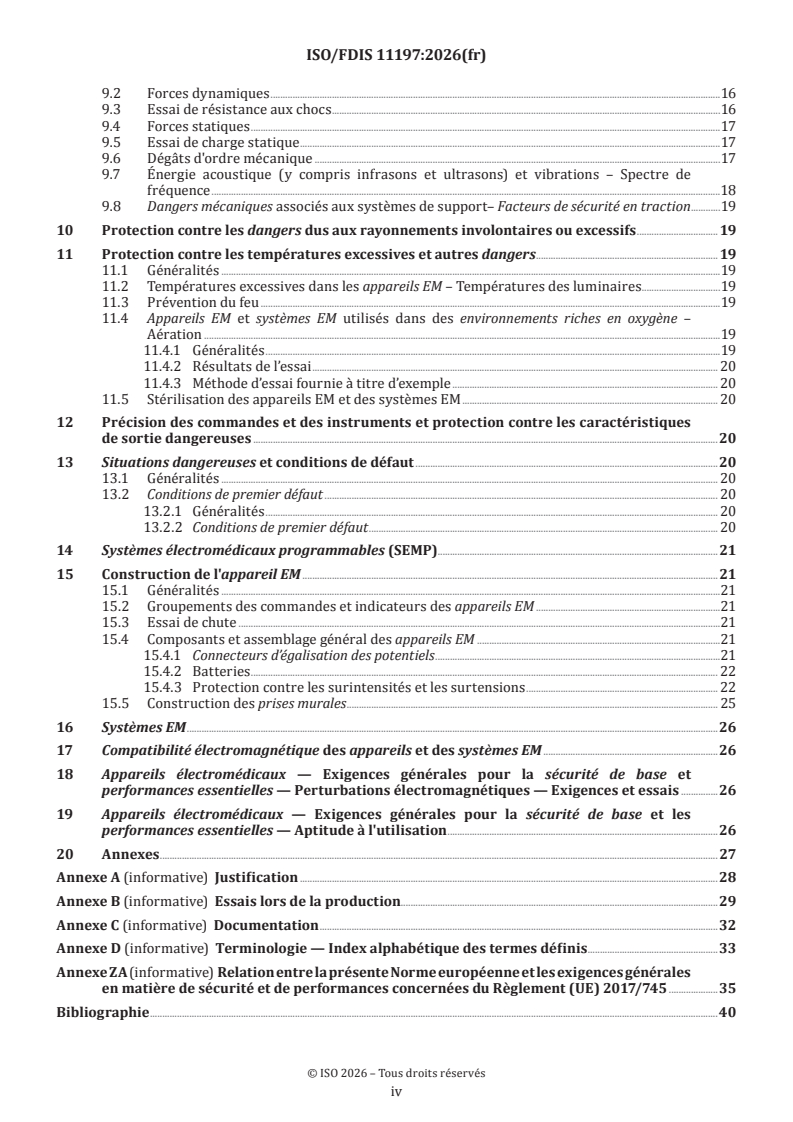
ISO/FDIS 11197 - Gaines techniques à usage médical
ISO 11197 is an ISO standard for medical supply units. It sets particular basic safety and essential performance requirements for permanently installed medical electrical equipment that supplies power, communications, lighting, medical gases, liquids, anaesthetic gas scavenging and plume evacuation services in healthcare facilities. It is written for manufacturers, on-site assemblers, installers, and the people who design, inspect, test, maintain and operate these units.
What does ISO 11197 specify?
ISO 11197 applies to medical supply units made in a factory or assembled on site, including cabinetry and other enclosures that contain patient care services. The standard is based on IEC 60601-1 and focuses on the safety of the medical supply unit as ME equipment, not on the hazards that come from the intended clinical function itself except where specific IEC 60601-1 provisions are pulled in.
The document is organized into clauses 1 to 20. The main technical topics are scope, normative references, terms and definitions, general and test requirements, classification, marking and documents, electrical hazards, mechanical hazards, radiation, temperature and fire, hazardous situations, PEMS, construction, ME systems, EMC, and usability. Annexes A to D support the body with rationale, production tests, documentation and an alphabetical index of defined terms.
| Annex | What it covers |
|---|---|
| Annex A | Rationale for selected requirements |
| Annex B | Tests during production |
| Annex C | Documentation |
| Annex D | Terminology - alphabetical index of defined terms |
What are the key requirements of ISO 11197?
ISO 11197 is mainly about making sure a medical supply unit stays safe to use, safe to maintain, and traceable through testing and documentation. The most important requirements combine electrical protection, mechanical strength, gas and liquid service construction, marking, and routine test records.
Electrical safety and earthing
Clause 6.2 requires a medical supply unit to be designed and constructed as class I. In practice, that means protective earthing is a core part of the design, and the usual IEC 60601-1 applied-part requirements do not apply.
Clauses 8.4 to 8.7 require a common earth bar, protective earth connections, and a potential equalization connector at each medical location of Group 1 and above. The conductor sizes are specified in the standard, and the medical gas pipeline system must not be used as a bus bar. For a buyer or installer, this means the unit must be wired so that fault currents have a reliable earth path and external equipment can be bonded correctly.
Clause 8.8 requires safe separation or insulation where communication wiring, mains wiring, and gas or liquid services share the same enclosure. It also requires low smoke zero halogen insulation for cabling inside the unit. That matters because the unit has to remain safe if one circuit fails and because smoke behavior and cable layout affect emergency and maintenance risk.
Marking, documents and identification
Clause 7 requires clear identification of the unit, its terminal units, and its connections. Mains-operated equipment needs permanent marking showing origin and model or type reference, and terminal units for gases, scavenging, liquids and plume evacuation have to be marked in line with the named service standards.
Clause 7.4 requires parts designed for extra loads to show the maximum safe working load. Clause 7.5 requires electrical and electronic connection information at the junction point inside the equipment. Clause 7.9 requires the accompanying documents to include the manufacturer’s identity, a declaration of conformity, instructions for use, and inspection and replacement procedures where flexible hoses are used. This is the information maintenance staff need to install, service and verify the unit without guessing.
Routine testing and records
Clause 4.2 and Annex B require the manufacturer to run the defined or referenced tests and keep records. Annex B covers electrical tests such as protective earth impedance, earth leakage current, dielectric strength and functional checks, plus gas, vacuum and liquid system tests such as leakage, cross-connections and mechanical integrity.
Clause 5.3 requires each medical supply unit to be tested, with results recorded and made available to the responsible organization on request. For procurement and quality control, that means the unit is not just designed to the standard - it must also leave production with traceable evidence that the required checks were done.
Mechanical strength and load-bearing parts
Clause 9 requires impact, static load and tensile safety checks for the unit and any parts intended to carry additional loads. The standard uses defined test setups, including an impact test, and expects the unit to keep live parts inaccessible and keep terminal units and pipeline joints functional after impact.
Clause 9.4 requires parts designed for extra loads to withstand a test load of twice the manufacturer’s maximum safe working load. That matters for rails, shelves, articulated arms and similar attachments, because the unit has to support real equipment without permanent deformation beyond the permitted limit.
Gas, liquid and scavenging construction
Clause 15.4.3.2 sets detailed construction rules for medical gas distribution systems within the unit. Flexible hoses and hose assemblies are limited to operator-adjustable portions in suitable locations, and where they are used the documents must include inspection, replacement and post-replacement test instructions. The clause also sets temperature limits and separation rules between electrical parts and gas or liquid services.
Clause 15.4.3.3 and 15.4.3.4 do the same for anaesthetic gas scavenging systems and liquid supply systems. For example, chambers containing oxygen, oxygen 93 or nitrous oxide have to be vented to atmosphere, and the liquid system rules address pipe materials, hose compatibility, cross-connections and low-risk construction. In practice, these clauses are what stop service mix-ups, leakage, overheating and unsafe gas accumulation inside the enclosure.
Fire, temperature and fault conditions
Clause 11 covers excessive temperatures, fire prevention and oxygen-rich environments. Luminaires have to stay within the temperature limits of IEC 60598-1, and the enclosure has to provide appropriate fire-resistant properties. Where oxidising gases are inside the unit, the relevant chamber has to be vented so the oxygen concentration stays under the stated limit in the example test.
Clause 13 links the design to risk management in accordance with ISO 14971. The unit has to remain acceptably safe in normal condition and single fault condition during transport, storage, installation, use and maintenance.
What terms does ISO 11197 define?
Medical supply unit - Permanently installed ME equipment that supplies power, communication, lighting, medical gases or liquids, anaesthetic gas scavenging, plume evacuation, or low level waste gas extraction to a healthcare area.
ME equipment - Medical electrical equipment; in this standard, the term is used for the medical supply unit itself.
ME system - A medical electrical system made up of the medical supply unit and connected equipment or services where relevant.
Junction point - The connection point between the medical supply unit and the interconnecting systems already installed.
Enclosure - The surrounding case that protects people from live parts and protects the enclosed equipment from defined environmental conditions.
Compartment - A section inside an enclosure created by barriers, walls and covers.
Potential equalization conductor - The conductor used to connect external equipment to the unit’s bonding arrangement so exposed metal parts can be equalized.
Programmable electrical medical systems (PEMS) - Programmable electrical medical systems as used in the IEC 60601-1 family.
Who uses ISO 11197?
ISO 11197 is used by people who design, manufacture, assemble, install, inspect, test, maintain and operate medical supply units in healthcare facilities. It is also relevant to teams working on bedhead service modules, ceiling pendants, booms, columns, wall-mounted enclosures, prefabricated walls and similar installations.
The standard is especially relevant where the unit interfaces with medical gas pipeline systems, vacuum, anaesthetic gas scavenging, plume evacuation, dialysis liquids, electrical power and communication services. It helps engineers, quality managers and buyers check whether a proposed unit suits the clinical space and the services it has to carry.
What changed in ISO 11197 from the previous edition?
ISO 11197 is the fifth edition and it cancels and replaces ISO 11197:2019. The foreword states that the document was technically revised.
The main changes stated in the document are:
- transition of temporary healthcare facilities to those that become permanent installations
- inclusion of requirements for the use of anti-static hoses within medical supply units
- amendments following a scope gap assessment against IEC 60601-1:2005+A1:2012+A2:2020
Which standards are used with ISO 11197?
| Standard | What it contributes |
|---|---|
| IEC 60601-1 | Base requirements for basic safety and essential performance of ME equipment |
| IEC 60601-1-2 | Electromagnetic disturbances - requirements and tests |
| IEC 60601-1-3 | Radiation protection in diagnostic X-ray equipment |
| IEC 60601-1-6 | Usability |
| IEC 60364-7-710 | Electrical installation requirements for medical locations |
| IEC 60598-1 | Luminaires - general requirements and tests |
| IEC 61386-1 | Conduit systems for cable management |
| IEC 62684 | Dedicated charging port requirements for USB charging devices |
| ISO 32 | Marking for identification of medical gas cylinders |
| ISO 3744 | Sound power measurement method for noise sources |
| ISO 5359 | Low-pressure hose assemblies for medical gases |
| ISO 5367 | Breathing sets and connectors |
| ISO 7396-1 | Medical gas pipeline systems for compressed gases and vacuum |
| ISO 7396-2 | Anaesthetic gas scavenging disposal systems |
| ISO 9170-1 | Terminal units for compressed medical gases and vacuum |
| ISO 9170-2 | Terminal units for anaesthetic gas scavenging systems |
| ISO 14971 | Risk management for medical devices |
| ISO 16571 | Plume evacuation systems |
| EN 50174-1 | Installation specification and quality assurance for IT cabling |
| EN 50174-2 | Cabling installation planning and practices inside buildings |
What does the ISO 11197 document contain?
ISO 11197 contains the full requirement set for medical supply units, plus the supporting annexes for rationale, production testing, documentation and terminology. The body includes marked requirements for electrical bonding, output connectors, protective earth conductors, terminal units, ventilation of oxidising-gas chambers, load-bearing parts, and the construction of gas and liquid services.
It also contains figures showing typical bonding arrangements, example layouts and the impact test setup, and a table for liquid marking names. Annex B gives routine test methods for production control, including electrical tests and service-line checks. Annex C defines the documentation to keep and provide on request, and Annex D gives an alphabetical index of defined terms for use with the standard.
Relations
- Effective Date
- 12-Feb-2026
- Effective Date
- 23-Jul-2022
Buy Documents
ISO/FDIS 11197 - Medical supply units
REDLINE ISO/FDIS 11197 - Medical supply units
ISO/FDIS 11197 - Gaines techniques à usage médical
Get Certified
Connect with accredited certification bodies for this standard

BSI Group
BSI (British Standards Institution) is the business standards company that helps organizations make excellence a habit.

TÜV Rheinland
TÜV Rheinland is a leading international provider of technical services.

TÜV SÜD
TÜV SÜD is a trusted partner of choice for safety, security and sustainability solutions.
Sponsored listings
Frequently Asked Questions
ISO 11197 is a draft published by the International Organization for Standardization (ISO). Its full title is "Medical supply units". This standard covers: IEC 60601-1:2005+A1:2012, 1.1 is replaced by: This document applies to the basic safety and essential performance of medical supply units, hereafter also referred to as ME equipment. This document applies to medical supply units manufactured within a factory or assembled on site, including cabinetry and other enclosures, which incorporate patient care services. NOTE 1 A party that assembles on site various components intended for patient care services into an enclosure is considered the manufacturer of the medical supply unit. Hazards inherent in the intended function of ME equipment or ME systems within the scope of this document are not covered by specific requirements in this standard, except in of IEC 60601-1:2005+A1:2012, 7.2.13 and 8.4.1 (see 201.1.4). NOTE 2 Refer to IEC 60601-1:2005+A1:2012, 4.2.
IEC 60601-1:2005+A1:2012, 1.1 is replaced by: This document applies to the basic safety and essential performance of medical supply units, hereafter also referred to as ME equipment. This document applies to medical supply units manufactured within a factory or assembled on site, including cabinetry and other enclosures, which incorporate patient care services. NOTE 1 A party that assembles on site various components intended for patient care services into an enclosure is considered the manufacturer of the medical supply unit. Hazards inherent in the intended function of ME equipment or ME systems within the scope of this document are not covered by specific requirements in this standard, except in of IEC 60601-1:2005+A1:2012, 7.2.13 and 8.4.1 (see 201.1.4). NOTE 2 Refer to IEC 60601-1:2005+A1:2012, 4.2.
ISO 11197 is classified under the following ICS (International Classification for Standards) categories: 11.040.01 - Medical equipment in general. The ICS classification helps identify the subject area and facilitates finding related standards.
ISO 11197 has the following relationships with other standards: It is inter standard links to FprEN ISO 11197, ISO 11197:2019. Understanding these relationships helps ensure you are using the most current and applicable version of the standard.
ISO 11197 is available in PDF format for immediate download after purchase. The document can be added to your cart and obtained through the secure checkout process. Digital delivery ensures instant access to the complete standard document.
Standards Content (Sample)
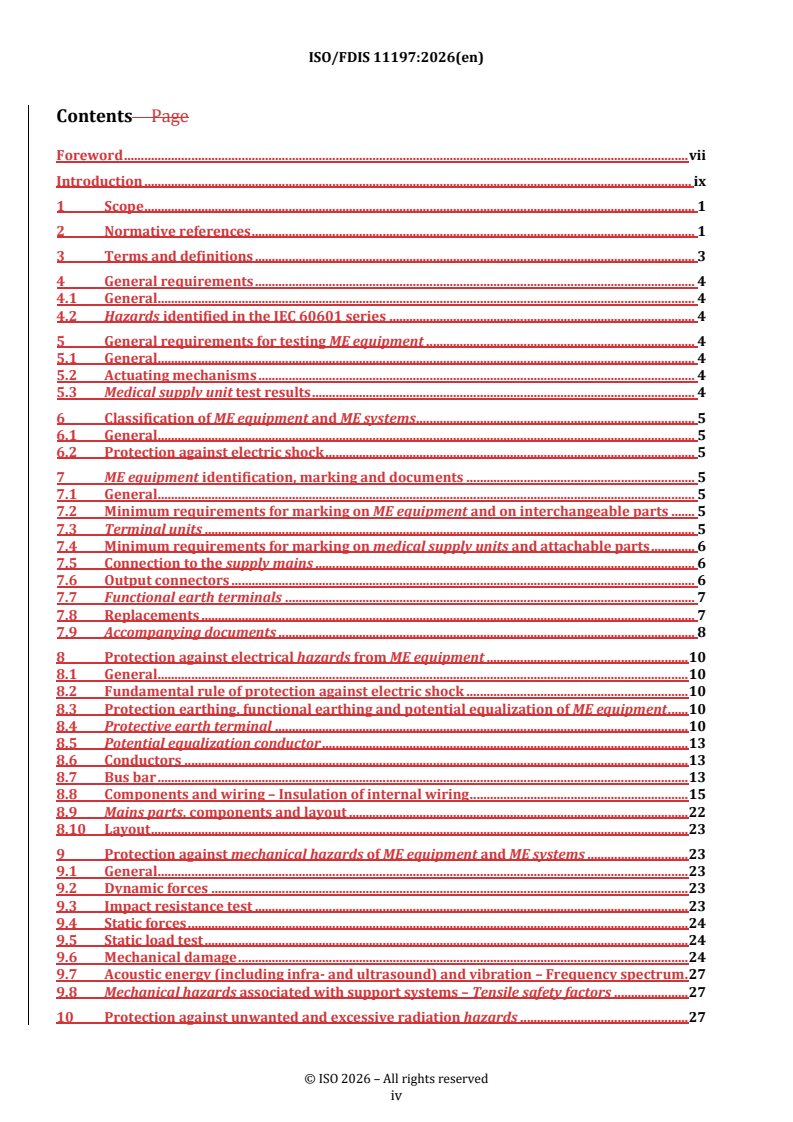
Contents
- Introduction
- 1 Scope
- 2 Normative references
- 3 Terms and definitions
- 3.1 enclosure
- 3.2 medical supply unit
- 3.3 junction point
- 3.4 compartment
- 4 General requirements
- 4.1 General
- 4.2 Hazards identified in the IEC 60601 series
- 5 General requirements for testing ME equipment
- 5.1 General
- 5.2 Actuating mechanisms
- 5.3 Medical supply unit test results
- 6 Classification of ME equipment and ME systems
- 6.1 General
- 6.2 Protection against electric shock
- 7 ME equipment identification, marking and documents
- 7.1 General
- 7.2 Minimum requirements for marking on ME equipment and on interchangeable parts
- 7.3 Terminal units
- 7.4 Minimum requirements for marking on medical supply units and attachable parts
- 7.5 Connection to the supply mains
- 7.6 Output connectors
- 7.7 Functional earth terminals
- 7.8 Replacements
- 7.9 Accompanying documents
- 8 Protection against electrical hazards from ME equipment
- 8.1 General
- 8.2 Fundamental rule of protection against electric shock
- 8.3 Protection earthing, functional earthing and potential equalization of ME equipment
- 8.4 Protective earth terminal
- 1 Cupal (Cu/Al) washer (copper surface uppermost)
- 8.5 Potential equalization conductor
- 8.6 Conductors
- 8.7 Bus bar
- 8.8 Components and wiring – Insulation of internal wiring
- 8.9 Mains parts, components and layout
- 8.10 Layout
- 9 Protection against mechanical hazards of ME equipment and ME systems
- 9.1 General
- 9.2 Dynamic forces
- 9.3 Impact resistance test
- 9.4 Static forces
- 9.5 Static load test
- 9.6 Mechanical damage
- 9.7 Acoustic energy (including infra- and ultrasound) and vibration – Frequency spectrum
- 9.8 Mechanical hazards associated with support systems – Tensile safety factors
- 10 Protection against unwanted and excessive radiation hazards
- 11 Protection against excessive temperatures and other hazards
- 11.1 General
- 11.2 Excessive temperatures in ME equipment – Temperatures of luminaires
- 11.3 Fire prevention
- 11.4 ME equipment and ME systems used in conjunction with oxygen-rich environments –
- 11.5 Sterilization of ME equipment and ME systems
- 12 Accuracy of controls and instruments and protection against hazardous outputs
- 13 Hazardous situations and fault conditions
- 13.1 General
- 13.2 Single fault conditions
- 14 Programmable electrical medical systems (PEMS)
- 15 Construction of ME equipment
- 15.1 General
- 15.2 Arrangements of controls and indicators of ME equipment
- 15.3 Drop test
- 15.4 ME equipment components and general assembly
- 15.5 Terminal unit construction
- 16 ME systems
- 17 Electromagnetic compatibility of ME equipment and ME systems
- 18 Medical electrical equipment —General requirements for basic safety and essential
- 19 Medical electrical equipment —General requirements for basic safety and essential
- 20 Annexes
- Annex A
- Annex B
- Annex C
- Annex D
- Annex ZA
- 11.3 temperature hazards associated with
- 9.3 9.4
- 9.5 9.6
Introduction
Many healthcare facilities use surface-mounted or recessed containment systems and enclosures for accommodating and displaying essential patient care services. These are known as medical supply units. This document specifies requirements for medical supply units manufactured in factories or assembled from components on site.
It is intended for use by those persons involved in the design, construction, inspection, testing, maintenance and operation of healthcare facilities as well as those manufacturing, assembling and installing medical supply units.
Persons involved in the design, manufacture, installation, maintenance and testing of equipment intended to be connected to gas for medicinal use, medical device gas, vacuum, anaesthetic gas scavenging and/or plume extraction systems should be aware of the contents of this document. This document is a particular standard, based on IEC 60601-1:2005+A1:2012+A2:2020. IEC 60601-1:2005+A1:2012 +A2:2020 is the general standard for the safety of all medical electrical equipment used by or under the supervision of qualified personnel in the general medical and patient environment; it also contains certain requirements for reliable operation to ensure safety. IEC 60601-1:2005+A1:2012+A2:2020 has associated collateral standards and particular standards. The collateral standards include requirements for specific technologies and/or hazards and apply to all applicable equipment, such as medical systems, electromagnetic compatibility (EMC), radiation protection in diagnostic X-ray equipment, software, etc. The particular standards apply to specific equipment types, such as medical electron accelerators, high frequency surgical equipment, hospital beds, etc. Where a healthcare facility is developed for temporary use, such as in a pandemic or other natural disaster, the basic principles of this document shall apply. Once the stage of critical use of the facility has normalised the product remaining in use shall fulfil the requirements of this document. NOTE Definitions of collateral standard and particular standard can be found in IEC 60601:2005+A1:2012+A2:2020. Annex A contains rationale statements for some of the requirements of this document. It is included to provide additional insight into the reasoning that led to the requirements and recommendations that have been incorporated in this document.
FINAL DRAFT International Standard ISO/FDIS 11197:2026(en) Medical supply units
1 Scope
This document establishes particular basic safety and essential performance requirements for medical supply units as defined in 3.2.
This document applies to the basic safety and essential performance of medical supply units, hereafter also referred to as ME equipment.
This document applies to medical supply units manufactured within a factory or assembled on site, including joinery, cabinetry and other enclosures, which incorporate patient care services. NOTE 1 A party that assembles on site various components intended for patient care services into an enclosure is considered the manufacturer of the medical supply unit.
Hazards inherent in the intended function of ME equipment or ME systems within the scope of this document are not covered by specific requirements in this document, except in IEC 60601-1:2005+A1: 2012+ A2: 2020, 7.2.13 and 8.4.1 (see Clause 4).
NOTE 2 Refer to IEC 60601-1:2005+A1: 2012+ A2: 2020, 4.2.
2 Normative references
The following documents are referred to in the text in such a way that some or all of their content constitutes requirements of this document. For dated references, only the edition cited applies. For undated references, the latest edition of the referenced document (including any amendments) applies. ISO 32, Gas cylinders for medical use — Marking for identification of content ISO 3744:2025, Acoustics — Determination of sound power levels of noise sources using sound pressure — Engineering methods for an essentially free field over a reflecting plane ISO 5359:2014, Anaesthetic and respiratory equipment — Low-pressure hose assemblies for use with medical gases ISO 5367:2023, Anaesthetic and respiratory equipment — Breathing sets and connectors ISO 7396-1:2016, Medical gas pipeline systems — Part 1: Pipeline systems for compressed medical gases and vacuum ISO 7396-2:2007, Medical gas pipeline systems — Part 2: Anaesthetic gas scavenging disposal systems ISO 9170-1:2017, Terminal units for medical gas pipeline systems — Part 1: Terminal units for use with compressed medical gases and vacuum ISO 9170-2:2008, Terminal units for medical gas pipeline systems — Part 2: Terminal units for anaesthetic gas scavenging systems ISO 14971:2019, Medical devices — Application of risk management to medical devices ISO 16571:2024, Systems for evacuation of plume generated by medical devices IEC 60364-7-710:2021, Electrical installations of buildings — Part 7-710: Requirements for special installations or locations - Medical locations
ISO/FDIS 11197:2026(en) IEC 60598-1:2024, Luminaires — Part 1: General requirements and tests IEC 60601-1:2005+A1: 2012+ A2: 2020, Medical electrical equipment — Part 1: General requirements for basic safety and essential performance IEC 60601-1-2:2014+A1: 2020, Medical electrical equipment — Part 1-2: General requirements for basic safety and essential performance — Collateral standard: Electromagnetic disturbances — Requirements and tests IEC 60601-1-3:2008+A1: 2013+ A2: 2021, Medical electrical equipment — Part 1-3: General requirements for basic safety and essential performance — Collateral standard: Radiation protection in diagnostic X-Ray equipment IEC 60601-1-6:2010+A1: 2013+ A2: 2020, Medical electrical equipment — Part 1-6: General requirements for basic safety and essential performance — Collateral standard: Usability IEC 61386-1:2008+A1: 2017, Conduit systems for cable management — Part 1: General requirements IEC 62684:2018, Interoperability specifications of common external power supply (EPS) for use with dataenabled mobile telephones EN 50174-1:2018, Information technology. Cabling installation — Part 1: Installation specification and quality assurance EN 50174-2:2018, Information technology. Cabling installation — Part 2: Installation planning and practices inside buildings
3 Terms and definitions
For the purposes of this document, the terms and definitions given in IEC 60601-1:2005+A1: 2012+ A2: 2020, ISO 16571:2024, ISO 7396-1:2016 and the following apply.
ISO and IEC maintain terminology databases for use in standardization at the following addresses:
- ISO Online browsing platform: available at https:// www .iso .org/ obp - IEC Electropedia: available at https:// www .electropedia .org/ NOTE An alphabetical index of defined terms is provided in Annex D.
3.1 enclosure
surrounding case constructed to provide a degree of protection to personnel against accidental contact with live parts and also the enclosed equipment against specified environmental conditions Note 1 to entry: The environmental conditions are referenced in IEC 61950:2007, 3.15. Note 2 to entry: An enclosure can be subdivided into compartments.
3.2 medical supply unit
permanently installed ME equipment intended to supply electric power, communication means (telephone, call systems, etc.), data transmission, lighting, and/or gas for medicinal use, medical device gas and/or liquids, an anaesthetic gas scavenging system and/or a plume evacuation system, low level waste gas extract ductwork systems and vents/grilles to medical areas of a healthcare facility Note 1 to entry: medical supply units can include ME equipment or ME systems or parts thereof. medical supply units can also consist of modular sections for electrical supply, lighting for therapy or illumination, communication, supply of gas for medicinal use, medical device gas and liquids, plume evacuation systems and anaesthetic gas scavenging system. Some typical examples of medical supply units are bed head service modules, ceiling pendants, beams, booms, columns, pillars, wall mounted enclosure for area shut-off valve boxes of the medical gas pipeline system, joinery, cabinetry, concealed compartments on or in a wall and prefabricated walls. Note 2 to entry: Examples of configurations are given in Figures 3, 4 and 5.
ISO/FDIS 11197:2026(en) Note 3 to entry: Where in-patient care locations (bed spaces) are required within an acute healthcare facility for dedicated purposes, for example mental health patients, prisons etc, care should be taken to provide bedhead services arrangements including medical supply units which limit ligature points or ease of access to services therein.
3.3 junction point
connection point(s) between the medical supply unit and the inter-connecting system(s) already installed
3.4 compartment
area within an enclosure which is created by separating barriers, walls and covers forming its own cellular section
4 General requirements
4.1 General
IEC 60601-1:2005+A1: 2012+ A2: 2020, Clause 4 applies, with the following addition.
4.2 Hazards identified in the IEC 60601 series
The manufacturer shall undertake all tests as defined or referenced within this document and Annex B and record the results.
NOTE National standards can also apply which require test and record keeping.
5 General requirements for testing ME equipment
5.1 General
IEC 60601-1:2005+A1: 2012+ A2: 2020, Clause 5 applies with the following additions.
5.2 Actuating mechanisms
All external surfaces shall conform to a degree of protection against direct contact in normal use of at least IP2X or IPXXB. Refer to IEC 60529:1989+AMD1: 1999+ AMD2: 2013. This level of protection to live parts shall not be compromised during maintenance of the medical gas pipeline systems, anaesthetic gas scavenging system, plume evacuation systems or liquid pipeline systems, e.g. by the provision of covers, barriers or individual protection with a degree of protection of at least IP2X or IPXXB. Refer to IEC 60529:1989+AMD1: 1999+ AMD2: 2013.
If requested by the healthcare facility (e.g. in psychiatric or paediatric units or prison healthcare facilities), the manufacturer shall provide means to prevent inadvertent or unauthorized dismantling of medical supply units.
5.3 Medical supply unit test results
The manufacturer shall test each medical supply unit. The test results shall be recorded and presented to the responsible organization on request.
The manufacturer shall maintain legible records of all tests undertaken on each medical supply unit according to applicable requirements subject to a minimum period of 5 years for conformance with this document.
ISO/FDIS 11197:2026(en)
6 Classification of ME equipment and ME systems
6.1 General
IEC 60601-1:2005+A1: 2012+ A2: 2020, Clause 6 applies, with the following additions.
6.2 Protection against electric shock
A medical supply unit shall be designed and constructed as class I. NOTE A Class I device will not have an (Type B or other) applied part. Consequently, all cross-references to tests or requirements for applied parts in IEC 60601-1 are not applicable for Medical Supply Units.
7 ME equipment identification, marking and documents
7.1 General
IEC 60601-1:2005+A1: 2012+ A2: 2020, Clause 7 applies, with the following additions.
7.2 Minimum requirements for marking on ME equipment and on interchangeable parts
Mains-operated equipment, including separable components thereof which have a mains part, shall be provided with permanent and legible marking on the outside of the major part of the equipment indicating the origin and model or type reference.
7.3 Terminal units
Terminal units for gas for medicinal use and medical device gas which are mounted within a medical supply unit shall be obvious. Where decorative finishes are applied to the medical supply unit (e.g. graphics, where the terminal unit is displayed as part of the graphic) the design shall ensure a plain surround to the protrusion hole for the terminal unit of not less than 10 mm.
- terminal units for medical gas, medical device gas pipeline systems shall be marked in accordance with ISO 9170-1:2017. Colour coding, if used, shall be in accordance with ISO 9170-1:2017 and ISO 32. - terminal units for anaesthetic gas scavenging system shall be marked in accordance with ISO 9170-2:2008. Colour coding, if used, shall be in accordance with ISO 9170-2:2008. - terminal units for liquids for dialysis shall be marked with the name of the liquid in accordance with Table 1 or with the equivalent national language.
- terminal units for plume evacuation shall be marked in accordance with ISO 16571:2024. NOTE Regional or national regulations which apply to ME equipment identification, marking and documents can exist.
Table 1 — Marking for liquids Name of liquid Potable water, cold Potable water, warm Cooling water Cooling water, feed-back De-mineralized water
ISO/FDIS 11197:2026(en) TTabablele 1 1 ((ccoonnttiinnueuedd)) Name of liquid Distilled water Dialysing concentrate Dialysing permeate
7.4 Minimum requirements for marking on medical supply units and attachable parts
Parts of medical supply units designed for additional loads shall be marked to show the maximum safe working load specified by the manufacturer.
NOTE Medical supply units can comprise various attachments such as rail systems for supporting medical equipment, shelves, articulated equipment support arms, tracks for monitoring equipment and similar attachments.
7.5 Connection to the supply mains
Due to the possible complexity of external marking, information indicating all electrical and electronic connections to the medical supply unit shall be located at the junction point inside the equipment. For electrical connections, the information shall indicate voltages, number of phases, and differentiation of circuits. For electronic connections, the information shall indicate connector numbers and wire identification.
7.6 Output connectors
7.6.1 Mains power output
Mains socket-outlets for special purposes (e.g. for x-ray equipment) shall be marked with the type of supply mains, rated voltage, rated current and with a label (e.g. “X-RAY”). When a medical supply unit is provided with socket-outlets for connection to an essential electrical supply circuit (e.g. uninterruptable power supply (UPS), a Medical IT system as defined in IEC 60364-7-710:2021), these socket-outlets shall comply with the installation rules or be individually identified if not covered by those rules.
If socket-outlets in the same location are supplied from different power sources, each source should be readily identifiable.
NOTE Regional or national regulations can apply to the mains power outlet configurations.
7.6.2 USB Charging
Where Universal Serial Bus (USB) charging devices are installed within medical supply units they shall not form part of a mains power socket assembly. USB charging devices should be stand-alone units wired on a final circuit. The USB charging device shall comply with IEC 62684:2018 and conform to the requirements for dedicated charging ports (DCP) of EN 62680-1-1:2015 to provide a nominal output voltage not exceeding 5 V DC.
The facia plate shall be marked to indicate the following:
- symbol for nature of supply, for direct current only;
- rated current, in milliamperes or amperes;
- rated output voltage;
- labelled “ for non medical use only” in the local language.
ISO/FDIS 11197:2026(en) Where a USB charging device is intended to supply a medical device, the power supply source shall be resilient, e g: UPS or Medical IT system. The facia plate shall be marked to indicate the following:
- symbol for nature of supply, for direct current only;
- rated current, in milliamperes or amperes;
- rated output voltage;
- Medical Use Only.
7.7 Functional earth terminals
Facilities for the connection of protective equipotential bonding shall be marked with symbol 8 of IEC 60601-1:2005+A1: 2012+ A2: 2020, Annex D, Table D.
7.8 Replacements
7.8.1 Marking on the inside of ME equipment or ME equipment parts
IEC 60601-1:2005+A1: 2012+ A2: 2020, 7.3 is replaced by the following:
Junction points and pipelines for gas distribution systems shall be marked in accordance with ISO 7396-1:2016. Colour coding, if used, shall be in accordance with ISO 7396-1:2016 or ISO 32. Junction points and pipelines for anaesthetic gas scavenging systems shall be marked in accordance with ISO 7396-2:2007. Colour coding, if used, shall be in accordance with ISO 7396-2:2007, ISO 32. Junction points and pipelines for liquids shall be marked with the name of the liquid in accordance with Table 1 or the equivalent in national language.
Junction points and pipelines for plume evacuation shall be marked in accordance with ISO 16571:2024. If the medical supply unit has a terminal connecting the neutral line of the power supply, it shall be clearly identified using the sign A of IEC 60601-1:2005+A1: 2012+ A2: 2020, Annex D.3, the letter N and/or be colour coded blue.
7.8.2 Colours of indicator lights
IEC 60601-1:2005+A1: 2012+ A2: 2020, 7.8.1 is replaced by the following:
Where electrical components such as indicators, control buttons and the like are incorporated into a medical supply unit, the requirements of IEC 60601-1:2005+A1: 2012+ A2: 2020 shall be maintained. NOTE 1 Where supply mains final circuit socket-outlets are incorporated within medical supply units, these are generally only supplied by socket-outlet manufacturers from a general range without adaptation for healthcare use. Where lamp/neon/Light Emitting Diode (LED) indicators are supplied as part of that assembly, the illumination colour might not be in accordance with Table 2 of IEC 60601-1:2005+A1: 2012+ A2: 2020. NOTE 2 The illumination of an indicator might not truly reflect the operational state of the socket-outlet or its supply mains.
7.9 Accompanying documents
7.9.1 General
Replace the first dash in IEC 60601-1:2005+A1: 2012+ A2: 2020, 7.9.1 with the following:
ISO/FDIS 11197:2026(en) The accompanying documents shall include the following:
- the name or trade name and address of the manufacturer and the authorized representative where the manufacturer does not have a registered place of business within the local market;
- a declaration of conformity by the manufacturer or on-site manufacturer of conformance with this document and that the manufacturer has satisfied the testing requirements.
7.9.2 Instructions for use and maintenance
7.9.2.1 General
The instructions for use shall contain the date of issue or the latest revision of the document.
7.9.2.2 Reference to the technical description
General information:
- Instructions for use shall state which parts of the equipment are capable of bearing additional loads. The maximum safe working load shall be stated.
- If flexible hoses and hose assemblies are used as part of the gas distribution systems and liquids for dialysis and/or are components of an anaesthetic gas scavenging system or a plume evacuation system in an operator-adjustable system (e.g. a ceiling pendant), the instructions for use shall include a procedure for, and the recommended frequency of inspection and replacement. Responsibility of the manufacturer:
- The manufacturer shall document the manufacturing tests that have been performed on each medical supply unit to demonstrate that the requirements of this document have been met. This documentation shall be retained and made available upon request.
Specifications for installation, use and maintenance:
- Medical supply units shall be manufactured, tested, installed and used in conformance with this document and supported by the manufacturer’s instructions.
...
Contents
- Introduction
- 1 Cupal (Cu/Al) washer 4 lock washer
- 1 Cupal (Cu/Al) washer (copper surface uppermost)
- Annex A
- Annex B
- Annex C
- Annex D
- Annex ZA
- Annex ZA
- 11.3 and temperature hazards associated
- 9.3 9.4
- 9.5 9.6
- 15.4.3.4 supplies
- 7.6 other equipment for supplies of
- 7.7 electrical power, medical gases and
- 8.5 8.6
- 8.7 15.4.1
- 15.4.3.1 15.4.3.3
- 15.4.3.4 15.5
- 7.6 medical supply unit and devices
- 8.2 supplied with electrical power by
- 8.4 the medical supply unit
- 8.5 8.6
- 8.7 8.8
- 8.9 8.10
- 9.4 9.5
- 9.6 9.8
- Bibliography
Introduction
Many healthcare facilities use surface-mounted or recessed containment systems and enclosures for accommodating and displaying essential patient care services. These are known as medical supply units. This document specifies requirements for medical supply units manufactured in factories or assembled from components on site.
It is intended for use by those persons involved in the design, construction, inspection, testing, maintenance and operation of healthcare facilities as well as those manufacturing, assembling and installing medical supply units.
Persons involved in the design, manufacture, installation, maintenance and testing of equipment intended to be connected to gas for medicinal use, medical device gas, vacuum, anaesthetic gas scavenging and/or plume extraction systems should be aware of the contents of this document. This document is a particular standard, based on IEC 60601-1:2005+A1:2012+A2:2020. IEC 60601- 1:2005+A1:2012 +A2:2020 is the general standard for the safety of all medical electrical equipment used by or under the supervision of qualified personnel in the general medical and patient environment; it also contains certain requirements for reliable operation to ensure safety.
IEC 60601-1:2005+A1:2012+A2:2020 has associated collateral standards and particular standards. The collateral standards include requirements for specific technologies and/or hazards and apply to all applicable equipment, such as medical systems, electromagnetic compatibility (EMC), radiation protection in diagnostic X-ray equipment, software, etc. The particular standards apply to specific equipment types, such as medical electron accelerators, high frequency surgical equipment, hospital beds, etc. Where a healthcare facility is developed for temporary use, such as in a pandemic or other natural disaster, the basic principles of this document shall apply. Once the stage of critical use of the facility has normalised the product remaining in use shall fulfil the requirements of this document. NOTE Definitions of collateral standard and particular standard can be found in IEC 60601:2005+A1:2012+A2:2020.
Annex AAnnex A contains rationale statements for some of the requirements of this document. It is included to provide additional insight into the reasoning that led to the requirements and recommendations that have been incorporated in this document.
FINAL DRAFT International Standard ISO/FDIS 11197:2026(en)
Medical supply units 1 1 Scope This document establishes particular basic safety and essential performance requirements for medical supply units as defined in 3.2.
This document applies to the basic safety and essential performance of medical supply units, hereafter also referred to as ME equipment.
This document applies to medical supply units manufactured within a factory or assembled on site, including joinery, cabinetry and other enclosures, which incorporate patient care services. NOTE 1 A party that assembles on site various components intended for patient care services into an enclosure is considered the manufacturer of the medical supply unit.
Hazards inherent in the intended function of ME equipment or ME systems within the scope of this document are not covered by specific requirements in this document, except in IEC 60601-1:2005+A1:2012+A2:2020, 7.2.13 and 8.4.1 (see Clause 4).Clause 4).
NOTE 2 Refer to IEC 60601-1:2005+A1:2012+A2:2020, 4.2.
The object of this document is to establish particular basic safety and essential performance requirements for medical supply units as defined in 3.2.
2 2 Normative references The following documents are referred to in the text in such a way that some or all of their content constitutes requirements of this document. For dated references, only the edition cited applies. For undated references, the latest edition of the referenced document (including any amendments) applies. ISO 32, Gas cylinders for medical use — Marking for identification of content ISO 3744:2025, Acoustics — Determination of sound power levels of noise sources using sound pressure — Engineering methods for an essentially free field over a reflecting plane ISO 5359:2014, Anaesthetic and respiratory equipment — Low-pressure hose assemblies for use with medical gases ISO 5367:2023, Anaesthetic and respiratory equipment — Breathing sets and connectors ISO 7396-1:2016, Medical gas pipeline systems — Part 1: Pipeline systems for compressed medical gases and vacuum ISO 7396-2:2007, Medical gas pipeline systems — Part 2: Anaesthetic gas scavenging disposal systems ISO 9170-1:2017, Terminal units for medical gas pipeline systems — Part 1: Terminal units for use with compressed medical gases and vacuum
ISO AWI /FDIS 11197:2023(E) N1112026(en) ISO 9170-2:2008, Terminal units for medical gas pipeline systems — Part 2: Terminal units for anaesthetic gas scavenging systems ISO 14971:2019, Medical devices — Application of risk management to medical devices ISO 16571:2024, Systems for evacuation of plume generated by medical devices IEC 60364-7-710:20022021, Electrical installations of buildings — Part 7-710: Requirements for special installations or locations - Medical locations IEC 60598-1:2014+A1:20172024, Luminaires — Part 1: General requirements and tests IEC 60601-1:2005+A1:2012+A2:2020, Medical electrical equipment — Part 1: General requirements for basic safety and essential performance IEC 60601-1-2:2014+A1:2020, Medical electrical equipment — Part 1-2: General requirements for basic safety and essential performance –— Collateral standard: Electromagnetic disturbances –— Requirements and tests IEC 60601-1-3:2008+A1:2013+A2:2021, Medical electrical equipment — Part 1-3: General requirements for basic safety and essential performance –— Collateral standard: Radiation protection in diagnostic X-Ray equipment IEC 60601-1-6:2010+A1:2013+A2:2020, Medical electrical equipment — Part 1-6: General requirements for basic safety and essential performance — Collateral standard: Usability IEC 61386-1:2008+A1:2017, Conduit systems for cable management — Part 1: General requirements IEC 62684:2018, Interoperability specifications of common external power supply (EPS) for use with dataenabled mobile telephones ISO 32, Gas cylinders for medical use - Marking for identification of content ISO 3744:2010, Acoustics — Determination of sound power levels and sound energy levels of noise sources using sound pressure — Engineering methods for an essentially free field over a reflecting plane ISO 5359:2014, Anaesthetic and respiratory equipment — Low-pressure hose assemblies for use with medical gases ISO 5367:2023, Anaesthetic and respiratory equipment – Breathing sets and connectors ISO 7396-1:2016, Medical gas pipeline systems — Part 1: Pipeline systems for compressed medical gases and vacuum ISO 7396-2:2007, Medical gas pipeline systems — Part 2: Anaesthetic gas scavenging disposal systems ISO 9170-1:2017, Terminal units for medical gas pipeline systems — Part 1: Terminal units for use with compressed medical gases and vacuum
ISO/FDIS 11197:2026(en) ISO 9170-2:2008, Terminal units for medical gas pipeline systems — Part 2: Terminal units for anaesthetic gas scavenging systems ISO 14971:2019, Medical devices — Application of risk management to medical devices ISO 16571:2014, Systems for evacuation of plume generated by medical devices EN 50174-1:2018, Information technology. Cabling installation — Part 1: Installation specification and quality assurance EN 50174-2:2018, Information technology. Cabling installation — Part 2: Installation planning and practices inside buildings 3 3 Terms and definitions For the purposes of this document, the terms and definitions given in IEC 60601-1:2005+A1:2012+A2:2020, ISO 16571:20142024, ISO 7396-1:2016 and the following apply.
ISO and IEC maintain terminology databases for use in standardization at the following addresses:
- — ISO Online browsing platform: available at https://www.iso.org/obphttps://www.iso.org/obp - — IEC Electropedia: available at http://www.electropedia.org/https://www.electropedia.org/ NOTE An alphabetical index of defined terms is provided in Annex D.Annex D. 3.1 3.1 enclosure surrounding case constructed to provide a degree of protection to personnel against accidental contact with live parts and also the enclosed equipment against specified environmental conditions Note 1 to entry: The environmental conditions are referenced in IEC 61950:2007, 3.15. Note 2 to entry: An enclosure can be subdivided into compartments. 3.2 3.2 medical supply unit permanently installed ME equipment intended to supply electric power, communication means (telephone, call systems, etc.), data transmission, lighting, and/or gas for medicinal use, medical device gas and/or liquids, an anaesthetic gas scavenging system and/or a plume evacuation system, low level waste gas extract ductwork systems and vents/grilles to medical areas of a healthcare facility Note 1 to entry: medical supply units can include ME equipment or ME systems or parts thereof. medical supply units can also consist of modular sections for electrical supply, lighting for therapy or illumination, communication, supply of gas for medicinal use, medical device gas and liquids, plume evacuation systems and anaesthetic gas scavenging system. Some typical examples of medical supply units are bed head service modules, ceiling pendants, beams, booms, columns, pillars, wall mounted enclosure for area shut-off valve boxes of the medical gas pipeline system, joinery, cabinetry, concealed compartments on or in a wall and prefabricated walls.
Note 2 to entry: Examples of configurations are given in Figures 3, 4Figures 3, 4 and 5.5. Note 3 to entry: Where in-patient care locations (bed spaces) are required within an acute healthcare facility for dedicated purposes, for example mental health patients, prisons etc, care should be taken to provide bedhead services arrangements including medical supply units which limit ligature points or ease of access to services therein.
ISO AWI /FDIS 11197:2023(E) N1112026(en) 3.3 3.3 junction point connection point(s) between the medical supply unit and the inter-connecting system(s) already installed 3.4 3.4 compartment area within an enclosure which is created by separating barriers, walls and covers forming its own cellular section 4 4 General requirements 4.1 4.1 General IEC 60601-1:2005+A1:2012+A2:2020, Clause 4 applies, with the following addition. 4.2 4.2 Hazards identified in the IEC 60601 series The manufacturer shall undertake all tests as defined or referenced within this document and Annex B,Annex B and record the results.
NOTE National standards can also apply which require test and record keeping. 5 5 General requirements for testing ME equipment 5.1 5.1 General IEC 60601-1:2005+A1:2012+A2:2020, Clause 5 applies with the following additions. 5.2 5.2 Actuating mechanisms All external surfaces shall conform to a degree of protection against direct contact in normal use of at least IP2X or IPXXB. Refer to IEC 60529:1989+AMD1:1999+AMD2:2013.
This level of protection to live parts shall not be compromised during maintenance of the medical gas pipeline systems, anaesthetic gas scavenging system, plume evacuation systems or liquid pipeline systems, e.g. by the provision of covers, barriers or individual protection with a degree of protection of at least IP2X or IPXXB. Refer to IEC 60529:1989+AMD1:1999+AMD2:2013 CSV/COR2:2015.
If requested by the healthcare facility (e.g. in psychiatric or paediatric units or prison healthcare facilities), the manufacturer shall provide means to prevent inadvertent or unauthorized dismantling of medical supply units. 5.3 5.3 Medical supply unit test results The manufacturer shall test each medical supply unit. The test results shall be recorded and presented to the responsible organization on request.
The manufacturer shall maintain legible records of all tests undertaken on each medical supply unit according to applicable requirements subject to a minimum period of 5 years for conformance with this document.
ISO/FDIS 11197:2026(en) 6 6 Classification of ME equipment and ME systems 6.1 6.1 General IEC 60601-1:2005+A1:2012+A2:2020, Clause 6 applies, with the following additions. 6.2 6.2 Protection against electric shock A medical supply unit shall be designed and constructed as class I. NOTE A Class I device will not have an (Type B or other) applied part. Consequently, all cross-references to tests or requirements for applied parts in IEC 60601-1 are not applicable for Medical Supply Units. 7 7 ME equipment identification, marking and documents 7.1 7.1 General IEC 60601-1:2005+A1:2012+A2:2020, Clause 7 applies, with the following additions. 7.2 7.2 Minimum requirements for marking on ME equipment and on interchangeable parts Mains-operated equipment, including separable components thereof which have a mains part, shall be provided with permanent and legible marking on the outside of the major part of the equipment indicating the origin and model or type reference.
7.3 7.3 Terminal units terminalTerminal units for gas for medicinal use and medical device gas which are mounted within a medical supply unit shall be obvious. Where decorative finishes are applied to the medical supply unit (e.g. graphics, where the terminal unit is displayed as part of the graphic) the design shall ensure a plain surround to the protrusion hole for the terminal unit of not less than 10 mm.
- — terminal units for medical gas, medical device gas pipeline systems shall be marked in accordance with ISO 9170-1:2017. Colour coding, if used, shall be in accordance with ISO 9170-1:2017 and ISO 32. - — terminal units for anaesthetic gas scavenging system shall be marked in accordance with ISO 9170- 2:2008. Colour coding, if used, shall be in accordance with ISO 9170-2:2008. - — terminal units for liquids for dialysis shall be marked with the name of the liquid in accordance with Table 1Table 1 or with the equivalent national language.
- — terminal units for plume evacuation shall be marked in accordance with ISO 16571:20142024. NOTE Regional or national regulations which apply to ME equipment identification, marking and documents can exist.
Table 1 — Marking for liquids Name of liquid Potable water, cold Potable water, warm Cooling water Cooling water, feed-back
ISO AWI /FDIS 11197:2023(E) N1112026(en) Name of liquid De-mineralized water Distilled water Dialysing concentrate Dialysing permeate 7.4 7.4 Minimum requirements for marking on medical supply units and attachable parts Parts of medical supply units designed for additional loads shall be marked to show the maximum safe working load specified by the manufacturer.
NOTE Medical supply units can comprise various attachments such as rail systems for supporting medical equipment, shelves, articulated equipment support arms, tracks for monitoring equipment and similar attachments. 7.5 7.5 Connection to the supply mains Due to the possible complexity of external marking, information indicating all electrical and electronic connections to the medical supply unit shall be located at the junction point inside the equipment. For electrical connections, the information shall indicate voltages, number of phases, and differentiation of circuits. For electronic connections, the information shall indicate connector numbers and wire identification. 7.6 7.6 Output connectors 7.6.1 7.6.1 Mains power output Mains socket-outlets for special purposes (e.g. for x-ray equipment) shall be marked with the type of supply mains, rated voltage, rated current and with a label (e.g. “X-RAY”). When a medical supply unit is provided with socket-outlets for connection to an essential electrical supply circuit (e.g. uninterruptable power supply (UPS), a Medical IT system as defined in IEC 60364--7-- 710:20022021), these socket-outlets shall comply with the installation rules or be individually identified if not covered by those rules.
If socket-outlets in the same location are supplied from different power sources, each source should be readily identifiable.
NOTE Regional or national regulations can apply to the mains power outlet configurations. 7.6.2 7.6.2 USB Charging Where Universal Serial Bus (USB) charging devices are installed within medical supply units they shall not form part of a mains power socket assembly. USB charging devices should be stand-alone units wired on a final circuit. The USB charging device shall comply with IEC 62684:2018 and conform to the requirements for
ISO/FDIS 11197:2026(en) dedicated charging ports (DCP) of EN 62680-1-1:2015 to provide a nominal output voltage not exceeding 5 V DC.
The facia plate shall be marked to indicate the following:
- — symbol for nature of supply, for direct current only;
- — rated current, in milliamperes or amperes;
- — rated output voltage;
- — labelled “for non medical use only” in the local language. Where a USB charging device is intended to supply a medical device, the power supply source shall be resilient, e g: UPS or Medical IT system. The facia plate shall be marked to indicate the following:
- — symbol for nature of supply, for direct current only;
- — rated current, in milliamperes or amperes;
- — rated output voltage;
- — Medical Use Only.
7.7 7.7 Functional earth terminals Facilities for the connection of protective equipotential bonding shall be marked with symbol 8 of IEC 60601- 1:2005+A1:2012+A2:2020, Annex D, Table D.
7.8 7.8 Replacements 7.8.1 7.8.1 Marking on the inside of ME equipment or ME equipment parts IEC 60601-1:2005+A1:2012+A2:2020, 7.3 is replaced by the following:
Junction points and pipelines for gas distribution systems shall be marked in accordance with ISO 7396-1:2016. Colour coding, if used, shall be in accordance with ISO 7396-1:2016 or ISO 32. Junction points and pipelines for anaesthetic gas scavenging systems shall be marked in accordance with ISO 7396-2:2007. Colour coding, if used, shall be in accordance with ISO 7396-2:2007, ISO 32. Junction points and pipelines for liquids shall be marked with the name of the liquid in accordance with Table 1Table 1 or the equivalent in national language.
Junction points and pipelines for plume evacuation shall be marked in accordance with ISO 16571:20142024. If the medical supply unit has a terminal connecting the neutral line of the power supply, it shall be clearly identified using the sign A of IEC 60601-1:2005+A1:2012+A2:2020, Annex D.3, the letter N and/or be colour coded blue.
7.8.2 7.8.2 Colours of indicator lights IEC 60601-1:2005+A1:2012+A2:2020, 7.8.1 is replaced by the following:
Where electrical components such as indicators, control buttons and the like are incorporated into a medical supply unit, the requirements of IEC 60 601 60601-1:2005+A1:2012+A2:2020 shall be maintained.
ISO AWI /FDIS 11197:2023(E) N1112026(en) NOTE 1 Where supply mains final circuit socket-outlets are incorporated within medical supply units, these are generally only supplied by socket-outlet manufacturers from a general range without adaptation for healthcare use. Where lamp/neon/Light Emitting Diode (LED) indicators are supplied as part of that assembly, the illumination colour might not be in accordance with Table 2 of IEC 60601-1:2005+A1:2012. +A2:2020. NOTE 2 The illumination of an indicator might not truly reflect the operational state of the socket-outlet or its supply mains.
7.9 7.9 Accompanying documents 7.9.1 7.9.1 General Replace the first dash in IEC 60601-1:2005+A1:2012+A2:2020, 7.9.1 with the following:
The accompanying documents shall include the following:
...
Contents
- Introduction
- 1 Domaine d'application
- 2 Références normatives
- 3 Termes et définitions
- 3.1 enveloppe
- 3.2 gaine technique à usage médical
- 3.3 point de raccordement
- 3.4 compartiment
- 4 Exigences générales
- 4.1 Généralités
- 5 Exigences générales relatives aux essais des appareils EM
- 5.1 Généralités
- 5.2 Mécanismes de manœuvre
- 5.3 Résultats des essais des gaines techniques à usage médical
- 6 Classification des appareils EM et des systèmes EM
- 6.1 Généralités
- 6.2 Protection contre les chocs électriques
- 7 Identification, marquage et documentation des appareils EM
- 7.1 Généralités
- 7.2 Exigences minimales pour le marquage sur les appareils EM et sur les parties
- 7.3 Prises murales
- 7.4 Exigences minimales relatives au marquage des gaines techniques à usage médical et
- 7.5 Raccordement au réseau d’alimentation
- 7.6 Connecteurs de sortie
- 7.7 Bornes de terre fonctionnelles
- 7.8 Remplacements
- 7.9 Documents d'accompagnement
- 8 Protection contre les dangers d'origine électrique provenant des appareils EM
- 8.1 Généralités
- 8.2 Règle fondamentale de protection contre les chocs électriques
- 8.3 Mise à la terre de protection, mise à la terre fonctionnelle et égalisation des potentiels
- 8.4 Borne de terre de protection
- 8.5 Conducteur d’égalisation des potentiels
- 8.6 Conducteurs
- 8.7 Barre principale de terre
- 8.8 Composants et câblage – Isolation du câblage interne
- 8.9 Parties reliées au réseau, composants et configuration
- 8.10 Configuration
- 9 Protection contre les dangers mécaniques des appareils EM et systèmes EM
- 9.1 Généralités
- 9.2 Forces dynamiques
- 9.3 Essai de résistance aux chocs
- 9.4 Forces statiques
- 9.5 Essai de charge statique
- 9.6 Dégâts d'ordre mécanique
- 9.7 Énergie acoustique (y compris infrasons et ultrasons) et vibrations – Spectre de
- 9.8 Dangers mécaniques associés aux systèmes de support– Facteurs de sécurité en traction
- 10 Protection contre les dangers dus aux rayonnements involontaires ou excessifs
- 11 Protection contre les températures excessives et autres dangers
- 11.1 Généralités
- 11.2 Températures excessives dans les appareils EM – Températures des luminaires
- 11.3 Prévention du feu
- 11.4 Appareils EM et systèmes EM utilisés dans des environnements riches en oxygène –
- 11.5 Stérilisation des appareils EM et des systèmes EM
- 12 Précision des commandes et des instruments et protection contre les
- 13 Situations dangereuses et conditions de défaut
- 13.1 Généralités
- 13.2 Conditions de premier défaut
- 14 Systèmes électromédicaux programmables (SEMP)
- 15 Construction de l'appareil EM
- 15.1 Généralités
- 15.2 Groupements des commandes et indicateurs des appareils EM
- 15.3 Essai de chute
- 15.4 Composants et assemblage général des appareils EM
- 15.5 Construction des prises murales
- 16 Systèmes EM
- 17 Compatibilité électromagnétique des appareils et des systèmes EM
- 18 Appareils électromédicaux — Exigences générales pour la sécurité de base et
- 19 Appareils électromédicaux — Exigences générales pour la sécurité de base et les
- 20 Annexes
- Annexe A
- Annexe B
- Annexe C
- Annexe D
- Annexe ZA
- 11.3 de l'enceinte de feu, et les risques de
- 9.3 9.4
- 9.5 9.6
- 15.4.3.4 alimentations en liquide
- 7.6 à usage médical et d'autres équipe-
Introduction
Un grand nombre d’installations de soins utilisent des systèmes et des enveloppes de confinement montés en saillie ou encastrés, destinés à loger et à présenter les principaux services de soins aux patients. Ces systèmes et enveloppes sont appelés gaines techniques à usage médical.
Le présent document définit les exigences relatives aux gaines techniques à usage médical fabriquées en usine ou montées sur site à partir de composants.
Il est destiné à être utilisé par les personnes impliquées dans la conception, la construction, l’inspection, les essais, la maintenance et l’exploitation des installations de soins ainsi que par celles qui fabriquent, assemblent et installent les gaines techniques à usage médical. Il convient que les personnes impliquées dans la conception, la fabrication, l’installation, la maintenance et les essais des appareils destinés à être raccordés à des systèmes de distribution de gaz médicaux, de gaz dispositif médical et de vide, ainsi qu’à des systèmes d’évacuation de gaz d’anesthésie et/ou des effluents gazeux soient informées du contenu du présent document.
Le présent document est une norme particulière, qui repose sur l’IEC 60601-1:2005+A1:2012+A2:2020. L’IEC 60601-1:2005+A1:2012+A2:2020 est la norme générale relative à la sécurité de tous les appareils électromédicaux utilisés par ou sous la supervision d’un personnel qualifié dans l’environnement médical général et dans l'environnement du patient. Elle comporte également certaines exigences relatives à la fiabilité de fonctionnement, afin de garantir la sécurité.
L’IEC 60601-1:2005+A1:2012+A2:2020 est associée à des normes collatérales et à des normes particulières. Les normes collatérales comportent des exigences relatives à des technologies spécifiques et/ou à des dangers, et s’appliquent à tous les équipements concernés, tels que les systèmes médicaux, la compatibilité électromagnétique (CEM), la radioprotection dans les appareils à rayonnement X de diagnostic, les logiciels, etc. Les normes particulières s’appliquent à des types d’appareils spécifiques, tels que les accélérateurs d’électrons à usage médical, les équipements chirurgicaux à haute fréquence, les lits d’hôpitaux, etc. Les principes de base du présent document doivent s’appliquer lorsque des installations de soins sont mises en place pour une utilisation temporaire, comme dans le contexte d’une pandémie ou d’une catastrophe naturelle. Une fois le stade d’utilisation critique de l’installation passé, les produits continuant à être utilisés doivent respecter les exigences du présent document.
NOTE Les définitions de “norme collatérale” et de “norme particulière” sont fournies dans l’IEC 60601:2005+A1:2012+A2:2020.
L’Annexe A comporte des justifications concernant certaines des exigences du présent document. Elle est fournie afin de mieux comprendre le raisonnement qui a permis d’aboutir aux exigences et recommandations incluses dans le présent document.
PROJET FINAL Norme internationale ISO/FDIS 11197:2026(fr) Gaines techniques à usage médical
1 Domaine d'application
Le présent document établit des exigences spécifiques relatives à la sécurité de base et aux performances essentielles des gaines techniques à usage médical, telles que définies en 3.2. Le présent document s’applique à la sécurité de base et aux performances essentielles des gaines techniques à usage médical, également désignées sous le terme d’appareil EM. Le présent document s’applique aux gaines techniques à usage médical fabriquées en usine ou montées sur site, y compris les zones d’assemblage, armoires et autres enveloppes, qui intègrent des services de soins aux patients.
NOTE 1 Une entité qui monte sur site divers composants destinés à des services de soins aux patients intégrés dans une enveloppe est considérée comme le fabricant de la gaine technique à usage médical. Les dangers inhérents à la fonction prévue des appareils EM ou des systèmes EM dans le cadre du domaine d'application du présent document ne sont pas couverts par des exigences spécifiques contenues dans le présent document, à l'exception de l'IEC 60601-1:2005+A1: 2012+ A2: 2020, 7.2.13 et 8.4.1 (voir 4). NOTE 2 Voir le paragraphe 4.2 de l’IEC 60601-1:2005+A1: 2012+ A2: 2020.
2 Références normatives
Les documents suivants sont cités dans le texte de sorte qu’ils constituent, pour tout ou partie de leur contenu, des exigences du présent document. Pour les références datées, seule l’édition citée s’applique. Pour les références non datées, la dernière édition du document de référence s'applique (y compris les éventuels amendements).
ISO 32, Bouteilles à gaz pour usages médicaux — Marquage pour l'identification du contenu ISO 3744:2025, Acoustique — Détermination des niveaux de puissance acoustique et des niveaux d’énergie acoustique émis par les sources de bruit à partir de la pression acoustique — Méthodes d’expertise pour des conditions approchant celles du champ libre sur plan réfléchissant ISO 5359:2014, Matériel d'anesthésie et de réanimation respiratoire — Flexibles de raccordement à basse pression pour utilisation avec les gaz médicaux ISO 5367:2023, Matériel d'anesthésie et de réanimation respiratoire — Ensembles respiratoires et raccords ISO 7396-1:2016, Systèmes de distribution de gaz médicaux — Partie 1: Systèmes de distribution de gaz médicaux comprimés et de vide ISO 7396-2:2007, Systèmes de distribution de gaz médicaux — Partie 2: Systèmes d'évacuation de gaz d'anesthésie non réutilisables ISO 9170-1:2017, Prises murales pour systèmes de distribution de gaz médicaux — Partie 1: Prises murales pour les gaz médicaux comprimés et le vide ISO 9170-2:2008, Prises murales pour systèmes de distribution de gaz médicaux — Partie 2: Prises murales pour systèmes d'évacuation des gaz d'anesthésie ISO 14971:2019, Dispositifs médicaux — Application de la gestion des risques aux dispositifs médicaux
ISO/FDIS 11197:2026(fr) ISO 16571:2024, Systèmes d'évacuation des fumées chirurgicales générées par l'utilisation de dispositifs médicaux IEC 60364-7-710:2021, Installations électriques à basse tension — Partie 7-710: Exigences pour les installations ou emplacements spéciaux — Locaux à usages médicaux IEC 60598-1:2024, Luminaires — Partie 1: Exigences générales et essais I EC 6 06 01-1:20 05+ A 1: 2012+ A 2: 2020, Appareils électromédicaux — Partie 1: Exigences générales pour la sécurité de base et les performances essentielles I EC 6 06 01-1-2:2014 +A 1: 2020, Appareils électromédicaux — Partie 1-2: Exigences générales pour la sécurité de base et les performances essentielles — Norme collatérale: Perturbations électromagnétiques — Exigences et essais I EC 6 06 01-1-3:20 0 8 + A 1: 2013+ A 2: 2021, Appareils électromédicaux — Partie 1-3: Exigences générales pour la sécurité de base et les performances essentielles — Norme collatérale: Radioprotection dans les appareils à rayonnement X de diagnostic I EC 6 06 01-1- 6:2010 + A 1: 2013+ A 2: 2020, Appareils électromédicaux — Partie 1-6: Exigences générales pour la sécurité de base et les performances essentielles — Norme collatérale: Aptitude à l’utilisation I EC 6138 6 -1:20 0 8 +A 1: 2017, Systèmes de conduits pour la gestion du câblage — Partie 1: Exigences générales IEC 62684:2018, Interoperability specifications of common external power supply (EPS) for use with dataenabled mobile telephones EN 50174-1:2018, Technologies de l’information — Installation de câblages — Partie 1: Spécification de l’installation et assurance de la qualité EN 50174-2:2018, Technologies de l’information — Installation de câblages — Partie 2: Planification et pratiques d’installation à l’intérieur des bâtiments
3 Termes et définitions
Pour les besoins du présent document, les termes et définitions de l’IEC 60601-1:2005+A1: 2012+ A2: 2020, de l’ISO 16571:2024 et de l’ISO 7396-1:2016 ainsi que les suivants s’appliquent. L'ISO et l'IEC tiennent à jour des bases de données terminologiques destinées à être utilisées en normalisation, consultables aux adresses suivantes:
- ISO Online browsing platform: disponible à l'adresse https:// www .iso .org/ obp - IEC Electropedia: disponible à l'adresse https:// www .electropedia .org/ NOTE Un index alphabétique des termes définis est fourni à l'Annexe D.
3.1 enveloppe
boîtier conçu pour protéger, à un certain degré, les personnels contre tout contact accidentel avec les parties sous tension, ainsi que les appareils fermés contre des conditions d’environnement spécifiées Note 1 à l'article: Ces conditions environnementales sont énoncées dans le paragraphe 3.15 de l’IEC 61950:2007. Note 2 à l'article: Une enveloppe peut être divisée en compartiments.
ISO/FDIS 11197:2026(fr)
3.2 gaine technique à usage médical
appareil EM fixe destiné à fournir l’alimentation électrique, les moyens de communication (téléphone, systèmes d’appel, etc.), la transmission de données, l’éclairage et/ou l’alimentation en gaz médicaux, en gaz dispositif médical et/ou en liquides, un système d’évacuation de gaz d’anesthésie et/ou un système d’évacuation des effluents gazeux, des systèmes d'extraction des gaz résiduels de faible niveau et des évents/grilles aux zones médicales d’une installation de soins Note 1 à l'article: Les gaines techniques à usage médical peuvent comporter des appareils EM ou des systèmes EM, ou des éléments de ces appareils ou systèmes. Les gaines techniques à usage médical peuvent également être constituées d’éléments modulaires destinés à l’alimentation électrique, à l’éclairage thérapeutique ou à l’éclairage normal, à la communication, à l’alimentation en gaz médicaux, en gaz dispositif médical et en liquides, aux systèmes d’évacuation des effluents gazeux et aux systèmes d’évacuation de gaz d’anesthésie. Les bandeaux tête de lit, les bras plafonniers, les faisceaux, les perches, les colonnes, les colonnes de distribution, les enveloppes murales pour boîtiers de vannes d’arrêt de zone des systèmes de distribution de gaz médicaux, les zones d’assemblage, les armoires et les compartiments dissimulés sur ou dans une paroi et les parois préfabriquées sont des exemples types de gaines techniques à usage médical.
Note 2 à l'article: Des exemples de configurations sont décrits dans les Figure 3, Figure 4 et Figure 5. Note 3 à l'article: Lorsque des emplacements (lits) sont requis pour les patients hospitalisés dans des installations de soins aigus à des fins précises (par exemple, pour des patients présentant des troubles mentaux ou en prison), il convient de faire attention à la manière dont sont disposées les têtes de lit comprenant des gaines techniques à usage médical afin de limiter les points de pendaison ou l’accès à ces équipements.
3.3 point de raccordement
point(s) de connexion entre la gaine technique à usage médical et le ou les systèmes d’interconnexion déjà installés
3.4 compartiment
zone dans une enveloppe, formée par des barrières, des parois et des capots de séparation pour créer une cellule spécifique
4 Exigences générales
4.1 Généralités
L'IEC 60601-1:2005+A1: 2012+ A2: 2020, Article 4 s'applique avec l'ajout suivant:
4.2 Dangers identifiés dans la série IEC 60601 Le fabricant doit effectuer tous les essais conformément aux définitions et références définies dans le présent document ainsi que dans l'Annexe B, et consigner les résultats. NOTE Certaines normes nationales exigeant l’exécution d’essais et la conservation des données peuvent également s’appliquer.
5 Exigences générales relatives aux essais des appareils EM
5.1 Généralités
L'IEC 60601-1:2005+A1: 2012+ A2: 2020, Article 5 s'applique avec les ajouts suivants:
ISO/FDIS 11197:2026(fr)
5.2 Mécanismes de manœuvre
L’ensemble des surfaces externes doit respecter un degré de protection contre tout contact direct dans des conditions normales de fonctionnement d’au moins IP2X ou IPXXB. Voir l’IEC 60529:1989+AMD1: 1999+ A M D2: 2013 .
Ce niveau de protection contre l’accès aux parties sous tension ne doit pas être compromis lors de la maintenance des systèmes de distribution de gaz médicaux, des systèmes d’évacuation de gaz d’anesthésie, des systèmes d’évacuation des effluents gazeux ou des systèmes de distribution de liquides. Il faut utiliser, à titre d’exemple, des capots, des barrières ou une protection individuelle assurant un degré de protection d’au moins IP2X ou IPXXB. Voir l’IEC 60529:1989+AMD1: 1999+ AMD2: 2013. Si cela est exigé par l'installation de soins (par exemple, dans des unités psychiatriques ou pédiatriques ou dans des installations de soins en milieu carcéral), le fabricant doit fournir un moyen permettant d’empêcher un démontage des gaines techniques à usage médical par inadvertance ou sans autorisation.
5.3 Résultats des essais des gaines techniques à usage médical
Le fabricant doit soumettre à essai chaque gaine technique à usage médical. Les résultats des essais doivent être enregistrés et présentés sur demande à l’organisme responsable. Le fabricant doit tenir à jour des enregistrements lisibles de tous les essais effectués sur chaque gaine technique à usage médical, conformément aux exigences applicables soumises à une période minimale de 5 ans pour la conformité au présent document.
6 Classification des appareils EM et des systèmes EM
6.1 Généralités
L'IEC 60601-1:2005+A1: 2012+ A2: 2020, Article 6 s'applique avec les ajouts suivants:
6.2 Protection contre les chocs électriques
Une gaine technique à usage médical doit être conçue et construite conformément aux dispositions de la classe I.
NOTE Un dispositif de classe I ne dispose pas de partie appliquée (de type B ou autre). Par conséquent, tous les renvois à des références à des essais ou à des exigences pour les parties appliquées dans l’IEC 60601-1 ne s’appliquent pas aux gaines techniques à usage médical.
7 Identification, marquage et documentation des appareils EM
7.1 Généralités
L'IEC 60601-1:2005+A1: 2012+ A2: 2020, Article 7 s'applique avec les ajouts suivants:
7.2 Exigences minimales pour le marquage sur les appareils EM et sur les parties
interchangeables Les appareils alimentés par le réseau, y compris leurs composants séparables qui comprennent une partie reliée au réseau, doivent comporter un marquage lisible et permanent apposé à l’extérieur du constituant principal de l’appareil et indiquant l’origine et la référence du modèle ou du type.
7.3 Prises murales
Les prises murales pour les gaz médicaux et les gaz dispositif médical intégrées à une gaine technique à usage médical doivent être clairement visibles. Si la gaine technique à usage médical présente des finitions
ISO/FDIS 11197:2026(fr) décoratives (par exemple, des motifs graphiques dans lesquels la prise murale est intégrée), sa conception doit garantir une zone sans motif d'au moins 10 mm autour du trou protubérant de la prise murale. - Le marquage des prises murales pour systèmes de distribution de gaz médicaux ou de gaz dispositif médical doit être conforme à la norme ISO 9170-1:2017. Le code couleur, le cas échéant, doit être conforme aux normes ISO 9170-1:2017 et ISO 32.
- Le marquage des prises murales pour systèmes d’évacuation de gaz d’anesthésie doit être conforme à la norme ISO 9170-2:2008. Le code couleur, le cas échéant, doit être conforme à la norme ISO 9170-2:2008.
- Le marquage des prises murales pour liquides de dialyse doit comporter le nom du liquide, conformément au Tableau 1 ou son équivalent dans la langue nationale.
- Le marquage des prises murales pour évacuation des effluents gazeux doit être conforme à la norme ISO 16571:2024.
NOTE Il peut exister des réglementations régionales ou nationales s’appliquant à l’identification, au marquage et à la documentation des appareils EM.
Tableau 1 — Marquage des liquides Nom du liquide Eau potable, froide Eau potable, chaude Eau de refroidissement Eau de refroidissement, retour Eau déminéralisée Eau distillée Concentré pour dialyse Dialysat
7.4 Exigences minimales relatives au marquage des gaines techniques à usage médical et
des pièces raccordables Les parties des gaines médicales à usage médical conçues pour supporter des charges supplémentaires doivent être marquées pour indiquer la charge de fonctionnement en sécurité maximale spécifiée par le fabricant.
NOTE Les gaines techniques à usage médical peuvent présenter divers moyens de fixation, tels que des systèmes de rails pour les équipements médicaux, des plateaux, des bras articulés, des rainures pour les équipements de surveillance et d’autres dispositifs de fixation similaires.
7.5 Raccordement au réseau d’alimentation
Du fait de la possible complexité du marquage extérieur, des informations indiquant l’ensemble des connexions électriques et électroniques à la gaine technique à usage médical doivent figurer au niveau du point de raccordement, à l’intérieur de l’appareil.
Les informations relatives aux connexions électriques doivent indiquer les tensions ainsi que le nombre de phases et la différenciation des circuits. Les informations concernant les connexions électroniques doivent indiquer les numéros des connecteurs et l’identification des conducteurs.
ISO/FDIS 11197:2026(fr)
7.6 Connecteurs de sortie
7.6.1 Sortie de puissance réseau
Le marquage des socles de prises de courant destinés à des usages spécialisés (par exemple, pour les appareils à rayonnement X) doit comporter les éléments suivants: type de réseau d’alimentation, tension nominale, courant nominal et une étiquette (par exemple, “RAYONS X”).
Lorsqu’une gaine technique à usage médical est pourvue de socles de prises de courant de raccordement à un circuit d’alimentation électrique essentiel (notamment une alimentation sans coupure (UPS), un système IT médical comme défini dans l’IEC 60364-7-710:2021), ces socles de prises doivent être conformes aux règles d’installation ou être identifiés de manière individuelle, dans le cas où ils ne seraient pas couverts par ces règles.
Si des socles de prises de courant situés au même endroit sont alimentés par différentes sources d’alimentation électrique, il convient que chaque source soit aisément identifiable. NOTE Des réglementations régionales ou nationales peuvent s’appliquer aux configurations des socles de prises réseau.
7.6.2 Chargement USB
Si des dispositifs à chargement USB sont installés dans des gaines techniques à usage médical, ils ne doivent pas faire partie d’un ensemble de socles de prise réseau. Il convient que les dispositifs à chargement USB soient des unités autonomes raccordées sur un circuit terminal. Le dispositif à chargement USB doit être conforme à l’IEC 62684:2018 ainsi qu’aux exigences relatives aux ports de chargement dédiés (DCP) de l’EN 62680-1-1:2015 afin de fournir une tension de sortie nominale de 5 Vcc. La plaque sur la façade doit comporter les éléments suivants:
- un symbole renseignant sur la nature de l’alimentation, pour les dispositifs à courant continu uniquement;
- le courant nominal, en milliampères ou en ampères;
- la tension de sortie nominale;
- la mention “destiné uniquement à un usage non médical” dans la langue locale. Lorsqu’un dispositif à chargement USB est censé alimenter un dispositif médical, la source d’alimentation doit être résiliente (par exemple, une alimentation sans coupure (UPS) ou un système IT médical). La plaque sur la façade doit comporter les éléments suivants:
- un symbole renseignant sur la nature de l’alimentation, pour les dispositifs à courant continu uniquement;
- le courant nominal, en milliampères ou en ampères;
- la tension de sortie nominale;
- Usage médical uniquement.
7.7 Bornes de terre fonctionnelles
Le marquage des installations de raccordement d’une liaison équipotentielle de protection doit comporter le symbole 8 de l’Annexe D, Tableau D, de l’IEC 60601-1:2005+A1: 2012+ A2: 2020.
...