

ISO/FDIS 14711
(Main)Space systems — Uncrewed mission operations concepts — Requirements and recommendations
- Abstract
ISO 14711:2003 gives guidelines for areas to be addressed and defines the products that are to be generated to develop a space systems mission operations concept. ISO 14711:2003 enables the generation of standard space systems mission operations concept products produced either by an industry, a government agency, or by a university.
- Status
- Not Published
- Technical Committee
- ISO/TC 20/SC 14 - Space systems and operations
- Drafting Committee
- ISO/TC 20/SC 14/WG 3 - Operations and support systems
- Current Stage
- 5020 - FDIS ballot initiated: 2 months. Proof sent to secretariat
- Start Date
- 19-Aug-2026
- Completion Date
- 19-Aug-2026
Buy Documents

ISO/FDIS 14711 - Space systems — Uncrewed mission operations concepts — Requirements and recommendations
REDLINE ISO/FDIS 14711 - Space systems — Uncrewed mission operations concepts — Requirements and recommendations
ISO/FDIS 14711 is an ISO standard for space systems mission operations concepts, focused on uncrewed missions. It sets requirements and recommendations for the areas to address and the products to create when developing the mission operations concept for industry, government agencies, or universities.
The standard is written for the post-separation mission phase after boost and orbital insertion, and it also applies to mission operations support for pre-launch and launch phases through the mission operations system. In practice, it helps teams define how the mission will be operated, what data will move between flight and ground, and what documents and scenario descriptions should be produced.
What does ISO/FDIS 14711 specify?
ISO/FDIS 14711 specifies the content and structure of a space systems mission operations concept. It organizes the work into scope, terms and definitions, and a requirements section that covers inputs, mission element characteristics, processes, enablers, trade studies, organization, operational scenarios, and the products to generate.
The document is centered on the mission operations concept as a living project artifact. It is meant to be developed in parallel with the mission and space element design so that operational choices, ground support, and spacecraft capabilities stay aligned.
What are the key requirements of ISO/FDIS 14711?
ISO/FDIS 14711 requires a mission operations concept to be built from identified inputs, defined processes, and documented scenario-based outputs.
Key points in practice
- Define and confirm the concept inputs such as mission objectives, science characteristics, environment, end-user data products, constraints, relay capability, ground system capability, users, and external dependencies. This forces the team to start from agreed assumptions.
- Describe mission element characteristics for the space systems capabilities, payload capabilities, and ground support equipment system. This links operations planning to what the spacecraft and ground segment can actually do.
- Characterize the top-level operations processes, especially uplink, downlink, anomaly detection and response, and the end-to-end information flow. This gives the team a common picture of command, data, and contingency handling.
- Identify process enablers including existing services, new technology to be developed, and the facilities, tools, and ground support equipment needed. This helps separate what can be reused from what must be created.
- Perform trade studies when more than one operating method is possible and where cost, quality, reliability, or mission risk are affected. This supports decisions on where functions should sit - on board, on the ground, or split between the two.
- Define the mission operations organization and responsibilities including roles, team structure, and training approach. This makes interfaces between people explicit and easier to manage.
- Develop operational scenarios for the total mission and for mission phases such as checkout, launch and early orbit, payload checkout, manoeuvres, sample return, contingencies, and end of mission. These scenarios become the basis for timelines and derived requirements.
- Generate the required products: assumptions, end-user data product definition, process descriptions, data flow diagrams, technology development and verification plans, team responsibilities, scenario timelines, and mission operations requirements.
What terms does ISO/FDIS 14711 define?
ISO/FDIS 14711 defines key terms that frame the operations concept.
- mission data system - the hardware, software, and information system on the space platform and ground support side that transport and control mission data after separation.
- mission operations concept - the description, in operator and user terms, of how the flight and ground elements are operated.
- mission operations system (MOS) - the mission data system together with the people who operate it.
- operations organization - the people and procedures that control the space segment, including payload processing and mission data handling.
- process - a set of related activities that turn inputs into an intended result.
- product - an output of an organization that can be produced without a customer transaction.
- space element - a product, or set of products, intended for operation in space.
Who uses ISO/FDIS 14711?
ISO/FDIS 14711 is used by project managers, operations personnel, space element engineers, and operations facility personnel who are responsible for developing and integrating the mission operations system. It is also relevant to organizations in industry, government, and universities that need a common structure for mission operations planning.
The standard is useful when teams need to align spacecraft design, ground support, data handling, training, and contingency planning. That makes it relevant to mission development, operations readiness, and life-cycle cost and risk discussions.
What changed in ISO/FDIS 14711 from the previous edition?
ISO/FDIS 14711 is the second edition and it cancels and replaces ISO 14711:2003. The foreword states that the document has been technically revised, and the main change is a revision of Clause 3.
Which standards are used with ISO/FDIS 14711?
ISO/FDIS 14711 cites EN ISO 9000:2015 / ISO 9000:2015 for the definitions of process and product used in Clause 3. It also cites ISO 24113:2023 in the operational scenario guidance for phases such as pre-launch testing, space system bus checkout, entry, descent, and landing, extended mission, and end of mission.
What does the ISO/FDIS 14711 document contain?
ISO/FDIS 14711 contains guidance and requirements for building a mission operations concept, together with the supporting terms and the structure for the concept itself. It describes the inputs to capture, the processes to map, the operational scenarios to write, and the products to produce.
The detailed content includes process descriptions for uplink and downlink, anomaly response, information flow, and process enablers such as facilities, tools, services, and new technology plans. It also calls for timelines, data flow diagrams, derived requirements, and responsibility allocations so the concept can be used as a working basis for development and operations.
Relations
- Effective Date
- 26-Jul-2025
Buy Documents
ISO/FDIS 14711 - Space systems — Uncrewed mission operations concepts — Requirements and recommendations
REDLINE ISO/FDIS 14711 - Space systems — Uncrewed mission operations concepts — Requirements and recommendations
Get Certified
Connect with accredited certification bodies for this standard

BUREAU VERITAS Certification Germany
Bureau Veritas certification in Germany.

Element Materials Technology
Materials testing and product certification.

AQMS Ltd.
AQMS provides ISO certification to SMEs across the UK.
Sponsored listings
Frequently Asked Questions
ISO/FDIS 14711 is a draft published by the International Organization for Standardization (ISO). Its full title is "Space systems — Uncrewed mission operations concepts — Requirements and recommendations". This standard covers: ISO 14711:2003 gives guidelines for areas to be addressed and defines the products that are to be generated to develop a space systems mission operations concept. ISO 14711:2003 enables the generation of standard space systems mission operations concept products produced either by an industry, a government agency, or by a university.
ISO 14711:2003 gives guidelines for areas to be addressed and defines the products that are to be generated to develop a space systems mission operations concept. ISO 14711:2003 enables the generation of standard space systems mission operations concept products produced either by an industry, a government agency, or by a university.
ISO/FDIS 14711 is classified under the following ICS (International Classification for Standards) categories: 49.140 - Space systems and operations. The ICS classification helps identify the subject area and facilitates finding related standards.
ISO/FDIS 14711 has the following relationships with other standards: It is inter standard links to ISO 14711:2003. Understanding these relationships helps ensure you are using the most current and applicable version of the standard.
ISO/FDIS 14711 is available in PDF format for immediate download after purchase. The document can be added to your cart and obtained through the secure checkout process. Digital delivery ensures instant access to the complete standard document.
Standards Content (Sample)
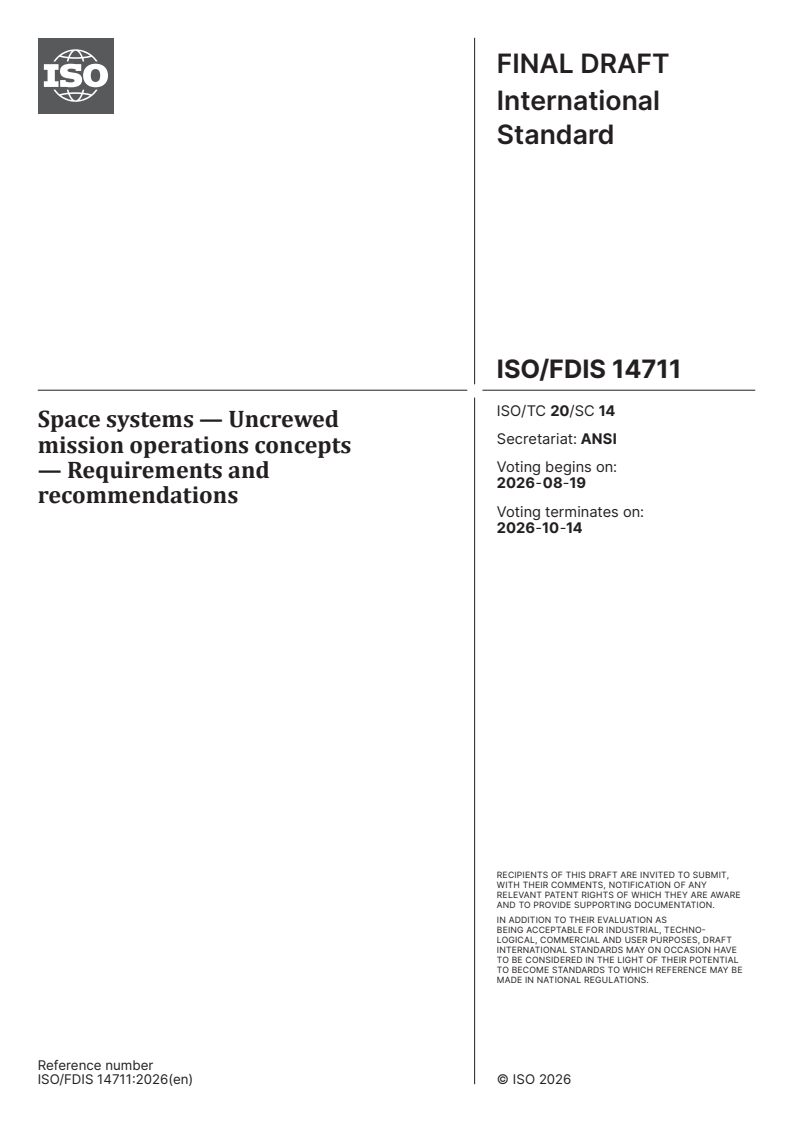
FINAL DRAFT
International
Standard
ISO/TC 20/SC 14
Space systems — Uncrewed
Secretariat: ANSI
mission operations concepts
Voting begins on:
— Requirements and
2026-08-19
recommendations
Voting terminates on:
2026-10-14
RECIPIENTS OF THIS DRAFT ARE INVITED TO SUBMIT,
WITH THEIR COMMENTS, NOTIFICATION OF ANY
RELEVANT PATENT RIGHTS OF WHICH THEY ARE AWARE
AND TO PROVIDE SUPPOR TING DOCUMENTATION.
IN ADDITION TO THEIR EVALUATION AS
BEING ACCEPTABLE FOR INDUSTRIAL, TECHNO
LOGICAL, COMMERCIAL AND USER PURPOSES, DRAFT
INTERNATIONAL STANDARDS MAY ON OCCASION HAVE
TO BE CONSIDERED IN THE LIGHT OF THEIR POTENTIAL
TO BECOME STAN DARDS TO WHICH REFERENCE MAY BE
MADE IN NATIONAL REGULATIONS.
Reference number
FINAL DRAFT
International
Standard
ISO/TC 20/SC 14
Space systems — Uncrewed
Secretariat: ANSI
mission operations concepts
Voting begins on:
— Requirements and
recommendations
Voting terminates on:
RECIPIENTS OF THIS DRAFT ARE INVITED TO SUBMIT,
WITH THEIR COMMENTS, NOTIFICATION OF ANY
RELEVANT PATENT RIGHTS OF WHICH THEY ARE AWARE
AND TO PROVIDE SUPPOR TING DOCUMENTATION.
© ISO 2026
IN ADDITION TO THEIR EVALUATION AS
All rights reserved. Unless otherwise specified, or required in the context of its implementation, no part of this publication may
BEING ACCEPTABLE FOR INDUSTRIAL, TECHNO
LOGICAL, COMMERCIAL AND USER PURPOSES, DRAFT
be reproduced or utilized otherwise in any form or by any means, electronic or mechanical, including photocopying, or posting on
INTERNATIONAL STANDARDS MAY ON OCCASION HAVE
the internet or an intranet, without prior written permission. Permission can be requested from either ISO at the address below
TO BE CONSIDERED IN THE LIGHT OF THEIR POTENTIAL
or ISO’s member body in the country of the requester.
TO BECOME STAN DARDS TO WHICH REFERENCE MAY BE
MADE IN NATIONAL REGULATIONS.
ISO copyright office
CP 401 • Ch. de Blandonnet 8
CH-1214 Vernier, Geneva
Phone: +41 22 749 01 11
Email: copyright@iso.org
Website: www.iso.org
Published in Switzerland Reference number
ii
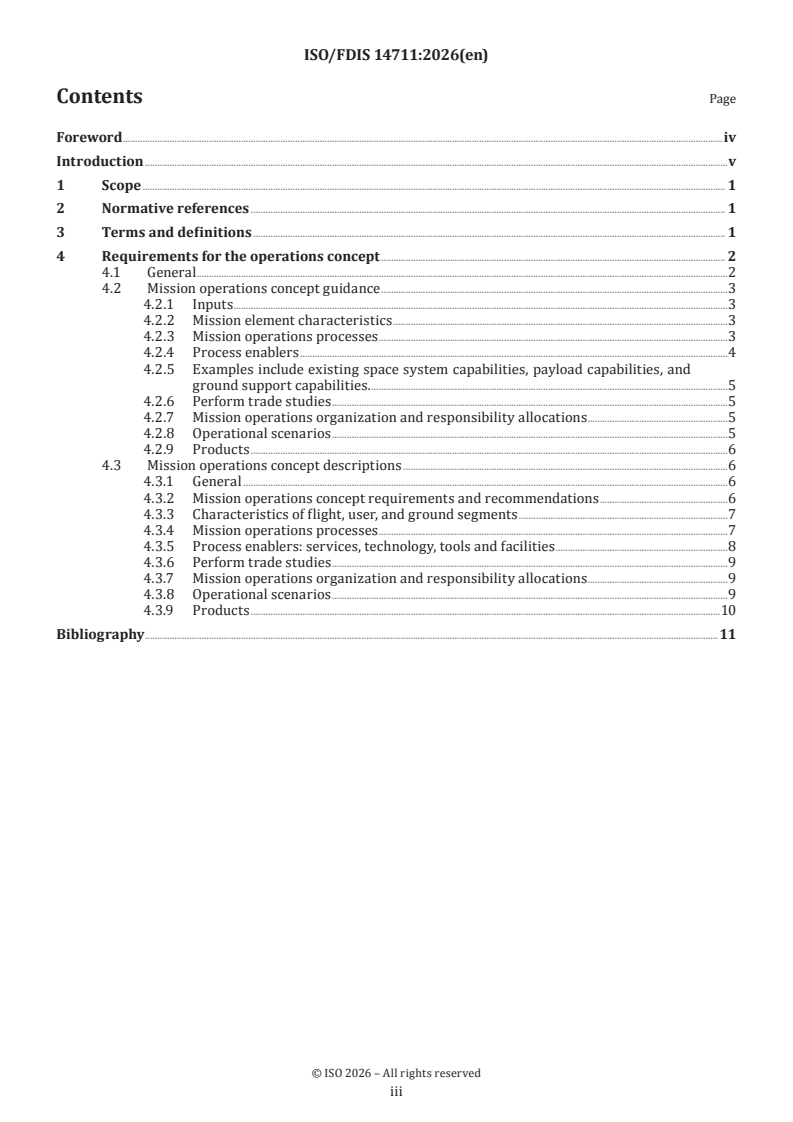
Contents Page
Foreword .iv
Introduction .v
1 Scope . 1
2 Normative references . 1
3 Terms and definitions . 1
4 Requirements for the operations concept . 2
4.1 General .2
4.2 Mission operations concept guidance .3
4.2.1 Inputs .3
4.2.2 Mission element characteristics .3
4.2.3 Mission operations processes .3
4.2.4 Process enablers .4
4.2.5 Examples include existing space system capabilities, payload capabilities, and
ground support capabilities. .5
4.2.6 Perform trade studies .5
4.2.7 Mission operations organization and responsibility allocations .5
4.2.8 Operational scenarios .5
4.2.9 Products .6
4.3 Mission operations concept descriptions .6
4.3.1 General .6
4.3.2 Mission operations concept requirements and recommendations .6
4.3.3 Characteristics of flight, user, and ground segments .7
4.3.4 Mission operations processes .7
4.3.5 Process enablers: services, technology, tools and facilities .8
4.3.6 Perform trade studies .9
4.3.7 Mission operations organization and responsibility allocations .9
4.3.8 Operational scenarios .9
4.3.9 Products .10
Bibliography .11
iii
Foreword
ISO (the International Organization for Standardization) is a worldwide federation of national standards
bodies (ISO member bodies). The work of preparing International Standards is normally carried out through
ISO technical committees. Each member body interested in a subject for which a technical committee
has been established has the right to be represented on that committee. International organizations,
governmental and non-governmental, in liaison with ISO, also take part in the work. ISO collaborates closely
with the International Electrotechnical Commission (IEC) on all matters of electrotechnical standardization.
The procedures used to develop this document and those intended for its further maintenance are described
in the ISO/IEC Directives, Part 1. In particular, the different approval criteria needed for the different types
of ISO document should be noted. This document was drafted in accordance with the editorial rules of the
ISO/IEC Directives, Part 2 (see www.iso.org/directives).
ISO draws attention to the possibility that the implementation of this document may involve the use of (a)
patent(s). ISO takes no position concerning the evidence, validity or applicability of any claimed patent
rights in respect thereof. As of the date of publication of this document, ISO had not received notice of (a)
patent(s) which may be required to implement this document. However, implementers are cautioned that
this may not represent the latest information, which may be obtained from the patent database available at
www.iso.org/patents. ISO shall not be held responsible for identifying any or all such patent rights.
Any trade name used in this document is information given for the convenience of users and does not
constitute an endorsement.
For an explanation of the voluntary nature of standards, the meaning of ISO specific terms and expressions
related to conformity assessment, as well as information about ISO's adherence to the World Trade
Organization (WTO) principles in the Technical Barriers to Trade (TBT), see www.iso.org/iso/foreword.html.
This document was prepared by Technical Committee ISO/TC 20, Aircraft and space vehicles, Subcommittee
SC 14, Space systems and operations.
This second edition cancels and replaces the first edition (ISO 14711:2003), which has been technically
revised.
The main change is as follows:
— revision of Clause 3.
Any feedback or questions on this document should be directed to the user’s national standards body. A
complete listing of these bodies can be found at www.iso.org/members.html.
iv
Introduction
This document defines the required steps to develop a comprehensive space system mission operations
concept for the development and operations after the boost phase and orbital insertion (i.e., post-separation)
of a space mission is completed. Effective concept development relies on a development process that runs
concurrently with the mission and space element development efforts, balancing performance, cost, and risk
issues.
Standard products enable industry to develop commercial off-the-shelf tools for developing a space systems
mission operations concept. While this document is specifically tailored for uncrewed space missions, it can
additionally be of partial use for human flight mission operations concepts. Users of this document include
project managers, operations personnel, space element engineers, and operations facility personnel who are
responsible for developing and integrating the mission operations system. This document lists items to be
considered and defines the contents of a mission operations concept for space systems. This document is
applicable for the flow of data between the integration site, the launch pad, the operations centre, and users,
but does not include the items needed for a launch operations concept.
A space systems mission operations concept is prepared in parallel with the mission concept and space
element design and contains increasing levels of detail as the mission matures. During the early study
phases, the operations concept is a high-level overview and contains many assumptions. As the mission
operations concept evolves and advances to the approval stage, the content becomes more detailed with
fewer documented assumptions. The space systems mission operations concept does not detail a mission’s
development or operational costs but is the basis of cost estimation. Developing a space system mission
operations concept early in the study phase helps to minimize life-cycle costs, make acceptable risk
trades, and to determine the effectiveness of using existing system capabilities. The mission operations
documentation and development costs are also reduced as all the documents are referenced to a specific
operations concept rather than a set of high-level project documents. The earlier the space systems mission
operations concept is developed, the more leverage there is for influencing the operability of the entire
mission system, including the space element. This document establishes early in the project’s development
cycle a conceptual view of the mission data system which allows for:
a) early understanding of data and command transfer between sensors and end users;
b) testing operational capabilities;
c) training personnel as the mission operation system matures.
The development of the space system mission operations concept is most beneficial when done in parallel
with the space element design, thus creating a tight coupling between the two efforts performing trade
studies in the areas of cost, performance and risks.
v
FINAL DRAFT International Standard ISO/FDIS 14711:2026(en)
Space systems — Uncrewed mission operations concepts —
Requirements and recommendations
1 Scope
This document provides requirements and recommendations for areas to be addressed and defines the
products that are to be generated to develop a space systems mission operations concept.
This document is also applicable to the mission operations support to the pre-launch and launch phases of
the mission using the mission operations systems.
2 Normative references
There are no normative references in this document.
3 Terms and definitions
For the purposes of this document, the following terms and definitions apply.
ISO and IEC maintain terminological databases for use in standardization at the following addresses:
— IEC Electropedia: available at http:// www .electropedia .org/
— ISO Online browsing platform: available at http:// www .iso .org/ obp
3.1
mission data system
hardware and software located both on the space platform and in the ground support systems that provide
the transport mechanisms for mission data after the boost phase and orbital insertion (i.e., post-separation)
of a space mission is completed, together with the information system that properly configures and controls
this hardware and software
3.2
mission operations concept
description, in operator and user terms, of the operational attributes of a mission’s flight and ground
elements
3.3
mission operations system
MOS, noun
system consisting of a mission data system and the organizational personnel who operate it
3.4
operations organization
people and procedures that control the space segment, including the payload, and processing of its mission
data and information
Note 1 to entry: The flight element itself is not a part of “operations organization".
3.5
process
set of interrelated or interacting activities that use inputs to deliver an intended result
Note 1 to entry: Whether the “intended result” of a process is called output, product, or service depends on the context
of the reference.
Note 2 to entry: Inputs to a process are generally the outputs of other processes and outputs of a process are generally
the inputs to other processes.
Note 3 to entry: Two or more interrelated and interacting processes in series can also be referred to as a process.
Note 4 to entry: Processes in an organization are generally planned and carried out under controlled conditions to add
value.
Note 5 to entry: A process where the conformity of the resulting output cannot be readily or economically validated is
frequently referred to as a “special process”.
Note 6 to entry: This constitutes one of the common terms and core definitions for ISO management system standards
given in Annex SL of the Consolidated ISO Supplement to the ISO/IEC Directives, Part 1. The original definition has
been modified to prevent circularity between process and output, and Notes 1 to 5 to entry have been added.
[1]
[SOURCE: EN ISO 9000:2015 , 3.4.1]
3.6
product
output of an organization that can be produced without any transaction taking place between the
organization and the customer
Note 1 to entry: Production of a product is achieved without any transaction necessarily taking place between provider
and customer, but can often involve this service element upon its delivery to the customer.
Note 2 to entry: The dominant element of a product is that it is generally tangible.
Note 3 to entry: Hardware is tangible and its amount is a countable characteristic (e.g. tyres). Processed materials are
tangible and their amount is a continuous characteristic (e.g. fuel and soft drinks). Hardware and processed materials
are often referred to as goods. Software consists of information regardless of delivery medium (e.g. computer
programme, mobile phone app, instruction manual, dictionary content, musical composition copyright, driver’s
license).
[1]
[SOURCE: EN ISO 9000:2015 , 3.7.6]
3.7
space element
product (3.6) or a set of products intended for operation in space
4 Requirements for the operations concept
4.1 General
The space systems mission operations concept is a result of a cooperative effort of assorted project systems:
— flight element,
— ground support equipment system,
— mission operations system.
Development of these three space systems is closely coupled and is implemented by the project management
team and mission designers in parallel with the development of the other project systems to produce a
consistent and integrated mission operations concept. The space system's mission operations concept
specifies design details and emphasises the way a mission is operated. It describes the operational
characteristics of the space elements being controlled. The space system's mission operations concept
consists of mission documentation, constraints, and characteristics. It also contains the specific required
mission operations products, including operational scenarios, timelines, processes performed by personnel,
hardware and software processes, derived requirements, contingency scenarios, and conflict resolution
processes. It also may contain a technology plan. End-user data products are specified and, depending on the
mission, may be in various forms such as analogue, digital, and physical (e.g. sample return) data products.
Another end user data product received from the mission operations system should be a lessons-learned
report to help future missions.
A list of elements to be considered, defined, and generated when developing a space system mission
operations concept is given in 4.2. Each item of the list is described further in 4.3. This guidance specifies
the broadest scope of possible mission operations, tasks, issues, and products to facilitate mission managers
and engineers in assessing the full scope of their mission operations concept.
4.2 Mission operations concept guidance
4.2.1 Inputs
Identify and confirm assumptions for the following inputs to the concept:
a) mission scope, objectives, and requirements on operations;
b) mission description and science characteristics;
c) mission environments;
d) end-user data products;
e) mission philosophies, strategies, and tactics;
f) programmatic and operational constraints;
g) data relay capabilities (space-to-space, space-to-ground);
h) ground system capabilities and characteristics;
i) customer and users identified;
j) relationships with other missions and programs;
k) external dependencies with other agencies or companies.
4.2.2 Mission element characteristics
Describe the following mission element characteristics:
a) space systems capabilities and characteristics;
b) payload capabilities and characteristics;
c) ground support equipment system.
4.2.3 Mission operations processes
Identify and characterize the following mission operations processes:
a) establishment of a list of top-level operations processes that shall be performed;
b) descriptions of uplink processes:
1) user request planning;
2) space system resources to be managed by the ground system;
3) space system constraints to be enforced by the ground system;
4) space system maintenance activities to be managed by mission operation system;
5) procedure for processing user requests;
6) process for scheduling data acquisition services;
7) integration of activity requests;
8) method for validating commands (if necessary) prior to uplink;
9) method for converting integrated requests to executable commands;
10) method for transmitting command files to the space system and payload;
11) verification process for command execution or command storage;
12) method for receipt of command files by the spacecraft and p
...
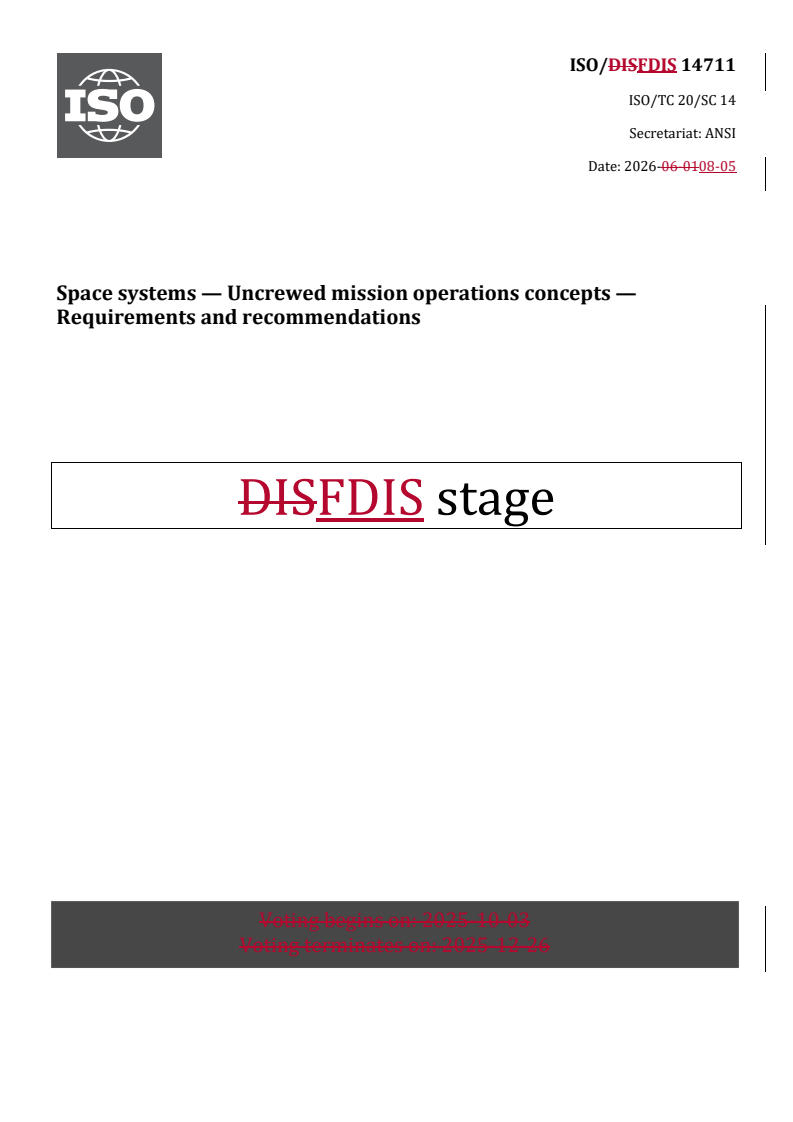
ISO/DISFDIS 14711
ISO/TC 20/SC 14
Secretariat: ANSI
Date: 2026-06-0108-05
Space systems — Uncrewed mission operations concepts —
Requirements and recommendations
DISFDIS stage
Voting begins on: 2025-10-03
Voting terminates on: 2025-12-26
ISO/DISFDIS 14711:2026(en)
All rights reserved. Unless otherwise specified, or required in the context of its implementation, no part of this publication
may be reproduced or utilized otherwise in any form or by any means, electronic or mechanical, including photocopying,
or posting on the internet or an intranet, without prior written permission. Permission can be requested from either ISO
at the address below or ISO’s member body in the country of the requester.
ISO copyright office
CP 401 • Ch. de Blandonnet 8
CH-1214 Vernier, Geneva
Phone: + 41 22 749 01 11
E-mail: copyright@iso.org
Website: www.iso.org
Published in Switzerland
ii
ISO/DISFDIS 14711:2026(en)
Contents
Foreword . iv
Introduction . v
1 Scope . 1
2 Normative references . 1
3 Terms and definitions . 1
4 Requirements for the operations concept . 2
Bibliography . 12
iii
ISO/DISFDIS 14711:2026(en)
Foreword
ISO (the International Organization for Standardization) is a worldwide federation of national standards
bodies (ISO member bodies). The work of preparing International Standards is normally carried out through
ISO technical committees. Each member body interested in a subject for which a technical committee has been
established has the right to be represented on that committee. International organizations, governmental and
non-governmental, in liaison with ISO, also take part in the work. ISO collaborates closely with the
International Electrotechnical Commission (IEC) on all matters of electrotechnical standardization.
The procedures used to develop this document and those intended for its further maintenance are described
in the ISO/IEC Directives, Part 1. In particular, the different approval criteria needed for the different types of
ISO document should be noted. This document was drafted in accordance with the editorial rules of the
ISO/IEC Directives, Part 2 (see www.iso.org/directives).
ISO draws attention to the possibility that the implementation of this document may involve the use of (a)
patent(s). ISO takes no position concerning the evidence, validity or applicability of any claimed patent rights
in respect thereof. As of the date of publication of this document, ISO had not received notice of (a) patent(s)
which may be required to implement this document. However, implementers are cautioned that this may not
represent the latest information, which may be obtained from the patent database available at
www.iso.org/patents. ISO shall not be held responsible for identifying any or all such patent rights.
Any trade name used in this document is information given for the convenience of users and does not
constitute an endorsement.
For an explanation of the voluntary nature of standards, the meaning of ISO specific terms and expressions
related to conformity assessment, as well as information about ISO's adherence to the World Trade
Organization (WTO) principles in the Technical Barriers to Trade (TBT), see www.iso.org/iso/foreword.html.
This document was prepared by Technical Committee ISO/TC 20, Aircraft and space vehicles, Subcommittee
SC 14, Space systems and operations.
This second edition cancels and replaces the first edition (ISO 14711:2003), which has been technically
revised.
The main change is as follows:
— revision of Clause 3.
Any feedback or questions on this document should be directed to the user’s national standards body. A
complete listing of these bodies can be found at www.iso.org/members.html.
iv
ISO/DISFDIS 14711:2026(en)
Introduction
This document defines the required steps to develop a comprehensive space system mission operations
concept for the development and operations after the boost phase and orbital insertion (i.e., post-separation)
of a space mission is completed. Effective concept development relies on a development process that runs
concurrently with the mission and space element development efforts, balancing performance, cost, and risk
issues.
Standard products enable industry to develop commercial off-the-shelf tools for developing a space systems
mission operations concept. WhlieWhile this document is specifically tailored for unmanneduncrewed space
missions, it can additionally be of partial use for human flight mission operations concepts. Users of this
document include project managers, operations personnel, space element engineers, and operations facility
personnel who are responsible for developing and integrating the mission operations system. This document
lists items to be considered and defines the contents of a mission operations concept for space systems. This
document is applicable for the flow of data between the integration site, the launch pad, the operations centre,
and users, but does not include the items needed for a launch operations concept.
A space systems mission operations concept is prepared in parallel with the mission concept and space
element design and contains increasing levels of detail as the mission matures. During the early study phases,
the operations concept is a high-level overview and contains many assumptions. As the mission operations
concept evolves and advances to the approval stage, the content becomes more detailed with fewer
documented assumptions. The space systems mission operations concept does not detail a mission’s
development or operational costs but is the basis of cost estimation. Developing a space system mission
operations concept early in the study phase helps to minimize life-cycle costs, make acceptable risk trades,
and to determine the effectiveness of using existing system capabilities. The mission operations
documentation and development costs are also reduced as all the documents are referenced to a specific
operations concept rather than a set of high-level project documents. The earlier the space systems mission
operations concept is developed, the more leverage there is for influencing the operability of the entire
mission system, including the space element. This document establishes early in the project’s development
cycle a conceptual view of the mission data system which allows for:
a) early understanding of data and command transfer between sensors and end users,;
b) testing operational capabilities, and;
c) training personnel as the mission operation system matures.
The development of the space system mission operations concept is most beneficial when done in parallel
with the space element design, thus creating a tight coupling between the two efforts performing trade studies
in the areas of cost, performance and risks.
v
ISO/DISFDIS 14711:2026(en)
Space systems — Uncrewed mission operations concepts —
Requirements and recommendations
1 Scope
This document provides requirements and recommendations for areas to be addressed and defines the
products that are to be generated to develop a space systems mission operations concept by an industry, a
government agency, or by a university. .
This document is also applicable to the mission operations support to the pre-launch and launch phases of the
mission using the mission operations systems.
2 Normative references
There are no normative references in this document.
3 Terms and definitions
For the purposes of this document, the following terms and definitions apply.
ISO and IEC maintain terminological databases for use in standardization at the following addresses:
— IEC Electropedia: available at http://www.electropedia.org/
— ISO Online browsing platform: available at http://www.iso.org/obp
3.1
mission data system
hardware and software located both on the space platform and in the ground support systems that provide
the transport mechanisms for mission data after the boost phase and orbital insertion (i.e., post-separation)
of a space mission is completed, together with the information system that properly configures and controls
this hardware and software
3.2
mission operations concept
description, in operator and user terms, of the operational attributes of a mission’s flight and ground elements
3.3
mission operations system
(MOS), noun
system consisting of a mission data system and the organizational personnel who operate it
3.4
operations organization
people and procedures that control the space segment, including the payload, and processing of its mission
data and information
Note 1 to entry: The flight element itself is not a part of “operations organization."".
3.5
process
set of interrelated or interacting activities that use inputs to deliver an intended result
ISO/DISFDIS 14711:2026(en)
Note 1 to entry: Whether the “intended result” of a process is called output, product, or service depends on the context
of the reference.
Note 2 to entry: Inputs to a process are generally the outputs of other processes and outputs of a process are generally
the inputs to other processes.
Note 3 to entry: Two or more interrelated and interacting processes in series can also be referred to as a process.
Note 4 to entry: Processes in an organization are generally planned and carried out under controlled conditions to add
value.
Note 5 to entry: A process where the conformity of the resulting output cannot be readily or economically validated is
frequently referred to as a “special process”.
Note 6 to entry: This constitutes one of the common terms and core definitions for ISO management system standards
given in Annex SL of the Consolidated ISO Supplement to the ISO/IEC Directives, Part 1. The original definition has been
modified to prevent circularity between process and output, and Notes 1 to 5 to entry have been added.
[1]
[SOURCE: EN ISO 9000:2015 [SOURCE: ISO 9000:2015,, 3.4.1]]]
3.6
product
output of an organization that can be produced without any transaction taking place between the organization
and the customer
Note 1 to entry: Production of a product is achieved without any transaction necessarily taking place between provider
and customer, but can often involve this service element upon its delivery to the customer.
Note 2 to entry: The dominant element of a product is that it is generally tangible.
Note 3 to entry: Hardware is tangible and its amount is a countable characteristic (e.g. tyres). Processed materials are
tangible and their amount is a continuous characteristic (e.g. fuel and soft drinks). Hardware and processed materials are
often referred to as goods. Software consists of information regardless of delivery medium (e.g. computer programme,
mobile phone app, instruction manual, dictionary content, musical composition copyright, driver’s license).
[1]
[SOURCE: EN ISO 9000:2015 [SOURCE: ISO 9000:2015,, 3.7.6]]]
3.7
space element
product (3.6) or a set of products intended for operation in space
4 Requirements for the operations concept
4.1 General
The space systems mission operations concept is a result of a cooperative effort of assorted project systems:
— flight element,
— ground support equipment system,
— mission operations system.
Development of these three space systems is closely coupled and is implemented by the project management
team and mission designers in parallel with the development of the other project systems to produce a
consistent and integrated mission operations concept. The space system's mission operations concept
specifies design details and emphasises the way a mission is operated. It describes the operational
ISO/DISFDIS 14711:2026(en)
characteristics of the space elements being controlled. The space system's mission operations concept consists
of mission documentation, constraints, and characteristics. It also contains the specific required mission
operations products, including operational scenarios, timelines, processes performed by personnel, hardware
and software processes, derived requirements, contingency scenarios, and conflict resolution processes. It
also may contain a technology plan. End-user data products are specified and, depending on the mission, may
be in various forms such as analogue, digital, and physical (e.g. sample return) data products. Another end
user data product received from the mission operations system should be a lessons-learned report to help
future missions.
A list of elements to be considered, defined, and generated when developing a space system mission
operations concept is given in 4.24.2. Each item of the list is described further in 4.34.3. This guidance
specifies the broadest scope of possible mission operations, tasks, issues, and products to facilitate mission
managers and engineers in assessing the full scope of their mission operations concept.
4.2 Mission operations concept guidance
4.2.1 Inputs
Identify and confirm assumptions for the following inputs to the concept:
a) mission scope, objectives, and requirements on operations;
b) mission description and science characteristics;
c) mission environments;
d) end-user data products;
e) mission philosophies, strategies, and tactics;
f) programmatic and operational constraints;
g) data relay capabilities (space-to-space, space-to-ground);
h) ground system capabilities and characteristics;
i) customer and users identified;
j) relationships with other missions and programs;
k) external dependencies with other agencies or companies.
4.2.2 Mission element characteristics
Describe the following mission element characteristics:
a) space systems capabilities and characteristics;
b) payload capabilities and characteristics;
c) Groundground support equipment system.
4.2.3 Mission operations processes
Identify and characterize the following mission operations processes:
ISO/DISFDIS 14711:2026(en)
a) establishment of a list of top-level operations processes that shall be performed;
b) descriptions of uplink processes:
1) user request planning;
2) space system resources to be managed by the ground system;
3) space system constraints to be enforced by the ground system;
4) space system maintenance activities to be managed by mission operation system;
5) procedure for processing user requests;
6) process for scheduling data acquisition services;
7) integration of activity requests;
8) method for validating commands (if necessary) prior to uplink;
9) method for converting integrated requests to executable commands;
10) method for transmitting command files to the space system and payload;
11) verification process for command execution or command storage;
12) method for receipt of command files by the spacecraft and payload and for storage or execution of
commands;
13) on-board execution and processing of commands or rules;
14) method for archiving command files;
15) flight software maintenance process;
c) descriptions of downlink processes:
1) payload-to-user processes and interfaces;
2) transmission of data from:
i) payload instruments and space element subsystems to onboard storage;
ii) onboard storage area to the space system transmitter;
iii) space system transmitter to the storage in the ground database (Level 0 processing);
3) space system transmitter to the storage in the ground database (Level 0 processing);
4) processing steps required from the receipt of the space system and payload data in the project
database to delivery to the end user;
5) method of data encapsulation and delivery to the user;
6) method of analysing data with regard to that analysis required to conduct the mission;
ISO/DISFDIS 14711:2026(en)
7) method to archive data;
8) effect of processed data on the mission plan or planned sequencing;
9) processes and concepts involved in anomaly detection (space and ground) and responses;
10) ground software maintenance process;
d) anomaly detection and response process;
e) end-to-end information capabilities and characteristics with data flow diagrams.
4.2.4 Process enablers
Identify ways to accomplish the process:
a) specify existing capabilities and services to be utiliutilized and identify who provides these;
EXAMPLE Examples of capabilities include existing space system capabilities, payload capabilities, and ground
support capabilities.
zed and identify who provides these;
b) specify new technology development needed and plans for its verification;
c) summarize the facilities, ground support equipment, and tools needed to make the mission operations
successful.
NOTE Examples of capabilities include existing space system capabilities, payload capabilities, and ground support
capabilities.
4.2.5 Examples include existing space system capabilities, payload capabilities, and ground
support capabilities.
4.2.6 Perform trade studies
Perform trade studies where operating methods and operations issues have impact on cost, quality, reliability,
or mission risk for the processes that maycan be accomplished in more than one way.
4.2.7 Mission operations organization and responsibility allocations
Describe the mission operations system organizational structure and allocate responsibilities to its
individuals and teams:
a) specify operations organization;
b) define the roles and responsibilities of the operations teams and personnel;
c) describe training responsibilities and approac
...