

ISO/IEC 19788-1:2024
(Main)Information technology for learning, education and training — Metadata for learning resources — Part 1: Framework
General Information
- Abstract
This document provides a framework that applies to all resources and specifies how to describe resources. It includes rules governing the way in which descriptions are made. This document provides principles, rules and structures for specifying the description of any type of resource; it identifies and establishes attributes for specifying properties, resources classes, vocabularies and application profiles and the rules governing their use. The key principles set out in this document are framed in a user-centric context and aim to meet the requirements of multilingual and cultural adaptability from a global perspective. This document can be used for the specification of metadata describing any type of resource (not only learning resources). This document is information-technology-neutral and defines a set of common approaches. This document specifies generic properties, generic resource classes and predefined rule sets for content value rules. These generic elements are proposed in such a way that they can be widely reused, thereby promoting interoperability. This document is applicable to the development of: — application profiles based on the ISO/IEC 19788 series but not part of it or any other document based on it, — standards consisting of the description of resources (in a broad sense), whether they belong to the domain of education or to any other domain.
- Status
- Published
- Publication Date
- 07-Nov-2024
- Current Stage
- 6060 - International Standard published
- Start Date
- 08-Nov-2024
- Due Date
- 25-Nov-2024
- Completion Date
- 08-Nov-2024
Buy Documents
ISO/IEC 19788-1:2024 - Information technology for learning, education and training — Metadata for learning resources — Part 1: Framework Released:11/8/2024
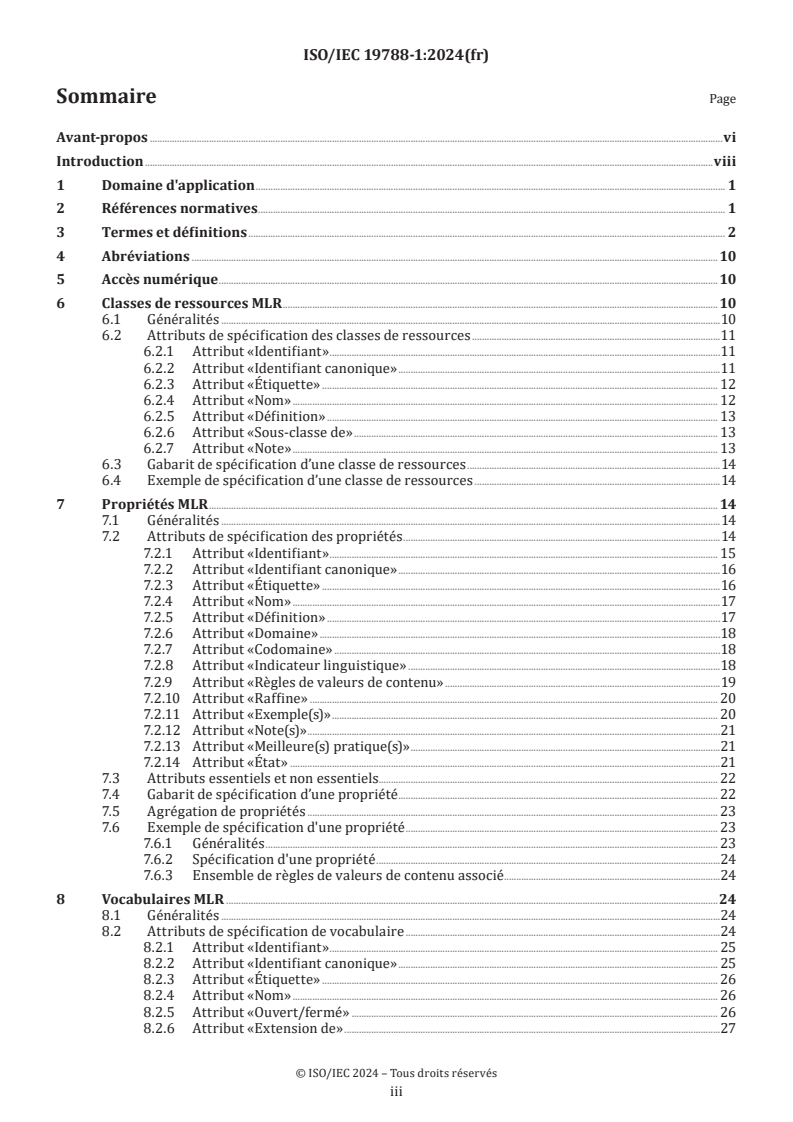
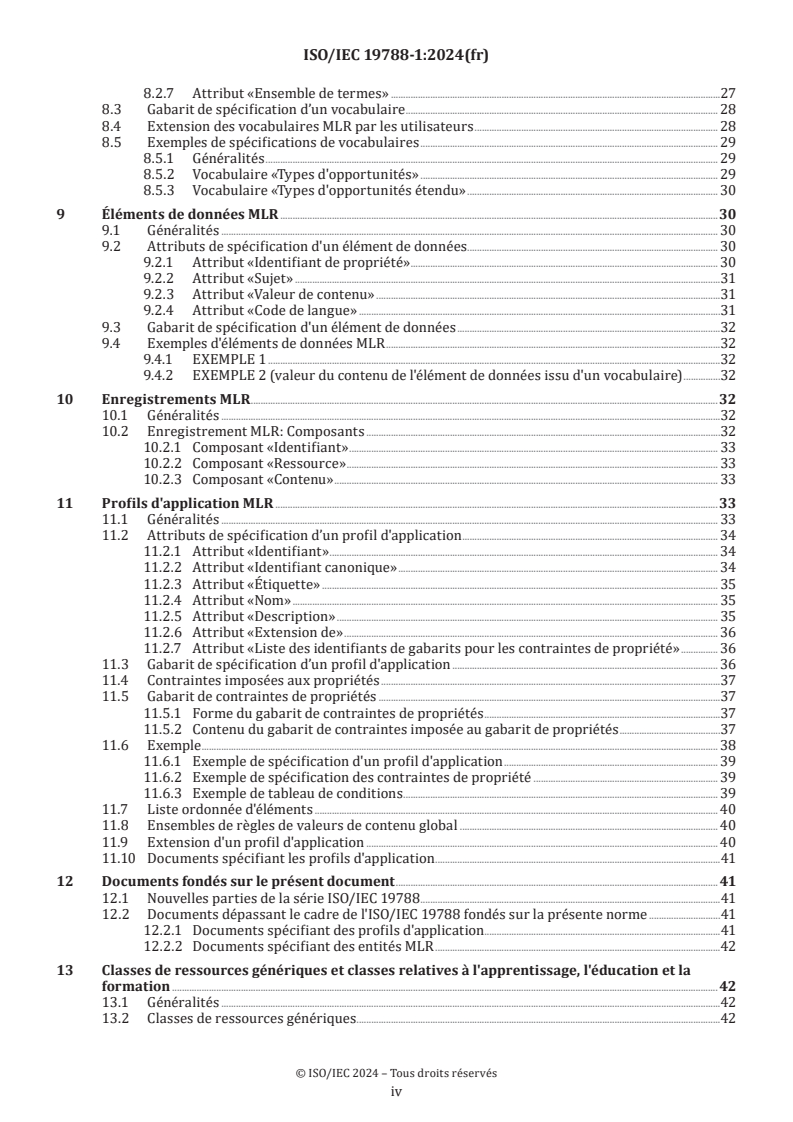
ISO/IEC 19788-1:2024 - Technologies de l'information pour l'apprentissage, l'éducation et la formation — Métadonnées pour ressources d'apprentissage — Partie 1: Cadre de référence Released:11/8/2024
Overview
ISO/IEC 19788-1:2024 - Information technology for learning, education and training - Metadata for learning resources - Part 1: Framework defines a framework for describing resources. Often referred to as the MLR (Metadata for Learning Resources) framework, this second-edition standard is IT‑neutral and prescribes principles, structures and rules for creating interoperable metadata. Although optimized for learning, education and training, the framework is applicable to describing any type of resource and supports multilingual and cultural adaptability from a global perspective.
Keywords: ISO/IEC 19788-1:2024, metadata for learning resources, MLR, educational metadata, interoperability
Key Topics and Technical Requirements
- Resource classes: standardized classification and templates for defining resource types (attributes such as Identifier, Label, Name, Definition, Subclass of, Note).
- Properties: formal property specifications including Identifier, Canonical identifier, Domain, Codomain, Linguistic indicator, Content value rules, Refines, Examples, Best practices and Status.
- Vocabularies: controlled vocabularies with attributes (Identifier, Label, Name, Open/closed, Extension of, Set of terms) and guidance for user extensions.
- Data elements and records: definition of data elements (property identifier, subject, content value, language code) and MLR record structure (Identifier, Resource, Content).
- Application profiles: mechanisms and templates for creating application profiles based on the MLR framework, including property constraint templates and condition tables.
- Content value rules and templates: predefined rule sets and templates to ensure consistent content values and promote reuse.
- Principles: user-centric approach emphasizing multilingual support, cultural adaptability and reuse to promote interoperability across systems.
Keywords: resource classes, properties, vocabularies, data elements, application profiles, content value rules
Practical Applications and Who Uses This Standard
ISO/IEC 19788-1:2024 is used to design, implement and govern metadata that improves discovery, reuse and exchange of resources. Typical applications:
- Learning management systems (LMS) and digital repositories - consistent metadata for search and aggregation.
- Educational publishers and content creators - standardized descriptions to support distribution and discovery.
- Libraries, archives and museums - interoperable metadata for resource sharing across cultural and language boundaries.
- EdTech vendors and platform developers - implementable templates and vocabularies to ensure system compatibility.
- Metadata architects, librarians, instructional designers and standards developers - use the framework to build application profiles and governance rules.
Keywords: LMS metadata, educational repositories, metadata architects, multilingual metadata
Related Standards (if applicable)
- ISO/IEC 19788 series - Part 1 provides the framework on which additional parts and application profiles are built.
- The framework is intentionally compatible with other metadata initiatives to promote broad interoperability.
Keywords: ISO metadata standards, MLR framework, metadata interoperability
Relations
- Effective Date
- 06-Jun-2022
- Effective Date
- 06-Jun-2022
Buy Documents
ISO/IEC 19788-1:2024 - Information technology for learning, education and training — Metadata for learning resources — Part 1: Framework Released:11/8/2024
ISO/IEC 19788-1:2024 - Technologies de l'information pour l'apprentissage, l'éducation et la formation — Métadonnées pour ressources d'apprentissage — Partie 1: Cadre de référence Released:11/8/2024
Get Certified
Connect with accredited certification bodies for this standard

BSI Group
BSI (British Standards Institution) is the business standards company that helps organizations make excellence a habit.

Bureau Veritas
Bureau Veritas is a world leader in laboratory testing, inspection and certification services.

DNV
DNV is an independent assurance and risk management provider.
Sponsored listings
Frequently Asked Questions
ISO/IEC 19788-1:2024 is a standard published by the International Organization for Standardization (ISO). Its full title is "Information technology for learning, education and training — Metadata for learning resources — Part 1: Framework". This standard covers: This document provides a framework that applies to all resources and specifies how to describe resources. It includes rules governing the way in which descriptions are made. This document provides principles, rules and structures for specifying the description of any type of resource; it identifies and establishes attributes for specifying properties, resources classes, vocabularies and application profiles and the rules governing their use. The key principles set out in this document are framed in a user-centric context and aim to meet the requirements of multilingual and cultural adaptability from a global perspective. This document can be used for the specification of metadata describing any type of resource (not only learning resources). This document is information-technology-neutral and defines a set of common approaches. This document specifies generic properties, generic resource classes and predefined rule sets for content value rules. These generic elements are proposed in such a way that they can be widely reused, thereby promoting interoperability. This document is applicable to the development of: — application profiles based on the ISO/IEC 19788 series but not part of it or any other document based on it, — standards consisting of the description of resources (in a broad sense), whether they belong to the domain of education or to any other domain.
This document provides a framework that applies to all resources and specifies how to describe resources. It includes rules governing the way in which descriptions are made. This document provides principles, rules and structures for specifying the description of any type of resource; it identifies and establishes attributes for specifying properties, resources classes, vocabularies and application profiles and the rules governing their use. The key principles set out in this document are framed in a user-centric context and aim to meet the requirements of multilingual and cultural adaptability from a global perspective. This document can be used for the specification of metadata describing any type of resource (not only learning resources). This document is information-technology-neutral and defines a set of common approaches. This document specifies generic properties, generic resource classes and predefined rule sets for content value rules. These generic elements are proposed in such a way that they can be widely reused, thereby promoting interoperability. This document is applicable to the development of: — application profiles based on the ISO/IEC 19788 series but not part of it or any other document based on it, — standards consisting of the description of resources (in a broad sense), whether they belong to the domain of education or to any other domain.
ISO/IEC 19788-1:2024 is classified under the following ICS (International Classification for Standards) categories: 03.100.30 - Management of human resources; 35.240.90 - IT applications in education. The ICS classification helps identify the subject area and facilitates finding related standards.
ISO/IEC 19788-1:2024 has the following relationships with other standards: It is inter standard links to ISO/IEC 19788-1:2011/Amd 1:2014, ISO/IEC 19788-1:2011. Understanding these relationships helps ensure you are using the most current and applicable version of the standard.
ISO/IEC 19788-1:2024 is available in PDF format for immediate download after purchase. The document can be added to your cart and obtained through the secure checkout process. Digital delivery ensures instant access to the complete standard document.
Standards Content (Sample)
International
Standard
ISO/IEC 19788-1
Second edition
Information technology for
2024-11
learning, education and training —
Metadata for learning resources —
Part 1:
Framework
Technologies de l'information pour l'apprentissage, l'éducation et
la formation — Métadonnées pour ressources d'apprentissage —
Partie 1: Cadre de référence
Reference number
© ISO/IEC 2024
All rights reserved. Unless otherwise specified, or required in the context of its implementation, no part of this publication may
be reproduced or utilized otherwise in any form or by any means, electronic or mechanical, including photocopying, or posting on
the internet or an intranet, without prior written permission. Permission can be requested from either ISO at the address below
or ISO’s member body in the country of the requester.
ISO copyright office
CP 401 • Ch. de Blandonnet 8
CH-1214 Vernier, Geneva
Phone: +41 22 749 01 11
Email: copyright@iso.org
Website: www.iso.org
Published in Switzerland
© ISO/IEC 2024 – All rights reserved
ii
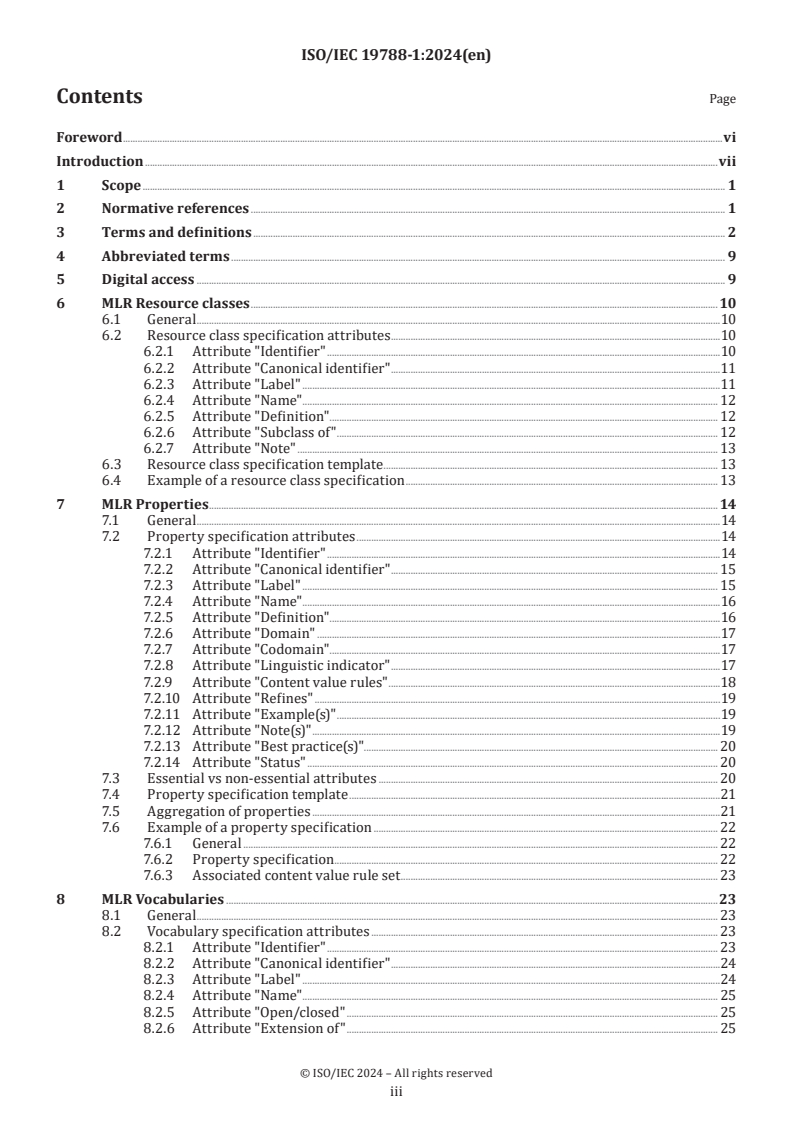
Contents Page
Foreword .vi
Introduction .vii
1 Scope . 1
2 Normative references . 1
3 Terms and definitions . 2
4 Abbreviated terms . 9
5 Digital access . 9
6 MLR Resource classes . 10
6.1 General .10
6.2 Resource class specification attributes .10
6.2.1 Attribute "Identifier" .10
6.2.2 Attribute "Canonical identifier" .11
6.2.3 Attribute "Label" .11
6.2.4 Attribute "Name" . 12
6.2.5 Attribute "Definition" . . . 12
6.2.6 Attribute "Subclass of" . 12
6.2.7 Attribute "Note" . 13
6.3 Resource class specification template . 13
6.4 Example of a resource class specification . 13
7 MLR Properties . 14
7.1 General .14
7.2 Property specification attributes .14
7.2.1 Attribute "Identifier" .14
7.2.2 Attribute "Canonical identifier" . 15
7.2.3 Attribute "Label" . 15
7.2.4 Attribute "Name" .16
7.2.5 Attribute "Definition" . .16
7.2.6 Attribute "Domain" .17
7.2.7 Attribute "Codomain" . .17
7.2.8 Attribute "Linguistic indicator" .17
7.2.9 Attribute "Content value rules" .18
7.2.10 Attribute "Refines" .19
7.2.11 Attribute "Example(s)" .19
7.2.12 Attribute "Note(s)" .19
7.2.13 Attribute "Best practice(s)". 20
7.2.14 Attribute "Status" . 20
7.3 Essential vs non-essential attributes . 20
7.4 Property specification template .21
7.5 Aggregation of properties .21
7.6 Example of a property specification . 22
7.6.1 General . 22
7.6.2 Property specification . 22
7.6.3 Associated content value rule set . 23
8 MLR Vocabularies .23
8.1 General . 23
8.2 Vocabulary specification attributes . 23
8.2.1 Attribute "Identifier" . 23
8.2.2 Attribute "Canonical identifier" .24
8.2.3 Attribute "Label" .24
8.2.4 Attribute "Name" . 25
8.2.5 Attribute "Open/closed" . 25
8.2.6 Attribute "Extension of" . 25
© ISO/IEC 2024 – All rights reserved
iii
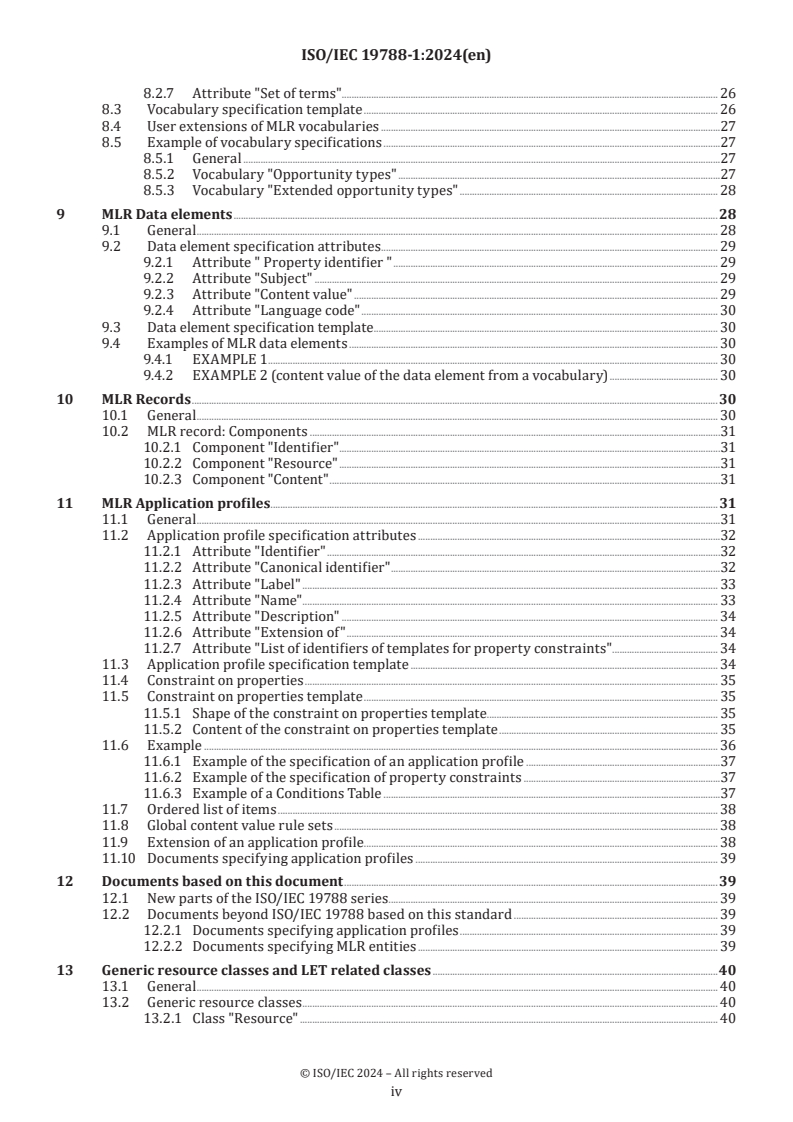
8.2.7 Attribute "Set of terms" . . 26
8.3 Vocabulary specification template . 26
8.4 User extensions of MLR vocabularies .27
8.5 Example of vocabulary specifications .27
8.5.1 General .27
8.5.2 Vocabulary "Opportunity types" .27
8.5.3 Vocabulary "Extended opportunity types" . 28
9 MLR Data elements .28
9.1 General . 28
9.2 Data element specification attributes . 29
9.2.1 Attribute " Property identifier " . 29
9.2.2 Attribute "Subject" . 29
9.2.3 Attribute "Content value" . 29
9.2.4 Attribute "Language code" . 30
9.3 Data element specification template . . 30
9.4 Examples of MLR data elements . 30
9.4.1 EXAMPLE 1 . . . 30
9.4.2 EXAMPLE 2 (content value of the data element from a vocabulary) . 30
10 MLR Records .30
10.1 General . 30
10.2 MLR record: Components .31
10.2.1 Component "Identifier" .31
10.2.2 Component "Resource" .31
10.2.3 Component "Content" .31
11 MLR Application profiles . .31
11.1 General .31
11.2 Application profile specification attributes .32
11.2.1 Attribute "Identifier" .32
11.2.2 Attribute "Canonical identifier" .32
11.2.3 Attribute "Label" . 33
11.2.4 Attribute "Name" . 33
11.2.5 Attribute "Description" . 34
11.2.6 Attribute "Extension of" . 34
11.2.7 Attribute "List of identifiers of templates for property constraints" . 34
11.3 Application profile specification template . 34
11.4 Constraint on properties . 35
11.5 Constraint on properties template . 35
11.5.1 Shape of the constraint on properties template . 35
11.5.2 Content of the constraint on properties template . 35
11.6 Example . 36
11.6.1 Example of the specification of an application profile .37
11.6.2 Example of the specification of property constraints .37
11.6.3 Example of a Conditions Table .37
11.7 Ordered list of items . 38
11.8 Global content value rule sets . 38
11.9 Extension of an application profile . 38
11.10 Documents specifying application profiles . 39
12 Documents based on this document .39
12.1 New parts of the ISO/IEC 19788 series . 39
12.2 Documents beyond ISO/IEC 19788 based on this standard . 39
12.2.1 Documents specifying application profiles . 39
12.2.2 Documents specifying MLR entities . 39
13 Generic resource classes and LET related classes .40
13.1 General . 40
13.2 Generic resource classes . 40
13.2.1 Class "Resource" . 40
© ISO/IEC 2024 – All rights reserved
iv
13.2.2 Class "Information Resource" . 40
13.2.3 Class "Web Resource" .41
13.2.4 Class "Representation" .41
13.3 Other resource classes .42
13.3.1 Class "Person" .42
13.3.2 Class "Learning Resource".42
14 Generic properties .42
14.1 General .42
14.2 Properties whose domain is class "Resource".43
14.2.1 Property "has Description" .43
14.2.2 Property "name" .43
14.3 Properties whose domain is class "Information Resource" . 44
14.3.1 Property "describes" . 44
14.3.2 Property "has representation" .45
14.4 Property whose domain is class "Web Resource" .45
14.4.1 Property "location" .45
14.5 Properties whose domain is class "Representation" . 46
14.5.1 Property "character encoding" . 46
14.5.2 Property "media type" .47
14.5.3 Property "refers to" .47
14.5.4 Property "represents" . 48
15 Generic content value rule sets .48
15.1 General . 48
15.2 MLR String . 49
15.3 BCP 47 . 49
15.4 Boolean . 49
15.5 Date . 49
15.6 Date & Time . 50
15.7 Duration . 50
15.8 HTTP IRI . 50
15.9 IRI . 50
15.10 MEDIA TYPE .51
15.11 Time interval .51
15.12 JSON string. .52
Annex A (normative) Language equivalents for names and labels.53
Annex B (normative) MLR identifiers .54
Annex C (normative) MLR canonical identifiers and additional constraints on MLR
specifications .58
Annex D (normative) Rules for all parts of ISO/IEC 19788 .65
Annex E (normative) UML class diagram of generic and other resource classes and related
properties .69
Annex F (informative) UML class diagrams for this document .70
Annex G (informative) Contents of documents specifying application profiles .73
Annex H (informative) Contents for documents beyond ISO/IEC 19788 specifying MLR entities.75
Annex I (informative) Principles governing the development of ISO/IEC 19788 .77
Bibliography .79
© ISO/IEC 2024 – All rights reserved
v
Foreword
ISO (the International Organization for Standardization) and IEC (the International Electrotechnical
Commission) form the specialized system for worldwide standardization. National bodies that are
members of ISO or IEC participate in the development of International Standards through technical
committees established by the respective organization to deal with particular fields of technical activity.
ISO and IEC technical committees collaborate in fields of mutual interest. Other international organizations,
governmental and non-governmental, in liaison with ISO and IEC, also take part in the work.
The procedures used to develop this document and those intended for its further maintenance are described
in the ISO/IEC Directives, Part 1. In particular, the different approval criteria needed for the different types
of document should be noted. This document was drafted in accordance with the editorial rules of the ISO/
IEC Directives, Part 2 (see www.iso.org/directives or www.iec.ch/members_experts/refdocs).
ISO and IEC draw attention to the possibility that the implementation of this document may involve the
use of (a) patent(s). ISO and IEC take no position concerning the evidence, validity or applicability of any
claimed patent rights in respect thereof. As of the date of publication of this document, ISO and IEC had not
received notice of (a) patent(s) which may be required to implement this document. However, implementers
are cautioned that this may not represent the latest information, which may be obtained from the patent
database available at www.iso.org/patents and https://patents.iec.ch. ISO and IEC shall not be held
responsible for identifying any or all such patent rights.
Any trade name used in this document is information given for the convenience of users and does not
constitute an endorsement.
For an explanation of the voluntary nature of standards, the meaning of ISO specific terms and expressions
related to conformity assessment, as well as information about ISO's adherence to the World Trade
Organization (WTO) principles in the Technical Barriers to Trade (TBT) see www.iso.org/iso/foreword.html.
In the IEC, see www.iec.ch/understanding-standards.
This document was prepared by Joint Technical Committee ISO/IEC JTC 1, Information technology,
Subcommittee SC 36, Information technology for learning, education and training.
This second edition cancels and replaces the first edition (ISO/IEC 19788-1:2011), which has been technically
revised. It also incorporates amendment 1 (ISO/IEC 19788-1:2011/AMD 1:2014).
The main changes are as follows:
— Generic terms and definitions, previously in ISO/IEC 19788-8:2015 (Annex E) have been added to
Clause 3;
— An attribute "label" has been added to MLR specification templates for resource classes, properties (DESs in
ISO/IEC 19788-1:2011), application profiles, generic content rule sets, vocabularies, and vocabulary terms;
— "Data element specification" has been renamed to "property specification";
— Redefining what an application profile is and deleting data element groups (DEGs);
— Clause 8 about MLR Vocabularies has been added. This clause solves a long-standing problem with
the MLR Standard: The non-existence of a normalized way to specify/describe MLR vocabulary in a
technology independent way;
— the entire content of the document has been reviewed and modified where necessary.
A list of all parts in the ISO/IEC 19788 series can be found on the ISO and IEC websites.
Any feedback or questions on this document should be directed to the user’s national standards
body. A complete listing of these bodies can be found at www.iso.org/members.html and
www.iec.ch/national-committees.
© ISO/IEC 2024 – All rights reserved
vi
Introduction
0.1 Purpose and overview
This document was originally designed as a framework for the specification of metadata describing learning
resources (hence it’s title MLR: Metadata for Learning Resources). Its use in SC36 to specify metadata about
competences or accessibility has shown that its scope is broader than originally intended.
This document is about providing a metadata framework relevant to several committees and sectors and
is of crucial importance to ensure coherence across standardization deliverables. The framework provides
specification of generic entities and rules governing their use. This would then be used to define the semantic
(meaning) of any type of information in a predictable way. This framework is information-technology-
neutral and defines a set of common approaches, i.e. methodologies and constructs. The key principles
are informed by a user requirements-driven context with the aim of supporting multilingual and cultural
adaptability requirements from a global perspective, providing a way to link semantics to content.
This document includes rules for the assignment and management of identifiers and the development of
subsequent documents fulfilling specific user needs.
Additionally, this document specifies how to define application profiles.
Some generic resource classes and properties are included in this document but there are few of them.
Excluded from this document are the specification of bindings for properties (e.g. XML or RDF/OWL bindings)
and the description of particular application profiles. These will be considered in subsequent documents.
Nevertheless, code may be used in an informal way in examples.
The primary purpose of the ISO/IEC 19788 series is to facilitate: (1) the description of a learning resource by
providing a standards-based approach to the identification and specification of the properties required to
describe a learning resource, for example, as a metadata learning resource (MLR) record; and, (2) the search,
discovery, acquisition, evaluation, and use of learning resources, for instance by learners, instructors or
automated software processes. The interoperability of these functions can be achieved through harvesting
or federated search processes, among other technologies and solutions. ISO/IEC 19788 (all parts) is based on
identified user requirements.
At the same time, ISO/IEC 19788 (all parts) takes into account the diversity of cultural and linguistic
contexts in which learning resources and their metadata are likely to be created and exploited.
ISO/IEC 19788 (all parts) also facilitates the sharing and reuse of learning resource descriptions.
ISO/IEC 19788 (all parts) aims to specify properties relating to learning resources to be expressed in a range
[2] [4]
of established formats, providing some compatibility with IEEE 1484.12.1-2002, ISO 15836-1:2017 and
[5]
ISO 15836-2:2019 (as exemplified by ISO/IEC 19788-2 and amendment), while also addressing user-driven
requirements and uses not explicitly addressed in those two standards. These properties are used to form
the description of a learning resource.
In addition to having this document, ISO/IEC 19788 (all parts) is modularly structured with all subsequent
parts having a distinct scope. Some of these parts represent a specified set of user requirements for the
identification and specification of properties having a particular focus and intended use in the description
of a learning resource. This includes collections of properties focused on technical perspectives, educational
(pedagogical) aspects, etc.
0.2 About the description of resources
Properties are the basis of the resource description. However, not all properties are relevant to describe all
resources. Indeed, a person is not described like a book. So, when specifying a property, a type of resources
containing all the entities the property may be applied to, a domain for the property is provided.
An important aspect of MLR is the notion of classes of resources, i.e., sets of resources sharing common
characteristics (e.g. books, people). Classes can be linked together by an inheritance relationship. This
notion is to be understood as close to the notion of subset. If class A inherits from class B then all instances
of A are also instances of B and instances of all classes from which B inherits.
© ISO/IEC 2024 – All rights reserved
vii
MLR supports multiple inheritance. In addition, a resource can belong to two classes that are not in a
hierarchy. Moreover, it is not necessary before describing a resource to declare a class it is an instance of. If
a property applies to a resource, then the resource in question is an instance of the class that is declared as
the domain of the property.
The description of a resource is done by making explicit the characteristics of the resource in consideration.
Each characteristic is made explicit by specifying the property involved, the resource described and the
value of the property for that resource. This is the purpose of MLR data elements.
The values of properties can be either data like a specific date (a date of birth for example) or references
to other resources (the author of a book being itself a resource with its own characteristics that can itself
linked to other resources and so on).
0.3 About neutral identifiers
A base principle of the approach of this document is that it is linguistically and culturally neutral, even if
its text is in English. This is achieved by using language and culture-neutral identifiers. Thus, a designation
in the desired language can be associated with a given identifier (e.g. of a property, of a vocabulary term),
meaning the same identifier can have as many different names as languages.
Identifiers for MLR entities (properties, resource classes, generic content value rule sets, application profiles,
vocabularies and vocabulary terms) are unique reference and permanent tags.
Those identifiers are:
— language-neutral,
— unambiguous in the identification of a particular MLR entity in ISO/IEC 19788 (all parts), related
standards or any other type of document based on this document,
— be used to reference and cross-reference MLR entities,
— be information technology independent,
— be as self-explanatory as possible.
The design of MLR identifiers is explained in Annex B.
Canonical identifiers for MLR entities provide a way to denote the common "essence" of entities that are
essentially the same. Usually, the description associated with such an identifier is the latest version of the
specification/description of the entity. Canonical identifiers are preferentially used if they exist. The design
of MLR canonical identifiers is explained in Annex C.
Non-canonical identifiers are only used by persons writing normative documents based on this document.
Using non-canonical identifiers allows to keep the history of modifications to the definitions.
In ISO/IEC 19788 (all parts), URI/IRI are used as identifiers for resources (they denote resources). A URI/
IRI denoting a resource based on HTTP uses the ‘http’ scheme, not the ‘https’ scheme. Any URI/IRI identifier
using the ‘https’ scheme will be deemed to be the identifier obtained by replacing ‘https’ by ‘http’.
© ISO/IEC 2024 – All rights reserved
viii
International Standard ISO/IEC 19788-1:2024(en)
Information technology for learning, education and
training — Metadata for learning resources —
Part 1:
Framework
1 Scope
This document provides a framework that applies to all resources and specifies how to describe resources.
It includes rules governing the way in which descriptions are made.
This document provides principles, rules and structures for specifying the description of any type of
resource; it identifies and establishes attributes for specifying properties, resources classes, vocabularies
and application profiles and the rules governing their use. The key principles set out in this document are
framed in a user-centric context and aim to meet the requirements of multilingual and cultural adaptability
from a global perspective.
This document can be used for the specification of metadata describing any type of resource (not only
learning resources). This document is information-technology-neutral and defines a set of common
approaches.
This document specifies generic properties, generic resource classes and predefined rule sets for content
value rules. These generic elements are proposed in such a way that they can be widely reused, thereby
promoting interoperability.
This document is applicable to the development of:
— application profiles based on the ISO/IEC 19788 series but not part of it or any other document based on it,
— standards consisting of the description of resources (in a broad sense), whether they belong to the
domain of education or to any other domain.
2 Normative references
The following documents are referred to in the text in such a way that some or all of their content constitutes
requirements of this document. For dated references, only the edition cited applies. For undated references,
the latest edition of the referenced document (including any amendments) applies.
1)
ISO 639-3 , Codes for the representation of names of languages — Part 3: Alpha-3 code for comprehensive
coverage of languages
ISO 8601-1:2019, Date and time — Representations for information interchange — Part 1: Basic rules
ISO/IEC 10646, Information technology — Universal coded character set (UCS)
2)
IETF RFC 3987 , Internationalized Resource Identifiers (IRIs)
3)
IETF RFC 5646 , Tags for Identifying Languages
1) Cancelled and replaced by ISO 639. ISO 639-3 is available at: https:// iso639 -3 .sil
...
Norme
internationale
ISO/IEC 19788-1
Deuxième édition
Technologies de l'information pour
2024-11
l'apprentissage, l'éducation et la
formation — Métadonnées pour
ressources d'apprentissage —
Partie 1:
Cadre de référence
Information technology for learning, education and training —
Metadata for learning resources —
Part 1: Framework
Numéro de référence
DOCUMENT PROTÉGÉ PAR COPYRIGHT
© ISO/IEC 2024
Tous droits réservés. Sauf prescription différente ou nécessité dans le contexte de sa mise en œuvre, aucune partie de cette
publication ne peut être reproduite ni utilisée sous quelque forme que ce soit et par aucun procédé, électronique ou mécanique,
y compris la photocopie, ou la diffusion sur l’internet ou sur un intranet, sans autorisation écrite préalable. Une autorisation peut
être demandée à l’ISO à l’adresse ci-après ou au comité membre de l’ISO dans le pays du demandeur.
ISO copyright office
Case postale 401 • Ch. de Blandonnet 8
CH-1214 Vernier, Genève
Tél.: +41 22 749 01 11
E-mail: copyright@iso.org
Web: www.iso.org
Publié en Suisse
© ISO/IEC 2024 – Tous droits réservés
ii
Sommaire Page
Avant-propos .vi
Introduction .viii
1 Domaine d'application . 1
2 Références normatives . 1
3 Termes et définitions . 2
4 Abréviations . 10
5 Accès numérique . 10
6 Classes de ressources MLR .10
6.1 Généralités .10
6.2 Attributs de spécification des classes de ressources .11
6.2.1 Attribut «Identifiant» .11
6.2.2 Attribut «Identifiant canonique» .11
6.2.3 Attribut «Étiquette» . 12
6.2.4 Attribut «Nom» . 12
6.2.5 Attribut «Définition» . 13
6.2.6 Attribut «Sous-classe de» . 13
6.2.7 Attribut «Note» . 13
6.3 Gabarit de spécification d’une classe de ressources .14
6.4 Exemple de spécification d’une classe de ressources .14
7 Propriétés MLR . 14
7.1 Généralités .14
7.2 Attributs de spécification des propriétés .14
7.2.1 Attribut «Identifiant» . 15
7.2.2 Attribut «Identifiant canonique» .16
7.2.3 Attribut «Étiquette» .16
7.2.4 Attribut «Nom» .17
7.2.5 Attribut «Définition» .17
7.2.6 Attribut «Domaine» .18
7.2.7 Attribut «Codomaine» .18
7.2.8 Attribut «Indicateur linguistique» .18
7.2.9 Attribut «Règles de valeurs de contenu» .19
7.2.10 Attribut «Raffine» . 20
7.2.11 Attribut «Exemple(s)» . 20
7.2.12 Attribut «Note(s)» .21
7.2.13 Attribut «Meilleure(s) pratique(s)» .21
7.2.14 Attribut «État» .21
7.3 Attributs essentiels et non essentiels. 22
7.4 Gabarit de spécification d’une propriété . 22
7.5 Agrégation de propriétés . 23
7.6 Exemple de spécification d'une propriété . 23
7.6.1 Généralités . 23
7.6.2 Spécification d'une propriété .24
7.6.3 Ensemble de règles de valeurs de contenu associé .24
8 Vocabulaires MLR .24
8.1 Généralités .24
8.2 Attributs de spécification de vocabulaire .24
8.2.1 Attribut «Identifiant» . 25
8.2.2 Attribut «Identifiant canonique» . 25
8.2.3 Attribut «Étiquette» . 26
8.2.4 Attribut «Nom» . 26
8.2.5 Attribut «Ouvert/fermé» . 26
8.2.6 Attribut «Extension de» .27
© ISO/IEC 2024 – Tous droits réservés
iii
8.2.7 Attribut «Ensemble de termes» .27
8.3 Gabarit de spécification d’un vocabulaire . 28
8.4 Extension des vocabulaires MLR par les utilisateurs . 28
8.5 Exemples de spécifications de vocabulaires . 29
8.5.1 Généralités . 29
8.5.2 Vocabulaire «Types d'opportunités» . 29
8.5.3 Vocabulaire «Types d'opportunités étendu» . 30
9 Éléments de données MLR .30
9.1 Généralités . 30
9.2 Attributs de spécification d'un élément de données . 30
9.2.1 Attribut «Identifiant de propriété» . 30
9.2.2 Attribut «Sujet» .31
9.2.3 Attribut «Valeur de contenu» .31
9.2.4 Attribut «Code de langue» .31
9.3 Gabarit de spécification d'un élément de données .32
9.4 Exemples d'éléments de données MLR .32
9.4.1 EXEMPLE 1 .32
9.4.2 EXEMPLE 2 (valeur du contenu de l'élément de données issu d'un vocabulaire) .32
10 Enregistrements MLR .32
10.1 Généralités .32
10.2 Enregistrement MLR: Composants .32
10.2.1 Composant «Identifiant» . 33
10.2.2 Composant «Ressource» . 33
10.2.3 Composant «Contenu» . 33
11 Profils d'application MLR .33
11.1 Généralités . 33
11.2 Attributs de spécification d’un profil d'application . 34
11.2.1 Attribut «Identifiant» . 34
11.2.2 Attribut «Identifiant canonique» . 34
11.2.3 Attribut «Étiquette» . 35
11.2.4 Attribut «Nom» . 35
11.2.5 Attribut «Description» . 35
11.2.6 Attribut «Extension de» . 36
11.2.7 Attribut «Liste des identifiants de gabarits pour les contraintes de propriété» . 36
11.3 Gabarit de spécification d’un profil d'application . 36
11.4 Contraintes imposées aux propriétés .37
11.5 Gabarit de contraintes de propriétés .37
11.5.1 Forme du gabarit de contraintes de propriétés .37
11.5.2 Contenu du gabarit de contraintes imposée au gabarit de propriétés .37
11.6 Exemple . 38
11.6.1 Exemple de spécification d'un profil d'application . 39
11.6.2 Exemple de spécification des contraintes de propriété . 39
11.6.3 Exemple de tableau de conditions . 39
11.7 Liste ordonnée d'éléments . 40
11.8 Ensembles de règles de valeurs de contenu global . 40
11.9 Extension d'un profil d'application . 40
11.10 Documents spécifiant les profils d'application .41
12 Documents fondés sur le présent document . 41
12.1 Nouvelles parties de la série ISO/IEC 19788 .41
12.2 Documents dépassant le cadre de l'ISO/IEC 19788 fondés sur la présente norme .41
12.2.1 Documents spécifiant des profils d'application . .41
12.2.2 Documents spécifiant des entités MLR .42
13 Classes de ressources génériques et classes relatives à l'apprentissage, l'éducation et la
formation .42
13.1 Généralités .42
13.2 Classes de ressources génériques .42
© ISO/IEC 2024 – Tous droits réservés
iv
13.2.1 Classe «Ressource» .42
13.2.2 Classe «Ressource informationnelle» .43
13.2.3 Classe «Ressource web» .43
13.2.4 Classe «Représentation» . 44
13.3 Autres classes de ressources . 44
13.3.1 Classe «Personne» . 44
13.3.2 Classe «Ressource pédagogique» .45
14 Propriétés génériques .45
14.1 Généralités .45
14.2 Propriétés dont le domaine est la classe «Ressource» .45
14.2.1 Propriété «a pour description» .45
14.2.2 Propriété «nom» . 46
14.3 Propriétés dont le domaine est la classe «Ressource informationnelle» .47
14.3.1 Propriété «décrit» .47
14.3.2 Propriété «a pour représentation» .47
14.4 Propriétés dont le domaine est la classe «Ressource web» . 48
14.4.1 Propriété «localisation» . 48
14.5 Propriétés dont le domaine est la classe «Représentation» . 49
14.5.1 Propriété «encodage des caractères» . 49
14.5.2 Propriété «type de média» . 49
14.5.3 Propriété «réfère à» . 50
14.5.4 Propriété «représente» .51
15 Ensembles génériques de règles de valeurs de contenu .51
15.1 Généralités .51
15.2 Chaîne de caractères MLR .52
15.3 BCP 47 .52
15.4 Booléen .52
15.5 Date .52
15.6 Date et heure . 53
15.7 Durée . 53
15.8 HTTP_IRI . 53
15.9 IRI . 53
15.10 TYPE DE MÉDIA . 54
15.11 Intervalle de temps . 54
15.12 Chaîne JSON . 55
Annexe A (normative) Équivalents linguistiques pour les noms et les étiquettes .56
Annexe B (normative) Identifiants MLR .57
Annexe C (normative) Identifiants canoniques MLR et contraintes supplémentaires sur les
spécifications MLR . 61
Annexe D (normative) Règles pour toutes les parties de l'ISO/IEC 19788 .68
Annexe E (normative) Diagrammes de classes UML des classes de ressources génériques et
autres, ainsi que des propriétés associées .72
Annexe F (informative) Diagrammes de classes UML pour le présent document .73
Annexe G (informative) Contenus des documents spécifiant les profils d'application . 76
Annexe H (informative) Contenus pour les documents dépassant le cadre de l'ISO/IEC 19788 et
spécifiant les entités MLR .78
Annexe I (informative) Principes régissant l'élaboration de l'ISO/IEC 19788 .80
Bibliographie .82
© ISO/IEC 2024 – Tous droits réservés
v
Avant-propos
L'ISO (Organisation internationale de normalisation) et l'IEC (Commission électrotechnique internationale)
forment le système spécialisé de la normalisation mondiale. Les organismes nationaux membres de l'ISO
ou de l'IEC participent au développement de Normes Internationales par l'intermédiaire des comités
techniques créés par l'organisation concernée afin de s'occuper des domaines particuliers de l'activité
technique. Les comités techniques de l'ISO et de l'IEC collaborent dans des domaines d'intérêt commun.
D'autres organisations internationales, gouvernementales et non gouvernementales, en liaison avec l'ISO et
l'IEC participent également aux travaux.
Les procédures utilisées pour élaborer le présent document et celles destinées à sa mise à jour sont décrites
dans les Directives ISO/IEC, Partie 1. Il convient, en particulier, de prendre note des différents critères
d'approbation requis pour les différents types de documents. Le présent document a été rédigé conformément
aux règles de rédaction données dans les Directives ISO/IEC, Partie 2 (voir www.iso.org/directives ou
www.iec.ch/members_experts/refdocs).
L'ISO et l'IEC attirent l'attention sur le fait que la mise en application du présent document peut entraîner
l'utilisation d'un ou de plusieurs brevets. L'ISO et L'IEC ne prennent pas position quant à la preuve, à la
validité et à l'applicabilité de tout droit de propriété revendiqué à cet égard. À la date de publication du
présent document, l'ISO et l'IEC n'avaient pas reçu notification qu'un ou plusieurs brevets pouvaient être
nécessaires à sa mise en application. Toutefois, il y a lieu d'avertir les responsables de la mise en application
du présent document que des informations plus récentes sont susceptibles de figurer dans la base de données
de brevets, disponible à l'adresse www.iso.org/brevets et https://patents.iec.ch. L'ISO et l'IEC ne sauraient
être tenues pour responsables de ne pas avoir identifié tout ou partie de tels droits de brevet.
Les appellations commerciales éventuellement mentionnées dans le présent document sont données pour
information, par souci de commodité, à l'intention des utilisateurs et ne sauraient constituer un engagement.
Pour une explication de la nature volontaire des normes, la signification des termes et expressions
spécifiques de l'ISO liés à l'évaluation de la conformité, ou pour toute information au sujet de l'adhésion de
l'ISO aux principes de l'Organisation mondiale du commerce (OMC) concernant les obstacles techniques au
commerce (OTC), voir www.iso.org/avant-propos. Pour l'IEC, voir www.iec.ch/understanding-standards.
Le présent document a été élaboré par le comité technique mixte ISO/IEC JTC 1, Technologies de l'information,
sous-comité SC 36, Technologies de l'information pour l'apprentissage, l'éducation et la formation.
Cette deuxième édition annule et remplace la première édition (ISO/IEC 19788-1:2011), qui a fait l'objet
d'une révision technique. Elle intègre également l'Amendement 1 (ISO/IEC 19788-1:2011/AMD 1:2014).
Les principales modifications sont les suivantes:
— les termes génériques et les définitions, qui figuraient précédemment dans l'ISO/IEC 19788-8:2015
(Annexe E) ont été ajoutés à l'Article 3;
— un attribut «étiquette» a été ajouté aux gabarits de spécification MLR pour les classes de ressources, les
propriétés (les DES dans ISO/IEC 19788-1:2011), les profils d'application, les ensembles génériques de
règles de contenu, les vocabulaires et les termes de vocabulaire;
— la «spécification des éléments de données» a été renommée «spécification des propriétés»;
— la notion de profil d'application a été redéfinie et les groupes d'éléments de données (DEG) ont été
supprimés;
— l'Article 8 concernant les vocabulaires des métadonnées pour ressources d’apprentissage (MLR) a été
ajouté. Cet article résout un problème persistant de la norme MLR: l'absence d'une méthode normalisée
permettant de spécifier/décrire un vocabulaire MLR d'une manière indépendante de la technologie;
— l'ensemble du contenu du document a été revu et modifié, le cas échéant.
Une liste de toutes les parties de la série ISO/IEC 19788 se trouve sur les sites web de l'ISO et de l'IEC.
© ISO/IEC 2024 – Tous droits réservés
vi
Il convient que l'utilisateur adresse tout retour d'information ou toute question concernant le présent
document à l'organisme national de normalisation de son pays. Une liste exhaustive desdits organismes se
trouve aux adresses www.iso.org/fr/members.html et www.iec.ch/national-committees.
© ISO/IEC 2024 – Tous droits réservés
vii
Introduction
0.1 Objectif et vue d'ensemble
Le présent document a été conçu à l'origine comme un cadre pour la spécification des métadonnées décrivant
les ressources d'apprentissage (d'où son titre MLR: Métadonnées pour ressources d'apprentissage). Son
utilisation au sein du SC36 pour spécifier des métadonnées sur les compétences ou l'accessibilité a montré
que son domaine d'application est plus large que celui initialement prévu.
Le présent document vise à fournir un cadre de métadonnées pertinent pour plusieurs comités et secteurs
et est d'une importance cruciale pour assurer la cohérence entre les livrables de normalisation. Le cadre
fournit la spécification des entités génériques et les règles qui régissent leur utilisation. Cela permet ensuite
de définir la sémantique (signification) de tout type d'information de manière prévisible. Ce cadre est neutre
en termes de technologies de l'information et définit un ensemble d'approches communes, c'est-à-dire des
méthodologies et des structures. Les principes clés sont dictés par les exigences des utilisateurs en vue de
prendre en compte des exigences d'adaptabilité relatives au multilinguisme et au multiculturalisme dans
une perspective globale, offrant ainsi un moyen de relier la sémantique au contenu.
Le présent document inclut des règles pour l'attribution et la gestion des identifiants ainsi que pour le
développement d'autres documents répondant aux besoins particuliers des utilisateurs.
De plus, le présent document décrit la manière de définir les profils d'application.
Certaines classes de ressources et propriétés génériques sont incluses dans le présent document mais elles
sont peu nombreuses. La spécification des représentations des propriétés (par exemple, les représentations
en XML ou RDF/OWL) et la description de profils d'application particuliers ne sont pas couvertes par le
présent document. Ces dernières seront traitées dans des documents ultérieurs. Néanmoins, du code peut
être utilisé de manière informelle dans le cadre des exemples.
La série ISO/IEC 19788 vise en premier lieu à faciliter: (1) la description d'une ressource pédagogique grâce
à une approche normalisée d'identification et de spécification des propriétés requises pour décrire une
ressource d'apprentissage, par exemple, par le biais d'un enregistrement de métadonnées pour ressources
d’apprentissage (enregistrement MLR) et (2) la recherche, la découverte, l'acquisition, l'évaluation et
l'utilisation des ressources d'apprentissage effectuées, par exemple, par des utilisateurs des ressources
pédagogiques, des instructeurs ou des processus logiciels automatisés. L'interopérabilité de ces fonctions
peut être réalisée par diverses technologies et solutions et notamment par des processus de collecte
ou de recherche groupée. L'ISO/IEC 19788 (toutes les parties) est basée sur les exigences identifiées des
utilisateurs.
L'ISO/IEC 19788 (toutes les parties) prend également en compte la diversité des contextes culturels et
linguistiques dans lesquels les ressources pédagogiques peuvent être créées et exploitées. L'ISO/IEC 19788
(toutes les parties) facilite également le partage et la réutilisation des descriptions des ressources
d'apprentissage.
L'ISO/IEC 19788 (toutes les parties) vise à spécifier des propriétés se rapportant à des ressources
pédagogiques, qui seront exprimées sous différents types de formats établis, ce qui permettra une certaine
[2] [4] [5]
compatibilité avec l'IEEE 1484.12.1-2002 , l'ISO 15836-1:2017 et l'ISO 15836-2:2019 (comme illustré
par l'ISO/IEC 19788-2 et l'amendement), tout en traitant également les exigences et les usages des utilisateurs
qui ne sont pas explicitement traités dans ces deux normes. Ces propriétés sont utilisées pour décrire une
ressource pédagogique.
Outre le présent document, l'ISO/IEC 19788 (toutes les parties) est structurée de manière modulaire, toutes
les autres parties ayant un domaine d'application distinct. Certaines de ces parties représentent un ensemble
spécifié d'exigences des utilisateurs applicables à l'identification et à la spécification de propriétés qui ont
un objectif particulier et une utilisation ciblée dans le cadre de la description d'une ressource pédagogique.
Cela englobe des collections de propriétés consacrées aux perspectives techniques, aux aspects éducatifs
(pédagogiques), etc.
0.2 Concernant la description des ressources
© ISO/IEC 2024 – Tous droits réservés
viii
Les propriétés sont la base de la description des ressources. Toutefois, toutes les propriétés ne sont pas
pertinentes pour décrire toutes les ressources. En effet, une personne n'est pas décrite comme un livre.
Par conséquent, lors de la spécification d'une propriété, un type de ressources contenant toutes les entités
auxquelles la propriété peut être appliquée, un domaine pour la propriété est fourni.
Un aspect important du MLR est la notion de classes de ressources, c'est-à-dire des ensembles de ressources
qui partagent des caractéristiques communes (par exemple, des livres, des personnes). Les classes peuvent
être reliées entre elles par une relation d'héritage. Cette notion est à considérer comme proche de la notion
de sous-ensemble. Si la classe A hérite de la classe B, toutes les instances de A sont également des instances
de B et des instances de toutes les classes dont B hérite.
Le MLR prend en charge l'héritage multiple. En outre, une ressource peut appartenir à deux classes
n'appartenant pas à une hiérarchie. De plus, il n'est pas nécessaire, avant de décrire une ressource, de
déclarer la classe dont elle est une instance. Si une propriété s'applique à une ressource, alors la ressource en
question est une instance de la classe qui est déclarée comme le domaine de la propriété.
La description d'une ressource est réalisée en explicitant les caractéristiques de la ressource considérée.
Chaque caractéristique est explicitée en spécifiant la propriété concernée, la ressource décrite et la valeur
de la propriété pour cette ressource. C'est l'objectif des éléments de données MLR.
Les valeurs des propriétés peuvent être des données telles qu'une date spécifique (une date de naissance
par exemple) ou des références à d'autres ressources (l'auteur d'un livre étant en soi une ressource avec ses
propres caractéristiques qui peuvent elles-mêmes être liées à d'autres ressources et ainsi de suite).
0.3 Concernant les identifiants neutres
L'un des principes de base de l'approche du présent document est qu'elle est neutre d'un point de vue
linguistique et culturel, même si son texte originel est en anglais. Pour cela, on utilise des identifiants neutres
du point de vue de la langue et de la culture. Ainsi, il est possible d'associer une désignation dans la langue
souhaitée à un identifiant donné (par exemple, d'une propriété, d'un terme de vocabulaire), ce qui signifie
que le même identifiant peut avoir autant de noms différents que de langues.
Les identifiants des entités MLR (propriétés, classes de ressources, ensembles génériques de règles de
valeurs de contenu, profils d'application, vocabulaires et termes de vocabulaire) sont des étiquettes de
référence uniques et permanentes.
Ces identifiants sont:
— neutres sur le plan linguistique;
— sans ambiguïté dans l'identification d'une entité MLR particulière de l'ISO/IEC 19788 (toutes les parties),
de normes connexes ou de tout autre type de document basé sur le présent document;
— utilisés pour des entités MLR de référence et de renvoi;
— indépendants de toute technologie de l'information;
— aussi auto-explicatifs que possible.
La conception des identifiants MLR est expliquée à l'Annexe B.
Les identificateurs canoniques pour les entités MLR permettent de désigner l'«essence» commune d'entités
qui sont essentiellement les mêmes. En général, la description associée à un tel identifiant est la dernière
version de la spécification/description de l'entité. Les identifiants canoniques sont utilisés de préférence
s'ils existent. La conception des identifiants canoniques MLR est expliquée à l'Annexe C.
Les identifiants non canoniques sont utilisés uniquement par les personnes qui rédigent des documents
normatifs basés sur le présent document. L'utilisation d'identifiants non canoniques permet de conserver
l'historique des modifications apportées aux définitions.
Dans l'ISO/IEC 19788 (toutes les parties), les URI/IRI sont utilisés comme identifiants de ressources (ils
désignent des ressources). Un URI/IRI qui désigne une ressource basée sur HTTP utilise le schéma «http»
© ISO/IEC 2024 – Tous droits réservés
ix
et non le schéma «https». Tout identifiant URI/IRI utilisant le schéma «https» sera considéré comme
l'identifiant obtenu en remplaçant «https» par «http».
© ISO/IEC 2024 – Tous droits réservés
x
Norme internationale ISO/IEC 19788-1:2024(fr)
Technologies de l'information pour l'apprentissage,
l'éducation et la formation — Métadonnées pour ressources
d'apprentissage —
Partie 1:
Cadre de référence
1 Domaine d'application
Le présent document fournit un cadre qui s'applique à toutes les ressources et précise comment décrire des
ressources. Il comprend des règles régissant la manière dont les descriptions sont faites.
Le présent document fournit les principes, les règles et les structures relatifs à la spécification de la
description de tout type de ressource. Il identif
...