

ISO/FDIS 8104-1
(Main)Improvement of safety and accessibility on existing lifts, escalators and moving walks — Part 1: Improvement of safety of passengers and goods passenger lifts
- Abstract
1.1 This document gives a methodology for improving the safety of existing passenger and goods passenger lifts with the aim of reaching an equivalent level of safety to that of a newly installed lifts by the application of today’s state-of-the-art for safety. 1.1 This document gives a methodology for improving the safety of existing passenger and goods passenger lifts with the aim of reaching an equivalent level of safety to that of a newly installed lifts by the application of today’s state-of-the-art for safety. This document prioritizes improvements of safety based on objective hazard analysis but does not define a methodology for achieving full compliance to current standards for new installations. NOTE Due to situations such as the building design, etc. it may not be possible in all cases to reach today’s state-of-the-art for safety. This document applies to permanently installed passenger or goods passenger lifts, with traction, positive or hydraulic drive serving defined landing levels, having a car designed for the transportation of persons or persons and goods and moving along guide rails inclined not more than 15° to the vertical. This document includes the improvement of safety of existing lifts for: a) passengers; b) maintenance and inspection personnel; c) persons outside the well, machinery space(s) and the pulley room(s) (but in their immediate vicinity); d) any other authorized persons. 1.2 This document is not applicable to: e) lifts with drive systems others than those mentioned above; f) lifting appliances such as paternosters, mine lifts, theatre lifts, appliances with automatic caging, skips, lifts and hoists for building and public works sites, ships’ hoists, platforms for exploration or drilling at sea, construction and maintenance appliances; g) installations where the inclination of the guide rails to the vertical exceeds 15°; h) lifting appliances with a rated speed lower than or equal to 0,15 m/s; i) safety during transport, installation, repairs and dismantling of lifts. However, this document can usefully be taken as a reference basis. 1.3 This document does not cover a) Improvement of safety for specific items like vandalism, seismic conditions, fire issues, etc. b) Improvement of accessibility
- Status
- Not Published
- Technical Committee
- ISO/TC 178 - Lifts, escalators and moving walks
- Current Stage
- 5020 - FDIS ballot initiated: 2 months. Proof sent to secretariat
- Start Date
- 26-Aug-2026
- Completion Date
- 26-Aug-2026
Buy Documents


ISO/FDIS 8104-1 - Improvement of safety and accessibility on existing lifts, escalators and moving walks — Part 1: Improvement of safety of passengers and goods passenger lifts
REDLINE ISO/FDIS 8104-1 - Improvement of safety and accessibility on existing lifts, escalators and moving walks — Part 1: Improvement of safety of passengers and goods passenger lifts
ISO/FDIS 8104-1 is an ISO document for improving the safety of existing passenger and goods passenger lifts. It gives a methodology for bringing older lifts closer to today’s state-of-the-art safety level by using hazard analysis, priority ranking and checklists. It is about safety upgrades for lifts in service, not about full compliance for new lifts or accessibility improvements.
What does ISO/FDIS 8104-1 specify?
ISO/FDIS 8104-1 specifies a structured way to assess and improve the safety of existing passenger and goods passenger lifts. It focuses on installed lifts in service and on selecting practical risk-reduction measures step by step.
The scope is limited to permanently installed lifts with traction, positive or hydraulic drive, serving defined landing levels, with a car for persons or persons and goods, and guide rails inclined not more than 15° to the vertical. It excludes other drive systems, special lifting appliances, installations with steeper guide rails, very slow lifting appliances, and safety during transport, installation, repairs and dismantling. It also states that the document does not cover accessibility improvement or special local risks such as vandalism, seismic conditions and fire issues.
The document is organized into clauses on scope, normative references, terms and definitions, significant hazards, the improvement methodology, verification of measures, and information for use. Annex A is normative and provides safety checklists for existing lifts.
| Annex | What it covers |
|---|---|
| Annex A | Safety checklists for existing lifts, used to identify hazards and select corrective measures |
What are the key requirements of ISO/FDIS 8104-1?
ISO/FDIS 8104-1 uses hazard-based upgrading rather than a one-step rewrite of an old lift to a new-lift standard. In practice, that means an owner or assessor first identifies the hazards, then chooses measures that raise safety to the greatest practicable extent.
- Clause 4 lists the significant hazards for existing lifts, grouped into 11 areas such as the well, machinery spaces, landing doors, car, suspension means, guide rails, machine, electric installations, controls, and notices. This matters because it gives a fixed hazard inventory to check against during an audit.
- Clause 5.2 requires Annex A checklists for hazard identification. If a hazard is not covered by the document, a separate risk assessment is needed, using ISO 14798 as the basis. That means unusual or older designs still need a documented engineering review.
- Clause 5.2 and the Introduction require competent examination and urgent action for extreme risk. Technically competent persons should carry out the examination, and if an extreme risk is found while the lift remains in service, mitigation shall be immediate and corrective action completed before return to service. In practice, this is the document’s stop-work rule for the highest risks.
- Clause 5.3 and 5.4 rank risk and priority. The original risk profile uses probability levels A to F and severity levels 1 to 4, with level D split into C-D, D and D-E for finer ranking. The modified profile then groups work into extreme, high, medium and low priorities, which helps owners schedule upgrades instead of trying to do everything at once.
- Clause 5.1 allows equivalent alternatives. The document prefers state-of-the-art solutions for new lifts, but it accepts other technical solutions if they achieve an equivalent or higher safety level. This matters where building constraints or existing layouts prevent a direct new-build solution.
- Clause 5 requires residual risks to be managed and recorded. If a hazard cannot be fully removed, signs, instructions and training shall be used, and remaining hazardous situations shall be documented for future upgrades. The document also asks for re-audits when the lift’s use changes or on a periodic basis.
- Clause 6 requires verification after modifications. Before a lift is put back into service, examinations and tests shall be carried out according to applicable state-of-the-art standards, and the review shall include components and systems affected by the change, not only the part that was modified. That prevents a local retrofit from creating a new problem elsewhere.
- Clause 7 requires information for use and records. Documentation must be provided for components that are modified, replaced or added, and important modifications must be recorded in the technical part of the register or file according to ISO 8100-1:2019. This supports maintenance, future audits and traceability.
What terms does ISO/FDIS 8104-1 define?
- existing lift - a lift that is in service.
- hazardous situation - a situation listed in the document where a hazard can create a need for action to reduce risk.
- residual risk - the risk that remains after a safeguard or upgrade measure has been applied.
- state-of-the-art for safety - the current safety level used by the document as the target for upgrades.
- priority level - the document’s ranking used to decide which hazards should be corrected first.
- technically competent persons - people considered qualified to carry out the examinations and checks needed for the assessment.
- objective hazard analysis - the document’s risk-based method for identifying and prioritizing hazards before choosing corrective actions.
Who uses ISO/FDIS 8104-1?
ISO/FDIS 8104-1 is aimed at people who need to assess, prioritize and upgrade lifts that are already installed. It is especially relevant where a building contains older passenger or goods passenger lifts and the owner wants a systematic safety-improvement plan.
The document says it can be used by:
- national authorities to build step-by-step implementation programmes
- owners to meet their responsibilities under existing regulations
- maintenance companies and inspection bodies to report safety levels and propose risk-reduction measures
- owners upgrading voluntarily when no regulation requires immediate action
It is also useful for auditors and engineering teams who need to compare an existing lift against a checklist, document residual risk, and plan modernization work in a controlled sequence.
Which standards are used with ISO/FDIS 8104-1?
- ISO 8100-1:2019 - provides the state-of-the-art baseline for new passenger and goods passenger lifts and is the main reference for many corrective measures and terms.
- ISO 14798 - provides the risk assessment and risk reduction methodology used when a hazard is outside the checklist or needs re-evaluation.
- ISO 13857:2019 - is used for safety distances when guarding moving equipment in machinery spaces.
- ASME A17.1-2022/CSA B44:22 - provides a North American code basis used in Annex A for existing-lift comparison.
- ASME A17.3-2020 - provides the existing-lift safety code used in Annex A.
- ASME A17.7-2007/CSA B44:07 (R2012) - provides the performance-based path used in Annex A where prescriptive code provisions are not used.
- EN 81-21:2022 - is used in examples for lifts in existing buildings and related retrofit measures.
- EN 81-28:2022 - is used for remote alarm arrangements with two-way voice communication.
- EN 81-58:2022 - is used for landing-door fire resistance.
- JIS A 4307-1:2019 - provides the Japanese comparison checklist in Annex A.
What does the ISO/FDIS 8104-1 document contain?
ISO/FDIS 8104-1 contains a complete hazard list, a risk-ranking method, and practical checklists for upgrading existing lifts. Table 1 lists the significant hazards, while Tables 2 to 4 set out the original risk profile, the modified priority profile, and a possible implementation sequence.
Annex A is the main practical tool. It gives yes/no safety checklists and links each item to a corrective measure or an alternative equivalent measure. It also includes comparison checklists against ISO 8100-1:2019, ASME A17.1/A17.3/A17.7 and JIS A 4307-1:2019.
The document also includes a flowchart for the assessment process and a bibliography that points readers to other safety and risk-assessment standards. In practice, that makes it suitable for audits, modernization planning, and documenting why a particular upgrade was chosen.
Buy Documents
ISO/FDIS 8104-1 - Improvement of safety and accessibility on existing lifts, escalators and moving walks — Part 1: Improvement of safety of passengers and goods passenger lifts
REDLINE ISO/FDIS 8104-1 - Improvement of safety and accessibility on existing lifts, escalators and moving walks — Part 1: Improvement of safety of passengers and goods passenger lifts
Get Certified
Connect with accredited certification bodies for this standard

DIBt (Deutsches Institut für Bautechnik)
German Institute for Building Technology.
DIN CERTCO
DIN Group product certification.

Aboma Certification B.V.
Specialized in construction, metal, and transport sectors.
Sponsored listings
Frequently Asked Questions
ISO/FDIS 8104-1 is a draft published by the International Organization for Standardization (ISO). Its full title is "Improvement of safety and accessibility on existing lifts, escalators and moving walks — Part 1: Improvement of safety of passengers and goods passenger lifts". This standard covers: 1.1 This document gives a methodology for improving the safety of existing passenger and goods passenger lifts with the aim of reaching an equivalent level of safety to that of a newly installed lifts by the application of today’s state-of-the-art for safety. 1.1 This document gives a methodology for improving the safety of existing passenger and goods passenger lifts with the aim of reaching an equivalent level of safety to that of a newly installed lifts by the application of today’s state-of-the-art for safety. This document prioritizes improvements of safety based on objective hazard analysis but does not define a methodology for achieving full compliance to current standards for new installations. NOTE Due to situations such as the building design, etc. it may not be possible in all cases to reach today’s state-of-the-art for safety. This document applies to permanently installed passenger or goods passenger lifts, with traction, positive or hydraulic drive serving defined landing levels, having a car designed for the transportation of persons or persons and goods and moving along guide rails inclined not more than 15° to the vertical. This document includes the improvement of safety of existing lifts for: a) passengers; b) maintenance and inspection personnel; c) persons outside the well, machinery space(s) and the pulley room(s) (but in their immediate vicinity); d) any other authorized persons. 1.2 This document is not applicable to: e) lifts with drive systems others than those mentioned above; f) lifting appliances such as paternosters, mine lifts, theatre lifts, appliances with automatic caging, skips, lifts and hoists for building and public works sites, ships’ hoists, platforms for exploration or drilling at sea, construction and maintenance appliances; g) installations where the inclination of the guide rails to the vertical exceeds 15°; h) lifting appliances with a rated speed lower than or equal to 0,15 m/s; i) safety during transport, installation, repairs and dismantling of lifts. However, this document can usefully be taken as a reference basis. 1.3 This document does not cover a) Improvement of safety for specific items like vandalism, seismic conditions, fire issues, etc. b) Improvement of accessibility
1.1 This document gives a methodology for improving the safety of existing passenger and goods passenger lifts with the aim of reaching an equivalent level of safety to that of a newly installed lifts by the application of today’s state-of-the-art for safety. 1.1 This document gives a methodology for improving the safety of existing passenger and goods passenger lifts with the aim of reaching an equivalent level of safety to that of a newly installed lifts by the application of today’s state-of-the-art for safety. This document prioritizes improvements of safety based on objective hazard analysis but does not define a methodology for achieving full compliance to current standards for new installations. NOTE Due to situations such as the building design, etc. it may not be possible in all cases to reach today’s state-of-the-art for safety. This document applies to permanently installed passenger or goods passenger lifts, with traction, positive or hydraulic drive serving defined landing levels, having a car designed for the transportation of persons or persons and goods and moving along guide rails inclined not more than 15° to the vertical. This document includes the improvement of safety of existing lifts for: a) passengers; b) maintenance and inspection personnel; c) persons outside the well, machinery space(s) and the pulley room(s) (but in their immediate vicinity); d) any other authorized persons. 1.2 This document is not applicable to: e) lifts with drive systems others than those mentioned above; f) lifting appliances such as paternosters, mine lifts, theatre lifts, appliances with automatic caging, skips, lifts and hoists for building and public works sites, ships’ hoists, platforms for exploration or drilling at sea, construction and maintenance appliances; g) installations where the inclination of the guide rails to the vertical exceeds 15°; h) lifting appliances with a rated speed lower than or equal to 0,15 m/s; i) safety during transport, installation, repairs and dismantling of lifts. However, this document can usefully be taken as a reference basis. 1.3 This document does not cover a) Improvement of safety for specific items like vandalism, seismic conditions, fire issues, etc. b) Improvement of accessibility
ISO/FDIS 8104-1 is classified under the following ICS (International Classification for Standards) categories: 91.140.90 - Lifts. Escalators. The ICS classification helps identify the subject area and facilitates finding related standards.
ISO/FDIS 8104-1 is available in PDF format for immediate download after purchase. The document can be added to your cart and obtained through the secure checkout process. Digital delivery ensures instant access to the complete standard document.
Standards Content (Sample)
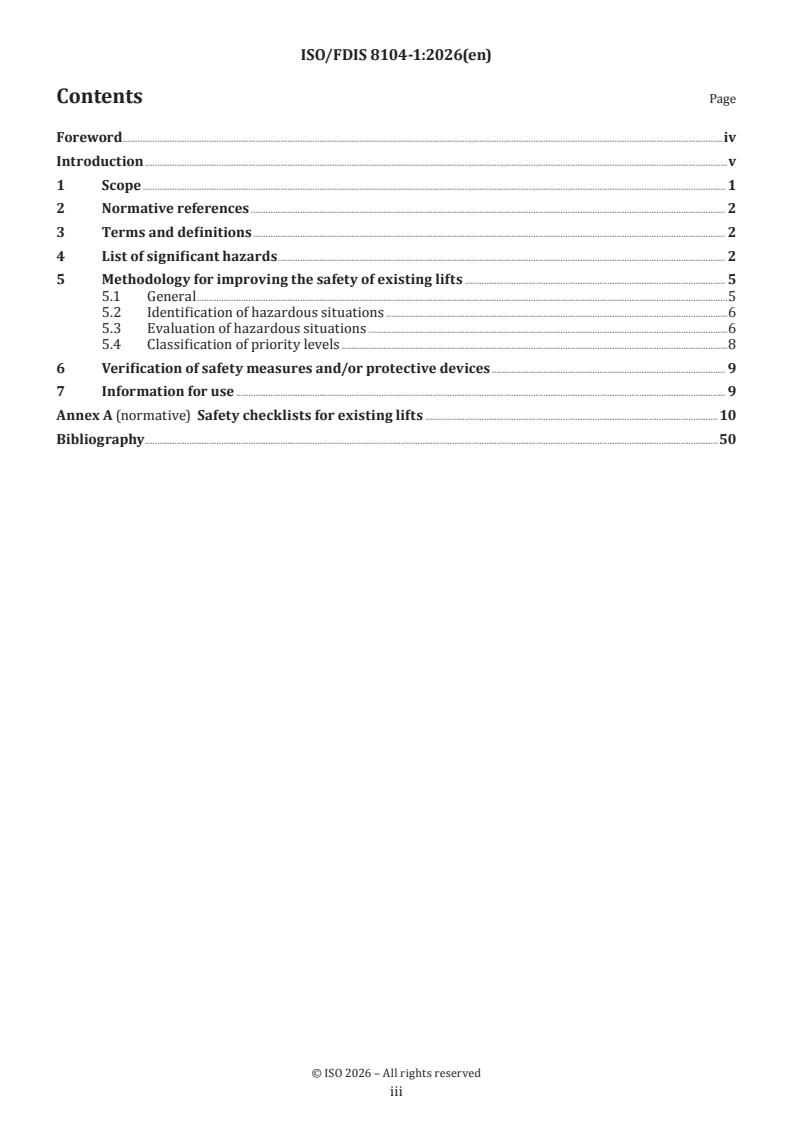
FINAL DRAFT
International
Standard
ISO/TC 178
Improvement of safety and
Secretariat: AFNOR
accessibility on existing lifts,
Voting begins on:
escalators and moving walks —
2026-08-26
Part 1:
Voting terminates on:
2026-10-21
Improvement of safety of
passengers and goods passenger
lifts
Amélioration de la sécurité et de l'accessibilité des ascenseurs,
escaliers mécaniques et trottoirs roulants existants —
Partie 1: Amélioration de la sécurité des ascenseurs et des
ascenseurs de charge existants
RECIPIENTS OF THIS DRAFT ARE INVITED TO SUBMIT,
WITH THEIR COMMENTS, NOTIFICATION OF ANY
RELEVANT PATENT RIGHTS OF WHICH THEY ARE AWARE
AND TO PROVIDE SUPPOR TING DOCUMENTATION.
IN ADDITION TO THEIR EVALUATION AS
BEING ACCEPTABLE FOR INDUSTRIAL, TECHNO-
LOGICAL, COMMERCIAL AND USER PURPOSES, DRAFT
INTERNATIONAL STANDARDS MAY ON OCCASION HAVE
TO BE CONSIDERED IN THE LIGHT OF THEIR POTENTIAL
TO BECOME STAN DARDS TO WHICH REFERENCE MAY BE
MADE IN NATIONAL REGULATIONS.
Reference number
FINAL DRAFT
International
Standard
ISO/TC 178
Improvement of safety and
Secretariat: AFNOR
accessibility on existing lifts,
Voting begins on:
escalators and moving walks —
Part 1:
Voting terminates on:
Improvement of safety of
passengers and goods passenger
lifts
Amélioration de la sécurité et de l'accessibilité des ascenseurs,
escaliers mécaniques et trottoirs roulants existants —
Partie 1: Amélioration de la sécurité des ascenseurs et des
ascenseurs de charge existants
RECIPIENTS OF THIS DRAFT ARE INVITED TO SUBMIT,
WITH THEIR COMMENTS, NOTIFICATION OF ANY
RELEVANT PATENT RIGHTS OF WHICH THEY ARE AWARE
AND TO PROVIDE SUPPOR TING DOCUMENTATION.
© ISO 2026
IN ADDITION TO THEIR EVALUATION AS
All rights reserved. Unless otherwise specified, or required in the context of its implementation, no part of this publication may
BEING ACCEPTABLE FOR INDUSTRIAL, TECHNO-
LOGICAL, COMMERCIAL AND USER PURPOSES, DRAFT
be reproduced or utilized otherwise in any form or by any means, electronic or mechanical, including photocopying, or posting on
INTERNATIONAL STANDARDS MAY ON OCCASION HAVE
the internet or an intranet, without prior written permission. Permission can be requested from either ISO at the address below
TO BE CONSIDERED IN THE LIGHT OF THEIR POTENTIAL
or ISO’s member body in the country of the requester.
TO BECOME STAN DARDS TO WHICH REFERENCE MAY BE
MADE IN NATIONAL REGULATIONS.
ISO copyright office
CP 401 • Ch. de Blandonnet 8
CH-1214 Vernier, Geneva
Phone: +41 22 749 01 11
Email: copyright@iso.org
Website: www.iso.org
Published in Switzerland Reference number
ii
Contents Page
Foreword .iv
Introduction .v
1 Scope . 1
2 Normative references . 2
3 Terms and definitions . 2
4 List of significant hazards . 2
5 Methodology for improving the safety of existing lifts . 5
5.1 General .5
5.2 Identification of hazardous situations .6
5.3 Evaluation of hazardous situations .6
5.4 Classification of priority levels .8
6 Verification of safety measures and/or protective devices . 9
7 Information for use . 9
Annex A (normative) Safety checklists for existing lifts . 10
Bibliography .50
iii
Foreword
ISO (the International Organization for Standardization) is a worldwide federation of national standards
bodies (ISO member bodies). The work of preparing International Standards is normally carried out through
ISO technical committees. Each member body interested in a subject for which a technical committee
has been established has the right to be represented on that committee. International organizations,
governmental and non-governmental, in liaison with ISO, also take part in the work. ISO collaborates closely
with the International Electrotechnical Commission (IEC) on all matters of electrotechnical standardization.
The procedures used to develop this document and those intended for its further maintenance are described
in the ISO/IEC Directives, Part 1. In particular, the different approval criteria needed for the different types
of ISO document should be noted. This document was drafted in accordance with the editorial rules of the
ISO/IEC Directives, Part 2 (see www.iso.org/directives).
ISO draws attention to the possibility that the implementation of this document may involve the use of (a)
patent(s). ISO takes no position concerning the evidence, validity or applicability of any claimed patent
rights in respect thereof. As of the date of publication of this document, ISO had not received notice of (a)
patent(s) which may be required to implement this document. However, implementers are cautioned that
this may not represent the latest information, which may be obtained from the patent database available at
www.iso.org/patents. ISO shall not be held responsible for identifying any or all such patent rights.
Any trade name used in this document is information given for the convenience of users and does not
constitute an endorsement.
For an explanation of the voluntary nature of standards, the meaning of ISO specific terms and expressions
related to conformity assessment, as well as information about ISO's adherence to the World Trade
Organization (WTO) principles in the Technical Barriers to Trade (TBT), see www.iso.org/iso/foreword.html.
This document was prepared by Technical Committee ISO/TC 178, Lifts, escalators and moving walks.
A list of all parts in the ISO 8104 series can be found on the ISO website.
Any feedback or questions on this document should be directed to the user’s national standards body. A
complete listing of these bodies can be found at www.iso.org/members.html.
iv
Introduction
0.1 General
This document was developed to establish a methodology to support procedures for improving the safety of
existing lifts.
0.2 Background of this document
More than 23 million lifts are in use today in the world.
Lifts were installed to the safety level appropriate at time of installation. This level is often lower than
today’s state-of-the-art for safety.
New technologies, experiences, and social expectations have led to today's state-of-the-art for safety. This
has led to the situation today with different levels of safety. However, users and authorized persons expect a
common minimum level of safety wherever they go.
In addition, there is a growing trend for people to live longer and for disabled people to expect access and
design for all. Therefore, it is especially important to provide a safe means of vertical transport for elderly
and disabled persons.
Lift attendants and, in many cases, building caretakers are not so common anymore, so it is important that
relevant safety features for the rescue of trapped persons are provided.
Furthermore, the life cycle of a lift is longer than most other transportation systems and building equipment,
which therefore means that lift design, performance, and safety can fall behind modern technologies.
If existing lifts are upgraded to today's state-of-the-art for safety, the number of injuries is very likely to
decrease (especially in buildings which can be accessed by the general public).
0.3 Approach behind the creation of this document
This document:
1) categorizes various hazards and hazardous situations, each of which has been analysed by a risk
assessment;
2) is intended to provide corrective actions to progressively and selectively improve, step by step, the
safety of all existing passenger and goods passenger lifts towards today’s state-of-the-art for safety;
3) enables each lift to be audited and safety measures to be identified and implemented in a step by step
and selective fashion according to the frequency and severity of any single risk;
4) lists the high, medium and low risks and corrective actions which can be applied in separate steps in
order to mitigate the risks.
Other designs to previous national regulations or standards, providing they have an equivalent safety level,
can also support this approach.
0.4 Use of this document
This document can be used as a guideline for:
1) national authorities to determine their own programme of implementation in a step by step process via
1)
a filtering process (see Clause 5) in a reasonable and practicable way based on the level of risk (e.g.
high, medium, low) and social and economic considerations;
2) owners to follow their responsibilities according to existing regulations;
1) "Reasonable and practicable” is defined as follows: “In deciding what is reasonable and practicable, the seriousness
of a risk to injury should be weighed against the difficulty and cost of removing or reducing that risk. Where the difficulty
and cost are high, and a careful assessment shows that the risk is rather low, short or medium term action may not need
to be taken. On the other hand where the risk is high, action should be taken at whatever cost.”
v
3) maintenance companies and/or inspection bodies to inform the owners on the safety level of their
installations and to propose risk reduction measures;
4) owners to upgrade their existing lifts on a voluntary basis in accordance with 3) if no regulations exist.
NOTE 1 Owner of the installation: natural or legal person who has the power of disposal of the installation and
takes the responsibility for its operation and use.
In making an audit of an existing lift installation, Annex A can be used to identify the hazards and corrective
actions in this document. However, where a hazardous situation is identified which is not covered in this
document a separate risk assessment should be made. This risk assessment should be based on ISO 14798.
NOTE 2 The risk profile according to ISO 14798 has been slightly modified in order to define different priorities
for the upgrading of items on existing lifts depending on the risk levels of the existing means (see 5.3 and 5.4). The
probability level D is covering a large range of probabilities between level C and level E. Due to this reason the largest
number of risks in existing lifts would fall into level D. Therefore, level D has been split into 3 smaller sub-levels C-D,
D and D-E. Higher probabilities C-D which can lead to a high number of incidents are close to C and, therefore, are
considered with high priority for severities 1 and 2 and with medium priority for severity 3. Lower probabilities D-E
where only very few incidents can be expected being close to E are considered with medium priority for severity 1 in
between high for 1 D and low for 1 E and with low priority for severity 2 as for 2 E.
vi
FINAL DRAFT International Standard ISO/FDIS 8104-1:2026(en)
Improvement of safety and accessibility on existing lifts,
escalators and moving walks —
Part 1:
Improvement of safety of passengers and goods passenger
lifts
1 Scope
1.1 This document gives a methodology for improving the safety of existing passenger and goods
passenger lifts with the aim of reaching an equivalent level of safety to that of newly installed lifts by the
application of today’s state-of-the-art for safety.
This document prioritizes improvements of safety based on objective hazard analysis but does not define a
methodology for achieving full conformity to current standards for new installations.
NOTE Due to situations, such as the building design, etc. it is not always possible to reach today’s state-of-the-art
for safety.
This document applies to permanently installed passenger or goods passenger lifts, with traction, positive
or hydraulic drive serving defined landing levels, having a car designed for the transportation of persons or
persons and goods and moving along guide rails inclined not more than 15° to the vertical.
This document includes the improvement of safety of existing lifts for:
a) passengers;
b) maintenance and inspection personnel;
c) persons outside the well, machinery space(s) and the pulley room(s) (but in their immediate vicinity);
d) any other authorized persons.
1.2 This document is not applicable to:
e) lifts with drive systems others than those mentioned above;
f) hydraulic lifts:
1) with a rated speed exceeding 1 m/s;
2) where the setting of the pressure relief valve exceeds 50 MPa;
g) lifting appliances, such as paternosters, mine lifts, theatre lifts, appliances with automatic caging, skips,
lifts and hoists for building and public works sites, ships’ hoists, platforms for exploration or drilling at
sea, construction and maintenance appliances;
h) installations where the inclination of the guide rails to the vertical exceeds 15°;
i) lifting appliances with a rated speed lower than or equal to 0,15 m/s;
j) safety during transport, installation, repairs and dismantling of lifts.
However, this document can usefully be taken as a reference basis.
1.3 This document does not cover:
a) improvement of safety for specific items like vandalism, seismic conditions, fire issues, etc.;
b) improvement of accessibility.
2 Normative references
The following documents are referred to in the text in such a way that some or all of their content constitutes
requirements of this document. For dated references, only the edition cited applies. For undated references,
the latest edition of the referenced document (including any amendments) applies.
2)
ISO 8100-1:2019 , Lifts for the transport of persons and goods — Part 1: Safety rules for the construction and
installation of passenger and goods passenger lifts
ISO 13857:2019, Safety of machinery — Safety distances to prevent hazard zones being reached by upper and
lower limbs
ASME A17.1-2022/CSA B44:22, Safety Code for Elevators and Escalators
ASME A17.3-2020, Safety Code for Existing Elevators and Escalators
ASME A17.7-2007/CSA B44:07 (R2012), Performance-Based Safety Code for Elevators and Escalators
EN 81-21:2022, Safety rules for the construction and installation of lifts — Lifts for the transport of persons and
goods — Part 21: New passenger and goods passenger lifts in existing building
EN 81-28:2022, Safety rules for the construction and installation of lifts — Lifts for the transport of persons and
goods — Part 28: Remote alarm on passenger and goods passenger lifts
EN 81-58:2022, Safety rules for the construction and installation of lifts — Examination and tests - Part 58:
Landing doors fire resistance test
JIS A 4307-1:2019, Lifts for the transport of persons and goods — Part 1: Passenger and goods passenger lifts
3 Terms and definitions
For the purposes of this document, the terms and definitions given in ISO 8100-1and the following apply.
ISO and IEC maintain terminology databases for use in standardization at the following addresses:
— ISO Online browsing platform: available at https:// www .iso .org/ obp
— IEC Electropedia: available at https:// www .electropedia .org/
3.1
existing lift
lift which is in service
4 List of significant hazards
This clause contains all the significant hazards, hazardous situations and events, as far as they are dealt with
in this document, identified by risk assessments as significant for existing lifts and which require action to
eliminate or reduce the risk.
2) Cancelled and replaced by ISO 8100-1:2026.
Table 1 — List of significant hazards
No. Hazard/Hazardous situation
1 General
1.1 Presence of harmful materials
2 Well
2.1 Inadequate locking devices on access, emergency and inspection doors to well and pit
2.2 No stopping of car when access, emergency and inspection doors to well or pit are opened
2.3 Well enclosures with perforate walls
2.4 Well enclosures with perforate walls near door locks
2.5 Partially enclosed well with too low enclosure
2.6 Inadequate vertical surface below landing door sills
2.7 Counterweight/balancing weight without safety gear in case of accessible spaces below well
2.8 No or inadequate screen of counterweight/balancing weight in the pit
2.9 No or inadequate partition in the pit for lifts in a common well
2.10 No or inadequate partition between moving parts of lifts in a common well
2.11 Insufficient refuge spaces and clearances in headroom
2.12 Insufficient refuge spaces and clearances in pit
2.13 No or inadequate means to enter the pit
2.14 No or inadequate lighting of the well
2.15 No or inadequate stopping device in the pit
2.16 No alarm initiation devices in pit and on car roof
2.17 Excessive horizontal distance between the inner surface of the well and the sill, door frame of
the car or closing edge of car sliding doors
2.18 Excessive horizontal distance between car door and landing door
2.19 Too large distance between leading edges of car and landing doors
3 Machinery spaces and pulley rooms
3.1 No or unsafe means of access to machinery spaces and pulley rooms
3.2 Inadequate lighting in machinery spaces and pulley rooms
3.3 No or inadequate stopping device(s) in the pulley room
3.4 Inadequate suspension points for handling of equipment in machinery spaces and top of the well
3.5 Slippery floor in machinery spaces or pulley rooms
3.6 Insufficient horizontal or vertical clearances in machinery spaces
3.7 No or inadequate protection on different levels and recesses in the machine room
3.8 No or inadequate intercom system between car and the location of the emergency operation
4 Landing doors and car doors
4.1 Perforate landing doors
4.2 Perforate car doors
4.3 Inadequate strength of landing doors
4.4 Inadequate strength of car doors
4.5 Inadequate glass in landing doors other than vision panels
4.6 Inadequate glass in car doors other than vision panels
4.7 Inadequate glass vision panels in landing doors
4.8 Inadequate glass vision panels in car doors
4.9 No or inadequate protective device (e.g. light curtain) for re-opening of power operated car and
landing sliding doors
4.10 No or inadequate protective device (150 N) for re-opening of power operated sliding doors
TTabablele 1 1 ((ccoonnttiinnueuedd))
No. Hazard/Hazardous situation
4.11 No or inadequate protective device (150 N) for re-opening of power operated doors other than
sliding doors
4.12 No or inadequate means against dragging of children hands in horizontally sliding car doors or
landing doors with glass
4.13 No or inadequate lighting on landings
4.14 No safe locking device on landing door
4.15 No special device (e.g. triangular key) for emergency unlocking of landing door
4.16 No or inadequate self-closing and locking of the landing door after opening for whatever reason
when the car is outside the unlocking zone
4.17 Inadequate link between multiple panels of landing doors (missing interlink or missing locking)
4.18 Inadequate fire resistance of landing doors
4.19 Car door moving with open (hinged) landing door
4.20 Car without door(s)
4.21 No car door restrictor where the landing door locking device is accessible when the car door is
opened outside of the door zone
5 Car, counterweight and balancing weight
5.1 Large car area in relation to rated load
5.2 No car apron or inadequate length of car apron
5.3 Unsafe locking of emergency trap door on the car
5.4 Insufficient strength of car roof and emergency trap door
5.5 No or inadequate protection against falling from car roof
5.6 Insufficient ventilation in car
5.7 Inadequate lighting in car
5.8 No or inadequate emergency lighting in car
5.9 No emergency lighting on the car roof
5.10 No or inadequate load control
5.11 No or inadequate remote alarm system
6 Suspension means, compensation means, precautions against free fall, excessive overspeed,
unintended car movement and creeping of the car
6.1 No or inadequate protection against injury from traction sheaves, pulleys or sprockets
6.2 No or inadequate protection against rope/chains leaving the sheaves, pulleys or sprockets
6.3 No or inadequate protection against the introduction of objects between ropes/chains and
sheaves, pulleys or sprockets
6.4 No or inadequate protection against free fall or descent with excessive speed
6.5 No or inadequate protection means against ascending car overspeed on traction drive lifts with
counterweight
6.6 No or inadequate protection means against unintended car movement with open doors
6.7 No or inadequate protection against creeping on hydraulic lifts
6.8 No or inadequate slack rope switch for governor rope
6.9 No or inadequate slack rope/chain detection device
7 Guide rails, buffers and final limit switches
7.1 Inadequate guidance system for counterweight or balancing weight
7.2 No or inadequate buffers
7.3 No or inadequate final limit switches
8 Lift machine
8.1 Inadequate machine brake (only one brake set)
TTabablele 1 1 ((ccoonnttiinnueuedd))
No. Hazard/Hazardous situation
8.2 No or inadequate emergency operation system
8.3 No or inadequate means for stopping the machine and checking its stopped position
8.4 No motor run-time limiter
8.5 No shut-off valve (hydraulic lifts)
8.6 No or inadequate low cylinder pressure device on hydraulic lifts
9 Electric installations and appliances
9.1 Insufficient protection against electric shock (direct contact)
9.2 Insufficient marking of connection terminals which remain live after switching off the main switch
9.3 No or inadequate protection against overheating of lift machine motor
9.4 No lockable main switch
9.5 No or inadequate stopping device at the machine in the machinery space
10 Protection against electric faults, controls, priorities
10.1 No earth fault protection in circuits with electric safety devices or in circuits controlling the
brake or the down valve
10.2 No protection against phase reversal
10.3 Inadequate levelling and/or stopping accuracy
10.4 No or inadequate inspection control station and stopping device on the car roof
10.5 No or inadequate inspection control station in the pit
11 Notices, markings and operating instructions
11.1 Missing notices, markings and operating instructions
5 Methodology for improving the safety of existing lifts
5.1 General
All technical solutions for upgrading existing lifts should be aligned as much as possible to the state-of-the-
art solutions applicable for new lifts. The requirements and/or protective measures documented in today's
state-of-the-art standards for new lifts should not be considered as the only possible solution. Alternatives
are possible, provided they lead to an equivalent or higher safety level. Although immediate upgrading of all
existing lifts to the state-of-the-art would be preferable from the safety point of view, this can not always be
possible in a short period of time mainly due to economic reasons.
This document does not provide legally binding requirements for measures to be carried out or for the
period of time for such measures. Such obligations for existing lifts are subject to national legislation. The
procedures described in this clause are intended to assist in setting up national regulations and/or providing
a systematic approach to the lift owners for increasing the safety of existing lifts by showing:
— how to identify hazards;
— how to evaluate the existing hazardous situations; and
— how to classify priority levels which apply to the relevant hazards and risk reduction measures.
Where the requirements of this document cannot be met, and a residual risk related to hazards in Table 1
remains or cannot be avoided, then appropriate measures such as signs, instructions and training shall be
given.
Before upgrading a lift by one or several of the appropriate measures, the consequences to other parts of the
lift shall be considered. This can lead to further modifications to align the interfaces and to prevent lowering
the safety in other areas of the lift.
After the upgrading of a lift by one or several of the appropriate measures, the remaining hazardous
situations shall be documented and recorded for future upgrades and general awareness to manage any
residual risks.
In a periodic scheme or whenever the use of the lift has changed, a new audit shall be carried out in order to
check whether the previous assessment needs to be updated.
5.2 Identification of hazardous situations
Annex A contains checklists which shall be used for identification of the hazardous situations relevant for
an individual lift. This list contains all hazardous situations indicated in Table 1. The hazardous situations
have been listed on the basis of experience gathered from registered accidents as well as specific risk
assessments. The state-of-the-art for safety of the relevant ISO, CEN, ASME, etc. served as a basis for risk
reduction measures.
There can be additional hazardous situations for very old lifts or lifts with special technology which are not
covered by this document. In this case, additional risk assessments shall be performed to identify hazards
and risk reduction measures.
The identification of the hazardous situation can be carried out in the course of any periodical survey or
special examination on a given installation, but only technically competent persons should be allowed to
carry out these examinations. This can be subject to national regulations.
When extreme risks are identified during an audit immediate action to mitigate or lower the risk shall be
taken if the lift is kept in service. Corrective actions shall be carried out before lift is brought back to service.
5.3 Evaluation of hazardous situations
The hazardous situations as listed in Table 1 were subjected to risk assessment in preparation for this
document.
The risk assessment was based on the assumption that an existing lift either has no or insufficient equipment
for preventing the hazardous situations.
Table 2 shows the original risk profile which can be present in existing lift installations which have not been
brought up to safety levels in accordance with state-of-the-art standards.
In the risk profile in Table 2, some risks appear twice. The background for this double assessment is that
some hazardous situations can lead to different effects, e.g. to high severity with a lower probability and to
medium severity with a higher probability. Accident statistics can show different experiences from country
to country. In these cases, the double assessments should demonstrate that, even if high severity accidents
cannot be experienced, there is still a certain probability for medium severity accidents.
Table 2 — Original risk profile
Level of severity
Level of
1 2 3 4
probability
Number of hazardous situation
A
B 4.9/4.10/4.11
2.3/4.1/4.2/4.9
C 4.19/5.8/7.3
4.10/4.11/8.2
2.6/2.13/2.14/3.1
3.2/3.7/4.5/4.6/4.7
C-D 10.4 4.13/5.7
4.8/4.20/5.11
6.4/7.2/10.3
1.1/2.1/2.2/2.4/2.5/2.9
2.10/2.11/2.12/2.14
2.15/2.17/2.18/2.19
2.16/3.4/3.6/4.4
3.3/4.3/4.5/4.6/4.7
D 4.12/5.3/5.6/6.1 5.4/6.3/8.4/8.5
4.8/4.14/4.15/4.16
6.2/6.5/6.9/8.6
4.20/5.2/5.5/5.11/6.4
6.6/6.7/8.1/8.2/8.3
9.1/9.2/9.4/10.3
3.8/4.17/4.18/4.21 3.5/5.1/5.10/7.1
D-E
6.5/6.8/10.1/11.1 9.3/9.5/10.2/10.5
E 2.7/2.8/3.4/5.10/7.1 5.9
F
Level of probability: Level of severity:
A Highly probable, B Probable, C Occasional, 1 High, 2 Medium, 3 Low, 4 Negligible
D Remote, E Improbable, F Highly improbable
NOTE 1 Numbers in cells correspond to the number of hazardous situations as listed in Table 1.
NOTE 2 For the significance of shading patterns, see Table 3.
NOTE 3 For reasons of practical application, the frequency category D was subdivided into C-D, D and D-E.
Table 2 does not strictly apply to every existing lift. Earlier local requirements valid in individual countries
can already include requirements which cover many of the hazardous situations in Table 1. Some of these
requirements may be regarded as almost equivalent to the state-of-the-art standards.
Some of these requirements could have just partially covered the hazardous situations, which means that
the remaining residual risk can be still too high compared with the safety level which is achieved for a lift in
accordance with the state-of-the-art standards.
This is why re-evaluating the risks and comparing with previous national standards will lead to filtering
the risk profile. On the one hand, hazardous situations covered by almost equivalent requirements can be
eliminated from the risk profile. On the other hand, the residual risk can be re-evaluated and re-ranked in
the risk profile. This filtering process may be done at national level.
The risk caused by no or inadequate lighting of the well (risk number 2.14) should serve as an example.
Considering the worst case, the risk assessment implies that no well lighting exists. The respective risk is
evaluated at severity level 1 and probability level D and also at 2 C-D. Consequently, the risk levels in the
original risk profile (see Table 2) are high, which means that risk-reducing measures are necessary in any
case.
Former valid standards already required permanently installed well lighting. Such well lighting had to be
mounted at determined positions in the well, but, in contrast to more recent standards, a defined intensity
of illumination was not required.
Therefore, the well lighting used earlier cannot be considered to be equivalent to the well lighting used
today. However, lifts equipped with well lighting in accordance with former standards have certainly a
lower residual risk than lifts without well lighting. Consequently, the remaining residual risk can be shifted
to lower risk levels than the original risk profile, i.e. to 1 D-E or 2 D, for example.
5.4 Classification of priority levels
As mentioned in 5.1, upgrading all existing lifts to the state-of-the-art for safety at the same time is not
always possible for various reasons. This is why a procedure which allows subdivision of the hazardous
situations in priority levels which then can be mitigated in several timed steps by the respective measures
proposed in this document is recommended.
The priority levels in Table 3 and Table 4 have been specified for the purpose of this document, slightly
deviating from the safety levels of the risk profile according to ISO 14798. The risk profile is subdivided in 4
priority levels (see Table 3 and Table 4).
These priority levels are defined in accordance with safety considerations only. However, implementation of
measures to mitigate the risk is also a question of economic consideration.
The priority levels can be assigned to a schedule for the implementation of the measures. Table 4 also
contains a possible schedule.
Table 3 — Modified risk profile with priority levels
Level of severity
Level of proba-
1 2 3 4
bility
Priority level
A Extreme Extreme High Low
B Extreme High High Low
C Extreme High Medium
C-D High High Medium
D High Medium Low
D-E Medium Low
E Low Low
F
Level of probability: Level of severity:
A Highly probable, B Probable, C Occasional, D Re- 1 High, 2 Medium,
mote, E Improbable, F Highly improbable
3 Low, 4 Negligible
Table 4 — Priorities and implementation
Fields in risk profile
Priority Implementation
S P
1 A, B, C
Extreme Immediate
2 A
1 C-D, D
2 B, C, C-D High Short-term
3 A, B
1 D-E
Medium term or together
2 D Medium
with a major modernization
3 C, C-D
1 E
Long term or together with a
2 D-E, E
Low modernization of the related
3 D
component
4 A, B
1 F
2 F
- -
3 D-E, E, F
4 C, C-D, D, D-E, E, F
Level of probability: Level of severity:
A Highly probable, B Probable, 1 High, 2 Medium,
C Occasional, D Remote, E Improbable, 3 Low, 4 Negligible
F Highly improbable
NOTE The length of the terms is subject to filtering, e.g. short-term within 5 years,
medium term within 10 years
6 Verification of safety measures and/or protective devices
Before putting a lift back into service after modifications, it shall be subject to examinations and tests in
accordance with applicable state-of-the-art standards.
Modifications made on a specific component can have implications on the safety or function of other
associated components and systems. Therefore, the examinations and tests after modification shall not be
limited only to those items modified but shall include these additional affected components and systems.
7 Information for use
Relevant documentation shall be provided for those components which are modified, replaced or added.
Important modifications shall be recorded in the technical part of the register or file according to
ISO 8100-1:2019, 7.3.
Annex A
(normative)
Safety checklists for existing lifts
A.1 General
The safety checklists given in A.2 to A.4 shall be used as a tool to identify the significant hazards on an
existing lift and to determine which type of protective measure(s) according to today’s state-of-the-art
standards are applicable. It may be amended taking into account national filtering (see Clause 5) and local
requirements.
Alternative protective measures may be chosen, provided they lead to an equivalent safety level.
A risk assessment shall be made on a case by case basis for safety items not covered in this document.
If a risk is re-evaluated, this re-evaluation should be done following the risk analysis methodology
(ISO 14798) used to establish this document.
A.2 Safety checklist for upgrading of existing lifts to the state-of-the-art according to
ISO 8100-1:2019
For many items in Table A.1, the safety level of ISO 8100-1:2019 compared to EN 81-1:1998 and EN 81-
2:1998 or other equivalent national standards based on EN 81-1:1998 and EN 81-2:1998 is equal. However,
there are some items where the safety level has been slightly increased like inspection control in the pit
(ISO 8100-1:2019, 5.2.1.5.1 b), equal to EN 81-20:2014) or refuge spaces.
The difference in safety level of such items is identified in the last column of Table A.1. In case of a “0” in the
last column, the protective measures in ISO 8100-1:2019 compared with EN 81-1:1998 and EN 81-2:1998
or other equivalent national standards based on EN 81-1:1998 and EN 81-2:1998 are either equal or the
difference in safety level is marginal and can therefore be ignored. In cases of significant differences in
safety level between lifts in accordance with ISO 8100-1:2019 and lifts in accordance with EN 81-1:1998 and
EN 81-2:1998 or other equivalent national standards based on EN 81-1:1998 and EN 81-2:1998 the priority
level of such items is indicated and conditions for different priority levels are specified if applicable.
Table A.1 — Safety check list ISO 8100-1:2019
No. Items to be checked Requirement fulfilled Priority level Protective measures Possible measures Priority level compared with
for conformance to be adopted lifts in conformance with EN 81-
(risk reduction measures)
with ISO 8100- 1:1998 and EN 81-2:1998 or
1:2019 other equivalent national stand-
ards based on EN 81-1:1998 and
EN 81-2:1998
1 General
1.1 Installation without Yes No High Components are free from harmful materials, e.g. asbestos 0
harmful material, see ISO 8100-1:2019, 0.4.3 e)
e.g. asbestos in brake
a) Remove asbestos which is subject to disintegration (e.g. Yes No
linings, contactor
replace brake lining material)
shields, cladding
b) Do not carry out work on asbestos = > put warning label
of the well, landing
Yes No
doors, cladding of the
machine room, car
floors, etc.
2 Well
2.1 Locking devices on Yes No High Provide locking device(s) according to Yes No 0
access, emergency
Not applicable ISO 8100-1:2019, 5.2.3.3 b) and c)
and inspection doors
to well and pit
2.2 Car stops when ac- Yes No High Provide electric safety device according to ISO 8100- Yes No 0
cess, emergency and 1:2019, 5.2.3.3 d)
Not applicable
inspection doors to
well or pit are open
2.3 Imperforate well Yes No High a) Provide imperforate well enclosure in accordance with Yes No 0
enclosure ISO 8100-1:2019, 5.2.5.2.2.1, or
Not applicable
b) if it can be justified, provide perforate well enclosure Yes No
e.g. according to EN 81-21:2022, 5.2
2.4 Non-accessibility of Yes No High a) Provide imperforate well enclosure, or Yes No 0
landing door locking
Not applicable b) provide protection around landing door locking device Yes No
devices in case of
e.g. according to EN 81-21:2022, 5.2 b)
well enclosures with
perforate walls by
unauthorized persons
to prevent deliberate
misuse (e.g. reaching
through a mesh well)
2.5 Partial well enclosure Yes No High a) Provide full well enclosure in accordance with Yes No 0
ISO 8100-1:2019, 5.2.5.2.2.1, or
Not applicable
b) provide partial well enclosure in accordance with Yes No
ISO 8100-1:2019, 5.2.5.2.3
2.6 Height of vertical Yes No High Provide appropriate means according to ISO 8100-1:2019, Yes No 0
surface below landing 5.2.5.3.2 below each landing door sill
door sills
Table A.1 (continued)
No. Items to be checked Requirement fulfilled Priority level Protective measures Possible measures Priority level compared with
for conformance to be adopted lifts in conformance with EN 81-
(risk reduction measures)
with ISO 8100- 1:1998 and EN 81-2:1998 or
1:2019 other equivalent national stand-
ards based on EN 81-1:1998 and
EN 81-2:1998
2.7 Protection of any ac- Yes No Low Provide a safety gear to the counterweight or balancing Yes No Low
cessible spaces below weight according to ISO 8100-1:2019, 5.2.5.4
Not applicable Note: ISO 8100-1:2019 does not
the well, where no
consider the use of solid piers
solid pier extending
down to solid ground
is existing
2.8 Counterweight or bal- Yes No Low Provide a counterweight or balancing weight screen ac- Yes No 0
ancing weight screen cording to ISO 8100-1:2019, 5.2.5.5.1
Not applicable
to prevent access to
area below counter-
weight or balancing
weight
2.9 Partition in the pit Yes No High Provide partition in the pit according to ISO 8100-1:2019, Yes No Low
for lifts in a common 5.2.5.5.2
Not applicable
well to avoid access to
adjacent lift
2.10 Partition between Yes No High Provide full height partition according to ISO 8100-1:2019, Yes No 0
moving parts of lifts 5.2.5.5.2
Not applicable
located in a common
well
2.11 Refuge spaces and Yes No High a) Provide refuge spaces and clearances in headroom in Yes No Low
clearances in head- accordance with ISO 8100-1:2019, 5.2.5.7, or
room
b) provide technical means to create refuge spaces and Yes No
clearances e.g. according to EN 81-21:2022, 5.5
2.12 Refuge spaces and Yes No High a) Provide refuge spaces and clearances in pit in accord- Yes No Low
clearances in pit ance with ISO 8100-1:2019, 5.2.5.8 or
b) provide technical means to create refuge spaces and Yes No
clearances e.g. according to EN 81-21:2022, 5.7
2.13 Means to enter the pit Yes No High Provide means to enter the pit according to ISO 8100- Yes No Low
1:2019, 5.2.2.4
2.14 Lighting of the well Yes No High Provide lighting of the well in accordance with ISO 8100- Yes No 0
1:2019, 5.2.1.4.1
2.15 Stopping device in pit Yes No High Provide stopping device according to ISO 8100-1:2019, Yes No 0
5.2.1.5.1 a)
2.16 Alarm initiation Yes No Medium If no means to escape are provided for person(s) trapped Yes No 0
device in pit and on in the well, fit alarm initiation device(s) according to
car roof ISO 8100-1:2019, 5.2.1.6
Table A.1 (continued)
No. Items to be checked Requirement fulfilled Priority level Protective measures Possible measures Priority level compared with
for conformance to be adopted lifts in conformance with EN 81-
(risk reduction measures)
with ISO 8100- 1:1998 and EN 81-2:1998 or
1:2019 other equivalent national stand-
ards based on EN 81-1:1998 and
EN 81-2:1998
2.17 Horizontal distance Yes No High a) Provide means to reduce the distance as in ISO 8100- Yes No 0
between the inner 1:2019, 5.2.5.3.1 or,
surface of the well
b) provide car door locking device as in ISO 8100-1:2019, Yes No
and the sill, door
5.3.9.2
frame of the car or
closing edge of car
sliding doors
2.18 Horizontal distance Yes No High Persons shall be prevented from being present between Yes No 0
between closed car closed car door and landing door in accordance with
Not applicable
door and landing
...
ISO/TC 178
Secretariat: AFNOR
Date: 20252026-08-11-12
Improvement of safety and accessibility on existing lifts,
escalators and moving walks — —
Part 1:
Improvement of safety of passengerpassengers and goods
passenger lifts
Élément introductif — Élément central — Partie 1: Élément complémentaire
Amélioration de la sécurité et de l'accessibilité des ascenseurs, escaliers mécaniques et trottoirs roulants
existants —
Partie 1: Amélioration de la sécurité des ascenseurs et des ascenseurs de charge existants
FDIS stage
All rights reserved. Unless otherwise specified, or required in the context of its implementation, no part of this publication
may be reproduced or utilized otherwise in any form or by any means, electronic or mechanical, including photocopying,
or posting on the internet or an intranet, without prior written permission. Permission can be requested from either ISO
at the address below or ISO'sISO’s member body in the country of the requester.
ISO copyright office
CP 401 • Ch. de Blandonnet 8
CH-1214 Vernier, Geneva
Phone: + 41 22 749 01 11
Email: E-mail: copyright@iso.org
Website: www.iso.org
Published in Switzerland.
iii
Contents Page
Foreword . v
Introduction . vi
1 Scope . 1
2 Normative references . 2
3 Terms and definitions . 2
4 List of significant hazards . 3
5 Methodology for improving the safety of existing lifts. 6
5.1 General. 6
5.2 Identification of hazardous situations . 6
5.3 Evaluation of hazardous situations . 7
5.4 Classification of priority levels . 8
6 Verification of safety measures and/or protective devices. 10
7 Information for use . 10
Annex A (normative) Safety checklists for existing lifts . 11
Bibliography . 68
iv
Foreword
ISO (the International Organization for Standardization) is a worldwide federation of national standards
bodies (ISO member bodies). The work of preparing International Standards is normally carried out through
ISO technical committees. Each member body interested in a subject for which a technical committee has been
established has the right to be represented on that committee. International organizations, governmental and
non-governmental, in liaison with ISO, also take part in the work. ISO collaborates closely with the
International Electrotechnical Commission (IEC) on all matters of electrotechnical standardization.
The procedures used to develop this document and those intended for its further maintenance are described
in the ISO/IEC Directives, Part 1. In particular, the different approval criteria needed for the different types of
ISO document should be noted. This document was drafted in accordance with the editorial rules of the
ISO/IEC Directives, Part 2 (see www.iso.org/directives).
ISO draws attention to the possibility that the implementation of this document may involve the use of (a)
patent(s). ISO takes no position concerning the evidence, validity or applicability of any claimed patent rights
in respect thereof. As of the date of publication of this document, ISO had not received notice of (a) patent(s)
which may be required to implement this document. However, implementers are cautioned that this may not
represent the latest information, which may be obtained from the patent database available at
www.iso.org/patents. ISO shall not be held responsible for identifying any or all such patent rights.
Any trade name used in this document is information given for the convenience of users and does not
constitute an endorsement.
For an explanation of the voluntary nature of standards, the meaning of ISO specific terms and expressions
related to conformity assessment, as well as information about ISO's adherence to the World Trade
Organization (WTO) principles in the Technical Barriers to Trade (TBT), see www.iso.org/iso/foreword.html.
This document was prepared by Technical Committee ISO/TC 178, Lifts, escalators and moving walks.
A list of all parts in the ISO 8104 series can be found on the ISO website.
Any feedback or questions on this document should be directed to the user’s national standards body. A
complete listing of these bodies can be found at www.iso.org/members.html.
v
Introduction
0.1 0.1General
This document was developed to establish a methodology to support procedures for improving the safety of
existing lifts.
0.2 0.2Background of this document
More than 23 million lifts are in use today (2025) in the world.
Lifts were installed to the safety level appropriate at time of installation. This level is often lower than today’s
state-of-the-art for safety.
New technologies, experiences, and social expectations have led to today's state-of-the-art for safety. This has
led to the situation today with different levels of safety. However, users and authorized persons expect a
common minimum level of safety wherever they go.
In addition, there is a growing trend for people to live longer and for disabled people to expect access and
design for all. Therefore, it is especially important to provide a safe means of vertical transport for elderly and
disabled persons.
Lift attendants and, in many cases, building caretakers are not so common anymore, so it is important that
relevant safety features for the rescue of trapped persons are provided.
Furthermore, the life cycle of a lift is longer than most other transportation systems and building equipment,
which therefore means that lift design, performance, and safety can fall behind modern technologies. If
existing lifts are upgraded to today's state-of-the-art for safety, the number of injuries is very likely to decrease
(especially in buildings which can be accessed by the general public).
0.3 0.3Approach behind the creation of this document
This document:
1) 1) categorizes various hazards and hazardous situations, each of which has been analysed by a
risk assessment;
2) 2) is intended to provide corrective actions to progressively and selectively improve, step by step,
the safety of all existing passenger and goods passenger lifts towards today’s state-of-the-art for safety;
3) 3) enables each lift to be audited and safety measures to be identified and implemented in a step
by step and selective fashion according to the frequency and severity of any single risk;
4) 4) lists the high, medium and low risks and corrective actions which can be applied in separate
steps in order to mitigate the risks.
Other designs to previous national regulations or standards, providing they have an equivalent safety level,
can also support this approach.
vi
0.4 0.4Use of this document
This document can be used as a guideline for:
1) 1) national authorities to determine their own programme of implementation in a step by step
11)
process via a filtering process (see Clause 5Clause 5)) in a reasonable and practicable way based on the
level of risk (e.g. high, medium, low) and social and economic considerations;
2) 2) owners to follow their responsibilities according to existing regulations;
3) 3) maintenance companies and/or inspection bodies to inform the owners on the safety level of
their installations and to propose risk reduction measures;
4) 4) owners to upgrade their existing lifts on a voluntary basis in accordance with 3) if no
regulations exist.
NOTE 1 Owner of the installation: natural or legal person who has the power of disposal of the installation and takes
the responsibility for its operation and use.
In making an audit of an existing lift installation, Annex AAnnex A can be used to identify the hazards and
corrective actions in this document. However, where a hazardous situation is identified which is not covered
in this document a separate risk assessment should be made. This risk assessment should be based on
ISO 14798.
NOTE 2 The risk profile according to ISO 14798 has been slightly modified in order to define different priorities for
the upgrading of items on existing lifts depending on the risk levels of the existing means (see 5.35.3 and 5.45.4).). The
probability level D is covering a large range of probabilities between level C and level E. Due to this reason the largest
number of risks in existing lifts would fall into level D. Therefore, level D has been split into 3 smaller sub-levels C-D, D
and D-E. Higher probabilities C-D which can lead to a high number of incidents are close to C and, therefore, are
considered with high priority for severities 1 and 2 and with medium priority for severity 3. Lower probabilities D-E
where only very few incidents can be expected being close to E are considered with medium priority for severity 1 in
between high for 1 D and low for 1 E and with low priority for severity 2 as for 2 E.
1 "Reasonable and practicable” is defined as follows: “In deciding what is reasonable and practicable the seriousness of a risk to injury should be weighed against the difficulty and cost
,
of removing or reducing that risk. Where the difficulty and cost are high, and a careful assessment shows that the risk is rather low, short or medium term action may not need to be
taken. On the other hand where the risk is high, action should be taken at whatever cost.”
1)
"Reasonable and practicable” is defined as follows: “In deciding what is reasonable and practicable, the seriousness of
a risk to injury should be weighed against the difficulty and cost of removing or reducing that risk. Where the difficulty
and cost are high, and a careful assessment shows that the risk is rather low, short or medium term action may not need
to be taken. On the other hand where the risk is high, action should be taken at whatever cost.”
vii
Improvement of safety and accessibility on existing lifts, escalators
and moving walks — Part 1: Improvement of safety of passenger and
goods passenger lifts —
Part 1:
Improvement of safety of passengers and goods passenger lifts
1 Scope
1.1 1.1 This document gives a methodology for improving the safety of existing passenger and goods
passenger lifts with the aim of reaching an equivalent level of safety to that of newly installed lifts by the
application of today’s state-of-the-art for safety.
This document prioritizes improvements of safety based on objective hazard analysis but does not define a
methodology for achieving full conformity to current standards for new installations.
NOTE Due to situations, such as the building design, etc. it is not always possible to reach today’s state-of-the-art for
safety.
This document applies to permanently installed passenger or goods passenger lifts, with traction, positive or
hydraulic drive serving defined landing levels, having a car designed for the transportation of persons or
persons and goods and moving along guide rails inclined not more than 15° to the vertical.
This document includes the improvement of safety of existing lifts for:
a) a) passengers;
b) b) maintenance and inspection personnel;
c) c) persons outside the well, machinery space(s) and the pulley room(s) (but in their immediate
vicinity);
d) d) any other authorized persons.
1.2 1.2 This document is not applicable to:
e) e) lifts with drive systems others than those mentioned above;
f) f) hydraulic lifts:
1) 1) with a rated speed exceeding 1 m/s;
2) 2) where the setting of the pressure relief valve exceeds 50 MPa;
g) g) lifting appliances, such as paternosters, mine lifts, theatre lifts, appliances with automatic
caging, skips, lifts and hoists for building and public works sites, ships’ hoists, platforms for exploration
or drilling at sea, construction and maintenance appliances;
h) h) installations where the inclination of the guide rails to the vertical exceeds 15°;
i) i) lifting appliances with a rated speed lower than or equal to 0,15 m/s;
j) j) safety during transport, installation, repairs and dismantling of lifts.
However, this document can usefully be taken as a reference basis.
1.3 1.3 This document does not cover:
a) a) improvement of safety for specific items like vandalism, seismic conditions, fire issues, etc.;
b) b) improvement of accessibility.
2 Normative references
The following documents are referred to in the text in such a way that some or all of their content constitutes
requirements of this document. For dated references, only the edition cited applies. For undated references,
the latest edition of the referenced document (including any amendments) applies.
2)
ISO 8100-1:2019, , Lifts for the transport of persons and goods — Part 1: Safety rules for the construction and
installation of passenger and goods passenger lifts
ISO 13857:2019, Safety of machinery — Safety distances to prevent hazard zones being reached by upper and
lower limbs
ASME A17.1-2022/CSA B44:22, Safety Code for Elevators and Escalators
ASME A17.3-2020, Safety Code for Existing Elevators and Escalators
ASME A17.7-2007/CSA B44:07 (R2012), Performance-Based Safety Code for Elevators and Escalators
EN 81--21:2022, Safety rules for the construction and installation of lifts — Lifts for the transport of persons and
goods — Part 21: New passenger and goods passenger lifts in existing building
EN 81--28:2022, Safety rules for the construction and installation of lifts — Lifts for the transport of persons and
goods — Part 28: Remote alarm on passenger and goods passenger lifts
EN 81--58:2022, Safety rules for the construction and installation of lifts — Examination and tests - Part 58:
Landing doors fire resistance test
JIS A 4307-1:2019, Lifts for the transport of persons and goods — Part 1: Passenger and goods passenger lifts
3 Terms and definitions
For the purposes of this document, the terms and definitions given in ISO 8100-1:2019 and1and the following
apply.
ISO and IEC maintain terminologicalterminology databases for use in standardization at the following
addresses:
— — ISO Online browsing platform: available at https://www.iso.org/obp
— — IEC Electropedia: available at https://www.electropedia.org/
3.1 3.1
existing lift
lift which is in service
2)
Cancelled and replaced by ISO 8100-1:2026.
4 List of significant hazards
This clause contains all the significant hazards, hazardous situations and events, as far as they are dealt with
in this document, identified by risk assessments as significant for existing lifts and which require action to
eliminate or reduce the risk.
Table 1 — List of significant hazards
No. Hazard/Hazardous situation
1 General
1.1 Presence of harmful materials
2 Well
2.1 Inadequate locking devices on access, emergency and inspection doors to well and pit
2.2 No stopping of car when access, emergency and inspection doors to well or pit are opened
2.3 Well enclosures with perforate walls
2.4 Well enclosures with perforate walls near door locks
2.5 Partially enclosed well with too low enclosure
2.6 Inadequate vertical surface below landing door sills
2.7 Counterweight/balancing weight without safety gear in case of accessible spaces below well
2.8 No or inadequate screen of counterweight/balancing weight in the pit
2.9 No or inadequate partition in the pit for lifts in a common well
2.10 No or inadequate partition between moving parts of lifts in a common well
2.11 Insufficient refuge spaces and clearances in headroom
2.12 Insufficient refuge spaces and clearances in pit
2.13 No or inadequate means to enter the pit
2.14 No or inadequate lighting of the well
2.15 No or inadequate stopping device in the pit
2.16 No alarm initiation devices in pit and on car roof
2.17 Excessive horizontal distance between the inner surface of the well and the sill, door frame of
the car or closing edge of car sliding doors
2.18 Excessive horizontal distance between car door and landing door
2.19 Too large distance between leading edges of car and landing doors
3 Machinery spaces and pulley rooms
3.1 No or unsafe means of access to machinery spaces and pulley rooms
3.2 Inadequate lighting in machinery spaces and pulley rooms
3.3 No or inadequate stopping device(s) in the pulley room
3.4 Inadequate suspension points for handling of equipment in machinery spaces and top of the
well
3.5 Slippery floor in machinery spaces or pulley rooms
3.6 Insufficient horizontal or vertical clearances in machinery spaces
3.7 No or inadequate protection on different levels and recesses in the machine room
No. Hazard/Hazardous situation
3.8 No or inadequate intercom system between car and the location of the emergency operation
4 Landing doors and car doors
4.1 Perforate landing doors
4.2 Perforate car doors
4.3 Inadequate strength of landing doors
4.4 Inadequate strength of car doors
4.5 Inadequate glass in landing doors other than vision panels
4.6 Inadequate glass in car doors other than vision panels
4.7 Inadequate glass vision panels in landing doors
4.8 Inadequate glass vision panels in car doors
4.9 No or inadequate protective device (e.g. light curtain) for re-opening of power operated car
and landing sliding doors
4.10 No or inadequate protective device (150 N) for re-opening of power operated sliding doors
4.11 No or inadequate protective device (150 N) for re-opening of power operated doors other
than sliding doors
4.12 No or inadequate means against dragging of children hands in horizontally sliding car doors or
landing doors with glass
4.13 No or inadequate lighting on landings
4.14 No safe locking device on landing door
4.15 No special device (e.g. triangular key) for emergency unlocking of landing door
4.16 No or inadequate self-closing and locking of the landing door after opening for whatever
reason when the car is outside the unlocking zone
4.17 Inadequate link between multiple panels of landing doors (missing interlink or missing
locking)
4.18 Inadequate fire resistance of landing doors
4.19 Car door moving with open (hinged) landing door
4.20 Car without door(s)
4.21 No car door restrictor where the landing door locking device is accessible when the car door is
opened outside of the door zone
5 Car, counterweight and balancing weight
5.1 Large car area in relation to rated load
5.2 No car apron or inadequate length of car apron
5.3 Unsafe locking of emergency trap door on the car
5.4 Insufficient strength of car roof and emergency trap door
5.5 No or inadequate protection against falling from car roof
5.6 Insufficient ventilation in car
5.7 Inadequate lighting in car
5.8 No or inadequate emergency lighting in car
5.9 No emergency lighting on the car roof
No. Hazard/Hazardous situation
5.10 No or inadequate load control
5.11 No or inadequate remote alarm system
6 Suspension means, compensation means, precautions against free fall, excessive
overspeed, unintended car movement and creeping of the car
6.1 No or inadequate protection against injury from traction sheaves, pulleys or sprockets
6.2 No or inadequate protection against rope/chains leaving the sheaves, pulleys or sprockets
6.3 No or inadequate protection against the introduction of objects between ropes/chains and
sheaves, pulleys or sprockets
6.4 No or inadequate protection against free fall or descent with excessive speed
6.5 No or inadequate protection means against ascending car overspeed on traction drive lifts
with counterweight
6.6 No or inadequate protection means against unintended car movement with open doors
6.7 No or inadequate protection against creeping on hydraulic lifts
6.8 No or inadequate slack rope switch for governor rope
6.9 No or inadequate slack rope/chain detection device
7 Guide rails, buffers and final limit switches
7.1 Inadequate guidance system for counterweight or balancing weight
7.2 No or inadequate buffers
7.3 No or inadequate final limit switches
8 Lift machine
8.1 Inadequate machine brake (only one brake set)
8.2 No or inadequate emergency operation system
8.3 No or inadequate means for stopping the machine and checking its stopped position
8.4 No motor run-time limiter
8.5 No shut-off valve (hydraulic lifts)
8.6 No or inadequate low cylinder pressure device on hydraulic lifts
9 Electric installations and appliances
9.1 Insufficient protection against electric shock (direct contact)
9.2 Insufficient marking of connection terminals which remain live after switching off the main
switch
9.3 No or inadequate protection against overheating of lift machine motor
9.4 No lockable main switch
9.5 No or inadequate stopping device at the machine in the machinery space
10 Protection against electric faults, controls, priorities
10.1 No earth fault protection in circuits with electric safety devices or in circuits controlling the
brake or the down valve
10.2 No protection against phase reversal
10.3 Inadequate levelling and/or stopping accuracy
No. Hazard/Hazardous situation
10.4 No or inadequate inspection control station and stopping device on the car roof
10.5 No or inadequate inspection control station in the pit
11 Notices, markings and operating instructions
11.1 Missing notices, markings and operating instructions
5 Methodology for improving the safety of existing lifts
5.1 General
All technical solutions for upgrading existing lifts should be aligned as much as possible to the state-of-the-art
solutions applicable for new lifts. The requirements and/or protective measures documented in today's state-
of-the-art standards for new lifts should not be considered as the only possible solution. Alternatives are
possible, provided they lead to an equivalent or higher safety level. Although immediate upgrading of all
existing lifts to the state-of-the-art would be preferable from the safety point of view, this can not always be
possible in a short period of time mainly due to economic reasons.
This document does not provide legally binding requirements for measures to be carried out or for the period
of time for such measures. Such obligations for existing lifts are subject to national legislation. The procedures
described in this clause are intended to assist in setting up national regulations and/or providing a systematic
approach to the lift owners for increasing the safety of existing lifts by showing:
— — how to identify hazards;
— — how to evaluate the existing hazardous situations; and
— — how to classify priority levels which apply to the relevant hazards and risk reduction measures.
Where the requirements of this document cannot be met, and a residual risk related to hazards in
Table 1Table 1 remains or cannot be avoided, then appropriate measures such as signs, instructions and
training shall be given.
Before upgrading a lift by one or several of the appropriate measures, the consequences to other parts of the
lift shall be considered. This can lead to further modifications to align the interfaces and to prevent lowering
the safety in other areas of the lift.
After the upgrading of a lift by one or several of the appropriate measures, the remaining hazardous situations
shall be documented and recorded for future upgrades and general awareness to manage any residual risks.
In a periodic scheme or whenever the use of the lift has changed, a new audit shall be carried out in order to
check whether the previous assessment needs to be updated.
5.2 Identification of hazardous situations
Annex AAnnex A contains checklists which shall be used for identification of the hazardous situations relevant
for an individual lift. This list contains all hazardous situations indicated in Table 1Table 1. The hazardous
situations have been listed on the basis of experience gathered from registered accidents as well as specific
risk assessments. The state-of-the-art for safety of the relevant ISO, CEN, ASME, etc. served as a basis for risk
reduction measures.
There can be additional hazardous situations for very old lifts or lifts with special technology which are not
covered by this document. In this case, additional risk assessments shall be performed to identify hazards and
risk reduction measures.
The identification of the hazardous situation can be carried out in the course of any periodical survey or special
examination on a given installation, but only technically competent persons should be allowed to carry out
these examinations. This can be subject to national regulations.
When extreme risks are identified during an audit immediate action to mitigate or lower the risk shall be taken
if the lift is kept in service. Corrective actions shall be carried out before lift is brought back to service.
5.3 Evaluation of hazardous situations
The hazardous situations as listed in Table 1Table 1 were subjected to risk assessment in preparation for this
document.
The risk assessment was based on the assumption that an existing lift either has no or insufficient equipment
for preventing the hazardous situations.
Table 2Table 2 shows the original risk profile which can be present in existing lift installations which have not
been brought up to safety levels in accordance with state-of-the-art standards.
In the risk profile in Table 2Table 2,, some risks appear twice. The background for this double assessment is
that some hazardous situations can lead to different effects, e.g.,. to high severity with a lower probability and
to medium severity with a higher probability. Accident statistics can show different experiences from country
to country. In these cases, the double assessments should demonstrate that, even if high severity accidents
cannot be experienced, there is still a certain probability for medium severity accidents.
Table 2 — Original risk profile
Level of Level of severity
Split Cells
probabilit
y
Level of
1 2 3 4
probability
Number of hazardous situation
A
B 4.9/4.10/4.11
2.3/4.1/4.2/4.9
C 4.19/5.8/7.3
4.10/4.11/8.2
2.6/2.13/2.14/3.1
3.2/3.7/4.5/4.6/4.7
C-D 10.4 4.13/5.7
4.8/4.20/5.11
6.4/7.2/10.3
1.1/2.1/2.2/2.4/2.5/2.9
2.10/2.11/2.12/2.14
2.15/2.17/2.18/2.19
2.16/3.4/3.6/4.4
3.3/4.3/4.5/4.6/4.7
D 4.12/5.3/5.6/6.1 5.4/6.3/8.4/8.5
4.8/4.14/4.15/4.16
6.2/6.5/6.9/8.6
4.20/5.2/5.5/5.11/6.4
6.6/6.7/8.1/8.2/8.3
9.1/9.2/9.4/10.3
3.8/4.17/4.18/4.21 3.5/5.1/5.10/7.1
D-E
6.5/6.8/10.1/11.1 9.3/9.5/10.2/10.5
E 2.7/2.8/3.4/5.10/7.1 5.9
Level of Level of severity
Split Cells
probabilit
y
Level of
1 2 3 4
probability
Number of hazardous situation
F
Level of probability: Level of severity:
A Highly probable, B Probable, C Occasional, 1 High, 2 Medium, 3 Low, 4 Negligible
D Remote, E Improbable, F Highly improbable
NOTE 1 Numbers in cells correspond to the number of hazardous situations as listed in Table 1Table 1.
NOTE 2 For the significance of shading patterns, see Table 3Table 3.
NOTE 3 For reasons of practical application, the frequency category D was subdivided into C-D, D and D-E.
Table 2Table 2 does not strictly apply to every existing lift. Earlier local requirements valid in individual
countries can already include requirements which cover many of the hazardous situations in Table 1Table 1.
Some of these requirements may be regarded as almost equivalent to the state-of-the-art standards.
Some of these requirements could have just partially covered the hazardous situations, which means that the
remaining residual risk can be still too high compared with the safety level which is achieved for a lift in
accordance with the state-of-the-art standards.
This is why re-evaluating the risks and comparing with previous national standards will lead to filtering the
risk profile. On the one hand, hazardous situations covered by almost equivalent requirements can be
eliminated from the risk profile. On the other hand, the residual risk can be re-evaluated and re-ranked in the
risk profile. This filtering process may be done at national level.
The risk caused by no or inadequate lighting of the well (risk number 2.14) should serve as an example here:.
Considering the worst case, the risk assessment implies that no well lighting exists. The respective risk is
evaluated at severity level 1 and probability level D and also at 2 C-D. Consequently, the risk levels in the
original risk profile (see Table 2Table 2)) are high, which means that risk-reducing measures are necessary in
any case.
Former valid standards already required permanently installed well lighting. Such well lighting had to be
mounted at determined positions in the well, but, in contrast to more recent standards, a defined intensity of
illumination was not required.
Therefore, the well lighting used earlier cannot be considered to be equivalent to the well lighting used today.
However, lifts equipped with well lighting in accordance with former standards have certainly a lower residual
risk than lifts without well lighting. Consequently, the remaining residual risk can be shifted to lower risk
levels than the original risk profile, i.e. to 1 D-E or 2 D, for example.
5.4 Classification of priority levels
As mentioned in 5.15.1,, upgrading all existing lifts to the state-of-the-art for safety at the same time is not
always possible for various reasons. This is why a procedure which allows subdivision of the hazardous
situations in priority levels which then can be mitigated in several timed steps by the respective measures
proposed in this document, is recommended.
The priority levels in Table 3Table 3 and Table 4Table 4 have been specified for the purpose of this document,
slightly deviating from the safety levels of the risk profile according to ISO 14798. The risk profile is
subdivided in 4 priority levels (see Table 3Table 3 and Table 4Table 4).).
These priority levels are defined in accordance with safety considerations only. However, implementation of
measures to mitigate the risk is also a question of economic consideration.
The priority levels can be assigned to a schedule for the implementation of the measures. Table 4Table 4 also
contains a possible schedule.
Table 3 — Modified risk profile with priority levels
Level of severity
Level of
1 2 3 4
probability
Priority level
A Extreme Extreme High Low
B Extreme High High Low
C Extreme High Medium
C-D High High Medium
D High Medium Low
D-E Medium Low
E Low Low
F
Level of probability: Level of severity:
A Highly probable, B Probable, C Occasional, D 1 High, 2 Medium,
Remote, E Improbable, F Highly improbable
3 Low, 4 Negligible
Table 4 — Priorities and implementation
Fields in risk profile
Priority Implementation
S P
1 A, B, C
Extreme Immediate
2 A
1 C-D, D
2 B, C, C-D High Short-term
3 A, B
1 D-E
Medium term or together
2 D Medium
with a major modernization
3 C, C-D
1 E
Long term or together with a
2 D-E, E
Low modernization of the related
3 D
component
4 A, B
1 F
- -
2 F
Fields in risk profile
Priority Implementation
S P
3 D-E, E, F
4 C, C-D, D, D-E, E, F
Level of probability: Level of severity:
A Highly probable, B Probable, 1 High, 2 Medium,
C Occasional, D Remote, E Improbable, 3 Low, 4 Negligible
F Highly improbable
NOTE The length of the terms is subject to filtering, e.g. short-term within
5 years, medium term within 10 years
6 Verification of safety measures and/or protective devices
Before putting a lift back into service after modifications, it shall be subject to examinations and tests in
accordance with applicable state-of-the-art standards.
Modifications made on a specific component can have implications on the safety or function of other
associated components and systems. Therefore, the examinations and tests after modification shall not be
limited only to those items modified but shall include these additional affected components and systems.
7 Information for use
Relevant documentation shall be provided for those components which are modified, replaced or added.
Important modifications shall be recorded in the technical part of the register or file according to ISO 8100-
1:2019, 7.3.
Annex A
(normative)
Safety checklists for existing lifts
A.1 General
The safety checklists given in A.2A.2 to A.4A.4 shall be used as a tool to identify the significant hazards on an
existing lift and to determine which type of protective measure(s) according to today’s state-of-the-art
standards are applicable. It may be amended taking into account national filtering (see Clause 5Clause 5)) and
local requirements.
Alternative protective measures may be chosen, provided they lead to an equivalent safety level.
A risk assessment shall be made on a case by case basis for safety items not covered in this document.
If a risk is re-evaluated, this re-evaluation should be done following the risk analysis methodology (ISO 14798)
used to establish this document.
A.2 Safety checklist for upgrading of existing lifts to the state-of-the-art
according to ISO 8100-1:2019
For many items in Table A.1Table A.2,, the safety level of ISO 8100-1:2019 compared to EN 81-1/-:1998 and
EN 81-2:1998 or other equivalent national standards based on EN 81-1/-:1998 and EN 81-2:1998 is equal.
However, there are some items where the safety level has been slightly increased like inspection control in
the pit (ISO 8100-1:2019, 5.2.1.5.1 b), equal to EN 81-20:2014) or refuge spaces.
The difference in safety level of such items is identified in the last column of Table A.1Table A.2. In case of a
“0” in the last column, the protective measures in ISO 8100-1:2019 compared with EN 81-1/-:1998 and EN 81-
2:1998 or other equivalent national standards based on EN 81-1/-:1998 and EN 81-2:1998 are either equal
or the difference in safety level is marginal and can therefore be ignored. In cases of significant differences in
safety level between lifts in accordance with ISO 8100-1:2019 and lifts in accordance with EN 81-1/-:1998
and EN 81-2:1998 or other equivalent national standards based on EN 81-1/-:1998 and EN 81-2:1998 the
priority level of such items is indicated and conditions for different priority levels are specified if applicable.
Table A.21 — Safety check list ISO 8100-1:2019
No. Items to be Requirement Priority Protective measures Possible Priority level compared
checked for fulfilled level measures to with lifts in conformance
(risk reduction measures)
conformance be adopted with EN 81--1/-:1998 and
with ISO 8100- EN 81-2:1998 or other
1:2019 equivalent national
standards based on
EN 81-1/-:1998 and
EN 81-2:1998
1 General
1.1 Installation without ☐ Yes ☐ No High Components are free from harmful materials, e.g. asbestos see 0
harmful material, e.g. ISO 8100-1:2019, 0.4.3 e)
asbestos in brake
a) Remove asbestos which is subject to disintegration (e.g. ☐ Yes ☐ No
linings, contactor
replace brake lining material)
shields, cladding of the
b) Do not carry out work on asbestos = > put warning label
well, landing doors,
☐ Yes ☐ No
cladding of the
machine room, car
floors, etc.
2 Well
2.1 Locking devices on ☐ Yes ☐ No High Provide locking device(s) according to ☐ Yes ☐ No 0
access, emergency and
☐ Not applicable ISO 8100-1:2019, 5.2.3.3 b) and c)
inspection doors to
well and pit
2.2 Car stops when access, ☐ Yes ☐ No High Provide electric safety device according to ISO 8100-1:2019, ☐ Yes ☐ No 0
emergency and 5.2.3.3 d)
☐ Not applicable
inspection doors to
well or pit are open
2.3 Imperforate well ☐ Yes ☐ No High a) Provide imperforate well enclosure in accordance with ☐ Yes ☐ No 0
enclosure ISO 8100-1:2019, 5.2.5.2.2.1, or
☐ Not applicable
b) if it can be justified, provide perforate well enclosure e.g. ☐ Yes ☐ No
according to EN 81--21:2022, 5.2
2.4 Non-accessibility of ☐ Yes ☐ No High a) Provide imperforate well enclosure, or ☐ Yes ☐ No 0
landing door locking
No. Items to be Requirement Priority Protective measures Possible Priority level compared
checked for fulfilled level measures to with lifts in conformance
(risk reduction measures)
conformance be adopted with EN 81--1/-:1998 and
with ISO 8100- EN 81-2:1998 or other
1:2019 equivalent national
standards based on
EN 81-1/-:1998 and
EN 81-2:1998
☐ Not applicable ☐ Yes ☐ No
devices in case of well b) provide protection around landing door locking device e.g.
enclosures with according to EN 81--21:2022, 5.2 b)
perforate walls by
unauthorized persons
to prevent deliberate
misuse (e.g. reaching
through a mesh well)
2.5 Partial well enclosure ☐ Yes ☐ No High a) Provide full well enclosure in accordance with ISO 8100- ☐ Yes ☐ No 0
1:2019, 5.2.5.2.2.1, or
☐ Not applicable
b) provide partial well enclosure in accordance with ISO 8100- ☐ Yes ☐ No
1:2019, 5.2.5.2.3
2.6 Height of vertical ☐ Yes ☐ No High Provide appropriate means according to ISO 8100-1:2019, ☐ Yes ☐ No 0
surface below landing 5.2.5.3.2 below each landing door sill
door sills
2.7 Protection of any ☐ Yes ☐ No Low Provide a safety gear to the counterweight or balancing weight ☐ Yes ☐ No Low
accessible spaces according to ISO 8100-1:2019, 5.2.5.4
Note: ISO 8100-1:2019 does not
☐ Not applicable
below the well, where
consider the use of solid piers
no solid pier extending
down to solid ground
is existing
2.8 Counterweight or ☐ Yes ☐ No Low Provide a counterweight or balancing weight screen according to ☐ Yes ☐ No 0
balancing weight ISO 8100-1:2019, 5.2.5.5.1
☐ Not applicable
screen to prevent
access to area below
counterweight or
balancing weight
2.9 Partition in the pit for ☐ Yes ☐ No High Provide partition in the pit according to ISO 8100-1:2019, ☐ Yes ☐ No Low
lifts in a common well 5.2.5.5.2
☐ Not applicable
No. Items to be Requirement Priority Protective measures Possible Priority level compared
checked for fulfilled level measures to with lifts in conformance
(risk reduction measures)
conformance be adopted with EN 81--1/-:1998 and
with ISO 8100- EN 81-2:1998 or other
1:2019 equivalent national
standards based on
EN 81-1/-:1998 and
EN 81-2:1998
to avoid access to
adjacent lift
Partition between ☐ Yes ☐ No Provide full height partition according to ISO 8100-1:2019, ☐ Yes ☐ No
2.10 High 0
moving parts of lifts 5.2.5.5.2
☐ Not applicable
located in a common
well
2.11 Refuge spaces and ☐ Yes ☐ No High a) Provide refuge spaces and clearances in headroom in ☐ Yes ☐ No Low
clearances in accordance with ISO 8100-1:2019, 5.2.5.7, or
headroom
b) provide technical means to create refuge spaces and ☐ Yes ☐ No
clearances e.g. according to EN 81--21:2022, 5.5
2.12 Refuge spaces and ☐ Yes ☐ No High a) Provide refuge spaces and clearances in pit in accordance ☐ Yes ☐ No Low
clearances in pit with ISO 8100-1:2019, 5.2.5.8 or
b) provide technical means to create refuge spaces and ☐ Yes ☐ No
clearances e.g. according to EN 81--21:2022, 5.7
2.13 Means to enter the pit ☐ Yes ☐ No High Provide means to enter the pit according to ISO 8100-1:2019, ☐ Yes ☐ No Low
5.2.2.4
2.14 Lighting of the well ☐ Yes ☐ No High Provide lighting of the well in accordance with ISO 8100-1:2019, ☐ Yes ☐ No 0
5.2.1.4.1
2.15 Stopping device in pit ☐ Yes ☐ No High Provide stopping device according to ISO 8100-1:2019, 5.2.1.5.1 ☐ Yes ☐ No 0
a)
2.16 Alarm initiation device ☐ Yes ☐ No Medium If no means to escape are provided for person(s) trapped in the ☐ Yes ☐ No 0
in pit and on car roof well, fit alarm initiation device(s) according to ISO 8100-1:2019,
5.2.1.6
2.17 Horizontal distance ☐ Yes ☐ No High a) Provide means to reduce the distance as in ISO 8100-1:2019, ☐ Yes ☐ No 0
between the inner 5.2.5.3.1 or,
surface of the well and
☐ Yes ☐ No
the sill, door frame of
No. Items to be Requirement Priority Protective measures Possible Priority level compared
checked for fulfilled level measures to with lifts in conformance
(risk reduction measures)
conformance be adopted with EN 81--1/-:1998 and
with ISO 8100- EN 81-2:1998 or other
1:2019 equivalent national
standards based on
EN 81-1/-:1998 and
EN 81-2:1998
the car or closing edge b) provide car door locking device as in ISO 8100-1:2019,
of car sliding doors 5.3.9.2
Horizontal distance ☐ Yes ☐ No Persons shall be prevented from being present between closed ☐ Yes ☐ No
2.18 High 0
between closed car car door and landing door in accordance with ISO 8100-1:2019,
☐ Not applicable
door and landing door 5.3.4.3
2.19 Distance between ☐ Yes ☐ No High Persons shall be prevented from entering between the car door ☐ Yes ☐ No 0
leading edges of car and landing door in accordance with ISO 8100-1:2019, 5.3.4.2
☐ Not applicable
and landing door
3 Machinery spaces and
...