

ISO 23817:2026
(Main)Ships and marine technology — Ballast water management systems (BWMS) — Procedures for commissioning and testing BWMS using electrolytic methods
- Abstract
This document provides requirements and procedures for commissioning a ballast water management system (BWMS) using electrolytic methods following installation on board a ship. It specifies safety measures, procedures for commissioning (including installation inspection, function test, training of the ship's crew) and a commissioning test according to BWM.2/Circ.70/Rev.1.[22] This commissioning process ensures the health and safety of personnel involved in commissioning, verifies proper function and operation, and provides procedures for sampling and analysis. This document also provides requirements on the documentation of commissioning. This document focuses on the commissioning of a BWMS using electrolytic methods after initial installation on board a ship, but it can also apply to other necessary surveys of a BWMS and readiness evaluation of land-based or shipboard testing for type approval required by either IMO or a port state, or both. NOTE A survey of the installed equipment and associated documentation is conducted by a Recognized Organization (RO) according to the BWMS Code (MEPC.300(72)[13]), and the Harmonized System for Survey and Classification (HSSC)[19]. Installation checkout and commissioning is normally completed by the manufacturer or their technical representative according to manufacturer requirements, while verification of discharge samples is conducted by a ballast water testing organization.
- Status
- Published
- Publication Date
- 04-Aug-2026
- Technical Committee
- ISO/TC 8 - Ships and marine technology
- Drafting Committee
- ISO/TC 8 - Ships and marine technology
- Current Stage
- 6060 - International Standard published
- Start Date
- 05-Aug-2026
- Due Date
- 07-Nov-2026
- Completion Date
- 05-Aug-2026
ISO 23817:2026 is an International Standard from ISO for commissioning and testing ballast water management systems (BWMS) using electrolytic methods after they are installed on board a ship. It specifies safety measures, installation inspection, function tests, commissioning testing, sampling and analysis, and the records that the ship owner, manufacturer, recognized organization (RO), and ballast water testing organization need to prepare.
What does ISO 23817:2026 specify?
ISO 23817:2026 specifies how to commission a BWMS using electrolytic methods after installation on board, and how to test that system before it enters service. It focuses on safe working practices, correct installation, functional checks, sample collection and analysis, and commissioning documentation.
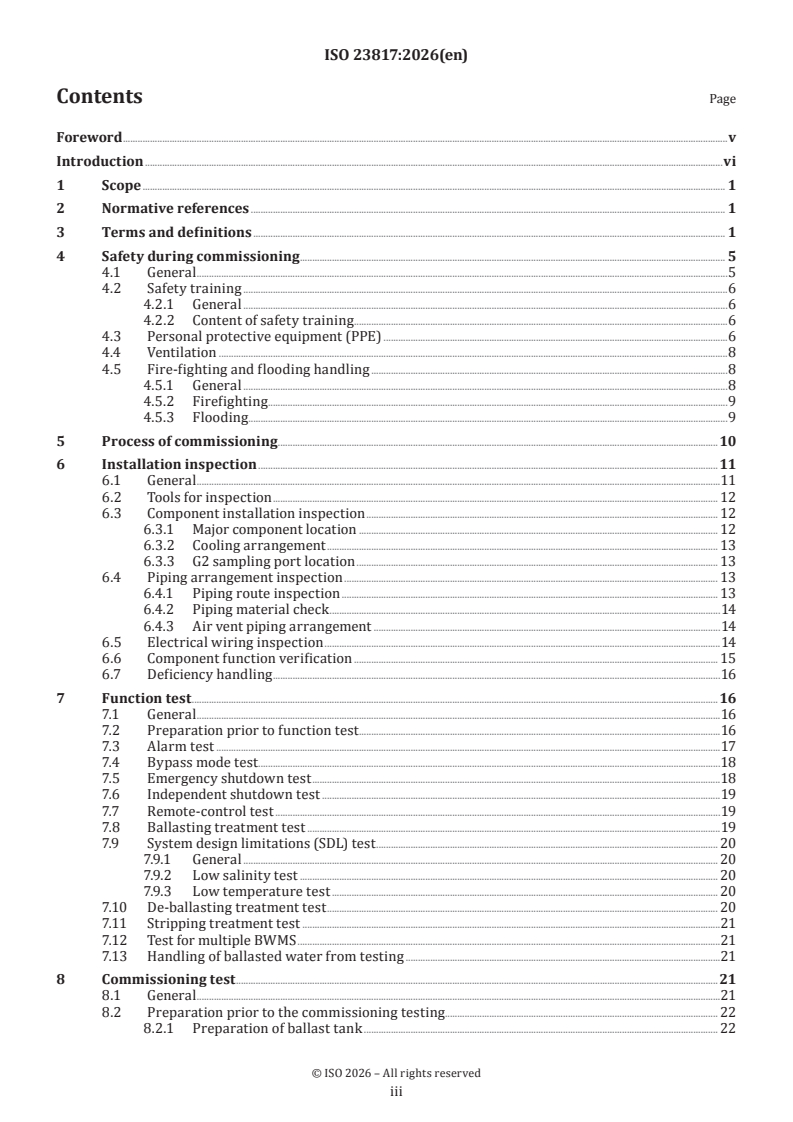
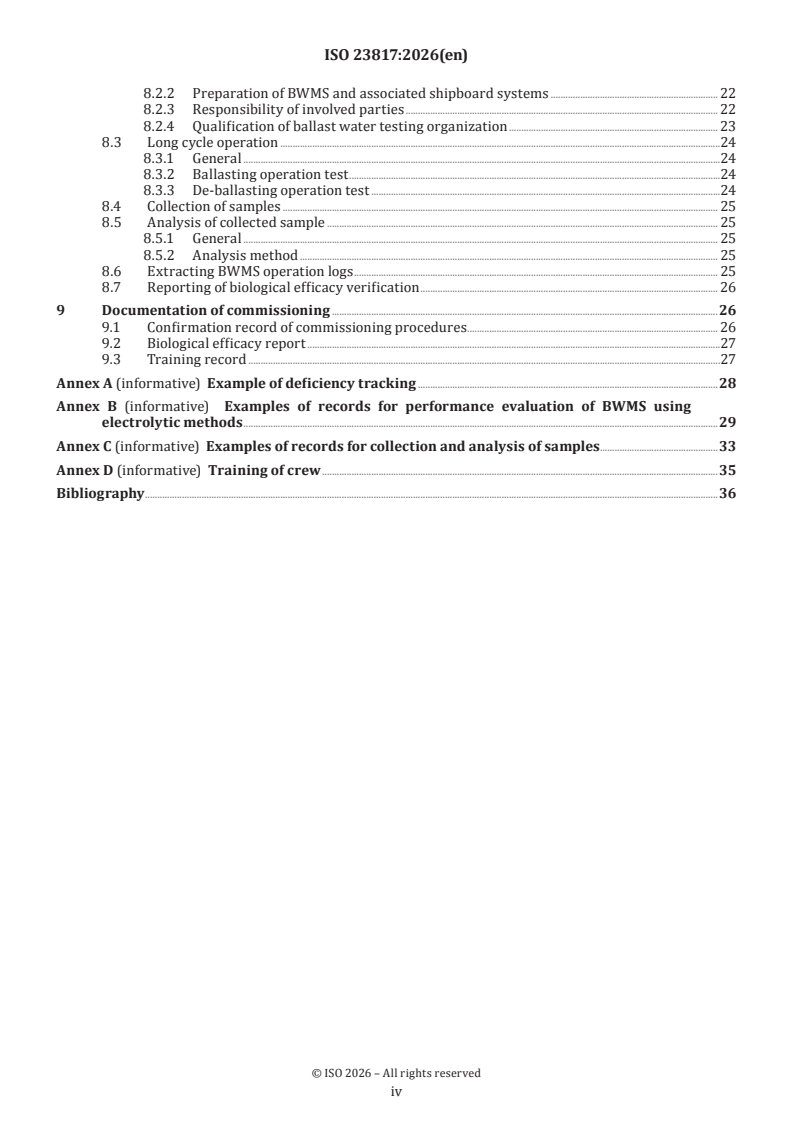
The document is organized into nine clauses and four informative annexes:
| Annex | What it covers |
|---|---|
| Annex A | Example of deficiency tracking |
| Annex B | Examples of records for performance evaluation of BWMS using electrolytic methods |
| Annex C | Examples of records for collection and analysis of samples |
| Annex D | Training of crew |
Clause 4 covers safety during commissioning. Clause 5 describes the overall commissioning process. Clauses 6 to 8 cover installation inspection, function tests, and the commissioning test. Clause 9 covers the records that must be prepared and signed.
What are the key requirements of ISO 23817:2026?
ISO 23817:2026 ties commissioning to a sequence of safety checks, installation verification, function tests, and a long-cycle commissioning test. In practice, this means the BWMS must be checked as a complete shipboard installation, not only as equipment on a bench.
Safety comes first during commissioning
Clause 4 requires safety training, suitable personal protective equipment (PPE), ventilation, and fire-fighting and flooding procedures. The standard gives examples of hazards such as electrical shock, limited space, enclosed space, active substances, dangerous gas, and chemicals used by BWMS using electrolytic methods.
For readers, this means commissioning cannot start until the site team understands shipboard hazards, wears the right PPE, and confirms that spaces are safe to enter and work in.
Installation inspection checks the shipboard arrangement
Clause 6 requires inspection of major component location, cooling arrangements, the G2 sampling port location, piping, electrical wiring, and basic component function. It also requires deficiency handling, with each issue listed and tracked until resolved.
In practice, this is where installers verify that equipment is reachable for maintenance, that vents and sensors are positioned correctly, that pipes and cables match the drawings, and that any deviation is documented before testing begins.
Piping, ventilation, and wiring must support safe operation
Clause 6 requires the piping route to support proper mixing and neutralization, and the air vent piping to safely remove hydrogen gas. Electrical wiring must match the diagrams and connect correctly to ship systems such as the PMS, AMS or IAS, BWMR ventilation, fixed fire extinguishing system, ballast pump controls, GPS, and emergency generator where applicable.
For the shipyard and manufacturer, this means the BWMS must not only run, but also communicate and shut down correctly with the ship’s other systems.
Function tests prove the main operating modes
Clause 7 requires function tests for alarms, bypass mode, emergency shutdown, independent shutdown, remote control, ballasting treatment, SDL tests, de-ballasting treatment, stripping treatment, and multiple BWMS installed on the same ship. The tests are meant to show that the system can operate safely and that protective functions work as intended.
In practice, the crew and test team need to see alarms, shutdown logic, valve positions, and treatment dosing behave correctly before any biological verification is attempted.
SDL tests cover low salinity and low temperature operation
Clause 7 includes SDL testing for low salinity and low temperature conditions. These tests check that measures such as brine addition or heating allow the BWMS to maintain the required treatment performance.
This matters because electrolytic BWMS can depend on water quality and temperature. The standard asks the team to confirm that the system still produces the intended treatment result when those conditions are at the edges of its operating range.
The commissioning test verifies biological efficacy
Clause 8 requires a long cycle operation with sample collection and analysis to validate the installation. The test checks that treated ballast water meets Regulation D-2 of the Convention for the two organism size classes, and that TRO in discharge water stays within the allowed limit.
For the reader, this is the core proof that the installed BWMS is working in service conditions, not just passing equipment checks.
Documentation closes the commissioning process
Clause 9 requires a confirmation record of commissioning procedures, a biological efficacy report, and a training record. These records are signed by the relevant parties and kept as evidence that commissioning, testing, and crew training were completed.
That paperwork is important because it supports ship handover, surveys, and later verification by the Administration or RO.
What terms does ISO 23817:2026 define?
- Commissioning - procedures performed after BWMS installation to verify that function, operation, and compliance meet the required design and construction intent.
- Commissioning test - the examination and evaluation used to validate the installation by showing that the mechanical, physical, chemical, and biological processes work properly.
- Long cycle operation - a procedure that checks whether the BWMS can maintain stable performance over time without shutdown.
- Recognized organization (RO) - an organization entrusted by a flag state to carry out inspections and surveys.
- Ballast water testing organization - an independent company, organization, or institute that collects and analyzes ballast water samples for the commissioning test.
- System design limitation (SDL) - a water quality or operational limit for which the BWMS is designed to meet the performance standard.
- Ballast water management room (BWMR) - a space containing BWMS equipment.
- Indicative analysis - a relatively quick compliance test using a representative sample.
- Detailed analysis - a more complex compliance test that directly measures viable organism concentration.
Who uses ISO 23817:2026?
ISO 23817:2026 is used by ship owners, shipyards, BWMS manufacturers, their technical representatives, RO surveyors, Administrations, and ballast water testing organizations. It is also relevant to crews who operate and maintain the BWMS.
In practice, manufacturers use it to prepare installation checkout and commissioning steps. Shipyards use it to complete onboard installation safely. Testing organizations use it to plan sampling, analysis, and reporting. ROs and Administrations use it to verify that the installation and test evidence support approval and survey decisions.
Which standards are used with ISO 23817:2026?
ISO 23817:2026 cites these normative references:
- ISO 11711-1 - provides the ballast water discharge sample port requirements used for biological verification.
- ISO 11711-2 - provides ballast water sample collection and handling requirements, including chain of custody and practical sampling steps.
- ISO 23314-2 - gives risk assessment and risk reduction guidance for BWMS using electrolytic methods, and supports crew training and safety planning.
The document also points to the ISO 11711 series more broadly for sampling and analysis practice, and it references ISO 11711-3 as the analysis part under preparation.
What does the ISO 23817:2026 document contain?
ISO 23817:2026 contains a commissioning flow, safety measures, installation inspection checklists, function test items, commissioning test steps, and documentation requirements. It also includes sample record formats for deficiencies, performance evaluation, sampling, analysis, and crew training.
Annex B and Annex C provide example record tables for test data, operating parameters, sample details, and analysis results. These are meant to help manufacturers and testing organizations record the information needed to support biological efficacy verification.
Clause 8 describes long cycle operation, sample collection, sample analysis, extraction of BWMS operation logs, and the biological efficacy verification report. Clause 9 then turns those activities into signed commissioning records for the owner, manufacturer, RO, and Administration.
Get Certified
Connect with accredited certification bodies for this standard

CIS Institut d.o.o.
Personal Protective Equipment (PPE) certification body. Notified Body NB-2890 for EU Regulation 2016/425 PPE.

Kiwa BDA Testing
Building and construction product certification.
Kmetijski inštitut Slovenije
Agricultural Institute of Slovenia. Soil testing, plant health, agricultural product analysis.
Sponsored listings
Frequently Asked Questions
ISO 23817:2026 is a standard published by the International Organization for Standardization (ISO). Its full title is "Ships and marine technology — Ballast water management systems (BWMS) — Procedures for commissioning and testing BWMS using electrolytic methods". This standard covers: This document provides requirements and procedures for commissioning a ballast water management system (BWMS) using electrolytic methods following installation on board a ship. It specifies safety measures, procedures for commissioning (including installation inspection, function test, training of the ship's crew) and a commissioning test according to BWM.2/Circ.70/Rev.1.[22] This commissioning process ensures the health and safety of personnel involved in commissioning, verifies proper function and operation, and provides procedures for sampling and analysis. This document also provides requirements on the documentation of commissioning. This document focuses on the commissioning of a BWMS using electrolytic methods after initial installation on board a ship, but it can also apply to other necessary surveys of a BWMS and readiness evaluation of land-based or shipboard testing for type approval required by either IMO or a port state, or both. NOTE A survey of the installed equipment and associated documentation is conducted by a Recognized Organization (RO) according to the BWMS Code (MEPC.300(72)[13]), and the Harmonized System for Survey and Classification (HSSC)[19]. Installation checkout and commissioning is normally completed by the manufacturer or their technical representative according to manufacturer requirements, while verification of discharge samples is conducted by a ballast water testing organization.
This document provides requirements and procedures for commissioning a ballast water management system (BWMS) using electrolytic methods following installation on board a ship. It specifies safety measures, procedures for commissioning (including installation inspection, function test, training of the ship's crew) and a commissioning test according to BWM.2/Circ.70/Rev.1.[22] This commissioning process ensures the health and safety of personnel involved in commissioning, verifies proper function and operation, and provides procedures for sampling and analysis. This document also provides requirements on the documentation of commissioning. This document focuses on the commissioning of a BWMS using electrolytic methods after initial installation on board a ship, but it can also apply to other necessary surveys of a BWMS and readiness evaluation of land-based or shipboard testing for type approval required by either IMO or a port state, or both. NOTE A survey of the installed equipment and associated documentation is conducted by a Recognized Organization (RO) according to the BWMS Code (MEPC.300(72)[13]), and the Harmonized System for Survey and Classification (HSSC)[19]. Installation checkout and commissioning is normally completed by the manufacturer or their technical representative according to manufacturer requirements, while verification of discharge samples is conducted by a ballast water testing organization.
ISO 23817:2026 is classified under the following ICS (International Classification for Standards) categories: 13.060.25 - Water for industrial use. The ICS classification helps identify the subject area and facilitates finding related standards.
ISO 23817:2026 is available in PDF format for immediate download after purchase. The document can be added to your cart and obtained through the secure checkout process. Digital delivery ensures instant access to the complete standard document.
Standards Content (Sample)
International
Standard
ISO 23817
First edition
Ships and marine technology —
2026-08
Ballast water management
systems (BWMS) — Procedures for
commissioning and testing BWMS
using electrolytic methods
Reference number
© ISO 2026
All rights reserved. Unless otherwise specified, or required in the context of its implementation, no part of this publication may
be reproduced or utilized otherwise in any form or by any means, electronic or mechanical, including photocopying, or posting on
the internet or an intranet, without prior written permission. Permission can be requested from either ISO at the address below
or ISO’s member body in the country of the requester.
ISO copyright office
CP 401 • Ch. de Blandonnet 8
CH-1214 Vernier, Geneva
Phone: +41 22 749 01 11
Email: copyright@iso.org
Website: www.iso.org
Published in Switzerland
ii
Contents Page
Foreword .v
Introduction .vi
1 Scope . 1
2 Normative references . 1
3 Terms and definitions . 1
4 Safety during commissioning . 5
4.1 General .5
4.2 Safety training .6
4.2.1 General .6
4.2.2 Content of safety training .6
4.3 Personal protective equipment (PPE) .6
4.4 Ventilation .8
4.5 Fire-fighting and flooding handling .8
4.5.1 General .8
4.5.2 Firefighting . .9
4.5.3 Flooding.9
5 Process of commissioning . .10
6 Installation inspection .11
6.1 General .11
6.2 Tools for inspection . 12
6.3 Component installation inspection . 12
6.3.1 Major component location . 12
6.3.2 Cooling arrangement . 13
6.3.3 G2 sampling port location . 13
6.4 Piping arrangement inspection . 13
6.4.1 Piping route inspection . 13
6.4.2 Piping material check .14
6.4.3 Air vent piping arrangement .14
6.5 Electrical wiring inspection .14
6.6 Component function verification . 15
6.7 Deficiency handling .16
7 Function test .16
7.1 General .16
7.2 Preparation prior to function test .16
7.3 Alarm test .17
7.4 Bypass mode test.18
7.5 Emergency shutdown test .18
7.6 Independent shutdown test .19
7.7 Remote-control test .19
7.8 Ballasting treatment test .19
7.9 System design limitations (SDL) test . 20
7.9.1 General . 20
7.9.2 Low salinity test . 20
7.9.3 Low temperature test . 20
7.10 De-ballasting treatment test . 20
7.11 Stripping treatment test .21
7.12 Test for multiple BWMS .21
7.13 Handling of ballasted water from testing .21
8 Commissioning test .21
8.1 General .21
8.2 Preparation prior to the commissioning testing. 22
8.2.1 Preparation of ballast tank . 22
iii
8.2.2 Preparation of BWMS and associated shipboard systems . 22
8.2.3 Responsibility of involved parties . 22
8.2.4 Qualification of ballast water testing organization . 23
8.3 Long cycle operation .24
8.3.1 General .24
8.3.2 Ballasting operation test .24
8.3.3 De-ballasting operation test .24
8.4 Collection of samples . 25
8.5 Analysis of collected sample . 25
8.5.1 General . 25
8.5.2 Analysis method . 25
8.6 Extracting BWMS operation logs . 25
8.7 Reporting of biological efficacy verification . 26
9 Documentation of commissioning .26
9.1 Confirmation record of commissioning procedures . 26
9.2 Biological efficacy report .27
9.3 Training record .27
Annex A (informative) Example of deficiency tracking .28
Annex B (informative) Examples of records for performance evaluation of BWMS using
electrolytic methods .29
Annex C (informative) Examples of records for collection and analysis of samples .33
Annex D (informative) Training of crew .35
Bibliography .36
iv
Foreword
ISO (the International Organization for Standardization) is a worldwide federation of national standards
bodies (ISO member bodies). The work of preparing International Standards is normally carried out through
ISO technical committees. Each member body interested in a subject for which a technical committee
has been established has the right to be represented on that committee. International organizations,
governmental and non-governmental, in liaison with ISO, also take part in the work. ISO collaborates closely
with the International Electrotechnical Commission (IEC) on all matters of electrotechnical standardization.
The procedures used to develop this document and those intended for its further maintenance are described
in the ISO/IEC Directives, Part 1. In particular, the different approval criteria needed for the different types
of ISO document should be noted. This document was drafted in accordance with the editorial rules of the
ISO/IEC Directives, Part 2 (see www.iso.org/directives).
ISO draws attention to the possibility that the implementation of this document may involve the use of (a)
patent(s). ISO takes no position concerning the evidence, validity or applicability of any claimed patent
rights in respect thereof. As of the date of publication of this document, ISO had not received notice of (a)
patent(s) which may be required to implement this document. However, implementers are cautioned that
this may not represent the latest information, which may be obtained from the patent database available at
www.iso.org/patents. ISO shall not be held responsible for identifying any or all such patent rights.
Any trade name used in this document is information given for the convenience of users and does not
constitute an endorsement.
For an explanation of the voluntary nature of standards, the meaning of ISO specific terms and expressions
related to conformity assessment, as well as information about ISO's adherence to the World Trade
Organization (WTO) principles in the Technical Barriers to Trade (TBT), see www.iso.org/iso/foreword.html.
This document was prepared by Technical Committee ISO/TC 8, Ships and marine technology.
Any feedback or questions on this document should be directed to the user’s national standards body. A
complete listing of these bodies can be found at www.iso.org/members.html.
v
Introduction
A ballast water management system (BWMS) using electrolytic methods typically applies a combination of
filtration (if applicable) and an electrolysis process to treat ballast water during uptake in port or while in
voyage. Treatment systems are typically used to meet either Regulation D-2 of the International Maritime
[10]
Organization (IMO) BWM Convention or the relevant ballast water discharge standard (BWDS) of a port
[28]
state administration, e.g. the US. Coast Guard (USCG), or both. A neutralization process may also be
applied by a BWMS using electrolytic methods prior to or during the discharge of ballast water, to ensure
that maximum allowable discharge concentrations of active substances do not exceed the requirements of
either the IMO or port states, or both.
Commissioning of a BWMS occurs after the initial installation on board a ship. The commissioning process
verifies correct installation, proper function and nominal operation of the BWMS to the satisfaction of
the owner and the Administration. It is required by the Code for Approval of Ballast Water Management
[13]
Systems (BWMS Code) that installation commissioning procedures are completed prior to the issuance
of the International Ballast Water Management Certificate. It is also required by Survey Guidelines under
[19]
the Harmonized System of Survey and Certification (HSSC) that a survey after installation of a BWMS
be carried out to confirm satisfactory installation and operation of the BWMS. Additionally, commissioning
[10]
testing to validate the installation of a BWMS is now mandatory for all parties to the Convention according
[22]
to IMO Circular BWM.2/Circ.70/Rev. 1, effective 1 June, 2022. This testing includes biological assessments
for the two organism size classes of ≥ 50 μm and ≥ 10 μm to < 50 μm, where “the commissioning test is
successful if the indicative analysis indicates that the discharge samples do not exceed the D-2 standard for
[22]
the size classes analysed.”
This document has been developed based on the treatment process employed by BWMS using electrolytic
[22]
methods and is aligned with IMO Circular BWM.2/Circ.70/Rev.1. It also provides requirements and
detailed procedures to perform commissioning and testing of BWMS using electrolytic methods. It includes:
— procedures for installation inspection to verify correct installation of the BWMS;
— procedures for function tests to verify correct functionality of the BWMS; and
— procedures for the commissioning test, which incorporates a long cycle operation with collection and
analyses of ballast water samples, to verify proper operation and sample analysis.
vi
International Standard ISO 23817:2026(en)
Ships and marine technology — Ballast water management
systems (BWMS) — Procedures for commissioning and
testing BWMS using electrolytic methods
1 Scope
This document provides requirements and procedures for commissioning a ballast water management system
(BWMS) using electrolytic methods following installation on board a ship. It specifies safety measures,
procedures for commissioning (including installation inspection, function test, training of the ship's crew)
[22]
and a commissioning test according to BWM.2/Circ.70/Rev.1. This commissioning process ensures
the health and safety of personnel involved in commissioning, verifies proper function and operation,
and provides procedures for sampling and analysis. This document also provides requirements on the
documentation of commissioning.
This document focuses on the commissioning of a BWMS using electrolytic methods after initial installation
on board a ship, but it can also apply to other necessary surveys of a BWMS and readiness evaluation of land-
based or shipboard testing for type approval required by either IMO or a port state, or both.
NOTE A survey of the installed equipment and associated documentation is conducted by a Recognized
[13]
Organization (RO) according to the BWMS Code (MEPC.300(72) ), and the Harmonized System for Survey and
[19]
Classification (HSSC) . Installation checkout and commissioning is normally completed by the manufacturer or
their technical representative according to manufacturer requirements, while verification of discharge samples is
conducted by a ballast water testing organization.
2 Normative references
The following documents are referred to in the text in such a way that some or all of their content constitutes
requirements of this document. For dated references, only the edition cited applies. For undated references,
the latest edition of the referenced document (including any amendments) applies.
ISO 11711-1, Ships and marine technology — Aquatic nuisance species — Part 1: Ballast water discharge sample
port
ISO 11711-2, Ships and marine technology — Aquatic nuisance species — Part 2: Ballast water sample collection
and handling
ISO 23314-2, Ships and marine technology — Ballast water management systems (BWMS) — Part 2: Risk
assessment and risk reduction of BWMS using electrolytic methods
3 Terms and definitions
For the purposes of this document, the terms and definitions given in ISO 11711-1, ISO 11711-2, ISO 23314-2
and the following apply.
ISO and IEC maintain terminology databases for use in standardization at the following addresses:
— ISO Online browsing platform: available at https:// www .iso .org/ obp
— IEC Electropedia: available at https:// www .electropedia .org/
3.1
commissioning
procedures performed in accordance with manufacturer specifications, IMO requirements, the
Administration and recognized organizations (3.14), after the completion of the installation of a ballast
water management system, to verify that its function and operation meet the design and construction
[10]
requirements and that it complies with Regulation D-2 of the Convention prior to delivery to the ship
owner
3.2
commissioning test
examination and evaluation to validate the installation of a ballast water management system by
demonstrating that its mechanical, physical, chemical and biological processes are working properly
Note 1 to entry: Compliance with the ballast water discharge standard as per port state rules can also be verified
during commissioning testing, if necessary.
[22]
[SOURCE: IMO BWM.2/cir.70/Rev.1 ]
3.3
alarm
alert to the operator through visual and audible indication that an operating parameter is not within range,
or a component or subsystem is not functioning correctly
Note 1 to entry: For the purposes of this document, a warning alarm typically does not shut down the ballast water
management system and will continue until acknowledged by the operator. Such an alarm can indicate inadequate
treatment or exceedance of system design limitations (3.21).
Note 2 to entry: In this document, a critical alarm will result in system shutdown without operator intervention.
3.4
long cycle operation
procedure that is conducted to verify the capability of a ballast water management system to maintain long-
term stable performance without activation of system shutdown
3.5
function test
examination and evaluation of the functionality, control, and safety equipment of the ballast water
management system or its components to ensure that it performs according to the specified task and meets
the required standards
3.6
control and monitoring equipment
equipment that is installed for the effective operation and control of the ballast water management system
and the assessment of its effective operation
[13]
[SOURCE: IMO BWMS Code, 2018, 3.4]
3.7
major component
component that directly affects the ability of the ballast water management system to meet the ballast water
[10]
performance standard described in Regulation D-2 of the Convention (D-2 standard)
[13]
[SOURCE: IMO BWMS Code, 2018, 3.9]
3.8
side-stream electrolysis
process that diverts a small portion of ballast water to the electrolysis unit for the generation of active
substances
3.9
full flow electrolysis
process where all ballast water flows through the electrolysis unit for the generation of active substances
3.10
independent shutdown
system shutdown initiated from an additional sensor, system, or trigger that is independent of the ballast
water management system control and monitoring equipment (3.6)
3.11
limited space
structurally complex or obstructed space that has limited access to entry due to adjacent arrangement of
equipment, piping and structures, e.g. space under lowest deck in engine room
3.12
enclosed space
confined space
space that has limited openings for entry and exit, inadequate ventilation and is not designed for continuous
worker occupancy
[18]
[SOURCE: IMO Resolution A.1050(27), 2011, 2.1]
3.13
ballast water management room
BWMR
space containing equipment belonging to the ballast water management system (BWMS)
Note 1 to entry: A space containing remote controls for the BWMS or a space dedicated to the storage of liquid or solid
chemicals for BWMS is not considered as a BWMR.
[26]
[SOURCE: IACS UR F45, 2021, 1.2.3, modified — "need not be " replaced with "is not" in Note 1 to entry.]
3.14
recognized organization
RO
organization that has been assessed and found to comply with the RO Code, and entrusted with inspections
and surveys by a flag state
[12]
[SOURCE: IMO Resolution MEPC.237(65) RO Code, 2013, 1.1]
3.15
ballast water testing organization
company, organization or institute, independent of the ballast water management system manufacturer or
supplier, that provides services to collect and analyse the samples of ballast water in accordance with IMO
circular BWM.2/Circ. 70/Rev.1 and to the satisfaction of the Administration and recognized organization
(3.14)
Note 1 to entry: See the ISO 11711 series for guidance on equipment and procedures for sampling and analysis of
ballast water.
3.16
self-monitoring parameter
parameter that is automatically monitored by control and monitoring equipment of the ballast water
management system (BWMS) and indicates the functionality of BWMS, e.g. pressure, total residual oxidants
(TRO) level, flow rate
3.17
ambient water
water from a natural, local source
[23]
[SOURCE: IMO BWM.2/Circ.78, 2023, 2.3]
3.18
indicative analysis
compliance test that is a relatively quick indirect or direct measurement of a representative sample of the
ballast water volume of interest
Note 1 to entry: An indirect, indicative analysis can include measurements whose parameters do not provide a value
[10]
directly comparable to the D-2 Standard, including biological, chemical or physical parameters. The practicalities,
associated error, and limitations of these methods should be understood before they are used in commissioning testing
(3.2).
[10]
Note 2 to entry: A direct measurement, which is directly comparable to the D-2 standard of the Convention can also
be indicative if it has a large confidence interval or high detection limits.
[20]
[SOURCE: IMO BWM.2/Circ.42/Rev.2, 2020, 2.4]
3.19
detailed analysis
compliance test that is likely to be more complex than indicative analysis (3.18) and is a direct measurement
of a representative sample used to determine the viable organism concentration of a ballast water volume of
interest
Note 1 to entry: The measurement result of detailed analysis should provide a direct measurement of viable organism
[10]
concentration in the ballast water discharge which is directly comparable to the D-2 Standard (number of viable
organisms per volume).
Note 2 to entry: The measurement result of detailed analysis should be of sufficient quality and quantity to provide
a precise measurement of organism concentration (±[X] organisms per volume) for the size categories in the D-2
[10]
Standard.
Note 3 to entry: Detailed analysis should use a measurement method with an adequate detection limit for the purpose
for which it is being applied.
[20]
[SOURCE: IMO BWM.2/Circ.42/Rev.2, 2020, 2.5]
3.20
compliance monitoring device
CMD
instrument and its associated indicative analytical methodology typically used as a rapid assessment of the
concentration of viable (or living) organisms in treated water for the purpose of determining compliance or
non-compliance with a discharge standard
[23]
[SOURCE: IMO BWM.2/Circ.78, 2023, 2.1]
3.21
system design limitation
SDL
water quality and operational parameter, determined in addition to the required type approval testing
parameters, that are important to its operation, and, for each such parameter, a low and/or a high value for
which the ballast water management system (BWMS) is designed to achieve the performance standard of
Regulation D-2
Note 1 to entry: The SDL should be specific to the processes being employed by the BWMS and should not be limited to
parameters otherwise assessed as part of the type approval process.
Note 2 to entry: The SDL should be identified by the manufacturer and validated under the supervision of the
[21]
Administration, taking into account guidance developed by IMO (BWM.2/Circ.69), and in accordance with BWMS
[13]
Code.
[13]
[SOURCE: IMO BWMS Code, 2018, 3.14]
3.22
power management system
PMS
automatic control system that monitors, controls, and optimizes the generation, distribution, and utilization
of electrical power aboard a ship to ensure stable and efficient power supply by functions such as automatic
synchronization of generators, load distribution, overload control, and fault protection
3.23
alarm monitoring system
AMS
automatic system that continuously monitors the status of critical shipboard equipment and systems,
detects anomalies by sensors and monitoring devices, and triggers alarms (3.3) when potential hazards or
hazardous situations are identified to ensure safety of the ship and crew
3.24
integrated automation system
IAS
automatic control system that integrates various operational and monitoring functions into a unified
platform and typically achieves functions such as power management, navigation, safety monitoring,
control of deck machinery and environmental equipment, aiming to enhance operational efficiency, safety
and reliability of the ship
4 Safety during commissioning
4.1 General
Personal safety is the most important consideration during the commissioning of the ballast water
management system (BWMS). This is owing to the extremely complex environment on board a ship and the
fact that either the BWMS, ship, or both, is not fully functional during the commissioning stage. Moreover,
potential risks are amplified by other unknown factors such as issues in the installation process or changes
in the operating environment. The shipyard shall provide safety briefings and identify required personal
protective equipment (PPE). Hazards that can pose risks to safety and health of personnel when performing
the commissioning of BWMS using electrolytic methods include, but are not limited to:
— dust,
— noise,
— fire,
— heat,
— flooding,
— falling objects,
— height from the ground,
— electrical shock,
— limited space,
— enclosed space,
— hazardous areas where dangerous gas can be present,
— active substances generated by the BWMS,
— dangerous gas generated by the BWMS,
— chemicals and reagent used by BWMS using electrolytic methods, and
— unfamiliarity with ships.
To minimize the risks to the personnel who are involved in commissioning, adequate protective measures
shall include:
— safety training (see 4.2);
— wearing suitable PPE (see 4.3);
— satisfactory ventilation in the space where a BWMS is operated and upon entry to any enclosed space
and/or hazardous area (see 4.4); and
— implementation of fire safety and flooding handling procedures (see 4.5).
4.2 Safety training
4.2.1 General
Before commissioning is undertaken, safety training shall be completed by personnel responsible for
commissioning of the BWMS. Safety training provides all essential information on personal safety and
health on board ships, taking into account the identified hazards and protective measures. The content of
safety training is given in 4.2.2.
NOTE In general, the safety training is specific to a ship and shipyard, and is required for all personnel working
on site.
4.2.2 Content of safety training
The content of safety training shall include, but is not limited to:
— firefighting measures, e.g. use of portable fire extinguisher and other shipboard firefighting equipment;
— identification of warning signs and shipboard audible alarm information;
— exits and emergency escape routes;
— emergency contact information, e.g. use of shipboard telephone station and contact information of
responsible personnel on board the ship;
— emergency procedures, e.g. emergency evacuation, muster locations;
— common first aid instructions, e.g. location and use of eye washing station, location and use of first aid
kit to treat minor injuries like wounds, bleeding, burns and broken bones etc.;
— knowledge of hazardous gas generated by BWMS using electrolytic methods, as specified in related
safety data sheets (SDS), including properties, first aid measures, accidental leakage measures and
firefighting measures;
— knowledge of chemicals generated and used by BWMS using electrolytic methods, as specified in related
SDS, including properties, first aid measures and firefighting measures; and
— protocol for entry into enclosed space.
4.3 Personal protective equipment (PPE)
When commissioning BWMS using electrolytic methods, personnel shall be equipped with appropriate
PPE to safeguard against injuries and illnesses arising from various workplace hazards, including physical,
electrical and chemical hazards (see 4.1). The PPE is expected to be properly selected and correctly worn
in accordance with international and national standards to provide maximum protection. The minimum
requirements for PPE are based on the working environment and potential hazards. Required PPE can
include the following.
— Masks, which shall be correctly worn to shield from hazardous particles and provide respiratory
protection in dusty environments on board ships.
— Helmets, which shall be properly worn to provide effective protection against impact and penetration.
[2]
NOTE 1 See ISO 3873 for detailed requirement for helmets.
— Protective clothing, consisting of a fitted full body suit, which shall be worn to provide overall coverage
and skin protection against exposed hazards in workplaces, such as abrasion, sprays, splashes and
chemicals.
[4]
NOTE 2 See ISO 13688 for general requirements for protective clothing.
— Gloves, which are essential for hand protection when performing tasks that can expose hands to various
risks, e.g. abrasion, slicing cuts, tears and perforations. Gloves shall be selected with suitable material
and penetration resistance for the expected hazards.
[9]
NOTE 3 See EN 388 for detailed requirement for safety gloves.
— Goggles, which shall be worn for eye protection when exposing to hazards such as flying particles, dust,
splashing and chemicals.
[7]
NOTE 4 See ISO 19734 for detailed guidance on eye protection.
— Protective footwear or safety shoes, which shall be worn to prevent foot injuries from impact, penetration,
and slips.
[8]
NOTE 5 See ISO 20345 for detailed requirements for safety footwear.
— Earplugs, which shall be worn in environments where noise levels can exceed acceptable limits, to
protect against noise-induced hearing loss.
— A safety belt or harness, which shall be used where there is a risk of falling from heights.
[3]
NOTE 6 See ISO 10333-1 for detailed requirements for safety belts.
Entry into hazardous areas and handling of flammable or explosive gas can require additional protections.
For example, on oil tankers, anti-static protection shall also be employed when selecting and using PPE,
including clothing, footwear and gloves, to prevent potential ignition in the spaces where flammable gas
could be present.
When handling active substances and chemicals, appropriate PPE shall be selected and worn to protect eyes,
skin, digestive system and respiratory system from accidental contact, inhalation, or ingestion of hazardous
materials. The following shall be considered.
a) Respirators shall be suitable for the space where active substances and other chemicals can be present.
b) Gloves shall be made of chemical resistant material and penetration resistant, such as nitrile or
polychloroprene gloves.
c) Chemical goggles or safety glasses shall include shield protection.
d) Waterproof safety shoes shall be worn when handling liquid chemicals.
e) Other requisite PPEs shall also be worn as identified by the manufacturer.
All PPE shall be properly designed and robustly constructed to provide effective protection. Regular
inspections and maintenance of PPE are essential to ensure safety. Training on proper use of PPE shall also
be provided to all people involved in the BWMS commissioning process.
4.4 Ventilation
A variety of both open and closed spaces are found on ships. BWMS can be flexibly arranged in both
types of spaces based on the type of treatment technology and sizes of related components. Enclosed and
unventilated spaces pose a high risk to humans due to the potential for deficient oxygen levels, toxic gases or
flammable gases. Adequate ventilation and a safe atmosphere shall be confirmed prior to entering any space
where the BWMS is located or when the BWMS is in operation. Safety precautions include the following.
a) Before entering a dedicated compartment where a BWMS is installed, such as the steering gear room,
ensure the ventilation system is operating in the space and verify that a safe oxygen level is properly
maintained in the space if forced ventilation is not available. Personnel shall evacuate from the area
immediately when the ventilation stops.
b) Entry into an enclosed space such as pump room shall be minimized. It is expected that particular
procedures are followed according to relevant local/national regulations when entering an enclosed
space, including but not limited to:
1) permit prior to entry;
2) thorough ventilation of the space prior to entry and continuous ventilation during entry;
3) immediate evacuation in case of ventilation system failure;
4) testing the atmosphere of the space to ascertain acceptable level of oxygen and acceptable levels of
flammable or toxic gases; and
5) suitable means of communication between all parties during entry with arrangement of an entry
supervisor and an attendant at the entry to the space.
[18]
NOTE See IMO Resolution A.1050(27) for detailed recommendations on entering enclosed spaces aboard ships.
Additionally, toxic or flammable gas can also be present when a BWMS using electrolytic methods is in
operation. Personnel involved in BWMS operation shall verify that:
— the ventilation exhaust for the ballast water management room (BWMR) is unobstructed;
— the ventilation system for the BWMR is running during BWMS operation; if the ventilation system is
stopped or fails, the personnel shall evacuate the BWMR immediately; and
— any dangerous gas produced by BWMS can be safely and efficiently evacuated to a safe location on open
deck in case it leaks from the system into BWMR.
4.5 Fire-fighting and flooding handling
4.5.1 General
Fire is a dangerous and common hazard on board ships. Fires can result from electrical faults such as
overload or short circuit, accidents during hot work, fuel oil leakage or other ignition sources (e.g. a lit
cigarette). During the commissioning stage when a ship is still under construction, a variety of work is
carried out simultaneously and numerous personnel participate on board, which can increase the risk of the
fire.
Flooding incidents occasionally occur during the BWMS commissioning stage, because the hull and piping
system is newly built and water can leak or surge into the ship space due to faults in construction or
connection.
To ensure the safety of ships and personnel, fire-fighting and flooding handling procedures shall be
undertaken to minimize the risk caused by fire and flooding, as provided in 4.5.2 and 4.5.3.
4.5.2 Firefighting
To mitigate the risk resulting from fire, personnel involved in the commissioning of a BWMS using
electrolytic methods shall:
a) rigorously follow the ship's firefighting management regulations, which includes at least:
1) no smoking;
2) obtaining fire watch permission prior to hot work;
b) participating in fire drills before sea trials, if applicable;
c) confirming the location of safety passages, emergency passages and escape exits;
d) confirming that a portable fire extinguisher is available in the vicinity of the BWMS;
e) verifying that portable fire extinguishers are suitable for electrical fires; they must comply with the
[14]
provisions of the IMO Fire Safety Systems Code (Fire Safety Systems Code) ;
f) verifying that the fire extinguishing medium is suitable for use with the chemicals that are used or
generated by the BWMS;
g) verifying that sufficient emergency escape breathing devices (EEBD) are provided in the BWMR and
are situated in places for quick and easy usage; these devices must comply with the Fire Safety Systems
[14]
Code ;
h) when a fire is found in the BWMS or in the vicinity of t
...