

SIST EN 61000-4-14:2001
(Main)Electromagnetic compatibility (EMC) -- Part 4-14: Testing and measurement techniques - Voltage fluctuation immunity test
General Information
- Abstract
Applies to electrical and/or electronic equipment that have a rated input current up to 16 A per phase. Aims to establish a reference for evaluating the immunity of electric and/or electronic equipment when subjected to positive and negative low amplitude voltage fluctuations. Only conducted phenomena are considered, including immunity tests for equipment connected to public and industrial power supply networks. Has the status of a Basic EMC publication.
- Status
- Published
- Publication Date
- 28-Feb-2001
- Technical Committee
- EMC - Electromagnetic compatibility
- Current Stage
- 6060 - National Implementation/Publication (Adopted Project)
- Start Date
- 01-Mar-2001
- Due Date
- 01-Mar-2001
- Completion Date
- 01-Mar-2001

Overview
EN 61000-4-14:1999 (IEC 61000-4-14) is a Basic EMC publication that defines a standardized voltage fluctuation immunity test for electrical and electronic equipment with a rated input current up to 16 A per phase. The standard addresses conducted phenomena only (equipment connected to public and industrial power supply networks) and establishes reference test levels and procedures to evaluate immunity against positive and negative low‑amplitude voltage fluctuations. Note: flicker (lighting luminance effects) and DC or 400 Hz networks are excluded.
Key topics and technical requirements
- Scope: Applies to equipment with input current ≤ 16 A per phase; excludes DC and a.c. 400 Hz distribution networks.
- Test classes: Three environment classes (Annex A):
- Class 1: no test required.
- Class 2: ΔU = ±8 % Un (public/lightly disturbed networks).
- Class 3: ΔU = ±12 % Un (industrial/heavily disturbed networks).
- Initial voltages: Tests use Un, Un – 10 %, Un + 10 % as starting points.
- Waveform and timing:
- Repetition period T = 5 s; fluctuation duration t = 2 s.
- Rise/fall include a single‑period element (π/2 radians ≈ 5 ms at 50 Hz) and a complete fluctuation built from five single‑period steps (≈0.1 s at 50 Hz).
- Voltage changes are applied in five successive steps of ΔU/5.
- Test generator requirements (selected):
- Output capability Un ± 25 %; voltage accuracy ±1 %.
- Zero‑crossing accuracy 250 μs; rise/fall switching <1 ms; overshoot <5 % of voltage change.
- Frequency accuracy ±2.5 % of nominal (50/60 Hz); max interphase error 2.5° for three‑phase tests.
- Generator must be verified with the EUT connected; power amplifier solutions per IEC 61000‑4‑11 are suitable.
- Test procedure & environment:
- Three sequences of fluctuations per test level with ≥2×60 s intervals between sequences.
- Tests under climatic reference conditions per IEC 60068‑1 (15–35 °C, RH 25–75 %, 86–106 kPa).
- Record any degradation; perform full functional checks after each group of tests.
Applications and who uses it
- EMC test laboratories performing mains‑immunity testing.
- Product manufacturers of consumer, industrial and control equipment to verify resilience to mains voltage fluctuations.
- Compliance and design engineers integrating immunity requirements into product specifications.
- Utilities and plant operators assessing equipment performance in disturbed industrial networks. Practical use cases include testing controllers, motor drives, power supplies and other mains‑connected devices for immunity to step changes and short‑term voltage variations.
Related standards
- IEC 61000 series (EMC framework)
- IEC 61000‑4‑11 (voltage dips, short interruptions and voltage variations - power amplifier/generator guidance)
- IEC 61000‑2‑4 (compatibility levels in industrial plants)
- IEC 60068‑1 (environmental testing)
- IEC 60050(161) (EMC vocabulary)
This standard is essential for ensuring reliable operation of mains‑connected equipment under real‑world voltage fluctuation conditions and for aligning product testing with recognized EMC requirements.
Relations
- Effective Date
- 09-Feb-2026
- Effective Date
- 03-Feb-2026
- Effective Date
- 03-Feb-2026
- Effective Date
- 09-Feb-2026
- Effective Date
- 09-Feb-2026
- Effective Date
- 09-Feb-2026
- Effective Date
- 03-Feb-2026
- Effective Date
- 03-Feb-2026
- Effective Date
- 03-Feb-2026
- Effective Date
- 03-Feb-2026
- Effective Date
- 03-Feb-2026
- Effective Date
- 03-Feb-2026
- Effective Date
- 03-Feb-2026
- Effective Date
- 03-Feb-2026
- Effective Date
- 03-Feb-2026
Get Certified
Connect with accredited certification bodies for this standard

ANCE
Mexican certification and testing association.

Intertek Slovenia
Intertek testing, inspection, and certification services in Slovenia.

LNE (Laboratoire National de Métrologie et d'Essais)
French national laboratory for metrology and testing.
Sponsored listings
Frequently Asked Questions
SIST EN 61000-4-14:2001 is a standard published by the Slovenian Institute for Standardization (SIST). Its full title is "Electromagnetic compatibility (EMC) -- Part 4-14: Testing and measurement techniques - Voltage fluctuation immunity test". This standard covers: Applies to electrical and/or electronic equipment that have a rated input current up to 16 A per phase. Aims to establish a reference for evaluating the immunity of electric and/or electronic equipment when subjected to positive and negative low amplitude voltage fluctuations. Only conducted phenomena are considered, including immunity tests for equipment connected to public and industrial power supply networks. Has the status of a Basic EMC publication.
Applies to electrical and/or electronic equipment that have a rated input current up to 16 A per phase. Aims to establish a reference for evaluating the immunity of electric and/or electronic equipment when subjected to positive and negative low amplitude voltage fluctuations. Only conducted phenomena are considered, including immunity tests for equipment connected to public and industrial power supply networks. Has the status of a Basic EMC publication.
SIST EN 61000-4-14:2001 is classified under the following ICS (International Classification for Standards) categories: 33.100.20 - Immunity. The ICS classification helps identify the subject area and facilitates finding related standards.
SIST EN 61000-4-14:2001 has the following relationships with other standards: It is inter standard links to SIST EN 13589:2004, SIST EN 60068-1:2001, SIST EN 61000-2-4:1997, SIST EN 1776:2026, SIST EN 1776:2016, SIST EN 267:2020, SIST EN IEC 61226:2021, SIST EN 60947-4-2:2012, SIST EN 61000-4-1:2007, SIST EN 61226:2010, SIST EN IEC 61674:2024, SIST EN 62340:2010, SIST EN 62811:2015, SIST EN IEC 60143-4:2024, SIST EN 61674:2013. Understanding these relationships helps ensure you are using the most current and applicable version of the standard.
SIST EN 61000-4-14:2001 is associated with the following European legislation: EU Directives/Regulations: 2004/108/EC, 2014/30/EU, 89/336/EEC; Standardization Mandates: M/490. When a standard is cited in the Official Journal of the European Union, products manufactured in conformity with it benefit from a presumption of conformity with the essential requirements of the corresponding EU directive or regulation.
SIST EN 61000-4-14:2001 is available in PDF format for immediate download after purchase. The document can be added to your cart and obtained through the secure checkout process. Digital delivery ensures instant access to the complete standard document.
Standards Content (Sample)
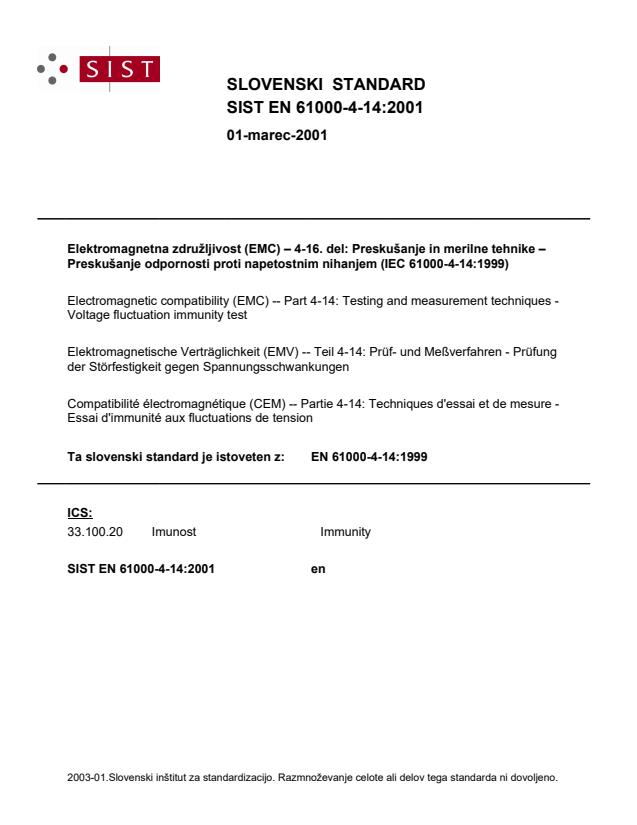
SLOVENSKI STANDARD
01-marec-2001
Elektromagnetna združljivost (EMC) – 4-16. del: Preskušanje in merilne tehnike –
Preskušanje odpornosti proti napetostnim nihanjem (IEC 61000-4-14:1999)
Electromagnetic compatibility (EMC) -- Part 4-14: Testing and measurement techniques -
Voltage fluctuation immunity test
Elektromagnetische Verträglichkeit (EMV) -- Teil 4-14: Prüf- und Meßverfahren - Prüfung
der Störfestigkeit gegen Spannungsschwankungen
Compatibilité électromagnétique (CEM) -- Partie 4-14: Techniques d'essai et de mesure -
Essai d'immunité aux fluctuations de tension
Ta slovenski standard je istoveten z: EN 61000-4-14:1999
ICS:
33.100.20 Imunost Immunity
2003-01.Slovenski inštitut za standardizacijo. Razmnoževanje celote ali delov tega standarda ni dovoljeno.
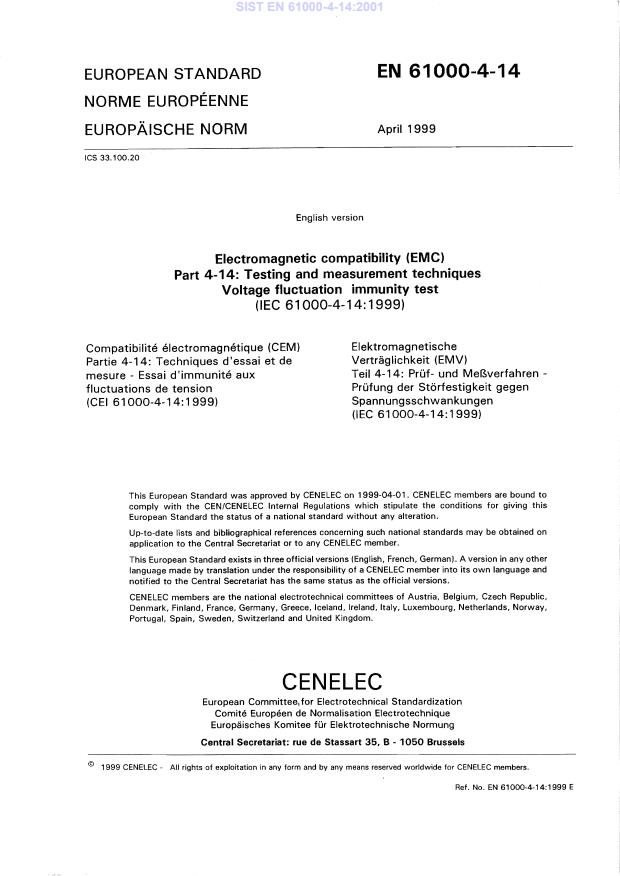
NORME CEI
INTERNATIONALE IEC
61000-4-14
INTERNATIONAL
Première édition
STANDARD
First edition
1999-02
PUBLICATION FONDAMENTALE EN CEM
BASIC EMC PUBLICATION
Compatibilité électromagnétique (CEM) –
Partie 4-14:
Techniques d'essai et de mesure –
Essai d'immunité aux fluctuations de tension
Electromagnetic compatibility (EMC) –
Part 4-14:
Testing and measurement techniques –
Voltage fluctuation immunity test
IEC 1999 Droits de reproduction réservés Copyright - all rights reserved
Aucune partie de cette publication ne peut être reproduite ni No part of this publication may be reproduced or utilized in
utilisée sous quelque forme que ce soit et par aucun procédé, any form or by any means, electronic or mechanical,
électronique ou mécanique, y compris la photo-copie et les including photocopying and microfilm, without permission in
microfilms, sans l'accord écrit de l'éditeur. writing from the publisher.
International Electrotechnical Commission 3, rue de Varembé Geneva, Switzerland
Telefax: +41 22 919 0300 e-mail: inmail@iec.ch IEC web site http://www.iec.ch
CODE PRIX
Commission Electrotechnique Internationale
N
PRICE CODE
International Electrotechnical Commission
Pour prix, voir catalogue en vigueur
For price, see current catalogue
61000-4-14 IEC:1999 – 3 –
CONTENTS
Page
FOREWORD . 5
INTRODUCTION .7
Clause
1 Scope.9
2 Normative references.9
3 General.11
3.1 Effects of voltage fluctuations. 11
3.2 Sources.11
4 Definitions.11
5 Test levels.13
6 Test equipment.15
6.1 Test generator.15
6.2 Characteristics and performance of the test generator . 15
6.3 Verification of the test generator. 15
7 Test set-up.15
8 Test procedure.17
8.1 Laboratory reference conditions . 17
8.2 Execution of the test . 17
9 Test results and test report. 17
Annex A (informative) Electromagnetic environment classes . 27
Bibliography . 29
Figure 1 – Example of test sequences of voltage fluctuations . 23
Figure 2 – Example of successive applications of voltage fluctuations . 25
Figure 3 – Schematic (single-phase) of test instrumentation for voltage fluctuations,
with power amplifier. 25
61000-4-14 IEC:1999 – 5 –
INTERNATIONAL ELECTROTECHNICAL COMMISSION
___________
ELECTROMAGNETIC COMPATIBILITY (EMC) –
Part 4-14: Testing and measurement techniques –
Voltage fluctuation immunity test
FOREWORD
1) The IEC (International Electrotechnical Commission) is a worldwide organization for standardization comprising
all national electrotechnical committees (IEC National Committees). The object of the IEC is to promote
international co-operation on all questions concerning standardization in the electrical and electronic fields. To
this end and in addition to other activities, the IEC publishes International Standards. Their preparation is
entrusted to technical committees; any IEC National Committee interested in the subject dealt with may
participate in this preparatory work. International, governmental and non-governmental organizations liaising
with the IEC also participate in this preparation. The IEC collaborates closely with the International Organization
for Standardization (ISO) in accordance with conditions determined by agreement between the two
organizations.
2) The formal decisions or agreements of the IEC on technical matters express, as nearly as possible, an
international consensus of opinion on the relevant subjects since each technical committee has representation
from all interested National Committees.
3) The documents produced have the form of recommendations for international use and are published in the form
of standards, technical reports or guides and they are accepted by the National Committees in that sense.
4) In order to promote international unification, IEC National Committees undertake to apply IEC International
Standards transparently to the maximum extent possible in their national and regional standards. Any
divergence between the IEC Standard and the corresponding national or regional standard shall be clearly
indicated in the latter.
5) The IEC provides no marking procedure to indicate its approval and cannot be rendered responsible for any
equipment declared to be in conformity with one of its standards.
6) Attention is drawn to the possibility that some of the elements of this International Standard may be the subject
of patent rights. The IEC shall not be held responsible for identifying any or all such patent rights.
International Standard IEC 61000-4-14 has been prepared by subcommittee 77A: Low fre-
quency phenomena, of IEC technical committee 77: Electromagnetic compatibility.
This standard forms part 4-14 of IEC 61000 series. It has the status of basic EMC publication
in accordance with IEC Guide 107.
The text of this standard is based on the following documents:
FDIS Report on voting
77A/263/FDIS 77A/268/RVD
Full information on the voting for the approval of this standard can be found in the report on
voting indicated in the above table.
Annex A is for information only.
61000-4-14 IEC:1999 – 7 –
INTRODUCTION
IEC 61000 is published in separate parts according to the following structure:
Part 1: General
General considerations (introduction, fundamental principles)
Definitions, terminology
Part 2: Environment
Description of the environment
Classification of the environment
Compatibility levels
Part 3: Limits
Emission limits
Immunity limits (insofar as these limits do not fall under the responsibility of the product
committees)
Part 4: Testing and measurement techniques
Measurement techniques
Testing techniques
Part 5: Installation and mitigation guidelines
Installation guidelines
Mitigation methods and devices
Part 6: Generic standards
Part 9: Miscellaneous
Each part is further subdivided into several parts, published either as International Standards,
or as technical reports, some of which have already been published as sections. Others will be
published with the part number followed by a dash and a second number identifying the
subdivision (example 61000-6-1).
61000-4-14 IEC:1999 – 9 –
ELECTROMAGNETIC COMPATIBILITY (EMC) –
Part 4-14: Testing and measurement techniques –
Voltage fluctuation immunity test
1 Scope
This part of IEC 61000 is a basic electromagnetic compatibility (EMC) publication. It considers
immunity tests for electrical and/or electronic equipment in their electromagnetic environment.
Only conducted phenomena are considered, including immunity tests for equipment connected
to public and industrial power supply networks.
This part aims to establish a reference for evaluating the immunity of electric and electronic
equipment when subjected to positive and negative low amplitude voltage fluctuations.
The voltage fluctuations considered by this standard do not include flicker, which is a
physiological phenomenon due to lighting luminance fluctuations.
This standard applies to electrical and/or electronic equipment that have a rated input current
up to 16 A per phase. It does not apply to electrical and/or electronic equipment connected to
d.c. or a.c. 400 Hz distribution networks. Tests concerning these networks will be covered by
other IEC standards.
The immunity test levels required for a specific electromagnetic environment, together with the
performance criteria, are indicated in the product, product family or generic standards as
applicable. However, most product groups do not have a history of being susceptible to voltage
fluctuations. Consequently, testing for these phenomena is often not required.
2 Normative references
The following normative documents contain provisions which, through reference in this text,
constitute provisions of this part of IEC 61000. For dated references, subsequent amendments
to, or revisions of, any of these publications do not apply. However, parties to agreements
based on this part of IEC 61000 are encouraged to investigate the possibility of applying the
most recent editions of the normative documents indicated below. For undated references, the
latest edition of the normative document referred to applies. Members of IEC and ISO maintain
registers of currently valid International Standards.
IEC 60050(161):1990, International Electrotechnical Vocabulary (IEV) – Chapter 161: Electro-
magnetic compatibility
IEC 60068-1:1988, Environmental testing – Part 1: General and guidance
IEC 61000-2-4:1994, Electromagnetic compatibility (EMC) – Part 2: Environment – Section 4:
Compatibility levels in industrial plants for low-frequency conducted disturbances
61000-4-14 IEC:1999 – 11 –
3 General
3.1 Effects of voltage fluctuations
Electrical and electronic equipment may be affected by voltage fluctuations. Examples of these
effects include the following:
– degradation of performances in equipment using storage devices (e.g. capacitors);
– loss of function in control systems;
– instability of internal voltages and currents in equipment;
– increased ripple.
3.2 Sources
There is a significant number of domestic appliances in the low-voltage network. However,
fluctuations caused by these appliances are not generally significant.
Fluctuations are mainly produced by
a) continuously but randomly varying large loads such as:
1) resistance welding machines;
2) rolling mills;
3) large motors with varying loads;
4) arc furnaces;
5) arc welding plant;
b) single on/off switching of loads (e.g. motors);
c) step voltage changes (due to tap voltage regulators of transformers).
These industrially produced fluctuations can affect a large number of consumers. Such
equipment operates co
...