

SIST-TS ISO/PAS 45007:2026
(Main)Occupational health and safety management - Risks arising from climate change and climate change action - Guidance for organizations
- Abstract
This document gives guidance to organizations on planning for and addressing occupational health and safety (OH&S) risks arising from climate change and climate change action, including:
— OH&S risks which arise as a result of climate change adaptation efforts, including changing ways of working and work processes, and infrastructure upgrades;
— OH&S risks arising from climate change mitigation actions;
— OH&S opportunities arising from both climate change adaptation and mitigation actions.
This document is applicable to all organizations taking a systematic approach to addressing OH&S risks arising from climate change. It is applicable to organizations of all sizes including small and medium-sized enterprises (SMEs).
- Status
- Published
- Publication Date
- 16-Jul-2026
- Technical Committee
- VZK - Quality management and quality assurance
- Current Stage
- 6060 - National Implementation/Publication (Adopted Project)
- Start Date
- 09-Jul-2026
- Due Date
- 13-Sep-2026
- Completion Date
- 17-Jul-2026
Buy Documents

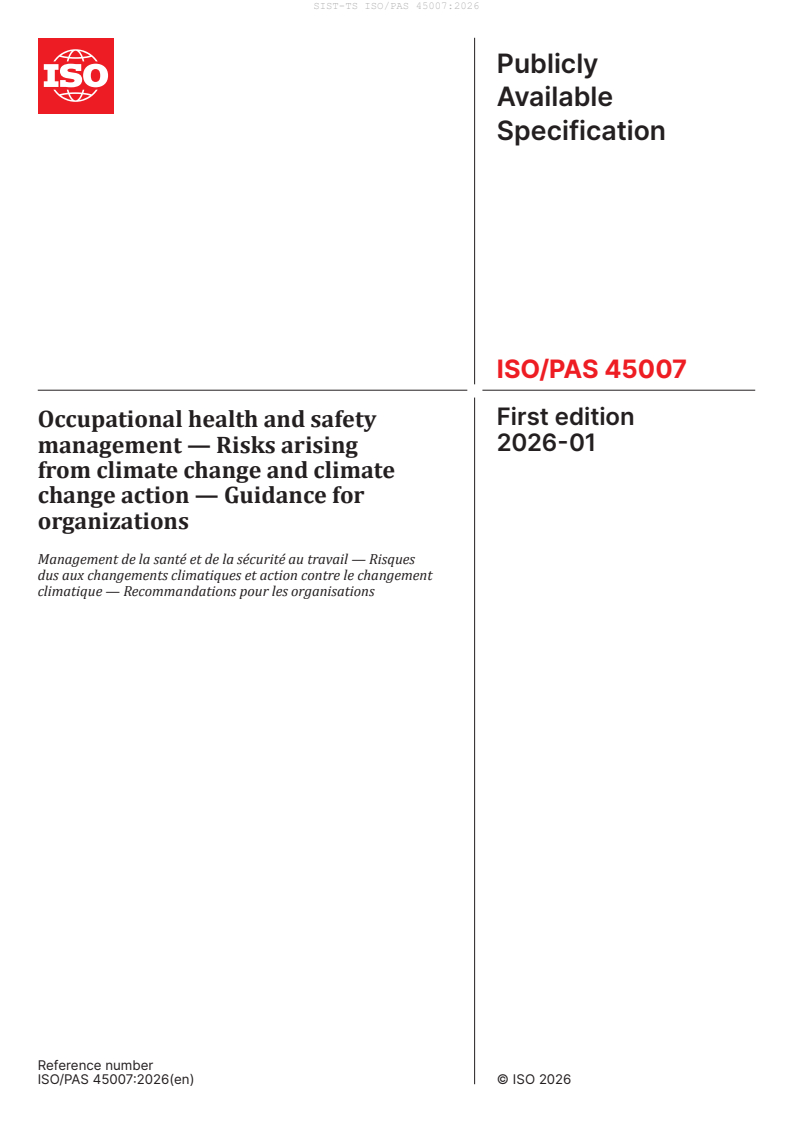

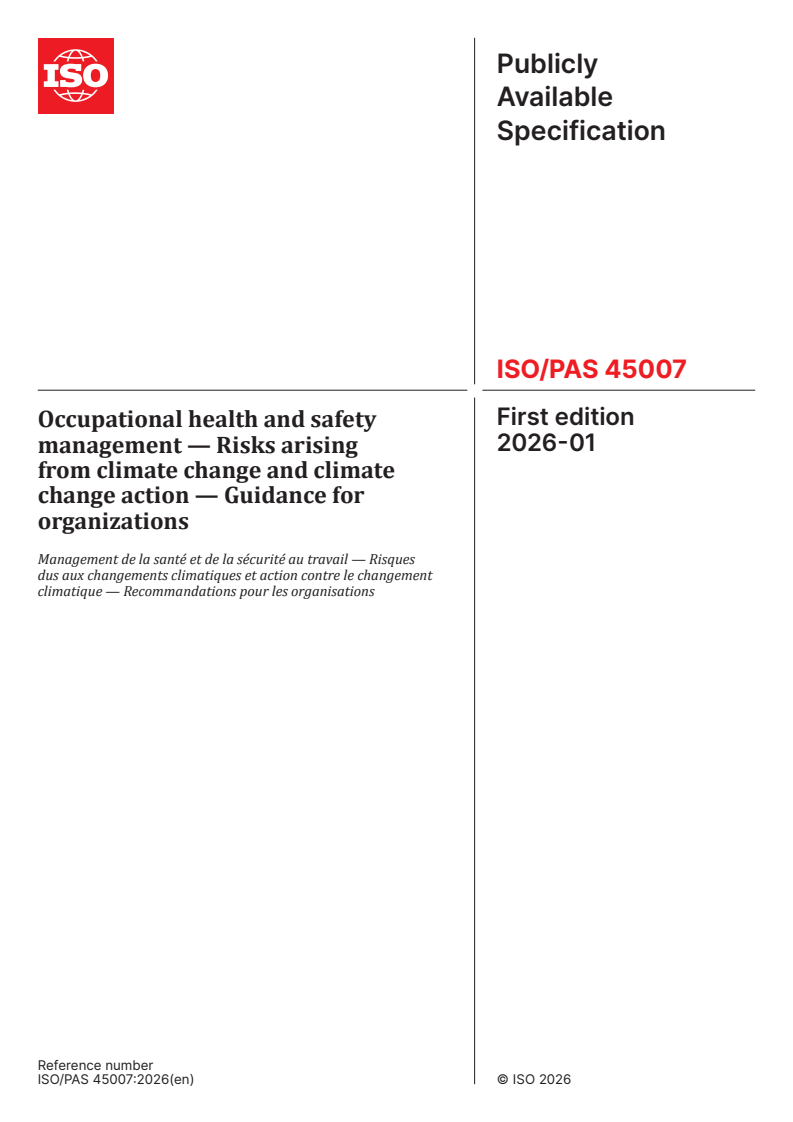

ISO/PAS 45007:2026 - Occupational health and safety management — Risks arising from climate change and climate change action — Guidance for organizations Released:14. 01. 2026
ISO/PAS 45007:2026 - Occupational health and safety management — Risks arising from climate change and climate change action — Guidance for organizations
SIST-TS ISO/PAS 45007:2026 is a publicly available specification from ISO that gives guidance on managing occupational health and safety (OH&S) risks and opportunities linked to climate change and climate change action. It helps organizations plan for climate-related impacts, including adaptation and mitigation measures that can change work, workplaces, emergency readiness, supply chains, and worker vulnerability.
What does SIST-TS ISO/PAS 45007:2026 specify?
SIST-TS ISO/PAS 45007:2026 specifies guidance for organizations that want a systematic way to address OH&S risks arising from climate change and from actions taken in response to climate change. The document applies to organizations of all sizes, including small and medium-sized enterprises (SMEs), and it covers both risks and opportunities.
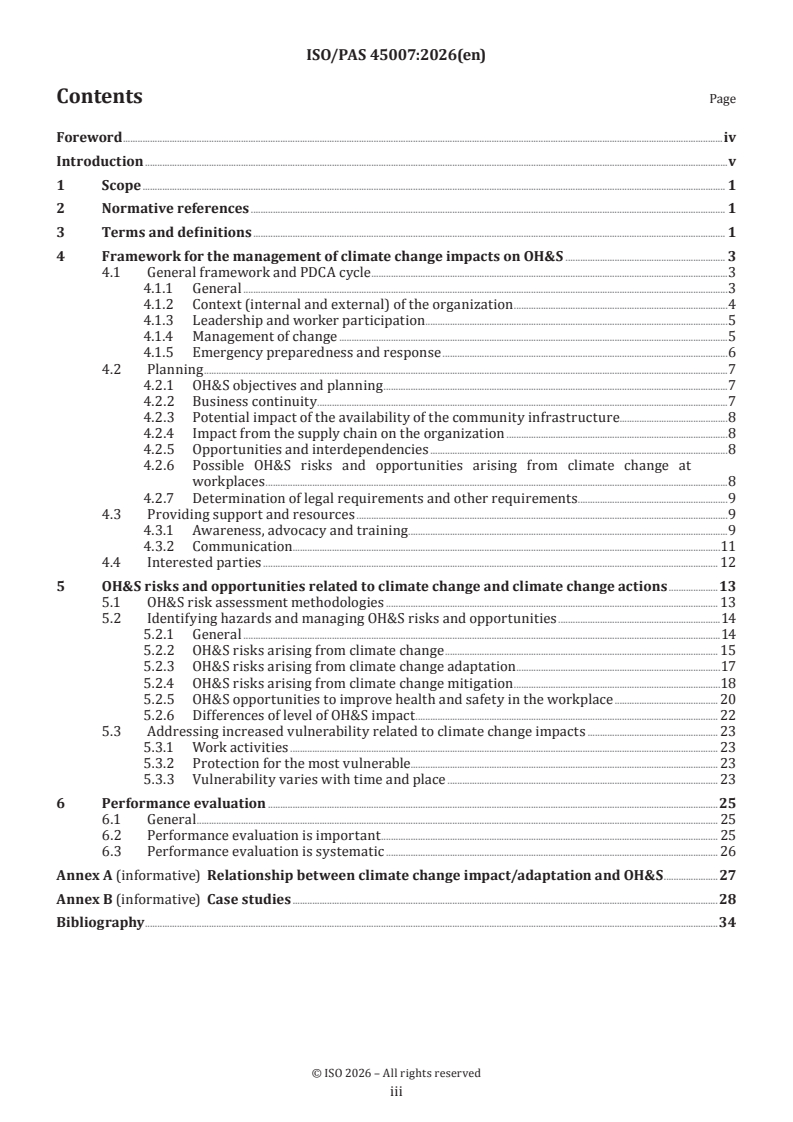
The document is organized into six clauses and two informative annexes.
| Annex | What it covers |
|---|---|
| Annex A | The relationship between climate change impacts or adaptation and OH&S |
| Annex B | Case studies |
Clause 1 states the scope. Clause 2 covers normative references. Clause 3 gives terms and definitions. Clause 4 sets out the management framework, including context, leadership, change management, emergency preparedness, planning, support, communication and interested parties. Clause 5 addresses OH&S risk assessment, hazard identification, vulnerability and opportunities. Clause 6 covers performance evaluation.
What are the key requirements of SIST-TS ISO/PAS 45007:2026?
SIST-TS ISO/PAS 45007:2026 is mainly a guidance document, but it still sets out a clear management approach. The core idea is that climate change should be treated as an external issue that can alter risk, controls, technology, work organization and emergency response, so organizations need to review their OH&S system in a structured way.
Context, leadership and change management
Clause 4.1 says organizations should analyze internal and external issues that affect their ability to deal with climate-related OH&S effects. That includes location, infrastructure, worker characteristics, resources, laws, utilities, emergency services and supply chain resilience. In practice, this means climate change should be considered when deciding where and how work is done.
Clause 4.1.3 asks top management to lead the response, communicate the issue, provide resources and remove barriers to worker participation. Clause 4.1.4 says climate-related changes to operations should go through the organization’s management of change process. This matters because adaptation or mitigation measures can create new hazards even when they are meant to reduce risk.
Emergency preparedness and business continuity
Clause 4.1.5 links climate change to emergency preparedness and response. It points to events such as heatwaves, tornadoes and flooding, and to reduced access to water or external emergency services. Clause 4.2.2 adds business continuity, so organizations can keep critical functions going during and after disruption while protecting workers.
In practice, organizations are expected to plan for evacuation, response, communication, recovery and continuity together, not as separate activities. The document also highlights early warning systems (EWS), which can help organizations act before conditions become dangerous.
Planning, objectives and supply chains
Clause 4.2.1 asks organizations to set OH&S objectives related to climate risks, adaptation and mitigation, and to review them regularly. Clause 4.2.3 looks at community infrastructure, while Clause 4.2.4 focuses on supply chain impacts. Clause 4.2.5 reminds organizations to look for opportunities as well as risks.
The practical message is that climate change planning should include dependence on utilities, transport, health services, local emergency response and suppliers. If those links fail, workers can be exposed to delays, unsafe conditions or disrupted controls.
Support, training and communication
Clause 4.3.1 says workers should receive awareness, advocacy and training so they can recognize climate-related hazards and respond appropriately. The training should fit the organization’s context and the different roles of executives, managers, supervisors, frontline workers, temporary workers and self-employed contract workers.
Clause 4.3.2 emphasizes internal and external communication, early warning, and the need to deal with misinformation and disinformation. In practice, organizations should make sure warnings reach workers in time and that climate-related messages are based on reliable information.
Risk assessment, hazards and vulnerability
Clause 5.1 explains that climate-related risks can be systemic, long term and indirect, so they may need an “impact chain” approach rather than a normal one-step hazard check. Clause 5.2 separates risks from climate change itself, from adaptation actions, and from mitigation actions.
Clause 5.2.1 to 5.2.4 give examples such as heat stress, flooding, vector-borne disease, pesticide exposure, relocation, new technologies, energy systems and transport changes. Clause 5.2.5 also shows that some adaptation and mitigation actions can improve workplace safety, for example by improving lighting, ventilation, emergency readiness, hydration, transport or work schedules.
Clause 5.3 focuses on vulnerability. It asks organizations to look at work activities, individual workers and groups that may be more exposed or less able to adapt, such as outdoor workers, people with health conditions, and workers affected by location, mobility or socioeconomic factors.
Performance evaluation
Clause 6 says organizations should evaluate whether their climate-related OH&S actions are working. That includes setting objectives, choosing reliable indicators, checking for unintended consequences and using the findings to improve plans, controls and management decisions. This matters because climate risk control has to be tracked over time, not just designed once.
What terms does SIST-TS ISO/PAS 45007:2026 define?
- Climate - the statistical description of weather over time, using mean and variability of relevant quantities.
- Climate change - a persistent change in climate, typically over decades or longer.
- Climate change action - an initiative to meet climate change goals through mitigation and/or adaptation.
- Climate change adaptation - adjustment to actual or expected climate and its effects.
- Climate change mitigation - human intervention to reduce greenhouse gas (GHG) emissions or increase GHG removals.
- Climate change risk - the risk of negative climate change impacts that depends on vulnerability, exposure and hazard.
- Occupational health and safety risk (OH&S risk) - the combination of likelihood and severity of work-related harm.
- Impact chain - an analytical way to understand how hazards create direct and indirect impacts through a system.
Who uses SIST-TS ISO/PAS 45007:2026?
SIST-TS ISO/PAS 45007:2026 is for organizations that manage OH&S risks in changing climate conditions, whether they already use a formal OH&S management system or not. It is especially relevant to OH&S managers, senior leaders, supervisors, facilities and operations teams, emergency planners, human resources, maintenance teams, and supply chain and sustainability functions.
It is useful in sectors and jobs exposed to heat, cold, flooding, storms, outdoor work, utilities disruption, new technologies, transport changes, agriculture, construction, emergency response, manufacturing and energy. It also matters for buyers, contractors and other interested parties that want to understand how an organization is handling climate-related worker safety.
Which standards are used with SIST-TS ISO/PAS 45007:2026?
SIST-TS ISO/PAS 45007:2026 points readers to several related standards and guidance documents:
- ISO 45001:2018 - the main OH&S management system requirements, which this document builds on.
- ISO 45002:2023 - implementation guidance for ISO 45001, including communication.
- ISO 45004:2024 - guidance on OH&S performance evaluation.
- ISO 45006:2023 - guidance on preventing, controlling and managing infectious diseases.
- ISO 14090:2019 and ISO 14091 - climate change adaptation principles and vulnerability, impacts and risk assessment.
- ISO 14080:2018 - framework and principles for climate actions.
- ISO Guide 84:2020 - terminology and guidance on climate change in standards.
- ISO 7243:2017, ISO 8025:2024 and ISO 28803:2012 - thermal environment and special requirements references used for specific risk assessments.
- ISO 37002:2021 - whistleblowing guidance, relevant to complaint and concern reporting.
What does the SIST-TS ISO/PAS 45007:2026 document contain?
SIST-TS ISO/PAS 45007:2026 contains a framework figure linking the document to the PDCA cycle, plus several tables that give practical examples of climate-related hazards, risks, controls and opportunities. Tables 1 to 5 compare climate change, adaptation and mitigation impacts, and show how they can affect heat, water, weather, disease, air quality, transport, energy and technology.
Table 6 gives performance evaluation tasks and the questions organizations should ask when checking whether their actions are working. Annex A explains the pathways from climate impacts to OH&S effects such as heat illness, waterborne disease, respiratory harm, displacement and mental health impacts. Annex B gives case studies for an oil palm plantation, a chemical manufacturing facility, farming and an offshore wind farm, showing how organizations can turn climate-related risk into safer work practices and operational changes.
Buy Documents
ISO/PAS 45007:2026 - Occupational health and safety management — Risks arising from climate change and climate change action — Guidance for organizations Released:14. 01. 2026
ISO/PAS 45007:2026 - Occupational health and safety management — Risks arising from climate change and climate change action — Guidance for organizations
Get Certified
Connect with accredited certification bodies for this standard

BSI Group
BSI (British Standards Institution) is the business standards company that helps organizations make excellence a habit.

Bureau Veritas
Bureau Veritas is a world leader in laboratory testing, inspection and certification services.

DNV
DNV is an independent assurance and risk management provider.
Sponsored listings
Frequently Asked Questions
SIST-TS ISO/PAS 45007:2026 is a technical specification published by the Slovenian Institute for Standardization (SIST). Its full title is "Occupational health and safety management - Risks arising from climate change and climate change action - Guidance for organizations". This standard covers: This document gives guidance to organizations on planning for and addressing occupational health and safety (OH&S) risks arising from climate change and climate change action, including: — OH&S risks which arise as a result of climate change adaptation efforts, including changing ways of working and work processes, and infrastructure upgrades; — OH&S risks arising from climate change mitigation actions; — OH&S opportunities arising from both climate change adaptation and mitigation actions. This document is applicable to all organizations taking a systematic approach to addressing OH&S risks arising from climate change. It is applicable to organizations of all sizes including small and medium-sized enterprises (SMEs).
This document gives guidance to organizations on planning for and addressing occupational health and safety (OH&S) risks arising from climate change and climate change action, including: — OH&S risks which arise as a result of climate change adaptation efforts, including changing ways of working and work processes, and infrastructure upgrades; — OH&S risks arising from climate change mitigation actions; — OH&S opportunities arising from both climate change adaptation and mitigation actions. This document is applicable to all organizations taking a systematic approach to addressing OH&S risks arising from climate change. It is applicable to organizations of all sizes including small and medium-sized enterprises (SMEs).
SIST-TS ISO/PAS 45007:2026 is classified under the following ICS (International Classification for Standards) categories: 13.100 - Occupational safety. Industrial hygiene. The ICS classification helps identify the subject area and facilitates finding related standards.
SIST-TS ISO/PAS 45007:2026 is available in PDF format for immediate download after purchase. The document can be added to your cart and obtained through the secure checkout process. Digital delivery ensures instant access to the complete standard document.
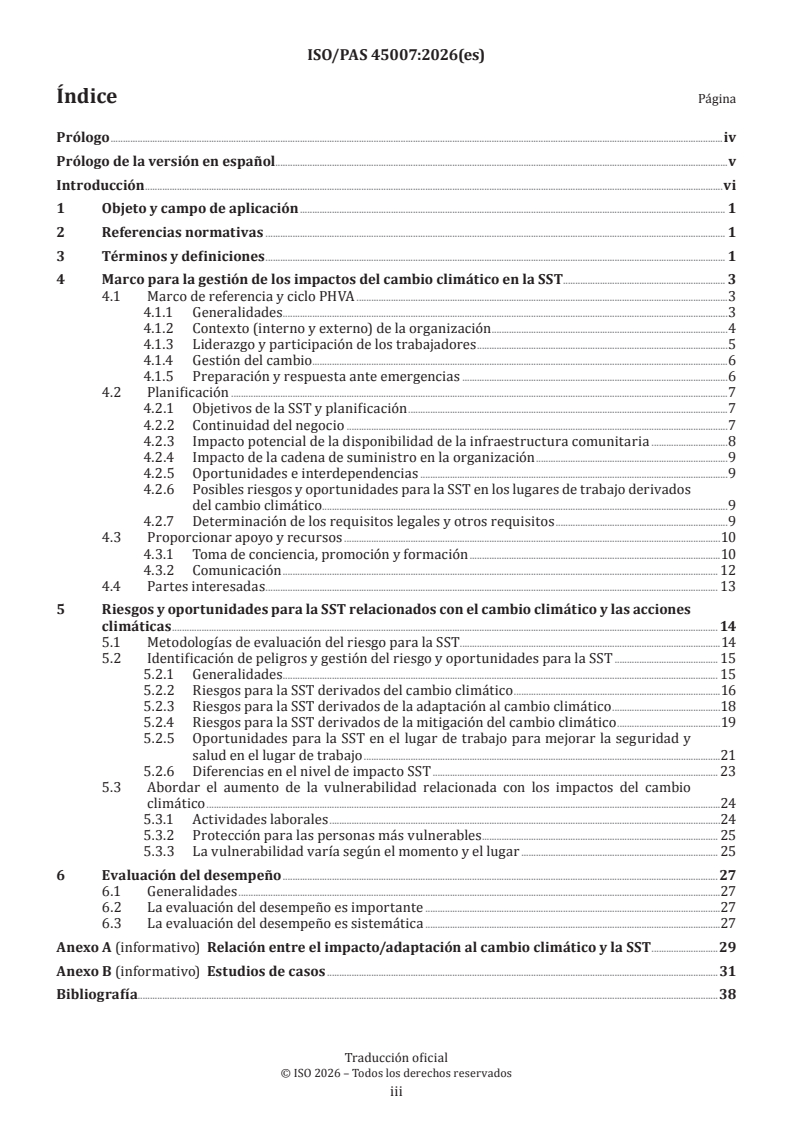
Standards Content (Sample)
Contents
- Introduction
- 1 Scope
- 2 Normative references
- 3 Terms and definitions
- 3.1 climate
- 3.2 climate change
- 3.3 climate change action
- 3.4 climate change adaptation
- 3.5 climate change impact
- 3.6 climate change mitigation
- 3.7 climate change risk
- 3.8 extreme weather event
- 3.9 impact chain
- 3.10 organization
- 3.11 occupational health and safety risk
- 4 Framework for the management of climate change impacts on OH&S
- 4.1 General framework and PDCA cycle
- 4.2 Planning
- 4.3 Providing support and resources
- 4.4 Interested parties
- 5 OH&S risks and opportunities related to climate change and climate change
- 5.1 OH&S risk assessment methodologies
- 5.2 Identifying hazards and managing OH&S risks and opportunities
- 5.3 Addressing increased vulnerability related to climate change impacts
- 6 Performance evaluation
- 6.1 General
- 6.2 Performance evaluation is important
- 6.3 Performance evaluation is systematic
- Annex A
- Annex B
- Bibliography
Introduction
Climate change poses significant challenges to organizations worldwide, impacting not only the environment but also occupational health and safety (OH&S), meaning that it is important that organizations proactively address the OH&S challenges arising from climate change and climate change actions. This document provides comprehensive guidance for organizations to manage these risks and opportunities effectively. This document is intended for all organizations, whether or not they have implemented informal or formal OH&S management system such as ISO 45001. Such a management system includes the relevant elements of a Plan-Do-Check-Act (PDCA) system. Taking a systems approach facilitates the coordination of resources and efforts, which is important in managing climate change.
This document will assist organizations to better understand the impacts of climate change and climate change actions on OH&S and to create resilient and sustainable work environments that protect the health and safety of workers.
It encompasses OH&S risks resulting from climate change itself, as well as those arising from climate change adaptation efforts, such as changes in work processes or infrastructure upgrades, and those associated with climate change mitigation efforts aimed at reducing greenhouse gas (GHG) effects or an organization’s carbon footprint.
It also highlights the opportunities to enhance workplace health and safety through proactive measures. Due to the nature of the subject, many definitions and concepts have been imported from the fields of climate change science and adapted to the context of hazard identification and assessment and control of OH&S risks, with focus on both health and safety impacts and opportunities.
SIST-TS ISO/PAS 45007:2026
SIST-TS ISO/PAS 45007:2026 Publicly Available Specification ISO/PAS 45007:2026(en) Occupational health and safety management — Risks arising from climate change and climate change action — Guidance for organizations
1 Scope
This document gives guidance to organizations on planning for and addressing occupational health and safety (OH&S) risks arising from climate change and climate change action, including:
- OH&S risks which arise as a result of climate change adaptation efforts, including changing ways of working and work processes, and infrastructure upgrades;
- OH&S risks arising from climate change mitigation actions;
- OH&S opportunities arising from both climate change adaptation and mitigation actions. This document is applicable to all organizations taking a systematic approach to addressing OH&S risks arising from climate change. It is applicable to organizations of all sizes including small and medium-sized enterprises (SMEs).
2 Normative references
There are no normative references in this document.
3 Terms and definitions
For the purposes of this document, the following terms and definitions apply. ISO and IEC maintain terminology databases for use in standardization at the following addresses:
- ISO Online browsing platform: available at https:// www .iso .org/ obp
- IEC Electropedia: available at https:// www .electropedia .org/
3.1 climate
statistical description of weather in terms of the mean and variability of relevant quantities over a period of time ranging from months to thousands or millions of years Note 1 to entry: The usual period for considering these variables is 30 years, as defined by the World Meteorological Organization.
Note 2 to entry: The relevant quantities are most often near-surface variables such as temperature, precipitation and wind.
[SOURCE: ISO 14090:2019, 3.4]
3.2 climate change
change in climate (3.1) that persists for an extended period, typically decades or longer Note 1 to entry: Change in climate can be identified (e.g. by using statistical tests) by changes in the mean and/or the variability of its properties.
SIST-TS ISO/PAS 45007:2026 ISO/PAS 45007:2026(en) Note 2 to entry: Climate change can be due to natural processes, internal to the climate system, or external forces such as modulations of the solar cycles, volcanic eruptions, and persistent anthropogenic changes in the composition of the atmosphere or in land use.
[SOURCE: ISO Guide 84:2020, 3.1.2]
3.3 climate change action
initiative to achieve climate change measures or goals based on mitigation and/or adaptation priorities under climate change policies Note 1 to entry: Climate change action intends to a) reduce or prevent emissions or enhance removals, and b) reduce vulnerability, maintain and increase the resilience, and increase adaptive capacity of human and ecological systems from adverse climate change impacts (3.5).
[SOURCE: ISO 14080:2018, 3.1.1.1, modified — “change” added to the term.]
3.4 climate change adaptation
process of adjustment to actual or expected climate (3.1) and its effects Note 1 to entry: In human systems, adaptation seeks to moderate or avoid harm or exploit beneficial opportunities. Note 2 to entry: In some natural systems, human intervention can facilitate adjustment to expected climate and its effects.
[SOURCE: ISO 14090:2019, 3.1, modified — “climate change adaptation” replaced “adaptation to climate change” as the preferred term.]
3.5 climate change impact
effect on natural and human systems of extreme weather and climate events and of climate change (3.2) Note 1 to entry: Impacts generally refer to effects on lives, livelihoods, health, ecosystems, economies, societies, cultures, services and infrastructure due to the interaction of climate change or hazardous climate events occurring within a specific time period and the vulnerability of an exposed society or system. Impacts are also referred to as consequences and outcomes. The impacts of climate change on geophysical systems, including floods, droughts and sea level rise, are a subset of impacts called “physical impacts”. [SOURCE: ISO 14090:2019, 3.8, modified — “climate change” added to the term. “of extreme weather and climate events and of climate change” added to the definition. “In the context of climate change” deleted from Note 1 to entry.]
3.6 climate change mitigation
human intervention to reduce greenhouse gas (GHG) emissions or enhance GHG removals [SOURCE: ISO 14080:2018, 3.1.2.1, modified — “to reduce greenhouse gas (GHG) emissions or enhance GHG removals” replaced “to reduce the sources or enhance the sinks of greenhouse gases (GHGs)” in the definition.]
3.7 climate change risk
risk of negative climate change impacts (3.5) that reflects the interaction among vulnerability, exposure and hazard Note 1 to entry: A risk assessment can include the consideration of vulnerabilities, exposure and climate change hazards, or the consideration of likelihoods and consequences. [SOURCE: ISO Guide 84:2020, 3.1.6]
SIST-TS ISO/PAS 45007:2026 ISO/PAS 45007:2026(en)
3.8 extreme weather event
event that is significantly different from typical weather patterns or occurrences Note 1 to entry: What is considered extreme can change based on location and can change over time.
3.9 impact chain
analytical approach that enables understanding of how given hazards generate direct and indirect impacts which propagate through a system at risk
3.10 organization
person or group of people that has its own functions with responsibilities, authorities and relationships to achieve its objectives Note 1 to entry: The concept of organization includes, but is not limited to, sole-trader, company, corporation, firm, enterprise, authority, partnership, charity or institution, or part or combination thereof, whether incorporated or not, public or private.
3.11 occupational health and safety risk
OH&S risk combination of the likelihood of occurrence of a work-related hazardous event(s) or exposure(s) and the severity of injury and ill health that can be caused by the event(s) or exposure(s) Note 1 to entry: In this document, referring to “OH&S risk” means OH&S risks and risks to the OH&S management system.
Note 2 to entry: OH&S risk includes the “cause – effect” relationship of cascading risks (chain of events) in the context of climate change (3.2), for both existing and new/emerging risks. [SOURCE: ISO 45001:2018, 3.21, modified — Notes 1 and 2 to entry added.]
4 Framework for the management of climate change impacts on OH&S
4.1 General framework and PDCA cycle
4.1.1 General
An informal or formal system to manage OH&S risks and opportunities outlines the need for an organization to identify issues that can affect its ability to achieve the intended result(s). A formal management system includes the relevant elements of a PDCA system (see Figure 1). Climate change is an external issue (see the examples given in Annex B) which poses OH&S risks (and opportunities) and can require the organization to adapt its OH&S management system, due to changes in context, risks, availability of technologies and other aspects related to OH&S management.
It is crucial that the organization analyses its context before adopting relevant changes in production, work organization, introduction of technologies and other actions.
Actions to address the effects of climate change by introducing new work systems and technologies can create new OH&S risks and opportunities. The risks can impact workers’ mental and physical health and safety.
Regardless of the framework adopted, it is important that processes and arrangements are tailored to reflect the organization and its context. This includes tailoring to reflect the demands on the organization’s management of OH&S risk(s) that arise from climate change. This clause highlights some of the key areas for attention.
SIST-TS ISO/PAS 45007:2026 ISO/PAS 45007:2026(en) Figure 1 — Framework of this document and its relationship to PDCA
4.1.2 Context (internal and external) of the organization
The organization should determine internal and external issues that affect its ability to address the OH&S- related effects, where applicable, of climate change and the needs and expectations of interested parties (e.g. contractors, insurance companies) in relation to these effects. The organization should consider how these issues affect its OH&S risks and opportunities, and how they are managed. Examples of internal issues that can affect the organization’s management of the OH&S impacts, some broader and others more specific to climate change, include:
- issues raised by workers and other interested parties that can impact the organization’s internal activities;
- internal requirements, including policies and practices, mission, vision, values, objectives, strategies, agreements and guidelines;
- organization structure and governance model, work scope, work shifts, roles, functions and responsibilities;
- processes, products and services, including the location of premises in geographical zones with higher climate change impacts and frequent travels of workers due to their work activity, including zones with specific impacts of climate change (e.g. extreme temperatures);
- differences in vulnerability due to demographic characteristics of workers (e.g. gender, age, disabilities);
SIST-TS ISO/PAS 45007:2026 ISO/PAS 45007:2026(en) - proficiency in languages, literacy and education levels; - financial, human (availability, competence, etc.) and technological (availability and conditions of equipment, products, facilities, systems and workplaces) resources and distribution of resources. Examples of external issues that can affect the organization’s management of the OH&S impacts, some broader and others more specific to climate change, include:
- legal requirements and other requirements, including legislation, sectoral agreements, conventions and voluntary agreements subscribed to by the organization;
- local authorities that plan to cope with specific climate change impacts and/or possible impacts of climate change on supplies such as water or electricity, or emergency response;
- local transport services and infrastructure, potentially affecting the organization’s ability to effect significant changes to working hours, or shift patterns (e.g. to avoid the hottest times of day);
- dependence upon supplied products and services, utilities and external services (e.g. emergency response and medical services) and the resilience of these in relation to climate change;
- influence of economic, financial, political factors, national or international conflict on local resources and delivery (e.g. disaster relief delivery);
- influence of climate change impacts (e.g. loss of crops producing economic conflict) on economic, financial, political stability in a region where operations are conducted;
- technological innovations, equipment, products and systems evolution, and more specifically those intended to reduce OH&S risks as a result of climate change mitigation or adaptation (e.g. cooling vest against extreme heat for construction workers);
- the geographical location of the organization relative to natural or human-originated disasters and associated climate change impacts.
4.1.3 Leadership and worker participation
Top management should engage in, promote, communicate and monitor the performance and effectiveness of the organization in addressing the OH&S-related impacts of climate change, and in minimizing OH&S harm from climate change mitigation and adaptation. How this can be applied depends on various factors, such as the size and complexity of the organization, its management style and organizational culture. In addition to providing direction to the organization, top management should also ensure that the organization provides the necessary physical and financial resources to enable it to effectively address the OH&S-related effects of climate change.
Top management should encourage worker participation by:
- communicating the importance of the organization’s efforts to address the impacts of climate change on OH&S and encouraging workers to support them;
- ensuring the organization establishes processes for consultation and participation of workers, and their representatives when they exist, and removing barriers that limit worker participation;
- ensuring that workers are protected from reprisals when they report climate-change-related OH&S issues and concerns by ensuring the organization identifies or establishes processes for investigating and resolving relevant concerns and complaints, as well as a whistleblowing system and policy.
4.1.4 Management of change
The organization should include in its process(es) for the management of change the new aspects arising from climate change and its OH&S-related impacts.
SIST-TS ISO/PAS 45007:2026 ISO/PAS 45007:2026(en) Changes made to the organization’s operations to mitigate and/or adapt to the effects of climate change should be managed to avoid adverse OH&S impacts on workers. This should include consultation with affected workers.
NOTE Changes can result in OH&S risks and opportunities.
4.1.5 Emergency preparedness and response
The focus of this subclause is to provide specific guidance on emergency preparedness and response of the organization arising from:
- OH&S-related emergency situations resulting from climate change (e.g. such as heatwaves, tornados, flooding);
- climate change effects on the organization’s emergency management (e.g. lack of access to water, limited external emergency services response).
The emergency management processes can include the use of information provided by the early warning system (EWS).
NOTE EWS refers to a system or mechanism that provides advance notice of a serious or dangerous event that is about to happen. It can be used in various contexts, such as detecting enemy attacks, predicting natural disasters or identifying potential health problems.
Therefore, to effectively address OH&S risk arising from climate change, the organization should consider establishing vigorous and robust emergency management processes. The organization should make efforts to enhance its preparedness, coordination and response strategies to effectively mitigate the health and safety risks associated with climate-change-related emergencies, by:
- incorporating climate change considerations into its OH&S risk assessments;
- determining how climate change can create risks to the OH&S management system and OH&S opportunities;
- developing adaptive/dynamic/resilient response plans;
- promoting collaboration between emergency teams/establishments, public health agencies and other relevant interested parties.
The organization should review how relevant climate change events/disasters at the workplaces can adversely affect the effectiveness of its emergency preparedness and response. Climate change events/ disasters can lead to:
a) exposure to new hazards; b) exposing emergency response workers to new OH&S risks; c) the increasing likelihood or severity, or both, of previously identified OH&S risks (related to a lack of understanding of the severity of emergency situations including disasters, underestimating the size and scale, and failing to keep up to date with local and regional climate-change-related emergency tiers/ levels such as civil defence agencies, fire departments and healthcare agencies); d) limitation of the interested party’s capability to respond to emergencies (e.g. vulnerability of supply chain, regulatory and voluntary agreement issues).
The organization should consider inclusiveness when planning for emergency preparedness and response to climate change events/disasters.
SIST-TS ISO/PAS 45007:2026 ISO/PAS 45007:2026(en)
4.2 Planning
4.2.1 OH&S objectives and planning
The organization should establish clear objectives regarding risks, opportunities and impacts resulting from climate change, its adaptations and climate change actions, and determine whether it needs to establish new processes, procure new technologies or other actions.
The organization should determine specific objectives and expected results for continuing operations, addressing climate-change-related problems including supply chains and protecting vulnerable groups or individuals.
EXAMPLE Storms, floods, blackouts, reduced work performance due to heat-related issues. The organization should regularly review its OH&S objectives to determine:
a) if they are still valid; b) if some objectives need to be revised; c) if objectives need to be added or removed.
NOTE In some countries, operational risk assessment and the derivation of measures is a legal obligation.
4.2.2 Business continuity
Business continuity refers to the capability of an organization to continue its critical functions during and after a disruptive incident or crisis, minimizing adverse impact on the organization, its interested parties and society as a whole.
Organizations should include OH&S considerations when analysing the situations arising from climate change consequences that can challenge business continuity.
The organization should consider the following key aspects (using the case of flooding as an example):
...
Contents
- Introduction
- 1 Scope
- 2 Normative references
- 3 Terms and definitions
- 3.1 climate
- 3.2 climate change
- 3.3 climate change action
- 3.4 climate change adaptation
- 3.5 climate change impact
- 3.6 climate change mitigation
- 3.7 climate change risk
- 3.8 extreme weather event
- 3.9 impact chain
- 3.10 organization
- 3.11 occupational health and safety risk
- 4 Framework for the management of climate change impacts on OH&S
- 4.1 General framework and PDCA cycle
- 4.2 Planning
- 4.3 Providing support and resources
- 4.4 Interested parties
- 5 OH&S risks and opportunities related to climate change and climate change
- 5.1 OH&S risk assessment methodologies
- 5.2 Identifying hazards and managing OH&S risks and opportunities
- 5.3 Addressing increased vulnerability related to climate change impacts
- 6 Performance evaluation
- 6.1 General
- 6.2 Performance evaluation is important
- 6.3 Performance evaluation is systematic
- Annex A
- Annex B
- Bibliography
Introduction
Climate change poses significant challenges to organizations worldwide, impacting not only the environment but also occupational health and safety (OH&S), meaning that it is important that organizations proactively address the OH&S challenges arising from climate change and climate change actions. This document provides comprehensive guidance for organizations to manage these risks and opportunities effectively. This document is intended for all organizations, whether or not they have implemented informal or formal OH&S management system such as ISO 45001. Such a management system includes the relevant elements of a Plan-Do-Check-Act (PDCA) system. Taking a systems approach facilitates the coordination of resources and efforts, which is important in managing climate change.
This document will assist organizations to better understand the impacts of climate change and climate change actions on OH&S and to create resilient and sustainable work environments that protect the health and safety of workers.
It encompasses OH&S risks resulting from climate change itself, as well as those arising from climate change adaptation efforts, such as changes in work processes or infrastructure upgrades, and those associated with climate change mitigation efforts aimed at reducing greenhouse gas (GHG) effects or an organization’s carbon footprint.
It also highlights the opportunities to enhance workplace health and safety through proactive measures. Due to the nature of the subject, many definitions and concepts have been imported from the fields of climate change science and adapted to the context of hazard identification and assessment and control of OH&S risks, with focus on both health and safety impacts and opportunities.
Publicly Available Specification ISO/PAS 45007:2026(en) Occupational health and safety management — Risks arising from climate change and climate change action — Guidance for organizations
1 Scope
This document gives guidance to organizations on planning for and addressing occupational health and safety (OH&S) risks arising from climate change and climate change action, including:
- OH&S risks which arise as a result of climate change adaptation efforts, including changing ways of working and work processes, and infrastructure upgrades;
- OH&S risks arising from climate change mitigation actions;
- OH&S opportunities arising from both climate change adaptation and mitigation actions. This document is applicable to all organizations taking a systematic approach to addressing OH&S risks arising from climate change. It is applicable to organizations of all sizes including small and medium-sized enterprises (SMEs).
2 Normative references
There are no normative references in this document.
3 Terms and definitions
For the purposes of this document, the following terms and definitions apply. ISO and IEC maintain terminology databases for use in standardization at the following addresses:
- ISO Online browsing platform: available at https:// www .iso .org/ obp
- IEC Electropedia: available at https:// www .electropedia .org/
3.1 climate
statistical description of weather in terms of the mean and variability of relevant quantities over a period of time ranging from months to thousands or millions of years Note 1 to entry: The usual period for considering these variables is 30 years, as defined by the World Meteorological Organization.
Note 2 to entry: The relevant quantities are most often near-surface variables such as temperature, precipitation and wind.
[SOURCE: ISO 14090:2019, 3.4]
3.2 climate change
change in climate (3.1) that persists for an extended period, typically decades or longer Note 1 to entry: Change in climate can be identified (e.g. by using statistical tests) by changes in the mean and/or the variability of its properties.
ISO/PAS 45007:2026(en) Note 2 to entry: Climate change can be due to natural processes, internal to the climate system, or external forces such as modulations of the solar cycles, volcanic eruptions, and persistent anthropogenic changes in the composition of the atmosphere or in land use.
[SOURCE: ISO Guide 84:2020, 3.1.2]
3.3 climate change action
initiative to achieve climate change measures or goals based on mitigation and/or adaptation priorities under climate change policies Note 1 to entry: Climate change action intends to a) reduce or prevent emissions or enhance removals, and b) reduce vulnerability, maintain and increase the resilience, and increase adaptive capacity of human and ecological systems from adverse climate change impacts (3.5).
[SOURCE: ISO 14080:2018, 3.1.1.1, modified — “change” added to the term.]
3.4 climate change adaptation
process of adjustment to actual or expected climate (3.1) and its effects Note 1 to entry: In human systems, adaptation seeks to moderate or avoid harm or exploit beneficial opportunities. Note 2 to entry: In some natural systems, human intervention can facilitate adjustment to expected climate and its effects.
[SOURCE: ISO 14090:2019, 3.1, modified — “climate change adaptation” replaced “adaptation to climate change” as the preferred term.]
3.5 climate change impact
effect on natural and human systems of extreme weather and climate events and of climate change (3.2) Note 1 to entry: Impacts generally refer to effects on lives, livelihoods, health, ecosystems, economies, societies, cultures, services and infrastructure due to the interaction of climate change or hazardous climate events occurring within a specific time period and the vulnerability of an exposed society or system. Impacts are also referred to as consequences and outcomes. The impacts of climate change on geophysical systems, including floods, droughts and sea level rise, are a subset of impacts called “physical impacts”. [SOURCE: ISO 14090:2019, 3.8, modified — “climate change” added to the term. “of extreme weather and climate events and of climate change” added to the definition. “In the context of climate change” deleted from Note 1 to entry.]
3.6 climate change mitigation
human intervention to reduce greenhouse gas (GHG) emissions or enhance GHG removals [SOURCE: ISO 14080:2018, 3.1.2.1, modified — “to reduce greenhouse gas (GHG) emissions or enhance GHG removals” replaced “to reduce the sources or enhance the sinks of greenhouse gases (GHGs)” in the definition.]
3.7 climate change risk
risk of negative climate change impacts (3.5) that reflects the interaction among vulnerability, exposure and hazard Note 1 to entry: A risk assessment can include the consideration of vulnerabilities, exposure and climate change hazards, or the consideration of likelihoods and consequences. [SOURCE: ISO Guide 84:2020, 3.1.6]
ISO/PAS 45007:2026(en)
3.8 extreme weather event
event that is significantly different from typical weather patterns or occurrences Note 1 to entry: What is considered extreme can change based on location and can change over time.
3.9 impact chain
analytical approach that enables understanding of how given hazards generate direct and indirect impacts which propagate through a system at risk
3.10 organization
person or group of people that has its own functions with responsibilities, authorities and relationships to achieve its objectives Note 1 to entry: The concept of organization includes, but is not limited to, sole-trader, company, corporation, firm, enterprise, authority, partnership, charity or institution, or part or combination thereof, whether incorporated or not, public or private.
3.11 occupational health and safety risk
OH&S risk combination of the likelihood of occurrence of a work-related hazardous event(s) or exposure(s) and the severity of injury and ill health that can be caused by the event(s) or exposure(s) Note 1 to entry: In this document, referring to “OH&S risk” means OH&S risks and risks to the OH&S management system.
Note 2 to entry: OH&S risk includes the “cause – effect” relationship of cascading risks (chain of events) in the context of climate change (3.2), for both existing and new/emerging risks. [SOURCE: ISO 45001:2018, 3.21, modified — Notes 1 and 2 to entry added.]
4 Framework for the management of climate change impacts on OH&S
4.1 General framework and PDCA cycle
4.1.1 General
An informal or formal system to manage OH&S risks and opportunities outlines the need for an organization to identify issues that can affect its ability to achieve the intended result(s). A formal management system includes the relevant elements of a PDCA system (see Figure 1). Climate change is an external issue (see the examples given in Annex B) which poses OH&S risks (and opportunities) and can require the organization to adapt its OH&S management system, due to changes in context, risks, availability of technologies and other aspects related to OH&S management.
It is crucial that the organization analyses its context before adopting relevant changes in production, work organization, introduction of technologies and other actions.
Actions to address the effects of climate change by introducing new work systems and technologies can create new OH&S risks and opportunities. The risks can impact workers’ mental and physical health and safety.
Regardless of the framework adopted, it is important that processes and arrangements are tailored to reflect the organization and its context. This includes tailoring to reflect the demands on the organization’s management of OH&S risk(s) that arise from climate change. This clause highlights some of the key areas for attention.
ISO/PAS 45007:2026(en) Figure 1 — Framework of this document and its relationship to PDCA
4.1.2 Context (internal and external) of the organization
The organization should determine internal and external issues that affect its ability to address the OH&S- related effects, where applicable, of climate change and the needs and expectations of interested parties (e.g. contractors, insurance companies) in relation to these effects. The organization should consider how these issues affect its OH&S risks and opportunities, and how they are managed. Examples of internal issues that can affect the organization’s management of the OH&S impacts, some broader and others more specific to climate change, include:
- issues raised by workers and other interested parties that can impact the organization’s internal activities;
- internal requirements, including policies and practices, mission, vision, values, objectives, strategies, agreements and guidelines;
- organization structure and governance model, work scope, work shifts, roles, functions and responsibilities;
- processes, products and services, including the location of premises in geographical zones with higher climate change impacts and frequent travels of workers due to their work activity, including zones with specific impacts of climate change (e.g. extreme temperatures);
- differences in vulnerability due to demographic characteristics of workers (e.g. gender, age, disabilities);
ISO/PAS 45007:2026(en) - proficiency in languages, literacy and education levels; - financial, human (availability, competence, etc.) and technological (availability and conditions of equipment, products, facilities, systems and workplaces) resources and distribution of resources. Examples of external issues that can affect the organization’s management of the OH&S impacts, some broader and others more specific to climate change, include:
- legal requirements and other requirements, including legislation, sectoral agreements, conventions and voluntary agreements subscribed to by the organization;
- local authorities that plan to cope with specific climate change impacts and/or possible impacts of climate change on supplies such as water or electricity, or emergency response;
- local transport services and infrastructure, potentially affecting the organization’s ability to effect significant changes to working hours, or shift patterns (e.g. to avoid the hottest times of day);
- dependence upon supplied products and services, utilities and external services (e.g. emergency response and medical services) and the resilience of these in relation to climate change;
- influence of economic, financial, political factors, national or international conflict on local resources and delivery (e.g. disaster relief delivery);
- influence of climate change impacts (e.g. loss of crops producing economic conflict) on economic, financial, political stability in a region where operations are conducted;
- technological innovations, equipment, products and systems evolution, and more specifically those intended to reduce OH&S risks as a result of climate change mitigation or adaptation (e.g. cooling vest against extreme heat for construction workers);
- the geographical location of the organization relative to natural or human-originated disasters and associated climate change impacts.
4.1.3 Leadership and worker participation
Top management should engage in, promote, communicate and monitor the performance and effectiveness of the organization in addressing the OH&S-related impacts of climate change, and in minimizing OH&S harm from climate change mitigation and adaptation. How this can be applied depends on various factors, such as the size and complexity of the organization, its management style and organizational culture. In addition to providing direction to the organization, top management should also ensure that the organization provides the necessary physical and financial resources to enable it to effectively address the OH&S-related effects of climate change.
Top management should encourage worker participation by:
- communicating the importance of the organization’s efforts to address the impacts of climate change on OH&S and encouraging workers to support them;
- ensuring the organization establishes processes for consultation and participation of workers, and their representatives when they exist, and removing barriers that limit worker participation;
- ensuring that workers are protected from reprisals when they report climate-change-related OH&S issues and concerns by ensuring the organization identifies or establishes processes for investigating and resolving relevant concerns and complaints, as well as a whistleblowing system and policy.
4.1.4 Management of change
The organization should include in its process(es) for the management of change the new aspects arising from climate change and its OH&S-related impacts.
ISO/PAS 45007:2026(en) Changes made to the organization’s operations to mitigate and/or adapt to the effects of climate change should be managed to avoid adverse OH&S impacts on workers. This should include consultation with affected workers.
NOTE Changes can result in OH&S risks and opportunities.
4.1.5 Emergency preparedness and response
The focus of this subclause is to provide specific guidance on emergency preparedness and response of the organization arising from:
- OH&S-related emergency situations resulting from climate change (e.g. such as heatwaves, tornados, flooding);
- climate change effects on the organization’s emergency management (e.g. lack of access to water, limited external emergency services response).
The emergency management processes can include the use of information provided by the early warning system (EWS).
NOTE EWS refers to a system or mechanism that provides advance notice of a serious or dangerous event that is about to happen. It can be used in various contexts, such as detecting enemy attacks, predicting natural disasters or identifying potential health problems.
Therefore, to effectively address OH&S risk arising from climate change, the organization should consider establishing vigorous and robust emergency management processes. The organization should make efforts to enhance its preparedness, coordination and response strategies to effectively mitigate the health and safety risks associated with climate-change-related emergencies, by:
- incorporating climate change considerations into its OH&S risk assessments;
- determining how climate change can create risks to the OH&S management system and OH&S opportunities;
- developing adaptive/dynamic/resilient response plans;
- promoting collaboration between emergency teams/establishments, public health agencies and other relevant interested parties.
The organization should review how relevant climate change events/disasters at the workplaces can adversely affect the effectiveness of its emergency preparedness and response. Climate change events/ disasters can lead to:
a) exposure to new hazards; b) exposing emergency response workers to new OH&S risks; c) the increasing likelihood or severity, or both, of previously identified OH&S risks (related to a lack of understanding of the severity of emergency situations including disasters, underestimating the size and scale, and failing to keep up to date with local and regional climate-change-related emergency tiers/ levels such as civil defence agencies, fire departments and healthcare agencies); d) limitation of the interested party’s capability to respond to emergencies (e.g. vulnerability of supply chain, regulatory and voluntary agreement issues).
The organization should consider inclusiveness when planning for emergency preparedness and response to climate change events/disasters.
ISO/PAS 45007:2026(en)
4.2 Planning
4.2.1 OH&S objectives and planning
The organization should establish clear objectives regarding risks, opportunities and impacts resulting from climate change, its adaptations and climate change actions, and determine whether it needs to establish new processes, procure new technologies or other actions.
The organization should determine specific objectives and expected results for continuing operations, addressing climate-change-related problems including supply chains and protecting vulnerable groups or individuals.
EXAMPLE Storms, floods, blackouts, reduced work performance due to heat-related issues. The organization should regularly review its OH&S objectives to determine:
a) if they are still valid; b) if some objectives need to be revised; c) if objectives need to be added or removed.
NOTE In some countries, operational risk assessment and the derivation of measures is a legal obligation.
4.2.2 Business continuity
Business continuity refers to the capability of an organization to continue its critical functions during and after a disruptive incident or crisis, minimizing adverse impact on the organization, its interested parties and society as a whole.
Organizations should include OH&S considerations when analysing the situations arising from climate change consequences that can challenge business continuity.
The organization should consider the following key aspects (using the case of flooding as an example):
- risk management; EXAMPLE 1 Identifying and assessing the increasing likelihood and possible impact of flooding due to extreme precipitation on business continuity and the safety of workers, and taking preventive measures such as adequate flood defences so that work can continue safely. Considering accessing past and present weather data from EWS organizations, aimed at enabling early action to save and protect lives, livelihoods and assets of people at risk. - incident management; EXAMPLE 2 Allocating appropriate resources to address adverse effects of extreme or prolonged precipitation, ensuring safe spaces and access to basic needs such as potable water and food. - incident preparedness and response; EXAMPLE 3 Establishing and circulating plans to prepare for and respond to incidents, such as safe evacuation after flooding.
...
Contents
- Prólogo
- Prólogo de la versión en español
- Introducción
- 1 Objeto y campo de aplicación
- 2 Referencias normativas
- 3 Términos y definiciones
- 4 Marco para la gestión de los impactos del cambio climático en la SST
- 4.1 Marco de referencia y ciclo PHVA
- 4.1.1 Generalidades
- 4.1.2 Contexto (interno y externo) de la organización
- 4.1.3 Liderazgo y participación de los trabajadores
- 4.1.4 Gestión del cambio
- 4.1.5 Preparación y respuesta ante emergencias
- 4.2 Planificación
- 4.2.1 Objetivos de la SST y planificación
- 4.2.2 Continuidad del negocio
- 4.2.3 Impacto potencial de la disponibilidad de la infraestructura comunitaria
- 4.2.4 Impacto de la cadena de suministro en la organización
- 4.2.5 Oportunidades e interdependencias
- 4.2.6 Posibles riesgos y oportunidades para la SST en los lugares de trabajo derivados del cambio climático
- 4.2.7 Determinación de los requisitos legales y otros requisitos
- 4.3 Proporcionar apoyo y recursos
- 4.3.1 Toma de conciencia, promoción y formación
- 4.3.2 Comunicación
- 4.4 Partes interesadas
- 5 Riesgos y oportunidades para la SST relacionados con el cambio climático y las acciones climáticas
- 5.1 Metodologías de evaluación del riesgo para la SST
- 5.2 Identificación de peligros y gestión del riesgo y oportunidades para la SST
- 5.2.1 Generalidades
- 5.2.2 Riesgos para la SST derivados del cambio climático
- 5.2.3 Riesgos para la SST derivados de la adaptación al cambio climático
- 5.2.4 Riesgos para la SST derivados de la mitigación del cambio climático
- 5.2.5 Oportunidades para la SST en el lugar de trabajo para mejorar la seguridad y salud en el lugar de trabajo
- 5.2.6 Diferencias en el nivel de impacto SST
- 5.3 Abordar el aumento de la vulnerabilidad relacionada con los impactos del cambio climático
- 5.3.1 Actividades laborales
- 5.3.2 Protección para las personas más vulnerables
- 5.3.3 La vulnerabilidad varía según el momento y el lugar
- 6 Evaluación del desempeño
- 6.1 Generalidades
- 6.2 La evaluación del desempeño es importante
- 6.3 La evaluación del desempeño es sistemática
- Anexo A (informativo) Relación entre el impacto/adaptación al cambio climático y la SST
- Anexo B (informativo) Estudios de casos
- Bibliografía
Introducción
El cambio climático plantea importantes retos a las organizaciones de todo el mundo, ya que afecta no solo al ambiente, sino también a la seguridad y salud en el trabajo (SST), lo que significa que es importante que las organizaciones aborden de forma proactiva los retos de SST derivados del cambio climático y de las acciones contra el cambio climático. Este documento proporciona una orientación completa para que las organizaciones gestionen estos riesgos y oportunidades de forma eficaz.
Este documento está destinado a todas las organizaciones, independientemente de que hayan implementado o no un sistema de gestión de la SST informal o formal, como la Norma ISO 45001. Dicho sistema de gestión incluye los elementos pertinentes de un sistema Planificar-Hacer-Verificar-Actuar (PHVA). Adoptar un enfoque sistémico facilita la coordinación de recursos y esfuerzos, lo cual es importante para gestionar el cambio climático.
Este documento ayudará a las organizaciones a comprender mejor los impactos del cambio climático y de las acciones contra el cambio climático en la SST, y a crear entornos de trabajo resilientes y sostenibles que protejan la seguridad y salud de los trabajadores.
Abarca los riesgos para la SST resultantes del propio cambio climático, así como los que se derivan de los esfuerzos de adaptación al cambio climático, como los cambios en los procesos de trabajo o las mejoras de las infraestructuras, y los asociados a los esfuerzos de mitigación del cambio climático destinados a reducir los efectos de los gases de efecto invernadero (GEI) o la huella de carbono de una organización. También destaca las oportunidades para mejorar la seguridad y salud en el lugar de trabajo mediante medidas proactivas.
Debido a la naturaleza del tema, se han importado muchas definiciones y conceptos de los campos de la ciencia del cambio climático y se han adaptado al contexto de la identificación de peligros y la evaluación y control de los riesgos para la SST, centrándose tanto en los impactos como en las oportunidades para la seguridad y la salud.
Especificación Disponible al Público ISO/PAS 45007:2026(es) Gestión de la seguridad y salud en el trabajo — Riesgos derivados del cambio climático y de las acciones contra el cambio climático — Orientación para las organizaciones
1 Objeto y campo de aplicación
Este documento proporciona orientación a las organizaciones sobre la planificación y el abordaje de los riesgos para la seguridad y salud en el trabajo (SST) derivados del cambio climático y de las acciones contra el cambio climático, entre los que se incluyen:
- los riesgos para la SST que se derivan como resultado de los esfuerzos de adaptación al cambio climático, incluidos los cambios en las formas de trabajar y los procesos de trabajo, y las mejoras de la infraestructura;
- los riesgos para la SST derivados de las acciones de mitigación del cambio climático;
- oportunidades para la SST derivadas tanto de las acciones de adaptación al cambio climático como de las acciones de mitigación del cambio climático.
Este documento es aplicable a todas las organizaciones que adoptan un enfoque sistemático para abordar los riesgos para la SST derivados del cambio climático. Es aplicable a organizaciones de todos los tamaños, incluidas las pequeñas y medianas empresas (pymes).
2 Referencias normativas
No hay referencias normativas en este documento.
3 Términos y definiciones
Para los fines de este documento, se aplican los términos y definiciones siguientes:
ISO e IEC mantienen bases de datos terminológicas para su utilización en normalización en las siguientes direcciones:
- Plataforma de búsqueda en línea de ISO: disponible en https:// www .iso .org/ obp
- Electropedia de IEC: disponible en https:// www .electropedia .org/
3.1 clima
descripción estadística del tiempo atmosférico en términos de la media y de la variabilidad de las magnitudes pertinentes durante un período que va desde meses hasta miles o millones de años Nota 1 a la entrada: El período habitual para considerar estas variables es de 30 años, según lo define la Organización Meteorológica Mundial.
Nota 2 a la entrada: Las cantidades pertinentes son con mayor frecuencia variables de superficie, tales como la temperatura, la precipitación y el viento.
[FUENTE: ISO 14090:2019, 3.4]
3.2 cambio climático
cambio en el clima (3.1) que persiste durante un periodo prolongado, generalmente décadas o más Nota 1 a la entrada: El cambio climático se puede identificar (por ejemplo, mediante pruebas estadísticas) por los cambios en la media y/o la variabilidad de sus propiedades.
Nota 2 a la entrada: El cambio climático puede corresponder a procesos naturales, internos del sistema climático, o a fuerzas externas, tales como las modulaciones de los ciclos solares, las erupciones volcánicas y los cambios antropogénicos persistentes en la composición de la atmósfera o en el uso del suelo.
[FUENTE: Guía ISO 84:2020, 3.1.2]
3.3 acción contra el cambio climático
iniciativa para lograr objetivos o medidas sobre cambio climático con base en prioridades de mitigación y/o adaptación de acuerdo con políticas de cambio climático Nota 1 a la entrada: La acción contra el cambio climático tiene por objeto a) reducir o prevenir emisiones o mejorar las remociones y b) reducir la vulnerabilidad, mantener e incrementar la resiliencia y aumentar la capacidad de adaptación de sistemas humanos y ecológicos frente a los impactos del cambio climático (3.5) adversos. [FUENTE: ISO 14080:2018, 3.1.1.1, modificado — se ha añadido "contra el cambio climático" al término.]
3.4 adaptación al cambio climático
proceso de ajuste al clima (3.1) real o esperado y sus efectos Nota 1 a la entrada: En los sistemas humanos, la adaptación busca moderar o evitar daños o aprovechar oportunidades beneficiosas.
Nota 2 a la entrada: En algunos sistemas naturales, la intervención humana puede facilitar el ajuste al clima esperado y sus efectos.
[FUENTE: ISO 14090:2019, 3.1]
3.5 impacto del cambio climático
efecto en los sistemas naturales y humanos de los fenómenos meteorológicos y climáticos extremos y del cambio climático (3.2)
Nota 1 a la entrada: Los impactos generalmente se refieren a los efectos en la vida, medios de subsistencia, salud, ecosistemas, economías, sociedades, culturas, servicios e infraestructura debido a la interacción del cambio climático o los eventos climáticos peligrosos que ocurren dentro de un período de tiempo específico y la vulnerabilidad de una sociedad o sistema expuesto. Los impactos también son referidos como consecuencias y resultados. Los impactos del cambio climático en los sistemas geofísicos, incluidas las inundaciones, las sequías y el aumento del nivel del mar, son un subconjunto de los impactos llamados "impactos físicos".
[FUENTE: ISO 14090:2019, 3.8, modificado — Se ha añadido "del cambio climático" al término. Se ha añadido "de los fenómenos meteorológicos y climáticos extremos y del cambio climático" a la definición. Se ha eliminado "En el contexto del cambio climático" de la Nota 1 a la entrada.]
3.6 mitigación del cambio climático
intervención humana para reducir las emisiones de gases de efecto invernadero (GEI) o mejorar las remociones de GEI [FUENTE: ISO 14080:2018, 3.1.2.1, modificado — "para reducir las emisiones de gases de efecto invernadero (GEI) o mejorar la remoción de GEI" sustituye a "para reducir las fuentes de GEI o mejorar los sumideros de gases de efecto invernadero (GEI)" en la definición.]
3.7 riesgo de cambio climático
riesgo de impactos negativos del cambio climático (3.5) que refleja la interacción entre la vulnerabilidad, la exposición y el peligro
Nota 1 a la entrada: Una evaluación del riesgo puede incluir la consideración de las vulnerabilidades, la exposición y los peligros del cambio climático, o la consideración de las probabilidades y las consecuencias. [FUENTE: ISO Guide 84:2020, 3.1.6]
3.8 fenómeno meteorológico extremo
fenómeno que difiere significativamente de los patrones o sucesos meteorológicos típicos Nota 1 a la entrada: Lo que se considera extremo puede variar en función de la ubicación y puede cambiar con el tiempo.
3.9 cadena de impacto
enfoque analítico que permite comprender cómo determinados peligros generan impactos directos e indirectos que se propagan a través de un sistema en riesgo
3.10 organización
persona o grupo de personas que tiene sus propias funciones con responsabilidades, autoridades y relaciones para alcanzar sus objetivos
Nota 1 a la entrada: El concepto de organización incluye, entre otros, un trabajador independiente, compañía, corporación, firma, empresa, autoridad, sociedad, organización benéfica o institución, o una parte o combinación de estas, ya estén constituidas o no, públicas o privadas.
3.11 riesgo para la seguridad y salud en el trabajo
riesgo para la SST combinación de la probabilidad de que ocurran eventos o exposiciones peligrosos relacionados con el trabajo y la severidad de la lesión y deterioro de la salud que pueden causar los eventos o exposiciones Nota 1 a la entrada: En este documento, la referencia al "riesgo para la SST" se refiere a los riesgos para la SST y a los riesgos para el sistema de gestión de la SST.
Nota 2 a la entrada: El riesgo para la SST incluye la relación "causa-efecto" de los riesgos en cascada (cadena de eventos) en el contexto del cambio climático (3.2), tanto para los riesgos existentes como para los nuevos o emergentes. [FUENTE: ISO 45001:2018, 3.21, modificado — Notas 1 y 2 a la entrada añadidas.]
4 Marco para la gestión de los impactos del cambio climático en la SST
4.1 Marco de referencia y ciclo PHVA
4.1.1 Generalidades
Un sistema informal o formal para gestionar los riesgos y oportunidades para la SST describe la necesidad de que una organización identifique las cuestiones que pueden afectar a su capacidad para alcanzar los resultados previstos. Un sistema de gestión formal incluye los elementos pertinentes de un sistema PHVA (véase la Figura 1). El cambio climático es una cuestión externa (véanse los ejemplos que figuran en el Anexo B) que plantea riesgos (y oportunidades) para la SST y puede requerir que la organización adapte su sistema de gestión de la SST, debido a cambios en el contexto, los riesgos, la disponibilidad de tecnologías y otros aspectos relacionados con la gestión de la SST.
Es fundamental que la organización analice su contexto antes de adoptar cambios pertinentes en la producción, la organización del trabajo, la introducción de tecnologías y otras acciones.
Las acciones para hacer frente a los efectos del cambio climático mediante la introducción de nuevos sistemas de trabajo y tecnologías pueden crear nuevos riesgos y oportunidades para la SST. Los riesgos pueden afectar a la seguridad y a la salud física y mental de los trabajadores.
Independientemente del marco adoptado, es importante que los procesos y disposiciones se adapten para reflejar la organización y su contexto. Esto incluye la adaptación para reflejar las exigencias de la gestión de la organización de los riesgos para la SST que se derivan del cambio climático. Este capítulo destaca algunas de las áreas clave a las que hay que prestar atención.
Figura 1 — Marco de este documento y su relación con el PHVA
4.1.2 Contexto (interno y externo) de la organización
La organización debería determinar las cuestiones internas y externas que afectan su capacidad para abordar los efectos relacionados con la seguridad y salud en el trabajo, cuando sea aplicable, del cambio climático y las necesidades y expectativas de las partes interesadas (por ejemplo, contratistas, compañías de seguros) en relación con estos efectos. La organización debería considerar cómo estas cuestiones afectan a sus riesgos y oportunidades para la SST, y cómo se gestionan.
Ejemplos de cuestiones internas que pueden afectar a la gestión de los impactos en la SST de la organización, algunas más generales y otras más específicas del cambio climático, incluyen:
- cuestiones planteadas por los trabajadores y otras partes interesadas que pueden tener un impacto en las actividades internas de la organización;
- requisitos internos, incluidas políticas y prácticas, misión, visión, valores, objetivos, estrategias, acuerdos y directrices;
- la estructura de la organización y el modelo de gobernanza, el alcance del trabajo, los turnos de trabajo, roles, las funciones y las responsabilidades;
- los procesos, productos y servicios, incluida la ubicación de las instalaciones en zonas geográficas con mayores impactos del cambio climático y los desplazamientos frecuentes de los trabajadores debido a su actividad laboral, incluidas las zonas con impactos específicos del cambio climático (por ejemplo, temperaturas extremas);
- diferencias en la vulnerabilidad debido a las características demográficas de los trabajadores (por ejemplo, género, edad, discapacidades);
- dominio de idiomas, alfabetización y niveles de educación;
- recursos financieros, humanos (disponibilidad, competencia, etc.) y tecnológicos (disponibilidad y condiciones de los equipos, productos, instalaciones, sistemas y lugares de trabajo) y distribución de los recursos.
Ejemplos de cuestiones externas que pueden afectar a la gestión de los impactos en la SST de la organización, algunas más generales y otras más específicas del cambio climático, incluyen:
- requisitos legales y otros requisitos, incluida la legislación, los acuerdos sectoriales, los convenios y los acuerdos voluntarios suscritos por la organización;
- autoridades locales que planifican hacer frente a impactos específicos del cambio climático y/o posibles impactos del cambio climático en suministros como el agua o la electricidad, o en la respuesta a emergencias;
- servicios e infraestructuras de transporte locales, que potencialmente afectan la capacidad de la organización para introducir cambios significativos en los horarios de trabajo o en los turnos (por ejemplo, para evitar las horas más calurosas del día);
- la dependencia de los productos y servicios suministrados, los servicios públicos y los servicios externos (por ejemplo, la respuesta a emergencias y los servicios médicos) y la resiliencia de estos en relación con el cambio climático;
- influencia de factores económicos, financieros y políticos, así como de conflictos nacionales o internacionales, en los recursos locales y su suministro (por ejemplo, la prestación de ayuda en caso de desastres);
- influencia de los impactos del cambio climático (por ejemplo, la pérdida de cosechas que provoca conflictos económicos) en la estabilidad económica, financiera y política de una región donde se realizan las operaciones;
- innovaciones tecnológicas, evolución de equipos, productos y sistemas, y más concretamente aquellos destinados a reducir los riesgos para la SST como resultado de la mitigación del cambio climático o la adaptación al cambio climático (por ejemplo, chalecos refrigerantes contra el calor extremo para los trabajadores de la construcción);
- la ubicación geográfica de la organización en relación con los desastres naturales o de origen humano y los impactos asociados al cambio climático.
4.1.3 Liderazgo y participación de los trabajadores
La alta dirección debería involucrarse en promover, comunicar y hacer seguimiento del desempeño y la eficacia de la organización en abordar los impactos del cambio climático relacionados con la SST, y de minimizar los daños a la SST derivados de la mitigación y adaptación del cambio climático. Como esto puede ser aplicado depende de diversos factores, como el tamaño y la complejidad de la organización, su estilo de gestión y su cultura organizacional.
Además de proporcionar orientación a la organización, la alta dirección también debería asegurar que la organización proporcione los recursos físicos y financieros necesarios para permitirle abordar de manera eficaz los efectos del cambio climático relacionados con la SST.
La alta dirección debería animar a los trabajadores a participar:
- comunicando la importancia de los esfuerzos de la organización para abordar los impactos del cambio climático en SST y animando a los trabajadores a apoyarlos;
- asegurando que la organización establezca procesos de consulta y participación de los trabajadores y sus representantes, cuando existan, y eliminando las barreras que limitan la participación de los trabajadores;
- asegurando que los trabajadores estén protegidos contra represalias cuando reporten cuestiones e inquietudes del cambio climático relacionados con la SST, asegurando de que la organización identifique o establezca procesos para investigar y resolver las inquietudes y quejas pertinentes, así como un sistema y una política de denuncia.
4.1.4 Gestión del cambio
La organización debería incluir en sus procesos de gestión del cambio los nuevos aspectos derivados del cambio climático y sus impactos relacionados con la SST.
Los cambios introducidos en las operaciones de la organización para mitigar y/o adaptarse a los efectos del cambio climático deberían ser gestionados para evitar impactos adversos en la SST de los trabajadores. Esto debería incluir la consulta con los trabajadores afectados.
NOTA Los cambios pueden resultar en riesgos y oportunidades para la SST.
4.1.5 Preparación y respuesta ante emergencias
El objetivo de este apartado es proporcionar orientación específica sobre la preparación y respuesta ante emergencias de la organización derivadas de:
- situaciones de emergencia relacionadas con la SST resultantes del cambio climático (por ejemplo, olas de calor, tornados, inundaciones);
- los efectos del cambio climático en la gestión de emergencias de la organización (por ejemplo, falta de acceso al agua, respuesta limitada de los servicios de emergencia externos).
Los procesos de gestión de emergencias pueden incluir el uso de la información proporcionada por el sistema de alerta temprana (SAT).
NOTA El SAT se refiere a un sistema o mecanismo que proporciona un aviso previo de un evento grave o peligroso que está a punto de ocurrir. Puede utilizarse en diversos contextos, como la detección de ataques enemigos, la predicción de desastres naturales o la identificación de posibles problemas de salud.
Por lo tanto, para abordar de manera eficaz los riesgos para la SST derivados del cambio climático, la organización debería considerar el establecimiento de procesos de gestión de emergencias vigorosos y sólidos.
La organización debería realizar esfuerzos por mejorar sus estrategias de preparación, coordinación y respuesta para mitigar eficazmente los riesgos para la seguridad y salud asociados a las emergencias relacionadas con el cambio climático, mediante:
- la incorporación de consideraciones sobre el cambio climático en sus evaluaciones del riesgo para la SST;
- la determinación de cómo el cambio climático puede crear riesgos para el sistema de gestión de la SST y oportunidades para la SST;
- el desarrollo de planes de respuesta adaptativos, dinámicos y resilientes;
- la promoción de la colaboración entre los equipos/establecimientos de emergencia, los organismos de salud pública y otras partes interesadas pertinentes.
La organización debería revisar cómo los eventos/desastres del cambio climático pertinentes para los lugares de trabajo pueden afectar negativamente a la eficacia de su preparación y respuesta ante emergencias. Los fenómenos/desastres del cambio climático pueden provocar:
...