


SIST EN 1186-11:2003
(Main)Materials and articles in contact with foodstuffs - Plastics - Part 11: Test methods for overall migration into mixtures of C-labelled synthetic triglycerides
Materials and articles in contact with foodstuffs - Plastics - Part 11: Test methods for overall migration into mixtures of C-labelled synthetic triglycerides
This European Standard describes test methods for the determination of the overall migration into fatty food simulants from plastics materials and articles into a mixture of 14C-labelled synthetic triglycerides at temperatures above 20 °C and up to, and including, 121 °C for selected times.
These methods are suitable for plastics in the form of films and sheets, a wide range of articles or containers from which test pieces of a suitable size can be cut and containers and articles that can be filled.
The test methods described are applicable to all plastics.
Werkstoffe und Gegenstände in Kontakt mit Lebensmitteln - Kunststoffe - Teil 11: Prüfverfahren für die Gesamtmigration in Mischungen aus 14C-markierten synthetischen Triglyceriden
Diese Europäische Norm beschreibt Prüfverfahren zur Bestimmung der Gesamtmigration aus Kunststoffen und Gegenstände in fettige Prüflebensmittel durch Extraktion in ein Gemisch aus 14C-markierten synthetischen Triglyceriden über festgelegte Zeiten bei Temperaturen oberhalb 20 °C bis einschließlich 121 °C.
Diese Verfahren sind geeignet für Kunststoffe in Form von Folien und Lagen und einen großen Bereich von Gegenständen oder Behältern, aus denen Prüfmuster geeigneter Größe ausgeschnitten werden können, sowie für Behälter und Gegenstände, die gefüllt werden können.
Die beschriebenen Prüfverfahren sind auf alle Kunststoffarten anwendbar.
Matériaux et objets en contact avec les denrées alimentaires - Matieres plastiques - Partie 11: Méthodes d'essai pour la migration globale dans des mélanges de triglycérides synthétiques marqués au 14C
La présente Norme européenne décrit des méthodes d'essai pour la détermination de la migration globale des matières et objets plastiques dans des simulants alimentaires gras, immergés dans un mélange de triglycérides synthétiques marqués au 14C à des températures supérieures à 20 °C et inférieures ou égales à 121 °C, pendant des durées limitées.
Ces méthodes s'appliquent notamment aux matières plastiques sous forme de films et de feuilles, à une large gamme d'objets ou de récipients à partir desquels des éprouvettes de taille appropriée peuvent être prélevées ainsi qu'à des récipients et objets pouvant être remplis.
Les méthodes d'essai décrites sont applicables à toutes les matières plastiques.
Materiali in predmeti v stiku z živili - Polimerni materiali - 11. del: Preskusne metode za celotno migracijo v zmes sintetičnih trigliceridov, označenih s 14C
General Information
- Status
- Published
- Publication Date
- 31-Dec-2002
- Technical Committee
- EPO - Packaging - sales and grouped
- Current Stage
- 6060 - National Implementation/Publication (Adopted Project)
- Start Date
- 01-Jan-2003
- Due Date
- 01-Jan-2003
- Completion Date
- 01-Jan-2003
Relations
- Effective Date
- 01-Jan-2003
Overview
EN 1186-11:2002 is a CEN European Standard that specifies test methods for overall migration from plastics into fatty food simulants using mixtures of 14C‑labelled synthetic triglycerides. It covers testing at temperatures above 20 °C and up to and including 121 °C for selected exposure times. The standard applies to plastics in the form of films, sheets, a wide range of articles or containers (including those that can be filled) and is applicable to all plastics intended to come into contact with foodstuffs.
Key topics and technical requirements
- Purpose: determination of overall migration into fatty food simulants (mixture of 14C‑labelled synthetic triglycerides).
- Temperature range: >20 °C up to and including 121 °C for selected times.
- Test forms: total immersion, cell methods, pouch method, and article filling - enabling testing of films, cut test pieces and filled containers.
- Analytical approach:
- Measurement of mass loss per unit surface area and quantitative recovery of retained simulant.
- Use of liquid scintillation counting for 14C detection.
- Extraction techniques (e.g., Soxhlet), and where necessary dissolution or combustion of specimens to recover bound simulant.
- Karl Fischer titration procedures for assessment of moisture-sensitive specimens (annexes cover conditioning and moisture determination).
- Quality & safety:
- Minimum of three replicates (quadruplicate recommended to allow discard of one result).
- Attention to regulatory and safety controls for handling and disposal of 14C‑labelled substances (national rules vary).
- Annexes: normative annexes on conditioning (A–C) and informative annexes including precision data and relationship to EU Directives (Annex ZA).
Practical applications and users
Who uses EN 1186-11:2002:
- Testing and analytical laboratories performing migration testing for food contact materials.
- Packaging manufacturers and material suppliers validating compliance of plastic food packaging with migration limits.
- Regulatory compliance officers and product safety teams assessing migration into fatty foods.
- Research and development teams in food packaging design and materials science.
Practical benefits:
- Provides harmonized, reproducible methods for overall migration into fatty simulants, supporting product safety assessments and regulatory compliance.
- Enables selection of appropriate test techniques for different product geometries (films, containers, pouches).
Related standards
- EN 1186-1:2002 (Guide to selection of conditions and test methods for overall migration)
- Other parts of the EN 1186 series covering olive oil, aqueous simulants, pouch and article filling methods, and temperature-specific procedures (Parts 2–15).

Frequently Asked Questions
SIST EN 1186-11:2003 is a standard published by the Slovenian Institute for Standardization (SIST). Its full title is "Materials and articles in contact with foodstuffs - Plastics - Part 11: Test methods for overall migration into mixtures of C-labelled synthetic triglycerides". This standard covers: This European Standard describes test methods for the determination of the overall migration into fatty food simulants from plastics materials and articles into a mixture of 14C-labelled synthetic triglycerides at temperatures above 20 °C and up to, and including, 121 °C for selected times. These methods are suitable for plastics in the form of films and sheets, a wide range of articles or containers from which test pieces of a suitable size can be cut and containers and articles that can be filled. The test methods described are applicable to all plastics.
This European Standard describes test methods for the determination of the overall migration into fatty food simulants from plastics materials and articles into a mixture of 14C-labelled synthetic triglycerides at temperatures above 20 °C and up to, and including, 121 °C for selected times. These methods are suitable for plastics in the form of films and sheets, a wide range of articles or containers from which test pieces of a suitable size can be cut and containers and articles that can be filled. The test methods described are applicable to all plastics.
SIST EN 1186-11:2003 is classified under the following ICS (International Classification for Standards) categories: 67.250 - Materials and articles in contact with foodstuffs. The ICS classification helps identify the subject area and facilitates finding related standards.
SIST EN 1186-11:2003 has the following relationships with other standards: It is inter standard links to SIST ENV 1186-11:1997. Understanding these relationships helps ensure you are using the most current and applicable version of the standard.
SIST EN 1186-11:2003 is associated with the following European legislation: EU Directives/Regulations: 89/109/EEC; Standardization Mandates: M/052. When a standard is cited in the Official Journal of the European Union, products manufactured in conformity with it benefit from a presumption of conformity with the essential requirements of the corresponding EU directive or regulation.
SIST EN 1186-11:2003 is available in PDF format for immediate download after purchase. The document can be added to your cart and obtained through the secure checkout process. Digital delivery ensures instant access to the complete standard document.
Standards Content (Sample)
2003-01.Slovenski inštitut za standardizacijo. Razmnoževanje celote ali delov tega standarda ni dovoljeno.Werkstoffe und Gegenstände in Kontakt mit Lebensmitteln - Kunststoffe - Teil 11: Prüfverfahren für die Gesamtmigration in Mischungen aus 14C-markierten synthetischen TriglyceridenMatériaux et objets en contact avec les denrées alimentaires - Matieres plastiques - Partie 11: Méthodes d'essai pour la migration globale dans des mélanges de triglycérides synthétiques marqués au 14CMaterials and articles in contact with foodstuffs - Plastics - Part 11: Test methods for overall migration into mixtures of C-labelled synthetic triglycerides67.250Materiali in predmeti v stiku z živiliMaterials and articles in contact with foodstuffsICS:Ta slovenski standard je istoveten z:EN 1186-11:2002SIST EN 1186-11:2003en01-januar-2003SIST EN 1186-11:2003SLOVENSKI
STANDARDSIST ENV 1186-11:19971DGRPHãþD
EUROPEAN STANDARDNORME EUROPÉENNEEUROPÄISCHE NORMEN 1186-11September 2002ICS 67.250English versionMaterials and articles in contact with foodstuffs - Plastics - Part11: Test methods for overall migration into mixtures of C-labelledsynthetic triglyceridesMatériaux et objets en contact avec les denréesalimentaires - Matière plastique - Partie 11: Méthodesd'essai pour la migration globale dans des mélanges detriglycérides synthétiques marqués au CWerkstoffe und Gegenstände in Kontakt mit Lebensmitteln- Kunststoffe - Teil 11: Prüfverfahren für dieGesamtmigration in Mischungen aus 14C-markiertensynthetischen TriglyceridenThis European Standard was approved by CEN on 29 April 2002.CEN members are bound to comply with the CEN/CENELEC Internal Regulations which stipulate the conditions for giving this EuropeanStandard the status of a national standard without any alteration. Up-to-date lists and bibliographical references concerning such nationalstandards may be obtained on application to the Management Centre or to any CEN member.This European Standard exists in three official versions (English, French, German). A version in any other language made by translationunder the responsibility of a CEN member into its own language and notified to the Management Centre has the same status as the officialversions.CEN members are the national standards bodies of Austria, Belgium, Czech Republic, Denmark, Finland, France, Germany, Greece,Iceland, Ireland, Italy, Luxembourg, Malta, Netherlands, Norway, Portugal, Spain, Sweden, Switzerland and United Kingdom.EUROPEAN COMMITTEE FOR STANDARDIZATIONCOMITÉ EUROPÉEN DE NORMALISATIONEUROPÄISCHES KOMITEE FÜR NORMUNGManagement Centre: rue de Stassart, 36
B-1050 Brussels© 2002 CENAll rights of exploitation in any form and by any means reservedworldwide for CEN national Members.Ref. No. EN 1186-11:2002 ESIST EN 1186-11:2003
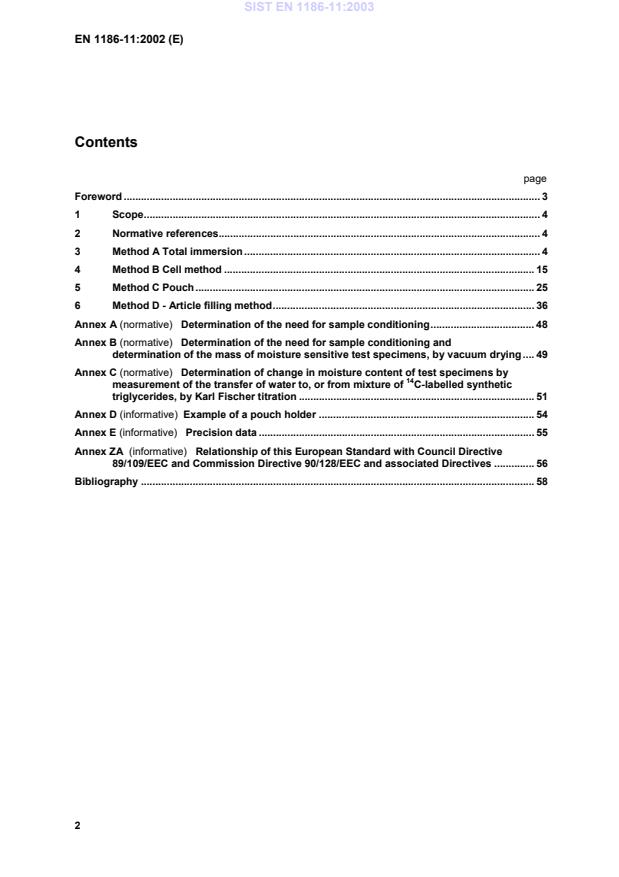
Determination of the need for sample conditioning.48Annex B (normative)
Determination of the need for sample conditioning anddetermination of the mass of moisture sensitive test specimens, by vacuum drying.49Annex C (normative)
Determination of change in moisture content of test specimens bymeasurement of the transfer of water to, or from mixture of 14C-labelled synthetictriglycerides, by Karl Fischer titration.51Annex D (informative)
Example of a pouch holder.54Annex E (informative)
Precision data.55Annex ZA
(informative)
Relationship of this European Standard with Council Directive89/109/EEC and Commission Directive 90/128/EEC and associated Directives.56Bibliography.58SIST EN 1186-11:2003
FurtherDirectives and amendments to existing Directives are expected which could change the legislativerequirements which this standard supports.
It is therefore strongly recommended that users of thisstandard refer to the latest relevant published Directive(s) before commencement of any of the test ortests described in this standard.Further parts of this standard have been prepared, concerned with the determination of overallmigration from plastics materials into food simulants.
Their titles are as follows:EN 1186 - Materials and articles in contact with foodstuffs - Plastics –Part 1Guide to the selection of conditions and test methods for overall migrationPart 2Test methods foroverall migration into olive oil by total immersionPart 3Test methods for overall migration into aqueous food simulants by total immersionPart 4Test methods for overall migration into olive oil by cellPart 5Test methods for overall migration into aqueous food simulants by cellPart 6Test methods for overall migration into olive oil using a pouchPart 7Test methods for overall migration into aqueous food simulants using a pouchPart 8Test methods for overall migration into olive oil by article fillingPart 9Test methods for overall migration into aqueous food simulants by article fillingPart 10Test methods for overall migration into olive oil (modified method for use in cases whereincomplete extraction of olive oil occurs)Part 12Test methods for overall migration at low temperaturesPart 13Test methods for overall migration at high temperaturesPart 14Test methods for 'substitute tests' for overall migration from plastics intended to comeinto contact with fatty foodstuffs using test media iso-octane and 95 % ethanolPart 15Alternative test methods to migration into fatty food simulants by rapid extraction into iso-octane and/or 95 % ethanolSIST EN 1186-11:2003
These normative references are cited at the appropriate places in the text and thepublications are listed hereafter. For dated references, subsequent amendments to and revisions ofany of these publications apply to this European Standard only when incorporated in it by amendmentor revision.
For undated references the latest edition of the publication referred to applies (includingamendments).EN 1186-1:2002, Materials and articles in contact with foodstuffs – Plastics - Part 1: Guide to theselection of conditions and test methods for overall migration.EN 10088-1, Stainless steels – Part 1: List of stainless steels.ISO 648, Laboratory glassware - One mark pipettes.ISO 4788, Laboratory glassware - Graduated measuring cylinders.3 Method A Total immersion3.1 PrincipleWARNINGThe use and disposal of 14C labelled substances are subject to regulations which vary fromcountry to country.
Laboratories should ensure that they comply with local legislation requirements.NOTE 1This method is most suitable for plastics in the form of films and sheets, but can be applied to a widerange of articles or containers from which test pieces of a suitable size can be cut.The overall migration from a sample of the plastics is determined as the loss in mass per unit ofsurface area intended to come into contact with foodstuffs.The selection of the conditions of test will be determined by the conditions of use, see clauses 6 and 7of EN 1186-1:2002.SIST EN 1186-11:2003
In this method the mixture of 14C-labelled synthetictriglycerides that remains after soxhlet extraction is released by dissolution or combustion.
Thecombustion method is suitable for all plastics, the dissolution method is only suitable for polymers thatare soluble in a suitable solvent, e.g. tetrahydrofuran.NOTE 2Good sensitivity can only be achieved for samples of very low mass, e.g. for thin films.
The specificradioactivity of the mixture of 14C-labelled synthetic triglycerides routinely used is approximately 200 dpm/mg.
Inroutine tests the limit of determination in liquid scintillation counting is in the order of 20 dpm per sample, forcombustion, and 10 dpm per sample, for dissolution.
In combustion only aliquots up to approximately 50 mg canbe used.
Consequently the determination limit for retained simulant is in the order of 0,1 mg to 50 mg.
It isapparent that for heavy test specimens the method gives only an estimation of the retained simulant.
Thedissolution method, which is generally preferred, results in similar figures.
A higher specific radioactivity of thesimulant would improve the determination limit.Migration into the mixture of 14C-labelled synthetic triglycerides is calculated by subtracting the mass of14C-labelled synthetic triglycerides retained by the test specimen from the mass of the test specimenafter removal from the 14C-labelled synthetic triglycerides, and then subtracting this mass from theinitial mass of the specimen.The total loss in mass is expressed in milligrams per square decimetre of surface area of the specimenand the overall migration is reported as the mean of a minimum of three determinations on separatetest specimens.To allow for inaccuracies which may arise during the procedure and which may be difficult to detect,due for example to contamination or loss of the 14C-labelled synthetic triglycerides during the samplehandling stages, quadruplicate determinations are carried out on the sample allowing for the resultfrom one specimen to be discarded.This method includes variations which are applicable to certain plastics and to experiencedlaboratories.3.2 ReagentsNOTEAll reagents should be of recognized analytical quality, unless otherwise specified.3.2.1 Mixture of 14C-labelled synthetic triglycerides, simulant D as specified in 5.2 ofEN 1186-1:2002.NOTEDetails of suppliers can be obtained from CEN.3.2.2 Extraction solvent (see 10.1 of EN 1186-1:2002).3.2.2.1Pentane 98 % (mixed isomers) boiling point 36 °C.WARNINGPentane is a very volatile and highly flammable solvent.
Take care when using and handlingthis solvent to prevent contact with sources of ignition.
It is not recommended for extractions with thissolvent to be left unattended, particularly overnight.NOTEDue to low boiling point of the solvent, cooled condenser water can be used to prevent undue loss ofthe solvent from the condenser.SIST EN 1186-11:2003
For environmental reasons the use of this solventshould be avoided where possible, see 10.1 of EN 1186-1:2002.
Experience has shown that this solvent althougheffective for most plastics requires longer periods of extraction.3.2.3 Liquid scintillation cocktail, suitable for scintillation counting of the 14C-labelled synthetictriglycerides and in which the fat simulant is soluble.3.2.4 Diethyl ether.3.2.5 Karl Fischer solvent, commercially prepared, methanol and chloroform based, water capacityof 5 mg/ml.3.2.6 Karl Fischer titrant (for volumetric apparatus only), commercially prepared, water capacity of 2mg/ml.3.3 Apparatus3.3.1 Cutting slab, clean smooth glass, metal or plastics slab of sufficient area to prepare testspecimens, 250 mm ´ 250 mm is suitable.3.3.2 Tweezers, stainless steel, blunt nosed.3.3.3 Cutting implement, scalpel, scissors, sharp knife or other suitable device.3.3.4 Metal templates 100 mm ± 0,2 mm ´ 100 mm ± 0,2 mm (square).3.3.5 Rule, 25 mm ± 1 mm wide.3.3.6 Rule, graduated in millimetres, and with an accuracy of 0,1 mm.3.3.7 Analytical balance capable of determining a change in mass of 0,1 mg.3.3.8 Specimen supports, constructed of stainless steel with cross arms attached by welding orsilver soldering.
Stainless steel X4 CrNi 18 10 according to EN 10088-1 or of composition, chromium17 %, nickel 9 %, carbon 0,04 %, is suitable. Before initial use thoroughly clean the steel supports. Theuse of a degreasing solvent and then dilute nitric acid has been found to be suitable.NOTEFor rigid samples, supports with a single cross arm can be used.3.3.9 Gauze, pieces of fine stainless steel gauze, with a mesh size of 1 mm have been found to besuitable, approximately 25 mm x 100 mm for insertion between the test pieces on the supports.Before initial use thoroughly clean the gauze, first with a degreasing solvent and then with dilute nitricacid.Conditioning containers, for conditioning test specimens at 50 % ± 5 % relative humidity and80 % ± 5 % relative humidity at 20 °C ± 5 °C.NOTEFor 50 % relative humidity, 43 % w/v sulphuric acid solution in water is suitable and for 80 % relativehumidity, 27 % w/v sulphuric acid solution is suitable.
The solutions should be freshly prepared by adding theweighed amount of acid to a suitable volume of water, cooling to room temperature and making up to the requiredvolume.SIST EN 1186-11:2003
Thereforethe containers should be placed in a thermostatically controlled room or oven, at a temperature of approximately20 °C, the set temperature should not vary by more than ± 1 °C.3.3.10 Glass tubes, ground neck and stoppers, for retaining the 14C-labelled synthetic triglyceridesand test specimens.
Tubes with an internal diameter of approximately 35 mm and length in the rangeof 120 mm to 200 mm, with a volume of not less than 120 ml, excluding the ground neck, see 8.2 ofEN 1186-1:2002, have been found to be satisfactory.3.3.11 Oven or incubator, thermostatically controlled, capable of maintaining the set temperature,within the tolerances specified in Table B.2 of EN 1186-1:2002.3.3.12 Filter paper, lint-free.3.3.13 Anti-bumping beads.3.3.14 Soxhlet type extractors, capable of holding test specimens on the supports, with 250 ml or500 ml round bottom flasks to fit.NOTEAlternative extractors capable of satisfactorily extracting absorbed 14C-labelled synthetic triglyceridesfrom the test specimens can be used.3.3.15 Water bath capable of holding the flasks of soxhlet type extractors (3.3.14).3.3.16 Rotary evaporator or distillation apparatus for evaporation and collection of the extractionsolvent.NOTEArtificially cooled water can be necessary for efficient condensation of a low boiling point solvent.3.3.17 Steam bath or hot plate.3.3.18 Measuring cylinders conforming to the minimum requirement of ISO 4788, 500 ml, 250 mland 100 ml.3.3.19 Glass beads, 2 mm to 3 mm diameter or glass rods, 2 mm to 3 mm in diameter andapproximately 100 mm long, see 8.2 of EN 1186-1:2002.3.3.20 Liquid scintillation counter with integrated quench correction.3.3.21 Liquid scintillation vials to fit into the liquid scintillation counter (3.3.20).3.3.22 Vacuum oven or vacuum desiccator.3.3.23 Desiccator containing self indicating silica gel or anhydrous calcium chloride.3.3.24 Device for combustion of 14C-labelled materials for subsequent determination ofradioactivity, e.g. Schöninger flask or automatic sample oxidizer.3.3.25 Vacuum oven or vacuum desiccator, capable of maintaining a temperature of 60 °C ± 2 °C.The vacuum oven or vacuum desiccator shall be equipped with, or connected to a vacuum pumpcapable of achieving a vacuum of 1,3 kPa or less.
The vacuum pump shall be provided with a timecontroller to switch on the vacuum pump every hour for 15 min.NOTEIf a vacuum oven is not available, a vacuum desiccator placed in an oven at 60 °C can be used.SIST EN 1186-11:2003
The Karl Fischer titrator shall be capable of measuring the water content of the simulant with aprecision
(standard deviation) of 10 mg/kg or less (equivalent to 1 mg/dm² plastic).
An automatedvolumetric or coulometric instrument shall be used.
Manual titration procedures do not give therequired accuracy or precision.3.4 Preparation of test specimens3.4.1 GeneralIt is essential that test specimens are clean and free from surface contamination (many plastics canreadily attract dust due to static charges).
Before preparing test specimens, remove any surfacecontamination from the sample by gently wiping it with a lint-free cloth, or by brushing with a soft brush.Under no circumstances wash the sample with water or solvent.
If it is specified in the instructions foruse of the article that it should be washed or cleaned before use see 9.1 of EN 1186-1:2002.
Minimisehandling of the samples and, where necessary, wear cotton gloves.To ensure that test pieces are well separated and that their surfaces are freely exposed to 14C labelledsynthetic triglycerides during the period of the test, for thin films insert a piece of fine stainless steelgauze (3.3.9) between the test pieces or for thick samples not placed on the supports, insert glass rodsbetween the test pieces after immersion in the 14C-labelled synthetic triglycerides.
Where specimensupports are used, label the supports with a tag bearing the test specimen identification.When preparing test specimens measure the surface area according to 9.3 of EN 1186-1:2002.3.4.2 Number of test specimensSix test specimens are required for samples, in the form of thin films, sheet, cut sections fromcontainers or similar articles.
Eight test specimens, similar dimensionally one to another, are requiredfor samples of articles of irregular shape.These test specimens are utilized as follows:a) four test specimens for the migration test;b) two test specimens to check for possible loss of volatiles;c) two test specimens for determination of the surface area, in the case of samples of irregularshape (see 3.4.5).If the conditioning test in annex B is used, one additional test specimen is required.NOTEThe two test specimens, b), are used to check whether the sample loses mass from the evaporation ofvolatiles, such as solvents, during the test period.
If the vacuum drying procedure in annex B is used these testspecimens are not required as during the vacuum drying any volatiles will have been removed from the testspecimens.A minimum of three valid test results is required to calculate the mean.
Testing in triplicate is allowedbut in this case if one test result is invalid repeat the entire procedure.SIST EN 1186-11:2003
Check, using the rule (3.3.6), that thedimensions of the test specimen are within the specified deviation (± 1 mm).Cut each test specimen into four test pieces 25 mm x 100 mm using the rule (3.3.5).
Assemble onetest specimen onto the support by piercing suitable holes in the test pieces and placing two test pieceson each side of the cross arms of the support. Repeat this procedure for all remaining test specimens.3.4.4 Containers and other articlesCut sections from the walls of the container or article to give test specimens each of areaapproximately 1 dm².
For articles with individual areas less than 1 dm², use a number of articles toprovide each test specimen.Measure the dimensions of each test specimen to the nearest 1 mm, using the rule, see 9.3 ofEN 1186-1:2002.Calculate the area of each test specimen to the nearest 0,01 dm² and record.
If necessary, cut eachtest specimen into smaller pieces to enable them to fit into the glass tubes (3.3.11).
The testspecimens or pieces are placed on the specimen supports if these are appropriate or, if the testspecimens or pieces are sufficiently rigid, they can be tested unsupported.NOTECutting the test specimens into smaller pieces increases the area of cut edges. If the area of the cutedges exceeds 10 % of the test specimen area, than see 8.3 of EN 1186-1:2002.3.4.5 Articles of irregular shapeSelect representative portions of the article, or multiples of the articles for small articles, to give ninedimensionally similar test specimens each with a known total surface area of at least 1 dm².
Measureonly the surface area intended to come into contact with foodstuffs of two of these test specimens tothe nearest 0,05 dm² using the Schlegel Method (see EN ISO 8442-2:1997 annex B), or any othersuitable method.
Record the surface area of each test specimen.3.5 Procedure3.5.1 GeneralBefore weighing, discharge any build up of static electricity with an antistatic gun or other suitablemeans.The mixture of 14C-labelled synthetic triglycerides has a melting point of 28 °C to 30 °C.
To ensurehomogeneity of the simulant liquefy the contents of the storage bottle before use.3.5.2 Initial weighing of test specimens3.5.2.1
Determine the need for conditioning of the test specimens by carrying out the proceduredescribed in annex A or in annex B.
If prior tests have established that sample conditioning is notrequired then annex A and annex B may be omitted.
If prior tests have established that the proceduredescribed in annex C is applicable to the sample, then annex A or annex B may be omitted.3.5.2.2
If the tests described in annex A or annex B show that conditioning is not necessary,determine and record the mass of each test specimen.3.5.2.3 If the tests described in annex A or annex B show that conditioning is necessary, followthe directions in the relevant annex to determine the initial mass of the sample.SIST EN 1186-11:2003
Measure 100 ml ± 5 ml of14C-labelled synthetic triglycerides (3.2.1) into each tube by measuring cylinder and stopper the tube.NOTE 1If the procedure described in annex C is used, it can be necessary to dry all of the 14C-labelledsynthetic triglycerides used for the migration test, see C.3.2.Alternatively mark the tubes for a volume of 100 ml and fill with 14C-labelled synthetic triglycerides tothe mark.
Place into one of the tubes a thermometer or thermocouple and stopper the tubes.
Twoextra tubes with a minimum of 50 ml of 14C-labelled synthetic triglycerides are required as blanksimulant, if the procedure in annex C is used.
Place the six or eight tubes, and two empty tubes, in thethermostatically controlled oven or incubator (3.3.11) set at the test temperature.
Leave until the 14C-labelled synthetic triglycerides have attained the test temperature, using the thermometer orthermocouple to monitor the temperature.
Take all tubes from the oven and place into four of thetubes containing 14C-labelled synthetic triglycerides, weighed test specimens prepared as in 3.4 andconditioned if necessary.
Stopper the tubes.
Ensure that the test specimens are totally immersed in14C-labelled synthetic triglycerides; if they are not, then add either glass beads or glass rods (3.3.19) toraise the level of the 14C-labelled synthetic triglycerides until total immersion is achieved.NOTE 2If the procedure in annex C is used, the 14C-labelled synthetic triglycerides in the fifth tube is used asthe third blank sample for Karl Fischer titrations.
The 14C-labelled synthetic triglycerides in the sixth tube are usedto check the temperature of the triglycerides.
If glass beads or glass rods have been used to raise the level of the14C-labelled synthetic triglycerides to achieve total immersion, then similar glass beads or glass rods should beadded to the sixth tube.Place the remaining two test specimens into the empty tubes and stopper.NOTE 3These two test specimens are used to check whether the sample loses mass from the evaporation ofvolatiles, such as water, solvents and oligomers, during the test period.
If the vacuum drying procedure inannex B is applicable these test specimens are not required as during the vacuum drying volatiles are removedfrom the test specimens.NOTE 4Experience has shown that it is not necessary to check the contribution of extracts from the testspecimens not exposed to the fat simulant to the level of radioactivity in liquid scintillation counting.Replace all eight or ten tubes in the thermostatically controlled oven or incubator set at the testtemperature.
Carry out this part of the operation in the minimum time possible to prevent undue heatloss.
Observe the temperature of the thermostatically controlled oven or incubator or the 14C-labelledsynthetic triglycerides
(see NOTE 6) in the sixth tube and leave the tubes for the selected test period,taking into account the tolerances
specified in Table B.1 of EN 1186-1:2002, after the 14C-labelledsynthetic triglycerides in the sixth tube has reached a temperature within the tolerance specified inTable B.2 of EN 1186-1:2002.NOTE 5Annex B of EN 1186-1:2002 includes tolerances on a wide range of contact times and contacttemperatures.
All of these contact times and contact temperatures are not necessarily relevant to this Part of thestandard.NOTE 6For exposure times of 24 h or more it is acceptable to monitor the temperature of the airbath of thethermostatically controlled oven or incubator or refrigerator, instead of the temperature of the simulant.SIST EN 1186-11:2003
the Karl Fischerdetermination of water content should be carried out as soon as possible.3.5.4 Final weighing of test specimens3.5.4.1
For those specimens which did not require conditioning to obtain their initial masses (see3.5.2.2), weigh all six test specimens, i.e. the four that have been in 14C-labelled synthetic triglyceridesand the two that were in the empty tubes and record the mass of each test specimen.3.5.4.2 If conditioning of the test specimens was carried out using the procedure in annex A thenrepeat the procedure.3.5.4.3If conditioning was carried out before the initial weighing using the procedure described inannex B then carry out the procedure described in B.4.3.5.4.4 If it was decided that the procedure described in annex C was applicable to the testsample, then carry out that procedure.3.5.4.5If the final mass of each of the test specimens which have been in empty tubes is lessthan their initial mass by more than 2,0 mg, then volatile substances have been lost and adjustmentmay be made, see 10.4 of EN 1186-1:2002, to the final mass for each test specimen such that thevalues obtained are a measure of the migration of non-volatile substances only.3.5.5Extraction of absorbed 14C-labelled synthetic triglyceridesNOTESome types of plastics are known to retain some of the absorbed 14C-labelled synthetic triglycerides.In these cases extraction of the 14C-labelled synthetic triglycerides is incomplete and a second extraction with amore polar solvent is required, see also 10.2 of EN 1186-1:2002.Take four flasks, 250 ml or 500 ml as appropriate to the size of the soxhlet type extractor (3.3.14) to beused for the extraction, and add sufficient extraction solvent (3.2.2) to allow cycling of the soxhlet typeextractor (approximately 200 ml or 400 ml, according to the size of the flask) with anti-bumping beads(3.3.13) to control boiling.Place the four test specimens which have been in contact with 14C-labelled synthetic triglycerides intofour soxhlet type extractors.
Couple each soxhlet to a flask containing the extraction solvent.
Usingeither a water bath (3.3.15) or steam bath (3.3.17), extract for a period of 7 10+ h, with a minimum of 6cycles per hour, ensuring that the test pieces are totally submerged in the solvent during each soxhletcycle, and that they remain separated from each other.Drain all of the solvent from the soxhlet type extractors, remove the flasks from the soxhlet typeextractors and evaporate the solvent almost to dryness using a rotary evaporator, or simple distillationapparatus (3.3.16).
Transfer the remaining solutions containing the extracted 14C-labelled synthetictriglycerides to separate liquid scintillation vials, and wash each flask with three portions of liquidscintillation cocktail.
Add the three washings to the respective individual vials.Repeat the extraction of the test specimens for an additional 710+ h, with diethyl ether (3.2.4).If previous testing has established that all of the 14C-labelled synthetic triglycerides will be extractedfrom the test specimens during the first 7 h extraction then the second 7 h extraction may be omitted.SIST EN 1186-11:2003
If more than 2,0 mg per test specimen is found in the second extract, then determine theretained 14C-labelled synthetic triglycerides via liquid scintillation after combustion or dissolution of thetest sample.3.5.6Determination of extracted mixture of 14C - labelled synthetic triglycerides3.5.6.1Standard and background samplesTake five scintillation vials and add the 14C-labelled synthetic triglycerides from the same batch asused for the migration test, the amounts being from 50 mg to 250 mg.
Weigh to the nearest 0,1 mgand add liquid scintillation cocktail in the required amount.
Take three scintillation vials and fill withcocktail only.3.5.6.2Liquid scintillation countingTransfer the samples prepared according to 3.5.5 and 3.5.6.1 into the liquid scintillation counter(3.3.21) and determine the radioactivity in the sample.
Make sure that the instrument has been set tothe correct parameters for determination of carbon-14, including the correct quench curve.3.5.6.3Calculation of extracted mixture of 14C-labelled synthetic triglyceridesCalculate the specific radioactivity, sA, of the 14C-labelled synthetic triglycerides with consideration ofthe background value as follows:wRRs os-=A(1)wheresA is the specific radioactivity, in disintegrations per minute per milligram;Rs is the measuring rate, in disintegrations per minute, of the standard sample (see 3.5.6.1);Ro is the measuring rate, in disintegrations per minute, of the background sample (see 3.5.6.1);w is the mass of the standard sample, in milligrams.Calculate the amount of extracted 14C-labelled synthetic triglycerides as follows:mc = 1000AoM x sR - R(2)wheremc is the mass of 14C-labelled synthetic triglycerides absorbed by test specimen, in grams;RM is the measuring rate, in disintegrations per minute, of the sample;Ro is the measuring rate, in disintegrations per minute, of the background sample as prepared in3.5.6.1;SIST EN 1186-11:2003
The combustion method (see 3.5.6.4.2) is suitable for all plastics.
Thedissolution method (see 3.5.6.4.3) is only suitable for plastics that are soluble in a suitable solvent, e.g.tetrahydrofuran.3.5.4.1.2 Combustion methodDry the extracted test specimen and weigh as described in 3.5.4.1; cut five small pieces of about 50mg from each test specimen, weigh to the nearest 0,1 mg and combust in a sample oxidizer (3.3.24).Determine the radioactivity in the samples obtained, as described in 3.5.6.2, and calculate the amountof 14C-labelled synthetic triglycerides retained, according to 3.5.6.3, taking into account the aliquot ofthe extracted test specimen used for combustion.
Add this quantity of 14C-labelled synthetictriglycerides to that found by the extraction for each test specimen.3.5.4.1.3 Dissolution methodTransfer the extracted test specimen into a beaker (100 ml, 250 ml or 500 ml as appropriate), dissolvein a minimum amount of tetrahydrofuran, transfer the solution into a volumetric flask (250 ml, 500 ml or1 000 ml as appropriate) and make up to the mark.
Take three aliquots of 2 ml each into scintillationvials, add liquid scintillation cocktail in the required amount and determine the radioactivity in thesamples as described in 3.5.6.2.
Calculate the amount of 14C-labelled synthetic triglycerides retainedaccording to 3.5.6.3.Add this quantity of 14C-labelled synthetic triglycerides to that found by the extraction for each testspecimen.3.6 Expression of results3.6.1 Method of calculationExpress the overall migration as milligrams lost per square decimetre of surface of the sample which isintended to come into contact with foodstuffs, calculated for each test specimen using the followingformula:M =S
x )m-
(m-
m
1000][cba(3)whereMis the overall migration into 14C-labelled synthetic triglycerides, in milligrams per squaredecimetre of the surface area of sample intended to come into contact with the foodstuff;mais the initial mass of the test specimen, before contact with the 14C-labelled synthetictriglycerides, in grams (see 3.5.2.2 or 3.5.2.3 or 3.5.2.4 as appropriate);SIST EN 1186-11:2003
Conventionally, if the thickness exceeds 0,5 mm, the whole of the surfacearea is taken into account in determining the migration value, see 9.3 of EN 1186-1:2002.Calculate the result for each test specimen to the nearest 0,1 mg/dm² and the mean of the valid testresults, to the nearest milligrams per square decimetre.See 12.3 of EN 1186-1:2002, for directions to determine whether the results are valid.The corrected mass is calculated using the formula:mb = mbI + md(4)wherembis the corrected mass of the test specimens allowing for loss of volatiles in empty tubes, ingrams;mdis the mean loss in mass of the test specimens in the empty tubes, in grams;mbI is the mass of the test specimen after contact with the 14C-labelled synthetic triglycerides, ingrams.NOTEThis allowance for loss of volatile substances during the exposure period of the test specimensassumes the quantities of volatile substances lost from the test specimens immersed in the 14C-labelled synthetictriglycerides equates to the mean loss of volatile substances from the two test specimens in the empty tubes.If the procedure described in annex C has been followed express the overall migration as milligramslost per square decimetre of surface of the sample which is intended to come into contact withfoodstuffs, calculated for each test specimen using the following formula:MD =S x )]Mm-
(m-
[m
1000wc ba+
(5)whereMDis the overall migration into 14C-labelled synthetic triglycerides, in milligrams per squaredecimetre of the surface area of sample intended to come into contact with the foodstuff obtainedby following the procedure described in annex C;mais the initial mass of the test specimen, before contact with the 14C-labelled synthetictriglycerides, in grams;mbis the mass of the test specimen after contact with 14C-labelled synthetic triglycerides, ingrams or corrected mass (see equation (4)) where the loss of volatiles is greater than 2 mg pertest specimen;mcis the mass of 14C-labelled synthetic triglycerides absorbed by test specimen, in grams;SIST EN 1186-11:2003
Conventionally, if the thickness exceeds 0,5 mm, the whole of the surfacearea is taken into account in determining the migration value, see 9.3 of EN 1186-1:2002.3.6.2 PrecisionSee annex E.3.7 Test reportWhere the plastics material is intended for use in contact with fatty foods for which reduction factorsare permitted then these factors shall be taken into account when reporting the results, see 12.2 of EN1186-1:2002.The test report shall include the following:a) reference to this European Standard and to the Part used for the test procedure;b) all information necessary for complete identification of the
sample such as chemical type,supplier, trade mark, grade, batch number(s), thickness;c) conditions of time and temperature of exposure to simulants;d) departures from the specified procedure and reasons for these;e) individual test results and the mean of these expressed as milligrams lost per square decimetreof sample;f) reference to the procedure used for determining the mass of moisture sensitive samples and thereason for selecting that procedure;g) any adjustment made for loss of volatile substances from the test specimens;h) relevant comments on the test results;i) reference to any reduction factor used in calculating migration.4 Method B Cell method4.1 PrincipleWARNINGThe use and disposal of 14C labelled substances are subject to regulations which vary fromcountry to country.
Laboratories should ensure that they comply with local legislation requirements.NOTE 1This method is most suitable for plastics in the form of films and sheets, but is particularly applicableto those materials consisting of more than one layer or of surfaces that differ in their migration characteristics,which should be tested with the food simulant in contact only with the surface which is intended to come intocontact with foodstuffs.The overall migration from a sample of the plastics is determined as the loss in mass per unit ofsurface area intended to come into contact with foodstuffs.The selection of the conditions of test will be determined by the conditions of use, see clauses 6 and 7of EN 1186-1:2002.SIST EN 1186-11:2003
In this method the mixture of 14C-labelled synthetictriglycerides that remains after soxhlet extraction is released by dissolution or combustion.
Thecombustion method is suitable for all plastics, the dissolution method is only suitable for polymers thatare soluble in a suitable solvent, e.g. tetrahydrofuran.NOTE 2Good sensitivity can only be achieved for samples of very low mass, e.g. for thin films.
The specificradioactivity of the
...
Questions, Comments and Discussion
Ask us and Technical Secretary will try to provide an answer. You can facilitate discussion about the standard in here.
Loading comments...