

SIST EN 60819-3-3:2012
(Main)Non-cellulosic papers for electrical purposes - Part 3: Specifications for individual materials Sheet 3: Unfilled aramid (aromatic polyamide) papers
General Information
- Abstract
IEC 60819-3-3:2011 is a sheet of IEC 60819-3 specifies requirements for four types of unfilled aramid papers: - Type 1: calendered paper; - Type 2: calendered paper, with improved tearing resistance and conformability; - Type 3: uncalendered paper; - Type 4: calendered paper, with lower density for laminating. This edition includes the following significant technical changes with respect to the previous edition: - normative references change: all the requirements are now determined according the clauses of test methods from IEC 60819-2 specific for non cellulosic papers, instead of IEC 60554-2:2001 generally valid for cellulosic papers; - and some new, very thin thicknesses, of type 4, calendered paper with lower density for laminating, were added.
- Status
- Published
- Publication Date
- 14-Nov-2011
- Technical Committee
- IIZS - Insulating materials and systems
- Current Stage
- 6060 - National Implementation/Publication (Adopted Project)
- Start Date
- 14-Nov-2011
- Due Date
- 19-Jan-2012
- Completion Date
- 15-Nov-2011



Overview
SIST EN 60819-3-3:2012 is a European Standard developed by CENELEC (CLC) that specifies the requirements for unfilled aramid (aromatic polyamide) papers used for electrical insulation purposes. This document, part of the wider IEC 60819 series, focuses on non-cellulosic insulating papers critical in the electrical industry for their high thermal stability, mechanical strength, and dielectric properties. The standard establishes the properties, testing methods, and classifications for four major types of unfilled aramid papers designed for various industrial and electrical applications.
Key applications for these materials include use in electrical insulation systems for transformers, cables, motors, and electronic devices, where enhanced performance and reliability are required under demanding conditions.
Key Topics
Material Types Covered:
- Type 1: Calendered aramid paper
- Type 2: Calendered aramid paper with improved tearing resistance and conformability
- Type 3: Uncalendered aramid paper
- Type 4: Calendered, lower-density aramid paper for laminating
Revised Normative References: All test methods for compliance are now determined according to IEC 60819-2, which is specific to non-cellulosic papers. This is an update from previous editions that referenced test methods primarily created for cellulosic papers.
Enhanced Scope: This edition introduces new, very thin versions of type 4 aramid paper to support advanced laminating applications.
Key Performance Requirements:
- Mechanical strength
- Tearing resistance
- Thickness and grammage tolerances
- Density and electrical strength
- Shrinkage on heating
Conformance and Safety: To ensure safety and quality, all paper types must comply with the requirements in IEC 60819-1 and testing methods in IEC 60819-2, as well as follow the sampling procedures in ISO 186.
Applications
SIST EN 60819-3-3:2012 aramid papers offer effective solutions for demanding electrical insulation needs. Typical applications include:
- Transformers: Used as insulating wraps and spacers in both dry-type and oil-immersed transformers due to high temperature resistance and mechanical durability.
- Rotating Machines: Applied as slot liners, phase insulation, and interlayer insulation in motors and generators owing to their electrical and thermal resilience.
- Cables and Wires: Employed as wrap insulation to enhance flame resistance and mechanical protection in power and communication cables.
- Laminates: Type 4 low-density papers are especially suited for the production of laminates for use in composite insulation systems.
- Electronic Components: Suitable for flexible printed circuit boards and as insulation in capacitors, given their dielectric strength and flexibility.
Related Standards
For a comprehensive approach to selecting, testing, and applying non-cellulosic insulating papers, the following standards are relevant:
- IEC 60819-1 – Non-cellulosic papers for electrical purposes – Definitions and general requirements
- IEC 60819-2 – Non-cellulosic papers for electrical purposes – Methods of test
- ISO 186 – Paper and board – Sampling to determine average quality
These standards, in conjunction with SIST EN 60819-3-3:2012, provide a robust framework for quality assurance, performance verification, and safe application of aramid insulating papers across electrical industries.
Keywords: aramid paper, electrical insulation, EN 60819-3-3, IEC 60819, non-cellulosic insulation materials, polyamide paper, transformer insulation, electrical standards, CENELEC, industrial laminates, dielectric paper.
Relations
- Effective Date
- 07-Jun-2022
- Effective Date
- 09-Feb-2026
- Refers
SIST EN 60819-2:2002 - Non-cellulosic papers for electrical purposes -- Part 2: Methods of test - Effective Date
- 03-Feb-2026
- Effective Date
- 03-Feb-2026
- Effective Date
- 03-Feb-2026
- Effective Date
- 03-Feb-2026
- Effective Date
- 03-Feb-2026
- Effective Date
- 01-Mar-2011
Get Certified
Connect with accredited certification bodies for this standard

IMQ S.p.A. (Certification)
Italian electrical product certification.

SLG Prüf- und Zertifizierungs GmbH
German testing and certification body.

UL Solutions
Global safety science company with testing, inspection and certification.
Sponsored listings
Frequently Asked Questions
SIST EN 60819-3-3:2012 is a standard published by the Slovenian Institute for Standardization (SIST). Its full title is "Non-cellulosic papers for electrical purposes - Part 3: Specifications for individual materials Sheet 3: Unfilled aramid (aromatic polyamide) papers". This standard covers: IEC 60819-3-3:2011 is a sheet of IEC 60819-3 specifies requirements for four types of unfilled aramid papers: - Type 1: calendered paper; - Type 2: calendered paper, with improved tearing resistance and conformability; - Type 3: uncalendered paper; - Type 4: calendered paper, with lower density for laminating. This edition includes the following significant technical changes with respect to the previous edition: - normative references change: all the requirements are now determined according the clauses of test methods from IEC 60819-2 specific for non cellulosic papers, instead of IEC 60554-2:2001 generally valid for cellulosic papers; - and some new, very thin thicknesses, of type 4, calendered paper with lower density for laminating, were added.
IEC 60819-3-3:2011 is a sheet of IEC 60819-3 specifies requirements for four types of unfilled aramid papers: - Type 1: calendered paper; - Type 2: calendered paper, with improved tearing resistance and conformability; - Type 3: uncalendered paper; - Type 4: calendered paper, with lower density for laminating. This edition includes the following significant technical changes with respect to the previous edition: - normative references change: all the requirements are now determined according the clauses of test methods from IEC 60819-2 specific for non cellulosic papers, instead of IEC 60554-2:2001 generally valid for cellulosic papers; - and some new, very thin thicknesses, of type 4, calendered paper with lower density for laminating, were added.
SIST EN 60819-3-3:2012 is classified under the following ICS (International Classification for Standards) categories: 29.035.10 - Paper and board insulating materials. The ICS classification helps identify the subject area and facilitates finding related standards.
SIST EN 60819-3-3:2012 has the following relationships with other standards: It is inter standard links to SIST EN 60819-3-3:2007, SIST EN ISO 186:2003, SIST EN 60819-2:2002, SIST EN 60819-1:2013, SIST EN 60317-53:2014, SIST EN 60317-52:2014, SIST EN IEC 60626-1:2024, SIST EN 60819-3-3:2007. Understanding these relationships helps ensure you are using the most current and applicable version of the standard.
SIST EN 60819-3-3:2012 is available in PDF format for immediate download after purchase. The document can be added to your cart and obtained through the secure checkout process. Digital delivery ensures instant access to the complete standard document.
Standards Content (Sample)
2003-01.Slovenski inštitut za standardizacijo. Razmnoževanje celote ali delov tega standarda ni dovoljeno.Vliesstoffe auf Kunststofffaserbasis für elektrotechnische Zwecke - Teil 3: Bestimmungen für einzelne Materialien - Blatt 3: Ungefüllte Aramid (aromatische Polyamid) PapierePapiers non cellulosiques pour usages électriques - Partie 3: Spécifications pour matériaux particuliers - Feuille 3: Papiers en aramide non chargé (polyamide aromatique)Non-cellulosic papers for electrical purposes - Part 3: Specifications for individual materials Sheet 3: Unfilled aramid (aromatic polyamide) papers29.035.10Papirni in kartonski izolacijski materialiPaper and board insulating materialsICS:Ta slovenski standard je istoveten z:EN 60819-3-3:2011SIST EN 60819-3-3:2012en01-januar-2012SIST EN 60819-3-3:2012SLOVENSKI
STANDARD
EUROPEAN STANDARD EN 60819-3-3 NORME EUROPÉENNE
EUROPÄISCHE NORM October 2011
CENELEC European Committee for Electrotechnical Standardization Comité Européen de Normalisation Electrotechnique Europäisches Komitee für Elektrotechnische Normung
Management Centre: Avenue Marnix 17, B - 1000 Brussels
© 2011 CENELEC -
All rights of exploitation in any form and by any means reserved worldwide for CENELEC members.
Ref. No. EN 60819-3-3:2011 E
ICS 29.035.10 Supersedes EN 60819-3-3:2006
English version
Non-cellulosic papers for electrical purposes -
Part 3: Specifications for individual materials -
Sheet 3: Unfilled aramid (aromatic polyamide) papers (IEC 60819-3-3:2011)
Papiers non cellulosiques pour usages électriques -
Partie 3: Spécifications pour matériaux particuliers -
Feuille 3: Papiers en aramide non chargé (polyamide aromatique) (CEI 60819-3-3:2011)
Zellulosefreie Papiere für elektrotechnische Zwecke -
Teil 3: Bestimmungen für einzelne Materialien -
Blatt 3: Ungefüllte Aramid-(aromatische Polyamid-)Papiere (IEC 60819-3-3:2011)
This European Standard was approved by CENELEC on 2011-10-18. CENELEC members are bound to comply with the CEN/CENELEC Internal Regulations which stipulate the conditions for giving this European Standard the status of a national standard without any alteration.
Up-to-date lists and bibliographical references concerning such national standards may be obtained on application to the CEN-CENELEC Management Centre or to any CENELEC member.
This European Standard exists in three official versions (English, French, German). A version in any other language made by translation under the responsibility of a CENELEC member into its own language and notified to the CEN-CENELEC Management Centre has the same status as the official versions.
CENELEC members are the national electrotechnical committees of Austria, Belgium, Bulgaria, Croatia, Cyprus, the Czech Republic, Denmark, Estonia, Finland, France, Germany, Greece, Hungary, Iceland, Ireland, Italy, Latvia, Lithuania, Luxembourg, Malta, the Netherlands, Norway, Poland, Portugal, Romania, Slovakia, Slovenia, Spain, Sweden, Switzerland and the United Kingdom.
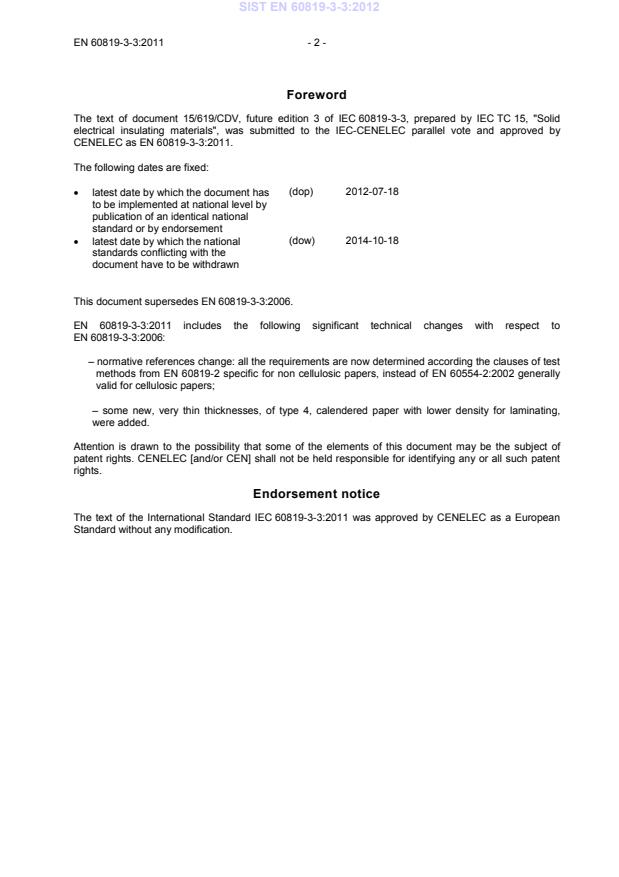
This document supersedes EN 60819-3-3:2006.
EN 60819-3-3:2006: – normative references change: all the requirements are now determined according the clauses of test methods from EN 60819-2 specific for non cellulosic papers, instead of EN 60554-2:2002 generally valid for cellulosic papers; – some new, very thin thicknesses, of type 4, calendered paper with lower density for laminating, were added.
Attention is drawn to the possibility that some of the elements of this document may be the subject of patent rights. CENELEC [and/or CEN] shall not be held responsible for identifying any or all such patent rights. Endorsement notice The text of the International Standard IEC 60819-3-3:2011 was approved by CENELEC as a European Standard without any modification. SIST EN 60819-3-3:2012
- 3 - EN 60819-3-3:2011 Annex ZA (normative)
Normative references to international publications with their corresponding European publications
The following referenced documents are indispensable for the application of this document. For dated references, only the edition cited applies. For undated references, the latest edition of the referenced document (including any amendments) applies.
NOTE
When an international publication has been modified by common modifications, indicated by (mod), the relevant EN/HD applies.
Publication Year Title EN/HD Year
IEC 60819-1 - Non-cellulosic papers for electrical purposes - Part 1: Definitions and general requirements EN 60819-1 -
IEC 60819-2 2001 Non-cellulosic papers for electrical purposes - Part 2: Methods of test EN 60819-2 2001
ISO 186 2002 Paper and board - Sampling to determine average quality EN ISO 186 2002
IEC 60819-3-3 Edition 3.0 2011-09 INTERNATIONAL STANDARD NORME INTERNATIONALE Non-cellulosic papers for electrical purposes –
Part 3: Specifications for individual materials – Sheet 3: Unfilled aramid (aromatic polyamide) papers
Papiers non cellulosiques pour usages électriques –
Partie 3: Spécifications pour matériaux particuliers – Feuille 3: Papiers en aramide non chargé (polyamide aromatique)
INTERNATIONAL ELECTROTECHNICAL COMMISSION COMMISSION ELECTROTECHNIQUE INTERNATIONALE H ICS 29.035.10 PRICE CODE CODE PRIX ISBN 978-2-88912-686-6
– 2 – 60819-3-3 IEC:2011 INTERNATIONAL ELECTROTECHNICAL COMMISSION ____________
NON-CELLULOSIC PAPERS FOR ELECTRICAL PURPOSES –
Part 3: Specifications for individual materials –
Sheet 3: Unfilled aramid (aromatic polyamide) papers
FOREWORD 1) The International Electrotechnical Commission (IEC) is a worldwide organization for standardization comprising all national electrotechnical committees (IEC National Committees). The object of IEC is to promote international co-operation on all questions concerning standardization in the electrical and electronic fields. To this end and in addition to other activities, IEC publishes International Standards, Technical Specifications, Technical Reports, Publicly Available Specifications (PAS) and Guides (hereafter referred to as “IEC Publication(s)”). Their preparation is entrusted to technical committees; any IEC National Committee interested in the subject dealt with may participate in this preparatory work. International, governmental and non-governmental organizations liaising with the IEC also participate in this preparation. IEC collaborates closely with the International Organization for Standardization (ISO) in accordance with conditions determined by agreement between the two organizations. 2) The formal decisions or agreements of IEC on technical matters express, as nearly as possible, an international consensus of opinion on the relevant subjects since each technical committee has representation from all interested IEC National Committees.
3) IEC Publications have the form of recommendations for international use and are accepted by IEC National Committees in that sense. While all reasonable efforts are made to ensure that the technical content of IEC Publications is accurate, IEC cannot be held responsible for the way in which they are used or for any misinterpretation by any end user. 4) In order to promote international uniformity, IEC National Committees undertake to apply IEC Publications transparently to the maximum extent possible in their national and regional publications. Any divergence between any IEC Publication and the corresponding national or regional publication shall be clearly indicated in the latter. 5) IEC itself does not provide any attestation of conformity. Independent certification bodies provide conformity assessment services and, in some areas, access to IEC marks of conformity. IEC is not responsible for any services carried out by independent certification bodies. 6) All users should ensure that they have the latest edition of this publication. 7) No liability shall attach to IEC or its directors, employees, servants or agents including individual experts and members of its technical committees and IEC National Committees for any personal injury
...