

SIST EN 1993-1-9:2025/oprA1:2026
(Amendment)Eurocode 3 - Design of steel structures - Part 1-9: Fatigue
- Abstract
1.1 Scope of EN 1993-1-9
(1) EN 1993-1-9 gives design methods for the verification of the fatigue design situation of steel structures.
NOTE Steel structures consist of members and their joints. Each member and joint can be represented as a constructional detail or as several of the latter.
(2) Design methods other than the stress-based methods, such as the notch strain method or fracture mechanics methods, are not covered by EN 1993-1-9.
(3) EN 1993-1-9 only applies to structures made of all grades of structural steels and products within the scope of EN 1993-1 (all parts), in accordance with the provisions noted in the detail category tables or annexes.
(4) EN 1993-1-9 only applies to structures where execution conforms to EN 1090-2.
NOTE Supplementary execution requirements are indicated in the detail category tables.
(5) EN 1993-1-9 applies to structures operating under normal atmospheric conditions and with sufficient corrosion protection and regular maintenance. The effect of seawater corrosion is not covered.
(6) EN 1993-1-9 applies to structures with hot dip galvanizing in accordance with the provisions noted in the detail category tables or annexes.
(7) Microstructural damage from high temperature (> 150°C) that occurs during the design service life is not covered.
(8) EN 1993-1-9 gives guidance of how to consider post-fabrication treatments that are intended to improve the fatigue resistance of constructional details.
1.2 Assumptions
(1) Unless specifically stated, EN 1990, EN 1991 (all parts) and EN 1993 1 (all parts) apply.
(2) The design methods given in EN 1993-1-9 are applicable if:
- the execution quality is as specified in EN 1090-2, and
- the construction materials and products used are as specified in the relevant parts on EN 1993 (all parts), or in the relevant material and product specifications.
(3) The design methods of EN 1993-1-9 are generally derived from fatigue tests on constructional details with large scale specimens that include effects of geometrical and structural imperfections from material production and execution (e.g. the effects of tolerances and residual stresses from welding).
- Status
- Not Published
- Public Enquiry End Date
- 29-Jul-2026
- Technical Committee
- KON - Structures
- Current Stage
- 4020 - Public enquire (PE) (Adopted Project)
- Start Date
- 10-Jun-2026
- Due Date
- 28-Oct-2026

SIST EN 1993-1-9:2025/oprA1:2026 is the Slovenian version of the draft amendment to Eurocode 3, Part 1-9, aligned with EN 1993-1-9:2025/prA1. It updates the fatigue design rules for steel structures, so engineers can verify welded and bolted details using stress-based methods. The document is intended for designers, checking engineers, fabricators and others who need to classify details, choose a verification method and apply the right execution assumptions.
What does SIST EN 1993-1-9:2025/oprA1:2026 specify?
SIST EN 1993-1-9:2025/oprA1:2026 is a draft amendment to EN 1993-1-9:2025, the Eurocode part for fatigue of steel structures. EN 1993-1-9 gives design methods for verifying the fatigue design situation of steel structures, with an emphasis on stress-based methods and detail categories.
The scope keeps the usual Eurocode boundaries in view: it applies to steel structures made of structural steels and products within EN 1993-1, to execution in accordance with EN 1090-2, and to normal atmospheric conditions with corrosion protection and maintenance. It excludes notch strain and fracture mechanics methods, seawater corrosion effects and microstructural damage from temperatures above 150 °C.
| Annex | What it covers |
|---|---|
| A | Verification using cumulative linear damage model |
| B | Hot spot stress method |
| C | Effective notch stress method |
| D | Recommendations for magnification factors k and stress concentration factors k |
| F | Fatigue design of welded joints subjected to High Frequency Mechanical Impact treatment |
| G | Hot spot stress reference detail method |
The amendment is organized as modifications to the Introduction, Clause 3, Clause 7, Clause 8, Clause 10, and Annexes A, B, C, D, F and G.
What are the key requirements of SIST EN 1993-1-9:2025/oprA1:2026?
SIST EN 1993-1-9:2025/oprA1:2026 keeps the core Eurocode fatigue approach: verify the detail against stress ranges, use the right detail category, and select the method that matches the joint or member. The amendment mainly refines how that is done for class 4 sections, cope holes, hot dip galvanizing, HFMI-treated joints and specific bolted or welded details.
Fatigue verification and stress ranges
- Clause 7.1 requires class 4 cross sections to use the effective cross section from EN 1993-1-5 when nominal stresses are calculated. In practice, local instability has to be reflected in the fatigue check, not ignored.
- Clause 7.3.2 defines how to determine design nominal stress ranges and modified nominal stress ranges when the fatigue action effect is represented by an equivalent constant stress range. This matters when the loading is not already in the form needed for direct detail-category checks.
- Clause 7.4 covers the notation and treatment of fatigue action effects where stress ratio effects matter. For readers, this means the stress history and loading case have to be translated into the form required by the chosen verification method.
Fatigue resistance, detail categories and inspection
- Clause 8.1 describes characteristic fatigue resistance as parallel, equally spaced curves that relate endurance to stress range. Tables 8.1 and 8.2, and the matching Annex A tables, provide the detail categories used to read off resistance.
- Clause 8.2 allows the National Annex to add supplementary inspection requirements for constructional details. In practice, the design may need inspection and maintenance rules alongside the stress check.
- Clause 8.3 and Annex F link the fatigue rules to High Frequency Mechanical Impact (HFMI) treated welded joints. The amendment raises the highest detail categories for some HFMI-treated high-strength steel details, so the treatment has to be identified correctly in the design documents.
Detail tables and special geometries
- Clause 10 updates the nominal stress method detail tables, including stainless steel bolts and studs, thermal cut quality to EN ISO 9013, and the wording used for weld toe angle. This matters because the detail category depends on the exact fabrication condition.
- Annex D gives specific rules for flange thickness transitions in girders with cope holes in the web, including the influence of shear stress and limits on hole radius and thickness ratio. This is the part to use when a girder changes thickness and the web is cut out locally.
- Annexes B, C and G refine the hot spot stress method, the effective notch stress method and the reference detail method. These annexes are used when nominal stress tables alone are not the right model for the joint.
What terms does SIST EN 1993-1-9:2025/oprA1:2026 define?
- Fatigue design situation - the design situation assessed for damage caused by repeated loading during the service life.
- Constructional detail - a member or joint, or part of one, represented in fatigue design as a specific detail.
- Detail category - the class used to express the characteristic fatigue resistance of a detail.
- Nominal stress method - a method that checks fatigue using nominal stress ranges and the relevant detail category.
- Hot spot stress method - a method that evaluates stress concentration at the weld region for fatigue checks.
- Effective notch stress method - a method that models the weld toe or root with a rounded notch to assess fatigue resistance.
- High Frequency Mechanical Impact (HFMI) treatment - a post-fabrication treatment used to improve fatigue resistance of welded details.
- Stress ratio R - the ratio that describes the loading cycle and can influence fatigue resistance for some details.
Who uses SIST EN 1993-1-9:2025/oprA1:2026?
SIST EN 1993-1-9:2025/oprA1:2026 is used by structural engineers, fatigue specialists, detailing engineers, fabricators and checking authorities working on steel structures. It is relevant wherever fatigue-sensitive details are present, especially welded and bolted joints, transition details, cope holes and treated welds.
Typical tasks include selecting the fatigue verification method, assigning detail categories, checking class 4 sections, specifying execution quality, and deciding whether inspection or HFMI treatment is needed. It is used across Eurocode-based steel projects such as buildings and other steel structures where repeated loading controls the design.
What changed in SIST EN 1993-1-9:2025/oprA1:2026 from the previous edition?
SIST EN 1993-1-9:2025/oprA1:2026 modifies EN 1993-1-9:2025. The main changes stated for the amendment are:
- detail categories for stainless steel bolts and studs are added
- the effect of shear stress is added for a built-up girder detail with a cope hole in the web, including cases with and without thickness transitions
- the highest detail categories for HFMI-treated details in high-strength steel are increased to 180
- technical and editorial points are corrected across the document to improve clarity and usability
- references to EN 1990 are updated, and several tables, figures and annexes are aligned with the revised terminology and method descriptions
Which standards are used with SIST EN 1993-1-9:2025/oprA1:2026?
| Standard | What it contributes |
|---|---|
| EN 1990-1 - Basis of structural and geotechnical design - Part 1: New structures | General basis for structural design used alongside the fatigue rules |
| EN 1991 (all parts) | Actions on structures used to define loading for fatigue verification |
| EN 1993-1 (all parts) | The steel design framework within which this fatigue part is applied |
| EN 1993-1-5 | Effective cross sections for class 4 sections |
| EN 1090-2 | Execution requirements for steel structures |
| EN ISO 9013 | Thermal cut quality used in the updated detail tables |
The scope also ties the standard to the relevant material and product specifications for the steel products being designed.
What does the SIST EN 1993-1-9:2025/oprA1:2026 document contain?
The document contains revised clause text, detail category tables, fatigue resistance curves and method-specific annex material. It covers the cumulative linear damage model, hot spot stress, effective notch stress and the reference detail method for fatigue assessment.
It also includes updated figures and notes for weld toe or flank angle, cope holes, flange thickness transitions and HFMI-treated joints. For users, this means the document is a working design reference, not just a list of rules: it tells you which verification route to use and how to interpret the detail geometry that drives fatigue performance.
Relations
- Effective Date
- 20-Jan-2026
Get Certified
Connect with accredited certification bodies for this standard

DIBt (Deutsches Institut für Bautechnik)
German Institute for Building Technology.
DIN CERTCO
DIN Group product certification.

Aboma Certification B.V.
Specialized in construction, metal, and transport sectors.
Sponsored listings
Frequently Asked Questions
SIST EN 1993-1-9:2025/oprA1:2026 is a draft published by the Slovenian Institute for Standardization (SIST). Its full title is "Eurocode 3 - Design of steel structures - Part 1-9: Fatigue". This standard covers: 1.1 Scope of EN 1993-1-9 (1) EN 1993-1-9 gives design methods for the verification of the fatigue design situation of steel structures. NOTE Steel structures consist of members and their joints. Each member and joint can be represented as a constructional detail or as several of the latter. (2) Design methods other than the stress-based methods, such as the notch strain method or fracture mechanics methods, are not covered by EN 1993-1-9. (3) EN 1993-1-9 only applies to structures made of all grades of structural steels and products within the scope of EN 1993-1 (all parts), in accordance with the provisions noted in the detail category tables or annexes. (4) EN 1993-1-9 only applies to structures where execution conforms to EN 1090-2. NOTE Supplementary execution requirements are indicated in the detail category tables. (5) EN 1993-1-9 applies to structures operating under normal atmospheric conditions and with sufficient corrosion protection and regular maintenance. The effect of seawater corrosion is not covered. (6) EN 1993-1-9 applies to structures with hot dip galvanizing in accordance with the provisions noted in the detail category tables or annexes. (7) Microstructural damage from high temperature (> 150°C) that occurs during the design service life is not covered. (8) EN 1993-1-9 gives guidance of how to consider post-fabrication treatments that are intended to improve the fatigue resistance of constructional details. 1.2 Assumptions (1) Unless specifically stated, EN 1990, EN 1991 (all parts) and EN 1993 1 (all parts) apply. (2) The design methods given in EN 1993-1-9 are applicable if: - the execution quality is as specified in EN 1090-2, and - the construction materials and products used are as specified in the relevant parts on EN 1993 (all parts), or in the relevant material and product specifications. (3) The design methods of EN 1993-1-9 are generally derived from fatigue tests on constructional details with large scale specimens that include effects of geometrical and structural imperfections from material production and execution (e.g. the effects of tolerances and residual stresses from welding).
1.1 Scope of EN 1993-1-9 (1) EN 1993-1-9 gives design methods for the verification of the fatigue design situation of steel structures. NOTE Steel structures consist of members and their joints. Each member and joint can be represented as a constructional detail or as several of the latter. (2) Design methods other than the stress-based methods, such as the notch strain method or fracture mechanics methods, are not covered by EN 1993-1-9. (3) EN 1993-1-9 only applies to structures made of all grades of structural steels and products within the scope of EN 1993-1 (all parts), in accordance with the provisions noted in the detail category tables or annexes. (4) EN 1993-1-9 only applies to structures where execution conforms to EN 1090-2. NOTE Supplementary execution requirements are indicated in the detail category tables. (5) EN 1993-1-9 applies to structures operating under normal atmospheric conditions and with sufficient corrosion protection and regular maintenance. The effect of seawater corrosion is not covered. (6) EN 1993-1-9 applies to structures with hot dip galvanizing in accordance with the provisions noted in the detail category tables or annexes. (7) Microstructural damage from high temperature (> 150°C) that occurs during the design service life is not covered. (8) EN 1993-1-9 gives guidance of how to consider post-fabrication treatments that are intended to improve the fatigue resistance of constructional details. 1.2 Assumptions (1) Unless specifically stated, EN 1990, EN 1991 (all parts) and EN 1993 1 (all parts) apply. (2) The design methods given in EN 1993-1-9 are applicable if: - the execution quality is as specified in EN 1090-2, and - the construction materials and products used are as specified in the relevant parts on EN 1993 (all parts), or in the relevant material and product specifications. (3) The design methods of EN 1993-1-9 are generally derived from fatigue tests on constructional details with large scale specimens that include effects of geometrical and structural imperfections from material production and execution (e.g. the effects of tolerances and residual stresses from welding).
SIST EN 1993-1-9:2025/oprA1:2026 is classified under the following ICS (International Classification for Standards) categories: 91.010.30 - Technical aspects; 91.080.13 - Steel structures. The ICS classification helps identify the subject area and facilitates finding related standards.
SIST EN 1993-1-9:2025/oprA1:2026 has the following relationships with other standards: It is inter standard links to kSIST FprEN 1993-1-9:2024. Understanding these relationships helps ensure you are using the most current and applicable version of the standard.
SIST EN 1993-1-9:2025/oprA1:2026 is available in PDF format for immediate download after purchase. The document can be added to your cart and obtained through the secure checkout process. Digital delivery ensures instant access to the complete standard document.
Standards Content (Sample)
SLOVENSKI STANDARD
01-julij-2026
Evrokod 3: Projektiranje jeklenih konstrukcij - 1-9. del: Utrujanje
Eurocode 3 - Design of steel structures - Part 1-9: Fatigue
Eurocode 3 - Calcul des structures en acier - Partie 1-9 : Fatigue
Eurocode 3 - Calcul des structures en acier - Partie 1-9 : Fatigue
Ta slovenski standard je istoveten z: EN 1993-1-9:2025/prA1
ICS:
91.010.30 Tehnični vidiki Technical aspects
91.080.13 Jeklene konstrukcije Steel structures
2003-01.Slovenski inštitut za standardizacijo. Razmnoževanje celote ali delov tega standarda ni dovoljeno.
DRAFT
EUROPEAN STANDARD
EN 1993-1-9:2025
NORME EUROPÉENNE
EUROPÄISCHE NORM
prA1
May 2026
ICS 91.010.30
English Version
Eurocode 3 - Design of steel structures - Part 1-9: Fatigue
Eurocode 3 - Calcul des structures en acier - Partie 1-9 : Eurocode 3 - Calcul des structures en acier - Partie 1-9 :
Fatigue Fatigue
This draft amendment is submitted to CEN members for enquiry. It has been drawn up by the Technical Committee CEN/TC 250.
This draft amendment A1, if approved, will modify the European Standard EN 1993-1-9:2025. If this draft becomes an
amendment, CEN members are bound to comply with the CEN/CENELEC Internal Regulations which stipulate the conditions for
inclusion of this amendment into the relevant national standard without any alteration.
This draft amendment was established by CEN in three official versions (English, French, German). A version in any other
language made by translation under the responsibility of a CEN member into its own language and notified to the CEN-CENELEC
Management Centre has the same status as the official versions.
CEN members are the national standards bodies of Austria, Belgium, Bulgaria, Croatia, Cyprus, Czech Republic, Denmark, Estonia,
Finland, France, Germany, Greece, Hungary, Iceland, Ireland, Italy, Latvia, Lithuania, Luxembourg, Malta, Netherlands, Norway,
Poland, Portugal, Republic of North Macedonia, Romania, Serbia, Slovakia, Slovenia, Spain, Sweden, Switzerland, Türkiye and
United Kingdom.
Recipients of this draft are invited to submit, with their comments, notification of any relevant patent rights of which they are
aware and to provide supporting documentation.
Warning : This document is not a European Standard. It is distributed for review and comments. It is subject to change without
notice and shall not be referred to as a European Standard.
EUROPEAN COMMITTEE FOR STANDARDIZATION
COMITÉ EUROPÉEN DE NORMALISATION
EUROPÄISCHES KOMITEE FÜR NORMUNG
CEN-CENELEC Management Centre: Rue de la Science 23, B-1040 Brussels
© 2026 CEN All rights of exploitation in any form and by any means reserved Ref. No. EN 1993-1-9:2025/prA1:2026 E
worldwide for CEN national Members.
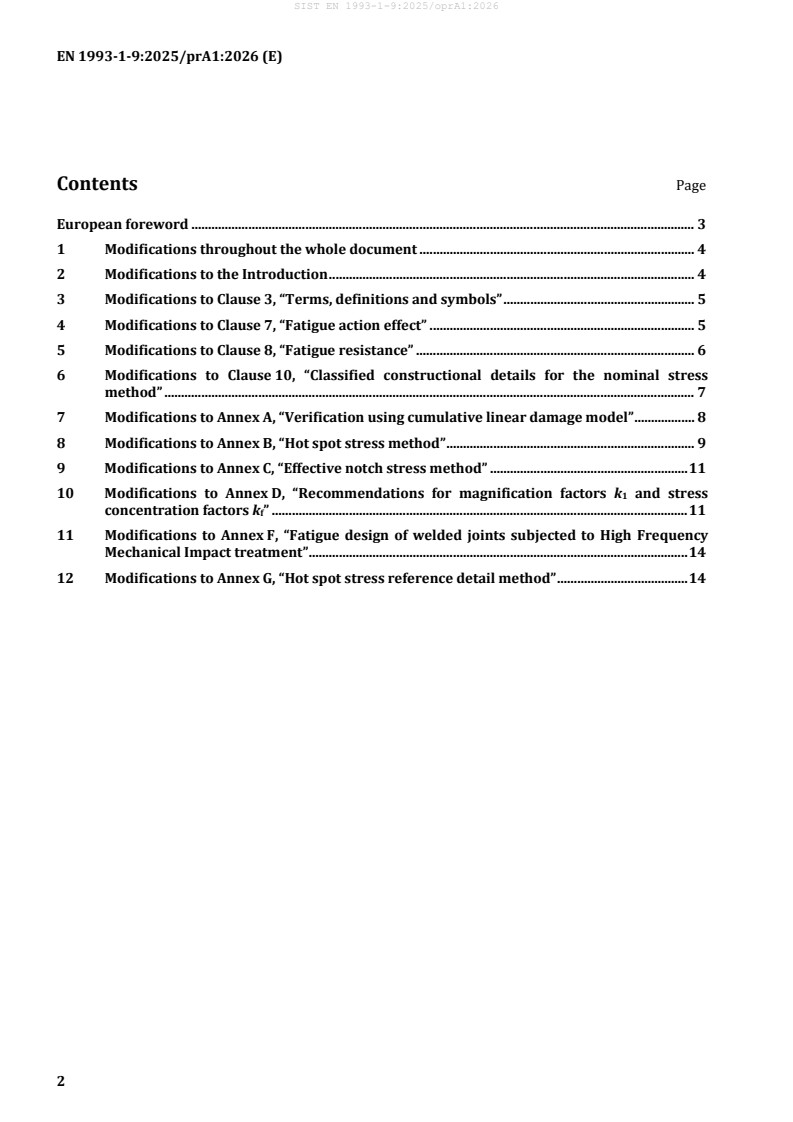
Contents Page
European foreword . 3
1 Modifications throughout the whole document . 4
2 Modifications to the Introduction . 4
3 Modifications to Clause 3, “Terms, definitions and symbols” . 5
4 Modifications to Clause 7, “Fatigue action effect” . 5
5 Modifications to Clause 8, “Fatigue resistance” . 6
6 Modifications to Clause 10, “Classified constructional details for the nominal stress
method” . 7
7 Modifications to Annex A, “Verification using cumulative linear damage model” . 8
8 Modifications to Annex B, “Hot spot stress method” . 9
9 Modifications to Annex C, “Effective notch stress method” . 11
10 Modifications to Annex D, “Recommendations for magnification factors k and stress
concentration factors k ” . 11
f
11 Modifications to Annex F, “Fatigue design of welded joints subjected to High Frequency
Mechanical Impact treatment” . 14
12 Modifications to Annex G, “Hot spot stress reference detail method” . 14
European foreword
This document (EN 1993-1-9:2025/prA1:2026) has been prepared by Technical Committee CEN/TC 250
“Structural Eurocodes”, the secretariat of which is held by BSI. CEN/TC 250 is responsible for all
Structural Eurocodes and has been assigned responsibility for structural and geotechnical design matters
by CEN.
This document is an amendment to EN 1993-1-9:2025 and is currently submitted to the CEN Enquiry.
The following main changes to EN 1993-1-9:2025 are included in the amendment:
— Detail categories of stainless steel bolts and studs are added.
— The influence of shear stress is added to the detail with a cope hole in the web of a built-up girder
with and without thickness transitions.
— The highest detail categories for HFMI treated details in high-strengths steel is increased to 180.
— This amendment corrects technical and editorial points in EN 1993-1-9:2025 to increase the clarity
and user friendliness.
The first generation of EN Eurocodes was published between 2002 and 2007. This document forms part
of the second generation of the Eurocodes, which have been prepared under Mandate M/515 issued to
CEN by the European Commission and the European Free Trade Association.
The Eurocodes have been drafted to be used in conjunction with relevant execution, material, product
and test standards, and to identify requirements for execution, materials, products and testing that are
relied upon by the Eurocodes.
The Eurocodes recognize the responsibility of each Member State and have safeguarded their right to
determine values related to regulatory safety matters at national level through the use of National
Annexes.
1 Modifications throughout the whole document
Add “-1:2023+A1:2026” to the reference “EN 1990” in Clause 2 and update throughout the text when a
dated reference is given.
Add part number “-1” to the reference “EN 1990” and update throughout the text when an undated
reference is given.
2 Modifications to the Introduction
0.1 Replace “— New parts are under development, e.g. Eurocode for design of structural glass”
with “— EN 19100 Eurocode 10 — Design of glass structures”.
0.1 Add the following new list item: “— New parts are under development, e.g. Eurocode for design of
fibre-polymer composite structures and for design of tensioned membrane structures”.
0.2 Replace in the first paragraph the reference to EN 1990 with “EN 1990-1 — Basis of structural and
geotechnical design — Part 1: New structures”.
0.2 Replace the list of the various parts of EN 1993 with:
“EN 1993-1-1, Eurocode 3 — Design of Steel Structures — Part 1-1: General rules and rules for buildings;
EN 1993-1-2, Eurocode 3 — Design of Steel Structures — Part 1-2: Structural fire design;
EN 1993-1-3, Eurocode 3 — Design of Steel Structures — Part 1-3: Cold-formed members and sheeting;
NOTE Cold-formed hollow sections supplied according to EN 10219 (all parts) are covered in EN 1993-1-1.
EN 1993-1-4, Eurocode 3 — Design of Steel Structures — Part 1-4: Stainless steel structures;
EN 1993-1-5, Eurocode 3 — Design of Steel Structures — Part 1-5: Plated structural elements;
EN 1993-1-6, Eurocode 3 — Design of Steel Structures — Part 1-6: Strength and stability of shell structures;
EN 1993-1-7, Eurocode 3 — Design of Steel Structures — Part 1-7: Plate assemblies with elements under
transverse loads;
EN 1993-1-8, Eurocode 3 — Design of Steel Structures — Part 1-8: Joints;
EN 1993-1-9, Eurocode 3 — Design of Steel Structures — Part 1-9: Fatigue;
EN 1993-1-10, Eurocode 3 — Design of Steel Structures — Part 1-10: Material toughness and through-
thickness properties;
EN 1993-1-11, Eurocode 3 — Design of Steel Structures — Part 1-11: Tension components;
EN 1993-1-12, Eurocode 3 — Design of Steel Structures — Part 1-12: Additional rules for steel grades up to
S960;
EN 1993-1-13, Eurocode 3 — Design of Steel Structures — Part 1-13: Beams with large web openings;
EN 1993-1-14, Eurocode 3 — Design of Steel Structures — Part 1-14: Design assisted by finite element
analysis;
EN 1993-2, Eurocode 3 — Design of Steel Structures — Part 2: Bridges;
EN 1993-3, Eurocode 3 — Design of Steel Structures — Part 3: Towers, masts and chimneys;
EN 1993-4-1, Eurocode 3 — Design of Steel Structures — Part 4-1: Silos;
EN 1993-4-2, Eurocode 3 — Design of Steel Structures — Part 4-2: Tanks;
EN 1993-5, Eurocode 3 — Design of Steel Structures — Part 5: Piling;
EN 1993-6, Eurocode 3 — Design of Steel Structures — Part 6: Crane supporting structures;
EN 1993-7, Eurocode 3 — Design of Steel Structures — Part 7: Sandwich panels (under preparation).”.
0.5 In the list for national choices replace “7.1(5)” with “7.1(4)” and add “8.2(2)”.
3 Modifications to Clause 3, “Terms, definitions and symbols”
3.1.1.3 Modify the definition to read as follows:
“design concept in which an appropriate level of reliability for the fatigue design situation is obtained
without the need for regular in-service inspection or monitoring for fatigue cracks during the design
service life”.
3.1.1.4 Modify the definition to read as follows:
“design concept in which an appropriate level of reliability for the fatigue design situation is obtained by
implementing prescribed inspection and maintenance for detecting and mitigating fatigue cracks during
the design service life”.
3.1.1.16 Replace the title of Figure 3.2d) with:
“d) notch stress distribution”.
3.1.3.5 Replace the entire Note 1 to entry with:
“Note 1 to entry: The influence of stress ratio typically exists for non-welded constructional details and for welded
constructional details with thermal stress relief as specified in 7.4 and for welded constructional details with post-
weld treatment as specified in Annex F.”.
3.1.4.3 Delete Note 1 to entry and move Figure 3.6 to 3.1.4.4 after Note 1 to entry.
3.2.2 Add the following Latin lower-case letters:
“ stress concentration factor to account for the cope hole in the web within the constructional detail
f
co
flange thickness transition in girders
k reduction factor for fatigue resistance (in terms of stress) to account for simultaneously acting
τ
shear stresses
r radius of the cope hole in the web
co
t flange thickness”.
f
4 Modifications to Clause 7, “Fatigue action effect”
7.1(4) and (5) Replace (4) and (5) with:
“(4) For class 4 cross sections, the nominal stresses should be calculated with the effective cross section
according to EN 1993-1-5 in order to account for local instability effects.
NOTE The National Annex can give specifications for class 4 sections subject to fatigue actions.”.
7.3.2(1) Replace the first sentence with:
“For fatigue design situations where the fatigue action effect is defined by an equivalent constant stress
range, the design value of the nominal stress ranges Δσ and Δτ should be determined as follows:”.
e,2,Ed e,2,Ed
7.3.2(2) Replace the first sentence with:
“For fatigue design situations where the fatigue action effect is defined by an equivalent constant stress
range and where macro-geometric and/or concentrated load effects occur, the design value of the
modified nominal stress ranges Δσ and Δτ should be determined as follows:”.
e,2,Ed e,2,Ed
7.4(3) Replace the numbering of Formula (7.9) with (7.8), the numbering of Formula (7.10) with (7.9) and
the numbering of Formula (7.11) with (7.10).
5 Modifications to Clause 8, “Fatigue resistance”
8.1(1) Replace NOTE 1 with:
“NOTE 1 The characteristic fatigue resistance is represented by a series of parallel and equally spaced
fatigue resistance curves defining the number of cycles, N (endurance), that a stress range Δσ or Δτ can be
R
withstood by a constructional detail until failure occurs, as shown in Figures 8.1 to 8.4.”.
8.1(6) Delete the NOTE within Figure 8.2.
8.1(6), Table 8.1 Make the following changes within the Table 8.1:
— add within the block “8.1a” of the column “Figure” after detail category 80 a new line with: “71”in the
column detail category, with “71,0” in the column Δσ and with “46,0” in the column Δσ ;
D L
— delete in the block “8.1b” of the column “Figure” the four lines for detail categories 112, 100, 90 and 80;
and add after detail category 50 a new line with “45”in the column detail category, with “45,0” in the
column Δσ and with “20,6” in the column Δσ ;
D L
— replace in the block “8.2a” in the line for detail category 90 the value “36,5” in the column Δσ with
L
“36,4” and in the line for detail category 80 the value “59,0” in the column Δσ with “58,9” and in the
D
line for detail category 71 the value “28,8” in the column Δσ with “28,7”;
L
— replace in the block “8.2b” in the line for detail category 63 the value “36,9” in the column Δσ with
D
“36,8” and in the line for detail category 56 the value “32,8” in the column Δσ with “32,7” and in the
D
line for detail category 50 the value “29,3” in the column Δσ with “29,2” and the value “18,5” in the
D
column Δσ with “18,4”;
L
— replace in the block “8.3” in the line for detail category 90 the value “65,3” in the column Δσ with “65,2”
D
and add after detail category 71 a new line with: “63”in the column detail category, with “45,7” in the
column Δσ and with “35,4” in the column Δσ ; and replace in the line for detail category 50 the value
D L
“36,3” in the column Δσ with “36,2” and delete the whole line of detail category 45.
D
8.1(6), In Table 8.2, add after detail category 100 a new line with: “90”in the column detail category, with
“41,2” in the column Δτ and with “41,2” in the column Δτ to read as follows:
D L
“
Table 8.2 — Characteristic fatigue resistance values in N/mm from curves in Figure 8.4
Figure Detail category Slope parameter
∆τD ∆τL
2 2
[N/mm ] [N/mm ]
8.4 100 5 — 45,7 45,7
90 41,2 41,2
80 36,6 36,6
”.
8.2(2) Renumber the “NOTE” to “NOTE 1” and add NOTE 2 to read as follows:
“NOTE 2 The National Annex can give supplementary requirements on inspection of constructional details.”.
8.3.2(1) Replace NOTE 2 of (1) with:
“NOTE 2 Guidance is given in Annex F regarding fatigue design of welded joints subject HFMI treatment.”.
6 Modifications to Clause 10, “Classified constructional details for the nominal
stress method”
10(7), Table 10.1, Detail No. 5 Replace in last column:
“⑤ Thermal cut quality acc. to EN 9013 …” with “⑤ Thermal cut quality acc. to EN ISO 9013 …”.
10(7), Table 10.2, Detail No. 6, Within the block of constructional detail ⑥ add a new line with: “63
m =3” for the detail category and “Austenitic-ferritic stainless steel bolts and rods with cold rolled ISO
metric screw threads, subjected to normal stress” in the column “description”. Replace the description for
detail category 56 with “Carbon steel uncoated bolts and rods with rolled ISO metric screw threads, rolled
before heat treatment and austenitic stainless steel bolts and rods with cold rolled ISO metric screw
threads, subjected to normal stress” and the description for the first detail category 50 with “Carbon steel
hot-dip or electric galvanized bolts and rods with ISO metric screw threads, subjected to normal stress”
and the description for the second detail category 50 with “Carbon steel, austenitic stainless steel, and
austenitic-ferritic stainless steel bolts and rods with cut ISO metric screw threads, subjected to normal
stress”.
Table 10.3, Detail N
...