

oSIST prEN ISO 11137-2:2026
(Main)Sterilization of health care products - Radiation - Part 2: Establishing the sterilization dose (ISO/DIS 11137-2:2026)
- Abstract
ISO 11137-2:2013 specifies methods for determining the minimum dose needed to achieve a specified requirement for sterility and methods to substantiate the use of 25 kGy or 15 kGy as the sterilization dose to achieve a sterility assurance level, SAL, of 10−6. ISO 11137-2:2013 also specifies methods of sterilization dose audit used to demonstrate the continued effectiveness of the sterilization dose.
ISO 11137-2:2013 defines product families for sterilization dose establishment and sterilization dose audit.
- Status
- Not Published
- Public Enquiry End Date
- 30-Oct-2026
- Technical Committee
- VAZ - Healthcare
- Current Stage
- 4020 - Public enquire (PE) (Adopted Project)
- Start Date
- 04-Sep-2026
- Due Date
- 22-Jan-2027

oSIST prEN ISO 11137-2:2026 is the SIST publication of ISO/DIS 11137-2:2026, a draft international standard for radiation sterilization of health care products. It specifies how to establish or substantiate a sterilization dose, and how to audit that dose to confirm continued effectiveness, for products sterilized by ionizing radiation.
This document is used by organizations that develop, validate, monitor, and review sterilization processes for medical devices and other health care products. It gives a technical basis for choosing a dose, checking it with microbiological data, and keeping that dose under control over time.
What does oSIST prEN ISO 11137-2:2026 specify?
oSIST prEN ISO 11137-2:2026 specifies methods for determining the minimum dose needed to achieve a specified sterility requirement, methods for substantiating the use of specified sterilization doses to achieve a sterility assurance level, SAL, of 10−6, and methods for sterilization dose audit. It also defines product families for dose establishment and dose audit.
The document is organized into clauses 1 to 10, followed by Annexes A to H and Annexes ZA and ZB. In practice, that means the standard first sets the framework, then gives the dose-setting methods, then explains how to maintain effectiveness and what to do if an audit fails.
| Annex | What it covers |
|---|---|
| Annex A | Normative tables for Method 1 and Method VD, including verification dose values, dose values, and dose augmentation values |
| Annex B | Worked examples for Method 1, Method 2, Method VD, and dose audits |
| Annex C | Guidance on investigating positives from sterilization dose audits |
| Annex D | Guidance on bioburden limits, low bioburden, and dose-selection risk |
| Annex E | Guidance on bioburden alert and action levels |
| Annex F | Guidance on sample size and microbiological controls |
| Annex G | Guidance on selecting the dose establishment method |
| Annex H | Product adoption worksheet example |
| Annex ZA | Relationship to Regulation (EU) 2017/745 |
| Annex ZB | Relationship to Regulation (EU) 2017/746 |
What are the key requirements of oSIST prEN ISO 11137-2:2026?
Product families, representation, and maintenance
Clause 4 requires product families to be defined and documented for dose setting, dose substantiation, and sterilization dose auditing. The grouping is based mainly on the number and types of microorganisms on or in the product, so the practical question is whether products share a similar bioburden profile.
Clause 4 also requires a product family to be represented by a master product, an equivalent product, or a simulated product, with a formal documented assessment behind that choice. That matters because the representative product is the one used to justify the dose for the family.
Clause 4 further requires periodic review of the family using bioburden trending data, verification dose experiment data, product and packaging-system design changes, manufacturing changes, and evidence of state of control. If a sterilization dose establishment or audit fails, all members of that product family are considered affected, so the impact is not limited to one SKU.
Product selection, sample portions, and microbiological testing
Clause 5 requires the product used for dose establishment to be selected and handled so that it represents normal production. Sampling has to reflect the product that will actually be sterilized, which matters because artificial handling can distort bioburden or sterility-test outcomes.
Clause 5 uses the term sample item portion, SIP, for the portion of product tested. For an average bioburden greater than or equal to 1.0, the entire product is used whenever practicable, while for an average bioburden less than 1.0, the entire product is required for testing.
Clause 5 also ties the microbiology work to ISO 11737-1 and ISO 11737-2, and it ties irradiation and dose measurement to ISO 11137-1. In practice, that means dose setting is not a stand-alone exercise - bioburden testing, sterility testing, irradiation control, and dose measurement all have to line up.
Dose establishment and substantiation methods
Clause 6 says a product-specific sterilization dose can be established by Method 1, by Methods 2A and 2B and their Modified Methods, or by another method that gives equivalent assurance. Clause 6 also says that selected sterilization doses of 15 kGy, 17.5 kGy, 20 kGy, 22.5 kGy, 25 kGy, 27.5 kGy, 30 kGy, 32.5 kGy, and 35 kGy are substantiated by Method VD or by an equivalent method.
This matters because the standard separates two tasks: establishing a dose for a product, and substantiating an already selected dose. If you already have a target dose, Method VD is the route described for showing it is justified.
Method 1: bioburden-based dose setting
Clause 7 bases Method 1 on bioburden information and the standard distribution of resistances, SDR. The method checks whether the product bioburden is less resistant than the SDR, which is why it is often used when conservative dose-setting is acceptable.
Method 1 uses the average bioburden, a verification dose taken from the tables in Annex A, and a verification dose experiment with 100 product items. Acceptance is based on the sterility-test results, and if verification is accepted, the sterilization dose is then read from the tables for the chosen SAL. For average bioburden values from 0.1 to 0.9, the standard requires the entire product, a correction factor, and use of the Annex A.2 values.
Method 2 and Modified Method 2
Clause 8 sets out Method 2, which uses fraction positive information from incremental dosing to determine an extrapolation factor. The method then uses that information to derive D*, D**, and the sterilization dose.
This is the more data-intensive route, and it matters when the product bioburden or radiation response is being characterized in finer detail. Clause 8 includes Method 2A and 2B, plus Modified Method 2A and 2B, and it requires bioburden testing, incremental dose experiments, and verification dose experiments as part of the procedure.
Method VD and continued control
Clause 9 describes Method VD for substantiating a selected sterilization dose using 10 product items and a verification dose experiment. The method applies to selected doses in the 15 kGy to 35 kGy range and accepts the dose if no more than one positive test of sterility is obtained from the 10 tests.
Clause 10 then requires maintaining process effectiveness through periodic bioburden determinations and sterilization dose audits for multiple production batches. It also states that if a dose audit fails, the cause has to be investigated and correction or corrective action taken in line with ISO 11137-1:2025, with further guidance in Annex C.
What terms does oSIST prEN ISO 11137-2:2026 define?
- Action level - a monitored value that requires immediate intervention.
- Alert level - a monitored value that gives early warning of deviation from specified conditions.
- Batch - a defined quantity of product intended or purported to be uniform in character and quality.
- Fraction positive - the number of positive sterility tests divided by the number of tests performed.
- Incremental dose - a dose within a dose series used to obtain or confirm the sterilization dose.
- Sample item portion (SIP) - the specified portion of a health care product that is tested.
- Standard distribution of resistances (SDR) - the reference set of microorganism resistances and their probabilities of occurrence.
- Sterilization dose audit - an exercise undertaken to confirm the appropriateness of an established sterilization dose.
Who uses oSIST prEN ISO 11137-2:2026?
oSIST prEN ISO 11137-2:2026 is used by medical device and health care product manufacturers, sterilization process developers, microbiology laboratories, and quality and validation teams. It is also relevant to buyers and technical assessors who need to understand how a sterilization dose was established or maintained.
In practice, these users apply the standard when developing a radiation sterilization process, choosing a product family representative, running bioburden and sterility tests, setting a dose, performing dose audits, and deciding whether a dose needs to be augmented after a failure.
What changed in oSIST prEN ISO 11137-2:2026 from the previous edition?
oSIST prEN ISO 11137-2:2026 replaces ISO 11137-2:2013.
Which standards are used with oSIST prEN ISO 11137-2:2026?
- ISO 11137-1:2025 - provides the process requirements for development, validation, and routine control of radiation sterilization and is the main companion document for this part.
- ISO 11737-1:2018 - gives the microbiological method for determining a population of microorganisms on products, which is needed for bioburden work.
- ISO 11737-2 - gives the sterility test methods used for the verification dose and audit experiments.
What does the oSIST prEN ISO 11137-2:2026 document contain?
The document contains dose-setting methods, dose substantiation methods, and dose-audit procedures, together with the tables needed to apply them. Annex A provides the key verification-dose, dose, and dose-augmentation tables; Annex B shows worked examples; and Annexes C to G give guidance on failures, low bioburden, alert and action levels, sample size, and method selection.
It also includes an adoption worksheet in Annex H for bringing a candidate product into an existing product family. The European Annexes ZA and ZB link the document to the General Safety and Performance Requirements of Regulations (EU) 2017/745 and 2017/746.
Relations
- Effective Date
- 31-Jul-2024
- Effective Date
- 31-Jul-2024
Get Certified
Connect with accredited certification bodies for this standard

BSI Group
BSI (British Standards Institution) is the business standards company that helps organizations make excellence a habit.

TÜV Rheinland
TÜV Rheinland is a leading international provider of technical services.

TÜV SÜD
TÜV SÜD is a trusted partner of choice for safety, security and sustainability solutions.
Sponsored listings
Frequently Asked Questions
oSIST prEN ISO 11137-2:2026 is a draft published by the Slovenian Institute for Standardization (SIST). Its full title is "Sterilization of health care products - Radiation - Part 2: Establishing the sterilization dose (ISO/DIS 11137-2:2026)". This standard covers: ISO 11137-2:2013 specifies methods for determining the minimum dose needed to achieve a specified requirement for sterility and methods to substantiate the use of 25 kGy or 15 kGy as the sterilization dose to achieve a sterility assurance level, SAL, of 10−6. ISO 11137-2:2013 also specifies methods of sterilization dose audit used to demonstrate the continued effectiveness of the sterilization dose. ISO 11137-2:2013 defines product families for sterilization dose establishment and sterilization dose audit.
ISO 11137-2:2013 specifies methods for determining the minimum dose needed to achieve a specified requirement for sterility and methods to substantiate the use of 25 kGy or 15 kGy as the sterilization dose to achieve a sterility assurance level, SAL, of 10−6. ISO 11137-2:2013 also specifies methods of sterilization dose audit used to demonstrate the continued effectiveness of the sterilization dose. ISO 11137-2:2013 defines product families for sterilization dose establishment and sterilization dose audit.
oSIST prEN ISO 11137-2:2026 is classified under the following ICS (International Classification for Standards) categories: 11.080.01 - Sterilization and disinfection in general. The ICS classification helps identify the subject area and facilitates finding related standards.
oSIST prEN ISO 11137-2:2026 has the following relationships with other standards: It is inter standard links to SIST EN ISO 11137-2:2015/A1:2023, SIST EN ISO 11137-2:2015. Understanding these relationships helps ensure you are using the most current and applicable version of the standard.
oSIST prEN ISO 11137-2:2026 is associated with the following European legislation: EU Directives/Regulations: 2017/745, 2017/746; Standardization Mandates: M/575, M/575 AMD 2. When a standard is cited in the Official Journal of the European Union, products manufactured in conformity with it benefit from a presumption of conformity with the essential requirements of the corresponding EU directive or regulation.
oSIST prEN ISO 11137-2:2026 is available in PDF format for immediate download after purchase. The document can be added to your cart and obtained through the secure checkout process. Digital delivery ensures instant access to the complete standard document.
Standards Content (Sample)
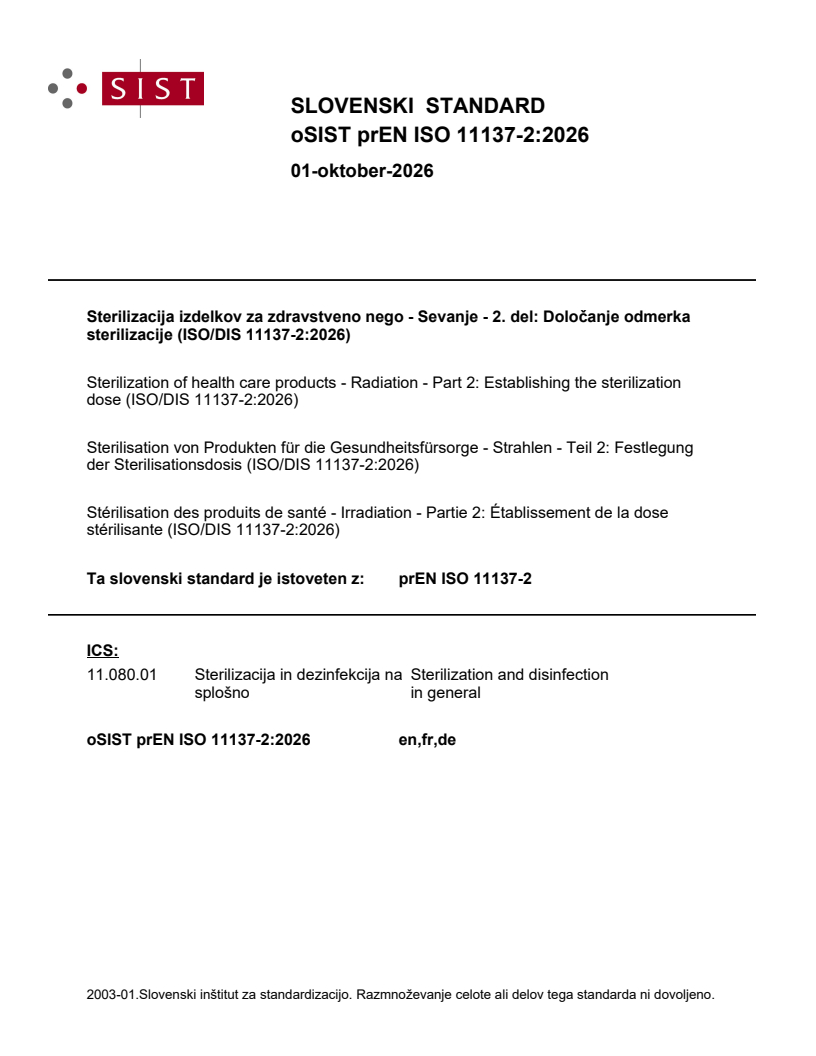
SLOVENSKI STANDARD
01-oktober-2026
Sterilizacija izdelkov za zdravstveno nego - Sevanje - 2. del: Določanje odmerka
sterilizacije (ISO/DIS 11137-2:2026)
Sterilization of health care products - Radiation - Part 2: Establishing the sterilization
dose (ISO/DIS 11137-2:2026)
Sterilisation von Produkten für die Gesundheitsfürsorge - Strahlen - Teil 2: Festlegung
der Sterilisationsdosis (ISO/DIS 11137-2:2026)
Stérilisation des produits de santé - Irradiation - Partie 2: Établissement de la dose
stérilisante (ISO/DIS 11137-2:2026)
Ta slovenski standard je istoveten z: prEN ISO 11137-2
ICS:
11.080.01 Sterilizacija in dezinfekcija na Sterilization and disinfection
splošno in general
2003-01.Slovenski inštitut za standardizacijo. Razmnoževanje celote ali delov tega standarda ni dovoljeno.
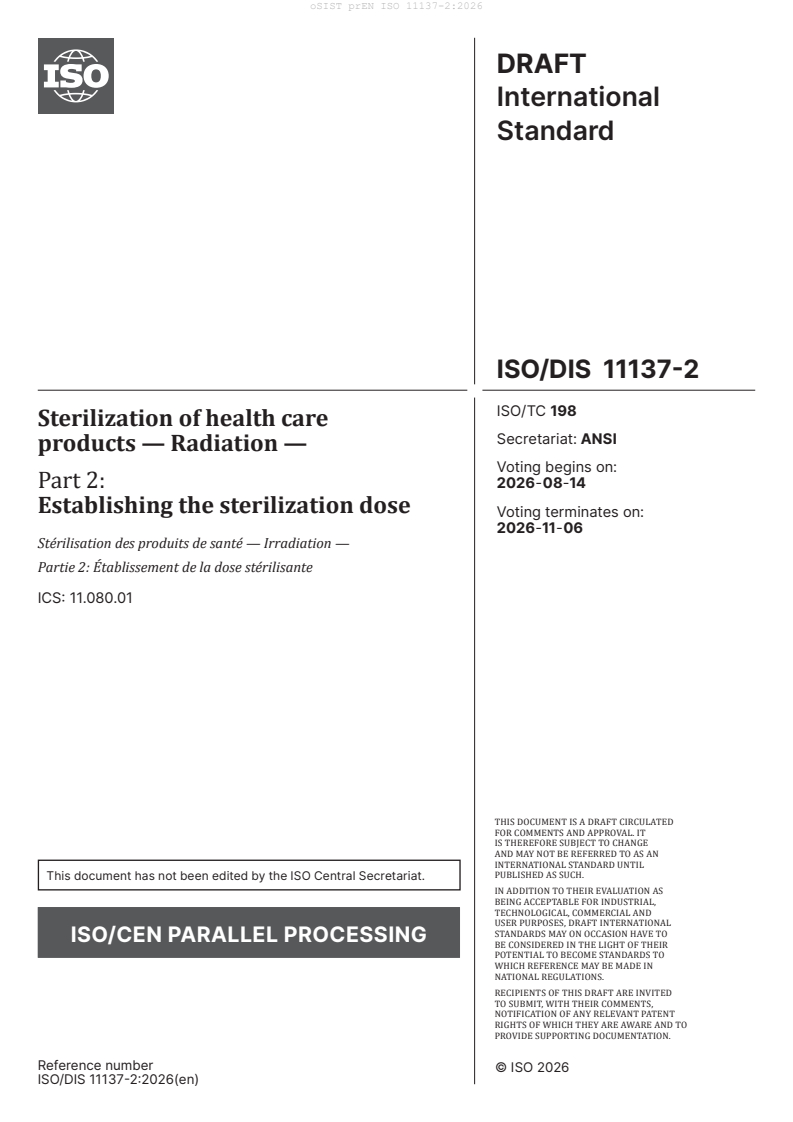
DRAFT
International
Standard
ISO/DIS 11137-2
ISO/TC 198
Sterilization of health care
Secretariat: ANSI
products — Radiation —
Voting begins on:
Part 2: 2026-08-14
Establishing the sterilization dose
Voting terminates on:
2026-11-06
Stérilisation des produits de santé — Irradiation —
Partie 2: Établissement de la dose stérilisante
ICS: 11.080.01
THIS DOCUMENT IS A DRAFT CIRCULATED
FOR COMMENTS AND APPROVAL. IT
IS THEREFORE SUBJECT TO CHANGE
AND MAY NOT BE REFERRED TO AS AN
INTERNATIONAL STANDARD UNTIL
PUBLISHED AS SUCH.
This document has not been edited by the ISO Central Secretariat.
IN ADDITION TO THEIR EVALUATION AS
BEING ACCEPTABLE FOR INDUSTRIAL,
TECHNOLOGICAL, COMMERCIAL AND
USER PURPOSES, DRAFT INTERNATIONAL
STANDARDS MAY ON OCCASION HAVE TO
ISO/CEN PARALLEL PROCESSING
BE CONSIDERED IN THE LIGHT OF THEIR
POTENTIAL TO BECOME STANDARDS TO
WHICH REFERENCE MAY BE MADE IN
NATIONAL REGULATIONS.
RECIPIENTS OF THIS DRAFT ARE INVITED
TO SUBMIT, WITH THEIR COMMENTS,
NOTIFICATION OF ANY RELEVANT PATENT
RIGHTS OF WHICH THEY ARE AWARE AND TO
PROVIDE SUPPORTING DOCUMENTATION.
Reference number
ISO/DIS 11137-2:2026(en)
DRAFT
ISO/DIS 11137-2:2026(en)
International
Standard
ISO/DIS 11137-2
ISO/TC 198
Sterilization of health care
Secretariat: ANSI
products — Radiation —
Voting begins on:
Part 2:
Establishing the sterilization dose
Voting terminates on:
Stérilisation des produits de santé — Irradiation —
Partie 2: Établissement de la dose stérilisante
ICS: 11.080.01
THIS DOCUMENT IS A DRAFT CIRCULATED
FOR COMMENTS AND APPROVAL. IT
IS THEREFORE SUBJECT TO CHANGE
AND MAY NOT BE REFERRED TO AS AN
INTERNATIONAL STANDARD UNTIL
PUBLISHED AS SUCH.
This document has not been edited by the ISO Central Secretariat.
IN ADDITION TO THEIR EVALUATION AS
BEING ACCEPTABLE FOR INDUSTRIAL,
© ISO 2026
TECHNOLOGICAL, COMMERCIAL AND
USER PURPOSES, DRAFT INTERNATIONAL
All rights reserved. Unless otherwise specified, or required in the context of its implementation, no part of this publication may
STANDARDS MAY ON OCCASION HAVE TO
ISO/CEN PARALLEL PROCESSING
be reproduced or utilized otherwise in any form or by any means, electronic or mechanical, including photocopying, or posting on
BE CONSIDERED IN THE LIGHT OF THEIR
the internet or an intranet, without prior written permission. Permission can be requested from either ISO at the address below
POTENTIAL TO BECOME STANDARDS TO
WHICH REFERENCE MAY BE MADE IN
or ISO’s member body in the country of the requester.
NATIONAL REGULATIONS.
ISO copyright office
RECIPIENTS OF THIS DRAFT ARE INVITED
CP 401 • Ch. de Blandonnet 8
TO SUBMIT, WITH THEIR COMMENTS,
CH-1214 Vernier, Geneva
NOTIFICATION OF ANY RELEVANT PATENT
Phone: +41 22 749 01 11
RIGHTS OF WHICH THEY ARE AWARE AND TO
PROVIDE SUPPORTING DOCUMENTATION.
Email: copyright@iso.org
Website: www.iso.org
Published in Switzerland Reference number
ISO/DIS 11137-2:2026(en)
ii
ISO/DIS 11137-2:2026(en)
Contents Page
Foreword .vi
Introduction .viii
1 Scope . 1
2 Normative references . 1
3 Terms and definitions . 1
3.1 Terms and definitions .1
3.2 Abbreviated terms .3
4 Definition of product families for dose setting, dose substantiation and sterilization
dose auditing . 4
4.1 General .4
4.2 Defining product families .4
4.3 Designation of product to represent a product family .5
4.3.1 Product to represent a product family .5
4.3.2 Master product .5
4.3.3 Equivalent product .6
4.3.4 Simulated product .6
4.4 Maintaining product families .6
4.4.1 Periodic review .6
4.4.2 Aspects of periodic review .6
4.4.3 Evaluation for adoption of new or modified product into a product family .8
4.4.4 Methods for adoption of product into a product family .8
4.4.5 Records .9
4.5 Consequence of failure of sterilization dose establishment or sterilization dose audit .9
5 Selection and testing of product for establishing the sterilization dose . 9
5.1 Nature of product .9
5.2 Sample item portion (SIP) .10
5.3 Manner of sampling .11
5.4 Microbiological testing .11
5.5 Irradiation . 12
6 Methods of dose establishment .12
7 Method 1: dose setting using bioburden information .13
7.1 Rationale . 13
7.2 Procedure for Method 1 for product with an average bioburden greater than or equal
to 1,0 for multiple production batches .14
7.2.1 General .14
7.2.2 Stage 1: Select SAL and obtain samples of product .14
7.2.3 Stage 2: Determine average bioburden .14
7.2.4 Stage 3: Obtain verification dose . 15
7.2.5 Stage 4: Perform verification dose experiment . 15
7.2.6 Stage 5: Interpretation of results . 15
7.2.7 Stage 6: Establish sterilization dose .16
7.3 Procedure for Method 1 for product with an average bioburden greater than or equal
to 1,0 for a single production batch .16
7.3.1 Rationale .16
7.4 Procedure for Method 1 for product with an average bioburden in the range 0,1 to 0,9
for multiple or single production batches .16
8 Method 2: Dose setting using fraction positive information from incremental dosing to
determine an extrapolation factor . 17
8.1 Rationale .17
8.1.1 General .17
8.1.2 Modified Method 2 .17
8.1.3 Method 2 and Modified Method 2 .18
iii
ISO/DIS 11137-2:2026(en)
8.1.4 Bioburden determination .18
8.1.5 Calculations . .18
8.2 Procedure for Method 2A and Modified Method 2A .19
8.2.1 General .19
8.2.2 Stage 1: Select SAL and obtain samples of product .19
8.2.3 Stage 2: Perform bioburden testing and incremental dose experiment .19
8.2.4 Stage 3: Perform verification dose experiment . 22
8.2.5 Stage 4: Interpretation of results . 22
8.2.6 Stage 5: Establish sterilization dose . 23
8.3 Procedure for Method 2B and Modified Method 2B . 23
8.3.1 General . 23
8.3.2 Stage 1: Select SAL and obtain samples of product .24
8.3.3 Stage 2: Perform bioburden testing and incremental dose experiment .24
8.3.4 Stage 3: Perform verification dose experiment .27
8.3.5 Stage 4: Interpretation of results .27
8.3.6 Stage 5: Establish sterilization dose .27
SD
9 Method VD — Substantiation of a selected sterilization dose .28
max
9.1 Selected doses and rationale . 28
SD
9.2 Procedure for Method VD for multiple production batches . 29
max
9.2.1 General . 29
9.2.2 Stage 1: Obtain samples of product . 29
9.2.3 Stage 2: Determine average bioburden . 29
9.2.4 Stage 3: Obtain the selected sterilization dose . 30
SD
9.2.5 Stage 4: Obtain VD .31
max
9.2.6 Stage 5: Perform verification dose experiment .31
9.2.7 Stage 6: Interpretation of results .32
9.2.8 Confirmatory verification dose experiment . 33
SD
9.3 Procedure for Method VD for a single production batch . 34
max
9.3.1 Rationale . 34
10 Maintaining process effectiveness .34
10.1 General . 34
10.2 Frequency of determination of bioburden . 34
10.3 Sterilization dose audit . 34
10.3.1 Frequency . 34
10.3.2 Outcome . 35
10.3.3 Procedure for auditing a sterilization dose established using Method 1,
Method 2A, Method 2B, Modified Method 2A and Modified Method 2B . 35
10.3.4 Augmentation of sterilization dose established using Method 1, Method 2A, or
Method 2B . 38
SD
10.4 Procedure for auditing a sterilization dose substantiated using Method VD . 39
max
10.4.1 General . 39
10.4.2 Stage 1: Obtain samples of product . 39
10.4.3 Stage 2: Determine average bioburden . 39
10.4.4 Stage 3: Perform verification dose experiment . 40
10.4.5 Stage 4: Interpretation of results . 40
10.4.6 Confirmatory sterilization dose audit .41
SD
10.4.7 Augmentation of a sterilization dose substantiated using Method VD .43
max
10.5 Failure of a sterilization dose audit . 44
SD
Annex A (normative) Method 1 and Method VD verification dose and dose augmentation
max
value tables .45
Annex B (informative) Worked examples . 61
Annex C (informative) Addressing sterilization dose audit positives .78
Annex D (informative) Bioburden less than the limit of detection (LOD) .85
Annex E (informative) Guidance on bioburden alert and action levels .89
Annex F (informative) Guidance on sample size and microbiological controls .92
iv
ISO/DIS 11137-2:2026(en)
Annex G (informative) Guidance on selection of dose establishment method .94
Annex H (informative) Product adoption worksheet example .96
Annex ZA (informative) Relationship between this European Standard and the General Safety
and Performance Requirements of Regulation (EU) 2017/745 aimed to be covered .98
Annex ZB (informative) Relationship between this European Standard and the General Safety
and Performance Requirements of Regulation (EU) 2017/746 aimed to be covered .102
Bibliography .105
v
ISO/DIS 11137-2:2026(en)
Foreword
ISO (the International Organization for Standardization) is a worldwide federation of national standards
bodies (ISO member bodies). The work of preparing International Standards is normally carried out through
ISO technical committees. Each member body interested in a subject for which a technical committee
has been established has the right to be represented on that committee. International organizations,
governmental and non-governmental, in liaison with ISO, also take part in the work. ISO collaborates closely
with the International Electrotechnical Commission (IEC) on all matters of electrotechnical standardization.
The procedures used to develop this document and those intended for its further maintenance are described
in the ISO/IEC Directives, Part 1. In particular, the different approval criteria needed for the different types
of ISO documents should be noted. This document was drafted in accordance with the editorial rules of the
ISO/IEC Directives, Part 2 (see www.iso.org/directives).
ISO draws attention to the possibility that the implementation of this document may involve the use of (a)
patent(s). ISO takes no position concerning the evidence, validity or applicability of any claimed patent
rights in respect thereof. As of the date of publication of this document, ISO had not received notice of (a)
patent(s) which may be required to implement this document. However, implementers are cautioned that
this may not represent the latest information, which may be obtained from the patent database available at
www.iso.org/patents. ISO shall not be held responsible for identifying any or all such patent rights.
Any trade name used in this document is information given for the convenience of users and does not
constitute an endorsement.
For an explanation of the voluntary nature of standards, the meaning of ISO specific terms and expressions
related to conformity assessment, as well as information about ISO's adherence to the World Trade
Organization (WTO) principles in the Technical Barriers to Trade (TBT), see www.iso.org/iso/foreword.html.
This document was prepared by Technical Committee ISO/TC 198, Sterilization of health care products.
This fourth edition cancels and replaces the third edition (ISO 11137-2:2013), which has been technically
revised.
The main changes are as follows:
SD
— Method VD tables (i.e. 17,5 kGy, 20 kGy, 22,5 kGy, 27,5 kGy, 30 kGy, 32,5 kGy, and 35 kGy) from
max
ISO 13004 were incorporated and Table 7 was added to describe the different sterilization doses and
corresponding upper limit of average bioburden;
SD
— Method VD procedures were combined into one procedure rather than having separate procedures
max
for each sterilization dose;
SD
— VD tables for 15 kGy, 17,5 kGy, 20 kGy, 22,5 kGy, and 25 kGy were all combined into one table, and
max
for 27,5 kGy, 30 kGy, 32,5 kGy, and 35 kGy were all combined into a second table, and both updated tables
were added into (normative) Annex A;
SD
— VD tables for dose augmentation values were also combined as described above and added into
max
Annex A;
SD
— VD tables were truncated at average bioburden counts greater than 9,0 CFU to shorten the tables;
max
— Method 1 tables were moved to Annex A;
— information on maintaining product families, including product review considerations and product
adoption from AAMI TIR35 was incorporated;
— information on bioburden limit of detection (LOD) and TNTC/spreaders was added in Clauses 5, 7, 9, 10,
and Annex D;
SD
— dose establishment method procedures (Method 1 and Method VD ) for a single batch were simplified
max
to contain only the changes that need to be made to the multiple batch procedure when establishing dose
for a single batch;
vi
ISO/DIS 11137-2:2026(en)
— information on a Modified Method 2 option from AAMI TIR40 was incorporated;
— information was added to allow continued use of the augmented verification and sterilization doses in
Methods 1, 2A, or 2B;
— worked examples were moved to Annex B;
— guidance on sterilization dose audit failures was added in Annex C;
— guidance on bioburden alert and action levels was added in Annex E;
— guidance on sample size and microbiological controls was added in Annex F;
— guidance on selection of dose establishment method was added in Annex G;
— an example product adoption worksheet was added in Annex H.
A list of all parts in the ISO 11137 series can be found on the ISO website.
Any feedback or questions on this document should be directed to the user’s national standards body. A
complete listing of these bodies can be found at www.iso.org/members.html.
vii
ISO/DIS 11137-2:2026(en)
Introduction
This part of ISO 11137 describes methods that can be used to establish the sterilization dose in accordance
with one of the two approaches specified in ISO 11137-1:2025, 8.2. The methods used in these approaches
are:
— dose setting to obtain a product-specific dose;
— dose substantiation to verify a preselected dose.
The basis of the dose setting methods described in this part of ISO 11137 (Methods 1 and 2) owe much to the
[18][19][20]
ideas first propounded by Tallentire . Subsequently, standardized protocols were developed (see
References [8], [9]), which formed the basis of the dose setting methods detailed in the AAMI Recommended
1) 2)
Practice for Sterilization by Gamma Radiation and ANSI/AAMI ST32 .
Methods 1 and 2 and the associated sterilization dose audit procedures use data derived from the inactivation
of the microbial population in its natural state on product. The methods are based on a probability model
for the inactivation of microbial populations. The probability model, as applied to bioburden made up of a
mixture of various microbial species, assumes that each such species has its own unique D value. In the
model, the probability that an item will possess a surviving microorganism after exposure to a given dose of
radiation is defined in terms of the initial number of microorganisms on the item prior to irradiation and the
D values of the microorganisms. The methods involve performance of tests of sterility on product items
that have received doses of radiation lesser than the sterilization dose. The outcome of these tests is used to
predict the dose needed to achieve a predetermined sterility assurance level (SAL).
A modification to Method 2 is provided that reduces the number of incremental doses needed to determine
the minimum dose required to achieve a predetermined SAL. The Modified Method 2 can be employed at
any time but is more successful when the product bioburden counts and resistance are low.
SD
Methods 1 and 2 can also be used to substantiate any of the VD doses if, on performing a dose setting
max
exercise, the derived sterilization dose for the selected SAL is less than or equal to the selected sterilization
dose. The basis of the method devised specifically for substantiation of 25 kGy, Method VD , was put
max
[14]
forward by Kowalski and Tallentire. Subsequent evaluations involving computational techniques
[13]
demonstrated that the underlying principles were soundly based and field trials confirmed that
SD
Method VD is effective in substantiating a selected sterilization dose for a wide variety of products
max
[16]
manufactured and assembled in different ways .
SD
Method VD is founded on dose setting Method 1 and, as such, it possesses the high level of
max
conservativeness characteristic of Method 1. In a similar manner to the dose setting methods, it involves
performance of tests of sterility on product items that have received a specified dose of radiation lesser than
the sterilization dose. The outcomes of these tests are used to substantiate that the selected sterilization
dose achieves the selected SAL.
To link the use of Method VD for the substantiation of a particular preselected sterilization dose, the
max
numerical value of the latter, expressed in kiloGrays, is included as a superscript to the VD symbol. Thus,
max
for substantiation of a sterilization dose of 25 kGy, the method is designated Method VD . Reference to
max
SD
the general term of the VD method but not to a selected sterilization dose is designated VD .
max max
This part of ISO 11137 also describes methods that can be used to carry out sterilization dose audits in
accordance with ISO 11137-1:2025, Clause 12. Following establishment of the sterilization dose, sterilization
dose audits are performed routinely to confirm that the sterilization dose continues to achieve the desired
SAL.
1) Withdrawn.
2) Withdrawn.
viii
DRAFT International Standard ISO/DIS 11137-2:2026(en)
Sterilization of health care products — Radiation —
Part 2:
Establishing the sterilization dose
1 Scope
This document specifies methods for determining the minimum dose needed to achieve a specified
requirement for sterility and methods to substantiate the use of a specified sterilization dose to achieve
−6
an SAL of 10 . This document also specifies methods of sterilization dose audit used to demonstrate the
continued effectiveness of the sterilization dose.
This document defines product families for sterilization dose establishment and sterilization dose audit.
2 Normative references
The following documents are referred to in the text in such a way that some or all of their content constitutes
requirements of this document. For dated references, only the edition cited applies. For undated references,
the latest edition of the referenced document (including any amendments) applies.
ISO 11137-1:2025, Sterilization of health care products — Radiation — Part 1: Requirements for the development,
validation and routine control of a sterilization process for medical devices
ISO 11737-1:2018, Sterilization of health care products — Microbiological methods — Part 1: Determination of
a population of microorganisms on products
ISO 11737-2, Sterilization of health care products — Microbiological methods — Part 2: Tests of sterility
performed in the definition, validation and maintenance of a sterilization process
3 Terms and definitions
For the purposes of this document, the terms and definitions given in ISO 11137-1 and the following apply.
ISO and IEC maintain terminology databases for use in standardization at the following addresses:
— ISO Online browsing platform: available at https:// www .iso .org/ obp
— IEC Electropedia: available at https:// www .electropedia .org/
3.1 Terms and definitions
3.1.1
action level
value from monitoring that necessitates immediate intervention
[SOURCE: ISO 11139:2018, 3.5]
3.1.2
alert level
value from monitoring providing early warning of deviation from specified conditions
[SOURCE: ISO 11139:2018, 3.11]
ISO/DIS 11137-2:2026(en)
3.1.3
batch
defined quantity of a product intended or purported to be uniform in character and quality produced during
a specified cycle of manufacture
[SOURCE: ISO 11139:2018, 3.21]
3.1.4
candidate product
product being examined for adoption into an existing product family
3.1.5
false positive
test result interpreted as growth arising from the product, or portions thereof, tested when either growth
resulted from extraneous microbial contamination or turbidity occurred from interaction between the
product, or portions thereof, and the test medium
3.1.6
fraction positive
quotient in which the number of positive tests of sterility is given by the numerator, and the number of tests
performed is given by the denominator
[SOURCE: ISO 11139:2018, 3.122]
3.1.7
incremental dose
dose within a series of doses applied to a number of product, or portions thereof, and used in a dose setting
method to obtain or confirm the sterilization dose
[SOURCE: ISO 11139:2018, 3.138]
3.1.8
packaging system
combination of a sterile barrier system and protective packaging
[SOURCE: ISO 11139:2018, 3.192]
3.1.9
positive test of sterility
test result for which there is detectable microbial growth from product, or portions thereof, subjected to a
test of sterility
3.1.10
sample item portion
SIP
specified portion of a health care product that is tested
[SOURCE: ISO 11139:2018, 3.240]
3.1.11
standard distribution of resistances
SDR
reference set of resistances of microorganisms and corresponding probabilities of occurrence
[SOURCE: ISO 11139:2018, 3.263]
3.1.12
sterilization dose audit
exercise undertaken to confirm the appropriateness of an established sterilization dose
[SOURCE: ISO 11139:2018, 3.281]
ISO/DIS 11137-2:2026(en)
3.2 Abbreviated terms
3.2.1
A
dose to adjust the median ffp dose downwards to the FFP dose
3.2.2
CD*
number of positive tests of sterility obtained from tests performed individually on 100 product items
irradiated in a Method 2 verification dose experiment
3.2.3
d*
dose derived from an incremental dose experiment performed on product items drawn from a given
production batch
3.2.4
D*
−2
initial estimate of the dose to provide an SAL of 10 for the test items
Note 1 to entry: Generally, it is the median of the three d * values derived for a given product.
3.2.5
D**
−2
final estimate of the dose to provide an SAL of 10 for the test items, which is used in the calculation of the
sterilization dose
3.2.6
DD*
highest dose delivered in a Method 2 verification dose experiment
3.2.7
DS
estimate of the D value of microorganisms present on product after exposure to DD*
3.2.8
D value
D value
time or dose required under stated conditions to achieve inactivation of 90 % of a population of the test
microorganism
Note 1 to entry: For the purposes of this part of ISO 11137, D applies to the radiation dose only and not to time.
[SOURCE: ISO 11139:2018, 3.75, modified — Note to entry has been added.]
3.2.9
first fraction positive dose
ffp
lowest dose of an incremental dose series, applied to product items drawn from a given production batch, at
which at least one of the associated 20 tests of sterility is negative for growth
Note 1 to entry: Notation in lower case refers to results derived from product taken from a single batch.
3.2.10
First Fraction Positive dose
FFP
dose at which 19 positives out of the 20 tests of sterility are expected to occur, calculated by subtracting A
from the median of three ffp doses
Note 1 to entry: Notation in upper case refers to results derived from product taken from all three batches.
ISO/DIS 11137-2:2026(en)
3.2.11
First No Positive dose
FNP
−2
estimate of the dose to provide an SAL of 10 for the test items, that is used in the calculation of DS
3.2.12
SD
VD
max
−6
maximal verification dose for a given bioburden, consistent with the attainment of an SAL of 10 at a
specified sterilization dose
4 Definition of product families for dose setting, dose substantiation and
sterilization dose auditing
4.1 General
The establishment of a sterilization dose and the carrying out of sterilization dose audits are activities that
are part of process definition and maintaining process effectiveness (see ISO 11137-1). For these activities,
product may be grouped into families. Definition of product families is based principally on the numbers and
types of microorganisms on or in product (the bioburden), the type being indicative of the microorganism’s
resistance to radiation (see ISO 11137-1:2025, A.7.2 and ISO 11737-1). Variables such as density and product
configuration within its packaging system are not considered in the establishment of these product families
because they are not factors that influence bioburden.
NOTE 1 In using product families for establishing the sterilization dose and for carrying out sterilization dose audits,
it is important to be aware of the reduction in the ability to detect an inadvertent change within the manufacturing
process that influences the effectiveness of sterilization. Furthermore, with the use of a single product to represent
the product family, it is possible that changes that occur in other members of the product family will not be detected.
The effect of a reduction on ability to detect changes in other members of the product family is understood and a plan
for maintaining product families is developed and implemented before proceeding.
NOTE 2 The product families outlined in Clause 4 are based on their microbiological properties. In this document
the concept of microbiological families is called product families.
4.2 Defining product families
4.2.1 The criteria for defining a product family shall be documented. Product shall be assessed against
these criteria and the similarities between potential product family members considered. Consideration
shall include all product- and sterile barrier system (SBS)-related variables that affect bioburden, including,
but not limited to:
1. nature and sources of inputs, including, raw materials, components, and manufacturing process
materials (e.g. water, cleaning solutions, machine fluids) and their ability to support microbial growth;
a) product design and size as it relates to product bioburden;
b) manufacturing processes, including level of automation versus manual operations and any washing
or cleaning processes
c) manufacturing equipment;
d) manufacturing environment;
2. manufacturing location (see also 4.2.4).
The outcome of the assessment and considerations shall be recorded.
4.2.2 Product shall only be included in a product family if it is demonstrated that the product- and SBS-
related variables (see 4.2.1) are similar and under control.
ISO/DIS 11137-2:2026(en)
4.2.3 To include product within a product family, it shall be determined that bioburden comprises similar
numbers and types of microorganisms.
4.2.4 Inclusion of product from more than one manufacturing location in a product family shall be
specifically justified and recorded. In addition to all elements of 4.2.1, consideration shall be given to:
a) geographic or climatic differences, or both, between locations;
b) any differences in the control of the manufacturing processes or environment.
4.3 Designation of product to represent a product family
4.3.1 Product to represent a product family
4.3.1.1 The number and types of microorganisms on or in product shall be used as the basis for selecting
product to represent a product family.
4.3.1.2 A product family shall be represented by one of the following:
a) the master product (see 4.3.2);
b) an equivalent product (see 4.3.3);
c) a simulated product (see 4.3.4).
4.3.1.3 A formal, documented assessment shall be undertaken to decide which of the three potential
representative products in 4.3.1.2 is appropriate. In this assessment, consideration shall be given to the
following:
a) number of microorganisms comprising the bioburden;
b) types of microorganisms comprising the bioburden;
c) environment in which the microorganisms occur;
d) size of product;
e) number of components;
f) complexity of product;
g) degree of automation during manufacture;
h) manufacturing environment;
i) SBS packaging process, materials, components and environment;
j) production frequency and volume of production.
4.3.2 Master product
A member of a product family shall only be considered the master product if assessment (see 4.3.1.3)
indicates that the member presents a microbiological challenge to the sterilization process that is greater
than that of all other product family members. The master product can have a different verification dose than
other products that are given the same sterilization dose. In some situations, there can be several products
within the product family, each of which could be considered as the master product. In such circumstances,
any one of these products may be selected as the master product to represent the family, either
a) at random; or
ISO/DIS 11137-2:2026(en)
b) according to
...