

kSIST FprEN 13121-3:2026
(Main)GRP tanks and vessels for use above ground - Part 3: Design and workmanship
- Abstract
This document gives requirements for the design, fabrication, inspection, testing and verification of GRP tanks and vessels with or without thermoplastics lining for storage or processing of fluids, factory made or site built, non-pressurized or pressurized up to 10 bar, for use above ground. Further requirements are presented in normative Annex G.
The terms vessels and tanks as used in this document include branches up to the point of connection to pipe work or other equipment by bolting and supports, brackets or other attachments bonded directly to the shell.
Fatigue is not considered a design criterion, as keeping strains below the limit strain inherently prevents fatigue failure. This document is applicable to vessels and tanks exposed to temperatures between -40 °C and 120 °C.
This document does not apply to:
- tanks and vessels for the transport of fluids;
- underground storage tanks;
- spherical vessels;
- vessels and tanks of irregular shape;
- tanks and vessels with double containment where the double wall is considered structural;
- tanks and vessels which are subject to the risk of explosion, or failure of which can cause an emission of radioactivity;
- specification for fibre reinforced cisterns of one piece and sectional construction for the storage, above ground, of cold water (see EN 13280).
- Status
- Not Published
- Public Enquiry End Date
- 02-Nov-2022
- Technical Committee
- TLP - Pressure vessels
- Current Stage
- 5020 - Formal vote (FV) (Adopted Project)
- Start Date
- 28-Apr-2026
- Due Date
- 16-Jun-2026
- Completion Date
- 29-May-2026


kSIST FprEN 13121-3:2026 is the SIST draft European Standard for glass reinforced plastics (GRP) tanks and vessels for use above ground. It specifies requirements for their design, fabrication, inspection, testing and verification, for factory-made or site-built equipment used to store or process fluids. It is written for manufacturers, designers, inspectors, purchasers and other parties who need a common technical basis for GRP equipment with or without thermoplastics lining.
What does kSIST FprEN 13121-3:2026 specify?
kSIST FprEN 13121-3:2026 specifies how to design and make above-ground GRP tanks and vessels for fluids, including units with thermoplastics lining, up to 10 bar and within the stated temperature range. It also sets the framework for documentation, material selection, structural design, quality control and final marking.
The scope includes branches up to the first connection to pipework or equipment, and it treats fatigue as not being a separate design criterion because the design approach keeps strains below the limit strain.
The document excludes these applications:
- tanks and vessels for transport of fluids
- underground storage tanks
- spherical vessels
- vessels and tanks of irregular shape
- double-containment tanks and vessels where the double wall is structural
- equipment subject to explosion risk, or failure that may emit radioactivity
- fibre reinforced cisterns for above-ground storage of cold water covered by EN 13280
The document is organized into clauses for information and documentation, materials, mechanical properties, strain and load determination, design and design analysis, supports, seismic loading, anchorage, structures and fittings, local load analysis, quality control and marking. It also has Annexes A to G.
| Annex | What it covers |
|---|---|
| A | Product testing for serial or batch production, including initial type testing, batch release tests and records |
| B | Calculation support for laminate thickness, modulus, stiffness and strains |
| C | Pressure testing of tanks and vessels, including open-top, pressure-less, hydraulic and vacuum-related testing |
| D | Test methods for welds, laminates, bonding, hardness, electrical resistivity, Tg, HDT and pull-off strength |
| E | Approval testing of laminators |
| F | Design verification support, including typical methods and important determination results |
| G | Additional requirements linked to water protection, food, recycling and storage of substances hazardous to water |
What are the key requirements of kSIST FprEN 13121-3:2026?
kSIST FprEN 13121-3:2026 is built around a documented design-and-verification process. The most important practical points are what information must be exchanged, which material properties must be proven, which loads must be checked, and how the finished vessel must be inspected and marked.
Documentation and defined responsibility
Clause 5 requires the manufacturer to obtain process requirements from the purchaser and to prepare the technical, manufacturing and final documentation. In practice, this means the order has to be defined before design and fabrication start, and the manufacturer must keep a clear record of the finished vessel.
Materials and protective layers
Clause 6 covers materials, chemical protective barriers, flammability and electrical resistivity. This matters because the vessel must be matched to the fluid and service environment, and the liner or barrier has to be chosen as part of the design, not added later as a minor detail.
Mechanical properties and allowable design factors
Clause 7 requires the selection and proof of mechanical properties, including heat deflection temperature, laminate construction, laminate thickness, inter-laminar shear strength, peel strength and pull-off strength. It also sets the logic for choosing physical properties and design factors. In practice, the designer has to use proven laminate and liner data, not assumptions, when checking that the shell and details can carry the loads.
Strain limits and load combinations
Clause 8 defines limit design strains and how laminate values are obtained, with or without test data. Clause 9 then applies the partial factor method to external loads such as snow, wind, seismic actions, insulation, connections, agitation, inadequate venting, personnel loading and temperature effects. The important practical point is that strength checks use factored loads, while strain checks use unfactored characteristic combinations in the serviceability state.
Shape-specific design checks
Clause 10 is the main design-analysis clause. It gives checks for vertical cylinders, cylindrical shells under compression, conical shells, dished ends, flat bottoms, skirts, seams, openings, branches, blind flanges, saddles and horizontal vessels. This is where the document turns general design into component-by-component rules, so the engineer can select the correct shell, head, joint and support detail for the actual geometry.
Where standard shell rules are not enough, Clause 10 allows FE Analysis in Annex F or experimental design verification under Clause 17.6. That matters for unusual geometry or heavily loaded details, because the standard gives a route to prove the design when the simple formulas are outside their intended range.
Flanged joints, supports and anchorage
Clause 11 covers bolted flange connections, including full face flanges, stub flanges, backing rings and gasket loading. Clauses 12 and 14 cover supports and anchorage for vertical and horizontal vessels, including saddles, ring girders, skirts, uplift and anchor bolts. In practice, these clauses are there to stop support loads, bolt loads and restraint from damaging the shell or preventing free expansion.
Quality control, testing and marking
Clause 17 requires works control, raw-material storage, manufacturing conditions, inspection after fabrication and prototype verification for pressure vessels. Clause 18 sets the marking data that must stay with the vessel, including PS, PT and the allowable temperature range. That gives traceability for production, acceptance, installation and later inspection.
What terms does kSIST FprEN 13121-3:2026 define?
- Manufacturer - The organization that designs, manufactures and tests the vessel or tank in accordance with this document.
- Purchaser - The organization or individual that buys the finished vessel or tank and specifies the process requirements.
- Authorized inspecting authority - The body or organization that may be required to check compliance with the design, materials and construction; this is linked in the document to PS ≤ 0,5 bar.
- Notified body - The certificated organization listed by the European commission of pressure equipment; this is linked in the document to PS > 0,5 bar.
- Vessel - A closed container subject to applied pressure or vacuum, with or without hydrostatic head, including branches up to the first flanged connection.
- Tank - A container for storage of fluids subject only to hydrostatic head and freely vented to atmosphere, including branches up to the first flanged connection.
- Maximum allowable pressure (PS) - The maximum pressure, excluding hydrostatic pressure, for which the equipment is designed, as specified by the manufacturer.
- Test pressure (PT) - The pressure to which the tank or vessel is tested.
Who uses kSIST FprEN 13121-3:2026?
kSIST FprEN 13121-3:2026 is used by the people who specify, design, build, inspect and accept GRP tanks and vessels for above-ground fluid service.
Typical users include:
- vessel and tank designers
- GRP manufacturers and fabricators
- quality control and inspection staff
- purchasers and project engineers writing technical specifications
- authorized inspecting authorities and notified bodies
- installation and maintenance teams that need the final documentation and marking data
It is relevant wherever GRP vessels are used for storage or processing of fluids and where the design has to be traceable through calculation, fabrication records and inspection.
What changed in kSIST FprEN 13121-3:2026 from the previous edition?
kSIST FprEN 13121-3:2026 is the draft intended to supersede EN 13121-3:2016.
Which standards are used with kSIST FprEN 13121-3:2026?
The following referenced and companion standards contribute directly to the design, testing and production rules in this document:
| Standard | What it contributes |
|---|---|
| EN 13121-1 | Raw materials specification and acceptance conditions |
| EN 13121-2 | Chemical resistance, including CRL, VL and TPL |
| EN 13121-4 | Delivery, installation and maintenance |
| EN 59 | Barcol hardness testing for GRP |
| EN 1990 | Basis of structural design |
| EN 1991-1-3 | Snow loads |
| EN 1991-1-4 | Wind actions |
| EN 1991-4 | Actions on silos and tanks |
| EN 1993-1-1 | General rules for steel parts |
| EN 1993-1-6 | Strength and stability of shell structures |
| EN 1998-1 | Seismic actions |
| EN 10025-2 | Structural steel delivery conditions |
| EN 13067 | Qualification testing of welders for thermoplastics welded assemblies |
| EN 13445-3 | Design reference for unfired pressure vessels |
| EN ISO 75-2 | Heat deflection temperature |
| EN ISO 291 | Conditioning and testing atmospheres |
| EN ISO 527-4 | Tensile properties of fibre-reinforced plastic composites |
| EN ISO 1172 | Glass and filler content by calcination |
| EN ISO 2592 | Flash and fire point by Cleveland open cup |
| EN ISO 3915 | Resistivity of conductive plastics |
| EN ISO 7500-1 | Calibration of force-measuring systems in testing machines |
| EN ISO 9513 | Calibration of extensometer systems |
| EN ISO 11357-2 | Glass transition temperature by DSC |
| EN ISO 14125 | Flexural properties of fibre-reinforced plastic composites |
| EN ISO 14692-3 | GRP piping system design |
| ISO 48-2 | Hardness of rubber |
| ASTM D4541 | Pull-off strength of coatings using portable adhesion testers |
What does the kSIST FprEN 13121-3:2026 document contain?
kSIST FprEN 13121-3:2026 contains detailed design equations, tables, figures and test procedures for GRP tanks and vessels. The body of the document includes formulas for strain limits, load combinations, shell stability, flat bottoms, skirts, openings, flanges, saddles, anchors and lifting devices, together with figures that show the preferred and non-preferred construction details.
It also includes tables of symbols and abbreviations, design factors, flange and bolt arrangements, support dimensions, tolerances and permissible laminate imperfections. Annex C provides the testing sequences for pressure-related checks, while Annex D gives the material and joint test setups used for qualification and quality control.
Annex E covers laminator approval, which is important for production quality because it ties workmanship to personnel competence. Annex F supports design verification, and Annex G adds special requirements linked to water, food, recycling and substances hazardous to water.
Relations
- Effective Date
- 28-Jan-2026
- Effective Date
- 28-Jan-2026
- Effective Date
- 28-Jan-2026
- Effective Date
- 28-Jan-2026
- Effective Date
- 28-Jan-2026
- Effective Date
- 28-Jan-2026
- Effective Date
- 28-Jan-2026
- Effective Date
- 28-Jan-2026
- Effective Date
- 28-Jan-2026
- Effective Date
- 28-Jan-2026
- Effective Date
- 28-Jan-2026
- Effective Date
- 28-Jan-2026
- Effective Date
- 28-Jan-2026
- Effective Date
- 28-Jan-2026
- Effective Date
- 28-Jan-2026
Get Certified
Connect with accredited certification bodies for this standard

Institut za varilstvo d.o.o. (Welding Institute)
Slovenia's leading welding institute since 1952. ISO 3834, EN 1090, pressure equipment certification, NDT personnel, welder qualification. Only IIW Au
Sponsored listings
Frequently Asked Questions
kSIST FprEN 13121-3:2026 is a draft published by the Slovenian Institute for Standardization (SIST). Its full title is "GRP tanks and vessels for use above ground - Part 3: Design and workmanship". This standard covers: This document gives requirements for the design, fabrication, inspection, testing and verification of GRP tanks and vessels with or without thermoplastics lining for storage or processing of fluids, factory made or site built, non-pressurized or pressurized up to 10 bar, for use above ground. Further requirements are presented in normative Annex G. The terms vessels and tanks as used in this document include branches up to the point of connection to pipe work or other equipment by bolting and supports, brackets or other attachments bonded directly to the shell. Fatigue is not considered a design criterion, as keeping strains below the limit strain inherently prevents fatigue failure. This document is applicable to vessels and tanks exposed to temperatures between -40 °C and 120 °C. This document does not apply to: - tanks and vessels for the transport of fluids; - underground storage tanks; - spherical vessels; - vessels and tanks of irregular shape; - tanks and vessels with double containment where the double wall is considered structural; - tanks and vessels which are subject to the risk of explosion, or failure of which can cause an emission of radioactivity; - specification for fibre reinforced cisterns of one piece and sectional construction for the storage, above ground, of cold water (see EN 13280).
This document gives requirements for the design, fabrication, inspection, testing and verification of GRP tanks and vessels with or without thermoplastics lining for storage or processing of fluids, factory made or site built, non-pressurized or pressurized up to 10 bar, for use above ground. Further requirements are presented in normative Annex G. The terms vessels and tanks as used in this document include branches up to the point of connection to pipe work or other equipment by bolting and supports, brackets or other attachments bonded directly to the shell. Fatigue is not considered a design criterion, as keeping strains below the limit strain inherently prevents fatigue failure. This document is applicable to vessels and tanks exposed to temperatures between -40 °C and 120 °C. This document does not apply to: - tanks and vessels for the transport of fluids; - underground storage tanks; - spherical vessels; - vessels and tanks of irregular shape; - tanks and vessels with double containment where the double wall is considered structural; - tanks and vessels which are subject to the risk of explosion, or failure of which can cause an emission of radioactivity; - specification for fibre reinforced cisterns of one piece and sectional construction for the storage, above ground, of cold water (see EN 13280).
kSIST FprEN 13121-3:2026 is classified under the following ICS (International Classification for Standards) categories: 23.020.10 - Stationary containers and tanks. The ICS classification helps identify the subject area and facilitates finding related standards.
kSIST FprEN 13121-3:2026 has the following relationships with other standards: It is inter standard links to SIST EN ISO 16671:2025, SIST EN ISO 15883-1:2025, SIST EN ISO 9170-1:2020, SIST EN ISO 11334-4:2024, SIST EN ISO 10651-5:2021, SIST EN ISO 5840-1:2021, SIST EN ISO 5840-3:2021, SIST EN ISO 18113-1:2024, SIST EN ISO 7439:2023, SIST EN ISO 10555-1:2024, SIST EN ISO 81060-3:2023, SIST EN ISO 14607:2025, SIST EN ISO 12417-1:2024, SIST EN ISO 10651-4:2023, SIST EN ISO 18113-2:2024. Understanding these relationships helps ensure you are using the most current and applicable version of the standard.
kSIST FprEN 13121-3:2026 is associated with the following European legislation: EU Directives/Regulations: 2014/68/EU; Standardization Mandates: M/071, M/601. When a standard is cited in the Official Journal of the European Union, products manufactured in conformity with it benefit from a presumption of conformity with the essential requirements of the corresponding EU directive or regulation.
kSIST FprEN 13121-3:2026 is available in PDF format for immediate download after purchase. The document can be added to your cart and obtained through the secure checkout process. Digital delivery ensures instant access to the complete standard document.
Standards Content (Sample)
SLOVENSKI STANDARD
oSIST prEN 13121-3:2022
01-oktober-2022
Nadzemni rezervoarji in posode iz umetnih mas, ojačanih s steklenimi vlakni - 3.
del: Konstruiranje in izdelava
GRP tanks and vessels for use above ground - Part 3: Design and workmanship
Oberirdische GFK-Tanks und -Behälter - Teil 3: Auslegung und Herstellung
Réservoirs et récipients en PRV pour applications hors sol - Partie 3 : Conception et
fabrication
Ta slovenski standard je istoveten z: prEN 13121-3
ICS:
23.020.10 Nepremične posode in Stationary containers and
rezervoarji tanks
oSIST prEN 13121-3:2022 en,fr,de
2003-01.Slovenski inštitut za standardizacijo. Razmnoževanje celote ali delov tega standarda ni dovoljeno.
oSIST prEN 13121-3:2022
oSIST prEN 13121-3:2022
DRAFT
EUROPEAN STANDARD
prEN 13121-3
NORME EUROPÉENNE
EUROPÄISCHE NORM
September 2022
ICS 23.020.10 Will supersede EN 13121-3:2016
English Version
GRP tanks and vessels for use above ground - Part 3:
Design and workmanship
Réservoirs et récipients en PRV pour applications hors Oberirdische GFK-Tanks und -Behälter - Teil 3:
sol - Partie 3 : Conception et fabrication Auslegung und Herstellung
This draft European Standard is submitted to CEN members for enquiry. It has been drawn up by the Technical Committee
CEN/TC 210.
If this draft becomes a European Standard, CEN members are bound to comply with the CEN/CENELEC Internal Regulations
which stipulate the conditions for giving this European Standard the status of a national standard without any alteration.
This draft European Standard was established by CEN in three official versions (English, French, German). A version in any other
language made by translation under the responsibility of a CEN member into its own language and notified to the CEN-CENELEC
Management Centre has the same status as the official versions.
CEN members are the national standards bodies of Austria, Belgium, Bulgaria, Croatia, Cyprus, Czech Republic, Denmark, Estonia,
Finland, France, Germany, Greece, Hungary, Iceland, Ireland, Italy, Latvia, Lithuania, Luxembourg, Malta, Netherlands, Norway,
Poland, Portugal, Republic of North Macedonia, Romania, Serbia, Slovakia, Slovenia, Spain, Sweden, Switzerland, Türkiye and
United Kingdom.
Recipients of this draft are invited to submit, with their comments, notification of any relevant patent rights of which they are
aware and to provide supporting documentation.
Warning : This document is not a European Standard. It is distributed for review and comments. It is subject to change without
notice and shall not be referred to as a European Standard.
EUROPEAN COMMITTEE FOR STANDARDIZATION
COMITÉ EUROPÉEN DE NORMALISATION
EUROPÄISCHES KOMITEE FÜR NORMUNG
CEN-CENELEC Management Centre: Rue de la Science 23, B-1040 Brussels
© 2022 CEN All rights of exploitation in any form and by any means reserved Ref. No. prEN 13121-3:2022 E
worldwide for CEN national Members.
oSIST prEN 13121-3:2022
prEN 13121-3:2022 (E)
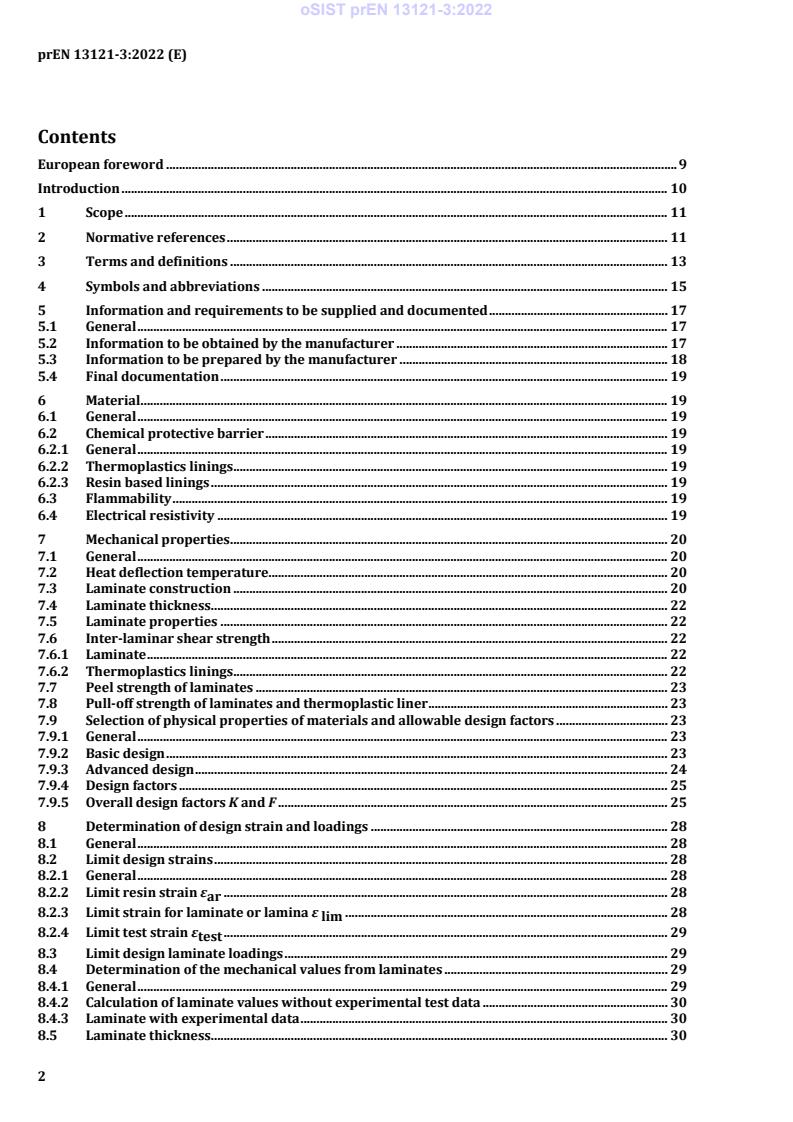
Contents
European foreword . 9
Introduction . 10
1 Scope . 11
2 Normative references . 11
3 Terms and definitions . 13
4 Symbols and abbreviations . 15
5 Information and requirements to be supplied and documented . 17
5.1 General . 17
5.2 Information to be obtained by the manufacturer . 17
5.3 Information to be prepared by the manufacturer . 18
5.4 Final documentation . 19
6 Material . 19
6.1 General . 19
6.2 Chemical protective barrier . 19
6.2.1 General . 19
6.2.2 Thermoplastics linings . 19
6.2.3 Resin based linings . 19
6.3 Flammability . 19
6.4 Electrical resistivity . 19
7 Mechanical properties . 20
7.1 General . 20
7.2 Heat deflection temperature. 20
7.3 Laminate construction . 20
7.4 Laminate thickness . 22
7.5 Laminate properties . 22
7.6 Inter-laminar shear strength . 22
7.6.1 Laminate . 22
7.6.2 Thermoplastics linings . 22
7.7 Peel strength of laminates . 23
7.8 Pull-off strength of laminates and thermoplastic liner . 23
7.9 Selection of physical properties of materials and allowable design factors . 23
7.9.1 General . 23
7.9.2 Basic design . 23
7.9.3 Advanced design . 24
7.9.4 Design factors . 25
7.9.5 Overall design factors K and F . 25
8 Determination of design strain and loadings . 28
8.1 General . 28
8.2 Limit design strains . 28
8.2.1 General . 28
8.2.2 Limit resin strain ε . 28
ar
8.2.3 Limit strain for laminate or lamina ε . 28
lim
8.2.4 Limit test strain ε . 29
test
8.3 Limit design laminate loadings . 29
8.4 Determination of the mechanical values from laminates . 29
8.4.1 General . 29
8.4.2 Calculation of laminate values without experimental test data . 30
8.4.3 Laminate with experimental data . 30
8.5 Laminate thickness . 30
oSIST prEN 13121-3:2022
prEN 13121-3:2022 (E)
9 Design . 31
9.1 Introduction . 31
9.2 Determination of external loads . 31
9.2.1 Snow loads . 31
9.2.2 Wind loads . 31
9.2.3 Seismic loads . 32
9.2.4 Insulation loads . 34
9.2.5 Loads resulting from connections . 34
9.2.6 Agitation . 34
9.2.7 Pressure due to inadequate venting . 34
9.2.8 Personnel loading . 34
9.2.9 Internal stresses in vessels and tanks due temperatures . 35
9.3 Verification by the partial factor method . 35
9.3.1 General . 35
9.3.2 Dimensioning by using (A ⋅γ )-factored loads. 40
F,i
9.4 Drawings and design calculations . 41
9.5 Design details . 41
9.5.1 Design temperature TS . 41
9.5.2 Pressure . 41
10 Design analysis . 42
10.1 Symbols and units . 42
10.2 Vertical vessels or tanks, cylinders under loads (t < 0,01∙D) . 45
10.2.1 Circumferential loadings . 45
10.2.2 Combined axial loading . 45
10.3 Cylindrical shells subject to compressive loadings — critical buckling criteria. 46
10.3.1 General . 46
10.3.2 Critical axial buckling load . 46
10.3.3 Critical circumferential buckling pressure . 47
10.3.4 Combined axial and radial compressive loadings . 47
10.3.5 Critical buckling pressure for cylindrical shell stiffened with external or internal rings. 48
10.4 Conical shells . 50
10.4.1 General requirements. 50
10.4.2 Shallow conical ends . 51
10.4.3 Conical ends subject to internal pressure . 52
10.4.4 Conical ends subject to external pressure . 53
10.4.5 Shell conical covers . 55
10.5 Dished end . 56
10.5.1 General requirements. 56
10.5.2 Dished ends subject to internal pressure . 57
10.5.3 Stability for dished ends subject to external pressure . 58
10.6 Design of flat bottoms and skirts for vertical tanks and vessels . 59
10.6.1 Definitions . 59
10.6.2 Fully supported, flat bottom tanks . 59
10.6.3 Vessels with flat bases subjected to pressure . 66
10.6.4 Dished bottom and conical bottom configurations . 66
10.7 Circumferential seams for cylindrical joints . 75
10.7.1 General . 75
10.7.2 Construction without thermoplastics liner . 78
10.7.3 Construction with thermoplastics liner . 78
10.8 Openings, branches and compensating laminate . 78
10.8.1 General . 78
10.8.2 Symbols . 79
10.8.3 Compensation requirements for openings . 79
10.8.4 Pull out load from nozzles . 86
10.8.5 Prevention of failure in peel . 86
10.8.6 Pad connections . 86
oSIST prEN 13121-3:2022
prEN 13121-3:2022 (E)
10.8.7 Screwed connections . 88
10.8.8 Access and inspecting openings . 88
10.8.9 Gusset on branches . 88
10.9 Flat Panels or Blind flanges . 88
10.9.1 General . 88
10.9.2 Symbols . 89
10.9.3 Circular panels . 89
10.10 Horizontal tanks and vessels . 92
10.10.1Types of supports . 92
10.10.2Symbols . 94
10.10.3Unit loads of the cylindrical shell . 95
10.10.4Unit loads on saddle position. 101
10.10.5Unit loads for horizontal loads at the vessel . 108
10.11 Large diameter pipes and pipe fittings . 109
10.11.1General . 109
10.11.2Joints . 109
10.11.3Elbows . 110
10.11.4Large cut-outs and Tees . 110
11 Bolted flange connections . 113
11.1 General . 113
11.2 Full face flanges design . 119
11.2.1 General . 119
11.2.2 Symbols . 120
11.2.3 Pipe loads on flanges. 122
11.2.4 Gasket load and bolt torque . 122
11.2.5 Summary of loads . 123
11.2.6 Total bending moment . 123
11.2.7 Flange design . 123
11.2.8 Flange slope . 125
11.3 Stub flange design with backing ring . 131
11.3.1 General . 131
11.3.2 Loads, bending moment and design for backing ring made of steel or GRP . 132
11.3.3 Stub flange loadings . 133
11.3.4 Stub shear interface design . 133
11.3.5 Stub end or flange design . 133
11.3.6 Seating stress . 134
11.4 Butt and strap jointed flanges at vessels or tanks. 136
12 Supports for vessels and tanks . 136
12.1 General . 136
12.2 Supports and mountings for tanks and vessels . 137
12.2.1 General considerations for supports . 137
12.2.2 Supports for vertical vessels . 137
13 Seismic loading . 143
14 Design calculation for tank and vessel anchorage . 143
14.1 General . 143
14.2 Design for uplift . 143
14.3 Design for anchor bolts . 143
15 Structures and fittings . 147
15.1 General . 147
15.2 Internal structures and fittings . 147
15.3 External structures and fittings . 147
15.4 Lifting devices . 147
16 Local load analysis . 152
17 Quality Control . 152
oSIST prEN 13121-3:2022
prEN 13121-3:2022 (E)
17.1 General . 152
17.2 Works requirements . 152
17.2.1 General . 152
17.2.2 Raw materials storage . 152
17.2.3 Manufacturing area . 152
17.2.4 Conditions for laminating . 152
17.3 Documentation to be prepared by the manufacturer . 153
17.3.1 Technical documentation . 153
17.3.2 Records and documentation requirements for raw materials . 153
17.3.3 Manufacturing documentation requirements . 154
17.3.4 Quality control documentation requirements . 154
17.4 Manufacture . 160
17.4.1 General . 160
17.4.2 Fabrication of thermoplastics liners . 160
17.4.3 Fabrication of laminates . 160
17.4.4 Imperfections in laminates . 161
17.4.5 Curing . 161
17.5 Inspection and testing after completion of fabrication . 161
17.5.1 Visual and dimensional inspection . 161
17.5.2 Physical test to be carried out . 162
17.5.3 Coupon testing . 162
17.6 Experimental Design Verification Method for pressure vessel . 163
17.6.1 General . 163
17.6.2 Manufacture of the prototype vessel . 163
17.6.3 Tests to be applied to prototype vessels . 164
18 Marking . 165
Annex A (informative) Product testing for serial or batch production process . 166
A.1 Initial type testing (ITT) . 166
A.2 Testing of samples . 166
A.2.1 General . 166
A.2.2 Batch release tests (BRT) . 166
A.2.2.1 General . 166
A.2.2.2 Retesting procedures for batch release tests . 167
A.2.3 Process control tests . 167
A.3 Inspection and test records . 167
A.3.1 General . 167
A.3.2 Marking . 167
A.3.3 Delivery, installation, maintenance . 167
Annex B (informative) Derivation of laminate properties from laminate properties . 168
B.1 General . 168
B.2 Lamina/laminate thickness . 168
B.3 Laminate modulus . 169
B.4 Determination of laminate flexural stiffness . 170
B.5 Determination of laminate strains from load resultants . 170
Annex C (normative) Pressure and leak testing . 172
C.1 General . 172
oSIST prEN 13121-3:2022
prEN 13121-3:2022 (E)
C.2 Open top tanks . 172
C.3 Tests of pressure less tanks and vessels . 173
C.3.1 Contents having a specific gravity up to 1,0 . 173
C.3.2 Contents having a specific gravity greater than 1,0 . 173
C.4 Hydraulic pressure test by pressure vessels . 173
C.4.1 Test done in the working attitude . 173
C.4.2 Pneumatic testing . 174
C.4.3 Vacuum test . 174
Annex D (normative) Methods of tests . 175
D.1 General . 175
D.1.1 Tests . 175
D.1.2 Accuracy of test equipment . 175
D.2 Loss on ignition . 176
D.3 Tensile strength of thermoplastics welds . 176
D.4 Bend test for thermoplastics welds . 176
D.4.1 Introduction . 176
D.4.2 Test arrangement . 176
D.4.3 Test pieces . 177
D.4.4 Method of test . 177
D.4.5 Requirements from flexural test . 177
D.4.6 Test report . 177
D.5 Ultimate tensile unit strength of laminates . 178
D.5.1 Test pieces and procedure . 178
D.5.2 Simple laminates . 178
D.5.3 Combined laminates . 178
D.6 Unit tensile modulus of laminates . 179
D.7 Inter laminar shear strength of laminates . 181
D.7.1 Form of test specimen . 181
D.7.2 Number of test specimens . 181
D.7.3 Procedure . 181
D.7.4 Results . 181
D.7.5 Report . 181
D.8 Lap shear strength of bond between thermoplastics lining and laminate or between
laminates . 182
D.8.1 Form of the test specimen . 182
D.8.2 Number of test specimens . 182
D.8.3 Procedure . 182
D.8.4 Report . 183
D.9 Peel strength of bond between laminate layers . 183
oSIST prEN 13121-3:2022
prEN 13121-3:2022 (E)
D.9.1 Form of the specimen . 183
D.9.2 Number of specimens. 183
D.9.3 Procedure . 184
D.9.4 Report . 184
D.10 Flexural short-term creep test (flexural modulus E and E test) . 186
1h 24h
D.10.1 General
...