


oSIST prEN ISO 3183:2007
Petroleum and natural gas industries - Steel pipe for pipeline transportation systems (ISO/FDIS 3183:2006)
Petroleum and natural gas industries - Steel pipe for pipeline transportation systems (ISO/FDIS 3183:2006)
2008-08-25 Vote postive in ISO negative in CEN. ISO proceeded to publish. ECISS/TC 29 informed CMC WI to be deleted.
Erdöl- und Erdgasindustrie - Stahlrohre für Rohrleitungstransportsysteme (ISO/FDIS 3183:2006)
Diese Internationale Norm legt Anforderungen für die Fertigung nahtloser und geschweißter Rohre für Rohrleitungstransportsysteme der Erdöl- und Erdgasindustrie nach zwei Produkt-Anforderungsstufen (PSL1 und PSL2) fest.
Diese Internationale Norm gilt nicht für gegossene Rohre.
Industries du pétrole et du gaz naturel - Tubes en acier pour les systemes de transport par conduites (ISO/FDIS 3183:2006)
Naftna industrija in industrija zemeljskega plina – Jeklene cevi za cevovodne sisteme (ISO/FDIS 3183:2006)
General Information
Relations
Standards Content (Sample)
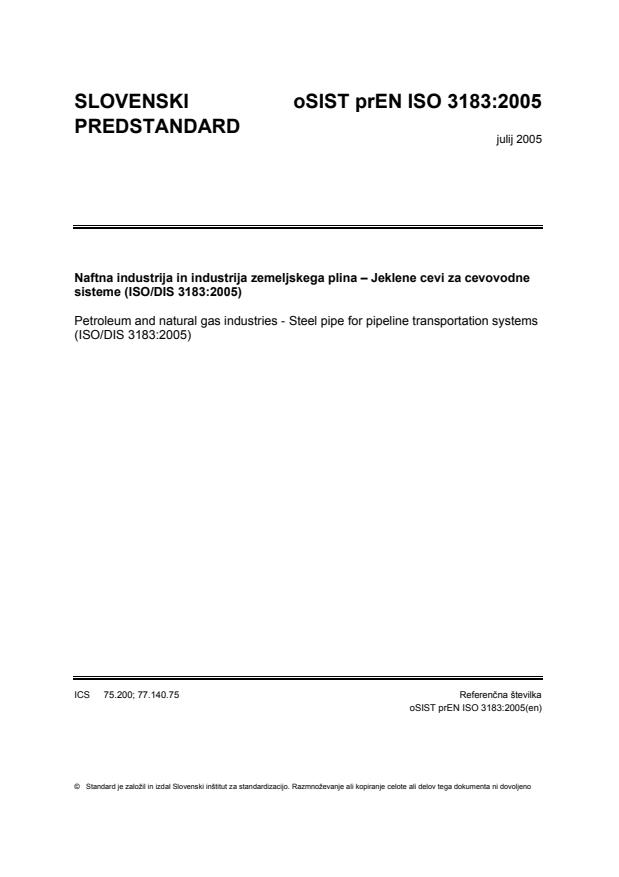
SLOVENSKI oSIST prEN ISO 3183:2005
PREDSTANDARD
julij 2005
Naftna industrija in industrija zemeljskega plina – Jeklene cevi za cevovodne
sisteme (ISO/DIS 3183:2005)
Petroleum and natural gas industries - Steel pipe for pipeline transportation systems
(ISO/DIS 3183:2005)
ICS 75.200; 77.140.75 Referenčna številka
oSIST prEN ISO 3183:2005(en)
© Standard je založil in izdal Slovenski inštitut za standardizacijo. Razmnoževanje ali kopiranje celote ali delov tega dokumenta ni dovoljeno
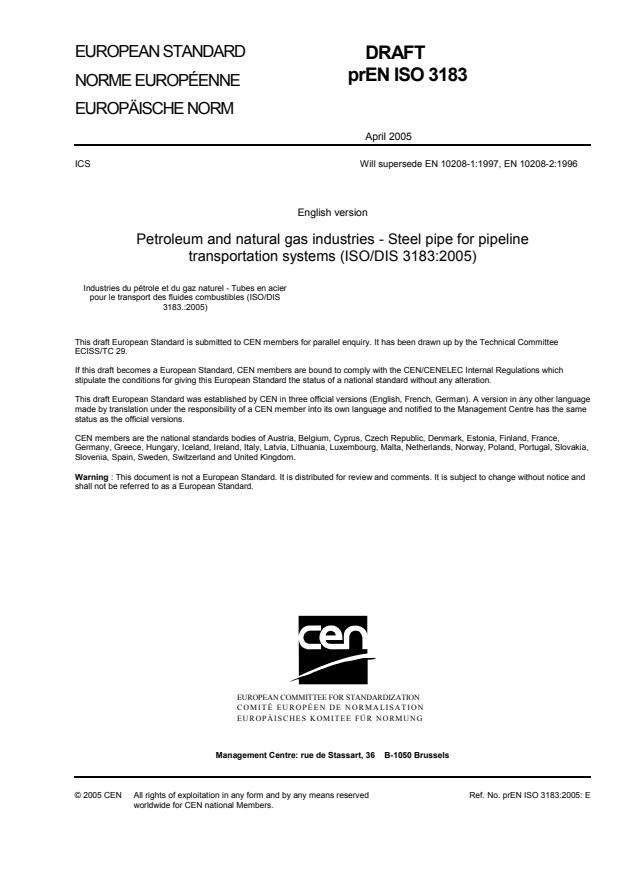
EUROPEAN STANDARD
DRAFT
NORME EUROPÉENNE
EUROPÄISCHE NORM
April 2005
ICS Will supersede EN 10208-1:1997, EN 10208-2:1996
English version
Petroleum and natural gas industries - Steel pipe for pipeline
transportation systems (ISO/DIS 3183:2005)
Industries du pétrole et du gaz naturel - Tubes en acier
pour le transport des fluides combustibles (ISO/DIS
3183.:2005)
This draft European Standard is submitted to CEN members for parallel enquiry. It has been drawn up by the Technical Committee
ECISS/TC 29.
If this draft becomes a European Standard, CEN members are bound to comply with the CEN/CENELEC Internal Regulations which
stipulate the conditions for giving this European Standard the status of a national standard without any alteration.
This draft European Standard was established by CEN in three official versions (English, French, German). A version in any other language
made by translation under the responsibility of a CEN member into its own language and notified to the Management Centre has the same
status as the official versions.
CEN members are the national standards bodies of Austria, Belgium, Cyprus, Czech Republic, Denmark, Estonia, Finland, France,
Germany, Greece, Hungary, Iceland, Ireland, Italy, Latvia, Lithuania, Luxembourg, Malta, Netherlands, Norway, Poland, Portugal, Slovakia,
Slovenia, Spain, Sweden, Switzerland and United Kingdom.
Warning : This document is not a European Standard. It is distributed for review and comments. It is subject to change without notice and
shall not be referred to as a European Standard.
EUROPEAN COMMITTEE FOR STANDARDIZATION
COMITÉ EUROPÉEN DE NORMALISATION
EUROPÄISCHES KOMITEE FÜR NORMUNG
Management Centre: rue de Stassart, 36 B-1050 Brussels
© 2005 CEN All rights of exploitation in any form and by any means reserved Ref. No. prEN ISO 3183:2005: E
worldwide for CEN national Members.
Foreword
This document (prEN ISO 3183:2005) has been prepared by Technical Committee ISO/TC 67 "Materials,
equipment and offshore structures for petroleum and natural gas industries" in collaboration with Technical
Committee CEN/TC 29 "Steel tubes and fittings for steel tubes", the secretariat of which is held by UNI.
This document is currently submitted to the parallel Enquiry.
This document will supersede EN 10208-1:1997 and EN 10208-2:1996.
Endorsement notice
The text of ISO 3183:2005 has been approved by CEN as prEN ISO 3183:2005 without any modifications.
DRAFT INTERNATIONAL STANDARD ISO/DIS 3183
ISO/TC 67/SC 2 Secretariat: NEN
Voting begins on: Voting terminates on:
2005-04-28 2005-09-28
INTERNATIONAL ORGANIZATION FOR STANDARDIZATION • МЕЖДУНАРОДНАЯ ОРГАНИЗАЦИЯ ПО СТАНДАРТИЗАЦИИ • ORGANISATION INTERNATIONALE DE NORMALISATION
Petroleum and natural gas industries — Steel pipe for pipeline
transportation systems
Industries du pétrole et du gaz naturel — Tubes en acier pour les systèmes de transport par conduites
[Revision of ISO 3183-1:1996, 3183-2:1996 and 3183-3:1999]
ICS 75.200; 77.140.75
ISO/CEN PARALLEL ENQUIRY
The CEN Secretary-General has advised the ISO Secretary-General that this ISO/DIS covers a subject
of interest to European standardization. In accordance with the ISO-lead mode of collaboration as
defined in the Vienna Agreement, consultation on this ISO/DIS has the same effect for CEN
members as would a CEN enquiry on a draft European Standard. Should this draft be accepted, a
final draft, established on the basis of comments received, will be submitted to a parallel two-month FDIS
vote in ISO and formal vote in CEN.
In accordance with the provisions of Council Resolution 15/1993 this document is circulated in
the English language only.
Conformément aux dispositions de la Résolution du Conseil 15/1993, ce document est distribué
en version anglaise seulement.
To expedite distribution, this document is circulated as received from the committee secretariat.
ISO Central Secretariat work of editing and text composition will be undertaken at publication
stage.
Pour accélérer la distribution, le présent document est distribué tel qu'il est parvenu du
secrétariat du comité. Le travail de rédaction et de composition de texte sera effectué au
Secrétariat central de l'ISO au stade de publication.
THIS DOCUMENT IS A DRAFT CIRCULATED FOR COMMENT AND APPROVAL. IT IS THEREFORE SUBJECT TO CHANGE AND MAY NOT BE
REFERRED TO AS AN INTERNATIONAL STANDARD UNTIL PUBLISHED AS SUCH.
IN ADDITION TO THEIR EVALUATION AS BEING ACCEPTABLE FOR INDUSTRIAL, TECHNOLOGICAL, COMMERCIAL AND USER PURPOSES, DRAFT
INTERNATIONAL STANDARDS MAY ON OCCASION HAVE TO BE CONSIDERED IN THE LIGHT OF THEIR POTENTIAL TO BECOME STANDARDS TO
WHICH REFERENCE MAY BE MADE IN NATIONAL REGULATIONS.
© International Organization for Standardization, 2005
ISO/DIS 3183
PDF disclaimer
This PDF file may contain embedded typefaces. In accordance with Adobe's licensing policy, this file may be printed or viewed but shall
not be edited unless the typefaces which are embedded are licensed to and installed on the computer performing the editing. In
downloading this file, parties accept therein the responsibility of not infringing Adobe's licensing policy. The ISO Central Secretariat
accepts no liability in this area.
Adobe is a trademark of Adobe Systems Incorporated.
Details of the software products used to create this PDF file can be found in the General Info relative to the file; the PDF-creation
parameters were optimized for printing. Every care has been taken to ensure that the file is suitable for use by ISO member bodies. In the
unlikely event that a problem relating to it is found, please inform the Central Secretariat at the address given below.
Copyright notice
This ISO document is a Draft International Standard and is copyright-protected by ISO. Except as permitted
under the applicable laws of the user's country, neither this ISO draft nor any extract from it may be
reproduced, stored in a retrieval system or transmitted in any form or by any means, electronic, photocopying,
recording or otherwise, without prior written permission being secured.
Requests for permission to reproduce should be addressed to either ISO at the address below or ISO's
member body in the country of the requester.
ISO copyright office
Case postale 56 CH-1211 Geneva 20
Tel. + 41 22 749 01 11
Fax + 41 22 749 09 47
E-mail copyright@iso.org
Web www.iso.org
Reproduction may be subject to royalty payments or a licensing agreement.
Violators may be prosecuted.
©
ii ISO 2005 – All rights reserved
ISO/DIS 3183
Contents Page
Foreword .v
Introduction.vi
1 Scope.1
2 Conformance .1
2.1 Units of measurement.1
2.2 Rounding.1
3 Normative references.1
4 Terms and definitions .4
5 Symbols and abbreviated terms.9
5.1 Symbols.9
5.2 Abbreviated terms.10
6 Pipe designation and delivery condition .10
6.1 Pipe designation.10
6.2 Delivery condition .11
7 Information to be supplied by the purchaser .12
7.1 General information .12
7.2 Additional information .12
8 Manufacturing.15
8.1 Process of manufacture .15
8.2 Starting material .17
8.3 Tack welds .17
8.4 Weld seams in COW pipe .18
8.5 Weld seams in SAW pipe.18
8.6 Weld seams in double-seam pipe.18
8.7 Treatment of weld seams in EW and LW pipes.18
8.8 Cold sizing and cold expansion.18
8.9 Strip/plate end welds .19
8.10 Jointers.19
8.11 Heat treatment .19
8.12 Traceability.19
9 Acceptance criteria .19
9.1 General .19
9.2 Chemical composition .20
9.3 Tensile properties.22
9.4 Hydrostatic test .25
9.5 Bend test .25
9.6 Flattening test.25
9.7 Guided-bend test.26
9.8 CVN impact test for PSL 2 pipe.26
9.9 DWT test for PSL 2 welded pipe .28
9.10 Surface conditions, imperfections, and defects .28
9.11 Dimensions, mass, and tolerances .30
9.12 Finish of pipe ends.35
9.13 Tolerances for the weld seam .36
9.14 Tolerances for mass .40
9.15 Weldability of PSL 2 pipe.41
10 Inspection.41
ii © ISO 2005 – All rights reserved
ISO/DIS 3183
10.1 Types of inspection and inspection documents . 41
10.2 Specific inspection . 42
11 Marking . 65
11.1 General. 65
11.2 Pipe markings. 65
11.3 Coupling markings. 67
12 Coatings and thread protectors . 67
12.1 Coatings and linings. 67
12.2 Thread protectors . 67
13 Retention of records. 68
14 Pipe loading. 68
Annex A (normative) Specification for welded jointers . 69
A.1 Method. 69
A.2 Workmanship . 69
A.3 Marking . 69
A.4 Non-destructive inspection. 69
Annex B (informative) Manufacturing procedure qualification for PSL 2 pipe . 70
B.1 Introduction . 70
B.2 Additional information to be supplied by the purchaser . 70
B.3 Characteristics of the manufacturing procedure . 70
B.4 Manufacturing procedure qualification tests. 71
Annex C (normative) Treatment of surface imperfections and defects . 72
C.1 Treatment of surface imperfections. 72
C.2 Treatment of dressable surface defects. 72
C.3 Treatment of non-dressable surface defects . 72
C.4 Repair of defects by welding . 72
Annex D (normative) Repair welding procedure . 73
D.1 General. 73
D.2 Repair welding procedure qualification. 73
D.3 Welding personnel performance qualification. 77
Annex E (normative) Non-destructive inspection for other than sour service or offshore service. 78
E.1 Qualification of personnel. 78
E.2 Standard practices for inspection. 78
E.3 Methods of inspection. 78
E.4 Radiographic inspection of weld seams . 80
E.5 Ultrasonic and electromagnetic inspection . 83
E.6 Magnetic particle inspection. 86
E.7 Residual magnetism . 86
E.8 Laminar imperfections in the pipe body of EW, SAW, and COW pipes . 87
E.9 Laminar imperfections along the strip/plate edges or pipe weld seam of EW, SAW, and
COW pipes . 88
E.10 Disposition of pipes containing defects. 88
Annex F (normative) Requirements for couplings (PSL 1 only) . 89
F.1 Material. 89
F.2 Tensile tests . 89
F.3 Dimensions. 89
F.4 Inspection . 89
Annex G (informative) PSL 2 welded pipe with resistance to ductile fracture propagation . 91
G.1 Introduction . 91
G.2 Additional information to be supplied by the purchaser . 91
G.3 General. 91
G.4 Acceptance criteria. 92
G.5 Test frequency. 92
G.6 Approach 1 . 93
ISO/DIS 3183
G.7 Approach 2.95
G.8 Approach 3.96
G.9 Approach 4.96
G.10 Approach 5.96
G.11 Pipe markings.97
Annex H (informative) PSL 2 pipe ordered for sour service.98
H.1 Introduction.98
H.2 Additional information to be supplied by the purchaser .98
H.3 Manufacturing.99
H.4 Acceptance criteria .100
H.5 Surface conditions, imperfections, and defects .103
H.6 Treatment of HFW pipe .103
H.7 Inspection.104
H.8 Pipe markings.107
Annex I (informative) Pipe ordered as TFL pipe .109
I.1 Introduction.109
I.2 Additional information to be supplied by the purchaser .109
I.3 Dimensions and grades.109
I.4 Lengths and jointers .109
I.5 Drift test.109
I.6 Hydrostatic test .109
I.7 Pipe markings.110
Annex J (informative) PSL 2 pipe ordered for offshore service.111
J.1 Introduction.111
J.2 Additional information to be supplied by the purchaser .111
J.3 Manufacturing.112
J.3.1 Manufacturing procedure .112
J.4 Acceptance criteria .113
J.5 Surface conditions, imperfections, and defects .116
J.6 Tolerances for diameter, wall thickness, length, and straightness .116
J.7 Tolerances for the weld seam .118
J.8 Inspection.119
J.9 Pipe markings.122
Annex K (informative) Non-destructive inspection for pipe ordered for sour service and/or
offshore service.123
K.1 Introduction.123
K.2 General non-destructive inspection requirements and acceptance criteria.123
K.3 Non-destructive inspection of SMLS pipe .124
K.4 Non-destructive inspection of HFW pipe.125
K.5 Non-destructive inspection of SAW pipe.126
Annex L (informative) Correspondence of terminology between ISO 3183 and its source
documents .128
Bibliography.129
iv © ISO 2005 – All rights reserved
ISO/DIS 3183
Foreword
ISO (the International Organization for Standardization) is a worldwide federation of national standards bodies
(ISO member bodies). The work of preparing International Standards is normally carried out through ISO
technical committees. Each member body interested in a subject for which a technical committee has been
established has the right to be represented on that committee. International organizations, governmental and
non-governmental, in liaison with ISO, also take part in the work. ISO collaborates closely with the
International Electrotechnical Commission (IEC) on all matters of electrotechnical standardization.
International Standards are drafted in accordance with the rules given in the ISO/IEC Directives, Part 2.
The main task of technical committees is to prepare International Standards. Draft International Standards
adopted by the technical committees are circulated to the member bodies for voting. Publication as an
International Standard requires approval by at least 75 % of the member bodies casting a vote.
Attention is drawn to the possibility that some of the elements of this document may be the subject of patent
rights. ISO shall not be held responsible for identifying any or all such patent rights.
ISO 3183 was prepared by Technical Committee ISO/TC 67, Materials and equipment for petroleum and
natural gas industries, Subcommittee SC 2, Pipeline transportation systems.
ISO/DIS 3183
Introduction
This International Standard is the result of harmonizing the requirements of the following standards:
API Specification 5L Forty-Third Edition, March 2004, Specification for Line Pipe
ISO 3183-1:1996, Petroleum and natural gas industries — Steel pipe for pipelines — Technical delivery
conditions — Part 1: Pipes of requirement class A
ISO 3183-2:1996, Petroleum and natural gas industries — Steel pipe for pipelines — Technical delivery
conditions — Part 2: Pipes of requirement class B
ISO 3183-3:1999, Petroleum and natural gas industries — Steel pipe for pipelines — Technical delivery
conditions — Part 3: Pipes of requirement class C
This edition of ISO 3183 cancels and replaces ISO 3183-1:1996, ISO 3183-2:1996, and ISO 3183-3:1999.
In the preparation of this edition of ISO 3183, the technical committee recognized that there are two basic
levels of standard technical requirements for line pipe and therefore agreed to establish requirements for two
product specification levels (PSL 1 and PSL 2). Level PSL 1 provides a standard quality level for line pipe.
Level PSL 2 has additional mandatory requirements for chemical composition, notch toughness, and strength
properties. Requirements that apply to only PSL 1 or to only PSL 2 are so designated. Requirements that are
not designated to a specific PSL designation apply to both PSL 1 and PSL 2. A correspondence table
comparing this edition of ISO 3183 with the four standards used in the harmonization is given in Annex L.
The technical committee also recognized that the petroleum and natural gas industry often specifies additional
requirements for particular applications. In order to facilitate the use of ISO 3183, optional additional
requirements are available for special applications as follows:
PSL 2 pipe ordered with a qualified manufacturing procedure (Annex B)
PSL 2 pipe ordered with resistance to ductile fracture propagation in gas pipelines (Annex G)
PSL 2 pipe ordered for sour service (Annex H)
Pipe ordered as TFL pipe (Annex I)
PSL 2 pipe ordered for offshore service (Annex J)
This International Standard does not provide guidance on when the above supplementary requirements
should be specified. Instead, the purchaser should specify, based upon the intended use and design
requirements, whether any of the supplementary requirements apply for a particular purchase order.
vi © ISO 2005 – All rights reserved
DRAFT INTERNATIONAL STANDARD ISO/DIS 3183
Petroleum and natural gas industries — Steel pipe for pipeline
transportation systems
1 Scope
This International Standard specifies requirements for the manufacture of two product specification levels
(PSL 1 and PSL 2) of seamless and welded steel pipes for use in pipeline transportation systems in the
petroleum and natural gas industries.
This International Standard is not applicable to cast pipe.
2 Conformance
2.1 Units of measurement
In this International Standard, data are expressed in both SI units and USC units. For a specific order item,
unless otherwise stated, only one system of units shall be used, without combining data expressed in the
other system.
For data expressed in SI units, a comma is used as the decimal separator and a space is used as the
thousands separator. For data expressed in USC units, a dot (on the line) is used as the decimal separator
and a space is used as the thousands separator.
2.2 Rounding
Unless otherwise stated in this International Standard, to determine conformance with the specified
requirements, observed or calculated values shall be rounded to the nearest unit in the last right-hand place of
figures used in expressing the limiting value, in accordance with ISO 31-0:1992, Annex B, Rule A.
NOTE For the purposes of this provision, the rounding method of ASTM E 29-02 [1] is equivalent to ISO 31-0:1992,
Annex B, Rule A.
3 Normative references
The following referenced documents are indispensable for the application of this document. For dated
references, only the edition cited applies. For undated references, the latest edition of the referenced
document (including any amendments) applies.
ISO 31-0:1992, Quantities and units — Part 0: General principles
ISO 377, Steel and steel products — Location and preparation of samples and test pieces for mechanical
testing
ISO 404, Steel and steel products — General technical delivery requirements
ISO/DIS 3183
ISO 2566-1, Steel — Conversion of elongation values — Part 1: Carbon and low alloy steelsISO 4885,
Ferrous products — Heat treatments — Vocabulary
ISO 6506 (all parts), Metallic materials — Brinell hardness test
ISO 6507 (all parts), Metallic materials — Vickers hardness test
ISO 6508 (all parts), Metallic materials — Rockwell hardness testISO 6892, Metallic materials — Tensile
testing at ambient temperatures
ISO 6929, Steel products — Definitions and classification
ISO 7438, Metallic materials — Bend test
ISO 7539-2, Corrosion of metals and alloys — Stress corrosion testing — Part 2: Preparation and use of bent-
beam specimens
ISO 8491, Metallic materials — Tube (in full section) — Bend test
ISO 8492, Metallic materials — Tube — Flattening test
ISO 8501-1:1988, Preparation of steel substrates before application of paints and related products — Visual
assessment of surface cleanliness — Part 1: Rust grades and preparation grades of uncoated steel
substrates and of steel substrates after overall removal of previous coatings
ISO 9303:1989, Seamless and welded (except submerged arc-welded) steel tubes for pressure purposes —
Full peripheral ultrasonic testing for the detection of longitudinal imperfections
ISO 9304:1989, Seamless and welded (except submerged arc-welded) steel tubes for pressure purposes —
Eddy current testing for the detection of imperfections
ISO 9305:1989, Seamless steel tubes for pressure purposes — Full peripheral ultrasonic testing for the
detection of transverse imperfections)
ISO 9402:1989, Seamless and welded (except submerged arc-welded) steel tubes for pressure purposes —
Full peripheral magnetic transducer/flux leakage testing of ferromagnetic steel tubes for the detection of
longitudinal imperfections
ISO 9598:1989, Seamless steel tubes for pressure purposes — Full peripheral magnetic transducer/flux
leakage testing of seamless ferromagnetic steel tubes for the detection of transverse imperfections
ISO 9764:1989, Electric resistance and induction welded steel tubes for pressure purposes — Ultrasonic
testing of the weld seam for the detection of longitudinal imperfections
ISO 9765:1990, Submerged arc-welded steel tubes for pressure purposes — Ultrasonic testing of the weld
seam for the detection of longitudinal and/or transverse imperfections
ISO/TR 9769, Steel and iron — Review of available methods of analysis
ISO 10124:1994, Seamless and welded (except submerged arc-welded) steel tubes for pressure purposes —
Ultrasonic testing for the detection of laminar imperfections
ISO 10474:1991, Steel and steel products — Inspection documents
ISO 10543, Seamless and hot stretch-reduced welded steel tubes for pressure purposes — Full peripheral
ultrasonic thickness testing
ISO 11484, Steel tubes for pressure purposes — Qualification and certification of non-destructive testing
(NDT) personnel
2 © ISO 2005 – All rights reserved
ISO/DIS 3183
ISO 11496, Seamless and welded steel tubes for pressure purposes — Ultrasonic testing of tube ends for the
detection of laminar imperfections
ISO 11699-1:1998, Non-destructive testing — Industrial radiographic films — Part 1: Classification of film
systems for industrial radiography
ISO 12094:1994, Welded steel tubes for pressure purposes — Ultrasonic testing for the detection of laminar
imperfections in strips/plates used in the manufacture of welded tubes
ISO 12095, Seamless and welded tubes for pressure purposes — Liquid penetrant testing
ISO 12096:1996, Submerged arc-welded steel tubes for pressure purposes — Radiographic testing of the
weld seam for the detection of imperfections
ISO 12135, Metallic materials — Unified method of test for the determination of quasistatic fracture toughness
ISO 13663:1995, Welded steel tubes for pressure purposes — Ultrasonic testing of the area adjacent to the
weld seam for the detection of laminar imperfections
ISO 13664, Seamless and welded steel tubes for pressure purposes — Magnetic particle inspection of the
tube ends for the detection of laminar imperfections
ISO 13665, Seamless and welded steel tubes for pressure purposes — Magnetic particle inspection of the
tube body for the detection of surface imperfections
ISO 13678, Petroleum and natural gas industries — Evaluation and testing of thread compounds for use with
casing, tubing and line pipe
ISO 14284, Steel and iron — Sampling and preparation of samples for the determination of chemical
composition
ISO 15156-2:2003, Petroleum and natural gas industries — Materials for use in H S-containing environments
in oil and gas production — Part 2: Cracking-resistant carbon and low alloy steels, and the use of cast irons
ISO 19232-1:2004, Petroleum and natural gas industries — Image quality of radiographs — Part 1: Image
quality indicators (wire type) — Determination of image quality value
API Spec 5B, Specification for Threading, Gauging, and Thread Inspection of Casing, Tubing, and Line Pipe
Threads (US customary units)
API RP 5A3, Recommended Practice for Thread Compounds for Casing, Tubing, and Line Pipe
API RP 5L3, Recommended Practice for Conducting Drop-weight Tear Tests on Line Pipe
(American Petroleum Institute, 1220 L Street, N.W., Washington, DC 20005, USA)
ASNT SNT-TC-1A, Recommended Practice No. SNT-TC-1A
(American Society for Nondestructive Testing, 1711 Arlingate Lane, Columbus, Ohio 43228-0518)
ASTM A 370, Standard Test Methods and Definitions for Mechanical Testing of Steel Products
ASTM A 751, Standard Test Methods, Practices, and Terminology for Chemical Analysis of Steel Products
ASTM A 941, Terminology Relating to Steel, Stainless Steel, Related Alloys, and Ferroalloys
ASTM E 8, Standard Test Methods for Tension Testing of Metallic Materials
ISO/DIS 3183
ASTM E 18, Standard Test Methods for Rockwell Hardness and Rockwell Superficial Hardness of Metallic
Materials
ASTM E 92, Standard Test Method for Vickers Hardness of Metallic Materials
ASTM E 94, Standard Guide for Radiographic Examination
ASTM E 165, Standard Test Method for Liquid Penetrant Examination
ASTM E 213, Standard Practice for Ultrasonic Examination of Metal Pipe and Tubing
ASTM E 273, Standard Practice for Ultrasonic Examination of the Weld Zone of Welded Pipe and Tubing
ASTM E 309, Standard Practice for Eddy-Current Examination of Steel Tubular Products Using Magnetic
Saturation
ASTM E 570, Standard Practice for Flux Leakage Examination of Ferromagnetic Steel Tubular Products
ASTM E 709, Standard Guide for Magnetic Particle Examination
ASTM E 747, Standard Practice for Design, Manufacture, and Material Grouping Classification of Wire Image
Quality Indicators (IQI) Used for Radiology
ASTM E 1815-96, Standard Test Method for Classification of Film Systems for Industrial Radiography
(ASTM International, 100 Barr Harbor Drive, West Conshohocken, Pennsylvania 19428-2959, USA)
NACE TM0177-96 (1996), Standard test method — Laboratory Testing of Metals for Resistance to Sulfide
Stress Cracking in H S Environments
NACE TM0284-2003, Standard Test Method — Evaluation of Pipeline and Pressure Vessel Steels for
Resistance to Hydrogen-Induced Cracking
(NACE International, P.O. Box 201009, Houston, Texas, 77216-1009, USA)
4 Terms and definitions
4.1 For the purpose of this International Standard, except as given in 4.2 to 4.52, the following apply.
a) Terms and definitions for the definition of steel products shall be in accordance with ISO 6929 or
ASTM A 941.
b) Terms and definitions for heat treatment shall be in accordance with ISO 4885 or ASTM A 941.
c) Terms and definitions for the types of sampling procedures, inspection, and inspection documents shall
be in accordance with ISO 377, ISO 404, or ISO 10474, whichever is applicable.
4.2
as agreed
requirement to be as agreed upon by the manufacturer and the purchaser and specified in the purchase order
NOTE Associated, for example, with items covered by 7.2 a).
4.3
cold-expanded pipe
pipe that, while at ambient mill temperature, has received a permanent increase in outside diameter or
circumference throughout its length, by internal hydrostatic pressure in closed dies or by an internal expanding
mechanical device
4 © ISO 2005 – All rights reserved
ISO/DIS 3183
4.4
cold-sized pipe
pipe that, while at ambient mill temperature, has received a permanent increase or decrease in outside
diameter or circumference for all or part of its length
4.5
cold finishing
cold-working operation (normally cold drawing) with a permanent strain greater than 1,5 %
NOTE The amount of permanent strain generally differentiates it from cold expansion and cold sizing.
4.6
cold forming
process in which a strip or plate is formed into a pipe without heating
4.7
continuous welding
process of forming a seam by heating the strip in a furnace and mechanically pressing the formed edges
together, wherein successive coils of strip had been joined together to provide a continuous flow of strip for
the welding mill
4.8
COW pipe
tubular product having one or two longitudinal seams, or one helical seam, produced by a combination of gas
metal-arc and submerged-arc welding
4.9
COWH pipe
tubular product having one helical seam produced by a combination of gas metal-arc and submerged-arc
welding
4.10
COWL pipe
tubular product having one or two longitudinal seams produced by a combination of gas metal-arc and
submerged-arc welding
4.11
COW seam
a longitudinal or helical seam produced by a combination of gas metal-arc and submerged-arc welding
4.12
CW pipe
tubular product having one longitudinal seam produced by continuous welding
4.13
defect
imperfection of a size and/or population density greater than the acceptance criteria sp
...
Questions, Comments and Discussion
Ask us and Technical Secretary will try to provide an answer. You can facilitate discussion about the standard in here.