

SIST EN 16265:2027
(Main)Pyrotechnic articles - Other pyrotechnic articles - Ignition devices
- Abstract
This document defines the terms and specifies the requirements, means of categorization, test methods, minimum labelling requirements and instructions for use of the article, for ignition devices (except ignition devices for pyrotechnic articles for vehicles) of the following generic types:
- igniters;
- components for pyrotechnic trains;
- pyrotechnic cords and fuses;
- delay fuses;
- fuzes.
NOTE Safety fuses are subject to Directive 2014/28/EU [9] and therefore not considered in this document.
- Status
- Published
- Public Enquiry End Date
- 24-Dec-2025
- Publication Date
- 09-Nov-2026
- Technical Committee
- IEKS - Explosives
- Current Stage
- 6060 - National Implementation/Publication (Adopted Project)
- Start Date
- 09-Nov-2026
- Due Date
- 14-Jan-2027
- Completion Date
- 10-Nov-2026

SIST EN 16265:2027 is the Slovenian adoption of EN 16265:2026, published by SIST for ignition devices used in pyrotechnic articles. It defines the terms, categorization rules, test methods, minimum labelling requirements and instructions for use for igniters, components for pyrotechnic trains, pyrotechnic cords and fuses, delay fuses and fuzes.
The standard is aimed at manufacturers, test laboratories, importers and conformity assessors that need to design, test or document these ignition devices. It applies to these articles except ignition devices for pyrotechnic articles for vehicles.
What does SIST EN 16265:2027 specify?
SIST EN 16265:2027 covers the technical requirements and verification methods for ignition devices within the field of pyrotechnic articles. It also sets out how these articles are classified, how they are labelled, and what instructions must accompany them.
The document is organized into seven clauses and a set of annexes:
- Clause 1 gives the scope.
- Clause 2 lists the normative references.
- Clause 3 defines the terms used throughout the standard.
- Clause 4 groups the articles into generic types and subtypes and gives the conditions used to decide whether an article is P1 or P2.
- Clause 5 states the requirements.
- Clause 6 gives the test apparatus and procedures.
- Clause 7 sets the minimum labelling requirements and the instructions for use.
| Annex | What it covers |
|---|---|
| A | Bruceton method for determining all-fire and no-fire levels |
| B | Dichotomic, or Langlie, method for determining all-fire and no-fire levels |
| C | Mechanical conditioning using the shock apparatus |
| D | Mechanical impact test, or drop test |
| E | Specification of grinding steel for the wire abrasion test |
| F | Duration of accelerated ageing for demonstrating correct functioning at the “use by” date |
| G | Apparatus and reporting for electrostatic discharge testing of pyrotechnic composition |
| ZA | Relationship with Directive 2013/29/EU |
What are the key requirements of SIST EN 16265:2027?
SIST EN 16265:2027 is mainly about proving that an ignition device is safe to handle, functions as intended, and is marked and described correctly. The most important requirements are in Clause 5, with the test methods in Clause 6 supporting them.
Design, substances and article category
SIST EN 16265:2027 requires verification of construction and design, including checks for incompatible and forbidden substances, and for the specific rules that apply to fuzes, components for pyrotechnic trains and pyrotechnic trains. Clause 4 also matters here because it defines the generic type and subtype of the article and sets the conditions used to decide whether an article is P1 or P2.
In practice, this means the manufacturer must know exactly what kind of ignition device is being placed on the market and must be able to show that its design matches the declared type. The category affects how the article is assessed and how it is handled in later testing and marking.
Functioning and safety under normal use
SIST EN 16265:2027 requires verification of the specified functioning characteristics for each relevant generic type, and it requires thermal stability, safety features, and resistance to foreseeable handling and transportation. It also requires resistance to moisture where relevant.
The practical effect is that the article must still function after thermal conditioning, handling and transport simulation, and moisture-related exposure if it is intended for humid, wet or underwater use. Safety features such as protective covers, safe/arm devices, shunts and protection against electromagnetic fields or electrostatic discharge must be present when applicable and must be effective.
Mechanical and environmental resistance
SIST EN 16265:2027 includes tests for mechanical damage, including leading wires, leading optical fibre, crush resistance and tension for cords and fuses. For some unpacked articles, a drop test is required, and the article must not ignite or arm during that test.
This matters because these devices can be sensitive to shock, pulling, abrasion or impact during packing, handling and installation. The standard distinguishes between P1 and P2 articles here: P1 articles must not lose pyrotechnic composition, while P2 articles are allowed only very limited loose composition after mechanical conditioning.
Electrical performance and electrostatic discharge
SIST EN 16265:2027 requires electric igniters to meet electrical resistance and insulation resistance limits, including pin-to-case and, for double-bridgewire igniters, pin-to-pin checks. It also requires electrostatic discharge testing so that the igniter does not function in either the pin-to-pin or pin-to-case configuration, where applicable.
This is important because electrical characteristics affect firing reliability and safe handling. In practice, the manufacturer must measure the resistance values, prove the insulation performance, and show that an electrostatic discharge will not unintentionally initiate the igniter.
All-fire and no-fire levels
SIST EN 16265:2027 requires all-fire and no-fire levels for igniters to be determined by either the Bruceton method in Annex A or the Dichotomic, or Langlie, method in Annex B. The standard calls for at least 25 igniters in these sequential tests and requires the calculated levels to be within the values claimed in the technical specifications or instructions for use.
This means the igniter’s initiating input has to be quantified, not just described. The test confirms the lower limit that reliably fires the item and the upper limit that should not fire it, which is essential for matching the igniter to the correct firing equipment and use conditions.
Series firing, use-by date, and conformity checks
SIST EN 16265:2027 requires series-firing tests for igniters intended to be fired in series, and there must be no misfire in that test. It also requires the article to remain correct in use up to any stated “use by” date, with accelerated ageing permitted for longer storage claims.
The standard also defines type tests and batch tests, including sampling plans, small-batch sample sizes, nonconformity categories and batch acceptance or rejection. In practice, this gives manufacturers and laboratories the framework for product qualification and lot release.
What terms does SIST EN 16265:2027 define?
- Type - a sample representative of the production envisaged.
- Generic type - a set of articles with common, very general design features and/or common characteristic effects.
- Subtype - a set of articles within a generic type with specific design features.
- Individual item - an article for which every feature and characteristic has been fixed.
- Technical documentation provided with the article - all technical information about the article that must be provided for EU-type examination.
- All-fire level - the minimum initiation input level that ensures firing within a given time frame.
- No-fire level - the maximum initiation input level that does not cause firing within a specified time period.
- Net explosive content (NEC) - the total mass of explosive substance in a pyrotechnic article.
- Electrostatic discharge (ESD) - a sudden and momentary electric current between two objects at different electrical potentials.
Who uses SIST EN 16265:2027?
SIST EN 16265:2027 is used by manufacturers of pyrotechnic ignition devices, including makers of igniters, cords and fuses, delay fuses and fuzes. It is also used by test laboratories that perform functioning, mechanical, electrical and environmental tests.
Quality teams, importers and conformity assessment bodies use it to check design files, review labelling, verify instructions for use, and assess type or batch conformity. Regulatory and market-surveillance users can also use it when checking whether a product matches the requirements tied to Directive 2013/29/EU through Annex ZA.
What changed in SIST EN 16265:2027 from the previous edition?
SIST EN 16265:2027 supersedes EN 16265:2015. The European foreword states these main changes compared with the previous edition:
- references to EU Directive 2007/23/EC were deleted;
- forbidden substances were moved to 5.1.2;
- the definition of technical documentation provided with the article was added;
- the definition of explosive substance was improved;
- some old definitions were deleted from Clause 3, while new ones such as output effect and secondary explosive were added;
- new subtypes were added, including magnetically-coupled igniter, reactive tape, ignition rod and ignition stick;
- the provisions for igniters, components for pyrotechnic trains, pyrotechnic cords and fuses were revised;
- new provisions were added for hand-held igniters, pyrotechnic trains, detonative explosives, “use by” date and ESD testing;
- the sampling and nonconformity rules were expanded, including critical and major nonconformities;
- Annex G was added and Annex ZB was deleted.
Which standards are used with SIST EN 16265:2027?
| Reference | What it contributes |
|---|---|
| EN 13631-3:2025 | Friction insensitiveness test for explosives and explosive substances, used in the pyrotechnic composition friction test |
| EN 13631-4:2025 | Impact insensitiveness test for explosives and explosive substances, used in the pyrotechnic composition impact test |
| EN ISO 13385-1:2019 | Design and metrological characteristics of callipers, used for dimensional measurement |
| EN 61672-1:2013 | Sound level meter specifications, used where acoustic measurement equipment is needed |
| EN 13763-1:2025 | Detonators and detonating cord relays, used for the reference detonators in the detonation test method |
| EN 10088-2:2024 | Stainless steel delivery conditions, used for the grinding steel specified in Annex E |
| ISO 565:1990 | Test sieves, used in Annex G sample preparation |
| ISO 2859-1:2026 | Sampling procedures by attributes and AQL, used for batch testing and nonconformity classification |
The document also points users to the EN 13630 series in the note on safety fuses, while stating that safety fuses themselves are outside the scope of this standard.
What does the SIST EN 16265:2027 document contain?
SIST EN 16265:2027 contains the test methods, apparatus descriptions, and calculation rules needed to verify ignition devices against the requirements in Clause 5. It includes procedures for initiation time, closed vessel testing, flame observation, fire transmission, burning rate, thermal conditioning, mechanical conditioning, abrasion, traction, crush, series firing, electrical resistance, insulation resistance, ESD, water immersion, and detonative or non-detonative behaviour.
It also contains the statistical methods in Annex A and Annex B for deriving all-fire and no-fire levels, including worked examples and confidence-level calculations. Annex C, Annex D and Annex E provide apparatus details or material specifications, while Annex F gives the ageing calculation used for “use by” date claims.
Annex G provides the ESD test generator, test cell, sample preparation, evaluation method and reporting format for pyrotechnic composition. Annex ZA maps the clauses of the standard to the essential safety requirements of Directive 2013/29/EU.
Relations
- Effective Date
- 11-Nov-2026
- Effective Date
- 11-Nov-2026
- Effective Date
- 11-Nov-2026
- Effective Date
- 11-Nov-2026
- Effective Date
- 11-Nov-2026
- Effective Date
- 11-Nov-2026
- Effective Date
- 11-Nov-2026
- Effective Date
- 22-Mar-2023
Get Certified
Connect with accredited certification bodies for this standard

ECOCERT
Organic and sustainability certification.

Eurofins Food Testing Global
Global leader in food, environment, and pharmaceutical product testing.

Intertek Bangladesh
Intertek certification and testing services in Bangladesh.
Sponsored listings
Frequently Asked Questions
SIST EN 16265:2027 is a standard published by the Slovenian Institute for Standardization (SIST). Its full title is "Pyrotechnic articles - Other pyrotechnic articles - Ignition devices". This standard covers: This document defines the terms and specifies the requirements, means of categorization, test methods, minimum labelling requirements and instructions for use of the article, for ignition devices (except ignition devices for pyrotechnic articles for vehicles) of the following generic types: - igniters; - components for pyrotechnic trains; - pyrotechnic cords and fuses; - delay fuses; - fuzes. NOTE Safety fuses are subject to Directive 2014/28/EU [9] and therefore not considered in this document.
This document defines the terms and specifies the requirements, means of categorization, test methods, minimum labelling requirements and instructions for use of the article, for ignition devices (except ignition devices for pyrotechnic articles for vehicles) of the following generic types: - igniters; - components for pyrotechnic trains; - pyrotechnic cords and fuses; - delay fuses; - fuzes. NOTE Safety fuses are subject to Directive 2014/28/EU [9] and therefore not considered in this document.
SIST EN 16265:2027 is classified under the following ICS (International Classification for Standards) categories: 71.100.30 - Explosives. Pyrotechnics and fireworks. The ICS classification helps identify the subject area and facilitates finding related standards.
SIST EN 16265:2027 has the following relationships with other standards: It is inter standard links to SIST EN 13763-1:2025, SIST EN 13631-3:2025, SIST EN 13631-4:2025, SIST EN ISO 13385-1:2019, SIST EN 10088-2:2024, SIST ISO 565:2003, SIST EN 61672-1:2014, SIST EN 16265:2016. Understanding these relationships helps ensure you are using the most current and applicable version of the standard.
SIST EN 16265:2027 is associated with the following European legislation: EU Directives/Regulations: 2013/29/EU; Standardization Mandates: M/583. When a standard is cited in the Official Journal of the European Union, products manufactured in conformity with it benefit from a presumption of conformity with the essential requirements of the corresponding EU directive or regulation.
SIST EN 16265:2027 is available in PDF format for immediate download after purchase. The document can be added to your cart and obtained through the secure checkout process. Digital delivery ensures instant access to the complete standard document.
Standards Content (Sample)
SLOVENSKI STANDARD
01-januar-2027
Pirotehnični izdelki - Drugi pirotehnični izdelki - Vžigalne naprave
Pyrotechnic articles - Other pyrotechnic articles - Ignition devices
Pyrotechnische Gegenstände - Sonstige pyrotechnische Gegenstände - Anzündmittel
Articles pyrotechniques - Autres articles pyrotechniques - Dispositifs d'allumage
Ta slovenski standard je istoveten z: EN 16265:2026
ICS:
71.100.30 Eksplozivi. Pirotehnika in Explosives. Pyrotechnics and
ognjemeti fireworks
2003-01.Slovenski inštitut za standardizacijo. Razmnoževanje celote ali delov tega standarda ni dovoljeno.
EN 16265
EUROPEAN STANDARD
NORME EUROPÉENNE
October 2026
EUROPÄISCHE NORM
ICS 71.100.30 Supersedes EN 16265:2015
English Version
Pyrotechnic articles - Other pyrotechnic articles - Ignition
devices
Articles pyrotechniques - Autres articles Pyrotechnische Gegenstände - Sonstige pyrotechnische
pyrotechniques - Dispositifs d'allumage Gegenstände - Anzündmittel
This European Standard was approved by CEN on 28 September 2026.
CEN members are bound to comply with the CEN/CENELEC Internal Regulations which stipulate the conditions for giving this
European Standard the status of a national standard without any alteration. Up-to-date lists and bibliographical references
concerning such national standards may be obtained on application to the CEN-CENELEC Management Centre or to any CEN
member.
This European Standard exists in three official versions (English, French, German). A version in any other language made by
translation under the responsibility of a CEN member into its own language and notified to the CEN-CENELEC Management
Centre has the same status as the official versions.
CEN members are the national standards bodies of Austria, Belgium, Bulgaria, Croatia, Cyprus, Czech Republic, Denmark, Estonia,
Finland, France, Germany, Greece, Hungary, Iceland, Ireland, Italy, Latvia, Lithuania, Luxembourg, Malta, Netherlands, Norway,
Poland, Portugal, Republic of North Macedonia, Romania, Serbia, Slovakia, Slovenia, Spain, Sweden, Switzerland, Türkiye and
United Kingdom.
EUROPEAN COMMITTEE FOR STANDARDIZATION
COMITÉ EUROPÉEN DE NORMALISATION
EUROPÄISCHES KOMITEE FÜR NORMUNG
CEN-CENELEC Management Centre: Rue de la Science 23, B-1040 Brussels
© 2026 CEN All rights of exploitation in any form and by any means reserved Ref. No. EN 16265:2026 E
worldwide for CEN national Members.
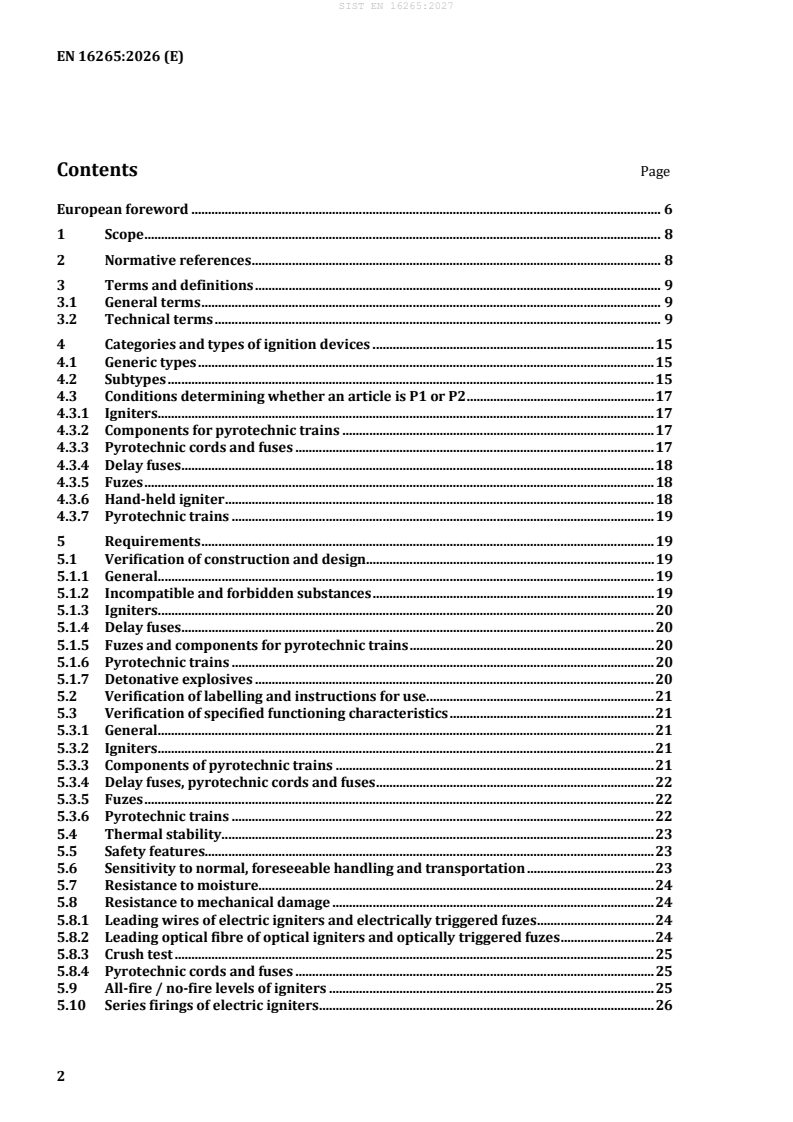
Contents Page
European foreword . 6
1 Scope . 8
2 Normative references . 8
3 Terms and definitions . 9
3.1 General terms . 9
3.2 Technical terms . 9
4 Categories and types of ignition devices . 15
4.1 Generic types . 15
4.2 Subtypes . 15
4.3 Conditions determining whether an article is P1 or P2 . 17
4.3.1 Igniters . 17
4.3.2 Components for pyrotechnic trains . 17
4.3.3 Pyrotechnic cords and fuses . 17
4.3.4 Delay fuses . 18
4.3.5 Fuzes . 18
4.3.6 Hand-held igniter . 18
4.3.7 Pyrotechnic trains . 19
5 Requirements . 19
5.1 Verification of construction and design. 19
5.1.1 General. 19
5.1.2 Incompatible and forbidden substances . 19
5.1.3 Igniters . 20
5.1.4 Delay fuses . 20
5.1.5 Fuzes and components for pyrotechnic trains . 20
5.1.6 Pyrotechnic trains . 20
5.1.7 Detonative explosives . 20
5.2 Verification of labelling and instructions for use . 21
5.3 Verification of specified functioning characteristics . 21
5.3.1 General. 21
5.3.2 Igniters . 21
5.3.3 Components of pyrotechnic trains . 21
5.3.4 Delay fuses, pyrotechnic cords and fuses . 22
5.3.5 Fuzes . 22
5.3.6 Pyrotechnic trains . 22
5.4 Thermal stability . 23
5.5 Safety features. 23
5.6 Sensitivity to normal, foreseeable handling and transportation . 23
5.7 Resistance to moisture. 24
5.8 Resistance to mechanical damage . 24
5.8.1 Leading wires of electric igniters and electrically triggered fuzes . 24
5.8.2 Leading optical fibre of optical igniters and optically triggered fuzes . 24
5.8.3 Crush test . 25
5.8.4 Pyrotechnic cords and fuses . 25
5.9 All-fire / no-fire levels of igniters . 25
5.10 Series firings of electric igniters . 26
5.11 Electrical characteristics . 26
5.12 Electrostatic discharge . 26
5.13 “Use by” date . 26
5.14 Type tests . 27
5.14.1 General . 27
5.14.2 Number of items to be tested . 27
5.14.3 Test report . 28
5.15 Batch tests . 29
5.15.1 General . 29
5.15.2 Sampling plans. 29
5.15.3 Sample size for small batches (destructive tests) . 30
5.15.4 Nonconformities . 30
5.15.5 Labelling and instructions for use . 32
5.15.6 Test report . 32
5.15.7 Acceptance or rejection of a batch . 32
6 Test methods . 33
6.1 General . 33
6.2 Apparatus . 33
6.2.1 Calliper . 33
6.2.2 Ruler . 33
6.2.3 Balance . 33
6.2.4 Climatic chamber . 33
6.2.5 Sound level meter . 33
6.2.6 Electric firing sources . 33
6.2.7 Time-measuring equipment . 34
6.2.8 Optical sensors . 34
6.2.9 Pressure sensors . 34
6.2.10 Video camera . 34
6.2.11 Stills photographic camera . 34
6.2.12 Microphone . 34
6.2.13 Shock apparatus . 34
6.2.14 Drop-test apparatus. 34
6.2.15 Ohmmeters . 34
6.2.16 Magnifying equipment . 34
6.2.17 Transparent type size sheet . 35
6.3 Procedures . 35
6.3.1 Construction . 35
6.3.2 Verification of design . 35
6.3.3 Verification of labelling and instructions for use . 35
6.3.4 Initiation (or reaction) time . 36
6.3.5 Closed vessel test . 37
6.3.6 Aspect of flame or flow of reacting species . 39
6.3.7 Fire transmission . 41
6.3.8 Linear burning rate, delay time or functioning time . 42
6.3.9 Thermal conditioning . 45
6.3.10 Mechanical conditioning . 46
6.3.11 Mechanical impact (drop test) . 46
6.3.12 Resistance of leading wires to abrasion . 47
6.3.13 Resistance of leading wires or fibres to traction . 51
6.3.14 Crush test . 53
6.3.15 Resistance of cords and fuses to tension . 55
6.3.16 Series firing of electric igniters . 56
6.3.17 Electrical resistance of electric igniters . 57
6.3.18 Insulation resistance of electric igniters . 57
6.3.19 Electrostatic discharge. 59
6.3.20 Water immersion test . 60
6.3.21 Determination of the detonative / non-detonative characteristics . 61
6.3.22 Visual examination . 65
6.3.23 Sensitiveness of pyrotechnic composition . 65
7 Minimum labelling requirements and instructions for use . 69
7.1 General. 69
7.2 Labelling requirements . 69
7.2.1 Name and type . 69
7.2.2 CE marking and identification number . 69
7.2.3 Category and registration number . 69
7.2.4 Age limit and specialist knowledge labelling . 70
7.2.5 Net explosive content . 70
7.2.6 “Use by” date . 70
7.2.7 Printing . 70
7.2.8 Marking of very small items . 70
7.2.9 Ignition input . 70
7.3 Instructions for use . 70
Annex A (normative) Bruceton method. 72
A.1 General. 72
A.2 Procedure . 72
A.3 Calculation of results . 72
A.4 Values at 95 % confidence level . 73
A.5 Example . 74
A.6 Curves of G and H functions . 77
A.7 Table of Student-t distribution . 77
Annex B (normative) Dichotomic (or Langlie) method . 79
B.1 General. 79
B.2 Procedure . 79
B.3 Calculation of results . 80
B.4 Values at 95 % confidence level . 83
B.5 Example . 84
Annex C (informative) Mechanical conditioning (shock apparatus) . 87
Annex D (informative) Mechanical impact test (drop test) . 90
Annex E (normative) Specification of grinding steel for wire abrasion test . 91
E.1 Type . 91
E.2 Material . 91
E.3 Dimensions. 91
E.4 Availability of abrasive strips (informative) . 93
Annex F (informative) Determination of the duration of accelerated ageing test to
demonstrate the correct functioning at the “use by” date . 94
Annex G (normative) Apparatus for the testing of sensitiveness of the pyrotechnic
composition to electrostatic discharge . 98
G.1 Electrostatic energy supply. 98
G.2 Test cell assembly . 99
G.3 Preparation of the test sample . 99
G.4 Conditioning of the test sample and test conditions . 99
G.5 Evaluation of spark gap energy . 100
G.6 Reporting of results . 100
G.7 Test report . 100
Annex ZA (informative) Relationship between this European Standard and the essential
safety requirements of Directive 2013/29/EU aimed to be covered . 102
Bibliography . 104
European foreword
This document (EN 16265:2026) has been prepared by Technical Committee CEN/TC 212 “Pyrotechnic
articles”, the secretariat of which is held by NEN.
This European Standard shall be given the status of a national standard, either by publication of an
identical text or by endorsement, at the latest by April 2027, and conflicting national standards shall be
withdrawn at the latest by October 2027.
Attention is drawn to the possibility that some of the elements of this document may be the subject of
patent rights. CEN shall not be held responsible for identifying any or all such patent rights.
This document supersedes EN 16265:2015.
— references to EU Directive 2007/23/EC have been deleted;
— forbidden substances have been moved from Clause 1 to 5.1.2;
— definition of technical documentation provided with the article has been added (3.1.5);
— definition of explosive substance has been improved (3.2.18);
— definitions of delay fuse duration, firework and pyrotechnic delay have been deleted from Clause 3;
— definitions of output effect (3.2.39) and secondary explosive (3.2.52) have been added;
— four subtypes have been added: magnetically coupled igniter (4.2.8), reactive tape (4.2.14), ignition
rod (4.2.16) and ignition stick (4.2.17);
— subtype primer has been deleted from 4.2.11;
— subclause on igniters has been revised (4.3.1);
— subclause on the NEC of the components for pyrotechnic trains has been revised (4.3.2);
— subclause on pyrotechnic cords and fuses has been revised (4.3.3);
— subclause on categorization criteria has been added for hand-held igniters (4.3.6);
— subclauses on pyrotechnic trains have been added to 4.3.7, 5.1.6 and 5.3.6;
— subclause on the use of detonative explosive substances has been added (5.1.7);
— subclause on sensitivity of pyrotechnic composition has been deleted from 5.13 and Table 1 has been
revised accordingly;
— subclause on the “use by” date has been added (5.13) and Table 1 has been revised accordingly;
— subclauses on test report have been completed (5.14.3 and 5.15.6);
— determination of all-fire / no-fire levels have been deleted from 5.15.2;
— acceptable numbers of critical and major nonconformities have been added in Table 2 (5.15.3);
— nonconformities regarding tolerances provided in the definition file of the article have been added
(5.15.4);
— subclause on the resistance of leading wires to abrasion has been revised (6.3.12);
— subclause on the slow release test has been deleted from 6.3.13.3.3;
— subclause on the electrostatic discharge has been revised (6.3.19). Table 5 on the minimum ESD
impulse has been deleted;
— subclause on the determination of the detonative / non-detonative characteristic has been revised,
depending on the test method used and if the articles contain detonative explosives (6.3.21);
— subclause on the electrostatic discharge generator has been revised (6.3.23.2);
— subclause on the details on manufacturer or importer has been deleted from 7.2.6;
— subclause on the “use by” date has been revised (7.2.6);
— text height on the transparent sheet has been changed. Figure 1 has been revised accordingly; the
subclause on printing has been revised accordingly (7.2.7);
— subclause on the marking of very small items (7.2.8) has been revised;
— Annex G has been added;
— Annex ZB has been deleted.
NOTE Words in italics (apart from document titles) are defined in Clause 3 (Terms and definitions).
This document has been prepared under a standardization request addressed to CEN by the European
Commission. The Standing Committee of the EFTA States subsequently approves these requests for its
Member States.
For the relationship with EU Legislation, see informative Annex ZA, which is an integral part of this
document.
Any feedback and questions on this document should be directed to the users’ national standards body.
A complete listing of these bodies can be found on the CEN website.
According to the CEN-CENELEC Internal Regulations, the national standards organisations of the
following countries are bound to implement this European Standard: Austria, Belgium, Bulgaria, Croatia,
Cyprus, Czech Republic, Denmark, Estonia, Finland, France, Germany, Greece, Hungary, Iceland, Ireland,
Italy, Latvia, Lithuania, Luxembourg, Malta, Netherlands, Norway, Poland, Portugal, Republic of North
Macedonia, Romania, Serbia, Slovakia, Slovenia, Spain, Sweden, Switzerland, Türkiye and the United
Kingdom.
1 Scope
This document defines the terms and specifies the requirements, means of categorization, test methods,
minimum labelling requirements and instructions for use of the article, for ignition devices (except
ignition devices for pyrotechnic articles for vehicles) of the following generic types:
— igniters;
— components for pyrotechnic trains;
— pyrotechnic cords and fuses;
— delay fuses;
— fuzes.
NOTE Safety fuses are subject to Directive 2014/28/EU [9] and therefore not considered in this document.
2 Normative references
The following documents are referred to in the text in such a way that some or all of their content
constitutes requirements of this document. For dated references, only the edition cited applies. For
undated references, the latest edition of the referenced document (including any amendments) applies.
EN 13631-3:2025, Explosives for civil uses — Explosives for blasting, boosters and explosive substances —
Part 3: Verification of the insensitiveness to friction of explosives for blasting and explosive substances
EN 13631-4:2025, Explosives for civil uses — Explosives for blasting, boosters and explosive substances —
Part 4: Verification of the insensitiveness to impact of explosives for blasting and explosive substances
EN ISO 13385-1:2019, Geometrical product specifications (GPS) — Dimensional measuring equipment —
Part 1: Design and metrological characteristics of callipers (ISO 13385-1:2019)
EN 61672-1:2013, Electroacoustics — Sound level meters — Part 1: Specifications
EN 13763-1:2025, Explosives for civil uses — Detonators and detonating cord relays — Part 1:
Requirements
EN 10088-2:2024, Stainless steels — Part 2: Technical delivery conditions for sheet/plate and strip of
corrosion resistant steels for general purposes
ISO 565:1990, Test sieves — Metal wire cloth, perforated metal plate and electroformed sheet — Nominal
sizes of openings
ISO 2859-1:2026, Sampling procedures for inspection by attributes — Part 1: Sampling schemes indexed by
acceptance quality limit (AQL) for lot-by-lot inspection
3 Terms and definitions
For the purposes of this document, the following terms and definitions apply.
3.1 General terms
3.1.1
type
sample representative of the production envisaged
3.1.2
generic type
set of articles with common, very general, design features and/or with common characteristic effects
3.1.3
subtype
set of articles within a generic type with specific design features
3.1.4
individual item
article within a generic type and/or subtype for which every possible feature and characteristic has been
fixed
Note 1 to entry: Each feature and characteristic will be specified in the technical name or a technical data sheet, as
appropriate.
3.1.5
technical documentation provided with the article
all technical information about the article to be provided for EU-type examination
3.1.6
technical name
general description of an individual item
3.2 Technical terms
3.2.1
acceptance quality limit
AQL
quality level that is the worst tolerable process average when a continuing series of lots is submitted for
acceptance sampling
3.2.2
acceptor charge
acceptor component
charge of pyrotechnic composition or component receiving a stimulus from a donor charge
3.2.3
all-fire current
minimum current needed to ensure that an electric igniter is fired within a given time frame
Note 1 to entry: The minimum current is generally expressed in Amperes DC.
3.2.4
all-fire level
minimum level of the initiation input needed to ensure that an igniter or an ignition device is fired within
a given time frame
Note 1 to entry: All-fire level is a characteristic given in the instructions for use of every igniter. It is generally
associated with a probability level (e.g. 99,9 % at 95 % confidence level) within a specified time frame (e.g. 50 ms).
Note 2 to entry: Examples of initiation input are electric current in Amperes, mechanical force in Newtons, optical
power in Watts, etc.
3.2.5
ancillary equipment
any device which does not form part of a pyrotechnic article, but which is supplied with it and is required
in order that the article functions safely and correctly when used in accordance with the instructions for
use of the article
3.2.6
batch test
test performed on one or more sample(s) of products taken at random from a production batch to check
compliance with a given specification
Note 1 to entry: Batch testing needs all products in the production batch to comply with the characteristics this
document requires to ensure homogeneity of the whole batch. It aims at proving all products which are placed on
the market are in conformity with the type which is described in the EU-type examination certificate and have been
successfully submitted to type tests determined by this document.
3.2.7
black powder
intimate mixture of charcoal and sodium nitrate or potassium nitrate with or without sulphur
3.2.8
booster
pyrotechnic device used as a donor charge to amplify the energy supplied to the acceptor charge
3.2.9
bridgewire
resistive element connecting the leading wires inside an electric igniter
3.2.10
burning time
time in seconds for a defined mass or length of pyrotechnic composition to burn from its ignition to its
consumption
3.2.11
critical nonconformity
nonconformity that judgement and experience indicate is likely to result in hazardous or unsafe
conditions
Note 1 to entry: This type of nonconformity is referred to as a “class A nonconformity” in ISO 2859-1:2026.
3.2.12
critical nonconforming unit
nonconforming unit with one or more critical nonconformities, with or without major or minor
nonconformities
3.2.13
deflagration
reaction of fast combustion through a pyrotechnic composition at subsonic velocity in the reacting
explosive substance
3.2.14
detonation
reaction which propagates through an explosive substance at supersonic velocity in the reacting material
3.2.15
detonative explosive
explosive substance which can undergo a fast-internal decomposition reaction leading to a detonation in
normal use
3.2.16
donor charge
charge of pyrotechnic composition supplying a stimulus to an acceptor charge
3.2.17
electrostatic discharge
ESD
sudden and momentary electric current that flows between two objects at different electrical potentials
3.2.18
explosive substance
solid or liquid substance or a mixture of substances which is in itself capable by chemical reaction of
producing gas at such a temperature and pressure and at such a speed as to cause damage to the
surroundings
Note 1 to entry: Pyrotechnic substances are included even when they do not evolve gases.
3.2.19
firing current
constant electrical direct current required to reliably initiate functioning of an electric igniter
3.2.20
friction head
ignition head designed to be ignited by friction
3.2.21
fusehead
part of an electric igniter consisting of one or more pairs of metal conductors, bridged by fine resistance
wire(s), and coated with a pyrotechnic composition which initiates when the firing current is passed
through the bridgewire(s)
3.2.22
gross mass
total mass of a pyrotechnic article, not including any ancillary equipment
3.2.23
ignition head
initial fuse consisting of pyrotechnic composition only
3.2.24
ignition tube
tube usually containing a thin pyrotechnic charge on the inner wall capable on activation of transmitting
a deflagration effect from one end of the tube to the other at a subsonic velocity
3.2.25
incompatible substances
materials that undergo chemical reaction together resulting in unsafe conditions
3.2.26
linear burning rate
length of pyrotechnic composition in millimetres or metres divided by the burning time in seconds
3.2.27
main charge
pyrotechnic composition which produces the principal effect
3.2.28
major nonconformity
nonconformity, other than a critical nonconformity, which is likely to result in failure, to reduce materially
the usability of the pyrotechnic article, or to increase the potential hazard
Note 1 to entry: This type of nonconformity is referred to as a “class B nonconformity” in ISO 2859-1:2026.
3.2.29
major nonconforming unit
nonconforming unit with one or more major nonconformities, with or without minor nonconformities, but
with no critical nonconformities
3.2.30
minor nonconformity
nonconformity that is not likely to reduce materially the usability of the pyrotechnic article
Note 1 to entry: This type of nonconformity is referred to as a “class C nonconformity” in ISO 2859-1:2026.
3.2.31
minor nonconforming unit
nonconforming unit with one or more minor nonconformities, but with no critical or major nonconformities
3.2.32
misfire
incomplete functioning or non-functioning of a pyrotechnic article after application of initiation stimulus
3.2.33
net explosive content
NEC
total mass of explosive substance in a pyrotechnic article
3.2.34
no-fire current
maximum current that can be applied without causing an electric igniter to function within a specified
time period
Note 1 to entry: The maximum current is generally expressed in Amperes DC.
3.2.35
no-fire level
maximum level of the initiation input that can be applied without causing an igniter to function within a
specified time period
Note 1 to entry: No-fire level is a characteristic given in the instructions for use of every igniter. It is generally
associated with a probability level (e.g. 99,9 % at 95 % confidence level) within a specified time frame (e.g. 50 ms).
Note 2 to entry: Examples of initiation input are electric current in Amperes, mechanical force in Newtons, optical
power in Watts, etc.
3.2.36
nonconforming unit
pyrotechnic article with one or more nonconformities
3.2.37
nonconformity
non-fulfilment of a requirement
[SOURCE: EN ISO 9000:2026, 3.5.13 [1]]
3.2.38
other pyrotechnic article
pyrotechnic article other than fireworks, theatrical pyrotechnic articles and pyrotechnic articles for
vehicles
3.2.39
output effect
final effect used to initiate or transmit ignition to another pyrotechnic article
3.2.40
“pin-to-case” configuration
configuration in which the ESD occurs between the two short-circuited leading wire ends and the igniter
casing or between the pins and the casing of the connector of the igniter
3.2.41
“pin-to-pin” configuration
configuration in which the ESD occurs through the bridgewire of the igniter
3.2.42
primary pack
package of one or more pyrotechnic articles, offered for retail sale as a single unit
Note 1 to entry: A primary pack is neither necessarily the smallest piece of packaging nor a full enclosure: for
instance, pyrotechnic cords and fuses are often delivered coiled around a reel as the smallest piece of retail sale.
3.2.43
principal effect
main effect a pyrotechnic article is designed to produce
3.2.44
pyrotechnic component
any component of a pyrotechnic article which contains one or more pyrotechnic compositions
3.2.45
pyrotechnic composition
explosive substance or mixture of explosive substances which is designed, on ignition or initiation, to
produce heat, light, sound, gas or smoke or a combination of such effects through self-sustained
exothermic chemical reactions
3.2.46
pyrotechnic device
any device containing pyrotechnic composition(s) which determine its principal effect
3.2.47
pyrotechnic operation
any operation which leads to the direct application of a mechanical, thermal and/or chemical stress on a
pyrotechnic composition without intending to ignite or initiate the article at the time the stress is applied
3.2.48
relay
charge of pyrotechnic composition that is used to transmit ignition
3.2.49
safe test current
maximum electrical current that can be applied without causing an electric igniter to function regardless
of the duration
Note 1 to entry: The electrical current is generally expressed in Amperes DC.
3.2.50
safety friction tip
friction head that can only be ignited when rubbed against a striker component containing a chemical
substance with which it reacts, such as red phosphorus, or a combination of such a chemical substance
and an abrasive surface
3.2.51
safety fuse
article consisting of a core of fine-grained black powder surrounded by a flexible woven fabric with one
or more protective coverings
Note 1 to entry: Other names are safety cord, fuse cord, mine or mining fuse. This article is the subject of
Directive 2014/28/EU and the corresponding European Standards EN 13630 series [2].
3.2.52
secondary explosive
detonative explosive that is insensitive to heat or handling impact but will detonate under strong shock
impulse
[SOURCE: ISO 26871:2020, 3.1.54 [3], modified – “detonative” has been added and “material” has been
deleted]
3.2.53
slag
condensed reaction products resulting from the combustion of pyrotechnic composition(s)
3.2.54
type test
test performed on a sample of products, representative of the production envisaged
Note 1 to entry: The test is intended to demonstrate the compliance of the sample with the essential safety
requirements of Annex I and the relevant provisions of Directive 2013/29/EU [8].
Note 2 to entry: The successful submission to type tests leads to the attribution of an EU-type examination
certificate.
3.2.55
“use by” date
latest date by which an article shall be used if it is to safely exhibit the performance characteristics
described in the technical specifications of the article
4 Categories and types of ignition devices
4.1 Generic types
The generic types are defined as follows:
4.1.1 Igniter: Article containing pyrotechnic composition(s) used to initiate combustion or deflagration.
They may be actuated by chemical, electrical, optical or mechanical means.
NOTE Complex igniters (e.g. some integral rocket igniters) are not considere
...