

SIST EN 1999-1-3:2007
(Main)Eurocode 9: Design of aluminium structures – Part 1-3: Structures susceptible to fatigue
- Abstract
1.1.1 Scope of EN 1999
(1) P EN 1999 applies to the design of buildings and civil engineering and structural works in aluminium. It complies with the principles and requirements for the safety and serviceability of structures, the basis of their design and verification that are given in EN 1990 – Basis of structural design.
(2) EN 1999 is only concerned with requirements for resistance, serviceability, durability and fire resistance of aluminium structures. Other requirements, e.g. concerning thermal or sound insulation, are not considered.
(3) EN 1999 is intended to be used in conjunction with:
- EN 1990 Basis of structural design
- EN 1991 Actions on structures
- European Standards for construction products relevant for aluminium structures
- EN 1090-1: Execution of steel structures and aluminium structures - Part 1: Conformity assessment of structural components )
- EN 1090-3: Execution of steel structures and aluminium structures – Part 3: Technical requirements for aluminium structures )
(4) EN 1999 is subdivided in five parts:
EN 1999-1-1 Design of Aluminium Structures: General structural rules
EN 1999-1-2 Design of Aluminium Structures: Structural fire design
EN 1999-1-3 Design of Aluminium Structures: Structures susceptible to fatigue
EN 1999-1-4 Design of Aluminium Structures: Cold-formed structural sheeting
EN 1999-1-5 Design of Aluminium Structures: Shell structures
1.1.2 Scope of EN 1999-1-3
(1) EN 1999-1-3 gives the basis for the design of aluminium alloy structures with respect to the limit state of fracture induced by fatigue.
(2) EN 1999-1-3 gives rules for:
- Safe life design;
- damage tolerant design;
- design assisted by testing.
(3) EN 1999-1-3 is intended to be used in conjunction with EN 1090-3 -Technical requirements for the execution of aluminium structures- which contains the requirements necessary for the design assumptions to be met during execution of components and structures.
(4) EN 1999-1-3 does not cover pre
- Status
- Published
- Publication Date
- 17-Sep-2007
- Technical Committee
- KON - Structures
- Current Stage
- 6060 - National Implementation/Publication (Adopted Project)
- Start Date
- 13-Jun-2007
- Due Date
- 18-Aug-2007
- Completion Date
- 18-Sep-2007



SIST EN 1999-1-3:2007 is the Slovenian adoption of EN 1999-1-3:2007 published by SIST and CEN. It specifies fatigue design rules for aluminium alloy structures in buildings and civil engineering works, including safe life design, damage tolerant design and design assisted by testing. It is used by structural engineers, checkers, fabricators, inspectors and clients who need to assess fatigue-critical aluminium members and joints.
What does SIST EN 1999-1-3:2007 specify?
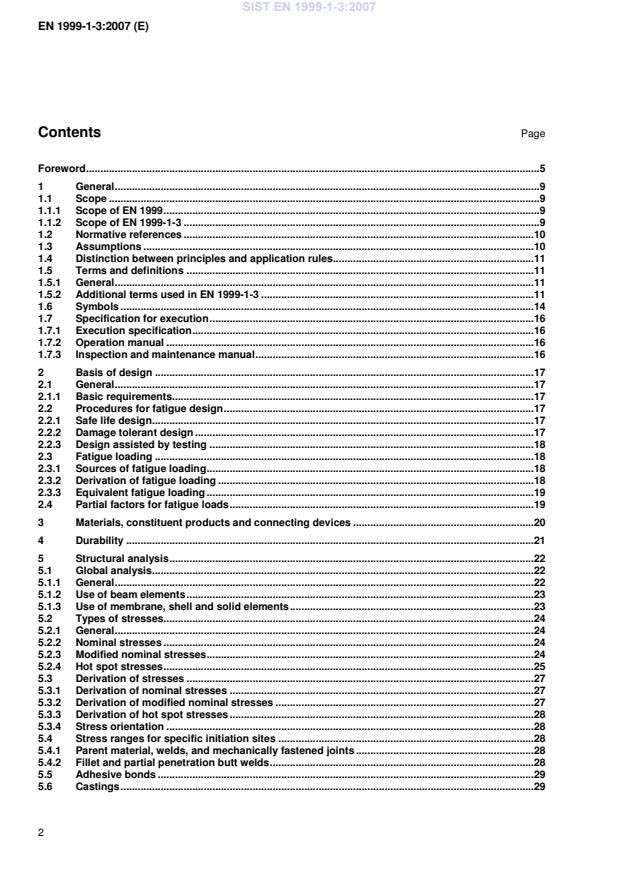
SIST EN 1999-1-3:2007 gives the basis for designing aluminium alloy structures against fracture caused by fatigue. The document is organized into six main clauses covering general provisions, basis of design, materials and connecting devices, durability, structural analysis and fatigue resistance, followed by Annexes A to K.
It is intended to be used with EN 1990, EN 1991, the EN 1090 series for execution, and construction product standards relevant to aluminium structures. The scope also states that it does not cover pressurised containment vessels or pipe-work.
| Annex | What it covers |
|---|---|
| A | Basis for calculation of fatigue resistance |
| B | Guidance on crack growth assessment by fracture mechanics |
| C | Testing for fatigue design |
| D | Stress analysis |
| E | Adhesively bonded joints |
| F | Low cycle fatigue range |
| G | Influence of R-ratio |
| H | Fatigue strength improvement of welds |
| I | Castings |
| J | Detail category tables |
| K | Hot spot reference detail method |
What are the key requirements of SIST EN 1999-1-3:2007?
SIST EN 1999-1-3:2007 sets out how to check fatigue using stress histories, detail categories and fatigue strength curves, then links those checks to design life and inspection planning. In practice, it tells the designer what loading data to use, how to turn variable loading into cycles, which stress definition applies at a detail, and how to decide whether the part needs redesign or scheduled inspection.
Fatigue design methods
Clause 2.2 allows three approaches: safe life design, damage tolerant design and design assisted by testing. Safe life design compares the accumulated damage with the design life, while damage tolerant design adds inspection planning and crack growth limits. This matters because the chosen method determines whether the structure is designed to avoid cracking entirely or to remain safe while a crack is monitored.
Fatigue loading and stress assessment
Clauses 2.3 and 5 require fatigue loading to be derived from the expected service history and reduced to equivalent loading where needed. Clause 5 distinguishes nominal stress, modified nominal stress and hot spot stress, and gives methods for beam, shell, membrane and solid models. In practice, the reader must choose the stress measure that matches the detail being checked, otherwise the fatigue assessment can be misleading.
Detail categories and fatigue strength
Clause 6 bases verification on standardized detail categories with reference fatigue strength and slope values. Annex J provides detail category tables for plain members, welded attachments, butt-welded joints, fillet-welded joints, crossing welds, attachments on built-up beams and bolted joints. This is the core design data for everyday checks, because it links a joint type and quality level to the stress range it can sustain.
Mean stress, exposure and improvements
Clause 6 also addresses mean stress, low R-ratio effects and exposure conditions. It states that detail category values may be reduced for certain alloy and exposure combinations, and that fatigue strength improvement techniques for welds may be used. For a project team, this means corrosion environment, stress ratio and weld finishing are not afterthoughts - they change the usable fatigue resistance.
Execution, operation and maintenance information
Clause 1.7 requires an execution specification, operation manual and inspection and maintenance manual. These documents must cover material preparation, assembly, joining, loading assumptions, prohibited modifications, repair methods and inspection schedules. This matters in practice because fatigue performance depends not only on calculation, but also on how the structure is fabricated, used and maintained.
What terms does SIST EN 1999-1-3:2007 define?
- Fatigue - weakening of a structural part through crack initiation and crack growth caused by repeated stress fluctuations.
- Fatigue loading - the set of typical load events, including their intensity, frequency and sequence.
- Nominal stress - stress in the parent material near a potential crack location, calculated by simple elastic theory without stress concentration effects.
- Modified nominal stress - nominal stress increased by a geometric stress concentration factor for shape changes not already covered by the detail category.
- Hot spot stress - the geometric stress at a specified crack initiation site, such as a weld toe, where fatigue strength is known in terms of hot spot stress range.
- Detail category - the classification used to select the applicable fatigue strength curve for a particular initiation site and stress direction.
- Design life - the reference period over which the structure is expected to perform safely against fatigue cracking.
- Damage tolerance - the ability of a structure to accommodate fatigue cracking without structural failure or unserviceability.
Who uses SIST EN 1999-1-3:2007?
SIST EN 1999-1-3:2007 is used by structural engineers designing aluminium buildings, bridges, masts, cranes, machinery supports and other civil engineering works that see repeated loading. It is also used by fabricators and execution teams because weld quality, joint detail and finishing affect the fatigue class.
Inspection engineers, maintenance planners and asset owners use it to define monitoring intervals, crack detection limits and repair actions. Testing laboratories and design teams use it when test evidence is needed instead of, or in addition to, calculation.
What changed in SIST EN 1999-1-3:2007 from the previous edition?
SIST EN 1999-1-3:2007 supersedes ENV 1999-2:1998.
Which standards are used with SIST EN 1999-1-3:2007?
SIST EN 1999-1-3:2007 is intended to be used with EN 1990 for basis of structural design, EN 1991 for actions on structures, EN 1090-1 for conformity assessment of structural components, and EN 1090-3 for technical requirements for aluminium structures. The scope also refers to European Standards for construction products relevant for aluminium structures. Clause 1.2 states that the normative references of EN 1999-1-1 apply, and the wider EN 1999 series is split into parts for general rules, fire design, fatigue, cold-formed sheeting and shell structures.
What does the SIST EN 1999-1-3:2007 document contain?
The document contains fatigue assessment methods, stress definitions, cycle-counting guidance, detail category tables and worked procedures for design verification. Annex A gives the calculation basis for fatigue resistance, including the safe life and damage tolerant workflows and the inspection strategy for cracks.
Annexes B, C and D support fracture-mechanics assessment, testing and stress analysis. Annexes E to I cover special cases such as adhesive joints, low cycle fatigue, R-ratio effects, weld improvement and castings, while Annex J provides the main detail category data and Annex K gives the hot spot reference detail method.
Relations
- Effective Date
- 01-Oct-2007
- Effective Date
- 19-May-2026
- Effective Date
- 09-Feb-2026
- Effective Date
- 09-Feb-2026
- Effective Date
- 28-Jan-2026
- Effective Date
- 10-Jul-2010
Get Certified
Connect with accredited certification bodies for this standard

DIBt (Deutsches Institut für Bautechnik)
German Institute for Building Technology.

DIN CERTCO
DIN Group product certification.

Aboma Certification B.V.
Specialized in construction, metal, and transport sectors.
Sponsored listings
Frequently Asked Questions
SIST EN 1999-1-3:2007 is a standard published by the Slovenian Institute for Standardization (SIST). Its full title is "Eurocode 9: Design of aluminium structures – Part 1-3: Structures susceptible to fatigue". This standard covers: 1.1.1 Scope of EN 1999 (1) P EN 1999 applies to the design of buildings and civil engineering and structural works in aluminium. It complies with the principles and requirements for the safety and serviceability of structures, the basis of their design and verification that are given in EN 1990 – Basis of structural design. (2) EN 1999 is only concerned with requirements for resistance, serviceability, durability and fire resistance of aluminium structures. Other requirements, e.g. concerning thermal or sound insulation, are not considered. (3) EN 1999 is intended to be used in conjunction with: - EN 1990 Basis of structural design - EN 1991 Actions on structures - European Standards for construction products relevant for aluminium structures - EN 1090-1: Execution of steel structures and aluminium structures - Part 1: Conformity assessment of structural components ) - EN 1090-3: Execution of steel structures and aluminium structures – Part 3: Technical requirements for aluminium structures ) (4) EN 1999 is subdivided in five parts: EN 1999-1-1 Design of Aluminium Structures: General structural rules EN 1999-1-2 Design of Aluminium Structures: Structural fire design EN 1999-1-3 Design of Aluminium Structures: Structures susceptible to fatigue EN 1999-1-4 Design of Aluminium Structures: Cold-formed structural sheeting EN 1999-1-5 Design of Aluminium Structures: Shell structures 1.1.2 Scope of EN 1999-1-3 (1) EN 1999-1-3 gives the basis for the design of aluminium alloy structures with respect to the limit state of fracture induced by fatigue. (2) EN 1999-1-3 gives rules for: - Safe life design; - damage tolerant design; - design assisted by testing. (3) EN 1999-1-3 is intended to be used in conjunction with EN 1090-3 -Technical requirements for the execution of aluminium structures- which contains the requirements necessary for the design assumptions to be met during execution of components and structures. (4) EN 1999-1-3 does not cover pre
1.1.1 Scope of EN 1999 (1) P EN 1999 applies to the design of buildings and civil engineering and structural works in aluminium. It complies with the principles and requirements for the safety and serviceability of structures, the basis of their design and verification that are given in EN 1990 – Basis of structural design. (2) EN 1999 is only concerned with requirements for resistance, serviceability, durability and fire resistance of aluminium structures. Other requirements, e.g. concerning thermal or sound insulation, are not considered. (3) EN 1999 is intended to be used in conjunction with: - EN 1990 Basis of structural design - EN 1991 Actions on structures - European Standards for construction products relevant for aluminium structures - EN 1090-1: Execution of steel structures and aluminium structures - Part 1: Conformity assessment of structural components ) - EN 1090-3: Execution of steel structures and aluminium structures – Part 3: Technical requirements for aluminium structures ) (4) EN 1999 is subdivided in five parts: EN 1999-1-1 Design of Aluminium Structures: General structural rules EN 1999-1-2 Design of Aluminium Structures: Structural fire design EN 1999-1-3 Design of Aluminium Structures: Structures susceptible to fatigue EN 1999-1-4 Design of Aluminium Structures: Cold-formed structural sheeting EN 1999-1-5 Design of Aluminium Structures: Shell structures 1.1.2 Scope of EN 1999-1-3 (1) EN 1999-1-3 gives the basis for the design of aluminium alloy structures with respect to the limit state of fracture induced by fatigue. (2) EN 1999-1-3 gives rules for: - Safe life design; - damage tolerant design; - design assisted by testing. (3) EN 1999-1-3 is intended to be used in conjunction with EN 1090-3 -Technical requirements for the execution of aluminium structures- which contains the requirements necessary for the design assumptions to be met during execution of components and structures. (4) EN 1999-1-3 does not cover pre
SIST EN 1999-1-3:2007 is classified under the following ICS (International Classification for Standards) categories: 91.010.30 - Technical aspects; 91.080.17 - Aluminium structures. The ICS classification helps identify the subject area and facilitates finding related standards.
SIST EN 1999-1-3:2007 has the following relationships with other standards: It is inter standard links to SIST ENV 1999-2:2002, SIST-TS CLC/TS 50711:2026, SIST EN 50583-2:2016, SIST EN 50583-1:2016, SIST EN 1090-3:2008, SIST EN 1999-1-3:2007/A1:2012. Understanding these relationships helps ensure you are using the most current and applicable version of the standard.
SIST EN 1999-1-3:2007 is associated with the following European legislation: EU Directives/Regulations: 2005-01-4408, 305/2011, 89/106/EEC; Standardization Mandates: M/265, M/BC/CEN/89/11. When a standard is cited in the Official Journal of the European Union, products manufactured in conformity with it benefit from a presumption of conformity with the essential requirements of the corresponding EU directive or regulation.
SIST EN 1999-1-3:2007 is available in PDF format for immediate download after purchase. The document can be added to your cart and obtained through the secure checkout process. Digital delivery ensures instant access to the complete standard document.
Standards Content (Sample)
2003-01.Slovenski inštitut za standardizacijo. Razmnoževanje celote ali delov tega standarda ni dovoljeno.Eurocode 9: Bemessung und Konstruktion von Aluminiumtragwerken — Teil 1-3: Ermüdungsbeanspruchte TragwerkeEurocode 9: Calcul des structures en aluminium — Partie 1-3: Structures sensibles a la fatigueEurocode 9: Design of aluminium structures – Part 1-3: Structures susceptible to fatigue91.080.10Kovinske konstrukcijeMetal structures91.010.30Technical aspectsICS:Ta slovenski standard je istoveten z:EN 1999-1-3:2007SIST EN 1999-1-3:2007en,fr01-oktober-2007SIST EN 1999-1-3:2007SLOVENSKI
STANDARDSIST ENV 1999-2:20021DGRPHãþD
EUROPEAN STANDARDNORME EUROPÉENNEEUROPÄISCHE NORMEN 1999-1-3May 2007ICS 91.010.30; 91.080.10Supersedes ENV 1999-2:1998
English VersionEurocode 9: Design of aluminium structures - Part 1-3:Structures susceptible to fatigueEurocode 9: Calcul des structures en aluminium - Partie 1-3: Structures sensibles à la fatigueEurocode 9: Bemessung und Konstruktion vonAluminiumtragwerken - Teil 1-3: ErmüdungsbeanspruchteTragwerkeThis European Standard was approved by CEN on 25 November 2006.CEN members are bound to comply with the CEN/CENELEC Internal Regulations which stipulate the conditions for giving this EuropeanStandard the status of a national standard without any alteration. Up-to-date lists and bibliographical references concerning such nationalstandards may be obtained on application to the CEN Management Centre or to any CEN member.This European Standard exists in three official versions (English, French, German). A version in any other language made by translationunder the responsibility of a CEN member into its own language and notified to the CEN Management Centre has the same status as theofficial versions.CEN members are the national standards bodies of Austria, Belgium, Bulgaria, Cyprus, Czech Republic, Denmark, Estonia, Finland,France, Germany, Greece, Hungary, Iceland, Ireland, Italy, Latvia, Lithuania, Luxembourg, Malta, Netherlands, Norway, Poland, Portugal,Romania, Slovakia, Slovenia, Spain, Sweden, Switzerland and United Kingdom.EUROPEAN COMMITTEE FOR STANDARDIZATIONCOMITÉ EUROPÉEN DE NORMALISATIONEUROPÄISCHES KOMITEE FÜR NORMUNGManagement Centre: rue de Stassart, 36
B-1050 Brussels© 2007 CENAll rights of exploitation in any form and by any means reservedworldwide for CEN national Members.Ref. No. EN 1999-1-3:2007: ESIST EN 1999-1-3:2007
3 5.7 Stress spectra.29 5.8 Calculation of equivalent stress range for standardised fatigue load models.29 5.8.1 General.29 5.8.2 Design value of stress range.30 6 Fatigue resistance and detail categories.31 6.1 Detail categories.31 6.1.1 General.31 6.1.2 Factors affecting detail category.31 6.1.3 Constructional details.31 6.2 Fatigue strength data.32 6.2.1 Classified constructional details.32 6.2.2 Unclassified details.34 6.2.3 Adhesively bonded joints.34 6.2.4 Determination of the reference hot spot strength values.34 6.3 Effect of mean stress.34 6.3.1 General.34 6.3.2 Plain material and mechanically fastened joints.35 6.3.3 Welded joints.35 6.3.4 Adhesive joints.35 6.3.5 Low endurance range.35 6.3.6 Cycle counting for R-ratio calculations.35 6.4 Effect of exposure conditions.35 6.5 Improvement techniques.36 Annex A [normative]: Basis for calculation of fatigue resistance.37 A.1 General.37 A.1.1 Influence of fatigue on design.37 A.1.2 Mechanism of failure.37 A.1.3 Potential sites for fatigue cracking.37 A.1.4 Conditions for fatigue susceptibility.38 A.2 Safe life design.38 A.2.1 Prerequisites for safe life design.38 A.2.2 Cycle counting.39 A.2.3 Derivation of stress spectrum.39 A.3 Damage tolerant design.42 A.3.1 Prerequisites for damage tolerant design.42 A.3.2 Determination of inspection strategy for damage tolerant design.42 Annex B [informative]: Guidance on assessment of crack growth by fracture mechanics.45 B.1 Scope.45 B.2 Principles.45 B.2.1 Flaw dimensions.45 B.2.2 Crack growth relationship.46 B.3 Crack growth data A and m.46 B.4 Geometry function y.48 B.5 Integration of crack growth.48 B.6 Assessment of maximum crack size a2.48 Annex C [informative]: Testing for fatigue design.58 C.1 General.58 C.2 Derivation of action loading data.58 C.2.1 Fixed structures subject to mechanical action.58 C.2.2 Fixed structures subject to actions due to exposure conditions.59 C.2.3 Moving structures.59 C.3 Derivation of stress data.59 C.3.1 Component test data.59 C.3.2 Structure test data.60 C.3.3 Verification of stress history.60 C.4 Derivation of endurance data.60 C.4.1 Component testing.60 C.4.2 Full scale testing.61 SIST EN 1999-1-3:2007
4 C.4.3 Acceptance.61 C.5 Crack growth data.64 C.6 Reporting.64 Annex D [informative]: Stress analysis.65 D.1 Use of finite elements for fatigue analysis.65 D.1.1 Element types.65 D.1.2 Further guidance on use of finite elements.66 D.2 Stress concentration factors.66 D.3 Limitation of fatigue induced by repeated local buckling.68 Annex E [informative]: Adhesively bonded joints.69 Annex F [informative]: Low cycle fatigue range.71 F.1 Introduction.71 F.2 Modification to -N curves.71 F.3 Test data.71 Annex G [informative]: Influence of R-ratio.73 G.1 Enhancement of fatigue strength.73 G.2 Enhancement cases.73 G.2.1 Case 1.73 G.2.2 Case 2.74 G.2.3 Case 3.74 Annex H [informative]: Fatigue strength improvement of welds.75 H.1 General.75 H.2 Machining or grinding.75 H.3 Dressing by TIG or plasma.76 H.4 Peening.76 Annex I [informative]: Castings.77 I.1 General.77 I.2 Fatigue strength data.77 I.2.1 Plain castings.77 I.2.2 Welded material.77 I.2.3 Mechanically joined castings.77 I.2.4 Adhesively bonded castings.78 I.3 Quality requirements.78 Annex J [informative]: Detail category tables.79 J.1 General.79 Annex K [informative]: Hot spot reference detail method.95 Bibliography.96
5 Foreword This document (EN 1999-1-3:2007) has been prepared by Technical Committee CEN/TC 250 “Structural Eurocodes”, the secretariat of which is held by BSI. This European Standard shall be given the status of a national standard, either by publication of an identical text or by endorsement, at the latest by November 2007, and conflicting national standards shall be withdrawn at the latest by March 2010. This European Standard supersedes ENV 1999-2: 1998. According to the CEN/CENELEC Internal Regulations, the national standards organizations of the following countries are bound to implement this European Standard: Austria, Belgium, Bulgaria, Cyprus, Czech Republic, Denmark, Estonia, Finland, France, Germany, Greece, Hungary, Iceland, Ireland, Italy, Latvia, Lithuania, Luxemburg, Malta, Netherlands, Norway, Poland, Portugal, Romania, Slovakia, Slovenia, Spain, Sweden, Switzerland and the United Kingdom. Background to the Eurocode programme In 1975, the Commission of the European Community decided on an action programme in the field of construction, based on article 95 of the Treaty. The objective of the programme was the elimination of
technical obstacles to trade and the harmonisation of technical specifications. Within this action programme, the Commission took the initiative to establish a set of harmonised technical rules for the design of construction works, which in a first stage would serve as an alternative to the national rules in force in the Member States and, ultimately, would replace them. For fifteen years, the Commission, with the help of a Steering Committee with Representatives of Member States, conducted the development of the Eurocodes programme, which led to the first generation of European codes in the 1980s. In 1989, the Commission and the Member States of the EU and EFTA decided, on the basis of an agreement1)
between the Commission and CEN, to transfer the preparation and the publication of the Eurocodes to the CEN through a series of Mandates, in order to provide them with a future status of European Standard (EN). This links de facto the Eurocodes with the provisions of all the Council’s Directives and/or Commission’s Decisions dealing with European standards (e.g. the Council Directive 89/106/EEC on construction products – CPD – and Council Directives 93/37/EEC, 92/50/EEC and 89/440/EEC on public works and services and equivalent EFTA Directives initiated in pursuit of setting up the internal market). The Structural Eurocode programme comprises the following standards generally consisting of a number of Parts: EN 1990 Eurocode 0: Basis of structural design
EN 1991 Eurocode 1: Actions on structures
EN 1992 Eurocode 2: Design of concrete structures
EN 1993 Eurocode 3: Design of steel structures
1) Agreement between the Commission of the European Communities and the European Committee for Standardisation (CEN) concerning the work on EUROCODES for the design of building and civil engineering works (BC/CEN/03/89). SIST EN 1999-1-3:2007
6 EN 1994 Eurocode 4: Design of composite steel and concrete structures
EN 1995 Eurocode 5: Design of timber structures
EN 1996 Eurocode 6: Design of masonry structures
EN 1997 Eurocode 7: Geotechnical design
EN 1998 Eurocode 8: Design of structures for earthquake resistance
EN 1999 Eurocode 9: Design of aluminium structures
...