

kSIST FprEN 1104:2026
(Main)Paper and board intended to come into contact with foodstuffs - Determination of the transfer of antimicrobial constituents
- Abstract
This document specifies a test method for the determination of the transfer of antimicrobial constituents from paper and board materials and articles intended for food contact.
NOTE The use of this document is determined by legislation pertaining to paper and board intended to come into contact with foodstuffs.
- Status
- Not Published
- Public Enquiry End Date
- 14-Dec-2025
- Technical Committee
- VPK - Pulp, paper, board and products
- Current Stage
- 5020 - Formal vote (FV) (Adopted Project)
- Start Date
- 20-Aug-2026
- Due Date
- 08-Oct-2026
- Completion Date
- 21-Aug-2026

kSIST FprEN 1104:2026 is a SIST standard for testing paper and board intended to come into contact with foodstuffs. It specifies a laboratory method for determining the transfer of antimicrobial constituents from those materials and articles, so users can check whether such constituents release under the test conditions.
What does kSIST FprEN 1104:2026 specify?
kSIST FprEN 1104:2026 specifies a test method for paper and board materials and articles intended for food contact. The document focuses on whether water-soluble antimicrobial constituents transfer from the sample into the test medium and create an inhibition zone around the test piece.
The standard is organized into clauses on scope, normative references, terms and definitions, principle, apparatus, reagents and media, sampling and preparation of test pieces, procedure, evaluation, and the test report. Annex A gives informative guidance for interpreting results, including how to read the controls and how to judge the different types of responses on paper and board samples.
The document notes that its use is determined by legislation for paper and board intended to come into contact with foodstuffs.
What are the key requirements of kSIST FprEN 1104:2026?
Test principle and microorganisms
kSIST FprEN 1104:2026 uses two test organisms, Bacillus subtilis and Aspergillus niger, to check for transfer of antimicrobial constituents. A prepared nutrient medium is inoculated, poured into Petri dishes, and the test pieces are placed on the still soft medium before incubation.
In practice, this means the method looks for an obvious growth-free area around the sample. If an inhibition zone appears, the sample is considered to have released antimicrobial constituents under the test conditions.
Apparatus and media
kSIST FprEN 1104:2026 requires laboratory equipment in line with EN ISO 7218, plus a punch iron, a pressing device, and a zone reading device. The punch iron is specified for circular test pieces, and the reading device must allow measurement of the width of the inhibition zone.
The media section gives the compositions and preparation steps for the culture media used for Bacillus subtilis and Aspergillus niger, plus a tryptone salt solution and positive-control materials. The text also ties media preparation and storage to EN ISO 11133. In practice, this means the laboratory has to prepare or obtain media with the right growth performance, because the result depends on the quality of the culture conditions.
Sampling and test pieces
kSIST FprEN 1104:2026 requires sampling according to EN ISO 186. The samples must be handled carefully, at least 10 samples are taken per unit, and at least 20 circular test pieces are punched out with a sterile or aseptic punch iron.
If the material is not homogeneous, the inhibition test must represent each area. If the food-contact side is not known, both sides are tested. In practice, this prevents a false sense of security from testing only one surface when the transfer could differ by side or by printed area.
Plate preparation and controls
kSIST FprEN 1104:2026 requires at least 3 Petri dishes for each test, with 3 test pieces per dish, so 9 test pieces are evaluated per microorganism and tested area. The Bacillus subtilis plates use the bacterium in test agar at the stated density, and the Aspergillus niger plates use the modified Sabouraud medium with the fungus at the stated density.
Each analysis also needs a negative control and a positive control. The negative control checks that the microorganism grows normally on the medium, while the positive control uses penicillin G for Bacillus subtilis and amphotericin B or an isothiazolinon solution for Aspergillus niger. In practice, the controls tell the user whether the test run is valid before judging the sample.
Incubation and evaluation
kSIST FprEN 1104:2026 includes a prediffusion step in a refrigerator, followed by incubation at the organism-specific temperature and time. After incubation, plates should be examined immediately, or stored for a limited time at refrigerator temperature before reading.
The evaluation rules matter because not every edge effect is an inhibition zone. The document says that an inhibition zone must be present on at least 2 of the 9 test pieces to conclude that the tested area or side shows inhibition. Annex A also explains how to read special cases such as modified growth, microbial contamination, and sporulation activation for Aspergillus niger.
What terms does kSIST FprEN 1104:2026 define?
- Inhibition zone - An obvious growth-free area around a test piece on inoculated nutrient medium, caused by release of water-soluble antimicrobial constituents.
- Test piece - A circular piece cut from the sampled paper or board and placed on the test agar for evaluation.
- Negative control - A nutrient agar plate without test pieces that checks whether the test microorganism grows normally.
- Positive control - A plate with sterile paper discs impregnated with a reference antimicrobial agent that checks the sensitivity of the test microorganism.
- Working culture - The prepared culture of Bacillus subtilis or Aspergillus niger used to make the inoculating suspension.
- Spore suspension - The suspension of spores used to inoculate the test agar for the fungus or to prepare the bacterial inoculum.
- Water-soluble antimicrobial constituents - The antimicrobial substances whose release is detected by the appearance of an inhibition zone.
Who uses kSIST FprEN 1104:2026?
kSIST FprEN 1104:2026 is used by testing laboratories that assess paper and board for food-contact applications. It is also relevant to manufacturers and converters of paper and board, especially when they use antimicrobial constituents and need to know whether those constituents transfer.
Quality, regulatory, and customer-facing technical teams use it when they need a repeatable laboratory method and a reportable result for food-contact evidence. The method is particularly useful when a buyer or supplier needs to compare one material or printed area with another using the same microbiological test approach.
What changed in kSIST FprEN 1104:2026 from the previous edition?
kSIST FprEN 1104:2026 will supersede EN 1104:2018. The foreword states these main technical changes:
- Clause 3.1 was updated to current terminology requirements.
- The rule on measuring inhibition-zone width was clarified so the 2 mm criterion can be checked.
- The punch iron precision was updated, and the wording on aseptic and sterile was harmonized.
- Several media compositions and preparation details were simplified or clarified.
- The preparation of working cultures and spore suspensions was clarified, with unnecessary details removed.
- The word spores replaced conidia for consistency.
- The wording for positive controls was adjusted, including the antifungal agent options.
- Sampling, the number of test pieces, and the sides to be tested were clarified.
- The plate preparation and incubation reading instructions were rephrased for clearer use.
- The evaluation timing was updated to allow later reading after refrigerated storage.
- Annex A terminology was corrected for the negative control wording.
Which standards are used with kSIST FprEN 1104:2026?
- EN ISO 186 - Used for sampling paper and board so the tested pieces represent the average quality of the unit.
- EN ISO 7218 - Provides general laboratory and microbiological examination requirements for the equipment and handling used in the test.
- EN ISO 11133 - Gives the requirements for preparing, producing, storing, and checking the performance of the culture media used in the method.
What does the kSIST FprEN 1104:2026 document contain?
The document contains the test principle, apparatus list, media compositions and preparation steps, microorganism preparation, sampling instructions, the detailed plate and incubation procedure, evaluation rules, and the test report content. It also includes the definitions needed to read the method correctly.
Clause 6 provides the media formulations and culture-preparation steps for both test organisms, including positive-control materials. Clauses 7 to 9 describe how to cut, incubate, and judge the sample pieces in practice. Annex A adds figures and examples that show the expected appearance of negative controls, positive controls, inhibition zones, modified growth, contamination, and Aspergillus niger sporulation activation.
Relations
- Effective Date
- 07-Aug-2024
Get Certified
Connect with accredited certification bodies for this standard

BSI Group
BSI (British Standards Institution) is the business standards company that helps organizations make excellence a habit.

Bureau Veritas
Bureau Veritas is a world leader in laboratory testing, inspection and certification services.

DNV
DNV is an independent assurance and risk management provider.
Sponsored listings
Frequently Asked Questions
kSIST FprEN 1104:2026 is a draft published by the Slovenian Institute for Standardization (SIST). Its full title is "Paper and board intended to come into contact with foodstuffs - Determination of the transfer of antimicrobial constituents". This standard covers: This document specifies a test method for the determination of the transfer of antimicrobial constituents from paper and board materials and articles intended for food contact. NOTE The use of this document is determined by legislation pertaining to paper and board intended to come into contact with foodstuffs.
This document specifies a test method for the determination of the transfer of antimicrobial constituents from paper and board materials and articles intended for food contact. NOTE The use of this document is determined by legislation pertaining to paper and board intended to come into contact with foodstuffs.
kSIST FprEN 1104:2026 is classified under the following ICS (International Classification for Standards) categories: 67.250 - Materials and articles in contact with foodstuffs; 85.060 - Paper and board. The ICS classification helps identify the subject area and facilitates finding related standards.
kSIST FprEN 1104:2026 has the following relationships with other standards: It is inter standard links to SIST EN 1104:2019. Understanding these relationships helps ensure you are using the most current and applicable version of the standard.
kSIST FprEN 1104:2026 is available in PDF format for immediate download after purchase. The document can be added to your cart and obtained through the secure checkout process. Digital delivery ensures instant access to the complete standard document.
Standards Content (Sample)
SLOVENSKI STANDARD
oSIST prEN 1104:2025
01-december-2025
Papir, karton in lepenka v neposrednem stiku z živili - Določanje izločanja
antimikrobnih snovi
Paper and board intended to come into contact with foodstuffs - Determination of the
transfer of antimicrobial constituents
Papier und Pappe vorgesehen für den Kontakt mit Lebensmitteln - Bestimmung des
Übergangs antimikrobieller Bestandteile
Papier et carton destinés à entrer en contact avec les denrées alimentaires -
Détermination du transfert des constituants antimicrobiens
Ta slovenski standard je istoveten z: prEN 1104
ICS:
67.250 Materiali in predmeti v stiku z Materials and articles in
živili contact with foodstuffs
85.060 Papir, karton in lepenka Paper and board
oSIST prEN 1104:2025 en,fr,de
2003-01.Slovenski inštitut za standardizacijo. Razmnoževanje celote ali delov tega standarda ni dovoljeno.
oSIST prEN 1104:2025
oSIST prEN 1104:2025
DRAFT
EUROPEAN STANDARD
prEN 1104
NORME EUROPÉENNE
EUROPÄISCHE NORM
October 2025
ICS 67.250; 85.060 Will supersede EN 1104:2018
English Version
Paper and board intended to come into contact with
foodstuffs - Determination of the transfer of antimicrobial
constituents
Papier et carton destinés à entrer en contact avec les Papier und Pappe vorgesehen für den Kontakt mit
denrées alimentaires - Détermination du transfert des Lebensmitteln - Bestimmung des Übergangs
constituants antimicrobiens antimikrobieller Bestandteile
This draft European Standard is submitted to CEN members for enquiry. It has been drawn up by the Technical Committee
CEN/TC 172.
If this draft becomes a European Standard, CEN members are bound to comply with the CEN/CENELEC Internal Regulations
which stipulate the conditions for giving this European Standard the status of a national standard without any alteration.
This draft European Standard was established by CEN in three official versions (English, French, German). A version in any other
language made by translation under the responsibility of a CEN member into its own language and notified to the CEN-CENELEC
Management Centre has the same status as the official versions.
CEN members are the national standards bodies of Austria, Belgium, Bulgaria, Croatia, Cyprus, Czech Republic, Denmark, Estonia,
Finland, France, Germany, Greece, Hungary, Iceland, Ireland, Italy, Latvia, Lithuania, Luxembourg, Malta, Netherlands, Norway,
Poland, Portugal, Republic of North Macedonia, Romania, Serbia, Slovakia, Slovenia, Spain, Sweden, Switzerland, Türkiye and
United Kingdom.
Recipients of this draft are invited to submit, with their comments, notification of any relevant patent rights of which they are
aware and to provide supporting documentation.
Warning : This document is not a European Standard. It is distributed for review and comments. It is subject to change without
notice and shall not be referred to as a European Standard.
EUROPEAN COMMITTEE FOR STANDARDIZATION
COMITÉ EUROPÉEN DE NORMALISATION
EUROPÄISCHES KOMITEE FÜR NORMUNG
CEN-CENELEC Management Centre: Rue de la Science 23, B-1040 Brussels
© 2025 CEN All rights of exploitation in any form and by any means reserved Ref. No. prEN 1104:2025 E
worldwide for CEN national Members.
oSIST prEN 1104:2025
prEN 1104:2025 (E)
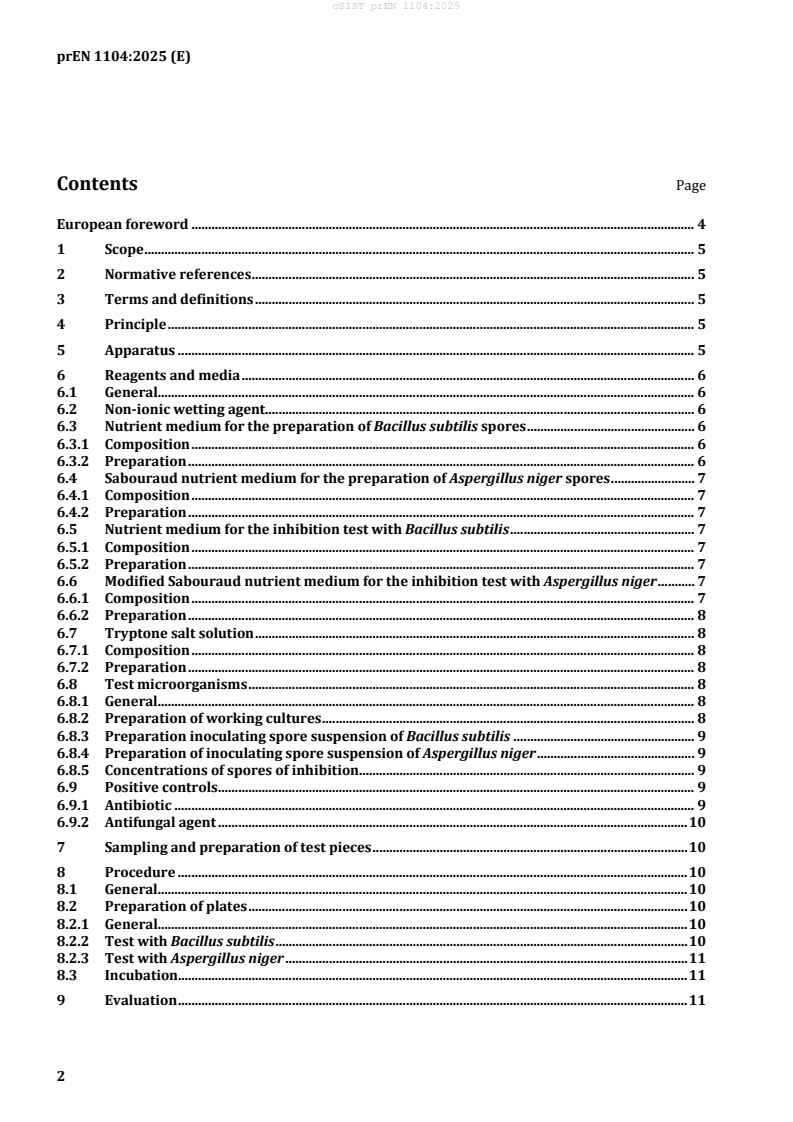
Contents Page
European foreword . 4
1 Scope . 5
2 Normative references . 5
3 Terms and definitions . 5
4 Principle . 5
5 Apparatus . 5
6 Reagents and media . 6
6.1 General. 6
6.2 Non-ionic wetting agent. 6
6.3 Nutrient medium for the preparation of Bacillus subtilis spores . 6
6.3.1 Composition . 6
6.3.2 Preparation . 6
6.4 Sabouraud nutrient medium for the preparation of Aspergillus niger spores . 7
6.4.1 Composition . 7
6.4.2 Preparation . 7
6.5 Nutrient medium for the inhibition test with Bacillus subtilis . 7
6.5.1 Composition . 7
6.5.2 Preparation . 7
6.6 Modified Sabouraud nutrient medium for the inhibition test with Aspergillus niger . 7
6.6.1 Composition . 7
6.6.2 Preparation . 8
6.7 Tryptone salt solution . 8
6.7.1 Composition . 8
6.7.2 Preparation . 8
6.8 Test microorganisms . 8
6.8.1 General. 8
6.8.2 Preparation of working cultures . 8
6.8.3 Preparation inoculating spore suspension of Bacillus subtilis . 9
6.8.4 Preparation of inoculating spore suspension of Aspergillus niger . 9
6.8.5 Concentrations of spores of inhibition . 9
6.9 Positive controls . 9
6.9.1 Antibiotic . 9
6.9.2 Antifungal agent . 10
7 Sampling and preparation of test pieces . 10
8 Procedure . 10
8.1 General. 10
8.2 Preparation of plates . 10
8.2.1 General. 10
8.2.2 Test with Bacillus subtilis . 10
8.2.3 Test with Aspergillus niger . 11
8.3 Incubation. 11
9 Evaluation . 11
oSIST prEN 1104:2025
prEN 1104:2025 (E)
10 Test report . 12
Annex A (informative) Guidelines for interpreting results . 13
oSIST prEN 1104:2025
prEN 1104:2025 (E)
European foreword
This document (prEN 1104:2025) has been prepared by Technical Committee CEN/TC 172 “Pulp, paper
and board”, the secretariat of which is held by DIN.
This document is currently submitted to the CEN Enquiry.
This document will supersede EN 1104:2018.
This document includes the following significant technical changes with respect to EN 1104:2018:
a) 3.1 has been updated according to current regulations for terms and definitions;
b) Clause 5, A.3.2.3 and A.3.3.2: The statement that the measuring of the width of the inhibition zone is
not compulsory has been removed as the result requires to measure the width of the inhibition zone
in order to check the 2 mm criteria;
c) 5.3 and Clause 7: the precision regarding the punch iron has been updated; usage of the term
“aseptic” or “sterile” which both signifies germ-free;
d) 6.3.1, 6.4.1, 6.5.1, 6.7.1 regarding compositions of media: the term “tryptic digest” for the casein has
been deleted as some media indicate pancreatic digest which is the same thing;
e) 6.3.2, 6.4.2, 6.5.2, 6.6.2: unnecessary details regarding media containers have been deleted;
precision about storage conditions have been updated;
f) 6.8.2, 6.8.3, 6.8.4, 6.8.5: unnecessary details have been deleted and details for a better
understanding of the procedure have been added;
g) 6.8.5: the term “conidia” has been replaced by the term “spores” to harmonize wording since both
terms have the same meaning;
h) 6.9.2: the term “solution” for the amphotericin B has been deleted as it could be bought as pre-
impregnated discs; the note has been deleted as the isothiazolinone solution is not commercially
available;
i) Clause 7: the phrase “for each microorganism” has been deleted as 20 test pieces for both
microorganisms for one tested area is enough (9 test pieces by microorganism and by tested
area/side);
j) Clause 7 and Clause 8: a clarification about the sides tested has been added;
k) 8.2.2 and 8.2.3 have been rephrased for a better understanding;
l) 8.3: evaluation of the plates has been updated since it could be done at least 3 days after the end of
the incubation if the plates are stored at (5 ± 3) °C;
m) Clause 9: the precision “with a new inoculating suspension” has been deleted to allow repeating the
assay with the same inoculating suspension;
n) A.3.2.4: the term “positive” has been replaced by “negative” since the negative control is the nutrient
agar plate without test pieces and inoculated with the test microorganism.
oSIST prEN 1104:2025
prEN 1104:2025 (E)
1 Scope
This document specifies a test method for the determination of the transfer of antimicrobial
constituents from paper and board materials and articles intended for food contact.
NOTE The use of this document is determined by legislation pertaining to paper and board intended to come
into contact with foodstuffs.
2 Normative references
The following documents are referred to in the text in such a way that some or all of their content
constitutes requirements of this document. For dated references, only the edition cited applies. For
undated references, the latest edition of the referenced document (including any amendments) applies.
EN ISO 186, Paper and board — Sampling to determine average quality (ISO 186)
EN ISO 7218, Microbiology of the food chain — General requirements and guidance for microbiological
examinations (ISO 7218)
EN ISO 11133 , Microbiology of food, animal feed and water — Preparation, production, storage and
performance testing of culture media (ISO 11133)
3 Terms and definitions
For the purposes of this document, the following terms and definitions apply.
ISO and IEC maintain terminology databases for use in standardization at the following addresses:
— ISO Online browsing platform: available at https://www.iso.org/obp/
— IEC Electropedia: available at https://www.electropedia.org/
3.1
inhibition zone
obvious area in which growth is absent and which forms around test pieces placed on a nutrient
medium inoculated with a preselected test microorganism, due to the release of water-soluble
antimicrobial constituents
Note 1 to entry: The proof of the presence of an inhibition zone is provided by the absence of test microorganism
growth (translucent zone) in a minimum of 2 mm width zone at the edges of the test pieces.
4 Principle
A prepared nutrient medium is mixed with an appropriate inoculum and poured into Petri dishes. The
test pieces are placed on the nutrient medium before its complete solidification and incubated. When
incubation is terminated, the existence of an inhibition zone is an indicator of the release of
antimicrobial constituents.
The test is performed with a bacterium, bacillus subtilis, and with a fungus, aspergillus niger.
5 Apparatus
All laboratory equipment and parts of the equipment, according to EN ISO 7218, shall be used, in
addition to the following.
Under revision.
oSIST prEN 1104:2025
prEN 1104:2025 (E)
5.1 Punch iron, with a diameter = 10 mm to 15 mm, sterilizable or aseptic.
5.2 Pressing device, suitable for pressing the test pieces on the agar plates (e.g. Drigalski spatula).
5.3 Zone reading device, allowing the measurement of the width of the inhibition zone.
6 Reagents and media
6.1 General
When water is mentioned in a formula, distilled or purified water shall be used, according to
EN ISO 11133.
For preparing culture media, general requirements are described in EN ISO 11133. Culture media shall
be prepared as follows, or from commercially available dehydrated culture media according to the
manufacturer's instructions. Ready-to-use medium may be used when its composition and/or growth
performance is comparable to that of formula given in 6.3 and 6.4 (according to EN ISO 11133).
6.2 Non-ionic wetting agent
For example, polyoxyethylenesorbitane monooleate can be used.
6.3 Nutrient medium for the preparation of Bacillus subtilis spores
6.3.1 Composition
— Beef extract: 3,0 g;
— Peptone from casein: 5,0 g;
— Sodium chloride: 5,0 g;
— Agar-agar: 12,0 g;
— Water: 1,0 l.
NOTE The addition of 10 mg/l MnSO4 to the nutrient medium for Bacillus subtilis will support the formation
of spores.
6.3.2 Preparation
Dissolve the components, or a dehydrated ready-to-use medium, in the water by mixing while heating.
Dispense one part of the nutrient medium into flasks (for instance 100 ml or 200 ml flasks) for further
storage and the other part into test tubes for the preparation of working cultures (for instance 10 ml
per tube in 15 to 20 tubes).
Sterilize flasks and test tubes in an autoclave for 15 min at 121 °C. After sterilization, the pH of the
medium shall be equivalent to 7,2 ± 0,2 when measured at 45 °C. Before solidification, position the test
tubes in such a way that the nutrient medium solidifies with a sloping surface.
Medium may be stored according to EN ISO 11133.
oSIST prEN 1104:2025
prEN 1104:2025 (E)
6.4 Sabouraud nutrient medium for the preparation of Aspergillus niger spores
6.4.1 Composition
— Peptone from casein: 5,0 g;
— Meat peptone: 5,0 g;
— D-(+)-glucose C H O ·H O (dextrose): 40,0 g;
6 12 6 2
— Agar-agar: 10,0 g to 15,0 g;
— Water: 1,0 l.
6.4.2 Preparation
Dissolve the components, or a dehydrated ready-to-use medium, in the water by mixing while heating.
Proceed as described in 6.3 by dispensing the medium into flasks and test tubes.
Sterilize in an autoclave for 15 min at 121 °C. After sterilization, the pH of the medium shall be
equivalent to 5,6 ± 0,2, when measured at 25 °C.
Medium may be stored according to EN ISO 11133.
6.5 Nutrient medium for the inhibition test with Bacillus subtilis
6.5.1 Composition
— Peptone from casein: 3,45 g;
— Meat peptone: 3,45 g;
— Sodium chloride: 5,1 g;
— Agar-agar: 13,0 g;
— Water: 1,0 l.
6.5.2 Preparation
Dissolve the components, or a dehydrated ready-to-use medium, in the water by mixing while heating.
Dispense the medium into flasks.
Sterilize in an autoclave for 15 min at 121 °C. After sterilization, the pH medium shall be equivalent to
6,0 ± 0,2, when measured at 45 °C.
Cool the flasks to below 60 °C for the preparation of the inoculation medium (8.2.2) or allow to solidify
if they have to be stored before use.
Medium may be stored according to EN ISO 11133.
6.6 Modified Sabouraud nutrient medium for the inhibition test with Aspergillus niger
6.6.1 Composition
— Peptone from casein: 5,0 g;
— Meat peptone: 5,0 g;
oSIST prEN 1104:2025
prEN 1104:2025 (E)
— D-(+)-glucose C H O ·H O (Dextrose): 10,0 g;
6 12 6 2
— Maltose C H O ·H O: 10,0 g;
12 22 11 2
— Agar-agar: 10,0 g to 15,0 g;
— Water: 1,0 l.
6.6.2 Preparation
Dissolve the components, or a dehydrated ready-to-use medium, in the water by mixing while heating.
Dispense the medium into flasks.
Sterilize in an autoclave for 15 min at 121 °C. After sterilization, the pH of the medium shall be
equivalent to 5,4 ± 0,2, when measured at 45 °C.
Cool the flasks to below 60 °C for the preparation of the inoculation medium (8.2.2) or allow to solidify
if they have to be stored before use.
Medium may be stored according to EN ISO 11133.
6.7 Tryptone salt solution
6.7.1 Composition
— Peptone from casein: 1,0 g;
— Sodium chloride: 5,0 g;
— Water: 1,0 l.
6.7.2 Preparation
Dissolve the components in the water by mixing while heating.
Dispense in
...