

SIST EN ISO 1825:2026
(Main)Rubber hoses and hose assemblies for aircraft ground fuelling and defuelling - Specification (ISO 1825:2026)
General Information
- Abstract
This document specifies the dimensions and construction of, and requirements for, four types of hose and hose assembly for use in all operations associated with the ground fuelling and defuelling of aircraft.
All four types are designed for:
use with petroleum fuels having an aromatic-hydrocarbon content not exceeding 30 % by volume;
operation within the temperature range of −30 °C to +65 °C and such that they will be undamaged by climatic conditions of −40 °C to +70 °C when stored in static conditions. For LT hose, the temperature range of −40 °C to +65 °C and such that they will be undamaged by climatic conditions of −48 °C to +70 °C when stored in static conditions;
operation at up to 2,0 MPa (20 bar) maximum working pressure, including surges of pressure which the hose can be subjected to in service.
- Status
- Published
- Public Enquiry End Date
- 21-Apr-2025
- Publication Date
- 08-Apr-2026
- Technical Committee
- IPMA - Polimer materials and products
- Current Stage
- 6060 - National Implementation/Publication (Adopted Project)
- Start Date
- 27-Mar-2026
- Due Date
- 01-Jun-2026
- Completion Date
- 09-Apr-2026

Overview
SIST EN ISO 1825:2026 specifies the requirements for rubber hoses and hose assemblies used in the ground fuelling and defuelling of aircraft. This harmonized European and international standard is issued by CEN and aligns with ISO 1825, supporting the safe and reliable transfer of petroleum fuels at airports and other aircraft servicing locations. The standard covers four types of hoses with specific temperature and pressure ratings, ensuring compatibility with aviation fuels and resilience under various operational and environmental conditions.
Key features of SIST EN ISO 1825:2026 include specification of hose dimensions, construction, electrical properties, physical characteristics, and test methods, thus enabling consistency and safety in ground support equipment for the aviation sector.
Key Topics
Scope and Purpose
- Defines requirements for rubber hoses and hose assemblies used in ground fuelling and defuelling operations for aircraft.
- Covers four hose types designed for use with petroleum fuels containing up to 30% aromatic hydrocarbons by volume.
- Specifies performance criteria for operation between −30 °C to +65 °C, with storage tolerance from −40 °C to +70 °C, and an LT (low temperature) class accommodating −40 °C to +65 °C operation, with storage down to −48 °C.
Hose Types and Classes
- Four main types with distinctions in electrical bonding and construction.
- Each type supports standard and low-temperature operation.
Pressure and Safety
- Designed for maximum working pressure of 2.0 MPa (20 bar), including pressure surges during use.
- Robust against climatic variation and mechanical stresses encountered during airport ground operations.
Physical and Electrical Properties
- Requirements for tensile strength, elongation, volume change in fuel, abrasion resistance, and ageing.
- Detailed guidance on bonding and continuity for safe dissipation of static electricity during fuel transfer.
- Marking and traceability mandates for compliance and safety audits.
Testing and Certification
- Outlines frequency and procedures for type and routine tests.
- Mandates test certificates or reports upon request, detailing manufacturer, product identification, hose classification, and testing results.
Applications
SIST EN ISO 1825:2026 is critical across multiple aviation ground operations, supporting:
- Airport Fuel Farms and Dispensing Vehicles
- Safe, reliable hoses for fuelling and defuelling commercial, military, and private aircraft.
- Maintenance and Servicing
- Hose assemblies tailored for aviation GSE (Ground Support Equipment), ensuring predictable performance and easy maintenance.
- Fuel Storage and Transfer
- Hoses for road and rail fuel tankers engaged in transferring aviation fuel between storage, vehicles, and aircraft.
- Compliance and Safety Management
- Enables operators to meet regulatory and quality management requirements for safe handling of hazardous aviation fuels.
Related Standards
Organizations using SIST EN ISO 1825:2026 may also refer to related and supporting standards, including:
- ISO 1402 - Hydrostatic testing of rubber and plastics hose assemblies.
- ISO 1817 - Determination of the effect of liquids on rubber.
- ISO 4649 - Abrasion resistance assessment of rubber.
- ISO 4671 - Methods for measuring hose dimensions.
- ISO 6246 - Jet fuel gum content testing.
- ISO 7326 - Ozone resistance testing for hoses.
- ISO 8031 - Measurement of electrical resistance and conductivity.
- ISO 10619-2 - Flexibility and stiffness testing at sub-ambient temperatures.
SIST EN ISO 1825:2026 is a cornerstone for aviation ground fuelling safety, ensuring hoses and hose assemblies perform dependably, resist fuel degradation, and meet rigorous international quality and safety benchmarks. Adopting this standard helps operators reduce risk, promote equipment longevity, and maintain compliance with global aviation industry best practices.
Relations
- Effective Date
- 18-Mar-2026
- Effective Date
- 18-Mar-2026
- Effective Date
- 18-Mar-2026
- Effective Date
- 18-Mar-2026
- Effective Date
- 22-Jan-2023
Get Certified
Connect with accredited certification bodies for this standard

BUREAU VERITAS Certification Germany
Bureau Veritas certification in Germany.

DIN CERTCO
DIN Group product certification.

Element Materials Technology
Materials testing and product certification.
Sponsored listings
Frequently Asked Questions
SIST EN ISO 1825:2026 is a standard published by the Slovenian Institute for Standardization (SIST). Its full title is "Rubber hoses and hose assemblies for aircraft ground fuelling and defuelling - Specification (ISO 1825:2026)". This standard covers: This document specifies the dimensions and construction of, and requirements for, four types of hose and hose assembly for use in all operations associated with the ground fuelling and defuelling of aircraft. All four types are designed for: use with petroleum fuels having an aromatic-hydrocarbon content not exceeding 30 % by volume; operation within the temperature range of −30 °C to +65 °C and such that they will be undamaged by climatic conditions of −40 °C to +70 °C when stored in static conditions. For LT hose, the temperature range of −40 °C to +65 °C and such that they will be undamaged by climatic conditions of −48 °C to +70 °C when stored in static conditions; operation at up to 2,0 MPa (20 bar) maximum working pressure, including surges of pressure which the hose can be subjected to in service.
This document specifies the dimensions and construction of, and requirements for, four types of hose and hose assembly for use in all operations associated with the ground fuelling and defuelling of aircraft. All four types are designed for: use with petroleum fuels having an aromatic-hydrocarbon content not exceeding 30 % by volume; operation within the temperature range of −30 °C to +65 °C and such that they will be undamaged by climatic conditions of −40 °C to +70 °C when stored in static conditions. For LT hose, the temperature range of −40 °C to +65 °C and such that they will be undamaged by climatic conditions of −48 °C to +70 °C when stored in static conditions; operation at up to 2,0 MPa (20 bar) maximum working pressure, including surges of pressure which the hose can be subjected to in service.
SIST EN ISO 1825:2026 is classified under the following ICS (International Classification for Standards) categories: 49.100 - Ground service and maintenance equipment; 83.140.40 - Hoses. The ICS classification helps identify the subject area and facilitates finding related standards.
SIST EN ISO 1825:2026 has the following relationships with other standards: It is inter standard links to SIST EN 13617-2:2012, SIST EN 12312-5:2005+A1:2009, SIST EN 13617-4:2012, SIST EN 13617-1:2012, SIST EN ISO 1825:2018. Understanding these relationships helps ensure you are using the most current and applicable version of the standard.
SIST EN ISO 1825:2026 is available in PDF format for immediate download after purchase. The document can be added to your cart and obtained through the secure checkout process. Digital delivery ensures instant access to the complete standard document.
Standards Content (Sample)
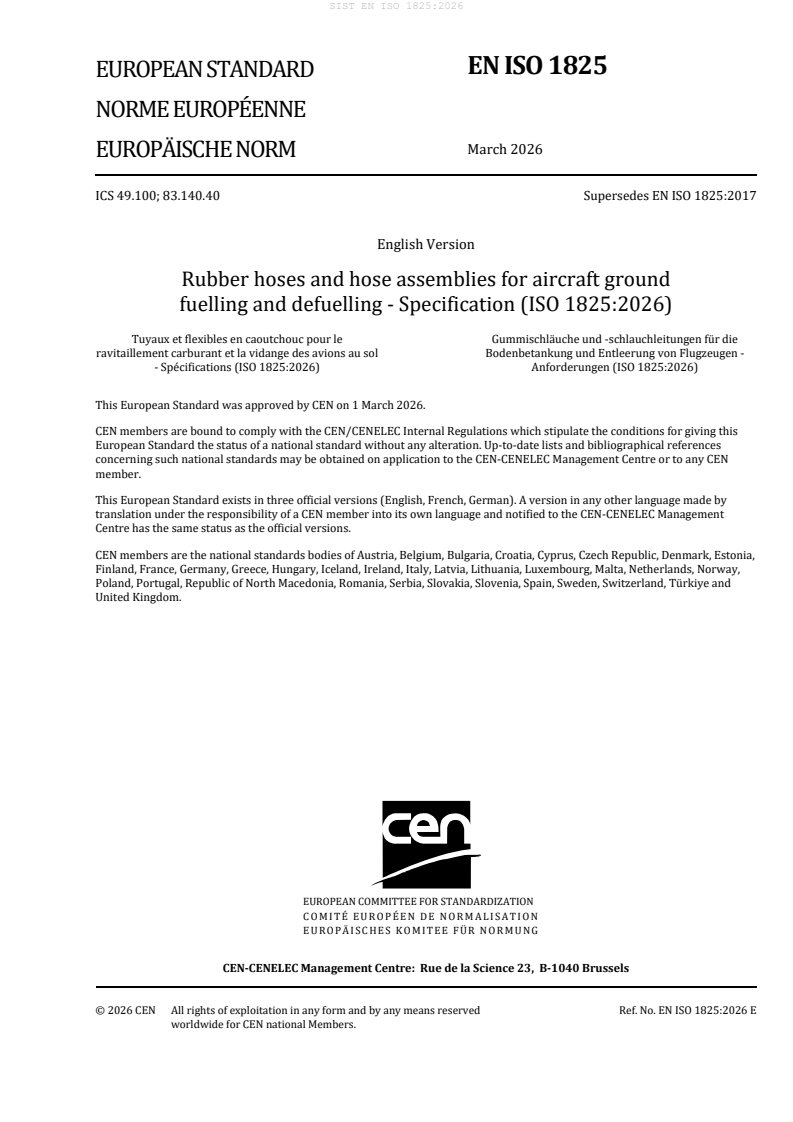
SLOVENSKI STANDARD
01-maj-2026
Gumene cevi in cevni priključki za pretakanje in praznjenje goriv letal na tleh -
Specifikacija (ISO 1825:2026)
Rubber hoses and hose assemblies for aircraft ground fuelling and defuelling -
Specification (ISO 1825:2026)
Gummischläuche und -schlauchleitungen für die Bodenbetankung und Entleerung von
Flugzeugen - Anforderungen (ISO 1825:2026)
Tuyaux et flexibles en caoutchouc pour le ravitaillement carburant et la vidange des
avions au sol - Spécifications (ISO 1825:2026)
Ta slovenski standard je istoveten z: EN ISO 1825:2026
ICS:
49.100 Oprema za servis in Ground service and
vzdrževanje na tleh maintenance equipment
83.140.40 Gumene cevi Hoses
2003-01.Slovenski inštitut za standardizacijo. Razmnoževanje celote ali delov tega standarda ni dovoljeno.
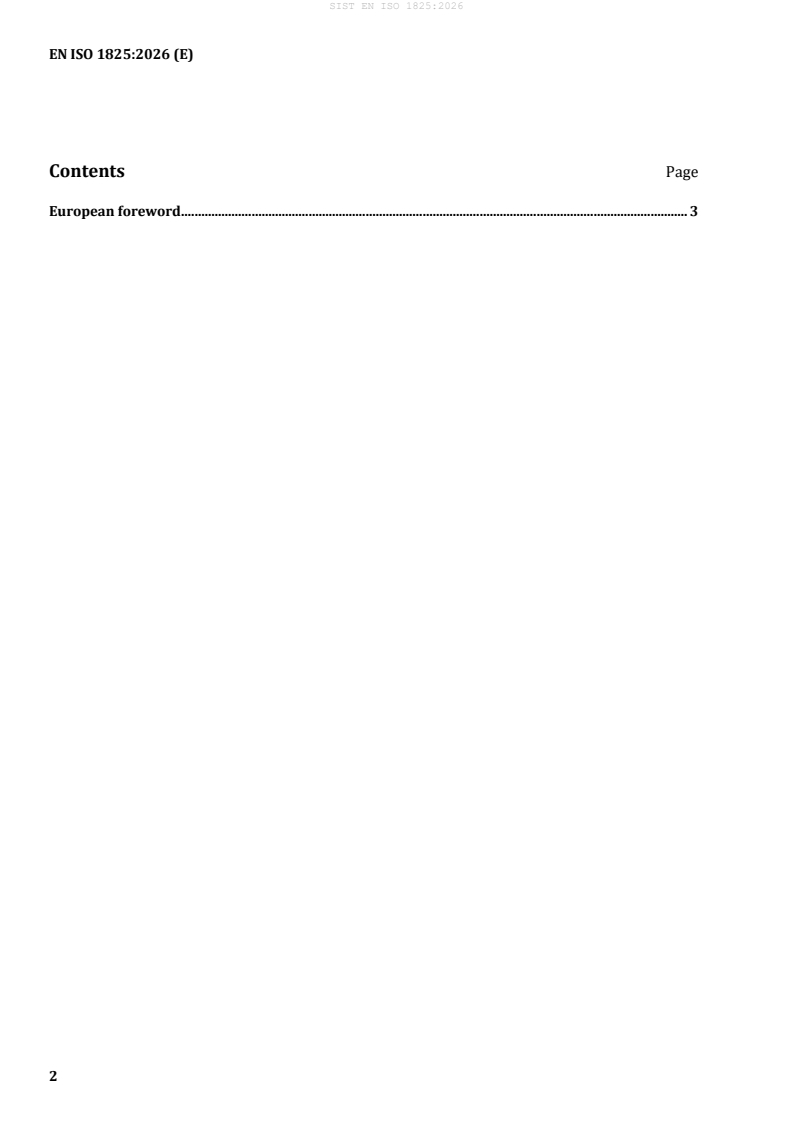
EN ISO 1825
EUROPEAN STANDARD
NORME EUROPÉENNE
March 2026
EUROPÄISCHE NORM
ICS 49.100; 83.140.40 Supersedes EN ISO 1825:2017
English Version
Rubber hoses and hose assemblies for aircraft ground
fuelling and defuelling - Specification (ISO 1825:2026)
Tuyaux et flexibles en caoutchouc pour le Gummischläuche und -schlauchleitungen für die
ravitaillement carburant et la vidange des avions au sol Bodenbetankung und Entleerung von Flugzeugen -
- Spécifications (ISO 1825:2026) Anforderungen (ISO 1825:2026)
This European Standard was approved by CEN on 1 March 2026.
CEN members are bound to comply with the CEN/CENELEC Internal Regulations which stipulate the conditions for giving this
European Standard the status of a national standard without any alteration. Up-to-date lists and bibliographical references
concerning such national standards may be obtained on application to the CEN-CENELEC Management Centre or to any CEN
member.
This European Standard exists in three official versions (English, French, German). A version in any other language made by
translation under the responsibility of a CEN member into its own language and notified to the CEN-CENELEC Management
Centre has the same status as the official versions.
CEN members are the national standards bodies of Austria, Belgium, Bulgaria, Croatia, Cyprus, Czech Republic, Denmark, Estonia,
Finland, France, Germany, Greece, Hungary, Iceland, Ireland, Italy, Latvia, Lithuania, Luxembourg, Malta, Netherlands, Norway,
Poland, Portugal, Republic of North Macedonia, Romania, Serbia, Slovakia, Slovenia, Spain, Sweden, Switzerland, Türkiye and
United Kingdom.
EUROPEAN COMMITTEE FOR STANDARDIZATION
COMITÉ EUROPÉEN DE NORMALISATION
EUROPÄISCHES KOMITEE FÜR NORMUNG
CEN-CENELEC Management Centre: Rue de la Science 23, B-1040 Brussels
© 2026 CEN All rights of exploitation in any form and by any means reserved Ref. No. EN ISO 1825:2026 E
worldwide for CEN national Members.
Contents Page
European foreword . 3
European foreword
This document (EN ISO 1825:2026) has been prepared by Technical Committee ISO/TC 45 “Rubber and
rubber products” in collaboration with Technical Committee CEN/TC 218 “Rubber and plastics hoses
and hose assemblies” the secretariat of which is held by BSI.
This European Standard shall be given the status of a national standard, either by publication of an
identical text or by endorsement, at the latest by September 2026, and conflicting national standards
shall be withdrawn at the latest by September 2026.
Attention is drawn to the possibility that some of the elements of this document may be the subject of
patent rights. CEN shall not be held responsible for identifying any or all such patent rights.
This document supersedes EN ISO 1825:2017.
Any feedback and questions on this document should be directed to the users’ national standards
body/national committee. A complete listing of these bodies can be found on the CEN website.
According to the CEN-CENELEC Internal Regulations, the national standards organizations of the
following countries are bound to implement this European Standard: Austria, Belgium, Bulgaria,
Croatia, Cyprus, Czech Republic, Denmark, Estonia, Finland, France, Germany, Greece, Hungary, Iceland,
Ireland, Italy, Latvia, Lithuania, Luxembourg, Malta, Netherlands, Norway, Poland, Portugal, Republic of
North Macedonia, Romania, Serbia, Slovakia, Slovenia, Spain, Sweden, Switzerland, Türkiye and the
United Kingdom.
Endorsement notice
The text of ISO 1825:2026 has been approved by CEN as EN ISO 1825:2026 without any modification.
International
Standard
ISO 1825
Fifth edition
Rubber hoses and hose assemblies
2026-02
for aircraft ground fuelling and
defuelling — Specification
Tuyaux et flexibles en caoutchouc pour le ravitaillement
carburant et la vidange des avions au sol — Spécifications
Reference number
ISO 1825:2026(en) © ISO 2026
ISO 1825:2026(en)
© ISO 2026
All rights reserved. Unless otherwise specified, or required in the context of its implementation, no part of this publication may
be reproduced or utilized otherwise in any form or by any means, electronic or mechanical, including photocopying, or posting on
the internet or an intranet, without prior written permission. Permission can be requested from either ISO at the address below
or ISO’s member body in the country of the requester.
ISO copyright office
CP 401 • Ch. de Blandonnet 8
CH-1214 Vernier, Geneva
Phone: +41 22 749 01 11
Email: copyright@iso.org
Website: www.iso.org
Published in Switzerland
ii
ISO 1825:2026(en)
Contents Page
Foreword .v
1 Scope . 1
2 Normative references . 1
3 Terms and definitions . 2
4 Classification . 2
5 Service reeling diameter . 3
6 Material and construction . 3
6.1 Hoses .3
6.2 Hose assemblies .3
7 Dimensions and tolerances . 4
7.1 Inside diameters.4
7.2 Thickness .4
7.3 Concentricity .4
7.4 Tolerances on length.4
7.5 Mass per unit length of hose .4
8 Physical properties . 5
8.1 Rubber compounds .5
8.2 Finished hoses and hose assemblies .6
9 Electrical properties . 7
9.1 Type B and type E (electrically bonded) .7
9.2 Type C and type F (electrically conductive incorporating a semi-conductive cover
compound) .8
10 Frequency of testing . . 8
10.1 Hoses .8
10.2 Hose assemblies .8
11 Marking . . 8
11.1 Hoses .8
11.2 Hose assemblies .9
12 Test certificate or test report . 9
13 Cleanliness . 9
14 Protection for dispatch and storage .10
Annex A (normative) Method for determination of fuel-soluble matter .11
Annex B (normative) Method of test for cold embrittlement .12
Annex C (normative) Method for determination of adhesion between components .13
Annex D (normative) Method for determination of resistance to fuel contamination . 14
Annex E (normative) Method of test for flexibility at 20 °C .15
Annex F (normative) Method of test for low temperature flexibility .16
Annex G (normative) Method of test for crush recovery . 17
Annex H (normative) Method for determination of cyclic kinking resistance . 19
Annex I (normative) Flammability test .20
Annex J (normative) Hydrostatic test .22
Annex K (normative) Method of test for vacuum resistance .23
Annex L (normative) Method of test for security of attachment of couplings .24
iii
ISO 1825:2026(en)
Annex M (normative) Type test and routine test .25
Annex N (informative) Recommended practice for hose flushing and handling .26
Bibliography .28
iv
ISO 1825:2026(en)
Foreword
ISO (the International Organization for Standardization) is a worldwide federation of national standards
bodies (ISO member bodies). The work of preparing International Standards is normally carried out through
ISO technical committees. Each member body interested in a subject for which a technical committee
has been established has the right to be represented on that committee. International organizations,
governmental and non-governmental, in liaison with ISO, also take part in the work. ISO collaborates closely
with the International Electrotechnical Commission (IEC) on all matters of electrotechnical standardization.
The procedures used to develop this document and those intended for its further maintenance are described
in the ISO/IEC Directives, Part 1. In particular, the different approval criteria needed for the different types
of ISO document should be noted. This document was drafted in accordance with the editorial rules of the
ISO/IEC Directives, Part 2 (see www.iso.org/directives).
ISO draws attention to the possibility that the implementation of this document may involve the use of (a)
patent(s). ISO takes no position concerning the evidence, validity or applicability of any claimed patent
rights in respect thereof. As of the date of publication of this document, ISO had not received notice of (a)
patent(s) which may be required to implement this document. However, implementers are cautioned that
this may not represent the latest information, which may be obtained from the patent database available at
www.iso.org/patents. ISO shall not be held responsible for identifying any or all such patent rights.
Any trade name used in this document is information given for the convenience of users and does not
constitute an endorsement.
For an explanation of the voluntary nature of standards, the meaning of ISO specific terms and expressions
related to conformity assessment, as well as information about ISO's adherence to the World Trade
Organization (WTO) principles in the Technical Barriers to Trade (TBT), see www.iso.org/iso/foreword.html.
This document was prepared by Technical Committee ISO/TC 45, Rubber and rubber products, Subcommittee
SC 1, Rubber and plastics hoses and hose assemblies, in collaboration with the European Committee for
Standardization (CEN) Technical Committee CEN/TC 218, Rubber and plastics hoses and hose assemblies, in
accordance with the Agreement on technical cooperation between ISO and CEN (Vienna Agreement).
This fifth edition cancels and replaces the fourth edition (ISO 1825:2017), which has been technically
revised.
The main changes compared to the previous edition are as follows:
— addition of two temperature classes (to bring the document in line with EI 1529);
— addition of nominal sizes 51 and 75;
— removal of the working pressure test in Table 6 and Annex J (to bring the document in line with EI 1529);
— modification of the ozone resistance at 1 ppm instead of 0,5 ppm to align with EI 1529;
— removal of tests for production acceptance;
— revision of Annexes F and G (to bring the document in line with EI 1529);
— revision of the method specified in Annex L.
Any feedback or questions on this document should be directed to the user’s national standards body. A
complete listing of these bodies can be found at www.iso.org/members.html.
v
International Standard ISO 1825:2026(en)
Rubber hoses and hose assemblies for aircraft ground
fuelling and defuelling — Specification
1 Scope
This document specifies the dimensions and construction of, and requirements for, four types of hose and
hose assembly for use in all operations associated with the ground fuelling and defuelling of aircraft.
All four types are designed for:
a) use with petroleum fuels having an aromatic-hydrocarbon content not exceeding 30 % by volume;
b) operation within the temperature range of −30 °C to +65 °C and such that they will be undamaged by
climatic conditions of −40 °C to +70 °C when stored in static conditions. For LT hose, the temperature
range of −40 °C to +65 °C and such that they will be undamaged by climatic conditions of −48 °C to
+70 °C when stored in static conditions;
c) operation at up to 2,0 MPa (20 bar) maximum working pressure, including surges of pressure which the
hose can be subjected to in service.
2 Normative references
The following documents are referred to in the text in such a way that some or all of their content constitutes
requirements of this document. For dated references, only the edition cited applies. For undated references,
the latest edition of the referenced document (including any amendments) applies.
ISO 37, Rubber, vulcanized or thermoplastic — Determination of tensile stress-strain properties
ISO 188, Rubber, vulcanized or thermoplastic — Accelerated ageing and heat resistance tests
ISO 1382, Rubber — Vocabulary
ISO 1402, Rubber and plastics hoses and hose assemblies – Hydrostatic testing
ISO 1817:2024, Rubber, vulcanized or thermoplastic — Determination of the effect of liquids
ISO 4649:2024, Rubber, vulcanized or thermoplastic — Determination of abrasion resistance using a rotating
cylindrical drum device
ISO 4671, Rubber and plastics hoses and hose assemblies — Methods of measurement of the dimensions of hoses
and the lengths of hose assemblies
ISO 6246, Petroleum products — Gum content of fuels — Jet evaporation method
ISO 7326, Rubber and plastics hoses — Assessment of ozone resistance under static conditions
ISO 7989-1, Steel wire and wire products — Non-ferrous metallic coatings on steel wire — Part 1: General
principles
ISO 7989-2, Steel wire and wire products — Non-ferrous metallic coatings on steel wire — Part 2: Zinc or zinc-
alloy coating
ISO 8031, Rubber and plastics hoses and hose assemblies — Determination of electrical resistance and
conductivity
ISO 8033, Rubber and plastics hoses — Determination of adhesion between components
ISO 1825:2026(en)
ISO 8330, Rubber and plastics hoses and hose assemblies — Vocabulary
ISO 10619-2:2021, Rubber and plastics hoses and tubing — Measurement of flexibility and stiffness — Part 2:
Bending tests at sub-ambient temperatures
3 Terms and definitions
For the purposes of this document, the terms and definitions given in ISO 1382 and ISO 8330 and the
following apply.
ISO and IEC maintain terminology databases for use in standardization at the following addresses:
— ISO Online browsing platform: available at https:// www .iso .org/ obp
— IEC Electropedia: available at https:// www .electropedia .org/
3.1
hose assembly
hose with either permanent or reusable end fittings attached
3.2
electrically bonded
hose or hose assembly (3.1) that uses a metallic wire connection to conduct static electricity
3.3
electrically conductive
hose or hose assembly (3.1) that is capable of conducting static electrical charges, using a conductive rubber
layer
4 Classification
Hoses for this application are classified into four types and two grades according to their construction and
electrical properties given in Table 1. Each type of hose shall be divided into two temperature classes.
— Normal temperature class with an ambient working temperature of –30 °C to +65 °C.
— Low temperature class (LT) with an ambient working temperature of –40 °C to +65 °C.
Table 1 — Classification
Type Grade Construction
B M Electrically bonded, incorporating at least two low-resistance electrically conductive wires
and a conductive cover compound.
C Ω Electrically conductive, incorporating a conductive cover compound.
E M Electrically bonded, incorporating at least one metallic wire helix, at least two low-resist-
ance electrically conductive wires and a conductive cover compound. Has an enhanced
defuelling capability.
F Ω Electrically conductive, incorporating at least one non-electrically conductive non-metallic
helix and a conductive cover compound.
NOTE 1 Type C hoses are intended for general pressure applications on all vehicles used for plane fuelling. They can
also be used for vehicle/rail car loading and discharge where excessive vacuum does not occur.
NOTE 2 Type F hoses can be used for plane delivery applications on vehicles that are also used for defuelling at high
flow rates where type C hoses are not suitable.
NOTE 3 Type E and F hoses can also be used for vehicle/rail car loading and discharge, for trailer to fueller transfer
and for elevation platform supply (riser) to provide greater kink resistance.
ISO 1825:2026(en)
5 Service reeling diameter
Hoses shall be designed for operation on equipment fitted with hose reels of the diameters given in Table 2.
These hoses remain substantially circular in cross-section when reeled on drums and should not be confused
with hoses of the collapsible type that are intended to be reeled flat.
Table 2 — Service reeling diameters
Minimum outside diameter of
Nominal size
reeling drum used in service
of hose
mm
19 225
25 300
31,5 375
32 375
38 450
50 550
51 550
63 600
75 600
76 600
100 900
101,5 900
6 Material and construction
6.1 Hoses
If the hose is mandrel-built and vulcanized on a mandrel, particulate-type release agents shall not be used.
The hose shall be uniform in quality and be free from porosity, air holes, foreign inclusions and other defects
when inspected visually.
The hose shall comprise the following components:
— a lining of synthetic rubber resistant to petroleum fuel;
— a reinforcement consisting of layers of woven, braided or spirally wound textile material;
— an outer cover made of synthetic rubber which shall be conductive and resistant to abrasion, outdoor
exposure and petroleum fuel.
For types E and F hoses only, an embedded helix reinforcement shall be included in the construction.
For type E hoses, the wire reinforcement used shall be a hard steel and shall have a galvanized finish in
accordance with ISO 7989-1 and ISO 7989-2.
Types B and E shall also incorporate low-resistance electrically conductive wires to ensure that the hoses
are electrically conductive.
The cover may have a shallow cloth-marked finish.
6.2 Hose assemblies
In order to produce the required electrical properties, the method of attachment of the couplings shall be in
accordance with Clause 9.
ISO 1825:2026(en)
7 Dimensions and tolerances
7.1 Inside diameters
The diameters of the hoses shall be measured in accordance with the most appropriate method in ISO 4671.
The inside diameter shall lie within the tolerance limits specified in Table 3.
Table 3 — Nominal size, inside diameters and tolerances
Inside diameter Tolerance limits
Nominal size
mm mm
19 19,0 ±0,8
25 25,0 ±0,8
31,5 31,5 ±0,8
32 32,0 ±0,8
38 38,0 ±0,8
50 50,0 ±1,2
51 51,0 ±1,2
63 63,0 ±1,2
75 75,0 ±1,2
76 76,0 ±1,2
100 100,0 ±1,6
101,5 101,5 ±1,6
NOTE: Other diameters than listed in the table, can be agreed with the customer
7.2 Thickness
The thickness of the lining shall be measured in accordance with the most appropriate method in ISO 4671.
The thickness of the lining shall be not less than 1,6 mm.
The thickness of the cover shall be measured in accordance with the most appropriate method in ISO 4671.
The thickness of the cover shall be not less than 1,6 mm for hoses of nominal size less than 50 and not less
than 2,0 mm for hoses of nominal size 50 and greater.
7.3 Concentricity
The concentricity of the hose shall be determined in accordance with ISO 4671. The concentricity, based on a
total indicator reading between the inside diameter and the outside surface of the cover, shall be no greater
than 1,0 mm.
7.4 Tolerances on length
The tolerances on the measured length of hose or hose assembly shall be ±1 %.
7.5 Mass per unit length of hose
The maximum mass per unit length shall be as given in Table 4.
ISO 1825:2026(en)
Table 4 — Mass per unit length of hose
Maximum mass per unit length of hose
Nominal size
Types B and C Types E and F
kg/m kg/m
19 0,9 1,1
25 1,1 1,5
31,5 1,4 1,9
32 1,4 1,9
38 1,7 2,2
50 2,7 3,0
51 2,7 3,0
63 3,5 4,0
75 4,0 4,7
76 4,0 4,7
100 6,5 7,5
101,5 6,5 7,5
8 Physical properties
8.1 Rubber compounds
The physical properties of the rubber compounds used for the lining and cover shall conform to the values
given in Table 5, and shall be tested by the methods listed in Table 5. For oil resistance of rubber compounds,
the test shall be carried out in accordance with ISO 1817 by immersion in the specified fluid by heated oven or
bath for the specified time and temperature listed in Table 5. Tests shall be carried out on test pieces or test
samples taken either from the hose or from separately vulcanized sheets, except for the cold embrittlement
and abrasion resistance tests which shall be carried out on moulded test pieces vulcanized to the same state
as the hose. The tests which shall be carried out for type testing and routine testing are given in Annex M.
Table 5 — Requirements for rubber compounds
Requirement
Property Unit Method of test
Lining Cover
Tensile strength, min. MPa 7,0 7,0 ISO 37
(dumb-bell test pieces)
Elongation at break, min. % 250 300 ISO 37
(dumb-bell test pieces)
Change in volume (swelling) in fuel, max. % 50 75 ISO 1817:2024, method B
(48 h at 40 °C in liquid B)
Fuel-soluble matter, max. % 4,0 Not Annex A
applicable
Normal temperature class 6,0
Low temperature class
Cold embrittlement No cracking No cracking Annex B
Abrasion resistance, max. mm 140 ISO 4649:2024, Method A
Not
Normal temperature class 200
applicable
Low temperature class
ISO 1825:2026(en)
TTabablele 5 5 ((ccoonnttiinnueuedd))
Requirement
Property Unit Method of test
Lining Cover
Ageing ISO 188 (7 days at 70 °C)
(air-oven method)
Tensile strength change. from the origi- % ±30 ±30 ISO 37 (see above)
nal value
Elongation at break change from the % ±30 ±30 ISO 37 (see above)
original value
8.2 Finished hoses and hose assemblies
Finished hoses and
...