

SIST EN 351-1:2023
(Main)Durability of wood and wood-based products - Preservative-treated solid wood - Part 1: Classification of preservative penetration and retention
General Information
- Abstract
This part of the EN 351 series establishes a classification of preservative-treated wood in terms of preservative penetration and gives guidance on a classification of retention. These can be used as a basis for specifying preservative treatments for particular products.
This part of the EN 351 series defines terminology to be used by the specifier when preparing a preservative treatment specification or product standard. It is not a treatment specification in itself.
This part of the EN 351 series is applicable to the production of preservative-treated solid wood, including glued laminated timber, suitable for use in those service conditions defined within the use classes in EN 335. It does not apply to any subsequent examination of treated wood in service.
NOTE 1 Glued laminated timber is not suitable for use in fresh or sea water.
This part of the EN 351 series is applicable to the protection of wood against attack by wood-destroying and wood-disfiguring fungi, insects and marine organisms.
NOTE 2 Protection against wood-disfiguring fungi is an optional property verified by testing in accordance with EN 599-1.
This part of the EN 351 series does not consider other properties of treated wood, for example odour, compatibility with other materials, such as corrosivity of fasteners. Nor does it consider any properties from the health, safety and environmental point of view.
This part of the EN 351 series does not apply to wood to be treated with formulations which are applied to timber in service to eliminate or control an existing fungal or insect infestation, or the prevention of attack by sapstain fungi, or insects in green timber.
Annex A (informative) provides a decision process for specifying preservative treatment requirements.
Annex B (informative) gives an example of the marking system.
- Status
- Published
- Public Enquiry End Date
- 14-Sep-2020
- Publication Date
- 17-Aug-2023
- Technical Committee
- LLZ - Les, lesni izdelki in zaščita lesa
- Current Stage
- 6060 - National Implementation/Publication (Adopted Project)
- Start Date
- 20-Jun-2023
- Due Date
- 25-Aug-2023
- Completion Date
- 18-Aug-2023
Buy Documents


Overview
EN 351-1:2023 (CEN) - "Durability of wood and wood‑based products - Preservative‑treated solid wood - Part 1: Classification of preservative penetration and retention" provides a harmonized European framework for specifying and classifying preservative treatments of solid wood. It defines terminology and establishes classes for preservative penetration and gives guidance on classifying retention (amount of active ingredient in the analytical zone). The document is intended as a basis for product specifications and procurement requirements, not as a treatment formulation or performance warranty.
Key topics and technical requirements
- Penetration classification: Defines penetration classes for treated solid wood (including glued laminated timber) to ensure adequate depth of active ingredient where required.
- Retention guidance: Describes how to set and assess retention requirements (expressed as g/m² for superficial processes and kg/m³ for penetrating processes) within the analytical zone.
- Terminology: Standardized definitions (e.g., active ingredient, analytical zone, batch, penetration requirement, retention requirement) to ensure consistent specification and testing.
- Compliance and testing: Procedures for demonstrating compliance with penetration and retention requirements; includes factory production control, direct and indirect testing approaches and sampling considerations (further elaborated in EN 351‑2).
- Scope and exclusions: Applicable to preservative‑treated solid wood and glulam for the use classes in EN 335; applies to protection against wood‑destroying/disfiguring fungi, insects and marine organisms. Does NOT cover odour, material compatibility (e.g., corrosivity), health/safety or in‑service remedial treatments such as formulations applied to eliminate existing infestations.
- Informative guidance: Annex A - decision process for specifying treatment requirements; Annex B - example marking system for treated timber.
Applications and practical value
EN 351‑1:2023 is used to:
- Develop product standards and supplier specifications that require defined penetration and retention classes.
- Guide timber treatment plants and quality managers in setting acceptance criteria and factory production control.
- Support architects, engineers, procurement officers and specifiers when selecting treated wood for specific service conditions (refer to EN 335 use classes).
- Ensure traceability and marking of treated wood (example marking in Annex B).
- Aid regulatory bodies and testing laboratories in harmonized interpretation of analytical zones and sampling strategies.
Practical benefits include clearer procurement criteria, consistent quality control across Europe, and reduced risk of under‑treatment for expected service environments.
Related standards (if applicable)
- EN 335 - Durability of wood and wood‑based products: Use classes
- EN 599‑1 - Efficacy of preventive wood preservatives (specification by use class)
- EN 1001‑2 - Terminology: Vocabulary
- EN 351‑2 - Sampling for analysis of preservative‑treated solid wood
- ISO 2859‑1 - Sampling procedures for inspection by attributes
Keywords: EN 351-1:2023, preservative-treated wood, penetration classification, retention requirement, wood durability, glulam, CEN standard, use classes.
Relations
- Effective Date
- 01-Sep-2023
- Effective Date
- 25-Aug-2026
- Effective Date
- 28-Jan-2026
- Refers
SIST EN 1001-2:2006 - Durability of wood and wood based products - Terminology - Part 2: Vocabulary - Effective Date
- 28-Jan-2026
- Effective Date
- 28-Jan-2026
- Effective Date
- 16-Sep-2026
- Effective Date
- 28-Jan-2026
- Effective Date
- 28-Jan-2026
- Effective Date
- 28-Jan-2026
- Effective Date
- 28-Jan-2026
- Effective Date
- 28-Jan-2026
- Effective Date
- 28-Jan-2026
- Effective Date
- 28-Jan-2026
- Effective Date
- 28-Jan-2026
- Effective Date
- 28-Jan-2026
Buy Documents
Get Certified
Connect with accredited certification bodies for this standard

ECOCERT
Organic and sustainability certification.

Eurofins Food Testing Global
Global leader in food, environment, and pharmaceutical product testing.

Gozdarski inštitut Slovenije
Slovenian Forestry Institute. Forest management certification support, timber testing.
Sponsored listings
Frequently Asked Questions
SIST EN 351-1:2023 is a standard published by the Slovenian Institute for Standardization (SIST). Its full title is "Durability of wood and wood-based products - Preservative-treated solid wood - Part 1: Classification of preservative penetration and retention". This standard covers: This part of the EN 351 series establishes a classification of preservative-treated wood in terms of preservative penetration and gives guidance on a classification of retention. These can be used as a basis for specifying preservative treatments for particular products. This part of the EN 351 series defines terminology to be used by the specifier when preparing a preservative treatment specification or product standard. It is not a treatment specification in itself. This part of the EN 351 series is applicable to the production of preservative-treated solid wood, including glued laminated timber, suitable for use in those service conditions defined within the use classes in EN 335. It does not apply to any subsequent examination of treated wood in service. NOTE 1 Glued laminated timber is not suitable for use in fresh or sea water. This part of the EN 351 series is applicable to the protection of wood against attack by wood-destroying and wood-disfiguring fungi, insects and marine organisms. NOTE 2 Protection against wood-disfiguring fungi is an optional property verified by testing in accordance with EN 599-1. This part of the EN 351 series does not consider other properties of treated wood, for example odour, compatibility with other materials, such as corrosivity of fasteners. Nor does it consider any properties from the health, safety and environmental point of view. This part of the EN 351 series does not apply to wood to be treated with formulations which are applied to timber in service to eliminate or control an existing fungal or insect infestation, or the prevention of attack by sapstain fungi, or insects in green timber. Annex A (informative) provides a decision process for specifying preservative treatment requirements. Annex B (informative) gives an example of the marking system.
This part of the EN 351 series establishes a classification of preservative-treated wood in terms of preservative penetration and gives guidance on a classification of retention. These can be used as a basis for specifying preservative treatments for particular products. This part of the EN 351 series defines terminology to be used by the specifier when preparing a preservative treatment specification or product standard. It is not a treatment specification in itself. This part of the EN 351 series is applicable to the production of preservative-treated solid wood, including glued laminated timber, suitable for use in those service conditions defined within the use classes in EN 335. It does not apply to any subsequent examination of treated wood in service. NOTE 1 Glued laminated timber is not suitable for use in fresh or sea water. This part of the EN 351 series is applicable to the protection of wood against attack by wood-destroying and wood-disfiguring fungi, insects and marine organisms. NOTE 2 Protection against wood-disfiguring fungi is an optional property verified by testing in accordance with EN 599-1. This part of the EN 351 series does not consider other properties of treated wood, for example odour, compatibility with other materials, such as corrosivity of fasteners. Nor does it consider any properties from the health, safety and environmental point of view. This part of the EN 351 series does not apply to wood to be treated with formulations which are applied to timber in service to eliminate or control an existing fungal or insect infestation, or the prevention of attack by sapstain fungi, or insects in green timber. Annex A (informative) provides a decision process for specifying preservative treatment requirements. Annex B (informative) gives an example of the marking system.
SIST EN 351-1:2023 is classified under the following ICS (International Classification for Standards) categories: 71.100.50 - Wood-protecting chemicals; 79.040 - Wood, sawlogs and sawn timber. The ICS classification helps identify the subject area and facilitates finding related standards.
SIST EN 351-1:2023 has the following relationships with other standards: It is inter standard links to SIST EN 351-1:2007, SIST ISO 2859-1:2003, SIST EN 599-1:2009+A1:2014, SIST EN 1001-2:2006, SIST EN 196-1:1995, SIST EN 212:2026, SIST EN 16582-1:2015+A1:2021, SIST EN 13629:2012, SIST EN 15644:2009, SIST EN 599-1:2009, SIST EN 14915:2013+A2:2020, SIST EN 14974:2019, SIST EN 12490:2010, SIST EN 14915:2013, SIST EN 599-2:2017. Understanding these relationships helps ensure you are using the most current and applicable version of the standard.
SIST EN 351-1:2023 is associated with the following European legislation: EU Directives/Regulations: 305/2011; Standardization Mandates: M/112. When a standard is cited in the Official Journal of the European Union, products manufactured in conformity with it benefit from a presumption of conformity with the essential requirements of the corresponding EU directive or regulation.
SIST EN 351-1:2023 is available in PDF format for immediate download after purchase. The document can be added to your cart and obtained through the secure checkout process. Digital delivery ensures instant access to the complete standard document.
Standards Content (Sample)
SLOVENSKI STANDARD
01-september-2023
Nadomešča:
SIST EN 351-1:2007
Trajnost lesa in lesnih proizvodov - Masivni les, zaščiten z biocidnimi proizvodi - 1.
del: Razvrščanje biocidnih proizvodov glede na penetracijo in navzem
Durability of wood and wood-based products - Preservative-treated solid wood - Part 1:
Classification of preservative penetration and retention
Durabilité du bois et des matériaux dérivés du bois - Bois massif traité avec produit de
préservation - Partie 1 : Classification des pénétrations et rétentions des produits de
préservation
Durabilité du bois et des matériaux dérivés du bois - Bois massif traité avec produit de
préservation - Partie 1 : Classification des pénétrations et rétentions des produits de
préservation
Ta slovenski standard je istoveten z: EN 351-1:2023
ICS:
71.100.50 Kemikalije za zaščito lesa Wood-protecting chemicals
79.040 Les, hlodovina in žagan les Wood, sawlogs and sawn
timber
2003-01.Slovenski inštitut za standardizacijo. Razmnoževanje celote ali delov tega standarda ni dovoljeno.
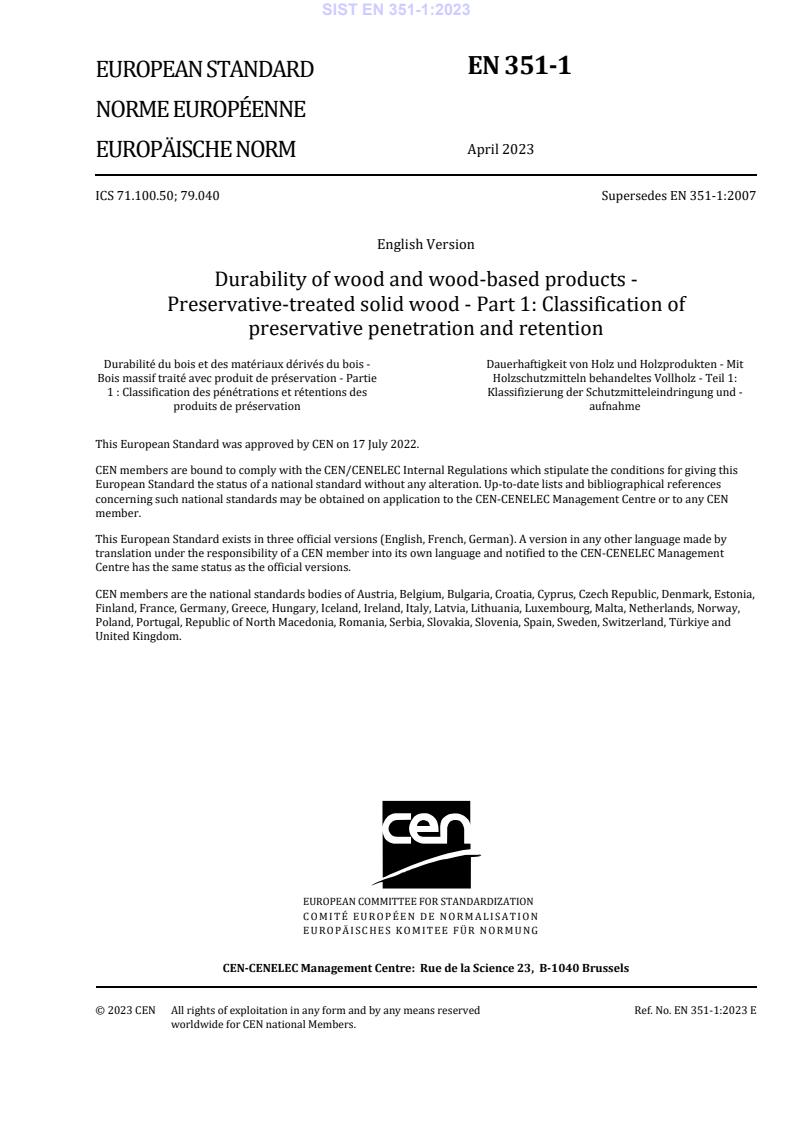
EN 351-1
EUROPEAN STANDARD
NORME EUROPÉENNE
April 2023
EUROPÄISCHE NORM
ICS 71.100.50; 79.040 Supersedes EN 351-1:2007
English Version
Durability of wood and wood-based products -
Preservative-treated solid wood - Part 1: Classification of
preservative penetration and retention
Durabilité du bois et des matériaux dérivés du bois - Dauerhaftigkeit von Holz und Holzprodukten - Mit
Bois massif traité avec produit de préservation - Partie Holzschutzmitteln behandeltes Vollholz - Teil 1:
1 : Classification des pénétrations et rétentions des Klassifizierung der Schutzmitteleindringung und -
produits de préservation aufnahme
This European Standard was approved by CEN on 17 July 2022.
CEN members are bound to comply with the CEN/CENELEC Internal Regulations which stipulate the conditions for giving this
European Standard the status of a national standard without any alteration. Up-to-date lists and bibliographical references
concerning such national standards may be obtained on application to the CEN-CENELEC Management Centre or to any CEN
member.
This European Standard exists in three official versions (English, French, German). A version in any other language made by
translation under the responsibility of a CEN member into its own language and notified to the CEN-CENELEC Management
Centre has the same status as the official versions.
CEN members are the national standards bodies of Austria, Belgium, Bulgaria, Croatia, Cyprus, Czech Republic, Denmark, Estonia,
Finland, France, Germany, Greece, Hungary, Iceland, Ireland, Italy, Latvia, Lithuania, Luxembourg, Malta, Netherlands, Norway,
Poland, Portugal, Republic of North Macedonia, Romania, Serbia, Slovakia, Slovenia, Spain, Sweden, Switzerland, Türkiye and
United Kingdom.
EUROPEAN COMMITTEE FOR STANDARDIZATION
COMITÉ EUROPÉEN DE NORMALISATION
EUROPÄISCHES KOMITEE FÜR NORMUNG
CEN-CENELEC Management Centre: Rue de la Science 23, B-1040 Brussels
© 2023 CEN All rights of exploitation in any form and by any means reserved Ref. No. EN 351-1:2023 E
worldwide for CEN national Members.
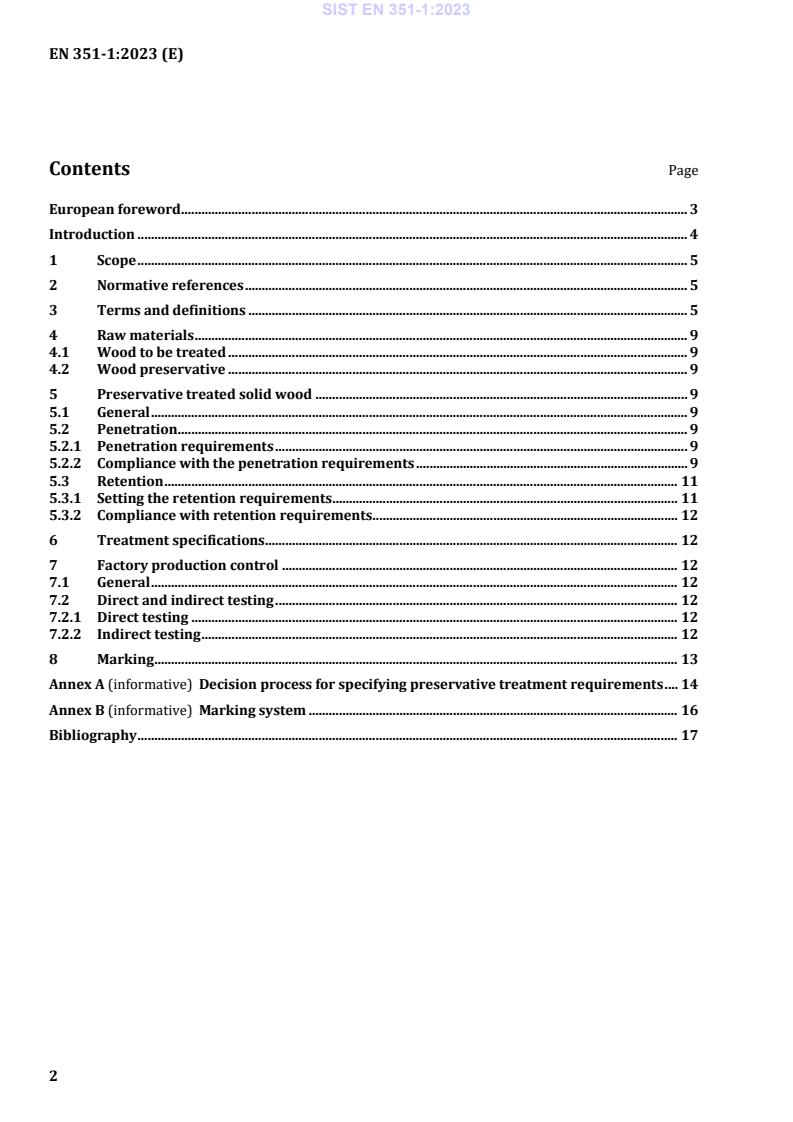
Contents Page
European foreword . 3
Introduction . 4
1 Scope . 5
2 Normative references . 5
3 Terms and definitions . 5
4 Raw materials . 9
4.1 Wood to be treated . 9
4.2 Wood preservative . 9
5 Preservative treated solid wood . 9
5.1 General . 9
5.2 Penetration . 9
5.2.1 Penetration requirements . 9
5.2.2 Compliance with the penetration requirements . 9
5.3 Retention . 11
5.3.1 Setting the retention requirements . 11
5.3.2 Compliance with retention requirements. 12
6 Treatment specifications . 12
7 Factory production control . 12
7.1 General . 12
7.2 Direct and indirect testing . 12
7.2.1 Direct testing . 12
7.2.2 Indirect testing . 12
8 Marking . 13
Annex A (informative) Decision process for specifying preservative treatment requirements . 14
Annex B (informative) Marking system . 16
Bibliography . 17
European foreword
This document (EN 351-1:2023) has been prepared by Technical Committee CEN/TC 38 “Durability of
wood and wood-based products”, the secretariat of which is held by SIS.
This European Standard shall be given the status of a national standard, either by publication of an
identical text or by endorsement, at the latest by October 2023, and conflicting national standards shall
be withdrawn at the latest by October 2023.
Attention is drawn to the possibility that some of the elements of this document may be the subject of
patent rights. CEN shall not be held responsible for identifying any or all such patent rights.
This document supersedes EN 351-1:2007.
The main changes compared to the previous edition are listed below:
— a new penetration class has been introduced;
— optional requirement on longitudinal penetration has been deleted;
— compliance with penetration and retention requirements have been further elaborated;
— clause on marking has been updated;
— Figure A.1 has been updated;
— Annex C, showing penetration classes according to EN 351-1:1995, has been deleted.
The EN 351 series consists of two parts. Part 1 gives guidance on the specification of penetration and
retention requirements for preservatives in preservative-treated solid wood. Part 2 gives guidance on
the general procedures to be followed in the sampling for analysis of preservative-treated solid wood.
Any feedback and questions on this document should be directed to the users’ national standards body.
A complete listing of these bodies can be found on the CEN website.
According to the CEN-CENELEC Internal Regulations, the national standards organisations of the
following countries are bound to implement this European Standard: Austria, Belgium, Bulgaria, Croatia,
Cyprus, Czech Republic, Denmark, Estonia, Finland, France, Germany, Greece, Hungary, Iceland, Ireland,
Italy, Latvia, Lithuania, Luxembourg, Malta, Netherlands, Norway, Poland, Portugal, Republic of North
Macedonia, Romania, Serbia, Slovakia, Slovenia, Spain, Sweden, Switzerland, Turkey and the United
Kingdom.
Introduction
This part of the EN 351 series allows a specifier or user to choose a preservative treatment for a solid
wood product taking into account its intended service or the needs of different regional or traditional
practices throughout Europe and the use class conditions to which the solid wood products will be
exposed (see EN 335). In addition, it provides the basis on which treatments for timber in European
product standards are to be specified. No attempt has been made to quantify the working life that could
be expected from a particular preservative treatment as this will also depend on the geographical location
and the associated climate of the service environment. The performance of treated wood cannot be
assessed directly, for example by field tests or bioassay, as no agreed documents exist specifically for this
purpose. As a consequence, the quality of treatment is specified using the penetration and retention of a
preservative in treated wood. The penetration and retention values are measured by analysis of the active
ingredient(s) in the treated wood.
Preservative treatment for certain wood species used in the different use classes might be unnecessary
owing to their natural durability (see EN 350 and EN 460). If preservative treatment is necessary,
preservatives with appropriate efficacy against wood destroying organisms as specified in EN 599-1 need
to be chosen.
1 Scope
This part of the EN 351 series establishes a classification of preservative-treated wood in terms of
preservative penetration and gives guidance on a classification of retention. These can be used as a basis
for specifying preservative treatments for particular products.
This part of the EN 351 series defines terminology to be used by the specifier when preparing a
preservative treatment specification or product standard. It is not a treatment specification in itself.
This part of the EN 351 series is applicable to the production of preservative-treated solid wood,
including glued laminated timber, suitable for use in those service conditions defined within the use
classes in EN 335. It does not apply to any subsequent examination of treated wood in service.
NOTE 1 Glued laminated timber is not suitable for use in fresh or sea water.
This part of the EN 351 series is applicable to the protection of wood against attack by wood-destroying
and wood-disfiguring fungi, insects and marine organisms.
NOTE 2 Protection against wood-disfiguring fungi is an optional property verified by testing in accordance with
EN 599-1.
This part of the EN 351 series does not consider other properties of treated wood, for example odour,
compatibility with other materials, such as corrosivity of fasteners. Nor does it consider any properties
from the health, safety and environmental point of view.
This part of the EN 351 series does not apply to wood to be treated with formulations which are applied
to timber in service to eliminate or control an existing fungal or insect infestation, or the prevention of
attack by sapstain fungi, or insects in green timber.
Annex A (informative) provides a decision process for specifying preservative treatment requirements.
Annex B (informative) gives an example of the marking system.
2 Normative references
The following documents are referred to in the text in such a way that some or all of their content
constitutes requirements of this document. For dated references, only the edition cited applies. For
undated references, the latest edition of the referenced document (including any amendments) applies.
EN 599-1, Durability of wood and wood-based products - Efficacy of preventive wood preservatives as
determined by biological tests - Part 1: Specification according to use class
EN 1001-2, Durability of wood and wood based products - Terminology - Part 2: Vocabulary
ISO 2859-1, Sampling procedures for inspection by attributes — Part 1: Sampling schemes indexed by
acceptance quality limit (AQL) for lot-by-lot inspection
3 Terms and definitions
For the purposes of this document, the terms and definitions given in EN 1001-2 and the following apply.
ISO and IEC maintain terminological databases for use in standardization at the following addresses:
— IEC Electropedia: available at https://www.electropedia.org/
— ISO Online browsing platform: available at https://www.iso.org/obp
3.1
active ingredient
chemical compound or compounds included in a wood preservative to give it specific activity against
biological agents of deterioration
[SOURCE: EN 1001-2:2005, 4.01]
3.2
analytical zone
part of the treated wood which is analysed for assessing compliance with the retention requirement (see
3.16)
Note 1 to entry: The analytical zone is taken from the lateral surfaces of the treated wood. The depth to which
sampling is required will depend upon the penetration class according to Table 1.
[SOURCE: EN 1001-2:2005, 4.03]
3.3
batch
clearly identifiable collection of units of preservative-treated wood manufactured to conform to the same
defined penetration and retention requirements
[SOURCE: EN 1001-2:2005, 4.04]
3.4
biological reference value
amount in grams per square metre or kilograms per cubic metre of a wood preservative (as product)
found to be effective in the test in preventing attack by the particular biological agent being tested
[SOURCE: EN 1001-2:2005, 4.06]
3.5
charge
all the wood treated together in a single operation
[SOURCE: EN 1001-2:2005, 4.13]
3.6
composite sample
collection of all test samples derived from the sampling units taken from the batch in accordance with the
chosen sampling plan for the determination of retention
[SOURCE: EN 1001-2:2005, 4.15]
3.7
critical value
value equivalent to the highest biological reference value (in grams per square metre or kilograms per
cubic metre) obtained from all the biological tests carried out in accordance with EN 599-1 for any given
use class
Note 1 to entry: The critical value will vary according to use class, method of application, and organisms against
which the preservative is to provide protection and whether it is to be applied to softwood or hardwood.
[SOURCE: EN 1001-2:2005, 4.18, modified]
3.8
exposed heartwood
heartwood of a timber component that is not enclosed by sapwood
[SOURCE: EN 1001-2:2005, 1.14]
3.9
glued laminated timber
glulam
structural member formed by the lateral surfaces of timber laminatio
...
SLOVENSKI STANDARD
01-september-2023
Nadomešča:
SIST EN 351-1:2007
Odpornost lesa in lesnih proizvodov - Masivni les, zaščiten z biocidnimi proizvodi -
1. del: Razvrščanje biocidnih proizvodov glede na penetracijo in navzem
Durability of wood and wood-based products - Preservative-treated solid wood - Part 1:
Classification of preservative penetration and retention
Durabilité du bois et des matériaux dérivés du bois - Bois massif traité avec produit de
préservation - Partie 1 : Classification des pénétrations et rétentions des produits de
préservation
Durabilité du bois et des matériaux dérivés du bois - Bois massif traité avec produit de
préservation - Partie 1 : Classification des pénétrations et rétentions des produits de
préservation
Ta slovenski standard je istoveten z: EN 351-1:2023
ICS:
71.100.50 Kemikalije za zaščito lesa Wood-protecting chemicals
79.040 Les, hlodovina in žagan les Wood, sawlogs and sawn
timber
2003-01.Slovenski inštitut za standardizacijo. Razmnoževanje celote ali delov tega standarda ni dovoljeno.
EN 351-1
EUROPEAN STANDARD
NORME EUROPÉENNE
April 2023
EUROPÄISCHE NORM
ICS 71.100.50; 79.040 Supersedes EN 351-1:2007
English Version
Durability of wood and wood-based products -
Preservative-treated solid wood - Part 1: Classification of
preservative penetration and retention
Durabilité du bois et des matériaux dérivés du bois - Dauerhaftigkeit von Holz und Holzprodukten - Mit
Bois massif traité avec produit de préservation - Partie Holzschutzmitteln behandeltes Vollholz - Teil 1:
1 : Classification des pénétrations et rétentions des Klassifizierung der Schutzmitteleindringung und -
produits de préservation aufnahme
This European Standard was approved by CEN on 17 July 2022.
CEN members are bound to comply with the CEN/CENELEC Internal Regulations which stipulate the conditions for giving this
European Standard the status of a national standard without any alteration. Up-to-date lists and bibliographical references
concerning such national standards may be obtained on application to the CEN-CENELEC Management Centre or to any CEN
member.
This European Standard exists in three official versions (English, French, German). A version in any other language made by
translation under the responsibility of a CEN member into its own language and notified to the CEN-CENELEC Management
Centre has the same status as the official versions.
CEN members are the national standards bodies of Austria, Belgium, Bulgaria, Croatia, Cyprus, Czech Republic, Denmark, Estonia,
Finland, France, Germany, Greece, Hungary, Iceland, Ireland, Italy, Latvia, Lithuania, Luxembourg, Malta, Netherlands, Norway,
Poland, Portugal, Republic of North Macedonia, Romania, Serbia, Slovakia, Slovenia, Spain, Sweden, Switzerland, Türkiye and
United Kingdom.
EUROPEAN COMMITTEE FOR STANDARDIZATION
COMITÉ EUROPÉEN DE NORMALISATION
EUROPÄISCHES KOMITEE FÜR NORMUNG
CEN-CENELEC Management Centre: Rue de la Science 23, B-1040 Brussels
© 2023 CEN All rights of exploitation in any form and by any means reserved Ref. No. EN 351-1:2023 E
worldwide for CEN national Members.
Contents Page
European foreword . 3
Introduction . 4
1 Scope . 5
2 Normative references . 5
3 Terms and definitions . 5
4 Raw materials . 9
4.1 Wood to be treated . 9
4.2 Wood preservative . 9
5 Preservative treated solid wood . 9
5.1 General . 9
5.2 Penetration . 9
5.2.1 Penetration requirements . 9
5.2.2 Compliance with the penetration requirements . 9
5.3 Retention . 11
5.3.1 Setting the retention requirements . 11
5.3.2 Compliance with retention requirements. 12
6 Treatment specifications . 12
7 Factory production control . 12
7.1 General . 12
7.2 Direct and indirect testing . 12
7.2.1 Direct testing . 12
7.2.2 Indirect testing . 12
8 Marking . 13
Annex A (informative) Decision process for specifying preservative treatment requirements . 14
Annex B (informative) Marking system . 16
Bibliography . 17
European foreword
This document (EN 351-1:2023) has been prepared by Technical Committee CEN/TC 38 “Durability of
wood and wood-based products”, the secretariat of which is held by SIS.
This European Standard shall be given the status of a national standard, either by publication of an
identical text or by endorsement, at the latest by October 2023, and conflicting national standards shall
be withdrawn at the latest by October 2023.
Attention is drawn to the possibility that some of the elements of this document may be the subject of
patent rights. CEN shall not be held responsible for identifying any or all such patent rights.
This document supersedes EN 351-1:2007.
The main changes compared to the previous edition are listed below:
— a new penetration class has been introduced;
— optional requirement on longitudinal penetration has been deleted;
— compliance with penetration and retention requirements have been further elaborated;
— clause on marking has been updated;
— Figure A.1 has been updated;
— Annex C, showing penetration classes according to EN 351-1:1995, has been deleted.
The EN 351 series consists of two parts. Part 1 gives guidance on the specification of penetration and
retention requirements for preservatives in preservative-treated solid wood. Part 2 gives guidance on
the general procedures to be followed in the sampling for analysis of preservative-treated solid wood.
Any feedback and questions on this document should be directed to the users’ national standards body.
A complete listing of these bodies can be found on the CEN website.
According to the CEN-CENELEC Internal Regulations, the national standards organisations of the
following countries are bound to implement this European Standard: Austria, Belgium, Bulgaria, Croatia,
Cyprus, Czech Republic, Denmark, Estonia, Finland, France, Germany, Greece, Hungary, Iceland, Ireland,
Italy, Latvia, Lithuania, Luxembourg, Malta, Netherlands, Norway, Poland, Portugal, Republic of North
Macedonia, Romania, Serbia, Slovakia, Slovenia, Spain, Sweden, Switzerland, Turkey and the United
Kingdom.
Introduction
This part of the EN 351 series allows a specifier or user to choose a preservative treatment for a solid
wood product taking into account its intended service or the needs of different regional or traditional
practices throughout Europe and the use class conditions to which the solid wood products will be
exposed (see EN 335). In addition, it provides the basis on which treatments for timber in European
product standards are to be specified. No attempt has been made to quantify the working life that could
be expected from a particular preservative treatment as this will also depend on the geographical location
and the associated climate of the service environment. The performance of treated wood cannot be
assessed directly, for example by field tests or bioassay, as no agreed documents exist specifically for this
purpose. As a consequence, the quality of treatment is specified using the penetration and retention of a
preservative in treated wood. The penetration and retention values are measured by analysis of the active
ingredient(s) in the treated wood.
Preservative treatment for certain wood species used in the different use classes might be unnecessary
owing to their natural durability (see EN 350 and EN 460). If preservative treatment is necessary,
preservatives with appropriate efficacy against wood destroying organisms as specified in EN 599-1 need
to be chosen.
1 Scope
This part of the EN 351 series establishes a classification of preservative-treated wood in terms of
preservative penetration and gives guidance on a classification of retention. These can be used as a basis
for specifying preservative treatments for particular products.
This part of the EN 351 series defines terminology to be used by the specifier when preparing a
preservative treatment specification or product standard. It is not a treatment specification in itself.
This part of the EN 351 series is applicable to the production of preservative-treated solid wood,
including glued laminated timber, suitable for use in those service conditions defined within the use
classes in EN 335. It does not apply to any subsequent examination of treated wood in service.
NOTE 1 Glued laminated timber is not suitable for use in fresh or sea water.
This part of the EN 351 series is applicable to the protection of wood against attack by wood-destroying
and wood-disfiguring fungi, insects and marine organisms.
NOTE 2 Protection against wood-disfiguring fungi is an optional property verified by testing in accordance with
EN 599-1.
This part of the EN 351 series does not consider other properties of treated wood, for example odour,
compatibility with other materials, such as corrosivity of fasteners. Nor does it consider any properties
from the health, safety and environmental point of view.
This part of the EN 351 series does not apply to wood to be treated with formulations which are applied
to timber in service to eliminate or control an existing fungal or insect infestation, or the prevention of
attack by sapstain fungi, or insects in green timber.
Annex A (informative) provides a decision process for specifying preservative treatment requirements.
Annex B (informative) gives an example of the marking system.
2 Normative references
The following documents are referred to in the text in such a way that some or all of their content
constitutes requirements of this document. For dated references, only the edition cited applies. For
undated references, the latest edition of the referenced document (including any amendments) applies.
EN 599-1, Durability of wood and wood-based products - Efficacy of preventive wood preservatives as
determined by biological tests - Part 1: Specification according to use class
EN 1001-2, Durability of wood and wood based products - Terminology - Part 2: Vocabulary
ISO 2859-1, Sampling procedures for inspection by attributes — Part 1: Sampling schemes indexed by
acceptance quality limit (AQL) for lot-by-lot inspection
3 Terms and definitions
For the purposes of this document, the terms and definitions given in EN 1001-2 and the following apply.
ISO and IEC maintain terminological databases for use in standardization at the following addresses:
— IEC Electropedia: available at https://www.electropedia.org/
— ISO Online browsing platform: available at https://www.iso.org/obp
3.1
active ingredient
chemical compound or compounds included in a wood preservative to give it specific activity against
biological agents of deterioration
[SOURCE: EN 1001-2:2005, 4.01]
3.2
analytical zone
part of the treated wood which is analysed for assessing compliance with the retention requirement (see
3.16)
Note 1 to entry: The analytical zone is taken from the lateral surfaces of the treated wood. The depth to which
sampling is required will depend upon the penetration class according to Table 1.
[SOURCE: EN 1001-2:2005, 4.03]
3.3
batch
clearly identifiable collection of units of preservative-treated wood manufactured to conform to the same
defined penetration and retention requirements
[SOURCE: EN 1001-2:2005, 4.04]
3.4
biological reference value
amount in grams per square metre or kilograms per cubic metre of a wood preservative (as product)
found to be effective in the test in preventing attack by the particular biological agent being tested
[SOURCE: EN 1001-2:2005, 4.06]
3.5
charge
all the wood treated together in a single operation
[SOURCE: EN 1001-2:2005, 4.13]
3.6
composite sample
collection of all test samples derived from the sampling units taken from the batch in accordance with the
chosen sampling plan for the determination of retention
[SOURCE: EN 1001-2:2005, 4.15]
3.7
critical value
value equivalent to the highest biological reference value (in grams per square metre or kilograms per
cubic metre) obtained from all the biological tests carried out in accordance with EN 599-1 for any given
use class
Note 1 to entry: The critical value will vary according to use class, method of application, and organisms against
which the preservative is to provide protection and whether it is to be applied to softwood or hardwood.
[SOURCE: EN 1001-2:2005, 4.18, modified]
3.8
exposed heartwood
heartwood of a timber component that is not enclosed by sapwood
[SOURCE: EN 1001-2:2005, 1.14]
3.9
glued laminated timber
glulam
structural member formed by the lateral surfaces of timber laminatio
...