

SIST EN 13581:2002
(Main)Products and systems for the protection and repair of concrete structures - Test method - Determination of loss of mass of hydrophobic impregnated concrete after freeze-thaw salt stress
General Information
- Abstract
This European Standard is one of a series dealing with products and systems for the protection and repair of concrete structures. It specifies a method for determining the loss of mass after freeze-thaw salt stress in sodium chloride solution. It can be used to test the resistance of hydrophobic impregnated concrete as well as the untreated concrete. There are two types of concrete deterioration when a freeze-thaw attack occurs: surface scaling and internal damage.
- Status
- Published
- Publication Date
- 31-Oct-2002
- Technical Committee
- BBB - Concrete, reinforced concrete and prestressed concrete
- Current Stage
- 6060 - National Implementation/Publication (Adopted Project)
- Start Date
- 01-Nov-2002
- Due Date
- 01-Nov-2002
- Completion Date
- 01-Nov-2002

Overview
SIST EN 13581:2002 is a European Standard developed by CEN that defines a test method for evaluating the resistance of hydrophobic impregnated concrete - and untreated concrete - to freeze-thaw salt stress. This standard is part of a broader series covering products and systems for the protection and repair of concrete structures. It is vital for assessing the durability of concrete exposed to de-icing salts and cyclic freezing and thawing, which are common causes of concrete deterioration in cold climates.
By determining the loss of mass in concrete samples after exposure to a prescribed sodium chloride solution and temperature cycling, the standard provides a robust and reproducible means to qualify hydrophobic impregnation products and methods for concrete protection.
Key Topics
- Freeze-thaw resistance: The core focus is on testing how well concrete products withstand repeated freezing and thawing in the presence of de-icing salts.
- Hydrophobic impregnation: The test distinguishes between untreated and hydrophobic-impregnated concrete surfaces, evaluating their respective performance.
- Mass loss determination: The procedure measures loss of mass as an indicator of scaling and durability under aggressive environmental conditions.
- Concrete deterioration mechanisms:
- Surface scaling (flaking due to ice formation and salt)
- Internal damage (cracking from freeze-thaw cycles)
- Standardized methodology:
- Use of type C reference concrete as per EN 1766
- Prescribed sodium chloride (3%) solution exposure
- Well-defined cycle durations and freeze-thaw chamber controls
Applications
SIST EN 13581:2002 is widely used by materials scientists, engineers, and manufacturers involved in the design, production, and testing of concrete protection and repair systems. Its applications include:
- Product qualification: Validates the effectiveness of hydrophobic impregnating agents and surface treatments designed to enhance freeze-thaw resistance in concrete structures.
- Quality control: Helps manufacturers demonstrate compliance with European durability standards for concrete repair and protection products.
- Verification in construction: Assists specifiers and contractors in selecting suitable protective systems for concrete infrastructure exposed to winter de-icing salts, such as bridges, tunnels, parking decks, and roadways.
- Comparative performance: Enables the comparison between untreated and treated concrete, informing decisions for maintenance, repair, and lifespan extension of existing structures.
- Research and development: Provides a reproducible test protocol for R&D programs focused on improving concrete durability in aggressive environments.
Related Standards
- EN 1766: Reference concrete for testing methods, cited within EN 13581 as the specification for concrete samples used in durability assessments.
- EN 1504 series: Addresses broader aspects of products and systems for the protection and repair of concrete structures, including performance requirements and quality evaluations.
- EN 12390 series: Covers testing of hardened concrete, with relevance to mechanical and physical property assessment.
Practical Value
Implementing SIST EN 13581:2002 is crucial for organizations aiming to prove product performance and compliance with European regulations regarding concrete protection. By ensuring that hydrophobic treatments meet the requirements for resistance to freeze-thaw cycles with de-icing salts, stakeholders can:
- Increase the durability and service life of concrete structures
- Reduce maintenance costs and structural degradation
- Minimize environmental impact from repair and reconstruction
Keywords: EN 13581, freeze-thaw resistance, concrete protection, hydrophobic impregnation, mass loss, salt stress, de-icing salts, concrete durability, CEN standard, concrete repair, surface scaling, internal damage, concrete test methods.
Relations
- Effective Date
- 28-Jan-2026
- Effective Date
- 28-Jan-2026
- Referred By
SIST EN 13000:2010 - Cranes - Mobile cranes - Effective Date
- 28-Jan-2026
- Effective Date
- 28-Jan-2026
Get Certified
Connect with accredited certification bodies for this standard

DIBt (Deutsches Institut für Bautechnik)
German Institute for Building Technology.
DIN CERTCO
DIN Group product certification.

Aboma Certification B.V.
Specialized in construction, metal, and transport sectors.
Sponsored listings
Frequently Asked Questions
SIST EN 13581:2002 is a standard published by the Slovenian Institute for Standardization (SIST). Its full title is "Products and systems for the protection and repair of concrete structures - Test method - Determination of loss of mass of hydrophobic impregnated concrete after freeze-thaw salt stress". This standard covers: This European Standard is one of a series dealing with products and systems for the protection and repair of concrete structures. It specifies a method for determining the loss of mass after freeze-thaw salt stress in sodium chloride solution. It can be used to test the resistance of hydrophobic impregnated concrete as well as the untreated concrete. There are two types of concrete deterioration when a freeze-thaw attack occurs: surface scaling and internal damage.
This European Standard is one of a series dealing with products and systems for the protection and repair of concrete structures. It specifies a method for determining the loss of mass after freeze-thaw salt stress in sodium chloride solution. It can be used to test the resistance of hydrophobic impregnated concrete as well as the untreated concrete. There are two types of concrete deterioration when a freeze-thaw attack occurs: surface scaling and internal damage.
SIST EN 13581:2002 is classified under the following ICS (International Classification for Standards) categories: 91.080.40 - Concrete structures; 91.100.30 - Concrete and concrete products. The ICS classification helps identify the subject area and facilitates finding related standards.
SIST EN 13581:2002 has the following relationships with other standards: It is inter standard links to SIST EN 1766:2017, SIST EN 13000:2010+A1:2014, SIST EN 13000:2010, SIST EN 1504-2:2004. Understanding these relationships helps ensure you are using the most current and applicable version of the standard.
SIST EN 13581:2002 is associated with the following European legislation: EU Directives/Regulations: 305/2011, 89/106/EEC; Standardization Mandates: M/128. When a standard is cited in the Official Journal of the European Union, products manufactured in conformity with it benefit from a presumption of conformity with the essential requirements of the corresponding EU directive or regulation.
SIST EN 13581:2002 is available in PDF format for immediate download after purchase. The document can be added to your cart and obtained through the secure checkout process. Digital delivery ensures instant access to the complete standard document.
Standards Content (Sample)
2003-01.Slovenski inštitut za standardizacijo. Razmnoževanje celote ali delov tega standarda ni dovoljeno.Produkte und Systeme für den Schutz und die Instandsetzung von Betontragwerken - Prüfverfahren - Bestimmung des Masseverlustes von hydrophobiertem Beton nach der Beanspruchung durch Frost-Tausalz-WechselProduits et systemes pour la protection et la réparation des structures en béton - Méthode d'essai - Détermination de la perte de masse apres la méthode d'essai de gel-dégel d'un béton hydrofugeProducts and systems for the protection and repair of concrete structures - Test method - Determination of loss of mass of hydrophobic impregnated concrete after freeze-thaw salt stress91.100.30Beton in betonski izdelkiConcrete and concrete products91.080.40Betonske konstrukcijeConcrete structuresICS:Ta slovenski standard je istoveten z:EN 13581:2002SIST EN 13581:2002en01-november-2002SIST EN 13581:2002SLOVENSKI
STANDARD
EUROPEAN STANDARDNORME EUROPÉENNEEUROPÄISCHE NORMEN 13581August 2002ICS 91.080.40; 91.100.30English versionProducts and systems for the protection and repair of concretestructures - Test method - Determination of loss of mass ofhydrophobic impregnated concrete after freeze-thaw salt stressProduits et systèmes pour la protection et la réparation desstructures en béton - Méthode d'essai - Détermination de laperte de masse après la méthode d'essai de gel-dégel d'unbéton hydrofugeProdukte und Systeme für den Schutz und dieInstandsetzung von Betontragwerken - Prüfverfahren -Bestimmung des Masseverlustes von hydrophobiertemBeton nach der Beanspruchung durch Frost-Tausalz-WechselThis European Standard was approved by CEN on 23 December 2001.CEN members are bound to comply with the CEN/CENELEC Internal Regulations which stipulate the conditions for giving this EuropeanStandard the status of a national standard without any alteration. Up-to-date lists and bibliographical references concerning such nationalstandards may be obtained on application to the Management Centre or to any CEN member.This European Standard exists in three official versions (English, French, German). A version in any other language made by translationunder the responsibility of a CEN member into its own language and notified to the Management Centre has the same status as the officialversions.CEN members are the national standards bodies of Austria, Belgium, Czech Republic, Denmark, Finland, France, Germany, Greece,Iceland, Ireland, Italy, Luxembourg, Malta, Netherlands, Norway, Portugal, Spain, Sweden, Switzerland and United Kingdom.EUROPEAN COMMITTEE FOR STANDARDIZATIONCOMITÉ EUROPÉEN DE NORMALISATIONEUROPÄISCHES KOMITEE FÜR NORMUNGManagement Centre: rue de Stassart, 36
B-1050 Brussels© 2002 CENAll rights of exploitation in any form and by any means reservedworldwide for CEN national Members.Ref. No. EN 13581:2002 ESIST EN 13581:2002
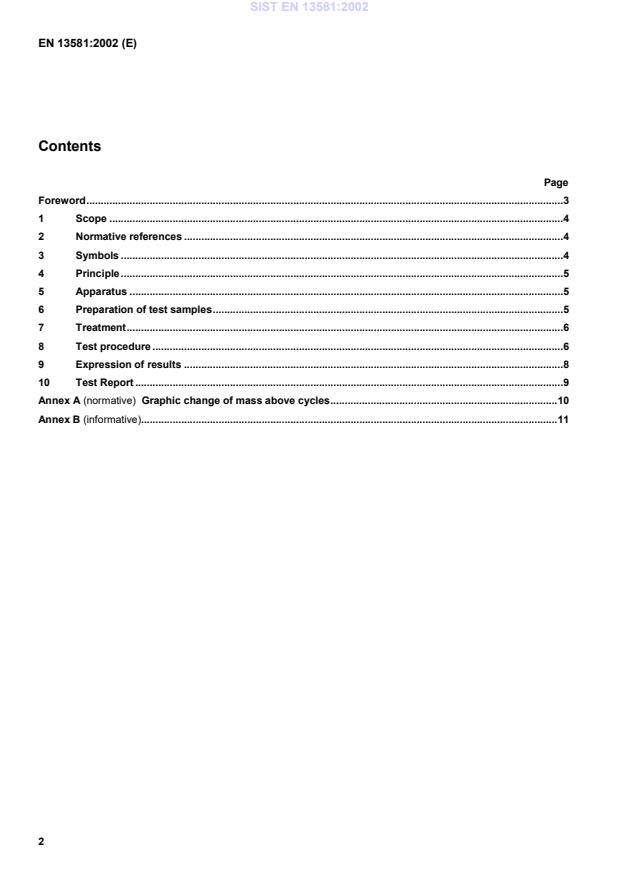
Graphic change of mass above cycles.10Annex B (informative).11SIST EN 13581:2002
...