


kSIST FprEN IEC 63041-1:2025
(Main)Piezoelectric sensors - Part 1: Generic specifications
Piezoelectric sensors - Part 1: Generic specifications
Piezoelektrische Sensoren - Teil 1: Fachgrundspezifikation
Capteurs piézoélectriques - Partie 1: Spécifications génériques
Piezoelektrični senzorji - 1. del: Splošne specifikacije
General Information
Relations
Overview
The kSIST FprEN IEC 63041-1:2025 standard, titled Piezoelectric sensors - Part 1: Generic specifications, issued by the CLC, provides comprehensive generic specifications for piezoelectric sensors. This standard, currently in the Committee Draft for Vote (CDV) stage, aims to establish a uniform basis for evaluating essential parameters, testing methods, and quality requirements across a broad range of piezoelectric sensor types.
As a foundational document, it covers piezoelectric devices used in frequency control, selection, and detection applications with emphasis on resonator and non-acoustic sensor elements. This standard supports industries working with sensor technologies, improving interoperability, consistency, and reliability in sensor design and usage globally.
Key Topics
Sensor Types and Definitions
Detailed classification of piezoelectric sensors including quartz crystal resonators, piezoelectric ceramic resonators, SAW (Surface Acoustic Wave) resonators and delay-line types, non-acoustic sensors, and wireless SAW sensors.Symbols and Conceptual Diagrams
Standardized symbols and diagrams provide clarity in documentation and communication about sensor elements in circuit diagrams and technical documents.Specifications and Performance Requirements
- Frequency ranges and power levels
- Unwanted response characteristics
- Long-term and short-term stability performance
- Enclosure and environmental robustness
- Transmission power criteria for wireless elements
Measurement and Detection Methods
Covers reflection and transmission characteristic measurements, oscillation circuit methods, phase and frequency measurement techniques, and specialized methods for wireless SAW sensors.Quality Assurance and Reliability
Guidelines on test conditions, shipment testing, screening processes, reuse protocols, and validity criteria to ensure sensor performance consistency and longevity.Test Procedures and Environmental Conditions
Detailed test classifications-including mechanical, environmental, and shipment conditions-and recommended standard testing environments to ensure compliance and performance integrity.
Applications
The kSIST FprEN IEC 63041-1:2025 standard is vital for multiple sectors relying on piezoelectric sensors, such as:
- Industrial Automation: Enhancing precise sensing in control systems and machinery monitoring.
- Automotive Industry: Improving sensor reliability for engine management, safety systems, and environmental sensing.
- Consumer Electronics: Standardizing sensor elements for wearable devices, smartphones, and health monitors.
- Medical Devices: Ensuring accuracy and longevity of sensors used in diagnostics and patient monitoring equipment.
- Aerospace and Defense: Supporting rugged sensor applications requiring high reliability under extreme conditions.
- Wireless Sensor Networks: Facilitating specifications for wireless SAW sensors critical in remote and harsh environments.
By following this standard, manufacturers and developers can ensure their piezoelectric sensors meet global quality, reliability, and interoperability expectations.
Related Standards
kSIST FprEN IEC 63041-1:2025 interacts with several other relevant IEC and ISO standards in the field of sensor technology and piezoelectric device testing, including but not limited to:
- IEC 60068 series for environmental testing of electronic equipment
- IEC 61757 series on sensor terminologies and characteristic parameters
- IEC 61131 for programmable controllers interfacing with sensors
- ISO 9001 quality management standards applicable to manufacturing processes for sensor elements
- IEC TC 49 standards covering piezoelectric, dielectric, and electrostatic devices
Adhering to these complementary standards alongside FprEN IEC 63041-1 ensures a comprehensive approach to piezoelectric sensor design, testing, and deployment.
Keywords: piezoelectric sensors, IEC 63041-1, sensor specifications, piezoelectric device standards, sensor measurement methods, SAW sensors, sensor reliability, wireless piezoelectric sensors, sensor testing, industrial sensor standards.
Standards Content (Sample)
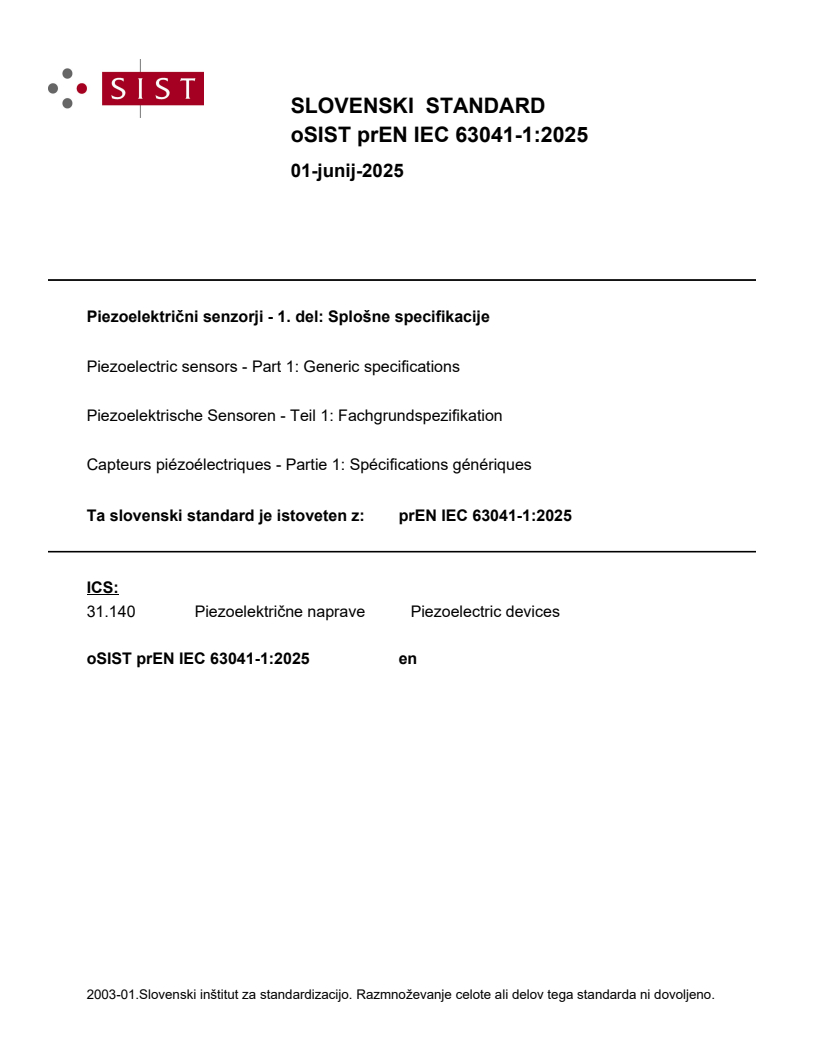
SLOVENSKI STANDARD
oSIST prEN IEC 63041-1:2025
01-junij-2025
Piezoelektrični senzorji - 1. del: Splošne specifikacije
Piezoelectric sensors - Part 1: Generic specifications
Piezoelektrische Sensoren - Teil 1: Fachgrundspezifikation
Capteurs piézoélectriques - Partie 1: Spécifications génériques
Ta slovenski standard je istoveten z: prEN IEC 63041-1:2025
ICS:
31.140 Piezoelektrične naprave Piezoelectric devices
oSIST prEN IEC 63041-1:2025 en
2003-01.Slovenski inštitut za standardizacijo. Razmnoževanje celote ali delov tega standarda ni dovoljeno.
oSIST prEN IEC 63041-1:2025
oSIST prEN IEC 63041-1:2025
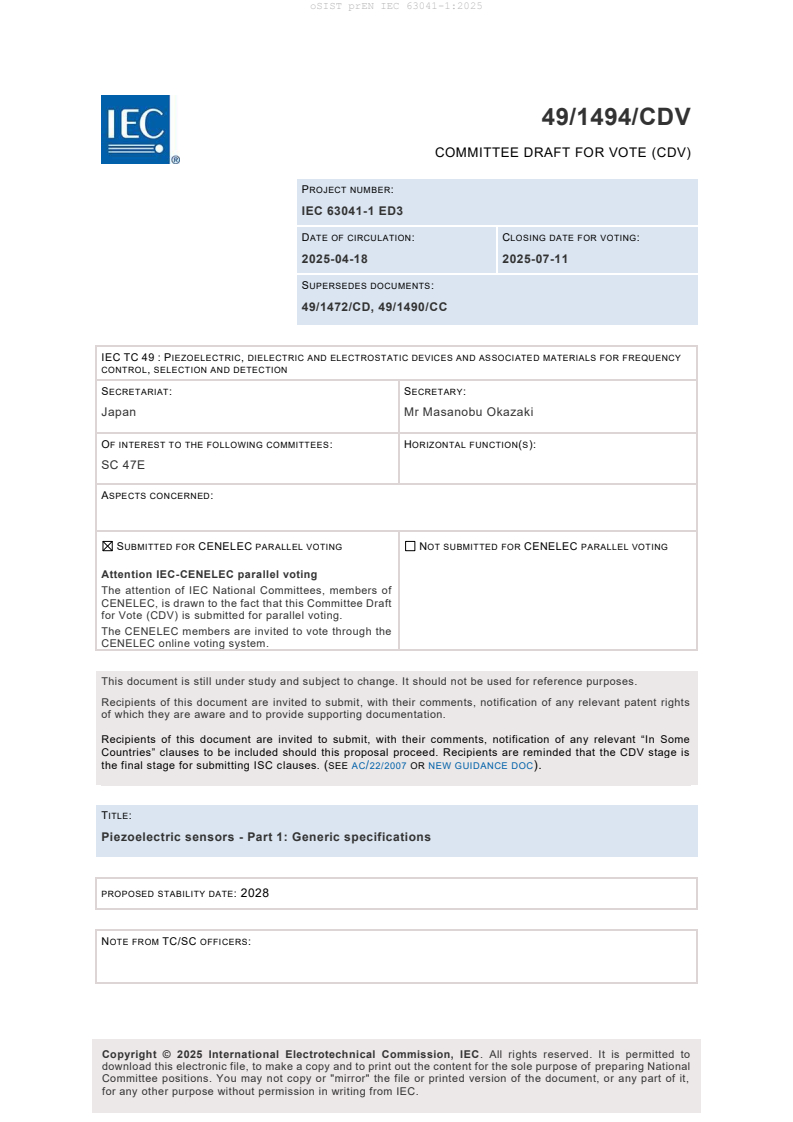
49/1494/CDV
COMMITTEE DRAFT FOR VOTE (CDV)
PROJECT NUMBER:
IEC 63041-1 ED3
DATE OF CIRCULATION: CLOSING DATE FOR VOTING:
2025-04-18 2025-07-11
SUPERSEDES DOCUMENTS:
49/1472/CD, 49/1490/CC
IEC TC 49 : PIEZOELECTRIC, DIELECTRIC AND ELECTROSTATIC DEVICES AND ASSOCIATED MATERIALS FOR FREQUENCY
CONTROL, SELECTION AND DETECTION
SECRETARIAT: SECRETARY:
Japan Mr Masanobu Okazaki
OF INTEREST TO THE FOLLOWING COMMITTEES: HORIZONTAL FUNCTION(S):
SC 47E
ASPECTS CONCERNED:
SUBMITTED FOR CENELEC PARALLEL VOTING NOT SUBMITTED FOR CENELEC PARALLEL VOTING
Attention IEC-CENELEC parallel voting
The attention of IEC National Committees, members of
CENELEC, is drawn to the fact that this Committee Draft
for Vote (CDV) is submitted for parallel voting.
The CENELEC members are invited to vote through the
CENELEC online voting system.
This document is still under study and subject to change. It should not be used for reference purposes.
Recipients of this document are invited to submit, with their comments, notification of any relevant patent rights
of which they are aware and to provide supporting documentation.
Recipients of this document are invited to submit, with their comments, notification of any relevant “In Some
Countries” clauses to be included should this proposal proceed. Recipients are reminded that the CDV stage is
the final stage for submitting ISC clauses. (SEE AC/22/2007 OR NEW GUIDANCE DOC).
TITLE:
Piezoelectric sensors - Part 1: Generic specifications
PROPOSED STABILITY DATE: 2028
NOTE FROM TC/SC OFFICERS:
download this electronic file, to make a copy and to print out the content for the sole purpose of preparing National
Committee positions. You may not copy or "mirror" the file or printed version of the document, or any part of it,
for any other purpose without permission in writing from IEC.
oSIST prEN IEC 63041-1:2025
IEC CDV 63041-1 © IEC 2025 – 2 – 49/1494/CDV
Link to Committee Draft for Vote (CDV) online document*:
https://osd.iec.ch/#/iec/archive/2549726a-a336-7aa5-e063-1410000a55ef/en/CCDV/1
How to access
This link leads you to the Online Standards Development (OSD) platform for National Mirror
Committee’s (NMC) comments. The project draft may be found further down this document.
Resource materials
We recommend NCs to review the available materials to better understand the member commenting
on the OSD platform. This includes the:
• OSD NC roles overview: here
• How to add and submit comments to the IEC: here
Contact
Should you require any assistance, please contact the IEC IT Helpdesk at helpdesk@iec.ch.
oSIST prEN IEC 63041-1:2025
IEC CDV 63041-1 © IEC 2025 – 3 – 49/1494/CDV
CONTENTS
FOREWORD . 6
INTRODUCTION . 8
1 Scope . 9
2 Normative references . 9
3 Terms and definitions . 9
3.1 Piezoelectric sensors . 9
3.2 Types of chemical sensors . 11
3.3 Types of physical sensors . 11
3.4 Types of sensor modules . 12
3.5 Types of sensor systems . 12
4 Symbols of sensor elements . 12
4.1 General . 12
4.2 Symbol for sensor elements of quartz crystal resonator and piezoelectric
ceramic resonator type . 13
4.3 Symbol for sensor elements of SAW resonator type. 13
4.4 Symbol for sensor elements of SAW delay-line type . 14
4.5 Symbol for sensor elements of non-acoustic type . 14
4.6 Symbol for wireless SAW sensor element . 15
4.7 Symbols . 17
5 Specifications . 18
5.1 Sensor elements . 18
5.1.1 General . 18
5.1.2 Sensor elements of resonator and delay-line types. 18
5.1.3 Sensor elements of non-acoustic type . 19
5.2 Frequency ranges . 19
5.3 Level of drive or input power . 19
5.4 Unwanted response . 19
5.5 Analysis of measurements . 19
5.6 Enclosure . 19
5.7 Performance confirmation . 19
5.8 Long-term and short-term stabilities . 20
5.9 Transmission power. 20
6 Measurement and detection methods . 20
7 Delivery conditions . 20
7.1 Marking . 20
7.2 Wrapping . 20
7.3 Packaging . 20
8 Quality and reliability . 20
8.1 Reuse . 20
8.2 Validity of release . 20
8.3 Test procedures . 20
8.4 Screening requirements . 21
8.5 Unchecked parameters . 21
9 Test and measurement procedures . 21
oSIST prEN IEC 63041-1:2025
IEC CDV 63041-1 © IEC 2025 – 4 – 49/1494/CDV
9.1 General . 21
9.1.1 Test classification. 21
9.1.2 Shipping test . 21
9.1.3 Mechanical and environmental test . 21
9.2 Test and measurement conditions . 21
9.2.1 Standard conditions for testing . 21
9.2.2 Equilibrium state . 22
9.2.3 Power supply . 22
9.2.4 Alternative test system . 22
9.2.5 Visual inspection . 22
9.3 Test conditions for shipment . 22
9.3.1 Temperature dependence of frequency, phase, insertion loss/gain,
motional resistance, and electric charge / voltage . 22
9.3.2 Unwanted response . 23
9.3.3 Shunt capacitance . 23
9.3.4 Insulation resistance . 23
Annex A (normative) Measurement methods . 24
A.1 General . 24
A.2 Measurement methods using reflection and transmission characteristics . 24
A.3 Measurement methods using oscillation circuits . 25
A.4 Measurement method of non-acoustic type sensor elements and cells . 26
A.5 Other measurement methods . 27
Annex B (normative) Detection methods . 28
B.1 General . 28
B.2 Detection methods . 28
B.2.1 Frequency difference measurement . 28
B.2.2 Insertion loss/gain measurement . 29
B.2.3 Phase difference measurement . 30
B.2.4 Other detection methods . 30
Annex C (normative) Wireless SAW sensor . 31
C.1 General . 31
C.2 Detection methods . 31
C.2.1 General . 31
C.2.2 Conceptual diagrams of wireless SAW resonator type sensor system . 31
C.2.3 Conceptual diagrams of wireless SAW reflective delay-line type sensor
system . 31
C.2.4 Conceptual diagrams of wireless SAW transmission delay-line type
sensor system . 32
C.2.5 Key points of detection mechanism . 32
C.2.6 Technical documents. 32
Bibliography . 34
Figure 1 – Conceptual diagrams for sensor elements of quartz crystal resonator and
piezoelectric ceramic resonator type. 13
Figure 2 – Symbol for sensor elements of quartz crystal resonator and piezoelectric
ceramic resonator type . 13
Figure 3 – Conceptual diagram of sensor elements of SAW resonator type . 13
Figure 4 – Symbol for sensor elements of SAW resonator type . 14
oSIST prEN IEC 63041-1:2025
IEC CDV 63041-1 © IEC 2025 – 5 – 49/1494/CDV
Figure 5 – Conceptual diagram for sensor elements of SAW delay-line type . 14
Figure 6 – Symbol for sensor elements of SAW delay-line type . 14
Figure 7 – Conceptual diagrams for sensor elements of non-acoustic type . 14
Figure 8 – Symbol for sensor elements of non-acoustic type . 15
Figure 9 – Conceptual diagram for basic sensor elements of wireless SAW resonator
type 15
Figure 10 – Symbol for basic sensor elements of wireless SAW resonator type . 15
Figure 11 – Conceptual diagram for basic sensor elements of wireless SAW reflective
delay-line type . 16
Figure 12 – Symbol for basic sensor elements of wireless SAW reflective delay‑line
type 16
Figure 13 – Conceptual diagram for basic sensor elements of wireless SAW
transmission delay‑line type [7] . 17
Figure 14 – Symbol for basic sensor elements of wireless SAW transmission delay‑line
type [7] . 17
Figure A.1 – Measurement method using reflection characteristics of
quartz crystal resonator and piezoelectric ceramic resonator type sensor elements
and cells . 24
Figure A.2 – Measurement method using reflection characteristics of SAW resonator
type sensor elements and cells . 24
Figure A.3 – Measurement method using transmission characteristics of SAW delay-
line type sensor elements and cells . 25
Figure A.4 – Measurement method using oscillation circuit consisting of
quartz crystal resonator and piezoelectric ceramic resonator type sensor elements
and cells . 25
Figure A.5 – Measurement method using oscillation circuit consisting of SAW
resonator type sensor elements and cells . 26
Figure A.6 – Measurement method using oscillation circuit consisting of SAW delay-
line type sensor elements and cells . 26
Figure A.7 – Measurement method using amplifier consisting of non-acoustic type
sensor elements and cells . 27
Figure B.1 – Measurement of frequency difference using two oscillation circuits . 28
Figure B.2 – Measurement of frequency difference using an oscillation circuit and
frequency synthesizer . 29
Figure B.3 – Conceptual diagram of piezoelectric dual mode sensor module . 29
Figure B.4 – Measurement of insertion loss/gain difference using two oscillation
circuits . 30
Figure B.5 – Measurement of phase difference using signal generator and phase
detector . 30
Figure C.1 – Fundamental measurement system of wireless SAW resonator type
sensor . 31
Figure C.2 – Fundamental measurement system of wireless SAW reflective delay-line
type sensor . 32
Figure C.3 – Fundamental measurement system of wireless SAW transmission
delay‑line type [7] . 32
oSIST prEN IEC 63041-1:2025
IEC CDV 63041-1 © IEC 2025 – 6 – 49/1494/CDV
INTERNATIONAL ELECTROTECHNICAL COMMISSION
____________
Piezoelectric sensors - Part 1: Generic specifications –
FOREWORD
1) The International Electrotechnical Commission (IEC) is a worldwide organization for
standardization comprising all national electrotechnical committees (IEC National
Committees). The object of IEC is to promote international co-operation on all questions
concerning standardization in the electrical and electronic fields. To this end and in addition to
other activities, IEC publishes International Standards, Technical Specifications, Technical
Reports, Publicly Available Specifications (PAS) and Guides (hereafter referred to as “IEC
Publication(s)”). Their preparation is entrusted to technical committees; any IEC National
Committee interested in the subject dealt with may participate in this preparatory work.
International, governmental and non-governmental organizations liaising with the IEC also
participate in this preparation. IEC collaborates closely with the International Organization for
Standardization (ISO) in accordance with conditions determined by agreement between the
two organizations.
2) The formal decisions or agreements of IEC on technical matters express, as nearly as
possible, an international consensus of opinion on the relevant subjects since each technical
committee has representation from all interested IEC National Committees.
3) IEC Publications have the form of recommendations for international use and are accepted
by IEC National Committees in that sense. While all reasonable efforts are made to ensure that
the technical content of IEC Publications is accurate, IEC cannot be held responsible for the
way in which they are used or for any misinterpretation by any end user.
4) In order to promote international uniformity, IEC National Committees undertake to apply
IEC Publications transparently to the maximum extent possible in their national and regional
publications. Any divergence between any IEC Publication and the corresponding national or
regional publication shall be clearly indicated in the latter.
5) IEC itself does not provide any attestation of conformity. Independent certification bodies
provide conformity assessment services and, in some areas, access to IEC marks of
conformity. IEC is not responsible for any services carried out by independent certification
bodies.
6) All users should ensure that they have the latest edition of this publication.
7) No liability shall attach to IEC or its directors, employees, servants or agents including
individual experts and members of its technical committees and IEC National Committees for
any personal injury, property damage or other damage of any nature whatsoever, whether
direct or indirect, or for costs (including legal fees) and expenses arising out of the publication,
use of, or reliance upon, this IEC Publication or any other IEC Publications.
8) Attention is drawn to the Normative references cited in this publication. Use of the
referenced publications is indispensable for the correct application of this publication.
9) IEC draws attention to the possibility that the implementation of this document may involve
the use of (a) patent(s). IEC takes no position concerning the evidence, validity or applicability
of any claimed patent rights in respect thereof. As of the date of publication of this document,
IEC [had/had not] received notice of (a) patent(s), which may be required to implement this
document. However, implementers are cautioned that this may not represent the latest
information, which may be obtained from the patent database available at
https://patents.iec.ch. IEC shall not be held responsible for identifying any or all such patent
rights.
oSIST prEN IEC 63041-1:2025
IEC CDV 63041-1 © IEC 2025 – 7 – 49/1494/CDV
IEC 63041–1 has been prepared by subcommittee 13: Sensor devices and systems, of IEC
technical committee 49: Piezoelectric, dielectric and electrostatic devices and associated
materials for frequency control, selection and detection. It is an International Standard.
The third edition cancels and replaces the second edition published 2020. This edition
constitutes a technical revision.
This edition includes the following significant technical changes with respect to the previous
edition:
a) The term “SOURCE” of the definition has been added based on IEC TS 61994-5:2023;
b) 3.1.4 quasi-static piezoelectric sensor element has been added.
The text of this International Standard is based on the following documents:
Draft Report on voting
49/XX/FDIS 49/XX/RVD
Full information on the voting for its approval can be found in the report on voting indicated in
the above table.
The language used for the development of this International Standard is English.
This document was drafted in accordance with ISO/IEC Directives, Part 2, and developed in
accordance with ISO/IEC Directives, Part 1 and ISO/IEC Directives, IEC Supplement, available
at www.iec.ch/members_experts/refdocs. The main document types developed by IEC are
described in greater detail at www.iec.ch/standardsdev/publications.
A list of all parts in the IEC 63041 series, published under the general title Piezoelectric
sensors, can be found on the IEC website.
The committee has decided that the contents of this document will remain unchanged until the
stability date indicated on the IEC website under webstore.iec.ch in the data related to the
specific document. At this date, the document will be
– reconfirmed,
– withdrawn, or
– revised.
oSIST prEN IEC 63041-1:2025
IEC CDV 63041-1 © IEC 2025 – 8 – 49/1494/CDV
INTRODUCTION
Further reading:
IEC 60068 (all parts), Environmental testing
IEC 60642, Piezoelectric ceramic resonators and resonator units for frequency control and
selection – Chapter I: Standard values and conditions – Chapter II: Measuring and test
conditions
IEC 60679 (all parts), Piezoelectric, dielectric and electrostatic oscillators of assessed quality
IEC 60689, Measurements and test methods for tuning fork quartz crystal units in the range
from 10 kHz to 200 kHz and standard values
IEC 60758:2016, Synthetic quartz crystal – Specifications and guidelines for use
IEC 61240:2016, Piezoelectric devices – Preparation of outline drawings of surface-mounted
devices (SMD) for frequency control and selection – General rules
IEC 61760 (all parts), Surface mounting technology
IEC 61837 (all parts), Surface mounted piezoelectric devices for frequency control and
selection – Standard outlines and terminal lead connections
IEC TS 61994 (all parts), Piezoelectric and dielectric devices for frequency control and
selection – Glossary
IEC 62276:2016, Single crystal wafers for surface acoustic wave (SAW) device applications –
Specifications and measuring methods
IEC 63041-2, Piezoelectric sensors – Part 2: Chemical and biochemical sensors
A. Benjaminson and S. Stallings, A Microcomputer-Compensated Crystal Oscillator Using Dual-
Mode Resonator, Proc. 43rd Annual Symposium on Frequency Control, pp. 20-26, 1989.
J. R. Vig, Dual-mode Oscillators for Clocks and Sensors, Proc. 1999 IEEE International
Ultrasonics Symposium
N. Matsumoto, Y. Sudo, B. Sinha and M. Niwa, Long-term stability and performance
characteristics of crystal gauge at high pressures and temperatures, Proc. 1999 IEEE
International Frequency Control Symposium
oSIST prEN IEC 63041-1:2025
IEC CDV 63041-1 © IEC 2025 – 9 – 49/1494/CDV
Piezoelectric sensors - Part 1: Generic specifications –
1 Scope
This part of IEC 63041 applies to piezoelectric sensors of resonator, delay-line and non-
acoustic types, which are used in physical and engineering sciences, chemistry and
biochemistry, medical and environmental sciences, etc.
The purpose of this document is to specify the terms and definitions for piezoelectric sensors,
and to make sure from a technological perspective that users understand the state -of-art
piezoelectric sensors and how to use them correctly.
2 Normative references
The following documents are referred to in the text in such a way that some or all of their
content constitutes requirements of this document. For dated references, only the edition cited
applies. For undated references, the latest edition of the referenced document (including any
amendments) applies.
IEC 60050–561, International Electrotechnical Vocabulary – Part 561: Piezoelectric, dielectric
and electrostatic devices and associated materials for frequency control, selection and
detection
IEC 60122–2–1, Quartz crystal units for frequency control and selection – Part 2: Guide to the
use of quartz crystal units for frequency control and selection – Section One: Quartz crystals
for microprocessor clock supply
IEC 60444–9, Measurement of quartz crystal unit parameters – Part 9: Measurement of
spurious resonances of piezoelectric crystal units
IEC 60617, Graphical symbols for diagrams, available at https://std.iec.ch/iec60617
ISO 2859–1:1999, Sampling procedures for inspection by attributes – Part 1: Sampling
schemes indexed by acceptance quality limit (AQL) for lot-by-lot inspection
ISO 80000–1, Quantities and units – Part 1: General
IEC 63041–3,Piezoelectric sensors – Part 3: Physical sensors
3 Terms and definitions
For the purposes of this document, the terms and definitions given in IEC 60027, IEC 60050–
561, IEC 60617, ISO 80000–1 and the following apply.
ISO and IEC maintain terminological databases for use in standardization at the following
addresses:
• IEC Electropedia: available at https://www.electropedia.org/
• ISO Online browsing platform: available at https://www.iso.org/obp
NOTE Piezoelectric sensors covered herein are those used for the detection and measurement of physical
quantities, chemical substances or biological molecules.
3.1 Piezoelectric sensors
3.1.1
piezoelectric sensor element
electronic component which is able to detect physical quantities as a change in its frequency,
phase, delay, electrical charge, resistance, Q-value, bandwidth, etc.
oSIST prEN IEC 63041-1:2025
IEC CDV 63041-1 © IEC 2025 – 10 – 49/1494/CDV
Note 1 to entry: For chemical and biochemical sensor applications, the piezoelectric sensor element includes a
sensitive or receptive layer (target recognition material).
3.1.2
resonator type sensor element
piezoelectric sensor component using acoustic resonances
[SOURCE: IEC TS 61994-5:2023, 3.26]
3.1.3
delay-line type sensor element
piezoelectric sensor component using a delay-line of surface acoustic wave (SAW) transversal
filter type
[SOURCE: IEC TS 61994-5:2023, 3.1]
3.1.4
quasi-static piezoelectric sensor element
piezoelectric sensor component using the electrical charge induced by a quasi-static force,
torque
Note 1 to entry: Here, the term, "non-acoustic", represents "quasi-static piezoelectric". Accordingly, the
(piezoelectric) non-acoustic type sensor element means a sensor element using the quasi-static piezoelectric effect.
[SOURCE: IEC TS 61994-5:2023, 3.25]
3.1.5
3.1.6
piezoelectric sensor cell
piezoelectric sensor element equipped with necessary mechanical accessories and
attachments to correctly detect the parameters to be measured
[SOURCE: IEC TS 61994-5:2023, 3.15]
3.1.7
piezoelectric sensor module
sensor element or cell equipped with electronic accessories for interfacing to external data
acquisitions
[SOURCE: IEC TS 61994-5:2023, 3.17]
3.1.8
piezoelectric sensor system
organized system including detection, amplification of detected value, communication with
other equipment and analysis of detected value
Note 1 to entry: Here, these functions cooperate mutually.
[SOURCE: IEC TS 61994-5:2023, 3.18]
3.1.9
piezoelectric sensor
generic term that includes a sensor element, cell, module and system
[SOURCE: IEC TS 61994-5:2023, 3.14]
3.1.10
QCM
quartz crystal microbalance
piezoelectric sensor element for detecting small mass change using quartz crystal resonators
Note 1 to entry: A thickness shear mode (TSM) sensor is identical with a QCM.
oSIST prEN IEC 63041-1:2025
IEC CDV 63041-1 © IEC 2025 – 11 – 49/1494/CDV
Note 2 to entry: Some sensor elements include asymmetric electrode type film-thickness sensors, in which the
areas of the front and back electrodes are different. This specification should be clearly defined by the contract
specifications or individual specifications concluded between the manufacturer and the customer.
[SOURCE: IEC TS 61994-5:2023, 3.24]
3.2 Types of chemical sensors
3.2.1
piezoelectric chemical sensor element
piezoelectric sensor component including a sensitive layer (target recognition material), which
is necessary for the practical measurement of simple non-biological molecules in quantity, and
which works and detects chemical substances mainly in the gas phase
Note 1 to entry: The sensitive layer is usually formed as a thin film of a target recognition material on the surface
of the piezoelectric sensor element and is often called a target recognition material.
Note 2 to entry: A gas sensor element is one of the chemical sensor elements.
[SOURCE: IEC TS 61994-5:2023, 3.9]
3.2.2
piezoelectric biochemical sensor element
piezoelectric sensor component including a receptive layer (target recognition material), which
is necessary for the practical measurement of complex biological molecules in quantity, and
which works mainly in aqueous media and detects biomolecules therein
Note 1 to entry: The receptive layer is usually formed as a thin film of a target recognition material on the surface
of the piezoelectric sensor element and is often called a target recognition material.
[SOURCE: IEC TS 61994-5:2023, 3.8]
3.3 Types of physical sensors
3.3.1
piezoelectric force sensor element
p
...
Frequently Asked Questions
kSIST FprEN IEC 63041-1:2025 is a draft published by the Slovenian Institute for Standardization (SIST). Its full title is "Piezoelectric sensors - Part 1: Generic specifications". This standard covers: Piezoelectric sensors - Part 1: Generic specifications
Piezoelectric sensors - Part 1: Generic specifications
kSIST FprEN IEC 63041-1:2025 is classified under the following ICS (International Classification for Standards) categories: 31.140 - Piezoelectric devices. The ICS classification helps identify the subject area and facilitates finding related standards.
kSIST FprEN IEC 63041-1:2025 has the following relationships with other standards: It is inter standard links to SIST EN IEC 63041-1:2022. Understanding these relationships helps ensure you are using the most current and applicable version of the standard.
You can purchase kSIST FprEN IEC 63041-1:2025 directly from iTeh Standards. The document is available in PDF format and is delivered instantly after payment. Add the standard to your cart and complete the secure checkout process. iTeh Standards is an authorized distributor of SIST standards.
Questions, Comments and Discussion
Ask us and Technical Secretary will try to provide an answer. You can facilitate discussion about the standard in here.
Loading comments...