SIST CECC 200 008:2002
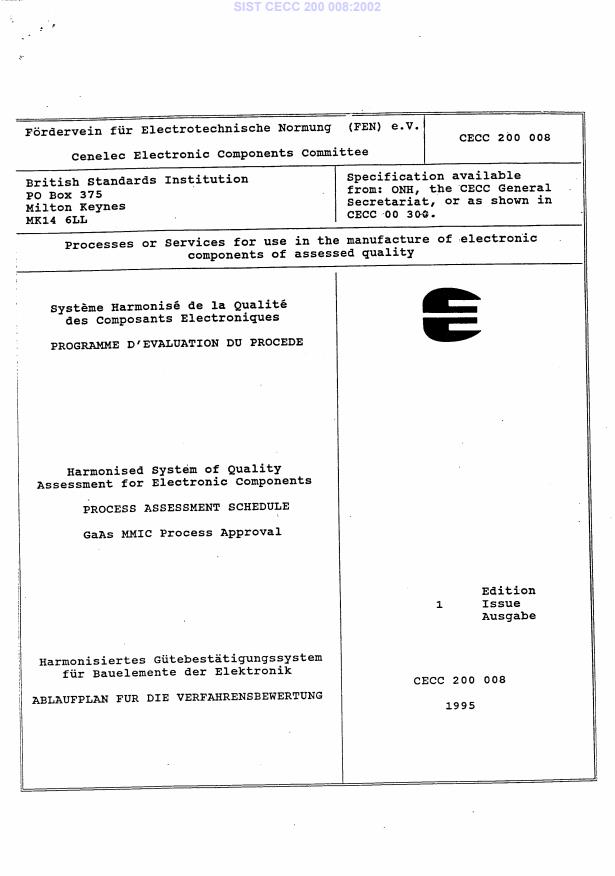
(Main)Process Assessment Schedule: GaAs MMIC process approval
Process Assessment Schedule: GaAs MMIC process approval
D97/081: CECC/SC 52 disbanded
Process Assessment Schedule: GaAs MMIC process approval
General Information
Standards Content (Sample)
2003-01.Slovenski inštitut za standardizacijo. Razmnoževanje celote ali delov tega standarda ni dovoljeno.Process Assessment Schedule: GaAs MMIC process approvalProcess Assessment Schedule: GaAs MMIC process approval31.020Elektronske komponente na splošnoElectronic components in generalICS:Ta slovenski standard je istoveten z:CECC 200 008:1995SIST CECC 200 008:2002en01-maj-2002SIST CECC 200 008:2002SLOVENSKI
STANDARD
SIST CECC 200 008:2
...
This May Also Interest You
IEC 63366:2025 defines product category rules (PCR) for electrical and electronic products and systems (EEPS) to develop Type III environmental declarations for electrical and electronic products and systems (EEPS). It specifies the process and requirements on how to conduct life cycle assessment (LCA) in the context of environmental declarations.
This document provides common rules for:
a) LCA, including the requirements for developing default scenarios;
b) the LCA report;
c) the development of PSR.
This document provides further guidelines for environmental declarations.
The LCA principles and framework are based on ISO 14040 and ISO 14044, and are therefore out of scope of this document.
PCR is complemented by additional product-specific rules (PSR), which further define, for example, functional units and default scenarios in the product-specific context. Therefore, this document also provides guidance on how to develop PSR in corresponding technical committees.
This document has the status of a horizontal publication in accordance with IEC Guide 108. In accordance with IEC Guide 108, this generic essential horizontal standard is intended for use by product committees as a starting point in preparing PSR standards. Specific requirements developed by product committees in PSR standard take precedence over requirements in this standard.
When there is no PSR available in a product committee, this generic essential horizontal standard could be applied by LCA practitioners with recorded complementary specifications.
- Standard60 pagesEnglish languagesale 10% offe-Library read for×1 day
IEC 62321-12:2023 specifies a reference test method for the simultaneous determination of polybrominated biphenyls, polybrominated diphenyl ethers, and four phthalates: di-isobutyl phthalate (DIBP), di-n-butyl phthalate (DBP), benzylbutyl phthalate (BBP), di-(2-ethylhexyl) phthalate (DEHP) in polymers of electrotechnical products.
The extraction technique described in this document is the ultrasonic-assisted extraction used for simultaneous extraction for sample preparation.
Gas chromatography-mass spectrometry (GC-MS) is considered as the reference technique for the measurement of the simultaneous determination of analytes in the range of 25 mg/kg to 2 000 mg/kg.
The test method using ultrasonic-assisted extraction followed by GC-MS detection has been evaluated by the tests of polypropylene (PP), polyvinylchloride (PVC), acrylonitrile butadiene styrene (ABS), acrylate rubber (ACM), polystyrene (PS), polyurethane (PU) and polyethylene (PE) materials.
This document has the status of a horizontal publication in accordance with IEC Guide 108.
- Standard40 pagesEnglish languagesale 10% offe-Library read for×1 day
This part of IEC 62321 specifies two different techniques for the determination of TCEP tris(2-chloroethyl) phosphate (TCEP) in plastics, the GC-MS or LC-MS method; both of which are suitable for quantitative analysis.
These two techniques have been evaluated for use with polyurethane, Polyvinyl chloride and polyethylene materials containing TCEP between 200 mg/kg to 2 000 mg/kg. Use of the methods escribed in International Standard for other polymers and concentration ranges has not been specifically evaluated.
These test methods do not apply to plastics materials having a processing temperature higher than 230 ℃.
NOTE TCEP starts thermal decomposition at approximately 230 ℃. Polymer types which have a processing temperature into shapes of plastics (e.g. pellets, moulded parts, or sheets etc.) not exceeding the decomposition temperature can contain TCEP.
Py-TD-GC-MS is another technique, suitable for the screening of TCEP in plastics (See Annex A).
- Standard39 pagesEnglish languagesale 10% offe-Library read for×1 day
IEC 62321-3-4:2023 specifies procedures for the screening of di-isobutyl phthalate (DIBP), di-n-butyl phthalate (DBP), benzyl butyl phthalate (BBP), di-(2-ethylhexyl) phthalate (DEHP) in polymers of electrotechnical products by using high performance liquid chromatography with ultraviolet detector (HPLC-UV), thin layer chromatography (TLC) and thermal desorption mass spectrometry (TD-MS).
High performance liquid chromatography with ultraviolet detector (HPLC-UV), thin layer chromatography (TLC) and thermal desorption mass spectrometry (TD-MS) techniques are described in the normative part of this document. Fourier transform infrared spectroscopy (FT-IR) is described in the informative annexes of this document.
- Standard55 pagesEnglish languagesale 10% offe-Library read for×1 day
This document specifies a marking
— of electrical and electronic equipment (EEE) with a view to minimizing the disposal of waste EEE (WEEE) as unsorted waste and to facilitating its separate collection.
NOTE 1 This is in accordance with Article 14(4) of Directive 2012/19/EU (WEEE, recast)
— that serves to clearly identify the producer of the equipment and
— that the equipment has been put on the market after 13 August 2005.
NOTE 2 This is in accordance with Articles 12(3) and 15(2) of Directive 2012/19/EU (WEEE, recast)
— that applies to categories of electrical and electronic equipment subject to WEEE collection, treatment, recovery and environmentally sound disposal as defined by European and national regulations, provided the equipment concerned is not part of another type of equipment that does not fall within the scope of above mentioned regulations.
NOTE 3 This is in accordance with Article 2 and Annexes I – IV of Directive 2012/19/EU (WEEE, recast) [1]
The definition of a technical carrier medium for machine based identifying the producer, such as a barcode, electronic data medium or microchip, is not covered by this document.
- Standard10 pagesEnglish languagesale 10% offe-Library read for×1 day
This part of IEC 62321 provides strategies of sampling along with the mechanical preparation of samples from electrotechnical products. These samples can be used for analytical testing to determine the levels of certain substances as described in the test methods in other parts of the IEC 62321 series. Restrictions for substances will vary between geographic regions and can be updated on a regular basis. This document describes a generic process for obtaining and preparing samples prior to the determination of any substance of concern.
This document does not provide:
- full guidance on each and every product that could be classified as electrotechnical product. Since there is a huge variety of electrotechnical parts, with various structures and compositions, along with the continuous innovations in the industry, it is unrealistic to attempt to provide procedures for the disjointment of every type of part;
- guidance regarding other routes to gather additional information on certain substances in a product, although the information collected has relevance to the sampling strategies in this document;
- safe disassembly and mechanical disjointment instructions related to electrotechnical products (e.g. mercury-containing switches) and the recycling industry (e.g. how to handle CRTs or the safe removal of batteries). See IEC 62554 [1] 1 for the disjointment and mechanical sample preparation of mercury-containing fluorescent lamps;
- sampling procedures for packaging and packaging materials;
- analytical procedures to measure the levels of certain substances. This is covered by other standards (e.g. other parts of the IEC 62321 series), which are referred to as "test standards" in this document;
- guidelines for assessment of compliance.
This document has the status of a horizontal standard in accordance with IEC Guide 108 [2].
- Standard54 pagesEnglish languagesale 10% offe-Library read for×1 day
- 07-Dec-2021
- 29.020
- 31.020
- 71.040.50
- 2011/65/EU
- ITIV
This part of IEC 62321 specifies the screening analysis of polybrominated biphenyls (PBBs), polybrominated diphenyl ethers (PBDEs), di-isobutyl phthalate (DIBP), di-n-butyl phthalate (DBP), benzylbutyl phthalate (BBP), di-(2-ethylhexyl) phthalate (DEHP), di-n-octyl phthalate (DNOP), di-isononyl phthalate (DINP), and di-isodecyl phthalate (DIDP) in polymers of electrotechnical products using the analytical technique of gas chromatography-mass spectrometry using a pyrolyser/thermal desorption accessory (Py/TD-GC-MS).
This test method has been evaluated through the analysis of PP (polypropylene), PS (polystyrene), and PVC (polyvinyl chloride) materials containing deca-BDE between 100 mg/kg and 1 000 mg/kg and individual phthalates between 100 mg/kg to 4 000 mg/kg as depicted in Annex J. Use of the methods described in this document for other polymer types, PBBs (mono-deca), PBDEs (mono-deca) and phthalates or concentration ranges other than those specified above has not been specifically evaluated.
This document has the status of a horizontal standard in accordance with IEC Guide 108 [1]1.
- Standard45 pagesEnglish languagesale 10% offe-Library read for×1 day
This part of IEC 62321 specifies two techniques for the determination of hexabromocyclododecane (HBCDD) in polymers of electrotechnical products.
The gas chromatography-mass spectrometry (GC-MS) test method is described in the normative part of this document. The GC-MS method is suitable for the determination of hexabromocyclododecane (HBCDD).
A method using high-pressure liquid chromatography-mass spectrometry (HPLC-MS) is given in informative Annex A.
These test methods have been evaluated for use with EPS (expanded polystyrene foam), XPS (extruded polystyrene foam) and ABS (acrylonitrile butadiene styrene) within the concentration ranges as specified in Table 1. The use of this method for other types of materials or concentration ranges outside those specified below has not been evaluated.
[Table 1]
This document has the status of a horizontal standard in accordance with IEC Guide 108.
- Standard34 pagesEnglish languagesale 10% offe-Library read for×1 day
This International Standard describes the transportation and storage conditions for surface mounting devices (SMDs) that are fulfilled in order to enable trouble-free processing of surface mounting devices, both active and passive. (Conditions for printed boards are not taken into consideration.)
The object of this standard is to ensure that users of SMDs receive and store products tha can be further processed (e.g. positioned, soldered) without prejudice to quality and reliability. Improper transportation and storage of SMDs may cause deterioration and result in assembly problems such as poor solderability, delamination and "popcorning".
- Standard18 pagesEnglish languagesale 10% offe-Library read for×1 day
IEC 62430:2019 describes principles, specifies requirements and provides guidance for organizations intending to integrate environmental aspects into the design and development in order to minimize the adverse environmental impacts of their products.
This document applies to processes on how ECD (environmentally conscious design) are integrated into the design and development. This document applies to any organization, regardless of its size, type or sector.
This document does not provide requirements for assessing the conformity of individual products.
This horizontal standard is primarily intended for use by technical committees in the preparation of standards in accordance with the principles laid down in IEC Guide 108.
One of the responsibilities of a technical committee is, wherever applicable, to make use of horizontal standards in the preparation of its publications. The contents of this horizontal standard will not apply unless specifically referred to or included in the relevant publications.
IEC 62430:2019 cancels and replaces the first edition published in 2009. This edition constitutes a technical revision.
This edition includes the following significant technical changes with respect to the previous edition:
a) Scope is extended from electrotechnical product and systems to all products including services.
b) As a consequence of the scope expansion, non-electrotechnical products, services in particular, are taken into account to modify requirements.
c) Clause 6 is added as a guidance.
- Standard32 pagesEnglish languagesale 10% offe-Library read for×1 day


Questions, Comments and Discussion
Ask us and Technical Secretary will try to provide an answer. You can facilitate discussion about the standard in here.
Loading comments...